-
Enclosure to: NSAD-L-2010-144 JHS01
NSAD-R-2010-043
Live-Virtual-Constructive Architecture
Roadmap Implementation, Common
Capabilities - Common Data Storage
Formats Implementation Plan
Technical Report
NSAD-R-2010-043
Live-Virtual-Constructive Architecture
Roadmap Implementation, Common
Capabilities - Common Data Storage
Formats Implementation Plan
Technical Report
May 2010
FOR:
Joint Training Integration and Evaluation Center 12000 Research Parkway, Suite 300
Orlando, FL 32826
BY:
Johns Hopkins University - Applied Physics Laboratory 11100 Johns Hopkins Road
LVC Common Capabilities: Common Data Storage Formats Implementation Plan
JHU/APL Team
Title Name Organization Team Lead Dr. Katherine L. Morse JHU/APL Program Manager Dr. James Coolahan JHU/APL
Team SME Ryan Brunton JHU/APL
Team SME Terri Morgan JHU/APL
Team SME Bill Riggs JHU/APL
LVC Common Capabilities: Common Data Storage Formats Implementation Plan
LVC Common Capabilities: Common Data Storage Formats Implementation Plan
TABLE OF CONTENTS
EXECUTIVE SUMMARY ... ES-1 1 INTRODUCTION ... 1-1 1.1 GOALS AND OBJECTIVES ... 1-1 1.2 BACKGROUND ... 1-1 1.2.1 History of DoD Data Standardization ... 1-1 1.2.2 M&S Data Standardization Challenge – Multiple Representations ... 1-3 1.2.3 Standards Stewardship and the M&S Community ... 1-3 1.2.4 Common Patterns for Solving Data Interoperability Problems
with Standards ... 1-4 1.2.5 Base State: Multiple Producer and Consumer Formats, without Mediation .... 1-4 1.2.6 Fully Converged: Single Data Format ... 1-5 1.2.7 Partially Converged: Mediation Format(s) Exist ... 1-6 1.3 SCOPE ... 1-7 1.4 METHODOLOGY ... 1-8 2 CURRENT STATE AND FEASIBILITY ASSESSMENT ... 2-1 2.1 GEOSPATIAL DATA ... 2-2 2.2 MANMADE ENVIRONMENTAL FEATURES... 2-6 2.3 UNIT ORDER OF BATTLE/FORCE STRUCTURE ... 2-9 2.4 ELECTRONIC ORDER OF BATTLE/NETWORK... 2-12 2.5 PLATFORM/WEAPONS PERFORMANCE AND/OR CHARACTERISTICS ... 2-14 2.6 PLANS/SCENARIOS ... 2-15 2.7 BEHAVIOR ... 2-18 2.8 LOGISTICS ... 2-21 2.9 EVENT RESULTS ... 2-22 3 IMPLEMENTATION PLAN ... 3-1 3.1 QUESTIONNAIRE RESPONSES ... 3-1 3.1.1 What and How to Standardize ... 3-1 3.1.2 Priorities Based on Community Input... 3-2 3.2 FEASIBILITY AND PRIORITIES ... 3-4 3.3 STRATEGIES FOR EACH FORMAT CATEGORY ... 3-7 APPENDIX A: REFERENCES ... A-1 APPENDIX B: CURRENT STATE ... B-1 APPENDIX C: QUESTIONNAIRE RESULTS ... C-1 APPENDIX D: COI COORDINATION MATRIX ... D-1 APPENDIX E: NAMESPACE COORDINATION MATRIX ... E-1 APPENDIX F: ANALYSIS OF NEED AND DIFFICULTY ... F-1 APPENDIX G: ABBREVIATIONS AND ACRONYMS ... G-1
LVC Common Capabilities: Common Data Storage Formats Implementation Plan
LIST OF FIGURES
Figure 1-1: Base State: Multiple Producer and Consumer Formats, without Mediation ... 1-5 Figure 1-2: Fully Converged: Single Data Format ... 1-6 Figure 1-3: Partially Converged: Mediation Format(S) Exist ... 1-7 Figure 3-1: “Level” at which to Standardize Data Formats ... 3-1 Figure 3-2: How/Where to Standardize Data Formats ... 3-2 Figure 3-3: Recommendations Graph ... 3-4 Figure C-1: Participants Organization Type ... C-9 Figure F-1: Needs and Difficulty Plot... F-3
LVC Common Capabilities: Common Data Storage Formats Implementation Plan
LIST OF TABLES
Table ES-1: Implementation Plans ... ES-2 Table 2-1: Geospatial Data Summary ... 2-5 Table 2-2: Manmade Environmental Features Summary ... 2-8 Table 2-3: UOB Summary... 2-11 Table 2-4: EOB Summary ... 2-13 Table 2-5: C&P Data Summary ... 2-15 Table 2-6: Plans/Scenarios Summary ... 2-17 Table 2-7: Behavior Summary ... 2-20 Table 2-8: Logistics Summary ... 2-22 Table 2-9: Event Results Summary ... 2-24 Table 3-1: Questionnaire Results ... 3-3 Table 3-2: Difficulty Summary ... 3-5 Table B-1: Synthetic Natural Environment Formats ... B-3 Table B-2: Manmade Environmental Feature Formats ... B-17 Table B-3: Unit Order Of Battle/Force Structure Formats ... B-21 Table B-4: Electronic Order Of Battle/Network Formats ... B-24 Table B-5: Platform/Weapons Performance and/or Characteristics Formats ... B-27 Table B-6: Plans/Scenario Formats ... B-29 Table B-7: Behavior Formats ... B-36 Table B-8: Logistics ... B-37 Table B-9: Event Results ... B-39 Table C-1: Participant Roles ... C-10 Table C-2: Reusable Tools and Common Data Storage Formats ... C-11 Table C-3: Geospatial Data ... C-12 Table C-4: Manmade Environmental Features: ... C-13 Table C-5: Unit Order Of Battle Data ... C-14 Table C-6: Electronic Order Of Battle/Network ... C-15 Table C-7: Weapons Performance and Characteristic Data ... C-16 Table C-8: Plans And Scenario Data ... C-17 Table C-9: Behavior Data ... C-18 Table C-10: Logistics Data ... C-19 Table C-11: Event Results Data ... C-20 Table C-12: Data Standardization ... C-21 Table C-13: Data Formats Used ... C-22 Table C-14: Organizations Responsible for Data Standardization ... C-24 Table D-1: GIG COI Coordination Cross-Reference Matrix ... D-1 Table F-1: Detailed Need and Difficulty Calculation ... F-1
LVC Common Capabilities: Common Data Storage Formats Implementation Plan
LVC Common Capabilities: Common Data Storage Formats Implementation Plan EXECUTIVE SUMMARY
The Live-Virtual-Constructive Architecture Roadmap (LVCAR) report recommended actions to promote the sharing of tools, data, and information across the Enterprise and to foster common formats and policy goals to promote interoperability and the use of common Modeling and Simulation (M&S) capabilities. One of the recommended actions was to examine different data storage formats used across the various architectures to determine the feasibility of creating a set of architecture-independent formats. Such formats would be used for storage of classes of data in order to mitigate the cost and schedule impacts of database conversion, minimize conversion errors, and improve consistency across Live-Virtual-Constructive (LVC) architectures. The focus of this effort is limited to data interchange formats and applicable standards where the data is persistent, e.g., in stored datasets.
The study team identified nine (9) categories of data storage formats, based on expertise and feedback received at the LVC Common Capabilities Workshop at The Johns Hopkins University Applied Physics Laboratory (JHU/APL) in November 2009 and questionnaires administered in person at the Interservice/Industry Training, Simulation and Education Conference (I/ITSEC) 2009 and online. This stakeholder feedback was used to assess the priority for rationalization of data storage formats for each category. The team examined the contents of eight (8) metadata standards registries, catalogs and repositories for each category identified. These sources included the Department of Defense (DoD) Metadata Registry, DoD Information Technology Standards and Profile Registry (DISR), the North Atlantic Treaty Organization (NATO) and DoD M&S Standards Profile, and the Acquisition Streamlining and Standardization Information System (ASSIST) database, in addition to privately maintained source materials. For each of the nine (9) format categories, a list of applicable formats was compiled and characterized in terms of currency, openness, maturity, and applicability as a source (producer), interchange (mediation) and executable (consumer) data format. This information was used to assess the difficulty of rationalizing formats within each category.
In addition, the team developed a strategy for each of the nine categories by evaluating the feasibility of moving to a state of greater reuse via a combination of: (1) reduction in the number of formats used in each category; (2) standardization of formats in each category if no standards exist; (3) increased adoption of mediation formats to reduce translation errors; and (4) creation or engagement with category-specific communities of interest (COIs).
Using this prioritization approach, the standardized formats should be pursued in the following order:
LVC Common Capabilities: Common Data Storage Formats Implementation Plan
Priority 2
Geospatial Priority 3
Unit Order of Battle (UOB) Plans/scenarios
Priority 4
Platform/Weapons performance Behavior
Priority 5
Electronic Order of Battle (EOB)/network Logistics
The team identified the following list of general engagement strategies for improving the state of any category:
Engage with ongoing efforts to ensure they include LVC-specific requirements, Establish forum/process for mediating between dissenting communities,
Initiate activity to bring key stakeholders together to develop format where no clear viable solution currently exists,
Accelerate promising, but slow, ongoing efforts, Enable management/cooperation changes, and
Monitor until sufficient meaningful direction emerges.
Table ES-1 consolidates the recommendations, feasibility, and priority with these general strategies to provide specific strategies and timelines for each category.
Table ES-1: Implementation Plans
Category Strategy Timeline
Manmade features (Priority 1)
Engage with ongoing efforts to ensure they include LVC-specific requirements:
Determine M&S-specific set of requirements for three dimensional (3D) manmade features representation.
Work with existing standards bodies to ensure requirements not yet met by their specifications are incorporated in the next iteration (Khronos Group - COLLADA1, Open Geospatial Consortium (OGC) – CityGML, Web3D - X3D). Start: Fall 2010 Simulation Interoperability Workshop (SIW) Duration: 2 years 1
A COLLAborative Design Activity for establishing an open standard Digital Asset schema for interactive 3D applications – a standard of the Khronos Group.
LVC Common Capabilities: Common Data Storage Formats Implementation Plan
Category Strategy Timeline
Event results (Priority 1)
Monitor until sufficient meaningful direction emerges:
Observe ongoing development in the Joint Digital Collection, Analysis, and Review System(JDCARS) and One Semi-Automated Forces (OneSAF)
logging/After Action Report (AAR) efforts with the goal of discovering commonalities in the development event results data models.
Coordinate with subject matter experts (SMEs) who regularly utilize event results data to generate AAR reports to gather their input requirements.
Start: 1 year Duration: 2 years
Geospatial (Priority 2)
Establish forum/process for mediating between dissenting communities; management/cooperation changes:
M&S Technical Working Group (TWG) petitions for voting status in the GWG.
Establishment of an M&S Geospatial Task Force. This task force would be tasked with coordinating with the Command and Control (C2) community to establish broad format requirements.
Development of a standards strategy, including the potential for convergence on a common set of mediation formats and identification of the Standards Development Organizations (SDOs) responsible for managing and extending those formats.
Start: Immediately Duration: 5 years Geospatial Intelligence Standards Working Group (GWG) voting status – 6 months M&S Geospatial Task Force – 6 months Standards strategy – 2 – 5 years UOB/force structure (Priority 3)
Engage with ongoing efforts to ensure they include LVC-specific requirements:
Ensure that government-owned proprietary standards are exposed to the commercial community in the form of recognized open standards.
Deconflict Coalition Battle Management Language (C-BML) with related standards.
Utilize Joint Land Component Constructive Training Capability (JLCCTC) as a reference implementation for wider LVCAR applicability.
Start: Fall 2010 SIW Duration; 2-5 years
LVC Common Capabilities: Common Data Storage Formats Implementation Plan
Category Strategy Timeline
Plans/ scenarios (Priority 3)
Engage with ongoing efforts to ensure they include LVC-specific requirements; initiate activity to bring key stakeholders together to develop format where no clear viable solution currently exists:
Move towards standardization and rationalization of data storage formats by delineating the relationship, scope and fundamental limitations of Joint
Consultation, Command, and Control Information Exchange Model (J3CIEDM), Military Scenario Definition Language (MSDL) and C-BML.
Ensure that semantic as well as syntactic issues are addressed as exising mediation formats for plans and scenarios evolve.
Explore the reconciliation of plans and scenario representations in multi-resolution federations.
Start: Immediately Duration: 2 years Platform /weapons performance (Priority 4)
Initiate activity to bring key stakeholders together to develop format where no clear viable solution currently exists:
Determine the Air Force and Navy’s desire/need to establish authoritative data sources and formats analogous to those produced by Army Materiel Systems Analysis Activity (AMSAA).
Start: 6 months Duration: 6 months
Behavior (Priority 4)
Monitor until sufficient meaningful direction emerges:
SISO has established a Human, Social, Cultural, Behavioral (HSCB) study group to determine if any standards are feasible in this area. Participate in this activity.
The Office of the Secretary of Defense (OSD) / Office of Naval Research (ONR) HSCB program funds several key model developers, but they are indifferent or antagonistic to standards at this point. Continue to engage with this effort and attempt to improve understanding and acceptance of common data storage formats.
Start: N/A Duration: revisit feasibility in 1.5 – 2 years
LVC Common Capabilities: Common Data Storage Formats Implementation Plan
Category Strategy Timeline
EOB/ network (Priority 5)
Engage with ongoing efforts to ensure they include LVC-specific requirements; initiate activity to bring key stakeholders together to develop format where no clear viable solution currently exists:
Extend recognized government standards (JC3IEDM, C-BML, MSDL) into a published open standard that is also reflected in the DISR baseline.
Establish an appropriately focused Simulation Interoperability Standards Organization (SISO) study group consisting of the relevant stakeholders from government and private industry.
Explore a pilot project aligning Commercial-Off-The-Shelf (COTS) and Government Off-the-Commercial-Off-The-Shelf (GOTS) tools with an updated Lightweight Directory Access Protocol (LDAP) Interchange Format (LDIF).
Start: Fall 2010 SIW Duration: 2-3 years
Logistics (Priority 5)
Accelerate promising, but slow, ongoing efforts:
Explore a pilot project that extends JC3IEDM to enable the direct interchange of logistics data into JLCTCC Entity Resolution Federation components
Extend initial JLCTCC pilot effort to support aggregate level constructive simulations and interaction with live systems through Logistics C2 systems.
Start: January 2011 Duration: 2 years
LVC Common Capabilities: Common Data Storage Formats Implementation Plan
LVC Common Capabilities: Common Data Storage Formats Implementation Plan 1 INTRODUCTION
1.1 GOALS AND OBJECTIVES
The Live-Virtual-ConstructiveArchitecture Roadmap (LVCAR) included an expert tip on common data storage formats: The Department of Defense (DoD) should lead efforts to standardize or automate translations of data/scenario inputs to simulations and data capture formats. This makes it easier to prepare common data for use in different simulations. It will also help to limit errors due to data mismatches and makes it easier to test and compare results of different federations. It also makes it easier and cheaper to build new simulations since there will be ready data sources available.
This means that proliferation of data storage formats contributes to the cost, schedule, and risk of Live-Virtual-Constructive (LVC) events. The goal of this task is to reduce these impacts by reducing the number of formats in the identified categories with the following objectives:
Reduce the cost and time to produce and/or transform input formats; Reduce the risk of errors caused by format conversion failures;
Support the reuse of development tools by enabling the tools to produce and consume accepted common data storage formats; and
Provide the basis for consistent database reuse where practicable.
1.2 BACKGROUND
1.2.1 History of DoD Data Standardization
Because of the breadth of the Defense Enterprise and the resulting interoperability challenges, data standardization has long been an issue. Initial data standardization efforts began in the early 1990s with the issuance of the DoD 8320-series of documents [Reference (a)]2. The approach at that time centered on standardizing individual data elements (attributes), e.g., PERSON-Name. The intent was that all DoD information systems would implement those data standards internally and, thus, would be inherently interoperable. Along with the list of standardized data elements would be one DoD Enterprise Data Model to establish the relationship among the data elements. The data element definitions resided in the DoD Data Dictionary System. This centralized approach, directed by Office of the Assistant Secretary of Defense (OASD) Command, Control, Communications, and Intelligence (C3I) and implemented by the Defense Information Systems Agency (DISA), ultimately failed. Major reasons for this failure included the huge cost of modifying legacy systems to implement the approved data
LVC Common Capabilities: Common Data Storage Formats Implementation Plan
elements and the notion that one data model context could apply to all data across the department3. As will be described later, this “one size fits all” issue is a key challenge for M&S.
In 2003, the DoD Chief Information Officer (CIO) established a new direction for data in the Department—the Net-Centric Data Strategy (NCDS) [Reference (b)]. This memorandum and subsequent guidance [Reference (c)], called for the posting of data to shared spaces to support intended and unintended users, and to facilitate the use of that data, the development of common data formats [typically Extensible Markup Language (XML) schemas]. The strategy and guidance called for Communities of Interest (COIs) to establish those data formats and the mechanisms for data sharing.
The major differences between the initial data strategy and this new data strategy relative to standards were 1) the focus on establishing standards for data interchange (vice internal implementation) and 2) the decentralized approach to establishing standards. This second factor meant that some (but not all) of the “one size fits” all problems of the previous strategy were ameliorated. Some of the initial COIs were broadly scoped, and the Modeling & Simulation (M&S) COI is one such example; the Training COI is another. For broadly scoped COIs, challenges in reaching consensus on a single way of representing a data area still are likely to arise. Some of the later-established, more tightly focused COIs have been held up by the Assistant Secretary of Defense for Networks and Information Integration (ASD NII) as successful examples. A commonly cited example is the Maritime Domain Awareness COI, which focused on the sharing of maritime situational awareness data. To date, over 80 COIs have been established. Problems can arise when multiple COIs define conflicting data formats, and COI members have the need to interoperate with members of several COIs. This is an especially important point for the M&S COI, and will be further elaborated later. Apparent solutions to this are:
Cross-COI collaborations - In the worst possible case becomes an N*(N-1)/2 problem where N is the number of COIs. For 80 COIs, that means 3160 possible collaborations, although practically the number is smaller but not insignificant.
Adjudication by a higher body where conflicts arise – There is no current DoD organization tasked with this responsibility, which, as can be seen from the above, is a daunting task.
Establishment of core elements – This strategy is evident in the establishment of the Universal Core (UCore) [Reference (c)] set of schema elements. UCore defines common concepts (who, where, etc.) that are intended for use in all COIs, eliminating many interoperability problems. The C2Core [Reference (d)] effort takes this same approach for a specific domain, spanning multiple, but not all, COIs.
3
LVC Common Capabilities: Common Data Storage Formats Implementation Plan
1.2.2 M&S Data Standardization Challenge – Multiple Representations
The “one size fits all” issue was raised earlier as an issue across COIs. This issue exists to a great extent within the M&S Community. M&S is the art and science of abstracting away the unnecessary detail of a problem so that focus can be given to the essential elements. What those essential elements are varies depending on the application that M&S is supporting, thus the appropriate abstraction differs. For example, the information about an aircraft necessary to model its aerodynamic performance and the information necessary to model the logistical sustainment of an aircraft are largely two completely separate sets of attributes. The same need for varying representation in data becomes evident when models and simulations of differing resolutions exist. For example, when considering multiple simulations that model aircraft detectability, where one simulation models the aircraft as a single value for radar cross-section, and where another model takes into account the orientation and geometry of the aircraft, the data sufficient for one model is not suitable for use in the other. The result is a need for related, but separate, data interchange formats to describe aircraft. In some cases, data formats can be constructed that support multiple levels of resolution, but this is not always possible.
1.2.3 Standards Stewardship and the M&S Community
Standards stewardship addresses who has the ultimate responsibility for establishing and maintaining data standards. The first reaction of most communities is to establish standards sufficient for their own use, without regard to the representational needs from other communities. This approach works as long as applications stay within the boundaries of that community, but rapidly becomes a problem when applications work across community boundaries, or applications from multiple communities must interoperate. The M&S Community arguably encounters this problem more than any other community. The problem arises when virtual and constructive M&S must be integrated with operational live systems. In general, the data necessary to simulate a process or entity exceeds what is necessary for humans to reason about the same processes or entities. For example, a soldier can navigate using a raster image representation of terrain. However, for a semi-automated force constructive simulation to perform that same task, it must have information about the topology and characteristics of the simulated terrain.
Very few data standards are M&S-specific, e.g., standards for the interchange of Verification, Validation, and Accreditation (VV&A) results or run-time data exchange models. For standards to drive operational systems, the operational community is assigned stewardship for standardization, either by consensus or in some cases by DoD policy or United States (US) Code. That is not to say that related standards to support M&S applications should not exist, but where they do and differ in the overlapping representations with the operational standards, the potential for interoperability problems exist. Thus, forethought and cross-collaboration between
LVC Common Capabilities: Common Data Storage Formats Implementation Plan
1.2.4 Common Patterns for Solving Data Interoperability Problems with Standards
To address the landscape of standards and data formats that are used to solve data interoperability problems, it is helpful to understand that several possible patterns exist to address standardization issues. To address these patterns, it is helpful to draw a distinction between data producers and data consumers. The terms “producer” and “consumer” should be considered “roles,” not as categories of organizations or systems. In reality, a series of transactions often occur between the initial capture of data, and the final use or employment of the data. Intermediary organizations and systems in the chain of transactions take on roles as both producers and consumers of data. Based on these roles, three primary states of standardization can exist.
1.2.5 Base State: Multiple Producer and Consumer Formats, without Mediation
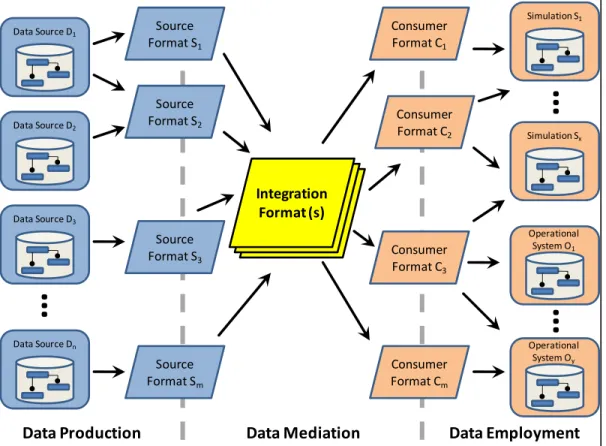
Without active standardization, the state of affairs for most data domains resembles what is shown in Figure 1-1. This state is characterized by a variety of producer and consumer formats, where some data producers (but not all) may use the same formats, and likewise some consumers (but not all) use the same formats. Historically, the producer formats are driven by the needs and capabilities of authoritative data producers, and consumer formats are driven by the efficient formatting of data for use in M&S or operational systems. This is not to say that data is stored inside the data production or using systems in exactly the corresponding formats. Often internal data storage is highly optimized. But in both cases--internal data storage and external data interchange formats--there is some documented schema describing the structure of data, and optimally, a well defined data dictionary the captures data semantics.
LVC Common Capabilities: Common Data Storage Formats Implementation Plan
Figure 1-1: Base State: Multiple Producer and Consumer Formats, without Mediation
As can be seen in Figure 1-1, multiple PxC data translations can potentially exist, where P is the number of producer formats and C is the number of data consumer formats. Practically, a subset of these translations is often built, since not all consumers use data from all producers. With large numbers of producers and consumers, this state becomes problematic, requiring multiple changes in translation software when either producer or consumer formats change. Additionally, this doesn’t scale as more producer and consumer formats are defined.
1.2.6 Fully Converged: Single Data Format
In an ideal world, one data format would include any and all data concepts, properties, and relationships. This state is represented in Figure 1-2. For the reasons stated above regarding “one size fits all,” this state has not occurred for any of the data categories addressed in this report. To reach this state, strong central control would need to exist. Where legacy systems exist, significant costs would be incurred to modify the legacy systems to produce and consume data in a mandated format.
Data Source D1 Data Source D2 Data Source D3 Data Source Dn
…
Source Format Sm Simulation S1 Simulation Sx……
Operational System O1 Operational System Oy Source Format S3 Source Format S2 Source Format S1 Consumer Format Cm Consumer Format C3 Consumer Format C2 Consumer Format C1LVC Common Capabilities: Common Data Storage Formats Implementation Plan
Figure 1-2: Fully Converged: Single Data Format
1.2.7 Partially Converged: Mediation Format(s) Exist
Where multiple producer and consumer formats exist, one or more mediation formats often emerge as is seen in Figure 1-3. These formats integrate representation capabilities from multiple producers and consumer formats. In the case of a single mediation format existing for a data category, the number of data translations that must be maintained is reduced from a complexity of PxC to P+C, where P is the number of producer formats and C is the number of consumer formats. Multiple mediation formats often exist where either 1) the data category has clearly identifiable subcategories and/or 2) consensus on a mediation format has been reached among a subset of data producers and consumers that have an interest in the data category. The achievement of an agreement among a group of stakeholders is what categorizes a successful COI in the DoD Net-centric Data Strategy.
Data Source D1 Data Source D2 Data Source D3 Data Source Dn
…
Simulation S1 Simulation Sx……
Operational System O1 Operational System Oy Single Common Data FormatLVC Common Capabilities: Common Data Storage Formats Implementation Plan
Figure 1-3: Partially Converged: Mediation Format(s) Exist
1.3 SCOPE
Although the term “standards” has been used in the previous section, the scope of this report is not just standards that are maintained by an open, consensus standards body. The broader definition of the term was used, and this report will address both formal standards and storage formats that are maintained either within the government or by industry (with or without collaborative means).
The scope of this report is limited to data formats used for the interchange of data. Consistent with the movement from the prior DoD data standardization direction to the Net-centric Data Strategy, no consideration is given to how data is represented internally in models or simulations. Further refining the scope, this report is concerned with data interchange formats and standards where the data has some persistence, e.g., in stored datasets.
This report does not address the temporal exchange of data among simulations or among simulations with other LVC systems. Data dictionaries that contain enumerated values that are used to constrain the contents of datasets consistent with the data formats are within the scope of this report. This report does not address the standardization of service oriented architecture
Data Source D1 Data Source D2 Data Source D3 Data Source Dn
…
Source Format Sm Simulation S1 Simulation Sx……
Operational System O1 Operational System Oy Source Format S3 Source Format S2 Source Format S1 Consumer Format Cm Consumer Format C3 Consumer Format C2 Consumer Format C1 Integration Format (s)LVC Common Capabilities: Common Data Storage Formats Implementation Plan
The scope of this report focuses on the data classifications and corresponding formats as defined in the taxonomy found in Section 1.4, and does not address the interchange of data artifacts that describe the process of conducting M&S, e.g., conceptual models, federation agreements, VV&A documentation, etc.
1.4 METHODOLOGY
The team began by identifying categories of data storage formats from the team’s event experience. This list was briefed at a workshop at JHU/APL in November 2009 where Joint Rapid Scenario Generation (JRSG) was proposed as a key input. The Authoritative Data Source (ADS) classes as defined by the prior Defense Modeling and Simulation Office (DMSO) and Services ADS initiatives were also submitted as an input. The resulting list is a rationalized mix of JRSG and ADS:
1. Geospatial data [including Meteorological and Oceanographic (METOC) and air/space]
2. Manmade environmental features, e.g., 3D models
3. Unit order of battle/force structure (including manning and readiness) 4. Electronic order of battle/network
5. Platform/weapons performance and/or characteristics
6. Plans/scenarios [including Time-Phased Force Deployment Data (TPFDD)] 7. Behavior (including organizational and individual)
8. Logistics
9. Event (testing, training, analysis, etc.) results
The team solicited inputs on categories and instances of data storage formats from the community via the November workshop, an online questionnaire4, and a workshop in conjunction with the 2010 Spring Simulation Interoperability Workshop (SIW). In addition, the team searched the following recognized sources of data formats:
Acquisition Streamlining and Standardization Information System (ASSIST) [Reference (e)]
DoD Information Technology Standards and Profile Registry (DISR) [Reference (f)] M&S Standards Profile5 [Reference (g)]
Formats used by the tools in the Reusable Tools Implementation Plan [Reference (h)] NATO M&S Standards Profile
4
The Current State Research can be found in Appendix B, and the original online questionnaire and responses are in Appendix C.
5
Provided in draft format by AEgis Technologies on behalf of the Modeling and Simulation Coordination Office (M&S CO).
LVC Common Capabilities: Common Data Storage Formats Implementation Plan
Simulation input formats identified in the federation agreements acquired for the Federation Agreements Template task
Simulation Interoperability Standards Organization (SISO) web site DoD Metadata Registry [Reference (k)]
The instances of formats in each category were researched to determine the state of the “market” for the category to support determination of the difficulty of reducing the number of formats as detailed at the beginning of the next section. The priorities for improving the “market” for each category were determined from the online questionnaire and feedback at the November 2009 workshop. The recommendations in Section 1 are based on the correlation of difficulty and priority.
LVC Common Capabilities: Common Data Storage Formats Implementation Plan
LVC Common Capabilities: Common Data Storage Formats Implementation Plan 2 CURRENT STATE AND FEASIBILITY ASSESSMENT
In this section, the team describes the current state of formats in each of the identified categories and assesses the difficulty of achieving a reduced number of formats as described in Section 1.2.4. The detailed data upon which the assessment is based can be found in Appendix B. Criteria for assessing difficulty include:
1. Number of formats in the area.
2. How complex the format is: size, number of classes and attributes. 3. Multiple organizations working on standardized formats.
4. Political conflict in the domain. For the purpose of this study, “political conflict” is defined as “the actual or perceived opposition of needs, values, and interests” [Reference (i)].
5. Maturity (from M&S Standards Management Plan) [Reference (g)]
a. Concept – The technology is conceptually feasible, but has not been implemented. b. Proof-of-concept – The technology has been demonstrated, but a prototype may
require work arounds or expert support.
c. Reference implementation(s) – The technology has at least one implementation that is sufficiently stable not to require expert support, but does not necessarily have the support tools, materials, and services that accompany a mature product. d. Experimentation – Proof-of-concept or reference implementation(s) are being
evaluated by multiple users under multiple use cases.
e. Productized/mature market – The technology is stable; at least one mature product is available with appropriate support tools, materials, and services.
6. Existence of one or more mediation standards in the category
In addition to current state, the team evaluated the feasibility of moving to a state of greater reuse via:
1. Reduction in the number of formats used in each category; 2. Standardization of formats in each category if no standards exist;
3. Increased adoption of mediation formats to reduce translation errors; and 4. Creation or engagement with category-specific communities of interest. COIs would be focused on the format category, tasked with:
1. Determining a core set of required capabilities, likely determined by operational needs;
LVC Common Capabilities: Common Data Storage Formats Implementation Plan
A listing, description, and cross-reference of all Global Information Grid (GIG) COIs to this effort is provided in Appendix D.
2.1 GEOSPATIAL DATA
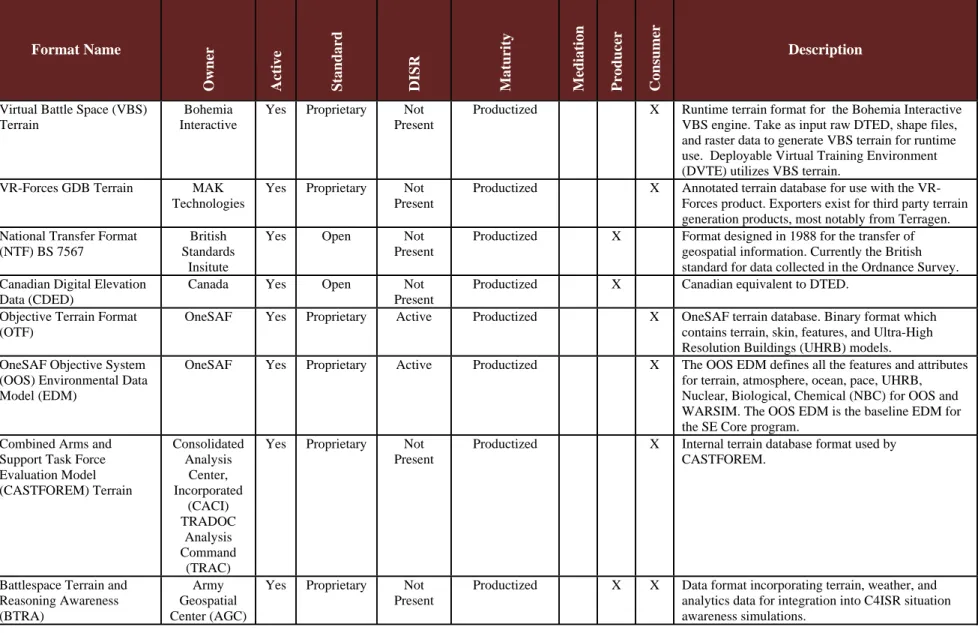
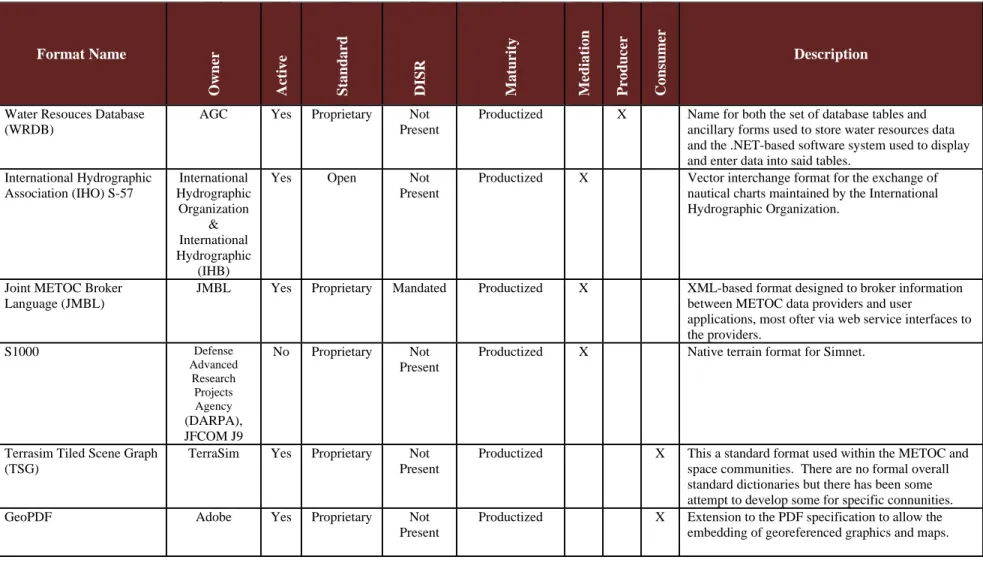
The geospatial data category is here defined as encompassing all data storage formats for the representation of synthetic natural environments. This includes elevation models, two-dimensional (2D) and three-two-dimensional (3D) terrain, vector maps, geo-referenced raster imagery, Geographic Information System (GIS) databases, METOC data, and air and space data. This category covers all natural features and phenomena that are defined by a specific geographical location.
The team has identified 93 currently used data storage formats for geospatial data, 80 of which are actively maintained. Thirteen of those formats are not, strictly speaking, data storage formats, but are included as they are data dictionaries or conceptual models without which several important storage formats cannot be implemented. Of the remaining entries on the list, four are GIS extensions to major relational databases, 71 are unique storage formats, and five are Service- or Department-specific “universal” geospatial databases. Ten of the storage formats and 10 of the conceptual models have been identified as mediation formats.
The geospatial data category is characterized by a plethora of formats, standards bodies working on comprehensive solutions, and vendors producing data in proprietary formats. Attempts at comprehensive solutions to the explosion of formats have been made and are currently underway [e.g., Synthetic Environment Data Representation and Interchange Specification (SEDRIS), Open Geospatial Consortium (OGC) Geography Markup Language (GML), National Imagery Transmission Format Standard (NITFS), etc.] and each of the Army, Air Force, Navy, United States Special Operations Command (USSOCOM), and the Department of Homeland Security (DHS) all have their own “universal” geospatial data production plans ongoing, all of which are developing independently. A variety of factors have resulted in the number and diversity of data formats in this area:
First, the area of geospatial data is very broad, encompassing data from sub-surface to space. For each subcategory of data there are a variety of data producers where many have established their own format.
A commercial geospatial data market exists at a scope unlike other data categories addressed in this report. For other categories, the DoD tends to be the primary data producer, controlling the formats for data production. In the geospatial area, this is not the case; a large number of non-DoD data producers, including commercial data producers, are well established.
Most geospatial data users, especially those using geospatial data in M&S, must integrate data from multiple sources to produce a coherent representation of the
LVC Common Capabilities: Common Data Storage Formats Implementation Plan
environment. This process is a service industry unto itself and has resulted in multiple mediation efforts, e.g., Sythetic Environment Core (SE Core) and standards, e.g., SEDRIS, being established.
The end-use application of geospatial data in M&S varies. Traditionally, geospatial data was driven by the need to produce paper maps and charts. With the emergence of automated decision support systems and M&S, geospatial data is used to drive applications from visualization to terrain reasoning to electromagnetic propagation calculation. Each of these applications has distinct data representation needs; thus, different formats have emerged.
All of these reasons have resulted in a trade-space of formats that resembles the model described in Figure 1-3 above. However, the mediation formats and standards are not aligned. One reason for the divergence in formats, especially mediation formats, has been the lack of cross-coordination between the operational community and the community of M&S users. M&S users have typically presumed that the operational geospatial community would not take action to satisfy their needs, and thus, have independently developed solutions including establishing formats and standards.
A recent example of these issues arising has been the conflict between the SEDRIS and National System for Geospatial Intelligence (NSG) standards, specifically the Environmental Data Coding Specification and the NSG Feature Data Dictionary (NFDD). Although many of the overlapping concepts in SEDRIS and NFDD derived from a common baseline, they have been named and defined differently in the two standards. The effort just to identify where the overlaps and conflicts exist has taken over three staff years to date. Additional effort will be required to either develop data translation solutions to mediate data between systems using these standards or to revise the standards and the applications that rely on them.
Addressing the divergence in the geospatial data category is very much like addressing the divergence in LVC architectures, and the same conclusions can be drawn. The geospatial data market is well established, with producers and consumers having made significant investments that preclude radical shifts in direction. It is unreasonable to expect that a single format for all geospatial data will emerge that will satisfy the needs of all geospatial data producers, integrators, and consumers. The results would be “yet another format.” Much as the LVCAR roadmap recognized that establishing a new LVC architecture would result in “yet another format,” a more reasonable expections is that the number of mediation formats can be reduced (achieve convergence). A first reasonable step is to reduce the divergence across the set of formats.
LVC Common Capabilities: Common Data Storage Formats Implementation Plan
The Community of M&S geospatial data users must engage with the operational geospatial community. In the past, M&S has been recognized only as a non-voting member of the Geospatial Working Group (GWG)—the body that established geospatial standards within the DoD Information Technology Standards Committee (ITSC), M&S users should be represented in the GWG via their Service and Component representatives, and the M&S Technical Working Group (TWG) should become a voting member of the GWG to represent combined M&S interests.
A Geospatial Task Force should be established to coordinate first across the body of M&S users, then with the command and control (C2) community. This Task Force should identify current in-use set of geospatial standards, define subcategories and relationships among the subcategories, and identify where commonalities and overlaps exist among formats in the subcategories.
The Geospatial Task Force should identify the potential for, and means of influence, to drive convergence in formats, focusing on mediation formats first. The result should be a geospatial data roadmap, similar in scope to the LVCAR roadmap.
The Geospatial Task Force should develop a standards strategy that clearly identifies what Standards Development Organizations (SDOs) will be engaged to develop and maintain DoD-used standards, how DoD representation will be achieved in these SDOs, and how a unified DoD position will be presented to these SDOs.
LVC Common Capabilities: Common Data Storage Formats Implementation Plan Table 2-1: Geospatial Data Summary
Criterion State
Number of formats (total / active) 93/80
Identified subcategories Digital Elevation Models, 2D and 3D terrain, Vector maps, Geo-referenced raster imagery, GIS databases, METOC, Air and Space data
Organizations working on standardized formats
11 [National Geospatial Intelligence Agency (NGA), International Organization for
Standardization (ISO), OGC, SEDRIS Group, Digital Geographic Information Working Group (DGIWG), American Society for Photogrammetry and Remote Sensing (ASPRS), LandXML.org, NATO, University Corporation for Atmospheric Research (UCAR), World Meteorological
Organization (WMO), International Hydrographic Organization (IHO)]
Political conflict Substantial political conflict. Proliferation due to political concerns, legacy formats/systems,
domain-specific requirements, substantial industry investment in proprietary formats, and runtime requirements.
Maturity Productized (96%), Experimentation (2%),
Reference Implementation (1%), Proof of Concept (1%)
Complexity Extremely complex.
Mediation formats 10 storage [Digital Geographic Information Exhange Standard (DIGEST), GML, CityGML, SEDRIS Transmittal Format (STF), Standard Interchange Format (SIF), IHO S-57, S1000, Skyline Multi-Resolution Model, SE Core Master Database (MDB), Common Database (CDB)], 9 conceptual [Environmental Data Coding
Specification (EDCS), Shaded Relief Model (SRM), DGIWG Feature Data Dictionary (DFDD), Feature and Attribute Coding Catalog (FACC), Urban Topographic Data Store (UTDS), Local Topographic Data Store (LTDS), Regional Topographic Data Store (RTDS), Global
LVC Common Capabilities: Common Data Storage Formats Implementation Plan
Criterion State
Related COIs M&S, GWG, Defense Critical Infrastructure Program (DCIP), Defense Installation Spatial Data Infrastructure (DISDI), Installation Management (IM), METOC, Overhead Non Imaging Infrared (ONIR), Symbology (SYM)
Key Stakeholders DoD stakeholders include data providers (e.g., NGA), data integrators (e.g., SECore), operational users [e.g., Joint Forces Command (JFCOM)], and M&S users [e.g., Future Combat Systems (FCS)]. Geospatial stakeholders outside the DoD include tool vendors, imagery providers (e.g., satellite, aerial, etc.), database providers, and GIS service providers (e.g., Google, Mapquest, etc.), standards organizations (e.g., ISO, OGC, DGIWG, etc.), and the METOC community.
2.2 MANMADE ENVIRONMENTAL FEATURES
The manmade environmental features category is here defined as encompassing 3D models of non-geospatial data. This excludes terrain, vector map data, environmental conditions, etc., but includes 3D models which may include geospatial positioning data including buildings, vehicles, or any other model of a man-made element that may be incorporated into a synthetic natural environment at runtime that can be stored independently of its geospatial positioning.
Team members have identified 20 currently used data storage formats for manmade environmental features, 17 of which are actively maintained, and eight of which have been explicitly designed as mediation formats. There is substantial overlap in identified usage for many of these formats, with many existing primarily as reflections of the internal implementation of the tools that generate them.
A combination of engagement with identified communities of interest and economic incentives can likely reduce the number of formats used in M&S without limiting capabilities to exchange and display 3D models. Engagement has already produced results tailored for the M&S community with OpenFlight and X3D. The study team recommends the formation of a 3D Modeling COI whose tasking would be to first identify the core domain needs of M&S 3D models and then to determine what, if any, specific use cases have requirements not generally supported.
This space is mature and rich enough in existing open standard formats that new format and standards development is not needed. The team recommends focusing post-assessment COI
LVC Common Capabilities: Common Data Storage Formats Implementation Plan
efforts on the semantic extension of existing formats that meet the identified core requirements, and then only when specific use case gaps are identified. Formats particularly suitable for such extension are COLLADA, an open, extensible, XML-based format for 3D moving models, and CityGML, an open, XML-based application schema for GML designed for urban environment modeling and arbitrary semantic annotation. Additional focus should also be paid to OpenFlight and X3D as entrenched players in this space, though reliance upon proprietary formats controlled by a single company, like OpenFlight, is to be generally avoided. Once the COI has determined a minimal subset of formats that meet identified M&S use case requirements economic incentives can be used to encourage future development and conversion of existing models to one of these formats based on intended use without any lost capability.
LVC Common Capabilities: Common Data Storage Formats Implementation Plan Table 2-2: Manmade Environmental Features Summary
Criterion State
Number of formats (total / active) 20 / 17
Identified subcategories 3D moving models, Scenegraph transfer, Urban modeling, aided design (CAD) / computer-aided manufacturing (CAM), Architectural modeling Organizations working on standardized
formats
8 [ISO, OGC, Khronos Group, Web3D, SEDRIS Group, Open Design Alliance (ODA),
buildingSMART, OpenNurbs (McNeel)] Political conflict Little political conflict beyond open/ proprietary
standards choice. Proliferation primarily due to specialized subcategory needs with increasing collaboration within subcategories the rule and cross-domain collaboration increasing (COLLADA
extensions).
Maturity Productized (81%), Experimentation (19%)
Complexity Complex but well understood category. Complexity primarily due to increasingly advanced visualization capabilities.
Mediation formats 8 [Extensible Three Dimensional (X3D), COLLADA, SEDRIS Transmittal, CityGML, Autodesk
FilmBox(FBX), Industry Foundation Classes Standard for the Exchange of Product model data (IFC STEP), Lightwave, 3D Model (3DM).
Related COIs M&S, GEOINT Standards, Installation Management Key Stakeholders DoD stakeholders include data providers and
integrators (e.g., SECore), operational users (e.g., SOCOM), and M&S users [e.g., Program Manager, Combined Arms Tactical (PM CATT), Distributed Mission (DMT), etc.]. 3D modeling stakeholders outside the DoD include tool vendors, media
companies (e.g., movies, advertising, etc.), the video game industry, and professional design industries (e.g., industrial design, architecture).
LVC Common Capabilities: Common Data Storage Formats Implementation Plan
2.3 UNIT ORDER OF BATTLE/FORCE STRUCTURE
The unit order of battle (UOB) category consists of the identification, command structure, strength, and disposition of personnel, equipment, and units of the forces included in an operation, exercise, or simulation event. Standard unit configurations are defined in tables of organization and equipment (TO&E) which may be locally modified for specific units, based on mission needs. Organizational data is organized hierarchically in a tree structure, with superior and subordinate units and their assigned personnel and equipment assets. Units are uniquely designated for each echelon or level of command and type. Order of battle information includes task organization and attachment and detachment of units from their organic structure, with a set of defined command and support relations derived from the organic structure, that may be modified according to doctrine for each mission or operational phase. As defined in this study, an “order of battle” has no geospatial content, such that a “force laydown” that positions units within the operational environment is considered part of the Plans/Scenarios category.
The study team identified ten (10) currently used data storage formats for order of battle data. Two (2) other identified formats have been deprecated and two (2) more are in development at present. Six (6) of the active formats are mediation formats, three (3) are consumer formats and one (1) is a reference standard used to define the contents of unit symbology. Order of battle data is often closely linked to electronic orders of battle and operational plans and scenarios; indeed, the standard US military operations order (OPORD) format describes the order of battle for friendly and enemy forces. For this reason, many of the formats found and analyzed in this category were also allocated to these categories.
Because the functional boundaries between order of battle and plans/scenarios are complex, there is considerable overlap between mediation formats used to define forces in LVC simulations, to define plans to be executed by those forces, and to issue orders for execution by those forces. For example, the Military Scenario Definition Language (MSDL), by agreement in SISO, has proponency for the first two of these functions, while the Coalition Battle Management Language (C-BML) has responsibility for issuing orders to live (human and robotic) as well as simulated units in an exercise context. The Joint Consultation, Command and Control Information Exchange Data Model (JC3IEDM) also enables the description of unit composition in terms of tables of organization, equipment and personnel. Although individual simulations enable the user to define unit organizations and identifying characteristics in accordance with their respective conceptual model, there is a strong need to ensure compatible unit attributes across a simulation environment to ensure consistency of message traffic initiated by both live and simulated players. There are also cost and resource considerations associated with having to manually enter similar or the same data across multiple heterogeneous simulation and C2 systems.
LVC Common Capabilities: Common Data Storage Formats Implementation Plan
The survey of source, mediation and consumer formats in this category indicates that there are a number of robust and generally mature mediation formats available. Less clear is the potential for full convergence to one or just a few mediation formats. Moreover, the presence of XML-based mediation formats that are still in development and/or various states of upgrade would indicate that the data interchange mechanism in this category is not yet settled, and that some enhancement of the current state is possible. The most important consideration in this area is to ensure that government-owned proprietary standards are exposed to the commercial community in the form of recognized open standards. The maturation of C-BML as well as the deconfliction of C-BML with related standards (e.g., MSDL and JC3IEDM) is a critical milestone to achieve this. The Joint Land Component Constructive Training Capability (JLCCTC) Entity Resolution Federation (ERF), Multi-Resolution Federation – Warfighter’s Simulation (WARSIM) (MRF-W) and Multi-Resolution Federation – Corps Battle Simulation (CBS) (MRF-C) would offer an appropriate reference implementation for wider LVCAR applicability.
LVC Common Capabilities: Common Data Storage Formats Implementation Plan
Table 2-3: UOB Summary
Criterion State
Number of formats (total / active) 14 / 10
Identified subcategories Operational Command and Control systems, Entity Resolution simulations and
federations, Aggregate level simulations and federations, interface to live ranges and simulations
Organizations working on standardized formats
(9) Office of the Deputy Undersecretary of Defense (ODUSD), Office of the Under Secretary of Defense, Acquisition,
Technology, and Logistics (OUSD-ATL), DISA, JFCOM, Program Executive Office, Simulation, Training and Instrumentation (PEO STRI), Lawrence Livermore National Laboratory (LLNL), Joint Chiefs of Staff (JCS J8), Navy Warfare Development Command (NWDC), SISO
Political conflict Open and proprietary mediation standards are not synchronized, resulting in
considerable redundancy and confused boundaries.
Maturity Productized/Mature (64%); Concept (22%);
Proof of Concept (14%)
Complexity Moderate Complexity, but intertwined with other event-specific data domains (e.g., plans and scenarios, behaviors, logistics)
Mediation formats 9 (JC3IEDM, Joint Training Data Services (JTDS) Order of Battle Service (OBS) Schema, Military Scenario Definition Language, Joint Conflict and Tactical Simulation (JCATS) Integrated Force Plan (FPLAN) file, Global Force Management Information Exchange Data Model, Unit Object Standard (deprecated), Integrated Gaming System XML Schema, C-BML, WARSIM Common Data Format)
LVC Common Capabilities: Common Data Storage Formats Implementation Plan
Criterion State
Related COIs Air Force Readiness, Global Force
Management (GFM), M&S
Key Stakeholders DoD stakeholders include data providers (e.g., Global Force Management Initiative), data integrators (e.g., JFCOM JTDS), training developers (e.g., PEOSTRI), operational users (e.g., SOCOM), and M&S users [e.g., Joint Live-Virtual-Constructive (JLVC) Federations].
2.4 ELECTRONIC ORDER OF BATTLE/NETWORK
The electronic order of battle (EOB) (see Table 2-4) category includes network organization and topology at the application, physical and transport layers, electronic footprint, initialization of communications models and databases that define mappings between simulated forces and live systems. The formats associated with this category are used to define and disseminate logical and physical address locations across live and simulated tactical networks. This data is utilized (as a minimum) to initialize these networks, and to support the modeling of communications media and effects within the operational environment. Network topology and routing mechanisms are also defined upon initialization through this mechanism. While constitution of ad hoc networks and dynamic addressing lie outside the scope of this category, consumer formats must take these functions into consideration if the simulated environment includes them.
The study team identified thirteen (13) total formats in this category, ten (10) of which are currently in use. Of these, seven (7) were identified as mediation formats, four (4) of which are currently being used. In their current state, the extant mediation formats support limited definition of electronic addressing associated with current force Command, Control, Communications, Computers, Intelligence, Surveillance, Reconnaissance (C4ISR) systems, but do not support seamless and lossless import and export of simulation specific data used to define network topology and to simulate discovery and policy services in a service oriented architecture.
Although, consumer formats are maturing in this category, there is some evidence to suggest that additional changes will be required as both C2 systems and C2 simulations evolve. The communications effects models utilized in many distributed simulations are often used in a stand-alone mode as well as part of a distributed simulation environment. In order for mediation formats to support these models effectively, the full range of their initialization parameters must be taken into account. In general, static addressing schemes for digital battle command systems
LVC Common Capabilities: Common Data Storage Formats Implementation Plan
have been successfully migrated into formats consumable by distributed simulation systems. The Simulation to Command, Control, Communications, Computers and Information (C4I) Interoperability (SIMCI) program has provided a useful complement to both constructive simulation programs as well as networked battle command systems in facilitating this progress. As with other C2-related categories, JC3IEDM offers at least a partially functional mediation format that could be extended to address the full range of data integration needed in this category. It is unclear whether C-BML or MSDL have sufficient scope to address electronic order of battle functions.
At this point, a combination of the “multiple producer/multiple consumer” and “partial convergence” models represent the “as-is” state of this category. Due to the very strong position that commercial tools vendors occupy in the communications effects modeling space, and the relative immaturity of government off-the-shelf (GOTS) solutions for network-centric simulation, it is unlikely that a “government-proprietary” standard will be fully effective. Consequently, this category represents a potentially fruitful area for a pilot project, with concrete benefits to be achieved if recognized government standards are extended into an published open standard that is also reflected in the DISR baseline. This suggests that JC3IEDM may be further extended, that MSDL be integrated with the C-BML/JC3IEDM baseline to address electronic order of battle considerations and that SISO develop an appropriately focused study group consisting of the relevant stakeholders from government and private industry to advance this goal. In terms of the scope of a pilot project, it is suggested that the union of C3 Grid, Qualnet, Opnet and Orion models with an updated Lightweight Directory Access Protocol [(LDAP) Data Interchange Format (LDIF)] be considered as a baseline configuration for experimentation, test, and training implementation.
Table 2-4: EOB Summary
Criterion State
Number of formats (total / active) 13/10
Identified subcategories Unit address lists/Unit reference numbers; physical network addressing/ electronic footprint; operational C4ISR routing space definition; communications effects model initialization
Organizations working on standardized formats
(13) NGA, OUSD (ATL), Internet Engineering Task (ITEF), Program Executive Office, Command Control Communications - Tactical (PEO C3T), US Army Research, Development, and Engineering Command (RDECOM), Opnet Technologies, Scaleable Network Technologies, US Army
Electronic Proving Ground (EPG), PEO STRI, SISO, JFCOM, Training and Doctrine Command
LVC Common Capabilities: Common Data Storage Formats Implementation Plan
Criterion State
Political conflict Similar overlap with Order of Battle as well as Plans and Scenarios category; this domain has more specialized applications. There is direct competition among radio frequency (RF) propagation models with few extant standards.
Maturity Productized/Mature (68%); Concept (8%); Proof of Concept (8%); Experimentation (8%); Reference Implementation (8%)
Complexity Consumer formats are relatively simple, but diverse in scope.
Mediation formats DoD Discovery Metadata Specification (DDMS) Intelligence, Surveillance, and Reconnaissance (ISR) Extensions, JC3IEDM, Advanced Field Artillery Tactical Data System (AFATDS) Joint Master Unit List (JMUL), Orion Gateway XML file, Military Scenario Definition Language, C-BML, JCATS Integrated (FPLAN) File
Related COIs Common Sensor, Computer Network Defense (CND), Information Operations, Joint Airborne Networking-Tactical Edge (JAN-TE), M&S, NetOps COI
Key Stakeholders DoD stakeholders include data providers (e.g., intelligence agencies), data integrators (e.g., SIMCI, DISA, etc.), training developers (e.g., PEOSTRI), operational users (e.g., JFCOM, FCS, etc.), and M&S users [e.g., JLVC Federations, Army Test and
Evaluation (ATEC), etc.].
2.5 PLATFORM/WEAPONS PERFORMANCE AND/OR CHARACTERISTICS
The platforms/weapons performance and characteristics data category, often referred to as characteristics and performance (C&P), is here defined as encompassing all data storage formats for the representation of physical parameters of warfighting platforms and weapons systems. It does not include messaging formats for controlling or communicating with these systems, nor the performance of an humans operating them.
The team identified 15 data storage formats for C&P data (see Table 2-5), only 11 of which are known to be actively maintained. Two of the active formats are not strictly speaking formats, but rather databases. However, one of these databases is the Army Materiel Systems Analysis Activity (AMSAA) database from which AMSAA exports 126 different Standard File Formats (SFFs). In almost all cases, the AMSAA data is the source of authoritative data reformatted into other formats.
LVC Common Capabilities: Common Data Storage Formats Implementation Plan
Given the preeminence of AMSAA as the source of authoritative data and the success of data consumers transforming this data, no action is recommended with respect to the data that AMSAA currently produces. However, neither the Navy nor the Air Force has a similar organization with the authority to produce comparable source data for their weapons and platforms. These two Services should be engaged to determine the desirability and feasibility of providing such authoritative data and agreeing upon common formats.
Table 2-5: C&P Data Summary
Criterion State
Number of formats (total / active) 15/11 Identified subcategories None Organizations working on standardized
formats
OGC, S1000D
Political conflict Although there are several proprietary formats, all substantially used formats rely on AMSAA for source data.
Maturity Productized/Mature (80%); Concept (13%);
Reference Implementation (7%)
Complexity Although the AMSAA SFF database contains over 2500 elements, they can be represented in a
spreadsheet.
Mediation formats The only active mediation format is S1000D which is narrowly focused on producing maintenance manuals.
Related COIs Anti-Submarine Warfare (ASW), Chemical, Biological, Radiological and Nuclear (CBRN), Common Sensor, Joint Service Explosive Ordnance Disposal, Joint Strike Fighter (JSF) Munitions/Ordnance Data, Mine Warfare, M&S Key Stakeholders DoD stakeholders include data providers (e.g.,
AMSAA, intelligence agencies, etc.), data integrators (e.g., PEOSTRI), training developers (e.g., PEOSTRI), operational users (e.g., JFCOM), and M&S users (e.g., JLVC Federations, ATEC, PM CATT). Stakeholders outside the DoD include commercial publishers (e.g., Jane’s).
2.6 PLANS/SCENARIOS
The plans and scenarios category includes operational plans, orders and tasking instructions issued to live, virtual and constructive players in a simulated event or exercise. These instructions are documented in the form of text, tables and associated graphics. The US
LVC Common Capabilities: Common Data Storage Formats Implementation Plan
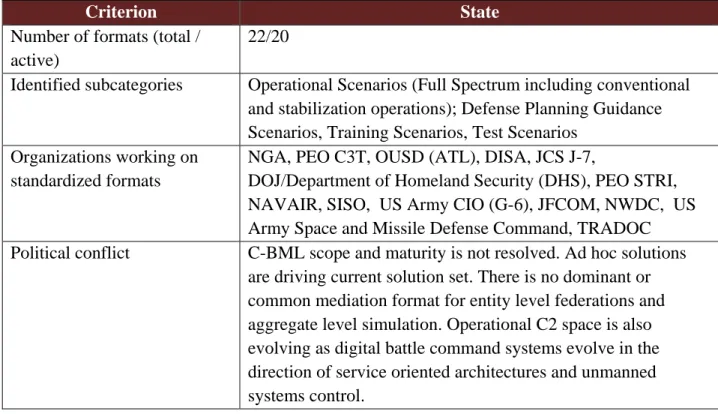
breaks down the planning, preparation, execution and assessment of military operations into five steps. These steps are (1) Planning, (2) Design, (3) Preparation, (4) Execution and (5) Assessment. This process extends the older “Military Decision Making Process” which focused on the production of plans and orders prior to the execution of a military operation. These processes are conducted hierarchically and in a combination of sequential and concurrent activities that decompose plans, orders and related artifacts to lower and lower levels. Plans are generally used only once; the Prussian General von Moltke once wrote “no plan of operations extends with any certainty beyond the first contact with the main hostile force” [Reference (j)]. Scenarios relate to planning in that they describe a future sequence of events. For non-deterministic simulations, the scenario describes the initial conditions and static variables that do not change during the execution of the simulation. From the standpoint of data storage formats, scenario files capture the initial state of plans and orders when the simulation is started. Online planning tools may update or modify these plans and orders during scenario execution. These changes may or may not be persistent during the execution of the simulation – or they may be saved at specific time intervals, or when the simulation is paused or checkpointed. When operational C2 systems are involved, this raises the question of sychronizing the state of plans and orders across the C2-simulation boundary. Interchange of plans and scenario data becomes an issue both prior to event execution and during a simulation event or exercise itself. The team identified twenty-two (22) total formats in this category, twenty (20) of which are currently in use. Of ten (10) mediation formats identified, eight (8) are currently in use. One (1) mediation format used by C2 systems, Command and Control Information Exchange Model (C2IEDM) has been superceded by JC3IEDM. Another simulation-specific mediation format, C-BML, is in development and is closely linked to JC3IEDM. For stabilization operations and Operations Other Than War (OOTW), one mediation format, the National Information Exchange Model (NIEM), is mandated in the DISR and maintained by the Department of Justice (DoJ). This model superceded previous mediation formats used in OOTW scenarios. Source data for scenarios may either be generated manually from predefined scenario products or imported from external databases such as TPFDD. For this reason, creation of simulation-capable scenarios can be a complex and time-consuming process.
As previously stated, there is substantial overlap between the Order of Battle and Plans/Scenarios categories. Individual consumer models, such as OneSAF, JCATS, and FireSim, must translate generic plans and orders that are designed to be executable by humans into machine readable and executable form. By design and SISO agreement, MSDL provides planning data in the form of unit locations and overlays that must be assigned to tasks defined external to the data interchange mechanism. C-BML and IBML, on the other hand, are designed to provide at least partial support for the direct tasking of computer generated forces and aggregate constructive models. The MSG-048 demonstration conducted at George Mason University in late 2009 provided a proof-of-concept for the battle management language approach. Control of live and simulated unmanned systems is also a consideration for Battle