Towards Data Mining on Emerging Architectures
Gregory Buehrer and Srinivasan Parthasarathy
Department of Computer Science and Engineering,
The Ohio State University, Columbus, OH 43210, USA
Anthony Nguyen, Daehyun Kim, Yen-Kuang Chen, and Pradeep Dubey
Applications Research Laboratory,
Intel Corporation, Santa Clara, CA 95052, USA
Abstract
Recent advances in microprocessor design have given rise to new commodity architectures. One such innovation is to place multiple cores on a single chip, called Chip Multiprocessing (CMP). Each core is an independent computational unit, allow-ing multiple processes to execute concurrently. A second re-cent architectural advancement is to allow multiple processes to compete for resources simultaneously on a single core, called simultaneous multithreading (SMT). SMT can improve overall throughput in cases where CPU utilization is low. We inves-tigate the implications of these advances on the design of data mining algorithms. In particular, we focus on frequent graph mining. Mining graph based data sets has practical applications in many areas including molecular substructure discovery, web link analysis, fraud detection, and social network analysis. In this work, we propose a novel approach for parallelizing graph mining on CMP architectures. We design a parallel algorithm with low memory consumption, low bandwidth, and fine task granularity. We show that dynamic partitioning and dynamic task allocation provide a synergy which greatly improves scala-bility over a naive algorithm, from 5 fold to 27 fold on 32 nodes.
1
Introduction
Recent advances in microprocessor design have trans-formed the desktop PC into a shared-memory parallel machine. Two such advances are chip multiprocessing (CMP) and simultaneous multithreading (SMT). CMP de-signs exhibit multiple processing cores on one chip. These cores are independent computational units which may or may not share level 2 cache. Current dual core chips include Intel’s Pentium D, AMD’s Opteron, and IBM’s Power4.
Contact emails – [buehrer,srini]@cse.ohio-state.edu
This work is supported in part by NSF grants (#CAREER-IIS-0347662), (#RI-CNS-0403342), and (#NGS-CNS-0406386).
SMT provides support for multiple contexts to com-pete simultaneously for chip resources, in an effort to improve overall utilization. It is essentially a hardware-based latency-hiding technique. Intel’s Hyperthreading technology is an example of SMT. By executing two threads concurrently, an application can gain significant improvements in effective IPC (instructions per cycle).
These technologies arise in part because of the inher-ent challenges with increasing clock frequencies. The increase in processor frequencies over the past several years has required a significant increase in voltage, which has increased power consumption and heat dissipation of the central processing unit. In addition, increased fre-quencies require considerable extensions to instruction pipeline depths. Finally, since memory latency has not de-creased proportionally to the increase in clock frequency, higher frequencies are often not beneficial due to poor memory performance. By incorporating thread level par-allelism, chip vendors can continue to improve IPC by ex-ploiting thread level parallelism, without raising frequen-cies. As these low cost parallel chips become mainstream, designing data mining algorithms to leverage them be-comes an important task. Finally, it is likely that even distributed clusters will groups of inexpensive, highly par-allel shared memory machines.
Mining frequent structures in graphical data sets is an important problem with applications in a broad range of domains. Finding frequent patterns in graph databases such as chemical and biological data [20], XML docu-ments [19], web link data [16], financial transaction data [9], social network data[17], protein folding data [24], and other areas has posed a nice challenge to the data min-ing community. Representmin-ing these data sets in graphical form can capture relationships between entities which are convoluted or inefficient when captured in relational ta-bles. For example, molecular data is easily represented in graphical form. Also, financial transactions can be stored as graphs, where each node is an institution and the edge
is an account number. Finally, web logs can be mapped to user sessions, and subsequently represented as graphs [16].
Frequent pattern mining was first introduced by Agrawal et al [1] in 1994, and has been studied ex-tensively [5, 8, 13, 20, 21]. In web session data, fre-quent patterns represent resources which are more often used, and the paths most often taken to access those re-sources. Application service providers can improve web server behavior by prefetching resources as users move through the web application according to their typical ses-sion patterns. In molecular data sets, nodes correspond to atoms and edges represent chemical bonds. Frequent substructures may provide insight into the behavior of the molecule. For example, researchers exploring immunod-eficiency viruses [7] may gain insight into recombinants via commonalities within initial replicants. In addition, it can be used to group previously unknown groups, afford-ing new information. Zaki et al [24] apply graph-based methods on weighted secondary graph structures of pro-teins to predict folding sequences. Finally, in financial transaction data, large graphs with high occurrence rates could represent potential criminal activity such as money laundering.
Although shared memory algorithms exist for several data mining tasks, none of these works address the archi-tectural issues specific to CMP systems we outline in this work. The key contributions of this paper are
We describe several key issues to consider when de-signing data mining algorithms for CMP machines We provide a highly scalable parallel graph mining algorithm, specifically designed to maximize scala-bility on CMP architectures
We design several task partitioning models, and show that a novel dynamic model affords the lowest runtimes
2
Related Work
Initial efforts exist [18, 6] which explore data mining on clusters of SMP machines. Jin and Agrawal [6] devel-oped a parallel algorithm for association rule mining on a cluster of SMP machines. They effectively partitioned the workload to make use of multiple CPUs on a node. This was extended to dense datasets by Sucahyo et al [18].
Several serial algorithms exist which enumerate fre-quent subgraphs. FSG [8] mines for all frefre-quent sub-graphs in an APRIORI-like breadth-first fashion. Yan and Han proposed GSpan [21], which uses a combination of depth-first and breadth-first trajectories to discover fre-quent patterns. Gaston [13], developed by Nijssen and Kok, is an efficient depth-first breadth-first miner as well.
It incorporates embedding lists using an efficient pointer-based structure. This provides an improvement in exe-cution time at the cost of significantly increased memory consumption. Meinl et al [12] parallelized MoFa[2] for SMP machines, and kindly supplied their implementation. We will briefly compare our parallel algorithm to it in Sec-tion 4.
Wang and Parthasarathy [20] developed a parallel algo-rithm for their Motif Miner toolkit [14]. Their paralleliza-tion strategy cannot be directly applied to the more gen-eral graph mining problem. Cook et al [3] have been de-veloping a system called Subdue for several years. Their research has produced a parallel implementation, which solves a different problem, using approximations and user interaction to return potentially interesting substructures again on geometric graphs. There have been several ap-proaches for parallel mining of other frequent patterns [15, 23]. Strategies for mining associations in parallel have been proposed by various researchers. Zaki [22] pro-posed parallel partitioning schemes for sequence mining. The author illustrates the benefits of dynamic load balanc-ing in shared memory environments.
None of these works evaluate data mining techniques on new architectures, such as CMPs. In a previous effort [4], we examined frequent itemset mining on SMT archi-tectures.
3
Graph Mining on Emerging
Architectures
3.1
Architectures
Chip Multiprocessing (CMP) designs (often called mul-ticore) incorporate more than one processing element on the same die. They can execute multiple threads concur-rently because each processing element has its own con-text and functional units. Most designs will run these el-ements at somewhat slower clock frequencies than cur-rent state of the art, to conserve power. Although curcur-rent designs have relatively few cores, Intel’s 2015 Processor road map proposes CMPs with hundreds of cores1. Mul-ticore serves both basic desktop needs as well as the needs of the high performance community. Desktop users gain true multitasking for everyday tasks such as multimedia and office applications. High performance computing will gain considerable parallelism opportunities, as these chips become standards for cluster nodes.
CMP systems have significant differences when com-pared to existing platforms. To begin with, inter-process
communication costs can be much lower than previous
1
parallel architectures. Distributed clusters must exchange
messages, and traditional shared memory multiple CPU systems write to main memory. CMP systems can keep locks on chip, either in specially designed hardware, or in a shared L2 cache. A direct consequence of lower lock-ing costs is an improved task queulock-ing system. Because CMP chips are designed for thread level parallelism, low-overhead software queues are essential; on chip hardware-based queues are also attractive. Therefore, algorithm
de-signers should consider a much finer granularity when
targeting these systems. For example, in FPGrowth[5], multiple threads could mine items from the same pro-jected header table.
Several important issues with CMP systems arise when discussing the memory hierarchy. To begin with, off chip
bandwidth is a precious commodity. Whereas clusters
have bandwidth which scales with increasing processing elements, CMP systems do not. CMPs are even more lim-ited than SMPs in this regard, because each node in an SMP has independent access to the memory subsystem. CMP systems are limited because of the practical limits to the number of pins which can be placed on a single chip. Although not significant with two cores, as chips scale to 32 and 64 cores off chip bandwidth will be a sig-nificant concern. Algorithm designers can compensate by improving thread-level data sharing.
Intuitively, CMP architectures increase the potential computational throughput while maintaining the same amount of main memory as their single core counterparts. The amount of main memory in commodity CMP sys-tems will likely not rival that of high end SMP or dis-tributed systems. We believe that algorithms which trade
slightly increased computation for lower memory con-sumption will exhibit better overall performance on CMP systems, when compared to systems which use more main
memory.
CMP systems can have shared caches. Although both
AMD and Intel currently manufacture dual core chips with dedicated L2 caches, future designs possess shared L2 cache. Essentially, having a shared L2 cache allows the on chip memory of each processing element to grow based on runtime requirements. Cache coherency proto-cols can be processed on chip, allowing multiple
process-ing elements to share a sprocess-ingle cache line and save a sig-nificant number of memory operations. For example, the
Intel Duo’s Smart Cache does not need to write to main memory when multiple cores write to the same cache line. This advancement greatly improves the potential benefits of cooperation amongst processes.
Simultaneous multithreading (SMT) is the ability of a single processing element to execute instructions from multiple independent instruction streams concurrently. Because SMT systems do not have additional functional
units, it’s main performance improvement is to hide the la-tency of main memory when executing multiple threads. Many data mining workloads are latency bound, and as such can benefit from SMT. Algorithm designers should
intelligently schedule thread execution to share as many memory fetches as possible, a process called thread
co-scheduling.
3.2
Frequent Graph Mining
The task of frequent graph mining is to enumerate all sub-graphs which appear in at least graphs in the data set, where is a user-defined threshold called minimum
sup-port. In our instantiation of the problem, edges and
ver-tices have labels. If the dataset does not contain labels, we merely set all labels to 0. Edges can be either directed or undirected. In building an algorithm for CMP, we seek to establish a small memory footprint, low bandwidth uti-lization, and fine-grained task partitioning. In addition, we propose to incorporate as much runtime information as possible in an effort to maximize system resource uti-lization.
To reduce the exponential time complexity required to test for subgraph isomorphism, a canonical labeling sys-tem is used. A canonical labeling syssys-tem is a bijection from graph space to a label space. Several labeling and normalization systems have been proposed [13, 21, 11]. Our labeling closely resembles DFScodes by Han [21].
Given a data set, all edges which occur at least times are called frequent one edges. A candidate edge is any other frequent edge, which either grows the graph by adding an additional node, or merely creates a new cy-cle by adding just an edge. Graph mining algorithms can traverse the search space in either a depth-first fashion, or a breadth first fashion. Each frequent one edge is grown with all possible candidate edges. This process then re-curses to mine for all possible frequent subgraphs in the dataset.
3.3
Algorithmic Improvements
We now provide our techniques for addressing the CMP specific issues outlined in section 3.1 for graph mining.
3.3.1 Improving Task Granularity
In our algorithm, every child candidate can be a separate task. We consider two methods to control the granular-ity of the tasks, which we term partitioning. Level-wise partitioning deterministically enqueues tasks to a param-eterized depth of recursion. Dynamic partitioning allows the parent mining node to decide at runtime whether to enqueue each child task, or to mine it locally. This deci-sion is based on the current load balance of the system.
We do not require a specific mechanism to make this de-cision, because in part the decision is based on the queu-ing mechanism used. For example, an involved decision could be made based on the rate of decay of the size of the appropriate queue, perhaps implemented with on chip hardware. Dynamic partitioning affords very fine-grained task allocation, without the queuing costs associated with full partitioning.
We use a distributed queuing model, where there are exactly as many queues as processing nodes. Each queue is unlimited in capacity, has a lock, and is assigned to a particular node. The default behavior for a node is to en-queue and deen-queue using its own en-queue. Although this incurs a locking cost, there is generally no contention. If a node’s queue is empty, it searches other queues in a round robin fashion, looking for work. If all queues are empty, it sleeps; an enqueing thread then wakes sleeping threads. We believe that distributed queues are the best fit for CMP architectures because their round robin checking mecha-nism will be relatively inexpensive, while affording highly efficient dynamic load balancing.
3.3.2 Minimizing Off-chip Bandwidth
Our parallel algorithm employs a depth-first search space traversal. We only grow graphs with candidates that are found to be frequent in the projected dataset. As stated prior, each frequent substructure is grown with all ob-served candidates. Briefly, let be a frequent graph, and
be the set of graphs containing . The locations of in
are called ’s embeddings. Let be the result of appending a candidate to , and let
be its graph set. It is clear that
. To increase temporal locality, and lower off-chip bandwidth, we maximize the possibil-ity is processed by the miner of . We accomplish this through our distributed queuing, and placing a bound on the total number of tasks that exist in all the queues. When is mined, the cache will benefit from temporal locality of mining . Performance is increased via the benefits of affinity [10].
3.3.3 Lowering Memory Consumption
By limiting the amount of main memory consumed, we increase the size of the problem we can solve. Returning to our definitions above, each embedding of overlaps a corresponding embedding of in
, and thus maintaining ’s embedding list will aid in constructing the embeddings for. There is a performance trade off when considering the amount of memory used to maintain embeddings. In our algorithm, a task is a pointer-based structure with 2 fields. The first field is the code for the graph, imple-mented as an array of tuples. The second is a vector of
SubMine
Input: Code s
Output: All frequent graphs.
Method: Call SubMine(s) for each -1 code s.
Procedure SubMine(s) (1) if (minimumCode(s)) (2) AddToResults(s) (3) Children C = null (4) Enumerate(s,C) (5) for each (Child c in C) (6) if (c is frequent)
(7) Code newS = Append(c,s) (8) if (timeToMine) SubMine(newS) (10) else Enqueue(newS)
Figure 1: Pseudo Code
pointers to the first node of each embedding of’s par-ent. Thus, we maintain very little state when queuing a task. We do not employ expensive embedding lists[13], nor do we utilize list joins[21]. List joins require that every child’s extensions be known, which requires more main memory because all for a given must be in mem-ory concurrently. Our succinct embedding list affords two benefits, namely a) low memory consumption and b) there is no data dependency between tasks.
3.3.4 Improving Thread Cooperation for SMT
To improve efficiency on SMT systems, we force two threads to share the same queue, and increase the bound before the queue is considered full. They are initialize with a parent and child of the same frequent one item. The net effect is to create a system where two threads are mining tasks in the same portion of the search space, thus they share a large percentage of the database graphs resid-ing in cache.
4
Experimental Results
4.1
Experimental Setup
We implemented our algorithm in C++ using POSIX threads. Experimentation was performed on several real machines. We used a 2.8 GHz dual core Pentium D with 2 GB of RAM, a 2.80GHz Intel Hyperthreaded Pentium 4 with 1GB of RAM, and an Altix 3000 with 32 1.3 MHz processors and 64 GB of RAM. We employ several real world data sets, shown in Table 2. Briefly, these include PTE12, HIV13, the nasa multicast dataset4, and Weblogs
2http://web.comlab.ox.ac.uk/oucl/research/areas/machlearn/PTE/ 3http://dtp.nci.nih.gov/docs/aids/aids data.html
[16]. T100k and T50k are synthetic data sets made from the PAFI toolkit5.
4.2
Scalability
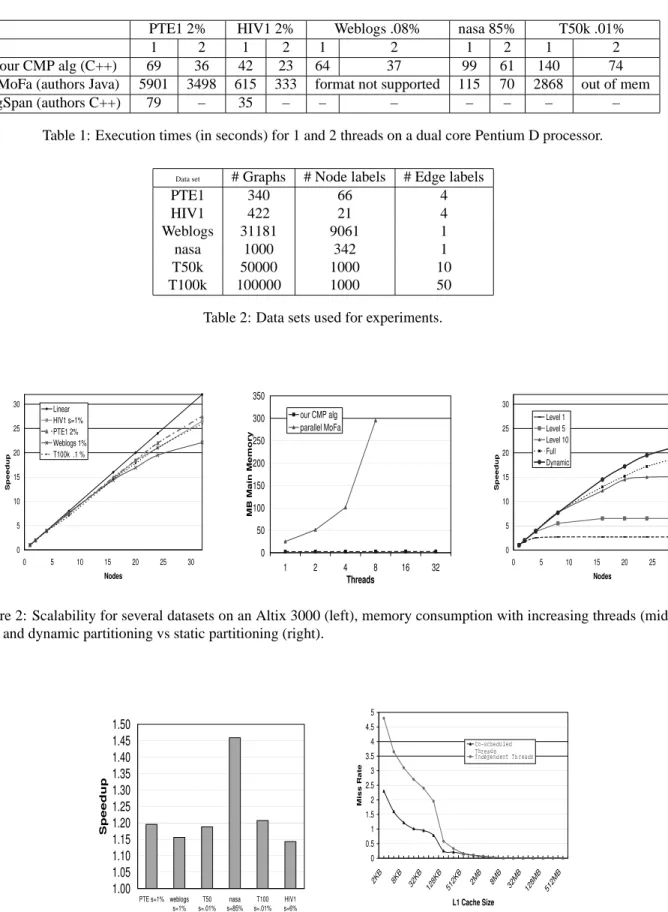
Our algorithm compares favorably to other public graph miners. GSpan[21] and MoFa[12] were both kindly sup-plied by their original authors. The provided GSpan is serial and requires there to be no more than 256 node labels (shown as –). Parallel MoFa is implemented in Java, which may hinder its overall performance. Noting this, our CMP algorithm scales considerably better both in terms of memory consumption and execution times. A key factor is that our algorithm does not require that an additional thread consume additional memory. Execution times for several datasets executed on the dual core are given in Table 1. All datasets are processed in nearly half the time, except the nasa dataset. Interestingly, while only scaling 1.62 times on the dual core machine, it scales 1.95 fold on the Altix. After inspection, we found that this dataset has a much larger working set due to its highly repetitive large tree patterns. Each node on the Altix is equipped with a 256KB L2 cache and a 3MB L3 cache, whereas the Pentium D 820 has merely a 1MB L2 cache, and no L3 cache. This additional cache made a consider-able difference in this case.
On the 32 node Altix, the scalability ranges from 21.5 to 27.4 over the four data sets, as seen in Figure 2. This is a major improvement over existing techniques[12], which scale to 7 fold on 12 nodes. Weblogs has the lowest scal-ability. This can be attributed to its increased memory traffic. The frequent graphs in the Weblogs data set are larger than those in the other data sets, which requires the algorithm to traverse a larger percentage of each of the database graphs, deeper into the recursion.
Our algorithm uses much less memory than other par-allel shared memory solutions, as presented at the right of Figure 2. This study was performed on the PTE dataset at 1% support. As illustrated, our CMP algorithm for graph mining does not consume significantly more memory as the number of threads increases (increase is about 10%). This is intuitive, since threads do not maintain state, and the working memory required for any one thread is typi-cally much lower than the dataset. Finally, scalability gen-erally increases as support is reduced, since the common case (in dynamic partitioning) is for the parent to mine its own children (thus better locality).
Full partitioning enqueues each child task, regardless of the state of the system. It outperforms all level-wise partitioning depths (1,5,10, and other static methods, not shown here). The right graph in Figure 2 illustrates the benefits of dynamic partitioning on the PTE dataset. On
5http://www-users.cs.umn.edu/ karypis/pafi/
average, we found that partitioning based on frequent one items resulted in poor load balancing, affording merely a 5 fold speedup on 32 nodes. Fine-grained full partition-ing more closely approached dynamic partitionpartition-ing. The performance difference between full partitioning and dy-namic partitioning is due to the slightly lower cache per-formance exhibited in full partitioning. A detailed simu-lation is currently in progress to study this further.
4.3
Simultaneous Multithreading
We briefly evaluate the benefit of SMT using the hyper-threaded machine described in Section 4.1. As seen in Figure 3, most datasets see only a modest improvement when compared to dual core execution time reductions. This is because the CPU utilization is high. However, as the working set size increases, hyperthreading has sig-nificant benefits. The nasa dataset illustrates this notion. We performed a cache working set study to simulate the difference between co-scheduled threads and running in-dependent threads. We simulated this experiment using cachegrind6, allowing one thread to alternate between
in-dependent tasks in case 1, and mining from similar parent tasks in case 2 (co-scheduling). Figure 3 illustrates the in-creased miss rates of two independent threads. This same effect occurs if we partition the dataset completely as op-posed to allowing parent threads to mine as many of their children as possible. In future work we will implement a tightly coupled co-scheduling algorithm to evaluate this further.
5
Conclusions and Future Work
Several architectural advancements have led to the emer-gence of new inexpensive commodity parallel systems. These systems have significant differences from existing architectures, and pose new challenges to algorithm de-signers. We have illustrated the benefits of mindful al-gorithm design with a sample data mining task, frequent substructure mining. We feel this algorithm is well suited for commodity next generation systems because of its low memory bandwidth, small footprint, fine granularity, and frequent communication (via queues). In the near future, we plan to improve upon this by incorporating dynamic state management for shared cache architectures. We also plan to investigate the scalability of large CMP systems via a publicly available simulator. Finally, we plan to in-vestigate tight co-scheduling to further evaluate the bene-fits of SMT.
PTE1 2% HIV1 2% Weblogs .08% nasa 85% T50k .01%
1 2 1 2 1 2 1 2 1 2
our CMP alg (C++) 69 36 42 23 64 37 99 61 140 74
MoFa (authors Java) 5901 3498 615 333 format not supported 115 70 2868 out of mem
gSpan (authors C++) 79 – 35 – – – – – – –
Table 1: Execution times (in seconds) for 1 and 2 threads on a dual core Pentium D processor.
Data set # Graphs # Node labels # Edge labels
PTE1 340 66 4 HIV1 422 21 4 Weblogs 31181 9061 1 nasa 1000 342 1 T50k 50000 1000 10 T100k 100000 1000 50
Table 2: Data sets used for experiments.
Figure 2: Scalability for several datasets on an Altix 3000 (left), memory consumption with increasing threads (mid-dle), and dynamic partitioning vs static partitioning (right).
Figure 3: CMP code on a two way SMT (left), and working sets for co-scheduled threads vs independent threads (right).
References
[1] R. Agrawal, T. Imielinski, and A. Swami. Min-ing association rules between sets of items in large databases. In Proceedings of the International
Con-ference on Management of Data (SIGMOD), 1993.
[2] C. Borgelt and M. R. Berthold. Mining molec-ular fragments: Finding relevant substructures in molecules. In Proceedings of the 2nd Internation
Conference on Data Mining (ICDM), pages 51–58,
2002.
[3] D. J. Cook, L. B. Holder, G. Galal, and R. Ma-glothin. Approaches to parallel graph-based knowl-edge discovery. volume 61, pages 427–446, Or-lando, FL, USA, 2001. Academic Press, Inc. [4] A. Ghoting, G. Buehrer, S. Parthasarathy, D. Kim,
A. Nguyen, Y.-K. Chen, and P. Dubey. Cache-conscious frequent pattern mining on a modern pro-cessor. In Proceedings of the 2005 International
Conference on Very Large Databases (VLDB05),
2005.
[5] J. Han, J. Pei, and Y. Yin. Mining frequent patterns without candidate generation. In Proceedings of the
International Conference on Management of Data (SIGMOD), 2000.
[6] R. Jin and G. Agrawal. An efficient association min-ing implementation on cluster of smps. In Workshop
on Parallel and Distributed Data Mining (PDDM),
2001.
[7] E.-Y. Kim, M. Busch, K. Abel, L. Fritts, P. Busta-mante, J. Stanton, D. Lu, S. Wu, J. Glowczwskie, T. Rourke, D. Bogdan, M. Piatak, J. D. Lifson, R. Desrosiers, S. Wolinsky, and C. Miller. Retroviral recombination in vivo: Viral replication patterns and genetic structure of simian immunodeficiency virus (siv) populations in rhesus macaques after simul-taneous or sequential intravaginal inoculation with sivmac239vpx/vpr and sivmac239nef. In Journal of
Virology, volume 79, pages 4886 – 4895, 2005.
[8] M. Kuramochi and G. Karypis. Frequent subgraph discovery. In Proceedings of the Internation
Confer-ence on Data Mining (ICDM), pages 313–320, 2001.
[9] H. Manilla, H. Toivonen, and I. Verkamo. Discov-ering frequent episodes in sequences. In
Proceed-ings of the International Conference on Knowledge Discovery and Data mining (KDD), pages 146–151,
1995.
[10] E. Markatos and T. Leblanc. Using processor affinity in loop scheduling on shared-memory multiproces-sors. In IEEE Transactions on Parallel and
Distri-uted Systems, 1993.
[11] B. McKay. Practical graph isomorphism. In
Con-gressus Numerantium, volume 30, pages 45–87,
1981.
[12] T. Meinl, I. Fischer, and M. Philippsen. Parallel mining for frequent fragments on a shared-memory multiprocessor. In LWA 2005 - Beitrge zur
GI-Workshopwoche Lernen, pages 196–201, 2005.
[13] S. Nijssen and J. N. Kok. A quickstart in fre-quent structure mining can make a difference. In
Proceedings of the 10th International Conference on Knowledge Discovery and Data mining (KDD),
pages 647–652, New York, NY, USA, 2004. ACM Press.
[14] S. Parthasarathy and M. Coatney. Efficient discov-ery of common substructures in macromolecules. In
Proceedings of the IEEE International Conference on Data Mining (ICDM), 2002.
[15] S. Parthasarathy, M. J. Zaki, M. Ogihara, and W. Li. Parallel data mining for association rules on shared-memory systems. In Knowledge and Information
Systems, volume 3, pages 1–29, 2001.
[16] J. Punin, M. Krishnamoorthy, and M. J. Zaki. Logml – log markup language for web usage mining. In
WEBKDD Workshop: Mining Log Data Across All Customer TouchPoints (with SIGKDD01), 2001.
[17] P. Raghavan. Social networks on the web and in the enterprise. In Lecture Notes in Computer Science, volume 2198, 2001.
[18] Y. G. Sucahyo, R. P. Gopalan, and A. Rudra. Effi-ciently mining frequent patterns from dense datasets using a cluster of computers. In Lecture Notes in
Computer Science, volume 2903, pages 233 – 244,
2003.
[19] A. Termier, M.-C. Rousset, and M. Sebag. Treefinder: a first step towards xml data mining. In
International Conference on Data Mining ICDM02,
2002.
[20] C. Wang and S. Parthasarathy. Parallel algorithms for mining frequent structural motifs in scientific data. In Proceedings of the ACM International
Con-ference on Supercomputing (ICS), 2004.
[21] X. Yan and J. Han. gspan: Graph-based substructure pattern mining. In Proceedings of the 2002
Interna-tional Conference on Data Mining (ICDM), 2002.
[22] M. Zaki. Parallel sequence mining on shared-memory machines. In Journal of Parallel and
Dis-tributed Computing, volume 61, pages 401–426,
2001.
[23] M. J. Zaki. Parallel and distributed association min-ing: A survey. In IEEE Concurrency, special issue
on Parallel Mechanisms for Data Mining, volume
7.4, pages 14–25, 1999.
[24] M. J. Zaki, V. Nadimpally, D. Bardhan, and C. Bystroff. Predicting protein folding pathways.