Whose Talk is Walked? IT Decentralizability,
Vendor versus Adopter Discourse, and the
Diffusion of Social Media versus Big Data
Completed Research Paper
Shaila Miranda
Price College of Business
University of Oklahoma
Norman, OK 73072
[email protected]
Inchan Kim
Huntsman School of Business
Utah State University
Logan, UT 84322
[email protected]
Dawei (David) Wang
Price College of Business
University of Oklahoma
Norman, OK 73072
[email protected]
Abstract
Discourse plays a central role in organizing vision and computerization movement perspectives on IT innovation diffusion. While we know that different actors within a community contribute to the discourse, we know relatively little about the roles different actors play in diffusing different types of IT innovations. Our study investigates vendor versus adopter roles in social media and big data diffusion. We conceptualize the difference between the two IT innovations in terms of their decentralizability, i.e., extent to which decision rights pertinent to adoption of an organizational innovation can be decentralized. Based on this concept, we hypothesized: (1) adopters would contribute more to discourse about the more decentralizable social media and influence its diffusion more than would vendors; (2) vendors would contribute more to discourse about the less decentralizable big data and influence its diffusion more than would adopters. Empirical evidence largely supported these hypotheses.
Keywords: Diffusion, Discourse, Decentralization
Introduction
The concept of discourse has attracted much attention in research on IT innovation diffusion. Two specific literature streams view discourse as essential to diffusion. The organizing vision literature, which views an organizing vision as a community’s ideas about application of information technology, sees discourse as the means through which the organizing vision is constructed and influences diffusion (Swanson and Ramiller 1997). The computerization movements literature suggests that actors’ utopian frames about an IT innovation, articulated through discourse, mobilize organizations’ resource commitments to that innovation, thereby influencing diffusion (Kling and Iacono 1988). While both literatures recognize that different community members or actors contribute to the discourse, we yet know little about how contributions by disparate community members influence diffusion. Additionally, these literatures on IT innovation discourse pay little attention to distinguishing among the types of IT innovations in how they diffuse, i.e., to effects of characteristics of the IT itself on diffusion.
We propose a concept, which we term decentralizability, defined as the degree to which an innovation can be adopted, implemented, and/or used independently by organizational members and units. Decentralizability relates to the extent to which decision rights pertinent to adoption of an organizational innovation can be decentralized, to describe a technology characteristic implicated in diffusion. The governance literature sees centralization as a characteristic of organizational structures (e.g., Sambamurthy and Zmud 1999; Weill and Ross 2004). While we draw upon this literature to develop the concept of decentralizability, we show how it can be viewed as a technology characteristic. We then apply this concept to study the role of discourse in the diffusion of two technologies – social media, which we view as more decentralizable, and big data, which we view as less decentralizable. Social media is defined as “a group of Internet-based technologies that allows users to easily create, edit, evaluate, and/or link to content or to other creators of content” (Majchrzak et al. 2013: 38). Examples of social media include Facebook, Twitter, and blogs (Kane et al. 2010). Big data refers to technology that stores, manages, and analyzes data with high volume, velocity, and variety and veracity of which needs to be ascertained (Chen et al. 2012; Davenport et al. 2012; Goes et al. 2014). Examples of big data technologies are Hadoop, SAS Enterprise Miner, and Tableau. These two innovations are of strategic importance to organizations today. Social media is believed to provide “an enormous opportunity for most organizations, particularly knowledge-intensive ones” (Kane 2013). Big data has been characterized as “the most significant ‘tech’ disruption in business and academic ecosystems since the meteoric rise of the Internet and the digital economy” (Agarwal and Dhar 2014: 443).
The objective of this paper is to understand the relative roles played by disparate community members – in particular, vendors and adopters – in the diffusion of different types of IT innovations (i.e., more versus less decentralizable technologies). Specifically, we address the following two research questions:
RQ1: To what extent do contributions by adopters and vendors to discourse about IT innovations differ between less decentralizable IT innovations and more decentralizable IT innovations? RQ2: How does the decentralizability of an IT innovation influence the effects of discourse
contributions by adopters and vendors on subsequent diffusion of the IT innovations?
We addressed these questions by comparing discourse about two IT innovations of current interest to researchers and businesses: social media and big data. To do so, we used a sample of Fortune 50 firms to capture diffusion and a sample of the 15 organizations most prominent in the discourse about each of the two technologies to capture adopter and vendor discourse. Preliminary investigation revealed social media discourse commenced in 2005, while big data discourse commenced in 2008. To maintain commensurability of effects across the two technologies, we focused on social media discourse and diffusion between 2005 and 2011, and big data discourse and diffusion between 2008 and 2014. We coded press releases in the second sample for whether the organization issued the press releases in their role as an adopter or vendor of the focal technologies. We examined effects of discourse levels based on each of these two roles on subsequent diffusion, which we operationalized as press releases issued by Fortune 50 firms signaling adoption.
This study contributes to the growing body of IS literature on discourse (e.g., Swanson and Ramiller 1997; Barrett et al. 2013; Miranda et al. 2015) and IT innovation diffusion (e.g., Fichman 2004; Zhu et al. 2006). First, we fine-tune the organizing vision and computerization movement theories by highlighting the differential roles of different community members in diffusion of different IT innovations. Second, we augment the IT innovation diffusion literature in general (e.g., Rogers 2010) by proposing decentralizablity as a new way to categorize innovations and showing that the diffusion of decentralizable innovations tends to be more affected by adopters’ discourse, while that of less decentralizable innovations by vendors’ discourse. Decentralizability augments other IT characteristics such as relative advantage, compatibility, complexity, trialability, and observability (Tornatzky and Klein 1982; Rogers 2010) in addressing the enduring question in the innovation diffusion field: what explains IT innovation diffusion (Fichman 2000). Finally, our study has practical consequences for managers. They inform vendors of the usefulness of their direct participation in discourse about an IT innovation – relative to relying on adopter contributions – to enhancing diffusion of that innovation. For managers of adopter firms, our findings identify community participants worth attending to in their sensemaking about different types of IT innovation.
Conceptual Foundations
To situate our study, we begin by briefly reviewing the literature on community discourse and IT innovation diffusion. With a view toward understanding decision rights about social media and big data, we then review the literature on IT decision rights.
Community Discourse and IT Innovation Diffusion
Two lines of research emphasize the role of community discourse in the diffusion of IT innovations. The first is driven by Swanson and Ramiller’s (1997) organizing vision theory. The second is driven by Kling and Iacono’s (1988) theory of computerization movements.
An organizing vision is a community’s idea about the application of an information technology (Swanson and Ramiller 1997). It consists mainly of three types of knowledge: what the technology is, why the technology should be considered by organizations, and how the technology can be adopted, implemented, and used (Wang and Ramiller 2009). These three types of knowledge facilitate interpretation and legitimization of the technology and help mobilize the material resources necessary for the technology to diffuse (Swanson and Ramiller 1997).
The primary goal of organizing vision theory is to explain how IT innovations diffuse across a community of organizations (Swanson and Ramiller 1997; Ramiller and Swanson 2003). The theory is an institutional counterpart to the traditional economic-rationality view of IT innovation diffusion (Wang 2010; Yang and Hsu 2011). It focuses on how institutional environments, rather than technologies’ economic qualities (such as efficiency) affect diffusion. Institutional environments – comprised of academics, consultants, media, vendors, and users (Wang and Ramiller 2009) – create, maintain, and evolve an organizing vision for a technology (Firth and Lawrence 2006; De Vaujany et al. 2012; Fradley et al. 2012). Community discourse is the key mechanism through which organizing visions are produced and by which they shape diffusion (Swanson and Ramiller 1997; Miranda et al. 2015).
In explaining IT innovation diffusion, organizing vision theory has focused primarily on the characteristics of the vision for a technology. To illustrate, studies show that a technology with a coherent and continuous vision experiences a wider diffusion (Swanson and Ramiller 1997; Ramiller and Swanson 2003; Currie 2004; Wang and Swanson 2007; Wang 2009; Miranda et al. 2015). Interpretability, plausibility, and importance of a vision have also been recognized as vision characteristics that positively affect technology diffusion (Ramiller and Swanson 2003; Reardon and Davidson 2007; Schultze 2007; Marsan et al. 2012). Attractive visions were shown to facilitate technology diffusion (Marsan and Paré 2013). Early visions that describe both technical functions and social contexts of the technology facilitate subsequent technology diffusion (Hirschheim et al. 2012). Finally, a clear vision that addresses diverse business problematics has been found to influence technology diffusion (Miranda et al. 2015).
To a lesser extent, the organizing vision literature also has examined how community members contribute to IT innovation diffusion. To illustrate, Wang and Swanson (2007) suggested that institutional entrepreneurs attempt to facilitate innovation diffusion by developing and recognizing community leaders, attracting community attention to the vision, and developing a coherent organizing vision that incorporates success stories. Yang et al. (2008) showed that influential organizations such as Walmart can actively promote an organizing vision resulting in diffusion of the technology. Swanson (2010) discussed consultants’ contributions to organizing visions in the five areas: business strategy, technology assessment, business process improvement, systems integration, and business support services. Wang and Ramiller (2009) found that different community members contributed to different knowledge categories within the organizing vision and at different stages of diffusion. Specifically, the researchers found that vendors contribute the most at early stages of diffusion, whereas adopters contribute the most at later stages of diffusion and to the know-what category of an organizing vision.
Research on computerization movements, defined as “a kind of movement whose advocates focus on computer-based systems to bring about a new social order” (Kling and Iacono 1988: 228), also highlights the salience of public discourse to technology diffusion (Elliott and Kraemer 2008; Iacono and Kling 2008). Public discourse is the “written and spoken rhetoric that develops around the technology” (Elliott and Kraemer 2008: 10). In this conceptualization, public discourse socially constructs and reveals collective action frames, thereby shaping organizational practices (Elliott 2008). It does so by drawing
upon ideology as a deep structure to give meaning to IT innovations (Barrett et al. 2013). Bingham and Kahl (2013) surfaced three processes through which discourse shapes diffusion – assimilation, wherein characteristics of the new technology are interpreted based on existing schemas, deconstruction, wherein existing schema are broken down and reconstructed to interpret the new technology, and unitization, wherein a unified schema regarding the technology is constructed. Discourse is a cultural resource through which technology activists effect change without resorting to coercion (Kellogg 2011). As such, different actors engage in “competing discourses”, that posit alternate frames to justify or denounce an IT innovation, thereby influencing diffusion (also Kling and Iacono 1988; Barrett et al. 2013: 203).
Iacono and Kling (2008) identified four categories of actors prominent in discourse about IT innovations: governments, scientists, media, and organizations and professions. The authors noted these actors assumed varying levels of prominence in the discourse surrounding different workplace technologies. For instance, they observed government discourse to be particularly prominent with regard to telecommuting, professional associations and scientists with regard to work automation, and mass media for work collaboration and remote work. Dedrick and West (2008: 447) observed that activists and beneficiaries have different frames and the “different populations kept to their distinct visions, discourses and technological action frames.”
Thus, we see that research on both organizing visions and computerization movements explain IT innovation diffusion based on the content of the discourse – e.g., prioritizing information sharing freedom over commercialization (Barrett et al. 2013) – and qualities of the aggregate discourse – e.g., interpretability, coherence, and clarity (Ramiller and Swanson 2003). Less is known about how different community members contribute to the discourse about different types of technologies and about how the contributions made by different community members affect the diffusion of different types of technologies (e.g., social media versus big data). In this paper, we turn our focus to the role of community members in technology diffusion – in particular, the role of vendors and adopters.
IT Decentralizablity as Locus of IT Decision Rights
Kling and Iacono (1988: 226) noted that IT adoption “entails social choices about the levels of appropriate investment and control over equipment and expertise, as well as choices of equipment.” Whether these choices should be centralized or decentralized within organizations has posed a long-standing challenge to MIS researchers (King 1983). In early days of mainframe computing, such decision rights were centralized. With the onset of end-user computing, these rights moved out across the organization as users made decisions on what technologies to acquire and when and how to manage their data (Alavi et al. 1987) and provided technology training and support to one another (e.g., George et al. 1995). While these tactical choices may have yielded outcomes satisfactory to end-users, researchers lamented the absence of centralized strategy development, priority setting, policies, and controls (Rockart and Flannery 1983). With the arrival of enterprise resource planning (ERP) systems, the centralization-decentralization debate re-emerged. Some researchers (e.g., Lee et al. 2003) posited that ERP systems were suited only to centralized organizations. Yet, Winkler and Brown (2013: 14) alluded to the problem of the “shadow IT”, where “business units operate applications without central approval and involvement of IT units.” To understand the salience of IT decision rights to IT innovation diffusion, we consider the set of decisions
associated with IT innovations and the resources actors need in order to exercise those rights.
What are the specific decisions rights associated with corporate information technologies and where are those rights vested? To answer this question, we look first to seminal research on types of organizational decisions. Thompson and Bates (1957) outlined three specific decision-making tasks: determination of objectives, management of resources (manpower, materials, and money), and methods of execution. Likewise, Price (1963: 366) identified three key decision-making tasks: goal specification, enumeration of the means to realize the goal, and selection of best practices for goal attainment.
The decision tasks identified by early organizational researchers are consistent with those subsequently identified by the IT governance literature. Sambamurthy and Zmud (1999) identified three IT-related governance choices in organizations – IT infrastructure decisions that pertain to hardware and software platforms, IT use decisions that pertain to prioritization of business applications, and project management that pertain to strategic planning for IT. Elaborating on this model, Weill and Ross (2004) noted five types of decisions related to IT assets. First, organizations make decisions about IT principles, i.e., about how IT links to organizational objectives. Second, organizations make decisions about IT
architecture, i.e., about issues such as interoperability or integration, and standardization. Third, decisions are made about IT infrastructure, i.e., the IT capability platform that provides the foundation for specific business applications of IT. Fourth are decisions about business applications, i.e., the technology solutions oriented toward a specific business problematic. Fifth are IT investment decisions, i.e., the decision to procure specific IT capabilities, including hardware, software, and manpower assets. In this traditional view of IT governance, researchers are concerned with where the different decisions about an IT innovation are located, how those decisions are made, and how location of those decisions may influence successful deployment of information technologies. For example, Sambamurthy and Zmud (1999) found that the level of IT centralization in organizations related to their corporate governance, diversification, and absorptive capacity. Constantinides and Barrett (2015) considered different actors’ framing of a regional health information infrastructure as a public good in their contests for the centralization versus decentralization of the infrastructure. Tiwana (2009) found that effective decentralization of decision rights depended on organizational units’ technical and business knowledge. A more limited line of research has begun to associate decision rights with specific IT artifacts. For example, discussing the IT architecture decision in terms of modularity, i.e., decoupling and standardization of technology, Tiwana and Konsynski (2010) noted that Web services are a standardized, loosely-coupled IT architecture. In other words, they noted that the Internet lends itself to a particular governance model. Winkler and Brown (2013: 26) noted “the recent rise of Internet-based delivery models such as software-as-a-service (SaaS) challenges … traditional assumptions” about IT application governance and that SaaS technologies were associated with more decentralized IT application governance. The authors found organizations’ IT application governance was influenced by their overall IT governance only for on-premise applications, not for SaaS applications. Availability of an IT innovation via the SaaS delivery mode influences (but does not entirely determine) decision rights with regard to the five IT-related decisions. Features of the SaaS model include immediate sign-up, reduced integration costs, try-before-buy, scalability, shared tenancy, and meter-driven pricing (De Datta 2012). While the governance literature considers actors’ rights over resources, the exercise of decision rights
requires resources. For example, buying a car requires financial resources. Furthermore, it is difficult to operate a stick-shift vehicle if you do not know how to drive one or a Nissan Leaf in an area of the country lacking sufficient density of battery charging stations. As such, buying a car requires financial, knowledge, and complementary technical resources. As with buying a car, exercising rights related to information technology requires financial resources, knowledge, and complementary resources. Thus, Aral et al. (2012) found investments to human resource (HR) management systems to pay off most in the presence of revised incentive schemes and HR analytics. Given that payoffs to an IT investment are optimized – even accrue only (Powell and Dent-Micallef 1997) – in the presence of sufficient knowledge and complementary resources, rational decision-makers will desist from exercising rights absent access to essential resources. Not all decisions require commensurate resources though. Buying a soda entails a fractional financial outlay relative to a car and no knowledge or complementary resources to enjoy it. The lower the resource threshold required to exercise a decision right, the greater the pool of possible actors able to exercise that right, i.e., the decision right will be decentralizable. We use the term decentralizable rather than decentralized because firms yet may harness control of the decision rights (though possibly not completely) through policy statements1. The higher the threshold, the more likely it is that the firm
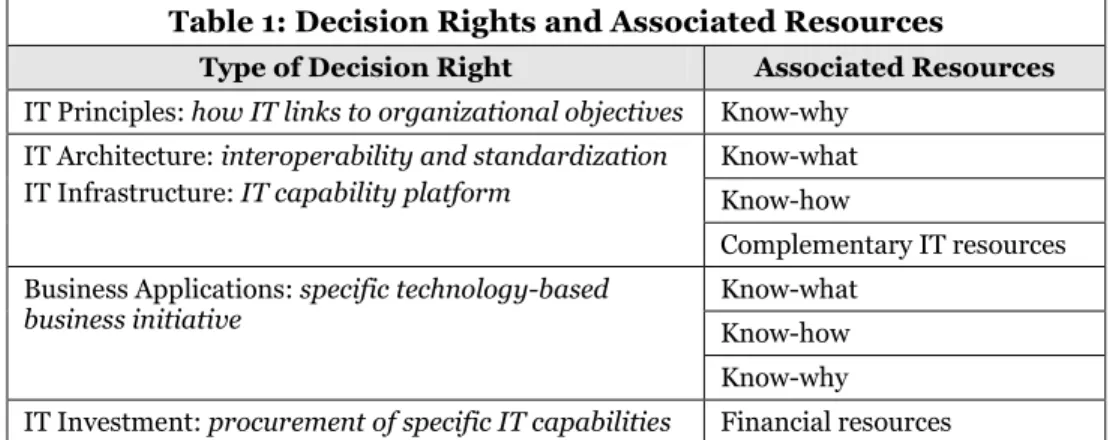
alone will hold the resources necessary to exercise a decision right. Because firms enjoy economies of scale and scope relative and scope relative to individual actors, they are in a better position to procure and accumulate the necessary resources (e.g., Hines 1957). In this case, decision rights are less decentralizable, unless explicitly allocated by the firm to individual actors, e.g., via budgetary control. In Table 1, we outline the key resources associated with each of the IT-related decision rights identified by Weill and Ross (2004). Exercising decision rights about IT principles requires know-why. As per Weill
1IT policy statements frequently circumscribe actors’ technology rights (Vaast and Kaganer 2013). These statements
notwithstanding, vari0us organizational actors retain some rights vis-à-vis information technologies. Residual rights theory is useful in shedding light on how this occurs. The theory posits two types of decision rights: specific rights, which are contractually assigned, and residual rights, which pertain under conditions not covered by a contract (Grossman and Hart 1986). In the context of IT adoption and use, decision rights are shared among stakeholders such as vendors, central IT departments and user departments, and even individual users. In our ensuing discussion of decision rights regarding different technologies, we therefore consider a decision right to be decentralizable absent a policy statement specifically precluding decentralization of that right.
and Ross (2004), decisions about IT principles entail relating IT to business objectives. This requires know-why, which Wang and Ramiller (2009: 717) defined why as “adoption rationales grounded in business benefits.” Exercising decision rights about IT architecture and infrastructure requires know-what, i.e., understanding “of the principles, features, or components of the innovation”, and know-how, which entails “strategies/capabilities for adopting, implementing, or assimilating the innovation” (Wang and Ramiller 2009: 717). Exercising these two decision rights also requires access to complementary resources such as data, processes, and other organizational applications. Exercising business application rights requires know-how, know-what, and know-why. Finally, the IT investment decision itself requires financial resources. We therefore define IT decentralizability as the degree to which an innovation can be adopted, implemented, and/or used independently by organizational members and units. This property derives from the extent to which decision rights pertinent to adoption of an organizational innovation can be decentralized, by virtue of where control of resources necessary to exercise those rights is located. The more location of resources and concomitant decision rights about an IT innovation are decentralized, the more independently users can adopt, implement, and use that IT innovation.
Table 1: Decision Rights and Associated Resources
Type of Decision Right Associated Resources IT Principles: how IT links to organizational objectives Know-why
IT Architecture: interoperability and standardization IT Infrastructure: IT capability platform
Know-what Know-how
Complementary IT resources Business Applications: specific technology-based
business initiative
Know-what Know-how Know-why
IT Investment: procurement of specific IT capabilities Financial resources
Extant study findings offer preliminary support for the relationship between resources held and IT centralization. For example, IT decentralization in the end-user computing era was driven largely by decreasing hardware costs, i.e., because the financial resources required of end-users were modest (Rockart and Flannery 1983). Factors increasing individuals’ know-what, know-how, and know-why (e.g., education and media exposure) were found to foster individual adoption (Brancheau and Wetherbe 1990). In Winkler and Brown’s (2013) study, centralization of IT application governance increased with the origination of the initiative with IT and with the IT units’ business knowledge – i.e., know-why. In the sections below, we now consider the decentralizability of social media and big data.
Decentralizability of Social Media
Social media is defined as “a group of Internet-based technologies that allows users to easily create, edit, evaluate, and/or link to content or to other creators of content” (Majchrzak et al. 2013: 38). Not only is social media used widely in the social sphere, but it has also been penetrated into many organizations (Chui et al. 2012; Kane et al. 2014). As with other technologies, business users have a strong grasp on know-why for the IT innovation (Miranda et al. 2015).
Not only is social media used for communication within an organization, but it is also used to interact with external stakeholders (Deans 2011; Kane et al. 2014). As such, social media spans boundaries between organizations and their external stakeholders (Jarvenpaa and Tuunainen 2013), increasing the breadth of information available (Treem and Leonardi 2012), linking people who are otherwise separated in terms of age, region, and time (Wattal et al. 2010; Kiron et al. 2012), and giving voice to all stakeholders (Majchrzak et al. 2013).
Although too much decentralization of social media initiatives can be harmful to organizations (Gallaugher and Ransbotham 2010), researchers have noted that decision rights with regard to social media tend to be highly decentralized (Kaganer and Vaast 2010; Kiron et al. 2012). For example, Gallaugher and Ransbotham (2010: 206) argued that “[b]ecause of widespread media attention, firms may find that staff demand access to these technologies or may have already launched initiatives on their own.” Kane (2013) made an even stronger argument for the fit of decentralized decision rights with social
media initiatives (what he terms social businesses): “[t]he most effective social businesses may start to look more like organizations that long predate modern corporations — so-called ‘loosely coupled’ organizations such as military, education and religious institutions.” Even for social media initiatives such as internal knowledge sharing, research has noted employees’ tendency to eschew official wiki tools for unofficial ones (Kiron et al. 2012).
Four social media characteristics make the innovation suitable for decentralization. First, social media typically does not require much investment in new IT infrastructure (Gallaugher and Ransbotham 2010; Kaganer and Vaast 2010), in fact, is available free of cost for many uses. SaaS features of reduced integration costs and meter-driven pricing lower financial barriers to entry, facilitating users’ investment in the IT innovation. Second, social media initiatives do not require complementary organizational resources such as data or other business application, and architecture and infrastructure decisions – such as which social media platforms to combine in an initiative – vests entirely with the user. Third, the try-before-buy SaaS feature enhances transparency of the architecture and infrastructure, putting know-what and know-how in the hands of prospective users. Fourth, being easy to use (Gallaugher and Ransbotham 2010) and familiar to most employees (McCarthy and Krishna 2011), social media typically does not require as much employee training (Wright 2013).
By virtue of its decentralizability, social media has been applied independently to initiatives in functions as diverse as marketing (Kane et al. 2014), employee training (Leidner et al. 2010; Koch et al. 2012), R&D (Di Gangi et al. 2010; Alexy et al. 2011), employee recruiting (Jarvenpaa and Tuunainen 2013), and customer engagement (Gallaugher 2010). Social media also has been used independently by employees in networking (Gray et al. 2011), promoting organizations (Wright 2013). Employees even have used social media in ways damaging to their organizations’ reputation (Aggarwal et al. 2012). In sum, while enterprise-wide strategic initiatives may yield additional value (Gallaugher and Ransbotham 2010; Deans 2011), decentralized tactical initiatives not only are feasible, but also provide value (Kane et al. 2014).
Decentralizability of Big Data
Gartner (2013a) defined big data in terms of three Vs: high volume, velocity, and variety. To these, researchers have added the characteristic of “veracity”, alluding to the challenges associated with validating big data, parsing noise and relevance, and detecting deception (Goes 2013; Lee et al. 2014). Big data IT innovations address such data, obtained from sources such as traditional organizational repositories, and blogs and other unstructured web content, mobile-device and sensor-based data (Chau and Xu 2012; Chen et al. 2012; Lau et al. 2012; Park et al. 2012; O'Leary 2013). Big data innovations include IT solutions oriented at storage, management, and analysis of such data (Goes 2013).
Scholars to date agree on the strategic significance of big data innovations (e.g., Davenport 2014; Bhimani 2015). Some believe that big data is inimical to conventional strategizing, leading to an “ad hoc, inductivist way of strategy making” (Constantiou and Kallinikos 2015: 51). Most suggest though that big data innovations “extend a firm’s business strategy toolbox” (Woerner and Wixom 2015: 62), that by making the real world “endogenous” to strategizing, big data renews and enhances strategic efforts (Yoo 2015). This line of thought emphasizes that advantages of big data accrue “only if IT and business management can work together” (Beath et al. 2012: 18). The heterogeneous, unstructured, haphazard, and trans-semiotic (i.e., comprised of text, image, and sound) nature of big data poses challenges to “established rules of strategy making” (Constantiou and Kallinikos 2015: 44).
Researchers suggest decisions to acquire big data technologies ought to be centralized – in other words, that big data itself is less decentralizable. Davenport (2014: 176) reported that though an “enterprise focus” was not a concern for start-ups and online firms, “in not a single one of [the twenty surveyed] large firms was big data being managed separately from other types of data and analytics.” He noted five complementary resources in the “big data stack”: storage, platform infrastructure, data, application code (used to manipulate the data), business view (used to prepare the data for analysis), and applications (such as visualization, BI, and analytics). Though SaaS delivery models are available for big data innovations too (Dillon et al. 2010; August et al. 2014), four key issues mitigate location of decision rights with users. First, the multi-tenancy model (i.e., cohabitation of data resources from multiple organizations on a single server) exacerbates security concerns such as non-malicious data loss and malicious targeting of data (Dillon et al. 2010; August et al. 2014). Thus, Brown et al. (2011: 11) cautioned that by making “IT architectures … more integrated and outward facing,” big data “will pose greater risks
to data security and intellectual property.” Further, data in general is increasingly being viewed as a critical organizational resource and consequently increasingly controlled via organizational structures such as the Chief Data Officer role (Lee et al. 2014) and by technologies such as firewalls (Njenga and Brown 2012). Second, possible decreases in infrastructure costs associated with the resource virtualization model are offset by increases in data communication costs (Dillon et al. 2010). Third, big data innovations necessitate synergistic collaborations among a variety of data owners to optimize the insights gleaned (e.g., Groves et al. 2013). Galbraith (2014: 5) noted “the company must work to integrate and unite the many islands of data and analytics that exist throughout the organization” in order to glean value from their big data initiatives or decision-makers using big data likely will be sidelined and ignored. SaaS-based big data innovations carry “significant security risk implications”, meriting careful organizational decision-making about their adoption (August et al. 2014: 490). Barton and Court (2012: 82) further suggested the need for organizations to “upgrade IT architecture and infrastructure for easy merging of data”, which end-users cannot undertake without central IT buy-in and support. Fourth, big data innovations require complementary technologies, e.g., data capture systems (O'Leary 2013). In other words, the requirements for complementary resources for leveraging value from big data investments are high and, as such, big data innovations do not lend themselves to unilateral adoption. Thus, Beath et al. (2012: 19) noted the salience of central IT since “IT runs the databases and data centers.”
Another key challenge to decentralized adoption of big data innovations is availability of know-what and know-how. The proliferation of university degree and certificate programs is equipping a multitude of college graduates with at least a rudimentary knowledge about how big data innovations can be used and what specific technology products and features are available (Davenport 2014). Yet, talent – i.e., “data scientists and other professionals skilled at working with large quantities of information” (McAfee and Brynjolfsson 2012: 66) – is scarce and is constraining effective deployment of big data initiatives (Davenport and Patil 2012). Further, while universities are able to impart generic technical knowledge, organization-specific technical knowledge. Such knowledge is necessary for effectively deploying big data within the architecture of the firm’s extant systems, but is unlikely to be available, except to those who have acquired that knowledge by working within that architecture, i.e., members of the IT department or others the organization deems to have legitimate need for access to that knowledge.
In other words, unlike social media, the know-what and know-how required for big data initiatives is not easily acquired by existing employees. Additionally, Lee et al. (2014: 1-2) suggested that “placing [data scientists] in operational business units without leadership at the corporate level might be insufficient to harness the full value of big data.” Further, Tambe (2014) noted that the value firms gleaned from their investments in specialized big data personnel was a function of their data assets, reinforcing our belief that leveraging value from big data investments requires multiple complementary investments. Along these lines, Barton and Court (2012: 82) noted that big data initiatives need to be “in sync with the company’s day-to-day processes.” Beath et al. (2012) also suggested that deriving value from big data necessitated refinement of business processes. Not surprisingly, under conditions of low uncertainty, research has found that data governance models that are congruent with business models are most effective – i.e., centralization is most appropriate for firms with similar business units and decentralization is most appropriate for diversified firms units (Velu et al. 2013). Lee et al. (2014: 2) emphasized need for centrally-located data officers and for “data-governance mechanisms, committees, councils and workgroups” because “data problems are often fundamentally business problems.”
Conceptual Model and Research Hypotheses
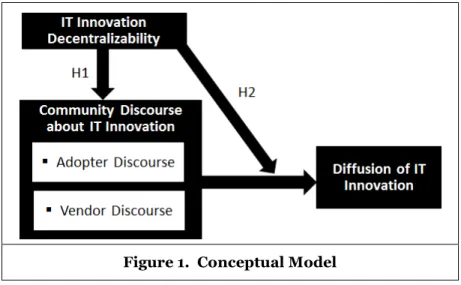
A central tenet of both organizing vision and computerization movement theories is that community discourse plays an important role in the diffusion of IT innovations (Swanson and Ramiller 1997; Iacono and Kling 2008). Using the concept of IT innovation decentralizability developed above, we characterize social media as a more decentralizable IT innovation and big data as a less decentralizable IT innovation. We then augment extant theory about effects of discourse on diffusion with two sets of hypotheses concerning the distinct roles of adopters and vendors as community members, summarized in the conceptual model in Figure 1. While the possible mediation role of discourse in the relationship between decentralizabilty and diffusion suggested by the figure is interesting indeed, we limit our focus to the relationships specified by our two research questions, i.e., the extent to which decentralizability influenced (1) discourse and (2) the relationship between discourse and diffusion.
Figure 1. Conceptual Model
IT Decentralizability and Community Member Discourse
We characterize social media as a more decentralizable IT innovation as financial outlays and infrastructure requirements are relatively low and requisite knowledge relatively well diffused. While not all social media products are available in SaaS delivery format, most are. Those (such as Chatter) that are not available in SaaS format, have SaaS counterparts such as Facebook and Twitter through which users can develop their know-what and know-how. By putting know-what and know-how in the hands of users, the SaaS try-before-buy feature reduces the need for communication by vendors. By necessitating few complementary resources and low financial commitment together with SaaS-based meter-driven pricing, social media vendors have maintained low barriers to entry, again reducing the need for vendor communication to entice user adoption and use of the IT innovation. In contrast, given the extensive hype and expectations of social media (Gartner 2013b), adopters’ discourse about their social media deployments provides shareholders with credible signals of their innovativeness and pro-activeness with IT use. In other words, the dynamics of mimetic isomorphism (DiMaggio and Powell 1983) increase adopters’ contributions to social media discourse.
We characterize the big data innovation as minimally decentralizable. While users may have the know-why, some know-what and know-how, and even the financial resources to implement big data, the absence of complementary resources limits decentralized adoption of big data innovations. Specifically, absent access to complementary resources such as data, processes, and related applications, users will lack the architecture and infrastructure decision rights necessary for implementing big data initiatives. Because big data does not lend itself to decentralized adoption, there will be fewer organizational actors able to offer testimony on the IT innovation. Lacking other information sources, vendors will have to advertise their products and services to attract adopters. In particular, vendors will need to share application-specific know-how related to data security, privacy, and scalability. Based on these arguments, we hypothesize that:
H1: Decentralizabilty of the IT innovation will affect discourse levels of community members such that (a) adopters will have higher discourse levels than vendors for social media (IT innovation with high decentralizability) and (b) vendors will have higher discourse levels than adopters for big data (IT innovation with low decentralizability).
IT Decentralizability and Effects of Discourse
The decentralizability of the social media innovation will influence the role of adopters’ versus vendors’ discourse in diffusion. With their ability to try a product before committing to the IT innovation, prospective adopters can glean the requisite know-how. Given the minimal investment threshold, prospective adopters will not require much information from vendors. Discourse by vendors therefore should have minimal – if any – impact on social media diffusion. By comparison, adopters’ communication of know-what and -why can stimulate mimicry (Angst et al. 2010) and innovation – as
adopters recombine existing social media uses into novel deployments (Moran and Ghoshal 1999) – within the adopter community. We therefore hypothesize that:
H2a: For social media, adopters’ discourse will facilitate diffusion more than vendors’ discourse.
While new, the big data innovation often is associated with existing technology such as business intelligence (Davenport et al. 2012). This confusion is exacerbated by business intelligence vendors such as IBM and SAS retooling themselves as big data vendors – a phenomenon not uncommon in the IT area. When prospective adopters face new technologies with similarities to existing technologies, they tend to “anchor” their assessment of the new technology to the existing knowledge (Moscovici 1984). Such anchoring precludes their view of the innovation as novel and therefore limits their engagement with the innovation (Bingham and Kahl 2013). Lower decentralizability of the innovation will limit the pool of adopters able to share information on the innovation’s novel features. Absent such information from adopters, vendor contributions highlighting the novel features of the innovation therefore will be critical to prospective adopters’ view of the big data innovation as novel and their engagement with it.
For big data products with an on-premise delivery model (i.e., without the try-before-buy option), vendors will need to justify firms’ costs associated with the IT innovation, and explain their costing mechanisms. For all products, vendors will need to assure prospective adopters of the robustness of their products relative to data security, privacy, and scalability issues. We therefore hypothesize that:
H2b: For big data, vendors’ discourse will facilitate diffusion more than adopters’ discourse.
Methods
The time span selected for studying social media diffusion was 2005 to 2011, and for big data diffusion was 2008 to 2014. We chose these time spans so as to capture diffusion of the two IT innovations from their inception. While prior research viewed 2007 as the start of social media diffusion (Miranda et al. 2015), our preliminary investigations revealed some discourse as early as 2005. Preliminary investigations revealed no discourse about big data before 2008, thereby setting the timeframe for our big data investigation to the seven-year period between 2008 and 2014 – the most recent year for which we could obtain complete data. To increase comparability of our data for the two IT innovations with regard to diffusion stages and the number of observations, we subsequently restricted our investigation of social media also to seven years, i.e., 2005 through 2011.
Sampling Approach
To test our hypotheses, we developed two samples for each IT innovation. The first sample for each innovation permitted us to operationalize discourse. This sample, representing the population of community members (i.e., for assessing adopter and vendor discourse), was developed from a Factiva search for the two key terms – social media and big data – for the period of our investigation. The Factiva search identified the 100 “most mentioned companies” in discourse about each of the two IT innovations. From these lists, we chose firms whose total volume of discourse about the focal IT innovation ranked among the top 10 across the entire period or who appeared on the top 100 list in more than five years. This process yielded 15 firms prominent in the social media discourse and 15 prominent in the big data discourse, accounting for 36% and 40% of the total discourse over the study period respectively.
The second sample permitted us to assess diffusion. This sample, representing the population of current and prospective adopter/user firms (i.e., for assessing diffusion), was the top 50 Fortune firms (from 2012 list). This sampling is appropriate because large organizations tend to be early adopters (e.g., Tolbert and Zucker 1983) and influence later adopters (e.g., Han 1994).
Data Collection and Coding Procedures
For the firms in each sample, we searched the firms’ press releases – our unit of analysis – for their use of the “social media” and “big data” buzz words for the seven-year period. Press releases are “overt discursive actions used by organizations for public relations, marketing, etc., and are written in a form that can easily be used by journalists” (Kaganer et al. 2010: 11). Being costlier and more deliberate (Dennis et al. 2008), written discourse is likely to be more valid than spoken discourse, which may represent spontaneous utterances. We then excluded press releases about social media and big data not
emanating from focal firms from subsequent analyses. This yielded: 482 press releases from the sample of firms prominent in the social media discourse; 1,608 press releases from the sample of firms prominent in the big data discourse; and 358 press releases about social media and 68 press releases about big data from the sample of prospective adopters.
We then read and coded each PR based on the role played by the focal firm, i.e., adopter or vendor. We coded a firm as an “adopter” if they discussed their use of IT innovation, and a “vendor” if they discussed selling or promoting the IT innovation for other organizations’ initiatives. For instance, Facebook was coded as a vendor when it discussed the applications available through Facebook (May 27, 2007). IBM was coded as a vendor when it discussed unveiling new software that “brought the power of managing and analyzing big data to the workplace” (October 24, 2011). CVS Caremark was coded as an adopter in its discussion of its hosting of live Facebook chats during American Diabetes Month (November 3, 2011). Walmart was coded as adopter when it discussed its plan to build a broader assortment through investing in big data capability (October 15, 2014). A firm could be coded as playing an adopter role in one press release and a vendor role in another. For example, Facebook and Salesforce adopted and sold social media; EMC and IBM adopted and sold big data. The first and the third authors discussed and iteratively-developed coding rules for designating a firm’s role depicted in a press release as adopter or vendor. They then coded a sample of 30 press releases independently. Inter-rater reliability, computed as Cohen’s kappa was found to be 0.80. Coding rules subsequently refined, together with sample quotes illustrating the rules, are provided in Table 2. Thereafter, the first author coded the social media press releases and the third author coded the big data press releases.
Dataset and Metrics
From the data gathered and coded as described above, we created a panel dataset. The panel comprised the 50 Fortune companies, i.e., prospective adopters/users, and 28 quarters (7 years) for each IT innovation. This enabled us model the effects of community discourse (by adopters and vendors) in a given quarter on diffusion of the IT innovations within a firm in subsequent quarters.
Diffusion
While original meanings of diffusion address innovation adoption (Rogers 2010), researchers have suggested that focusing on use may be more appropriate to studies of the diffusion of organizational innovations (e.g., Fichman 1992). There are three reasons why a diffusion-as-use perspective may be more appropriate. First, diffusion of an organizational innovation is a multi-stage process “…that starts at adoption and extends to usage” (Zhu and Kraemer 2005: 62). Second, organizations comprise multiple adopting units (e.g., Cool et al. 1997). Third, organizations may apply an IT innovation toward multiple problematics (Miranda et al. 2015). Our diffusion measure as a count of Fortune 50 firms’ press releases describing different firm initiatives involving social media or big data therefore is consistent with this diffusion-as-use perspective and with prior measures of organizational IT use (Dehning et al. 2007).
Discourse
Community discourse was operationalized as the quarterly number of press releases by firms that were prominent in IT innovation discourse signaling adoption or vending. Specifically, we counted the number of press releases signaling adoption and those signaling vending to yield the quarterly count metrics for adopter and vendor discourse respectively. Because prospective adopters need time to process community discourse, we investigated effects of lagged discourse on diffusion of the IT innovations. For social media, prior research has found that effects of discourse on diffusion can be visible within one year (Miranda et al. 2015). In the case of big data, a Gartner study found that of firms aware of the IT innovation, 47% had adopted it, 30% planned to adopt it within 1 year, 23% within 2 years (Gartner 2013a), suggesting an average time from awareness to adoption of three quarters2. We therefore use
counts of press releases for the four quarters preceding the diffusion quarter. While investigation of longer lags undoubtedly would be desirable, longer lags decreased the effective number of observations in the analyses and therefore the power of our tests.
Table 2: Coding Rules and Illustrations
Rule Text Illustrating Coding Rule Adopter Role
Adoption anduse of the focal IT innovation
Chevrolet will also leverage social-media services, including Gowalla,
FourSquare, and Qrank, to connect with consumers in Austin. (GM 3/3/2011) Acquiring firms with capabilities
in the focal IT innovation for purposes of improving internal capabilities
EMC Corporation announced it has signed an agreement to acquire privately-held Silver Tail Systems, a leader in real-time web session intelligence and behavioral analysis. (EMC 10/30/2012)
Hiring executives with expertise in the focal IT innovation for purposes of enhancing internal capabilities
We are excited to welcome Jolie to AOL as a member of our executive leadership team. Hunt has an extensive background building the reputations for some of the world’s leading media and technology companies. (AOL 7/17/2012)
Vendor Role Selling or promoting the focal IT
innovation for other
organizations’ initiatives (e.g., launching IT innovation-related products or services)
Amazon Web Services LLC (AWS), a subsidiary of Amazon.com Inc. (NASDAQ: AMZN), today launched “Public Data Sets on AWS,” providing access to a centralized repository of public data sets that can be seamlessly integrated into AWS cloud-based applications. (Amazon 12/ 4/2008) Acquiring firms for purposes of
improving capabilities of products and/or services to be sold
Salesforce.com (NYSE: CRM), the enterprise cloud computing company, today announced it has entered into a definitive agreement to acquire Model Metrics, a mobile and social cloud consulting services company. With Model Metrics, salesforce.com will add mobile and social expertise, allowing the company to further transform customers and empower its global partner ecosystem. (Salesforce 11/14/2011)
Collaboration with
university/college to develop students’ skills with the focal IT innovation
Teradata University Network, in conjunction with Teradata (NYSE: TDC), the analytic data solutions company, is now offering free web-based certification training for students seeking to make themselves attractive candidates for analytic data jobs or a wide range of other jobs that today require data-driven decision-making. (Teradata 12/19/2012)
Holding/attending a conference or workshop on the focal IT innovation
Actuate Corporation (NASDAQ: BIRT), The BIRT Company(TM) - delivering more insights to more people than all BI companies combined, today announced they will participate at the E2 Conference next week as part of the panel discussion. (6/10/2013)
Announcing award/recognition related to a focal IT innovation product/service, which the firm sells
IBM (NYSE: IBM) today announced that it has been named the market share leader in the big data market for the second consecutive year, according to Wikibon's Big Data Vendor Revenue and Market Forecast report. IBM again ranks number one ahead of more than 70 vendors considered in the research. (IBM 3/27/2014)
Controls
Consistent with prior diffusion research (Bass 1969; Mahajan and Peterson 1985), we included cumulative
community use in the diffusion models. This was operationalized as the total number of press releases prior to a given data quarter. Strang and colleagues suggested that diffusion should be modeled as heterogeneous across the community of prospective adopters (Strang and Tuma 1993; Strang and Soule 1998), accounting for differences in organizations’ susceptibility/receptivity to the innovation. We therefore included firm performance, since performance influences firms’ inclination toward exploratory or exploitative learning (e.g., Baum and Dahlin 2007), and cumulative firm use, to account for learning and other spillover advantages of firms’ prior use. We operationalized firm performance as profit (dollar value in millions) and cumulative firm use as the total number of press releases issued by that firm about the focal IT innovation prior to the given data quarter.
Results
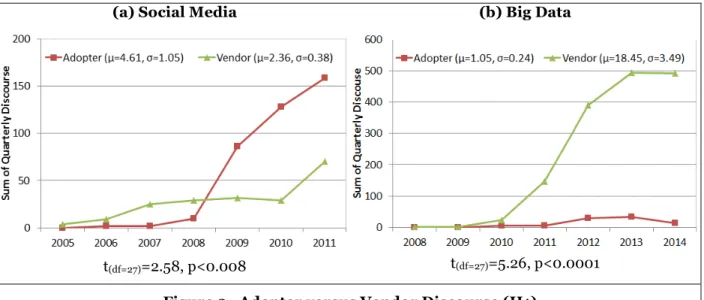
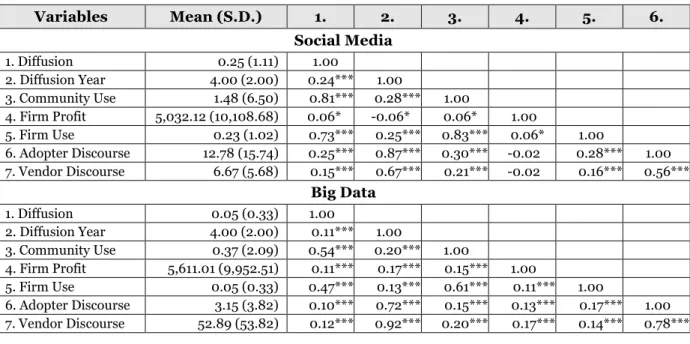
Descriptive statistics are provided in Appendix A. To test our first set of hypotheses – that adopters and vendors participate to different levels in the discourse concerning the two technologies, we graphed adopter and vendor discourse over time. Results presented in Figure 2 support hypotheses 1a and 1b. Specifically, in Figure 2a, we observe that while vendors’ contributions to the community discourse exceeded adopters’ contributions for the first four years, adopters’ contributions greatly exceeded that of vendors in the subsequent three years, resulting in a quarterly average number of contributions by vendors of 2.36 press releases and by adopters of 4.61 press releases (t=2.58, p<0.008). In Figure 2b, we observe adopter discourse contributions consistently to be lower than vendor contributions across the entire 7-year period. The quarterly average number of contributions by vendors was 18.45 press releases and by adopters was 1.05 (t=5.26, p<0.0001)3.
(a) Social Media
t(df=27)=2.58, p<0.008
(b) Big Data
t(df=27)=5.26, p<0.0001
Figure 2. Adopter versus Vendor Discourse (H1)
While we attempted to develop two comparable samples to study social media versus big data diffusion in our study design, Figure 2 suggests heterogeneity of the data across the two IT innovations. Since the panel dataset contains multiple observations for each firm over time, the residual terms are likely to be correlated within each firm (i.e., autocorrelation). We therefore used STATA’s Prais-Winsten regression with panel-corrected standard errors (PCSE), which assumes heteroscedasticity across panels and permits correction for panel-specific autocorrelation (Cameron and Trivedi 2005)4.
Table 3 reports on the effects of community discourse on social media diffusion (hypothesis 2a). We observe that adopter discourse explains a significant – albeit modest – 0.7% of the variance in diffusion (∆R2 for model 3), whereas the effects of vendor discourse are insignificant (∆R2 for model 4). Examining
model 3 further, we observe that adopter discourse influences social media diffusion with a two-quarter lag. Finally, combining the effects of adopter and vendor discourse contributes to an insignificant increment in variance explained (∆R2 for model 5), leading us to reject this model. (In the interest of
conserving space, we signify only significant coefficients in the table, with the number of negative or
3To capture the effect of IT decentralizability on community discourse as represented in Figure 1 more directly – in addition to the
differential effect of decentralizability on adopter and vendor discourse argued in Hypothesis 1, we also directly compared discourse levels across the two IT innovations. We found these differences to be significant (see Appendix B, Figure B1), i.e., higher levels of adopter discourse for the more decentralizable innovation – social media – and higher levels vendor discourse for the less decentralizable innovation – big data. Supplementary analysis in Appendix B (Table B1) also confirms the direct positive effect of decentralizability on diffusion, after controlling for effects of the diffusion year (β=0.021, p=0.086), community use (β=0.000, p<0.190), firm profit (β=0.000, p<0.530), and firm prior use of the IT innovation (β=0.147, p<0.000). Table B1 then provides evidence that this relationship is fully-mediated by discourse – partially by adopter discourse, and fully by vendor discourse.
4Our test for H2 differs from conventional diffusion analysis for two reasons. First, we are estimating diffusion-as-use rather than
positive signs indicating the strength of the negative or positive relationship.) Nonetheless, this model is informative in that we observe no significant effects of vendor discourse, but a positive – though more immediate – effect of adopter discourse on diffusion. Together, these findings support hypothesis 2a.
Table 3: Community Discourse and Social Media Diffusion across Firms Independent Variables 1. Community Control 2. Firm Control 3. Adopter Discourse 4. Vendor Discourse 5. Both† Constant -.1887 -.3103* -.1997 -.3739* Diffusion Year .1052*** .12 33*** .0789 .1341*** Community Use .0036** -.0037** -.0050*** -.0043** ––– Firm Profit .89e-05* .88e-05* .92e-05* +
Firm Use .1473*** .1461*** .1472*** +++ Discourse t-1q .0002 -.0015 ++ t-2q .0120** .0053 t-3q -.0009 .0046 t-4q -.0020 -.0042 R2 0.0509*** 0.4634*** 0.4707*** 0.4639*** 0.4716*** ∆R2 0.4125*** 0.0073** 0.0005 0.0082
*|–|+ p<0.05; **|––|++ p<0.01; ***|–––|+++ p<0.001 †only significant coefficients signified to conserve space
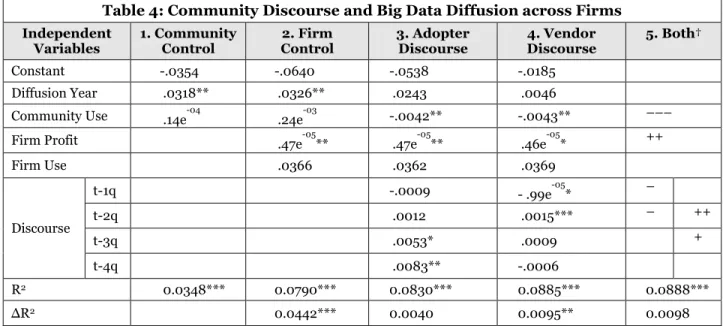
Table 4 reports on the effects of discourse on big data diffusion (hypothesis 2b). Here, we observe that insignificant effects of adopter discourse (∆R2 for model 3), but that vendor discourse explains a
significant 0.95% of the variance in diffusion (∆R2 for model 4). Examining model 4 further, we observe
that vendor discourse has a slight, but significant negative effect on big data diffusion with a one-quarter lag and a significant, positive effect on big data diffusion with a two-quarter lag. Finally, combining the effects of adopter and vendor discourse contributes to an insignificant increment in variance explained (∆R2 for model 5), leading us to reject this model. Nonetheless, this model is informative in that the only
significant effects of adopter discourse on big data diffusion are slight and negative, whereas positive effects of vendor discourse still are visible. Together, these findings support hypothesis 2b.
Table 4: Community Discourse and Big Data Diffusion across Firms Independent Variables 1. Community Control 2. Firm Control 3. Adopter Discourse 4. Vendor Discourse 5. Both† Constant -.0354 -.0640 -.0538 -.0185 Diffusion Year .0318** .0326** .0243 .0046
Community Use .14e-04 .24e-03 -.0042** -.0043** ––– Firm Profit .47e-05** .47e-05** .46e-05* ++
Firm Use .0366 .0362 .0369 Discourse t-1q -.0009 - .99e-05* – t-2q .0012 .0015*** – ++ t-3q .0053* .0009 + t-4q .0083** -.0006 R2 0.0348*** 0.0790*** 0.0830*** 0.0885*** 0.0888*** ∆R2 0.0442*** 0.0040 0.0095** 0.0098
Discussion
Researchers increasingly are noting the role of community discourse in IT innovation diffusion. The goal of our study was to answer two questions related to such discourse: To what extent do contributions by adopters and vendors to discourse about IT innovations differ across types of innovations? How does IT innovation decentralizability influence effects of discourse contributions by adopters and vendors on diffusion of the IT innovations? We began to address these questions by developing the decentralizabilty
concept based on the IT decision rights literature. Following our review of the social media and big data literatures, we noted the evident decentralizability of social media and the limits to decentralizability of big data – stemming from the need for complementary resources and specialized technical knowledge. As a decentralizable IT innovation, we then hypothesized that adopters would contribute more to the community discourse about social media than vendors, and that their discourse would influence the diffusion of the IT innovation more than would that of vendors. Our findings support both hypotheses. Between 2005 and 2011, adopter contributions to the social media discourse exceeded vendor contributions and had a stronger impact on social media diffusion than did vendor discourse. Our characterization of big data as a less decentralizable IT innovation led us to hypothesize that vendors would contribute more to the community discourse than adopters, and that their discourse would influence the diffusion of the IT innovation more than would that of adopters. Our findings support both hypotheses. Between 2008 and 2014, vendor contributions to big data discourse exceeded adopter contributions and had a stronger impact on big data diffusion than did adopter discourse.
In addition to findings related to our hypotheses, one notable observation from Figure 2 is that within the seven-year time periods studied, big data diffusion substantially lagged social media diffusion. That diffusion of big data so lags that of social media perhaps is unsurprising in light of findings by Grover and Goslar that (1993) that organizational centralization was negatively associated with the adoption and diffusion of telecommunications technology. In other words, perhaps the centralized nature of big data decision rights has retarded big data diffusion; in contrast, the highly decentralizable decision rights associated with social media have accelerated social media diffusion across organizations.
Theoretical Contributions and Practical Implications
We offer four theoretical contributions to the IT diffusion literature. First, we fine-tune organizing vision and computerization movement theories by highlighting the differential roles of different community members in diffusing different IT innovations. Second, we introduce the concept of IT decentralizability, which augments extant conceptualizations of IT innovation characteristics of relative advantage, compatibility, complexity, trialability, and observability. Our conceptualization of IT decentralizability further suggests possible inter-relationships among some of these IT characteristics. Specifically, we noted the salience of trialability – in the SaaS try-before-buy feature, which conveys know-what and -how, and consequently associated decision rights, to prospective adopters. This suggests that decentralizability may be the more-proximate antecedent to diffusion, mediating effects of other characteristics such as trialability. Fourth, in contrast to the focus on individuals’ perceptions of IT innovations in much of the prior diffusion literature, our concept of decentralizablity considers a characteristic of the two IT innovations – social media and big data – within an organizational context.
For vendors, our findings highlight their essential role in facilitating diffusion of IT innovations. Though adopter contributions to the social media discourse exceeded vendor contributions across the study period, it is important to be cognizant of the initially higher levels of vendor contribution. In fact, in the first four years of social media diffusion (2005 through 2008), vendor (µ=1.40, σ=0.27) discourse levels significantly exceeded adopter (µ=0.19, σ=0.12) discourse levels (t=3.80, p<0.0004). In this regard, our findings are consistent with Wang and Ramiller’s (2009) findings that vendors contributed 31% of the discourse at the emergence of ERP, while adopters (the next most active participants) contributed 19%. For managers of adopter firms, our findings suggest that adopter discourse is more informative for decentralizable innovations, while vendors’ input is key with regard to less decentralizable innovations.
Limitations and Future Research Directions
We developed our hypotheses based on our conceptualization of social media as a more decentralizable IT innovation and of big data as a less decentralizable IT innovation. While prior research supports this