Adaptive Emergency Evacuation Centre
Management for Dynamic Relocation of Flood
Victims using Firefly Algorithm
Noraziah ChePa
1, Nor Laily Hashim
2, Yuhanis Yusof
1, Azham Hussain
21Computational Intelligence Research Group, School of Computing, Universiti Utara Malaysia, Malaysia. 2Software Technology, School of Computing, Universiti Utara Malaysia, Malaysia.
Abstract—Situations during bad flood demands a systematic management of evacuation centres. Flood evacuation centres which are gazeted as temporary locations to evacuate flood victims have chances from being drowned by flood. Problem occurs to relocate flood victims when the evacuations centres are flooded. Currently, there is no study done on proposing a decision support aid to reallocate victims and resources of the evacuation centre when the situation getting worsens. Therefore, this article proposes a decision aid model to be utilized in realizing an adaptive emergency evacuation centre management system. This study undergoes two main phases; development of algorithm and models, and development of a web-based and mobile app. The proposed model operates using Firefly multi-objective optimization algorithm that creates an optimal schedule for the relocation of victims and resources for an evacuation centre. The proposed decision aid model and the adaptive system can be applied in supporting the National Security Council’s respond mechanisms for handling disaster management level II (State level) especially in providing better management of the flood evacuating centres.
Index Terms— Flood; Evacuation Centre; Optimization; Firefly Algorithm.
I. INTRODUCTION
Malaysia was hit with the worst flood in 100 years in both January 2007 and January 2015. The flood caused more than 100,000 people to be evacuated in the state of Johor alone in January 2007, with the total cost of the damage in the country estimated to be RM1.5 billion. In November 2010, the north Malaysian were hit with a series of floods concentrated in the Malaysian states of Kedah and Perlis. The floods involved around 50,000 people evacuated and left at least four people dead [1]. The vast increasing numbers of the lost from flood enforces the government to take proactive steps in dealing with flood problems such as setting up supervisory bodies, implementing flood mitigation programmes, implementing non-structural steps with the setting up of flood forecasting and warning systems for the flood prone area.
Nevertheless, the most important flood management focused on the immediate evacuation for the victims. The evacuation and relocation of flood victims involves a lot of capital. As informed by the Minister in the Prime Minister Department in March 2011, almost USD 21.12 million was spend in for 89,000 flood victims in five states effected by the disaster and it was
estimated that 53 percent of that amount was spent on relocation of the victims, which also includes food and other daily necessities. At the moment, there are 5,156 evacuation centres nationwide have been identified which could accommodate up to 1.4 million flood victims with 28,000 disaster relief personnel from various agencies as well as 12,500 volunteers from NGOs on standby. These evacuation centres have been setup to accommodate flood victims which increasing yearly.
Currently, there is no research yet done to provide solution on reallocating victims and resources when the evacuation is almost drowned. Therefore, this research proposes an Adaptive Emergency Evacuation Centre Management (AEECM) which is capable of providing a decision support capabilities to provide solution for relocation of victims and resources to other evacuation centres when these centres are drowned. The proposed solution will provide information on the quantity of victims and resources that are required to be transported to the new evacuation centres.
This paper presented an Adaptive Emergency Evacuation Centre Management (AEECM) as a decision support in relocating flood victims. Section 2 discussed evacuation center management and the issues. Section 3 covers methodology of designing, devoping, and evaluation of AEECM. Concluding remarks is covered in Section 4.
II. EVACUATION CENTRE MANAGEMENT
In Malaysia, evacuation centres which mainly used for evacuating flood victims are managed by the Department of Social Welfare (Jabatan Kebajikan Masyarakat, JKM). JKM works closely with a number of governmental and non-governmental agencies to provide necessary steps to ensure safety and comfort in every evacuation centre. These individuals are the backbone of the flood evacuation centres and often face difficult decision making problems. Despite immediate actions have been taken by the Department of Social Welfare to manage all victims at the evacuation centres, the authority still falls short to manage the flux of victims.
Due to the large number and urgency of managing the flood victims, the authority is facing some problems to manage all victims effectively. The volunteers and officers cannot resolve all of the problems faced by victims who have been living in evacuation centres for longer period of time due to the lack of
supply, funding, or access. Even though these people usually have clear instructions about how to act, they often have difficulties in making appropriate decisions, due to a combination of factors, including time pressure and heavy emotions. In the recent 2015 flood tragedy, several flood evacuation centres in Kuala Krai were drowned. For example, SMK Manek Urai was drowned where it previously held 500 evacuees [2].
Despite the information that the rescuing team and evacuation centre staff have from the e-banjir portal on the evacuation centre for example on the current water level, number of victims at each evacuation centre, quantity of flood supply and others, the rescuing team was late in making decision to reallocate the victims to other safer evacuation centres. The flood already reached the third floor of the school building before they started to move the victims to other centres. Therefore, this has risen to the needs of having a decision support aid that is able to provide solution to help the evacuation centres staff to make quick and accurate decision to reallocate the trapped victims and their resources to the safest evacuation centres. Early interview with an officer of Kedah State, Department of Social Welfare, Rusdi Ishak [3], also supported the same claim.
There are many issues that have to be considered while planning and managing evacuation centres during flood disaster. Among the issues that is closely related with evacuation centres is on resource coordination and distribution. Multiple demands on resources are to be expected and how these demands will be addressed and prioritised has to be decided. Where gaps are identified, mutual aid should be considered and arrangements of victims to other evacuation centres with adequate resources should be put into place [4].
Zhu [5] proposed a resource allocation model that is aimed at determining the location of reserve depots and the amount and type of resources to be stored. It is modelled based on discrete scenarios that is divided into two; local government and national. Their optimization focuses on the commodities inventory holding and transportation cost. A more recent work was discussed in [6] that proposed a model that identifies the optimal number, location and inventory level of warehouses around the world in the occurrence of a disaster. The model considers uncertainties on product quality, availability and production capacity in affected areas.
III. ADAPTIVE EMERGENCY EVACUATION CENTRE
(AEECM)
An Adaptive Emergency Evacuation Centre Management (AEECM) is proposed as a decision support tool to provide solutions for relocation of victims and resources to other evacuation centres when the existing centres are drowned. The proposed solution will provide information on the number of victims and resources that are required to be transported to the new evacuation centres. Three main phases involved in designing and developing AEECM which operates based on multi-objective optimization algorithm are (a) design and development of Firefly multi-objective and (b) design and development of the mobile apps and web-based of AEECM, and
A. FA Development
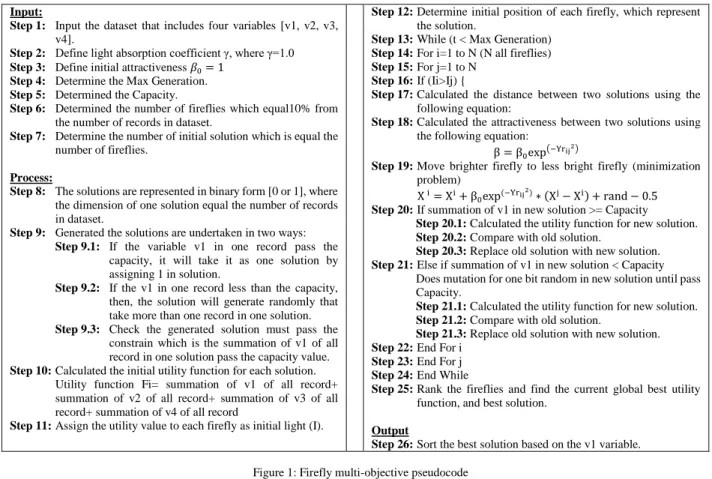
FA is adapted in finding the best available evacuation centres to relocate the victims if the existing evacuation centre itself is predicted to be closed. Based on its strength, FA is capable of achieving the mentioned objectives. Factors to be considered in selecting the best new evacuation centres are size of an EC (V1), distance of an EC to a nearby river (V2), water level of a nearby river (V3) and distance of an EC to a nearby river (V4). Based on the mentioned factors and criteria, a pseudocode is designed as shown in Figure 1.
Input of the proposed FAFlooding are defined based on some important parameters for operating the algorithm such as the light absorption coefficient γ, where it set to 1 in the algorithm, the value of initial attractiveness β0, where it sets to 1, the number of max generation, the value of capacity which is equal to the value of number of victims that needs to be in safe places, the number of fireflies which is equal to 10% from the number of records in dataset, and finally is the number of initial solution which is equal to the number of fireflies. The proposed FAFlooding starts to operate by generating the initial solutions which are represented in binary form [0 or 1], where the dimension of one solution equals the number of records in dataset. The generating of the initial solutions are undertaken in two ways: If the variable V1 in one record passes the capacity, it will take it as one solution by assigning 1 in solution, else, the solution will be generated randomly that takes more than one record in one solution. Then, the generated solutions are undergone to check the constraint which is the summation of V1 of all record in one solution and passes the capacity value. After that, the generated initial solution is undergone to be evaluated using an objective function (Utility function) as shown in Figure 2. Assign the inverse of utility value (fitness) of each solution to each firefly as initial light (I). Then, the initial position of each firefly is determined, which is represented by the solution. The proposed utility function is of minimum problem as most of the included parameters V1, V2, and V3 prefer small values. For example, an EC with a smaller distance to the closed EC is preferred when compared to the EC that has farther distance. On the other hand, the fourth parameter which is V4 is of maximum value as the system needs to avoid EC that is near to a river. In addition, the first variable includes the constraint of 75% usage as we need to ensure that there is no EC that is 100% occupied for safety and convenience purposes. The fireflies competed between them to determine the best solution that has maximum fitness value. The firefly with the brightest light attracts the brighter ones by firstly determine the distance between two solutions using Hamman distance.
B. AEECM Development
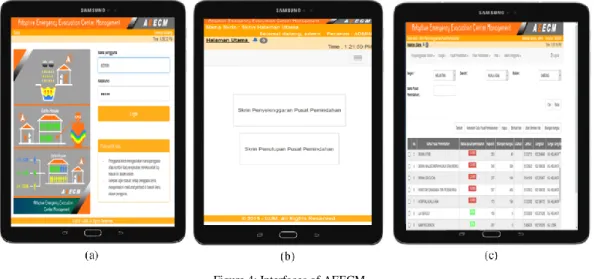
This phase involved requirements gathering and development of web-based and mobile apps of AEECM. The FA with multi-objective algorithm and supporting model has been translated into Android platform using PHP and Java. AEECM is developed for authorities who are managing evacuation centers; JKM officer, rescuers, and the head of villagers. As a start, Kuala Krai, Kelantan is chosen involving 109 evacuation centers from four districts; Guchil, Mengkebang, Manek Urai,
ECs, as shown in Figure 4(b). Maintenance will be handled by JKM officers, while authority to close the EC is given to the head of villagers, who is in charged with the EC in their area. ECs will be closed when water level approching a danger level.
In order to close, victims need to be relocated. Once head of villagers request for closing the EC, system will automatically generate several evacuation plans by proposing the nearest available ECs. Status of ECs can be seen in Figure 4(c). Input:
Step 1: Input the dataset that includes four variables [v1, v2, v3, v4].
Step 2: Define light absorption coefficient γ, where γ=1.0
Step 3: Define initial attractiveness 𝛽0= 1
Step 4: Determine the Max Generation.
Step 5: Determined the Capacity.
Step 6: Determined the number of fireflies which equal10% from the number of records in dataset.
Step 7: Determine the number of initial solution which is equal the number of fireflies.
Process:
Step 8: The solutions are represented in binary form [0 or 1], where the dimension of one solution equal the number of records in dataset.
Step 9: Generated the solutions are undertaken in two ways:
Step 9.1: If the variable v1 in one record pass the capacity, it will take it as one solution by assigning 1 in solution.
Step 9.2: If the v1 in one record less than the capacity, then, the solution will generate randomly that take more than one record in one solution.
Step 9.3: Check the generated solution must pass the constrain which is the summation of v1 of all record in one solution pass the capacity value.
Step 10:Calculated the initial utility function for each solution. Utility function Fi= summation of v1 of all record+ summation of v2 of all record+ summation of v3 of all record+ summation of v4 of all record
Step 11:Assign the utility value to each firefly as initial light (I).
Step 12:Determine initial position of each firefly, which represent the solution.
Step 13:While (t < Max Generation)
Step 14:For i=1 to N (N all fireflies)
Step 15:For j=1 to N
Step 16:If (Ii>Ij) {
Step 17:Calculated the distance between two solutions using the following equation:
Step 18:Calculated the attractivenessbetween two solutions using the following equation:
β = β0exp(−Yrij 2)
Step 19:Move brighter firefly to less bright firefly (minimization problem)
X i= Xi+ β 0exp(−Yrij
2)
∗ (Xj− Xi) + rand − 0.5
Step 20:If summation of v1 in new solution >= Capacity
Step 20.1:Calculated the utility function for new solution.
Step 20.2:Compare with old solution.
Step 20.3:Replace old solution with new solution.
Step 21:Else if summation of v1 in new solution < Capacity Does mutation for one bit random in new solution until pass Capacity.
Step 21.1:Calculated the utility function for new solution.
Step 21.2:Compare with old solution.
Step 21.3:Replace old solution with new solution.
Step 22:End For i
Step 23:End For j
Step 24:End While
Step 25:Rank the fireflies and find the current global best utility function, and best solution.
Output
Step 26:Sort the best solution based on the v1 variable.
Figure 1: Firefly multi-objective pseudocode
Utility function (F) = Summation of (75% of V1) of available EC + Summation of V2 of available EC + Summation of V3 of available EC – Summation of V4 of available EC
Figure 2: Utility function
Figure 3: AEECM architecture
C. AEECM Evaluation
AEECM has undergone a thorough system testing, which 38 tests cases have been constructed. For comparison purpose, AEECM which runs using FA (FAFlood) was compared with
Tabu search (TSFlood) [16] and [17]. Table 1 depicted the comparison result.
The effectiveness of TSFlood and FAFlood is evaluated based on two criteria; utility value and computational time. AEECM prefers the method that produces solution with the lowest utility value and computational time. This scenario investigates solutions for a to-be closed EC with number of victims that is larger than the capacity of any available EC. Meaning that the solution is expected to consist of a combination of ECs. In Table 1, the proposed algorithms were executed for three times for the to-closed EC. Assuming the closed EC is ECID_76 and the number of victims in this EC is (298) greater than the capacity of any EC. As shown in Table 1, the utility values of FAFlood are (5635.15, 5235.45, and 4068.59) which are smaller than TSFlood which are (5754.95, 5545.95, and 4521.59). However, the execution time for TSFlood (305, 368, and 295) is better than FAFlood which took 676, 641, and 641ms. Results of the experiments show that the average value of utility function produced by FA solutions is smaller than the one obtained by Tabu Search. Nevertheless, it is noted that FA consumes larger computational time compared to Tabu Search. Result suggested by FA is more economic and less hassle in transporting the victims.
Figure 4: Interfaces of AEECM
Table 1 Result of TSFlood and FAFlood
Center to-be
closed Victims
FAFlood TSFlood
Solution Utility value Time (ms) Solution Utility value Time (ms)
ECID_76 298 ECID_38 = 255 ECID_34 = 43 5635.15 676 ECID_38 = 255 ECID_80 = 43 5754.95 305 ECID_34 = 245 ECID_64 = 53 ECID_80 = 253 ECID_70 = 45 ECID_64 = 242 ECID_60 = 56 ECID_70 = 249 ECID_90 = 49 ECID_76 298 ECID_70 = 249 ECID_34 = 49 5235.45 641 ECID_70 = 249 ECID_90 = 49 5545.95 368 ECID_34 = 245 ECID_64 = 53 ECID_90 = 203 ECID_125 = 95 ECID_64 = 242 ECID_121 = 56 ECID_125 = 197 ECID_103 = 101 ECID_76 298 ECID_88 = 255 ECID_70 = 4068.59 641 ECID_37 = 189 ECID_46 = 109 4521.59 295 ECID_70 = 249 ECID_34 = 49 ECID_46 = 188 ECID_57 = 110 ECID_34 = 245 ECID_64 = 53 ECID_57 = 179 ECID_105 = 119
User acceptance test (UAT) of AEECM has been conducted in Kuala Krai, Kelantan and Penang involving respondents among the officer of Social Welfare department (JKM), the rescuing teams, head of villagers, and the manpower of evacuation centres. First part of UAT involved training and hands on sessions. Second part of UAT investigated on AEECM participant behavior’s, especially on how they perceive their experience in using AEECM system for the first time in each of the four specific scenarios.
First UAT in Kuala Krai involved 7 participants. 42.9% of the respondents are Head of Villagers, 28.6% of the respondents who are JPAM personnel, 14.3% are District Officer and Social Welfare Officer (admin) respectively. Second session of UAT was carried out in Penang involving four categories of system users as well. The UAT tests were done at user environment, whereas the data setup was based on requirement provided by the client. For example the map for location of the flood is linked with Google Maps API. For Admin module, there are 7
District Officer module with similar function, they have executed 2 test scenarios for each UAT session and number of task is 8. In both UAT tests in Kuala Krai and Penang, the test script is 100% successfully passed with no major defects. It shows that AEECM is usable and acceptable by the real users. Table 2 depicted results of tests execution.
Table 2 AEECM test result execution
Module Number of Test Number of Pass Test
Admin (JKM) 46 46
Head of Villager 14 14
Rescuer 8 8
District Officer 8 8
Four criteria have been considered in measuring usability of AEECM; usability acceptance (learnability, efficiency), information (content), user interface, and user satisfaction.
management. Table 3 depicted cross tabulation result of efficiency of AEECM.
Table 3
Cross tabulation Analysis of efficiency criteria
Scale 5 (Strongly Agree) 7 Total
Admin 0 1 1
District Officer 1 0 1
Head of Villagers 0 3 3
Rescuer 2 0 2
Total 3 4 7
Although result of UAT shows that users are satisfied with AEECM, there is area of improvement that could be done to make the system more effective and easy to use. One of the suggestions is to simplify the evacuation relocation process. Secondly, since portable device is the most practical platform to use AEECM during flood, information displayed must be only relevant to disaster data for quick decision making in response and relief phase to support the small screen [15]. Another suggestion coming from District Officer (DO) who involved in the National Security Council. It is claimed that the decision making on relocation of flood victims for Stage 2 is under responsibility of the District Officer. Thus, they should be given the access and authority for Admin module.
IV. CONCLUSION
This paper proposed a dynamic relocation of flood victims through an Adaptive Emergency Evacuation Centre Management (AEECM). AEECM is capable of providing a decision support capabilities to provide solution for relocation of victims and resources to other evacuation centres when these centres are drowned. The proposed solution will provide information on the quantity of victims and resources that are required to be transported to the new evacuation centres. The proposed decision aid model and the adaptive system can be applied in supporting the National Security Council’s respond mechanisms for handling disaster management level II (State level) especially in providing better management of the flood evacuating centres.
ACKNOWLEDGEMENT
This research is funded by Ministry of Education Malaysia (MoHE) through Fundamental Research Grant Scheme [13183 (2015)]. The authors fully acknowledged MoHE and UUM for the approved fund which makes this important research viable and effective.
REFERENCES
[1] Government Portal 2015. Public Infor Banjir, retrieved from http://publicinfobanjir.water.gov.my.
[2] Bernama 2015. Kaji Kawasan Baharu Untuk Dijadikan Pusat Pemindahan Banjir - Panglima ATM.Bernama.com. Retrieved from http://web6.bernama.com/bernama/v3/bm//news_lite.php?id=1103254 [3] Rusdi Ishak (personal communication, 12 January 2014)
[4] HM Goverment. 2006. Evacuation and Shelter Guidance. Retrieved
February 26, 2015, from
https://www.gov.uk/government/publications/evacuation-and-shelter-guidance
[5] Zhu, J., Huang, J., Liu, D., and Han, J. "Resource Allocation Problem for Local Reserve Depots in Disaster Management based on Scenario Analysis". 7th International Symposium on Operations Research and Its Applications (ISORA’08).2008. Lijiang, China
[6] Duran, S., Gutierrez, M. A., and Keskinocak, P. "Pre-Positioning of Emergency Items for CARE International". Interfaces. vol. 41(3), pp. 223-237, 2011.
[7] Yang, X.-S. 2010. Nature-inspired metaheuristic algorithms 2nd edition. United Kingdom: Luniver Press.
[8] Hassanzadeh, T., Faez, K., and Seyfi, G. "A Speech Recognition System Based on Structure Equivalent Fuzzy Neural Network Trained by Firefly Algorithm. Proceedings of the International Conference on Biomedical Engineering (ICoBE), Penang, 2012.Hassanzadeh, T., Vojodi, H., and Moghadam, A. M. E. "An Image Segmentation Approach Based on Maximum Variance Intra-Cluster Method and Firefly Algorithm". 7th
International Conference on Natural Computation (ICNC). Shanghai, China, 2011.
[9] Horng, M. H., and Jiang, T. W. "Multilevel Image Thresholding Selection based on the Firefly Algorithm". 7th International Conference on Ubiquitous Intelligence & Computing and 7th International Conference on Autonomic & Trusted Computing. 2010.
[10] Dos Santos Coelho, L., De Andrade Bernert, D. L., and Mariani, V. C. "A chaotic firefly algorithm applied to reliability-redundancy optimization".
IEEE Congress on Evolutionary Computation (CEC) 2011. New Orleans, LA.
[11] Pop, C. B., Chifu, V. R., Salomie, I., Baico, R. B., Dinsoreanu, M., and Copil, G. "A Hybrid Firefly-inspired Approach for Optimal Semantic Web Service Composition". Scientific International Journal for Parallel and Distributed Computing. vol. 12(3), 2011.
[12] Nandy, S., Sarkar, P. P., and Das, A. "Analysis of a Nature Inspired Firefly Algorithm based Back-propagation Neural Network Training".
International Journal of Computer Applications. vol. 43(22), pp. 8-16, 2012.
[13] Adaniya, M. H. A. C., Abr˜ao, T., and Proenc¸a Jr., M. L. "Anomaly Detection Using Metaheuristic Firefly Harmonic Clustering". Journal of Networks. vol. 8(1), pp. 82-91, 2013.
[14] Dorasamy, M., Raman, M., and Kaliannan, M. "Evaluating CEMAS in Simulated Environment to Support Disaster Management Challenges".
11th International ISCRAM Conference. Pennsylavania: University Park. pp. 444-453, 2014.
[15] Koora, B.K., Satpute, N.R., Adiga, A., "Tabu search based implementation of object tracking using joint color texture histogram".
7th IEEE International Conference of Industrial and Information Systems (ICIIS), 2012. 6-9 August 2012. 1-6.
[16] Rathore, A., Bohara, A., Gupta Prashil, R., Lakshmi Prashanth, T. S. and Srivastava, P.P. "Application of genetic algorithm and tabu search in software testing. In 4th Annual ACM Bangalore Conference (COMPUTE '11). 2011, New York, USA.