theRepository at St. Cloud State
Culminating Projects in Information Assurance Department of Information Systems
12-2017
Multi-Stage Detection Technique for DNS-Based
Botnets
Wasseem Jammal
St. Cloud State University, [email protected]
Follow this and additional works at:https://repository.stcloudstate.edu/msia_etds
This Thesis is brought to you for free and open access by the Department of Information Systems at theRepository at St. Cloud State. It has been accepted for inclusion in Culminating Projects in Information Assurance by an authorized administrator of theRepository at St. Cloud State. For more information, please [email protected].
Recommended Citation
Jammal, Wasseem, "Multi-Stage Detection Technique for DNS-Based Botnets" (2017).Culminating Projects in Information Assurance. 38.
1
Multi-Stage Detection Technique for DNS-Based Botnets by Wasseem Jammal A Thesis
Submitted to the Graduate Faculty of St. Cloud State University
in Partial Fulfillment of the Requirements for the Degree of
Master of Science in Information Assurance
December, 2017
Thesis Committee: Tirthankar Ghosh, Chairperson
Mark Schmidt Mehdi Mekni
Abstract
Domain Name System (DNS) is one of the most widely used protocols in the Internet. The main purpose of the DNS protocol is mapping user-friendly domain names to IP addresses. Unfortunately, many cyber criminals deploy the DNS protocol for malicious purposes, such as botnet communications. In this type of attack, the botmasters tunnel communications between the Command and Control (C&C) servers and the bot-infected machines within DNS request and response. Designing an effective approach for botnet detection has been done previously based on specific botnet types Since botnet communications are characterized by different features, botmasters may evade detection methods by modifying some of these features. This research aims to design and implement a multi-staged detection approach for Domain Generation Algorithm (DGA), Fast Flux Service Network, and Domain Flux-based botnets, as well as encrypted DNS tunneled-based botnets using the BRO Network Security Monitor. This approach is able to detect DNS-based botnet communications by relying on analyzing different techniques used for finding the C&C server, as well as encrypting the malicious traffic.
Acknowledgement
First and foremost, I would like to express my sincere gratitude to my advisor, Dr. Tirthankar Ghosh, for his support of my study and research. He has been
supportive since the days I began taking his classes on the Intrusion Detection & Prevention Systems, Firewalls, and Penetration Testing. In his lectures and projects, I remember he used to say, "In security, you have to think like a bad guy and act like a good guy " to promote our critical thinking as graduate students. Besides my advisor, I would like to thank the rest of my thesis committee, Dr. Mark Schmidt and Dr. Mehdi Mekni, for their encouragement and insightful comments.
I would also like to express my profound thanks to my parents, brothers, and sisters for providing me with unfailing support and continuous encouragement throughout my life.
Last, but not the least, I would like to thank my wife, Amal, for her sincere support. I would never have been able to finish my thesis without her love, support, and patience.
Thank you very much, everyone!
Table of Contents Page List of Tables ... 6 List of Figures ... 7 Chapter I. Introduction ... 8 Introduction ... 8 Problem Statement ... 10
Nature and Significance of the Problem ... 11
Objective of the Study ... 12
Limitations of the Study ... 13
Definition of Terms ... 13
Summary ... 15
II. Background and Review of Literature ... 16
Introduction ... 16
Background Related to the Problem ... 16
Literature Review ... 22
Summary ... 32
III. Methodology ... 33
Introduction ... 33
Design of the Study ... 33
Chapter Page
Data Analysis ... 38
Summary ... 38
IV. Data Presentation and Analysis ... 39
Introduction ... 39
Data Presentation ... 39
Data Analysis ... 41
Summary ... 49
V. Results, Conclusion, and Recommendations ... 50
Introduction ... 50 Results ... 50 Conclusion ... 53 Future Work ... 53 References ... 55 Appendices: A. DNA Message Format ... 60
B. Iodine Lab Implementation ... 68
C. DNS2TCP Lab Implementation ... 73
D. BRO Network Security Monitor Scripts ... 77
List of Tables
Table Page
1. Variety of Botnet Automated Activities ... 12
2. Definition of Terms Used in This Document ... 13
3. Domain Flux Implementation ... 20
4. FFSN & DF Implementation ... 21
5. Feature Vector ... 23
List of Figures
Figure Page
1. Botnet architectures ... 18
2. Fast-Flux service network ... 20
3. DNS tunneling ... 22
4. Functioning principle of the DNS-based anti-evasion technique for botnet detection ... 26
5. A High-Level Overview of Pleiades ... 29
6. DNS statistics ... 35
7. Multistage detection technique for DNS-based botnets ... 35
8. Iodine and DNS2TCP lab ... 41
9. DNS packets statistics–DGA-based botnet ... 42
10. Wireshark packet capture of DGA-based botnet ... 43
11. DNS packets statistics–FFSN & DF-based botnet ... 43
12. Domain flux implementation ... 44
13. FFSN implementation ... 45
14. Iodine connection negotiation ... 45
15. SSH connection tunneled in DNS packets (iodine) ... 47
Chapter I: Introduction Introduction
Cyber-attacks, including malware injection, never stop threatening computer networks and information systems. One of the predominant forms of spreading malware is infecting systems with malicious software forcing them to act as botnets. These botnets often utilize Domain Name System (DNS) protocol to hide their communication with their Command & Control (C&C) servers. This research aims to design and implement a multi-staged detection approach for Domain Generation Algorithm (DGA), Fast Flux Service Network, and Domain Flux-based botnets, as well as encrypted DNS tunneled-based botnets using BRO Network Security Monitor.
Domain Name System is the Internet’s equivalent of a phone book and a central part of the Internet, providing a mechanism for naming resources in such a way that the names are usable in different hosts, networks, protocol families, internets, and administrative organizations (RFC 883). In other words, DNS
translates more readily memorized domain names to numerical IP addresses needed for locating and identifying computing devices and services (Domain Name System, 2017).
According to Wikipedia, mapping a simpler and more memorable name to a numerical address dates back to the ARPANET era (1969-1990). The Stanford Research Institute (SRI) maintained a text file named HOSTS.TXT to map host names to the numerical addresses of computers on the ARPANET. Each time a host had to connect to the network, it would have to download the latest version of the
table. At that time, the addresses were assigned manually, but by the early 1980s, keeping a single and centralized host table had turned out to become slow and unwieldy, creating the need for an automated naming system. The Domain Name System was created by Paul Mockapetris and the Internet Engineering Task Force (IETF) published the original specifications in RFC 882 and RFC 883 in November 1983 (Domain Name System, 2017).
A botnet, or robot network, is a collection of Internet-connected computers (bots) that are infected with a specific malware that allows these bots to be remotely controlled by a Command and Control (C&C) server (What is a Botnet Attack?-Definition, n.d.). Although DNS protocol is typically used for benign purposes, it can be used to port malicious packets. Domain Name System protocol can be abused at different stages of the communication process with botnets, which may implement some techniques to circumvent the detection methods.
Domain Generation Algorithm (DGA), Fast-Flux Service Network (FFSN), Domain Flux1, Double Flux, and DNS tunneling can be used as evasion techniques in
botnet communications (Dietrich et al., 2011; Farnham & Atlasis, 2013; Lysenko, Pomorova, Savenko, Kryshchuk, & Bobrovnikova, 2015). In DGA, a large number of short-lived domain names are generated. While the DNS A-record (IP address) for a specific malicious domain name changes frequently in FFSN, the DF changes the C&C server’s domain name repeatedly by implementing short TTL period. With DNS
tunneling, botnet communications with C&C servers can be wrapped and tunneled through DNS packets.
BRO Network Security Monitor is a powerful and open-source network analysis framework (The Bro Network Security Monitor, n.d.). The initial version of BRO was designed and implemented by Vern Paxson in 1995. BRO focuses on network security monitoring, and provides a comprehensive platform for more general network traffic analysis tasks even outside of the security domain, including performance measurements and helping with troubleshooting.
BRO is not a classic signature-based intrusion detection system (IDS). While it supports such standard functionality as well, BRO supports a wide range of analyses through its scripting language which indeed facilitates a much broader spectrum of very different approaches to finding malicious activity, including semantic misuse detection, anomaly detection, and behavioral analysis (Bro Introduction, n.d.). Problem Statement
Different botnets implement different protocols to communicate with C&C servers. As the Domain Name System (DNS) is one of the least monitored protocols from a security perspective, many cyber criminals abuse DNS to tunnel botnet communications, and some of the tunneling tools may encrypt the payload to evade detection. According to Dietrich et al. (2011), "DNS is usually one of the few
protocols- if not the only one- that is allowed to pass without further ado" (p. 10), thus making it an attractive means of botnet tunneling. Furthermore, many botnet
(Lysenko et al., 2015). This makes the detection and prevention efforts more complicated.
Domain Name System protocol can be abused at different stages of the botnet communication process, such as finding the C&C server, transmitting data, and/or controlling the bots. At the initial stage of botnet communication, a bot tries to find its C&C server by sending DNS requests to resolve the domain name(s) of the malicious server. After finding the C&C server, the communications between C&C server and the bot start. These communications may include data exfiltration, data infiltration, or controlling the bot to perform malicious actions against other systems.
Nature and Significance of the Problem
Botnets have become one of the most significant concerns on the Internet. "According to a report from Russian-based Kaspersky Labs, botnets–not spam, viruses, or worms … pose the biggest threat to the Internet. A report from Symantec came to a similar conclusion" (Newman, 2010). Botnet malware can be used against any Internet connected device, including smart televisions, to execute a wide range of malicious actions. These actions include launching a distributed denial-of-service (DDoS), phishing, generating and sending spam messages, propagating malware, sniffing information, hosting malicious content, and using infected bots for proxy activities (Bots and Botnets–A Growing Threat, 2016). Table 1 shows some malicious activities that are executed against or by botnet-infected machines.
Table 1
Variety of Botnet Automated Activities
Data exfiltration against bots
Data infiltration against bots Activities performed by bots • Stealing sensitive information • Installing malware • Sending spams • Lunching DoS • Click fraud • Proxy activities
The resiliency and dynamic nature of botnets pose challenges to detection methods, like when the botmasters change the botnets’ characteristics to avoid detection methods. Designing and implementing a detection mechanism for DNS-based botnets will rely on analysis of botnet features, and implementation of detection methods and existing evasion techniques.
Objective of the Study
Using BRO Network Security Monitor, the main objective of this study is to design and implement an effective detection technique for DNS-based botnets using rule-based and signature-based techniques in two phases. The first phase will implement a rule-based mechanism to detect the existence of DGA, FFSN, or DF based botnets, which are utilized to find the C&C server. The second phase will implement a signature-based mechanism to detect DNS tunneling, which is utilized to wrap malicious traffic in DNS packets.
Limitations of the Study
This study required a group of real botnet-infected machines and C&C servers. Network traffic of previously infected machines were used for analysis and design of the proposed detection mechanism of the DGA, FFSN, and DF implementations. Definition of Terms
Table 2
Definition of Terms Used in This Document
Term Definition
Authoritative Name Server (NS)
A name server that provides actual, original and definitive answer to DNS queries such as – mail server IP address (MX resource record) or web site IP address (A resource record). It does not provide just cached answers that were obtained from another name server.
What Is Authoritative Name Server? (2009, August 17). Retrieved March 25, 2017, from https://www.dnsknowledge.com/whatis/authoritative-nameserver/
Botmaster A person who operates the command and control of botnets for remote process execution.
DDoS Attack Definitions - DDoSPedia. (n.d.). Retrieved March 25, 2017, from
https://security.radware.com/ddos-knowledgecenter/ddospedia/botmaster/ Botnet (Zombie
Army)
An interconnected network of computers infected with malware without the user's knowledge and controlled by cybercriminals.
What is a Botnet Attack? - Definition. (n.d.). Retrieved March 25, 2017, from https://usa.kaspersky.com/internet-securitycenter/threats/botnet-attacks#.WN3sKYWcE2w
Command and Control Server (C&C)
A computer that controls and issues commands to members of a botnet. Botnet members may be referred to zombies and the botnet itself may be referred to as a zombie army.
What is command-and-control servers (C&C center)? - Definition from WhatIs.com. (n.d.). Retrieved March 25, 2017, from
http://whatis.techtarget.com/definition/command-andcontrol-server-CC-server
Covert Channel A mechanism for sending and receiving information data between machines without alerting any firewalls and IDS’s on the network. IDFAQ: What is covert channel and what are some examples? (n.d.). Retrieved March 25, 2017, from https://www.sans.org/security-resources/idfaq/what-is-covertchannel-and-what-are-some-examples/2/17 Distributed
Denial of Service
A type of DoS attack where multiple compromised systems, which are often infected with a Trojan, are used to target a single system causing a
Denial of Service (DoS) attack. Victims of a DDoS attack consist of both the end targeted system and all systems maliciously used and controlled by the hacker in the distributed attack.
Beal, V. (n.d.). DDoS attack - Distributed Denial of Service. Retrieved March 25, 2017, from
http://www.webopedia.com/TERM/D/DDoS_attack.html
DNS Tunneling The ability to encode the data of other programs or protocols in DNS queries and responses.
What is DNS Tunneling? (2017, January 04). Retrieved March 25, 2017, from https://www.plixer.com/blog/networksecurity-forensics/what-is-dns-tunneling/
Domain Flux (DF) A technique for keeping a malicious botnet in operation by constantly changing the domain name of the botnet owner's
Command and Control (C&C) server.
What is domain fluxing? - Definition from WhatIs.com. (n.d.). Retrieved March 25, 2017, from
http://searchsecurity.techtarget.com/definition/domain-fluxing
Domain Generation Algorithm (DGA)
A class of algorithm that takes a seed as an input, outputs a string and appends a top-level domain (TLD) such as .com, .ru, .uk, etc. in order to form a possible domain name. The seed is a piece of information accessible to both the botmaster and the infected host now acting as a bot. Why Domain Generating Algorithms (DGAs)? -. (2016, August 17). Retrieved March 25, 2017, from http://blog.trendmicro.com/domain-generating-algorithms-dgas/
Double Flux A DNS technique used by botnets to provide an additional layer of redundancy by changing the DNS A-records and authoritative NS-records continually for malicious domain using the round robin algorithm.
Fast Flux Networks Working and Detection, Part 1. (2015, February 13). Retrieved March 25, 2017, from http://resources.infosecinstitute.com/fast-flux-networks-workingdetection-part-1/#gref
Dynamic Domain Name System (DDNS)
A method of automatically updating a name server in the Domain Name System (DNS), often in real time, with the active DDNS configuration of its configured hostnames, addresses or other information.
Dynamic DNS. (2017, February 18). Retrieved March 25, 2017, from https://en.wikipedia.org/wiki/Dynamic_DNS
Fast Flux or Single Flux (FFSN)
A DNS technique used by botnets to associate a single domain name with many IP addresses and to hide phishing and malware delivery sites behind an ever-changing network of compromised hosts acting as proxies. Fast flux. (2017, March 20). Retrieved March 25, 2017, from https://en.wikipedia.org/wiki/Fast_flux
Metamorphic and polymorphic malware
Two categories of malicious software programs that have the ability to change their code as they propagate. With polymorphism, each time the bot binary propagates, it encrypts its original code to avoid pattern recognition. Instead of the code encryption, metamorphism changes the code to an equivalent one each time.
What is metamorphic and polymorphic malware? - Definition from WhatIs.com. (n.d.). Retrieved March 26, 2017, from
http://searchsecurity.techtarget.com/definition/metamorphicand-polymorphic-malware
Network Address Translation (NAT)
The process where a network device, usually a firewall, assigns a public address to a computer (or group of computers) inside a private network. The main use of NAT is to limit the number of public IP addresses an organization or company must use, for both economy and security purposes.
What is Network Address Translation (NAT)? (n.d.). Retrieved March 25, 2017, from http://whatismyipaddress.com/nat Resource
Records
The data elements that define the structure and content of the domain name space. All DNS operations are ultimately
formulated in terms of resource records.
Resource Records. (n.d.). Retrieved March 25, 2017, from http://www.freesoft.org/CIE/Course/Section2/8.htm
Single Flux The simplest type of fast flux, characterized by multiple individual nodes within the network registering and de-registering their IP addresses as part of the DNS A (address) record list for a single domain name. This combines round robin DNS with very short time to live - usually less than five minutes - to create a constantly changing list of destination
addresses for that single DNS name. Fast flux. (2017, March 08). Retrieved March 25, 2017, from
https://en.wikipedia.org/wiki/Fast_flux#Single-flux_and_doubleflux Zombie A computer connected to the Internet that has been compromised by a
hacker, computer virus or Trojan horse program, and can be used to perform malicious tasks of one sort or another under remote direction. Zombie (computer science). (2017, March 22). Retrieved March 25, 2017, from https://en.wikipedia.org/wiki/Zombie_(computer_science)
Summary
This chapter covered an introduction about botnets and their significance. Also, DNS protocol and how it is abused in favor of botnet communication, as well as some common evasion techniques used to circumvent botnet-detection methods. The next chapter provides an overview of botnets, more details about DNS-based botnet-detection methods and evasion techniques with a detailed review of existing literature.
Chapter II: Background and Review of Literature Introduction
Botnets use various communication protocols to tunnel and hide themselves from detection. Also, they may use encryption techniques to encrypt the tunnel itself. These evasion techniques complicate the detection process.
Research communities have proposed many different approaches for botnet detection. Many of these approaches are based on a specific type of botnet. Studying and analyzing different botnet features, implemented detection approaches, and evasion techniques will be helpful in designing and implementing a new approach for detecting DNS-based botnets at different stages of communications.
Background Related to the Problem
Most computers that are co-opted to serve in botnet are often home-based and are inadequately protected by an effective firewall or other safeguard (Rouse, 2012). According to Trend Micro, the two pieces of malware that started the botnet usage were Sub7 and Pretty Park–a Trojan and a Worm, respectively
(CounterMeasures–A Security Blog, 2010). These malwares introduced the concept of a victim machine connecting to an IRC channel to listen for malicious commands. These two pieces of malware first surfaced in 1999 and botnet innovation has been constant since then. Steadily, botnets migrated away from the original IRC Command & Control (C&C) channel to communicate over HTTP, ICMP, SSL, and DNS ports, often using custom protocols.
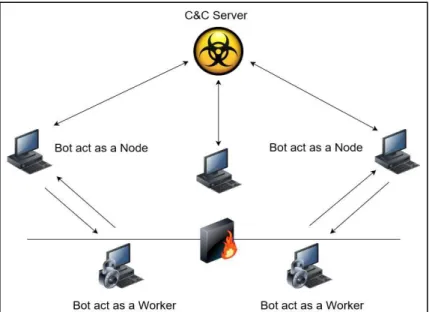
Botnet structure has evolved over time to evade detection and disruption. Bots are traditionally constructed as clients which communicate via central servers.
Theses bots connect to one or more servers through one or more domains, allowing the botmaster to perform with total control from a remote location. The centralized C&C model introduces a single point of failure; if the C&C domain is identified and dismantled, the botmaster loses control over the entire botnet (Antonakakis et al., 2012). To solve the problem of security, researchers and authorities target botnet domains and C&C servers. Many recent botnets now rely on peer-to-peer networks to communicate. These P2P bot programs perform the same actions as the client- server model without the need for a central server to communicate (Botnet, 2017).
In a peer-to-peer model, incoming connections to computers–that are behind a Network Address Translation (NAT) gateway, firewall, or proxy server–cannot be established. This would prevent most bots being connected to by other bots. In a client-server model, this obviously is not a problem as the bots connect to the server, so a peer-to-peer network still requires servers in a way (Peer-to-Peer Botnets for Beginners, 2016).
Bots that are not behind a proxy / NAT / firewall can accept incoming connections and act as servers. These bots are usually referred to as nodes or
peers, whereas the bots that do not accept incoming connections are usually referred to as workers. In a peer-to-peer model, the workers connect to one or more nodes to receive command(s). These nodes are technically servers, and the workers are
distributed between many nodes. This scenario allows the workers to shift to another node if one is dismantled.
Peer-to-Peer botnets present more challenges for detection authorities; it is impractical to take all the nodes down since the nodes are legitimate devices. They cannot simply be seized like a server would be (Peer-to-Peer Botnets for Beginners, 2016). Figure 1 shows the two communication models: client-server model between workers and C&C server and peer-to-peer model between nodes and workers.
Figure 1. Botnet architectures.
Botnets core components include C&C server(s) and zombies. Upon
successful infection, the infected machine tries to connect to the C&C server at the initial stage. There are different ways to find the C&C server: a) the IP address or the domain name of the C&C server is hard coded in the malware, b) the malware
implements Domain Generation Algorithm (DGA), c) the malware implements Fast-Flux Service Network (FFSN), or d) the malware implements Domain Fast-Flux (DF). In
the hard coding implementation, it is easy for defenders, upon botnet discovery, to block a specific IP address or domain name. However, with DGA, it is difficult to block tens of thousands of unpredictable generated domain names, and the problem
becomes more complicated when implementing DGA, FFSN, and DF together, thus, the traditional blacklisting technique based on the IP address or domain name is ineffective, and it is difficult to trace a large number of nodes ready to register their IP addresses to a domain name(s).
A botnet that implements DGA generates tens of thousands of domain names per day. These domains are short-lived and blacklists will not be effective. As
generated domains are predictable to the botmaster, they need to register only one of the domains to initiate C&C connection, whereas defenders need to block any
generated domains that are registered to completely eliminate C&C activity (Hagen & Luo, 2016).
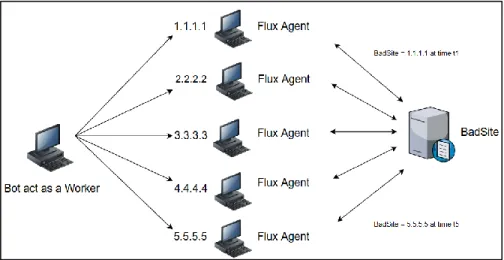
In FFSN, the basic concept is having multiple IP addresses associated with a single domain name, and then constantly changing them in quick succession. If one or more of them drop, others quickly take their place (Albors, 2017). Figure 2 shows how botmasters use bots (flux agents) to act as proxies to the C&C server.
Figure 2: Fast-Flux service network.
Using FFSN, a domain name resolves different IP addresses depending on the exact time in which the petition is made, which enables the decentralization of the C&C servers and complicates unraveling the structure of the botnet. To carry out the IP resolution changes, these domains have very low TTL in the cache, which forces the DNS systems to frequently refresh the resolution cache of the IP addresses associated to the domain. In the case of a null TTL, the resolution is not even stored. Therefore, those DNS petitions whose TTL is low are suspicious (Cantón, 2015). Table 3 illustrates the Concept of Domain Flux.
Table 3
Domain Flux Implementation
Time IP Address Domain Name
T1 1.1.1.1 3.3.3.3 7.7.7.7 botnet.com
T2 1.1.1.1 3.3.3.3 7.7.7.7 malicious.com
T3 1.1.1.1 3.3.3.3 7.7.7.7 C&C.com
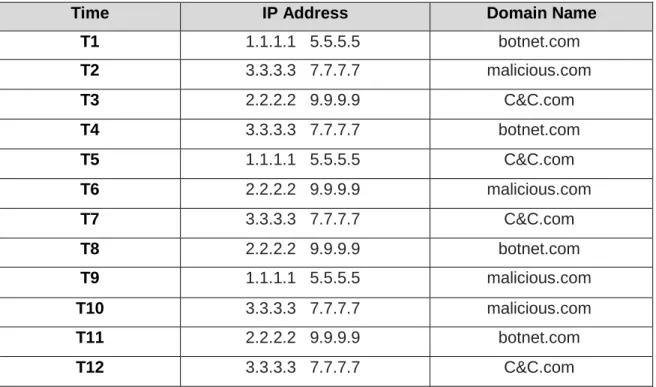
In DF, the botnets evade the detection by implementing short TTL periods and cycling of IP mappings for the domain name of C&C-servers (Lysenko et al., 2015). Table 4 illustrates the concept of FFSN and DF combination. The DF can be
implemented along with DGA or can be utilized by instructing bot(s)–already connected–to request different domains next time.
Table 4
FFSN & DF Implementation
Time IP Address Domain Name
T1 1.1.1.1 5.5.5.5 botnet.com T2 3.3.3.3 7.7.7.7 malicious.com T3 2.2.2.2 9.9.9.9 C&C.com T4 3.3.3.3 7.7.7.7 botnet.com T5 1.1.1.1 5.5.5.5 C&C.com T6 2.2.2.2 9.9.9.9 malicious.com T7 3.3.3.3 7.7.7.7 C&C.com T8 2.2.2.2 9.9.9.9 botnet.com T9 1.1.1.1 5.5.5.5 malicious.com T10 3.3.3.3 7.7.7.7 malicious.com T11 2.2.2.2 9.9.9.9 botnet.com T12 3.3.3.3 7.7.7.7 C&C.com
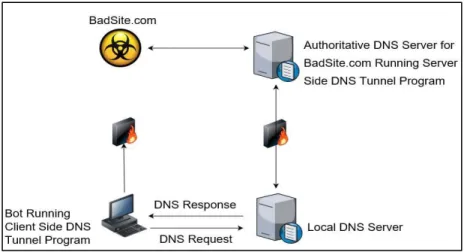
In DNS tunneling, a botmaster can abuse the Domain Name Service protocol, if the DNS traffic is not restricted, to establish a C&C channel between the bot(s) and the C&C server. These channels are difficult to detect and block. Some DNS
utilized to encrypt botnet communications to complicate traffic inspection. Figure 3 shows how a bot communicates with a C&C server through DNS tunnel.
Figure 3. DNS tunneling.
Literature Review
Dynamic domain generation, fluxing, and tunneling techniques have been used by different malware families to avoid detection and complicate mitigation efforts. Research communities have proposed many different approaches and mechanisms for the development of the botnet-detection techniques. Many of these approaches are effective for specific types of botnet.
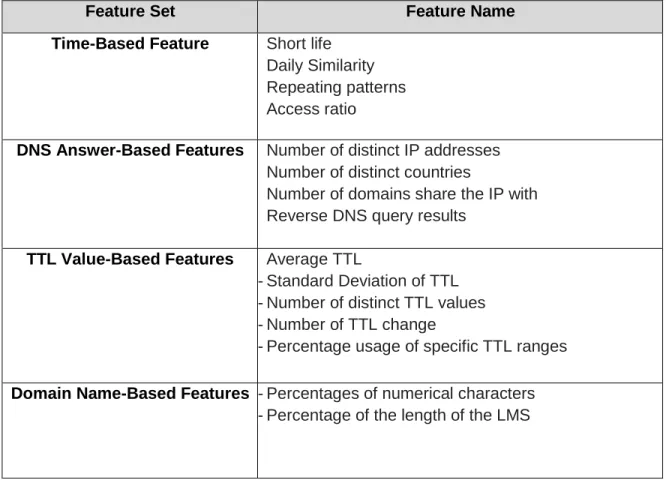
Bilge, Sen, Balzarotti, Kirda, and Kruegel(2011) identified a feature vector with 15 different features for malicious domain detection. These features are classified into four feature sets:
1. Time-Based Features.
2. DNS Answer-Based Features. 3. TTL Value-Based Features. 4. Domain Name-Based Features.
Table 5 shows that each feature set has a different feature for malicious domain detection.
Table 5
Feature Vector (Bilge et al., 2011)
Feature Set Feature Name
Time-Based Feature 1- Short life 2- Daily Similarity 3- Repeating patterns 4- Access ratio
DNS Answer-Based Features 5- Number of distinct IP addresses 6- Number of distinct countries
7- Number of domains share the IP with 8- Reverse DNS query results
TTL Value-Based Features 9- Average TTL
10- Standard Deviation of TTL 11- Number of distinct TTL values 12- Number of TTL change
13- Percentage usage of specific TTL ranges
Domain Name-Based Features 14- Percentages of numerical characters 15- Percentage of the length of the LMS
Krmíček (2011)examined the NetFlow1 of DNS IP traffic and its relation to the
botnet presence in the monitored network. He studied the DNS behavior of known malicious and benign domains based on features identified by Bilge, Sen, Balzarotti, Kirda, and Kruegel (2011). Since NetFlow inspects only packet headers, not the
1 Unidirectional sequence of packets with some common properties that pass through a network device. (p. 1).
entire packet payload, Krmíček concluded that "using NetFlow data solely, for the purpose of botnet detection is not possible" (p. 8), and he mentioned that extracting important information from the packet payload is the most promising approach for botnet detection.
Choi, Lee, and Kim (2007) proposed a botnet detection mechanism by
monitoring DNS traffic, which forms a group activity in DNS requests simultaneously sent by many distributed bots. Upon successful infection, the bots rally to a C&C server at an early stage. In other words, the bots will have to register with the C&C server. If the IP address of the C&C server in not hard coded, the bots use DNS in a rallying process, and the DNS traffic has unique features defined as group activity (Domain Names & Timestamps). Their mechanism uses the information of IP headers to detect botnets, irrespective of the protocol used.
Choi et al. (2007) developed a mechanism to detect C&C server migration, where a botnet frequently changes its C&C server–to avoid dismantling–by migrating to a candidate C&C server using DDNS. The authors summarized the differences between botnet DNS traffic and legitimate DNS traffic in Table 6.
Table 6
Differences between Botnet and Legitimate DNS
Source IPs accessed to domain name
Activity Appearance pattern
DNS Type
Botnet DNS Fixed size (Botnet members) Group activity Intermittently Usually DDNS Legitimate DNS Anonymous (Legitimate users) Non-group activity Randomly and continuously Usually DNS
There are some limitations to this mechanism: monitoring a huge scale of networks poses high processing times and presents significant problems. Also, their algorithms can be evaded when the botnet uses DNS only at initializing and never again (moreover, do not migrate the botnet). Furthermore, since their mechanism is based on the similarity of group activity, this makes it not suitable for detecting small numbers of infected machines in a monitored network.
Dietrich et al. (2011) are the first to document DNS-based botnet C&C traffic. They presented a technique for DNS-based C&C traffic detection and another technique for malware sample classification based on their behavior. Their work is based on the high entropy of C&C messages generated by Feederbots; they utilized the fact that encrypted or compressed messages have high entropy.
A limitation of their technique is that, for certain resource records, the
distribution of byte values could be compared against the expected distribution (e.g., rdata of A RR contains IPv4 addresses). However, the IPv4 address space is not uniformly distributed (e.g., reserved addresses, such as private addresses or multicast addresses, might rarely show up in Internet DNS traffic), whereas other addresses, such as popular websites, might appear more often in DNS query results. Another limitation is that:
Botmasters could restrict their C&C messages to very small sizes. In practice, message content could be stored in, e.g., 4 bytes of an A resource record’s rdata. In this case, our rdata features alone, which are applied to individual C&C message would not be able to detect these C&C messages as high
entropy messages because the statistical byte entropy of really short
messages is very low, and our estimate of the alphabet size by counting the number of distinct byte is inaccurate for very short messages. (p. 15)
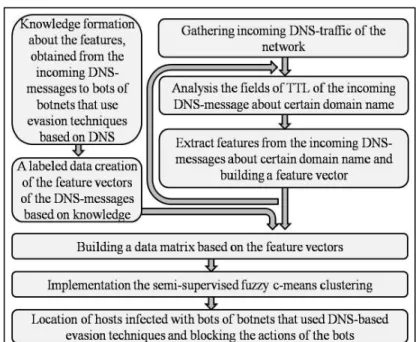
Lysenko et al. (2015) proposed a DNS-based anti-evasion technique for botnet detection. Their technique is based on a cluster analysis of the features obtained from the payload of incoming DNS messages. The method uses the semi-supervised fuzzy c-means clustering. Figure 4 illustrates the functioning principle of the DNS-based anti-evasion technique for botnet detection.
Figure 4. Functioning principle of the DNS-based anti-evasion technique for botnet detection (Lysenko et al., 2015).
According to Lysenko et al. (2015), their technique can detect fast flux, domain flux, cycling of IP mappings, and DNS tunneling evasion techniques with high
efficiency. They claimed that passive analysis of DNS traffic leads to the detection of only particular malware.
Jin, Ichise, and Iida (2015) designed a botnet communication detection method by collecting authoritative NS records and their IP addresses, as well as monitoring direct outbound DNS queries. Their method is based on storing NS
records with corresponding IP addresses of valid query response pairs, IP addresses of public DNS servers, and ISP specified DNS servers in a NS-IP database. Any destination IP address is not included in the previously achieved Name Server NS records, as well as its corresponding IP Address; a record is considered suspicious and should be investigated. In this way, "all unusual domain name resolution that uses direct outbound DNS query can be monitored" (p. 39).
A DNS tunneling technique could evade their method. Domain Name System tunneling can be used for a more robust C&C configuration. For example, a
botmaster could register the malicious domain name and designate the system running dnscat2 server software as the authoritative DNS server for that domain. In this way, the bot machine would issue a DNS query for that malicious domain to the victim’s trusted DNS server, which would forward the query to the C&C server and return the adversary’s answer to the bot. In this scenario, the protected network can only access the trusted DNS server, but that DNS server can contact external DNS servers to resolve queries that it cannot resolve directly (Zeltser, 2016). Since the returned malicious answer is from an authoritative DNS server, it would be stored in the NS-IP whitelist database, resulting in false-negative alert.
Holz, Gorecki, Rieck, and Freiling (2008) presented the first empirical study of FFSNs. They developed a metric that exploits the principles of FFSNs to derive an
effective mechanism for detecting new fast-flux domains in an automated way. They showed that the method is accurate, and they had very low positive and false-negative rates. Based on their empirical observations, they found other information (e.g., whois lookups and MX records) as promising features for an extended version of their flux-score.
Caglayan, Toothaker, Drapeau, Burke, and Eaton (2009) presented the first empirical study of detecting and classifying fast flux service networks (FFSNs) in real time. Their approach uses active and passive sensors derived from DNS monitoring and fusing the component sensors using a Bayesian classifier. The Fast Flux Monitor Architecture can detect single and double flux behavior in real time with acceptable false alarm rates.
Dabbagh (2012)proposed a method for detecting IP ID and TTL covert channels. He proposed a method based on his observation that "operating systems choose initially a random number for the ID in the IP header and then increment it sequentially" (p. 1). He concluded that a packet is suspicious if the new packet has an IP ID smaller than the previous packets. Also, he stated that "detecting TTL covert channel is based on the fact that the network is stable" (p. 2). Therefore, the receiver side should not observe many variations in the TTL values in the IP header of the packets that are coming from the same source.
A limitation of this method is when using NAT services, packets coming from different sources will have different IDs and TTL values, but will have the same source IP. Another limitation is that some IP stacks assign the ID values of the IP
header by using a pseudo-random generator (RFC 4413-TCP/IP Field Behavior, 2006).
Zhang, Papadopoulos, and Massey (2013) made an initial attempt to
investigate detection of encrypted communication. Since the encryption increases entropy, they presented two high-entropy classifiers and used one of them to enhance the BotHunter, and showed that BotHunter was able to detect encrypted bots.
Antonakakis et al. (2012) presented a novel detection system, called Pleiades, which is able to detect machines within a monitored network that are compromised with DGA-based botnets. Pleiades monitors traffic below the local recursive DNS server and analyzes streams of unsuccessful DNS resolutions (Name Error or
NXDomain Responses). Pleiades searches for relatively large clusters of NXDomains with similar syntactic features, and are queried by multiple, potentially compromised, machines during a specific epoch. As shown in Figure 5, there are two phases of detection: the first phase discovers the presence of DGA and the second classifies the discovered DGA and detects the C&C domain(s).
Antonakakis et al. (2012) claimed that "Pleiades was able to identify six DGAs that belong to known malware families and six new DGAs never reported before" (p. 14). Although their claim that Pleiades can achieve very high detection accuracy, one limitation of their evaluation method is "the exact enumeration of the number of
infected hosts in the ISP network" (p. 14). Because the location of monitoring sensors is below the recursive DNS server, they can only obtain a lower bound estimate of infected hosts. For example, an IP address that generates DNS traffic may be a NAT, firewall, DNS server, or other device that behaves as a proxy. Also, noisy
NXDomains may be generated to mislead the implementation of Pleiades.
Yadav and Reddy (2012) proposed methodologies for utilizing failed domain names (NXDOMAIN) in the quest for rapid detection of a fluxing botnet’s C&C server. They validated their method by detecting Conficker botnets and other anomalies with a false positive rate as low as 0.02%. Their technique can be applied at the edge of an autonomous system for real-time detection. Since their method is based on detecting botnets utilizing high entropy, botnet owners may alter the way domain names are created to evade their detection mechanism.
Farnham and Atlasis (2013) reviewed several utilities used to enable tunneling over DNS. They discussed practical techniques for detecting DNS tunneling and categorized the detection techniques into two categories: payload detection technique, which is used to detect specific DNS tunneling utilities, and traffic analysis-based technique, which is used to detect DNS tunneling in general. In the
payload analysis, they discussed the following techniques for DNS tunneling detection:
1. Size of DNS request and response. 2. Entropy of hostnames.
3. Statistical analysis. 4. Uncommon record types. 5. Policy violation.
6. Specific signatures.
In traffic analysis, they discussed the following techniques: 1. Volume of DNS traffic per IP address.
2. Volume of DNS traffic per domain. 3. Number of hostnames per domain. 4. Geographical location of DNS server. 5. Domain history.
6. Volume of NXDomain responses. 7. Visualization.
8. Orphan DNS requests.
9. General covert channel detection.
In this research, the NXDomain error will be utilized in a different way to detect the DGA implementations; the threshold relies on the percentages of the unique NXDomain errors to the total number DNS requests within an epoch. Although the DNS Server Failure error is not limited to the FFSN and DF implementations, this
error can be utilized to detect FFSN- and DF-based botnets. In other words, the first stage will utilize NXDomain and Server Failure errors to detect the rallying to a C&C server.
In the second phase, although polymorphism and metamorphism techniques change the form of each instance of bot binary to circumvent signature-based detection during the detection and investigative process, the algorithm will use a detection technique relying on a signature matching based on encoded SSH handshakes within DNS tunnels.
Summary
This chapter presented an overview of botnets implementation, as well as some detection methods and evasion techniques. The next chapter proposes a defense-in-depth approach for DNS-based botnets.
Chapter III: Methodology Introduction
Implementing a comprehensive, holistic approach for botnet detection could be a challenging task. Botnets implement different protocols, different architecture, and can evade detection methods by tunneling their communications within a range of services, DNS being the most predominant.
Since the DNS protocol can be used at different stages of botnet
communication, I have used BRO Network Security Monitor (NSM) to design and implement a detection mechanism for DNS-based botnets communication.
Design of the Study
This thesis proposes an empirical solution to design and implements a mechanism for detecting DNS-based botnets at different stages:
1. Rallying stage when finding the C&C server (DGA, FFSN, and DF). 2. Transmitting data and controlling the bots (DNS Tunnel).
Currently, botnets implement DGA and/or fluxing techniques to avoid botnets
detection and mitigation. The infected machine sends a high volume of DNS requests in order to find its C&C server.
As a botmaster only registers one or a few domain names (previously known) to carry out the C&C communication, almost all the DNS requests, generated by DGA, sent to find the C&C server will have unsuccessful resolutions (name error or NXDomain responses). The detection of DGA implementation was configured based on a threshold of NXDomain responses within an epoch. For example, if the infected
machine sends more than 100 DNS requests within an hour, and a specific
percentage of these requests have unsuccessful resolutions, BRO NSM will detect the presence of DGA based botnet.
In FFSN and DF based botnets, the malicious domain name(s) that has/have very low TTL forces the DNS systems to frequently refresh the resolution cache of the IP addresses associated with the domain(s). Although the DNS Server Failure can be related to issues other than fluxing implementations, these unsuccessful resolutions of very low TTL domain names (Server Failure) can be utilized for FFSN- and DF-based botnets detection. In other words, the detection of FFSN and DF implementation was configured based on a threshold of the "Server Failure" responses within an epoch.
The frequency of malicious DNS packets can be controlled by the botmaster to evade the detection threshold. In other words, in case the first BRO mechanism fails to detect DGA, FFSN, or DF presence, another mechanism will run. The second mechanism inspects the DNS payloads for DNS-encrypted tunnels based on SSH connections, also implemented with BRO NSM.
According to Brandhorst and Pras (2006) on their statistical analysis of name server traffic, the percentages of NXDomain errors and Server Failures were 8.74% and 1.28%, respectively, of the DNS queries. Figure 6 shows DNS statistics at four locations.
Figure 6. DNS statistics (Brandhorst & Pras, 2006).
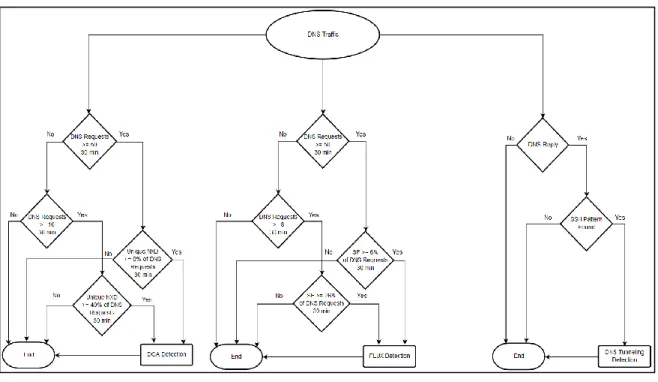
Figure 7. Multistage detection technique for DNS-based botnets.1
Figure 7 depicts the flowchart for the proposed algorithm. Domain Name System traffic is inspected at both stages, in parallel, to detect the multistage
communications of DNS-based botnets. The first stage detects the rallying to a C&C server and the second stage inspects each DNS reply of specific patterns of SSH handshakes within DNS tunnels.
In the first stage of botnet communication (rallying stage), a DGA-detection mechanism is applied every 30 minutes to find if total number of DNS requests is 10 or greater. In this case, two thresholds are used for the unique NXDomain errors: the first threshold, which is 8% of the total number of DNS requests, is based on Figure 6 and used if the total number of DNS requests is 50 or more. The second threshold (40%) is used if the total number of DNS requests is between 10 and 50. The second threshold is utilized to eliminate false positive detections in idle systems. For
example, an idle system running DGA has a higher percentage of unique NXDomain errors to the total number of DNS requests than the percentage in an active system running DGA. In both thresholds, at least four unique NXDomain errors are required for DGA detection.
In fluxing detection, which is another method for rallying, different thresholds are set. The fluxing detection mechanism is applied every 30 minutes if the total number of DNS requests is 8 or greater. In this mechanism, two thresholds are used for the Server Failure errors. If the total number of DNS requests is 50 or greater, the first threshold is used, which is 6% of the total number of DNS requests. The second threshold (26%) is used if the total number of DNS requests is between 8 and 50.
Similar to the DGA mechanism, the second threshold is utilized to eliminate false-positive detection in idle systems implementing fluxing techniques. In both
thresholds, at least three Server Failure errors are required for fluxing detection. The DNS threshold, which is 50 DNS requests every 30 minutes, is set below the lowest average in Figure 6 (location 1 has an average of 137 DNS requests per hour). Since location 1 in Figure 6 has a high percentage of NXDomain errors (33%), which indicates a high possibility of DGA existence, the NXDomain threshold (8%) is set based on the lowest average of NXDomain errors (location 3). To eliminate false-negative detection, the Server Failure threshold (6%) is set higher than the Server Failure percentage in location 2.
In other words, different threshold values are set for DGA and fluxing detection, based on the DNS statistics in Figure 6, as well as the activity of the infected systems. For example, the percentage of NXDomain errors to the total number of DNS requests depends on the frequency of DGA and the average number of DNS requests on different systems. Thus, these values need to be dynamically adjusted with the changing nature of communication.
Data Collection
Instead of real-time monitoring with real botnet malware, the dataset was collected from the Stratosphere Lab, which is a part of the Malware Capture Facility Project at CVUT University, Prague, Czech Republic (Garcia, 2015). The lab has a significant dataset of malware traffic captures, including different types of botnets. These datasets were used for DGA, FFSN, and DF detection.
Regarding DNS encrypted tunnels, Iodine and DNS2TCP were used to setup a SSH tunnel between the server and client device. The captured traffic was used for SSH connection detection.
Data Analysis
In order to implement and analyze the proposed approach, the following software, tools, and techniques were required:
1. BRO Network Security Monitor: intrusion detection system. 2. Iodine & DNS2TCP: DNS tunneling tools that support SSH. 3. Wireshark: traffic analyzer.
4. Security Onion: a customized Linux operating system for intrusion detection.
5. AWS Ubuntu machines: C&C server and infected machine. 6. Registered Domain Name.
Summary
This chapter covered the proposed detection methodology for DNS-based botnets. This methodology is built on a BRO Network Security Monitor to detect both DGA- and FFSN-based botnets according to thresholds within an epoch of
NXDomain and Server Failure responses, respectively. Also, the proposed methodology detects DNS-encrypted tunnels through analyzing connection
establishment within a DNS payload. The next chapter presents more detail about data collection and analysis.
Chapter IV: Data Presentation and Analysis Introduction
Different malicious traffic captures were collected from previously infected systems. These captures were used for DGA-, FFSN-, and DF-based botnet
analysis. For SSH connections tunneled in DNS packets, Iodine and DNS2TCP (with SSH connections) captures were used for packet analysis.
Data Presentation
In this section, the Wireshark packet captures were presented as the following: 1. Packet capture of DGA-based botnet. This capture was collected from a previously infected system and was used to test the BRO detection method for DGA-based botnets. The complete capture can be found at Wireshark–DGA-DGA-based Botnet.
2. Packet capture of FFSN- & DF-based botnet. This capture was collected from a previously infected system and was used to test the BRO detection method for FFSN- and DF-based botnets. The complete capture can be found at Wireshark– FFSN- & DF-based Botnet.
3. Packet capture of SSH connection tunneled in Iodine. Iodine is a DNS tunneling program that tunnels IPv4 data through a DNS server. It was developed by Bjorn Anderson and Erik Ekman. Iodine can be usable when the Internet access is firewalled, but DNS queries are allowed. Iodine is written in C and it runs on Linux, Mac OS X, FreeBSD, NetBSD, OpenBSD, and Windows (Anderson & Ekman, 2014).
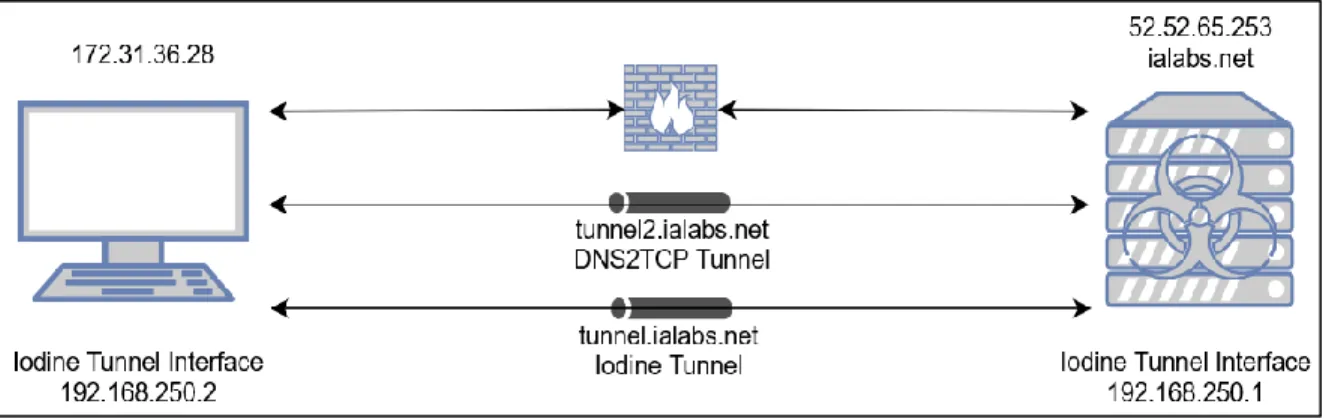
The packet capture of Iodine traffic was collected from the lab implementation. In this lab, the Iodine server and Iodine client were setup as the following:
• Iodine server static IP address 52.52.65.253 • Iodine client IP address 172.31.36.28
• Subdomain tunnel.ialabs.net
• Server’s tunnel interface IP address 192.168.250.1 • Client’s tunnel interface IP address 192.168.250.2 The complete lab steps can be found in Appendix B.
4. Packet capture of SSH connection tunneled in DNS2TCP. DNS2TCP is a network tool designed to relay TCP connections through DNS traffic. DNS2TCP was written by Olivier Dembour with the contributions of Nicolas Collignon. The encapsulation is done on the TCP level. DNS2TCP is composed of two parts: a server-side tool and a client-side tool. The server has a list of resources specified in a configuration file. Each resource is a local or remote service listening for TCP
connections. The client listens on a predefined TCP port and relays each incoming connection through DNS to the final service (HSC, 2012).
The packet capture of DNS2TCP traffic was also collected from the lab
implementation. In this lab, the two sides–the server and the client–were setup as the following:
• DNS2TCP server static IP address 52.52.65.253 • DNS2TCP client IP address 172.31.36.28
• Subdomain tunnel2.ialabs.net
Figure 8. Iodine and DNS2TCP lab.
Figure 8 shows the lab implementation of Iodine and DNS2TCP tunneling tools. The system is protected by a firewall that blocks all traffic except DNS on port UDP/53.
Data Analysis
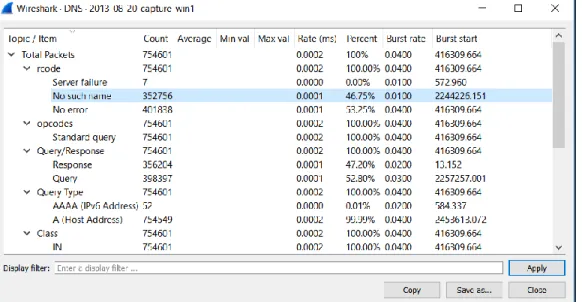
The packet captures of the previous section were analyzed as the following: 1. Packet capture of DGA implementation. Figure 9 shows the statistics of DNS packets. The "No such name" packets represent the total number of DNS responses that return with a NXDomain error. There were 352,756 responses with NXDomain error; these responses represented 46.75% of the total DNS packets (queries and responses), and 89% of the total requests (532,756/398,397). The "No error" packets represent both the total number of DNS requests and the successful responses.
Figure 9. DNS packets statistics–DGA-based botnet.
The previous capture shows a high presence of DGA implementation. Setting a threshold for DGA detection varies from one network to another. For example, when implementing a DGA botnet, botmasters can control the frequency of DNS requests to avoid detection, thus, a high threshold of NXDomain errors can be
evaded by a low frequency (false negative), however, a very low threshold may result in false-positive detection, such as typing errors. To eliminate the chance of
NXDomain errors due to mistyping or other errors not related to the DGA implementation, the threshold was set based on unique NXDomain records.
Figure 10 shows DGA-based botnet traffic. After many unsuccessful resolutions, the infected system found the IP address of a C&C server at packet number 234,427.
Figure 10. Wireshark packet capture of DGA-based botnet.
2. Packet capture of FFSN & DF implementation. Similar to the previous statistics, Figure 11 shows the statistics of DNS packets. The "Server Failure" packets represent the total number of DNS responses that return a Server Failure error. There were 159 responses with Server Failure errors; these responses
represented 26.07% of the total DNS packets (queries and responses), and 52.13% of the total requests (159/305).
This capture shows a high percentage of DNS Server Failure packets, and setting a threshold for these packets is also a challenge. For example, botmasters can control the TTL values and the frequency of DNS requests to avoid Server Failure errors, thus, a high threshold of Server Failure errors can be evaded by a lower frequency and higher TTL (false negative). However, a low threshold may result in a higher false positive.
Figure 12 shows the DF implementation. There were three IP addresses (87.221.209.204, 109.73.179.95, and 185.1.62.82) assigned to four different malicious domains (top-web.org, linetechservice.org, serviceline2013.org, and servicewebcheck.org); the assignment was done in a “round robin” fashion. When the DNS request (packet No. 15680) was sent, the IP addresses were not yet assigned to serviceonline2013.org, thus, packet No. 15683 had a Service Failure error since the TTL for serviceonline2013.org had expired.
Figure 12. Domain flux implementation.
Figures 13 illustrates the concept of FFSN; new IP addresses
Figure 13. FFSN implementation.
3. Packet capture of SSH connection tunneled in Iodine. Figure 14 shows the connection negotiation between the server and the client.
By analyzing the traffic from the Wireshark capture, it was noticed that Iodine used some patterns or signatures in its negotiation between the server and the client. These patterns were appended to the subdomain (tunnel.ialabs.net), and included the following:
The following figure shows the SSH connection tunneled in DNS packets. The SSH connection initialization started at packet No. 4248.
Figure 15. SSH connection tunneled in DNS packets (iodine).
Iodine uses the NULL RR (QTYPE 10) and provides higher performance by allowing the downstream data to be sent without encoding. Each DNS reply can contain over a kilobyte of compressed payload data. However, regarding the upstream date (the DNS requests), Iodine uses either Base-32 or a non-standard Base-64 encoding method (based on a configuration option) (Nussbaum, Neyron, & Richard, 2009).
By analyzing different SSH connections, the following signature was used to establish a SSH tunnel:
eaba82.2hb..Y.w which is equivalent to following hex string: \x65\x61\x62\x61\x38\x32\xca\x32\x68\x62\xbe\xee\x59\xd6 \x77
4. Packet capture of SSH connection tunneled in DNS2TCP. The following figure shows the SSH connection tunneled in DNS packets. The SSH connection initialization started at packet No. 4248.
Figure 16. SSH connection tunneled in DNS packets (dns2tcp).
By default, DNS2TCP uses the TXT RR type. Since DNS2TCP uses Base-64 encoding, SSH connection packets can be analyzed to find the encoded pattern of the normal SSH connection. In a normal situation, a SSH connection contains the SSH-2.0-OpenSSH_ string. By analyzing packet No. 187 in figure 16, the string AAACCFNTSC0yLjAtT3BlblNTSF83LjJwMiBVYnVudHUtNHVidW50dTIuMg0 was used to establish a SSH tunnel. This string is equivalent to ��
SSH-2.0-OpenSSH_7.2p2 Ubuntu-4ubuntu2.2.
To detect other versions of SSH-2.0 connections and/or operating systems, only the CFNTSC0yLjAtT3BlblNTSF8 part is used to detect SSH connections tunneled in DNS packets. After decoding this Base-64 encoded string, it is equivalent
to �SSH-2.0-OpenSSH_. To detect only OpenSSH_string, only the string T3BlblNTSF8 is used.
In BRO NSM, both Iodine and DNS2TCP queries were logged in DNS.Logs as lowercase queries, so the detection script was written based on the lowercase
equivalents. For example, the string Iodine SSH tunnel eaba82.2hb..Y.w was detected by the equivalent hex of its lowercase eaba82.2hb..y.w, which is
\x65\x61\x62\x61\x38\x32\xca\x32\x68\x62\xbe\xee\x79\xd6\x77 instead
of \x65\x61\x62\x61\x38\x32\xca\x32\x68\x62\xbe\xee\x59\xd6\x77. To find the complete script for SSH tunneling detection, refer to Appendix D.
Summary
This chapter presented and analyzed the packet captures of DGA, FFSN, and DF implementations, as well as SSH connections tunneled in DNS tunneling using Iodine and DNS2TCP tools. The next chapter discusses the results, conclusion, and future work.
Chapter V: Results, Conclusion, and Recommendations Introduction
As mentioned in the previous chapters, DNS protocol can be implemented for botnet communications. Some of these implementations utilize different evasion techniques to circumvent the detection and prevention methods. In this study, the multistage-detection technique was designed and implemented using the BRO Network Security Monitor. This chapter presents the results of the analysis methods, conclusion, and future recommendations.
Results
This thesis presents an empirical solution to detect DNS-based botnets at different stages of their communications. Domain Generation Algorithm-based
botnets were detected by the percentage of unique NXDomain errors among the total DNS queries within an epoch of 30 minutes. The fluxing techniques–FFSN and DF– were detected by the percentage of total Server Failure errors among the total DNS queries within an epoch of two hours.
Also, this thesis presents some popular DNS tunneling tools that are used to tunnel botnet traffic in DNS packets, and presents a signature-based method to detect DNS-tunneled botnets that use SSH as their encryption algorithm. Each tool has different method to tunnel the traffic. Since SSH is utilized to encrypt the tunnel, it is recommended to look for SSH connections wrapped in the DNS packets by looking for the encoded patterns of the SSH connection requests. Some tools, such as
Iodine, encoded the traffic using a non-standard Base-64 encoding method and other tools like DNS2TCP using a Base-64 encoding method.
From the Iodine lab results, a non-standard encoded pattern for SSH
connections was detected. In the DNS2TCP lab, a standard encoded pattern for SSH connections’ handshaking was detected. These patterns can be used as signatures to detect SSH connection handshaking tunneled in Iodine and DNS2TCP tools.
The following questions and answers provide a summary of the proposed solutions:
Question 1: Was the proposed method able to detect DGA-based botnets? Answer: Yes, based on unique NXDomain thresholds.
Question 2: Was the proposed method able to detect FFSN- and DF-based botnets?
Answer: Yes, based on Server Failure thresholds.
Question 3: Were the signatures able to detect SSH tunneling in the suggested tools?
Answer: Yes, the signatures were able to detect SSH tunneling in Iodine and DNS2TCP tools.
Organized and professional botmasters may develop other methods to bypass these detection mechanisms. The following questions and answers explain:
Question 1: Can the botmasters evade the detection of the DGA-, FFSN-, or DF-based botnets based on the NXDomain or Server Failure thresholds?
Answer: Yes, changing the frequency of the DNS requests will minimizes the NXDomain errors within a specific epoch. Also, they may control the TTL values properly to avoid the high number of Server Failure responses.
Question 2: Can the botmasters evade the non-standard encoded signatures of the SSH connection handshaking?
Answer: Yes. Like other characteristics and parameters in the DNS traffic, they may change the non-standard encoding/decoding code.
Question 3: Can the botmasters evade the standard encoded signatures of the SSH connection handshaking?
Answer: Creating a large set of possible strings of the encoded SSH connection handshaking using the standard encoding methods provides a strong mechanism for SSH tunneling detection. For example, using Base-64, the encoded pattern of
ANSSH-2.0-OpenSSH_ is QU5TU0gtMi4wLU9wZW5TU0hf, but the encoded
pattern of ASSH-2.0-OpenSSH_ is QVNTSC0yLjAtT3BlblNTSF8=,
which is completely different, because Base-64 method takes every three bytes and encodes them into four bytes output, so the order of the OpenSSH_ string within the packet gives different outputs.
However, creating a signatures list provides a strong mechanism for SSH connections tunneling detection; botmasters may change the trend to use non-standard encoding/decoding methods to tunnel these connections.
Conclusion
This thesis was to design and implement detection techniques for DNS-based botnets at different stages of communications. Using a BRO Network Security
Monitor, the suggested solutions were able to detect the botnet traffic at the rallying stage–when finding the C&C server–as well as, detecting the SSH tunneling
connections used to encrypt the traffic after finding the C&C server.
The detection of DGA-, FFSN-, and DF-based botnets was based on a threshold value of specific DNS response failures. Whereas, the detection of SSH tunneling was based on encoded patterns of SSH connection handshaking within two popular DNS tunneling tools. The suggested solutions were able to detect the SSH tunneling in Iodine and DNS2TCP. These tools can be utilized to tunnel the SSH connections in DNS-based botnets.
Future Work
In this thesis, tunneling SSH connections were implemented using two of the most popular DNS tunneling tools. In the future, analyzing other tools that support SSH connections, such as DNSCAT and OzymanDNS, and creating a large set of possible strings of the encoded SSH connection handshaking using the standard encoding methods will contribute to the detection efforts.
Regarding DGA and fluxing techniques, finding an automated way to set the thresholds of DNS queries, NXDomain, and Server Failure based on the behavior of the system will improve the detection mechanisms. The threshold settingsneed to be dynamically adjusted with the changing nature of communication which would
optimize false positives and negatives. Also, to minimize the false positive of fluxing detection, the DNS Server Failure error–resulting from fluxing implementations– needs to be differentiated from similar errors caused be other issues.
References
Albors, J. (2017, January 12). Fast Flux networks: What are they and how do they
work? Retrieved September 11, 2017, from https://www.welivesecurity.com/
2017/01/12/fast-flux-networks-work/.
Anderson, B., & Ekman, E. (2014). Iodine. Retrieved October 16, 2017, from
http://code.kryo.se/iodine./
Antonakakis, M., Perdisci, R., Nadji, Y., Vasiloglou, N., Abu-Nimeh, S., Lee, W., & Dagon, D. (2012). From throw-away traffic to bots: Detecting the rise of DGAbased malware. In Proceedings of the 21st USENIX Conference on
Security Symposium (pp. 24-24). Bellevue, WA: USENIX Association.
Bilge, L., Sen, S., Balzarotti, D., Kirda, E., & Kruegel, C. (2011). EXPOSURE: Finding malicious domains using passive DNS analysis. In Proceedings of the 18th
Annual Network and Distributed System Security Symposium, NDSS 2011.
San Diego, California, USA.
Botnet. (2017, March 23). Retrieved March 26, 2017, from https://en.wikipedia.
org/wiki/Botnet.
Bots and botnets—A growing threat. (2016). Retrieved March 26, 2017, from
https://us.norton.com/botnet/.
Brandhorst, C. J., & Pras, A. (2006). DNS: A statistical analysis of name server traffic at local network-to-Internet connections. In C. Delgado Kloos, A. Marín, & D. Larrabeiti (Eds.), EUNICE 2005-Proceedings of the 11th Open European
International Federation for Information Processing; Vol. 196). Berlin: Springer. doi: 10.1007/0-387-31170-X_19
Bro Introduction. (n.d.). Retrieved March 26, 2017, from https://www.bro.org/
sphinx/intro/.
Caglayan, A., Toothaker, M., Drapeau, D., Burke, D., & Eaton, G. (2009). Real-time detection of fast flux service networks. Cybersecurity Applications &
Technology Conference for Homeland Security (pp. 285-292). Washington,
DC: IEEE Computer Society. doi:10.1109/catch.2009.44.
Choi, H., Lee, H., & Kim, H. (2007). Botnet detection by monitoring group activities in DNS traffic. CIT '07 Proceedings of the 7th IEEE International Conference on
Computer and Information Technology(pp. 715-720). Washington, DC: IEEE
Computer Society.
Cantón, D. (2015, January 20). Botnet detection through DNS-based approaches.
Retrieved September 11, 2017, from https://www.certsi.es/en/blog/botnet-detection-dns.
CounterMeasures–A security blog. (2010, September 24). Retrieved March 26, 2017,
from http://countermeasures.trendmicro.eu/the-history-of-the-botnet-part-i/. Dabbagh, M. (2012). Covert channels in botnets. Retrieved from http://web.engr.
oregonstate.edu/~dabbaghm/projects/CovertChannels.pdf.
Dietrich, C., Rossow, C., Freiling, F. C., Bos, H., Steen, M., & Pohlmann, N. (2011). On botnets that use DNS for command and control. EC2ND '11 Proceedings
(pp. 9-16). Washington, DC: IEEE Computer Society. doi:10.1109/EC2ND.2011.16
Domain name system. (2017, March 22). Retrieved March 27, 2017, from
https://en.wikipedia.org/wiki/Domain_Name_System.
Farnham, G., & Atlasis, A. (2013). Detecting DNS tunneling. SANS Institute InfoSec
Reading Room (pp. 1-32).
Garcia, S. (2015). Malware capture facility project. Retrieved August 22, 2017, from
https://stratosphereips.org.
Hagen, J., & Luo, S. (2016, August 17). Why Domain Generating Algorithms (DGAs)?
Retrieved March 25, 2017, from http://blog.trendmicro.com/domain-generatingalgorithms-dgas/.
Holz, T., Gorecki, C., Rieck, K., & Freiling, F. (2008). Measuring and detecting fast-flux service networks. In Proceedings of the 15th Annual Network and
Distributed System Security Symposium (NDSS).
HSC. (2012, May 02). Retrieved October 02, 2017, from http://www.hsc.fr/
ressources/outils/dns2tcp/.
Jin, Y., Ichise, H., & Iida, K. (2015). Design of detecting botnet communication by monitoring direct outbound DNS queries. CSCLOUD '15 Proceedings of the
2015 IEEE 2nd International Conference on Cyber Security and Cloud
Computing (CSCloud) (pp. 37-41). Washington, DC: IEEE Computer Society.