tion Design. ACM Transactions on Computer-Human Interaction, 26(1), ISSN 1073-0516 [Article]
http://research.gold.ac.uk/24757/
The version presented here may differ from the published, performed or presented work. Please
go to the persistent GRO record above for more information.
If you believe that any material held in the repository infringes copyright law, please contact
the Repository Team at Goldsmiths, University of London via the following email address:
[email protected].
The item will be removed from the repository while any claim is being investigated.
For
more information, please contact the GRO team: [email protected]
39
Movement Interaction Design
MARCO GILLIES,
Department of Computing, Goldsmiths, University of London, UKInteraction based on human movement has the potential to become an important new paradigm of human computer interaction. However, high quality, mainstream movement interaction requires effective tools and techniques to support designers. A promising approach to movement interaction design is Interactive Machine Learning, in which designing is done by physically performing an action. This paper brings together many different perspectives on understand human movement knowledge and movement interaction. This understanding shows that the embodied knowledge involved in movement interaction is very different from the representational knowledge involved in a traditional interface, so a very different approach to design is needed. We apply this knowledge to understanding why interactive machine learning is an effective tool for motion interaction designers and to make a number of suggestions for future development of the technique. CCS Concepts: •Human-centered computing→HCI theory, concepts and models;Gestural input; Interaction design theory, concepts and paradigms;Virtual reality;
ACM Reference Format:
Marco Gillies. 2010. Understanding the role of Interactive Machine Learning in Movement Interaction Design.
ACM Trans. Comput.-Hum. Interact.9, 4, Article 39 (March 2010),35pages.https://doi.org/0000001.0000001 1 INTRODUCTION
Interaction paradigms that make use of human movement have been one of the most exciting frontiers of HCI research in the last decade. A range of tracking technologies have made it possible to use gestures and full body motion as a means of interaction. The increasingly low cost of the sensors means that this form of interaction could become very common and possibly a new major form of interaction after mouse and keyboard Graphical User Interfaces and touch screens.
However, the uptake of movement interfaces has been limited relative to volume of research pro-totypes. There are many potential reasons for this, but these include critiques by Norman [Norman 2010] that many of the movement interfaces that have developed have poor interaction design and fail to live up to their potential as “Natural Interaction” [Gillies and Kleinsmith 2014]. This points to a flaw in the way movement interactions are currently designed, which is itself potentially related to limitations in the tools currently used for that design.
The ubiquity of Graphical User Interfaces would not have been possible without the development of toolkits that make it easy to assemble new interfaces either by programming or using a graphical tool. Making movement interaction mainstream will mean making effective toolkits for designing it. While many sensor vendors such as leap motion (https://www.leapmotion.com) supply toolkits for designing interaction, these are often limited to a small set of standard gestures. A number of academic authors, on the other hand have developed methods that allow authoring of new
Author’s address: Marco Gillies, Department of Computing, Goldsmiths, University of London, New Cross, London, SE24 9PA, UK, [email protected].
Permission to make digital or hard copies of all or part of this work for personal or classroom use is granted without fee provided that copies are not made or distributed for profit or commercial advantage and that copies bear this notice and the full citation on the first page. Copyrights for components of this work owned by others than ACM must be honored. Abstracting with credit is permitted. To copy otherwise, or republish, to post on servers or to redistribute to lists, requires prior specific permission and/or a fee. Request permissions from [email protected].
© 2010 Association for Computing Machinery. 1073-0516/2010/3-ART39 $15.00
gestures and interactions by example [Hartmann et al. 2007;Wobbrock et al. 2007;Zamborlin et al. 2014] often using an approach called Interactive Machine Learning (IML) [Caramiaux et al. 2015a; Fiebrink et al. 2011] which is quite unlike the approach taken in a GUI toolkit. This paper seeks to understand how to make these toolkits. Can they work in a similar way to GUI toolkits or do they require a completely different approach? This paper explores the nature of movement interaction and uses this understanding to an analysis of why IML is suitable for movement interaction design and how it can be improved.
This paper makes the follow contributions:
• It brings together a number of different disciplinary perspectives to form an understanding of movement interaction, human movement knowledge and how people learn and teach movement knowledge.
• It uses this understanding to develop a theoretical model of how we should design and implement movement interaction.
• This model is applied to understanding why interactive machine learning is an effective way of designing movement interaction and highlights a number of features that support this design: designing by moving; a tight cycle of interaction, and supporting reflection on the experience of movement. It also uses this model to evaluate Interactive Machine Learning as an approach and suggest future research directions.
The aim of this work is to deepen our understanding of movement interaction and help guide the design of future movement interaction design toolkits.
2 WHAT IS MOVEMENT INTERACTION?
A simple definition of movement interaction is any technique for human computer interaction that makes use of body movement in a different, and fuller, way than mainstream interfaces such as mouse and keyboard or touchscreen. However, this encompasses a very wide range of possible applications, technologies, interaction styles and design techniques. While it is impossible to cover the full range of movement interaction in a paper of this length, the following section will attempt to provide and outline of the diversity of approaches.
2.1 Application areas
Movement interaction first entered the mass market in video games, and a lot of research still relates to games and entertainment, for example, Hämäläinen et al.’s work on movement and exertion games [Hämäläinen et al. 2015]. However, there are many other application areas. Much of the movement games research relates closely to sport, for example using projections to create a game out of a climbing wall activity [Kajastila et al. 2016] or allowing people to run together when geographically separated [Mueller et al. 2012]. Movement interaction has also been used in other ways in sport, particularly education, for example Velloso et al. [Velloso et al. 2013] developed a system that used motion sensing to give feedback to people learning weight training in order to improve their technique. Sport is not the only domain where physical movement and technique are important and so forms of movement interaction can help support many different forms of education, for example posture has a great effect on musical performance and movement feedback can be used effectively in initially training [Johnson et al. 2013]. The field of New Interfaces for Musical Expression (NIME) has seen many developments that use movement interaction as a means of musical performance with electronic instruments [Caramiaux and Tanaka 2013;Fiebrink et al. 2011;Françoise et al. 2013]. A closely related field is dance where movement interaction has been used to enhance the experience of professional dancers [Fdili Alaoui et al. 2015] and members of the public [Halpern et al. 2011]. Another important area for movement interaction is healthcare,
where movement games can support rehabilitation exercises for people with conditions such as parkinsons [McNaney et al. 2015] or stroke [Kirk et al. 2016]. Also health related is the development of custom interfaces for people with disabilities, for example the work of Katanet al.[Katan et al.
2015].
2.2 Sensing technologies
Movement interaction has seen mainstream interest in the last decade, primarily due to gaming devices such as the Nintendo Wii™ and Microsoft Kinect™. These are sensor technologies that are able to track human movement in detail, and their ready availability has triggered a large interest on the part of academic researchers in developing new forms of interaction that use human body movement. The sensors themselves take many forms. The Nintendo Wii™ primarily uses an accelerometer. Accelerometers are cheap, small and found in many devices including most mobile phones, making them an easily accessible way to sense aspects of human movement (though the data is limited, they cannot recognise full body pose). They have been used by many researchers working with movement interfaces [Caramiaux et al. 2015a;Zamborlin et al. 2014]. The Kinect™ on the other hand is based on computer vision, using an infrared structured light pattern to determine a depth image with is then used to determine a rough estimate of body pose. Vision based systems can give more detailed information and are therefore popular with researchers [Fdili Alaoui et al. 2015;Gillies et al. 2015a]. Other techniques include muscle sensing such as Electromyography (for example the commercial device Myo (https://www.myo.com), Mechanomyography (for example used by Caramiaux, Donarumma and Tanaka [Caramiaux et al. 2015b]) or two way interaction via electrical muscle stimulation [Lopes et al. 2015]. There has been also been considerable research into new techniques, such as sensing via the electrical noise that is ubiquitously present in modern homes [Cohn et al. 2011].
2.3 Interaction styles
These sensing techniques, and others, have been used to develop a wide range of interaction styles. For the purpose of this paper, we may distinguish three broad categories of movement interaction: object focused, direct mapping and movement focused.
Object Focused Interactionare forms of interface in which human movement is important, but the design is focused on an object of interaction, rather than the movement itself. Tangible user interfaces are a good example of this approach. The classic example of a tangible interface, URP by Underkoffler and Ishii [Underkoffler and Ishii 1999], is a tool for urban planning in which buildings are represented by physical models which are tracked by computer and overlaid with projected information such as daylight patterns. Users can interact with this in many ways by physically moving buildings around but also by moving their own viewpoint to the scene from different perspectives. These are interesting uses of body movement and are key to the effectiveness of the interaction. However, the focus of the design process is not the users’ body movements, which are never represented or explicitly recognized by the system, but the objects themselves.
Direct Mapping interaction is a form of interface in which the movements of a user are directly mapped into some form of digital space. Examples, include a large proportion of Virtual Reality Interaction in which the important factor is seeing the user’s body mapped into the VR space [Spanlang et al. 2014]. This type of interaction is often similar to object focused interaction, in that the key interaction design is focused on objects that users can interact with using whatever movements they choose (or at least those that are possible to track). The major difference is that in this case, the objects are virtual not physical. An
example of this form if interaction is a virtual button that is "clicked" by reaching out and touching it, the interaction is not determined by a specific movement by the user but simply the location of their hand that is mapped into virtual space. Unlike object focused interaction, there is a need to pay attention to human movement in design. However, the aims of this interaction design is quite clear and straightforward: to map movement accurately from the physical to digital domain (normally via tracking technology). This mapping is normally done in a standard way for a particular platform (e.g. for a particular Virtual Reality hardware system).
Movement Focused Interaction, on the other hand, is interaction design around specific body movements rather than objects. A typical example is the swipe gesture on a mobile phone. This does not rely simply on manipulating the phone directly, nor is it simply detecting the position of the user’s finger. It is activated by a specific form of movement, and only that movement. The focus of interaction design in this case is not longer an object, real or virtual, but on the movement itself. For this reason movement focused interaction is the most radically divergent from traditional interaction design techniques which have focused on first 2D interfaces and then 3D objects.
These types are not mutually exclusive, there are many designs that include more than one type. For example, many wearable devices, particularly those used in dance [Karpashevich et al. 2018;Wilde 2010]. A wearable is a physical object that is amenable to object focused design, but since it is worn on the body it can affect movement. For example, in the work of Karpashevich
et al.[Karpashevich et al. 2018] the design began with a physical object, a dress based on the
Schlemmer’s seminal costumes for the Bauhaus “Triadic Ballet”. However, the costumes was designed in a way that would constrain an have implications for a dancers movements, so a part of the design was movement focused. This became particularly important as the focus shifted from design of the object, to its use in designing choreographies. The focus of this paper is on the design process, and a single artifact can go through multiple phases of design, in which it can be worked on as a form of object focused interactions and others where it is a form of movement focused interaction. For example, Márquez Seguraet al.[Márquez Segura et al. 2013] use a pre-existing
device, a motion sensing toy called BodyBug (now commercially available as Oriboo). This was presumably designed in an object focused way. However, they use this device to design new motion games, which could be classified as motion focused interaction design.
For the purpose of this paper, I will focus primarily on Movement Focused Interaction (or stages of the design processed that work on movement focused interaction). For both object focused and direct mapping interaction the locus of interaction design is on the object, whether real or virtual. The movement itself is either outside the digital domain (in the case of object focused interaction) or uses a highly standardized mapping to the digital domain (direct mapping interaction). This means that existing interaction design techniques can be well suited to these forms of interaction. While their 3D nature may make 2D paper sketches and prototypes unsuitable, 3D prototyping techniques work well. For movement focused interaction, the locus of design is on the human movement itself, which requires very different design approaches.
Movement focused interaction is itself very diverse, comprising a wide range of interaction styles. The most common being gestural interaction, in which the computer recognizes a number of gestures which are separate movements, typically performed with the hands, each having a characteristic shape. Much work on gesture has focused on 2D gestures on touch screens [Wobbrock et al. 2007]. However, there has also been considerable work on 3D free space gestures that make a fuller use of body movement [Caramiaux et al. 2015b;Thórisson 1998;Zamborlin et al. 2014]. Gestural interaction tends to be relatively constrained, both to a limited area of the body (typically
hands) and to a limited vocabulary of recognized gestures. However, other work has experimented with freer, full body movement, for example for dance [Fdili Alaoui et al. 2015;Halpern et al. 2011] or exercise [Kajastila and Hämäläinen 2015;Mueller and Isbister 2014]. Some of this work focuses on expressive and enjoyable aspects of movement allowing for relatively free form experience, while others are closer to quantified self applications that aim to track specific activities such as running [Mueller et al. 2012]. Most of the work just cited uses movement interactions that relate to our interaction with our physical environment or virtual proxies of it, but our body movements are also a key part of oursocialinteractions. We use body language (or more formally, non-verbal
communication) in all of our face-to-face communications and it can carry many implicit and explicit messages. For example, Thórisson [Thórisson 1998] used explicit gestures as a means of interaction with a virtual character, while Gillies, Brenton and Kleinsmith [Gillies et al. 2015a] used full body movements as an interaction in the absence of speech and Huang, Morency and Gratch [Huang et al. 2010] detected subtle non-verbal cues to allow a virtual character to give non-verbal feedback to a speaker. Social movement interaction has also been used together with natural language understanding systems, for example, using head movements to establish when a concept has been grounded [Vosoughi 2014].
Movement interaction is often associated with particular display technologies. For example, forms of movement interaction are considered by many [Gillies 2016;Slater 2009] to be as important to Virtual Reality. At the very minimum the ability to change your viewpoint on a scene by turning or moving your head is vital to creating presence. Other displays that are suited to body movement interaction are very large displays where users need to stand back in order to take in all of the information [Nancel et al. 2011].
The majority of examples above have involved explicit interaction in that users are consciously choosing to make movements (even if they are not conscious of the full details of that movement). This creates an explicit dialog for action and response between human and artifact. However, there are also forms of interaction that users are less consciously aware, and are less structured as a dialog. For example, a fitness tracker will collect data about a users activity without them ever consciously interacting or performing particular movements to be recognized. This is an example of monitoring a user, but this form of implicit interaction can also take the form of a computational system that has its own behavior which continues independently of users, but which can be modulated by user behavior, similar to what Ingold termsCorrespondence[Ingold 2017]. An example of this might be a
plant in a virtual reality simulation, which moves under a physics model independent of users, but may waft in a particular way as they pass, a form of responsiveness that is barely noticeable but can increase the sense of presence.
From the point of view of design these forms of interaction are not too different from more explicit interaction. While, users may not be consciously aware of them, designers must be in order to design them, and much of what follows applies equally. All three types of interaction described in this section can take this, more implicit form. The VR plant, might be a form of object focused interaction: it’s behavior is determined by a physics engine, and any response to a user is a consequence of this and not explicitly designed. A fitness tracker that simply records intensity of movement is similar to direct mapping: the movement is simply turned into numbers without attempting to interpret it. On the other hand, if the fitness tracker attempts to recognize particular types of exercise, for example running or cycling, then the focus is on particular movement which would be a form of movement focused interaction.
2.4 Design Approaches
Movement focused interaction requires new approaches to interaction design. A design and proto-type can no longer be embodied in a sketch or an object, but has to include the user’s movement. It
is also not enough to view this movement from the outside. While a video prototype [Mackay and Fayard 1999], in which a person is shown performing the movement, may give the sense of what the movement is, but it does not give a sense of what it is like to do the movement. This requires afirst personperspective on interaction design [Höök et al. 2018], in which designers focus on their own
experience of movement. This implies that we should design by doing and moving [Hummels et al. 2007;Kleinsmith and Gillies 2013] rather than by representing (for example, with a sketch or video). The movement interaction community is gradually developing a range of design approaches focused on first person designing by doing. For example,Embodied Sketching[Márquez Segura et al. 2016]
encourages a hands-on, activity centered approach to design in which designers or participants engage in physical activity at different phases of the design process including sensitization and brainstorming. Another important feature of embodied sketching is that it happens over time, not in a single instant. This means that designers can experience the changing experience of movement, but also that it supports many cycles of reflection and refinement, as designers reflect on those changing experiences of movement as they happen. Another related approach is Núñez-Pacheco and Loke’s [Loke and Núñez-Pacheco 2018;Núñez-Pacheco and Loke 2018] use of Focusing in design workshops, which encourages designers to become aware of the first person experience of embodiment.
This paper will explore why these first person, embodied approaches work well for movement interaction.
3 INTERACTIVE MACHINE LEARNING
While embodied sketching is a good model for the ideation phases of movement interaction design, it cannot be entirely divorced from the process of implementation as noted by Françoise
et al.[Françoise et al. 2017]. Designing by performing physical actions is pointless if it is not
technically possible to recognize those action in a computer system. Also, performing an action without an implementation is fundamentally different from performing that action with feedback from technology and in the presence of tracking errors and limitations that are inevitable with movement based technology. Implemented prototypes become more important for movement interaction because there is no equivalent of a “paper prototype” that can capture the experience of movement interaction. Implementation techniques have to be fast if they are to enable iterative prototyping, however, this often limits interactions to simple recognition techniques that do not enable the full potential of embodied, movement based interaction.
A popular emerging approach to prototyping movement interaction is Interactive Machine Learning (IML) [Amershi et al. 2014;Fails and Olsen 2003]. Machine learning is a class of technology in which recognition systems are learned from a number of examples rather than being explicitly programmed. Machine learning is traditionally a batch process in which a large dataset is used to learn a model automatically, with little or no human interaction. Interactive Machine Learning, on the other hand, is an approach to machine learning which places much more importance of the role of the human in machine learning. Rather than the batch process of standard learning, the learning process is viewed as highly interactive, with the human user guiding the learning process by carefully selecting data and constantly testing the results. This creates a tight loop of interaction in which human and machine collaborate to create a model:
Rapid, focused and incremental learning cycles result in a tight coupling between the user and the system, where the two influence one another. As a result it is dif-ficult to decouple their influence on the resulting model and study such systems in isolation. [Amershi et al. 2014]
IML is part of a broader movement of Human-Centered Machine Learning [Gillies et al. 2016], which foregrounds the role of humans in machine learning and also Machine Teaching [Simard et al. 2017] which the role of the human "machine teacher" as key to the success of learning.
Interactive Machine Learning is normally framed in terms of supervised learning. Supervised Learning is a sub-class of machine learning problems in which the computer is presented with a number of examples of data each of which has a “label” representing the correct output of the system. The computer must learn a mapping from input data to output labels. The labels could be discrete categories in which case the task is called classification (for example, classifying whether an image contains a cat or a dog) or a continuous signal, in which case the task is called regression (for example, a musical interface that learns a continuous mapping between body movement and sound). In IML, a designer can “teach” a system by providing labeled training examples, and further refine the system by adding new example in cases where the current output is wrong or undesirable. IML may be seen as similar to Active Learning [Settles 2010], which also features a tight loop of interaction between human and machine learner. However, the fundamental difference is where the initiative lies. In active learning the initiative lies with the learning algorithm. The human acts as an "oracle" for the learner, labeling any data that the algorithm requests. The human is in the loop of the machine learner, but the loop still belongs to the machine. In IML, on the other hand, the human has the initiative, selecting data and choosing what to label. They correct behavior of the learner with more data, rather than relying on the machines judgment of what has been learned well or not. The machine is now in the loop of human activity, making the learning process much closer to a design process.
Interactive Machine Learning makes it possible to design a system by providing example of the correct behaviour. Designing by example goes back to early work on programming by demonstra-tion [Hartmann et al. 2007;Lieberman 2001] and is in fact a popular method for designing gestural and movement interfaces, for example defined gestures by drawn templates [Wobbrock et al. 2007]. This style of design by example has been implemented using IML in many gesture recognition and movement interaction systems [Caramiaux et al. 2015a;Fiebrink et al. 2011].
IML has been applied in a wide range of domains from email classification [Kulesza et al. 2015] to network alarm triage [Amershi et al. 2011]. It has been particularly popular in movement interaction. For example, Fiebrinket al.[Fiebrink et al. 2011] and Zamborlinet al.[Zamborlin et al. 2014] used
it as a means of electronic musicians to design new movement based instruments. Françoiseet al.[Françoise et al. 2017] also develop musical interfaces, but in this case use IML for the design
of an interactive, public installation. Caramiauxet al.[Caramiaux et al. 2015a] use interactive
machine learning for rapid prototyping of movement in a participatory design context and Gillieset al.[Gillies et al. 2015a,b] have used it for interactive 3D characters. We will return to some of these
examples later in order to better understand them, but they point to IML as a successful method for designing movement interaction. The rest of this paper will attempt to explain the success of IML through a better understanding of the nature of movement interaction and the challenges involved in designing it.
4 WHY MOVEMENT INTERACTION?
Even this short and far from exhaustive overview shows that movement interaction is a large and complex domain that uses many techniques and spans many areas of application. It is also very different from traditional desktop or touch screen interaction. This raises the question of why people have chosen to implement movement interaction, which is far more technically difficult than a traditional interface. Is it simply a gimmick or are there important benefits? Only by understanding this can we think about how to design movement interaction.
To many the answer to the question of whether and why movement interaction is a good idea is a straightforward yes. Recent years have seen movement interaction commonly (particularly in industry) described as “Natural User Interfaces”. The implication being that there is something innately natural for us about using body movement and that using a wider range of movement will automatically make human computer interaction easier. Norman [Norman 2010] has criticized this view, pointing out that many gestural interfaces are in fact very hard to use because they lack a number of features of good interfaces that Norman proposed in his seminal work [Norman 2013]. For example they are not discoverable in the sense that it is hard to know what gesture to do and we often cannot look it up in the way we would look at a menu to see what options are on it. This also makes them less memorable: there is no support in remembering the correct gesture. Finally, many gestural interfaces do not provide good feedback on whether they are being performed correctly. There is nothing so natural about body movement that means that the rules of good interaction design are suspended, some movements may be natural to learn by many are awkward, tiring and hard to remember. So if movement interfaces are not innately natural and can be harder to use than a screen based interface, are there reason, at least in certain situations, why they are valuable and worth doing?1
A simple answer to this question is that full body exertion can be healthier than sitting virtually motionless in front of a screen. This certainly seems to be the reason for some of the work described above, for example the exertion games [Hämäläinen et al. 2015], but for most examples there seems to be more to it than simply exercise.
4.1 Reality-based interaction
Another common argument is that movement interaction mimics our interactions with the physical (and possibly social) world. Slater [Slater 2009] proposes that movement is key to virtual reality because the relationship between our movements (turning our head) and what we see on the changing display (our view of the scene turning) reproduces thesensori-motor contingenciesthat
we experience in the real world. Sensori-motor contigencies are a term from O’Regan and Noë’s theory of perception [O’Regan and Noë 2001]. They propose that our perception of the world is based on learned relationships between our movements and our senses. According to this theory our experience of living in a 3D world is at least in part determined by the way our retinal image changes as we move our head. Traditional screen displays do not change in this way as we move our head and so they cannot recreate important aspects of our experience of being in the world. However, a virtual reality head-set can do so as it includes both head mounted displays in front of our eyes and a gyroscope to detect head rotation. In a properly set up virtual reality environment our head movements and view direction are linking in exactly the same way as they are in the real world. Slater proposes that this is a feature that creates a sense of presence he calls“Place Illusion”,
the illusion of physically being in a virtual space that can be created in VR but not on screen. A more general statement of this view can be found in Jacobet al.[Jacob et al. 2008]. They
identify a number of interaction techniques, including movement interaction, tangible interaction and virtual reality, that they class as“Reality-Based Interaction”. These are forms of human computer
interaction that reproduce at least some element of our interactions with the real world, whether that relates to the physical environment, our bodies or our social interactions with other people. A reality-based interface does not have to reproduce every single aspect of the real world, in fact to do so would be pointless as the technology needs to add something over and above what the real world can do, but reproducing key aspects of our interactions with the world can create usable forms of 1Gillies has examined this question in detail [Gillies 2016;Gillies and Kleinsmith 2014] and this section and the next will describe an expanded version of his argument.
interaction. The reason for this, according to Jacobet al.is that reality-based interaction allows us
to make use of our existing skills for interacting with the world including our understanding of physics, our own bodies, our awareness of our environment and our social skills. These are all skills that we have learned from infanthood and are strongly grounded in us, so we should be able to easily learn any interaction that makes use of them (as long as, following Norman, that interaction is discoverable and provides sufficient feedback).
This reality-based view helps explain why movement interaction can be valuable and also gives some guidance on what makes a good or bad movement based interaction. Movement based interaction is useful if it reproduces key aspects of our interaction with the real world and allows us to use our existing skills of interacting with the world.
4.2 Embodied Cognition
Another argument for movement interaction is that our body movements are closely related to our cognition and mental state. The theory of embodied cognition [Kirsh 2013] states that our physical movements are central to our thinking and cognition: we think, at least in part, by moving. Kirsh [Kirsh 2013] gives the example of assembling flat-pack furniture. We (or at least most people) cannot understand how to assemble the furniture by sitting in a chair thinking about it abstractly with our eyes closed, only moving to act when we have completely solved the problem in our head. We understand the problem as much with our movements as with our thoughts, or in fact we understand it with the two inseparable combined. We think about how to fit two sections together by moving to look at them from different angles; picking them up and manipulating them to see how they might join. The concept of embodied cognition can help us understand better the real world skills that Jacobet al.see as central to reality based interaction. In the most part they
involve exactly the combination of movement and cognition that embodied cognition proposes. This also suggests that movement can also be valuable if they allow us to think about problems in an embodied way. In fact this is a key benefit of a lot of tangible interaction including the URP system [Underkoffler and Ishii 1999] described earlier. This might be less applicable to the types of movement based interaction we are discussing in this paper, but a focus on movement could be important if the cognition relates to the body more than the physical world.
The embodied nature of cognition is closely related to the embodied nature of emotion. A number of studies have shown that the relationship between emotional experience and body movement is complex and two way, with the body having a powerful influence on emotion. For example, Bianchi-Berthouze and colleagues [Bianchi-Berthouze et al. 2007;Lindley et al. 2008] have shown in number of studies, that using full body movements when playing video games results in greater emotional engagement. Similarly, Wells and Petty [Wells and Petty 1980] found that participants who moved their heads in a nodding movement while listening to an audio of speech agreed more with the message than those who moved their head in a shaking motion. These results link to more theoretical ideas of the role of the body in emotion such as Damasio’s Somatic Marker Hypothesis [Damasio 1994] and even going back as far as William James [James 1890]. All this suggest that movement interfaces can have powerful emotional effects that more traditional interfaces cannot, a factor that is used extensively by many User Experience researchers, for example Höök and her team [Hook 2009].
So to summarize, it is naïve to assume that movement interaction will automatically be more natural than a traditional user interface, but it does bring a number of advantages, if well designed. It can tap our embodied cognition via our embodied skills, knowledge and emotions. However, the movement interaction must be designed in such as way that it can make use of our embodied knowledge and support our reflection on it. In order to do that we need a better understanding
of embodied knowledge and how it differs from the type of knowledge we typically bring to a graphical user interface.
5 MOVEMENT KNOWLEDGE
The idea that there is a distinctive type of knowledge associated with the body goes back at least to Merleau-Ponty [Merleau-Ponty 2002]. Tanaka [Tanaka 2013] defines this type of knowledge as
“embodied knowledge”drawing on Merleau-Ponty’s philosophy. He describes embodied knowledge
in this way:
Embodied knowledge is a type of knowledge in which the body knows how to act. A simple and general example is riding a bicycle. Most of us know how to ride a bicycle, and we can do so without any deliberation. There is no need to verbalize or represent in the mind all the procedures required. The knowledge of how to ride a bicycle seems to be imprinted in one’s body and just lived through it, without being consciously represented. Thus, the knowing subject here is not the mind but the body. [Tanaka 2013]
Tanaka shows that this type of knowledge draws together a number of strands of thought about knowledge. It is closely related to embodied cognition, in which, as we have seen, our cognitive processes are tightly entwined with our bodily actions and interactions with our environment. Tanaka also quotes Ryle [Ryle 1949], who distinguishes“knowing that”(for example, know that a
bicycle has two wheels) from“knowing how”(for example, knowing how to ride a bicycle). Embodied
knowledge is of the “knowing how” type which has traditionally been ignored by more declarative theories of knowledge. Embodied knowledge is alsotacit, defined by Polanyi [Polanyi 1966] as the
way we know“more than we can tell”: knowledge we have but cannot express in language. In general
Tanaka sees embodied knowledge as non-representational, i.e it does not involve representation in language or other symbolic forms. This seems to make embodied knowledgeimplicitwhich
Kirsh [Kirsh 2009] defines as“knowledge that cannot be elicited, cannot be made directly conscious, and cannot be articulated”(though, as we shall see later, Kirsh is actually quite critical of this idea).
Tacit embodied knowledge is a key aspect to understanding movement interaction and its design. However, this view of movement knowledge is, in fact, a simplification in a number of important ways. In particular we must understand how explicit knowledge interacts with tacit knowledge. The following sections will help understand that interplay by talking about how we learn motor skills (individually), how we reflect on our body and movement and how we teach and communicat movement knowledge.
5.1 Motor Learning
A mature motor skill, such as riding a bicycle, is likely to be entirely tacit and subconscious, however, this is not the case while we are learning that skill. Motor skill learning is an interplay between conscious and subconscious. Fitts and Posner’s classic model [Fitts and Posner 1967] of motor learning consists of three stages, in which explicit and implicit knowledge are used differently.
The Cognitive Stage involves explicit setting of goals and planning of the actions. The knowl-edge here is largely explicit and the work is primarily thinking rather than doing. In terms of riding a bicycle, this is planning how to mount the bicycle and checking the location of pedals and breaks.
The Associative Stageis where the learner begins the physical action, and involves an inter-play of explicit and implicit. They must practice movements that can only be fully understood implicitly, but they must also plan the detailed sequence of movements, and reflect on cases where they are not successful, both of which are explicit. In terms of riding a bicycle, this
is the stage where learners must concentrate consciously on actions such as pedaling or breaking.
The Autonomous Stage is where the action is becoming fully (or almost fully) automatic. Learners must practice the skill in order to improve it but most of this practice involves embodied action rather than explicit cognition. This is the stage at which a learner can comfortably ride a bicycle and can concentrate on where they are going rather than on the pedals, but still need practice in order to improve.
So in the Fitts-Posner model, explicit, cognitive thought is as important as implicit embodied practice, though one gradually morphs into the other. Authors such as Taylor and Ivry [Taylor and Ivry 2012] stress the importance of cognitive strategies in motor skill learning. So movement knowledge is not purely tacit, even if there are many aspects that we can never put into words. The interplay of explicit and implicit knowledge is vital to learning in terms of both planning and reflection. But, if we cannot fully explain our movement in words, how can we think about them and how can we teach them? The following two sections will explore these questions.
5.2 Somatic Reflection
Deeper understanding of the role of the body in HCI has been developed by Schiphorst [Schiphorst 2009,2011]; Núñez-Pacheco and Loke [Loke and Núñez-Pacheco 2018;Núñez-Pacheco and Loke 2018], and Höök and colleagues [Höök et al. 2016,2015] by introducing Richard Shusterman’s philosophy of Somaesthetics [Shusterman 2008]. Somaesthetics is the combination of two words:
Somameaning body andaestheticsmeaning sensory experience. Like embodied cognition,
Shuster-man’s philosophy places the body at the center of our understanding and cognition, but he also draws on movement or bodily practices such as yoga, meditation and Feldenkrais technique (of which Shusterman is a trained teacher). These techniques not only make use of the body as sport or dance might, they encourage reflection on the body. Feldenkrais involves slow movements that draw attention to the feelings of the body and can make people aware of uncomfortable positions or problems such as poor use of posture. Shusterman proposes that this form of reflection on our bodily experience can help improve our use of our bodies and break us out of bad habits of movement by making us more aware of them, and then changing the way we move and act. Both Schiphorst [Schiphorst 2009,2011] and Höök [Höök et al. 2016,2015] suggest that technologies can help to encourages this reflection if they are designed appropriately, and they show a number of designs, often movement based, that exemplify this idea. Movement interaction might, therefore, be able to not only use our embodied skills and knowledge but also improve them.
So while somaesthetics is closely aligned with embodied cognition it brings us to a very different picture from the previous section, in which knowledge is entirely tacit; we can only act without knowing how or why we act, and we cannot teach that knowledge only learn it from experience. Shusterman shows us that while it is not possible to put certain body movement experiences into words, we can be conscious of them and reflect on them. This is supported by Kirsh’s critique of the concept of implicit knowledge [Kirsh 2009]. He proposes that knowledge can be explicit but non-verbal. Polanyi’s original definition of tacit knowledge is that we know“more than we can tell”[Polanyi 1966]. This does not, in fact, imply that the knowledge is implicit in the sense
that we cannot think about that knowledge explicitly, simply that we cannot put it into language. Shusterman’s somatic reflection seems to be exactly that: knowledge that we can be conscious of but cannot put into words. In fact, even this is too strong, as some aspects can be put into words, all of the somatic practitioners we have discussed in this section, Shusterman, Feldenkrais, Schiphorst, Höök, have written extensively about their experiences. None of these writings can capture the
experience of movement in its entirety but they all capture something useful that contributes to that experience.
Another notable feature of bodily practices such as Feldenkrais is that they are done in the presence of, and learned from a teacher or facilitator, who is an expert, or in Schiphorst’s phrase, aconnoisseurof the practice. The role of the facilitator is vital, they guide learners in correct
movements and help them be aware of the correct feeling of those movements. Without facilitators, students could easily fall into incorrect habits and fail to realize the subtle but essential details of the movements they should be doing.
Not only can we be conscious of embodied knowledge, but we can also communicate it and teach it. Feldenkrais teachers do teach embodied knowledge, even though they cannot fully explain it in words. How they do this is a complex combination of many elements. The next section will explore how this is done, as it can serve as a good model for movement interaction design (which will be explained in the follow section).
5.3 How do we communicate embodied knowledge?
The fact that we can reflect on our bodily knowledge and that we be taught it by being guided by an expert therefore challenges the idea that we can only learn by experience. While we cannot learn by being told, we can learn through a complex interaction with a teacher. What happens in this interaction? How is an embodied skill communicated if not (entirely) through language?
Höök has published a valuable autoethnography of learning an embodied skill: horseback riding in the English style [Höök 2010] (she was already proficient in riding the Icelandic style). This example illustrates the process well.
Her description certainly supports the idea that personal experience is vital to this kind of learning, and we cannot learn by being told:
This insight did not come from being told a visual metaphor ... or from Christian [her teacher] showing me through riding himself what it should look like. In my case, I had to experience it myself in order for it to be meaningful to me. [Höök 2010]
and
Suddenly, without consciously trying to, I shifted my weight further back in the saddle and suddenly it worked. ... Thinking is precisely not what is required, I was simply entirely absorbed by the situation. My muscles were doing what they should be doing, my eyes were directed towards where we should be going, my hearing followed the rhythm of the horse’s hooves on the ground, and I felt as one with the horse. [Höök 2010]
However, Höök was not (and probably could not) learning to ride on her own, she had a teacher, Christian. What was his role and how did he support her in learning? Some of the interaction is verbal:
Christian kept saying that it was important that I put weight into my heels... [Höök 2010]
However, purely verbal instruction often fails:
... I could not understand what he meant. I tried making my heel the lowest point of my body rather than my toes, but I was still not getting it. [Höök 2010]
Simply telling can fail because understanding what the instructor means relies on correctly interpreting what is said in terms of an embodied experience which cannot directly be put into words. At this stage a different type of intervention is needed:
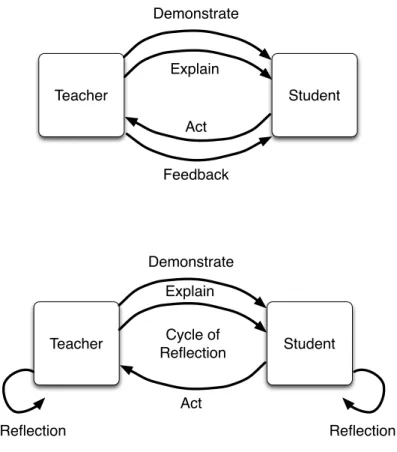
Teacher Student Demonstrate Act Explain Feedback Teacher Student Demonstrate Act Explain Cycle of Reflection Reflection Reflection
Fig. 1. Schön’s model of a reflective practicum. At first sight it appears to be a simple model of demonstration, action and feedback (top) but that tacit nature of the knowledge complicates this, because any stage of the interaction can lead to failures in understanding which require reflection and repair (bottom).
Christian decided to help me understand where my weight should be through a special exercise. He asked me to stand up in the saddle ... Suddenly I realized what Christian had meant by putting weight into my heels. My whole weight had moved down to my heels and it was from there that I found my balance. [Höök 2010]
This example shows that that teaching and learning an embodied skill is a complex interaction. The student acts (rides a horse) and the teacher diagnoses a problem with the action. The teacher intervenes verbally with a suggestion but the communication fails because it relies on an embodied experience that the student does not have. The teacher and student must therefore now diagnose a problem of communication and attempt to rectify it using an intervention based on action, not language. The interaction is a complex cycle of action, reflection and feedback in which teacher and student must try to come to a common understanding of concepts that neither of them can fully articulate.
Donald Schön has studied this type of teacher student interaction in his work on professional (though generally not movement) practice [Schön 1983,1987]. He noticed that while there are theoretical/scientific elements of professional practice that can be taught explicitly (biology to doctors, physics to engineers) there are important professional skills of action that are tacit and cannot be taught in this way (diagnosis for doctors, design for engineers). This has a strong analogy to the embodied skills we are interested in.
Schön proposes that this tacit knowledge can be taught via what he calls a “Reflective Practicum", a concept he developed based on his observation of architecture studio teaching (and which he then demonstrates in several other fields). A reflective practicum is one to one coaching where a teacher and student work together on a piece of the students independent work, giving feedback and suggesting improvements. Again, this is strongly analogous to the type of coaching we have seen in the somatic practices that Shusterman talks about [Shusterman 2008] or Höök’s example of horse riding [Höök 2010].
The basic process of a reflective practicum is shown in figure1(top). The teacher demonstrates a particular behaviour (Christian shows Höök how to sit in the saddle) or possible explains it verbally (as we have seen this is likely to be difficult for many forms of embodied behaviour). The student then attempts to act either by directly copying the teacher or producing similar work of her/his own. The teacher observes this action and gives feedback either verbally or by demonstration (“Christian kept saying that it was important that I put weight into my heels”[Höök 2010]).
However, as we have seen in Höök’s example this process can fail because of the tacit nature of the knowledge involved. Without the tacit knowledge needed to understand the teacher’s demonstration or feedback, it can be impossible to decipher (“I could not understand what he meant.” [Höök 2010]). In the case of verbal explanation or feedback this happens because the
teacher’s words refer to an embodied experience which cannot be fully explained in language. This means that students can only understand the comments fully via their own experience, but since they are learning they have not yet had that experience (or at least not fully understood it) and so they cannot understand what the teacher is saying. Demonstration may seem to get around this problem, but without personal experience the student does not know what aspects of the complex physical action to attend to and so to reproduce [Schön 1983].
Schön proposes that this is solved via a complex process of reflection, which as we saw is also key to Shusterman’s philosophy [Shusterman 2008]. Both teacher and student must reflect on their own actions and those of the other and attempt to understand what those actions mean to themselves and the other person. This reflection leads to a cycle of attempts to repair the failed understanding through further interaction: the student tries to act again or asks questions, the teacher adds further demonstrations and explanations. These attempts take many forms both verbal and non-verbal and a difficult problem might require the entire interaction to be reframed in order to achieve shared understanding, for example Christian, when his verbal instructions fail, attempts a new exercise that will lead to an experiential understanding (sitting in the saddle). This cycle of reflection and interaction, in difficult but successful cases, becomes what Schön calls the“ladder of reflection”[Schön 1987]. The teacher and student begin by reflecting directly on the
students work, but in order to repair failed understanding they must reflect on their and the other’s understanding of that action, then on their communication of that understanding so that they can have a meta-conversation about the interaction, and then reflect in turn on this meta-conversation. These progressively higher levels of interaction happen in the context of a close cycle of interaction between teacher and students where each act (whether verbal or non-verbal) is an attempt to understand and communicate.
This process is illustrated in figure1(bottom). A teacher must communicate a way of behaving that cannot be explained directly in words. This leads to a situation where teacher and students do
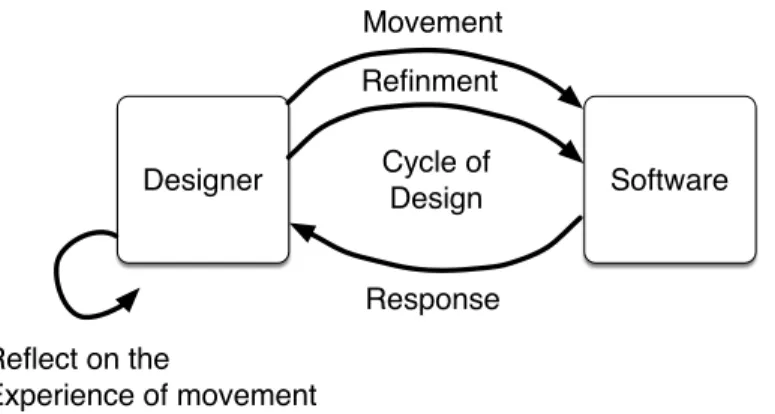
Designer Software Movement Response Refinment Cycle of Design Reflect on the Experience of movement
Fig. 2. The Schön’s reflective loop model adapted to movement design
not share an understanding and so cannot understand what the other is saying or doing. This must be repaired via a cycle of verbal and non-verbal interactions and personal reflection. The teacher demonstrates and/or explains and the student acts. Each must reflect on what happened before demonstrating, explaining or acting again, leading to an interactive cycle of mutual reflection. The main requirements of this process are a tight interaction cycle where both student and teacher attempt to communicate aspects of their understanding and the ability for each to reflect on that interaction to adjust their own understanding.
6 WHY IS INTERACTIVE MACHINE LEARNING SUITED TO MOVEMENT INTERACTION?
The previous sections have developed an understanding of movement knowledge as largely implicit and embodied but with explicit elements that can be thought about and talked about. It has also developed a model of how we communicate movement knowledge through a mix of demonstration, explanation and reflection, as exemplified by Schön’s reflective loop. What does this imply for the
designof movement interaction?
Design and implementation of movement interaction involves movement knowledge in the sense of understanding a particular movement that is designed, and also communication of that knowledge, both to other people (designers and the public) and also, importantly to computers and related technological artifacts as the interaction is implemented. This requires a reflective loop similar to that prosed by Schön [Schön 1983,1987], but it is no longer a loop between teacher and student but between designer and artifact (figure2). While a designer might begin with an explicit idea for an interaction they can only fully understand it through physical practice and reflection on that practice. This becomes a loop because the designer can refine the interaction based on this reflection. However, because this explicit reflection is necessarily partial and incomplete, results of a change to the artifact can only truly be understood through another cycle of practice.
First person, embodied design processes such as Embodied Sketching [Márquez Segura et al. 2016] are valuable in this context as they allow designers to design in an embodied way through movement and reflection on that movement, and they also support the communication of movement knowledge with other designers. However, on their own they do not support implementation of
the movement interaction: communication of movement knowledge to a machine. For that we need appropriate implementation tools.
6.1 Implementation and Toolkits
Embodied Sketching is therefore an effective means of ideation that leverages movement knowledge. However, it is useless if the resulting designs cannot be implemented in practice. For traditional graphical interfaces this would rely on Graphical User Interface (GUI) toolkits that allow for quick prototyping and implementations of 2D interfaces.
However, if embodied knowledge is not representational then it is very different from the kind of representation we normally associate with GUI toolkits. Computers are generally based on explicit representations [Gillies and Kleinsmith 2014], and this is equally true of GUI toolkits with their symbolic buttons, sliders and menus. Designing interfaces generally involves creating representations, whether they are in the form of program code or graphical user interface layouts. If we are unable to make explicit representations of our embodied knowledge then this means that traditional styles of interface design toolkit will not work as they rely on representations. They will only be able to make use of a small set of bodily actions that we can describe explicitly (for example, raise your arms above your head), not more complex ones (e.g. the movements we make when we pedal a bicycle). So a designer who has developed an interaction using embodied sketching will find themselves severely limited when it comes to implementing that interaction it they have to rely on a symbolic or code based toolkit. All the benefits of embodied knowledge would become instantly lost.
It may be possible to implement a more sophisticated form of interaction with complex code. However, this is likely to be a slow process that does not support fast design iteration. The above discussion should make clear that fast iteration is even more important for movement interaction than it is for graphical interaction. Understanding the nature of the interaction that is being designed relies on the tight reflective loop of action and reflection based on that proposed by Schön. Without that iterative loop, designers would find themselves unable to fully understand the possibilities of interaction, let alone improve it.
6.2 Interactive Machine Learning
If we cannot create toolkits based on representations, how can we support designers of movement interaction? If embodied knowledge is implicit it means that we candomovements but cannot say howwe do them. This implies that we should not only design by doing and moving [Hummels
et al. 2007;Kleinsmith and Gillies 2013] but we should implement those designs in the same way. Implementing by doing means implementing by giving examples of actions. Designing by example goes back to early work on programming by demonstration [Hartmann et al. 2007;Lieberman 2001] and is in fact a popular method for designing gestural and movement interfaces, for example defined gestures by drawn templates [Wobbrock et al. 2007]. This style of design tool is mostly associated with machine learning which is used in many gesture recognition and movement interaction systems [Caramiaux et al. 2015a;Fiebrink et al. 2011]. Machine learning is a class of technology in which recognition systems are learned from a number of examples rather than being explicitly programmed. The focus on examples means that machine learning based design can support design based on embodied knowledge, rather than symbolic or linguistic knowledge, and the popularity of machine learning based toolkits for movement interaction supports this idea.
There is also a pleasing analogy to how people learn embodied skills. The idea is that people can only learn a skill like riding a bicycle through experience (c.f. learning from examples) rather than by being told how to do it (c.f. being explicitly programmed). This analogy captures the strong
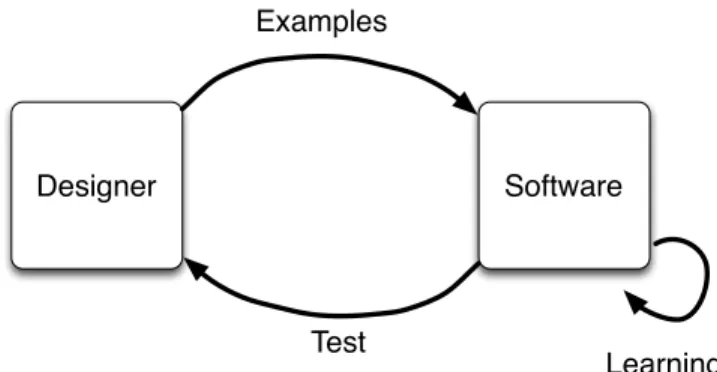
Designer Software Examples
Test
Learning
Fig. 3. The standard process of design via machine learning.
relationship between the idea of implicit, embodied knowledge and the process of design through machine learning.2
Machine learning makes it possible to design by giving examples of movement: designing by moving rather than having to put our tacit, embodied knowledge into explicitly linguistic or symbolic (i.e. program code) form. However, standard machine learning does not include the cycles of reflection and repair discussed in the previous section.
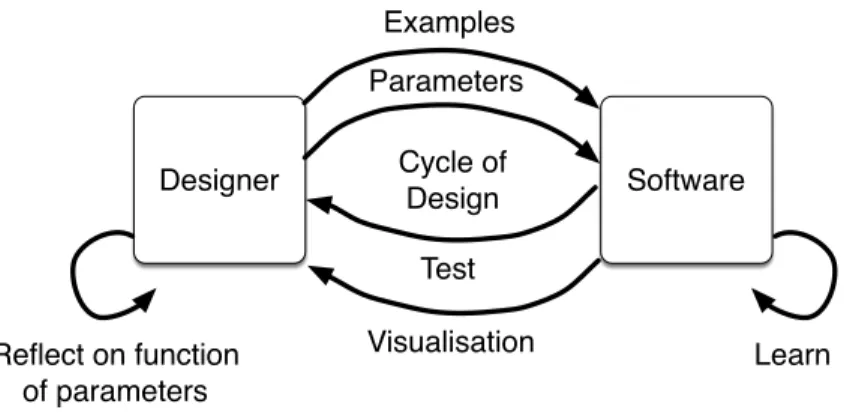
Let us compare Schön’s model with the standard process of using machine learning to create a gesture recognizer, illustrated in figure3. The designer’s role is to provide a (normally large) number of examples of the gestures to be recognized. Once this data set has been collected they are given to the learning algorithm which learns a model from the data, which can be tested by the designer. If we are to translate this into human learning it corresponds to a teacher designing a large number of readings and exercise, giving them to the student and then leaving them to work through them on their own, learning independently. They may possibly return at the end to administer an exam. Not only does this not model the teaching process well, most teachers will realize that it is unlikely to succeed.
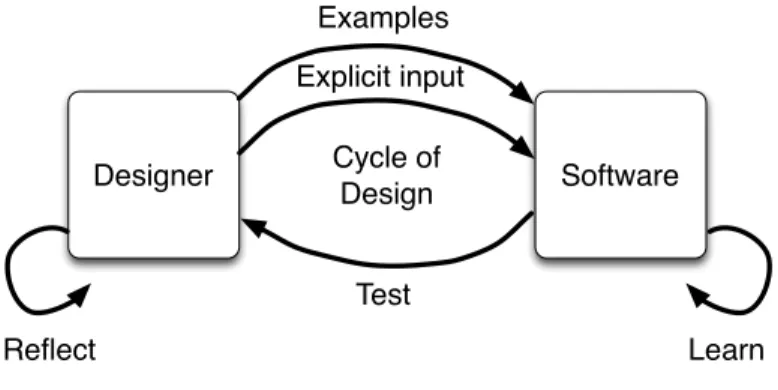
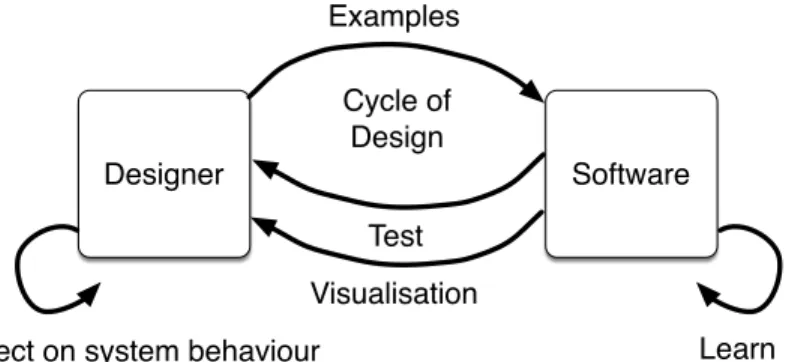
Schön’s model calls for a much tighter loop of interaction, which is precisely what is found in Interactive Machine Learning. In IML, rather than a designer creating a large data set before hand, they would iteratively interact with the system to gradually guide learning with a number of example, in a workflow that is analogous to Schön’s cycle of reflection. Figure4shows a proposed design process based on IML and Schön’s model. The monolithic collect data - train - test sequence is replaced with a tighter cycle of design in which data is added interactively with the ability to test at any time and repair any problems through further interactions. These interactions can potentially take many forms including demonstration and examples but also communicating explicit aspects of the knowledge (corresponding to verbal explanations in human teaching).
The interactive machine learning process should promote reflection on the interaction between human and software. This reflection should not simply be, as is the case in most software, about learning what the system can recognize and adapting movements to the software. The designer is 2In fact, it is not a perfect analogy. We do not learn to ride a bicycle by viewing example, but by trial and error, a process much closer to reinforcement learning [Sutton and Barto 1998] than the types of learning discussed in this paper. A better analogy might be language learning or learning to paint.
Designer Software Examples Test Explicit input Cycle of Design Learn Reflect
Fig. 4. A model of interaction with a movement interaction design tool based on Schön’s reflective practicum.
changing the system through the design process to recognize more movements or recognize more accurately. This is certainly about reflecting on the system but it is also about reflecting on the movements made to the system because the system is defined by the movements it recognizes (in machine learning this is literally the case: the system is designed by giving movement examples). In some cases this reflection will be largely about the system: the sensors cannot distinguish two movements so the designer must design new movements. Some times the reflection will be purely about movement: during testing a design might decide that a movement quickly becomes tiring or uncomfortable (this case is very close to Shusterman’s model of reflection). However, most of the time the reflection will be about the two together: a movement is not recognized because the designer is in fact performing it in a way that seems very similar to their original examples but is different in important ways. This requires reflecting on the details of the two movements and understanding how they are different, but also reflecting on the system and how it requires diverse examples (this model is very close to Schön’s model of reflection).
7 EXAMPLES
This section will analyze three examples of using interactive machine learning to design movement interaction to see if they can enable the form of reflective design proposed in the previous section. Each examples presents results from user studies in which users were asked to perform interaction design tasks. In the majority of cases the participants in those studies had some experience of interaction design, even if their main expertise was in another domain. The studies all, therefore, give some idea of the role of a designer within the system.
7.1 The Wekinator
The Wekinator (http://www.wekinator.org) is a software platform developed by Fiebrink [Fiebrink 2011;Fiebrink et al. 2011] for designing gestural and movement based interfaces, primarily for performing electronic music (though it has been used in a range of other ways). The software uses and interactive machine learning process. Users provide examples of gestures or movements and can quickly test the results and provide more examples in order to correct or refine the system.
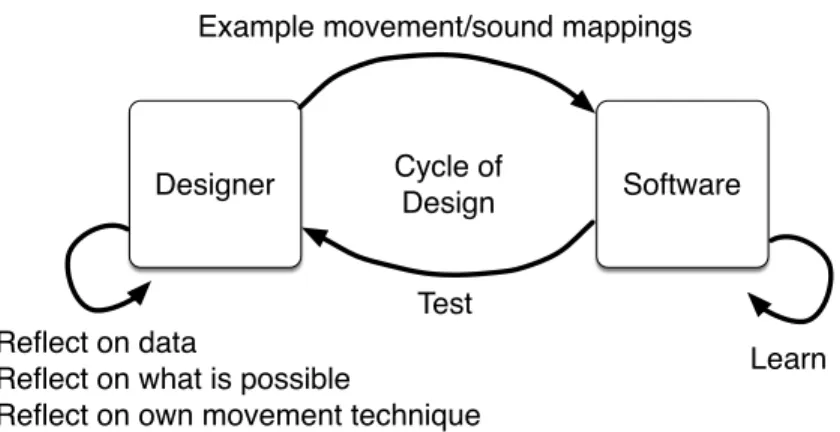
Designer Software Example movement/sound mappings
Test Cycle of
Design
Learn Reflect on data
Reflect on what is possible
Reflect on own movement technique
Fig. 5. The reflective design loop model applied to the wekinator
The discussion below is based on a number of user studies with a range of participants, including both students and professional musicians and designers. The majority had considerable experience of electronic or acoustic music and some experience of interaction design for musical applications. The ability to design by example was popular with Fiebrink’s participants, who felt that it allowed them to design in more embodied ways than with explicit programming systems such as Max/MSP (which many were familiar with):
“With [theWekinator], it’s possible to create physical sound spaces where the connec-tions between body and sound are the driving force behind the instrument design, and they *feel* right. ... it’s very difficult to create instruments that feel embodied with explicit mapping strategies, while the whole approach of [the Wekinator] ... is precisely to create instruments that feel embodied.” participant quoted in [Fiebrink 2011]
Fiebrinket al.’s participants interacted extensively with the learning process and preferred
interactive testing to more traditional machine learning metrics like cross validation [Fiebrink et al. 2011]. This interactive testing served to improve the learned models but it also encouraged users to adapt their own behaviour and learn themselves. Fiebrinket al.[Fiebrink et al. 2011] list a number
of ways in which their participants learned through interaction with the Wekinator.
Teaching Users to Provide Better Data.“ten students indicated that they had learned during their interaction with the software to provide training data that more clearly expressed their intentions”[Fiebrink et al. 2011]. This type of learning corresponds closely to Schön’s reflective
cycle [Schön 1983,1987]: users are learning to communicate better with the system. Teaching Users What is Possible“Users often adapted their goals for the system based on what
they discovered through direct evaluation ... When discovering that their efforts were failing to produce a model that worked how they wanted ... users adjusted their goals. Another reason for adaptation was that, through hands-on experimentation with the system, users discovered that models performed in unexpected ways that they actually liked better than their initial goals”[Fiebrink et al. 2011]. This form of learning is different from that described by Schön
and shows that as well as reflecting on the interaction, interactive machine learning can also support reflection on the design.
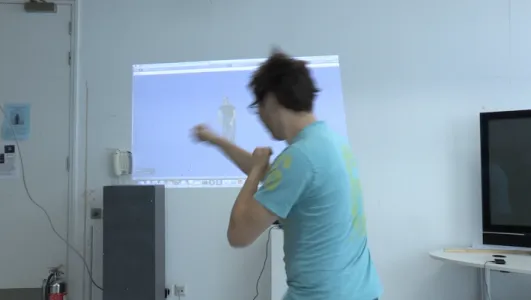
Fig. 6. Body language interaction with a virtual character
Providing Feedback on Users’ Gestural Techniques “the cellist ... noticing that the bowing articulation model was not discriminating well between riccocet and spiccato strokes, she reex-amined her own technique for those strokes and discovered that her spiccato technique actually needed to be improved” [Fiebrink et al. 2011]. Again this shows that interactive machine
learning can support the kind of reflection on movement technique and embodied knowledge that Shusterman [Shusterman 2008] advocates.
Figure5shows the reflective loop model applied to the Wekinator. The design loop is relatively simple, consisting of the designer providing examples and then testing the result. However, this interaction supports reflection on a number of different factors.
The example of the Wekinator therefore shows that interactive machine learning can support design based on embodied movement knowledge and also reflection on that design process. This reflection is not only on the communication (as proposed by Schön [Schön 1983,1987]) but also on the design itself and the users own embodied knowledge and technique (as proposed by Shuster-man [Shusterman 2008]). The reflective design process is therefore multi-faceted and allows for reflection on multiple different levels.
However, the problem of communication still remains. The Wekinator must attempt to learn what the designer intends and the designer must attempt to understand what the Wekinator has learned in order to correct it, without either being able to explicitly explain to the other. While we have established that entirely explicit communication is not possible, most of the teaching of movement practice does involve some form of explicit explanation as well as demonstration. The next two examples explore whether some form of explicit representation can help support the design process.
7.2 Body language based gameplay
The second example is work by Gillieset al.[Gillies et al. 2015a,b] on a platform for designing
body language interaction with a virtual character in a game-like environment. A player (figure6) can see a virtual character on screen. They can perform actions with their body that are tracked
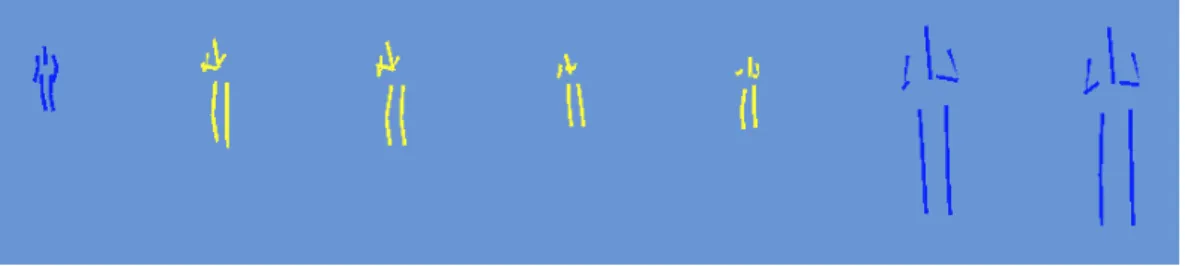
Fig. 7. Visual feedback to support debugging in the body language based gameplay example. Each stick figure represents an item in the original data set. The colors of the figures represent the classes they were labeled with. The size represents how much the contributed to the classification. Designers are therefore able to see that, in this instance, the current pose is being classified as the blue class based primarily on their similarity to the two figures on the far right.
using a Microsoft Kinect™and recognized by a machine learning based classification algorithm. The character will respond to the player’s actions with movements of its own.
The purpose of the design tools was to enable people to design the set of actions from the player that should be recognized, the responses by the character and train the machine learning classifier to recognize the actions. The system was specifically designed to be used by actors since they are experts in creating characters, and part of the design process was a series of participatory design sessions with a professional actor, who had limited experience of interaction design but considerable experience of “designing” characters in a theatrical context.
These sessions showed that the actor could easily understand the machine learning process of providing example data and classifying it. However, problems emerged when the system did not classify an action correctly. The actor could interactively test the system and see there was a problem, but did not know how to fix it:
[the actor was] not able to clearly identify specific causes of problems (“about the clips I’m still not clear what ...the problem [is]”) and therefore any proposed solutions were vague and often inappropriate. [Gillies et al. 2015b]
This situation seems clearly analogous to the failures in communication described by Schön [Schön 1983,1987]: the actor sees there is a problem but has no means to understand the actions of the system. What was needed was a way to enable him to reflect on the interaction and formulate a suitable correction. However, in this case simply iterating was not sufficient as the problem was too obscure to understand and any attempts at repair would have been essentially been random.
The solution was to provide visual feedback to help users understand how the machine learning algorithm was making its decisions (figure7). However this was not possible without changing the learning algorithm used. The first prototype used a decision tree algorithm whose classifications were based on a series of thresholding operations on joint rotation values. However, these rotation values, for example the y-orientation of the left shoulder, are not what we naturally think about when we move our bodies. Our sense of our bodies is much more holistic and we are more likely to think of the shoulder, clavical and upper arm (and maybe more of the body) as a single unit. For that reason, following a heuristic analysis using Blandford’s CASSM framework [Blandford et al. 2008], Gillieset al.redesigned the system to use a machine learning algorithm that worked on
holistic poses (a soft nearest neighbour based on Gaussian Mixture Models). The result is shown in figure7: users are shown poses from the original training data which are scaled to show how much they contribute to the classification, so they can conceptualize the action of the system in