PAIN & SYMPTOM CONTROL
GUIDELINES
Palliative Care
Greater Manchester & Cheshire
Cancer Network
PAIN & SYMPTOM CONTROL GUIDELINES 3rd
Edition May 2011 NOTES
This is third edition of the Greater Manchester and Cheshire Cancer Network Pain and Symptom Control Guidelines in palliative care for multi-professional health care teams involved in prescribing, advising, and administering therapies across all care settings including primary care, hospital, hospice and nursing homes. The guidelines cover pain and symptom control in specific situations and end of life care in the management of patients with an advanced progressive illness
Many drugs are used in palliative care outside their licensed indication at the doctor’s discretion. Details of these, together with “typical” doses and maximum doses are included, however, the inclusion of a drug or treatment in these guidelines does not absolve the doctors of their personal responsibility in providing treatment that they are confident with and can justify, and that is tailored to the individual patient’s circumstances. For further information or advice please contact your local Specialist Palliative Care Team, Hospital and Primary Care Trust Pharmacy Service Advisers.
Contributors:
• Chair: Dr Stephanie Gomm, Consultant, Palliative Medicine, Salford Royal NHS Foundation Trust and St Ann’s Hospice
• Co-lead Dr Trevor Rimmer, Consultant Palliative Medicine, East Cheshire NHS Trust
• Co-lead Dr David Waterman, Consultant Palliative Medicine, Stockport PCT/Stockport Foundation Trust/St Ann’s Hospice
• Kath Mitchell, Pharmacist, St Ann’s Hospice, Little Hulton/Salford Royal NHS Foundation Trust • Jennie Pickard, Pharmacist, St Ann’s Hospice, Heald Green/South Manchester Foundation NHS Trust • Barbara Wragg, Macmillan Palliative Care Nurse Specialist, Rochdale
• Dr Paul O’Donnell, Consultant Palliative/Respiratory Medicine, Acute Pennine Trust (Bury)
• Dr Jenny Wiseman, Consultant Palliative Medicine, Wigan and Leigh NHS Trust/Wigan & Leigh Hospice • Anne-Marie Raferty,The Christie NHS Foundation Trust
• Jacqueline Rees, Specialist Pharmacist for Surgery & Macmillan Cancer Care, Central Manchester & Manchester Children’s University Hospitals NHS Trust
• Nigel Warwick, Specialist Palliative Care Nurse, Community Services, Bury • Julie Whitehead, Pharmacist, East Cheshire Hospice
• Ann-Marie Cobb, Macmillan CNS Palliative Care, NHS Community Health Stockport • Louise Abedin, Pharmacist, Stockport NHS Foundation Trust
Acknowledgements:
Joanne Shaw Secretarial support Salford Royal NHS Foundation Trust Approved by:
Greater Manchester & Cheshire Cancer Network =Cross-Cutting Group Additional electronic copies can be obtained from:
Dr S Gomm
Consultant, Palliative Medicine
Salford Royal NHS Foundation Trust Stott Lane, Salford M6 8HD
Tel: 0161 206 0903 Fax: 0161 206 1451 E-mail [email protected] Also available on the following websites:
Greater Manchester and Cheshire Cancer Network
http://www.gmccn.nhs.uk/hp/Resources/DocumentsStore#national
Publication Date: July 2011 Review Date: July 2013
CONTENTS
PAIN MANAGEMENT
Pain Assessment 4
WHO Analgesic Ladder 5
Management of Opioid Side Effects 7
Treatment Guidelines 8
Alternative Strong Opioids 9
Adjuvants 13
NAUSEA AND VOMITING 14
GASTRO INTESTINAL OBSTRUCTION 16
ANOREXIA 18 CONSTIPATION 19 DIARRHOEA 20 RESPIRATORY SYMPTOMS 21 Breathlessness 21 Cough 24 Haemoptysis 25 ORAL PROBLEMS 26
DELIRIUM AND CONFUSION 27
HICCUPS 29
SWEATING 30
PRURITUS 31
ANXIETY 32
DEPRESSION 35
PALLIATIVE CARE EMERGENCIES 37
Hypercalcaemia 38
Superior Vena Caval Obstruction 38
Metastatic Spinal Cord Compression 39
Catastrophic haemorrhage 41
CARE OF THE DYING 42 SYRINGE DRIVERS 43 APPENDIX – OPIOID CONVERSION TABLES 46 REFERENCES 50
Abbreviations
b.d twice a day (bis die)
BNF British National Formulary
caps capsules
CD
controlled drug - preparation subject to prescription requirements of the Misuse of Drugs Act (UK). See BNF - "Controlled Drugs and Drug Dependence" section
COPD Chronic obstructive pulmonary disease
COX, COX2I cyclo-oxygenase, cyclo-oxygenase type 2 inhibitor
CSCI continuous subcutaneous infusion
EAPC European Association for Palliative Care
g gramme(s) h hour(s) hrly hourly i/m intramuscular i/v intravenous L Litre(s)
microgram not abbreviated
mg milligram
ml millilitre
min minute(s)
mmol millimoles
m/r modified release (used interchangeably with controlled
release)
nocte at night
LTOT Long Term Oxygen Therapy
NSAID Non - steroidal anti-inflammatory drug
o.d once a day (omni die)
p.o by mouth (per oris)
PPI proton pump inhibitor
p.r by rectum (per rectum)
p.r.n. when required (pro re nata)
q4h Every 4 hours (preferred to q.q.h - quarta quaque hora)
q.d.s four times a day (quarter die sumendus)
® Trade mark
SC Subcutaneous
SL Sublingual
SSRI Selective serotonin re-uptake inhibitor
stat Immediately
t.d.s three times a day (ter die sumendus)
TENS Transcutaneous electric nerve stimulator
UK United Kingdom
UTI urinary tract infection
WFI water for injection
WHO World Health Organization
PAIN MANAGEMENT 1. Pain assessment
• Therapy must be tailored to each patient. Use a logical stepwise approach.
• Consider: - physical aspects
functional aspects – effects on activities of daily living psychosocial – mood / relationship effects / sleep etc spiritual – fears / hopelessness / regrets / guilt
Assess physical aspects of the pain:
• cause of each pain - there may be more than one; may have non-cancer pain
• character, location, frequency, relieving and aggravating factors (see Table1)
• response to previous medication and treatment.
• severity by asking the patient (if able to respond); e.g.
- use of numerical score where 0 = no pain and 10 = severe, overwhelming
- simple verbal rating “none”, “mild”, “moderate” or “severe”
2. Table 1 - Common Pain Types
Pain Examples Character Initial
management Adjuvants Consider
Deep Somatic Bone metastases Gnawing, aching. Worse on moving or weight bearing. WHO Ladder NSAIDs Radiotherapy Surgery Bisphosphonate
Visceral Liver, lung,
bowel Sharp ache or deep, throbbing. Worse on bending or breathing. WHO Ladder Corticosteroid NSAIDs Nerve Block Surgery Neuro-pathic Nerve compression Nerve damage Burning, shooting; sensory disturbance in affected area WHO Ladder Tricyclic antidepressant Anticonvulsant Corticosteroid See Table 3 Radiotherapy TENS Nerve block Smooth muscle spasm Bowel obstruction Bladder spasm Deep, twisting, colicky (waves) May be sensitive to opioid - variable Anticholinergic - e.g hyoscine butylbromide for bowel colic
Surgical relief of obstruction
3. Pain Relief
• Set realistic goals, stage by stage: e.g. pain-free overnight; at rest; on movement.
• Prescribe analgesics regularly.
• Prescribe p.r.n. analgesic for breakthrough and/or incident pain (see section 5).
• Consider most appropriate route of administration – use oral route where possible.
• Prescribe by the WHO analgesic ladder (see section 4).
• Give patients and carers information and instruction about their pain and pain
management. Encourage them to take an active role in their pain management.
4. The WHO Analgesic Ladder
NOTE: MORPHINE IS STILL THE FIRST LINE STRONG OPIOID AT STEP 3 OF WHO LADDER (1996) AND EAPC GUIDELINES (2001)
Figure 1
Assess pain
• For mild pain start at step 1
• For moderate pain start at step 2
• For moderate to severe pain, start at step 3. If in doubt, give drug from step 2 and assess
after 30-40 minutes.
Adjuvant drugs contribute to pain relief and can be used alone or in conjunction with analgesics (see Table 3). They can be introduced at any step in the analgesic ladder.
Example use of analgesic ladder
Patient on no analgesics – mild pain:
Step 1 - Start regular paracetamol 1g q.d.s
Step 2 - Complaining of more pain - add codeine 30-60mg q.d.s. regularly. Step 3 - On maximum paracetamol and codeine, still in pain - stop weak opioid.
Commence morphine:
Either morphine m/r 10-30mg b.d
Or short-acting morphine 5-10mg 4 hourly regularly;
Or use alternative strong opioid if indicated (see below) Notes
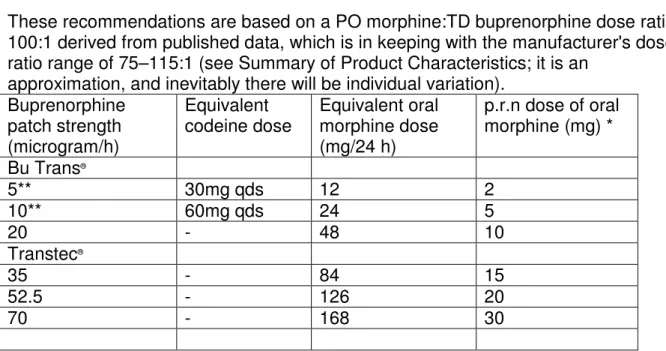
i. Tramadol is another weak opioid. However, the preparations available in the UK are more potent than codeine – e.g. tramadol 50mg is approximately as potent as 5mg of oral morphine. It is partly antagonized by ondansetron. See Table 33 for further details. ii. For dose conversion for weak opioids and buprenorphine to oral morphine see Appendix
Table 33
Step 1
NON-OPIOID
±
adjuvants
Step 2
WEAK OPIOID
+ non-opioid
±
adjuvants
Step 3
STRONG OPIOID +
non-opioid
±
adjuvants
5. Morphine
• Explanation and reassurance about morphine is essential to patients and carers.
• Reassure patients that they will not become psychologically dependent
Regular morphine
• See section 4 above for advice on commencing regular morphine.
• Be aware of dose conversions from weak opioids to oral morphine (see Appendix Table
33)
• In patients who are elderly or frail start with short acting morphine, using lower doses
and/or increased dosage intervals
• In patients with impaired renal function (eGFR 20-50 ml/min/1.73m2), active metabolites
of morphine may accumulate, causing toxicity. Give a lower dose (50%) and increased dosage intervals for administration – e.g. every 6-8 hours Titrate according to response .
• In severe renal failure (eGFR <20mls/min/1.73m2) - seek specialist advice
• Titrate morphine dose to achieve maximum analgesia and minimum side effects
o typical steps as 30-50% increments (in mg per 4h); 5-10-15-20-30-40-60-90mg.
o also prescribe “as needed” short-acting morphine for breakthrough pain (see
below)
• If commenced on regular short-acting morphine, once pain control is achieved, consider
conversion to modified release morphine at same 24h total dose.
Generic morphine Morphine brand names * Dose intervals
Short-acting morphine Oramorph®, Sevredol® 4 hourly
Modified release morphine Zomorph®, MST®, Morphgesic SR® 12 hourly (b.d.)
* Note: it is recommended that strong modified release oral opioids are prescribed by brand rather than generically.
Note – a once daily morphine m/r capsule preparation called MXL is also available
“As needed” (p.r.n.) morphine
• ALWAYS prescribe short-acting morphine for breakthrough pain when prescribing regular
morphine.
Calculate p.r.n. dose = total daily dose of morphine ÷÷÷÷ 6 (e.g. Morphine m/r 30mg b.d. =
Total oral morphine dose over 24hrs of 60mg, therefore breakthrough morphine oral dose =
60 ÷ 6 = 10mg p.r.n.). The p.r.n dose of morphine may be given up to every two hours. If
needed more frequently or 3 or more p.r.n doses given in 24h seek specialist advice.
Management of breakthrough pain (pain occurring before the next regular dose of analgesic)
• Is the regular opioid dose adequate? Titrate dose as necessary.
• If on m/r strong opioid, prescribe short-acting opioid p.r.n. and administer when required.
• Review pain and analgesia regularly.
Management of incident pain (pain free at rest but pain occurs on movement, weight-bearing; procedures such as dressing changes)
• Exclude a surgically correctable lesion, e.g. bone fracture
• Give equivalent of 4 hourly dose of short-acting opioid 30 min before procedures.
• If ineffective seek specialist advice.
Parenteral morphine and diamorphine
• If a patient is unable to take morphine orally, then give morphine or diamorphine by CSCI
• Dose equivalents: Oral morphine 3mg ≈≈≈≈ SC morphine 1.5mg ≈≈≈≈ SC diamorphine 1mg
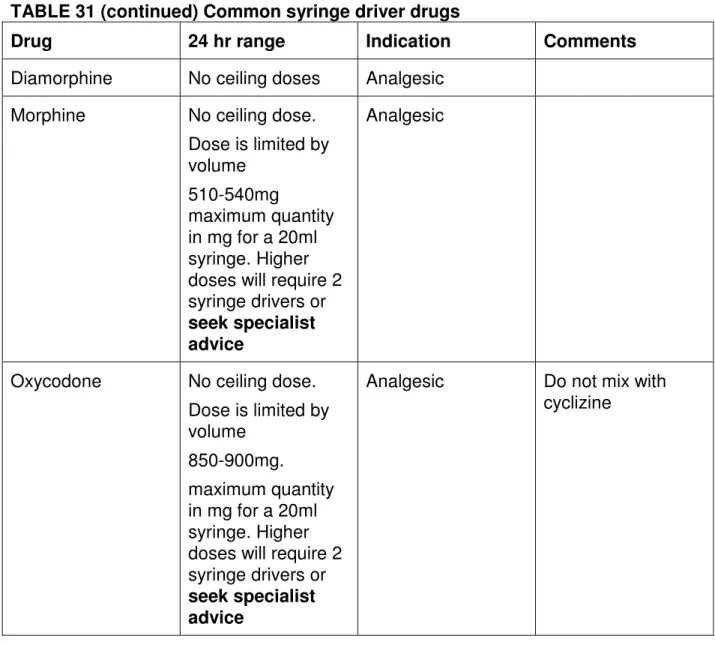
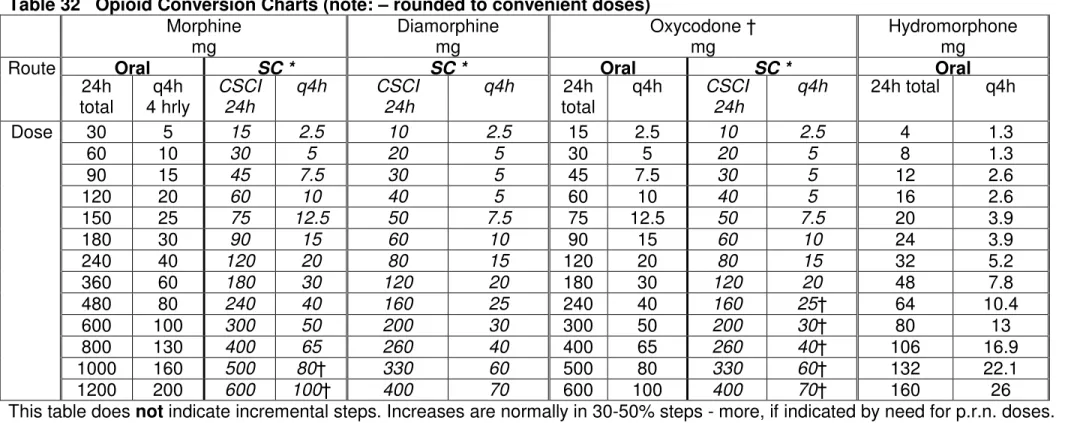
(For other strong opioid conversions, see Table 32 and Syringe Driver Guidelines on p44)
• Opioid naive patients should be observed for at least ONE HOUR following the
administration of the first dose of morphine or diamorphine injection (see National Patient Safety Agency, Safer Practice Notice 2006/012; ensuring safer practice with high dose
ampoules of diamorphine and morphine ) 1
• Parenteral morphine and diamorphine should normally be stocked and used in 5mg and
10mg strength ampoules for stat and p.r.n. breakthrough dose administration, and 30mg strength ampoules reserved for use in patients on continuous subcutaneous infusions (syringe drivers) requiring higher daily doses, unless the patient requires larger doses (see National Patient Safety Alert 2006/012)
6. Management of Opioid Side Effects
If side effects are intractable and reducing the patient’s quality of life or limiting pain relief,
consider changing to an alternative opioid. Seek specialist advice.
Consider renal impairment as a cause if toxicity occurs on previously tolerated dose.
i. Constipation (very common) - prevent by prescribing concurrent stimulant laxative ±
softener and titrate
ii. Nausea and vomiting(occurs in 30%) - prescribe haloperidol 1.5mg at night or metoclopramide 10mg t.d.s. for 5 days and then stop if asymptomatic
iii Drowsiness - warn patients that drowsiness and poor concentration may occur at start of therapy, and when dose is increased, but will lessen after a few more days
iv Delirium - decrease dose if possible; consider adjuvant drug or alternative opioid; consider haloperidol 1.5 - 3mg orally or subcutaneously – see page 28
v Myoclonus - decrease dose if possible; if this dose of opioid is essential, add oral clonazepam 500 micrograms nocte or use SC midazolam 2.5mg 4h p.r.n.
vi Hallucinations - decrease dose if possible; consider adjuvant drug or alternative opioid vii Dry mouth(nearly all patients) - inform patient and advise good oral hygiene (see p26) viii Respiratory depression - unlikely if opioids used and monitored correctly. Note -
naloxone can provoke a severe withdrawal syndrome if used too rapidly and/or in too high a dose
♦ If respiration slow (<12/min), but patient easily rousable
– Stop opioid and monitor carefully until improves
– Resume opioids at lower dose - seek specialist advice
♦ If the patient has slow respiration (<12/min) and is difficult to rouse and cyanosed
or hypoxic (SaO2 <90%) orif respiration <8/min - use naloxone ( to use dilute 1:10
with 0.9% sodium chloride solution for injections) – (see BNF section 15.1.7 )
– intravenous naloxone 100-200 microgram
– then 100 microgram i/v every 2 minutes until respiration is satisfactory
– monitor carefully - further doses (i/m or i/v) may be needed - naloxone acts
for 30- 60mins
– If venous access is not possible, or there would be an appreciable delay, naloxone
may be given i/m or SC (see BNF)
1
7. Treatment Guidelines for Cancer Pain Figure 2
Note: Adjuvant analgesics can be added on any step of the ladder.
Try To Diagnose Cause For Pain
Assess Pain STEP 1 NON-OPIOID e.g., Paracetamol 1g q.d.s. and/or NSAID STEP 2 WEAK OPIOID e.g., Codeine 30-60mg q.d.s. AND non-opioid STEP 3 STRONG OPIOID
Stop weak opioid Initiate morphine m/r 10-30mg b.d . or
short acting morphine 5-10mg q4h
or alternative strong opioid.
Prescribe breakthrough opioid dose - see text
Increase morphine dose by 30-50% each day until pain control achieved or side effects intervene
+/- adjuvants (See Table 3)
+/- adjuvants (See Table 3) +/- laxative
IF PAIN IS NOT CONTROLLED • Review causes
• Consider adjuvants • Consider other treatments • Seek specialist advice
IF PAIN CONTROLLED
Convert to equivalent dose if more convenient
• Modified release morphine • Alternative opioid
Continue
• Short acting p.r.n. strong opioid for breakthrough pain
• Anti-emetics p.r.n. • Laxatives
+/- adjuvants (See table 3) + laxative + anti-emetic Mild pain Moderate pain Severe pain
If pain not controlled or worsens
8. Alternative Strong Opioids
Morphine is the usual first line strong opioid Rationale for using alternative strong opioids:
- Pattern and severity of side-effects (when switching to another opioid of similar opioid-receptor affinity, improved pain relief should not be expected; but the pattern and severity of undesirable side-effects may be altered.)
- Renal impairment leading to accumulation of drug/metabolites (especially codeine, morphine and diamorphine) causing side-effects/toxicity
- Non-availability of oral route Equivalent dosage:
When switching from one opioid to another, the appropriate equivalent dose can be calculated by knowing the relative potency of the two drugs (see Table 32). However, this conversion is only an approximation as wide variations exist between individuals. Especially when converting high doses the initial dose may have to be reduced by 25-50% of the calculated equivalent dose to avoid undesirable side-effects or toxicity.
Seek specialist advice on the most appropriate alternative strong opioid and the appropriate conversion dose.
Fentanyl
• Similar analgesic properties to morphine.
• Lower incidence of sedation, delirium and hallucinations; constipation is less severe
• It is available as a transdermal preparation ("patch")
• Or as oro-mucosal ("lozenge") or sub-lingual/buccal tablet or intra-nasal or parenteral
preparations (seek specialist advice and local medicines management policy guidance ).
Fentanyl transdermal patches are not suitable for rapidly changing pain due to the long half-life of the drug. They should be used for chronic stable pain only.
• The patient should have been taking an equivalent dose of strong opioid previously
• It is recommended that fentanyl patches are prescribed by brand name due to small,
significant differences in release rates between opioid patches for individuals (Royal Pharmaceutical Society of Great Britain – February 2006)
• Note that there are two forms of fentanyl patch - matrix patches (e.g. Durogesic
DTrans®,Matrifen®) and forms with liquid reservoir (generic products and parallel imports
of Durogesic TTS®).
Place in therapy - stable pain responding to strong opioids and with at least one of the following:
• Unacceptable level of side effects with morphine/diamorphine or alternative opioids
• Oral route is inappropriate, e.g. dysphagia, vomiting
• Patient with renal impairment
• Patient with resistant morphine-induced constipation
• Where use may improve compliance (e.g. unwilling to take morphine)
Dosing of Transdermal Fentanyl Patch
• Available as 12, 25, 50, 75, 100 micrograms/h.
• Changed every 72h (rarely every 48h, seek advice).
by about 50% in 17h.
• Dose range is 25 -300 microgram/h; may be higher under specialist care
• In strong opioid –naïve patients the lowest 25 microgram/h fentanyl dose should be used
as the initial dose - note: this is equivalent to 60mg/24h of oral morphine, which might be too strong for some patients. If smaller doses may be indicated, seek specialist advice.
• If severe renal impairment (eGFR <20mls/min/1.73m2) use 50% of normal dose. Titrate
according to response
• Note – the fentanyl 12 microgram patch is licensed for dose titration between steps 25 to
50, and 50 to 75 micrograms/h; thereafter dose adjustments should be made in increments of 25 micrograms/h.
Table 2. To convert from strong opioid regimens to fentanyl patches
1. Short acting strong
opioid (e.g. Oramorph®,
OxyNorm®)
Apply patch – continue q4h strong opioid for first 12h until fentanyl reaches therapeutic level. Use q4h dose of short acting opioid p.r.n. for ‘breakthrough’ pain
2. Twice daily strong opioid
Apply patch with last dose of twice daily strong opioid and give q4h short acting strong opioid p.r.n. for
‘breakthrough’ pain 3. Once daily strong
opioid
Apply patch 12h after last dose of once daily strong opioid and prescribe q4h strong opioid prn for ‘breakthrough’ pain
4. Syringe driver Apply patch; discontinue syringe driver after 12h. Give
q4h strong opioid SC p.r.n. for ‘breakthrough’ pain.
Ensure correct breakthrough dose of short-acting strong opioid is prescribed (see Appendix Table 32 ,34 and 35)
Ten percent of patients previously taking regular morphine may experience withdrawal symptoms after changing to fentanyl giving symptoms of shivering, restlessness and bowel cramps. Pain control is not affected and the symptoms can be managed initially with
breakthrough doses of short-acting strong opioid. Seek specialist advice.
When a change to fentanyl is made, halve the dose of laxatives and adjust according to need.
Breakthrough pain
Prescribe morphine, diamorphine or oxycodone unless previously causing unacceptable toxicity, in which case ask for specialist advice for alternative drugs.
The dose is 1/6 of the equivalent 24h total equivalent dose to the fentanyl patch – use Tables 32 and 35.
Transmucosal Fentanyl preparations
There are several recently introduced rapidly acting fentanyl preparations, designed either
for buccal or sublingual use, or as trans-mucosal nasal sprays. They should only be used
in patients already on long-acting opioid medication – i.e.total of 60 mg of morphine per day
or equivalent. They are expensive - use according to local guidelines and under specialist
advice.
The indications for their use are:
• Breakthrough pain in patients who are all ready receiving and tolerant to opioids for
cancer pain eg morphine, oxycodone, hydromorphone and fentanyl patches
• Breakthrough pain that has a fast onset, but short duration of action.
• There is no direct dose equivalence with other opioids, including transdermal fentanyl,
so they need separate titration.
• Start with the lowest dose, unless otherwise advised.
• Maximum dose up to 2 doses per pain episode ,and limit to 4 episodes of breakthrough
pain daily. .
Management of patients with a fentanyl patch in the terminal phase
It is usual practice to leave the fentanyl patch in place - seek specialist advice
In the terminal phase, if a patient on a fentanyl patch develops unstable pain, a strong
opioid continuous subcutaneous infusion (CSCI) given by syringe driver can be used in
addition to the patch :-
• The total number of breakthrough doses of SC strong opioid (e.g. morphine,
diamorphine) needed in a 24h period is converted to a 24h CSCI and run alongside the
fentanyl patch. Be aware of doses used for incident pain. Usually up to a maximum of 3 doses should be added to the CSCI which is equivalent to an increase in the total opioid dose of 50%.
• Calculate the new p.r.n dose according to the fentanyl and the CSCI dose of strong
opioid - see Appendix Tables 32 & 35 Opioid Conversion Charts. Seek specialist
advice
For other drugs needed for symptom control, e.g., anti-emetics/sedatives, again leave the patch in place and administer the drugs by the oral or subcutaneous route. A syringe driver can be used for anti-emetic/sedative medication. (see Table 31)
Oxycodone
Oxycodone is a strong opioid with similar properties to morphine. It is licensed for moderate to severe cancer or post-operative pain.
Place in therapy
• Tolerance to morphine or unacceptable level of side effects with oral morphine
• Breakthrough medication for patients using fentanyl patches but intolerant of morphine.
• Oxycodone is approximately twice as potent as morphine when given orally (e.g. 20mg
oral morphine is equivalent to 10mg oral oxycodone)
Dosing
It is available in short-acting or m/r (over 12h) oral and parenteral formulations.
• Short-acting (OxyNorm):- 5mg, 10mg, 20mg caps or 5mg/5ml liquid, 10mg/ml
concentrated liquid
• M/r (OxyContin):- 5mg, 10mg, 20mg, 40mg, 80mg and 120mg tablets
• Parenteral oxycodone (OxyNorm injection):- 10mg/ml,as 1ml and 2ml ampoules and
50mg/ml , as 1ml ampoule.
If no previous strong opioid, use oral short-acting 2.5mg q4h or m/r 5mg b.d. and titrate
• If already on strong opioid; convert dose according to Conversion Table 32
• In renal impairment the clearance of oxycodone and its metabolites is reduced. Monitoring
for toxicity is required in renal impairment; In patients with impaired renal function (eGFR 20
-50 ml/min/1.73m2, active metabolites may accumulate, causing toxicity. Give a lower dose
(50%) and increased dosage intervals – e.g. every 6-8 hours and titrate according to response
• In severe renal impairment (eGFR below 20mls/min/1.73m2) - seek specialist advice
• Lower doses may also be required in the elderly
Parenteral oxycodone should be reserved for those intolerant of oral morphine or SC morphine/diamorphine,
Dose of SC oxycodone = Dose of oral oxycodone ÷ 1.5 (Table 32 ) See Syringe Driver Guidelines (p43)
Hydromorphone
Hydromorphone is a strong opioid, licensed for the relief of severe pain in cancer.
Place in therapy
• Patient intolerant of morphine or experiencing unacceptable level of side effects with
oral morphine, particularly sedation / hallucinations.
• Breakthrough medication for patients using fentanyl patches but intolerant of morphine.
• Analgesic potency ratio of oral morphine to hydromorphone is 5-10:1 (average of 7.5:1)
e.g. 1.3mg oral hydromorphone is approximately equivalent to 10mg oral morphine.
Dosing
It is available in short-acting or m/r (12 hrly) forms. Both forms may be swallowed whole or opened and sprinkled onto cold soft food (not suitable via PEG or nasogastric (NG) tubes).
• If no previous strong opioids, prescribe short-acting 1.3mg q4h or m/r 2mg b.d and
titrate
• If already on strong opioid convert dose according to Conversion Table (See Table 32)
• Hydromorphone is renally excreted. Monitoring for toxicity is required in renal impairment;
In patients with impaired renal function (eGFR 20 - 50 ml/min/1.73m2), active metabolites
may accumulate, causing toxicity. Give a lower dose (50%) and increased dosage intervals e.g. every 6-8 hours, Titrate according to response
• In severe renal failure (eGFR below 20mls/min/1.73m2) - seek specialist advice
• Consider dose reduction in the elderly
• Prescribe a p.r.n. dose as for morphine – 1/6 of the total 24h regular dosage, as needed up
to every two hours.
Methadone
Pharmacology of methadone is complex and its use as an alternative strong opioid should
be under specialist supervision, preferably as an inpatient.
Renal Failure and Opioid Prescriptions
If using weak or strong opioids in patients with acute or chronic renal disease and a reduced glomerular filtration rate (GFR <50 ml/min/1.73m2), please seek specialist advice from the palliative care team or pharmacist.
9. Other approaches to pain (consider seeking specialist advice)
• Radiotherapy/chemotherapy/hormone therapy
• TENS
• Massage
• Relaxation
• Psychological support
10. Use of Adjuvant Analgesics Table 3
Drug Use Comments
Tricyclic antidepressant, e.g. • amitriptyline - 25mg at night
(10mg in elderly); 25mg increments every 5 days, to 150mg as tolerated
Neuropathic pain May be combined with anticonvulsant if either inadequately effective used alone
Usually response in 5 days. Helps sleep.
Monitor for side effects see BNF; 4.3.1
Anticonvulsant – e.g • Gabapentin 300mg daily
increase by 300mg daily to 300mg tds; then by 300mg steps every 2-3 days up to 600mg tds - for higher doses seek specialist advice
Neuropathic pain Dose increases may be limited by side effects (e.g. sedation).
Slower titration and lower doses if in renal failure and frailer patients – use 100mg steps rather than 300mg; seek advice
Generic preparation is cost-effective • Pregabalin 75mg b.d, up to
150mg b.d after 3 to 7 days. Max 300mg b.d
If intolerant to gabapentin
Titration may be limited by side effects, e.g. sedation
May need to consider commencing lower doses ie 25mgs bd in patients with renal failure and frailer patients.
• Clonazepam 500 microgram to 2mg nocte
Titration may be limited by side effects, e.g. sedation
Corticosteroid - e.g:
• Dexamethasone 8-16mg a day in 1-2 doses
• Give in the morning to avoid sleep disturbance
• Dexamethasone is 7 times potency of prednisolone
To decrease peri-tumour oedema e.g. • Nerve compression. • ↑ intracranial pressure • Spinal cord compression • Organ infiltration.
May increase appetite, affect mood.
• consider gastro-protective agent (e.g. PPI) • stop if no response after 7 days
• review and reduce every 5-7 days to avoid side effects.
• check blood glucose for 3 days
NSAIDs
• e.g. ibuprofen 400mg -600mg q.d.s., naproxen 250-500mg b.d. diclofenac 50mg t.d.s
• COX-2 Inhibitors (see BNF 10.1.1)
• seek specialist advice Diclofenac or Ketorolac by CSCI - Seek specialist advice
Bone pain / soft tissue infiltration
Should respond within 1 week - stop if no improvement
• monitor for side effects
• add gastric protection (e.g. PPI) unless contra-indicated.
GI side effects and thrombosis risk is less with ibuprofen and naproxen in lower doses
Ketamine
Orally; continuous SC infusion Seek specialist advice
Neuropathic pain High incidence of dysphoria (see BNF
15.1.1.for side effects as used in anaesthesia). Consider prophylatic use of diazepam or haloperidol ; seek specialist advice
AVOID in hypertension, raised intracranial pressure, epilepsy and cerebrovascular disease.
NAUSEA AND VOMITING
About 40% of patients with advanced cancer have nausea and 30% will vomit.
Note - nausea may occur without vomiting and vice versa.
Definitions:
Nausea - unpleasant feeling of the need to vomit. Distinguish from anorexia
Vomiting - forceful expulsion of gastric contents through the mouth. Distinguish from regurgitation and expectoration
Assessment
• Review history and recent investigations
• Review medication
• Examination - looking for underlying causes and likely physiological mechanisms
• Investigations - only if will affect management
Table 4 - Management Of Reversible Causes
Cause Specific Management
Drug Therapy Stop or find alternative unless essential
Uncontrolled pain Analgesia - non-oral route until vomiting settles
Cough Cough suppressant
Urinary retention Catheterise
Constipation Laxatives; bowel intervention
Anxiety Determine fears; explanation; anxiolytics
Raised intracranial pressure Corticosteroids (e.g. dexamethasone)
Electrolyte disturbances Correct if possible and appropriate
Hypercalcaemia Rehydration and intravenous biphosphonate
Oral/oesophageal candidosis Antifungal (fluconazole,nystatin; imidazole)
Infection (URTI, UTI) Antibiotic
Gastritis Stop irritant drug; add PPI
Management
• Assess cause(s) of symptom ; may be more than one
• Remove reversible causes if identified
• Treat according to the likely pathophysiological mechanism
• If vomiting or severe nausea, use a non-oral route until controlled
• Avoid triggers (e.g. food smells); aim for small frequent meals
Anti-emetic Therapy
• Decide most likely cause, and choose first line treatment - Table 5
• Reassess daily - increase dose as needed until at maximum
• If no response, reassess cause
if cause changes, then use most appropriate medication
if same cause, go to second choice; combinations of anti-emetic therapy may be
needed
If poor response to second choice, consider second line approach (see below) and seek
TABLE 5
Drug Main Action of Drug Suggested Dose & Route Recommended Use
FIRST LINE Oral – 25-50mg t.d.s.
Cyclizine‡ Inhibits vomiting centre
Vestibular sedative SC - 75-150 mg/24h by CSCI (higher
doses under specialist advice)
Cerebral irritation; vertigo Visceral distortion/obstruction Oropharyngeal irritation
May be effectively added to haloperidol
Oral - 1.5mg - 5mg at night
Haloperidol Inhibits chemoreceptor
trigger zone SC - 2.5 - 5mg o.d. or by CSCI
Biochemical disturbance (drug, metabolic, toxic)
May be effectively added to cyclizine
Oral - 10-20mg t.d.s.-q.d.s. Metoclopramide * Pro-kinetic
SC - 30-60 mg/24h by CSCI (higher doses under specialist advice)
Gastric stasis, reflux
"Squashed stomach" - mass, ascites
Avoid in mechanical bowel obstruction
SECOND LINE
Oral – 6.25 -12.5mg nocte or in divided doses b.d. Note can be sedative in higher doses; seek specialist advice Levomepromazine Broad spectrum anti-emetic
(not pro-kinetic)
Also sedative - dose related
SC - 5-25mg o.d. or by CSCI
Replaces previous anti-emetic
Second choice - may be used earlier if sedation is not a problem or is desirable (more likely in doses ≥ 25mg/24h)”
Oral - 8mg b.d. (may be up to t.d.s. – seek specialist advice)
Rectal - 16mg o.d. Ondansetron (or
alternative equivalent)
5HT3 antagonists
SC - 16mg/24h by CSCI (higher doses may be used – seek specialist advice)
Mainly in chemotherapy, post-operatively Adjuvant in renal failure, gastric irritation or
biochemical stimulus
Added to previous anti-emetic Note – profoundly constipating
Dexamethasone Reduces inflammatory
response
May have central effect
Oral/SC - 4-16mg o.d. or in 2 divided doses
Adjuvant anti-emetic
Cerebral oedema; liver metastases
Added to previous anti-emetic
* - In Parkinson's syndromes, domperidone may be used in place of metoclopramide. See BNF 4.6
Note - avoid adding cyclizine or anti-muscarinic drugs to metoclopramide, as they inhibit its prokinetic action
GASTRO-INTESTINAL OBSTRUCTION Definition
It occurs in 3% of all cancer patients; more frequent complication if advanced intra-abdominal cancer (e.g. colon -10%; ovary -25%)
Site of obstruction is small bowel in 50%; large bowel in 30%; both in 20%
Table 6. Common causes of intestinal obstruction
Mechanical Functional
Cancer Constipation
Bowel wall infiltration Stricture formation Extrinsic compression
Autonomic nerve damage
Drugs – opioids, anti-cholinergics Postoperative
Metabolic - hypokalaemia; hypercalcaemia Radiation fibrosis
• Intestinal obstruction has a mechanical or functional cause, or both.
• Degree of obstruction may be partial or complete.
• Onset may be over hours or days; initial intermittent symptoms may worsen and
become continuous, or may resolve spontaneously (usually temporarily).
Signs and symptoms of bowel obstruction
• Nausea and vomiting (earlier and more profuse in higher obstruction)
• Pain due to abdominal colic or tumour itself
• Abdominal distension (especially distal obstruction)
• Altered bowel habit (from constipation to diarrhoea due to overflow)
• Bowel sounds (from absent to hyperactive and audible)
Assessment
• Clinical - see above
• Radiology - if needed to distinguish faecal impaction, constipation and ascites.
• Rarely an emergency - take time to discuss situation with patient and family to allow
them to make an informed choice about management.
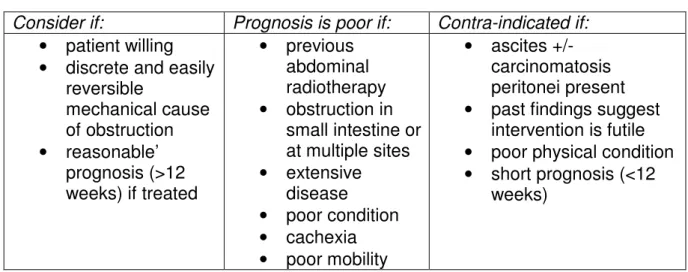
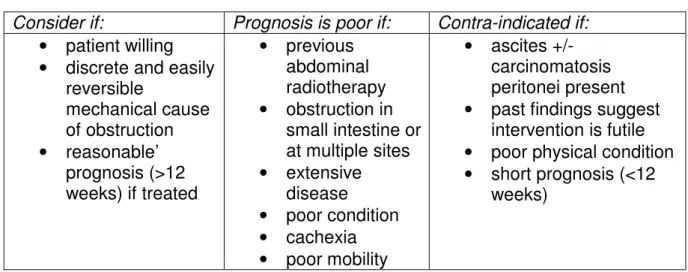
Surgery - consider for every patient at initial assessment.
Consider if: Prognosis is poor if: Contra-indicated if:
• patient willing
• discrete and easily
reversible mechanical cause of obstruction • reasonable’ prognosis (>12 weeks) if treated • previous abdominal radiotherapy • obstruction in small intestine or at multiple sites • extensive disease • poor condition • cachexia • poor mobility • ascites +/- carcinomatosis peritonei present
• past findings suggest
intervention is futile
• poor physical condition
• short prognosis (<12
Table 7 . Medical management of gastro- intestinal obstruction Nausea +/- vomiting
Complete obstruction
Try in sequence until effective:”
1)Cyclizine75-150mg/24hby CSCI (higher doses may
be used – seek specialist advice)
2Add haloperidol 2.5-5 mg/24h by CSCI
3Substitute both with levomepromazine 5-25mg/24h
Seek specialist advice
Functional or partial obstruction
Metoclopramide: 30 – 60 mg/24h by CSCI (may be increased up to 120 mg/24h – seek specialist advice)
• Contraindicated in complete bowel obstruction
• Stop if precipitates colic; use anti-emetics above
Persistent/high volume vomiting
Octreotide 300-1200 micrograms/24h by CSCI, or hyoscine butylbromide (as for colic below).
Give together if symptom resistant.
Seek specialist advice Other Symptoms
Constipation precipitating obstruction
Sodium docusate 100-200mg b.d – t.d.s. orally (avoid stimulant, bulk or fermenting laxatives such as lactulose)
Abdominal pain Follow pain control guidelines, using non-oral route
Abdominal colic • Anti-cholinergic agent, e.g. hyoscine butylbromide
60-300mg/24h by CSCI
• Stop: pro-kinetic drugs; bulk-forming, osmotic and
stimulant laxatives
Hydration Assess need for i/v or SC fluids on individual patient
basis. Many are not dehydrated
• May still absorb oral fluid above level of obstruction.
• SC fluid can be given up to 1-2 L/24h
Dietary intake • Allow food and drink if wished
• Total Parenteral Nutrition (TPN) may be appropriate
in selected cases - multidisciplinary team decision.
Naso- gastric intubation
Do not routinely usenasogastric (NG) tube for obstruction in the terminally ill.
Prolonged NG aspiration with i/v fluids is not recommended as it rarely gives sustained relief. Use medical measures described above.
May be considered for:
• decompression of upper gastrointestinal (GI) tract if surgery is being considered
• faeculent vomiting which is responding poorly to drug treatment
.
Venting percutaneous gastrostomy may be considered for symptom relief in patients whose vomiting is not relieved by pharmacological means and who are fit enough for the procedure
Ongoing Management
Review treatment at least daily
ANOREXIA
Definition - reduced desire to eat. Distinguish from nausea
Causes include
• Paraneoplastic effect of cancer
• Impaired gastric emptying
• Medication - e.g. opioids, SSRIs
• Poor oral hygiene, candidosis
• Altered taste or smell
• Anxiety, depression, delirium
• Any of the causes of nausea
Management of cancer-related anorexia
• Treat reversible causes
• Explanation - an effect of the cancer itself
• Listen to fears and anxieties of patient and family/carers - failure to eat can cause
fear and conflict
• Consider asking for dietician advice unless prognosis is short
• Food or supplements may be more easily taken by snacking through the day;
smaller portions more often
• Avoid offering excessive food;
Medication
Corticosteroid e.g.
• Dexamethasone - 4-6 mg once daily; assess after one week
– if beneficial, continue - reduce weekly to lowest effective dose
– if no benefit after 1 week, stop
Megestrol acetate
• 160mg once daily; may be increased - refer for specialist palliative care advice
• If no benefit after two weeks, then stop
• Less side effects than dexamethasone except increased risk of leg dependent
oedema and thromboembolic phenomena (5% excess risk) Metoclopramide - if impaired gastric emptying suspected
CONSTIPATION Causes to consider
• Drug induced – review medication; consider prophylactic laxative
• Dehydration - encourage fluids; review diuretics
• Reduced mobility - ensure ready access to toilet; attention to privacy
• Altered dietary intake - review and advise as appropriate
• Hypercalcaemia – i/v fluids and bisphosphonates (see Table 29)
• Neurological (e.g. spinal cord compression; autonomic neuropathy)
• Intestinal obstruction – (see Table 7)
Assessment
• History - normal bowel habit; medication list; causative factors
• Abdominal palpation and auscultation; digital rectal examination
• Investigations - if needed for treatment; e.g. abdominal x-ray; calcium levels
For intractable constipation, seek specialist advice
Table 8 Medical Management - Laxative Therapy
Clinical Situation Agent Type and examples Comments Soft bulky stools - low
colonic activity
Stimulant
Senna 2-4 tablets at night; bisacodyl 10mg suppositories 1-2 o.d.
Start with low dose and titrate. May cause abdominal cramp Colon full, no colic Stimulant ± softening agent – e.g.
senna + docusate sodium, or co-danthramer
Colon full and colic present. Macrogols
Movicol 2-3 sachets per day Encourage fluids Hard dry faeces Softening agents - docusate sodium
up to 500mgs/day.
Arachis oil enema (avoid if known nut allergy)
Useful in sub-acute obstruction. Higher doses may stimulate peristalsis.
Hard faeces in rectum Glycerol (glycerin) suppository 4g Stimulant plus softener, e.g. Co-danthramer strong 2.5-15ml or caps 1-3 at night and titrate
May cause red urine; peri-anal rash/irritation; colic
Hard faeces - full rectum, colon
2nd line -Movicol
2-3 sachets/day Encourage fluids Faecal impaction Arachis oil retention enema (avoid if
known nut allergy) ± phosphate enema
Warm before use
Give arachis oil at night, followed by phosphate enema in the morning
2nd line - Movicol - 8 sachets dissolved in 1Litre of water over 6h p.o. Repeat for up to 3 days.
Keep dissolved solution in a refrigerator.
Limit to 2 sachets/h in heart failure For opioid-induced
constipation resistant to the above methods
SC methylnaltrexone may be used. Seek specialist advice”.
N.B. – in paraplegic patients it is essential that a regular bowel regimen is established. A common pattern is use of a stimulant laxative with defaecation assisted by
suppositories or enema, avoiding faecal incontinence on the one hand and impaction on the other.(see Network Guidance on bowel management in malignant spinal cord
compression www.gmccn.nhs.uk/hp/Resources/DocumentsStore )
DIARRHOEA
Increase in the frequency of defecation and/or fluidity of the faeces.
Prevalence: 4% of patients with advanced cancer
Assessment and Management
Establish cause - usually evident from history Review diet
Review medication (including laxatives) – uncommon side effect of some drugs (e.g. PPIs)
Clinical assessment includes a rectal examination and inspection of the stool Exclude constipation with overflow - a plain abdominal x-ray if overflow may help if suspected. Treat as for constipation (Table 8).
Other investigations appropriate if will significantly affect treatment
If the patient is in the last days of life, treat symptomatically and do not investigate
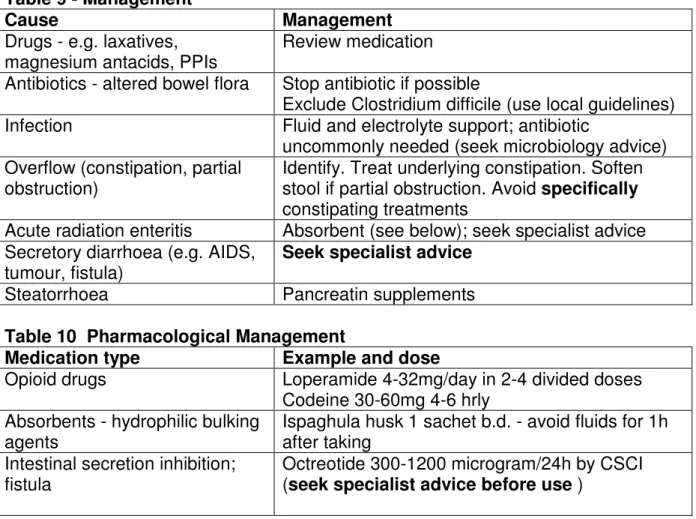
Table 9 - Management
Cause Management
Drugs - e.g. laxatives, magnesium antacids, PPIs
Review medication
Antibiotics - altered bowel flora Stop antibiotic if possible
Exclude Clostridium difficile (use local guidelines)
Infection Fluid and electrolyte support; antibiotic
uncommonly needed (seek microbiology advice) Overflow (constipation, partial
obstruction)
Identify. Treat underlying constipation. Soften
stool if partial obstruction. Avoid specifically
constipating treatments
Acute radiation enteritis Absorbent (see below); seek specialist advice
Secretory diarrhoea (e.g. AIDS, tumour, fistula)
Seek specialist advice
Steatorrhoea Pancreatin supplements
Table 10 Pharmacological Management
Medication type Example and dose
Opioid drugs Loperamide 4-32mg/day in 2-4 divided doses
Codeine 30-60mg 4-6 hrly Absorbents - hydrophilic bulking
agents
Ispaghula husk 1 sachet b.d. - avoid fluids for 1h after taking
Intestinal secretion inhibition; fistula
Octreotide 300-1200 microgram/24h by CSCI (seek specialist advice before use )
For severe resistant diarrhoea – seek specialist advice
RESPIRATORY SYMPTOMS BREATHLESSNESS (DYSPNOEA)
Respiratory symptoms are frequent in terminal disease, and tend to become more common and severe in the last few weeks of life.
Dyspnoea is an unpleasant subjective sensation that does not always correlate with the clinical pathology. The patient’s distress indicates the severity.
• The causes of breathlessness are usually multi-factorial: physical, psychological,
social and spiritual factors all contribute to this subjective sensation.
• It is important to recognise and treat potentially reversible causes of
breathlessness.
Assessment
• History and clinical examination
• Investigations e.g. chest x-ray
• Management will be dependent on clinical diagnosis.
Management
• Treat reversible causes
• Non-pharmacological measures
• Drug treatments
Table 11 – Potentially treatable causes of breathlessness
Cause Consider
Cardiac Failure and Pulmonary Oedema
Diuretics /
ACE inhibitors /nitrates /opioids
Pneumonia Antibiotics where appropriate
Bronchospasm Bronchodilators ± steroids
Anaemia Transfusion – treat symptoms rather
than Haemoglobin level
Pulmonary Embolism Anti-coagulation
Anxiety Psychological support, anxiolytics
Superior Vena Cava Obstruction Consider high dose steroid see
palliative care emergencies - Table 30 Refer to Oncologist for radiotherapy/ chemotherapy
Stents Tracheal/ Bronchial Obstruction from
malignancy
Refer to Oncologist for radiotherapy Or refer for stenting
Lung Metastases Refer to Oncologist for radiotherapy/
chemotherapy Pleural Effusion
Pericardial Effusion Ascites
Non-Pharmacological Management
• Reassurance and explanation
• Distraction and relaxation techniques
• Positioning of patient to aid breathing
• Increase air movement – fan/ open window
• Physiotherapy – decrease respiratory secretions and breathing exercises
• Occupational Therapy- modify activities of daily living to work with symptoms
• Establish the meaning of the breathlessness for the patient and explore fears
• Psychological support – to reduce distress of anxiety and depression
Pharmacological Management Oxygen therapy
• The evidence for efficacy is limited. Oxygen therapy may help dyspnoeic patients
who are hypoxic (Sa02 < 90%) at rest or who become so on exertion. It may help
other dyspnoeic patients due to facial or nasal cooling effect
• Consider a trial of oxygen for hypoxic patients (Sa02 <90%) and those where
saturation measurements not available. If of no benefit then discontinue. Oxygen therapy may lead to limited mobility, barrier to communication, inconvenience and cost implications; alternative therapies should be offered.
• For patients with COPD who are chronically hypoxic – do not use more than
28% oxygen. Seek guidance from respiratory physicians and follow local
guidelines
• Domiciliary oxygen for continuous or p.r.n use should be prescribed according to
local guidelines using a home oxygen order form (HOOF).
• For patients meeting the requirement for LTOT in COPD follow local guidelines.
Corticosteroids
May reduce inflammatory oedema.
Table 12
Indication Dexamethasone dose
• Superior vena cava obstruction 16 mg
• Stridor 8-16 mg
• Lymphangitis Carcinomatosis
• Post - Radiotherapy
• Bronchospasm
8 mg
- Review treatment with corticosteroids after 5 days.
- If symptoms have improved, reduce dose gradually to the lowest effective dose. If no improvement in symptoms, steroid should be stopped or reduced to previous maintenance dose. If patient has taken steroids for less than 14 days this can be done abruptly. If taken for more than 14 days reduce dose gradually and stop.
Opioids
Decrease perception of dyspnoea, decrease anxiety and decrease pain If patient is opioid naïve:
• Oral short acting morphine 2.5 – 5 mg 4-6 h p.r.n. for dyspnoea,
Titrate according to response
• If patient requires > 2 doses in 24 h, consider long-acting opioid
If patient is already taking regular strong opioid for pain:
• For breathlessness use an additional p.r.n. dose of strong opioid which is in
the range of 25-100% of the 4 hourly strong opioid dose depending on severity of breathlessness
•
For example ,if patient is on morphine m/r 30mg b.d for pain . – the additionalrange for oral short-acting morphine dose for dyspnoea is 2.5 – 10mg p.r.n
titrated according to response,
•
Consider increasing the regular dose by 25-50%• Titrate according to response
Note : Use with caution in patients with type 2 respiratory failure
Benzodiazepines
• Decrease anxiety
• Act as muscle relaxants
• Reduce anxiety and panic attacks
Note : Use with caution in patients with type II respiratory failure
Table 13
Drug Dose Comments
Diazepam 2 - 5 mg orally up to
t.d.s.
Long acting. (Half life = 20-100h) Lorazepam 500 micrograms -1 mg
sublingually/PO 8hrly
p.r.n.
Shorter acting (half life = 12 – 15h), fast onset of action.
Standard lorazepam tablets 1 mg are scored and can be used sublingually.
Midazolam 2.5 - 5 mg SC 4 hrly Short acting (half life = 2-5h)
Useful for intractable breathlessness
Review treatment with benzodiazepines after one week and reduce dose if the drug Is accumulating and causing drowsiness.
Nebulised medications Table 14
Drug Dose Comments
Sodium chloride 0.9% 5 ml p.r.n. or 4 hrly Hydrating agent for
viscous secretions
Salbutamol 2.5 - 5 mg p.r.n. or 4 hrly Bronchodilator
COUGH
• Assessment as to the likely causes(s) and purpose of the cough is essential
• May be cancer related / treatment related or due to other diseases.
• Cough may serve a physiological purpose and therefore where possible
expectoration should be encouraged
Management
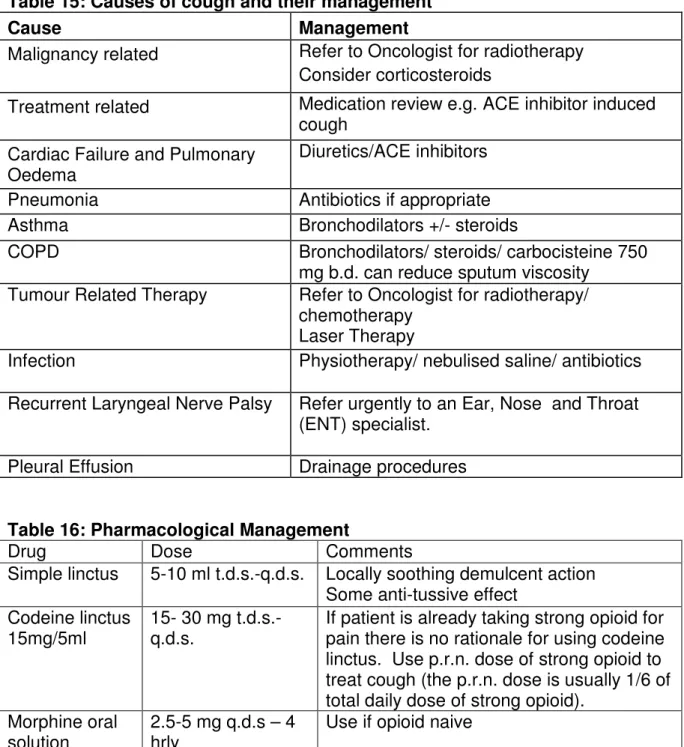
• Treat specific causes- see Table 15
Table 15: Causes of cough and their management
Cause Management
Malignancy related Refer to Oncologist for radiotherapy
Consider corticosteroids
Treatment related Medication review e.g. ACE inhibitor induced
cough Cardiac Failure and Pulmonary
Oedema
Diuretics/ACE inhibitors
Pneumonia Antibiotics if appropriate
Asthma Bronchodilators +/- steroids
COPD Bronchodilators/ steroids/ carbocisteine 750
mg b.d. can reduce sputum viscosity
Tumour Related Therapy Refer to Oncologist for radiotherapy/
chemotherapy Laser Therapy
Infection Physiotherapy/ nebulised saline/ antibiotics
Recurrent Laryngeal Nerve Palsy Refer urgently to an Ear, Nose and Throat
(ENT) specialist.
Pleural Effusion Drainage procedures
Table 16: Pharmacological Management
Drug Dose Comments
Simple linctus 5-10 ml t.d.s.-q.d.s. Locally soothing demulcent action
Some anti-tussive effect Codeine linctus
15mg/5ml
15- 30 mg t.d.s.-q.d.s.
If patient is already taking strong opioid for pain there is no rationale for using codeine linctus. Use p.r.n. dose of strong opioid to treat cough (the p.r.n. dose is usually 1/6 of total daily dose of strong opioid).
Morphine oral solution
2.5-5 mg q.d.s – 4 hrly
Use if opioid naive Morphine oral
solution
5 –10 mg 4 hrly Use this dose if patient has already been
taking codeine linctus but found it to be ineffective
Carbocisteine 750 mg b.d. Reduces sputum viscosity
Sodium chloride 0.9%
2.5 ml nebulised 4 hrly p.r.n
Helps expectoration, useful if it is a wet cough
HAEMOPTYSIS – See Haemorrhage in emergencies section Management
• Reassurance/ explanation
• Consider whether there is a treatable cause:
Table 17
Cause Management
Infection Antibiotics
Pulmonary embolus Consider investigation
Underlying malignant disease Palliative radiotherapy
Medications Review need & doses of anticoagulants/
aspirin/ NSAIDs Thrombocytopenia/ haematological
cause
Consult local guidelines
Pharmacological Management
• Etamsylate 500 mg orally q.d.s. (does not affect coagulation)
• Tranexamic acid 1 g orally t.d.s. – q.d.s
• Can be used in combination when symptoms difficult to control
Major life- threateninghaemorrhage (see palliative care emergencies page 37)
• Ensure patient is not left alone
• Keep patient warm
• Have dark towels (e.g. green, blue – not red) available
• Midazolam 5-10 mg deep i/m or i/v (for control of anxiety and amnesia)
• Diamorphine / morphine 5-10 mg deep i/m or i/v (or an appropriate dose if already
on opioids)
RESPIRATORY SECRETIONS
ORAL PROBLEMS
Preventative management
• Teeth and tongue should be cleaned at least twice daily with a small/ medium
head toothbrush and fluoride toothpaste. The mouth should be rinsed thoroughly with water after cleaning.
• Dentures should be removed twice daily, cleaned with a brush and rinsed with
water. They should be soaked overnight in water or the patient’s usual solution and cleaned with a brush.
• Adequate oral fluid intake should be encouraged.
• Lips should be moisturised sparingly with lip balm.
Table 18
Problem Management
Aphthous ulcers Local steroid – e.g. “Oromucosal” tablet of
hydrocortisone 2.5mg
Antiseptic mouthwash – e.g. chlorhexidine gluconate Topical gels – anti-inflammatory (e.g. Bonjela) or local anaesthetic (e.g. lidocaine) – see BNF 12.3.1
Viral ulcers Aciclovir 200 mg 5 times a day for 5 days
Topical gels (see above)
Malignant ulcers Consider antibiotic
Radiation stomatitis
Benzydamine mouthwash or spray
Paracetamol mucilage (use Christie formulation) 1 g, 4-6 hrly (similar preparations may be available from local pharmacies)
Opioid analgesics if above inadequate
Gingivitis Metronidazole 200 mg t.d.s. orally for 3 days
Consider metronidazole suspension topically (400 mg (10 ml) rinsed around the mouth then spat out) or rectal administration if not tolerated orally
Antiseptic mouthwash – e.g. chlorhexidine gluconate mouthwash
Dry mouth Review medications (opioids, anti-muscarinics)
Increase oral fluid intake
Saliva substitutes - e.g. AS Saliva Orthana, for dry mouth (see BNF 12.3.5)
Boiled sweets, ice cubes, sugar free chewing gum Pilocarpine tablets/eye drops- seek specialist advice
Coated tongue Chewing pineapple chunks
Brushing tongue with soft toothbrush
Fungal infection Nystatin oral suspension 100,000 units/ml 1 ml – 5 ml
q.d.s. held in the mouth for 1 min and then swallowed after meals and at bedtime or
Fluconazole 50-100mg daily for 7 days (14 days if dentures worn). Fluconazole 150mg stat can be used if prognosis is short.
Dentures should be soaked overnight in a weak
chlorine solution (e.g. ® Milton Sterilising Fluid )
Review and reassess treatment after 5 – 7 days. If recurrent please seek specialist microbiological advice.
DELIRIUM AND CONFUSION Definition
Delirium is characterised by 4 core features
• Disturbance of consciousness and attention
• Change in cognition, perception and psychomotor behaviour
• Develops over a short period of time and fluctuates during the day
• Is the direct consequence of a general medical condition, drug withdrawal or
intoxication
Delirium can have an acute or sub-acute onset (sub-acute seen commonly in the elderly) and should be distinguished from dementia.
Some patients may have significant cognitive disorder, but be quiet and withdrawn – in this situation the delirium may be overlooked. It can be a great source of distress to patients and carers
Causes of delirium can be multi-factorial so assessment is essential.
• Identification and treatment of the underlying cause is vital.
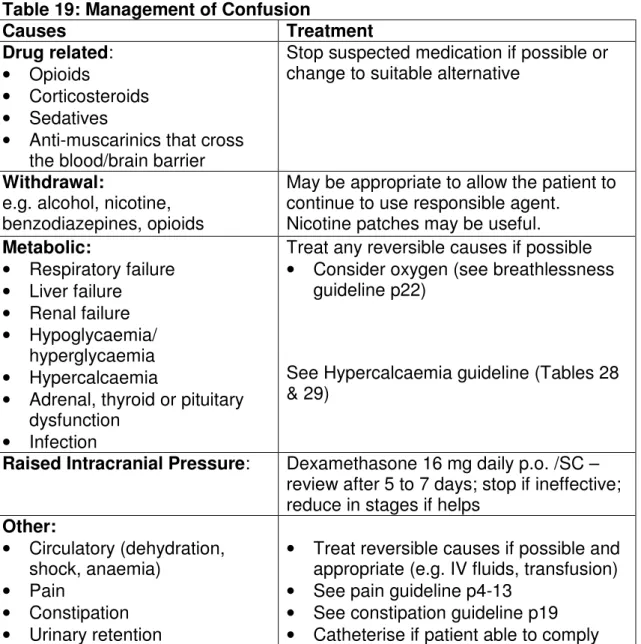
Table 19: Management of Confusion
Causes Treatment
Drug related:
• Opioids
• Corticosteroids
• Sedatives
• Anti-muscarinics that cross
the blood/brain barrier
Stop suspected medication if possible or change to suitable alternative
Withdrawal:
e.g. alcohol, nicotine, benzodiazepines, opioids
May be appropriate to allow the patient to continue to use responsible agent.
Nicotine patches may be useful.
Metabolic: • Respiratory failure • Liver failure • Renal failure • Hypoglycaemia/ hyperglycaemia • Hypercalcaemia
• Adrenal, thyroid or pituitary
dysfunction
• Infection
Treat any reversible causes if possible
• Consider oxygen (see breathlessness
guideline p22)
See Hypercalcaemia guideline (Tables 28 & 29)
Raised Intracranial Pressure: Dexamethasone 16 mg daily p.o. /SC – review after 5 to 7 days; stop if ineffective; reduce in stages if helps
Other: • Circulatory (dehydration, shock, anaemia) • Pain • Constipation • Urinary retention
• Treat reversible causes if possible and
appropriate (e.g. IV fluids, transfusion)
• See pain guideline p4-13
• See constipation guideline p19
Pharmacological management
• Only use if symptoms are marked, persistent, and causing distress to the patient.
• Regular review is imperative as sedative drugs may exacerbate symptoms.
• Use a step-wise approach to drug dosages and only use one drug at a time.
• For dying patients, please refer to local symptom control algorithm for Integrated
Care Pathway of the Dying.
Table 20
Delirium where sedation undesirable Haloperidol 0.5–3 mg at night or b.d. orally or i/m or
2.5 mg – 5 mg by CSCI over 24h. Consider a benzodiazepine if alcohol withdrawal is suspected.
Agitated delirium where sedation would be beneficial
Levomepromazine 12.5 – 25 mg 6-8 hourly orally or SC. If two or more doses given in 24 h, please seek specialist advice.
Acutely disturbed, violent or
aggressive; at risk to themselves or others
Haloperidol 5 mg SC or IM repeated after 20-30 min - seek specialist advice
Non- Pharmacological management
• Provide environmental and personal orientation. This maybe helped by the
presence of a family member or trusted friend.
• Manage patient in a quiet well-lit room.
• Ensure continuity of care by avoiding any potential disruptive interventions – e.g.
moving patient to different bed or ward
• Maintain hydration.
• Hallucinations, vivid dreams and misperceptions may reflect unresolved fears
and anxieties: facilitated discussion maybe necessary
• Reassure relatives and carers that the patient’s confusion is secondary to a
HICCUPS
A pathological respiratory reflex characterised by spasm of the diaphragm resulting in sudden inspiration and abrupt closure of the epiglottis.
Management of Hiccups
Treat if causing patient discomfort
Table 21
Cause Specific Management
Gastric distension – Vagus nerve Gastritis / gastro -oesphageal reflux Hepatic tumours
Ascites / intestinal obstruction
Peppermint Water
Metoclopramide 10 mg q.d.s.
(not concurrently with peppermint water) Anti-flatulent e.g Asilone ® 10mls q.d.s. Diaphragmatic Irritation – tumour
Phrenic Nerve Irritation – mediastinal tumour
Baclofen 5 mg orally t.d.s.
Anticonvulsant – e.g. gabapentin – in usual doses (see BNF 4.8)
Nifedipine m/r 10 mg b.d.
Midazolam – seek specialist advice Systemic: • Uraemia • Hyponatraemia • Hypokalaemia • Hypocalcaemia • Hyperglycaemia • Infection
Haloperidol 1-3 mg orally nocte Chlorpromazine 10-25 mg orally t.d.s
Caution: can cause sedation and hypotension especially in elderly patients
Midazolam – Seek specialist advice CNS tumour
Meningeal : infiltration by cancer
Anticonvulsant – e.g. gabapentin Baclofen 5 mg orally t.d.s.
SWEATING (hyperhidrosis) Table 22
Cause Treatment
Room temperature Excessive bedding
Lower ambient temperature Adjust bedding Infection Thyrotoxicosis Hypoglycaemia Hypoxia Pain Anxiety
Treat underlying cause where possible
Drugs (alcohol, antidepressants, opioids, etc) Review medication
Hormonal treatment for cancer, e.g.:
• Tamoxifen
• LHRH analogues (e.g. goserelin)
• Menopause due to XRT, chemotherapy.
Seek specialist advice
Paraneoplastic (± pyrexia), e.g.:
• lymphoma
• solid tumour (e.g. renal carcinoma)
Liver metastasis (often with no measurable pyrexia). See pharmacological management Non-pharmacological management • Oral fluids • Fan • Tepid sponging • Fewer bedclothes • Cotton clothing • Layered clothing Pharmacological management • Paracetamol 1 g q.d.s
• NSAID (standard doses)
• Anti - muscarinic (e.g. amitriptyline 10-25 mg nocte)
• Propranolol 10-40 mg t.d.s.
PRURITUS (ITCH)
Pruritus is an unpleasant sensation that provokes the urge to scratch
Non-Pharmacological Measures
If skin becomes wet, dry the skin by patting gently Keep finger nails cut short
Keep skin cool and hydrated Keep creams and lotions in fridge
Rub with ice cubes and leave wet to evaporate Avoid hot baths
Distraction techniques Avoid rough clothing
Pharmacological Measures
The evidence of the treatment of pruritus is limited. Many causes of pruritus are not histamine related. Antihistamines may have a sedative role in allowing a good nights sleep. Other measures need to be tried including treating the underlying cause if possible. In addition, stop any potentially causative drugs.
Table 23
Cause Specific Management
Dry Skin Emollients q.d.s. initially and b.d. long-term. e.g. Aqueous cream (+/- 1% menthol) Balneum Plus ® bath oil
Primary Skin Diseases e.g. Scabies
Dermatitis Psoriasis
Appropriate treatment of underlying condition
Skin inflamed Topical corticosteroids
e.g. hydrocortisone 1-2% cream Lymphoma Prednisolone 10 –20 mg t.d.s.
Cimetidine 400 mg b.d.
Opioid Induced Itch Step 1. Consider switching to alternative opioid Step 2. Ondansetron 4 – 8 mg b.d.
Step 3. Paroxetine 5 - 20 mg o.d.
Step 4. Anti-histamines e.g. chlorphenamine 4 mg t.d.s. Cholestasis Step 1. Emolient cream +/- night sedation
Step 2 Naltrexone 12.5 to 50 as a starting dose with effective doses up to 50-300 mg o.d. *
Step 3 Rifampicin 75 mg o.d. – 150 mg b.d. or Colestyramine (but is poorly tolerated in patients with advanced cancer -unpalatable, can cause diarrhoea and is often ineffective) Paroxetine 5-20 mg o.d.
Ondansetron 4 mg b.d. (increasing to 8 mg b.d. if required) Uraemia Naltrexone 50-100 mg o.d. *
Ondansetron 4 mg b.d. (increasing to 8 mg b.d. if required) UVB phototherapy as a potenti