The Role of Search for Field Force
Knowledge Management
Dyaa Albakour, Ge´ry Ducatel, and Udo Kruschwitz
Abstract Search has become a ubiquitous, everyday activity, but finding the right information at the right time in an electronic document collection can still be a very challenging process. Significant time is being spent on identifying suitable search terms, exploring matching documents, rephrasing the search request and assessing whether a document contains the information sought. Once another user is faced with a similar information need, the whole process starts again. There is significant potential in cutting down on this activity by taking a user straight to the required information. As well as delivering technical information and vital regulatory information, a knowledge management solution is concerned with capturing valu-able insight and experience in order to share it amongst workers. A search engine has been developed and deployed to technical support staff and we were able to assess its impact on mobile workers. The architecture is based on open-source software to satisfy the basic search functionality, such as indexing, search result ranking, faceting and spell checking. The search engine indexes a number of knowledge repositories relevant to the field engineers. On top of that we have developed anadaptivequery suggestion mechanism called Sunny Aberdeen.Query suggestionsprovide an interactive feature that can guide the user through the search process by providing alternative terminology or suggesting ‘best matches’. In our search engine, the query suggestions are generated and adapted over time using state-of-the-art machine learning approaches, which exploit past user interactions with the search engine to derive query suggestions. Apart from continuously updating the suggestions, this framework is also capable of reflecting current search trends as well as forgetting relations that are no longer relevant. Query log analysis D. Albakour (*)
School of Computer Science, University of Glasgow, Glasgow, UK e-mail:[email protected]
G. Ducatel
Research and Innovation, BT Technology, Services and Operations, Martlesham Heath, UK U. Kruschwitz
School of Computer Science and Electronic Engineering, University of Essex, Essex, UK
G. Owusu et al. (eds.),Transforming Field and Service Operations,
DOI 10.1007/978-3-642-44970-3_8,©Springer-Verlag Berlin Heidelberg 2013
of the system running in a real-life context indicates that the system was able to cut down the number of repeat faults and speeds up the decision process for sending out staff to certain jobs.
8.1
Introduction
Mobile IT technology is changing access to information for field workers—high-quality client devices can be carried whilst working away from office buildings. This opens the door to innovative knowledge management applications for mobile workers. Integration of mobile devices with enterprise networks is becoming more effective, with software-only solutions available and increased security. However, strategic knowledge management solutions are very costly and therefore changes are likely to be prudent. Pan enterprise solutions which store, distribute or capture information from field workers are not yet available, and the same is true for cloud solutions.
Information on enterprise networks is often stored in lengthy documents, across different silos with complex access rights. Access to this information is designed for desktop workers who can use tools to view, browse and even modify information. With regard to search engines, users tend to show some tolerance with regard to inaccuracy, given that query refinement is available; more complex interfaces (including facets, word clouds, filtering, etc.) have become the norm, but again, this is not something that is well adapted to mobility.
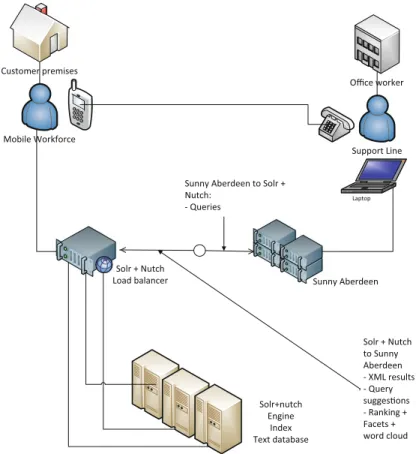
This chapter looks at field workers in particular and presents a knowledge management solution for accessing information. This solution, as seen in Fig.8.1, involves a support line where office workers are in charge of finding information for field workers and deciding on a line of action varying from verbal advice, electronic information sharing or even team support. Access to information is basically delegated to office workers and communicated back using whichever means is appropriate. This pilot scheme was also recording incidents to build a knowledge base, but this is outside the scope of the work presented in this chapter. The pilot scheme ran with an approximate ratio of support staff to field engineers of 1–80.
The support line has been provided with a search engine dedicated to all relevant technical repositories. The search engine solution technical features are described in the following sections. The solution is not only relevant from a technical point of view; the software design and architecture using open-source components have contributed to successfully demonstrating the value of this knowledge management solution for the field force.
This chapter presents the design and architecture of the software. This is followed by a description of the technical solution where we apply the Sunny Aberdeen open-source solution developed by one of the authors, and finally the experiment.
8.2
Software Architecture and Design
The search framework we have developed is a web-based application that provides search and adaptation services for local websites or intranets. Figure8.2illustrates the logical components of our adaptive search framework. The framework is built as a web application which can be used as a standalone system or integrated as a web service in other applications as it also provides an XML interface along with an HTML one. The web application interacts with external components which can be easily plugged into the system, i.e. the architecture is made flexible and extensible to other platforms.
8.2.1 The Web Application
The web application has three main engines:
Solr + Nutch to Sunny Aberdeen - XML results - Query suggesons - Ranking + Facets + word cloud Mobile Workforce Support Line Solr + Nutch
Load balancer Sunny Aberdeen Customer premises Office worker Laptop Solr+nutch Engine Index Text database Sunny Aberdeen to Solr + Nutch:
- Queries
Fig. 8.1 Overall solution design. Solr (Solr is an open-source search enginehttp://lucene.apache. org/solr) and Nutch (Nutch is an open-source indexerhttp://nutch.apache.org)
• The Search Engine
The search engine is a wrapper around an open-source search engine that can index documents and produce search results for a user query. It is responsible for retrieving a ranked list of documents for a user query.
• The Log Engine
The log engine is responsible for logging all user interactions with the search framework. Whenever a new session starts, all the interactions of the user within that session are logged. This includes the queries that had been issued with their timestamps, the documents that have been retrieved and interac-tions with the various visual components and their timestamps.
• The Domain Model (DM) Engine
The domain model engine is responsible for maintaining and adapting a knowl-edge structure that reflects the document collection and the user community’s interest. It is consulted to produce query recommendations and to visualise these recommendations.
8.2.2 The External Components
Each of the engines within the web application interacts with the corresponding external resource:
• Apache Solr
Apache Solr is a popular open-source enterprise search platform from the Apache Lucene project. It runs as a standalone web service to index the documents on the enterprise or local intranet and provides an interface to
search the index. In addition to that, it has powerful search features such as faceted search and spell checking.
• The Logging Database
This is implemented as a relational database and hosted on a MySQL service. The logging engine commits all the interactions to this database. • Offline Adaptation
This component is responsible for updating the knowledge structure that is maintained by the domain model engine. This component exploits and extends research and implementation from the AutoAdapt project (Lungley and Kruschwitz2009; Dignum et al.2010; Kruschwitz et al.2011; Albakour et al.2011). The AutoAdapt project has developed a number of methods to learn and adapt domain models from user interactions with a search engine. This is considered the added value in this search framework over a standard one as it automatically updates the domain model from the user community’s interests that can aid future users to the right path to finding information in addition to assisting them in browsing and navigation.
8.2.3 The User Interface
Alongside the search results displayed as a standard web search engine results, a number of interactive features are presented to the user. These include a list of query refinements, faceted browsing filters and a tag cloud of query refinements generated using the domain model adapted from previous logs of user interaction. Other interfaces can be instantiated from the framework such as an interactive connected graph of query suggestions.
Interactive information retrieval has received much attention in recent years (e.g. Baeza-Yates et al.2004). This can also be observed in the major Web search engines that have all become more interactive. A lot of this interactivity comes in the form of query recommendation suggestions. Such suggestions serve different purposes, they allow the user to rephrase the original query, they provide an insight into what the document collection might have to offer, and they illustrate what might be popular information requests. Ultimately they aim at shortening the interaction between user and system and guiding a user to the information that actually satisfies the original information request.
But what suggestions should be recommended to guide the user in the search process? Library classification schemes like theUniversal Decimal Classification1
(UDC) have been used for decades and have been demonstrated to be very useful when classifying books. The drawback that these manually encoded classification schemes have is that they lack flexibility. Furthermore, they represent a structured
view of the world but that view may not be the view that anonline searcher has. Instead, it has been recognised that there is great potential in mining information from query log files in order to improve a search engine (Silvestri2010). Given the reluctance of users to provide explicit feedback on the usefulness of results returned for a search query, the automatic extraction of implicit feedback has become the centre of attention of much research (Clark et al. 2011). Queries and clicks are interpreted as ‘soft relevance judgments’ (Craswell and Szummer2007) to find out what the user’s actual intention is and what the user is really interested in. This knowledge is then used to improve the search engine either by deriving query modification suggestions (the focus of our research) or by using such knowledge to modify the ranking of results to make the search system adaptive to the user or the entire user population.
Whilst query suggestions may seem useful for web search, they can become essential to cut down the time spent on finding documents in enterprise search contexts where users are not just interested in gettingsomematching documents but where they are looking for specific documents, memos, spreadsheets, etc. Enter-prise search is very different from web search (Hawking 2010; White 2007; Sherman2008), and one of the benefits an enterprise search setting offers is access to spam-free document collections as well as implicit feedback from an expert population (very different from the heterogeneous user population searching the
Web). Our research aims at capturing the implicit feedback from searchers in an enterprise setting to learn query suggestions as part of a continuous learning cycle. The main challenge we face is the dynamic nature of the document collection which requires a constant update of the ‘models’ that have been learned.
Our particular research is concerned with learning from the interaction logs that we collect from expert searchers who are answering calls in a call centre. The aim is to learn suggestions over time to ultimately shorten the time it takes to answer these calls. We investigate three different learning approaches that turn implicit feedback into models for query recommendation. In this first study we aim to answer two research questions as follows:
• Do the query suggestions presented by any of the models improve over time? • Does the continuous learning cycle lead to significantly shorter interactions?
Due to the lack of explicit feedback in the experimental setup, we make the simplifying assumption that higher take-up indicates better suggestions (to address the first question).
We report on a longitudinal study in a live industry setting in which we employ three different learning methods to derive query suggestions over time, one using maximum likelihood estimates, one using an ant colony optimisation approach and a third one using association rules. We employ A/B testing to assess these methods and compare them against each other.
8.3
Related Work
Searchers can have difficulties in identifying useful terms that truly represent their information needs when they interact with a search engine (Ruthven2003).Query recommendation addresses this particular issue by explicitly suggesting related queries for a searcher’s initial query. It was found to be a promising direction for improving the usability of Web search engines (Joho et al. 2004; White and Ruthven2006; White et al.2007). Therefore there has been a lot of interest in the IR community to develop and evaluate query recommendation systems. In partic-ular, many approaches have been proposed to exploit past interactions of the users with the search engine as recorded in the logs to capture ‘collective intelligence’ for providing query recommendations. Early work investigated the power of associa-tion rules applied on queries in the same session to derive related queries (Fonseca et al.2003). More elaborate techniques that learn from the flow of queries within a session were also proposed. This includes performing random walks on the query-flow graph (Boldi et al. 2008), projections on the query-flow graph (Bordino et al.2010) or the probabilistic model to predict the next user query introduced in He et al. (2009). Click-through information can also be exploited for query recom-mendation systems. For example, Mei et al. (2008) developed an algorithm to derive query suggestions from the query-click graph using random walks with hitting time. Ma et al. (2008) used the bipartite graph to derive a query similarity graph with latent semantic indexing.
However, suggestions derived using the previous methods treat the search logs as one batch and do not take the temporal aspect into account. Hence, the recom-mendations may become out of date and therefore irrelevant. Illustrated in Baraglia et al. (2010) is a query-flow graph model which can become outdated over time. In Broccolo et al. (2010), we can find an incremental version of the ‘association rules’ and ‘query-flow graph’ methods where the model can be updated whenever a new query is submitted. In this chapter we will be looking at query suggestion tech-niques which are adaptive over time.
Developing an efficient and effective search engine for a modern enterprise can have a significant financial value (Feldman and Sherman2001). Also, as indicated, the characteristics of enterprise search impose a lot of challenges on IR systems and make it different from Web search (Broder and Ciccolo2004; Hawking2004).
The search tasks are also different in nature as they are motivated by work problems. This includes approving an employee travel request, responding to a call in a call centre or finding people with technical expertise in a certain topic. Moreover, content in the enterprise comes from different repositories in different formats (emails, Web pages, database records) and do not necessarily cross-reference each other with hyperlinks as in the Web. For example, Fagin et al. (2003) found out that on the IBM corporate intranet, the ratio of strongly connected components (the ones that reach others by following links) accounts for only 10 % of the intranet collection which is much smaller than on the Web. Hence, the popular PageRank (Brin and Page1998) algorithm for Web search may not be
as effective on intranets. For example, Hawking et al. (2004) found out that links on the Web from outside an organisation have little value to add to the quality of the Web site search for that organisation. Mukherjee and Mao (2004) outlined the key ingredients that should be found in an enterprise search system. In addition to various techniques of designing effective ranking models for enterprise search, they suggested that contextualisation and recommendation can be particularly useful for search on the enterprise. In this work, we will take these observations forward and we propose and investigate adaptive domain models for a search engine serving the mobile workforce of a large corporation to improve retrieval in these environments. These models will be able to capture context and assist users in finding the right terminology that should deliver the ‘right’ answer to their information needs.
8.4
Search Framework to Support the Mobile Workforce
This section presents the context, in which the experiment has been conducted, and then the solution is described in detail and the different algorithms tested are explained.
8.4.1 Problem Description
We start here by describing the context of our solution. We have provided a search engine for a mobile workforce. We have exposed this solution to an operational mobile workforce with fifty desktop-based users supporting about one thousand mobile employees. As discussed earlier, the framework offers adaptive query suggestions to facilitate user experience, which is the major added value in our solution.
The solution we are discussing is designed to be used by top-level support line operators. They have been given a knowledge management tool which lets them access the main technical repository, but also health and safety, and compliance information. This tool also allows them to visualise historical data about specific cases. Mobile workers facing a risk of task failure are required to simply call the expert line for support. Search is paramount in deciding what type of response is offered to the mobile worker in difficulty. Operators will typically offer the following level of support: information (which can be technical, practical, compli-ance, health and safety, etc.), co-worker support (remotely or in person, typically a colleague close by) or the dispatch of an expert (as and when available). Therefore this solution aims primarily at reducing the number of repeat faults (attempted fixes of faults that fail, and which require new appointments). Of course, cost varies a lot depending on the response level given, and therefore savings can be evaluated in respect to the number of cases that do not fail and the level of response that was required.
8.4.2 System Setup
The search framework we provide is not accessible for mobile workers themselves. This can be seen as a paradox since more powerful mobile devices are becoming available. There are a number of reasons that mobile workers are not being asked to access the system directly: (1) wireless network access can still be poor in many places; (2) mobile devices do not always have a screen that is large enough especially when many documents and maps are involved; and (3) browsing for information might not be the quickest or safest way to carry out a task in jeopardy. The operators are expected to answer most questions without the need to look up the information. Mainly, search queries relate to technical references (e.g. clearance height, fault codes, validation codes) or handling of new equipment (e.g. installation settings), but also jeopardy situations (e.g. hostile environment, equipment incompatibilities, etc.).
Our search solution is therefore required to access a variety of sites which hold technical information, but also health and safety, and compliance. In large corpo-rations such portals or sites exist already, but they may be in a disparate form; they may use recent and rich information management tools (such as SharePoint), or they may be based on basic HTML pages. In any case, they will be attached to a number of processes and safeguards because the information they hold can be business critical or may have legal implications. Replacing and merging such systems is a risky and costly operation. Yet, having one single portal to reach out to all of those systems has obvious benefits in our context.
Deploying an open-source solution and being able to sustain legacy systems has two new benefits: it is low cost and it can be done quickly. We have used Solr,2an industry-strength open-source search engine which features rich user interface interaction. It is set up with facets, word cloud, spell checking and configurable ranking for different repositories. As well as aggregating key portals, our knowl-edge management solution includes a wiki used to keep a record of problems encountered by support line operators. Gradually, this system is growing a knowl-edge base of difficulties met by mobile workers with the solution applied. The system is inspired by bug tracking software. It is anticipated that the knowledge base hence gathered will be integrated into the search engine; however, it is not the case at this stage. This is due to a possible breach of compliance until the right validation processes can be created.
8.5
Adaptive Query Suggestions
The search engine has been improved by the addition of a query suggestion engine called Sunny Aberdeen. As discussed earlier, the major added value in our frame-work is the domain model engine, which derives and adapts query suggestions over time. In particular, we deploy the ant colony optimisation (ACO) approach devel-oped in the AutoAdapt project (Albakour et al. 2011). Here we give a brief description of the ant colony optimisation approach. ACO has been studied exten-sively as a form of swarm intelligence technique to solve problems in several domains such as scheduling. Here, the ACO analogy is used to first populate and then adapt a directional graph in which the nodes represent queries and the edges represent possible reformulations from one query to another. ACO uses the log of historical sessions as a training data set. A session is a sequence of queries that have been captured under the same browsing session. In an ideal scenario, each session would describe one search attempt, but in practice we expect noise which happens when users perform several distinct search tries within one session (abnormally long sessions have been excluded for the comparison). Automatically identifying the boundaries of sessions is a difficult task (Go¨ker and He 2000; Jansen et al.2007). One of the reasons is that a session can easily consist of a number of
search goalsandsearch missions(Jones and Klinkner2008). This is a particular problem in call-centre scenarios. Identifying topically related chains in user query sessions has been studied extensively (Gayo-Avello2009).
In the ACO analogy the edges in the graph are weighted with the pheromone levels that the ants, in this case, users, leave when they traverse the graph. The user traverses a portion of the graph by using query reformulations identified in a user session (analogous to the ant’s journey); the weights of the edges on this route are reinforced (increasing the level of pheromone). Over time all weights (pheromone levels) are reduced by introducing some evaporation factor to reflect unpopularity of the edge if it has not been used by ants. In other words, we reduce the weight of non-traversed edges over time, to penalise incorrect or less relevant query modifi-cations. In addition we expect outdated terms to be effectively removed from the model, i.e. the refinement weight will become so low that the term will never be recommended to the user.
8.5.1 Experiments
The aim of our live experiments is to compare our ACO algorithm with a couple of baseline alternatives, namely, maximum likelihood estimation (MLE) and associ-ation rules (AR). In the following, we briefly describe each baseline:
• MLE: MLE is a commonly used baseline approach in statistical natural language processing (Manning and Schu¨tze1999). This method essentially ranks queries
according to how likely they follow up a given query as observed from the past logs.
• AR: Association rules were used as an approach to derive query suggestions by Fonseca et al. (2004). Their approach maps the problem of finding association rules in customer transactions to the problem of finding related queries in a Web search engine. The general intuition is that if distinct queries co-occur in many sessions, then this may be an indication that these queries are related.
The experiment aims to establish which is the most effective algorithm for generating adapting query suggestions and what are the benefits, if any, in terms of speed. The domain model engine responds to the initial query by giving a list of possible words or phrases which are presented as candidates to either replace or augment the initial query. Given the call-centre context, we use a session timeout of 5 min, i.e. a session expires after 5 min of inactivity. To compare the different algorithms, we apply A/B testing (Kohavi et al.2007).
The domain model engine returns its list from one of the three algorithms randomly. Which algorithm is being used is obviously recorded within the session log. In order to assess the performance of each algorithm, we measure and compare the number of times end users select query suggestions and view between one and three documents returned. We therefore exclude sessions where no documents were viewed or when too many documents were accessed. This is an attempt to make sure that only successful queries are being compared. We do not have a means of knowing whether a search is in fact successful or not from explicit user feedback. Based on the specific context we operate in, we apply the assumption that viewing a small number of documents equates to a successful search. Whilst this is not a perfect match, it is designed to reduce noise to a minimum.
8.5.2 Results and Discussion
The search engine general usage figures show us that it processes on average just over 600 queries per week. The average session length is 1.92 queries (with a 1.83 standard deviation). This is shorter than an average Web query, e.g. (Silverstein et al.1999). Sessions of one query only account for 62 % overall, and sessions of two or three queries represent 27 % of all queries; longer sessions (four queries or more) are represented by the remaining 11 %. Finally, it takes an overall average of 62 s to access documents from initial query to final document viewing. These figures are only shown here to give an idea of the scale of the application; they are not relevant to the experiment in itself.
The experiment is divided into two phases: a training phase where algorithms are gathering data and a second post-training phase where algorithms have been trained and where we expect better suggestions. We then compare usage between the two phases. We expect to see an improvement in the quality of the results when users exploit query suggestions.
In Fig. 8.3 all algorithms start untrained and are trained on 30/07/2012. We consider the unpaired t-test analysis to be positive if its result is below 0.05. The results are ACO¼0.019, AR¼0.209 and MLE¼0.211.
We run an unpaired t-test analysis to measure whether or not there is a significant difference in usage. Figure8.3plots usage for each algorithm. The period before 30/07/12 is the training phase; the period thereafter shows results after training. The t-test analysis is only positive for the ACO algorithm. The MLE model does not indicate a significant usage increase and it remains quite low overall. The AR model is very much irregular in its usage perhaps indicating that suggestions vary in quality.
8.5.3 Time Comparison
The second part of the comparison aims to understand if using query suggestion can help save time. The query suggestion concept reduces the amount of typing and may also guide users during the course of their search sessions. We have measured successful queries in an attempt to establish whether suggestions lead to shorter sessions.
We measured the time length of sessions by subtracting the timestamp of the initial query from the timestamp of the last viewed document. We excluded sessions where more than three documents were found and session that spans over 5 min because this is a typical indication that the same session is being used for separate queries. Figure8.4shows three average session times. The first one is the time spent for a single, successful query which is 27 s. A query refined manually takes on average 81 s. A query which contains both manual refinements and suggestions takes on average 85 s. Finally, a query refined using suggestions takes 79 s. Time taken to refine queries is not improved significantly.
0.00% 1.00% 2.00% 3.00% 4.00% 5.00% 6.00%
MLE ACO AR Total Not trained Trained
Fig. 8.3 A/B testing for query success ratio
8.6
Conclusions
This setup demonstrates a design and high-level architecture for a practical mobility and knowledge management solution. The originality is to use an intermediate party to validate information going to field workers. This means that the tool focuses on empowering desktop-based workers rather than mobile workers. Desktop-based workers are more likely to be open to powerful interfaces, and they can improve their information-seeking skills with the provided search.
The benefits, although hard to quantify, can be listed as follows: access to technical documentation for unexpected difficulties leads to less repeat faults; the ability to monitor and enable collaborative work centrally leads to more effective use of resources. Access to all relevant aspects of unexpected tasks (health and safety, regulatory and technical) leads to compliant practices. Of course the search solution brings a significant contribution to the provision of a cost-effective functionality.
We weren’t able to measure the effective reduction in repeat faults because of high variability in this data set. Usage gives an indication of whether the search is deemed useful or not. There log-based evidence of sustained usage and indexing new content (to make new material available as soon as possible) has been a recurrent issue which is another indicator that search plays an important part.
We also introduce a learning element which brings huge benefits in terms of reducing maintenance costs. Enterprise search solutions are notorious for the level of manual configuration they require. Automated learning simplifies software maintenance and therefore reduces overheads. We identify a stronger learning model called ACO.
The relatively low usage of query suggestion (one in forty queries) might indicate that there are not enough suggestions made to represent the complexity of all queries at this stage. The ACO model is also more flexible in its ability to learn and discard query suggestions making it more robust and sustainable.
General usage reflects an important challenge in enterprise search query sug-gestion, in many cases data can remain sparse, and even weeks of training do not lead to an optimum trained set. Further work is required to understand if and when
Fig. 8.4 Average session length in seconds
the algorithm peaks with regard to usage. We need to establish a ratio between usage and quality against which we would be able to compare algorithms. Other solutions might be also be used to supplement training and increase usage more significantly.
For various reasons there is a growing interest in query suggestions. People are expecting quality to equal mainstream Internet search engines that are able to process large quantities of information. This work demonstrates valuable ways to progress at the enterprise search level. Ultimately, we believe that this will also lead towards a very valuable ‘queryless’ search with a high degree of personalisation. This potential could play an important role in enterprise search and mobility.
References
Albakour M-D, Kruschwitz U, Nanas N, Song D, Fasli M, de Roeck A (2011) Exploring ant colony optimisation for adaptive interactive search. In: Proceedings of the third international conference on the theory of information retrieval (ICTIR). Lecture notes in computer science. Springer, Bertinoro, pp 213–224
Baeza-Yates R, Hurtado C, Mendoza M (2004) Query recommendation using query logs in search engines. In: Proceedings of ClusWeb’04. Springer, pp 588–596
Baraglia R, Nardini FM, Castillo C, Perego R, Donato D, Silvestri F (2010) The effects of time on query flow graph-based models for query suggestion. In: RIAO. pp 182–189
Boldi P, Bonchi F, Castillo C, Donato D, Gionis A, Vigna S (2008) The query-flow graph: model and applications. In: Proceeding of CIKM’08. ACM, New York, NY, pp 609–618
Bordino I, Castillo C, Donato D, Gionis A (2010) Query similarity by projecting the query-flow graph. In: Proceedings of SIGIR’10, Geneva. pp 515–522
Brin S, Page L (1998) The anatomy of a large-scale hypertextual Web Search Engine. In: Proceedings of the seventh international World Wide Web Conference (WWW7), Brisbane. pp 107–117
Broccolo D, Frieder O, Nardini FM, Perego R, Silvestri F (2010) Incremental algorithms for effective and efficient query recommendation. In: Proceedings of the 17th international symposium string processing and information retrieval SPIRE’10. pp 13–24
Broder AZ, Ciccolo AC (2004) Towards the next generation of enterprise search technology. IBM Syst J 43(3):451–454
Clark M, Kim Y, Kruschwitz U, Song D, Albakour MD, Dignum S, Cervino Beresi U, Fasli M, de Roeck A (2011) Automatically structuring domain knowledge from text: an overview of current research. Inform Process Manag 48:552–568. doi:10.1016/j.ipm.2011.07.002
Craswell N, Szummer M (2007) Random walks on the click graph. In: Proceedings of the 30 th annual international ACM SIGIR conference on research and development in information retrieval, Amsterdam. pp 239–246
Dignum S, Kruschwitz U, Fasli M, Kim Y, Song D, Cervino U, de Roeck A (2010) Incorporating seasonality into search suggestions derived from intranet query logs. In: Proceedings of the IEEE/WIC/ACM international conferences on Web intelligence (WI’10), Toronto, pp 425–430 Fagin R, Kumar R, McCurley KS, Novak J, Sivakumar D, Tomlin JA, Williamson DP (2003)
Searching the workplace web. In: WWW. pp 366–375
Feldman S, Sherman C (2001) The high cost of not finding information. Technical Report 29127. IDC
Fonseca BM, Golgher PB, de Moura ES, Ziviani N (2003) Using association rules to discover search engines related queries. In: Proceedings of the first Latin American Web Congress. pp 66–71
Fonseca BM, Golgher PB, de Moura ES, Poˆssas B, Ziviani N (2004) Discovering search engine related queries using association rules. J Web Eng 2(4):215–227
Gayo-Avello D (2009) A survey on session detection methods in query logs and a proposal for future evaluation. Inform Sci 179:1822–1843
Go¨ker A, He D (2000) Analysing web search logs to determine session boundaries for user-oriented learning. In: AH ’00: Proceedings of the international conference on adaptive hyper-media and adaptive Web-based systems. Springer, Berlin, pp 319–322.
Hawking D (2004) Challenges in enterprise search. In: ADC. pp 15–24
Hawking D (2010) Enterprise search. In: Baeza-Yates R, Ribeiro-Neto B (eds) Modern informa-tion retrieval, 2nd edn. Addison-Wesley, Harlow, pp 645–686
Hawking D, Crimmins F, Craswell N, Upstill T (2004) How valuable is external link evidence when searching enterprise webs? In: ADC. pp 77–84
He Q, Jiang D, Liao Z, Hoi SCH, Chang K, Lim EP, Li H (2009) Web query recommendation via sequential query prediction. In: Proceedings of the 2009 I.E. international conference on data engineering, ICDE ’09. IEEE Computer Society, Washington, DC, pp 1443–1454
Jansen BJ, Spink A, Blakely C, Koshman S (2007) Defining a session on Web search engines. J Am Soc Inform Sci Technol 58(6):862–871
Joho H, Sanderson M, Beaulieu M (2004) A study of user interaction with a concept-based interactive query expansion support tool. In: ECIR. pp 42–56
Jones R, Klinkner KL (2008) Beyond the session timeout: automatic hierarchical segmentation of search topics in query logs. In: Proceeding of the 17th ACM conference on information and knowledge management (CIKM’08). pp 699–708
Kohavi R, Henne RM, Sommerfield D (2007) Practical guide to controlled experiments on the web: listen to your customers not to the hippo. In: KDD. pp 959–967
Kruschwitz U, Albakour MD, Niu J, Leveling J, Nanas N, Kim Y, Song D, Fasli M, de Roeck A (2011) Moving towards adaptive search in digital libraries. In: Advanced language technolo-gies for digital libraries. Lecture notes in computer science, vol 6699. Springer, Heidelberg, pp 41–60
Lungley D, Kruschwitz U (2009) Automatically maintained domain knowledge: initial findings. In: Proceedings of the 31st European conference on information retrieval (ECIR’09), Tou-louse. pp 739–743
Ma H, Yang H, King I, Lyu MR (2008) Learning latent semantic relations from clickthrough data for query suggestion. In: Proceedings of the 17th ACM conference on information and knowledge management, CIKM ’08. pp 709–718
Manning CD, Schu¨tze H (1999) Foundations of statistical natural language processing. MIT, Cambridge, MA
Mei Q, Zhou D, Church K (2008) Query suggestion using hitting time. In: Proceedings of the 17th ACM conference on information and knowledge management, CIKM ’08. pp 469–478 Mukherjee R, Mao J (2004) Enterprise search: tough stuff. Queue 2(2):36–46
Ruthven I (2003) Re-examining the potential effectiveness of interactive query expansion. In: Proceedings of the 26th annual international ACM SIGIR conference on research and devel-opment in information retrieval, Toronto, Canada. pp 213–220
Sherman C (2008) Why enterprise search will never be Google-y”. In: Enterprise search source-book. pp 12–13
Silverstein C, Henzinger MR, Marais H, Moricz M (1999) Analysis of a very large web search engine query log. SIGIR Forum 33(1):6–12
Silvestri F (2010) Mining query logs: turning search usage data into knowledge. Found Trend Inform Retriev 4:1–174
White M (2007) Making search work: implementing Web, intranet and enterprise search. Facet, London
White RW, Ruthven I (2006) A study of interface support mechanisms for interactive information retrieval. J Am Soc Inform Sci Technol 57(7):933–948
White RW, Bilenko M, Cucerzan S (2007) Studying the use of popular destinations to enhance Web search interaction. In: Proceedings of the 30th annual international ACM SIGIR confer-ence on research and development in information retrieval. Amsterdam, pp 159–166