1
Exchanging knowledge to improve organic arable farming: An evaluation of
1knowledge exchange tools with farmer groups across Europe
2Keywords: Knowledge exchange, internet, peer-to-peer, video, technical guide, organic arable 3
farming 4
Authors : Katie Bliss 1, Susanne Padel1, Beth Cullen2, Charline Ducottet3, Samantha Mullender1, Ilse A 5
Rasmussen4, Bram Moeskops5 6
1Organic Research Centre, Elm Farm, Hamstead Marshall, Newbury, UK 7
2Westminster University, London, UK 8
3INRA, France 9
4ICROFS, Aarhus University, Tjele, Denmark 10
5IFOAM-EU, Brussels, Belgium 11
Corresponding author: Susanne Padel, Organic Research Centre, Elm Farm, Hamstead Marshall, 12
Newbury, UK E-mail: Susanne.p @organicreserchcentre.com Tel: 044 1488 658 298 Ext 552 13
14
Abstract 15
Organic farming is knowledge intensive. To support farmers in improve yields and organic agriculture 16
systems, there is a need to improve how knowledge is shared. There is an established culture of 17
sharing ideas, successes and failures in farming. The internet and information technologies open-up 18
new opportunities for knowledge exchange involving farmers, researchers, advisors and other 19
practitioners. The OK-Net Arable brought together practitioners from regional Farmer Innovation 20
Groups across Europe in a multi-actor project to explore how online knowledge exchange could be 21
improved. Feedback from the groups was obtained for 36 'tools', defined as end-user materials, such 22
as technical guides, videos on websites informing about practices in organic agriculture. The groups 23
also selected one practice to test on farms, sharing their experiences with others through 24
workshops, exchange visits and through videos. Farmers valued the same key elements in face-to-25
face exchanges (workshops and visits) as in online materials. These were the opportunity for visual 26
observation, deeper understanding of the context in which a practice was being tried and details 27
about what worked and what did not work. Videos, decision support tools and social media can 28
provide useful mechanisms for taking knowledge exchange online, if farmers’ experiences and 29
practical implication are shared, and more visual information about the context, economics, 30
successes and failures is provided. Online platforms and forums should not be expected to replace 31
but rather to complement face to face knowledge exchange in improving organic farming. 32
Acknowledgements 33
The work presented here was carried out as part of the OK-Net Arable project. This project has 34
received funding from the European Union’s Horizon 2020 research and innovation programme 35
under grant agreement No. 652654. This communication only reflects the authors’ views. The 36
Research Executive Agency is not responsible for any use that may be made of the information 37
provided. 38
We would also like to acknowledge the input from all Farmer Innovation Group Members and 39
Coordinators, from the Project Partners at FIBL, ICROFS and AIAB and from our Co-ordinator Bram 40
Moeskops at IFOAM EU and his team and the helpful comments of two anonymous reviewers. 41
42
2
Exchange knowledge to improve organic arable farming: An evaluation of
43knowledge exchange tools with farm innovation groups across Europe
441
INTRODUCTION
45
The global literature for temperate and Mediterranean climate zones narrows the yield gap between 46
organic and conventional farms down to 9 to 25 percent (Seufert et al., 2012; De Ponti et al., 2012), 47
with legumes showing a considerably smaller yield gap than cereals or tubers (Roös et al., 2018). 48
There is now a re-vitalized interest in increasing yields in organic agriculture to provide more organic 49
food for a growing population. Yield differences within organic farming are a starting point for 50
potential yield improvements but are less well documented. Yields vary considerably with growing 51
conditions, management practices and crop types. According to Roös et al. (2018) much can be 52
gained from better management on farms that substantially underperform in comparison with top-53
performing farms under the same conditions. 54
The Organic Knowledge Network Arable (OK-Net Arable), a three-year thematic network funded 55
under Horizon 2020 aimed to improve knowledge exchange (KE) between farmers, advisors and 56
scientists and thus to improve organic arable production throughout Europe. It was founded in the 57
belief that there is potential for improving agronomic practices through KE on best and innovative 58
practices, which could help to bridge the yield gap between organic and conventional, as well as 59
among organic, farmers. Cullen et al. (2016) reported on yield differences between different organic 60
farmers in innovation groups that took part in the OK-Net Arable project. For example, for winter 61
wheat, the reported variation in yields ranged from 0.3 to 8 t ha-1, with the majority of groups 62
reporting yields ranges from 1 to 6 t ha-1 (Cullen et al., 2016). Similarly, long term trends on five 63
organic farms for organic winter wheat yield in the UK show a range of 2.4 to 6.9 t ha-1 (Calbeck and 64
Sumption, 2016). All these data suggest a need to improve yield performance and stability in organic 65
farming. Niggli et al. (2016) describe a number of practices for organic arable cropping that could 66
help to improve yields. This involves the implementation of well-known best practices, e.g. the use 67
of favourable crop rotation design to prevent weed infestation and disease and pest outbreaks, but 68
also the sharing of less-known practices and innovation (e.g. bio-effectors, robotics). The OK- Net 69
Arable project contributes directly to key features of Organic 3.0 of continuous improvement 70
towards best practice, of using the internet and social media, of empowering as well as 71
systematically extracting, evaluating, preserving and renewing tacit knowledge of farmers and farm 72
communities (Arbenz et al., 2017). 73
Innovation is closely related to information flows, learning and social interaction and different types 74
of knowledge can play important roles in social learning (Knickel et al., 2009). A focus on innovation 75
processes rather than singular innovative ideas is typical of transition theory, recently used to look at 76
innovation for sustainability in European agriculture. This recognises the importance of improving 77
the flow of information from scientists to farmers and advisors in supporting farmers to make better 78
decisions (Pretty et al., 2010). With this goes a need to rethink communication in agriculture – 79
moving away from the idea of a linear ‘transfer of technology’ from research to practice to 80
supporting knowledge exchange between all actors in an innovation system, including researchers, 81
farmers and advisors (Leeuwis and Aarts, 2011). This interactive model of innovation underpins the 82
3
European Innovation Platform for Agriculture, EIP-AGRI1. One the instruments of EIP-AGRI are the 83
thematic network projects for agriculture in H2020, such as OK-Net Arable. 84
Despite the clear benefits of face-to-face KE and n field events, these are costly in time and travel. It 85
is therefore interesting to consider how KE can be taken online. The internet offers a huge 86
opportunity to enhance KE on sustainable farming. Information can be made rapidly available, 87
updated regularly and shared with a wide audience. Offering the opportunity for more interaction 88
between users. However, there is also a danger of information deluge and it is therefore essential to 89
consider how providing access to relevant and reliable information can be ensured (Bruce, 2016). 90
Information sources aimed at the farming community are often fragmented and disconnected 91
(Klerkx and Proctor, 2013), as such there is a need to pull them together in one place for busy 92
farmers to find information and online hubs can play a key role (Bruce, 2016). 93
In the Organic Knowledge Network Arable (OK-Net Arable) we adopted an interactive multi-actor, 94
co-innovation approach, based on collaboration of organic research institutes, organic farming 95
associations and a network of regional Farmer Innovation Groups across ten countries (Austria, 96
Belgium, Bulgaria, Denmark, Estonia, France, Germany, Hungary, Italy and the UK). These groups 97
included organic farmers who grow arable crops, advisors and researchers and they meet regularly – 98
at least once per year. The thematic network thus aimed to realise co-innovation processes that 99
bring together a range of actors, including researchers and advisors, to create space for change 100
(Leeuwis and Aarts, 2011). 101
The project looked at the research communication process from a farmer’s perspective. A 102
Knowledge Exchange (KE) tool was defined as formatted information used as a means for the 103
circulation of knowledge among farmers and advisors, potentially involving (as source of 104
information, a reference or other, but not as primary target) researchers (Ortolani and Micheloni, 105
2016).The project partners identified KE tools on organic arable crops topics in the form of technical 106
guides, decision support tools, websites and videos and presented them on a newly developed 107
knowledge platform (www.farmknowledge.org .) 108
We worked with the Farmer Innovation Groups to improve their access to practical knowledge, but 109
also to learn about their challenges and likes and dislikes of different types of KE tools that are 110
available online. Common challenges identified by the groups related to weed management, soil 111
fertility and pest and disease control, but they also made reference to a general lack of knowledge 112
and research about organic agriculture; nutrient management, especially nitrogen; and challenges 113
with grass clover leys and rotations (see Cullen et al., 2016). Each group was then asked to provide 114
feedback on relevant KE tools through workshops and by using some of the practices, equipment or 115
recommendations described in the tools. 116
This paper sets out key feedback on KE tools and the process of co-evaluation. . It then seeks to draw 117
on these learnings for improving online KE on organic farming. 118
2
METHODOLOGY
119
The approach used in the OK-Net Arable project to evaluate Knowledge Exchange (KE) tools with 120
Farmer Innovation Groups was based on an initial offer of tools for groups to choose from and then 121
1 https://ec.europa.eu/eip/agriculture/sites/agri-eip/files/eip-agri_brochure_multi-actor_projects_2017_en_web.pdf
4
discussing them in moderated structured workshops, supported by some scoring exercises and use 122
of some of the tool recommendations. The tool evaluation considered the thematic fit, i.e. whether 123
a tool provided a useful answer to the challenge that the groups were facing and the preferences of 124
the Farmer Innovation Groups for different types or formats of the tools. 125
An initial offer of 30 tools describing practices in organic agriculture, divided into five themes, was 126
selected by the project steering group (see Table 1) based on a list of criteria that included type of 127
tool, provision of practical information, availability in English and other languages, potential for 128
translation and wider geographical relevance. Each group was encouraged to select up to ten tools 129
from this initial offer but could also make suggestions for different tools (for example in their own 130
language), which were then added to the offer. The tool evaluation presented in this paper is based 131
on 43 different tools, which included different types of leaflets/technical guides, decision support 132
tools, websites and videos (see Table 2). Of those, 36 tools were evaluated by one or several of the 133
Farmer Innovation Groups in workshops. Most tools have been uploaded to the knowledge platform 134
of OK-Net Arable (www.farmknowledge.org), but some have been reclassified under different topics 135
or tool type after they have been evaluated by the farmers group. 136
The network was made up 12 Farmer Innovation Groups in ten countries, with approx. 343 organic 137
farmers and advisors engaged in total, group sizes varying from 8 -49. All members of Farmer 138
Innovation Groups grow organic arable crops and cereals but represent a range of farm types, 139
including cereal producers, mixed farms with livestock, farms with field vegetables (e.g. potatoes, 140
cabbage, leeks etc.) and horticultural farms, as well as stockless arable cropping systems. Farm sizes 141
ranged from 0.5 ha in Hungary to 1 110 ha in Estonia and varied markedly within the groups, for 142
example 17 ha to 300 ha in Denmark Sjaelland (Cullen, et al., 2016). Each Farmer Innovation Group 143
held two workshops to conduct qualitative evaluations of the KE tools, with a total of 22 workshops 144
in 2015/16. In the first workshop each group discussed 5-7 tools and provided feedback. The groups 145
also scored these tools on a five-point scale (1 = low, 5 = high) for relevance (how appropriate the 146
topic of the tool was to their priorities, challenges and conditions on farm), interest (how engaged 147
the participants were with the topic of the tool), ease of use (how user friendly and simple they 148
found the tool to use) and practicality (how easily the participants felt the information could be 149
transferred into practice). An average of these scores was calculated. This analysis was 150
complimented with qualitative data from workshop discussions. In total, 53 separate tool scores 151
were reported by groups for 33 tools2. Most groups used face-to-face workshops, but two groups 152
conducted this step by phone. Each group then selected three tools for a more detailed qualitative 153
assessment in a second workshop, to get a deeper understanding of the strengths and weaknesses 154
of each tool. The results presented here are based on a synthesis of the qualitative feedback on each 155
tool from all groups, which enabled key themes and critical success factors to be identified (see also 156
Bliss et al., 2018). The names of the groups have been replaced with a letter (from A to L) to protect 157
the anonymity of the comments. 158
In a final step, each group could select one tool to implement and evaluate in practice. This step was 159
designed to give farmers the opportunity to do something practical and groups were free to choose 160
a topic that was of interested to them. In total 11 trials were carried out, related to mainly to weed 161
control, soil fertility and nutrient management tools. Six trials related to the use of machinery that 162
was previously not used in the region or country, such as testing the roller crimper for terminating 163
cover crops, testing of weed control equipment and an equal spacing seeder and one trial looked at 164
2 3 tools were evaluated in discussions, but no scores were provided, which explains the difference between the total numbers evaluated and the scores.
5
cultivars for cover crops. Four tested tools for diagnose of soils and rotation, such as the Spade Test – 165
leaflet and using the nutrient dynamics model NDICEA on several farms. The process of practical tool 166
testing in the field was documented with video diaries, which were edited into short videos shared 167
on a ‘farm news’ page on the knowledge platform of the project www.farmknowledge.org . This online 168
hub developed by the project brings together existing and new KE tools developed or translated in 169
the OK-Net Arable project, including practice abstracts. 170
A series of exchange visits further enabled Farmer Innovation Groups to share experiences and 171
knowledge on key topics of mutual interest, including intercropping and organic no till. A co-172
innovation workshop in Valence (France) in September 2017 enabled representatives of the groups 173
to come together to share what they had learned and discuss emerging questions, with peers from 174
other countries acting as ‘advisors’. Feedback and reflections from these meetings, exchange visits 175
and workshops were also documented (see Gócs et al, 2018) and provided additional insight into 176
farmer perceptions and preferences for KE and the experience of being engaged in the Farmer 177
Innovation Groups. 178
In the following section on results, we present the preference and feedback for tools covering the 179
different topics and the feedback and preferences for different tool types. Preferences have been 180
derived from the first choice (which tools were chosen to be evaluated by the groups) and the 181
average scores for the tools, which give a qualitative indication complementing the feedback from 182
the discussions with the group members that were reported. This is followed by a section on 183
common themes that emerged from the feedback, which is largely descriptive, using quotes from 184
the groups to illustrate points that the group have made. It should be also noted that the majority of 185
the tools evaluated are in English, which may have influenced the results, although some groups 186
chose to provide feedback on similar tools in their own language. 187
3
RESULTS
1883.1 Preferences for topics 189
We presented the Farmer Innovation Groups with an initial offer of 30 tools, categorised in five 190
thematic areas. Table 1 shows the number of tools that were chosen for evaluation in each theme. 191
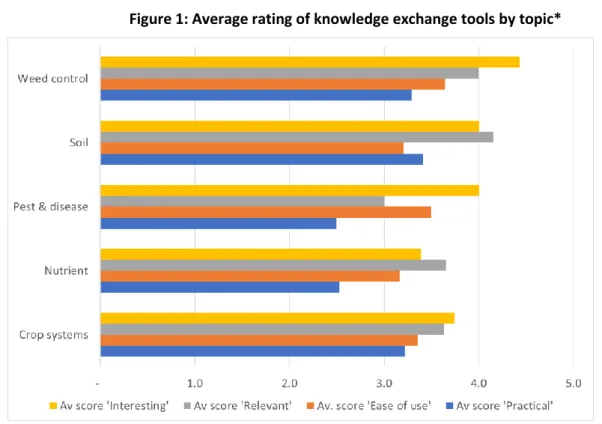
The average scores (Figure 1) indicate that in each topic, tools received lower average scores for 192
‘practical’ than for ‘interest’ or ‘relevance’. 193
The highest number of tools evaluated by groups related to soil quality and fertility and similar 194
topics, which was also identified as an important challenge by the groups (Cullen et al., 2016). The 195
initial offer included many technical guides for visual soil assessment and earthworm activity and 196
how to grow green manures to improve soil structure. The groups added three tools covering similar 197
topics in their own language. 198
There was considerable thematic overlap of soil quality and fertility with nutrient management 199
related tools; for example, tools related to green manure use were represented in both themes. 200
Apart from technical guides, nutrient management also included websites and decision support (also 201
called calculator) tools. One of the website tools, Cover crop and living mulch tool box, was 202
evaluated by seven groups. The tool was well liked on first impression, further confirmed during 203
workshop discussions. 204
Table 1: Number of tools selected and evaluated by theme 205
6
Theme Initial offer of
which evaluat ed New tools suggested by groups Total number of tools considered Of which evaluated Weed management 6 5 3 9 8
Soil quality & fertility 6 6 3 9 9
Pest & disease control 6 1 1 7 2
Nutrient management 6 5 2 8 8
Cropping systems & crop specific
6 4 4 10 8
Total 30 21 12 43 35
Source: Own data 206
Taking both topics together, the tools found most relevant were relating to green manure/cover 207
crops, visual soil assessment and building soil carbon. Tools on nutrient management were 208
considered relevant but were not liked overall and may not have been meeting the farmers’ needs. 209
Weed management tools were also popular, which corresponds well with the importance of weed 210
control as a challenge for most of the Farmer Innovation Groups (see Cullen et al., 2016). This 211
category included several videos, mostly related to reduced tillage. Tools on mechanical weed 212
control received high scores, in particular those comparing different machinery, but the farmers also 213
commented that such information goes out of date quickly with new developments. The feedback 214
indicated that the groups would like to see some tools that provide information on weed biology and 215
lifecycles to support improved management. Moreover, it was clear that more tools should focus on 216
an integrated approach to weed control, which includes preventative and cultural control as well as 217
direct methods such as mechanical weed control. 218
The category of Cropping systems and crop specific included tools that were both related to specific 219
crops (e.g. cereals or lupins) and to the design of the cropping systems, such as rotation planners 220
and websites with general information about organic agriculture. Most of the tools in this category 221
were only evaluated by one or two groups. 222
The least popular category by far was that of Pest and disease control, where only one of the tools 223
originally suggested was evaluated and one additional tool was suggested and evaluated by one 224
group. The two tools that were evaluated (one atlas and one app) support the diagnosis of pest and 225
disease and include recommendations for prevention as well as curative approaches. Farmers liked 226
that tools showed the life cycles of pests with the support of good visual information. Tools that 227
tackled specific pests or diseases were not relevant to all groups and some forecasting tools only 228
have relevance in a specific region. 229
7
Figure 1: Average rating of knowledge exchange tools by topic* 230
231
* Scores for interesting, relevant, ease of use and practical are based on 33 scored tools (using a five-232
point scale (1 = low, 5 = high) 233
Source: Own data 234
3.2 Preferences for different tool types 235
All the KE tools were characterised as a tool type (format), with the tool offer being dominated by 236
Leaflets/Technical guides. The choice of tools evaluated in Table 2 and Figure 1 show a clear 237
preference for videos, whereas websites where least preferred. 238
Table 2: Tools formats and preferences of the Farmer Innovation Groups 239
Tool type Total No considered. No. of tool evaluated
Website or web-tool 9 4 Video 4 4 Leaflets/technical guides 21 20 Decision-support/calculation tool 9 7 Total 43 35
Source: Own data 240
Tools were scored for ‘ease of use’ – which took into account the user friendliness of the type, the 241
instinctiveness of the layout and the energy it took to use them. This was considered particularly 242
important as farmers are busy. Figure 1 shows that on average, videos were considered the easiest 243
to use, followed by decision support tools. Interestingly websites were considered the least easy to 244
8
use. Participants also provided feedback on practicality, for which the technical guides score similar 245
to videos and website received a low score. 246
Figure 2: Average scores for ease of use and practicality of tools by type* 247
248
* Scores for ease of use and practical are based on 33 scored tools using a five-point scale (1 = low, 5 249
= high) 250
3.2.1 Feedback on videos 251
There was overall positive feedback on videos as a method of sharing knowledge, both from 252
research and between farmers (see also ‘Including visual information’ below). The video type was 253
well liked for ease of use and practicality, as a direct and simple way of learning from experience in 254
the field – in particular the action of machinery: “Videos are very direct and easy to understand” 255
(Group G); “You can see the machines in action as if you were there yourself, … you can see it at work 256
from all sides…” (Group C).
257
Feedback suggests that videos should be short (2-8 minutes). For example, the 20 minute long video 258
on Mechanical weed control in vegetables was considered too long and it was suggested to “cut the
259
film in different parts so you can look into the machine you are interested in” (Group C). However, 260
other videos, e.g. the Tilman.org videos, were criticised for being too general and simplistic, not 261
covering the detail necessary for practical application.“This is interesting as a kind of “first 262
information”. It`s not detailed, but well done as an entry into this topic. If somebody wants detailed 263
information a video is not the right thing” (Group G).
264
A few groups suggested that videos could be directly linked to other tools, such as technical guides 265
that provide further details for practical implementation (e.g. soil types, establishment methods, 266
timings, seed rates, machinery settings etc). Others suggested that providing a series of short videos 267
on the same topic might allow presentation of greater degree of detail. 268
3.2.2 Feedback on technical guides 269
Technical guides scored higher overall than videos for practicality, namely due to the level of detail 270
they could go into. As an example, the technical guide Earthworms: Architects of a fertile soil was 271
9
evaluated by eight groups. The participants had quite different opinions: four groups found it 272
interesting, easy to use and practical. They liked the presence of good pictures, clear subtitles and 273
short texts and the overall format that can both be printed or read online. Other groups found the 274
guide not so relevant, mainly because they found it to be too theoretical and overlapping with other 275
tools they knew, or mainly aimed at beginners. Other sceptical comments included missing 276
information about the effect of some machinery on the worms and the lack of a glossary explaining 277
scientific terms. 278
It became clear that some groups preferred short technical guides of less than 20 pages that are 279
clear and concise. One exception was a particular well-structured guide that made good use of visual 280
information. The Visual soil assessment: Field guide is 84 pages long, but was considered to be useful 281
because of the step-by step layout with photos, despite being seen as too long. On the other hand, 282
the topic of the tool Regionally adapted humus balance in organic farming appeared interesting and 283
relevant, but Group H, for example, found the tool not particularly practical to use because of the 284
complexity and length and was uncertain about applicability to their conditions. The guide Nutrient 285
management in farms in conversion to organic meanwhile received a mixed response, with one 286
group finding it relevant and practical (Group D), whereas another (Group G) finding it complicated. 287
The colourful guide Sort out your soil: A practical guide to green manures was found to be interesting 288
and practical, with sufficient detail about many green manure plants included. However, two groups 289
(D and H) thought it was more for beginners than for experienced organic farmers and had some 290
reservations about the transferability of the findings, whilst another group was doubtful whether or 291
not growing green manure was feasible in their specific climate (Group I). 292
Longer guides, such as Weed control in organic farming through mechanical solutions (288 pages), 293
were considered to be less easy to use because of long blocks of text with minimal use of visual 294
information. However, one of Group H did report “our experienced farmers read long materials, if
295
they are well presented and relevant”. 296
3.2.3 Feedback on decision support and calculation tools 297
The decision support and calculation tools (DST) evaluated included databases, software models and 298
digital applications and whilst there was recognition of the potential, while some of those evaluated 299
received very positive feedback, others did not come out so well. For example, the Living mulch and 300
cover crop tool box OSCARwas rated highly by many groups. The user interface was considered to be 301
easy to use, with simple check boxes supporting the toolbox to select cover crop species appropriate 302
to one’s own farm conditions and objectives: “The software is self-explanatory and therefore very
303
easy to use” (Group D). There was an appreciation of their “playful” nature - the ability to test out 304
new ideas and bringing together scientific knowledge for practical solutions. “The participants found 305
the criteria approach relevant, the tool is easy to use and playful. Moreover, it is adaptable to the
306
system of each farm” (Group B). The toolbox also has an associated wiki page, which allows farmers 307
to add their own experiences with different cover crops. This function was appreciated, although 308
many were not sure they would have the time to contribute and others felt that users should be able 309
to interact directly with the toolbox itself rather than a separate wiki. 310
There was, however, also some more critical feedback. The tool was considered to be lacking in 311
detail – for example it covered only individual species, whereas some users were more interested in 312
mixtures and the interaction of species in mixtures and crops following the cover crop in the 313
rotation. Users also felt it needed to include information on the practical management implications; 314
for example, identifying an appropriate ‘window’ for the cover crop in the rotation, including sowing 315
10
dates, seed rates etc. Some crops were also missing an indication of likely costs of the seeds and 316
benefit in terms of yield and cost savings. 317
In contrast, other calculation tools were not considered to be easy to use in their current form and 318
data entry in some cases was time consuming. For example, in relation to the N-flow simulation tool 319
NDICEA: “Very good, needs a considerable time investment. Could be useful if you have the time” 320
(Group J). Some data such tools require are collected on farms and the farmers would like them to 321
link to existing farm management software. Some were found to have complex user interfaces and 322
limited data input options not fitting for specific situations and there was some concern about the 323
reliability of output data. 324
Group J was supported by a researcher to apply the NDICEA nutrient dynamics model on their own 325
rotations at a field scale to deepen their understanding of what was happening in the soil below 326
their feet. With local data on climate, and soil and management practices for one field over a 327
rotation, the model calculated nutrient surpluses and deficiencies over multiple seasons. Modelling 328
the current rotations highlighted some common issues between the farms in relation to organic 329
matter balances and suggested that nutrients were being lost through leaching, harvest and 330
breaking the ley in the autumn. One farmer found the process of working through the scenarios 331
together with the researcher really useful, particularly to step back and reflect was a “real
eye-332
opener” that stimulated much discussion in the group and also in international knowledge exchange 333
workshops. 334
Although the majority of DSTs tested were not considered particularly ready for practice because 335
data-input was complicated, or output was either seen as too academic and not of practical 336
relevance or seen as not reliable, there was an interest in the future potential in supporting users to 337
pull together large amounts of complex information to make decisions tailored to their own farms. 338
The use of DSTs as an indication of the relative risk and opportunity of different actions, as well as 339
inspiring new ideas and approaches, was considered valuable. 340
3.2.4 Websites 341
Examples of websites also received mixed feedback. The website Knowledge platform for 342
Agroecology received most positive feedback. This resource is built around different agroecological 343
principles and farmer testimonies for using them. Starting with farmer experience and practical 344
examples seems to be a logical way to lead people into learning more in other, more detailed tools. 345
The tool was liked by one group of farmers “thanks to several videos of farmers telling their stories” 346
(Group F). Meanwhile, although appreciated for good overview of reduced tillage, the Bioaktuell 347
website was considered to be more difficult to navigate and many were not able to find the more 348
detailed technical guides contained on the site: “Due to the different sections navigation is 349
complicated.” (Group D). 350
3.3 Emerging themes 351
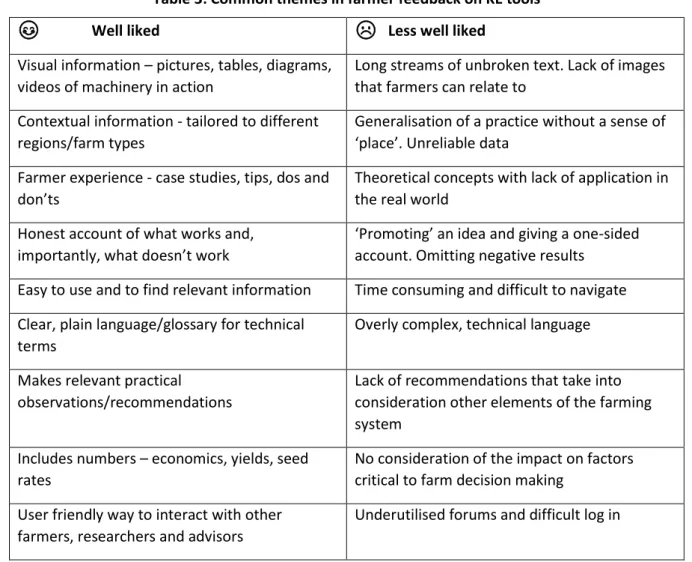
A number of common themes emerge from the feedback on the various tool types, which have been 352
summarised in Table 3 and are described further in this section 353
11
Table 3: Common themes in farmer feedback on KE tools 355
😊 Well liked ☹ Less well liked
Visual information – pictures, tables, diagrams, videos of machinery in action
Long streams of unbroken text. Lack of images that farmers can relate to
Contextual information - tailored to different regions/farm types
Generalisation of a practice without a sense of ‘place’. Unreliable data
Farmer experience - case studies, tips, dos and don’ts
Theoretical concepts with lack of application in the real world
Honest account of what works and, importantly, what doesn’t work
‘Promoting’ an idea and giving a one-sided account. Omitting negative results Easy to use and to find relevant information Time consuming and difficult to navigate Clear, plain language/glossary for technical
terms
Overly complex, technical language
Makes relevant practical
observations/recommendations
Lack of recommendations that take into consideration other elements of the farming system
Includes numbers – economics, yields, seed rates
No consideration of the impact on factors critical to farm decision making
User friendly way to interact with other farmers, researchers and advisors
Underutilised forums and difficult log in
Source: Own data 356
12
3.3.1 The importance of farmer experience and practical implementation 358
359
‘The best way to learn about something is to speak to someone who is doingit’ (Group J). 360
The importance of farmer experience and practical implementation is clearly reflected in the 361
farmers’ feedback on KE tools. One of the most common elements was that the Farmer Innovation 362
Groups value KE tools that include or are based on experience of another farmer who has tried the 363
practice. Tools that included case studies of farmers sharing their experiences with different 364
practices, including details of the context, what worked and what didn’t, and data on the impact on 365
yields and economics, were appreciated. For example: “The participants…appreciated the case 366
studies (farmers’ examples) and the technical detail represented on the figures…the farmers found it 367
very practical” (Group K) in reference to the technical guide on Mechanical weeding in arable crops. 368
Farmers considered this specific information useful to help inform them whether a practice could be 369
successful on their own farms. It adds a sense of ‘place’, in contrast to some technical guides, which 370
generalised findings across many farm types and contexts. This was particularly true for the YouTube 371
channel of a UK arable farmer. The farmer captures interesting insights and updates on his mobile 372
phone as he walks his fields. Group J felt he is “an ambassador for Organic Farming” who is often 373
innovating with new techniques – such as relay cropping and grazing wheat with sheep to control 374
black-grass and shares his experiences. Watching such videos is “Second best to standing in the field
375
with him”, according to members of the group. Farmers valued the honest analysis of the 376
advantages and disadvantages “…will be honest about what works and what doesn’t work which is 377
really important” (Group J). The farmer also provides updates over time, so that viewers can follow 378
progress on innovative practices he is trialling. 379
Groups discussed that it was important that tools should give recommendations and consider the 380
practical implications at a farm level – for example, regarding seed rates, tillage practices, drilling 381
dates, species selection etc. However, the groups did not always agree what ‘practical’ looks like. 382
One group scored the Müncheberg visual soil quality rating positively and commented “The test is
383
easy to perform and does not require additional expensive equipment” (Group L), whereas another 384
group found the tool “A bit difficult, maybe too theoretical, no practical suggestions” (Group H).
385
The FiBL technical guide Earthworms: Architects of fertile soils shows a practical step-by-step process 386
for counting earthworms as an indicator of soil biological activity. “The guide has a very helpful “so 387
what” summary at the end to help with management practices…… It would be useful to have more 388
information about the effects of specific machines/equipment (rotary) on earthworm populations 389
….and how to mitigate some of the less beneficial practices, as what’s bad for earthworms may be 390
beneficial in another context.” (Group J). This illustrates that farmers are faced with the need to 391
balance considerations for different parts of their farm when implementing recommendations and 392
what works for one part of the farm may not do so for another. It appears that ‘Sometimes [those 393
writing the guide] forget that farms are businesses, we need to know if it is going to pay’ (Group J).
394
Farmers expressed an appreciation for an honest portrayal of the challenges and trade-offs 395
experienced by those that have tried out the practices covered in the tools. Some KE tools were 396
viewed as trying to ‘promote’ a certain practice and not cover potential set-backs and disadvantages. 397
For example, in response to the US based video Bringing the dirt to the doorstepon reduced tillage, 398
one Group B reported “The farmers …were sceptical about impartiality of the results: they suspected 399
the authors to present only the successful results” (Group B). 400
13
The group members found examples where a technique had failed under certain conditions to be as 401
useful as where it had been successful. During practical testing, the Farmer Innovation Groups in 402
Bulgaria and Italy both tested a roller crimper to destroy cover crops and create a mulch into which 403
the following crop could be directly drilled. The trials in Italy showed relative success, but by contrast 404
the trials partially failed in Bulgaria. The group attributed this to a late sowing date, soil compaction 405
and lack of rain during the growing season but would like to carry out a further trial in future. In the 406
discussion at the common workshops in France it was highlighted that it is essential to be clear 407
about the different contexts in which the practice had been used to understand the difference. 408
Whilst many organic farmers in Europe are interested in reduced or no-tillage systems, they do want 409
to see more trials under their own conditions to judge whether it could work for them. An exchange 410
visit to Austria invited members of some of the Farmer Innovation Groups to meet US researchers to 411
talk about their experience. The direct exchange allowed the opportunity for two-way learning, as 412
the advisors and researchers engaged in the process also gained new knowledge and insights. 413
Bringing together farmers and scientists and organising national and international exchange visits, 414
farm walks and on-farm trials all play an important role in the innovation process. 415
3.3.2 Including visual information 416
Another common theme in the discussion of several different tools was the appreciation of photos 417
and visual information, which was expressed in the preferences for videos but also in response to 418
technical guides. The tool Mechanical weeding in arable crops received positive feedback for 419
combining short sections of text with photographs showing the mode of action of a finger weeder 420
and weed control interventions in the rotation. “Although it is quite a lot of information the layout 421
makes it easy digestible. You can read it as separate leaflets. There are lots of practical case studies, 422
pictures and practical tables.” (Group C). Guides that contain photos, diagrams and tables are seen as 423
more useful than long streams of text. 424
Photographs were also used to convey essential information on crop health, crop establishment and 425
soil condition. For example, the CroProtect App was rated positively for its visual content: “Photos 426
[in the App] are helpful visual cues for identification of pests in the field” (Group J). Additionally, visual 427
information can help to overcome language barriers: “even without translation or with only some 428
small keywords, you can learn a lot from a video” (Group C). 429
3.3.3 The importance of detail about context and ‘place’ 430
The OK-Net Arable project aimed to share tools between countries and many groups tested tools not 431
particularly developed for their specific soil, climate and socio-economic conditions. Several of the 432
farmer groups fed back that many of the tools were too general or not appropriate to their specific 433
conditions. 434
The video Bringing the dirt to the doorstepon the challenge of weed control with reduced tillage is 435
based on case studies in the US that the farmers did not consider to be relevant to the European 436
farming systems. Participants in Farmer Innovation Group B found it difficult “to transpose the
437
results to French pedoclimatic conditions because (i) there was a lack of context information in the
438
video and (ii) the experimentation is set in the US”. 439
Similarly, in response to the Living mulch and cover crop tool box OSCAR, one group commented: 440
“Highly relevant for the soil fertility issues raised by the farmers. However, it seems too generic and 441
does not offer specific solutions (cover crops) for the Marche region” (Group F). The same group 442
commented on the rotation calculation tool (ROTOR) that it does not cover important details:“…the 443
tool does not take economic aspects of the cropping system into account and it seems specifically 444
14
suitable for the Baltic area, so rather far from the agro-ecological characteristics of the Marche region. 445
This makes its practical value very low” (Group F). Commenting on the technical guide Mechanical 446
weeding in arable crops, another group highlighted the need to adapt to local conditions: “In all 447
details it needs to be adapted into the Hungarian agro-ecological and farming conditions” (Group I). 448
Details such as soil type, rainfall, establishment method, position in the rotation are all critical to 449
help farmers make the decision of whether a practice is suitable for their farm or how they may 450
adapt it. As every farm is different, it is unlikely that farmers will adopt a practice exactly as it is 451
presented in a tool, but providing more details helps them to interpret how the practice could fit 452
into their own situation. For applied knowledge, such as practices for weed control, cover crops and 453
reduced tillage, information about the local context was found to be critical, whereas the groups 454
found knowledge that covers more ‘fundamental’ topics, such as soil biology and soil monitoring 455
techniques might be transferable, irrespective of the local context. 456
4
DISCUSSION
457In the project, groups of organic farmers in several EU countries used KE tools that were presented 458
on a common platform. The evaluation of tools in the OK-Net Arable project by farmer groups was 459
an attempt to move beyond the linear model of innovation, where practices are developed by 460
scientists, disseminated through intermediaries and then used by farmers, towards an integrated 461
model of KE and contributing to the question how this knowledge exchange can be carried out 462
across borders and by using the internet. 463
One important question when talking about taking KE online is the question whether, for what and 464
how frequently organic farmers use the internet. In a survey of organic farmers as part of the OK-Net 465
Arable project, Ortolani and Micheloni (2016) found that only about 30% of farmers in their survey 466
considered the internet to be an important source of information, with time being the most 467
significant barrier. The proportion is higher among younger farmers and the increasing use of 468
smartphones will extend the time periods during which farmers can access the Internet to look up 469
technical information. This stands in contrast to a study in the South West of England which found 470
that 89% of farmers use the internet in the context of the farm business management for sending e-471
mails, reading farming news online and to apply for government grants (Buttler and Lobley, 2012), 472
although only a 9% used internet discussion boards and 6% used internet blogs. Since the sector of
473
KE is developing very fast, there is a need to repeat surveys to get up-to-date insights into
474
farmers and advisors use of the internet and digital tools.
475
In the same English survey, farmers were also asked to name the three sources they trusted most in 476
terms of the knowledge imparted. They cited advisors and other farming professionals (52%), the 477
farming press (36%), business professionals (31%) and farming friends (29%) (Buttler and Lobley, 478
2012). This stands in slight contrast to the preferences of the organic farmer groups in the OK-Net 479
Arable project, who appear to trust other farmers more than farming professionals. This may be a 480
reflection of the shortage of farming professionals that are well trained and qualified in organic 481
farming in several of the countries in which the groups operate. Trust in groups that learn together 482
develops through mutual support, so that both positive and negative experiences from trial and 483
error can be explored and learning emerge from a shared interest in a problem or challenge 484
(Moschitz et al., 2014). There is, however, also evidence that agronomist-farmer encounters that are 485
underpinned by trust, credibility, empathy, and consultation could provide an effective context for 486
knowledge exchange—potentially facilitating farmers’ transformation to more sustainable 487
15
management practices (Ingram, 2008).There is a need to consider what factors farmers value in KE 488
tools and face-to-face KE and how and if these factors can be included when taking KE tools online. 489
4.1 What tool formats are preferred? 490
Each tool type (leaflet/technical guide, video, website and DST) has relative advantages and 491
disadvantages and provides a slightly different function. Some are also better suited to certain types 492
of information. For example, videos can work better for introductory information and inspiration, 493
whereas technical guides provide detail for practical implementation. Moreover, different users are 494
likely to prefer certain formats over others and therefore providing a range of options is important 495
to be able to reach as wide an audience as possible. 496
The generation of web-hubs, like the knowledge exchange hub for agroecology, create the 497
opportunity for combining different formats in a single location, for example by linking to farmer 498
profiles and videos. This is an idea that has been considered in the design of the knowledge platform 499
of the OK-Net Arable project (http://farmknowledge.org), where videos are used as, and connected 500
to, other tools. In this way, videos can be an easy-to-use ‘hook’ and inspiration for farmers to then 501
delve deeper into existing information to learn how to apply certain practices on their own farms. 502
Our results also show some recognition of the potential of digital Decision Support Tools (DSTs), 503
which synthesise information in a way to support farmers in making decisions – those assessed 504
included databases, software models and digital applications. According to Rose et al. (2016), such 505
tools are designed to help users make more effective decisions, by leading them through clear 506
decision stages and presenting the likelihood of various outcomes resulting from different options. 507
However, whilst decision-support tools may have potential to tailor management practices to the 508
specific context of each farm, in their current form they frequently lack this detailed information 509
about location and experience-based knowledge to support decisions (Rose et al.,2018). Our 510
findings therefore suggested some scepticism that in their current form, DSTs could replace the 511
ability to consider different types of contextual knowledge, such as the tacit knowledge of each 512
farmer, the historical rotations, weather and soil types. They suggest a role in supporting farmers, 513
rather than trying to replace the farmer or advisor in making decisions. “Farmers and agronomists 514
require decision support not decision making because they are the ones that decide what is most 515
appropriate for their local conditions” (Bruce, 2016 p90).
516
Finally, DSTs and online tools that force farmers to be more office-based in their decision-making 517
ignore the spatialities of decision making and the workflow on farm (Rose et al., 2018).Another 518
consideration for future tool development is to consider the value in user centred design (UCD). For 519
example, Rose et al., (2018) suggest that engaging users in the co-development of Decision Support 520
Systems, including taking a decision support assessment prior to building and launching a product, 521
may enhance usefulness and uptake. 522
It is likely that e-learning could also be a useful online KE tool, but the farmer groups did not 523
evaluate any e-learning tools systematically. The OK-net Arable project developed a facilitated E-524
learning course that introduces some of the KE tools on the knowledge platform in five different 525
thematic modules. The course was taken by 70 participants from 23 countries and evaluated largely 526
positively and is now offered as self-learning course Challenges of Organic Arable Farming on the 527
knowledge platform (see Mohamad et al., 2018). This experience suggests that e-learning should be 528
explored further. However, further research would be needed to get better understand why farmers 529
prefer certain tools and interactions and how this can be used to improve KE in organic farming. 530
16 4.2 Keeping it practical
531
Weed control, soil fertility and nutrient management were the two most important thematic topics 532
that groups chose for tool feedback and practical trials, which corresponds well to the most common 533
challenges reported by the groups earlier in the project (Cullen et al., 2016). Our results show that 534
the farmers value practical experiences in KE tools, related to the agronomic conditions (soil, 535
climate, seed rates) and costs and benefits that help to inform their decisions whether or not a 536
practice is useful for their own farm. The farmer decision-making process is strongly influenced by
537
practical, but also by legal means and financial factors (Blackstock et al., 2010). They appreciate 538
succinct tools that clearly outline practical implications and recommendations, but this does not 539
mean that they are looking for information that has been generalised to apply to all conditions. 540
Understanding how certain practices have been applied in different contexts (soil, climate 541
conditions, farming systems), the specific field operations that were performed (machinery, 542
cultivations, position in the rotation etc.), the impact on yields and farm economics are all details 543
that the farmers found valuable but lacking in many of the tools. Also, often missing were honest 544
accounts of negative impacts – what didn’t work and why – which was also considered to be very 545
useful. Many of those elements that farmers felt were missing in existing KE tools are exactly those 546
they valued in direct communication with other farmers, advisors and researchers. This may be one 547
of the reasons why farmers express a strong preference for farmer-to-farmers KE rather than KE 548
tools written by researchers. According to a study with small-scale farmers in four European 549
countries, apart from independence the combination of tacit and codified knowledge is important 550
for credibility of source (Sutherland et al., 2017). 551
4.3 Providing a context and farmer experiences 552
Overall, many of the tools were considered to present practices without a sense of place or 553
reference to the contexts in which it could work or not. Farmers pull together information from 554
many sources to gain knowledge of their own systems. This is often hindered by lack of research 555
relevant to their own context – e.g. soil type, farming system, agroclimatic conditions (Röling, 1990). 556
Scientific knowledge is always embedded in specific contexts, but many tools seek to be broadly 557
compatible across farms/regions/countries. As such, information tools developed by scientists for 558
farmers are often considered to provide a placeless ‘view from nowhere’ (Rose et al., 2016 p14). Our 559
findings confirm the conclusion of Rose et al. (2018) that farmers value knowledge that is 560
contextualised. They value experience in the field and the opinions of advisors and other farmers 561
that know the farm and put less trust in scientific recommendations where the context is not 562
clear/realistic (Rose et al., 2018). 563
This value of location-based knowledge may thus be one of the critical success factors of direct 564
farmer-farmer KE and careful consideration is needed as to how this can be provided online. This is 565
an area to improve in future tools, perhaps adapting tools to be relevant to different regions or farm 566
types. Despite the need to synthesise results and keep tools relatively succinct, researchers creating 567
KE tools should be mindful of the tendency to over-generalise information. Providing case studies 568
and background to the trial sites is an important detail that farmers appreciate. However, this also 569
depends on such research outcomes being available for organic agriculture - highlighting a significant 570
research gap. 571
Overall, feedback from farmers reinforced that they are unlikely to adopt a practice directly as 572
scripted in a tool. Instead, they tend to refer to information tools once they have already explored 573
17
ideas by talking to others, and then ‘interpret’ how that information may be relevant to their own 574
situation. “For farmers and advisors using tools, decisions will be a hybrid of different forms of knowledge” 575
(Rose et al., 2018 p15). 576
4.4 Providing visual information through videos and images 577
In our results, the farmers expressed a clear preference for visual information. This may be related 578
to the fact that humans are neurologically wired with an overwhelmingly visual sensory ability 579
(Brown, 2014 p222) and that pictures are not only more effortless to recognise and process than 580
words, but also easier to recall (Dewan, 2015). It is likely that farmers are used to using visual cues in 581
the field every day to make decisions about the condition of their soil, crops and livestock and so 582
also relate well to seeing practices in action in other places. Visual information could be used more 583
widely in other online tools. Careful selection of practical images and other visual information 584
(flowcharts, diagrams, infographics) in written guides, websites and Decision Support and 585
Calculation Tools could improve their practicality. 586
The medium of the video in particular opens up a huge opportunity to take experience online and is, 587
as one farmer put it “second best to standing in the field”. There is also potential for sharing updates on 588
demonstrations and trials – both on farm and at research stations for example in the form of video 589
diaries or vlogs. Direct dialogue can permit feedback to the research community on what is 590
appropriate and realistic and thus increase research impact (Bruce, 2016) and give rise to new 591
insights and solutions. This could be an opportunity to engage other practitioners in an online co-592
innovation process, in which they are able to interact, ask questions and make suggestions to those 593
running the trials. However, the experience from the knowledge platform of OK-Net Arable has 594
shown that it is challenging to engage users in online interaction and trials would need to have 595
sufficient staff time resources to engage with such online interactions. With improving smartphone 596
technology, it is increasingly possible for farmers, advisors and researchers to make their own videos 597
and share these online through platforms such as YouTube, opening up a new space for dialogue. 598
Some farmers may do this for altruistic purposes, but most will need to see clear benefit to investing 599
time in sharing their experiences (Bruce, 2016). 600
Videos can be used to film in-field KE activities – such as farm walks – sharing those discussions with 601
a wider audience. Social media can also be used to bring questions and answers to on-farm events 602
from remote participants. 603
4.5 Seeking opportunities for dialogue and co-innovation. 604
Bringing farmers, advisors and researchers together in the Farmer Innovation Groups of OK-Net 605
Arable and through international exchange visits and workshops led to the production of new ideas 606
and insights that perhaps would not have emerged otherwise. Farmers were motivated to test the 607
tools in practice and share their findings with others on the farmknowledge.org knowledge platform, 608
in videos and as practice abstracts. Members of different groups were able to interact in meetings 609
and discuss openly what worked and what didn’t and how that related to the context – soil type, 610
slope, rainfall etc. sharing ideas and experiences. 611
In this sense, the Farmer Innovation Groups can be seen as ‘boundary organisations’, i.e. 612
organisations that work on the boundary between science and farming exemplify this convergence 613
of knowledge and roles (Carr and Wilkinson, 2007). They provide a new space for farmers, advisors 614
and scientists to interact. This in turn enables movement away from a linear process of knowledge 615
transfer from science to practice towards a co-innovation process, enabling researchers to learn 616
18
from farmer experience, deepen their understanding of what is realistic on farm and all actors to 617
learn from each other. This experience therefore reflects previous findings that such processes 618
constitute a powerful force for stimulating innovation and co-production of new knowledge (Carr 619
and Wilkinson, 2007; Almekinders, 2011). 620
However, despite the momentum generated by Farmer Innovation Groups meeting on exchange 621
visits, there was reluctance to continue these discussions online. This confirms findings of Buttler 622
and Lobley (2012), who also found farmers reluctant to visit internet discussion forums. Similarly, 623
the opportunity to interact with the discussion forum on farmknowledge.org was not taken up, and 624
the language barrier and the lack of a critical mass of active users were mentioned as reasons (see 625
Gócs et al., 2018). An alternative to seeking to establish forums or integrate other interactive 626
functions into online tools could be to tap into existing social media networks. Utilising these forms 627
of online communications also offers the opportunity to bridge the gap between actors separated 628
spatially (e.g. in different organisations) and/or by perspective (Klerkx and Proctor, 2013). Building 629
on established relationships and user profiles may create a more interpersonal experience and tap 630
into a critical mass of people using these channels. Finding new ways to integrate discussions on 631
these channels with platforms such as farmknowledge.org remains a challenge for the future. 632
Experience with the www.agricology.co.uk website hub in the UK, which integrates social media 633
channels (Twitter, Facebook, YouTube and Instagram), suggests that using the handle @agricology 634
can sometimes encourage users to ask each other questions or engage in polls and discussions. 635
#AgrichatUK is another peer to peer twitter home for weekly discussions on specific farming topics. 636
Similarly, social media channels that enable discussions in smaller focus groups have also shown 637
promise. A group of farmers from the UK and France that met on an OK-Net Arable exchange visit on 638
intercropping chose to set up a WhatsApp group to enable ongoing discussions and informal chats, 639
the sharing of photos, updates and anecdotes from their own trials. 640
5
CONCLUSIONS
641
Online Knowledge Exchange (KE) tools can play a valuable role in bringing together knowledge and 642
experience on good practice in organic arable farming in Europe and contribute to improving yields. 643
Topics chosen most frequently for evaluation in workshops and in practice include soil quality and 644
fertility, nutrient management and weed control corresponding with the topics identified as key 645
challenges by the group earlier in the project. For weed control tools integrating preventative with 646
direct methods were discussed favourable. Only a few crop specific tools and tools related to pest 647
and diseases management were evaluated, which maybe a reflection of the tools presented rather 648
then the importance of the topic. 649
Critical considerations for those developing online KE tools are to: 650
• Include farmers’ experience about a specific practice, for example through case studies and 651
farmer profiles 652
• Provide clues about the context: when did it work/not work 653
• Include visual information – photos, graphics and videos 654
• Support co-innovation through farmers interacting with the research results/researchers 655
656
There is no silver bullet in relation to tool formats and a range of tools are necessary to support 657
farmers to take new knowledge into action. Videos have potential for capturing field experiences, 658
such as trials and demonstrations, but technical guides may allow more detail and fundamental 659
knowledge to be conveyed. 660
19
Sharing case studies, tips, successes and failures in online KE tools can support farmers to judge for 661
themselves how a practice may work on their own farm and make use of the fact that farmers trust 662
the experience of another farmer. Furthermore, providing more details of the context in which a 663
practice has worked or not worked in an honest way, including the climate, rotation and other on 664
farm management practices, is also valuable. The final decision whether or not to try or use a new 665
practice lies with the farmer. Decision Support Tools should be co-developed these in collaboration 666
with farmers and could help in tailoring scientific information to individual farm contexts. Adopting a 667
a user centred design approach for future tool development is likely to enhance usefulness and 668
uptake. Tool developers should also consider including information on negative impacts and 669
situations in which practices failed. Details on the implications for management, economics and 670
yields would also be valuable. Integrating more relevant visual information such as photos and 671
diagrams in tools could additionally improve the ease of use and practicality for the farming 672
community. Online KE opens a whole new space for co-innovation between farmers, researchers 673
and advisors. Further studies could seek to analyse the processes involved in digital co-innovation
674
approaches, including the how social media can be utilised in contributing to knowledge exchange
675
between farmers and farmers and researcher. However, despite the considerable potential, online 676
KE tools should not be expected to replace face to face in-field KE. The farmers engaged in the 677
project hugely valued the opportunities for international face-to-face exchanges that were created 678
during the project and were inspired to reflect on their own practices. This in turn has the potential 679
to improve organic arable yields. Online KE tools, supported by social media channels to enable 680
discussion and allow feedback and informative chats, can complement this face to face in-field KE 681
and together they could play an increasing role in improving best practice in organic farming in 682
Europe and beyond. 683
20
6
REFERENCES
685
Almekinders, C.J.M., 2011. The joint development of JM-12.7: A technographic description of the
686
making of a bean variety. NJAS-Wageningen Journal of Life Sciences, 57(3-4):207-216.
687
Arbenz, M., Gould, D. & Stopes, C. 2017. ORGANIC 3.0—the vision of the global organic movement 688
and the need for scientific support. Organic Agriculture, 7 (3) 199-207. 689
Blackstock, K. L., J. Ingram, R. Burton, K. M. Brown and B. Slee. 2010. Understanding and influencing 690
behaviour change by farmers to improve water quality. Science of the total environment 408 (23): 691
5631-5638. 692
Bliss, K., Padel, S., and Ducottet, C., 2017. Evaluation of the usefulness of tools and end-user
693
materials to farmers. D 2.2 of OK-Net Arable. Newbury, Organic Research Centre. 694
Brown, S., 2014. The Doodle revolution: Unlock the power to think differently. London, Penguin. 695
Bruce, T. J. A., 2016. The CROPROTECT project and wider opportunities to improve farm productivity 696
through web-based knowledge exchange. Food and Energy Security, 5(2): 89–96. 697
https://doi.org/10.1002/fes3.80 698
Butler, A. and Lobley, M., 2012. Resource Management, Knowledge and Internet Use on Farms in
699
South West England: A Report for the SWARM Knowledge Hub. Exeter, Centre for Rural Policy 700
Research, University of Exeter. 701
Caldbeck, J. and Sumption, P., 2016. Mind the gap–exploring the yield gaps between conventional
702
and organic arable and potato crops. Organic Research Centre Bulletin, 121: 9-15.
703
Carr, A. and Wilkinson, R., 2005. Beyond participation: Boundary organizations as a new space for
704
farmers and scientists to interact. Society and Natural Resources, 18(3): 255-265.
705
Cullen, B., Amos, D and Padel, S., 2016. Description of Farmer Innovation Groups. D2.1 of OK Net
706
Arable. Newbury, Organic Research Centre. 707
De Ponti, T., Rijk, B. and Van Ittersum, M.K., 2012. The crop yield gap between organic and
708
conventional agriculture. Agricultural Systems, 108: 1-9.
709
Dewan, P., 2015. Words Versus Pictures: Leveraging the Research on Visual Communication 710
Partnership CanadianJournal of Library and Information Practice and Research, 10(1):3473. 711
Gócs K., Moeskops, B and Rasmussen, I.A., 2018. Plan for continuation of the knowledge platform. D 712
4.4 of the OK-Net Arable Project, Brussels: IFOAM-EU. 713
Kerkx, L. and Proctor, A., 2013. Beyond fragmentation and disconnect: Networks for knowledge 714
exchange in the English land management advisory system. Land Use Policy, 30(1): 13-24. 715
Knickel, K., T. Tisenkopfs and S. Peter, Eds. (2009). Innovation processes in agriculture and rural
716
development: Results of a cross-national analysis of the situation in seven countries, research gaps
717
and recommendations. IN-SIGHT: Strengthening Innovation Processes for Growth and Development 718
(FP6 SSP: 44510). 719
720
Ingram, J. 2008. Agronomist–farmer knowledge encounters: an analysis of knowledge exchange in 721
the context of best management practices in England. Agriculture and Human Values, 25, 405-418. 722