Theories of Homomorphic Encryption,
Unification, and the Finite Variant Property
∗
Fan Yang
University of Illinois at Urbana-Champaign, USA [email protected]Santiago Escobar
DSIC-ELP,Universitat Polit`ecnica de Val`encia, Spain
Catherine Meadows
Naval Research Laboratory, Washington DC, USA [email protected]
Jos´e Meseguer
University of Illinois at Urbana-Champaign, USA [email protected]
Paliath Narendran
University at Albany-SUNY, Albany, NY, USA [email protected]
Abstract
Recent advances in the automated analysis of cryptographic proto-cols have aroused new interest in the practical application of uni-fication modulo theories, especially theories that describe the al-gebraic properties of cryptosystems. However, this application re-quires unification algorithms that can be easily implemented and easily extended to combinations of different theories of interest. In practice this has meant that most tools use a version of a technique known asvariant unification. This requires, among other things, that the theory be decomposable into a set of axiomsBand a set of rewrite rulesRsuch thatRhas thefinite variant propertywith respect toB. Most theories that arise in cryptographic protocols have decompositions suitable for variant unification, but there is one major exception: the theory that describes encryption that is homomorphic over an Abelian group.
In this paper we address this problem by studying various ap-proximations of homomorphic encryption over an Abelian group. We construct a hierarchy of increasingly richer theories, taking ad-vantage of new results that allow us to automatically verify that their decompositions have the finite variant property. This new ver-ification procedure also allows us to construct a rough metric of the complexity of a theory with respect to variant unification, orvariant complexity. We specify different versions of protocols using the dif-ferent theories, and analyze them in the Maude-NPA cryptographic protocol analysis tool to assess their behavior. This gives us greater ∗Jose Meseguer and Fan Yang have been partially supported by NSF
Grant CNS 13-10109. Santiago Escobar has been partially supported by the EU (FEDER) and the Spanish MINECO under grants TIN 2010-21062-C02-02 and TIN 2013-45732-C4-1-P, and by Generalitat Valenciana PROMETEO2011/052.
2014 Association for Computing Machinery. ACM acknowledges that this contribu-tion was authored or co-authored by an employee, contractor or affiliate of the United States government. As such, the Government retains a nonexclusive, royalty-free right to publish or reproduce this article, or to allow others to do so, for Government pur-poses only.
PPDP ’14, September 08–10, 2014, Canterbury, United Kingdom.
Copyright c2014 ACM 978-1-4503-2947-7/14/09. . . $15.00.
http://dx.doi.org/10.1145/2643135.2643154
understanding of how the theories behave in actual application, and suggests possible techniques for improving performance.
Categories and Subject Descriptors C.2.2 [Computer communi-cation Networks]: Network Protocols; D.2.4 [Software Engineer-ing]: Software/Program Verification; D.3.2 [Programming Lan-guages]: Language Classifications; D.4.6 [Operating Systems]: Security and Protection; F.3.1 [Logics and Meanings of Pro-grams]: Specifying and Verifying and Reasoning about Programs
Keywords cryptographic protocol analysis, homomorphic en-cryption, finite variant property, unification
1.
Introduction
Recent advances in the automated analysis of cryptographic proto-cols [3, 7, 19, 25, 26, 39] have demonstrated that state exploration via unification modulo theories is both feasible and can make a substantial difference to the expressiveness of the system model. In systems of this type, protocol execution paths are computed by unifying messages received with messages sent. Since equational properties are usually involved, the unification must bemodulothe equational theory describing those properties. This requires unifi-cation algorithms that accommodate well to combinations of theo-ries and can be integrated with state space exploration techniques. The technique ofvariant unification, first formalized as a general approach in [20], although used for specific theories much earlier than that (e.g. in [7, 8, 18]), satisfies all these properties. Thus, it is used by many cryptographic protocol analysis tools in one form or another, including ProVerif [8], OFMC [7], Maude-NPA [19] and Tamarin [39] (see Section 3 of this paper for a comparison).
In order for variant unification to work, the equational the-ory of interest must be decomposable into(Σ, B, R), where: (1)
B is regular and has a finitary unification algorithm, (2) R is confluent, terminating, and coherent modulo B (for simplicity, we will simply say from now on that R is convergent modulo
B) and (3) R has the finite variant property (FVP) [15] with respect toB; i.e., for each term t there is a finite set of most general pairs{(σ1, t1), . . . ,(σn, tn)}(calledvariants) of→R,B -normalized substitutions and terms such thattσinormalizes toti moduloB. Fortunately, many cryptographic theories of interest can be decomposed in this way, withB=∅orB=AC(associativity and commutativity).
However, there is one important family of theories that fails to have a decomposition that satisfies our requirements: H for a homomorphic property of the forme(X ∗Y, K) = e(X, K)∗
e(Y, K)where∗may or may not have other properties. AGH (the case where ∗is an Abelian group) is a property belonging to a number of different cryptographic algorithms, starting with RSA in the late 70’s [38], and from early on it was realized to have a number of potential applications, including anonymous payment systems [13], computation on encrypted data [37], and voting [12]. The fact that the theory AGH by itself does not satisfy our needs does not mean that all is lost, however. But it does mean that we must investigate approximations that give us the ability to model a broad class of protocols while still satisfying the conditions neces-sary for variant based unification. First, we could use a dedicated unification algorithm for AGH, as we did in [17] for H; however, this is not satisfactory, see Section 3.2 for the reasons. Second, we can use an under-approximation of AGH, as we did in [17] with only one homomorphic encryption operator. Third, we can embed AGH or a subtheory in a richer theory; this may introduce false paths when verifying a protocol, but these can be discarded upon inspection. Fourth, we can use a combination of under and over-approximations in the same theory.
Such a strategy of course requires a fair amount of experimen-tation, both in checking for FVP and in using the theories in pro-tocol analysis. This has until recently been hampered by the fact that although necessary and sufficient conditions for FVP have been known for some time [15, 21], checks for these conditions are not straightforward to implement.
Indeed, this turns out to be an undecidable problem [10]. How-ever, a new semi-decision procedure for FVP has been developed which works well in practice: it has recently [14] been shown that, in order to prove FVP for a theory(Σ, B, R), whereRis conver-gent moduloB, it is enough to check, for each function symbolf, whether or not each pattern of the formf(X1, . . . , Xn)has a finite number of variants, where theXiare distinct variables of the appro-priate kind andnis the arity off. This can be done by attempting to generate all the variants off(X1, . . . , Xn), a feature supported by the forthcoming Maude 2.7. The other properties can be checked via the use of the Maude Formal Environment [1]. Thus it has be-come straightforward for us to verify that an equational theory has the properties we need.
This ability to generate all the variants of eachf(X1, . . . , Xn) appearing in a theory also gives us a measure of the overhead in-troduced by using this theory in a variant-based cryptographic pro-tocol analysis tool: the larger the number of variants produced, the larger the number of variants of a state generated by a unification-based protocol analysis tool, and thus the larger the number of states generated during a search, and thus the longer the time re-quired to generate them. We refer to this measure as thevariant complexityof the theory.
All these capabilities taken together greatly facilitate the gen-eration and verification of theories with the finite variant property, and allow us to refine our strategy for generating theories with FVP decompositions. We start with a non-FVP theory such as homo-morphic encryption, or a theory with unacceptably large variant complexity. First, we add equations that we conjecture achieve a finite number of variants. Then we check for convergence modulo
B using Maude tools. If convergence is not satisfied we add ad-ditional equations (possibly suggested by Maude Church-Rosser checker’s output) and try again. Once we are satisfied that the theory is convergent moduloB we then use Maude to check for FVP and compute the variant complexity. We can then test the the-ory using Maude-NPA. If the performance is unacceptable we go through the process again, introducing under or over approxima-tions to achieve lower variant complexity. If the performance is
ac-ceptable we may again try to tweak the theory, but in this case to increase its faithfulness to the theory of interest rather than reduc-ing variant complexity. We note that use of under approximation mean that Maude-NPA may miss attacks (that is, it affects com-pleteness), while over approximation means that Maude-NPA may find spurious attacks (that is, it affects soundness). Thus, ultimately we would expect to use several different theories, some under and some over approximations to approximate a theory of interest.
1.1 Our contributions
The contributions of this paper are thus fourfold. First, we de-velop ageneral strategyforapproximatingtheories without FVP or with high variant complexity by using a combination of under-approximation (eliminating equations from a theory or substituting them by weaker ones) and over-approximation (adding additional function symbols and equations), and then computing the variant complexity. The use of Maude to verify convergence moduloB
and to compute the variant complexity greatly facilitates the exper-imentation needed to carry this strategy out.
Secondly, we apply the strategy to develop ahierarchyof the-ories approximating homomorphic encryption that are verified to have the finite variant property.
Thirdly, as a result of proving the finite variant property for the theories in the hierarchy, we automatically obtain unification algorithms for these theories, which to the best of our knowledge are new unification results except for the already known H and AGH cases.
Fourthly, we have performed a careful experimental evaluation of the performance tradeoff between the faithfulness with which the theory models cryptographic operations and the number of vari-ants, giving us a better understanding of how variant complexity affects performance of automated protocol analysis tools. We used the most promising theories from the point of view of variant com-plexity and expressiveness to specify and analyze different versions of a protocol using the unification-based cryptographic protocol analysis tool Maude-NPA [19]. In this protocol two principalsA
andB want to learn the result of performing the operation∗on their respective secret informationDA andDBwithout revealing the information to each other, orDA∗DB to anyone else. Each one encrypts its information using a homomorphic encryption al-gorithm and sends it to a server, who performs the operation∗on the encrypted data and sends it toAandBwho decrypt the result to obtainDA∗DB. In that paper * was a free operator, so the the-oryEhad a trivial decomposition, in whichR=∅andB=E. In [19] it was shown that the protocol was subject to an authentication attack if a principal was unable to tell whether it had received valid data or nonsense. In the case that∗is a group operator it is also sub-ject to a secrecy attack:Acan simply computeD−A1∗(DA∗DB) to obtainDB. To our knowledge, this is the first successful use of a cryptographic protocol analysis tool to analyze homomophic en-cryption over theories obeying nontrivial equational theories.
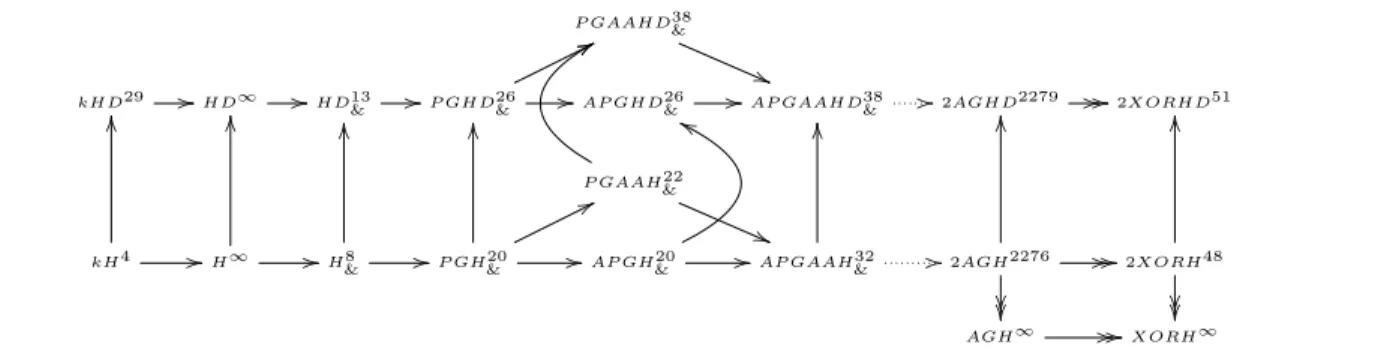
The theories for which we have found unification algorithms using our strategy are summarized in Figure 1 below. We explain the notation in Figure 1 as follows. A full arrow denotes theory inclusion, a full arrow with two heads denotes theory quotients, and a dotted arrow denotes a generalization. All theories are de-scribed in Section 4 and involve the functione(X, K) where e
is an encryption operator,X is a term of sortMessage, and K
is of sort Key or Keys depending on the theory, which are al-ways subsorts ofMessage. H denotes the homomorphic equation
e(X∗Y, K) =e(X, K)∗e(Y, K). kH denotes thebounded ho-momorphism theory, in which sorts are used to restrict the number of variants ofh(x)that can be computed. The symbol&represents the addition of an AC binary function symbol&on terms of a new sortKeys; it can be thought of as a multiset union operator. This
P GAAHD38& ( ( kHD29 //HD∞ //HD13& //P GHD26& // 7 7
AP GHD26& //AP GAAHD&38 //2AGHD2279 ////2XORHD51
P GAAH&22 ( ( 8 8 kH4 O O / /H∞ O O / /H&8 O O / /P GH&20 O O / / 7 7 AP GH&20 // g g AP GAAH32& O O / /2AGH2276 O O / ///2XORH48 O O AGH∞ ////XORH∞ Figure 1. Relations between the theories discussed in this paper
Theories Under-Approximation Over-Approximation
kH Under approximation of H via bound on message length.
No group axioms.
-H& No group axioms. Over approximation of H via use of multiset of keys. P GH&, P GAAH&, AP GH&, AP GAAH& Under approximation of associativity axiom. Over approximation of H via use of multiset of keys.
2AGH Under approximation of H via use of two groups instead of one*.
Under approximation of encryption via bound on number of keys.
-2XORH Under approximation of H via use of two groups instead of one*. Over approximation of Group Axioms.
Under approximation of encryption via bound on number of keys.
*Note that this is not an over-approximation when the encryption function being modeled is indeed a homomorphism from one group to another.
Table 1. Summary of Under and Over approximations w.r.t.AGH
introduces an over approximation if the order of applications of en-cryption to a message matters. PG adds an inverse( )−1, a constant 1and equations making∗apre-group operator(unit, inverses, but no associativity, also known as aloop, see [36] ), while APG makes
∗anAbelian pre-group operator(commutativity, unit, inverses, but no associativity). AA denotes an under approximation of associa-tivity. D denotes the decryption equationd(e(X, K), K) =X; this says that the result of decrypting an encrypted message is the orig-inal message. 2AGH denotes homomorphic encryption that maps one Abelian group to another:e(X∗aY) =e(X)∗be(Y). The operators∗a and∗bareAbelian group operators(commutativity, unit, inverses, associativity). Notice that, there is no key explicitly defined in 2AGH, since encryption with a specific key is implicitly captured by the definition of the encryption operatore. 2XORH de-notes homomorphic encryption over two Xor operators, which is an over approximation of 2AGH. In all cases the axiomsBare either
B =∅or the union of all the equations definingCandAC prop-erties. We also note that in many cases we completed the theory to ensure convergence; these are described in detail in Section 4. The superscript number of each theory denotes the “variant com-plexity” and denotes the sum of the number of variants obtained for each function symbol in the theory (excluding constants). If the su-perscript is∞, this means that the theory doesn’t have FVP. The de-tails of under approximation and/or over approximation w.r.t. AGH of all theories are given in Table 1. The theories with decryption operator are omitted here.
The rest of the paper is organized as follows. In Section 2 we give the background on term rewriting and variant unification nec-essary for understanding this paper. In Section 3 we give the mo-tivation of FVP in terms of cryptographic protocol analysis. In ad-dition we describe related work in unification and apply it to show that none of the possible decompositions of AGH satisfy the neces-sary conditions for variant unification. In Section 4 we present the various homomorphic theories we investigated and their properties. In Section 5 we present the results of performing experiments on several representative theories, using Maude-NPA to analyze pro-tocols specified using these theories. In Section 6 we conclude and discuss future work.
2.
Background on Term Rewriting
We follow the classical notation and terminology from [41] for term rewriting and from [31, 32] for rewriting logic and order-sorted notions. We assume anorder-sorted signatureΣwith a finite poset of sorts(S,≤)and a finite number of function symbols. We furthermore assume that: (i) each connected component in the poset ordering on sorts has a top sort, and for eachs∈Swe denote by [s]the top sort in the component of s; and (ii) for each operator declarationf :s1×. . .×sn→sinΣ, there is also a declaration f : [s1]×. . .×[sn] → [s].TΣ(X) denotes the set of terms for variablesX andTΣthe set of ground terms. We writeVar(t)for the set of variables present in a termt. The subterm oftat positionp
ist|p, andt[u]pis the result of replacingt|pbyuint. Asubstitution σis a sort-preserving mapping from a finite subset ofXtoTΣ(X). The identity substitution isι. Application of substitutionσto a term
tis denotedtσ.
AΣ-equationis an unoriented pairt = t0. Given a setB of Σ-equations, order-sorted equational logic induces a congruence relation=B on termst, t0 ∈ TΣ(X); see [32]. A setB of Σ -equations isregularif for eacht =t0 inB,Var(t) =Var(t0). A setB ofΣ-equations issort-preservingif for eacht=t0 inB
and for each substitutionσ,tσhas sortsifft0σhas sorts. A setB
ofΣ-equations usestop-sort variablesif for eacht=t0inB, the sort of each variable inVar(t)∪ Var(t0)is a top sort. For a setB
ofΣ-equations, aB-unifierfor aΣ-equationt=t0is a substitution
σs.t.σ(t) =B σ(t0). Acompleteset ofB-unifiers of an equation t=t0is writtenCSUB(t=t0). We sayCSUB(t=t0)isfinitaryif it contains a finite number ofB-unifiers.
A rewrite rule is an oriented pair l → r, wherel 6∈ X,
Var(r) ⊆ Var(l), andl, r ∈ TΣ(X)sfor some sorts ∈ S. An (unconditional) order-sorted rewrite theoryis a triple(Σ, B, R) withΣan order-sorted signature,Ba set ofΣ-equations, and R
a set of rewrite rules. A setR of rules is sort-decreasingif for eacht → t0 in R, each sorts, and each substitutionσ, t0σhas sortsimpliestσhas sortstoo. The relation→R,BonTΣ(X)is defined as:t→pR,Bt0(or→R,B) ifpis a non-variable position of t,l→r∈R,t|p=Bσ(l), andt0=t[σ(r)]pfor someσ.
A decomposition (Σ, B, R) of an equational theory E is a rewrite theory that satisfies the following properties: (i)Bis regu-lar, sort-preserving and uses top-sort variables, (ii)Bhas a finitary unification algorithm, and (iii) the rulesRareconvergentmodulo
B, i.e., sort-decreasing, confluent, terminating, and coherent mod-uloB.
Given a decompositionE= (Σ, B, R), a variant of a termtis a pair(t0, θ)such thatt0is a→R,B-canonical form of the substitution instancetθ, i.e., there is a termt00such thattθ →∗
R,B t
00 ,t00is a
→R,B-normal form, andt0 =B t00. A decomposition(Σ, B, R) has thefinite variant property (FVP) if there is a complete and finite set of variants for each term (see [15, 21] for details). If a decomposition(Σ, B, R)of an equational theoryEhas thefinite variant property, there is an algorithm to compute a finite complete setCSUE(t=t0)ofE-unifiers [21].
3.
Motivation and Related Work
In this section we discuss the related work that precedes and mo-tivates the work in this paper. This is divided into two parts. The first motivates our interest in FVP in terms of its application to cryptographic protocol analysis. The second gives a brief history of work on unification modulo one-sided distributivity that applies to homomorphic encryption and uses these results to show that no decomposition ofAGHsatisfies all the conditions necessary for the finite variant property, and thus demonstrates the need for other solutions such as theory approximations.
3.1 Motivation
Unification-based cryptographic protocol analysis tools are used to analyze cryptographic protocols in which an attacker interact-ing with the protocol may cause security properties to be violated. Actions of principals are modeled symbolically using logical vari-ables, and paths through protocols are computed by unifying mes-sages expected by a principal with mesmes-sages sent by a principal, often modulo some equational theory that describes the properties of the crypto algorithms used.
Any unification technique used in cryptographic protocol analy-sis must satisfy two properties. First of all, it must behave well with respect to composition, especially of disjoint theories, since crypto-graphic protocols often combine different algorithms described by different theories. Although methods for combining unification al-gorithms of disjoint theories are well-known [6, 40], the solution in the general case is highly nondeterministic and inefficient, so more efficient special algorithms are desirable.
The second property that must be satisfied is a little more subtle, and has to do with the fact that many of the state space reduction techniques used require that terms in the state be in some kind of normal form with respect to the theoryEused. Generally this is expressed by writingEas a decomposition(R, B)whereBis reg-ular and has a finitary unification algorithm, andRis convergent moduloB. This ensures enough stability in normal form represen-tations of terms so that syntactic state space reduction techniques can be applied.
Both the first and second desiderata of unification-based cryp-tographic can be achieved, if the decomposition(R, B)has the fi-nite variant property, via variant unification as described in Section 2. Since the first step of variant unification requires the compu-tation of all the irreducible variants of each side of the unifica-tion problem, and a soluunifica-tion is discarded if a soluunifica-tion makes ei-ther side reducible, variant unification guarantees the irreducibility constraint required by state space reduction techniques. Moreover, variant unification behaves well under composition, at least in the area of cryptographic protocol analysis. First of all, the axiomsB
are relatively few and well-understood. Moreover, if the
combina-tion of the two theories also has a finite variant decomposicombina-tion, then the same finite variant algorithm can be applied as well.
Not surprisingly many tools have followed approaches simi-lar, if not identical, to variant unification. Both Maude-NPA [19] and Tamarin [39] use variant-based unification explicitly. Indeed support for variant-based unification is being built into Maude 2.7. Moreover, other tools have used approaches that have many features in common with variant-based unification. For example, ProVerif [8] (see [9, Sec. 5]) and OFMC [7] (see [33, Sec. 10]) both compute the variants of protocol rules, modulo the free theory for ProVerif, and modulo the free theory or AC for OFMC. This has the effect of computing the variants of both sides of the unifica-tion problem. More recently, variants have been applied to expand-ing the capacity of ProVerif to deal with AC theories. Thus, in [26] K¨usters and Truderung implement a special case of the exclusive-or theory in the ProVerif tool by expressing it as a rewrite theory with the finite variant property with respect to the free theory (E =∅) and computing variants that are unified syntactically. This requires some restrictions on the syntax of the protocol, however. Similar approaches have been applied by K¨usters and Truderung for mod-ular exponentiation [25], and Arapinis et al. [3] for commuting en-cryption and AC theories.
Variant-based unification does have some drawbacks, however. First of all, it can be inefficient for theories of high variant com-plexity. This can be mitigated by the use ofasymmetric unification
[16], in which only the variants of the right-hand side of a unifica-tion problems are computed, and irreducibility constraints are also enforced only on the right-hand sides. This requires the use of spe-cialized asymmetric unification algorithms, so combination is no longer as straightforward, but it is still possible to apply the state space reduction techniques, and efficiency gains, as shown in [16], can be dramatic.
A more serious problem arises when a theory of interest fails to have an FVP decomposition at all. Fortunately, most theories of in-terest to cryptographic protocol analysis are FVP with respect to a decomposition in whichB is either the empty theory or AC. However, there is one notable exception, the theory of encryp-tion homomorphic over another operator, that ise(X∗Y, K) =
e(X, K)∗e(Y, K)where∗is an operator that may have some other equational properties, shown not to satisfy FVP when the homo-morphic equation is inRby Comon and Delaune in [15]. Comon and Delaune consider the case in whichehas only one argument and∗is exclusive-or, but their case can be considered as corre-sponding to a degenerate case ofewith two arguments, in which only one key is used. Moreover, their counterexamples apply to any sub theory of the theory they use for∗, including the Abelian group theory,AC, and the free theory.
Comon and Delaune prove their result by producing counterex-amples to a property that they show to be equivalent to FVP. How-ever, it is also easy to produce direct counter examples. Assum-ing that the distributive equation is oriented as the rewrite rule
e(X∗Y) →e(X)∗e(Y), then the irreducible variants ofe(Z) are[(e(Z), ι),(e(Z1)∗e(Z2),{Z 7→Z1∗Z2}), . . .]. If the equa-tion is oriented ase(X)∗e(Y)→e(X∗Y), then the variants of
e(Z∗W)are[(e(Z∗W), ι),(e(e(Z1∗W1)),{Z7→e(Z1), W 7→ e(W1)}), . . .].
3.2 Related Work in Equational Unification and its Application to Decompositions of AGH
Equational theories that include a homomorphic property appear in many applications, and thus there is a long history of research on unification in this area. As in Comon and Delaune, the homomor-phic operator under consideration generally has only one argument. However, as shown before, this theory can be considered as
apply-ing to a degenerate case of homomorphic encryption in which only one key is used and so is still relevant.
The earliest work on homomorphic theories is by Tiden and Arnborg [42] who gave a unification algorithm modulo the theory of one-sided distributivity:1x∗(y+z) = (x∗y) + (x∗z).The complexity of their algorithm is exponential. A polynomial-time algorithm for unifiability (existence of a unifier) modulo this theory was developed by Marshall [29, 30]. An alternative unification algorithm using a very different approach was developed by Hai Lin in his dissertation [2, 27]. This algorithm for the equational propertye(X∗Y, K) =e(X, K)∗e(Y, K)in which∗is a free operator was implemented in Maude-NPA and several protocols were tested [17].
Theories of homomorphisms of the forme(x∗y) =e(x)∗e(y), where the∗operator has additional properties, were first considered by Nutt [35] and also by Baader [4, 5]. The unification problem is decidable when∗is an Abelian group [4] and undecidable when
∗only has the associative and commutative properties [34]. The decidability results were extended to one-sided distributivity in [23, 24]. Liu in [28] gives a dedicated algorithm for the case in which∗
is exclusive-or.
We make use of all these previous results to study the decom-positions of AGH and show that none of them meet our needs. We give the equations for AGH below (ignoring equations needed to complete the theory for coherence):
(x∗y)∗z = x∗(y∗z) (1) x∗y = y∗x (2) x∗1 = x (3) x∗(x)−1 = 1 (4) e(1) = 1 (5) e(x∗y) = e(x)∗e(y) (6)
We note that although unification modulo AGH itself is finitary, this does not help us for variant-based unification, since AGH is not regular. Indeed, because of the need for regularity ofB (without it a convergent decomposition becomes practically impossible), Eq. 4 must be inR for any decomposition(Σ, B, R). Moreover, because commutativity can not be written as a rewrite rule, and because unification modulo associativity without commutativity is not finitary, Eqs. 1 and 2 must be inB.
We also know that if Eq. 6 is inR, then the decomposition will fail to have the finite variant property, as we have noted earlier. Thus the only choices left forB areB1 ={1,2,3,5,6},B2 =
{1,2,6},B3={1,2,5,6}, andB4={1,2,3,6}. Unification for B1 andB2 is known to be undecidable [34]. The theoriesB3and B4 have not been as well studied, but we note that the problems e(x) =? x
andx∗x=? x
have nonfinitary solutions forB3and B4 respectively. For the former, the set of mgu’s is{x→1, x→
1∗1, . . .}; for the latter it is{x→e(1), x→e(e(1)), . . .}.
4.
FVP Theories of Homomorphic Encryption
In this section we present all the theories mentioned in Figure 1. Theories kH and kHD are presented in Section 4.1. Theories H& and HD&are presented in Section 4.2.1. Theories PGH&, PGHD&, PGAAH&and PGAAHD&are presented in Section 4.2.2. Theories APGH&, APGHD&, APGAAH&and APGAAHD&are presented in Section 4.2.3. Theories 2AGH and 2AGHD are presented in Section 4.3.1, and 2XORH in Section 4.3.2 . Since these theories
all have FVP, they could often be combined with other theories,
1Note: in this theory the operation+corresponds to our use of∗and∗ corresponds to our use ofe.
which is another great benefit of our approach. All the theories are based on the following homomorphic theory.
Definition 1. The homomorphic theory is defined as TH = (ΣH,∅, RH). The signature ΣH is defined by sorts{Key,Msg}
with the subsort relationKey<Msg. The setRHof rules contains only the following rule, which is a variation of Equation (6), where
X, Y are of sortMsgandKis of sortKey:
e(X∗Y, K) → e(X, K)∗e(Y, K) (7) We also note that, given an order of the rulesRof a decompo-sition(Σ, B, R), there is a fixed minimal set of variants that can be determined. We use this to introduce the notion ofvariant complex-ity, which can be used as a rough metric of the complexity inherent in using a particular theory.
Definition 2. For E = (Σ, B, R), and a total order< on the rules inR, thevariant complexity, writtenvc(E, <), provides the number of variants generated for all the terms, i.e., vc(E) = P
f∈Σv(f), where v(f) is the cardinality of the complete and finite set of variants off(v1, . . . , vn)wherev1, . . . , vnare distinct variables.
We will often refer tovc(E)instead ofvc(E, <)when using variant complexity as a metric.
Example 1. Consider the theory with sorts{M sg, Key}, opera-torse : M sg×Key → M sg,d : M sg×Key → M sgand ruled(e(X, K), K) =X, whereXis of sortM sg, andKis of sortKey. The variant complexity of this theory is3, since the term
e(X, K)has1variant:(e(X, K), ι)and the termd(X, K)has2 variants:(d(X, K), ι)and(X1,{X → e(X1, K1), K → K1}), withX, X1of sortMsgandK, K1of sortKey.
4.1 Theory of Bounded Homomorphism
First, we define the equational theory for bounded homomorphism by using a new sortSingleMsg, which is a subsort ofMsg. The theory TkH obtained is convergent and have the FVP. Indeed,
vc(TkH) = 4.
Definition 3. The bounded homomorphic theory is defined as
TkH= (ΣkH,∅,RcH
k
)forkthe bound. The signatureΣkHis defined by adding sortSingleMsgto the previous sortsMsgandKeywith the subsort relationKey<SingleMsg<Msg. The signatureΣkH contains an overloaded definition of the encryption operator, i.e.,
e:SingleMsg×Key→SingleMsgande:Msg×Key→Msg. The equation (7) ofRH is replaced in RcH
k
by the following rules: for all1< j ≤k, adde(S1∗ · · · ∗Sj, K)→e(S1, K)∗
· · · ∗e(Sj, K)to RcH
k
, where K is a variable of sort Key, and
S1, . . . , Skare variables of sortSingleMsg. Fork = 3, the set of equations inRcH
3 is:
e(S1∗S2, K)→e(S1, K)∗e(S2, K)
e(S1∗S2∗S3, K)→e(S1, K)∗e(S2, K)∗e(S3, K)
Example 2. Consider the following unification problem:
X:Msg∗Y:Msg=?
e(data(A:Name, r0:Fresh)∗data(B:Name, r0:Fresh), K:Key) in the theoryT3H, wheredata:Name×Fresh→Datais an addi-tional operator that generates principle’s secrets, and we assume the subsort relationData< SingleMsg. We get the following unifier by variant based unification:
{X7→e(data(A1:Name, r1:Fresh), K1:Key), Y 7→e(data(B1:Name, r1:Fresh), K1:Key), A:Name7→A1:Name,
r0:Fresh7→r1:Fresh, B:Name7→B1:Name, K:Key7→K1:Key}
We can extend the theoryTkHby adding a decryption operator and the equations capturing the encryption/decryption cancellation properties.
Definition 4. The bounded homomorphic theory with decryption is defined asTkHD= (ΣH∪ΣkH∪ΣDec,∅,RcH
k
∪RDec∪RkH-Dec). ΣDec contains the overloaded decryption operator d : Msg ×
Key →Msg,d :SingleMsg×Key→ SingleMsg. The encryp-tion/decryption cancellation properties are captured by the equa-tionsRDec, whereXis of sortMsgandKis of sortKey:
e(d(X, K), K)→X d(e(X, K), K)→X
EquationsRkH-Dec capture the homomorphic property of the de-cryption operation, and are added for the theory to be convergent. The equations for boundk= 3are as follows:
d(S1∗S2, K)→d(S1, K)∗d(S2, K)
d(S1∗S2∗S3, K)→d(S1, K)∗d(S2, K)∗d(S3, K)
4.2 Homomorphic Theories: Theory of Homomorphic Encryption with a Multiset of Keys
Since neither AGH nor H have the FVP, we have extended H with a new presentation of e(M, K) built on top of a new symbol &, which is associative and commutative (AC), and keeps all the keys used for homomorphic encryption in a multiset. Since nested encryptions with the same subset of keys can be flattened using AC, this theory admits the FVP. But one side effect is that the order of applications of encryption to a message become immaterial. This is not a standard property of encryption, homomorphic or not, so in most cases, the multiset AC axioms are over approximations that are used to get the finite variant property. The soundness (i.e., any attacks found are real attacks) is lost since the over approximation may introduce spurious attacks, but they can be discarded upon inspection. Also, we note that there are a few cases, such as Distributed ElGamal [11], in which encryption does satisfy this multiset condition, so this may be useful for reasoning about an additional class of crypto-algorithms as well.
In this section, we first introduce the theoryTH&, which is
consists of homomorphic encryption over a free operator and using a multiset of keys. This theory is convergent and has the FVP. Indeed,vc(TH&) = 8.
TH&is then enriched with group operators and axioms. Since
the FVP is lost again when adding the full group axioms due to the fact that confluence required an infinite number of extra rules, associativity is approximated by a sub-theory. We call a group without associativity apre-group. The theoryTPGH&, which
is obtained by extending the TH& to homomorphic encryption
over a pre-group operator is convergent and has the FVP. Indeed,
vc(TPGH&) = 20.
TH&is then further enriched with Abelian group operators and
axioms. Again, associativity is approximated. The theoryTAPGH&,
which is obtained by extending theTH&to homomorphic
encryp-tion over an Abelian pre-group operator is convergent and has the FVP. Indeed, the variant complexity isvc(TAPGH&) = 20.
4.2.1 Theory of Homomorphic Encryption over a Free Operator
Definition 5. The theory for homomorphic encryption with a mul-tiset of keys is defined asTH&= (ΣH&, BH&, RH&). The signature
ΣH&is defined by sorts{Key,Keys, Msg}with the subsort rela-tionKey<Keys,Keys<Msg, and operators ∗ :Msg×Msg→
Msg, & :Keys×Keys→Keys, ande:Msg×Keys→Msg, where ∗ is a free operator, which can be understood as list con-catenation operator, & denotes a multiset union operator that is associative and commutative, andedenotes message encryption. The axiomsBH&are AC for &. There are five equations defined
inRH&. e(X, U)∗e(Y, U)→e(X∗Y, U) (8) e(e(X, V), U)→e(X, U&V) (9) e(X, U&V)∗e(Y, U)→e(e(X, V)∗Y, U) (10) e(X, U)∗e(Y, U&V)→e(X∗e(Y, V), U) (11) e(X, U&V)∗e(Y, U&W)→e(e(X, V)∗e(Y, W), U) (12) whereX, Y are variables of sortMsg, andU, V, Ware variables of sortKeys. The equation (8) is the reversed version of (7). The equa-tion (9) captures the property that a nested encrypequa-tion is simplified into an encryption with a multiset of keys. The remaining equations describe the homomorphic property of an encryption with respect to a multiset of keys, and are added for confluence of the theory.
The unification problem of Example 2 returns the same unifiers with this new theoryTH&as with the previous theoryTkH.
The extension of TH& with a decryption operator is denoted THD&. The theory obtained is convergent and has the FVP ( vc(THD&) = 13).
Definition 6. The theoryTHD&is defined by extendingTH&with
a decryption operatord : Msg×Keys → Msg together with additional equationsRH&-Decwhich describe encryption/decryption
cancellation properties with respect to a multiset of keys:
d(e(X, U), U)→X d(e(X, U&V), U)→e(X, V)
d(e(X, U), U&W)→d(X, W)
d(e(X, U&V), U&W)→d(e(X, V), W) withXof sortMsg, andU, V, Wof sortKeys.
4.2.2 Theory of Homomorphic Encryption over a Pre-Group
In this section, we extendTH&to be an homomorphic encryption
over a pre-group. For the reason that we mentioned before, associa-tivity is under approximated by a sub-associaassocia-tivity theory.
Definition 7. The pre-group theory is defined as
TPG= (ΣPG,∅, RPG). There is only one sortMsg, and three group operators{ ∗ , −1,1}, where ∗ : Msg×Msg→Msgis the group operator, −1:Msg→Msggenerates the inverse of an ele-ment and the constant1is the identity. The equationsRPGcontains all group axioms except associativity, whereXis a variable of sort Msg:
X∗1→X 1∗X→X X∗X−1→1
X−1∗X→1 (X−1)−1→X 1−1→1 Definition 8. The theory for homomorphic encryption with a mul-tiset of keys over pre-group is defined as TPGH& = (ΣH& ∪
ΣPG, BH&, RPGH&), where RPGH& = RPG∪RH&∪RPGH&-Aux.
The following set of equationsRPGH&-Auxis added to complete the
theory:
withXof sortMsgandUof sortKeys.
Example 3. Recall the unification problem in Example 2, with an instance of theoryTPGH&, we get all the unifiers in Example
1 together with the following unifiers:
{X7→e(data(A1, r1)∗data(B1, r1), K1), Y 7→1, A7→A1, r07→r1, B7→B1, K7→K1} {X7→1, Y 7→e(data(A1, r1)∗data(B1, r1), K1),
A7→A1, r07→r1, B7→B1, K7→K1}
Adding associativity approximation toTPG. Although the theory
TPGdefines a group without associativity, we can provide several sound approximations of associativity by adding a subtheory of the full associativity theory. This is an under approximation and the completeness (i.e., if there is an attack, an attack will be found) is lost since there may be attacks that can show up with full associa-tivity theory but cannot be found with a sub-associaassocia-tivity theory. Here we introduce one of the possible sub-associativity theories as an example to illustrate this approach. The associativity approxi-mation below captures the property that a term of sortNoncecan be canceled by its inverse when they are in the two separate ends of a sequence of terms of sortMsg.
Definition 9. The theory for a pre-group with associativity approx-imationTPGAAis defined asTPGAA = (ΣPG∪ {Nonce},∅, RPG∪
RPGAA). We assume the subsort relationNonce< Msg. The sub-associativity axiomsRPGAAare specified as follows, whereX is a variable of sortMsgandNis a variable of sortNonce:
(N−1∗X)∗N→X N∗(X∗N−1)→X
(N∗X)∗N−1→X N−1∗(X∗N)→X Remark1. Notice that, in order to get a sound sub-associativity approximation, it is crucial to take advantage of the order-sorted type structure.
We can also add associativity approximation to the theory of homomorphic encryption over a pre-group by combiningTPGH&
withTPGAA.
Definition 10. Combining the theoriesTPGH&andTPGAA, we
ob-tained the theoryTPGAAH&=TPGH&∪TPGAA.
We can also extend TPGH& by adding a decryption operator,
and/or associativity approximations, keeping FVP.
Definition 11. The theory TPGHD& is defined by extending the
theoryTPGH& with the decryption operatord : Msg×Keys → Msg, together with the equationRH&-Dec introduced in Definition
5, and the auxiliary equationd(1, U) = 1.
Definition 12. Adding the same associativity approximation to
TPGHD&, we obtain the theoryTPGAAHD&=TPGHD&∪TPGAA.
4.2.3 Theory of Homomorphic Encryption over an Abelian Pre-Group
We further approximate the theory AGH by adding a commutative axiom to the binary group operator in the pre-group. This provides a theory for homomorphic encryption over an Abelian pre-group.
Definition 13. The theory of Abelian pre-groupsTAPG = (ΣAPG,
BAPG, RAPG)is obtained from the theory of pre-groupTPGby just adding as axiomsBAPGthe commutativity equationX∗Y =Y∗X. Because of commutativity, the rules1∗X→XandX∗X−1→1 inTPGbecome redundant.
We can similarly provide a sound approximation of associativity by adding a subtheory of the full associativity theory. Here again, we introduce an Abelian pre-group with sub-associativity theory as an example to illustrate this approach.
Definition 14. The theory for an Abelian pre-group with asso-ciativity approximationTAPGAA is defined asTAPGAA = (ΣAPG ∪
{Nonce}, BAPG, RAPG∪RAPGAA). We assume the subsort relation
Nonce<Msg. The sub-associativity rulesRAPGAAare specified as follows:
(N−1∗X)∗N→X (N∗X)∗N−1→X
withXof sortMsgandNof sortNonce.
Definition 15. The theory of homomorphic encryption with a multiset of keys over an Abelian pre-group is defined asTAPGH&=
(ΣH&∪ΣAPG, BAPGH&, RPGH&∪RPGH&-Aux). The axiomsBAPGH&
define the commutativity property of ∗ and AC of &.
Example 4. For the unification problem in Example 2, with an instance of the theoryTAPGH&, we find the unifiers described in
Example 2, together with the following unifier: {X7→e(data(B1:Name, r1:Fresh), K1:Key),
Y 7→e(data(A1:Name, r1:Fresh), K1:Key), A:Name7→A1:Name, r0:Fresh7→r1:Fresh, B:Name7→B1:Name, K:Key7→K1:Key}
We can extend TAPGH& by adding a decryption operator, and
associativity approximations. Both extensions have the FVP.
Definition 16. TAPGHD&is obtained by adding decryption operator d:Msg×Keys→Msgto the signature ofTAPGH&, together with
the set of encryption/decryption cancellation equationsRH&-Decin
Definition 5, and together with the auxiliary equationd(1, U) = 1. We can similarly add associativity approximation to the theory of homomorphic encryption with a multiset of keys over an Abelian pre-group. By Combining the theories TAPGH& withTAPGAA, we
get the theory of homomorphic encryption with a multiset of keys over Abelian pre-group with associativity approximation, which is defined as:TAPGAAH&=TAPGH&∪TAPGAA.
Adding the same associativity approximation to TAPGHD&, we
obtain the theoryTAPGAAHD&=TAPGHD&∪TAPGAA.
4.3 Homomorphic Theories: Theory of Homomorphic Encryption over Two Groups
In this section, we introduce theories of homomorphic encryption over two different groups. Since this is essentially a function map-ping from one group to another, it does not have recursive calls, allowing the theories to have the FVP.
We first introduce the theory T2AGH, which defines homomor-phic encryption over two Abelian groups. This theory is defined based on the decomposition of an Abelian group by Lankford [22], which was proved to have FVP by [15, 21]. The theoryTAGhas the FVP. Indeed,vc(T2AGH) = 2276.
Notice that the variant complexity of the theory T2AGH is re-ally high. To achieve a lower variant complexity, we introduce the theoryT2XORH, which defines a homomorphic encryption over two Exclusive-or(Xor) theories. This is an over approximation of ho-momorphic encryption over two Abelian groups. The variant com-plexity of this theory is much lower, indeed,vc(T2XORH) = 48. 4.3.1 Theory of Homomorphic Encryption over Two Abelian
Groups
Definition 17. The theory of Abelian groups is defined asTAG= (ΣAG, BAG, RAG). The signatureΣAGis defined by sortAGand the set of Abelian-group operators
∗ :AG×AG→AG −1:AG→AG 1 :→AG
The axiomsBAGare associativity and commutativity axioms for
X∗1→X X∗(X−1)→1 (X−1)−1→X 1−1→1 X∗(X−1∗Y)→Y X−1∗Y−1→(X∗Y)−1 (X∗Y)−1∗Y →(X)−1 (X−1∗Y)−1→X∗(Y−1) X−1∗(Y−1∗Z)→(X∗Y)−1∗Z (X∗Y)−1∗(Y ∗Z)→X−1∗Z withX, Y, Zof sortAG.
Definition 18. The theory of homomorphic encryption over two Abelian groups is defined as T2AGH = (Σ2AGH, B2AGH, R2AGH). The signatureΣ2AGH is defined by sorts {AGa, AGb}, and the
homomorphic encryption operatore :AGa→AGb, together with
the set of group operators for the domain Abelian groupAGa, which
are {∗a,1a, −1a}, and the set of group operators for codomain Abelian groupAGb, which are{∗b,1b, −1b}. Notice that there is no key explicitly defined here, since encryption with a specific key is implicitly captured by the definition of the encryption operatore. The axiomsB2AGH are AC axioms for the binary Abelian group operators ∗a , ∗b . The set of equations R2AGH defines the remaining Abelian group axioms of AGa and AGb, which are instances ofRAGinTAGtogether with the homomorphic property ofe:
e(X)∗be(Y)→e(X∗aY) e(X)∗be(Y)∗bZ→e(X∗aY)∗bZ The following equations are added to complete the theory.
e(1a)→1b e(X)−1a→e((X)−1b) (e(X)∗bZ)−1b→e(X−1a)∗b(Z−1b) withX, Y of sortAGa, andZof sortAGb
We can also extendT2AGHby adding decryption operator in the following way:
Definition 19. T2AGHDis obtained by adding a decryption operator
d:AGb→AGato the signature ofT2AGH, together with adding the equationsd(1b) = 1aandd(e(X)) =XwithXof sortAGa.
4.3.2 Theory of Homomorphic Encryption over Two Xor Operators
Definition 20. The theory for homomorphic encryption over two Xor operators is defined asT2XORH = (Σ2XORH, B2XORH, R2XORH). The signatureΣ2XORH is defined by sorts{Xora, Xorb}, and the
homomorphic encryption operatore:Xora→Xorb, together with
the Xor operator and the corresponding identity ofXora, which are {∗a,1a}, and together with the Xor operator and the corresponding identity ofXorb, which are{∗b,1b}. Notice again that there is no key explicitly defined here. The axiomsB2XORH are associativity and commutativity axioms for ∗a , ∗b . The set of equations R2XORHare defined as following:
X∗aX→1a X∗aX∗aY →Y X∗a1a→X P∗bP→1b P∗bP∗bQ→Q P∗b1b→P together with the homomorphic property ofe:
e(1a)→1b e(X)∗be(Y)→e(X∗aY) e(X)∗be(Y)∗bP→e(X∗aY)∗bP withX, Y of sortXora, andP, Qof sortXorb
We can also extendT2XORHby adding a decryption operator in the similar way as inT2AGHD
5.
Experiments
In this section we describe the experiments2we have performed
on various of the Multiparty Computation Protocol that we had specified and analyzed in [17]. In that paper we analyzed a num-ber of protocols that were specified using a dedicated unification algorithm for equational theoryH. That is, Equation (7) was used and nothing else. This was necessary because the special-purpose unification algorithm was not easily combinable with other theo-ries. However, since in this paper we are using variant unification, we have much more freedom with respect to the equations we can include, as long as the theories satisfy FVP.
The experiments in this section serve several purposes. The first is to determine which of the theories we have generated are suitable for cryptographic protocol analysis. The second is to evaluate the variant complexity metric defined in this paper. How well does lower variant complexity correlate with performance, and if it does, at what point does higher variant complexity begin to make analysis impossible? The third is to use the experimental results to gain insights into how performance can be improved.
The protocol was specified and analyzed using the Maude-NPA cryptographic protocol analysis tool. One uses Maude-Maude-NPA by specifying an insecure state, called anattack state, from which Maude-NPA searches backwards. If it finds a path to an initial state then it has found an attack on the protocol. If it terminates without reaching an initial state then the attack state has been proven unreachable.
In the Multiparty Computation Protocol an initiator Alice and a responder Bob send messages encrypted with a homomorphic pub-lic key encryption operatore to a server, who combines the en-crypted data using an operator∗. As a result of participating in the protocol, both Alice and Bob are supposed to receive a homomor-phically encrypted version ofDA∗DB, whereDAis Alice’s secret data andDBis Bob’s secret data, without either learning the other’s secret. However, it is possible for Alice to accept data that did not come from Bob if she is not able to distinguishDA∗DB from nonsense. If she is able to, no authentication attack is possible. We specified two attack states: one in which Alice cannot reject non-sense, and one in which she can.
The protocol itself proceeds as follows:
1.A→B:sign(B;NA;pk(e(DA, pkey(A, B)), S), A) Astarts by encrypting her data first under the homomorphic public key, then under the server’s public key. She then attaches a nonce andB’s name, signs it, and sends it toB.
2.B→A:sign(NA;NB;pk(e(DB, pkey(A, B)), S), B) B sends a similar message toA, including both his andA’s nonce.
3.A→S:sign(A;B;NA;NB;pk(e(DA, pkey(A, B)), S); pk(e(DB, pkey(A, B)), S), A)
A sends a signed message containing both nonces and both encrypted data sets toS.
4.S→A, B:sign(A;B;NA;NB;
sign(e(DA, pkey(A, B))∗ e(DB, pkey(A, B)), S)
The server combines both encrypted data sets using∗and sends the result to A and B. They can now decrypt it to obtain
DA∗DB.
2 Available at http://formal.cs.illinois.edu/fanyang/
The attack runs as follows:
1.A→I(B) :sign(B;NA;pk(e(DA, pkey(A, B)), S), A) Ainitiates the protocol withB.
2.I→B:sign(B;NA;E, I)
I intercept’sA’s message, and uses it to create a message for
B. The messageEcould or could not beA’s encrypted data. This is irrelevant to the attack.
3.B→A:sign(NA;NB;pk(e(DB, pkey(I, B)), S), B) B believes that he is talking toI and sends the corresponding reply message.Iforwards it toA.
4.A→S:sign(A;B;NA;NB;
pk(e(DA, pkey(A, B)), S); pk(e(DB, pkey(I, B)), S), A)
Anow forwards both encrypted data sets to the serverS, who removes the outer layer of encryption, appliesf, and sends the results back toAandB.
5.S→A, B:sign(A;B;NA;N B;
sign(e(DA, pkey(A, B))∗ e(DB, pkey(I, B)), S)
If A now attempts to decrypt the result of S’s computation with her private key corresponding to pkey(A, B), she will get nonsense, because one of the data sets was encrypted with
pkey(I, B). Depending upon whether or notAcan recognize that she has received nonsense, this can be used to prevent this attack.
We thus specify two versions of this protocol : one in whichA
verifies that she has receivede(f(X, Y), pkey(A, B))for someX
andY, and one in which she does not.
If, in addition, we assume that∗ is an Abelian group opera-tor, there are several attacks in which Bob can learn Alice’s secret (and vice versa). In the first, Bob simply sends the unit 0 as his data and receivesDA∗1 = DA in return. In the second, Bob sends his correct data and receivesDA∗DB, and multiplies by
(DB)−1 to obtain DA. These attacks, although simple, were of interest to us because they follow from the Abelian group proper-ties of∗, and so we ran Maude-NPA on an attack state in which Bob learns Alice’s secret, using the homormorphic encryption over an Abelian pre-group with associativity approximation. To demon-strate the associativity approximation’s influence on performance, we investigated two such theories:TAPGAAH1&is the theoryTAPGH&
with the approximation equation:(D1 ∗D2)∗(D1)−1 = D2. TAPGAAH2& is the theoryTAPGH& with the approximation equation:
(D1∗X)∗(D1)−1=XwithXof sortMsg, andD1andD2of sortData, which is a subsort ofMsg. Notice that we start from an associativity approximation that is just expressive enough for this specific protocol and then try a more expressive one.
We tried the authentication attack on the protocol specified with the theoriesTkH (bounded homomorphism, variant complexity 4),
TH&(multi set of keys with free operator, variant complexity 8),
andTAPGH&(Abelian pre-group,variant complexity 20). The results
are given in Table 2 for the insecure version of the protocol and Table 3 for the second version of the protocol. We note that all the theories we obtained can be used for analyzing this attack, since the higher the variant complexity, the longer the analysis time, we thus consider only three equational theories. For the secrecy attack we investigatedTAPGAAH1& andTAPGAAH2&as well the theoriesT2AGH
(homomorphism between two Abelian groups, variant complex-ity 2276) and T2XOR (homomomorphism between two exclusive-or theexclusive-ories, variant complexity 48), since Abelian group axioms are necessary for the secrecy attack. The results forTAPGAAH1&and TAPGAAH2&are given in Table 4.
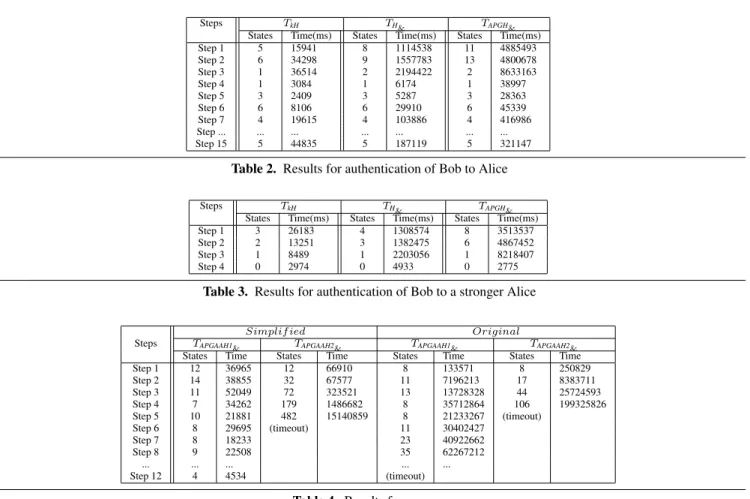
Tables 2 and 3 show the number of states generated by Maude-NPA and the amount of time taken in each step of the backwards reachability analysis. In Table 2, for each theory Maude-NPA found the authentication attack in six steps. However, in each case Maude-NPA failed to terminate and kept generating five states after fifteen steps. Upon investigation, these appeared to be infinite paths that were not discarded by the Maude-NPA state space reduction tech-niques. As we can also see from the table, as the variant complexity of theories involved in the specification grows, the number of states and the time needed for Maude-NPA to find the attack also grows, as well as the time it takes to complete each step. Furthermore, the time it takes to complete a step increases with the variant complex-ity of the theory even when the number of states generated at the step is the same for all three theories. We conjecture that this is the result of Maude-NPA generating many states that are then removed by the state space reduction mechanisms. Greater variant complex-ity means that more failed states are generated as well as successful ones.
For the second attack analysis, when Alice can tell whether she received nonsense or not, we verified that there is no authentica-tion attack between Alice and Bob. Table 3 shows the number of states and attacks generated by Maude-NPA in each step for the at-tack state with different theories described above. For each theory Maude-NPA terminated at Step 4. We note a similar relationship between between performance and variant complexity as in Table 2.
For the secrecy attack we found that the theories T2AGH and
T2XORgave very discouraging results. For Theory T2AGH Maude-NPA was not even able to complete Step 1, even for a simpler version of the protocol we constructed (see below). For theory
T2XORMaude-NPA did a little better; it was able to complete Steps 1 and 2, but not Step 3. This is not surprising, given the high variant complexity of the theories. We did not investigate these two theories any further.
Even withTAPGAAH1&andTAPGAAH2&, Maude-NPA struggled to
find the secrecy attack, as we can see in Table 4 forTAPGAAH2&.
We thus tried Maude-NPA on a simpler version of the protocol to get a better idea of the performance tradeoffs, omitting the checks for authentication and freshness. This simplification is intended to reduce search space while keeping the part of the protocol that is of interest to us. Maude-NPA was able to find the two attacks in five steps for the simplified protocols. The search of the protocol withTAPGAAH1& terminated after 12 steps and 4 possible attack
sequences were found, while the one withTAPGAAH2&took a much
longer time for each search step and suffered from state explosion. Even so, it was able to produce 5 attack sequences before the explosion.
Since the associativity approximation of TAPGAAH1& is more
restrictive than that ofTAPGAAH2&(indeed it is a special case of it),
less variants are generated for the same term, which reduced the state generation time. This result thus shows the tradeoff needed between a more general theory and performance in practice.
6.
Conclusions
The lack of FVP for H and AGH has made unification-based formal protocol analysis difficult to perform by extensible and generic methods such as variant-based unification. In this paper we have addressed this problem by studying a hierarchy of theories for homomorphic encryption that are all FVP. The existence of finitary unification algorithms for these theories seems to be a new result in the area of unification theory. We have also introduced variant complexity as a metric and shown how it affects performance. One important lesson learned from our experiments in using these theories for protocol analysis is that there is a tradeoff between theory accuracy (typically at the cost of higher variant complexity)
Steps TkH TH& TAPGH&
States Time(ms) States Time(ms) States Time(ms)
Step 1 5 15941 8 1114538 11 4885493 Step 2 6 34298 9 1557783 13 4800678 Step 3 1 36514 2 2194422 2 8633163 Step 4 1 3084 1 6174 1 38997 Step 5 3 2409 3 5287 3 28363 Step 6 6 8106 6 29910 6 45339 Step 7 4 19615 4 103886 4 416986 Step ... ... ... ... ... ... ... Step 15 5 44835 5 187119 5 321147
Table 2. Results for authentication of Bob to Alice
Steps TkH TH& TAPGH&
States Time(ms) States Time(ms) States Time(ms)
Step 1 3 26183 4 1308574 8 3513537
Step 2 2 13251 3 1382475 6 4867452
Step 3 1 8489 1 2203056 1 8218407
Step 4 0 2974 0 4933 0 2775
Table 3. Results for authentication of Bob to a stronger Alice
Simplif ied Original
Steps TAPGAAH1& TAPGAAH2& TAPGAAH1& TAPGAAH2&
States Time States Time States Time States Time
Step 1 12 36965 12 66910 8 133571 8 250829 Step 2 14 38855 32 67577 11 7196213 17 8383711 Step 3 11 52049 72 323521 13 13728328 44 25724593 Step 4 7 34262 179 1486682 8 35712864 106 199325826 Step 5 10 21881 482 15140859 8 21233267 (timeout) Step 6 8 29695 (timeout) 11 30402427 Step 7 8 18233 23 40922662 Step 8 9 22508 35 62267212 ... ... ... ... ... Step 12 4 4534 (timeout)
Table 4. Results for secrecy
and efficiency of the analysis process. Our hierarchy allows users to choose the right balance for their problem within this tradeoff.
The work also points out a number of avenues for future work. In particular, it demonstrates that better state space reduction tech-niques, while useful, are likely not to be adequate by themselves for addressing performance issues when dealing with theories of high variant complexity. That is because the techniques are only applied
after a state is generated. This points out the need of techniques that can be applied earlier in the state generation process. We have also discovered that different approximations of equational prop-erties via intruder strands can have widely different effects on the number of variants generated as well. Metrics that can be applied to these approximations are also desirable. We plan to address these issues in future work. We also plan to refine our techniques for gen-erating and identifying theories having FVP, and to apply them to develop new classes of FVP theories, with and without homomor-phic encryption. Finally, we plan to work on improving the perfor-mance of unification modulo the FVP theories we have identified, and integrating the unification implementation more closely with the Maude-NPA tool.
References
[1] Maude Formal Environment.http://maude.lcc.uma.es/MFE/. [2] Siva Anantharaman, Hai Lin, Christopher Lynch, Paliath Narendran,
and Micha¨el Rusinowitch. Cap unification: application to protocol security modulo homomorphic encryption. In Dengguo Feng, David A. Basin, and Peng Liu, editors,ASIACCS, pages 192–203. ACM, 2010.
[3] Myrto Arapinis, Sergiu Bursuc, and Mark Dermot Ryan. Reduction of equational theories for verification of trace equivalence:
Re-encryption, associativity and commutativity. In Pierpaolo Degano and Joshua D. Guttman, editors,POST, volume 7215 ofLecture Notes in Computer Science, pages 169–188. Springer, 2012.
[4] Franz Baader. Unification in commutative theories, Hilbert’s basis theorem, and Gr¨obner bases.J. ACM, 40(3):477–503, 1993. [5] Franz Baader and Werner Nutt. Adding homomorphisms to
commutative/monoidal theories or how algebra can help in equational unification. In Ronald V. Book, editor,RTA, volume 488 ofLecture Notes in Computer Science, pages 124–135. Springer, 1991. [6] Franz Baader and Klaus U. Schulz. Unification in the union of
disjoint equational theories: Combining decision procedures. In
CADE, volume 607 ofLNCS, pages 50–65. Springer, 1992. [7] David Basin, Sebastian M¨odersheim, and Luca Vigan`o. An
on-the-fly model-checker for security protocol analysis. InProceedings of Esorics’03, LNCS 2808, pages 253–270. Springer-Verlag, 2003. [8] Bruno Blanchet. An efficient cryptographic protocol verifier based on
Prolog rules. InCSFW, pages 82–96. IEEE Computer Society, 2001. [9] Bruno Blanchet, Mart´ın Abadi, and C´edric Fournet. Automated
verification of selected equivalences for security protocols. J. Log. Algebr. Program., 75(1):3–51, 2008.
[10] Christopher Bouchard, Kimberly A. Gero, Christopher Lynch, and Paliath Narendran. On forward closure and the finite variant property. In Pascal Fontaine, Christophe Ringeissen, and Renate A. Schmidt, editors,FroCos, volume 8152 ofLecture Notes in Computer Science, pages 327–342. Springer, 2013.
[11] Felix Brandt. Efficient cryptographic protocol design based on distributed El Gamal encryption. InICISC, pages 32–47, 2005. [12] David Chaum. Untraceable electronic mail, return addresses, and
digital pseudonyms.Commun. ACM, 24(2):84–88, 1981. [13] David Chaum. Blind signatures for untraceable payments. In
[14] Andrew Cholewa, Jose Meseguer, and Santiago Escobar. Variants of variants and the finite variant property. Technical report, University of Illinois at Urbana-Champaign, http://hdl.handle.net/2142/47117, 2014.
[15] Hubert Comon-Lundh and St´ephanie Delaune. The finite variant property: How to get rid of some algebraic properties. In J¨urgen Giesl, editor,Term Rewriting and Applications, 16th International Conference, RTA 2005, Nara, Japan, April 19-21, 2005, Proceedings, volume 3467 ofLecture Notes in Computer Science, pages 294–307. Springer, 2005.
[16] Serdar Erbatur, Santiago Escobar, Deepak Kapur, Zhiqiang Liu, Christopher Lynch, Catherine Meadows, Jos´e Meseguer, Paliath Narendran, Sonia Santiago, and Ralf Sasse. Asymmetric unification: A new unification paradigm for cryptographic protocol analysis. In Maria Paola Bonacina, editor,CADE, volume 7898 ofLecture Notes in Computer Science, pages 231–248. Springer, 2013.
[17] Santiago Escobar, Deepak Kapur, Christopher Lynch, Catherine Meadows, Jos´e Meseguer, Paliath Narendran, and Ralf Sasse. Protocol analysis in Maude-NPA using unification modulo homomorphic encryption. In Peter Schneider-Kamp and Michael Hanus, editors,
PPDP, pages 65–76. ACM, 2011.
[18] Santiago Escobar, Catherine Meadows, and Jos´e Meseguer. A rewriting-based inference system for the NRL Protocol Analyzer and its meta-logical properties. Theor. Comput. Sci., 367(1-2):162–202, 2006.
[19] Santiago Escobar, Catherine Meadows, and Jos´e Meseguer. Maude-NPA: Cryptographic protocol analysis modulo equational proper-ties. InFoundations of Security Analysis and Design V, FOSAD 2007/2008/2009 Tutorial Lectures, LNCS vol. 5705, pages 1–50. Springer, 2009.
[20] Santiago Escobar, Jos´e Meseguer, and Ralf Sasse. Variant narrowing and equational unification. Electr. Notes Theor. Comput. Sci., 238(3):103–119, 2009.
[21] Santiago Escobar, Ralf Sasse, and Jos´e Meseguer. Folding variant narrowing and optimal variant termination.J. Log. Algebr. Program., 81(7-8):898–928, 2012.
[22] Jean-Marie Hullot. A catalogue of canonical term rewriting systems. Technical Report CSL-113, SRI International, 1980.
[23] Deepak Kapur, Paliath Narendran, and Lida Wang. An E-unification algorithm for analyzing protocols that use modular exponentiation. In Robert Nieuwenhuis, editor,RTA, volume 2706 ofLecture Notes in Computer Science, pages 165–179. Springer, 2003.
[24] Deepak Kapur, Paliath Narendran, and Lida Wang. A unification algorithm for analysis of protocols with blinded signatures. In Dieter Hutter and Werner Stephan, editors, Mechanizing Mathematical Reasoning, volume 2605 ofLecture Notes in Computer Science, pages 433–451. Springer, 2005.
[25] Ralf K¨usters and Tomasz Truderung. Using ProVerif to analyze protocols with Diffie-Hellman exponentiation. InCSF, pages 157– 171. IEEE Computer Society, 2009.
[26] Ralf K¨usters and Tomasz Truderung. Reducing protocol analysis with xor to the xor-free case in the horn theory based approach.Journal of Automated Reasoning, 46(3-4):325–352, 2011.
[27] Hai Lin. Algorithms for cryptographic protocol verification in presence of algebraic properties. PhD thesis, Clarkson University, 2009.
[28] Zhiqiang Liu.Dealing Efficiently with Exclusive OR, Abelian Groups and Homomorphism in Cryptographic Protocol Analysis. PhD thesis, Clarkson University, 2012.
[29] Andrew M. Marshall. Equational Unification: Algorithms and Complexity with Applications to Cryptographic Protocol Analysis. PhD thesis, Univ. at Albany–SUNY, Albany, NY, USA, 2012. AAI3512570.
[30] Andrew M. Marshall and Paliath Narendran. New algorithms for unification modulo one-sided distributivity and its variants. In Bernhard Gramlich, Dale Miller, and Uli Sattler, editors,IJCAR, volume 7364 ofLecture Notes in Computer Science, pages 408–422. Springer, 2012.
[31] J. Meseguer. Conditional rewriting logic as a unified model of concurrency.Theoretical Computer Science, 96(1):73–155, 1992. [32] J. Meseguer. Membership algebra as a logical framework for
equational specification. In F. Parisi-Presicce, editor,Proc. WADT’97, pages 18–61. Springer LNCS 1376, 1998.
[33] Sebastian M¨odersheim. Models and methods for the automated analysis of security protocols. PhD thesis, ETH Zurich, 2007. [34] Paliath Narendran. Solving linear equations over polynomial
semirings. InLICS, pages 466–472, 1996.
[35] Werner Nutt. Unification in monoidal theories. In Mark E. Stickel, editor,CADE, volume 449 ofLecture Notes in Computer Science, pages 618–632. Springer, 1990.
[36] H. O.. Plugfelder.Quasigroups and Loops: Introduction. Heideman, 1990.
[37] R. Rivest, L. Adleman, and M. Dertouzos. On data banks and privacy homomorphism. In R. DeMillo, R. Lipton, D. Dobkin, and A. Jones, editors,Foundations of Security Computation. ACM, 1978. [38] Ronald L. Rivest, Adi Shamir, and Leonard M. Adleman. A
method for obtaining digital signatures and public-key cryptosystems.
Commun. ACM, 21(2):120–126, 1978.
[39] Benedikt Schmidt, Simon Meier, Cas J. F. Cremers, and David A. Basin. Automated analysis of Diffie-Hellman protocols and advanced security properties. InCSF, pages 78–94, 2012.
[40] Manfred Schmidt-Schauß. Unification in a combination of arbitrary disjoint equational theories.J. Symb. Comput., 8(1/2):51–99, 1989. [41] TeReSe, editor.Term Rewriting Systems. Cambridge University Press,
Cambridge, 2003.
[42] Erik Tid´en and Stefan Arnborg. Unification problems with one-sided distributivity.J. Symb. Comput., 3(1/2):183–202, 1987.