1
Minsky models: A structured survey
Maria Nikolaidi
University of Greenwich
And
Engelbert Stockhammer
Kingston University
Abstract
Minsky’s ideas have recently gained prominence in the mainstream as well as in the heterodox literature. However, there exists no agreement upon the formal presentation of Minsky’s insights. The aim of this paper is to survey the literature and identify differences and similarities in the ways through which Minskyan ideas have been formalised. We distinguish between the models that focus on the dynamics of debt or interest, with no or a secondary role for asset prices, and the models in which asset prices play a key role in the dynamic behaviour of the economy. Within the first category of models we make a classification between (i) the Kalecki-Minsky models, (ii) the Kaldor-Minsky models, (iii) the Goodwin-Minsky models, (iv) the credit rationing Minsky models, (v) the endogenous target debt ratio models and (vi) the Minsky-Veblen models. Within the second category of models, we distinguish between (i) the equity price Minsky models and (ii) the real estate price Minsky models. Key limitations of the models and directions for future research are outlined.
Year: 2017
No: GPERC50
Keywords:
business cycles, financial instability, post-Keynesian economics, debt cycles
Acknowledgments:
We thank two anonymous referees for their constructive comments and
suggestions. The paper has also benefited from comments by Sébastian Charles, Yannis
Dafermos, Giorgos Gouzoulis, Rob Jump, Ewa Karwowski, Yun Kim, Karsten Köhler,
Hiroshi Nishi, Soon Ryoo and Bazil Sansom. An earlier version of the paper was presented at
Kingston University and has benefited from discussion there. All mistakes are the authors’.
JEL codes:
B50, E32, G01
Corresponding author:
Maria Nikolaidi,
Senior Lecturer in Economics, Greenwich Political
Economy Research Centre, University of Greenwich, email:
[email protected]
1 1. Introduction
Since the global financial crisis there has been a surge in interest in the work of Hyman Mi nsky and his Financial Instability Hypothesis (FIH). Even the financial press (Financial Times Alphaville 20/8/2007),1 the key economic policy institutions (White, 2009; IMF, 2012) and the mainstream
economics literature (e.g. Eggertsson and Krugman, 2012 and Bhattacharaya et al., 2015) refer to Minsky respectfully. However, there is a literature on modelling Minsky’s FIH within the field of heterodox economics that has been largely ignored by this interest in Minsky. The aim of thi s pap e r is to offer a survey of this literature.
Minsky’s financial theory of economic crises explains how periods of tranquil growth l e ad to more financially fragile structures and speculative booms that can result in deep recessions and instabili ty (Minsky, 1975, 1982, 2008 [1986]). In Minsky’s theoretical framework financial fragility increases due to endogenous forces that are linked with institutional transformations and the willingness of fi rms and banks to adopt riskier financial practices because of lowe r perceived uncertainty. Financial markets play also an important role in the generation of booms and busts since asset prices affect investment and debt relationships. There are at least four key features in Minsky’s theory that have been extensively used in the Minskyan models so far. First, the debt ratio of firms tends to i ncre ase during the economic boom. Minsky expressed this over-indebtedness via his categorisation of fi rms into hedge, speculative and Ponzi ones. His FIH suggests that during periods of tranquillity firms gradually shift from hedge to speculative or Ponzi regimes and the financial fragility becomes higher. Second, stock market prices, which tend to increase during economic expansions, have a positive impact on economic activity via his ‘two price’ theory of investment. Third, the accumulation of debt has generally a negative impact of economic activity. However, this negative impact might take time to materialise because the rise in indebtedness is accompanied by (i) asset price inflation that boosts investment and (ii) a decline in the desired margins of safety of banks and firms that increases credi t expansion. Fourth, one of the reasons why economic booms come to an end is the rise in the interest rate that comes from commercial banks’ response to the rising indebtedness of borrowe rs or from central bank’s policy to increase interest rates in economic booms.
Minsky’s writings are rich and innovative, but lack analytical clarity. Since the mid 1980s there has been a growing number of papers that have tried to give a formal representation of Minsky’s arguments. While all Minskyan models share that the financial variables play an important role in generating business cycles or instability, a closer examination reveals substantial differe nce s i n the mechanisms involved in the models as well as their dynamic properties. The aim of thi s pape r i s to survey the literature and identify differences and similarities in the mechanisms that give rise to business cycles or instability. We suggest a structure to classify Minsky-inspired models. We will use the term Minsky model for macroeconomic models that analyse the dynamic interaction be twe en real and financial variables, build on Minsky and model some of the mechanisms he highlighted. We will distinguish between models that focus on debt or interest dynamics and models in whi ch asse t price dynamics play a key role. In the first type of models the source of the dynamics is in the interaction of the goods market with the financial market and the key variable is the debt ratio or the interest rate. Within this category of models we make a classification between (i) the Kalecki-Minsky models that assume a stable goods market, (ii) the Kaldor-Kalecki-Minsky models which postulate
2
instability in the goods market, (iii) the Goodwin-Minsky models that incorporate debt dynamics into the traditional Goodwin interactions between the wage share and employment rate, (iv) the cre di t rationing Minsky models which consider explicitly credit rationing and the role that banks’ fi nanci al position play in the provision of loans, (v) the endogenous target debt ratio models in which the accumulation of debt is driven by the stock-flow norms of the private sector that change endogenously during the economic cycle and (vi) the Minsky-Veblen models that combine consumer debt with the Veblenian ideas of emulation motives. Within the asset price dynamics models, we distinguish between (i) the equity price Minsky models that analyse the cycles and the instability that arise from the dynamics of equity prices and (ii) the real estate price Minsky models that study the dynamic interaction between mortgages and housing prices.
The paper is structured as follows. Section 2 provides an overview of the Minsky models and describes our suggested classification. Section 3 analyses the details of the Minsky models that concentrate on the debt or interest dynamics. Section 4 scrutinises the Minsky models in which asset prices play a key role. Section 5 discusses mainstream models that have incorporated Minskyan ideas. Section 6 summarises the key differences between the families of Mi nsky mode ls , outl ines their key limitations and briefly identifies directions for future research.
2. Overview and structure of Minsky models
There are several dimensions along which there are differences in the Minskyan models. Key differences include: Is the aim of the model to demonstrate the instability of the system or the emergence of endogenous cycles? Is the main source of instability in the interaction of the goods market and financial markets or is the source of the instability the financial sector itself? Is the ke y financial variable debt, the interest rate or asset prices? Does the interest rate change be cause of a change in portfolio decision, the behaviour of commercial banks or the policy of the ce ntral bank? What is the residual source of finance? Do banks ration credit?
We will refer to Minsky model when authors positively refer to Minsky and offer a formal macroeconomic model in which there are causally related cycles in financial markets and real markets or unstable interactions between the two. Figure 1 summarises our suggested structure of Minsky models. Our broad distinction relies on whether the source of cyclical dynamics and instability is in the interaction between the goods markets and the financial market, with debt or interest rate dynamics being central, or whether it is primarily in the financial markets itself, with asset prices playing the key role. The relevant financial market in the traditional Minsky models is the equity market. However, there are also some Minsky models that pay particular attention to the interaction between housing price and mortgages despite the fact that housing prices are not considered an integral part of Minsky’s analysis.
< Figure 1>
The Kalecki-Minsky models constitute the first group of debt or interest dynamics models. He re the output is demand determined, the standard Keynesian stability condition on the goods market holds (marginal propensity to save is larger than the marginal propensity to invest) while asset pri ce s and household debt are assumed away. In these models the debt-to-capital ratio is used as an i ndi cator
3
of financial fragility. Also, many of these models (e.g. Lima and Meirelles, 2007; Nishi , 2012; Sasaki and Fujita, 2012) measure the financial fragility of firms by using Minsky’s classification of hedge, speculative and Ponzi finance regimes based on the relationship between investment expenditures, profits and interest payments.2 In the majority of the Kalecki-Minsky models the interest rate is
endogenous. The interest rates are set by commercial banks which increase in response to the rising debt-to-capital ratios of their costumers (e.g. Charles, 2008) or because of i ncreasing economic activity (e.g. Lima and Meirelles, 2007). The labour market is not explicitly analysed i n the Kal e cki-Minsky models (an exception is Fazzari et al., 2008).
The second group within the debt or interest dynamics models are the Kaldor-Minsky models. Kaldor (1940) proposed a model where the goods market is overshooting because of strong accelerator effects.3 While in Kaldor and other related literature investment levels out at some point because of
real constraints (e.g. supply side bottle necks), the Kaldor-Minsky model “is made unstable by a strong investment accelerator, but the instability is contained by financial forces” (Foley, 1987, p. 364). In most Kaldor-Minsky models the interest rate is endogenous (e.g. Foley, 1987). However, there are also models in which the interest rate is exogenous (e.g. Skott, 1994).
The third group is the Goodwin-Minsky models. Goodwin (1967) examined the cycles that can be generated by the interaction of wage share and employment rate. In his framework the Say’s law holds and output is determined by capital stock. In the Goodwin-Minsky models debt is i ntroduce d via an investment function and interest payments squeeze profits and investment in the same way that wages do in the Goodwin model. A key difference of the Goodwin-Minsky models from the Kalecki-Minsky and the Kaldor-Minsky models is that labour market plays a central role via the Marxian idea of the reserve army of labour.
The fourth group is the credit rationing Minsky models. In contrast to the previous models, banks i n these models apply credit rationing explicitly and this credit rationing is affected by banks’ fi nancial position. Credit rationing refers either to the volume of credit that is supplied by banks (Ryoo, 2013b; Nikolaidi, 2014) or to the interest rate that is charged by banks which in turn affects the amount of credit (Delli Gatti et al., 2005, 2010). In these models the interaction between the financial position of firms and the financial position of banks plays a central role in the emerge nce of cycles and instability.
The fifth group is the endogenous target debt ratio models (Dafermos, 2017; Jump et al., 2017). In these models the expenditures of the private sector and the dynamics of debt are affected by stock -flow norms (target debt ratios). These stock--flow norms change endogenously based on the Minskyan argument that the perception of risk alters during the economic cycle : in a period of tranquil or high growth firms, or the private sector in general, increase their target of debt; the opposite is true during period of low or volatile growth. This endogeneity of the target debt rati os i s conducive to cycles and instability.
2 Foley (2003) was the first one who incorporated the hedge, speculative and Ponzi finance regime
classification into an open economy macro model. This classification has also been incorporated into agent-based models (see e.g. Delli Gatti et al., 2003; Chiarella and Di Guilmi, 2011).
3 The choice of labels for our families is somewhat arbitrary. In particular , Kaldor (1940, p. 78) notes that his
model is very similar to an earlier paper by Kalecki (1937). We think our labels are reasonably accurate as mos t Kaleckian models assume or imply stable goods markets (e.g. Lavoie, 2014).
4
The sixth group is the Minsky-Veblen models. Applying Veblen’s (1970 [1899]) ideas about the impact of social conventions on consumption, the Minsky-Veblen models assume that l ow-income households take on consumer debt in order to increase their consumption expenditures and emulate the high-income households (Kapeller and Schütz, 2014; Ryoo and Kim, 2014; Kapeller et al., 2016). In these models the credit provision is affected by households’ balance sheet, which implies that there is credit rationing. The interest rate can be either endogenous or exogenous. Cycles arise because banks are willing to provide credit to low -income households when their indebtedness is low, but reduce credit availability once households’ interest payments have become sufficiently high.
Within the group of asset price dynamics models the first type is the equity price Minsky model s. In these models households invest in different financial assets, including equities, and the i r por tfoli o choice affects the equity price dynamics. The expected rate of return on equity plays a key role in generating instability or endogenous cycles (see e.g. Taylor and O’Connell, 1985; Ryoo 2010, 2013a; Chiarella and Di Guilmi, 2011). When the expected rate of return increases, the price of equities goes up and this affects positively economic activity via investment and/or consumption. The second type of asset price models are the real estate price Minsky models. These models have been motivated by the global financial crisis and focus on the role of housing prices in the emergence of instabi lity and cycles (Ryoo, 2016). House prices affect the provision of mortgages (since houses are used as collateral in the debt contracts). As mortgages increase, the demand for houses increases leading to further increases in the price of houses. As in the Minsky-Veblen models, the boom stops because of the rise in household indebtedness.
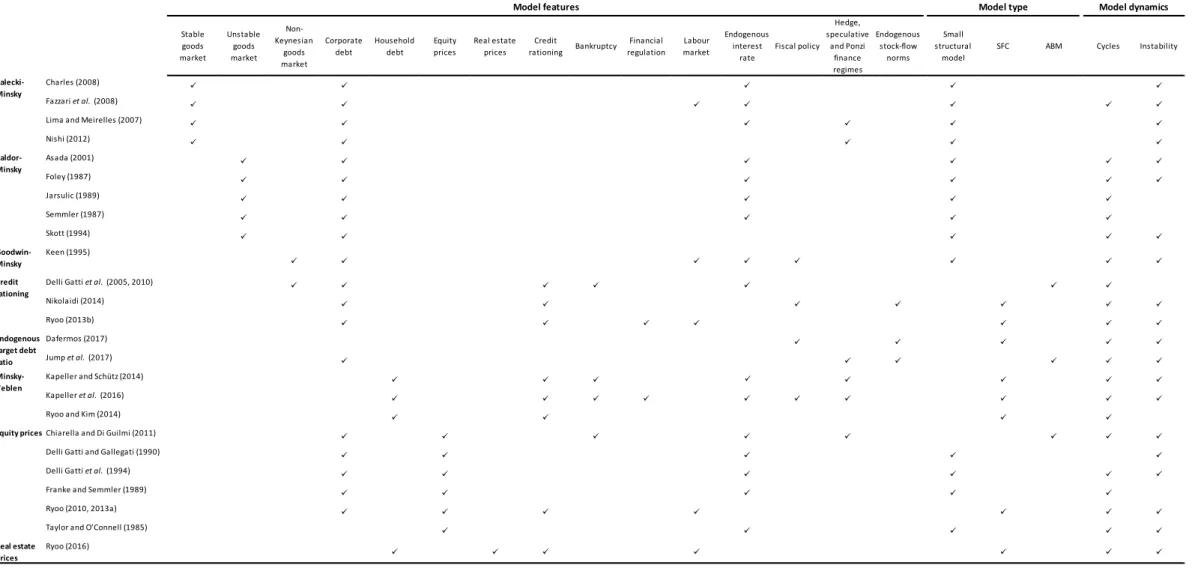
Table 1 gives an overview of the various features of the papers covered in this survey. These features include (i) the overshooting or not of the goods market with respect to demand shocks, (ii) the existence of a Keynesian or a non-Keynesian goods market, (iii) the incorporation of household de bt or corporate debt, (iv) the inclusion or not of equity or real estate prices, (v) the explicit incorporation or not of credit rationing, (vi) the examination or not of the labour market, (vii) the inclusion of an endogenous or exogenous interest rate and (viii) the incorporation of e ndogenous stock-flow norms).
Table 1 shows that the models also differ in the type of analytical framework that they use and the dynamic analysis that they conduct. The early Minsky models were primarily small structural model s with 2 or 3 dynamic variables, such as the leverage of firms, the investment rate and the interest rate. The most recent models tend to be stock-flow consistent (SFC) with more complex and explici t financial structures. There are also some attempts to develop Minskyan agent-based models (ABM). These models analyse financial fragility via the interaction between individual firms and banks, placing emphasis on network effects, or allow heterogenous firms to have different strategies or balance sheet structures. While some models concentrate more on the conditions under which local instability can arise, other models pay their attention to the emergence of cycles which in many cases arise when the equilibrium points are locally unstable but global stability exists becau se of bounded functions.
5 3. Debt or interest dynamics
3.1 Kalecki-Minsky models
In the Kalecki-Minsky models the investment decisions of firms are captured by a Kaleckian investment function in which the rate of profit plays a key role. If the retained profits are not sufficient to cover the investment expenditures, firms demand bank loans which are always supplied (i.e. there is no explicit credit rationing). The debt ratio has negative effects on investment because it increases the interest payments of firms. Output is demand-determined and the marginal propensity to save is higher than the marginal propensity to invest, ensuring goods market equilibrium. Typically, there are two types of households: rentiers who save a proportion of their income and workers who consume all their income. There is no equity market and therefore asset prices are assumed away.
Lima and Meirelles (2007), Charles (2008), Fazzari et al. (2008) and Nishi (2012) have developed the most prominent recent Kalecki-Minsky models. These models draw to a great extent on the mode l s developed by Jarsulic (1990), Dutt (1995) and Lavoie (1995) which were the first models that incorporated debt and finance into the Kaleckian framework. In our review we focus on the most recent models that pay more explicit attention to Minskyan dynamics. It is important to note that, with the exception of Fazzari et al. (2008), these models do not analyse cycles: they only focus on the conditions under which stability or instability arises. In addition, in many of these models the categorisation into hedge, speculative and Ponzi units is used and it is shown that instability is mostly associated with the speculative and Ponzi finance structures. Lastly, all the Kalecki-Minsky models are small structural models.
Our analysis will start with the models that consider that the interest rate changes in an endogenous way either because of commercial bank decisions (Lima and Meirelles, 2007; Charles, 2008), or because of changes in inflation that are passed on to the nominal interest rate (Fazzari et al. 2008) . Then we will analyse Nishi’s (2012) model where the interest rate is considered exogenous.
Charles (2008) develops a Minsky model that is composed of firms, households and banks. Firms produce a single good that is used for consumption and investment purposes. Investment is financed via bank loans and retained profits. Equities are assumed away. There are two types of house holds: rentiers who save a proportion of their income and wealth and workers who consume all their income. Banks provide loans to firms on demand. Output is demand-determined. Commercial banks change the interest rates according to the indebtedness of firms.
Firms’ desired investment rate (gd) depends on animal spirits (), the gross rate of profi t (r) and
the interest payments on accumulated debt. In particular, we have:
r id
gd (1)
where i is the interest rate and d is the ratio of firms’ debt (D) to capital (K). is a positive parameter that captures the sensitivity of the investment rate to the net profit rate (which i s e qual to the gross rate of profit minus the interest payments to capital ratio) .
The net borrowing of firms (D ) is derived from firms’ budget constraint. Thus, it is equal to
6
R iD
s I
D f (2)
where sf is the retention rate and R are the gross profits. Dividing through by capital stock, we
get:
r id
s g K D f (3) where g is the effective investment rate.Rentiers receive distributed profits of firms and interest income on deposits. The total saving of the economy is equal to the saving of firms plus the saving of rentiers. Hence, the ratio of saving to capital stock (gs) is given by:
r id
s
s
r id
id
sgs f c 1 f (4)
where sc is the capitalists’ propensity to save out of their dividend income and interest on deposits.
Charles (2008) makes a distinction between the desired and the effective investment rate and assumes that the effective investment rate adjusts towards the desired one via the following formula:
g g
g d (5)
where 0 is the adjustment speed.
Differentiating the debt-to-capital ratio, we get the law of motion of d :
gd K D
d (6)
The interest rate is an increasing function of debt-to-capital ratio: d
i
i (7)
where i and are positive parameters. The assumption is that a higher debt-to-capital ratio increases perceived risk, inducing banks to increase the interest rate in order to compensate for thi s risk.
An increase in the debt-to-capital ratio has both positive and negative effects on effective investment rate. On the one hand, a higher debt-to-capital ratio tends to increase consumption (and thus capacity utilisation and profit rate) since the rise in the interest payments overcompensates the decline in distributed profits, leading to higher rentier consumption. On the other hand, a higher debt-to-capital ratio tends to reduce the profit rate since firms have to pay higher interest. In Charles (2008) the adverse effects on investment overcompensate the positive ones and thus investment is debt-burdened.
The 2D system of the model consists of the debt-to-capital ratio and the investment rate. Combining the debt-to-capital ratio with equation (7) we get an isocline that is quadratic in d. In a gd
7
diagram the isocline is U-shaped. Hence, we get two equilibrium points. The first equilibrium point is stable and is characterised by high investment rate and low debt-to-capital ratio. The second equilibrium point is a saddle point and exhibits a low investment rate and a high debt-to-capital ratio. Charles (2008) tries to connect the equilibrium points with the finance regimes of Minsky: the stable point resembles a hedge finance structure while the saddle point is closer to the spe cul ati ve or Ponzi finance structure.
Lima and Meirelles (2007) construct a macrodynamic model which is similar to the model of Charl e s (2008).There are two crucial differences. The first difference is that the authors formalise the hedge, speculative and Ponzi regime and use it in their dynamic analysis.4 The second difference is that the
authors assume an endogenous interest rate that depends on economic activity and not on the leverage ratio. 5 In particular, in their model the law of motion of the interest rate is a function of the
banking mark-up, which in turn depends on economic activity. The change in the interest is given by:
u u
i
i (8)
where i is the base interest rate set by the central bank, is the responsiveness of the banking mark-up to capacity utilisation, u is the capacity utilisation and u is a threshold value for the
capacity utilisation. Lima and Meirelles (2007) consider both the case in which interest rate is pro-cyclical ( 0) and the case in which it is counter-cyclical (0). The commercial banks change the interest rate if economic activity is higher (lower) than the threshold value.
The 2D system of the model consists of the debt-to-capital ratio and the interest rate captured by equations (6) and (8). The authors identify the hedge, speculative and Ponzi finance regime are as i n the ig diagram. The system has one equilibrium point and its stability properties de pe nd on the
finance regime in which it is located. If it is located in the hedge finance area, the equilibrium point is stable when the banking mark-up is pro-cyclical and the growth rate is higher than the interest rate . When the banking mark-up is counter-cyclical, the equilibrium is unstable irrespective of the othe r conditions. If the equilibrium point is located in the speculative finance area, it is unstable when the propensity to save of capitalists is sufficiently low. When this propensity is high enough, stability wil l arise only if banking mark-up is pro-cyclical and the growth rate is higher than the interest rate. Finally, within a Ponzi regime the equilibrium point is always unstable.
Fazzari et al. (2008) present a richer model that combines an investment function, which incorporates debt payments effects and an accelerator effect, with a non-linear Phillips curve . One key difference of their model with the other Kalecki-Minsky models is that the nominal interest rate increases when inflation goes up (the implicit assumption seems to be that the central bank has a
4 The distinction between hedge and speculative units relies on the comparison between the gross profits and
the sum of investment expenditures and interest payments. When the former is higher than the latter, we have a hedge regime while, when the opposite holds , we have a speculative regime. In the extreme case where the gross profits are lower than the interest payments , we have a Ponzi regime.
5 There are some additional minor differences. In Lima and Meirelles’ set up the desired investment rate of
firms depends on the interest rate and not on the interest payments on debt, a separate sensitivity to gross profits and interest rate is assumed, rentiers’ propensities to save out of interest and dividends are different
and investment is debt-led (although in the dynamic analysis the investment rate is allowed to be debt-neutr a l by equalising the propensities to save out of interest and dividends).
8
real interest target which is fixed). Since inflation is a negative function of unemployment rate, it turns out that the nominal interest rate depends positively on economic activity.
Investment depends on output, via an accelerator mechanism, as well as the expected real cash flow of firms. It is assumed that there are two types of consumers: the forward-looking and backward-looking ones. The forward-backward-looking consumers base their consumption on the expected income while the backward-looking ones consume based on the income of the previous period. Overall , an increase in economic activity increases the disposable income of households, leading to higher consumption. Firms take on debt in order to finance the difference between investment and cash flow. It is implicitly assumed that the saving rate of firms is equal to 1. The net borrowing of fi rms i s determined in a similar way as in equation (2). The authors use a sophisticated version of the Phillips curve that assumes that wage inflation depends on productivity growth and the level as we l l as the change in unemployment, allowing thereby for unemployment hysteresis. Prices are determined vi a a mark-up over the unit labour costs and thus wage inflation directly affects price inflation.
The model has a complex and non-linear dynamic structure and the authors thus resort to simulations based on empirically motivated parameters in order to investigate its prope rtie s. The y show that in their benchmark simulations the system produces cycles after a positive demand shock. Initially, investment increases and gradually the debt ratio starts becoming higher. Simultaneousl y, higher economic activity leads to lower unemployment. This causes a rise in inflation (via the Phillips curve) which in turn leads to a rise in the nominal interest rate. The resulting increase in the debt service is the reason why the boom terminates at some point in time. The decline in economic activity ultimately leads to a reduction in the interest rate that makes the debt service lower, allowing the economy to recover. Fazzari et al. (2008) point out that, although the produce d cycl e s eventually die out, they persist for a long period of time. They also illustrate that the responsiveness of the investment rate to the cash flow is one of the key parameters that affect the dynamic properties of their model. When this responsiveness increases, the amplitude of the cycles becomes higher; also, when the responsiveness becomes sufficiently high, the system produce s asymptotic instability.
We now turn to the model of Nishi (2012) who assumes that the interest rate is exogenous. The structure of his model is very similar to the structure of Charles’ (2008) model. A key difference is that in Nishi’s investment function the desired investment rate depends on the gross rate of profi t and the interest payments separately, making it possible to get either a debt-burdened or a debt-led investment regime.
Nishi (2012) uses his model to examine how the various Minskyan finance regimes (hedge, speculative and Ponzi) can arise under different investment regimes.6 His discussion has a more
long-term focus and effectively uses the finance regimes to discuss different levels of the (fixed) interest rate. He shows that when the interest rate is low we may have a hedge and speculative regime. When these non-Ponzi regimes are combined with a debt-burdened growth regime the equilibrium point is stable. However, if the non-Ponzi regimes are combined with a debt-led growth
6Nishi’s (2012) distinction between hedge and speculative regimes relies on the comparison of gross profits
with net borrowing and interest payments. This allows hedge units to borrow, which is not the case in Lima and Meirelles (2007) where hedge units do not borrow. The Ponzi regime is defined a s in Lima and Meirelles (2007).
9
regime, we may have an unstable equilibrium point. When the interest rate is sufficiently high the re is the possibility of a Ponzi regime. If the Ponzi regime is combined with a debt-l ed growth re gi me we always have instability.
It is worth pointing out here that in the Kalecki-Minsky models presented above the l e verage rati o turns out to be pro-cyclical in most cases. However, Lavoie and Seccareccia (2001) have argue d that the Kaleckian framework does not in general generate a pro-cyclical leverage ratio, because investment creates profits. Thus while in the boom individual firms might want to take on more debt, the boom conditions make profits high and firms can finance investment internally. This is also referred to as the paradox of debt.7 Charles (2016) has shown that in a Kalecki-Minsky model the
counter-cyclicality of the leverage ratio is less likely when the retention rate of fi rms i s l ow. A l ow retention rate reduces the ability of firms to finance investment internally during economic expansion.
To sum up, in the Kalecki-Minsky models debt is accumulated as firms demand bank l oans i n orde r to finance their desired investment expenditures. In most of these models the accumulation of de bt has negative feedback effects on investment either directly (debt-burdened regime) or be cause of the fact that a higher debt ratio increases the interest rate (Charles, 2008). In some Kaleckin-Mi nsky models the interest rate can also increase when there is higher economic activity that induces commercial banks to increase their banking mark-up (Lima and Meirelles, 2007) or when central banks increase the base interest rate due to higher inflation (Fazzari et al., 2008).
3.2 Kaldor-Minsky models
In Kaldor-Minsky models firms’ investment expenditures are positively affected by economic activity (either through the rate of profit or through the capacity utilisation) and are negatively or positi ve ly affected by the accumulation of debt. Similar to the Kalecki-Minsky models output is demand determined, loans are provided on demand (i.e. there is no explicit credit rationing) and the re i s no equity market. The hall mark of the Kaldor-Minsky model is that investment is overshooting. In contrast to the Kalecki-Minsky models, there is an unstable goods market: the marginal prope nsi ty to save is lower than the marginal propensity to invest (close to the equilibrium). This is a characteristic of the Kaldor models (see e.g. Chiarella et al., 2000) that draw on Kaldor’s (1940) trade cycle model in which the marginal propensity to save is lower than the marginal propensity to invest at intermediate levels of output.
Asada (2001) develops a highly stylised Kaldor-Minsky model where Minsky cycles can be produce d. The author gives more emphasis to the assumptions that are needed to produce cycles while less attention is paid to the economic intuition of the macroeconomic model. The structure of Asada’s model is similar to the structure of Kalecki-Minsky models. His investment function can be written as follows:
f
d rd i s
g , ,, (9)
7 Lavoie (2014, p. 448) argues that when debt-led demand is combined with a counter-cyclical debt ratio,
10
where r r0, d d0, i i0 and sf sf 0.
The saving rate is given by:
r id
s
s
r id
id d
sgs f c 1 f (10)
This saving function is similar to the saving function of Charles (2008). The main difference is that Asada includes a positive impact of a safe asset on saving. This safe asset is assumed to be a l i ne ar function of the debt-to-capital ratio, i.e. it is equal to d. Therefore, equation (10) i mpl i es that an
increase in the debt-to-capital ratio has both positive and negative effects on the saving rate. A higher reinforces the positive effect of the debt ratio on the saving rate.
The interest rate is a positive function of the debt-to-capital ratio as in Charles (2008). The output-to-capital ratio increases when the sum of consumption-output-to-capital ratio and desired investment rate is higher than the current output-to-capital ratio:
c g y
y d (11)
where yY K is the output-to-capital ratio, cC K is the consumption-to-capital rati o and i s a positive adjustment parameter.
The debt-to-capital ratio and the output-to-capital ratio constitute the 2D system of the model, captured by equations (6) and (11) respectively. Asada (2001) assumes, without much explanation, that the goods market is de-stabilising, the output is debt-burdened, the leverage ratio is pro-cyclical and the debt ratio is self-stabilising.
Asada uses the Hopf bifurcation theorem in order to show the conditions under which a l i mi t cycl e arises. How does the cycle behave in this model? Suppose that the economy is initially characterised by a low output-to-capital ratio and a low debt-to-capital ratio. Since the debt-to-capital ratio is sufficiently low, the investment rate gradually becomes higher. When investment and output have become sufficiently high, the debt-to-capital ratio starts increasing. At some point, thi s i ncreasi ng debt-to-capital ratio causes a decline in the investment rate and thus in output-to-capital ratio. Once the investment rate has become sufficiently low, the debt-to-capital ratio decreases and the economy enters into a new expansionary period.
Semmler (1987) has developed another model with Kaldor-Minsky features. He introduces financial variables into a profit-investment dynamic system where the saving function is S-shaped as in Kaldor. The system without the financial variables produces a limit cycle. In the system with the financial variables the interest rate and the debt payment commitments have a negative i mpact on investment (i.e. investment is debt-burdened) and the debt-to-capital ratio rises during the expansions (i.e. leverage is pro-cyclical). The introduction of the financial variabl es can re duce the amplitude of the limit cycle (i.e. expansions become shorter and contractions become less severe) or can increase the possibility of instability.
Two other Kaldor-Minsky models are those developed by Foley (1987) and Jarsulic (1989) in which the interest rate plays a key role in the emergence of the cycles. In Foley’s model a decline in the interest rate increases borrowing which in turn increases investment and profitability. However, higher demand for credit produces a rise in the interest rate (via a loanable funds market) which has
11
a negative impact on borrowing. Foley (1987) uses the Hopf bifurcation theorem in order to show the emergence of cycles. Jarsulic’s (1989) model generates some similar dynamics. He postulates an investment function where the investment rate depends negatively on the interest rate and he al so assumes that a higher investment rate increases the interest rate. His investment function is non-linear: he assumes that the investment rate starts declining when it is already high. As a re sul t, hi s 2D dynamic system is bounded which allows him to use the Poincaré-Bendixson theorem to show the emergence of a limit cycle.
Skott (1994) develops a Kaldorian model in which some abstract financial variables are introduced in the investment function. In particular, he uses a financial fragility variable (F) and a tranquillity variable (T). The financial fragility variable captures the sensitivity of the financial system to smal l disturbances that might affect the ability of economic units to fulfil their financial obl igations. As a proxy of financial fragility, Skott (1994) uses the ratio of interest payments to the normal rate of profit (Fid r). As he points out, “Fragility and tranquillity evolve endogenously and, in accordance
with Minsky’s behavioural assumptions, it is assumed that changes in fragility depend on the degre e of tranquillity: in the absence of financial difficulties agents adopt schemes of increasing opti mism” (Skott, 1994, p. 53). Therefore, the change in the financial fragility ratio is given by:
T
F (12)
The tranquillity variable is associated with the appearance or not of crises. When a system experiences a crisis, tranquillity is at its minimum value since default and bankruptcy rates are hi gh. Tranquillity is at its maximum value when the financial system functions without disruptions and economic activity is high. As Skott (1994, p. 53) explains, “financial difficulties develop as a re sul t of an incongruence between the optimism which motivated financial arrangements and the actual outcome. If the source of potential instability is located primarily in the business sector (…) the n T should depend on financial fragility (inversely) and on realized profit rates (positivel y)”. He nce , he assumes that T is a negative function of F and a positive function of output-to-capital ratio:
BF Ay
T (13)
The investment function is written as:
y F Tgd (14)
where
y is a function where y
y y0. Similarly to the Kalecki-Minsky models, anincrease in economic activity increases investment.However, following Kaldor, it is assumed that investment is an S-shaped function, which implies that the investment rate is bounded (it stops increasing as output-to-capital ratio becomes too high). In addition, investment is positively or negatively affected by financial fragility (i.e. can be positive or negative) and is positively affecte d by the tranquillity indicator ( 0). Since Fid r and TAuBF, equation (14) can be rewri tte n
as follows:
r id B Ay y gd (15)12
where r is the normal profit rate while A and B are positive parameters. Equation (15) implies that an increase in economic activity positively affects the investment rate while the interest payments on debt may have a positive or a negative effect on the investment rate . Saving is a function of output and output adjusts to the difference between investment and saving via an equation which is similar to equation (11) used by Asada (2001).
The fragility ratio and the output-to-capital ratio constitute the 2D system. Skott (1994) analyses the stability conditions for this 2D system by considering two cases. In the first case, the impact of financial fragility on investment is positive. It is shown that in this case the mode l can be stabl e or unstable and does not produce cycles. In the second case, the impact of financial fragility on investment is negative. This makes it possible to generate cycles which are similar to the cycles generated by the model of Asada (2001). Since Skott’s system is bounded due to the S-shaped investment function, he uses the Poincaré-Bendixson theorem to illustrate the conditions under which a limit cycle emerges. According to this theorem, a 2D system that is locally unstable, bounded and has a unique stationary point produces a limit cycle.
To summarise, most Kaldor-Minsky models have a similar structure with the Kalecki-Minsky models. However, in the Kaldor-Minsky models the main source of instability is the accelerator me chanism that is included in the investment function and renders the goods market unstable. Compared to the Kalecki-Minsky models, the analysis of the Kaldor-Minsky models pays more attention to the conditions under which cycles emerge. In some Kaldor-Minsky models the interest rate is exogenous (e.g. Skott, 1994), while in other models the endogenous change in the interest rate is a ke y part of the cyclical behaviour (e.g. Foley, 1987 and Jarsulic, 1989).
3.3 Goodwin-Minsky models
Keen (1995) develops a Goodwin model with some Minskyan features that operate through the wage share equation: a higher debt ratio dampens investment and employment, which affe cts the wage share, which in turn affects the debt ratio. The use of the Goodwin framework implies that these models treat the labour market explicitly. This is a distinct feature compare d to most other Minsky models in which labour market dynamics are absent.
Keen (1995) assumes full capital utilisation and, as a result, output is determined by capital stock, which is driven by the past investment decisions of capitalists. This comes in contrast to the Kale cki -Minsky and Kaldor--Minsky models where output is demand-determined. Keen (1995) e xte nds the Goodwin model to include banks, whose rising income share can squeeze industrial profits similar to how a rising wage share squeezes profits. Unlike the Goodwin model, where all profits are reinvested, Keen (1995) uses a non-linear (convex) investment function, which creates a pro-cycli cal debt ratio. The interest rate is a positive function of the debt ratio. The theoretical proble m of thi s model is that it does not offer a mechanism that equilibrates investment and saving.8
8The Keynesian mechanism of equilibrating investment and saving is blocked because Say’s law is assumed to
hold; the classical mechanism is blocked because the interest rate does not clear the market for loanable funds but is determined by the leverage ratio.
13
The gross investment rate (i.e. net investment rate plus depreciation rate) depends on the net profi t rate of firms:
r id
g (16)
where is a convex function of the net profit rate. We have that rid v where v is the
capital-output ratio, 1b is the profit share, is the wage share and biDY is the bankers’
income share. This means that the gross investment rate ends up being a positive function of the profit share. The convexity of the investment function implies that the profit share has a gradual l y higher effect on the investment rate. In particular, for relatively low values of the profit share, investment is equal to profits but for relatively high values of the profit share investment be comes higher than profits, which means that the accumulation of debt accelerates.
As in Goodwin’s model, the wage share changes in an endogenous way. Since w x, the change
in the wage share is:
l (17)
where is a non-linear positive function of the employment rate (l), is the growth rate of
labour productivity, w is the wage rate and x is the labour productivity. When the employment rate becomes higher, the wage share increases.
Since the employment rate is lY xN, the law of motion of l is:
g
ll (18)
where is the growth rate of labour force and N is the labour force.
The net borrowing of firms depends on the difference between the investment rate and net profi ts. Keen (1995) normalises debt by dividing it by output and assumes that firm retain all their profits. In similar lines with Charles (2008), the interest rate is an increasing function of the indebtedness of firms (Keen uses the debt-to-output ratio instead of the debt-to-capital ratio).
The 3D system consists of the wage share and the employment, as in the Goodwin model, as well as the debt-to-capital ratio. Keen (1995) does not offer an analytical solution of the model, but move s swiftly to simulation.9 Thus the paper is more effective in illustrating the instabilities that can ari se
rather than clarifying the properties of the model. In his simulations Keen (1995) shows that both stability and instability can arise in his dynamic system. Instability arises when the base interest rate is high and/or when the interest rate is low and the sensitivity of the interest rate to the debt-to-capital is high. The system breaks down because the rate of profit becomes negative primarily because of increasing firms’ interest payments. Keen shows that a break down i s pre ve nte d whe n counter-cyclical fiscal policy is introduced. However, in his simulations fiscal policy does not eliminate cycles. Keen (2013) extends the model described above by including an e xpl ici t banki ng sector, endogenous money creation and a more explicit financial structure based on the SFC approach.
14
Sordi and Vercelli (2014) argue that Keen (1995) does not take into account that the goods market may be in a disequilibrium and they use an output adjustment mechanism. They propose a model based on Goodwin (1951) flexible accelerator. Therefore, in contrast to Keen (1995), output is demand determined and investment is demand driven (without direct effect of profitability or debt). In our classification it is thus closer to the Kaldor-Minsky model. They derive a 4D system with the wage share, the employment rate, the debt-to-capital ratio and the capital-to-output rati o as state variables and use the Hopf-bifurcation theorem to prove the possibility of cycles. Instability i n the i r model is more likely when investment responds strongly to expected output.
Stockhammer and Michell (2017) demonstrate that pseudo-Goodwin cycles can arise from a Mi nsky model that is paired with a reserve-army distribution function. Unlike the Goodwin-Minsky model, in their model output is demand determined and demand is debt-burdened and wage-led. The cycl e s are Minskyan debt cycles and income distribution fluctuates as it is dragged along by the business cycles. The economy thus exhibits pseudo-Goodwin cycles.
3.4 Credit rationing Minsky models
A key feature of the Minskyan models presented above is that banks play a relative ly p assi ve rol e . Although in some of these models banks increase the interest rate when the debt ratio of firms increases (e.g. Charles, 2008) or banks are in some cases implicitly considered to co-de te rmi ne the accumulation of debt, there is no explicit credit rationing based on the financial posi tion of banks. This is at odds with Minsky who has argued that banks are active players in the emergence of financial fragility and credit expansion relies on their financial structure (e.g. Minsky, 2008 [1986], p. 265). The models of Ryoo (2013b), Nikolaidi (2014) and Delli Gatti et al. (2005, 2010) belong to the credit rationing Minsky models.10
Ryoo (2013b) develops an SFC model that consists of firms, households and banks. Firms take on debt and issue equities in order to externally finance their investment. Equity is the residual source of finance11 and the equity-to-deposits ratio in the household portfolio choice is assumed to be
constant. This implies that the price of equities needs to adjust in order to keep the rati o constant. Banks provide loans taking into account the profit-to-interest payment ratio and the profitabi l ity of banks. The bank capital ratio positively depends on the profitability of firms.
Ryoo (2013b) distinguishes between short cycles and long waves. Based on Skott (1989), the short cycles result from the interaction between destabilising goods market dynamics à la Kaldor and stabilising labour market dynamics. Investment depends on capacity utilisation and there is an explicit function for economic growth whereby growth is affected positively by the profit share and negatively by the employment rate. The profit share is increasing in capacity utilisation. As capaci ty utilisation increases growth rate responds strongly. The increase in growth rate increases
10 The impact of banks’ financial position on credit rationing is taken into account in the recent model of
Kapeller et al. (2016). However, their model analyses household debt while our credit rationing Minsky models refer exclusively to corporate debt.
11 Ryoo (2010) supports this assumption by presenting some evidence that the ratio of issues of equity to
investment is very volatile and argues that this volatility is better captured when equity emission is modelled as a buffer.
15
employment. When employment becomes sufficiently high it exerts a negative impact on economi c growth, allowing the emergence of cycles.
The long wave of the model is captured by a 2D system which has the leverage ratios of firms and banks as state variables. It is shown that instability is more likely as the responsiveness of credit availability to bank profits increases. Using the Poincaré-Bendixson theorem, it is shown that cycl e s arise when the system becomes locally unstable. The rationale of the cycle is as foll ows. Whe n the leverage ratio of firms and banks is low, the debt-to-capital ratio starts increasing because firms are considered to be creditworthy and, hence, more loans are provided by banks. As loans expand, the leverage of banks, which goes hand in hand with bank profitability, goes up. This enhances credit supply. However, when the leverage of firms becomes sufficiently high, firms start being considered less creditworthy. This causes a reduction in credit supply, which in turn leads to a decline in bank leverage and bank profitability which reinforces the decline in credit. The reduction in credit leads to a lower firm leverage. When the leverage ratios of both firms and banks have be come suffi ci ently low, credit starts increasing again and a new cycle begins.
Ryoo (2013b) suggests that instability in his model can be reduced if a financial regulation rule is adopted according to which banks adjust their retention rate in order to achieve a specific l e ve rage ratio. This rule relies on Minsky’s writings about the ways through which banking instabili ty can be reduced (see Minsky, 2008 [1986], ch. 13).
Nikolaidi (2014) develops an SFC model with firms, households, banks, government and a central bank. Both firms and banks have a target leverage ratio which captures their desired margins of safety that are deemed to change in an endogenous way: when economic activity is high (l ow), the target leverage ratios increase (decrease). The target leverage ratio of firms affects their desired investment. The higher the target leverage ratio of firms compared to the actual ratio, the higher their investment, ceteris paribus. Banks provide only a proportion of the loans demanded. The y are more willing to reduce credit rationing when their leverage ratio is lower than the target one . Fi rms take on debt to finance their desired investment which is negatively affected by the leverage ratio of firms. Since there is credit rationing the effective investment is lower than the desired i nve stment. Banks’ credit rationing is affected by their leverage ratio and the leverage ratio of firms.12 Therefore,
in boom periods both the desired investment and the provision of loans become graduall y hi ghe r, which might lead to instability. The opposite holds in bust periods. Instability is more likely when the target leverage ratios respond strongly to changes in economic activity.
The model can produce cycles (this is shown using the Hopf-bifurcation theorem). The cycles can be described as follows. When investment activity is sufficiently high, the target leverage ratios of both firms and banks increase, leading to higher desired investment and lower credit ratio ning. This increases debt accumulation and the actual leverage ratios. However, once the leverage ratios have become sufficiently high, both firms and banks become less willing to participate in new debt contracts and economic activity starts slowing down. The decline in economic activity makes the leverage ratios lower and, at the same time, reduces the target leverage ratios of firms and banks reinforcing the contractionary forces. A new boom starts when the leverage ratios have declined
12 The formulation of credit rationing draws on the SFC model of Le Heron and Mouakil (2008) who, in line with
16
sufficiently. Nikolaidi (2014) also examines the role of fiscal policy. It is shown that counte r -cycl i cal fiscal policy can reduce the instability that stems from the behaviours of firms and banks.
While most of the literature on Minsky uses small or large scale macro models, there is also a fami l y that emphasises heterogeneity among firms and uses agent-based modelling techniques. Delli Gatti et al. (2005, 2010) have developed such models with heterogeneous firms and/or heterogeneous banks. Theoretically these models draw on the financial accelerator argument that the availability of credit for firms depends on their net worth (Bernanke and Gertler, 1990; Greenwald and Stiglitz, 1993). However, in line with the credit rationing models discussed above, the credit condi ti ons are also affected by the net worth of banks. In particular, the interest rate depends on the financial position of both firms and banks. Bankruptcy is explicitly introduced (which is an innovation compared to most Minsky models). When a firm goes bankrupt, this affects adversely the net worth of banks, leading to a higher interest rate. This in turn reduces the net worth of firms. Following stylised facts, firm size obeys a power law. This highly skewed distribution implies that id iosyncrati c shocks can turn into macro shocks (if they affect one of the few very large firms). This is compounded by network effects that can cause bankruptcy cascades. It is worth mentioning that there is no aggregate demand function comparable to those of most previously discussed mode ls, but output is determined by the optimising behaviour of credit and net worth constrained firms. Unlike many of the models discussed in this survey the main aim is not to analyse endogenous cycles but the conditions under which random shocks can turn into systemic crises. In some ways the models are closer to the New Keynesian financial accelerator approach, but they also highlight Minskyan features.
To sum up, in credit rationing Minsky models cycles and instability are affected by the behaviour and the financial position of banks. In some models the interest rate is exogenous and banks affe ct the volume of credit directly (Ryoo, 2013b; Nikolaidi, 2014) while in other models the intere st rate i s a function of the financial position of firms and banks (Delli Gatti et al., 2005, 2010). Banks contri bute to the increase in financial fragility during the boom periods by increasing credit availabili ty and/or providing credit at favourable terms. They can reinforce the destabilising forces in the bust pe ri od since their financial soundness is affected by macroeconomic performance and this has feedback effects on credit conditions.
3.5 Endogenous target debt ratio models
In the endogenous target debt ratio models, firms, banks or the private sector in general have targets about their leverage ratios. These targets are also called stock-flow norms (based on Godley) or desired margins of safety (based on Minsky). The target debt ratios tend to increase when economic and financial performance is good and they tend to decline when economic and fi nanci al environment is perceived to be unfavourable and unstable. Higher target debt ratios increase desired investment or desired consumption and tend to reduce credit rationing. In the endoge nous target debt ratio models output is demand determined, the interest rate is exogenous and the re i s no consideration of the labour market.
The model of Nikolaidi (2014), described in the previous section, was the first model that used explicitly an endogenous target debt ratio. Dafermos (2017) incorporated this idea of an endogenous
17
target debt ratio into a Godleyan analytical framework. Following Godley’s projection anal ysis (e .g. Godley, 1999), his model consists of three sectors: the private se ctor (which is consolidated), the government sector and the foreign sector. The balances and the debt of these sectors are expl i ci tly interrelated via Godley’s financial balances approach. The private sector has a stock-flow norm (the target net debt-to-income ratio) which is allowed to change endogenously based on the Mi nskyan idea that the perception of risk and, hence, the desired margins of safety change during the economic cycle.
In his dynamic analysis he first analyses a system with the propensity to spend of the private se ctor and the private debt-to-income ratio as state variables. In this system the propensity to spend of the private sector increases (decreases) when the target debt-to-income ratio is higher (lower) than the actual one. Using the Poincaré-Bendixson theorem, Dafermos (2017) shows that this system can produce cycles. Instability and cycles are more likely when the responsiveness of the prope nsi ty to spend to the target debt ratio is high. He also shows that when the target debt ratio is endoge ni sed via a Minsky mechanism, an otherwise stable system can become unstable.
This model is also used to examine the implications of two fiscal rules: (i) a Maastricht-type fiscal rule in which government expenditures decline (increases) when gove rnment indebtedne ss i s hi gh (low) and (ii) a Godley-Minsky fiscal rule that is close to the idea of counter-cyclical fiscal policy. The simulation analysis in the paper shows that the Maastricht type fiscal rule is conducive to instabi l i ty while the Godley-Minsky fiscal rule tends to stabilise the macroeconomy.
Jump et al. (2017) develop a model with heterogeneous firms in which the aggregate target debt ratio is determined by firms’ decisions via a switching mechanism. Firms choose be tween a he dge strategy with a low target debt ratio or a speculative strategy with a high target. The probability that firms select the speculative strategy increases as the interest payments relative to profits decre ases and the volatility of output goes down. This implies that good and stable economic and financial performance induces more firms to select the speculative strategy, resulting in a hi ghe r aggre gate target debt ratio. In the model, a higher target debt ratio affects investment positively (but actual debt negatively). The 3D system of the model consists of output, debt and the proportion of the firms that choose the hedge strategy. This system can produce limit cycles: in a stable growth period firms switch to higher debt targets. The initial equilibrium becomes unstable and l e ads to a boom. Once volatility increases firms switch back to a hedge strategy. The mode l can also give rise to chaotic dynamics if firms are allowed to accumulate financial assets.
3.6 Minsky-Veblen models
Despite the fact that household debt was not at the core of Minsky's analysis, there are some e arl y Minsky models that have formalised consumer debt using Minskyan ideas (e.g. Palley, 1994, 1997). More recently, the Veblenian analysis of emulation motives has been used in some Mi nsky mode ls to analyse the dynamics of consumer debt and the implications for financial fragility (Kapel ler and
18
Schütz, 2014; Ryoo and Kim, 2014; Kapeller et al., 2016). In these models low-income households take on debt in order to emulate the consumption of richer households.13
Ryoo and Kim (2014) develop a Kaldorian SFC model with households, firms and banks. Fi rms make investment expenditures by using equity and undistributed profits to finance their investment (the y do not take out loans). There are two types of households: workers and rentiers. Worke rs de mand consumer credit in order to increase their consumption and emulate the consumption of rentiers. Banks provide loans to workers taking into account their net income. Rentiers consume part of the i r income and wealth and do not take on debt. The 2D system of the model comprises the debt-to-capital ratio and the emulation motive. With this system cycles may emerge (the authors use the Poincaré-Bendixson theorem to show that). When the indebtedness of workers is suffi cie ntl y l ow, workers are more willing to take on debt in order to emulate the rentiers and, simultaneously, banks are more willing to provide these loans. This increases the debt-to-capital ratio which has fe e dback effects into the emulation: workers have to pay a higher interest that reduces their income and increases the income of rentiers. This reinforces the consumption differential between workers and rentiers producing a further rise in the debt-to-capital ratio. Once the debt ratio has reached a sufficiently high level, workers become less willing to take on more debt and banks become less accommodative. Note that instability and cycles are more likely when banks’ decision to provide loans is more accommodating and workers’ decision to emulate the rentiers is sufficiently strong. Kapeller and Schütz (2014) develop a large scale SFC model that consists of firms, households and banks. There are three main differences between the model of Kapeller and Schütz (2014) and Ryoo and Kim (2014). First, Kapeller and Schütz (2014) incorporate three types of households instead of two: (i) type 1 worker households whose income share is constant; (ii) type 2 worker households whose income share is declining; (iii) rentiers. Emulation refers only to the intra-worker consumption: it is assumed that type 2 workers try to emulate the consumption of type 1 workers and the consumption of rentiers does not affect the consumption of workers. Second, in similar lines with Charles (2008), Kapeller and Schütz (2014) assume an endogenous interest rate which is a positive function of debt. Third, bankruptcy is introduced. Workers become bankrupt when they cannot cover their subsistence-level consumption. When this happens, banks’ expectations are adversely affected and credit supply goes down.
In their simulations, Kapeller and Schütz (2014) produce cycles. Initially, the decline in the income of type 2 worker households relative to the income of type 1 worker household s leads to an increase in their indebtedness which also leads to an increase in the interest rate. However, at some point in time the rise in indebtedness causes bankruptcies that stop credit expansion leading to a de cl i ne i n economic activity. After some periods the economy recove rs because bankruptcies reduce the de bt of type 2 worker households, increasing their income.
Kapeller et al. (2016) extend the model developed by Kapeller and Schütz (2014) by introduci ng the role of fiscal policy and a more active banking sector. In their simulations they investigate the effects
13 Charpe et al. (2009) develop a Minskyan model with a Goodwin-type labour market in which workers take
on debt in order to increase their consumption expenditures. The model is similar to the Minsky -Veblen models in that consumption expenditures are driving the financial dynamics and household debt is key. However, loans are solely determined by the fact that workers have an exogenous marginal propensity to consume which is larger than one and there is no explicit mechanism through which they emulate the consumption norms of richer households.
19
of various government interventions (such as fiscal stimulus and bank bailouts) and financial regulation on the financial cycles. They show that the government interventions mitigate the impact of financial crises but they shorten the time between the crises since they are conduci ve to hi ghe r credit expansion. The financial crises become much less severe when a stricter financi al re gulati on (captured by a higher responsiveness of credit availability to the le verage of banks) is implemented. Overall, in the Minsky-Veblen models consumer debt is the driver of financial fragility. Credit expansion depends positively on inequality and the financial soundness of households. Financial booms come to an end when the interest payments of households have become suffici ently hi gh. The endogeneity of the interest rate is not necessary in order to get financial cycles.
4. Asset price dynamics
The models described in the previous sections do not allow a role for asset pri ce dynamics. This i s at odds with Minsky’s analysis according to which asset inflation positively affects investment and economic activity (see, for example, his ‘two price’ theory of investment). Actually, most Mi nskyan models that were developed in late 1980s and early 1990s paid particular attention to the role of asset prices. This changed after mid 1990s where most authors started developing Minskyan models using the Kaleckian framework where asset prices do not play a key role. 14 However, since 2010
there has been a resurgence of interest in Minsky models with asset prices. It is also interesting that the asset price Minsky models have traditionally confined their attention to equity prices ─ real estate prices have only very recently been combined with Minskyan dynamics.
4.1 Equity price Minsky models
The equity price Minsky models place particular attention on the equity price dynamics and their interactions with the real economy. In these models there is an equity market and househol ds take portfolio decisions that affect the demand for equity and thus the equity price , which in turn affe cts economic activity through consumption or investment. Equity market is the principal source of instability and both cycles and instability are investigated.
Taylor and O’Connell (1985) developed the first model that formalised Minsky’s arguments and put equity prices at the core of the analysis. Their model economy consists of firms, households and a government. Banks are not explicitly considered. Firms issue equity in order to finance their investment expenditures. There are two types of households: workers who consume all of their income and rentiers who invest in three different assets: equity, money and government bonds. Money is exogenous and the interest rate changes endogenously.
Firms’ desired investment rate depends on the actual rate of profit (r), a confidence vari able that captures the difference between the expected and the actual rate of profit () and the interest rate (i):
14 There are many SFC models that were developed in 2000s and analysed the interactions between asset
prices, the leverage of firms and the real economy (e.g. Lavoie and Godley, 2001 -2; van Treeck, 2009). However, most of these models do not examine explicitly Minskyan dynamics.