Notice
This document is disseminated under the sponsorship of the Department of Transportation in the interest of information exchange. The United States Government assumes no liability for its contents or use thereof.
NSN 7540-01-280-5500 Standard Form 298 (Rev. 2-89)
Prescribed by ANSI Std. 239-18
298-102
REPORT DOCUMENTATION PAGE
OMB No. 0704-0188Form ApprovedPublic reporting burden for this collection of information is estimated to average 1 hour per response, including the time for reviewing instructions, searching existing data sources, gathering and maintaining the data needed, and completing and reviewing the collection of information. Send comments regarding this burden estimate or any other aspect of this collection of information, including suggestions for reducing this burden, to Washington Headquarters Services, Directorate for Information Operations and Reports, 1215 Jefferson Davis Highway, Suite 1204, Arlington, VA 22202-4302, and to the Office of Management and Budget, Paperwork Reduction Project (0704-0188), Washington, DC 20503.
1. AGENCY USE ONLY (Leave blank) 2. REPORT DATE
September 2003
3. REPORT TYPE AND DATES COVERED Final Report October 2001-August 2003 4. TITLE AND SUBTITLE
Greenhouse Gas Reduction Through State and Local Transportation Planning 6. AUTHOR(S)
William M. Lyons, Scott Peterson, Kimberly Noerager
5. FUNDING NUMBERS
RS391/P3073
7. PERFORMING ORGANIZATION NAME(S) AND ADDRESS(ES) U.S. Department of Transportation
John A. Volpe National Transportation Systems Center 55 Broadway
Cambridge, MA 02142
8. PERFORMING ORGANIZATION REPORT NUMBER
DOT-VNTSC-RSPA-03-02
9. SPONSORING/MONITORING AGENCY NAME(S) AND ADDRESS(ES) U.S. Department of Transportation
Research and Special Programs Administration 400 7th Street, S.W.
Washington, D.C. 20590
10. SPONSORING/MONITORING AGENCY REPORT NUMBER
11. SUPPLEMENTARY NOTES
12a. DISTRIBUTION/AVAILABILITY STATEMENT
This document is available to the public through the National Technical Information Service, Springfield, Virginia 22161.
12b. DISTRIBUTION CODE
13. ABSTRACT (Maximum 200 words)
This report will improve understanding of how states and localities might contribute to greenhouse gas (GHG) emissions
reduction through transportation planning. Transportation is a major contributor to GHG emissions. State and local transportation planning affects transportation decisions, which, in turn, can influence travel patterns, land use, energy consumption, and,
ultimately, GHG emissions.
The amount of activity by states and local areas to develop GHG and climate change plans is impressive. States and local areas undertake these activities voluntarily. Typically, these areas make commitments to conduct a baseline GHG emissions analysis, set local GHG reduction targets, develop local action plans, implement emissions reduction policies, and monitor progress.
This report uses seven case studies to evaluate how states and local areas are using transportation planning to pursue goals to reduce GHG emissions. The research focuses on the broad transportation planning process, strategies and other actions selected, and GHG emission reductions accomplished or projected. This report considers both transportation planning by state Departments of Transportation, metropolitan planning organizations, city and county transportation agencies, and transportation operators, and energy, environmental, or land use planning by other state and local agencies that considers climate change and transportation policies, investments, and strategies.
15. NUMBER OF PAGES 92 14. SUBJECT TERMS
greenhouse gas, climate change action plan, GHG Plans, CO2 Plans, transportation planning
16. PRICE CODE 17. SECURITY CLASSIFICATION OF REPORT Unclassified 18. SECURITY CLASSIFICATION OF THIS PAGE Unclassified 19. SECURITY CLASSIFICATION OF ABSTRACT Unclassified 20. LIMITATION OF ABSTRACT Unlimited
METRIC/ENGLISH CONVERSION FACTORS
ENGLISH TO METRIC
METRIC TO ENGLISH
LENGTH (APPROXIMATE) LENGTH (APPROXIMATE) 1 inch (in) = 2.5 centimeters (cm) 1 millimeter (mm) = 0.04 inch (in)
1 foot (ft) = 30 centimeters (cm) 1 centimeter (cm) = 0.4 inch (in) 1 yard (yd) = 0.9 meter (m) 1 meter (m) = 3.3 feet (ft) 1 mile (mi) = 1.6 kilometers (km) 1 meter (m) = 1.1 yards (yd)
1 kilometer (km) = 0.6 mile (mi)
AREA (APPROXIMATE) AREA (APPROXIMATE)
1 square inch (sq in, in2) = 6.5 square centimeters (cm2)
1 square centimeter (cm2) = 0.16 square inch (sq in, in2)
1 square foot (sq ft, ft2) = 0.09 square meter (m2) 1 square meter (m2) = 1.2 square yards (sq yd, yd2)
1 square yard (sq yd, yd2) = 0.8 square meter (m2) 1 square kilometer (km2) = 0.4 square mile (sq mi, mi2) 1 square mile (sq mi, mi2) = 2.6 square kilometers
(km2) 10,000 square meters (m 2
) = 1 hectare (ha) = 2.5 acres
1 acre = 0.4 hectare (he) = 4,000 square meters (m2) MASS - WEIGHT (APPROXIMATE) MASS - WEIGHT (APPROXIMATE)
1 ounce (oz) = 28 grams (gm) 1 gram (gm) = 0.036 ounce (oz) 1 pound (lb) = 0.45 kilogram (kg) 1 kilogram (kg) = 2.2 pounds (lb) 1 short ton = 2,000 pounds (lb) = 0.9 tonne (t) 1 tonne (t) = = 1,000 kilograms (kg) 1.1 short tons VOLUME (APPROXIMATE) VOLUME (APPROXIMATE) 1 teaspoon (tsp) = 5 milliliters (ml) 1 milliliter (ml) = 0.03 fluid ounce (fl oz) 1 tablespoon (tbsp) = 15 milliliters (ml) 1 liter (l) = 2.1 pints (pt)
1 fluid ounce (fl oz) = 30 milliliters (ml) 1 liter (l) = 1.06 quarts (qt) 1 cup (c) = 0.24 liter (l) 1 liter (l) = 0.26 gallon (gal)
1 pint (pt) = 0.47 liter (l)
1 quart (qt) = 0.96 liter (l) 1 gallon (gal) = 3.8 liters (l)
1 cubic foot (cu ft, ft3) = 0.03 cubic meter (m3) 1 cubic meter (m3) = 36 cubic feet (cu ft, ft3) 1 cubic yard (cu yd, yd3) = 0.76 cubic meter (m3) 1 cubic meter (m3) = 1.3 cubic yards (cu yd, yd3)
TEMPERATURE (EXACT) TEMPERATURE (EXACT)
[(x-32)(5/9)] °F = y °C [(9/5) y + 32] °C = x °F
QUICK INCH - CENTIMETER LENGTH CONVERSION
1
0 2 3 4 5
Inches
Centimeters 0 1 2 3 4 5 6 7 8 9 10 11 12 13
QUICK FAHRENHEIT - CELSIUS TEMPERATURE CONVERSION
-40° -22° -4° 14° 32° 50° 68° 86° 104° 122° 140° 158° 176° 194° 212°
°F
°C -40° -30° -20° -10° 0° 10° 20° 30° 40° 50° 60° 70° 80° 90° 100°
For more exact and or other conversion factors, see NIST Miscellaneous Publication 286, Units of Weights and Measures.
iii
Acknowledgments
This report was prepared for the U.S. Department of Transportation’s (USDOT) Center for Climate Change and Environmental Forecasting (CCCEF) by the USDOT Volpe National
Transportation Systems Center (Volpe Center). The report presents the results of a study on how states and local areas use the transportation planning process to pursue goals to reduce
greenhouse gas (GHG) emissions.
The project team consisted of William M. Lyons, project manager, Scott Peterson, and Kim Noerager. Sara McKinstry and Kate Klotz assisted with editing. Diane Turchetta of the Federal Highway Administration coordinated the project for the CCCEF. The project team received helpful assistance and advice, including suggestions on candidate areas for case studies and information about state and local planning processes, from the following groups and contacts: • U.S. Environmental Protection Agency (EPA), State and Local Partners Program: Steve
Dunn, Denise Mulholland, and Andrea Denny of the State and Local Capacity Building Branch.
• International Council for Local Environmental Initiatives: Nancy Skinner, International Director; Abby Young, U.S. Director of Cities for Climate Protection; and Melissa Royael, Senior Technical Assistance Associate.
• International City/County Management Association: Jennifer Folta, Assistant Project Manager for Environmental Programs.
• Delaware: John Byrne, Director, and Leigh Glover, Center for Energy and Environmental Policy at the University of Delaware.
• King County, Washington: Ann Martin, Principal Transportation Planner. • Madison, Wisconsin: David Benzschawel, Environmental Manager.
• New England Governors’ Conference, Inc.: John Shea, Director of Energy and Environment Programs.
• New Jersey: Michael Winka, Administrator, Office of Innovative Technology and Market Development, and Athena Sarafides, New Jersey Department of Environmental Protection. • Portland, Oregon: Susan Anderson, Director, and Michael Armstrong, Policy Analyst, Office
of Sustainable Development.
• Seattle, Washington: David Allen and Jemae Hoffman, Seattle Department of Transportation Mobility Management Group, and Kim Drury, Environmental Program Manager, Office of Sustainability and Environment.
The research team also gained insights from the session on integrated transportation, energy, and climate change planning at the EPA’s Fifth State and Local Climate Change Partners’ Confer-ence, co-sponsored by the USDOT’s CCCEF, in November 2002 (http://www.epa.gov/global warming/annapolis). Local contacts were given the opportunity to review and comment on drafts of this report. However, please note that local contacts and the CCCEF are not responsible for the accuracy of the report, which is solely the responsibility of the research team.
iv
This report is available on the USDOT’s CCCEF web site at http://www.dot.gov/climate. A hard copy can be obtained by e-mail ([email protected]) or by fax ((617) 494-3260).
v
Table of Contents
Section Page
I. INTRODUCTION ... 1
1. SELECTION OF CASE STUDIES ... 3
2. METHODOLOGY AND APPROACH TO THE TRANSPORTATION PLANNING PROCESS ... 3
II. CASE STUDIES... 9
1. NEW ENGLAND GOVERNORS AND EASTERN CANADIAN PREMIERS ... 9
1.1 Introduction... 9
1.2 Approach... 9
1.2.1 Who Is Involved and Why ... 10
1.2.2 Climate Change Action Plan... 10
1.3 Links to the Energy and Transportation Planning Process ... 13
1.3.1 Energy Planning... 13 1.3.2 Transportation Planning... 16 1.4 Lessons Learned... 18 2. NEW JERSEY ... 19 2.1 Introduction... 19 2.2 Approach... 20
2.2.1 Who Is Involved and Why ... 22
2.2.2 The Climate Protection Plan ... 23
2.3 Links to the Planning Process ... 24
2.3.1 Energy Planning... 25
2.3.2 Transportation Planning... 26
2.4 Results to Date ... 27
2.5 How the Process Has Evolved ... 28
2.6 Lessons Learned... 29
3. DELAWARE ... 30
3.1 Introduction... 30
3.2 Approach... 31
3.2.1 Who Is Involved and Why ... 31
3.2.2 Climate Change Action Plan... 33
3.3 Links to the Planning Process ... 34
3.3.1 Energy Planning... 34
3.3.2 Transportation Planning... 35
3.4 Results to Date ... 36
3.5 How the Process Has Evolved ... 37
3.6 Lessons Learned... 37
4. PORTLAND AND MULTNOMAH COUNTY, OREGON... 38
4.1 Introduction... 38
vi
Table of Contents (cont.)
Section Page
4.2.1 Who Is Involved and Why ... 39
4.2.2 Climate Change Action Plan... 40
4.3. Links to the Planning Process ... 43
4.3.1 Energy Planning... 46
4.3.2 Transportation Planning... 46
4.4 Results to Date ... 47
4.5 How the Process Has Evolved ... 47
4.6 Lessons Learned... 47
5. SEATTLE AND KING COUNTY, WASHINGTON... 49
5.1 Introduction... 49
5.2 Seattle’s Approach ... 50
5.3 King County’s Approach ... 51
5.4 Who is Involved and Why ... 52
5.5 Links to the Planning Process ... 52
5.5.1 Energy Planning... 54
5.5.2 Transportation Planning... 54
5.6 Results to Date ... 56
5.7 How the Process Has Evolved ... 57
5.8 Lessons Learned... 57
6. MADISON, WISCONSIN... 59
6.1 Introduction... 59
6.2 Approach... 60
6.2.1 Who Is Involved and Why ... 60
6.2.2 The Climate Protection Plan ... 62
6.3 Links to the Planning Process ... 65
6.3.1 Energy Planning... 65
6.3.2 Transportation Planning... 66
6.4 Results to Date ... 66
6.5 How the Process Has Evolved ... 67
6.6 Lessons Learned... 67
III. OBSERVATIONS AND CONCLUSION ... 69
Appendix A. States with Greenhouse Gas Plans ... 75
Appendix B. Cities and Counties in ICLEI’s Cities for Climate Protection Program... 77
vii
List of Figures
Figure Page
1. Framework for Transportation Planning Process ... 5
2. Climate Change Linkages for Planning Activities in New England... 12
3. GHG Emissions by Sector, 1990 New Jersey Emissions Inventory... 21
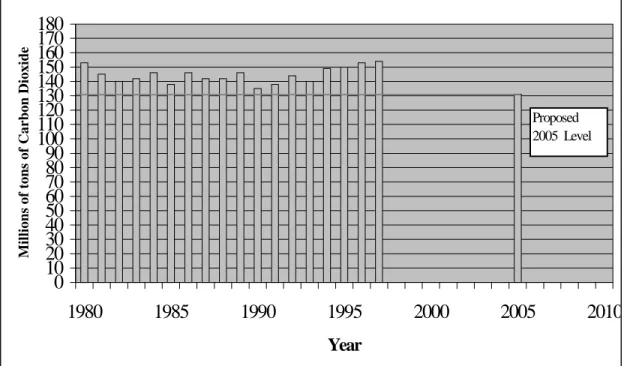
4. New Jersey GHG Emissions and Target Level... 22
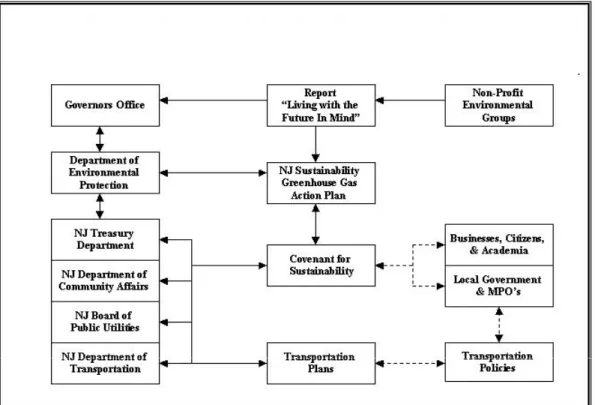
5. Climate Change Planning Process in New Jersey... 25
6. Climate Change Planning Process for King County Region, Washington State... 53
7. CO2 Emissions from Fossil Fuel Consumption for Washington State ... 55
8. Climate Change and the Planning Process for GHG Draft Flow Chart of Process for City of Madison... 65
List of Tables
Table Page 1. Energy Policies for the State of Connecticut ... 142. Milestones and Measures to Track Progress in New Jersey ... 24
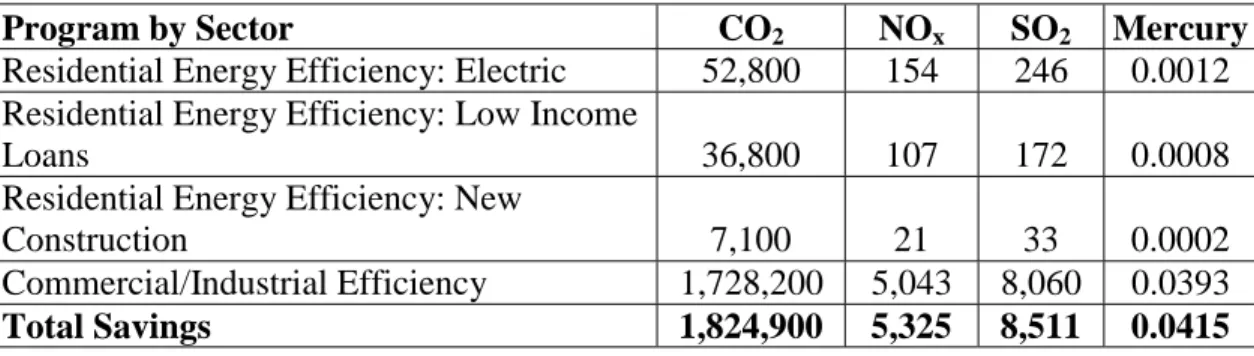
3. Emissions Savings Reported in 2001: Statewide Summary for New Jersey (Reported in Metric Tons) ... 28
4. Forecast 2010 Permanent Reduction in CO2 Emissions by Energy End-Use Sector from 1990 Baseline... 34
5. Delaware: Scenarios to Reduce CO2 Emissions ... 36
6. Per Capita Multnomah County GHG Emissions by Sector (Million Metric Tons)... 41
7. GHG Reduction Targets (Million Metric Tons), Portland and Multnomah County ... 41
8. Government Transportation Actions, Portland and Multnomah County... 42
9. Community Transportation Initiatives, Portland and Multnomah County ... 42
10. Long-term Strategies of Oregon GHG Plan... 44
11. Travel Modes for Work Trips, Seattle ... 57
12. 1990 Comparison of GHG Emissions... 59
13. Break-out of Madison’s 1990 CO2 Emissions by Sector... 62
14. Madison GHG Emissions Inventory (Tons of CO2) ... 63
ix
Executive Summary
Transportation is a major contributor to greenhouse gas (GHG) emissions. State and local transportation planning directly affects transportation decisions, which in turn can influence travel patterns, land use, energy consumption, and, ultimately, GHG emissions. This research will improve understanding of how states and localities might contribute to GHG emissions reduction through transportation planning. The research will also assist the U.S. Department of Transportation (USDOT) by identifying opportunities to integrate global climate change
considerations and GHG emissions reductions into programs and policies.
The amount of activity by states and local areas to develop GHG and climate change plans is impressive. States and local areas are undertaking these activities voluntarily, in the absence of federal requirements. Twenty-five states, plus Puerto Rico, have initiated GHG plans; 19 have completed plans; and 37 have initiated or completed GHG inventories. In addition, 134 cities and counties are participating in an initiative to reduce local GHG emissions. These local participants have made commitments to conduct a baseline GHG emissions analysis, set local GHG reduction targets, develop a local action plan, implement emissions reduction policies, and monitor progress.
This report uses seven case studies to evaluate how states and local areas are using transportation planning to pursue goals to reduce GHG emissions. Information is current as of the time of the research from 2001 to early 2003.
This research was not intended to critically examine the assumptions, methods, data, or likely success of the initiatives in the state and local area plans discussed in the case studies. Such a critical examination was beyond the scope of this limited study. The actions identified in the plans, which typically include projections of reductions in GHG emissions, are presented in this report as they are in their respective plans. In the future, states, local areas, and other interested parties may find it extremely valuable for the USDOT Center for Climate Change and
Environmental Forecasting (CCCEF) or another independent entity to undertake such an objective assessment.
The research focuses on the broad transportation planning process, strategies and other actions selected, and GHG emission reductions accomplished or projected. This report considers both:
• Traditional transportation planning undertaken by all state DOTs, metropolitan planning organizations, city and county transportation agencies, and transportation operators, and
• Energy, environmental, or land use planning by other state and local agencies that considers climate change and transportation policies, investments, and strategies.
x
Based on analysis of planning processes in the case study areas, this report offers the following observations:
• A coordinated formal approach is important. The planning elements used in the case study areas provide a framework for interested states and local areas to adapt to their unique situations. These elements include: description of regional impacts; assessment of GHG emissions baselines; emissions reduction goals; and an action plan to reduce emissions. This framework provides a useful alternative to taking an ad hoc approach to beginning a new GHG plan.
• Climate change impacts can be used as points of departure. Recognition of the regional impacts states or local areas face from climate change can be a critical impetus for
developing GHG plans. Impacts reflect the unique vulnerabilities of each area – shorelines in New Jersey, Oregon, and Washington, for example, or forests and tourism in New Hampshire.
• Motivation to act does not come solely from concern over impacts. Local areas may conduct GHG planning out of a sense of local responsibility and a need to contribute to actions underway by other areas, but areas may also participate in GHG planning out of a pragmatic understanding that climate change goals can strengthen other state and local initiatives. For example, Madison, Wisconsin, Delaware, and New Jersey’s GHG planning is closely linked to city or state energy policy.
• Smart growth and energy conservation planning can provide the foundation for climate change planning. Climate change planning does not appear to originate
independently. Rather, most case study areas are built on the planning foundations already established for related concerns, including energy (i.e., conservation and development of alternative sources and industries) and smart growth (i.e., balancing land use and economic development considerations). For example, Seattle’s GHG planning is closely linked to smart growth, energy conservation, and air quality.
• Political champions play a critical role. Political champions play a critical role in initiating and supporting GHG plans. Leadership from the Mayors and elected
Commissioners or Councilors was critical to the success of GHG planning in Madison, Wisconsin, and Portland, Oregon. The GHG initiative of the New England Governors and Eastern Canadian Premiers (NEG-ECP) is led by the bipartisan governors and premiers. • Non-transportation agencies are playing lead roles. Much of the impetus for state and
local GHG plans appears to come from state and local agencies with primary responsibility for non-transportation sectors such as energy, environment, and land use. The University of Delaware plays a key role as convener for Delaware’s GHG planning, the city
environmental manager coordinates GHG planning in Madison, and the Department of Environmental Protection is the lead in New Jersey’s GHG planning.
xi
• The transportation sector appears to lag behind in GHG emissions reduction planning. Although the transportation sector is consistently identified as a major source of GHG
emissions, transportation policies, strategies, and actions to reduce emissions typically lag behind those for other sectors. Recommended transportation actions tend to be more conceptual, framed as general policy, and less specific in terms of timetables and institutional responsibilities for implementation.
• A range of institutional approaches and integration methods exists. No single best approach exists for defining institutional roles and responsibilities to successfully integrate climate change and transportation planning. The case study areas include the NEG-ECP, a multistate/bi-national initiative, complementary city and county initiatives in Seattle, and state initiatives in Delaware and New Jersey.
• Success depends on a broad base of support and long-term commitment. The case study areas demonstrate that moving from the ideals of a GHG plan to the actual
implementation of plan actions is difficult and requires a long-term time horizon and the cooperation of different levels of government, different economic sectors, and public and private partners. GHG planning in Portland began formally with adaptation of the GHG Plan in 1993, and has continued through later planning, implementation, and evaluation stages. Delaware demonstrated continuity with its broad base of institutional and personal commitment to a long-term planning process.
• Incremental progress is valuable. Several case study areas recognized the value of demonstrating early incremental progress, beginning with strategies where benefits clearly surpass financial and political costs and where lead agencies have direct responsibility. Portland and New Jersey demonstrate that actions that can be quantified and quickly accomplished establish credibility for future initiatives.
• It is difficult to tell if the glass is “half empty” or “half full.” The case study areas uniformly recognize the significant contribution that the transportation sector makes to baseline GHG emissions and the important role that it might play in GHG emissions reduction. However, explicit GHG reduction linkages to transportation planning are at an early stage, newly formed, and rapidly evolving. For example, New Jersey will have a future focus on transportation after initial successes with industries, utilities, and education sectors.
• Continued evolution will be necessary to move from indirect supportive actions to explicit planning. The case study areas are already pursuing strategies for smart
growth/livability, congestion, and air quality improvements that also reduce GHG emissions. Opportunities exist to further develop climate change plans by building on these supportive initiatives through explicit consideration of how these strategies can also save energy, and reduce GHG emissions, while meeting traditional transportation goals. The cities of Portland and Madison have direct operational responsibilities for major transportation
xii programs, making it easier to implement transportation actions in their GHG plans. Seattle transportation agencies are implementing aggressive programs to reduce automobile use through expanded transit, ridesharing, telecommuting, and improved pedestrian and bicycle facilities.
• Peer experiences can demonstrate successful GHG planning. States and local areas are very interested in descriptions and documentation of successful GHG planning by peers. Such peer exchanges may be the best way to demonstrate that climate change goals and planning can be introduced in a rational manner without threatening the goals and programs of transportation agencies. According to one state program manager, it would be invaluable for Commissioners who have initiated GHG planning to share experiences with
Commissioners considering beginning a similar process.
• Additional research would prove valuable. While this study provides a perspective on how several states and local areas are beginning to integrate GHG emission reduction goals into transportation planning, it would be worthwhile to conduct additional research in the future. It would be valuable for an independent entity to assess these efforts in the future, including tracking lessons learned and actual GHG emission reductions.
1
I. INTRODUCTION
The U.S. Department of Transportation’s (USDOT) Volpe National Transportation Systems Center (Volpe Center) completed this report for the USDOT Center for Climate Change and Environmental Forecasting (CCCEF). The CCCEF is dedicated to fostering awareness of the potential links between transportation and global climate change and formulating related policy solutions.
Transportation is a major contributor to greenhouse gas (GHG) emissions. State and local transportation
planning has major impacts on transportation decisions, which in turn influence travel patterns, land use, energy consumption, and, ultimately, GHG emissions.
This research evaluates how states, metropolitan planning organizations (MPOs), cities, and transportation providers are using transportation planning to pursue goals to reduce GHG emissions. Focusing on the broad transportation planning process, strategies and other actions selected, and GHG emission reductions accomplished or projected, the research first considers traditional transportation planning undertaken by all state DOTs, MPOs, and city and county
transportation agencies. The research then considers the climate change and transportation policies,
investments, and strategies that are part of the energy, environmental, and land use planning efforts of state and local agencies.
The goal of this report is to improve understanding of how states and localities might contribute to GHG reduction. This research uses seven case studies to discuss how states and localities can reduce GHG emissions through transportation planning.1 The overall intent is to generate ideas other states and localities can use to connect transportation and GHG planning and to balance climate change goals with the traditional transportation goals of mobility, accessibility, and congestion relief. In addition, this research will assist the USDOT in identifying opportunities to integrate climate change and GHG reduction goals into USDOT programs and policies and to encourage further linkages.
This research was not intended to critically examine the assumptions, methods, data, or likely success of the initiatives in the state and local area plans discussed in the case studies. Such a critical examination was beyond the scope of this limited study. The actions identified in the
1
Since information is current as of the time of the research in 2001 to early 2003, and activities in the case study areas are rapidly evolving, readers are encouraged to review web sites of the case study areas for updated information.
Research Questions
• Incentives – Why are agencies combining global climate change goals with mobility, economic development, and other traditional transportation goals?
• Methodologies – What indicators, forecast models, and other techniques are applied?
• Win-Win Opportunities – How can global climate change goals complement state and local transportation goals, including improving accessibility, reducing congestion and energy use, and encouraging smart growth?
• Institutional Structures – What institutional structures support transportation decisions that reduce GHG emissions?
• Public and Political Support – How was public and political support gained?
• Results – What are the completed or projected reductions in carbon equivalents?
2 plans, which typically include projections of reductions in GHG emissions, are presented in this report as they are in their respective plans. In the future, states, local areas, and other interested parties may find it valuable for an independent entity such as the USDOT CCCEF to undertake such an objective assessment.
States and localities consistently identify transportation as a major source of GHG emissions. In baseline GHG inventories for state, regions, and cities, transportation typically accounts for 30 percent or more of total GHG emissions. Since state and local transportation planning can have impacts on travel patterns, land use decisions, and energy consumption, this planning is also likely to impact GHG emissions. As a result, states and localities may be able to use the
transportation planning process to reduce their GHG emissions and climate change “footprint.” An impressive number of states and localities are developing
GHG emissions reduction plans.2 Appendix B lists the cities and counties participating in the International Council for Local Environmental Initiatives’ (ICLEI) Cities for Climate Protection Campaign (CCPC). Even more impressive, these states and localities are undertaking these activities
voluntarily, in the absence of federal requirements. As part of these activities, participating areas are conducting baseline GHG emissions analyses, setting local GHG reduction targets, developing local action plans, implementing emissions reduction policies, and monitoring progress to reduce GHG.3
However, while many states and localities include transportation strategies and policies in their action plans to reduce GHG, most rely to a great extent on non-transportation strategies. A 2002 Volpe Center study for the Federal Highway Administration found that none of the 48 state DOT long-range transportation plans reviewed included substantive reference to climate change goals, despite frequent references to environmental, smart growth, and “livability” goals and policies and strong support of GHG plans by many governors.4 Many state transportation plans may lack climate change components as they predate more recent state and local GHG planning efforts. In many cases, linkages between transportation and GHG planning are newly formed and rapidly evolving.
2 Numbers are according to the ICLEI and the EPA, which encourages these efforts through the State and Local
Partners Program. The program provides technical advice, training, and financial assistance (http://yosemite.epa.gov/globalwarming/ghg.nsf/actions/StateActionPlans?Open).
3 Source: http://www.iclei.org/us/ccp/milestoneprocess.html. 4 Source: http://www.fhwa.dot.gov/hep10/state/evalplans.htm.
Who Has GHG Plans?
• 25 states and Puerto Rico are initiating plans.
• 19 states have completed plans.
• 37 states have initiated or completed GHG
inventories.
• 134 cities and counties are participating in a national initiative to reduce local GHG emissions.
3 1. SELECTION OF CASE STUDIES
This report presents case studies on four local areas, two states, and one bi-national region. Case studies were chosen based on the following criteria:
• Recommendations by peer agencies and associations involved in climate change programs.
• Willingness of local participants to provide information. • Availability of technical and other documentation. • Implementation of innovations that could be used as
nationwide examples.
2. METHODOLOGY AND APPROACH TO THE TRANSPORTATION PLANNING PROCESS
This analysis uses a transportation planning process framework derived from the Intermodal Surface Transportation Efficiency Act (ISTEA), which covered 1992-1997, and its
reauthorization act, the Transportation Equity Act for the 21st Century (TEA-21). ISTEA and TEA-21 define a comprehensive, continuous, and cooperative transportation planning process that each state and metropolitan area adjusts to reflect its unique circumstances, goals, and long-range priorities.
Under TEA-21, the major products of the statewide and metropolitan transportation planning processes are a 20-year strategic long-range plan and a 3- to 5-year program of investments. Key characteristics of the statewide and metropolitan-area planning processes, as described in TEA-21, include:
• A strategic look at how best to balance locally defined long-range traditional transportation concerns (e.g., congestion relief, mobility, or accessibility) with broader concerns (e.g., economic development, reduced air pollution, or GHG emissions).
• Broad participation of public citizens, advocacy groups, the private sector, and organizations that are not traditional participants in transportation planning but that have an interest in and impact on transportation (e.g., environmental, energy, and land use agencies).
• Financially realistic planning achieved by matching projected costs to revenues in the short and long terms.
• Consideration of a broad range of socioeconomic factors.
• Linkages to other planning processes with close connections to transportation, such as air quality and land use planning.
Transportation planning typically focuses on the activities of state DOTs, federally designated MPOs, city and county transportation agencies, and public transit, port, rail, and airport
Case Studies
• New England Governors and Eastern Canadian Premiers (NEG-ECP)
• New Jersey
• Delaware
• Portland, Oregon
• Seattle and King County, Washington
4 authorities and other transportation operators. This report takes a broader focus on transportation planning. Since climate change is a new and evolving concern for state and local transportation agencies, this research also analyzes selected state and local energy and environmental plans with transportation and climate change focuses. Of particular interest is the ability of state and local agencies to connect this energy and environmental planning to the planning and decision-making processes led by state DOTs, MPOs, city transportation agencies, and transportation providers.
State and local area GHG plans are often linked to energy planning and conservation or air quality planning. These efforts are typically initiated by state or local energy or environmental agencies and consider transportation in terms of goals, analysis of trends, and investments and strategies to reduce GHG emissions. (Appendix A provides a map of states with these GHG planning initiatives.) Of the state and local GHG plans reviewed for this report, all include transportation as a GHG emissions contributor and transportation policies and strategies as items in their action plans.
Figure 1 provides a simplified framework for a broad approach to transportation planning that considers GHG reductions. Well-established links between transportation planning processes and GHG, smart growth, or sustainable development planning are indicated with solid lines, and evolving links are indicated with broken lines. The traditional transportation planning process is identified with shaded boxes. This framework indicates how the planning processes of non-transportation agencies, such as state energy or environmental agencies, can be linked to the traditional planning processes of state DOTs and MPOs. In many cases, states and localities begin to connect traditional and non-traditional transportation planning as they conduct GHG, smart growth, or sustainable development planning. Linking these planning processes can help states and localities identify and implement GHG reductions. The research team used this framework to study and compare the processes observed in the case study areas.
5 Figure 1. Framework for Transportation Planning Process
The research team looked for early indications of a path toward integration of transportation and climate change planning and evolving linkages. Such planning integration and linkages involve more than placing a GHG reduction goal alongside typical mobility, accessibility, or congestion relief goals or federally required air quality improvement goals in a long-range plan for an air quality non-attainment area and more than using a criterion for GHG reduction (e.g., tons of carbon equivalent) as one among other factors to select alternative transportation projects. Instead, a connection, however modest, might be demonstrated by consideration of climate change:
• And regional impacts for transportation in a public information forum set up as part of the development of a transportation plan;
• Within the policy statement in the 20-year metropolitan plan; • In a 50-year vision plan developed by many regions; or
• Through participation of state DOT planners on a technical advisory committee for the state energy agency’s GHG plan.
The research team focused on the broadly defined transportation and GHG planning processes and did not review the GHG emission reductions local participants identified or forecast nor the methodologies they applied. Rather than considering the GHG emission reductions of specific transportation projects, strategies, or policies, this report considers how the transportation planning process can be used to support these decisions. The research team reviewed individual state and local processes to identify insights that might be of interest to a wider audience.
State/Local GHG Plans & Transport Policies State/Local Smart Growth/ Energy Plans Non-DOT State Agencies MPO/Local Transport Plans State DOT Plans Transportation Implementers – Decisions
6 This report makes a subtle but critical distinction between assigning GHG emission reductions to decisions that have already been made and using an ongoing planning process that incorporates GHG reduction goals into future decision-making. Assigning GHG reductions retroactively to decisions is useful for climate change planning because it establishes a technical process for measuring the GHG impacts of transportation and raises public and decision-maker awareness of the connections between transportation and GHG. While the connections between transportation and GHG can be helpful for future planning, this “after-the-fact” connection is not the focus of this research. Instead, this research examines the development of planning processes that
incorporate GHG reduction as a substantive goal alongside other traditional transportation goals, such as congestion relief, mobility, access to employment, and improved air quality.
The research team used the following guide to evaluate how each case study is using transportation planning to identify policies, investments, and strategies to reduce GHG emissions.
• Is there a strategy or action plan directed toward reducing GHG emissions? • At what level is the planning?
− Multistate − Statewide − Regional − Local
• Who is the lead agency?
• What other agencies participate?
• What type of plan or planning process is used? − Transportation plan
− GHG emissions reduction plan − Energy plan
− Environmental plan
− Comprehensive/land use plan (e.g., “smart growth,” “livable communities,” “sustainability”)
• Is there a distinct and significant transportation element? • Is a GHG baseline defined with inventory?
• Are anticipated GHG reductions clearly identified?
• Is there a reasonable basis to anticipate that these results can be achieved? − Is a finite time period set for achieving results?
− Are there qualitative measures to define success? − Are there quantitative measures to define success?
• Are there explicit linkages between climate change and transportation planning processes? − How are transportation planning agencies and their planning processes involved?
(Specify state DOT, city DOT, MPOs, regional agencies, port, or airport.)
7 environment, health and human services, economic development/commerce, physical planning, emergency response, etc.)
− What is the involvement of different levels of government? (Specify federal, state, regional, or local governments.)
• Are action plans or other credible means provided to implement strategies or recommendations? Or do plans appear to be endpoints?
• Are roles and responsibilities for implementation or other next steps identified?
• How are transportation-implementing agencies involved? (Specify state DOT, city DOT, transit operators, port, airport, private sector (e.g., freight), etc.)
The research team focused on the broad outlines of complex state and local planning processes. The analysis relied on technical reports and other documentation, and, when possible, conducted telephone interviews with a limited number of local officials who play lead roles in GHG
9
II. CASE
STUDIES
1. NEW ENGLAND GOVERNORS AND EASTERN CANADIAN PREMIERS (NEG-ECP)
1.1 Introduction
The New England Governors and Eastern Canadian Premiers (NEG-ECP) addressed climate change and GHG emissions issues at its conference in July2000. The conference established the political and policy foundation for regional climate change initiatives, including an action plan to complement other regional, state, local, and provincial initiatives. NEG-ECP is composed of the states of Vermont, Rhode Island, New Hampshire, Massachusetts, Connecticut, and Maine, and the provinces of New Brunswick, Newfoundland and Labrador, Nova Scotia, Prince Edward Island, and Quebec.
NEG-ECP’s work is based on a number of scientific and policy concerns. For example,the New England Regional Assessment, “Preparing for a Changing Climate: The Potential Consequences of Climate Variability and Change,” which was conducted for the U.S. Global Change Research Program, concluded thatNew England and upstate New York have warmed 0.7 degrees
Fahrenheit in the last 100 years. Researchers predict that temperatures will continue to rise 6 to 10 degrees by the end of this century. According to the report, the potential impacts from climate change on New England and Eastern Canada include the following:
• Deterioration of air quality.
• Significantly increased health risks. • Altered ecosystems.
• Economic impacts to the health sector, tourism, and the natural resource industry. 1.2 Approach
NEG-ECP recognizes that global climate change may have serious impacts on the New England-Eastern Canadian region. The NEG-ECP believesit is prudent to undertake multistate/
multiprovince preventative and adaptive measures to mitigate the impacts of climate change. In July 2000, NEG-ECP adopted Resolution 25-9, which recognizes that climate change could have a serious impact on the region’s environment and economy. Upon adoption of this resolution, NEG-ECP directed its Committee on the Environment, the Northeast International Committee on Energy (NICE), and the New Brunswick Premier’s National Round Table on the Environment and the Economy (NRTEE) to work together to develop a strategic plan consistent with the Canadian National Implementation Strategy for Climate Change. The result is the Climate Change Action Plan, the culmination of efforts between the NEG, the ECP, and their respective energy and environmental agencies.
10 1.2.1 Who Is Involved and Why
In 1937, the governors of Vermont, Rhode Island, New Hampshire, Massachusetts, Connecticut, and Maine formally established the New England Governors’ Conference (NEGC) as a voluntary alliance of states to promote New England’s economic development. The region’s six governors serve on NEGC’s board of directors and implement policies and programs designed to respond to regional issues. NEGC coordinates regional policy programs in economic development,
transportation, environment, energy, and health, among others. NEGC also serves as the New England Secretariat for NEG-ECP, which first met in 1973. Through NEG-ECP, New England governors and Eastern Canadian premiers discuss issues of common interest and concern and enact policy resolutions that call for voluntary actions by the state and provincial governments and by the two national governments.5
NEG-ECP established the NICE in 1978 to monitor and act upon common energy issues in the New England-Eastern Canadian region. The NEG-ECP Committee on the Environment and NICE then appointed a Climate Change Steering Committee to oversee implementation of the NEG-ECP Climate Change Action Plan.
1.2.2 Climate Change Action Plan
The NEG-ECP Climate Change Action Plan identifies steps to address those aspects of climate change that are within the region’s control in order to reduce regional GHG emissions, adopt adaptive measures, and build the foundation for a long-term shift to cleaner, more efficient, economically competitive, and secure ways of using energy. The Climate Change Steering Committee oversees the implementation of the action plan and reports to the Committee on the Environment and NICE on a regular basis. Both of these committees report annually to NEG-ECP.
Specifically, NEG-ECP created the action plan to:
• Provide a comprehensive and coordinated regional plan for reducing GHG through regional initiatives.
• Obtain and build commitment from each state and provincial jurisdiction to carry out its own planning for GHG reductions, including disclosure of progress and sharing of information. • Develop a plan to adapt the region’s economic resource base and physical infrastructure to
the impacts of climate change.
• Develop a public education and outreach effort to ensure that the region’s citizens continue to be educated about climate change.
• Maintain and enhance energy reliability and security. • Promote sustainable economic development.
The action plan also recommends strategies to reduce regional GHG emissions cost effectively while advancing other important regional objectives – what NEG-ECP labels as a “win-win”
11
solution, where all parties view quantitative and qualitative benefits as greater than costs. Other regional objectives include:
• Reducing emissions of pollutants that threaten human health and the natural environment. • Maintaining a reliable supply of reasonably priced energy within the region.
• Reducing regional dependence on energy imports, thereby keeping energy dollars in the regional economy.
• Reducing the region’s collective vulnerability to energy price shocks.
• Providing “early adoption” of innovative opportunities to enhance the competitive advantage of the region’s technology industries and research.
The action plan builds on discussions held at the NEG-ECP Climate Change Workshop in March 2001. At the workshop, participants identified the following nine steps each jurisdiction or the entire region will take and incorporated these steps into the action plan:
1. Establish a standardized emissions inventory beginning with 1990 GHG emissions levels and report updates every three years.
2. Create a plan identifying measures to achieve GHG reductions through regional short and mid-term targets.
3. By 2005, make the public in the region aware of the impacts of climate change and what personal actions they can take at home and work to reduce GHG emissions.
4. By 2012, reduce GHG emissions through improved energy efficiency and the reduced public sector use of carbon-based fuels by 25 percent, as measured from an established baseline. 5. By 2025, reduce the carbon dioxide (CO2) emitted per megawatt hour of electricity use
within the region by 20 percent of current emissions.
6. By 2025, increase the amount of energy saved through conservation programs (in tons of GHG gas emissions) within the region by 20 percent by encouraging residential, commercial, industrial, and institutional energy conservation. (Action Items 5 and 6 are complementary and designed to lower the overall carbon intensity of electricity production.)
7. Broaden the understanding of forecasted climate change impacts and plan for the adaptation of these impacts, where possible. In addition, seek adaptation options that do not increase GHG emissions further.
8. Slow the growth rate of and reduce GHG emissions from transportation and better
understand the impacts of transportation programs and projects on overall GHG emissions. Work with federal officials to improve the energy efficiency of vehicles for sale to the public. 9. Create a uniform and coordinated basis for GHG emissions banking and trading. Create a
regional GHG emissions registry and gain experience in certifying credits and trading within the geographic region. To accomplish this, states and provinces will allow industries, organizations, and other entities to disclose their current GHG emissions baseline without being penalized for early reductions.
12
The Climate Change Action Plan expects each state and province to initiate a coordinated set of policies and actions aimed at advancing their common goals. The region has three benchmarks or performance measures to measure itsdegree of success in addressing the action plan’s nine goals:6
• Short-term Measure. Reduce regional GHG emissions to 1990 emissions by 2010. • Mid-term Measure. Reduce regional GHG emissions by at least 10 percent below 1990
emissions by 2020. Beginning in 2005, establish an iterative, 5-year process to adjust the goals if necessary and to set future emissions reduction goals.
• Long-term Measure. Reduce regional GHG emissions sufficiently to eliminate any
dangerous threat to the climate. Current science suggests that this will require reductions of 75-85 percent below current levels.
Beyond these measures, each jurisdiction can choose additional measures to contribute towards meeting overall GHG reduction targets.
At the time of this report, Vermont, Maine, and Rhode Island had formally adopted their own climate change action plans. Connecticut, Massachusetts, and New Hampshire are at various stages of developing plans and should be finished in 2003. Figure 2 shows which states have adopted a climate change action plan and how these plans relate to the regional efforts of NEG-ECP and NICE.
Figure 2. Climate Change Linkages for Planning Activities in New England7
6
Note that these goals represent reductions that would need to be taken more universally, including outside the region, to have the intended positive results.
13
1.3 Links to the Energy and Transportation Planning Process
NEG-ECP is focused on energy and efficiency, leaving the states to develop and implement policies as they see appropriate. States vary greatly in their resources and priorities, including on which sectors they choose to focus – energy or transportation.
1.3.1 Energy Planning
NICE and five of the six New England states have energy plans that allow linkages between initiatives to reduce GHG emissions and energy plans and policies.
NICE
In July 2000, NEG-ECP adopted Resolution 25-12, which directs NICE to perform the following actions to help plan for energy use and to determine reduction strategies for the energy sector: • Continue to monitor developments in energy markets.
• Send a letter to the Secretary of the U.S. Department of Energy (DOE) recommending that DOE work with NICE, states, and provinces to maintain an open North American energy market and to clarify the treatment of large-scale hydro-electric power under federal restructuring legislation.
• Examine ways to encourage energy conservation, demand-side management programs, energy efficiency, and the development of new energy technologies.
• Continue to develop a computerized energy database for the region.
• Report on key jurisdictional energy issues in the region, including the region’s energy storage capacity and infrastructure.
While NEG-ECP and NICE cooperatively developed the Climate Change Action Plan, they did not directly link the action plan and NICE’s energy plan. In addition, neither group identified national or international agencies to enforce the policies or suggestions in these plans.
Nonetheless, the support and advice NICE provides is an important first step in developing a regional energy plan.
Connecticut
In its Act Studying State Energy Policies (SA 99-15), the Connecticut General Assembly charged the Connecticut Board of Energy with updating and strengthening the state’s energy policy.8 The act charged the board with accomplishing the following objectives:
• Reflect emerging competition among the various public utility industries and emerging trends in new technologies.
• Repeal or modify elements of the current policy that are inconsistent with recent state and federal laws.
14
• Protect the interests of low-income consumers and ensure they benefit from new opportunities available through competition, such as aggregation.
• Ensure that conservation of natural resources remains a high priority in the state’s energy policy.
After establishing the energy policy’s goals, Connecticut established a set of 15 energy policy strategies, as shown in Table 1. These strategies outline the ways through which the goals can best be achieved in the context of current energy conditions and markets.9 Although Connecticut recommended that future policies support efforts to address climate change, at the time of this report the state did not appear to link the energy plan directly with the climate change action plan currently under development.
Table 1. Energy Policies for the State of Connecticut10
Energy Policy Goals
Energy Policy Strategies
A. Economic B. Environmental C. Risk Mitigation D. Competitive Markets E. Policy Coordination
(1) Monitor Retail Energy Market Development * *
(2) Encourage Interstate & Federal Action to Enhance
Regional Market Development * *
(3) Remove Barriers to Distributed Energy * * *
(4) Support Emerging & Renewable Energy Technologies * * *
(5) Protect the Interests of All Customers, Including
Low-Income Customers *
(6) Support & Coordinate Energy Conservation and
Efficiency Programs * *
(7) Review Tax Incentives for Energy Efficiency and Clean
Energy * *
(8) Enhance Regional Supply Portfolio Diversity *
(9) Assess Natural Gas Restructuring * *
(10) Support Adequate Levels of Fuel Storage * * *
(11) Coordinate Environmental and Energy Policies * *
(12) Prioritize Energy Use in Transportation and Land Use
Planning * *
(13) Stimulate Commercialization of High-Mileage and
Alternate-Fuel Vehicles *
(14) Initiate a Coordinated Energy Education Campaign *
(15) Establish an Ongoing Energy Planning Review Process *
Maine
The Maine Office of Planning is developing and implementing a statewide clean energy agenda. The agenda emphasizes renewable energy resources and includes the following priorities:
• Reform the current renewable portfolio standard.
9
Source: http://dep.state.ct.us/wst/p2/energy/energy.htm.
15
• Implement a program of customer credits to spur purchases of clean energy.
• Target tax incentives to mitigate some of the barriers and costs faced by renewable energy generators.
• Promote transmission pricing and policy reforms at the regional level.
Maine’s energy plan includes environmental and climate change concerns and defines energy’s role in the state’s 1996 climate change action plan.
Massachusetts
The Massachusetts Legislature created the Renewable Energy Trust in 1998 to restructure the electric utility industry and to promote the development of renewable energy in the
commonwealth. In keeping with its legislative mandate, the Trust focuses on four statutory objectives:
• Shift electric energy consumption in Massachusetts from conventional energy resources to a greater reliance on energy generated from renewable resources.
• Increase electric generating capacity from renewable resources to meet the growing energy demands of consumers in Massachusetts.
• Expand the renewable energy sector in Massachusetts, including system developers,
manufacturers, equipment vendors, architects and engineers, service providers, and research organizations.
• Increase the overall level of economic activity related to renewable energy in the commonwealth.
Massachusetts cited the environment as a concern in the state’s energy plan and is currently developing a climate change action plan. The extent to which these plans will be linked is unknown.
New Hampshire
New Hampshire is currently developing energy and climate change action plans that will share common objectives. It is not yet known whether they will be linked.
Rhode Island
The Rhode Island Council adopted a state energy planon March 13, 1997. Developed by an interdisciplinary subcommittee of public and private sector experts, the plan identifies key energy issues and establishes related policies and actions. The overall objective of the plan is to ensure a supply of energy that is reliable, low-cost, environmentally benign, sufficient for economic growth, and safe from supply disruptions. The subcommittee has identified several goals and strategies in the plan, including the following:
16
• State policy should encourage the direct use of natural gas in end-uses determined to be economically and environmentally appropriate, especially those which help reduce the demand for electricity during summer and winter peak demand periods.
• State policy should encourage the move toward true electricity competition via regional cooperation and planning.
• State policy should support the expansion of natural gas pipeline capacity into the region and state to promote fuel diversity for direct end-use applications and electricity generation. • State policy should continue to reduce dependence on oil through conservation and the
enhancement of fuel diversity.
• State policy should stimulate the introduction of new technologies that include wind, solar, and fuel cells to provide new capacity as needed. State policy should also stimulate the creation of methods that decrease resistance in both electrical motors and transmission lines so as to increase efficiency.
The Rhode Island State Energy Plan cites numerous policies that promote energy conservation and environmental protection but does not mention climate change or GHG emissions. Rhode Island is in the process of developing a climate change action plan; it is not yet apparent whether this plan will be linked to its energy plan.
Vermont
Vermont’s energy plan, “Fueling Vermont’s Future,” presents “bold new policies for sound energy use.”11 The state has taken action in the following areas:
• Capturing more energy savings in existing homes and businesses. • Increasing the use of renewable energy sources.
• Improving transportation energy use. (Transportation is the largest energy user in Vermont.) • Reviewing energy policy and taxation at the state and federal levels to ensure that energy
goals are promoted.
All of the New England states have begun considering energy planning, most have begun to examine climate change issues, and some have directly linked their energy and climate change plans into one document. However, others have yet to make these connections. Level of involvement and commitment appears to vary substantially state to state.
1.3.2 Transportation Planning
NEG-ECP left the development of transportation policies related to climate change up to the states. As with energy planning, the states are at different levels of involvement and
commitment in linking transportation planning with climate change policies. In general, the states do not appear to explicitly refer to climate change in their transportation plans.
17 Connecticut
According to the Connecticut Environmental Protection Department’s 1998 emissions inventory, the transportation sector contributes over 36 percent of all GHG emissions in the state. The Connecticut DOT includes climate change concerns in its 2001 transportation plan and identifies transportation strategies to improve the environment and the mobility of people. The
Connecticut DOT identified the following selection of transportation initiatives as a way of improving air quality and the environment.
• Offering incentives to encourage drivers of single-occupancy vehicles to use mass transit or carpools. (Nearly 75 percent of the state’s drivers travel solo to work.)
• Improving the quality, quantity, and ease of accessing buses, trains, and light rail. • Simplifying the transfer between different modes.
• Reducing the volume of tractor-trailers on Interstates 95, 91, and 84 by a variety of means such as increasing weight limits and improving railroad freight services. The state’s waterways, in particular the Long Island Sound, remain unutilized corridors for reducing freight traffic and minimizing truck emissions.
• Establishing transit links among New Haven; Hartford; Bradley International Airport; and Springfield, Massachusetts.
• Expanding air service into Tweed in order to reduce vehicle miles traveled and automobile emissions.
Because Connecticut did not have a climate change action plan at the time of this review, it was not possible to determine direct linkages between transportation planning and climate change policies.
Maine
The transportation sector contributes almost half (47 percent) of Maine’s GHG emissions. Increasing amounts of vehicle miles traveled (VMT) and the current fuel efficiency of vehicles significantly affects CO2 emissions from the transportation sector. As part of their overall policy
to improve transportation service and air quality, the state identified several policy actions: • Implementing Maine DOT transportation plans that maximize emissions reductions
programs.
• Working with municipalities and developers to promote efficient patterns of development that reduce VMT.
• Establishing a system of bikeways and public transit vans. • Marketing public transit to citizens.
• Promoting the benefits of ridesharing in cars and vans.
• Enacting a “feebate program” to charge for the use of gas-guzzling vehicles. • Supporting the Clean Cities Program.
18
• Working with Congress to reform the corporate average fuel economy (CAFE) standards. Vermont
Vermont’s Climate Change Action Plan states that transportation planning and policies offer the greatest opportunities for increasing energy efficiency and for reducing GHG emissions and reliance on oil. Vermont has proposed several strategies and policies that would implement least cost transportation planning and broaden the focus of transportation planning in order to access a wide variety of resources at the lowest cost to society. The strategies and policies related to transportation include:
• Reducing VMT and transportation-related emissions.
• Using transportation energy taxation to remove market distortions from energy prices and “internalize” more of the societal and environmental costs into transportation fuel prices. • Using a “feebate” program to recognize that efficient vehicles impose lower costs and
impacts than less efficient, gas-guzzling vehicles.
• Increasing the efficiency of vehicles through higher CAFE standards and state polices that maximize fuel efficiency and minimize safety risks and associated emergency service costs. • Continuing the implementation of vapor recovery at gas stations and adopting a low
emissions vehicle standard.
• Implementing policies that shift travel to more efficient modes of transportation, including buses, vanpools, trains, and non-motorized transportation.
• Promoting telecommuting. 1.4 Lessons Learned
NEG-ECP provides a forum for the governors of New England to coordinate and implement policies and programs designed to respond to regional issues, including GHG emissions
reduction and climate change. In its regional climate change action plan, NEG-ECP focused on energy. At the same time, each New England state is developing its own climate change action plan and linking transportation and energy policies to different degrees. The Canadian
provinces, Vermont, and Maine have made noteworthy early progress in developing plans that link energy and transportation planning. In general, continued political support will be essential for these links to be expanded and strengthened.
This research identified several key lessons learned:
• Directly linking climate change policies to other policies, such as air quality and energy, may provide synergistic benefits. Directly linking these policies demonstrates the
interrelationships between climate change, energy, environment, economics, and
transportation. This direct linkage can also demonstrate that actions that further one goal can further others, encouraging political support.
19
• Political support on a broad geographical basis is necessary. Climate change issues have no borders. Acknowledging this fact is a critical first step towards developing cooperation and political support across state lines and international boundaries. The challenge is to turn this awareness and support into actual policies and initiatives that can be implemented by national, state, and local jurisdictions.
• Regional approaches encourage participation and action. NEG-ECP’s success at raising awareness demonstrates how a regional approach can establish a visible and high-profile forum for political leaders and governments to exchange ideas, provide mutual
encouragement, and develop coordinated climate change policies.
• Regional workshops foster understanding. Workshops and seminars at the regional level help stakeholders understand climate change issues and work cooperatively to develop solutions.
• Beginning to formulate a “win-win” approach can provide a useful foundation for policy development. NEG-ECP began its climate change policy development by attempting to formulate a “win-win” approach that required minimal financial and political investment and produced easily identifiable and cost-effective results. This kind of approach can
provide the foundation for later, more complex efforts and can encourage early cooperation. • A broad-based coalition can provide a laboratory for ideas. As a multistate and
multiprovince initiative, NEG-ECP provides a laboratory for studying policies and strategies in a broad range of situations. The regionhas had experience assessing the following ideas: − “Feebate” programs for gas-guzzling vehicles in rural areas with a high proportion of
trucks and utility vehicles.
− Reform of CAFE standards to address climate change in rural areas with a large proportion of trucks traveling long distances, such as in Maine.
− Combination energy and climate change action plans that support an efficient and coordinated approach to addressing issues, such as in Vermont.
2. NEW JERSEY 2.1 Introduction
New Jersey’s approach to reducing GHG emissions has been shaped by its industrial base and geography. New Jersey is geographically vulnerable to the impacts of climate change: the state is surrounded on three sides by water. In the mid-1990s, the New Jersey Coastline Study increased concerns about sea-level rise due to climate change. As a result, New Jersey feels compelled to take strong and collaborative actions to reduce GHG emissions. Initially, former New Jersey Governor Christine Todd Whitman and former New Jersey Department of
Environmental Protection (NJDEP) Commissioner Robert Shinn identified air pollution caused by industrialization and sea level rise caused by climate change as two of the most significant