Teaching Computer Networking with the Help of
Personal Computer Networks
Rocky K. C. Chang
Department of Computing The Hong Kong Polytechnic UniversityHung Hom, Kowloon, Hong Kong
[email protected]
ABSTRACT
This paper describes an “experiential” learning approach to teaching a foundational course on Computer Network-ing. In additional to the traditional laboratory sessions and analytical problem-solving, I have introduced a class project based on personal computer networks for the last three years. Each project group sets up and owns an IP private network throughout the course, and they perform various experiments on it to verify and test the networking principles learned from the textbooks and lectures. The stu-dents’ feedbacks collected so far are extremely positive. Not only they can acquire practical skills during the process, they are able to better understand the abstract networking con-cepts and protocols through their working experience with the personal computer networks.
Categories and Subject Descriptors
C.2.2 [Network Protocols]: Applications - Routing Pro-tocols; C.2.6 [Internetworking]: Routers - Standards
General Terms
Algorithms, Measurement, Performance, Experimentation
Keywords
TCP/IP, Experimental problem-solving, Personal computer networks
1.
INTRODUCTION
Computer networks and the Internet have already become the most critical infrastructure today for information dis-semination, business transactions, human communications, computer games, scientific computation, and even national security. Moreover, computer networks are ubiquitously de-ployed in many other commercial sectors, such as automo-biles, smart highways, smart clothing, smart appliances, and
Permission to make digital or hard copies of all or part of this work for personal or classroom use is granted without fee provided that copies are not made or distributed for profit or commercial advantage and that copies bear this notice and the full citation on the first page. To copy otherwise, to republish, to post on servers or to redistribute to lists, requires prior specific permission and/or a fee.
ITiCSE’04, June 28–30, 2004, Leeds, United Kingdom. Copyright 2004 ACM 1-58113-836-9/04/0006 ...$5.00.
coffee shops, just to name a few. As a result, there is a press-ing need to equip students on both undergraduate and grad-uate levels with a solid foundation in the field in order to further foster and flourish its development and applications. However, in many ways Computer Networking education is still in an exploratory stage. For example, we have seen for the last ten years many different approaches adopted by var-ious textbooks—analytical [1], bottom-up [2], engineering [3], system [4], balanced-view [5], visual [6], and top-down [7]. Whether these approaches can effectively facilitate stu-dents’ learning are yet to be seen and evaluated.
As the content of the field continues to increase in a very rapid rate, it is also very important to identify a minimal set of core principles to teach undergraduate students, and this has been discussed in the ACM Workshop on Network-ing Education last year [8]. Moreover, there is increasNetwork-ing effort on providing hands-on experience to students through more traditional laboratory sessions/courses, implementa-tion of networking hardware, simulaimplementa-tion tools, and socket programming.
This paper considers a foundational course on Computer Networking for junior students in a typical Computer Sci-ence or Computer Engineering program. The main thesis of this paper is that students’ learning in this subject can be significantly enhanced if they can interact with an actual computer network in parallel to other teaching and learn-ing activities. In the next subsection, I will first present the difficulties connected to teaching and learning this sub-ject. In section 2, I describe my experience of using a class project based on personal computer networks to enhance the teaching and learning qualities. In section 3, I present the student survey results to assess the effectiveness of the ap-proach. Finally, I conclude with some future work in section 4.
1.1
Identifying learning and teaching
difficulties
“Why is it (not) so difficult to learn Computer Network-ing?” is perhaps the first question that we as educators should ask ourselves (and our students). One of the obvious answers is of course to do with the rapid advances in the field. Only ten years ago, one undergraduate subject and one postgraduate subject were perhaps sufficient to provide a reasonable coverage. Today, however, an entire undergrad-uate program can be devoted to Computer Networking, and its associated subjects, such as economic and social issues. Many Computer Networking topics have also quickly
devel-oped into separate subjects, notably Wireless and Mobile Networks, Optical Networks, and Network Security.
From the educators’ point of view, it also becomes in-creasingly difficult to teach the subject effectively, partly because the Internet’s success has attracted students with various backgrounds. Thus, it is hard to provide one class for all. Even among students with similar educational back-grounds, say Computer Engineering students, some of them may have taken professional examinations, such as Cisco’s CCNA, before attending a first course on Computer Net-working, while others are not even able to expand the term TCP/IP.
Besides the issues related to the forever changing nature of the field (at least for now) and heterogeneity in students’ backgrounds, there are quite a number of obstacles to teach-ing and learnteach-ing Computer Networkteach-ing effectively, as out-lined below.
1. The principles underlying Computer Networking are intrinsically very complex. The layered model helps understand and manage the complexity. But very soon students find out that this layering approach has its own inadequacy. For example, the layers are not re-ally independent of each other, and a network layer could be degenerated into a data-link layer, e.g., IP over ATM. Therefore, getting the whole picture cor-rectly is already a challenge to many students. 2. Computer Networking concepts and protocols are also
very abstract to many students. For one, they cannot see typical networking equipments, and visualize pack-ets and protocols for themselves during lectures. For example, talking about a LAN switch without seeing one is already a hinderance for many students. Exam-ining the kernel code without a prior understanding of how the protocols work helps very little. Computer animation alleviates the problem to some extent, but it may not be able to equip students with the ability of conceptualizing other more abstract concepts on their own.
3. Unlike Computer Programming and Computer Archi-tecture courses, for example, resource provision for hands-on practical experience in Computer Network-ing is problematic. A Computer NetworkNetwork-ing labora-tory, if available, usually has a ready-to-use computer network on which students can conduct various exper-iments. However, students should also be expected to know how to set up a computer network from scratch after taking the course, very much like knowing how to write programs after taking a Computer Programming class. But it is not quite possible to provide adequate resources to achieving that in many academic environ-ments.
4. Many terminologies and acronyms are introduced and used in the field, and some of them are very similar, e.g., ARP and ARQ. Worse yet, these terminologies are often not used consistently, especially in the indus-try, e.g., hubs, switches, switching hubs, port switching hubs, and segment switching hubs. Students, on the other hand, are more used to clear and formal defi-nitions. For example, many students in my class are very perplexed by the termround-trip timewhen it is first mentioned during the subject overview.
5. Some of the networking problems are difficult to com-prehend and appreciate due to students’ common lack of practical experience. It is generally not difficult for undergraduate students to understand the access net-work technology, because almost all of them have ex-perience of accessing the Internet via ISPs and LANs. However, it is relatively difficult to comprehend the scalability issues in inter-domain routing and the im-portance of traffic engineering.
6. The sequence of coverage can also affect students’ learn-ing significantly. Computer Science students are per-haps more comfortable with a top-down approach while engineering students may find the pure bottom-up ap-proach more logical. In either case, it is bound to have missing information, which is yet to be revealed later, in order to complete the entire storytelling of the Computer Networking internals. Unfortunately, students may stumble on these missing information. Therefore, a good sequence of coverage may follow a “nonlinear” path which is in contrast to a rigid top-down or bottom-up sequence.
2.
PERSONAL COMPUTER NETWORKS
One issue that clearly stands out from the discussion in the last section is that a lack of practical and meaningful experience with an actual computer network could greatly hinder the understanding of the Computer Networking con-cepts. Therefore, practical assignments are usually supple-mented in a typical undergraduate course, e.g., socket pro-gramming assignments and laboratories.
Although socket programming assignments and labora-tory sessions are useful, they do not allow students to in-teract with the “kernel” of a computer network. To fill this void, I initiated a class project three years ago to let students experiment with a personal computer network throughout the course—each group is expected to work on their own network in parallel to the course’ progression. However, the amount of resources required for supporting 170 students is obviously very demanding, in terms of both equipments (PCs, hubs, NICs, etc) and space (space is extremely costly in Hong Kong). Finally, I have come to the conclusion that the only solution to resolving the resource constraint is to “bring the networking laboratory to where students are.” That is, each group is responsible for finding their own ma-chines, OSes, networking equipment, and space. Although it sounds like a very difficult task, all groups in the past three years were able to find all the resources and finish the project.
The projects are performed on group basis. The entire project consists of several phases. The first one is to find all the resources to form IP private networks which are usu-ally situated in students’ homes. The network is set up in a month’s time. Therefore, the students had to read ahead and understand some of the basic networking concepts, such as IP subnets and NAT. The first phase is concluded with a presentation on the network setup. The second phase is to observe how network protocols work by conducting experi-ments on the personal computer network. At the end of the project, each group is asked to submit a written report and make a final presentation. A sample report is available in [9].
Router 192.168.0.2 192.168.0.3 192.168.1.2 Hub 192.168.1.1 192.168.0.1
Figure 1: A minimal personal computer network.
2.1
Configuring private IP networks
A minimum set up, as depicted in Fig. 1, includes two subnets—an Ethernet LAN and a PPP network. A Linux system is configured as a router that also performs Network Address Translation (NAT). Although the test network is small, it contains both point-to-point and broadcast net-works. Moreover, the PPP’s MTU can be manually config-ured to cater for experiments on IP fragmentation and TCP throughput.
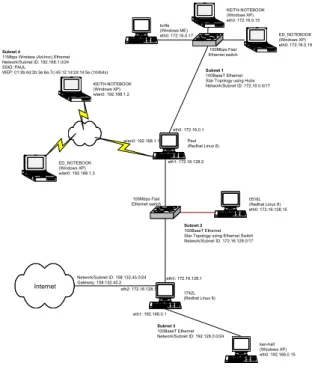
Advanced students are able to configure more complex networks and services, such as that in Fig. 2. Starting from last year I have asked students to configure an IPSec tunnel between two such private networks. Therefore, two or more project groups need to work among them to set up such tunnels.
Through the process of setting up the network, students pick up various invaluable practical skills of configuring net-works, diagnosing network problems, and finding solutions to them. These skills cannot be taught adequately in tradi-tional laboratory sessions. In particular, the students will be familiarized with the followings after this stage of project:
1. IP addressing scheme
2. The concept of IP subnets and subnet masks
3. Default router configurations
4. PPP network setup
5. NAT setup using iptables
6. Network diagnosis tools, such as ipconfig, ping, and netstat
7. Setting up various network services, such as SSH, HTTP, TELNET, SAMBA
2.2
Network experimentation
The second part is to reinforce the principles learned in lectures by performing various experiments on the network. In other words, the hands-on experiments draw students closer to the Computer Networking principles, because they can now visualize how protocols work for themselves. There are several types of experiments. The first one is simply to observe how network protocols work, e.g., they can observe
1. How ARP resolves the target MAC addresses using data-link broadcast, KEITH-NOTEBOOK (Windows XP) eth0: 172.16.0.15 ED_NOTEBOOK (Windows XP) eth0: 172.16.0.16 Paul (Redhat Linux 8) 1742L (Redhat Linux 8) 0516L (Redhat Linux 9) eth0: 172.16.128.15 ken-hall (Windows XP) eth0: 192.168.0.15 Subnet 1 100BaseT Ethernet Star Topology using Hubs Network/Subnet ID: 172.16.0.0/17
Subnet 2
100BaseT Ethernet Star Topology using Ethernet Switch Network/Subnet ID: 172.16.128.0/17 Subnet 3 100BaseT Ethernet Network/Subnet ID: 192.128.0.0/24 100Mbps Fast Ethernet switch eth1: 192.168.0.1 eth0: 172.16.0.1 eth1: 172.16.128.2 turtle (Windows ME) eth0: 172.16.0.17 Internet eth2: 172.16.128.1 Network/Subnet ID: 158.132.45.0/24 Gateway: 158.132.45.2 Subnet 4
11Mbps Wireless (Ad-hoc) Ethernet Network/Subnet ID: 192.168.1.0/24 SSID: PAUL
WEP: 01:3b:4d:2b:3e:6a:7c:45:12:1d:2d:14:5e (104bits) KEITH-NOTEBOOK (Windows XP) wlan0: 192.168.1.2 wlan0: 192.168.1.1 ED_NOTEBOOK (Windows XP) wlan0: 192.168.1.3 eth0: 172.16.128.1 100Mbps Fast Ethernet switch
Figure 2: A more elaborate personal computer net-work.
2. How the NAT router translates the internal IP ad-dresses and ports,
3. How a router fragments an IP packet,
4. The TCP three-way handshaking messages and the protocol values, and
5. The TCP’s persistent behavior in setting up a connec-tion.
Another set of experiments is related to the measurement of the network performance. For example, based on the measurement results, students can investigate
1. The effect of frame collisions on an Ethernet network’s performance,
2. The relationship between MTU and network through-put,
3. The effect of IP fragmentation on the network through-put,
4. The effect of packet fragmentation on the network per-formance,
5. The relationship between buffer sizes and TCP through-put, and
6. The DNS delay in repeated queries.
The last set of experiments concerns network faults and misconfigurations. For example, students will observe that
1. The states of a TCP connection are not affected by a nonpersistent network outage,
0 10 20 30 40 50 60 70 Strongly Agree
Agree Neutral Disagree Strongly Disagree
Assignments Project for practical skills Projects for understanding Mid-term tests
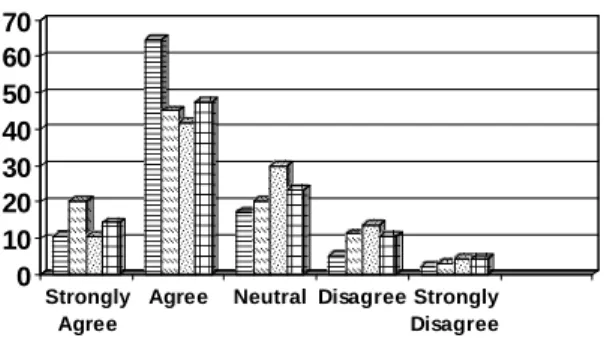
Figure 3: Effectiveness of assessment components for a large class in 2001.
2. The protocol interactions as a result of configuring du-plicate addresses on the same subnet, and
3. The effect of various hacking activities on the net-works.
3.
EVALUATION
This section presents students’ feedbacks received from an undergraduate course on Computer Networking in the last three years. The class in 2001 was a large one, consist-ing of 168 students. The classes in 2002 and 2003, on the other hand, were small, consisting of 54 and 46 students, respectively. The metrics of the evaluation are based on the impact of the group projects on the students’ learning, and the change of students’ interests in the subject at the end of the course.
3.1
The learning outcomes
Besides the feedbacks on the group project, I also include their feedbacks on the assignments and tests for the pur-pose of comparison. Therefore, the following four statements were presented to the students, and there were five possible answers to each question: Strongly agree, agree, neutral, disagree, and strongly disagree. The feedbacks are charted in Figs. 3-5. The numbers of responses received were 133 (79%), 52 (96%), and 41 (89%) for 2001-2003, respectively.
• The assignments helped me understand the subject materials.
• The class project helped me acquire practical skills in Computer Networking.
• The class project helped me understand the subject materials.
• The tests helped me find out how much I have under-stood (or have not underunder-stood).
The responses to both statements regarding the class project were quite similar for the small class in 2002 in that around 80% of the responses from the small class (strongly) agreed that the class project was helpful in the two aspects with slightly more favorable responses on the practical skill. The responses received from the small class in 2003 were even more encouraging. For the first time, the feedbacks on the
0 10 20 30 40 50 60 Strongly Agree
Agree Neutral Disagree Strongly Disagree
Assignments Project for practical skills Projects for understanding Mid-term tests
Figure 4: Effectiveness of assessment components for a small class in 2002.
0 10 20 30 40 50 60 Strongly Agree
Agree Neutral Disagree Strongly Disagree
Assignments Project for practical skills Projects for understanding Mid-term tests
Figure 5: Effectiveness of assessment components for a small class in 2003.
project surpassed that for the assignments—more than 90% of the respondents thought positively of the project on the practical skill aspect. Even with a large class, the project was very useful to most of the students. Around 65% of the responses (strongly) agreed that the class project helped them acquire practical skills in Computer Networking, while 51% of responses (strongly) agreed that the class project helped them understand the subject materials.
The responses were quite understandable. Although un-derstanding the networking principles was actually a major objective of the project, students still perceived that ac-quiring the practical skills throughout the process was more important. Based on students’ written comments, many of them felt that acquiring the skills of setting up networks from ground up would help them land on jobs upon grad-uation. Another reason is that most of them had never set up a computer network before; therefore the practical work itself seemed to be more rewarding and significant.
3.2
Students’ interests in the subject
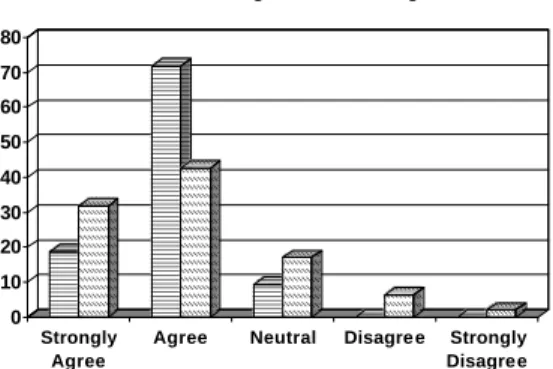
The most important student feedback, in my opinion, is whether students are more interested in Computer Net-working after taking the course. Therefore, students were asked whether they are interested in Computer Networking at two separate times: during the first class (indicated by pre-teaching in Figs. 6-7) and during the last class (indi-cated by post-teaching in Figs. 6-7). The reason for doing this is to accurately assess the impact of this course on their interests in the subject. Previously in the large class, stu-dents were asked whether they weremoreinterested in the
0 10 20 30 40 50 60 70 80 Strongly Agree
Agree Neutral Disagre e Strongly Disagree Pre-teaching Post-teaching
Figure 6: Students’ interests in Computer Network-ing before and after takNetwork-ing the course in 2002.
0 10 20 30 40 50 60 Strongly Agree
Agree Neutral Disagre e Strongly Disagree Pre-teaching Post-teaching
Figure 7: Students’ interests in Computer Network-ing before and after takNetwork-ing the course in 2003.
subject after taking the course, but the responses did not clearly indicate the absolute levels of interests.
Although the group project is just one of the many activ-ities that would affect the students’ interests in the subject, I believe that the project’s contribution is much more sig-nificant than others. It is quite easy to observe a positive correlation between a student’s interest in the subject and his interest in the project. Some students were very excited about setting up a private network and observing how proto-cols work, and in turn they were willing to spend more time on the project. On the other hand, other students would perceive the project just another burden to bear, and this attitude in turn decreased their interests in the subject.
The feedbacks are very revealing. For the 2002 class, for example, around 90% of the respondents (strongly) agreed that they are interested in Computer Networking in the first class. This result is also predictable, because of the impor-tance of the Internet. Moreover, some students wrongly be-lieved that Computer Networking is equivalent to WWW, or other network applications. Therefore, after learning the ac-tual Computer Networking principles, many students’ per-ceptions about the subject changed. Some became aware that Computer Networking was not for them, because the content may be a little too difficult to comprehend. How-ever, others found the subject much more interesting than before, because both the extent and depth of the subject far exceeded what they knew before. As a result, we see a higher variance in the post-teaching responses. The percentage of strongly-agreed cases jumped from 19% at the beginning of the course to 32% at the end of the course. On the other
hand, the percentage of agreed cases decreased significantly from 72% at the beginning of the course to 43% at the end of the course. The other cases also increased at the end of the course. Similar results were observed for another small class in 2003, as shown in Fig. 7.
4.
CONCLUSIONS AND FUTURE WORK
In this paper I have presented a group project based on personal computer networks. The main advantage of this learning approach is to let students practise and verify what they have learnt from lectures and textbooks as the course advances. By doing so, the abstract networking concepts can be made more concrete to the students. At the same time, they are taught practical skills in configuring and diagnosing an actual computer network.
One possible improvement is to further tighten the in-tegration of the class project with the instructional part. Currently, I start giving out the project approximately a month after the beginning of the course. In the next year, I am planning to give out the class project in the first class, and students are expected to “experience” a certain net-working topic on their personal computer network as soon as the topic is covered in lectures. This approach is some-what similar to the experiential learning approach discussed in the education sector. In contrast to cognitive learning, ex-periential learning attempts to provide incentives to learn, and in my case the incentive is to build a personal computer network after completing the course.
Acknowledgment
This work was partially supported by a Teaching Develop-ment Grant from The Hong Kong Polytechnic University. The network setup in Fig. 2 is part of the project report by Edmond Chan, Joey Chan, Keith Lee, and Paul Chu [9].
5.
REFERENCES
[1] D. Bertsekas and R. Gallager,Data Networks, Second Edition, Prentice-Hall, 1992.
[2] A. Tanenbaum,Computer Networks, Fourth Edition, Prentice Hall PTR, 2003.
[3] S. Keshav,An Engineering Approach to Computer Networking, Addison Wesley Longman, 1997. [4] L. Peterson and B. Davie,Computer Networks: A
Systems Approach, Second Edition, Morgan Kaufmann, 2000.
[5] A. Leon-Garcia and I. Widjaja,Communication Networks: Fundamental Concepts and Key Architectures, Second Edition, McGraw-Hill, 2004. [6] B. Forouzan,Data Communications and Networking,
Second Edition, McGraw-Hill, 2000.
[7] J. Kurose and K. Ross,Computer Networking: A Top-Down Approach Featuring the Internet, Second Edition, Addison Wesley Longman, 2003.
[8] ACM Workshop on Networking Education, Aug. 2002. Available from
http://www-net.cs.umass.edu/sigcomm/education/workshop1.html. [9] E. Chan, J. Chan, K. Lee, and P. Chu, A report on
“Networking in an Unsafe World!”, available from
http://www4.comp.polyu.edu.hk/∼csrchang/Edmond.pdf, May 2003.