Administration on Aging
Chronic Disease Self-Management Program (CDSMP)
Process Evaluation
HHSP233201100492G
Final Report Appendices
April 30, 2013
Authors:
Cynthia Woodcock, IMPAQ International
Holly Korda, Altarum Institute
Erkan Erdem, IMPAQ International
Sarah Pedersen, IMPAQ International
Michelle Kloc, Altarum Institute
Erik Tollefson, Altarum Institute
Submitted to:
Project Officer: Susan Jenkins
Office of Performance and Evaluation
Administration for Community Living
Department of Health and Human Services
330 Independence Ave SW # 4760
Washington, DC 20201
Submitted by:
Project Director: Tina Barretto
IMPAQ International, LLC
10420 Little Patuxent Parkway
Suite 300
Columbia, MD 21044
Telephone: (443) 367-0088
TABLE OF CONTENTS
Appendix A. CDSMP Technical Advisory Group Members
Appendix B. Site Visit Guide
Appendix C. Site Visit Summary
Appendix D. Key Informant Interview Questions
Appendix E. CDSMP Participants by AoA Region
Appendix F. CDSMP Participant Reach by Grantee
Appendix G. Class Size Fidelity by State Grantee
Appendix H. Statistical Tests for Chapter 6 Exhibits
Appendix I. CDSMP Workshops, Participants, and Completers BY QUARTER STATE GRANTEE
Appendix J. Logit Regression Analysis
APPENDIX A. CDSMP TECHNICAL ADVISORY GROUP MEMBERS
Name Affiliation Bio
Teresa Brady, PhD Senior Behavioral Scientist at the CDC - Atlanta
Dr. Brady has extensive chronic disease program knowledge and expertise in AoA/CDC partnership building.
Joshua Chodosh, MD UCLA Associate Professor in Residence, Geriatrics
Dr. Chodosh has extensive program knowledge, with a focus on outcomes for older adults.
Candace Goehring, MN RN Unit Manager, Aging and Disability Services, Washington State Department of Social and Health Services
Ms. Goehring has extensive chronic disease program knowledge. She has experience working with the Aging Network and has served as an implementer for AoA EBDDP grantees. Gerry Mackenzie, MSS Director of Community
Resources, Education and Wellness in the Division of Aging and Community Services, NJ Dept. of Health and Senior Services.
Ms. Mackenzie has over 20 years experience in the management and development of state and community-based programs for older adults. She currently manages the older adult health and wellness program, senior health insurance program, Aging and Disability Resource Connection and the statewide information and assistance service. Ms. Mackenzie is the project manager for NJ’s Evidence-Based Disease Prevention for Older Adults program. Ruth Palombo, PhD Assistant Secretary, MA
Executive Office of Elder Affairs
Dr. Palombo has experience in the MA network to provide evidence-based program and ad research interests in the development of strategies to promote successful aging among older adults with chronic conditions and disabilities.
Peter Reed, PhD Senior Director of Programs for the National Office of the Alzheimer’s Association
Dr. Reed has extensive chronic disease program knowledge and has experience as a
Researcher/Policy Developer and ARRA Reviewer in the field of Public Health.
Beth Richards Arthritis Program Director, Missouri
Ms. Richards the State CDSMP Lead for the State of Missouri and has set a best practice in imitating the relationship between the Missouri Arthritis and Osteoporosis Program and State Health and Aging Departments to implement evidence-based interventions.
Carlene Russell Iowa Healthy Links Project Director, Department of Elder Affairs
Ms. Russell has extensive chronic disease program knowledge. She has experience working with the Aging Network and has served as an Implementer for AoA EBDDP grantees.
David Sobel, MD Regional Director of Patient Education for the Northern California Kaiser
Permanente Medical Care Program
Dr. Sobel’s research and teaching interests include medical self-care, patient education, preventive medicine, behavioral medicine and psychosocial factors in health. He has co-authored seven books written for the general public including Living a Healthy Life with Chronic Conditions, The Healing Brain, and Healthy Pleasures. He has been Involved in CDSMP RCT design.
Name Affiliation Bio
Nancy Wilson Assistant Director for
Program Development, Baylor University,
Huffington Center on Aging
Ms. Wilson has extensive chronic disease program knowledge and has performed research concerning the Aging Network.
APPENDIX B. SITE VISIT GUIDE
Chronic Disease Self-Management Program (CDSMP) Site Visit Guide
“As you know, we are employees of IMPAQ International and Altarum Institute, and we are talking
with you today as part of our work with the Administration on Aging. The purpose of this discussion
is to collect information about how your [state/site] is implementing the Chronic Disease
Self-Management Program (CDSMP) to inform a national evaluation that is currently being designed.
Although during the course of our discussion we will ask specific questions about various aspects of
your program, this interview is not intended to monitor or to evaluate your program. Many of your
responses will inform what questions to include in a national web-based survey that is part of this
project. Your participation in this interview is voluntary and you may choose to discontinue the
interview at any time, for any reason. What we learn about your efforts from this interview will be
combined with input from other respondents, within your state and across five other states, and
incorporated into an evaluation design report to the Administration on Aging (AoA). Your name and
your role in this effort may be disclosed to our colleagues at AoA, but no specific statement or
quotes will be attributed to you in the report.
Do you have any questions before we begin?”
Domain 1: CDSMP Populations, Marketing/Recruitment
Topic Site Visit Questions
1.1 Populations Served 1.1 Populations Served
CDSMP Participants 1. How have the participants changed over time?
2. How do actual participants map to targeted populations?
3. What challenges have sites experienced in reaching, enrolling and keeping participants (i.e., retention)?
1.2 Marketing/Outreach 1.2 Marketing/Outreach
Target Populations 1. What is your catchment area? Is it urban/rural?
2. What provider groups do you target in your marketing efforts (e.g., health plans, hospitals, FQHCs, primary care physicians, health homes, pharmacies, DME suppliers)?
3. What is the message that you seek to communicate?
4. How do you segment the consumer market in your marketing and outreach efforts (e.g., by age, ethnicity, gender, chronic condition, type of health insurance (private, Medicare, Medicaid))?
5. How would you describe your target market?
6. What consumer groups do you market to directly (e.g., churches, YMCA, local AARP chapter)? What is the message that you seek to communicate?
7. What challenges have you faced in working with provider groups? Are there some groups that you would like to work with that you have not been able to?
8. What approaches have been best for attracting provider groups? 9. How do you measure whether you are reaching your target population?
Distribution Channels 1. What distribution channels do you use to disseminate program information? a) Targeted mailings: to whom, how many, response rates?
b) Website: host website, target market, URL, number of hits? c) Flyers/brochures: distributed how and where?
d) Telephonic marketing: to whom, how many calls/year, who conducts the calls, response rates?
e) Radio or TV: which channels, type and length of ads, number of broadcasts/year?
2. For each distribution channel, which population(s) are you targeting?
3. How did you develop your dissemination approach? Was it new for this effort? Was it something that you used before? Was it preplanned or did it develop more organically?
4. Which approaches have worked best and why?
Referring Organizations 1. Have you established a formal referral network? If so, what organizations, agencies, programs, and providers are in the network?
2. Is there an informal referral network? If so, describe.
3. Do you notice a difference between consumers who self refer as compared to those that are referred by your various referral sources? (e.g., in consumer demographics, in completion rates, in participation/interest in the classes)
Marketing Organization 1. Who is responsible for developing a marketing plan for CDSMP? What is the marketing message(s), who are the target populations, and what are the distribution channels? How often is the marketing plan revised?
2. Who is responsible for implementing the marketing plan (or, in the absence of a marketing plan, carrying out marketing activities): the state grantee, host site(s), and/or implementation site(s)?
3. Who is responsible for monitoring marketing/outreach efforts?
4. Did you develop a new marketing campaign for your CDSMP program or is the marketing for CDSMP part of an existing effort?
Marketing Messages 1. What messages do you aim to communicate to providers and consumers? 2. Have you “branded” CDSMP in your state? How?
Marketing Budget 1. What was your marketing budget for CDSMP for the most recent fiscal year? 2. How were marketing funds apportioned to the state level, host site level, and
implementation site level?
Marketing Research 1. Have you collected any data on how providers and/or consumers find out about CDSMP (e.g., via an enrollment form or in a follow-up survey)? If so, what are the findings?
2. Have you conducted any other marketing research? If so, what were the research questions? What did you find?
Lessons Learned 1. How do you measure whether your marketing efforts are paying off?
2. What approaches have you found to be most successful in marketing CDSMP? 3. What barriers have you encountered in marketing to specific provider and/or
consumer populations? How might these barriers be overcome?
Doman 2: Site Implementation
Topic Site Visit Questions
2.1 Budget and Financing 2.2 Budget and Financing - Also see DOMAIN 5: Statewide Distribution and Delivery
Cost Structure 1. Do you know the cost per participant? 2. How did you calculate this cost?
Program Budget 1. How does the cost CDSMP compare to other programs you administer?
2. Over the past three years, has the budget increased or decreased? Has the program had a deficit or surplus?
Grant Funding 1. What are the types of funding you have received and types of funding that you will seek to sustain the program?
Medicare Reimbursement Medicaid Reimbursement
1. Has the state been accredited by the American Diabetes Education Association to provide CDSMP for Medicare reimbursement?
2. Is CDSMP provided under Medicaid managed care in your state (i.e., through MCO capitation payments)?
Health Homes 1. Is CDSMP provided through medical/health homes in your state (e.g., Medicaid health home, ACO, FQHC)?
Fee Structure 1. What is the state’s fee structure for a CDSMP workshop for the different payers, if any, that reimburse for this service?
Financial Sustainability 1. Does the state have a strategy for funding CDSMP over the long term? If so, what is it? [Note: One of the challenges for programs like CDSMP is moving from a “grant culture” to a funding base structured around payment or reimbursement for services rendered. Probe whether the state recognizes this and is addressing it in their funding strategy.]
2. Does your site have formal business plan for sustainability? 2.2 Fidelity to Stanford
Model
2.2 Fidelity to Stanford Model Trainer/Leader Fidelity and
Retention
1. What supports do sites offer to leaders or trainers? 2. Are master trainers tracked or followed?
3. Who paid for the facilitator training?
4. Do your facilitators work at multiple host sites?
Fidelity Monitoring 1. “At the agency level, fidelity refers to the how closely staff members follow the program that the developers provide. This includes consistency of delivery as intended and the time and cost of the program.” If not, how would you define “fidelity” to the Stanford model? To what extent do you think your program operates with fidelity to the Stanford model?
2. Do you have a Quality Assurance Plan? If so, obtain a copy.
3. If the state’s completion rates are less than 70%, probe fidelity to see if there may be an issue.
4. Have you incorporated any changes to the Stanford model that you believe enables the program to better meets the needs of the 60+ population or increases completion rates and long-term compliance? Do you have any evidence of this? 5. Do you a process for regularly monitoring fidelity? If so, describe (e.g., protocol,
frequency, metrics, responsible parties, feedback).
Domain 3: CDSMP Eligibility, Enrollment, and Completion
Topic Site Visit Questions
3.1 Registration and Enrollment
3.1 Registration and Enrollment
Process 1. Do you conduct any type of eligibility screening or administer any kind of assessment prior to enrolling a consumer (e.g., age, chronic condition, functional limitations, financial status, readiness to participate)? If so, what are the criteria for determining “readiness” or eligibility/non-eligibility? What is the basis of turning people down? Is this a documented/written process used throughout the program? If yes, request a copy.
2. How do consumers enroll in CDSMP? Online, in-person, mail, or by telephone? 3. Is enrollment centralized at the state level or host site level? Or do consumers
enroll at the implementation site level?
4. Do people tend to enroll as individuals or as part of a couple or group (e.g., a group of friends join together)? How does this effect class participation and completion? Workshop Structure 1. Are workshops targeted at specific population groups (e.g., age, gender, and
ethnicity) or chronic conditions, or are workshops mixed groups?
2. Are workshops structured to take advantage of existing social networks? If so, how (e.g., location, group enrollments)?
3. Are the classes accessible to the target population in terms of how often classes are offered, locations of classes, etc?
4. Do your workshop sessions follow the curriculum recommended by Stanford (i.e., order of classes, number of hours, learning objectives and material covered in each class)? If not, how do your workshops differ and why do you do them differently?
5. Do you keep the ordering of the topics covered in the six CDSMP sessions fixed? That is, first day you cover Topic A, second day you cover Topic B, etc. and this ordering is constant across all host sites and implementation sites. What is the ordering of the classes? [This is supposed to be the case and gives us a sense of variability across programs or adaptations?
6. Continuity: What is the longest period of time in the last 12 months that you have gone without a workshop?
Workshop Scheduling 1. What is the class schedule for the current year?
2. Is class scheduling centralized at the state level or host site level? Or do implementation sites do their own scheduling?
3. Does the state maintain a master schedule of classes? If so, where can consumers and providers access it?
Workshop Enrollment 1. What was actual enrollment for each class offered in the past year versus available class slots?
2. In general, does demand exceed supply of class slots or can consumers generally find a class slot when they want it?
3. Do you maintain a waiting list? If so, how many people are on it and at what locations? Approximately what percent of applicants are placed on the waiting list? What is the typical waiting time to start a workshop?
4. If you have a waiting list, what efforts have you made to eliminate it?
5. If you have a waiting list or cannot accommodate someone for a particular workshop, do you ever refer consumers to other (non-CDSMP) self-management programs? If so, which programs? Is a slot usually available?
Orientation 1. Do you have orientation sessions or Class Zero? If yes, describe the curriculum, session length, and level of participation.
Registration Fees 1. Do you charge a fee to workshop participants? If so, how much?
2. If you charge a fee, do you offer a sliding fee schedule, scholarships, and/or free enrollment for individuals meeting certain criteria? What are those criteria? 3. If you charge a fee, are fees ever paid by a third party (e.g., health plan,
health/medical home, FQHC, Medicaid, Medicare, health insurance)?
4. What infrastructure is in place for billing and processing receipt of fees (e.g., manual or electronic system, accept checks, cash, credit cards, part of a larger organization’s billing system)?
3.2 Workshop Participation 3.2 Workshop Participation
Enrolled Population 1. Do you set goals for enrollment by site? If so, what are they and were they achieved (i.e., is your enrolled population representative of the population you are trying to reach)?
2. What is the prevalence of workshop participants with cognitive deficits? Have you implemented strategies aimed at better serving this population? What are those strategies? Any lessons learned?
3. Do you track re-enrollment by non-completers? If so, what do you know about these individuals?
4. Do you track re-enrollment by completers who wish to take the program again? If so, what do you know about these individuals?
Workshop Participation 1. Do you regularly examine attendance logs for problems?
2. Have you examined attendance records by enrollee characteristics (e.g., age, gender, ethnicity, chronic condition, disabilities, health insurance)?
3. Do you track milestones or achievements by participants? Which ones and why? 4. Do you offer incentives to participants to achieve specific goals or complete the
program (e.g., cash, gift cards, services)? If yes, what is the incentive structure and what is the source of funding for the incentives?
5. Are there particular topics that participants seem to be most interested in? Workshop Completion 1. Do you set goals for completion by site? If so, what are they and were they
achieved?
2. Do you conduct “exit interviews” with participants (completers and completers) to learn about satisfaction with the program and reasons for non-completion?
3. What is your perception of non-completers versus completers (e.g., characteristics, availability of supports, barriers)? Any data to support these perceptions?
4. Have you implemented strategies to increase completion rates? If so, what? Workshop Follow-up 1. Do you follow up with workshop participants in any way after the workshop is
concluded (i.e., effectiveness evaluations, such as questionnaires 4 to 6 months following the program)?
2. Do you offer any kind of “refresher” course for individuals who have completed CDSMP?
Domain 4: Data Collection
Topic Site Visit Questions
4.1 Data Collection and Program Monitoring
4.1 Data Collection and Program Monitoring
Data Collection Capability 1. Reporting to NCOA: Do you report the required data to NCOA on a quarterly basis? How are the data collected, aggregated, and submitted? Who is responsible for data collection, aggregation, and submission?
2. What other program data do you collect on a regular basis (e.g., purpose, users, data elements, frequency, format)? How are the data collected and who is responsible for data collection and reporting? Please share sample reports. 3. To what extent are your data collection systems electronic and centralized? What
kind of software do you use?
4. What staff resources (e.g., positions, skills/expertise) are available for data collection and reporting?
5. Do you partner with a university or private research organization on data collection and reporting?
Program Monitoring 1. How and what data is used for performance monitoring? What metrics do you use? Reporting to whom?
2. How do you use data for continuous program improvement?
Assessment and Evaluation 1. Have you conducted any evaluations of CDSMP to measure the effects of CDSMP on health outcomes and costs? If so, what datasets did you use (e.g., MMIS, MDS, program data)? What was the study design? What were the findings? Are there reports available?
2. Have you followed any workshop participants beyond their workshop participation to see if there were sustained benefits of CDSMP? If so, how long? Findings?
3. How are evaluation findings being used to promote the program and ensure its sustainability?
4.2 Evaluability 4.2 Evaluability
Randomization 1. If asked to participate in the RCT, what process would you suggest for randomizing participants into CDSMP given the unique features and processes of your program? Randomization during a centralized registration process? Randomization using provider settings?
2. What are the chances that control group participants would enroll in another similar program?
3. How long would control group participants be willing to wait to join a CDSMP workshop? 6 months?
Leadership and Resources 1. Probe whether the state has the resources and expertise to participate in an electronic Participant Tracking System.
2. Probe whether the state has leadership and staff who recognize the importance of a RCT and have the requisite expertise and commitment to manage a RCT.
Domain 5: Statewide Distribution and Delivery System
Topic Site Visit Questions
5.1 Program
Structure/Delivery System
5.1 Program Structure/Delivery System
State Grantee 1. Who is the leadership? What is their authority, roles, and responsibilities? How would you rate their level of commitment to CDSMP?
2. Is there a CDSMP state-level advisory board? If so, how often does it meet? Who is on it? How are members appointed? What authority does it have?
Responsibilities? Funding?
3. What state-level agencies partner with the state grantee on CDSMP (e.g., aging unit, department of health, Medicaid, human services department)? What is the role and responsibilities of each partner? Is there a written partnership agreement?
4. How many employees at the state level have CDSMP responsibilities? What are their positions, who do they report to, and what percent of their time do they spend on CDSMP, doing what? Is there a program coordinator?
5. Explain the organizational structure of CDSMP and the relationships/functions of the state grantee vs. host sites vs. implementation sites.
6. Is there an organizational chart for CDSMP? (If not, sketch one with the assistance of the state grantee.)
7. What specifically is the state grantee’s role in program planning, administration, and delivery?
8. What is the role of AAAs and ADRCs in program planning, administration, and delivery?
9. Who holds the Stanford license for CDSMP?
10. To what extent is the CDSMP delivery system “institutionalized” with dedicated staff and resources at the state, host site, and implementation site levels?
11. To what extent is CDSMP delivered as a “solo” program versus a program that is part of a constellation of other programs (e.g., other evidence-based programs, other health promotion programs)? If the latter, how do you think this influences consumer participation in CDSMP as well as other programs?
12. Have you conducted an adoption evaluation to look at the settings and/or organizations that are offering a program and how successful each is?
Host Sites 1. Is there a council representing host sites? If so, how often does it meet? Who is the chairperson/ leadership? What authority does it have? Responsibilities? Funding? How are members appointed?
2. How many employees of each host site have CDSMP responsibilities? What are their positions, who do they report to, and what percent of their time do they spend on CDSMP, doing what? Is there a project coordinator and a dedicated recruiter at each host site?
3. What specifically is the role of host sites in program planning, administration, and delivery?
Implementation Sites— Facilities
1. What is the relationship of these organizations with CDSMP? Are there employees at these organizations with responsibility for managing the CDSMP workshops? If so, what percent of their time do they spend on CDSMP? Or does the organization merely provide space for the workshops?
2. Describe the facilities and equipment available to CDSMP at implementation sites. Is it adequate or is additional equipment or space needed?
3. What fees, if any, does CDSMP pay to use the various implementation sites? Master Trainers and Leaders 1. How many Stanford-certified master trainers and T-Trainers are available in your
state? How many were available to train leaders during the past year? Do any of them lead workshops as well?
2. Are the master trainers employees of an agency or organization in your state, or do they work as independent contractors?
3. Does your state or your host sites provide any additional training to master trainers beyond what is recommended by Stanford? If so, on what topics and why?
4. How many leaders did the master trainers in your state train each year over the past three years?
what difficulties are you experiencing with regard to meeting recommendations? 6. Do your master trainers facilitate one 4-day Leader training within one year of
completing Master Training? How often do you have difficulty meeting this goal? What do you feel are the difficulties? Do you proactively plan to hold Leader Trainings within one year of Master Trainers completing training?
7. Do you ensure that, if training multiple Master Trainers, each facilitates a Leader? 8. Do each of your master trainers lead a full 4-day Leader training at least once
every year, to remain certified? If you hire Master Trainers, do you confirm they meet these training goals (do you use the Stanford Patient Education Center’s website to determine ‘active’ trainers?)
9. What process and curriculum do master trainers follow in training leaders? Are there documented learning objectives and competencies that must be met? 10. How consistently are you able to adhere to the recommended schedule for Leader
Trainings (total of 4 days – most recommended 2 days per week for 2 weeks)? 11. How do you recruit master trainers and leaders? Do you have a recruiting strategy,
goals, work plan? Who is responsible for recruiting?
12. If you hire Master Trainers, do you use the Stanford Patient Education Center’s website to determine ‘active’ trainers? Do you use Master Trainers who have not conducted a class within the past year?
13. Do you start leader trainings with less than 12 potential Leaders or with more than 25?
14. Do you have a protocol for directly observing Leaders during sessions?
15. Do you have workshops scheduled by the Leaders complete training, so they can meet the goal facilitating within 6 months of training? If Leaders are unable to facilitate within 6 months, do you require a refresher prior to facilitating?
16. Do new Leaders co-facilitate their first workshop with an experienced, active Leader?
17. Who are the master trainers and leaders (e.g., age, gender, ethnicity, chronic conditions, disabilities, years of experience)? Are you achieving a 30% male trainer rate? Are they paid or unpaid? If paid, by whom?
18. Does your state have a central registry of master trainers and leaders? If so, who maintains it?
19. How do you assign leaders to workshops (e.g., randomly vs. try to match leaders with certain kinds of consumers)?
20. What is the attrition rate for master trainers and leaders? If you’ve been losing a number of them, why do you think that is and what could be done about it? 21. Have you ever experienced shortages in master trainers or leaders? Has this
caused problems with staffing workshops or being able to train new leaders? 22. Have you ever had to run a workshop with only one leader (not two as required)?
Do you train 3 Leaders for new areas, such that there is a back-up? 23. What do you do if a leader is sick?
24. Do you have a process for periodically evaluating master trainers and leaders? Do you track completion rates by master trainer/leader? If so, what have you found and how do you use the evaluations for program improvement?
25. Do you ask workshop participants to evaluate their leaders? If so, what has been their feedback? How do you use these evaluations for program improvement? 26. In your opinion, what are the attributes of the “best” master trainers and leaders?
Domain 6: Consumer and System-Level
Topic Site Visit Questions
6.1 State/System Environment
6.1 State/System Environment
State Budget 1. Has CDSMP by affected by state budget deficits? If so, how (i.e., funding levels, staffing, number of sites)?
Political Environment 1. To what extent is the current administration supportive of CDSMP? (Democratic or Republican administration?)
Aging Network 1. What are some of the major programs of the state unit on aging? Would you consider CDSMP to be a priority program?
Medicaid Reform 1. Is your state considering any major Medicaid reform? If so, what (e.g., health homes, managed care, 1115 waiver)?
2. Are there ways in which CDSMP could benefit from Medicaid reform?
Competing Programs 1. Are there other CDSMP-type programs that could be considered competing programs? What programs? What is their catchment area? Target populations? Comprehensiveness of
services
2. Are there other CDSMP-type programs that could be considered competing programs? What programs? What is their catchment area? Target populations? CDSMP’s role in other
programs
3. Are participants linked to or from other prevention/health programs (e.g., falls prevention, PEARLS)? Is CDSMP part of a larger constellation of services? If so, what else is included in the constellation? Do they think this linkage makes a difference in terms of the types of consumers they get, enrollment rates, and/or completion rates?
Complicating Factors 1. Is the effect program influenced by disease progression or other age-related declines?
2. Have problems been reported with respondent memory issues? 3. What is the respondent and site burden?
4. Are there particular outcomes of interest that are not possible to capture with current data or techniques?
5. When using proxy respondents for those for diminished cognitive ability, what are the challenges?
What cultural factors or adjustments are made? How do these adjustments affect the outcomes?
6.2 Consumer Environment 6.2 Consumer Environment
Measures of interest to AoA 1. In addition to CDSMP-specific measures, AoA is interested in the following measures which may not directly by related CDSMP. Is your site exploring any of the following 1) Health maintenance, 2) Independence in the community, and 3) What is the effect of diminished cognitive ability on course adherence, completion and outcomes? In particular, does this program support health maintenance? Does it support helping participants remain independent in their communities? Outcomes that CDSMP does
not address
1. Are there issues that participants bring that CDSMP does not address? Does the program meeting their expectations in terms of what is advertised?
The goal of speaking to participants is to get a sense of whether individuals are willing to be randomized, or willing to wait 6 months to take the workshop (if it would mean important research could be conducted that benefits older adults, etc).
1) Participant introductions, when did you take the class, how many times have you taken the class
2) How did you hear about the program?
3) Did you come to the class with friend(s) or family? 4) Did you have to pay for the course?
5) Was there a class zero? How do you feel about having a class zero? 6) Did you have to wait to get into the class?
7) Was the class easy/convenient to get to? 8) Was the facility and accommodation adequate? 9) Were you able to come to all the classes? If not, why? 10) What were the other participants like?
11) What did you think of your leaders?
12) Was the course content (book, charts, information) useful to you? Do you have recommendations or ideas for change?
13) Are you doing anything differently now as a result of the class? If so what? 14) Have you shared anything you learned or the course book (informally or formally)
with family or friends?
15) Have/would you recommend the course to others?
16) Do your leaders follow up with you after the class? What do you think about the idea of a follow up after the class? Have you kept in touch with your leaders? 17) Are there other programs, like the CDSMP, that you have taken or are aware of? If
so, what are those?
18) Do you have any thoughts about the marketing – is it adequate or do you have recommendations for improvements?
APPENDIX C. SITE VISIT SUMMARY
Chronic Disease Self Management Program (CDSMP)
Process Evaluation and Detailed Outcome
Evaluation Design
HHSP233201100492G
Draft CDSMP Site Visit Summary
February 28, 2012
Submitted To:
Susan Jenkins, COTR
Administration on Aging, DHHS
CC:
Margo Katzper, CO
Program Support Center, DHHS
Submitted By:
Daver C. Kahvecioglu, Project Director
IMPAQ International
Site Visit Team:
Michelle Kloc, Altarum Institute
Holly Korda, Altarum Institute
Sarah Ruiz, IMPAQ International
Cynthia Woodcock, IMPAQ International
SYNTHESIS OF SITE VISIT FINDINGS
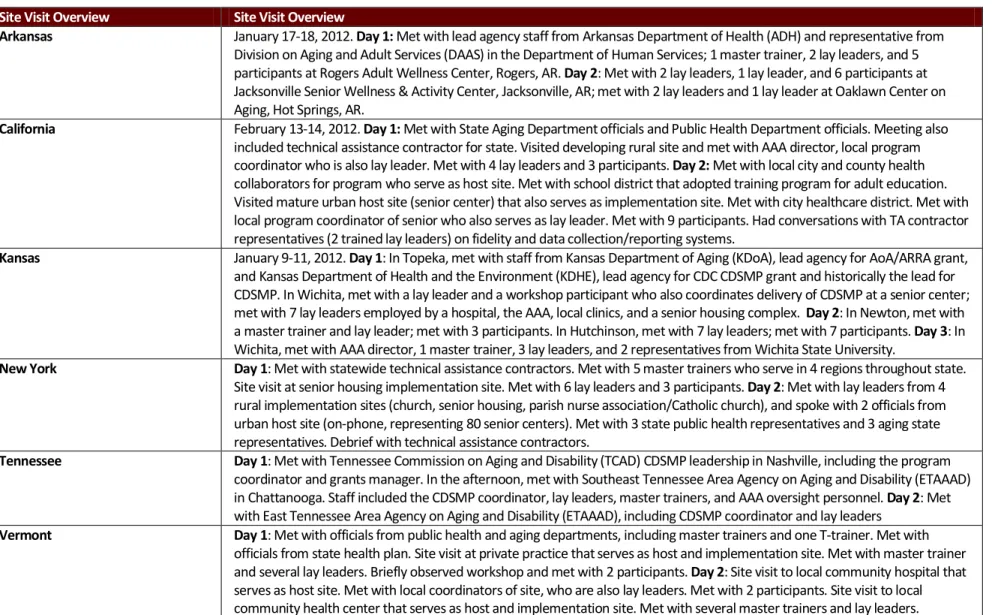
During January and February 2012, researchers from IMPAQ International and Altarum Institute
conducted site visits in six states to gain an understanding of the experience of states, host
1, and
implementation
2sites in implementing the Stanford Chronic Disease Self Management Program
(CDSMP) as funded by the U.S. Administration on Aging (AoA) under contract HHSP233201100492G:
CDSMP Process Evaluation and Detailed Outcome Evaluation Design
. Information obtained through
the site visits will inform development of a Web-based survey of states, host, and implementation
sites, and process evaluation findings, and will provide input to guide the design of a rigorous
outcome evaluation under the contract.
We conducted two or three day site visits in Arkansas, California, Kansas, New York, Tennessee, and
Vermont with teams of two or three individuals. Following review of National Council on Aging
(NCOA) data
3tracking implementation status and analyses of State Progress Reports
4, the team
developed an interview guide, including input from AoA representatives, to address key study
domains to explore onsite. Using data from the NCOA Sustainable Infrastructure and Delivery System
Self-Assessment, the project team selected thirteen state grantees of interest for AoA’s
consideration. To obtain an understanding of the diversity of contexts in which CDSMP has been
implemented, six of the thirteen states were selected to represent regional and organizational
diversity, and included visits with both developmental and mature sites. Over the course of the site
visits, the team spoke with eleven host sites, eight implementation sites, six groups of master
trainers, ten groups of lay leaders, and seven groups of participants. This brief report highlights key
site visit findings, followed by state summaries and one state comparison table
5.
Overview
CDSMP Populations, Marketing and Recruitment, Enrollment, Eligibility
Demand for CDSMP is generally weak across states. For most sites, recruiting participants is the
biggest challenge, with only a few host sites reporting no difficulty. Recruitment and enrollment
approaches are localized and vary considerably across sites. Sites that offer other evidence-based
programs often use these programs as a source for recruitment into CDSMP or a platform for
1 Host organizations are the organization or agency that sponsors CDSMPs offered in each state. The Host
Organization is often responsible for training CDSMP Master Trainers and Lay Leaders, and for planning and monitoring the implementation of workshops. Often (but not always) the Host Organization holds the license to train and offer CDSMP. Host Organization may also serve as an Implementation Site.
2Implementation Sites are the physical location where CDSMP workshops are offered in the community. An
Implementation Site may be identical to the Host Organization, or it may be a location (such as a community center, health care facility, church, etc.) that the Host Organization arranges to use.
3 To facilitate the collection and reporting of the required quantitative participant data, standardized pen and
pencil forms and a web-based data entry system are available to State Grantees through NCOA. Grantees must be trained and license to access the system.
4 States grantees are required to submit standard Grantee Progress Report on a quarterly basis. Grantee Progress
Reports include both quantitative and qualitative sections on program success.
offering a constellation of evidence-based programs. We heard some participants, leaders, and
trainers say that they appreciate the value of taking the course more than once and also taking other
self-management courses. One trainer stated that it would be best to take the generic CDSMP first,
and then take the disease-specific courses. Some sites use informal methods to screen potential
participants for enrollment or accommodate individuals with a disability (i.e. cognitive or visual
impairment). Two sites reported efforts to screen participants for mental health and cognitive ability
to participate. Sites use a variety of approaches to recruit participants, from targeted panel
management through electronic health records (EHRs), websites, presentations at senior centers,
personal contacts with prospective participants, advertisements in local newspapers and
newsletters, and on local radio and television. Panel management involves identifying patients in a
health care practice for outreach from medical records or claims data. Use of Class Zero
6is
infrequent, given by either the host or implementation site staff. However, one state reported
conducting Class Zero before about half of the workshops offered. Rarely does state-level staff
deliver these presentations. Some states and some localities have given brand names to CDSMP, but
the names vary.
Site Implementation and Fidelity
Workshops are provided in diverse settings including a bowling alley, restaurants, congregate meal
locations, senior centers, senior housing, health centers, hospitals, and churches. Participants
generally enjoy the social bonding with others in their workshops, and many continue to meet after
the workshop has ended. A few enroll in CDSMP a second time. Lay leaders may receive stipends
ranging up to $350 (plus mileage reimbursement) for 6 sessions. One state paid $1,500 to a host site
for registering 10 participants and an additional $200 for each completer. A number of host sites
have trained staff members as master trainers and lay leaders as a way to “embed” CDSMP in their
organization before American Recovery and Reinvestment Act (ARRA) funding ends.
Fidelity
7is interpreted and implemented inconsistently across state grantees, host and
implementation sites, master trainers
8, and lay leaders. Whether and the extent to which sites
monitor fidelity varies from grantees stating that the program is implemented with fidelity to more
extensive monitoring using state-specific check lists and frequent observations of workshops. States
typically determine which aspects of fidelity are important and feasible to monitor. States may have
“official” and “unofficial” policies, for example, to determine the number of participants required for
6 Class Zero, also referred to as a “pre-session” or “zero class,” is a recruitment session designed to increase enrollment for CDSMP workshops. Class zero sometimes serves as mechanism to screen clients who are not serious about participating in the workshop.
7 Stanford’s Fidelity Manual can be found at http://patienteducation.stanford.edu/. Fidelity requirements include areas such as licensing, training, and how the program is monitored. The organization that holds the CDSMP license is responsible for monitoring fidelity and reporting information related to fidelity to Stanford. Every organization offering a Stanford program must have a license for the program and each license lasts for 3 years. Each licensed organization must submit a yearly report which includes the number of workshops, number of participants, number of leader trainings conducted, and the names of leaders trained with contact information. 8 Trained leaders (T-trainers, master trainers, lay leaders) also have an obligation to monitor fidelity. Master trainers provide some oversight of CDSMP workshops, train workshop leaders, work in pairs, and serve as workshop leaders themselves. Lay Leaders are individuals who facilitate the CDSMP workshops.
workshops. Sites are implementing fidelity adaptations ranging from class sizes below Stanford
requirements, lay leader workshop presentation requirements (some providing only one workshop
annually), providing one-on-one follow-up visits, and use of the same buddy for all six classes rather
than changing buddies every session. One master trainer described the fidelity requirements as
“fuzzy,” leaving some gray areas for interpretation.
We also discovered some innovative ideas about ways to incorporate CDSMP into the health care
continuum such as group visits for the CDSMP participants in a given workshop. Accommodations
have been made for special groups, for example using audio for blind persons. Some sites reported
that it would be nice if they were made aware of any changes in the training materials before they
go out and use them. One leader reported that she was surprised to see two different versions of the
CDSMP book at a workshop since she was not aware of any changes Stanford made. Another person
reported that the most recent fidelity manual changed some important requirements (such as the
requirements to maintain trainer certification) that led to differences in interpretation of when the
new manual goes into effect. Some states noted they have trained too many (or too few) master
trainers. States with too many are often unable to provide sufficient workshops for the trainers to
ensure their continued certification, though these states are not aggressively monitoring trainers or
leaders for ‘active’ certification. In rural areas, meeting Stanford’s requirements for leaders to
maintain their certification can be a challenge. The smaller populations in rural areas means there is
not a need for so many workshops in a given year. However, the reluctance of many leaders to travel
long distances means that states still need to train a large cadre of leaders.
Statewide Distribution and Delivery
We noted great variation in state infrastructure and delivery networks as well as the degree to which
the lead agency has decentralized responsibility for program implementation, management, and
oversight. One program was rooted in a statewide hospital network involved with broader state
health reform activities; others were based in state public health departments and their local
networks, aging services networks including AAAs, or were comprised of loosely affiliated
independent community-based organizations without formal networks. The site visit team
discovered that states with longer histories of offering CDSMP tended to have more established,
sustainable infrastructures
9for CDSMP than the states with more recently established programs,
many of which have found initial implementation and sustainability difficult to achieve in the current
economic environment.
Sustainability after the end of ARRA funding is not guaranteed. Some developmental states say they
are not sure how they will continue offering CDSMP. Some used ARRA funding to train staff from
host organizations and implementation sites as leaders and see this as a way to continue offering
workshops. One mature state reported they will probably downsize but are trying to find funding to
sustain CDSMP. One state reported that ARRA funding will not impact their commitment or ability to
provide CDSMP.
9 Institutions are not as susceptible to fluctuations in grant and temporary funding and include organizations such
Data Collection and Feasibility of Outcome Evaluation
Sites need to modify enrollment procedures significantly to participate in a RCT. The sites also have
to develop data collection capacity and participant tracking capability. Adequate enrollment will be a
challenge in many states and localities. Enrollment numbers are likely to fall after ARRA funding ends
and states limit their marketing activities. Achieving adequate enrollment for a national RCT will
most likely require a major marketing campaign in evaluation sites. Sites were generally favorable
towards a rigorous evaluation as they thought it was very important for sustainability (to get
potential funders’ buy-in). Some sites even expressed that they would prefer an evaluation of this
type sooner rather later. However, sites will generally be very reluctant to deny service (required for
RCT). The evaluation should not reduce the total number of people served. The agency who funds
the evaluation may have to provide additional funding to encourage more participants to take the
workshops than otherwise would have taken the workshops in the absence of the evaluation.
Reduced social isolation/increased social networks for the older adults may be an important benefit
of CDSMP and a potential program outcome to evaluate to evaluate in addition to concrete
measures such as healthcare utilization and expenditures.
Goals of the Evaluation:
One interviewee noted that if the ultimate goal is to achieve sustainable systems to provide
CDSMP, then it is critical for the evaluation to consider agendas of potential funders. For
example, the evaluators should learn the specific outcomes/measures potential funders
(e.g., insurance companies) are interested in and should incorporate those into the design.
The end product of this project is to design a rigorous national outcome study of the CDSMP
in AoA-funded settings. Sites are not implementing “the” CDSMP as defined by the more
than 100 standards
10laid out in the Standard fidelity manual. If AoA evaluates CDSMP as it is
implemented on the ground, it will be difficult to attribute the impacts to a well-defined
program due to potentially important divergences from some of the CDSMP requirements.
The fidelity dimension appears to need closer scrutiny. What are the few core standards out
of the more than 100 standards currently listed in the manual? It is also important to
consider the possibility that some of the adaptations may be effective even though they are
inconsistent with the CDSMP must-do’s.
ARKANSAS SITE VISIT SUMMARY
The research team visited the Arkansas CDSMP program,
Be Well, Live Well
, on Tuesday and
Wednesday, January 17 and 18, 2012. The lead agency is the Arkansas Department of Health
(ADOH). The first meeting on Day 1 was with the state coordinator and data analyst from ADOH
along with the representative from the Division on Aging and Adult Services (DAAS) with
responsibility for CDSMP within that agency. This team of three accompanied us on all interviews
during our 2-day visit.
Our second meeting on Day 1 was convened at a senior center in Rogers, AR, in the northwest region
of the state. Participants included a master trainer who was an Area Agency on Aging (AAA)
employee, two lay leaders, and five participants who had recently completed a workshop together.
The lay leaders were a husband-wife team—a retired educator and a retired social worker. The
Rogers site was still developing, but was the most advanced of the three we visited. The senior
center is owned by the city, serves an affluent retiree population (Rogers is the home of Sam Walton
and Wal-Mart), and has about 1,100 people come through the door each day.
On Day 2, our first meeting was with two lay leaders, one lay leader, and six participants at a senior
center in Jacksonville, AR, not far from Little Rock. One of the lay leaders was the activities director
for the senior center; the other was employed by the AAA. The lay leader was an employee of the
senior center. The participants had recently completed the same workshop together. We also met
with two lay leaders and a lay leader at a senior center in Hot Springs, AR. Area Agencies on Aging
(AAA) managed the CDSMP programs in Rogers and Jacksonville; AAI managed the CDSMP program
in Hot Springs. The below table provides an overview of the interviews from the Arkansas Site Visit.
Arkansas: Overview of
Visit
Arkansas: Overview of Visit - Interviews Arkansas: Overview of Visit - Facility Arkansas: Overview of Visit - Location
Day 1, Session 1 State Officials-Aging and Health Department of Aging (State Grantee) Little Rock, AR
Day 1, Session 2 Met with AAA staff person who is also a master trainer Wellness Center (Host Site) Rogers, AR
Day 1, Session 2 Focus Groups with lay leaders and participants Wellness Center (Host Site) Rogers, AR
Day 2, Session 1
Met with AAA and Wellness and Activity Center staff, one of who was a lay leader
Wellness and Activity
Center (Host Site) Jacksonville, AR
Day 2, Session 1 Focus group with participants Wellness and Activity Center (Host Site) Jacksonville, AR
Day 2, Session 2
Met with staff from Medical Sciences staff and Center on Aging Staff
Medical Sciences
1.
CDSMP Populations, Marketing and Recruitment, Eligibility Screening
The state targets all adults aged 60 and older, but accepts younger people into
Be Well, Live Well
.
Most participants have participated through senior centers and have been Caucasian; African
Americans have been less likely to join. There are some Southeast Asian and Latino populations in
the state, but few have participated in the program.
Most marketing is performed locally by host and implementation sites through newspapers,
newsletters, and flyers at senior centers. There is no statewide Website that advertises
Be Well, Live
Well
. The ADRC, Choices in Living, has a Website and an 800 telephone number, and staff members
have access to workshop calendars for referrals. However, the state noted that they have not done
as good a job as they could with this marketing channel.
Host sites promote the program to faith communities. The Hot Springs site has been especially
successful with the local churches, which seek out opportunities for their members. The state
promotes the program at Medicare Improvements for Patients and Providers Act (MIPPA) health
fairs promoting Medicare plans and with the State Health Insurance Assistance Program (SHIP), a
federally funded program that provides counseling to Medicare beneficiaries on health insurance. To
date, there has been no systematic outreach to health plans or providers at either the state or local
level.
2.
Site Implementation
Arkansas received a Centers for Disease Control and Prevention (CDC) Empowerment grant 5 to 6
years ago for evidence-based program development. Startup under the AoA ARRA grant was
delayed, with the state hiring two directors of short duration before a 0.5 FTE program coordinator
was hired a year after the grant award and a 0.5 FTE data analyst 3 months later. This, in turn,
delayed host site startup. Implementation and enrollment have been more challenging in rural areas
due to low literacy and limited understanding of the benefits of the program, as well as a lack of
transportation and sparse population density.
In addition to an eight-region network of AAAs, the state has a six-region network of Centers on
Aging established by the University of Arkansas Medical Sciences (UAMS) Arkansas Aging Initiative
(AAI) with tobacco settlement funds. Both the AAA and AAI regions cover the entire state and
overlap with each other. Both the AAAs and AAI operate CDSMP, sometimes collaboratively. The
role of the AAI Centers on Aging is education (not services); many at the state and in the AAAs feel
that diverting tobacco settlement funds to AAI was not a wise use of public resources and makes for
a duplicative delivery system.
Be Well, Live Well
is offered free of charge in Arkansas. However, with ARRA funding about to end,
local sites are considering charging for books. Some of the sites have lending libraries and only give
books to participants if they complete at least four sessions. Using ARRA funding, ADOH pays each
host site $300 for each completer, up to a maximum of $15,000 (50 completers). ADOH also pays
each AAA region $2,400 for lay leader trainings. The Rogers site reported stipends of $100 per
6-week workshop for lay leaders. The state requires a minimum of 8 people to start a class and a
maximum of 15 per class.
The state takes an informal approach to monitoring fidelity, observing some classes and monitoring
attendance forms. Maintaining the certification of master trainers and leaders is a challenge for this
mostly rural state, given the low population density and travel distances for workshops and trainings.
Modifications to the CDSMP protocol include allowing participants to keep the same buddy
throughout the 6-week workshop if the participant is more comfortable with that arrangement
(Jacksonville site) and one instance of a workshop being compressed into 3 weeks. The Hot Springs
site pleaded for the ability to use
PowerPoint
instead of some of the flipcharts to save time and
paper.
The state does not offer Class Zero or an orientation, nor does it track participants after the
conclusion of a workshop. Strategies to sustain the program included embedding lay leaders and
master trainers as paid staff of ADOH, AAAs, and AAI, and a requirement in DAAS’s 4-year plan that
each AAA must offer one EBP.
3.
CDSMP Eligibility, Enrollment, Completion
Implementation sites and workshop leaders handle registration locally, mostly by telephone. The
local sites do not perform any systematic eligibility screening. Class size and completion rates vary by
class and implementation site. The state will meet its AoA enrollment and completion goals, but is
finding it challenging to increase awareness of and demand for the program. The state reports 467
completers and a goal of 500. AAI’s goal is 300 completers; the AAAs’ goal is 200 completers. The
AAA sites have higher completion rates than the AAI sites.
4.
Data Collection
Data on
Be Well, Live Well
participants, enrollment, and completion are collected by workshop
leaders in hard copy and submitted to the ADOH Older Adults and Communities section directly, for
sites supported by ADOH. For sites supported by the Arkansas Department of Human Services DAAS,
hard copy data are reviewed by the Division and forwarded to the ADOH. All hard copy data are
checked and entered into an
Excel
spreadsheet by a part-time staffer who submits information to
the National Council on Aging (NCOA). Only information required by Stanford is collected.
5.
Statewide Distribution and Delivery
Be Well, Live Well
workshops have been offered on a very limited basis by DAAS in two Arkansas
counties since 2006 through AoA Empowerment grants, and by ADOH with limited funding from the
CDC. ARRA funding enabled expansion of the workshops through partnership of ADOH and DAAS
and their respective stakeholder networks. A statewide stakeholder coalition has formed to help
establish and support statewide implementation of CDSMP, including Medicare and state Medicaid
program representatives. The state (ADOH and DAAS) has also reached out to faith-based
communities, SHIP, and others.
Be Well, Live Well
workshops are provided through the ADOH and DAAS using AAAs and senior
centers as host sites. These sites, in turn, may reach out into the community for implementation
partners, e.g., churches or retirement communities. A master trainer at one host site reported their
senior center had conducted considerable outreach to local physicians, who have not been too
receptive, and has attempted to recruit participants by offering other classes, such as healthy
cooking sessions, at local churches in African American communities.
Overall, the state distribution and delivery infrastructure is developmental and faces continuing
challenges in sustaining
Be Well, Live Well
workshops. The DAAS has been able to include, as a state
policy requirement, that all AAAs offer at least one evidence-based program. This is seen as a
positive step forward in sustaining CDSMP and other programs. The ADOH, prime grantee under the
AoA ARRA grant, cannot sustain the program beyond ARRA funding. The current program director
will be reassigned within ADOH. However, two lay leaders have been trained at ADOH and will be
available as embedded staff to provide the program.
6.
Feasibility of Outcome Evaluation
State ADOH and DAAS staff, workshop leaders, and participants expressed support for conducting a
rigorous outcome evaluation, but funding challenges are likely to pose problems for workshop
availability and presentation. Data collection will also pose challenges as the part-time state position
to support data collection will be eliminated when ARRA funds expire.
Participants at all sites appeared willing to delay workshop participation to enable and evaluation.
However, they emphasized the importance of informing participants at study start that they would
be part of a research study. A workshop leader at one site stated that participation in research
studies posed no problem, noting that the senior center has already participated successfully in
several studies. This leader further stated that she would be very interested in participating in a pilot
to assess the relative contribution of various fidelity elements in presenting the workshop if such a
study were to be conducted.
CALIFORNIA SITE VISIT SUMMARY
The research team conducted site visits with California representatives involved with CDSMP
workshops called
Healthier Living
. The interviews took place on Monday and Tuesday, February 13
and 14, 2012. The lead agency is the California Department of Aging (CDA). The first Day 1 meeting
was with two CDA officials, three Public Health Department officials, and the technical assistance
contractor for the state. The second Day 1 meeting was a site visit of a rural and developing CDSMP
host site. The team met with an AAA director, another AAA staff member, and the local program
coordinator who is also a lay leader. At this site visit, the team also met with four lay leaders and
three program graduates.
The first Day 2 meeting took place with local city and county health collaborators who serve as a host
site. A representative from a county school district, who adopted the program for adult education,
also attended this meeting. Under this partnership, teachers who are part of the adult education
program receive training as lay leaders and hold CDSMP workshops. The second Day 2 meeting was
with a city healthcare district
11that received a grant from Kaiser Permanente to implement CDSMP
in their area. This meeting took place with the director of the healthcare district center and the local
program coordinator who also serves as a lay leader. The third Day 2 meeting was a visit to a mature
urban senior center that served as a host and implementation site. The team met with the
evidence-based program coordinator who also served as a lay leader, and nine program graduates. The below
table provides an overview of the interviews from the California Site Visit.
California: Overview of
Visit
California: Overview of Visit -Interviews California: Overview of Visit - Facility California: Overview of Visit - Location Day 1, Session 1
State officials-Aging and Public Health, Technical Assistance Contractor
Department of Aging
(State Grantee) Sacramento, CA
Day 1, Session 2
Site director and staff, program coordinator, lay leaders, program participants
Area Agency on Aging
(Host Site) Vallejo, CA
Day 2, Session 1
Los Angeles Department on Aging director and contract staff, representative from school district, technical assistance contractor program staff and CEO
Los Angeles
Department of Aging (Host Site)
Los Angeles, CA
11Healthcare districts in California were developed in the aftermath of World War II, when American
soldiers return from war with extensive medical treatment needs. At the time, California was dealing with acute hospital bed shortages and legislated was based to enact the Local Hospital District Act, later known as the Health Care District Act. It authorizes communities to form Special Districts to construct and operate hospitals and other health care facilities to meet local needs, funded through property tax assessments with acute hospital bed shortages and enacted legislation for the Local Hospital District Act, later known as the Health Care District Act.
California: Overview of
Visit
California: Overview of Visit -Interviews California: Overview of Visit - Facility California: Overview of Visit - Location Day 2, Session 2
Healthcare district director and CDSMP program coordinator
Health Care District (Host and Implementation Site) Ventura County, CA Day 2, Session 3 Evidence-based program director (lay leader), program participants
Senior Center (Implementation Site)
Downtown Los Angeles