E
E
n
n
t
t
r
r
e
e
p
p
r
r
e
e
n
n
e
e
u
u
r
r
i
i
a
a
l
l
P
P
r
r
o
o
j
j
e
e
c
c
t
t
Entrepreneurial Project
Enterprising Projects in the Classroom
ENTREPRENEURIAL PROJECT
Enterprising Projects in the Classroom
Coordination Pierre Duchaine
Direction de la formation continue et du soutien Ministère de l’Éducation, du Loisir et du Sport
PRODUCTION TEAM
Project Director Brigitte Bourdages
Coordinator Continuing Education and Training
Cégep de Saint-Hyacinthe
Project Development, Lise Lecours
Coordination and Education consultant
Implementation Entrepreneurship coordinator Cégep de Saint-Hyacinthe
Formatting Louise St-Germain
Office technology consultant
Graphics Ginette Morneau
Art director
Versicolore
Design graphique enr
English Version Direction de la production en langue anglaise Secteur des services à la communauté anglophone Ministère de l’Éducation, du Loisir et du Sport
© Gouvernement du Québec
Entrepreneurial Spirit in College 2007
This instructional activity was made possible by financial support received under the Youth Entrepreneurship Challenge, coordinated by the Secrétariat à la jeunesse of the Ministère du Conseil exécutif. Part of a series of suggested instructional activities, it is intended to complement various college programs. Teachers will find suggestions for helping students develop entrepreneurial qualities that are inherent in and essential to their academic success.
This activity was designed to be incorporated into all programs. By using principles of active teaching, teachers will be able to easily establish connections with their programs, be it in general education, pre-university education or technical training, and make students aware of entrepreneurship and its values through specific objectives.
This activity was validated by a multidisciplinary team made up of teachers of different programs, education consultants, specialists in individual and social entrepreneurship, entrepreneurs and members of the socioeconomic community.
We hope that by implementing this activity you will discover a taste for entrepreneurship and help students in all programs of study develop a passion for different types of projects. These projects will help students develop useful competencies not only as future entrepreneurs, but also as committed citizens.
Entrepreneurial Spirit in College 2007
Publication of this entrepreneurial activity guide was made possible through the financial support of the Secrétariat à la jeunesse of the Ministère du Conseil exécutif as part of the Youth Entrepreneurship Challenge (<www.defi.gouv.qc.ca>).
This document is part of an activity kit whose aim is to help teachers promote entrepreneurial competencies and provide them with the necessary tools to do so. It is a valuable tool for helping students maintain or further develop their entrepreneurial skills in order to prepare them to better meet the many challenges ahead.
As coordinators of the project, we would first like to thank the Cégep de Saint-Hyacinthe for their work in carrying out this mandate. More particularly, we are very grateful to Lise Lecours and Brigitte Bourdages, for the excellent work they accomplished, from analyzing existing literature to selecting content elements and producing the instructional materials.
We would also like to thank the members of the validation committee, whose names appear on the following pages, who, through their work and their comments, contributed significantly to the quality and usefulness of this publication.
Finally, we would like to thank all those who participated in the production of these materials, which we hope you will find useful.
Jean Noël Vigneault Jean-Paul Riverin
Director, Continuing education and support Coordinator, Entrepreneurship
Secteur de la formation professionnelle Secrétariat à la Jeunesse
et technique et de la formation continue Ministère du Conseil exécutif Ministère de l’Éducation, du Loisir et du Sport
Entrepreneurial Spirit in College 2007 MINISTÈRE DU CONSEIL EXÉCUTIF
Cyimpaye, Donatilla Analyst-consultant Secrétariat à la jeunesse
MINISTERE DE L’ÉDUCATION, DU LOISIR ET DU SPORT
Duchaine, Pierre Entrepreneurship coordinator Direction de la formation continue et du soutien
ENTREPRENEURSHIP COMMUNITY
Carrier, Lorraine Coordinator – Youth and cooperative education
Conseil de coopération du Québec
Ruel, Claude Director Institut de stratégie et de pédagogie en entrepreneuriat
Riverin, Nathaly Director – Centre de vigie et de recherche sur la culture entrepreneuriale
Fondation de l’entrepreneurship
Touzel, Pierre Development director Association des clubs entrepreneurs étudiants
SOCIOECONOMIC ORGANIZATION
Gagnon, Sagette Youth entrepreneurship awareness officer Carrefour Jeunesse Emploi Maskoutain
ENTREPRENEURS
Letendre, Éric Owner STE Services Techniques
Entrepreneurial Spirit in College 2007 COLLEGE NETWORK
Sylvestre, Chantal Teacher and entrepreneurship resource Cégep de Granby
Martin, Isabelle Student Cégep de Granby
Thomas, Luc Student life adviser – Entrepreneurship Collège Montmorency
Therrien, Benoit Student Collège Montmorency
Leblanc, Pierre Education consultant Cégep de Victoriaville
Landry, Denise Teacher – Business Management Cégep de Victoriaville
Lemire, Kasandra Student Cégep de Victoriaville
Marchesseault, Claire Teacher – Ornamental Horticulture Landscaping and Marketing
ITA de Saint-Hyacinthe
TEACHERS, CÉGEP DE SAINT-HYACINTHE
Campeau-Péloquin, Antoine Biology and Biotechnology
Carrier, Bruno Mathematics
Gosselin, Raymonde Dental Hygiene
Johnson, Marc Dental Hygiene
Lavigne, Isabelle Dental Hygiene
Saint-Louis, Karine Psychology
Thibeault, Huguette Biology
Tremblay, Alain Language and Literature
Entrepreneurial Spirit in College 2007
INTRODUCTION... 11
INCORPORATING AN ENTREPRENEURIAL PROJECT IN A COURSE ... 15
SUGGESTED SCENARIO... 23
IMPLEMENTATION GUIDE... 25
STUDENT DOCUMENTS Introduction to the Project ... 31
1. Project Idea ... 37
2. The Team... 41
3. Context of the Project ... 43
4. Characteristics of the Offer... 47
5. Communication Plan ... 51
6. Action Plan ... 53
7. Human Resources Plan ... 57
8. Financing Plan ... 59
9. Project Implementation and Evaluation... 61
Entrepreneurial Spirit in College 2007
10. Project File... 63
EVALUATION GRID The Team’s Project File... 69
EVALUATION GRID Logbook ... 75
REFERENCES... 79
BIBLIOGRAPHY ... 81
APPENDIX 1 – Example of an entrepreneurial project... 83 Cooperative school cafeteria
Entrepreneurial Spirit in College 2007
P
11
ENTREPRENEURIAL PROJECT
GGetting Down to Business
INTRODUCTION
Whatever projects we undertake in our lifetime, be they academic, athletic, artistic or occupational, we must have the desire to achieve our dreams.1 Why develop entrepreneurial spirit in college?
Some might say for purely economic reasons. According to others, “entrepreneurship education helps students develop qualities such as self-confidence, initiative, creativity, team spirit, self-esteem, passion, self-fulfillment, the will and motivation to act, the desire to learn, intellectual curiosity, the drive to excel, appreciation for a job well done . . . ”2 These are important attitudes in education. Any individual or group activity that calls these qualities and attitudes into play and instills a desire to undertake an enterprise can be considered instructional and conducive to the development of entrepreneurial spirit.
This activity is part of the Youth Entrepreneurship Challenge, a Québec government initiative that stems from a decision to foster the development of a true entrepreneurial culture among young people across all of Québec’s regions.3 The Youth Entrepreneurship Challenge is a vast social undertaking that aims at promoting the
1. Québec, Secrétariat à la jeunesse, Défi à l’entrepreneuriat jeunesse, <http//:defi.gouv.qc.ca/> (November 21, 2006) (free translation). A pamphlet on the Youth Entrepreneurship Challenge. Three-Year Action Plan 2004-2005-2006. Shaping My Future My Way is available in English at
<http://www.defi.gouv.qc.ca/publications/>. 2. Paul Inchauspé, Cultiver le goût d’entreprendre à l’école pour que s’enracine le meilleur. Excerpt from a conference at the Forum d’automne de la Fondation de l’entrepreneurship, October 28, 2004,
<
http://www.jobboom.com/jobmag/2005/v6n1/v6n1-14f.html> (November 21, 2006) (free translation). 3. Défi de l’entrepreneuriat jeunesse
development of skills that will enable young people to achieve their full potential.
What is entrepreneurial culture? “Entrepreneurial culture is made up of qualities and attitudes that reflect a desire to wholeheartedly undertake and see through to completion whatever enterprise one chooses to be involved in; they include independence, creativity, initiative, self-confidence, leadership, team spirit, assiduity, responsibility, solidarity and perseverance.”4 An entrepreneurial project gives students an opportunity to develop entrepreneurial spirit. This guide proposes a process that students can apply in developing a suitable project. In addition to making the knowledge that they have acquired in their courses more meaningful, this process also provides students with a tried-and-true approach that they can apply in carrying out any project. This guide first presents teachers with a short text to help them understand how an entrepreneurial project could be incorporated into their course. Then, a pedagogical scenario proposes specific objectives and a process for carrying out an entrepreneurial project. An implementation
4. Québec, Ministère de l’Éducation, du Loisir et du Sport, Direction de la formation continue et du soutien, Introduction to Entrepreneurial Culture. Project Development Guide for Teachers, (Québec: Gouvernement du Québec, n.d.), 7 <http://www.inforoutefpt.org/mse/documents/guidemes ure_ang_compl.pdf> (November 21, 2006). • Entrepreneurship as an educational value • The Youth Entrepreneurship Challenge is a vast social undertaking in which the education community plays an important role. • Entrepreneurial attributes: - self-confidence - motivation - effort - sense of responsibility - initiative - perseverance - solidarity - team spirit - resourcefulness - determination
Entrepreneurial Spirit in College 2007
Getting Down to Business
ENTREPRENEURIAL PROJECT
P
12
guide provides teachers with some tips and hints for each step of the project, and a student document has been included for each
of these steps as well. Lastly, some evaluation tools and additional references have been recommended for teachers.
STRUCTURE OF THE GUIDE
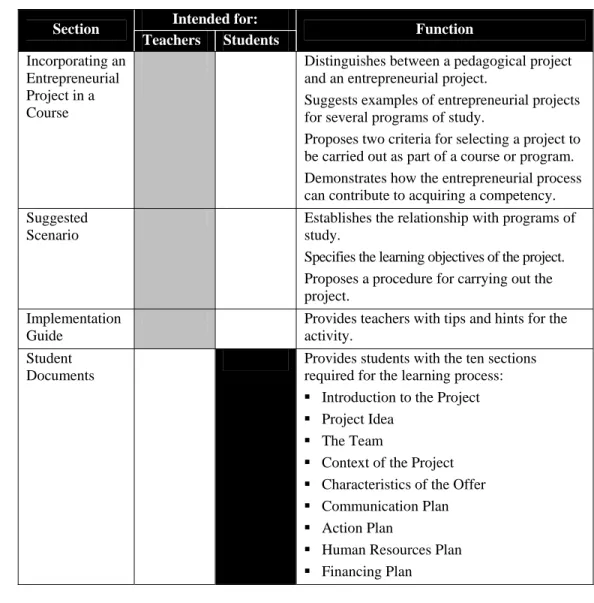
Table P.1 outlines the different sections of the guide, their intended audience and respective functions.
TABLE P.1 Structure of the guide
Intended for: Section
Teachers Students Function
Incorporating an Entrepreneurial Project in a Course
Distinguishes between a pedagogical project and an entrepreneurial project.
Suggests examples of entrepreneurial projects for several programs of study.
Proposes two criteria for selecting a project to be carried out as part of a course or program. Demonstrates how the entrepreneurial process can contribute to acquiring a competency. Suggested
Scenario
Establishes the relationship with programs of study.
Specifies the learning objectives of the project. Proposes a procedure for carrying out the project.
Implementation Guide
Provides teachers with tips and hints for the activity.
Student Documents
Provides students with the ten sections required for the learning process:
Introduction to the Project Project Idea
The Team
Context of the Project Characteristics of the Offer Communication Plan Action Plan
Human Resources Plan Financing Plan
Entrepreneurial Spirit in College 2007
P
13
ENTREPRENEURIAL PROJECT
Getting Down to Business
Intended for: Section
Teachers Students Function
Student Documents
Provides students with the ten sections required for the learning process:
Introduction to the Project Project Idea
The Team
Context of the Project Characteristics of the Offer Communication Plan Action Plan
Human Resources Plan Financing Plan
Project Implementation and Evaluation
Note: These documents are ready to be photocopied.
Project File Provides students with a guide to help them
prepare a project file. Evaluation Grid
(The Team’s Project File)
Provides teachers with a tool to evaluate student learning.
Evaluation Grid (Logbook)
Provides teachers with a tool to evaluate student learning.
References Provides teachers with additional information
sources.
Bibliography Lists the documents consulted to develop the
Entrepreneurial Spirit in College 2007
P
15
ENTREPRENEURIAL PROJECT
Getting Down to Business
INCORPORATING AN
ENTREPRENEURIAL PROJECT IN A
COURSE
Before incorporating an entrepreneurial project into a course, it is important to clearly distinguish between a pedagogical project and an entrepreneurial project. The aim of a pedagogical project is essentially to have students acquire learning related to the objectives of a course or program of study. An entrepreneurial project involves producing a product, service or event that meets an identified need; therefore, value is added to a pedagogical project. The following definitions also help clarify the difference between the two types of projects:
•
“PROJECT-BASED LEARNING: trying out and understanding concepts and principles by completing projects, in order to make specific acquisitions in the boundless realm of knowledge.•
ENTREPRENEURIAL PROJECT: producing something new, innovating, taking action to produce products, services or events that are valued in the community because they meet specific needs.”55. Introduction to Entrepreneurial Culture. Project Development Guide for Teachers, p. 27.
An entrepreneurial project involves more than the 10 per cent of students who will go on to become entrepreneurs; it targets all students, because all will be required, at one point or another in their lives, to actively participate in various forms of innovation and change in their environments.
An entrepreneurial project may focus on a single competency or on a set of competencies. A project involving a number of program competencies could be used as part of a comprehensive assessment in order to evaluate students’ overall learning. Table P.2 provides some examples of pedagogical projects with an entrepreneurial focus, as they relate to certain programs of study.
• Importance of clearly distinguishing between an entrepreneurial project and a pedagogical project • An entrepreneurial
project could take the form of a comprehensive assessment.
Entrepreneurial Spirit in College 2007
Getting Down to Business
ENTREPRENEURIAL PROJECT
P
16
TABLE P.2 Examples of entrepreneurial projects
Program of study Examples of pedagogical projects with an entrepreneurial focus
Creative Arts, Literature and Languages
• Offering services to review literature for a publishing house
• Offering services to write articles of interest to young people 17 to 25 years old
• Offering services to revise texts for a publishing house
• Offering services to write articles for a local newspaper
• Creating a touring, cooperative cultural or theatre troupe
• Offering assistance services to a group of local artists
• Producing a cultural or literary magazine
• Producing a show (e.g. readings, poetry)
• Producing a newspaper (e.g. a monthly publication) Fine Arts • Organizing an exhibit of student productions
• Designing and setting up a booth at a fair or exhibition
Music • Organizing a concert
• Offering music courses
• Creating an orchestra and producing shows
Social Science • Offering homework assistance services in an elementary school
• Starting up a nonprofit community service organization
• Organizing an international aid project
• Conducting a survey for the course in question on a subject of interest to the college
• Offering peer mentoring and assistance
• Doing volunteer work
Science • Carrying out a school/workplace project that supports certain technical programs at the college through the creation of new consumer products (e.g. Dietetics, Biotechnology)
• Offering analysis services (e.g. biomedical analyses)
• Organizing a science fair
• Offering ecosystem characterization services Biotechnology • Offering services for:
o microbiological analyses
o biochemical analyses
o product or waste toxicity analyses
o quality control
Entrepreneurial Spirit in College 2007
P
17
ENTREPRENEURIAL PROJECT
Getting Down to Business
Program of study Examples of pedagogical projects with an entrepreneurial focus
Biotechnology • Offering services for:
o microbiological analyses
o biochemical analyses
o product or waste toxicity analyses
o quality control o composting o water treatment o ferment production Building System Engineering Technology
• Offering services to prepare renovation project plans
Nursing • Designing an information booth with a health prevention theme
• Offering private homecare services
Dental Hygiene • Presenting a social economy project in a disadvantaged area
• Designing an information booth with a dental health theme
• Carrying out a fundraising project for a practicum abroad
• Carrying out a project related to a program’s achievement context, practicum outside of the program’s regular timetable where students deal with clients at a clinic
• Organizing a clinic on a theme related to dental prevention
• Writing a dental information column or series for a local newspaper, with different themes each issue (smoking, cavities, cardiovascular disease, periodontal disease)
• Preparing a dental information pamphlet on different themes for students or other target populations to be defined, that will be handed out at the dental clinic
• Designing an information booth with a screening session Dietetics • Offering services to review menus for school cafeterias and
food services in senior citizen homes
• Offering services to deliver cooked meals to senior citizens in disadvantaged areas (“meals on wheels”)
We suggest that teachers have students carry out the project in teams in order to improve the quality of the work, to allow a larger-scale project to be undertaken, to ensure that
the project is reflective of the workplace and the world of entrepreneurship, and, at the same time, to facilitate the correction of students’ work. Team projects also help
• Importance of
Entrepreneurial Spirit in College 2007
Getting Down to Business
ENTREPRENEURIAL PROJECT
P
18
students develop the entrepreneurial qualities of team spirit and solidarity. In order to evaluate the students’ individual learning, each team member will keep a logbook in which they will answer specific
questions to show what they have learned. The goal is to verify that students have integrated the recommended process and that they have met the learning objectives.
CHOOSING A PROJECT FOR STUDENTS
1st criterion: a project related to the teacher’s expertise
It is important that teachers propose project ideas that they are comfortable with so that they can help the students with their projects. Carrying out a project as a pedagogical activity requires that students explore and examine a wide array of aspects and ask their teachers questions that they may not always be able to answer. This is how a true learning process begins. It is normal for teachers not to have all the answers. What is important is that students are given guidance in how to seek answers because in the job market, as well as in many other situations, students will be required to find answers on their own. Teachers are in a position to truly help
students by providing them with tools that will enable them to find their own answers and thus become more independent and effective.
2nd criterion: a project related to the achievement context of the competency or competencies
The project must be carried out in a context that corresponds to the achievement context for the course competency or competencies. Thus, a project to have a group of students in the Food Service and Restaurant Management program develop and standardize a recipe will be carried out in the context that the program establishes for this competency, as presented in Table P.3. The teacher should therefore provide students with the relevant guidelines.
TABLE P.3 Example of a statement of competency and its achievement context6 Statement of
competency
Develop and standardize a recipe
Achievement context
• … using recipe books and other reference materials, nutrition facts tables, as well as culinary, menu, Web site and writing guidelines directories
• … interacting with cooks
• … in consultation with nutrition specialists
• … in accordance with the objectives established regarding customer satisfaction, profitability constraints and expectations
6.Québec, Ministère de l’Éducation, du Loisir et du Sport, Gestion d’un établissement de restauration. Programme d’études techniques (Québec: Gouvernement du Québec, 2005), 75 (free translation). This program is currently offered only in French.
• A logbook is used
to evaluate individual learning.
• Help students find
their own answers to questions so that a real learning process can begin.
• An example of a
project related to a competency’s achievement context
Entrepreneurial Spirit in College 2007
P
19
ENTREPRENEURIAL PROJECT
Getting Down to Business
Statement of competency
Develop and standardize a recipe
Achievement context
• … using recipe books and other reference materials, nutrition facts tables, as well as culinary, menu, Web site and writing guidelines directories
• … interacting with cooks
• … in consultation with nutrition specialists
• … in accordance with the objectives established regarding customer satisfaction, profitability constraints and expectations
• … using a word processor
Once teachers have identified projects that they would feel comfortable with and that are in line with the program’s achievement context, they must list the competencies that will be developed in carrying out the project. Using the example of developing and standardizing a recipe, the elements of the competency presented in Table P.4 list the steps that the students need to carry out for the project. The entrepreneurial project must allow students to apply this process, while at the same time adding value to the process.
Students must also apply the entrepreneurial process. Table P.5 presents an example of how the entrepreneurial process can be applied for the competency Develop and standardize a recipe. The first column outlines the steps in the entrepreneurial process, the second presents an offer of services for standardizing recipes, and the third lists some of the value added to the course’s learning process.
TABLE P.4 Elements of the competency: Develop and standardize a recipe 7
1. Search for resource recipes. 2. Plan, write and name a recipe.
3. Determine a culinary profile for the meals prepared. 4. Specify and verify the quality standards for the new recipe. 5. Calculate the cost of the recipe.
6. Test the recipe, using an experimental process. 7. Record the recipe.
TABLE P.5 The entrepreneurial process
7. Gestion d’un établissement de restauration. Programme d’études techniques, p. 75 (free translation).
• Demonstration of how the entrepreneurial process can be applied in developing a competency.
Entrepreneurial Spirit in College 2007
Getting Down to Business
ENTREPRENEURIAL PROJECT
P
20
The entrepreneurial process Offering recipe standardization servicesValue added to the course’s learning process
for the student
1. Define their project idea.
Each team gains an understanding of what is involved in offering services to standardize recipes.
• Understand the project presented by the teacher and attach their own interpretation to it. 2. Describe the team’s
strengths and weaknesses in carrying out the project.
Team members each define their personal strengths and the competencies acquired during the program that they can bring to the project.
• Identify all the resources that each student already possesses.
• Reinvest learning acquired in previous courses; this learning will take on new meaning for students.
• Identify any additional references required to carry the project through to completion.
3. Define the context of the project.
The competency’s
achievement context forms the basis for defining the project context, but entrepreneurial aspects are added: the sector of activity for this offer of services, the location, the target market, the target clientele, the potential competition and the potential income.
• Understand the context specific to the
competency and the context as it pertains to the role that this competency plays in the workplace.
• Students will not just standardize a recipe; they will standardize it for a specific clientele and will forecast potential income.
• All these aspects broaden and give additional meaning to the acquisition of the competency. 4. Describe their offer. Students clearly position
their offer. They interview potential customers, set sales prices for their services and reflect on other related aspects that will increase the value of their services.
• Concretely validate how the services can meet a need.
5. Define their The team identifies ways of informing the market of
• Discover how to communicate and reach
Entrepreneurial Spirit in College 2007
P
21
ENTREPRENEURIAL PROJECT
Getting Down to Business
The entrepreneurial process
Offering recipe standardization services
Value added to the course’s learning process
for the student
5. Define their communication plan.
The team identifies ways of informing the market of their services.
• Discover how to communicate and reach the target market. 6. Develop their action
plan.
The team specifies all the steps involved in
implementing their offer of services.
• Break down their offer of services into concrete operational steps. 7. Develop their human
resources plan.
The team prepares job descriptions to define the role of each member.
• Distribute the tasks (solidarity and team spirit). Capitalize on each member’s strengths. 8. Develop their
financing plan.
The team forecasts the potential income and expenses involved in carrying out the project.
• Analyze potential income and expenses.
• Become aware that nothing is free. 9. Implement and
evaluate the project.
Students apply the
competency in order to offer recipe standardization services; they must first demonstrate how their services meet a need in the market.
It would be interesting to actually offer their services to the college’s cafeteria, to the cafeteria of a
neighbouring school or to a restaurant in the area. The team therefore offers their services to real or hypothetical customers and presents their product or services to them. The project is then evaluated in order to identify its strengths and weaknesses.
• Apply the competency in the workplace.
• Become aware of the learning acquired.
• Students placed in a real work context will be hugely motivated by the project and will gain a great deal from it. They will no longer perceive the competency in the same light.
Students involved in this project are initiated to the entrepreneurial process, which they will be able to reinvest in other courses in their program or in another program as well as in their future occupation, regardless of whether they become entrepreneurs or intrapreneurs. • The entrepreneurial project as a comprehensive assessment
Entrepreneurial Spirit in College 2007
Getting Down to Business
ENTREPRENEURIAL PROJECT
P
22
Comprehensive assessment
It is important to emphasize that this process could easily be integrated into a comprehensive assessment for the program. In this case, the teaching team should provide students with specific projects and instructions in order to ensure that all of the competencies targeted by the comprehensive assessment are covered.
Entrepreneurial Spirit in College 2007
P
23
ENTREPRENEURIAL PROJECT
Getting Down to Business
SUGGESTED SCENARIO
1. Relationship with programs of study
TO BE DEFINED ACCORDING TO THE PROGRAM OF STUDY.
2. Targeted learning objectives
•
Contextualize the learning to be acquired as part of a course or program.•
Discover personal strengths and competencies acquired in the program that can be used to carry out a concrete project.•
Apply the entrepreneurial process as part of the learning in a program of study.•
Apply different principles to convey a message or promote an offer to a target market.3. Suggested procedure
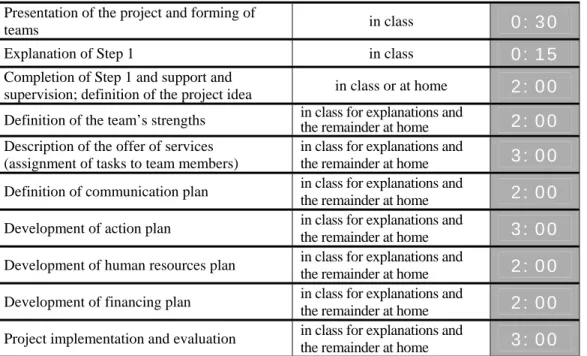
Table P.6 outlines the suggested procedure and duration.
Note: The time allotted to each step may vary significantly, depending on the number of team members and the scope of the project; it could represent half of the time estimated in the table or longer. It is important that teachers clearly define the scope of the project.
TABLE P.6 Suggested procedure and duration
Presentation of the project and forming of
teams in class
0: 30
Explanation of Step 1 in class
0: 15
Completion of Step 1 and support and
supervision; definition of the project idea in class or at home
2: 00
Definition of the team’s strengths in class for explanations and the remainder at home2: 00
Description of the offer of services(assignment of tasks to team members)
in class for explanations and
the remainder at home
3: 00
Definition of communication plan in class for explanations and
the remainder at home
2: 00
Development of action plan in class for explanations and
the remainder at home
3: 00
Development of human resources plan in class for explanations and
the remainder at home
2: 00
Development of financing plan in class for explanations and
the remainder at home
2: 00
Project implementation and evaluation in class for explanations and
the remainder at home
3: 00
• Teachers must
clearly define the scope of the project and adjust its duration accordingly.
Entrepreneurial Spirit in College 2007
P
25
ENTREPRENEURIAL PROJECT
Getting Down to Business
IMPLEMENTATION GUIDE
This section outlines the procedure and tools for conducting the project in class. The Appendix contains an example of an entrepreneurial project for a cooperative school cafeteria that was carried out for the Dietetics program. This example has been included to illustrate how students can integrate the suggested procedure. The possibilities are limitless, and depend only on the number of projects proposed, the teacher’s specific instructions, and the students’ interpretation of the projects. The suggested procedure allows students to construct their knowledge, making them the most active participants in their learning. Figure P.1 illustrates the procedure recommended to the student teams. The title of the activity, Entrepreneurial Project, appears at the centre. It is connected to the nine steps in the learning process by means of arrows. Each step is labelled and numbered. Before beginning the project, students should read the student document entitled Introduction to the Project (page 31), which presents an overview of the procedure for carrying out the project. We suggest that teachers prepare a detailed schedule for the project’s steps and plan meetings at specific times with the teams so that progress can be monitored. Dates for handing in assignments should also be planned for each step.
Figure P.1 shows the nine steps involved in the process:
1. Define the project idea
Students first read the document entitled Project Idea (page 37). Figure P.1 illustrates how this document fits into the entire process.
Students will use their creativity to interpret the project idea that their teacher has proposed. It is important that students fully understand the project idea and that they attach their own interpretation to it. In this way, the project will be very meaningful and motivating for them, and they will be more invested in it. The student document provides several “definitions” of creativity in order to help students define their project, bring out their innovative side and respond to the target clientele’s need.
The student teams will present the result of their work in the team’s project file. Presentation criteria have been recommended. An example of a completed document is included in the Appendix in order to help teachers provide appropriate support and supervision.
• A nine-step activity
• A schedule should
be prepared to help students and teachers with the various steps involved.
• Students use their
creativity to interpret the project proposed by the teacher.
Entrepreneurial Spirit in College 2007
Getting Down to Business
ENTREPRENEURIAL PROJECT
P
26
2. Describe the strengths of the team that can be used to carry out the project
In this step, students identify the personal resources of each team member as well as the resources related to the program of study or course in which the project is being conducted.
Before handing out the student document entitled The Team (page 41), teachers could first demonstrate how this course and preceding courses (general education and specific courses including contributory subjects) can help the students with their projects. This would be very useful in providing students with guidance for this step.
The entrepreneurial qualities of each team member will help them effectively carry out the project. To assist the students in identifying their entrepreneurial qualities, the teacher should conduct the Entrepreneurial Profile activity, presented in the activity guide that each college received.
3. Define the context of the project
In the student document entitled Context of the Project (page 43), students define the sector of activity and location of their project, the target market and segmentation of this market (territory, statistics and target clientele), the potential competition as well as a brief estimate of possible income. Access to a computer for the information search would be very useful for this step. The achievement context for the course or program competency or competencies must
be explained to the students so that they can take them into account when defining their project context.
4. Describe their offer
In this step, the students define the characteristics of their offer. We suggest that they conduct a short survey to help them better understand their clientele. Students will prepare a questionnaire, distribute it to about 20 people and then compile the results. The questionnaire should comprise roughly 10 questions that take 5 minutes at the most to complete. Students will be given some instructions on how to prepare their questionnaire.
The students will use the information gathered to describe their product, service or event, to establish an actual or hypothetical sales price, and to identify how they will meet their clientele’s needs and expectations. Lastly, students will identify how they will distribute their offer to their clientele.
The student document entitled Characteristics of the Offer (page 47) will help students with this step.
• Students identify
the personal resources that they have acquired through their life experience and studies and that can prove to be assets in developing the project. • The “Entrepreneurial Profile” activity could be done with students to help them identify their entrepreneurial qualities.
• The context of the
project must be imbued with the competency’s achievement context. • A product, service or event that corresponds to the expectations of the target clientele
Entrepreneurial Spirit in College 2007
P
27
ENTREPRENEURIAL PROJECT
Getting Down to Business
5. Develop their communication plan
In this step, the student document entitled Communication Plan (page 51) recommends a procedure for developing a communication plan. The students will present a schedule for the communication and promotional activities that they have selected and they will explain their choices.
6. Develop their action plan
In this step, students follow a procedure for defining their action plan. They define their needs in terms of project site and layout of the premises, and describe the steps involved in producing a product or providing a service so that they can identify the human resources required for the project. A sample of an action plan is provided. The team completes a document presenting their action plan and explaining their choices. Individually, students make an entry in their respective logbooks, explaining how they personally contributed to this step.
The student document for this step, Action Plan, is on page 53.
7. Develop their human resources plan
In this step, the students follow a procedure for defining the role of each team member in implementing the project. The team must define the task and responsibilities for each job position. Students are given an example to help them with this step.
The team completes a document that presents their human resources plan and
explains their choices. Individually, students make an entry in their respective logbooks, explaining how they personally contributed to this step. Students are also asked to make connections between the personal assessment they completed for Step 2 and the project tasks assigned to them.
The student document for this step, Human Resources Plan, is on page 57.
8. Develop their financing plan
In order to make the project as concrete as possible, the team will propose a three-step financing plan:
1) the start-up funds required 2) the sources of financing
3) the income statement forecast (examples are provided in the student document entitled Financing Plan on page 59).
The team must present their financing plan and, individually in their respective logbooks, their personal contribution to this step.
9. Implement and evaluate the project
Carrying out the project is the most gratifying step for the students. This is where they see the fruits of their labour and apply the competency or competencies required for the project. Each team member will prepare a work plan and will apply it. After the project has been implemented, students will answer some questions to help them evaluate their process and the results obtained.
• Presentation of a
schedule for communication activities
• A layout plan for
the premises, a clear procedure and identification of human resources needs • Clear definition of
the tasks of each person involved; as much as possible, the tasks correspond to each team member’s respective strengths.
• A work plan for
each person involved, according to the tasks assigned
• Students are given
questions to help them review their process.
Entrepreneurial Spirit in College 2007
Getting Down to Business
ENTREPRENEURIAL PROJECT
P
28
Teachers may add any additional criteria related to implementing and evaluating the project that they feel are necessary to verify whether the students have acquired the project competency or competencies.
The student document for this step, Project Implementation and Evaluation, is found on page 61.
Entrepreneurial Spirit in College 2007
P
29
ENTREPRENEURIAL PROJECT
Getting Down to Business
The characteristics of their offer
FIGURE P.1 Entrepreneurial Project – Suggested Procedure and Useful Documents
LEGEND:
Circles = steps in the activity Italics = documents in this guide Black rectangles = student productions
Human resources plan
ENTREPRENEURIAL
PROJECT
3. Define the context of the project 1. Define the project idea2. Describe the team’s strengths in carrying
out the project
4. Describe their offer 5. Develop the communication plan Project idea The team The characteristics of their offer (logbook) Project context Action plan (logbook) 6. Develop the action plan Communication plan Communication plan (logbook) Introduction to the project Document presenting the project (logbook) Example (support document for the teacher)
Document on their strengths and motivation in carrying out the project
(logbook)
Document presenting the context of the project (logbook)
Action plan Human resources plan
(logbook) 7. Develop the human resources plan Financing plan (logbook) 8. Develop the financing plan
The financing plan Implement the project
(logbook)
9. Implement and evaluate the project
Evaluate the project
Entrepreneurial Spirit in College 2007
P
31
ENTREPRENEURIAL PROJECT
Getting Down to Business
Student Document
INTRODUCTION TO THE PROJECT
Have you already carried out some projects during your elementary, secondary or college studies? For the most part, they were pedagogical projects. The documents that your teacher will present to you over the next few weeks deal with an entrepreneurial project. Before starting your project, it is important to distinguish between a pedagogical project and an entrepreneurial project. The aim of a pedagogical project is essentially to have students acquire learning related to the objectives of a course or program of study. An entrepreneurial project involves producing a product, service or event that meets an identified need; therefore, value is added to a pedagogical project. The following definitions also help clarify the difference between the two types of projects.
•
PROJECT-BASED LEARNING: trying out and understanding concepts and principles by completing projects, in order to make specific acquisitions in the boundless realm of knowledge.•
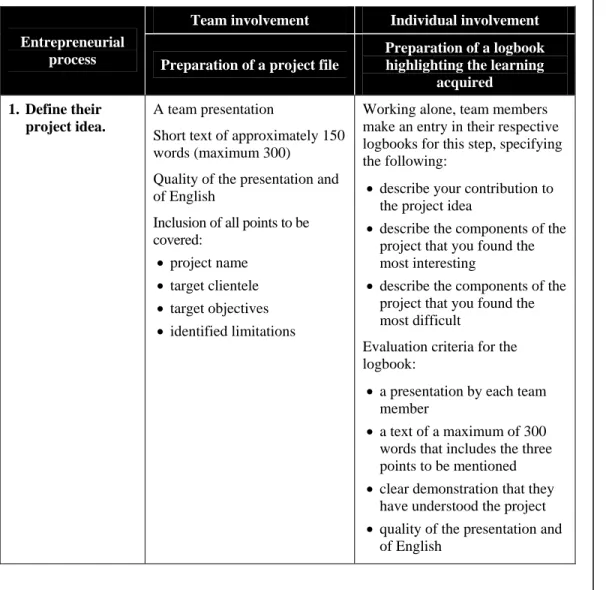
ENTREPRENEURIAL PROJECT: producing something new, innovating, taking action to produce products, services or events that are valued in the community because they meet specific needs.8 An entrepreneurial project involves more than the 10 per cent of students who will go on to become entrepreneurs; it targets all students, because all will be required, at one point or another in their lives, to actively participate in various forms of innovation and change in their studies, their life experiences and their careers.Table P.7 outlines the steps to be carried out as part of an entrepreneurial process as well as the work required of the team and each member.
8. Québec, Ministère de l’Éducation, du Loisir et du Sport, Direction de la formation continue et du soutien, Introduction to Entrepreneurial Culture. Project Development Guide for Teachers (Québec: Gouvernement du Québec, n.d.), 27 <http://www.inforoutefpt.org/mse/documents/guidemes ure_ang_compl.pdf> (25 October 2006). • A pedagogical project versus an entrepreneurial project • Series of steps to be completed in order to have an overview of the work to be done
Entrepreneurial Spirit in College 2007
Getting Down to Business
ENTREPRENEURIAL PROJECT
P
32
TABLE P.6 Steps in the project and team or individual involvement
Team involvement Individual involvement Entrepreneurial
process Preparation of a project file Preparation of a logbook highlighting the learning
acquired
1. Define their project idea.
A team presentation
Short text of approximately 150 words (maximum 300)
Quality of the presentation and of English
Inclusion of all points to be covered:
• project name
• target clientele
• target objectives
• identified limitations
Working alone, team members make an entry in their respective logbooks for this step, specifying the following:
• describe your contribution to the project idea
• describe the components of the project that you found the most interesting
• describe the components of the project that you found the most difficult
Evaluation criteria for the logbook:
• a presentation by each team member
• a text of a maximum of 300 words that includes the three points to be mentioned
• clear demonstration that they have understood the project
• quality of the presentation and of English 2. Describe the team’s strengths and weaknesses in carrying out the project.
Presentation by each team member
Presentation of a personal assessment (2 to 3 pages) Quality of the presentation and of English
Inclusion of all points to be covered:
• name and contact information
• motivation and personal objectives for the project
• time available to invest in the project
• skills (work and life
For this part of the file, students insert their personal assessment in their logbook.
Entrepreneurial Spirit in College 2007
P
33
ENTREPRENEURIAL PROJECT
Getting Down to Business
Team involvement Individual involvement Entrepreneurial
process Preparation of a project file Preparation of a logbook highlighting the learning
acquired 2. Describe the team’s strengths and weaknesses in carrying out the project.
Presentation by each team member
Presentation of a personal assessment (2 to 3 pages) Quality of the presentation and of English
Inclusion of all points to be covered:
• name and contact information
• motivation and personal objectives for the project
• time available to invest in the project
• skills (work and life experiences)
• competencies acquired during their studies
• personal entrepreneurial profile
For this part of the file, students insert their personal assessment in their logbook. 3. Define the context of the project. Text of approximately 1 000 words (5 pages)
Quality of the presentation and of English
Inclusion of all points to be covered:
• the sector and its stage of growth
• the project site (needs related to premises, availability of premises, importance of being able to easily access the premises, the costs, the planned location)
• the target market and clientele (territory, statistics)
• the competition and ways of differentiating the project
• potential income (supporting documents required)
• list of main sources of information
Working alone, team members make an entry in their respective logbooks for this step, answering these questions:
• how did you contribute to defining the context of the project? (provide a brief description)
• what were the main difficulties encountered in defining the context of the project?
• what means did you take to overcome these difficulties?
• given the information provided on the context of the project, what are the chances of your project succeeding? Explain.
Entrepreneurial Spirit in College 2007
Getting Down to Business
ENTREPRENEURIAL PROJECT
P
34
Team involvement Individual involvement Entrepreneurial
process Preparation of a project file Preparation of a logbook highlighting the learning
acquired
4. Describe their offer.
Text of approximately 800 words (5 pages) (excluding the
questionnaire and the compilation) Quality of the presentation and of English
Inclusion of all points to be covered:
• the questionnaire and the results of the compilation
• the description of the product, service or event
• establishment of sales price
• distribution of the offer
Working alone, team members make an entry in their respective logbooks for this step, answering these questions:
• how did you contribute to defining the characteristics of the offer? (provide a brief description)
• what were the main difficulties encountered in this step?
• what means did you take to overcome these difficulties?
• given the information provided up to now, do you still believe your project will succeed? Explain.
5. Define their communication plan.
Text of approximately 300 words (1½ pages)
Quality of the presentation and of English
Inclusion of all points to be covered:
• a table presenting the methods selected, the cost, the
frequency of the advertising, the duration, the dates
• explanation of the choices made
Working alone, team members make an entry in their respective logbooks for this step, specifying the following:
• briefly describe your contribution to defining the publicity and promotion
• provide your personal assessment of the methods selected
6. Develop their action plan.
Text of approximately 300 to 400 words (1½ to 2 pages) (excluding the plan)
Quality of the presentation and of English
Inclusion of all points to be covered:
• description of the project site
• description of any
improvements to be made to the premises
• description of how raw materials will be supplied for projects that involve producing
Working alone, team members make an entry in their respective logbooks for this step, specifying the following:
• briefly describe your contribution to defining the action plan
• provide your personal assessment of the methods selected
Entrepreneurial Spirit in College 2007
P
35
ENTREPRENEURIAL PROJECT
Getting Down to Business
Team involvement Individual involvement Entrepreneurial
process Preparation of a project file Preparation of a logbook highlighting the learning
acquired
6. Develop their action plan.
Text of approximately 300 to 400 words (1½ to 2 pages) (excluding the plan)
Quality of the presentation and of English
Inclusion of all points to be covered:
• description of the project site
• description of any
improvements to be made to the premises
• description of how raw materials will be supplied for projects that involve producing products
• description of the steps involved in producing a product or providing a service
• labour requirements (list only of the personnel required)
• a table presenting the action plan
• explanation of the choices made
Working alone, team members make an entry in their respective logbooks for this step, specifying the following:
• briefly describe your contribution to defining the action plan
• provide your personal assessment of the methods selected
7. Develop their human
resources plan.
Presentation in the form of a table, as shown in the example
Clear description of tasks for each job position required to carry out the project
Quality of the presentation and of English
Working alone, team members make an entry in their respective logbooks for this step, specifying the following:
• present the tasks that were assigned to you
• make the connection between your tasks and the personal assessment you conducted in Step 2
8. Develop their financing plan.
Presentation of the need for start-up funds, sources of financing and the income statement forecast Accurate calculations
Quality of the presentation and of English
Working alone, team members make an entry in their respective logbooks for this step, answering the following questions:
• how did you contribute to developing the financing plan?
Entrepreneurial Spirit in College 2007
Getting Down to Business
ENTREPRENEURIAL PROJECT
P
36
Team involvement Individual involvement Entrepreneurial
process Preparation of a project file Preparation of a logbook highlighting the learning
acquired
• what were the main difficulties encountered?
• what means did you take to overcome these difficulties?
9. Implement and evaluate the project.
Responses to the first 14 questions in the evaluation of the
entrepreneurial project
Presentation of a document in the form of questions and answers Well-supported answers provided to questions
Quality of the presentation and of English
Working alone, team members make an entry in their respective logbooks for this step, specifying the following:
• describe your contribution to carrying out the project
• present your response to question 15
• identify the main difficulties encountered
• indicate the means taken to overcome these difficulties
Entrepreneurial Spirit in College 2007
P
37
ENTREPRENEURIAL PROJECT
Getting Down to Business
Student Document
1.
PROJECT IDEA
Your teacher has given you an idea for a project. Now you need to interpret it so that you can make it your own. Brainstorm with your team members to clearly define this project idea. This document presents some tools to help you with this step: first, some notions of creativity are explored so that you can develop your own definition of the project; then, you will explain your choice; and lastly, you will identify the resources available to you to carry the project through to completion.
The project idea is based on the observation, analysis and understanding of a given situation. In fact, the project becomes meaningful when it contributes to improving quality of life or collective wealth, be it economic, cultural, humanitarian or ecological.
To enjoy the experience, the project must appeal to the team members; the members must each be able to relate to the project and want to be involved in carrying it out. In order to clearly define the project, students must be familiar with the situation presented or selected. Creativity comes into play when honing in on the situation and analyzing it. Students must demonstrate in what ways their project is innovative and how it meets a need.
The following section provides several notions of creativity that may be helpful in interpreting and defining your project.
CREATIVITY
Some people’s minds are constantly filled with new ideas; everything becomes an opportunity to explore, to experience something new. But not everyone is like this, so this section provides some tips on stimulating your creativity, so that you can use it as a distinct aspect of your personality and be an asset to your team.
First, a working definition of creativity is presented as well as the main elements that comprise it. Then, we will look at how these concepts can be used to identify the innovative aspects of a project.
Definition of creativity
The simplest definition of creativity is the ability to contribute something new. But what is “something new”? For whom? In which circumstances? etc. In fact, newness must be perceived as such by persons other than the individual introducing the new idea.
• Importance of
knowing yourself well so that you can optimize your involvement in the project. • Show your creativity in your interpretation of the project proposed by the teacher. • Creativity is the ability to contribute something new.
Entrepreneurial Spirit in College 2007
Getting Down to Business
ENTREPRENEURIAL PROJECT
P
38
According to Jacques Baronet,9 creativity is:
“the ability to regularly find solutions to problems, to construct new products, to define new questions in a given field, in a manner that is, at least initially, considered
new or original, but which is ultimately
accepted and recognized, and sometimes even compensated within a given cultural framework.”
Regularity, newness and acknowledgment of this newness are the three basic components generally present in creativity. Regularity refers to the creative person, an individual who, in the face of different situations, shows a propensity for finding solutions to problems, perceiving an opportunity in a situation or thinking of a new way of doing things. Newness is generally what is associated with creativity: it is the scoop, the originality, the audacity, the innovation. Acknowledgment by others is an important aspect, because without it, the newness does not have any value. If you are suggesting a new way of doing things, but others do not acknowledge or accept it, then this new idea has little value. Your idea must be original, but also accepted.
The creative process
An individual’s ability to find a new idea as part of a project, among other things, stems from personal knowledge of the field related to the project, which may, for example, be the field of study. The knowledge that you have acquired to date in your field of study
9. Filion, Louis Jacques et al. Réaliser son projet d’entreprise. Une initiation complète au métier d’entrepreneur (Montréal: Collection Entreprendre, 2001), 101 (free translation).
helps you perceive problems or uncomfortable situations for which you can find solutions. Your grasp of the situation, of the problem to be resolved, puts you in a state of creativity, where you can resolve this problem in an innovative manner. For example, in 1942, the chemist Edwin Land created the Polaroid when he felt a need to have immediate access to his vacation pictures. Similarly, your understanding of a problem in Peru’s daycares could result in developing a humanitarian aid project for this country. This project could propose a new approach to a problem, one that is recognized and accepted but that has not been previously used in this country: in short, an interesting opportunity to improve an existing service.
Several elements that promote creativity
The first element that fosters creativity is solitude. It is important to isolate oneself from all outside influences. Right before going to sleep is an ideal time for new ideas to emerge: rational barriers fall to the side, the imagination takes over and a state of semi-consciousness is conducive to analyzing different situations. To promote creativity, you must be open to change and be curious. These tips can help:
• write down the first idea that comes to mind, without changing or criticizing it
• note your thoughts, the ideas that cross your mind
• do things that you would normally not do, such as taking a different route home or doing a sport that you have
• Regularity,
newness and acknowledgment of this newness are the three basic components generally present in creativity.
• An individual’s
ability to find a new idea as part of a project, among other things, stems from personal knowledge of the field related to the project.
• Your idea must be
original, but also accepted.
• Tips for promoting
Entrepreneurial Spirit in College 2007
P
39
ENTREPRENEURIAL PROJECT
Getting Down to Business
never done before, cooking a new meal, watching a TV program that you do not usually watch
• frequent new places and people
In the midst of a creative process, most of all, you should not be afraid of making mistakes. If you immediately strive for the perfect idea, you will be limiting yourself and might bypass some of the best ideas. You also need to set aside enough time, because good ideas often come at the end of the process. You must persevere to the end of the process if you want to fully benefit from it.
The more you are familiar with the field of the project, the more easily new ideas will emerge that will be recognized and accepted by those working in that field.
Lastly, before choosing what you feel is the best idea, you can develop a tool to help you evaluate the ideas put forth by team members. The following questions can help you analyze ideas and choose the most appropriate for the project:
• Do you have the resources to implement this idea (people, time, money if needed, knowledge, etc.)?
• Would this idea be easy to carry out?
• Does this idea bring any interesting and innovative aspects to the project?
• Does this idea make it possible to better meet the need that was identified for the project?
DEFINING THE PROJECT
The information provided previously helped you generate a number of ideas that you can now use to define your project. Here, you will describe the basic idea for your project, its “raison d’être.” Describe your project in a few sentences: what the project entails, the field of activity concerned, where the project will be carried out. Also highlight the project’s innovative aspects, its potential, its particular features, and demonstrate how it meets the target clientele’s need. Answer the following questions when defining the project:
• What clientele is your project targeting?
• What services are you offering? It is important to clearly define your idea.
• What are your project’s objectives?
• Do you have any limitations in terms of time available to devote to the project, skills, geographical location? Do you need a team?
Your definition must clearly describe the nature of your project, the main features of the product or service, and the target market. It may prove interesting to see what your family and friends think about your project. They might even have some interesting ideas that could improve it. Take the opportunity to also find a name for your project.
• Your definition must
clearly describe the nature of your project, the main features of the product or service, and the target market.
Entrepreneurial Spirit in College 2007
Getting Down to Business
ENTREPRENEURIAL PROJECT
P
40
PRESENTATION CRITERIA
A team presentation
Short text of approximately 150 words (maximum 300)
Quality of the presentation and of English Inclusion of all points to be covered:
• project name
• target clientele
• target objectives
• identified limitations
THE LOGBOOK
Working alone, team members make an entry in their respective logbooks for this step, specifying the following:
• describe your contribution to the project idea
• describe the components of the project that you found the most interesting
• describe the components of the project that you found the most difficult
Evaluation criteria for the logbook:
• a presentation by each team member
• a text of a maximum of 300 words that includes the three points to be mentioned
• clear demonstration that they have understood the project
• quality of the presentation and of English