HOME
MAGAZINE
News and comment
Radio cellular and wireless Test and measurement REFERENCE AND TUTORIALS NEWS
EXHIBITIONS CALENDAR JOBS
BOOK SHOP
BOOKS BY IAN POOLE ABOUT US
ADVERTISE
3G Long-Term Evolution - Testing Times »
Using DVB-RCS to Bring the Internet to Remote Areas
Axel Jahn, Managing Director of TriaGnoSys, shows how DVB-RCS can be used to provide Internet access in remote areas of the World to bring huge benefits to people, businesses and communities. With difficulties in providing sufficient bandwidth to remote areas, DVB-RCS offers significant advantages, providing a system that can operate over wide areas at a workable cost.
The ever-increasing bandwidth available has extended the positive impact of the Internet, with the addition of more and more applications. There are areas of the world, however, where there is no Internet access of
Satellite Broadband
Find Satellite Internet Providers. The Online Business Directory.
www.business.com
Military GPS Time Servers
Supports Satellite Communication Configure Yours Today!
Brandywinecomm.com/Military-Time
Satellite Internet
Serving US Military Low cost exceptional service
www.oifnet.com
OFDM and DVB-H Courses
3-Day OFDM on Dec 9-11 in Munich 1-Day DVB-H on Dec 12 in Munich
any form or description, let alone broadband access - for example, broadband penetration is currently around 3% in Latin America, against an average of around 20% within the EU. The areas where broadband access is the least are often the very poorest ones, where the tools the Internet provides can bring significant positive benefits, from business development, to healthcare and education, to emergency services, as well as simply to widening leisure opportunities. Broadband connectivity using satellite technology is ideally suited to large inaccessible land masses such as those of rural South America.
BRASIL Project
A group of European companies, funded by the European Union, is using the very latest Digital Video Broadcast (DVB) via satellite standard to bring broadband Internet connectivity to the most rural areas in Latin America. The consortium, called the Broadband to Rural America over Satellite Integrated Links (BRASIL), is working with European as well as South American suppliers to provide fast, cost-efficient and reliable access to the Internet. The BRASIL project (SSA-045546) is funded by the European Union in the 6th
Framework programme. Digital Video Broadcasting-Return Channel via Satellite, DVB-RCS, was originally designed for video broadcast, but it has now been developed into a two-way high-capacity IP-based communications access solution. Today for example, it is the backbone of many tactical military systems such as the US Department of Defense GlobalBroadcast System, and for mission-critical civilian agency internal networks in the US. The key to future widespread adoption, however, is the use of the new generation of Digital Video Broadcast by Satellite: DVB-S2. The new DVB-S2 standard represents a massive leap in term of bandwidth efficiency compared to the former DVB-S standard. The performance improvement is typically around 30%, but in some circumstances it can be up to 130%, e.g. in overcast and/or rainy conditions because DVB-RCS is able to cope better with adverse propagation conditions like these. The key benefit of these efficiency savings is that much higher bandwidth can be supplied at lower cost. These improvements are as a result of two key developments. The first is an improved physical layer, which provides several higher order modulation waveforms with more powerful Forward Error Correction (FEC). The second is real-time adaptation to link and propagation conditions. In terms of FEC, DVB-S2 provides an efficiency saving of around 11% by significantly reducing the probability of an undetected error. Because there is a much smaller chance of an error, the need for a Cyclic Redundancy Check is removed, so that element of protocol overhead can be discarded, thereby reducing the overall size of the packet. In terms of adapting to link and propagation conditions, DVB-S2 can operate in three modes, each more efficient than the last.
The first is Constant Coding and Modulation (CCM), which provides a similar level of performance as DVB-S. In this mode, the signal is encoded and modulated using a single fixed Modulation Format and Coding Scheme (ModCod). The ModCod used is selected to be sufficiently robust to provide what is effectively error-free reception, based on the lowest common denominator. That means that a receiver at the very edge of the satellite coverage will be able to receive sufficient signal in the worst weather. The downside is that there is significant redundancy, and therefore waste, when
communicating with receivers in the centre of satellite coverage and in clear weather.
The second mode is Variable Coding and Modulation (VCM), which can provide an efficiency improvement of up to 60% against CCM. The individual worst-case channel performance expected at each receiver within the footprint of the satellite is considered. Using this information, a preferred ModCod is assigned for each terminal and that assignment typically does not change during transmission. For example, terminals with larger antennas or nearer the centre of the satellite beam will be able to receive and decode physical layer frames with less protection, whereas those with smaller antennas or at the edge of coverage will require higher protection levels. Also, ModCods can be selected to suit the services intended for each receiver, as well as the expected weather conditions. However, it is the Adaptive Coding and Modulation (ACM) that is the real key to the second generation of DVB by satellite because this provides the most significant performance benefits. ACM allows a
transmitter to select the most appropriate ModCod on a frame-by-frame basis for each baseband frame - the main framing unit used in DVB-S2 - depending on the geographical location and size of the destination terminals, the services going to that receiver, and the current weather conditions. It can use either feedback
from each receiver to monitor signal to noise plus interference (SNIR), for example from rain, or it can be pre-programmed with an estimated SNIR, with the return channel being used to report the receiving conditions at each receiving site. See Figure 1.
Figure 1. ACM in action
DVB-RCS User Groups
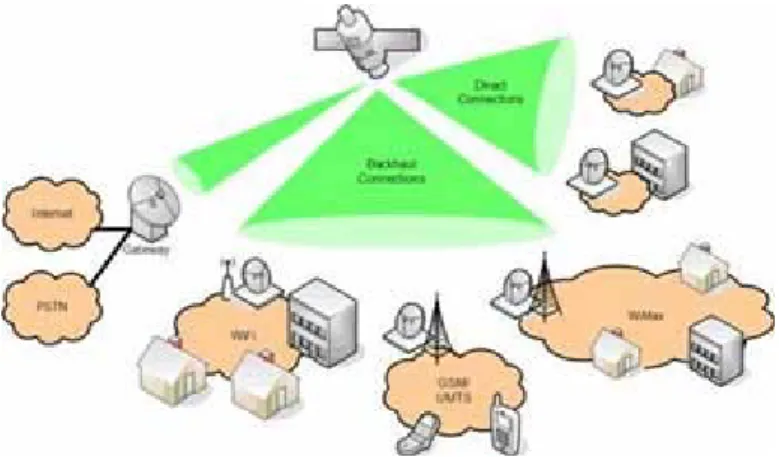
As well as being used to access remote areas, a second reason why DVB-RCS is perfectly suited for the BRASIL project is that it can be used to provide communication services to user groups. The local telecoms companies operate a user terminal, which receives the signals via an antenna that is between one and two metres in diameter, depending on the terminal location and satellite coverage. Local users - be they domestic, business or governmental - are then connected to the terminal. (See figure). End uses can then access services using their own equipment - GSM mobile phones, laptop and desktop computers and so on - connected via a wide range of standards, including WLAN, WiMax, UTRAN for UMTS, GPRS or GSM.
Figure 2 Dissemination of DVB-RCS
Finally, DVB-RCS is an open standard, not a proprietary one. That means that barriers to entry are low, giving a wide range of companies access to the market. This is of particular importance for the BRASIL project, which has a focus on generating business for small and medium sized enterprises in both Europe and Latin America.
Case study: DVB-RCS in Algeria
After ten years of internal conflict in Algeria, and little or no telecommunications infrastructure investment, the Government recognised the need to develop the internal communications system rapidly. Algeria is the second largest country in Africa after Sudan and has great wealth from natural gas and mineral deposits, attracting substantial foreign investment. However, the lack of communications infrastructure - only 20%
of households had a telephone and the fibre infrastructure outside of the capital was almost non-existent. This has made it difficult for companies to operate, particularly outside Algiers, and specifically in the southern desert areas of the country where most of the mineral deposits are located. In 2004 the
Government encouraged Algeria Telecom to initiate a country-wide DVB-RCS based Internet solution to help overcome its lack of communication infrastructure. Previously, the Internet had only been available in large towns, and even then there was no guarantee it would be broadband. Algeria Telecom Satellite’s (ATS) first target customers were banks and companies including mining and oil companies seeking to exploit virtual private network technology. They also provide solutions to cyber cafés across the country and are now focusing on governmental needs such as embassies’ internal security, border control, military communications, healthcare and distant learning. By the end of 2006, ATS had installed more than 2,000 satellite terminals across Algeria, with several hundred more terminals on order. The banking industry in Algeria has started deploying Automatic Teller Machines across the country that update account details in seconds, where before it took several days for changes to be registered. The banks, and other companies with multiple offices, are also using the system to deploy VoIP telephony for internal communication. And cyber cafés, regardless of where they are, can now provide high speed Internet connectivity for the first time. The economies in scale from which ATS has benefited allow SME customers to buy their own equipment and purchase a cost-effective monthly subscription that is within their reach. In the most recent development, ATS is running several tests with the Ministry of National Education, to provide both public Internet services, as well as Intranets, for universities and secondary schools. It is applications such as these that the BRASIL project is seeking to replicate in Latin America. The objective of the project is to provide DVB-RCS services through a network of SMEs across Europe and Latin America. It will do so through a combination of building direct contacts with relevant SMEs and by running symposiums in Latin America, for example at Futurecom in Sao Paulo in October. Further information about the BRASIL project can be obtained by visiting the website at www.dvb-brasil.org.
-Dr Axel Jahn is Managing Director of TriaGnoSys (www.triagnosys.com), a leading provider of mobility satellite communications solutions for remote mobile air, sea and land communications from anywhere to anywhere via satellite.
This entry was posted on Thursday, September 11th, 2008 at 8:43 pm and is filed under Radio cellular and wireless. trackback from your own site. -->
Satellite Internet
Serving US Military Low cost exceptional service
www.oifnet.com
OFDM and DVB-H Courses
3-Day OFDM on Dec 9-11 in Munich 1-Day DVB-H on Dec 12 in Munich
www.hueggenberg.com
Military Wireless
GSM/CDMA/3G, Rapid Deployment Visit us at MILCOM '08, Booth #1726
www.tecore.com
T.James Telecoms Ltd
Installation and Maintenance Wireless and Switched networks
This site is operated and owned by Adrio Communications Ltd and edited by Ian Poole. All information is © Adrio Communications Ltd and may not be copied except for individual personal use. This includes copying material in whatever form into website pages
While every effort is made to ensure the accuracy of the information on this site, no liability is accepted for any consequences of using it. By using this site, these terms are accepted.
Privacy Policy
Ads by Google
Ultra-Crea/RF
Design
Custom designed RF Filters and Antennas
from 10 MHz to 6 GHz