(will be inserted by the editor)
Continuously Mining Distributed Version Control
Systems: An empirical study of how Linux uses git
Daniel M German · Bram Adams · Ahmed E. Hassan
Received: date / Accepted: date
Abstract Distributed version control systems (D-VCSs—such as git and
mercurial) and their hosting services (such as Github and Bitbucket) have revolutionalized the way in which developers collaborate by allowing them to freely exchange and integrate code changes in a peer-to-peer fashion. However, this flexibility comes at a price: code changes are hard to track because of the proliferation of code repositories and because developers modify (“rebase”) and filter (“cherry-pick”) the history of these changes to streamline their inte-gration into the repositories of other developers. As a consequence, researchers and practitioners, who typically only consider the (cleaned up) history in the official project repository, are unaware of important elements and activities in the collaborative software development. In this paper, we present a method that continuously mines all known D-VCSs of a software project to uncover the complete history of a project’s development. We use this method to (1) show the divergence between the code history in the official Linux kernel repository and the complete kernel development history, and (2) to investigate the char-acteristics of the ecosystem of gitrepositories of the Linux kernel. Finally, we discuss how continuous mining could be adopted by current D-VCS hosting services.
Daniel German University of Victoria E-mail: [email protected] Bram Adams
Polytechnique Montr´eal E-mail: [email protected] Ahmed E. Hassan
Queen’s University
1 Introduction
Distributed version control systems (D-VCSs) have taken the open source ecosystem by storm. Since initial development of D-VCSs in the early 2000s (arch and monotone) and their breakthrough for open source development in the Linux kernel development community (bitkeeperand git), D-VCSs are quickly replacing the predominant centralized version control systems (C-VCSs) like CVS and Subversion. For example, by the end of 2013 Ohloh, a directory indexing more than 500,000 open source projects, reported that 29% of the tracked projects usegitand 5% use other D-VCSs likemercurialand
bazaar, compared to 52% using C-VCS Subversion and 11% using CVS (Black Duck Inc., 2013). Similarly, the Eclipse 2012 Community Survey with 732 open source participants reported that githas replaced CVS as the second most popular version control system, with 23.2% (almost double the adoption of 2011), right behind Subversion, with 46.0% (Foundation, 2012).
The success of D-VCSs is due to the flexibility that they provide as well as the emergence of D-VCS hosting services like Github and Bitbucket. One of the most fundamental characteristics of a D-VCS is that it allows each developer to have her own repository and to exchange change-sets with other developers in a peer-to-peer fashion. As such, each developer can decide which code changes are worthwhile to integrate into her repository and which ones are not. Hence, code changes propagate throughout developer repositories until they reach the primary project repository (we will refer to this repository as blessed) containing the “official” code base. Creating and hosting a D-VCS repository has become relatively trivial through the advent of hosting services, which offer 1-click access for cloning an existing D-VCS repository and making the new clone accessible for other developers.
The ability to access the public repositories of developers in addition to the official blessed repository (we use the term “Super-repository” for the set of all repositories of a project) makes it possible to obtain a more complete view of development activities. For example, it might be possible to observe if work is cleaned up before it is sent to blessed, or if some changes are never prop-agated to other repositories and developers. Hence, the data in all developer repositories would provide a potential gold mine for research on development processes, collaboration, software evolution and socio-technical congruence, as well as for practitioners who want to monitor their development progress.
To understand how developers use the features of D-VCSs in practice, we studied the use of the git D-VCS in the Linux kernel project. The Linux kernel is arguably one of the largest open source software systems ever devel-oped, with over 10,800 developers having contributed to its development since 2005 (Corbet et al, 2013). It was also at the forefront of the move towards D-VCSs. Our case study on the Linux kernel enables us to study the following research questions:
– What are the characteristics of the repositories in the Linux Super-repository?
– How do the repositories of aSuper-repository interact with each other and how do commits flow across them?
However, during our study, we observed that current repository mining methods are unable to exploit the rich set of development data stored in D-VCSs. In particular, there are three major challenges that have stopped traditional mining methods from leveraging the rich data available through D-VCSs. First,commits do not keep track of which repositories they have passed through. This is even true for online services like Github and gitorious, which track when a merge is performed, as well as its source and des-tination repositories, but do not explicitly track the commits that are moved
in such a request. Second, D-VCSs recommend developers to rewrite
(rebase) their development history, if necessary, to facilitate easier
integration of their work into other repositories(Bird et al, 2009b; Cor-bet, 2008a). This rewriting ranges from merging, splitting or deleting change-sets to changing their order (i.e., creating a copy and destroying the original commit). Third, when merging a change-set into another repository, developers are also encouraged to filter (cherry-pick) only the in-teresting portions and ignore the rest. Due to these three challenges, the actual development history of projects that use D-VCSs is permanently lost, making traditional analysis of code change history incomplete and potentially unreliable in a D-VCS repository.
In order to address our two research questions, this paper replaces the traditional “snapshot-based mining” (snapMining) of D-VCS repositories by a “continuous mining” (continuousMining) method. Whereas snapMining
merely analyzes the list of code changes in the blessed D-VCS repository,
continuousMining continuously crawlsallknown D-VCS repositories multiple times a day to record and analyze all new change-sets. As such, continuous-Mining not only yields more accurate development history, it also allows us to study phenomena that are impossible to study using onlyblessed, like rebas-ing and cherry-pickrebas-ing, and to study integration activities involved in movrebas-ing commits throughout the repositories on their way toblessed. To evaluate the effectiveness of continuousMining (which is a prerequisite for the other two research questions), we study the following research question:
– Does continuousMining expose any bias in the project history recovered using snapMining?
The contributions of this paper are:
– A method (and its implementation) to mine D-VCSs that relies on the continuous mining of the distributed repositories. Based on this method, we also implemented a git-history tracking dashboard to improve traceability of commits in the ecosystem of Linuxgitrepositories.
– We compare the use of continuousMining tosnapMining and show that:
– continuousMininguncovers significantly more development activity and a larger ecosystem thansnapMining.
– continuousMining can monitor the propagation of commits across repositories and identify when they arrive atblessed.
– Cherry-picking and rebasing make commit identifiers (ids) insufficient to track change-sets across repositories. They also make the commit date and the committer metadata unreliable.
– An empirical study of how Linux developers usegit, i.e., we:
– show that one can identify different kinds of repositories in the Linux ecosystem, each of which has a different role, such as: repositories for producers of patches, for integrators, and for product lines (e.g., versions of the kernels distributed by Android, SUSE, Redhat and Ubuntu).
– show that commits with new features take longer and visit more repos-itories on their way toblessed than commits that fix bugs.
2 Background
In this section, we introduce the nomenclature that we will use, then briefly introduce the Linux development process and how it usesgit.
2.1 The D-VCSSuper-repository
In C-VCSs all commits happen in a central repository. Only developers with write-access can contribute to this repository. The main development activity takes place on the so-called “trunk” of the repository (the repository’s main codeline), whereas more experimental features are developed on “branches” (other codelines), before being merged back into the trunk or abandoned.
D-VCSs, such asgit, take a radically different approach. Instead of making a working copy of the state of a repository at a particular time, the developer clones the whole history of a repository (the trunk and all branches), and develops inside her local repository. Any repository can be cloned, and, from a conceptual point of view, no repository is more important than any other. In practice, the development team will organize the repositories in a social hierarchy and at least one of the repositories will be marked as the central repository (its blessed repository), where the latest team-approved changes are expected to be found.
Any contributing developer aims her changes to flow from her personal repository toblessed, using one of three methods: by “pushing” them to the destination repository (if she has write-access–this is equivalent to committing to a centralized version control repository); by letting someone with write-access to the destination repository “pull” the changes in; or by emailing the set of commits to a person who has write access to the destination repository (D-VCSs allow exchange of commits via email with full commit history tracking). Conceptually, we can model the collection of all repositories of a project as if it were a single repository, which we call the project’sSuper-repository. The “trunk” of this Super-repository is the trunk of the blessed repository. The trunk and branches of all public (available to all teammates) and private
(accessible only to their owner) repositories that were (recursively) cloned from the same repository are branches of the Super-repository. The set of all commits in the Super-repository is the union of all commits in each of its repos, hence each commit in the Super-repository exists in at least one repository in theSuper-repository. Every time a developer pulls, pushes from another repository, or incorporates commits that she received via email, she is effectively merging one branch (in the source repository) into another one (in the destination repository). Such a merge might result in a new commit that records the merge, a so-called merge-commit, in contrast to the non-merge commits, which contain the actual code changes. Merge-commits link together branches, and correspond to integration work.
2.2 Linux andgit
In order to study the use of D-VCSs in practice, this paper analyzes the Linux kernel, which arguably is one of the most globally distributed software systems ever developed. According to the Linux Foundation, nearly 10,000 developers from over 1,000 different companies have contributed to the Linux kernel since 2005 (Corbet et al, 2013). The requirements imposed by such a large and diverse team, working on a codebase of more than 44,000 files, has prompted many innovations in the area of distributed version control systems.
In 2002, Linux decided to start using bitkeeper, a commercial D-VCS system. According to the Linux Weekly News, the adoption of bitkeeperby the Linux development team became a success: “The rate at which patches were merged skyrocketed, the developers were happy, and the whole system ran smoothly.”(Corbet, 2005). This improvement was attributed to the re-placement of a workflow based on email patches with a workflow based on multiple distributed repositories that could merge their changes with minimal user intervention. In 2005, Linus Torvalds decided to stop using bitkeeper, and replaced it withgit(his own implementation of a D-VCS). Because git
was built with the Linux workflow in mind, one can expect that Linux devel-opers exercise most of git’s features.
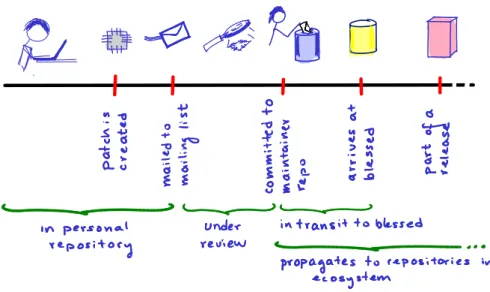
Anybody who wants to contribute to Linux is expected to clone one of its public repositories, and implement his or her contribution locally on top of such a clone. After the contributions are completed, they are sent to a mailing list for review (these emails are prepared using git’s email patch feature). Once the contribution is approved, it is committed by a member of the Linux development team into a repository. The newly created commit will record as its author the original creator and as its time of authorship the time when it was created in the author’s repository (before it was emailed). The committer and commit date of the newly created commit will reflect who integrated this commit into the receiving repository. gitalso implements a method to trace the review and mail-patch process via sign-off fields that get added to the message of each commit. These sign-off fields usually reflect the original author
Fig. 1 Life of a patch. A patch is created in a private repository. After that, the patch is sent to one of the kernel mailing lists where the patch might be picked up by a module maintainer, who signs it off and commits it to her public repository. From there, the patch (inside a commit) starts to be propagated to other repositories, eventually reachingblessed. This paper concentrates on the propagation of a patch in the ecosystem of public repositories, once the patch has been accepted by a module maintainer.
of a commit, the module maintainer who first committed to her repository, and other individuals involved in the review.
Once commits are in the git repository of the module maintainer, they start to propagate (via push and pulls) to other repositories, until eventually, they reach blessed (the repository of Linus Torvalds). Some commits might not go through a review process. In that case, they move from their source repository toblessed via push and pull operations between individual reposi-tories. Such commits might still include a sign-off field with the name of the person that first committed the change. This person will be recorded as both the author and committer of the commit. Figure 1 depicts the life of a patch. Since personal repositories are only accessible by their owners, we concentrate on the movements of commits in the ecosystem of public repositories.
2.3 Challenges Introduced by D-VCSs
In order to understand how software projects like the Linux kernel use a D-VCS likegit, we first need to address the three major challenges introduced by D-VCSs: (Bird et al, 2009b): (1) once a repository is merged into another, the history does not contain information about the location from where the commits originated, except for any optional commit log information stored in merge-commits (if these merge commits were created); developers can alter
the history of commits in their repository by (2) moving commits around (rebasing) or (3) filtering the commits (cherry-picking). We first discuss these challenges, and in the next Section presents our method to resolve them.
2.3.1 No Traceability of Commits across Repositories
Paradoxically, D-VCSs assume an self-centred view of the world. A repository does not keep track of other repositories in theSuper-repository; and a reposi-tory does not keep track of the commits that occurred in other repositories and have not propagated to it1. Commits receive a unique identifier upon creation
using a hash function (gituses SHA-1) of the contents of the commit, i.e., its metadata2, patch and parent commits. Since the slightest change to the
meta-data would alter the SHA1, the commit cannot accumulate any information about the repositories through which it has passed on its way toblessed. Only merge-commits (if these commits are created) might contain, as part of their commit message, information about the address (URI) of the branch being merged, but this depends on the discipline of the developer doing the merge.
2.3.2 Commits are Moved Around
Rebasing is the act of moving commits from their current location (following an older commit) to the new head (newest commit) of their branch (Chacon, 2009). Developers use rebasing to make their changes work with the newest changes committed in the parent repository (e.g.,blessed), and to make their repository easier to integrate into other repositories. Because rebasing changes the ancestors of a commit, the SHA1 of the commit itself changes as well (even if the rest of the metadata remains the same) and this results in a new commit ID for the same change, losing traceability with the old commit.
2.3.3 Commits are Filtered
Cherry-picking is a process that allows a developer to select one or more parts from a larger change-set in the source repository and only apply those in the destination. As with rebasing, cherry-picking a commit will change the com-mit’s ID because the ancestors of the destination are likely different than in the original repository. Also, the dropped parts of a change-set in the source repos-itory might be discarded by dropping the branch in which they reside. Again, possibly important development history disappears, making it impossible to retrieve a complete history fromblessed.
1 Even services on top of D-VCSs, like Github, do not provide a way to know the set of
all commits in aSuper-repository, i.e., the commits that have already arrived toblessed and those that are still in other repositories.
2 The metadata consists of the time during which the commit was first committed
(au-thorship date), the name of the author, the time when it was last committed (commit date), the committer, and the commit message.
3 Continuously Observing Events as They Happen
To overcome the three challenges described in Section 2.3, we need to be able to observe, over time, the commits as they are created in their original repository, the propagation of commits across repositories and, potentially, whether commits are deleted or rebased.
Traditionally, researchers have mined only the blessed repository of a project that uses a D-VCS, i.e., the final version of accepted commits. We will refer to this as the “snapshot method” (snapMining). Unfortunately, this method is not able to see how commits move across repositories, and misses ac-tivities that are not propagated toblessed. Also, the history of the interactions between the various development repositories is lost.
If D-VCSs had a central logging feature3, we could simply exploit such logs. However, even hosting services for D-VCSs do not provide full tracking of commits. For example, Github only tracks cloned repositories if the cloning operation is done inside Github’s web interface too, and Github tracks the origin of commits in a merge only if such a merge was the result of a pull-request. An in-depth explanation of this lack of traceability can be found in Gousios et al (2014) and Kalliamvakou et al (2014).
The alternative is to continuously query each repository in a Super-repository, discovering their new commits and those commits that these repos-itories no longer contain. Such continuous querying will allow us to know when and where commits are created, and how they propagate to other repositories. Along the way, new repositories in theSuper-repositorywill be discovered. We have developed a method to achieve this, which we call: continuous min-ing of distributed version control repositories, and we refer to it as
continuousMining.
UsingcontinuousMining, it is possible to retrieve: a) the repositories that compose the Super-repository, and for each of them, its owners (the devel-opers that have commit privilege to it), and its branches; and b) the set of all commits in the repository, and for each commit, the moment at which it appears and/or is deleted in each repository in theSuper-repository. Continu-ousMining is composed of three steps: 1)Initializing the set of repositories, 2)
Crawling process, and 3)Reviewing commits and discovering new repositories.
These steps are depicted in Algorithms 1 and 2, while their output is described in Table 1.
3.1 Initializing the set of repositories
At the very beginning of the mining process, the Super-repository (i.e., the set of known repositoriesR) will contain, at the very least, the blessed repos-itory of a project and any other known and accessible reposrepos-itory used by the project. We found that projects typically publish the locations of their main repositories. Services like Bitbucket, Github and Gitorious also cross-reference
Table 1 The output of our method forcontinuousMining. Name Description
R set of known public repositories
Owners set of tupleshperson, repoiindicating thatperson can commit inrepo
C set of commits inSuper-repository
P rop set of tupleshc, r, tishowing that commitchas propagated to reporat timet
Del set of tupleshc, r, tishowing that commitcis deleted from a reporat timet
B set of tupleshb, c, r, tishowing that branchbin reporhad commitcas its head at timet
hosted repositories that have been cloned from each other (as long as these clones are created within these services).
3.2 Crawling process
This step is fully automated. Every fixed time interval τ, each repository r
in the Super-repository is queried for changes (part I of Algorithm 1). If r
has changed, we record its new commits (including the metadata and patch of the commit), which commits were deleted, and the list of branches that each repository currently has. We timestamp this information with the time at which we updated the repository.
A major challenge is that this process is not atomic, i.e., we cannot stop people from updating the various repositories while we perform a scan. There-fore, we have to deal with two issues: a) commits that have been propagated between scans, where we do not find the new commit in its true origin, but in a repository to which it has been propagated; and b) finding commits that originated in new repositories that are not yet in our list of repositories. For this, we keep a list of theownersof every repository. The owner of a repository is the name of the person that can commit to that repository. A repository might have more than one owner. We deal with variations in names by first unifying the names of developers and their email addresses using a method similar to Bird et al (2006).
If a new commitcappears in repor, but committer(c) is not an owner of
r, then we mark the commit for review (see part II of Algorithm 1).
3.3 Reviewing commits and discovering new repositories
As described above, the crawling process finds, at every iteration, commits that need to be reviewed. This reviewing process is described in Algorithm 2 and it is semi-automated (usually conducted once a day). It is composed of two phases. The first phase is automated: for each commit c to review, we automatically verify if the commit is created by the owner of the repository (we
Algorithm 1: Crawling process
input :τ an interval of time between scans of the repositories
output:Rset of known repositories inSuper-repository
output:Cset of all commits inSuper-repository
output:P ropset of tuples each showing when a commit is observed arriving at a repository
output:Delset of tuples each showing when a commit is deleted from a repository
output:Bset of tuples showing a branch, the repository where it is observed, and its head
output:T oReviewset of tuples containing commits that are likely created in a repository not inSuper-repositoryyet and that must be manually reviewed C←P rop←Del←Branches←Owners← ∅;
R←known repositories inSuper-repository(at leastblessed); Make a local clone of every repo inR;
repeatat intervalsτ
I forevery repositoryrinRdo
Synchronize the local copy ofr;
if rchanged since last scanthen
t←current time;
new←commits not previously seen inr; Del←Del∪commits deleted inr; B←B∪new branches inr;
forevery commitcinnewdo
P rop←P rop ∪ hc, r, ti;
forevery commitcinnewbut not inCdo if hcommitter(c), ri∈/Ownersthen
II T oReview←T oReview ∪ hc, r, ti
else
C←C ∪c
might have updated the list ofOwnersof that repository since the time this commit was added toT oReview—see partαof Algorithm 2). Otherwise, we verify if the same commit was found in the same iteration or in the immediately next one in a repositoryr1such that thecommitter(c) is one of theOwners(r1) (see partβ of Algorithm 2). In that case, we tag the commit as coming from
r1and remove it from T oReview.
The second phase is manual (although we have developed scripts to help us with it). For every commit, we first inspect the commits that follow it, and if there is a merge, and the merge is by a different committer, then we manually inspect this merge to find if it refers to an unknown repository r2. If r2 is unknown, we cloner2, process it for the first time, identify its owners, and, ifc
is found inr2and the committer ofcis an owner ofr2, then we markcas having originated inr2 (see part γ of Algorithm 2). Otherwise, we scan the mailing lists and web sites of the project to determine if thecommitter(r) should be added as an owner ofr(partδ of Algorithm 2). Although we have developed tools to help with this phase, it requires manual intervention. Fortunately, we
Algorithm 2: Reviewing commits and discovery of new repositories. input :T oReviewset of tuples containing commits that are likely created in a
repository not inSuper-repositoryyet and that must be manually reviewed
output: UpdatesR,Owners,CandT oReview–see Table 1.
forevery tuplehc, r, ti ∈T oReviewdo // automated process
α if committer(c)∈owner(r)then
T oReview←T oReview− {hc, r, ti};
β else if hc, r1, t1i ∈P ropsuch thatt1−t < Iandhcommitter(c), r1i ∈Owners
then
setr1as the true origin ofc;
C←C ∪c;
T oReview←T oReview− {hc, r, ti};
forevery tuplehc, r, ti ∈T oReviewdo // req. manual intervention
γ if cis followed by a merge and the merge refers to an unknown repor2then
Make a local clone ofr2;
Processr2using sectionAofM ining;
Owners←Owners∪owners(r2);
if committer(c)is one ofowners(r2)andcis seen inr2 then
setr2as the true origin ofc;
C←C ∪c;
T oReview←T oReview− {hc, r, ti}; R←R ∪r2;
δ else if there is other evidence thatcommitter(c)is an owner ofror
committer(c)made many commits torthat are never followed by somebody else’s merges then
C←C ∪c;
Owners←Owners∪ hcommitter(c), ri; T oReview←T oReview− {hc, r, ti};
expect that (1) a short intervalτ minimizes propagation before new commits are found and that (2) over time the number of newly discovered repositories will decrease.
We have implemented continuousMining for git as a set of perl scripts with a relational database (postgresql) as its backend. We have run it continu-ously on Linux since November 2011. Since then, we have identified 2.3 million different commits from 635 repositories (as of Sept 2013).
4 Empirical Study
In this section, we present an empirical study of how Linux uses git as a concrete case study of how D-VCSs are used in practice. Through this study, we achieve two goals: first, we demonstrate thatcontinuousMining is effective at providing a richer picture on the use of gitthansnapMining, and second, we present an in-depth study of howgitis used by Linux developers.
Thus, we ground our empirical study on the following three research ques-tions:
– RQ1. Does continuousMining expose any bias in the project history re-covered usingsnapMining?
– RQ2.What are the characteristics of the repositories in the Linux Super-repository?
– RQ3. How do the repositories of a Super-repository interact with each other and how do commits flow across them?
4.1 Setup
The goal of this empirical study is to compare the information recovered using the two mining methods:snapMining andcontinuousMining. The subject of this study are the commit activities of the Linux kernel developers during 2012.
4.1.1snapMining
As the blessed repository, we use the git repository of Linus Torvalds. We made a clone of his repository on Jan 2, 2013. We extracted the metadata, and the patch of all commits performed in 2012.
4.1.2continuousMining
We started mining the Linux Super-repository in Nov 9, 2011. The mining performed during 2011 was used to fine-tune the implementation of continu-ousMining, to gather a substantial part of all repositories, and to determine the mining intervalτ.
4.1.3 Initializing the set of repositories
We seeded our list of repositories with those found in git.kernel.org on Nov 9, 2011 (193 repositories). We settled for a mining interval τ of 3 hrs, since a) it took approximately 2 hrs to complete a mining iteration, and b) only 1.4% of commits were propagated in such a time window. Considering that most public repositories of the Linux kernel are updated a median of once every 12 days, and very few were updated daily, it is unlikely that reducingτwould find many commits that are added to a public repository, and then deleted before a scan in that repo is performed. A shorterτ would have reduced the number of iterations where a commit had propagated before it was first discovered but this effect was already very small.
4.1.4 Crawling process
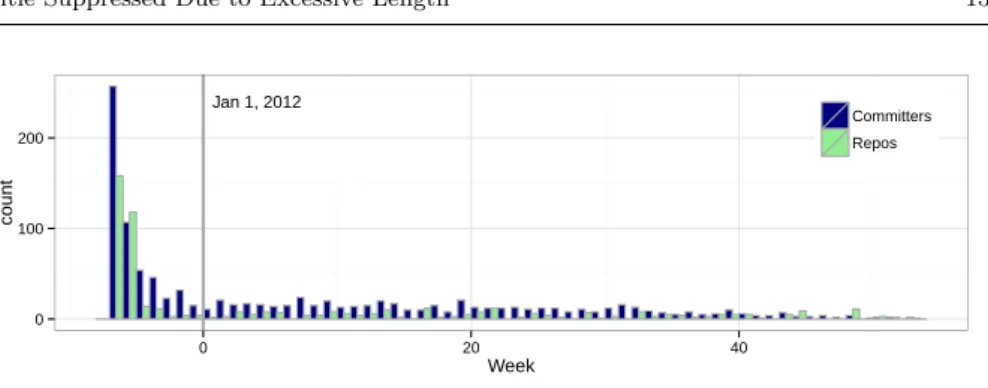
The growth of the number of crawled repositories can be seen in Figure 2. By Jan. 1, 2012 we were crawling 262 repositories and by the end of 2012 we were crawling 530 repositories. However, only 479 of these 530 repositories had
Jan 1, 2012 0 100 200 0 20 40 Week count Committers Repos
Fig. 2 Number of new repositories and committers discovered per week. Week 1 corre-sponds to the first week of 2012. The spike on the left hand side correcorre-sponds to the final weeks of 2011, the period during which we were discovering the majority of the repositories in the ecosystem.
at least one new commit during 2012. We completed 32,945 repository-crawls that found at least one new commit.
4.1.5 Reviewing commits and discovering new repositories
This step automatically fixed the origin of 1.4% of the commits (7,714). As described in Section 3, we incorrectly attributed these commits during con-tinuousMining, because pulling changes from repositories is not transactional. Hence some commits were copied between repositories while we were doing our crawling. We manually processed 0.7% of the commits (3,925) that had originated in previously unknown repositories. Frequently, a scan would result in many new commits that were resolved at once. For example, on April 20, 2012 we had to manually process 852 commits, but all of them came from the same unknown repository. The output of this step included the list of owners of each repository. Figure 2 shows the growing number of committers that were identified. We estimate that the amount of work invested to do this manual analysis was approximately 50 hours during the first two weeks of mining, and 2-3 hours per week after that.
By January 2012 we were confident that we were mining most of the ac-tive and publicly accessible repositories in the Linux Super-repository, and we were tracking commits from the first public repository in which they were seen. As withsnapMining, for each commit we recorded its metadata and any associated patches.
We observed that the same patch would appear in the
Super-repository with different commit ids. For that reason, we computed a
patch id using the following method: first, using ’git log --patch’ we extract the entire patch of the commit (it might contain changes to one or more files); second, we remove all index lines (index lines are used internally by git to indicate the SHA1 identifier of the exact files the patch applies to) and, from each hunk, the line numbers where the hunk is to be applied. For example, the patch:
index 6936e0a..f748cc8 100644 --- a/drivers/pnp/driver.c +++ b/drivers/pnp/driver.c
@@ -197,6 +197,11 @@ static int pnp_bus_freeze(struct device *dev) return __pnp_bus_suspend(dev, PMSG_FREEZE);
}
+static int pnp_bus_poweroff(struct device *dev) ...
becomes:
--- a/drivers/pnp/driver.c +++ b/drivers/pnp/driver.c
@@-@@ static int pnp_bus_freeze(struct device *dev) return __pnp_bus_suspend(dev, PMSG_FREEZE); }
+static int pnp_bus_poweroff(struct device *dev) ...
Finally, we compute the SHA1 checksum of the resulting patch (all changes to all files in the commit). Patch ids allow us to uniquely identify a contribution (patch), even when it is committed multiple times and its commit id changes (for example due to rebasing or cherry picking). A merge commit usually does not contain a patch, unless there was a conflict in the branches that it merges. In the latter case, the merge commit’s patch contains the changes needed to resolve the conflict. Hence, a commit might have zero or one patches associated with it.
4.2 Comparing the Information Recovered usingcontinuousMining and
snapMining
Table 2 Basic statistics performed on the commits from 2012, based on the two mining methods.
Metric cont. snap Ratio
cont./snap
Active repositories 479 1 479
Unique commits 533,513 64,029 8.3 Unique non-merge commits 485,027 58,953 8.2 Unique merge commits 48,486 5,076 9.5 Unique patches (patch ids) 135,352 58,355 2.3 Unique author email addresses 5,646 3,434 1.6
Unique authors 4,575 2,883 1.6
Unique committer email addresses 1,185 283 4.2
Unique committers 1,058 245 4.3
For each commit, we record its metadata, the repository where it is created, whether it is a merge or a non-merge, its associated
patch and its patch id. The basic statistics of the mining processes of
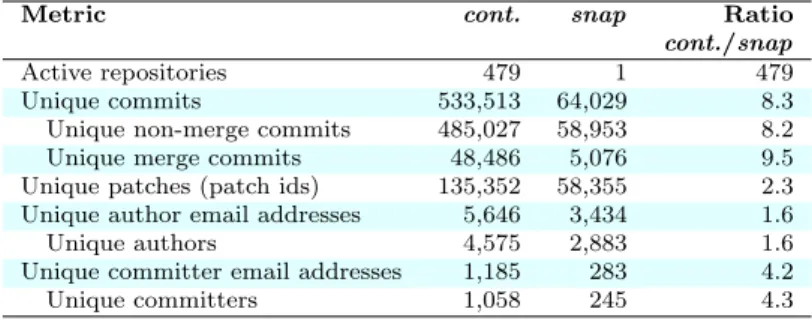
snapMining and continuousMining are reported in Table 2. As can be seen,
usingcontinuousMining we observe 8.3 times more commits, and 2.3 times more patches in theSuper-repository than inblessed.Hence, a patch is found in an average of 3.6 commits (135,352 patches across 485,027 non-merge commits). The additional number of patches in Super-repository
compared toblessed implies that there is a large amount of contributions that are not reflected inblessed. These contributions could be (1) rejected patches, (2) patches that were still in transit by the end of 2012 (end of our mining), or (3) development that is never expected to reach blessed (such as product line-type customizations). Rejected commits often keep on wandering around in at least one repository, making them hard to distinguish from commits that are still in transit. Between January 1st and Dec. 15th, 2013, only 931 (1.2%) of these patches had arrived atblessed.
With respect to the development team, the number of different au-thors and committers in theSuper-repository was, respectively, 1.6 and 4.3 times larger than those discovered usingsnapMining.These individuals collaborate using 479 different repositories. There is a low per-centage of committers who managed to have a patch accepted into blessed
(23.2%). This implies that 76.8% of the committers observed in the
Super-repository are not visible in blessed.However, we observed that,
of the 479 repositories, 360 (75.1%) had at least one commit contributed to
blessed.
continuousMininguncovers significantly more activity and a larger ecosys-tem of developers thansnapMining.
5 Results
The following subsections present the results for our research questions. For each research question, we discuss its motivation, the concrete findings in the Linux kernel project as well as the new opportunities for research that are opened up. While RQ1 focuses on bias introduced by snapMining, RQ2 and RQ3 highlight the richness of the data produced bycontinuousMining, since it enables new types of questions and analyses.
RQ1.DoescontinuousMining expose any bias in the project history recovered usingsnapMining?
Motivation
It is expected that by mining more repositories one would recover not just more complete data, but also a more accurate picture of the development pro-cess than by mining blessed only. However, one important question is if this
additional data exposes bias (i.e., significant differences) in the information recovered fromblessed using snapMining compared to the information recov-ered usingcontinuousMining? Such a bias might give an incorrect view of the development process. Our data collection showed that there were 2.3 times more new patches, and 8.3 times more commits in theSuper-repository than in blessed (see Section 4.2). Without rebasing, each patch would correspond to exactly one commit. Hence, rebasing seems to be common, which means that the metadata of commits (commit message, author, committer, dates of authorship and commit) might change across different incarnations (commits) of the same patch. In other words, what is observable in blessed might be significantly different than what is actually happening.
Even though blessed provides an accurate account of which commits have been accepted into a project, its view of the development history is reactive: a commit only becomes visible in blessed once it has been integrated (Jiang et al, 2013), even though the commit might have been around in the Super-repositoryfor months. For example, if one analyzes on a certain day the number of commits per week for each of the past weeks, one obtains a distributionD1. If that night, the maintainer ofblessed merges 1,000 new commits4, and the next morning one generates a new distribution (D2) of the number of commits per week for each of the past weeks, the two distributions can be substantially different, with certain periods in the past suddenly exhibiting a large number of commits. continuousMining on the other hand enables pro-active tracking of a commit (with respect toblessed) from the moment that it enters its first repository.
Findings:
RQ1.1 Regarding the relationship between commit ids and patches
At the beginning of our research we naively expected that every commit con-tained a different patch. However, when we discovered that the number of commits in theSuper-repositorywas 8.3 more than inblessed we hypothesized it was because the same patch was occurring in different commits. As described in Section 4.2, the number of commits in the repo was 533,513, but we only observed 135,352 different patches. For this reason we decided to look at the distribution of the number of commits in which a given patch appears. The number is heavily skewed, with an average of 3.7 commits per patch in the
Super-repository and 55% had one commit per patch. Table 3 shows the com-parison between patches and commits seen inblessedand theSuper-repository. Note that 482 patches appeared in at least two commits inblessed—we ver-ified every one of these commits and they contained non-trivial patches. We believe that this is the result of cherry-picking: the same patch is integrated into different development branches (each resulting commit will have a dif-ferent commit id) and when the second branch is merged into blessed, git 4 During 2012, there were 19 days where Linus merged at least 1,000 commits on the same
recognizes that the patch has already been applied (when the first branch was merged), and ignores the patch in the second commit. Although more work is needed to understand what kind of patches undergoes such cherry-picking, the implication of this result is thatin a Super-repository, the commit id cannot be used to uniquely identify patches as they move across repositories (and their branches).
Observation #1a: In a Super-repository, the same patch can appear in different commits, making commit ids insufficient to track patches in the
Super-repository.
Table 3 Comparison between patches and commits inblessed and theSuper-repository.
Super-Blessed repository
Number of Non-merge commits 58,953 485,027
Number of patches 58,356 135,532
Ratio of patches to non-merges 98.9% 27.9% Ratio of non-merges committed in 2012 that reachedblessed 12.1% Ratio of patches that reachedblessed 43.1%
Since we track commits from their origin, we know when a commit in
blessed contains a patch that was previously seen in another commit (that didn’t reach blessed), hence we are in the position to measure how many commits in blessed have different commit metadata than the earlier commit version. If we assume that the original metadata is correct, the different commit metadata could introduce bias in the data that is mined from blessed using
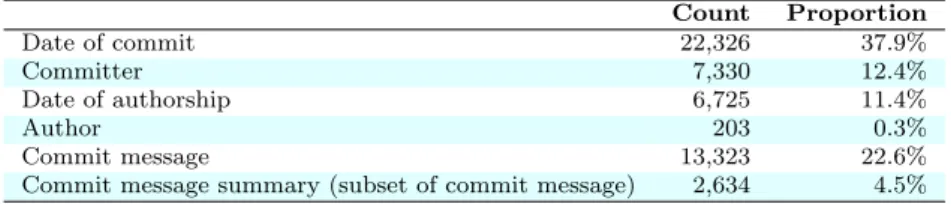
snapMining. Table 4 shows these commits, classified by the observed type of change in metadata.37.9% of the non-merge commits found inblessed
were later copies of an earlier commit that contains the same patch. This means that more than one third of commits were re-commits of the same change, and hence, had their date of commit changed. For these commits,the median difference in time between the first version of the commit and the one that arrived in blessed is 14.2 days. In other words, for 18.9% of the commits inblessed, the actual commit date is skewed by at least 14 days. Furthermore, in 11.4% of the changes inblessed, the authorship date was changed (a median difference of 10.9 days). Our results show empirically thatcommit date and even author date metadata inblessedis biased, which means that relying on the metadata stored in blessed likely gives a partially-incorrect representation of what really happened.
RQ1.2 Regarding rebasing
Of these metadata changes, we suspected that basic rebasing of commits might be one of the most common causes. As discussed in Section 2.3.2, simple
Table 4 Breakdown of changes in the metadata of patches for commits inblessed that are copies of earlier commits containing those patches. Committer and author names have been unified to account for changes in email addresses.
Count Proportion Date of commit 22,326 37.9% Committer 7,330 12.4% Date of authorship 6,725 11.4% Author 203 0.3% Commit message 13,323 22.6%
Commit message summary (subset of commit message) 2,634 4.5%
rebasing5occurs during a synchronization with another repository (
git pull) when a locally-developed codeline is detached from its location and re-attached after the latest pulled commit in the same branch. We identify simple rebasing as follows: if during a scan of a repository, a commit is deleted from this repository, and, in the same scan, a new commit appears in the same repository with the same patch id as the deleted one, we mark this new commit as a simple rebase of the deleted commit6.
In the Super-repository, 20% (27,856) of patches had been simply rebased at least once. This rebasing has the side effect that the commit-date of the pre-rebase commit is lost and the new commit has the commit-date of the pull. Such re-committing helps explain why sometimes developers appear to commit many changes in a very short period of time. For example, we observed that, during 2012, in thirteen occasions a developer committed more than 100 changes in one minute, whereas what actually happened was the automatic simple rebasing of those changes (during a git pull). Other common rea-sons for rebasing are modifying the commit message to improve the commit summary or to add tested-by, and signed-off-by fields. The large proportion of changes in metadata between the first commit containing a patch, and the commit that arrives at blessed with the same patch shows that, at least in Linux, rebasing is a common activity that introduces substantial bias in the data that is mined from blessed using snapMining.
Observation#1b:continuousMining exposes substantial bias in the com-mit’s date and committer name as recorded bysnapMining.
RQ1.3 Regarding the arrival of commits atblessed
Commits need to move from the repositories where they are first seen to
blessed. We wanted to explore any patterns in the arrival of the commits to
blessed, To do so, we looked at the rate at which they arrived atblessed over time. Figure 3 shows the number of commits authored (green) and committed
5 SeeThe Basic Rebaseinhttp://git-scm.com/book/ch3-6.html. 6 Simple rebasing is usually performed automatically during a
git pulloperation with the option--rebase.
● ● ● ● ● ● ● ● ● ● ● ● ● ● ● ● ● ●● ● ● ● ● ● ● ● ● ● ● ● ● ● ●●● ●● ● ● ● ● ●●● ● ● ● ● ● ● ● ● 0 2500 5000 7500 0 10 20 30 40 50 Week Number of Commits Date ● Arrival date Authorship date Commit date
Fig. 3 Number of commits per week based on three criteria: authorship date, commit date, and date-of-arrival atblessed(only includes commits committed in 2012). Both authorship and commit date have a fairly uniform distribution; however, the date of arrival atblessed
peaks on the week of a release or right after—which are depicted as vertical dashed lines.
(blue) per week in the Super-repository, and compares them to the number of commits arriving (red) into blessed per week. The overall authoring and committing of commits in theSuper-repository is more or less uniformly dis-tributed over the year, only slightly peaking around releases (vertical dashed lines). However, if we look at when these commits arrived atblessed, we notice that most of them are merged in the so-calledmerge window, i.e., the two weeks after a major release. After these two weeks, only bug fixes are permitted7.
This pattern is not surprising: it similar to that of multi-branch development (using centralized version control systems), in which developers continue with their work (e.g. new features) while their completed work is being tested and integrated into a current release. The implication of this result is that the many repositories of Linux act as branches where new features and bug fixes are constantly being developed. Once these work-items are completed, they move into blessed in a well defined pattern that starts with the release of a version (and the beginning of the integration of the next one). The signifi-cant difference between centralized and distributed repositories in this regard is that in the centralized repo all the activity is visible at once, while in the distributed one, only the commits that have reachedblessed are visible (unless one mines the rest of the repositories, as we have done in this research).
Table 5 shows the number of non-merge commits per release, for each merge window in 2012. This table shows that the number of commits that Linus Torvalds accepts during the merge window is significantly larger than during the bug-fixing window, while the total number of commits per release is relatively constant.The arrival of commits at blessed shows a well-defined periodicity around releases, i.e., the Linux “merge window”.
Observation#1c:continuousMining can monitor the propagation of com-mits across repositories and identify when such comcom-mits arrive atblessed.
Table 5 Number of commits for the merge and bug-fixing windows of each release, and the percentage of commits that contain “fix” or “bug” (capitalization ignored) at least once in its entire commit message (denoted asMsg.) or their one-line summary (denoted asSum.).
Rel Merge Incl. fix/bug Bug-Fix. Incl. fix/bug Total
Window Msg. Sum. Window Msg. Sum.
3.2 9,459 24.6% 15.8% 1,955 57.3% 42.9% 11,415 3.3 9,858 26.5% 17.5% 1,969 57.5% 41.2% 11,828 3.4 10,068 22.5% 13.3% 1,702 60.1% 42.1% 11,771 3.5 9,160 23.6% 15.1% 1,968 56.4% 41.9% 11,129 3.6 11,083 25.2% 15.4% 1,920 56.5% 42.4% 13,004 3.7 11,737 24.1% 15.4%
RQ1.4 Regarding commits that arrive during the bug-fixing window
As we have seen, Linus Torvalds designates a bug-fixing window: any non-merge that arrives during this window is expected to be a bug-fix. This gives an opportunity to evaluate one common method to identify bug fixes. Researchers—such as Mockus and Votta (2000); Hassan (2008)—often assume that commits with the strings “bug” or “fix” in their commit message are defect fixing commits. Table 5 shows for every window (both merge and bug-fixing) the number of commits that contain the strings “bug” or “fix” in the summary (the one-liner that describes the commit), or the detailed commit message—the average length of the commit message in Linux was 10.25 lines. The summary is part of the commit message.
During the bug fixing windows only 2 in every 5 commits contain the strings “bug” or “fix” in their one-line summary, and 3 out of 5 in the detailed description of the commit message. Hence, those heuristics seem to miss a significant number of bug fixes.
We inspected the commit messages and summaries during the bug-fixing windows, and in many of these bug-fixes the commit message does not state explicitly that they fixed a bug (and by consequence neither does their commit summary), instead the commits mention the action that the developer took to fix it, e.g.: “md: Avoid write invalid address if read seqretry returned true...”, “md/raid5: Make sure we clear R5 Discard when discard is finished...” and “md: make sure everything is freed when dm-raid stops an array..”.
However, the commit messages of commits that merge these fixes into
blessed often contain fix. For example, the three commits mentioned above were merged together with the commit message “Merge tag ’md-3.7-fixes’ of git://neil.brown.name/md ... Fixed a recently introduced deadlock”. Other examples of such merge-commit messages are: “Pull SELinux fixes from ...”, “Merge tag ’gfs2-fixes’ of ...”, “This batch of changes is mostly clean ups and small bug fixes.” and “Pull MIPS fixes from ...”. This implies that the commit message of the merge that incorporates commits intoblessed
can be an important source of information when trying to identify bug fixes. In fact, 88% of merges in the bug-fixing window contained “bug” or “fix” in their commit message (compared to only 48% in the merge window).
Because it is possible to identify the merge that merges a commit intoblessed, it is possible to identify bug-fixing commits with information extracted from
blessed usingsnapMining.
Observation #1d: continuousMining provides a pro-active view of a project’s development history (with respect to the information stored in
snapMining) and uncover patterns of development otherwise invisible.
Opportunities:
To understand a development process in full, one needs to use continuous-Mining, since it can uncover patterns of top-level integration that are other-wise lost in the recorded history of blessed. Furthermore, continuousMining
provides the opportunity to explain some of the large differences in activity between the entireSuper-repository andblessed (Table 5).
We observed that the number of accepted commits (including the number of bug-fixing commits) seems more or less stable for each release, with around 10,000 commits in the merge-window, and 1,900 commits in the bug-fixing window. Hence, it seems that the project has a kind of constant development capacity, however it is not clear why this is the case and if this is a long-term phenomenon.ContinuousMining of the Super-repository would provide researchers with development information that can help understand such an interesting phenomenon.
In addition, an advantage of identifying the arrival time of a commit in
blessed is that one can tag with a high level of confidence the commits that arrive during the bug-fixing window as bug-fixes. For instance, during the bug-fixing windows, we found that not all commits in the bug-fixing window contain the wordsfix orbug (see Table 5). One could exploit this information to improve current models for automated identification of bug-fixing commits (e.g., Tian et al (2012)) and to identify potential for bias, in a way similar to that found in bug databases—as reported by Herzig et al (2013).
Another advantage of monitoring the arrival of commits at blessed is that we can categorize bug-fixing commits into those that are discovering during the development of the new-features (those accepted during the merge-window and that contain “bug” or fix”) and those that are created to fix a bug that are found after integration has taken place. We know that it is important to discover defects as soon as possible. With this data we can add a new dimension to studies of defect-fixing activities that separates bugs-fixes into those two categories.
One of the most important lessons that we have uncovered in this research question is that the commit-date reflects the last time a patch was committed, and at least in Linux, 37.9% of commits in blessed have been recommitted (22.6% had their commit message reworked too). This means that, unless this phenomenon is taken into account, studies should not rely on this date. As shown in Table 4, these change in metadata of a patch from its first instance
to the one that arrives at blessed could be a potential threat to validity to studies that rely on the commit or authorship time, or the name of the com-mitter. Especially the bias in author data is worrisome, since many studies have considered this data to be much more reliable than commit data. By tracing commits throughout the Super-repository, one can understand what prompts developers to change commit metadata like author names in the first place. The fact that commits change their id makes it difficult to map to their origin in the mailing list. A shift in dates could also increase the difficulty to map the bug fix to the bug-report. On top of that, it is not clear if commits in Linux are entangledKawrykow and Robillard (2011)
Rebasing and cherry-picking in D-VCSs are activities that have not been studied in detail. How does rebasing help integration? What prompts some-body to cherry-pick a particular change?
As we have observed, commits in blessed are successful ones. They have arrived atblessed from other repositories where they are expected to be tested and chosen for integration. When we study only theblessedrepository of Linux, we are only studying commits that have gone through this vetting process. The entireSuper-repositoryis similar to an enormous centralized repository where development happens in multiples branches (each branch in each repository would be equivalent to one branch in this centralized repo). Concentrating in
blessed is similar to only studying the main integration branch of a software project (not even the older releases of Linux are found inblessed–as we will discuss in RQ2). Development in Linux is probably not that different from development in a large organization that does multi-branch development, as those described in Shihab et al (2012) and bird12. Future research should compare these two development models.
We can conclude that the answer to “RQ1.DoescontinuousMiningexpose any bias in the project history recovered usingsnapMining?” isYes.
RQ2. What are the characteristics of the repositories in the Linux Super-repository?
Motivation:
Up until now, we treated theSuper-repositoryas a collection of “equal” repos-itories, each of them serving up commits to blessed. However, the extremely low percentage (23.2%) of committers having commits accepted into blessed
suggests that not all commits are intended to be sent towardsblessed. Some repositories belong to automatic integration servers like linux-next8, which “is intended to be a gathering point for the patches which are planned to be merged in the next development cycle” (Corbet, 2008b). Yet, other repos-itories contain experimental or niche features that do not benefit everyone.
ContinuousMining allows us to study the different types of repositories and their development activities, and the interactions between them.
Findings:
RQ2.1 Regarding Activity
New Patches New Commits New Merges New NonMerges 0 1 10 100 1000 10000 Count
Originating in repo Contributed to blessed
Fig. 4 These bean plots show the distribution of the number of different patches and number of different types of commits that originated in each of the 459 repositories, and how many of them were contributed toblessed. The left side (in black) is the total count for each type, while the right side (in grey) is the size of the subset that were contributed toblessed. The horizontal lines are the median values for each set.
We identified 459 different repositories that contributed at least one commit to theSuper-repositoryduring 2012. We observed a very wide variance in both their activity, and the way they contributed to blessed. To illustrate their differences both in terms of activity and their contributions to blessed we first identified how many patches and commits originated in each repository. For patches, we only considered patches that we first observe in 2012. For each patch that was first seen in theSuper-repository in 2012, we record the repository where it first appeared. We also label each of these patches as contributed to blessed or not. We do the same for commits: we record the first repository where a commit is seen, and whether this commit is contributed to
blessed. The Figure 4 shows using bean plots the distribution of the number of patches and commits originating from each of the repositories. Each sides of bean plot corresponds to a density distribution of the number of repositories have a given count. The left hand side of each bean plot (the black section) is the total number of patches or commits (we also show the distributions for the two types of commits: merges and non-merges). The right hand side (grey) is the number of them that were contributed to blessed. The horizontal lines represent the median number. For instance, the median number of patches that originated in a repository was 84, but only a median of 28 of these patches
reached blessed. This implies that most repositories had a good proportion of patches that did not reached blessed. The same applies to the number of commits (median of 198 new commits per repository; median of 23 contributed. Also, it can be seen that many repositories never contribute commits toblessed. When commits are divided into merges and non-merges, it can be observed that many repositories never created any merges (41% of repositories had no merges, and in general a median of 2 merges per repository). It also shows that some repositories never contributed non-merges, implying that these reposito-ries’ activity never reachedblessed.
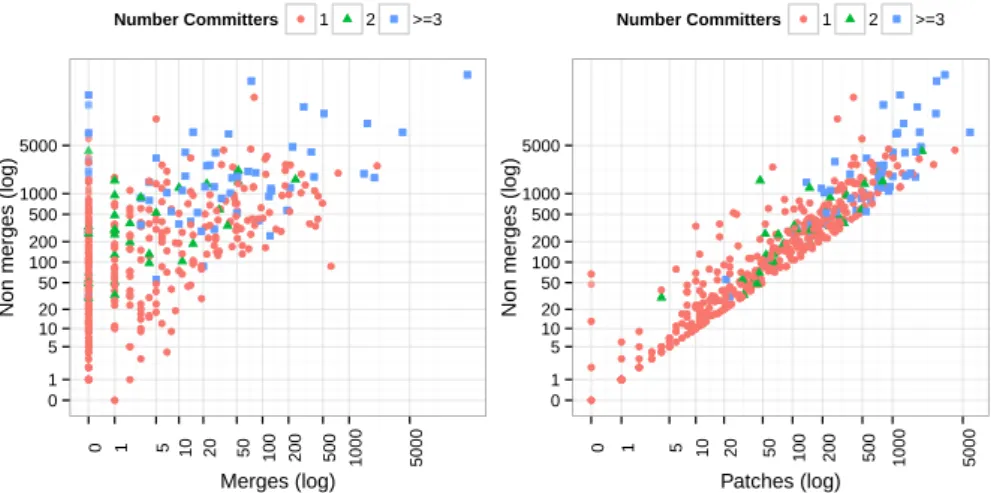
● ● ● ● ● ● ● ● ● ● ● ● ● ● ● ● ● ● ● ● ● ● ● ● ● ● ● ● ● ● ● ● ● ● ● ● ● ● ● ● ● ● ● ● ● ● ● ● ● ● ● ● ● ● ● ● ● ● ● ● ● ● ● ● ● ● ● ● ● ● ● ● ● ● ● ● ● ● ● ● ● ● ● ● ● ● ● ● ● ● ● ● ● ● ● ● ● ● ● ● ● ● ● ● ● ● ● ● ● ● ● ● ● ● ● ● ● ● ● ● ● ● ● ● ● ● ● ● ● ● ● ● ● ● ● ● ● ● ● ● ● ● ● ● ● ● ● ● ● ● ● ● ● ● ● ● ● ● ● ● ● ● ● ● ● ● ● ● ● ● ● ● ● ● ● ● ● ● ● ● ● ● ● ● ● ● ● ● ● ● ● ● ● ● ● ● ● ● ● ● ● ● ● ● ● ● ● ● ● ● ● ● ● ● ● ● ● ● ● ● ● ● ● ● ● ● ● ● ● ● ● ● ● ● ● ● ● ● ● ● ● ● ● ● ● ● ● ● ● ● ● ● ●● ● ● ● ● ● ● ● ● ● ● ● ● ● ● ● ● ● ● ● ● ● ● ● ● ● ● ● ● ● ● 0 1 5 10 20 50 100 200 500 1000 5000 0 1 5 10 20 50 100 200 500 1000 5000 Merges (log)
Non merges (log)
Number Committers ● 1 2 >=3 ● ● ● ● ● ● ● ● ● ● ● ● ● ● ● ● ● ● ● ● ● ● ● ● ● ● ● ● ● ● ● ● ●● ● ● ● ● ● ● ● ● ● ● ● ● ● ● ●● ● ● ● ● ● ●● ● ● ● ● ● ● ●● ● ●● ● ● ● ● ● ● ● ● ● ● ● ● ● ● ● ● ● ● ● ● ● ● ● ● ● ● ● ● ● ● ● ● ● ● ● ● ● ● ● ● ● ● ● ● ● ● ● ● ● ● ● ● ● ● ● ● ● ● ● ● ● ● ● ● ● ● ● ● ● ● ● ● ● ● ● ● ● ● ● ● ● ● ● ● ● ● ● ● ● ● ● ● ● ● ● ● ● ● ● ● ● ● ● ● ● ● ● ● ● ● ● ● ● ● ● ● ● ● ● ● ● ● ● ● ● ● ● ● ● ● ● ● ● ● ● ● ●●● ● ● ● ● ● ● ● ● ● ● ● ● ● ● ● ● ● ● ● ● ● ● ● ● ● ● ● ● ● ● ● ● ● ● ● ● ● ● ● ● ● ● ● ● ● ● ● ● ● ● ● ● ● ● ● ● ● ● ● ● ● ● ● ● ● ● ● ● ● ● ● ● ● ● ● ● ● ● ● ● ● ● ● ● ● ● ● ● ● ● ● ● ● ●● ● ● ● ● ● ● ● ● ● ● ● ● ● ● ● ● ● ● ● ● ● ● ● ● ● ●● ● ● ● ● ● ● ● ● ● ● ● ● ● ● ● ● ● ● ● ● ● ● ● ● ● ● ● ● ● ● ● ● ● ● ● ● 0 1 5 10 20 50 100 200 500 1000 5000 0 1 5 10 20 50 100 200 500 1000 5000 Patches (log)
Non merges (log)
Number Committers ● 1 2 >=3
Fig. 5 The scatterplot on the left shows for each repository its number of non-merges and merges, while the one on the right compares non-merges to patches.
Figure 5 allows to explore the relationship between merges and non-merges, and non-merges and patches (a patch can exist in many different non-merges). As can be seen, there is a large proportion of repositories that do not have merges, which implies that they do not perform any integration work. Regard-ing patches to non-merges, we can observe that many repositories, regardless of their size, create new non-merges from previous ones (the result of rebasing or cherry-picking).
Observation #2a: The activity in the repositories varies widely, and in most repositories non-merges heavily outnumber merges. Many reposito-ries do not have any merge commits, implying that they do not integrate other repositories’ work.
RQ2.2 The Roles of Repositories
One would expect that most commits end inblessed. However, that is not the case. The right hand side of the bean plots in Figure 4 show the distributions
of the contributions to blessed. One noteworthy result is that 22% of the repositories did not contribute a single commit to blessed (99 repos-itories). To further explore the contributions of repositories to blessed, and their role in the ecosystem, we computed, for each repository, the following metrics:
– Ratio of patches contributed to blessed. Number of patches created in the repository divided by the number of patches that made it toblessed. This ratio gives us an indication of whether patches created in this repos-itory are intended forblessed or not.
– Ratio of patches to non-merge commits. If this ratio is low, this implies that the repository is rebasing patches (from itself or somewhere else). A ratio of 1 implies that every patch is found in exactly one commit.
– Ratio of patches to merge commits. The lower this number, the more integration that the repository is doing. When this metric is undefined (the number of merge commits for a repository is zero), this repository is not doing any integration work.
Figure 6 uses these metrics to plot all the repositories. The X-axis corre-sponds to the total number of commits produced by the repository (a measure of its activity), while the Y-axis is the ratio of patches contributed toblessed. Using the median of each axis, the plot is divided into four quadrants. Each point is annotated in three ways: a) whether it is an official repository (is the repo hosted on kernel.org?), depicted by its shape; b) the ratio of patches to non-merge commits (how much rebasing is there?), depicted as its size (smaller means more rebasing); and c) the ratio of patches to merge commits (how much integration is there?), depicted as its colour (a warmer colour– closer to red–means more integration, while grey means that the repository had no merges).
The repositories in the top two quadrants have most of their patches con-tributed toblessed, i.e., they arecontributorsof patches. 15% of the repos-itories had all their patches contributed to blessed. The lower part of the right bottom quadrant contains active repositories that rarely contribute to
blessed, hence they areconsumersof commits fromblessed. These reposito-ries are summarized in Table 6, which shows the most active repositoreposito-ries with at most a 5% ratio of patches contributed toblessed. All of these repositories are product lines of Linux. For example, the Android-msm9repository hosted by Google contributed only 10 patches toblessed, yet it had a total activity of 11,922 commits.
The repositories depicted with a colour closer to blue represent those with a larger patch-to-non-merge-commit ratio, corresponding to repositories ded-icated primarily to produce code (they are producers of patches), while more red colours imply integration work (they are mainlyintegrators). Note how, as the repository increases its churn (in terms of number of commits— horizontal axis), it moves from being a producer to being an integrator. We
0.00 0.25 0.50 0.75 1.00 10 20 50 100 200 500 1000 5000 80000 Commits
Ratio of patches contr
ib uted to b lessed Official repo? True False Ratio patches to non−merge commits 0.1 0.3 0.7 0.9 1.0 0.1 1.0 4.0 16.0 64.0 512.0 Ratio patches to merge commits
Fig. 6 Scatterplot showing, for each repository, the number of commits in the repository versus the ratio of contributed patches toblessed. The size of the points represents the ratio of patches to non-merge commits, and the colour represents the ratio of patches to merge commits (grey indicates that the repository had no merge commit).
Table 6 Most active repositories with a ratio of contributed patches of at most 5%. All these repositories are product-lines of Linux or older releases still being maintained (e.g., linux-stable).
#New #New #Contr. Prop.
Address Com- Patch. Patch. Patches
mits Contr.
linaro.org/.../andygreen/kernel-tilt 43,290 2743 28 1.0%
ubuntu.com/.../ubuntu-precise 27,141 1184 28 2.3%
kernel.org/.../rt/linux-stable-rt 25,129 407 2 0.4%
ubuntu.com/.../ubuntu-quantal 19,459 809 7 0.8%
linaro.org/.../linux-tb-ux500 18,508 1765 20 1.1%
linaro.org/../linux-linaro-tracking 12,058 1291 58 4.4%
android.googlesource.com/.../msm 11,922 5911 10 0.1%
kernel.org/.../stable/linux-stable 7,591 1116 0 0.0%
github.com/vstehle/linux 7,421 1079 2 0.1%
denx.de/linux-denx 5,005 1915 2 0.1%
opensuse.org/kernel 4,399 1716 75 4.3%
can observe a large number of repositories in grey, which didn’t have a single merge. These repositories are pureproducersof patches.
Observation #2b: Repositories serve different purposes. They can be divided into contributors—those that send most of their commits to
blessed—and consumers—those that take commits from the Super-repository but hardly contribute toblessed. Contributors can be further divided intoproducersof patches andintegratorsof patches.
RQ2.3 On committers and authors
In terms of persons who committed to a repository, 79.7% of the repositories have only one committer (and 87.1% at most two). This person is usually responsible for integrating the work of various authors (the median ratio of authors to committers is 10). If only one person commits to a repository, this implies thatin Linux, commits are moved from one repository to another via email patches and pull operations that are performed by the owner of the destination repository. Hence,most repositories are con-trolled by one person who has the ultimate power to decide what makes it into that repository. This is best illustrated by theblessed repos-itory, where only Linus Torvalds can commit to it. Many repositories (10% of the total) had only one author and one committer. These repositories never integrated somebody else’s work (not even via email patches from other devel-opers). Similarly, most committers only work on one repository: 82% of them (865) only committed to one repository, and a further another 10% to two. The maximum was one person who committed to was nine repositories.
Observation #2c: Most of the repositories are personal, i.e., only their owner can commit to them; and most committers commit to only one repository.
We identified three groups of contributors that performed significant ac-tivity, but did not contribute any commits to blessed:
– Integration-testers are people like Stephen Rothwell, who maintain the linux-next integration repository (most of his commits are created auto-matically as part of the integration testing he is responsible for).
– Experimentorsare people offering less mainstream versions of the kernel, such as G. Roeck who is the maintainer of Linux Staging (stand-alone drivers and filesystems that are not ready to be merged into blessed) and T. Gleixner who maintains Linux RT (real-time version of the kernel).
– Product-line maintainers are those who are customizing the code in
blessedfor specific uses in product-line repositories (such as those employed by Android, Ubuntu and Linaro).
It is important to mention that in the case of integration-testers and ex-perimentors, their repositories were usually personal. This means that we can propagate the committers’ roles to their repository, i.e.,we can also classify repositories into whether they do integration testing or experimen-tal work. Product-line maintainers typically work in repositories that are shared among many developers.
On the other hand the most active developers that contributed to blessed
can be divided into two groups (non-mutually exclusive):producersand in-tegrators.
– Producers dedicate their efforts to create patches that end in blessed. Examples of producers are H. Verkuil and H. Hartleys (both maintainers of various drivers).
– Integrators are those that merge code on its way to blessed, and are responsible for the majority of the merges in blessed. In this category, we find Linus Torvalds (maintainer of blessed), and A. Bergman and O. Johannson (maintainers of the arm port of the kernel).
Because most committers commit to one repo only (see Observation 2c above), there is, for the majority of contributors, a one-to-one relationship be-tween the role of the contributor and the role of the repository where he/she commits. Some developers, however, play both roles, and maintain both pro-ducer and consumer repos, most notably Greg Kroah-Hartman (arguably the second most important of contributor to the kernel), who maintains 7 pro-ducer repositories, including the USB and tty subsystems and one consumer, the older versions of the kernel (known as stable). We have added a note regarding this.
Observation#2d: Contributors to the kernel can be classified into different roles. Some are similar to those of repositories (such asproducers and
integrators). Other roles such asintegration testers,experimenters
5.4 Official versus Non-Official Repositories
We observed that official repositories behaved differently than non-official. Official repositories are located atkernel.org. In Figure 6, we depicted official and non-official repositories (triangles correspond to official repositories, and circles to non-official). One aspect in which they appear different was whether they contributed toblessed or not. To evaluate this hypothesis we computed the ratio of patches that originated in a repo and ended inblessed, compared to the total number of patches that originated in that repository.
As it can be seen in Figure 7, the official repositories are more likely to contribute patches toblessed than non-official (median of 85% vs 50%). This difference is statistically significant (Kolmogorov-Smirnov test withD= 0.29 andp <<0.01). Also many non-official repos tend not to contribute toblessed, and vice-versa (many official repositories contribute most of their patches). The most active of the non-official are usually maintained by organizations that distribute bundled versions of Linux (such as Android, Linaro, SUSE, and Ubuntu). These repositories seem to be using gitas a way to maintain a customized version of Linux on top of blessed (their own product line of the kernel). Note that their patches could have been contributed via mailing lists, however it is well-known that a project like Android has had difficulties getting its changes integrated intoblessed (Kroah-Hartman, 2010).
Ratio Contributed to Blessed 0 20% 40% 60% 80% 100% Non Official Official
Fig. 7 Bean plot comparing the density of distributions of the ratio of patches contributed toblessedof official and non official repositories.
We can also observe that there are some repositories in the official server that do not contribute toblessed. Four of these official repositories that do not contribute to Linux are Linux-stable-rt (the stable version of Real Time linux), Linux-stable (the stable version of the last released version of the kernel–meant to receive only bug-fixes); and the 3.2 (bwh/linux-3.2.y) and 2.6 (linux-2.6.32.y-drm33.z) versions of the kernel that still receive bug-fixes. Hence we can conclude that in Linux, old releases are maintained