Models and Algorithms for Private Data Sharing
Noman Mohammed
A Thesis in The Department ofComputer Science and Software Engineering
Presented in Partial Fulfillment of the Requirements for the Degree of Doctor of Philosophy at
Concordia University Montréal, Québec, Canada
July 2012
c
CONCORDIA UNIVERSITY SCHOOL OF GRADUATE STUDIES
This is to certify that the thesis prepared
By:
Entitled:
and submitted in partial fulfillment of the requirements for the degree of
complies with the regulations of the University and meets the accepted standards with respect to originality and quality.
Signed by the final examining committee:
Chair External Examiner External to Program Examiner Examiner Thesis Supervisor Approved by Chair of Department or Graduate Program Director
Dean of Faculty
Noman Mohammed
Models and Algorithms for Private Data Sharing
Doctor of Philosophy (Computer Science)
Dr. H. Akbari
Dr. C. Castelluccia
Dr. P. Grogono
Dr. S. P. Mudur
Dr. K. Schmitt
Drs. M. Debbabi and B. C. M. Fung
ABSTRACT
Models and Algorithms for Private Data Sharing
Noman Mohammed, Ph.D. Concordia University, 2012
In recent years, there has been a tremendous growth in the collection of digital information about individuals. Many organizations such as governmental agencies, hospitals, and financial companies collect and disseminate various person-specific data. Due to the rapid advance in the storing, processing, and networking capa-bilities of the computing devices, the collected data can now be easily analyzed to infer valuable information for research and business purposes. Data from different sources can be integrated and further analyzed to gain better insights. On one hand, the collected data offer tremendous opportunities for mining useful information. On the other hand, the mining process poses a threat to individual privacy since these data often contain sensitive information. In this thesis, we address the problem of developing anonymization algorithms to thwart potential privacy attacks in different real-life data sharing scenarios. In particular, we study two privacy models: LKC -privacy and -differential privacy. For each of these models, we develop algorithms for anonymizing different types of data such as relational data, trajectory data, and heterogeneous data. We also develop algorithms for distributed data where multiple data publishers cooperate to integrate their private data without violating the given privacy requirements. Experimental results on the real-life data demonstrate that the proposed anonymization algorithms can effectively retain the essential informa-tion for data analysis and are scalable for large data sets.
Dedicated to the memory of my grandfather, Abdul Wadud Khan
ACKNOWLEDGEMENTS
I would like to express my gratitude to Almighty God for granting me the ability and opportunity to write this thesis.
I would like to thank my supervisors, Drs. Mourad Debbabi and Benjamin C. M. Fung for giving me the opportunity to work under their supervision. I am very grateful to them for their guidance, suggestions, and feedback throughout the prepa-ration of this thesis. Without their enormous support and encouragement, I would not have been able to finish this thesis. I am thankful to the other members of my committee, Drs. Claude Castelluccia, Peter Grogono, Sudhir P. Mudur, and Ketra Schmitt for the comment and advice they provided. I am also grateful to all my co-authors for their support and everything they have taught me.
At Concordia, I was fortunate to receive a lot of input and support from my friends, in particular, Dima Alhadidi, Khalil Al-Hussaeni, Hamad Binsalleeh, Amine Boukhetouta, Rui Chen, Farkhund Iqbal, Wenming Liu, Hadi Otrok, and Amin Ranjbar. Their help, support, and company made the graduate school much enjoy-able, eased the difficulty of my pursuit, and enabled me to finish my thesis in time. Special thanks to Hadi Otrok for guiding my every step during my initial years in Concordia. I am also grateful to Concordia University and to the Natural Sciences and Engineering Research Council (NSERC) of Canada for supporting my research during my graduate studies.
Looking back, I find that two wonderful mentors had enormous impact on my aca-demic life; my college computer science teacher, Mohammad Anisul Islam and my high school tutor and our family friend, Mohammad Abdullah Sadeque. I owe a huge debt of gratitude to them. Finally, I am grateful to my parents for their love and endless support over the years and to my wife who has been a constant source of support and encouragement. Without their love and support, I would never have made it this far.
TABLE OF CONTENTS
FIGURES . . . x TABLES . . . xii 1 Introduction 1 1.1 Motivation . . . 2 1.2 Contributions . . . 41.2.1 Relational Data Anonymization . . . 4
1.2.2 Trajectory Data Anonymization . . . 5
1.2.3 Heterogeneous Data Anonymization . . . 6
1.2.4 Distributed Data Anonymization . . . 6
1.3 Organization . . . 7 2 Background 8 2.1 Preliminaries . . . 9 2.1.1 Privacy Models . . . 10 2.1.2 Anonymization Techniques . . . 13 2.1.3 Utility Metrics . . . 15 2.2 Related Work . . . 17
2.2.1 Privacy-Preserving Data Publishing . . . 17
2.2.2 Privacy-Preserving Distributed Data Sharing . . . 22
2.2.3 Statistical Disclosure Control . . . 22
2.2.4 Privacy-Preserving Distributed Data Mining . . . 23
I
LKC
-Privacy Model
25
3 Anonymizing Relational Data 26 3.1 Introduction . . . 263.2 Problem Definition . . . 32 3.2.1 Privacy Model . . . 32 3.2.2 Utility Metric . . . 35 3.2.3 Problem Statement . . . 37 3.3 Anonymization Algorithm . . . 38 3.3.1 Overview . . . 38 3.3.2 Implementation . . . 39 3.3.3 Analysis . . . 43 3.4 Experimental Evaluation . . . 43 3.5 Discussion . . . 49
4 Anonymizing Trajectory Data 50 4.1 Introduction . . . 50 4.2 Problem Definition . . . 54 4.2.1 Trajectory Database . . . 54 4.2.2 Privacy Model . . . 56 4.2.3 Utility Metric . . . 57 4.2.4 Problem Statement . . . 59 4.3 Anonymization Algorithm . . . 60
4.3.1 Identifying Violating Sequences . . . 61
4.3.2 Eliminating Violating Sequences . . . 66
4.3.3 Analysis . . . 70 4.4 Experimental Evaluation . . . 71 4.5 Discussion . . . 77 5 Distributed Anonymization 79 5.1 Introduction . . . 79 5.2 Problem Definition . . . 85
5.2.2 Anonymization for Horizontally-Partitioned Data . . . 85
5.3 Algorithm for Vertically-Partitioned Data . . . 87
5.3.1 Overview . . . 87
5.3.2 Implementation . . . 88
5.3.3 Analysis . . . 91
5.4 Algorithm for Horizontally-Partitioned Data . . . 93
5.4.1 Overview . . . 94
5.4.2 Implementation . . . 95
5.4.3 Analysis . . . 100
5.5 Experimental Evaluation . . . 102
5.6 Discussion . . . 104
II
Differential Privacy Model
106
6 Anonymizing Heterogeneous Data 107 6.1 Introduction . . . 107 6.2 Problem Definition . . . 112 6.2.1 Differential Privacy . . . 113 6.2.2 Generalization . . . 115 6.2.3 Problem Statement . . . 116 6.3 Anonymization Algorithm . . . 117 6.3.1 Overview . . . 117 6.3.2 Privacy Analysis . . . 119 6.3.3 Implementation . . . 124 6.4 Experimental Evaluation . . . 127 6.5 Discussion . . . 1327 Two-Party Data Anonymization 134 7.1 Introduction . . . 134
7.2 Security Model . . . 135
7.2.1 Semi-Honest Adversary Model . . . 135
7.2.2 Cryptographic Primitives . . . 135
7.3 Problem Definition . . . 136
7.3.1 Anonymization for Vertically-Partitioned Data . . . 137
7.3.2 Anonymization for Horizontally-Partitioned Data . . . 137
7.4 Algorithm for Vertically-Partitioned Data . . . 138
7.4.1 Anonymization Algorithm . . . 138
7.4.2 Exponential Mechanism for Vertically-Partitioned Data . . . . 142
7.4.3 Analysis . . . 146
7.5 Algorithm for Horizontally-Partitioned Data . . . 149
7.5.1 Anonymization Algorithm . . . 150
7.5.2 Exponential Mechanism for Horizontally-Partitioned Data . . 151
7.5.3 Analysis . . . 155 7.6 Experimental Evaluation . . . 158 7.7 Discussion . . . 159 8 Conclusion 160 8.1 Summary . . . 160 8.2 Looking Ahead . . . 161 Bibliography 163
FIGURES
2.1 Data flow in privacy-preserving data publishing . . . 9
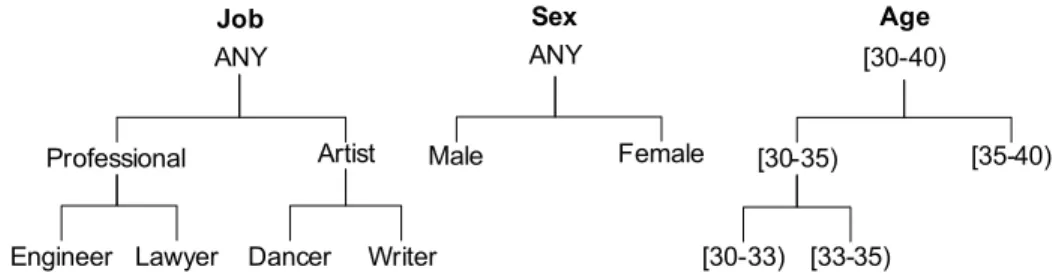
2.2 Taxonomy trees for J ob, Sex,Age . . . 14
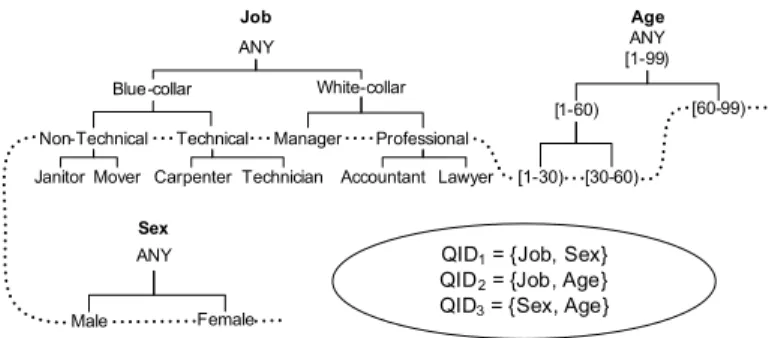
3.1 Data flow in Hong Kong Red Cross Blood Transfusion Service (BTS) 27 3.2 Taxonomy trees and QIDs . . . 28
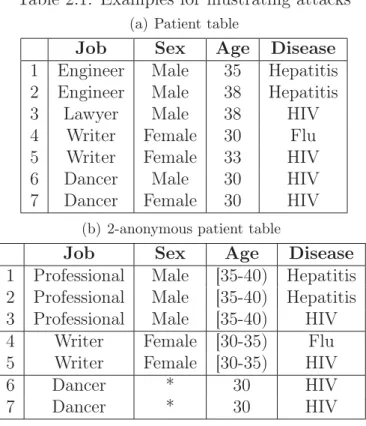
3.3 Tree for partitioning records . . . 40
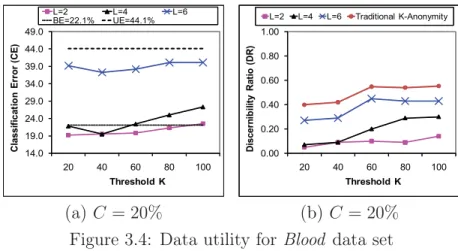
3.4 Data utility for Blood data set . . . 45
3.5 Classification error for Adult data set . . . 46
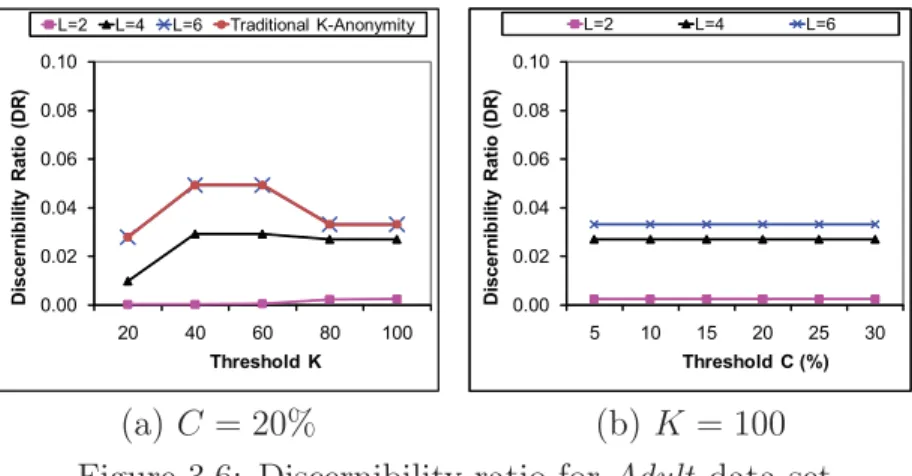
3.6 Discernibility ratio for Adult data set . . . 47
3.7 Scalability (L= 4, K = 20, C = 100%) . . . 48
4.1 Taxonomy tree on location . . . 59
4.2 MVS-tree and MFS-tree for efficient Score updates . . . 69
4.3 MVS-tree and MFS-tree after suppressing c4 . . . 69
4.4 Utility loss vs. K on City80K (L= 3, C = 60%) . . . 74
4.5 Utility loss vs. C on City80K (L= 3, K = 30) . . . 74
4.6 Utility loss vs. L on City80K (K = 30, C = 60%) . . . 74
4.7 Utility loss vs. K on Metro100K (L= 3, C = 60%) . . . 75
4.8 Utility loss vs. C on Metro100K (L= 3, K = 30) . . . 75
4.9 Scalability (K = 30, C = 60%, K = 1%) . . . 76
5.1 Distributed anonymization model for multiple data publishers . . . . 80
5.2 Distributed anonymization for vertically-partitioned data . . . 89
5.3 Distributed anonymization for horizontally-partitioned data . . . 98 5.4 Classification error for vertically-partitioned data ( L= 4, C = 20%) . 103 5.5 Classification error for horizontally-partitioned data (L= 4, C = 20%)104
6.1 Taxonomy tree of attributes . . . 109
6.2 Tree for partitioning records . . . 120
6.3 Classification accuracy for MIMIC data set . . . 128
6.4 Classification accuracy for Adult data set . . . 129
6.5 Comparison . . . 131
6.6 Scalability . . . 132
7.1 Generalized data table . . . 142
TABLES
1.1 Summary of the thesis contributions . . . 4
2.1 Examples for illustrating attacks . . . 11
2.2 Bucketized data . . . 14
3.1 Raw patient data . . . 29
3.2 Anonymous data (L= 2, K = 2,C = 50%) . . . 29
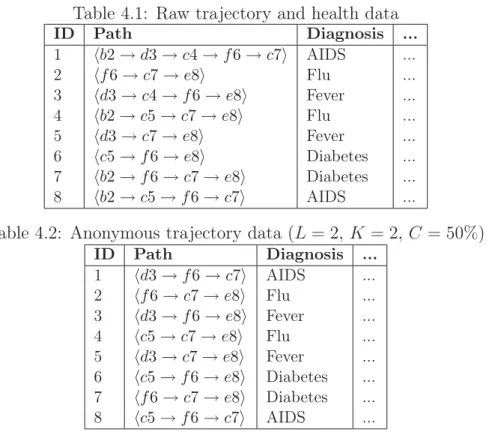
4.1 Raw trajectory and health data . . . 53
4.2 Anonymous trajectory data (L= 2, K = 2,C = 50%) . . . 53
4.3 Counter example for monotonic property . . . 62
4.4 Initial Score . . . 70
4.5 Score after suppressing c4 . . . 70
4.6 Data sets statistics . . . 72
5.1 Raw tables for vertically-partitioned data . . . 81
5.2 Raw tables for horizontally-partitioned data . . . 82
5.3 Naïve approach (L= 2, K = 2, C = 50%) . . . 83
5.4 Anonymous distributed data (L= 2, K = 2, C = 50%) . . . 84
5.5 Attributes for the Adult data set . . . 102
6.1 Heterogeneous health data . . . 108
6.2 Anonymous heterogeneous health data . . . 108
6.3 A raw data table and its anonymized versions . . . 110
7.1 Original tables . . . 140
7.2 Binary vectors . . . 142
Chapter 1
Introduction
Numerous organizations such as governmental agencies, hospitals, and financial com-panies collect and disseminate various person-specific data for research and business purposes. Worldwide governments systematically collect personal information about their citizens through censuses. These data are released to public for demographic research. In medical domain, gaining access to high-quality healthcare data is a vital requirement to informed decision making for medical practitioners and researchers. Driven by mutual benefits and regulations, there is a demand for healthcare insti-tutes to share patient data with various parties for research purposes. For example, licensed hospitals in California are required to periodically submit specific demo-graphic data on every discharged patient [20].
Data collection and publishing are also ubiquitous in other domains. With the emergence of new technologies, data about individuals get collected at various places in various ways. Grocery stores collect a large amount of customer purchase data by store courtesy cards. These data are analyzed to model customer behavior and used by advertisement companies. In online world, websites and service providers (e.g. Google) collect search requests of users for future analysis. Recent data release by AOL is a unique example of this kind [10].
Finally, the use of location-aware devices such as RFID tags, GPS-based de-vices, and cell phones raises new privacy concerns. These devices are used extensively in many network systems including mass transportation [90], car navigation [49], and healthcare management [105]. The collected trajectory data capture the detailed movement information of the tagged objects, offering tremendous opportunities for mining useful knowledge. However, these trajectory data contain people’s visited locations and thus reveal identifiable sensitive information such as social customs, religious preferences, and sexual preferences.
The explosion of digital data collection has given rise to a number of complex privacy questions regarding the ownership, collection and dissemination of personal data. The answers to these questions connect many avenues of research: social, legal, ethical and technical. The objective of this thesis is to answer the following question: How can a data publisher safeguard data privacy while keeping the released data useful?
1.1
Motivation
The current practice in data sharing primarily relies on policies and guidelines on the types of data that can be shared and agreements on the use of shared data. This approach alone may lead to excessive data distortion or insufficient protection. The most common practice is to remove the identifiable attributes (e.g. name, social security number) of individuals before releasing the data. However, this simple technique though apparently looks innocuous, in reality fails to protect the privacy of record holders. In this section, we present a number of real-world attacks to emphasize the need of privacy-preserving techniques and to illustrate the challenges in developing such tools.
The most illustrious privacy attack was demonstrated by Sweeney [96]. In Massachusetts, Group Insurance Commission (GIC) collected the medical data of
the state employees. The data set had no identifiable attributes such as name, social security number or phone numbers and thus was believed to be anonymous. GIC gave a copy of the data to researchers and sold a copy to industry. However, the data set did contain demographic information such as date of birth, gender, and ZIP code. Sweeney reported that 87% of the U.S. population can be uniquely identified based on 5-digit zip code, gender and date of birth. It is not common to find many people with the same date of birth, less likely for them to live in the same place and very less likely having same gender. She bought a copy of the Massachusetts voter registration list by $20 and identified the record of William Weld, governor of the state of Massachusetts, by joining both the tables. This kind of attack where an external data can be used to identify an anonymous data is called linking attack. The concern of linking attack has escalated in recent years due to the ease of collecting external information over Internet.
Not all linking attacks require external information. Sometimes the semantic information of the data itself reveals the identity of a user. The case of AOL data release is a notable example. On August 6, 2006, AOL released a 2GB file containing the search queries of its 650,000 users. There are approximately 20 million search queries collected over three months period. As a privacy protection mechanism, AOL removed all user identities except the search queries and assigned a random number to each of its users. Three days later, two New York Times reporters identified and interviewed the user#4417749 from the release data [10]. Ms. Thelma Arnold was re-identified from the semantic information of her search queries. She said, “We all have a right to privacy. Nobody should have found this all out."
Few months later, Netflix, a movie renting service, announced a $1,000,000 prize for10%improvement for their recommendation system. To assist the competi-tion, they also provided a real data set which contains 100 million ratings for 18,000 movie titles from 480,000 randomly chosen users. According to the Netflix web-site, “To protect customer privacy, all personal information identifying individual
Table 1.1: Summary of the thesis contributions
Algorithms Data Publisher Privacy Model
Single Multiple Differential Privacy LKC-privacy
Chapters 3 and 4
Chapter 5
Chapter 6 Chapter 7
customers has been removed and all customer ids have been replaced by randomly-assigned ids." Narayanan and Shmatikov shortly attacked the Netflix data by linking information from the International Movie Database (IMDb) site, where users post their reviews (not anonymous) [85]. They showed “With 8 movie ratings (of which 2 may be completely wrong) and dates that may have a 14-day error, 99% of records can be uniquely identified in the data set. For 68%, two ratings and dates (with a 3-day error) are sufficient."
It is evident from the above examples that mere removal of the personal in-formation does not ensure privacy to the users. Privacy-preserving data publishing
(PPDP) studies how to transform raw data into a version that is immunized against privacy attacks but that still preserves useful information for data analysis.
1.2
Contributions
This thesis examines various privacy attacks and develops anonymization algorithms for different application scenarios. The proposed anonymization algorithms adopt two privacy models: LKC-privacy and differential privacy. Table 1.1 summaries different characteristics of the proposed algorithms. Following we detail the technical contributions of this thesis.
1.2.1
Relational Data Anonymization
Sharing healthcare data has become a vital requirement in healthcare system man-agement; however, inappropriate sharing and usage of healthcare data could threaten
patients’ privacy. We study the privacy concerns of the blood transfusion information-sharing system between the Hong Kong Red Cross Blood Transfusion Service (BTS) and public hospitals, and identify the major challenges that make existing data anonymization methods not applicable. Furthermore, we propose a new privacy model called LKC-privacy, together with an anonymization algorithm, to effec-tively preserve both privacy and utility in high-dimensional relational data sharing. Experiments on real-life data demonstrate that our anonymization algorithm can effectively retain the essential information in anonymous data for data analysis and is scalable for anonymizing large data sets.
1.2.2
Trajectory Data Anonymization
Location-aware devices are used extensively in many network systems, such as mass transportation, car navigation, and healthcare management. The collected trajec-tory data capture the detailed movement information of the tagged objects, offering tremendous opportunities for mining useful knowledge. Yet, publishing the raw
trajectory data for data mining would reveal specific locations, times, and other potentially sensitive information of the tagged objects or individuals. We study the privacy threats in trajectory data publishing and show that existing anonymization methods are not applicable for trajectory data due to its challenging properties: high-dimensional, sparse, and sequential. Our primary contributions are (1) to adopt LKC-privacy model for trajectory data that overcomes these challenges, and (2) to develop an anonymization algorithm to achieveLKC-privacy while preserving the data utility for trajectory pattern mining. We evaluate the privacy model and anonymization algorithm, in terms of data utility, and scalability, on data sets that simulate real-life traffic.
1.2.3
Heterogeneous Data Anonymization
Among the existing privacy models,-differential privacyprovides one of the strongest privacy guarantees and has no assumptions about an adversary’s background knowl-edge. All existing solutions that ensure -differential privacy handle the problem of anonymizing relational and set-valued data separately. Our contribution is the pro-posal of the first anonymization algorithm for heterogenous data that contain both relational and set-valued data. The proposed approach makes a simple yet funda-mental switch in anonymization algorithm design: instead of listing all the possible records (i.e., contingency table) for noise addition, records are generalized before noise addition. The anonymization algorithm first probabilistically generalizes the raw data and then adds noise to guarantee -differential privacy. We show that the anonymized data can be used effectively to build a decision tree induction classi-fier. Experimental results demonstrate that the proposed algorithm is scalable and performs better than the existing solutions for classification analysis.
1.2.4
Distributed Data Anonymization
Data integration and sharing methods enable different data providers to flexibly in-tegrate their expertise and deliver highly customizable services to their customers. Nonetheless, combining data from different sources could potentially reveal person-specific sensitive information. Our contribution is the proposal of distributed algo-rithms to securely integrate private data from multiple parties where the database is divided either vertically or horizontally among the parties. The vertically-partitioned data problem problem was discovered in a collaborative project with a financial industry. The horizontally-partitioned data problem was generalized from the in-formation sharing scenario of the Hong Kong Red Cross Blood Transfusion Service (BTS). For both the scenarios, we devise algorithms that achieve bothLKC-privacy and differential privacy models.
1.3
Organization
The rest of this thesis is organized as follows:
• Chapter 2 provides an overview of various privacy models, anonymization techniques, and utility metrics of privacy-preserving data publishing. In this chapter, we also provide an overview of the related literature.
• Chapter 3formalizes theLKC-privacy model and presents the algorithm for anonymizing relational data. The results of this chapter appear in [80].
• Chapter 4 studies the privacy threat of releasing trajectory data. We adopt LKC-privacy model and propose an algorithm for trajectory data anonymiza-tion. The results of this chapter appear in [78].
• Chapter 5addresses the problem of distributed anonymization from multiple data publishers while ensuringLKC-privacy model. The results of this chapter appear in [79, 81, 82].
• Chapter 6 provides an overview of -differential privacy and describes a differentially-private data release algorithm for heterogeneous health data. The results of this chapter appear in [77].
• Chapter 7 presents the two-party differentially private data release algo-rithms. The results of this chapter appear in [8].
Chapter 2
Background
Data privacy has been an active area of research in statistics, database, and security community for the last three decades [2, 37]. These works can be broadly classi-fied into two frameworks: interactive and non-interactive. In interactive framework, users pose aggregate queries through a private mechanism and the data holder out-puts macro-data (e.g., SUM, COUNT) in response. This approach is also known as statistical disclosure control (SDC) [2]. In non-interactive setting, the original data are first sanitized and the entire anonymous data about individuals (micro-data) are published for data analysis. Once the data are published, the data publisher has no further control on the published data. This approach is also known as privacy-preserving data publishing (PPDP) [37]. The existing research works can also be categorized into two scenarios, which are somehow orthogonal to the above classifica-tion: centralized vs. distributed. Data may be owned by a single party (centralized) or by multiple parties (distributed). In the case of distributed scenario, the data owners want to achieve the same goal like single party on their integrated data without sharing their data with others.
In this thesis, we address the centralized and the distributed scenarios for the non-interactive framework. In Section 2.1, we first present an overview of various privacy models, anonymization technique, and utility metrics of privacy-preserving
'DWD5HFLSLHQWV 'DWD3XEOLVKLQJ 'DWD&ROOHFWLRQ 5DZ'DWD $QRQ\PL]HU'DWD ,QGLYLGXDOV 'DWD 3XEOLVKHU $QRQ\PRXV 'DWD
Figure 2.1: Data flow in privacy-preserving data publishing
data publishing. We then discuss the related research proposals in Section 2.2.
2.1
Preliminaries
Privacy-preserving data publishing (PPDP) has two phases: data collection and data publishing. Figure 2.1 depicts the data flow in PPDP. In data collection phase, the data publisher collects data from the individuals. There are two models in the data collection phase: trusted anduntrusted. In the trusted model, individuals trust the data publisher and give all the required data. For example, patients give their true information to hospitals to receive proper treatment. In this scenario, it is the responsibility of the data publisher to protect privacy of the individuals’ personal data. In untrusted model, individuals do not trust their data publisher. They add some noise to their data to protect sensitive information from the data publisher [31]. A typical example of this model is participants responding to a survey. In this thesis, we assume that the data publisher is trusted and study how to anonymize data in the data publishing phase to protect privacy of the individuals.
Data publishing phase includes sharing the data with specific recipients and releasing the data for public download; the recipient could be a data user (researcher) who wants to perform legitimate data analysis, or could potentially be an adversary who attempts to associate sensitive information in the published data with a target victim. Therefore, data publisher needs to transform the underlying raw data into
a version that is immunized against privacy attacks but still supports effective data mining tasks. To achieve proper balance between privacy and utility, the data publisher needs to decide three aspects: privacy model, anonymization techniques, and utility metric.
2.1.1
Privacy Models
The collected micro-data set are stored in a data table where each row represents an individual and each column is an attribute. We use the terms “data set” and “data table” interchangeably in the rest of this thesis. Attributes can be divided into three categories. (1) Attributes that explicitly identify an individual, such as SSN, and name. These attributes are called explicit identifier and must be removed before releasing the data. (2) A set of attributes whose combined value may potentially identify an individual. For example, the combined values of zip code, date of birth, and gender. These attributes are called quasi-identifier (QID) and the values of these attributes may be publicly accessible from other sources. Finally, an attribute is considered sensitive if an adversary is not permitted to link its value with an identifer. Examples includes disease, salary, etc.
Different privacy models have been proposed to prevent an adversary from linking an individual with a sensitive attribute given the knowledge of the quasi-identifer. Following we briefly present some of the well-known privacy models.
k-Anonymity. Samarati and Sweeney [94, 96] show that removing explicit iden-tifiers is not enough to protect privacy of the individuals. If a record in the table is so specific that not many individuals match it, releasing the data may lead to linking the individual’s record and, therefore, the value of her sensitive attribute. Consider the raw patient data in Table 2.1(a), where each record represents a pa-tient with the papa-tient-specific information. J ob, Sex, andAge are quasi-identifying attributes. Suppose that the adversary knows that the target patient is a Lawyer
Table 2.1: Examples for illustrating attacks
(a) Patient table
Job Sex Age Disease
1 Engineer Male 35 Hepatitis 2 Engineer Male 38 Hepatitis
3 Lawyer Male 38 HIV
4 Writer Female 30 Flu 5 Writer Female 33 HIV
6 Dancer Male 30 HIV
7 Dancer Female 30 HIV
(b) 2-anonymous patient table
Job Sex Age Disease
1 Professional Male [35-40) Hepatitis 2 Professional Male [35-40) Hepatitis 3 Professional Male [35-40) HIV 4 Writer Female [30-35) Flu 5 Writer Female [30-35) HIV
6 Dancer * 30 HIV
7 Dancer * 30 HIV
and his age is 38. Hence, record #3, together with his sensitive value (HIV in this case), can be identified since he is the only Lawyer who is 38 years old in the data. k-anonymity requires that no individual should be uniquely identifiable from a group of size smaller than k based on the values of QID attributes. A table satisfying this requirement is called a k-anonymous table. Table 2.1(b) is a 2-anonymous table of Table 2.1(a).
-diversity. Machanavajjhalaet al. [70] point out that k-anonymity only prevents identity linkage attacks since an adversary can not identify a record corresponding to an individual with confidence greater than 1/k. However, k-anonymous data table is vulnerable against attribute linkage attacks. Suppose the adversary knows that the patient is a dancer of age 30. In such case, even though there exist two such records (#6 and #7), the adversary can infer that the patient has HIV with 100%
confidence since both the records contain HIV. To prevent such attribute linkage attack, -diversity requires that every QID group should contain at least “well-represented” values for the sensitive attribute. Machanavajjhala et al. [12] gave a number of interpretations of the term “well-represented”. The simplest definition requires every equivalent group to have distinct values of the sensitive attribute.
Confidence Bounding. Wanget al. [103] consider bounding the confidence of in-ferring a sensitive value from different combination of QID values by specifying one or moreprivacy templates of the form,QID→s, h, wheresis a sensitive value,QID is a quasi-identifier, andhis a threshold. For example, withQID={J ob, Sex, Age}, QID → HIV,50% states that the confidence of inferring HIV from any group on QID is no more than 50%. For the data in Table 2.1(b), this privacy tem-plate is violated because the confidence of inferring HIV is 100% in the group for {Dancer,∗,30}. Unlike -diversity, confidence bounding can have different privacy templates with different confidence thresholds.
There are other privacy models. (α, k)-anonymity [108] requires every QID group to satisfy both k-anonymity and confidence bounding. t-closeness requires the distribution of a sensitive attribute in any group to be close to the distribution of the attribute in the overall table [65]. Xiao and Tao [110] propose the notion of
personalized privacy to allow each record owner to specify her own privacy level. This model assumes that a sensitive attribute has a taxonomy tree and each record owner specifies a guarding node in the taxonomy tree. Thus, all these partition-based privacy models have different assumptions about the adversary’s background knowledge.
Recently, Wong et al.[106] and Zhanget al.[121] have shown that algorithms that satisfy partition-based privacy models are vulnerable to minimality attack and do not provide the claimed privacy guarantee. Although several fixes against a
minimality attack have been proposed [24, 54, 112], new type of attacks such as composition attack [39], deFinetti attack [58], and foreground knowledge attack [107] have emerged against algorithms that adopt partition-based privacy models.
Differential privacy [28] has received considerable attention as a substitute for partition-based privacy models in privacy-preserving data publishing. Differen-tial privacy provides strong privacy guarantees independent of an adversary’s back-ground knowledge, computational power or subsequent behavior. Differential pri-vacy, in general, requires that the outcome of any analysis should not overly depend on a single data record. Thus, if a user had opted in the database, there would not be a significant change in any computation based on the database. Therefore, this as-sures every record owner that any privacy breach will not be a result of participating in a database. We further discuss about differential privacy in Chapter 6.
2.1.2
Anonymization Techniques
Given a privacy model, different anonymization techniques are used to transform the original data set into a version that satisfies the privacy requirements. Anonymiza-tion techniques are used to make the data less precise to protect privacy. Following, we present some common techniques that are often used for anonymization.
Suppression. The simplest technique to achieve anonymity is to suppress the value of a cell. Suppression is done by replacing an attribute value with a special sym-bol “*” or “Any”. It has been widely used to satisfy privacy requirement such as k-anonymity. For example in Table 2.1(b), the values of Sex attribute of records #6 and #7 are suppressed to ensure 2-anonymity. Both Meyerson and Williams [83] and Aggarwal et al.[4] prove that it is NP-hard to achieve optimalk-anonymization by suppression. Meyerson and Williams [83] propose an O(klogk) approximation algorithm. Aggarwal et al. [4] improve the approximation to O(k). Finally, Park and Shim [87] further improve the result to O(logk) approximation.
Engineer
ANY
Professional Artist
Lawyer Dancer Writer
ANY Male Female Sex Job [30-33) [30-40) [30-35) [35-40) [33-35) Age
Figure 2.2: Taxonomy trees for J ob, Sex, Age
Table 2.2: Bucketized data
(a) QID Attribute
Job Sex Age Bucket
Engineer Male 35 1 Engineer Male 38 2 Lawyer Male 38 1 Writer Female 30 3 Writer Female 33 2 Dancer Male 30 3 Dancer Female 30 3 (b) Sensitive Attribute Bucket Disease 1 Hepatitis 1 HIV 2 Hepatitis 2 HIV 3 Flu 3 HIV 3 HIV
Generalization. Generalization provides better data utility compared to suppres-sion by replacing the specific value with a more general value. While suppressuppres-sion works in a binary fashion (keep the original value or suppress), generalization has a number of intermediate states according to a taxonomy tree for each attribute. Fig-ure 2.2 depicts the taxonomy trees for the attributesJ ob,SexandAge. For example in Table 2.1(b), the values Engineer and Lawyer are replaced by a more general value P rof essional according to the taxonomy tree. Generalization techniques can be classified mainly into two categories: global vs. local [61]. In global generaliza-tion, all instances of a value are mapped to the same general value. While in local generalization, different instances can be generalized to different general values. A range of algorithms have been proposed that use generalization technique to enforce different privacy models. Some of these algorithms are optimal under restricted form of generalization [11, 61, 94], while others are based on heuristics [38, 62, 104].
Bucketization. Unlike generalization and suppression, bucketization [73, 111] does not modify the QID and the sensitive attribute (SA), but de-associates the relation-ship between the two. However, it thus also disguises the correlation between SA and other attributes; therefore, hinders data analysis that depends on such corre-lation. Bucketization was proposed to achieve -diversity. It divides all the records into different buckets in such a way that each bucket contains distinct values of sensitive attribute. Tables 2.2(a) and 2.2(b) are the bucketized data, which satisfies 2-diversity for the patient data Table 2.1(a).
Other anonymization techniques include randomization-based approach, and output perturbation-based approach. Randomization-based approach modifies the underling data randomly by either adding noise to the numerical values or replacing the categorical values with other values from the domain [6, 32]. Randomized data are useful at the aggregated level (such as average or sum), but not at the record level [6, 36]. Data recipients can no longer interpret the semantic of each individ-ual record, which is important in some knowledge exploration tasks, such as visindivid-ual data mining [122]. Yet, they are still useful techniques if the applications do not require preserving data truthfulness at the record level. On the other hand, output perturbation-based approach first computes the correct result and outputs a per-turbed version of the result by adding noise. This technique is often used to achieve differential privacy (more discussion in Chapter 6). Though randomization-based approach can also ensure differential privacy [92], it requires higher degree of noise than output perturbation-based approach [29, 30].
2.1.3
Utility Metrics
While protecting privacy is a critical element in data publishing, it is equally im-portant to preserve the utility of the published data because this is the primary
reason for publication. A number of utility metrics have been proposed to quantify the information that is present in the anonymized data. Data publishers use these metrics to evaluate and optimize the data utility of the anonymized data. In gen-eral, utility metrics can be classified into two categories: general purpose metric and special purpose metric.
General Purpose Metric. In many cases, data publisher does not know how the released data will be used by the data recipient. In such cases, data publisher uses general purpose metric that measures the similarity between the original data and the anonymized data. The objective is to minimize the distortion in the anonymized data. The simplest and most intuitive measure is to count the number of anonymiza-tion operaanonymiza-tions performed on the data set. For example, in case of suppression, the data utility is measured by counting the number of suppressed values [83]. Less suppression means more utility. Similarly, for generalization, the information loss is measured by the number of generalization steps performed. Samarati proposes one metric that measures the utility in terms of generalization height [94]. Other met-rics include Loss Metric (LM) [51] and Normalized Certainty Penalty (NCP) [98] that also takes into consideration the domain size of the attribute. Bayardo and Agrawal [11] propose another metric called Discernibility Metric (DM) to measure the data distortion in the anonymized data. The metric charges a penalty to each record for being indistinguishable from other records. This metric has been used to measure the data utility in [62, 70].
Special Purpose Metric. The type of information that should be preserved de-pends on the data mining task to be conducted on the published data. If the purpose of the data publishing is known before the data release, then customized anonymiza-tion techniques can be adapted to preserve certain informaanonymiza-tion that is useful for that
particular task. Iyengar [51] shows that optimizing data utility with respect to gen-eral purpose metrics (LM, DM, etc.) does not preserve enough information for a particular data mining task such as classification analysis. In such scenario, the target data mining model is first built on the anonymized data to compare the accu-racy of the model with respect to the model built from the original data. Different techniques have been proposed to optimize the accuracy of the data mining tasks such as classification, clustering, and regression [38, 63].
2.2
Related Work
In this section, we first present an overview of various PPDP research proposals for sharing different types of data. We then briefly discuss the related research areas in the subsequent sections.
2.2.1
Privacy-Preserving Data Publishing
Relational Data. Partition-based privacy models divide a given data set into disjoint groups and release some general information about the groups. There is a large body of work on anonymizing relational data based on partitioned-based privacy models. As discussed earlier, k-anonymity [94] [96], -diversity [70], and confidence bounding [103] are based on a predefined set of QID attributes. These single QID-based approaches suffer from the curse of high dimensionality [3] and render the high-dimensional data useless for data mining. In Chapter 3, we address the problem of high dimensionality by assuming that the adversary knows at most L values of QID attributes of any target patient.
Many algorithms have been proposed to preserve privacy, but only a few have considered the goal for classification [37]. Iyengar [51] has presented the anonymity problem for classification and proposed a genetic algorithmic solution. Bayardo and
Agrawal [11] have also addressed the classification problem using the same classifica-tion metric of [51]. Fung et al. [38] have proposed a top-down specialization (TDS) approach to generalize a data table. Recently, LeFevre et al. [63] have proposed another anonymization technique for classification using multidimensional recod-ing [62]. More discussion about the partition-based approach can be found in a survey paper [37].
Differential privacy has received considerable attention recently as a substi-tute for partition-based privacy models for PPDP. However, most of the research on differential privacy so far concentrates on the interactive setting with the goal of reducing the magnitude of added noise [26, 30, 93], releasing certain data mining results [13,35], or determining the feasibility and infeasibility results of differentially-private mechanisms [15, 57]. A general overview of various research works on differ-ential privacy can be found in the recent survey [29]. Below, we briefly review some current techniques that adopt the non-interactive approach.
Barak et al. [9] address the problem of releasing a set of consistent marginals of a contingency table. Their method ensures that each count of the marginals is non-negative and their sum is consistent for a set of marginals. Xiao et al. [113] propose Privelet, a wavelet-transformation-based approach that lowers the magni-tude of noise needed to ensure differential privacy to publish a multidimensional frequency matrix. Hay et al. [46] propose a method to publish differentially pri-vate histograms for a one-dimensional data set. Although Privelet and Hay et al.’s approach can achieve differential privacy by adding polylogarithmic noise variance, the latter is only limited to a one-dimensional data set. Xiao et al. [115] propose a two-step algorithm for releasing relational data. It first issues queries for every
possible combination of attribute values to the Privacy Integrated Queries (PINQ) interface [74], and then produces a generalized output using the perturbed data set returned by PINQ.
Some recent proposals [45, 64] address how to compute the results of a num-ber of given queries while minimizing the added noise. However, these methods require the set of queries to be given first altogether to compute the results. In contrast, our proposed algorithm described in Chapter 6 complements the above methods by determining how to partition the data adaptively so that the released data can be useful for a given data mining task. In addition, a number of recent works propose differentially-private mechanisms for different applications such as record linkage [50], and recommender systems [75]. Though closely related, these methods do not address the problem of privacy-preserving data publishing, the pri-mary theme of this thesis.
Set-Valued Data. The increasing prevalence of set-valued data has resulted in new types of privacy attacks. For example, Loukideset al.[67] show that diagnosis codes, a kind of set-valued data, could be used by an adversary as a linkage to patients’ identities. A large number of research works on privacy-preserving set-valued data publishing [19, 40, 47, 98, 99, 116, 117] have appeared in the literature. These works can be broadly divided into two categories according to whether they distinguish the items between sensitive and non-sensitive.
Ghinitaet al.[40] and Xu et al.[116, 117] divide all items into either sensitive
or non-sensitive, and assume that an adversary’s background knowledge is strictly confined to non-sensitive items. Ghinita et al. [40] propose a bucketization-based approach that limits the probability of inferring a sensitive item to a specified thresh-old, while preserving correlations among items for frequent pattern mining. Xu et al.[117] bound the background knowledge of an adversary to at mostpnon-sensitive items, and employ global suppression to preserve as many item instances as possi-ble. Xu et al. [116] improve the technique in [117] by preserving frequent itemsets and presenting a border representation. All these works have two main drawbacks. First, when an adversary is aware of some, even few, sensitive items, other sensitive
items could be learned. Second, in many cases there does not exist a consensus of “sensitive”. Items sensitive to someone may not be sensitive to others. Cao et al. [19] address the first concern by assuming that an adversary may possess back-ground knowledge on sensitive items and propose a privacy notion ρ-uncertainty, which bounds the confidence of inferring a sensitive item from any subset of items (sensitive or non-sensitive) to ρ. Terrovitis et al.[98, 99], and He and Naughton [47] eliminate the distinction between sensitive and non-sensitive. Any item could be both sensitive and non-sensitive at the same time.
Consequently, He and Naughton [47] and Terrovitiset al.[98,99] consider only identity attacks. Similar to the idea of [116] and [117], Terrovitis et al.[98] propose to bound the background knowledge of an adversary by the maximum numberm of items and propose a new privacy model km
-anonymity, a relaxation ofk-anonymity. They achieve km-anonymity by a bottom-up global generalization solution. To im-prove the utility, recently Terrovitis et al. [99] provide a local recoding method for achieving km-anonymity. He and Naughton [47] point out that km-anonymity pro-vides a weaker privacy protection than k-anonymity and propose a top-down local generalization solution underk-anonymity. However, recent research [39,58,106,107] has indicated that even k-anonymity provides insufficient privacy protection for set-valued data. Lately, Chen et al. [21], for the first time, apply differential privacy to set-valued data sanitization. They propose a probabilistic top-down partitioning al-gorithm, which scales linearly with the input data size. The published data provides guaranteed utility for count queries and other data analysis tasks based on counts, such as frequent itemset mining.
Trajectory Data. Some recent works [1, 49, 88, 97, 120] address the anonymity of moving objects. Abulet al. [1] propose a new privacy model called(k, δ)-anonymity
relies on a basic assumption that every trajectory is continuous. Though this as-sumption is valid for GPS-like devices where the object can be traced all the time, it does not hold for RFID-based moving objects. Moreover, Abul et al. [1] achieve anonymity by space translation that changes the actual location of an object. In contrast, our proposed algorithm described in Chapter 4 employs suppression for anonymity and thus preserves the data truthfulness and maximal frequent sequences with true support counts. Hoh et al. [49] present an uncertainly-aware privacy al-gorithm for GPS traces. They selectively remove trajectory pairs to increase un-certainly between trajectories to hinder identification. Both the works target GPS traces and can not be employed for anonymizing RFID data.
The privacy model proposed in [97] assumes that different adversaries have different background knowledge about the trajectories, and thus their objective is to prevent adversaries from gaining any further information from the published data. They consider the locations in a trajectory as sensitive information and assume that the data publisher has the background knowledge of all the adversaries. In reality, such information is difficult to obtain. Pensa et al. [88] propose a k-anonymity notion for sequence datasets. The proposed algorithm also aims to preserve frequent sequential patterns. However to achieve anonymity, they transform a sequence into the other by insertion, deletion or substitution of a single item. Thus, their approach also spoils data truthfulness. Yarovoy et al. [120] consider time as a QID attribute. However, there is no fixed set of time for all moving objects. Each trajectory has its own set of times as its QID. It is unclear how the data holder can determine the QID attributes for each trajectory.
2.2.2
Privacy-Preserving Distributed Data Sharing
This approach allows anonymizing data from different sources for data release with-out exposing the sensitive information. We categorise this approach as the dis-tributed non-interactive scenario. Jurczyk and Xiong [56] have proposed an algo-rithm to securely integrate horizontally-partitioned data from multiple data owners without disclosing data from one party to another. Jiang and Clifton [52] have pro-posed a method to integrate vertically-partitioned data by maintaining k-anonymity among the participating parties. However, this approach does not fulfill the security requirements of a semi-honest adversary model. To satisfy this requirement, Jiang and Clifton [53] have proposed Distributed k-Anonymity (DkA) framework to se-curely integrate two distributed data tables satisfyingk-anonymity requirement. To the best of our knowledge, Jiang and Clifton’s works are the only ones that generate a k-anonymous table in a distributed setting for vertically-partitioned data. Our proposed algorithm presented in Chapter 5 outperforms DkA framework in terms of algorithmic complexity and scalability for handling large data sets.
All the previous research proposals adopt k-anonymity [94, 96] or its exten-sions [70, 103] as the underlying privacy principle and, therefore, are vulnerable to the recently discovered privacy attacks [39, 58, 106, 107]. To thwart these privacy attacks, we propose differentially-private distributed algorithms in Chapter 7.
2.2.3
Statistical Disclosure Control
Information sharing while protecting individuals’ privacy has also been well studied in statistical databases [2]. We can categorize these works as centralized-interactive approach. Unlike PPDP, here the users (researchers) are only interested in the aggregate properties of the data such as SUM, MAX, MIN, COUNT, MEDIAN, etc. These aggregate values are computed over a set of values and should not disclose any sensitive value of an individual. However, it is possible for an adversary to
construct a set of queries that unveils the detailed underlying data. The challenge is to answer the queries in such a way that no inference can be made based on the aggregate statistics.
The proposed approaches can be roughly divided into two categories: restriction-based techniques and perturbation-restriction-based techniques. Restriction-restriction-based techniques ensure privacy by putting restriction on the query [16, 25, 33, 48, 72, 100]. In the response to a query, the system determines whether the answer can or cannot be safely delivered without inference and thus controls the amount of information to be released. In perturbation-based approach, the system first computes the cor-rect result and outputs a perturbed version of the result by adding noise [14, 26, 30]. The fundamental difference between the two approaches is that while the restriction-based approaches either answer the query result correctly or reject to avoid inference, the perturbation-based approaches add noise to the query output. All these works prohibit data publishing, which is the basic requirement of PPDP.
2.2.4
Privacy-Preserving Distributed Data Mining
This category of works can be classified as distributed-interactive approach. In privacy-preserving distributed data mining (PPDDM), multiple data holders want to compute a function based on their inputs without sharing their data with others. This function can be as simple as a count query or as complex as a data mining task such as classification, clustering, etc. For example, multiple hospitals may want to build a data mining model (e.g. classifier for predicting disease based on patients’ history) without sharing their data with one another. The usual assumption is that the data holders are semi-honest where they follow the protocol but may try to deduce additional information from the received messages. In recent years, extensive research has been conducted to design secure protocols that can construct different data mining models. These protocols are based on cryptographic techniques known as Secure Multiparty Computation (SMC). For example, Yanget al.[118] proposed a
method to acquire classification rules from a large number of data holders while their sensitive values are protected. Different methods have been proposed for different data mining tasks including association rules mining [101], clustering [102], ID3 decision tree [66]. Refer to [22, 89] for surveys on privacy-preserving distributed data mining.
However, compared to data mining result sharing, data sharing gives greater flexibility because data recipients (researchers) can perform their required analysis and data exploration, such as mining patterns in a specific group of records, visu-alizing the transactions containing a specific pattern, and trying different modeling methods and parameters.
Part I
Chapter 3
Anonymizing Relational Data
3.1
Introduction
Gaining access to high-quality health data is a vital requirement to informed de-cision making for medical practitioners and pharmaceutical researchers. Driven by mutual benefits and regulations, there is a demand for healthcare institutes to share patient data with various parties for research purposes. However, health data in its raw form often contains sensitive information about individuals, and publishing such data will violate their privacy. In this chapter, we study the challenges in a real-life information-sharing scenario in the Hong Kong Red Cross Blood Transfusion Service (BTS) and propose a new privacy model, together with a data anonymiza-tion algorithm, to effectively preserve individuals’ privacy and meet the informaanonymiza-tion requirements specified by the BTS.
Figure 3.1 illustrates the data flow in the BTS. After collecting and examining the blood collected from donors, the BTS distributes the blood to different public hospitals. The hospitals collect and maintain the health records of their patients and transfuse the blood to the patients if necessary. The blood transfusion information, such as the patient data, type of surgery, names of medical practitioners in charge, and reason for transfusion, is clearly documented and is stored in the database
&ROOHFW %ORRG 'RQRUV %ORRG 7UDQVIXVLRQ 'DWD +RVSLWDOV VWRUH 'LVWULEXWH%ORRGWR +RVSLWDOV 3DWLHQWV &ROOHFW 3DWLHQW 'DWD 5HG&URVV VKDUH 2XU&RQWULEXWLRQ &HQWUDOL]HG'DWD $QRQ\PL]HU 2XU&RQWULEXWLRQ 'LVWULEXWHG'DWD $QRQ\PL]HU *RYHUQPHQW +HDOWK $JHQF\
Figure 3.1: Data flow in Hong Kong Red Cross Blood Transfusion Service (BTS)
owned by each individual hospital. Periodically, the public hospitals are required to submit the blood usage data, together with the patient-specific surgery data, to the BTS for the purpose of data analysis. Hospitals transfer their data to BTS in two ways. Sometimes, hospitals begin by transferring their data to the to the central government health agency. The department then integrates the data from different hospitals and gives it to the BTS for data analysis. At other times, hospitals directly submit their data to BTS. These information sharing scenarios in BTS illustrate a typical dilemma in information sharing and privacy protection faced by many health institutes. For example, licensed hospitals in California are also required to submit demographic data on every discharged patient [20] which can provide a multitude of privacy concerns outside of the realm of health care. Our proposed solution, designed for the BTS case, will also benefit other health institutes that face similar challenges in information sharing.
The problems with this BTS case can be generalized into two scenarios. In the first scenario, there exists a trustworthy entity such as the central government health agency to collect the raw patient data from multiple hospitals and submit the data to BTS after performing the centralized anonymization. In this chapter, we address the problem of centralized anonymization. In the second scenario, the hospitals have to directly submit the integration of their data to the BTS while
QID1= {Job, Sex}
QID2= {Job, Age}
QID3= {Sex, Age}
Blue-collar White-collar Non-Technical Carpenter Manager ANY Technical Lawyer Professional Job Technician Mover Janitor [1-30) ANY [1-99) [1-60) [60-99) [30-60) Age ANY Male Female Sex Accountant
Figure 3.2: Taxonomy trees and QIDs
protecting the patients’ privacy. In Chapter 5, we address the distributed scenario. Below, we summarize the privacy concerns and challenges of the BTS case.
Privacy Model. Giving the BTS access to blood transfusion data for data analy-sis is clearly legitimate. However, it raises some concerns on patients’ privacy. The patients are willing to submit their data to a hospital because they consider the hospital to be a trustworthy entity. Yet, the trust in the hospital may not neces-sarily be transitive to a third party. Many agencies and institutes consider that the released data is privacy-preserved if explicit identifying information, such as name, social security number, address, and telephone number, is removed. However, sub-stantial research has shown that simply removing explicit identifying information is insufficient for privacy protection. Sweeney [96] showed that an individual can be re-identified by simply matching other attributes, called quasi-identifiers (QID), such as gender, date of birth, and postal code. Below, we illustrate the privacy threats by a simplified BTS example.
Example 3.1.1. Consider the raw patient data in Table 3.1, where each record represents a surgery case with the patient-specific information. J ob, Sex, and Age are quasi-identifying attributes. The hospital wants to release Table 3.1 to the BTS for the purpose of classification analysis on the class attribute, T ransf use, which has two values, Y and N, indicating whether or not the patient has received blood
Table 3.1: Raw patient data
Quasi-identifier (QID) Class Sensitive
ID Job Sex Age Transfuse Surgery
1 Janitor M 34 Y Transgender 2 Doctor M 58 N Plastic 3 Mover M 34 Y Transgender 4 Lawyer M 24 N Vascular 5 Mover M 58 N Urology 6 Janitor M 44 Y Plastic 7 Doctor M 24 N Urology 8 Lawyer F 58 N Plastic 9 Doctor F 44 N Vascular 10 Carpenter F 63 Y Vascular 11 Technician F 63 Y Plastic Table 3.2: Anonymous data (L= 2, K = 2, C = 50%)
Quasi-identifier (QID) Class Sensitive
ID Job Sex Age Transfuse Surgery
1 Non-Technical M [30−60) Y Transgender 2 Professional M [30−60) N Plastic 3 Non-Technical M [30−60) Y Transgender 4 Professional M [1−30) N Vascular 5 Non-Technical M [30−60) N Urology 6 Non-Technical M [30−60) Y Plastic 7 Professional M [1−30) N Urology 8 Professional F [30−60) N Plastic 9 Professional F [30−60) N Vascular 10 Technical F [60−99) Y Vascular 11 Technical F [60−99) Y Plastic
transfusion. Without a loss of generality, we assume that the only sensitive value in Surgery is T ransgender. The hospital expresses concern on two types of privacy threats:
Identity linkage: If a record in the table is so specific that not many patients match it, releasing the data may lead to linking the patient’s record and, therefore, her received surgery. Suppose that the adversary knows that the target patient is a M over and his age is 34. Hence, record #3, together with his sensitive value (T ransgender in this case), can be uniquely identified since he is the only M over who is 34years old in the raw data.
Attribute linkage: If a sensitive value occurs frequently together with some QID attributes, then the sensitive information can be inferred from such attributes even though the exact record of the patient cannot be identified. Suppose the adversary knows that the patient is a male of age 34. In such case, even though there exist two such records (#1 and #3), the adversary can infer that the patient has received a T ransgender surgery with 100% confidence since both the records contain T ransgender.
High Dimensionality. Many privacy models, such ask-anonymity [94] [96] and its extensions [70] [103], have been proposed to thwart privacy threats caused by identity and attribute linkages in the context of relational databases. The usual approach is to generalize the records into equivalence groups so that each group contains at least k records with respect to some QID attributes, and the sensitive values in each QID group are diversified enough to disorient confident inferences. However, Aggarwal [3] has shown that when the number of QID attributes is large, that is, when the dimensionality of data is high, most of the data have to be suppressed in order to achieve k-anonymity. Our experiments confirm this curse of high dimensionality on k-anonymity [3]. Applying k-anonymity on the high-dimensional patient data would significantly degrade the data quality. In order to overcome this bottleneck, we exploit one of the limitations of the adversary: in real-life privacy attacks, it is very difficult for an adversary to acquire all the information of a target patient because it requires non-trivial effort to gather each piece of prior knowledge from so many possible values. Thus, it is reasonable to assume that the adversary’s prior knowledge is bounded by at most L values of the QID attributes of the patient. Based on this assumption, we define a new privacy model called LKC-privacy for anonymizing high-dimensional data.
The general intuition of LKC-privacy is to ensure that every combination of values in QIDj ⊆ QID with maximum length L in the data table T is shared by at least K records, and the confidence of inferring any sensitive values in S is not
greater than C, where L, K, C are thresholds and S is a set of sensitive values specified by the data publisher (the hospital). LKC-privacy bounds the probabil-ity of a successful identprobabil-ity linkage to be ≤1/K and the probability of a successful attribute linkage to be ≤ C, provided that the adversary’s prior knowledge does not exceed L. Table 3.2 shows an example of an anonymous table that satisfies (2,2,50%)-privacy by generalizing all the values from Table 3.1 according to the taxonomies in Figure 3.2 (Ignore the dashed curve for now). Every possible value of QIDj with maximum length 2 in Table 3.2 (namely, QID1, QID2, and QID3 in Figure 3.2) is shared by at least 2 records, and the confidence of inferring the sensitive value T ransgender is not greater than 50%. In contrast, enforcing tra-ditional 2-anonymity will require further generalization. For example, in order to make P rof essional, M,[30−60) to satisfy traditional 2-anonymity, we may fur-ther generalize [1−30) and [30−60) to[1−60), resulting in higher utility loss.
Data Utility. The BTS wants to perform two types of data analysis on the blood transfusion data collected from the hospitals. First, it wants to obtain some general count statistics. Second, it wants to employ the surgery information as training data for building a classification model on blood transfusion. One frequently raised question is: To avoid the privacy concern, why doesn’t the hospital simply release the statistical data or a classifier to the BTS? The BTS wants to have access to the blood transfusion data, not statistics, from the hospitals for several reasons. First, the practitioners in hospitals have no expertise and interest in doing the data mining. They simply want to share the patient data with the BTS, who needs the health data for legitimate reasons. Second, having access to the data, the BTS has much better flexibility to perform the required data analysis. It is impractical to continuously request practitioners in a hospital to produce different types of statis-tical information and fine-tune the data mining results for research purposes.
Contributions. The contributions of this chapter are summarized as follows:
1. We use the BTS as a real-life example to present the challenges of privacy-aware information sharing for data analysis.
2. To thwart the privacy threats caused by identity and attribute linkage, we propose a new privacy model called LKC-privacy that overcomes the chal-lenge of anonymizing high-dimensional relational data without significantly compromising the data quality (Section 3.2).
3. We present an efficient anonymization algorithm for achieving LKC-privacy with two different adaptations. The first adaptation maximizes the informa-tion preserved for classificainforma-tion analysis; the second one minimizes the distor-tion on the anonymous data for general data analysis. Minimizing distordistor-tion is useful when the particular information requirement is unknown during in-formation sharing or the shared data is used for various kinds of data mining tasks (Section 3.3).
4. Experiments suggest that our developed algorithm is flexible and scalable enough to handle large volumes of blood transfusion data that include both cat-egorical and numerical attributes. In 2008, the BTS received 150,000 records from the public hospitals (Section 3.4).
3.2
Problem Definition
Based on the privacy threats, we first present our LKC-privacy model. Then, we address the data utility requirements, followed by the problem statement.
3.2.1
Privacy Model
Suppose a data publisher (e.g., the government health agency) wants to publish a health data tableT(ID, A1, . . . , Am, Class, Sens)(e.g., Table 3.1) to some recipient
(e.g., the Red Cross BTS) for data analysis. IDis an explicit identifier, such asSSN, and it should be removed before publication. We keep the ID in our examples for discussion purpose only. Each Ai is either a categorical or a numerical attribute. Sensis a sensitive attribute. A record has the formv1, . . . , vm, cls, s, wherevi is a domain value of Ai, cls is a class value of Class, and s is a sensitive value ofSens. The data publisher wants to protect against linking an individual to a record or some sensitive value in T through some subset of attributes called a quasi-identifier
or QID, whereQID⊆ {A1, . . . , Am}.
One recipient, who is an adversary, seeks to identify the record or sensitive values of some target victim patientV inT. As explained in Section 3.1, we assume that the adversary knows at most L values of QID attributes of the victim patient. We use qidto denote such prior known values, where |qid| ≤L. Based on the prior knowledge qid, the adversary could identify a group of records, denoted by T[qid], that contains qid. |T[qid]| denotes the number of records in T[qid]. For example, T[J anitor, M] = {ID#1,6} and |T[qid]| = 2. Then, the adversary could launch two types of privacy attacks:
1. Identity linkage: Given prior knowledgeqid,T[qid]is a set of candidate records that contains the victim patientV’s record. If the group size ofT[qid], denoted by |T[qid]|, is small, then the adversary may identify V’s record from T[qid] and, therefore, V’s sensitive value. For example, if qid = M over,34 in Table 3.1, T[qid] ={ID#3}. Thus, the adversary can easily infer that V has received a T ransgender surgery.
2. Attribute linkage: Given prior knowledgeqid, the adversary can identifyT[qid] and infer that V has sensitive value s with confidence P(s|qid) = |T|T[qid[qid∧]s|]|, whereT[qid∧s]denotes the set of records containing both qidands. P(s|qid) is the percentage of the records in T[qid] containing s. The privacy of V
is at risk if P(s|qid) is high. For example, given qid = M,34 in Ta-ble 3.1, T[qid∧T ransgender] = {ID#1,3} and T[qid] = {ID#1,3}, hence P(T ransgender|qid) = 2/2 = 100%.
To thwart the identity and attribute linkages on any patient in the table T, we require everyqidwith a maximum lengthLin the anonymous table to be shared by at least a certain number of records, and the ratio of sensitive value(s) in every group cannot be too high. Our privacy model, LKC-privacy, reflects this intuition.
Definition 3.1 (LKC-privacy). Let L be the maximum number of values of the prior knowledge. Let S⊆Domain(Sens) be a set of sensitive values. A data table T satisfies LKC-privacy if and only if for anyqid with |qid| ≤L,
1. |T[qid]| ≥K, where K >0is an integer anonymity threshold, and
2. P(s|qid) ≤ C for any s ∈ S, where 0 < C ≤ 1 is a real number confidence threshold. Sometimes, we write C in percentage.
The data publisher specifies the thresholdsL,K, andC. The maximum length L reflects the assumption of the adversary’s power. LKC-privacy guarantees that the probability of a successful identity linkage to be ≤ 1/K and the probability of a successful attribute linkage to be ≤ C. LKC-privacy has several nice properties that make it suitable for anonymizing high-dimensional data. First, it only requires a subset of QID attributes to be shared by at least K records. This is a major rela


![Figure 3.3: Tree for partitioning records E(T [Blue-collar]) + 115 × E(T [White-collar])) = 0.6396 Score(AN Y _J ob) = Inf oGain(AN Y _J ob) = 0.6396.](https://thumb-us.123doks.com/thumbv2/123dok_us/423820.2548675/52.918.173.798.134.295/figure-tree-partitioning-records-collar-white-collar-score.webp)