Privacy in Data Service Composition
Mahmoud Barhamgi, Charith Perera, Chia-Mu Yu, Djamal Benslimane,
David Camacho and Christine Bonnet
Abstract—In modern information systems different information features, about the same individual, are often collected and managed by autonomous data collection services that may have different privacy policies. Answering many end-users’ legitimate queries requires the integration of data from multiple such services. However, data integration is often hindered by the lack of a trusted entity, often called amediator, with which the services can share their data and delegate the enforcement of their privacy policies. In this paper, we propose a flexible privacy-preserving data integration approach for answering data integration queries without the need for a trusted mediator. In our approach, services are allowed to enforce their privacy policies locally. The mediator is considered to be untrusted, and only has access to encrypted information to allow it to link data subjects across the different services. Services, by virtue of a new privacy requirement, dubbedk-Protection, limiting privacy leaks, cannot infer information about the data held by each other. End-users, in turn, have access to privacy-sanitized data only. We evaluated our approach using an example and a real dataset from the
healthcare application domain. The results are promising from both the privacy preservation and the performance perspectives. Index Terms—Web privacy, Web services, Service composition, Privacy-preserving Web data integration.
F
1
I
NTRODUCTIOND
ATAintegration is the problem of bridging together a collection of data sources so that they can be queried as if they were parts of a single database. Despite intensive research works devoted to that problem over the last few decades [1], [2], developing a data integration system re-mains a challenging task. Data privacy, where the privacy of data subjects in one data source should be protected vis-a-vis other sources and the integration system as a whole, is among the key challenges involved in building a data integration system [3], [4].Most of existing multi-source data integration solutions are built as data warehouses where data is periodically collected from individual data sources and stored within a central data warehouse. Privacy is often approached by signing privacy agreements between data sources and the warehouse to specify who can access the data and for what purposes. However, such privacy agreements do not provide guarantees to individual data sources that their data would not be misused by the warehouse or any other stakeholder involved in the data integration system
In this paper, we explore an alternative multi-source data integration approach that gives data providers the control on their data while answering data integration queries and reduces the ability of the integration system to misuse data. We illustrate the research challenges addressed in this paper through a real-world example from the healthcare application domain.
• M. Barhamgi, D. Benslimane and C. Bonnet are with the Computer Science Department of Claude Bernard University, Lyon, France. E-mail: [email protected]
• C. Perera is with the Computer Science Department of Cardiff University. E-mail: [email protected]
• C. Yu is with the Computer Science Department of the National Chung Hsing University in Taiwan. E-mail: [email protected]
• D. Camacho is with the Department of Computer Systems Engineering of Universidad Politecnica de Madrid. E-mail: [email protected] Manuscript received xxx, xxx; revised xxx xx, 201x.
1.1 Motivating Example
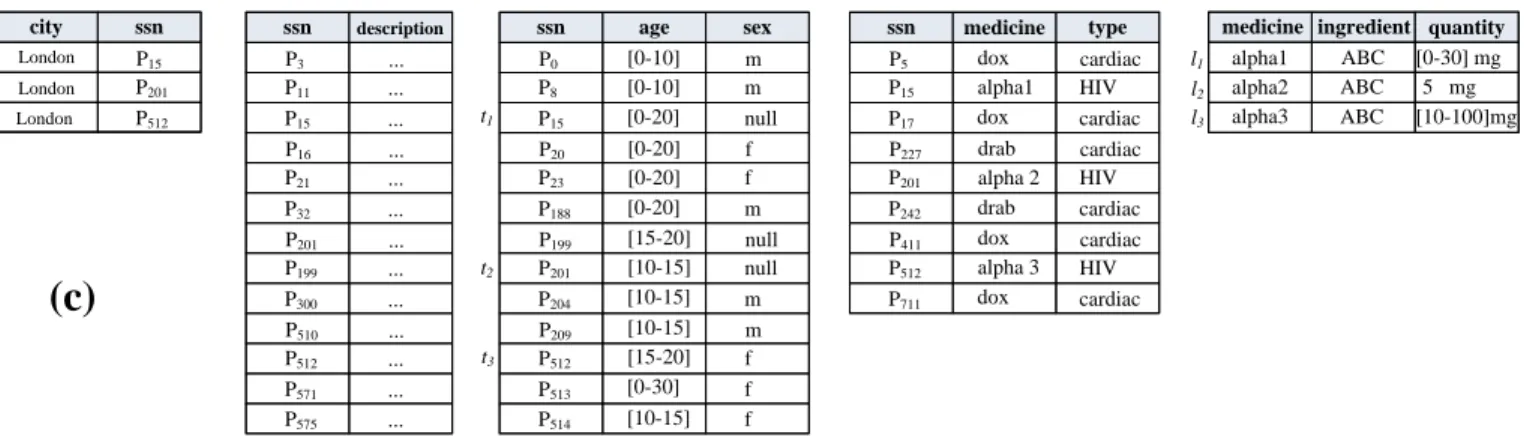
Data integration has important applications in the health-care domain such as building the patient medical record and detecting the side effects of medications. Assume for example a data integration system with an access to the data services1in Figure 1-a, which in turn have access to the
sample tables in Figure 1-c. Assume we need to investigate the psychological side-effects of a specific ingredient of HIV medicines on female patients. Our sample data services can be composed as in Figure 1-b to achieve our objec-tive. Specifically, DS1 is invoked with the desired city
to retrieve the identifiers (e.g. the social security numbers ssn) of HIV patients. Then,DS2, which is provided by
psy-chiatric hospitals, is invoked with obtained ssn numbers to retrieve the psychiatric disorders for which the patients have received some treatments for, if any. Then, for each HIV patient that has developed a psychiatric disorder,DS3
andDS4 are invoked in parallel to retrieve theirage,sex
andHIV medications, respectively. Consequently,DS5is
invoked to retrieve the quantity of the ingredient studied in each retrieved HIV medications. Then, the outputs ofDS3
andDS5are joined onssn.
The execution of the data integration plan (or also the service composition plan2) in Figure 1-b involves a
chal-lenging dilemma. That is, if individual services were to apply locally their privacy policies, and privacy-sanitize their output data then the plan cannot be executed. Note that in such case the social security numberssn, which is used by the integration plan to link the different information features of the same patient, will not be disclosed by any of the services, as it is a personally identifiable information. On the other hand, if services share their output data with the 1. It is a common practice in the healthcare domain to provide a service-oriented access to heterogeneous data sources [5]. This class of services is known asdata sharing services[3] or simplydata services[6].
2. We use the terms ”service composition plan” and ”data integration plan” interchangeably throughout the paper.
1551-3203 c2015 IEEE. Personal use is permitted, but republication/redistribution requires IEEE permission. See http://www.ieee.org/publications standards/publications/rights/index.html for more information.
city ssn P15 London London London P201 P512 ssn P3 P11 P15 P16 P21 P32 P201 P199 P300 P510 P512 P571 P575 ... ... ... ... ... ... ... ... ... ... ... ... ... ssn age P0 P8 P15 P20 P23 P188 P199 P201 P204 P209 P512 P513 P514 [0-20] sex m m null f f m null null m m f f f [0-10] [0-10] [0-20] [0-20] [0-20] [10-15] [10-15] [15-20] [0-30] [15-20] [10-15] [10-15] ssn P5 P15 P17 P227 P201 P242 P411 P512 P711 dox type cardiac HIV cardiac cardiac HIV cardiac cardiac HIV cardiac alpha1 dox drab alpha 2 drab dox alpha 3 dox description medicine ABC ABC ABC medicine alpha1 alpha2 alpha3
Table T1 (HIV Centers) Table T2 (Hospitals) Table T3 (Health ministry) Table T4 (Pharmacies) Table T5 (Labs)
(c)
t1 t2 t3 l1 l2 l3Semantics Implemented Parameterized Query
SELECT T1.ssn FROM T1 WHERE T1.city = $city
Provider HIV Centers DS1($city, ?ssn) SELECT T2.description FROM T2 WHERE T2.ssn = $ssn Hospitals Return description of the
psychiatric disorders of a given patient, if any.
Semantics Implemented Parameterized Query
SELECT T3.age, T3.sex FROM T3 WHERE T3.ssn = $ssn Provider Health ministry DS3($ssn, ?age, ?sex)
Return the age and sex of a given patient
SELECT T4.medicine FROM T4
WHERE T4.ssn=$ssn, T4.type=$type
Pharmacies
Semantics Implemented Parameterized Query Provider
DS5($medication, $ingredient, ?quantity)
Return the quantity of a given ingredient in a given medication.
SELECT T5.quantity FROM T5
WHERE T5.medication = $medication T5.ingredient = $ingredient
Return the medications of a given type that are taken by a given patient
Pharmaceutical Labs
(a)
DS1
Data Integration Plan
Begin End DS2 DS3 DS4 DS5 Join ssn city ssn, age, sex ssn ssn ssn, med ssn, med, qu
(b)
[10-100]mg 5 mg [0-30] mg quantity ingredientReturn the SSNs of HIV patients at a given city
Semantics Implemented Parameterized Query Provider
DS2($ssn, ?description)
Semantics Implemented Parameterized Query Provider
DS4($ssn, $type, ?medicine)
DS2 is exploited to retain only the HIV patients that
have been treated for some mental illness.
* *
The input of a service can be kept by the integration plan and joined with its corresponding outputs.
Fig. 1. (a) The data services of the running example; (b) A data integration plan; (c) Sample of the data accessed by the services.
integration system without any protection, then they may infer information about the data held by each other. For example, the provider of DS2 may infer that his patients
p15, p201 and p512 (refer to table T2 in Figure 1-c) are
also AIDS patients if were provided with an access to the integration plan3. He needs just to observe the inputs with whichDS2is queried. Providers ofDS3andDS4may also
infer that those same patients have psychiatric disorders and AIDS. Moreover, the integration system (i.e. the entity responsible of coordinating the execution of the integration plan), as well as the end-user (i.e. the stakeholder studying the side-effects of AIDS medications) will learn the diseases, medications and ages of all patients transmitted by the services.
A naive solution to avoid information leakage among involved services would be by getting each of the services 3. This is a reasonable assumption since data providers may require to be informed how their data is exploited, by which entities and for what purposes. Often, this is defined in agreed upon privacy polices.
to ship a copy of its underlying data sources to a centralized data integration system, which can store received copies and answer queries locally. However, such solution has several drawbacks that make it impractical for real-world applications. For example, in application domains where the data is dynamic, i.e. updated frequently on the data provider side, the results computed using the copies in the centralized system may not include the latest updates on the providers’ sides, which is crucial in critical domains such as the healthcare, where an incomplete or an erro-neous query answer might have dramatic consequences on the patient’s life. Moreover, such a centralized system may quickly become a target of choice for attackers due to the data concentration effect involved in retrieving copies from multiple data sources. Furthermore, current privacy regulations may prevent data providers from shipping the data they collect to a third-party which makes the solution undoable in practice.
the execution of multi-source data integration plans with-out leaking information abwith-out data subjects4 to involved stakeholders. That is, data services can not infer information about the data held by each other. Our solution can be used with trusted and semi-trusted (i.e. semi-honest) mediators. In the case of semi-trusted mediators, our solution enables involved data services to locally enforce their security and privacy policies (that relate to end-users), as the mediator cannot be trusted to enforce such policies. The solution still allows the mediator to join data subjects across the different services without leaking data from one service to another or to the mediator. In the case of trusted mediators, services can delegate the enforcement of their security and privacy policies to the mediator. The solution should just prevent data leakage among services.
1.2 Existing Solutions
Existing solutions for privacy-preserving data integration can be classified into three areas: privacy-preserving data publishing, secure multi-party query computation and trusted mediators based data integration. We discuss below their limi-tations based on our running example.
Privacy-preserving data publishing: Privacy models, such ask-Anonymity [7] and its variationsl-Diversity [8] and t-Closeness [9] compute ananonymized viewof a private table that can be shared with data consumers without the risk of disclosing the identity of specific data subjects (e.g. patients) in that view. Some recent works [10], [11] have attempted to apply thek-Anonymity concept (and its variations) in dis-tributed settings where the anonymized view is computed using multiple private tables managed by autonomous data providers.
However, while k-Anonymity and its variations pro-vide good privacy guarantees when the private table is owned by a single data provider, its implementations in distributed settings compromise the privacy of data subjects by leaking their private information to data providers while the latter compute the anonymized view. For example, all of the works [10], [11] assume that data providers, while computing the anonymized view, can know the list of data subjects they have in common5, but none of them should
know the specific attributes’ values that are held by each other, beyond what is included in the computed view. In our example, this means that the provider ofDS2can learn
that the patients p15, p201 and p512 are also managed by
the provider ofDS1 which is an HIV center, thus inferring
that these patients have AIDS, thus violating their privacy. Furthermore, such solutions are not convenient for data integration scenarios where data at the data providers’ side is dynamic.
Secure Multi-party Computation SMC: SMC protocols al-low two or more parties to evaluate a function over their private data, while revealing only the answer and nothing else about each party’s data. Initial solutions in this research 4. The term data subject refers to the person whose data is collected and managed by data services (e.g. patients).
5. Data providers in these works exchange the identifiers of data subjects in clear while they cooperatively compute the anonymized view.
area involved substantial computation costs that made them impractical [12]. Several new solutions with an improved efficiency have emerged over the last few years [13], [14]. However, the efficiency improvements come at an expensive cost, most of the new solutions such [13] require expensive (parallel) computation architectures that can be afforded by big corporations only. In addition, a recent evaluation study of the new solutions’ efficiency [15] suggests that they can be applied to non-critical applications only, where end-users can accept delayed answers.
Trusted mediators based data integration: Solutions in this category, such as [16], [17], rely on a centralized entity that can be trusted by all data providers to compute data integration queries. For example, Yau et al. [16] present a privacy-preserving data repository that can collect, from each data provider, only the data necessary to compute the answer of a query. The data collected is hashed in the repository in such a way to prevent its reuse for computing other queries. However, while such solutions could be used when the integrated data is dynamic, they leak privacy sensitive information to data providers about the data held by each other.
1.3 Proposed Approach and Contributions
In this paper, we propose a practical multi-source data integration approach that would preserve the privacy of data subjects against the different stakeholders involved in answering a data integration query including data services, mediator and end-users. Our approach has the particularity of reducing data leakage among services to a practical amount that would prevent services from inferring sensitive information about data subjects. The mediator has access only to encrypted information to join data subjects across involved services. The proposed approach can be used for both trusted and semi-trusted mediators. Our solution can be exploited in numerous applications where independent data sources should preserve the confidentiality of their data including healthcare [5], eGovernment [1], industrial collaboration scenarios [18], emergency management [19], [20], data management in smart environments [21], [22], personal data markets [23], multi sources data analytics [24], [25], etc.
The contributions of this paper are summarized as follows:
• We define the main privacy requirements for the
service-oriented class of data integration. These re-quirements consider the different actors involved in a composition of services answering a query, includ-ing theconstituent services (i.e., data providers), the mediator(i.e., the composition system) and the end-users(i.e., data consumers).
• We introduce a new privacy requirement, dubbed k-Protection, to ensure that there are no data leaks among services (i.e., data providers) during the query computation. In a nutshell, when the output of a serviceDSi is used by a composition as input
to another serviceDSj, thek-Protectionrequirement
protects the output ofDSiby preventing DSj from
distinguishing the exact input value fromkpossible input values, wherekis set byDSi. This would allow
DSi to reduce the inference capability of DSj (and
the other services in the composition) about its data below a practical threshold set byDSiitself.
• We propose an approach to evaluate multi-source
queries over autonomous Web data services while respecting thek-protection requirement. We validate our approach in the healthcare application domain by conducting a set of experiments using a real medi-cal dataset of 1,150,000 records. The results show that our solution provides a practical privacy protection with acceptable performance overhead.
The remainder of the paper is organized as follows. In Section 2, we define our privacy requirements with respect to services, the mediator, and the end-user. In Section 3, we present our approach for query evaluation. In Section 4, we evaluate the performance of our approach using a real medical dataset and discuss its applicability to real life application domains. In Section 5, we compare our approach with related research works and conclude in Section 6.
2
P
RIVACYR
EQUIREMENTS INS
ERVICEC
OMPO-SITION
In this section, we identify and discuss the data privacy requirements with respect to the different actors involved in a composition of services, including services, end-users and the mediator (or the composition system).
2.1 Service Composition
In this paper, we assume that data sources are exposed to the data sharing environment through Web APIs, i.e. Web services, to provide a standardized interface to data6.
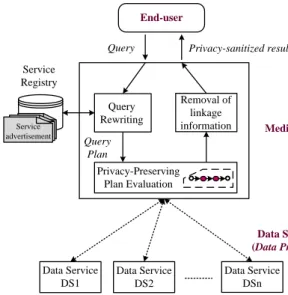
End-users’ queries are resolved by service composition as follows (Figure 2). Given a query and a set of available data services, the integration system compares the received query with the descriptions of available services to select the relevant ones. Then the integration system rewrites the query in terms of calls to selected services. The rewriting, also called a composition, is then executed in such a way that preserves the data privacy relative to the different actors involved.
In this paper we will focus on the privacy issues raised by the execution of a composition. Readers interested in ser-vice selection and query reformulation in terms of serser-vices are referred to our previous work [26], [27] or to similar works [28].
In the following we formalize the notion of a com-position execution plan and define the requirements that should be satisfied in a privacy-preserving execution of a composition plan with respect to the different actors involved, including the mediator, end-users and involved data sharing services.
Definition 1 (Composition Execution Plan): We adopt the definition given in [28]. A composition execution plan is a directed acyclic graphHin which there is a node corresponding 6. The class of Web services that access and query data sources is known as Data Servicesor Data Sharing Services [3], [6], [16], and is motivated by the flexibility, and the interoperability that service oriented architectures could bring to data integration.
Data Service DS1 Data Service DS2 Data Service DSn End-user Service Registry WSDL-S Files WSDL-S Files Service advertisement Query Rewriting Privacy-Preserving Plan Evaluation Query Plan
Query Privacy-sanitized result
Removal of linkage
information Mediator
Data Services
(Data Providers)
Fig. 2. Privacy-Preserving Service Composition
to each one of the data services involved in answering the query, and there is a directed edge eij from DSi to DSj if there is
a precedence constraint between DSi and DSj. We say that a
serviceDSi must preceedDSj if one of its outputs is an input
forDSj.
The composition execution plan of our example is shown in Figure 1-b. Please note that some nodes are simply preceded by end-users’ input, e.g. DS1. The query results
can be simply computed by joining the outputs of services that are leaves in the plan (e.g.DS3andDS5) [28].
2.2 Data Privacy Requirements
We focus on data privacy in this paper, i.e. the privacy of data subjects whose data is processed in a composition plan (e.g. patients in the running example), as opposed to the privacy of end-users who receive the final result which was adequately addressed in the literature.
We say that the execution of a composition plan H is privacy-preserving if it satisfies the following requirements with respect to the different actors involved including par-ticipating services, end-users and the mediator:
2.2.1 Requirements with respect to services
The execution of a composition should not leak information to its constituent services about the data held by each other. Let <(tx) represents the knowledge that a service DS
holds a given tupletx. Lettxconcerns a data subjectx(e.g.
a patient, a product, etc.). Let also <ij(tx) represents the
knowledge leaked formDSitoDSjthatDSiholdstx.
When a composition is executed without any privacy protection, the confidence of DSj’s provider in <ij(tx) is
P rj(<ij(tx))= 1. For example, whenDS3 in the running
example is invoked with the valuessn =p15, its provider
will learn that both ofDS1 andDS2 hold a tuple for the
patient p15, i.e. P r3(<13(tp15)) =P r3(<23(tp15)) = 1 (thus
inferringp15has HIV and mental disorders).
A service DSi can control the leakage of its data by
keepingP rj(<ij(tx))below an accepted threshold (fixed by
DSi). We define below a mechanism to control data leakage
Invocation of DS1 p15 p201 p512 Value Generalization p15 Invocation of DS2 Filtering extraneous tuples V=[p11, p16] p15 p11 p16 An interval with at least
k values stored in DS2
Fig. 3. Applying the k-protection mechanism on the edgee12(k=3)
Definition 2 (k-Protection): Given a composition H and a vector K = {k1, k2, ..., kn}, where ki is a positive integer
determining the protection threshold (i.e.1/ki) the serviceDSi
must provide for its output tuples against the other services inH, then for each edgeeijinH,P rj(<ij(tx))must be≤min(1/kl),
where1/klis the protection threshold ofDSl, which is, in turn,
a (direct or indirect) parent ofDSj inH. Note thatDSj has at
least one parent inH(i.e.DSi,kl≥ki).
Thek-protection mechanism is inspired by the concepts of k-anonymity [7] and Private Information Retrieval PIR [29]. Intuitively, this mechanism ensures that when a service DSjis invoked (with an input data value fromDSi), it must
not be able to precisely determine its input value between kl other possible input values (where kl ≥ ki). In other
words, instead of invokingDSj with a precise input value
v, DSj should be invoked with a generalized value of v
that matches with a range of values V (v ∈V) containing at leastklother possible values. This way, the certainty (i.e.
the confidence) ofDSj thatv is held byDSi is less than
1/kl. One possible way to implement this mechanism is to
computeV such that it containsklvalues for whichDSjhas
an output. Please note that thek-protection is similar to PIR in that when a service is queried (i.e. invoked) it does not know exactly the specific query it is executing on its own dataset.
Example: We continue on our running example. Given the data accessed by our sample services in Figure 1c, examples of the privacy breaches if these services were invoked with-out applying thek-protection mechanism include:DS2will
know that its patients p15,p201 andp512 have AIDS;DS3
will know that these same patients, in addition to having AIDS, suffer from severe psychiatric disorders, etc. Now, assume that k1 = 3, the k-protection mechanism ensures
thatDS2 must not be able to distinguish each of its input
values (e.g. p15) from at least 3 other values for which it
has matching tuples in its table T2. Figure 3 shows how thek-protection is enforced on the edgee12. The valuep15
is generalized into a range of values V which contains at least three values (e.g.p11,p15andp16) for whichDS2 has
matching tuples. After the invocation ofDS2, the
extrane-ous tuples are filtered out.
Preserving data privacy against the different data providers involved in a query has not been addressed ade-quately in the literature. For example, works on distributed privacy-preserving data publishing such as [10], [11] have focused on preserving the data privacy against final end-users while allowing involved data providers to know the list of data subjects they have in common. Thek-Protection mechanism complements those works by making them im-mune to information leakage among data providers.
2.2.2 Requirements with respect to end-users
End-users are the entities that issue a query and receive the final result of executing the composition answering the query. Depending on the application considered, end-users could be trusted or untrusted by data subjects. For examples, care givers (e.g. primary care doctors, nurses, etc.) could be trusted to access (all or part of) the medical infor-mation of their patients for treatment purposes. Researchers who study the health conditions of a population, could be only trusted to access to anonymized data that cannot be linked to any specific patient.
End-users should be only allowed to access the infor-mation they are entitled to. This can be ensured either by applying privacy-aware access control policies of individ-ual services in case of trusted end-users as in [30], or by anonymizing the results returned by the composition to prevent the re-identification of data subjects.
2.2.3 Requirements with respect to the mediator
The mediator, i.e. the entity that executes the composition plan, is another important actor in a composition of services. It may not be necessarily managed by the final data recipi-ent. It is responsible for carrying out the intermediary data operations in the composition plan (e.g. joining the outputs of different services, tuples selection, etc.).
Mediators could be trusted if managed by a trusted entity and are untrusted otherwise. An untrusted mediator should not have access to any Personally Identifiable Infor-mation PII. For example, the mediator should not be able to identify any of the patientsp15,p201andp512whose private
data is circulating throughout the composition plan. This implies that the data produced by a service should be protected by the service itself before being released to the mediator (and used for the invocation of other services). This can be ensured either by encrypting the released data (in case of trusted end-users) or by anonymizing it (in case of untrusted end-users).
Different applications may require different combina-tions of requirements, i.e. not all requirements should be respected at the same time. For example, in applications such as the healthcare, most often only the requirements re-lated to services and end-users are relevant. In that domain, data integration is usually carried out by a trusted authority (e.g., a government agency) to, for example, discover new medical knowledge. In that case, it is important to protect data privacy against individual data providers (i.e. services) and end-users (e.g. researchers), whereas the mediator itself (i.e., the authority) is trusted. In application domains such as cybersecurity and terrorist fighting, often the require-ment related to services is the most relevant. For example, consider a scenario where the objective is to proactively identify potential airplane terror attacks before they happen by identifying risky passengers (e.g., passengers with a criminal history and suspicious behaviors) on passenger lists of airline companies. Data providers in such case could be airline companies, police and intelligence services, banks, etc. The final end-user is a police inspector and the mediator is a governmental agency. In such case, the end-user and the mediator can be trusted, whereas data providers should not know they have a certain person in common, without a deep
investigation from the inspector (e.g., an airline company should not know that one of its passengers has a criminal history before the case is fully investigated by the inspector).
3
A P
RIVACY-P
RESERVINGQ
UERYE
VALUATIONA
PPROACHIn this section, we start by presenting our different as-sumptions and some key concepts. Then, we present an approach to evaluate multi-source queries while respecting the requirements discussed above.
3.1 Context and Assumptions
In this work, we made the following assumptions. We consider a distributed environment with heterogeneous dis-tribution of data. This means that different services manage different features of information about the same set of data subjects. In contrast, in a homogeneous data distribution, different services manage the same features of information about different data subjects. The second case is easier to deal with since there is no real integration to be done. Therefore we only look at the first case.
We consider ahonest but curious environment, where the stakeholders involved in the execution of a data integration plan will follow the given protocol. However, they may try to analyze exchanged data during the protocol execution. This setting is also known assemi-honest environmentin the literature [31].
We assume that services can provide statistical infor-mation about their accessed datasets such as the service selectivity [28]. The selectivity of a data serviceDSrelative to a range of input values R, denoted as Se(DS, R), is the number of output values when DS is queried with R. Let us consider the sample data in T3 (Figure 1-c), the selectivity of DS3 relative to some ranges is as
fol-lows:Se(DS3,[p0, p1000]) = 13, where the range[p0, p1000]
includes the whole table T3; Se(DS3,[p0, p10]) = 2,
Se(DS3,[p5, p20]) = 3.
3.2 An Overview of the Proposed Approach
In our approach we assume that services, the mediator and end-users are independent entities. Our approach ensures the privacy requirements relative to those entities as follows. In our approach, data services involved in the inte-gration plan can apply locally their security and privacy policies on non-identifier attributes. On the other hand, they are all required to encrypt the identifiers used by the mediator to join data by an Order Preserving Encryption Scheme OPES [32]. An OPES encrypts numeric data values while preserving the order relation between them. With OPES, we can apply equality and order comparison queries on encrypted data without decrypting the operands. Doing so, the mediator gets only access to encrypted values of identifier attributes and to values that are already protected by services for non-identifier attributes (e.g., by applying the desired anonymization techniques). This satisfies the privacy requirements relative to the mediator. Once the integration plan has been executed, the mediator removes encrypted identifier attributes from result. This way, the final recipient will only have the anonymized data without
Se(DS3, ]-∞,+∞[) Se=13, mid =c512 Se(DS3, ]-∞,c512]) Se=13, mid =c256 Se(DS3, ]-∞,c256]) Se=10, mid =c128 Se(DS3, ]-∞,c128]) Se=5, mid =c64 Se(DS3, ]-∞,c64]) Se=5, mid =c32 Se(DS3, ]-∞,c32]) Se=5, mid =c16 Se(DS3, ]-∞,c16]) Se=5, mid =c8 Se(DS3, [c8,c16]) Se=2, mid =c4 DS3 Mediator
Fig. 4. The communication rounds between the mediator andDS3 to compute the generalized value.
any individually identifiable information. This satisfies the privacy requirements relative to end-users.
To satisfy the privacy requirements relative to services, the mediator applies ourk-Protection mechanism by gener-alizing the encrypted identifiers’ values before using them to invoke the services. If a data service DSi was to be
invoked with a value x(originating from a parent service DSj) and it is required the certainty ofDSithatxis held by
DSj to be less than1/k, thenxis generalized through our
protocol (presented in the following) to match with, at least, ktuples inDSi. The value generalization is carried out by
the mediator in collaboration with the service to be invoked. Privacy requirements relative to end-users and the me-diator are conventional requirements and have been exten-sively studied in the literature. For example, the services can use any of the anonymization algorithms that implement the k-Anonymity and its variations [7], [8], [9] to locally anonymize their data. Privacy requirements with regard to services are, to the best of our knowledge, new, i.e., information leakage among data providers have not been property addressed in the literature. Therefore, in the fol-lowing sections we focus on ensuring the k-Protection by presenting a practical protocol for generalizing encrypted identifier values.
The anonymization applied by the individual data ser-vices (and its utility) is out of the scope of this paper. However, it is worth to mention that the anonymization can be realized by the services eitherin isolationby directly applying one of the algorithms [7], [8], [9], or cooperatively by extending one of the algorithms [10], [11] with our k-Protection mechanism presented in the next section.
3.3 Generalization of Encrypted Identifier Values
The objective of the generalization protocol can be formu-lated as follows:given an encrypted identifier valuex(x∈X) with which a serviceDSi should be invoked, allow the mediator
to compute a generalized value7 x0 of xsuch that x0 matches
7. We assume that data services provide different operations (i.e., functions) allowing to query the underlying datasets by precise or generalized values (e.g., intervals).
with, at least,kpossible values held byDSiwherekis maximum
protection factor required by the parents ofDSiinH.Note that
the mediator cannot decryptxto generalize it alone. Rather, it needs to collaborate with the services to be invoked to carry out the generalization.
We first describe two naive approaches to generalize the identifier values and analyze their limitations. Then, we build on our analysis to define a hybrid approach that addresses the identified limitations.
3.3.1 Domain-based identifier generalization
A naive approach to compute x0 is to exploit the domain of the attributex (i.e., X). The idea here is to use X as a starting value ofx0 then to gradually increase its precision by removing parts of X until it is not possible to remove any part without violating thek-Protection requirement.
For this purpose, the mediator determines for each data serviceDSithe protection factorkthat must be respected:k
= MAX(DSj.kj), whereDSj represents the parents ofDSi
inH. Then, for each input tuplet, the mediator determines the minimum range of valuesR[a,b] that should be used to invoke DSi instead of t.x. To this end, the mediator
queries the selectivity ofDSiwith respect to a wide range of
identifier valuesR(we use the range ]-∞, +∞[ to denote the range covering all the tuples managed byDSi) along with
a valuemidoccurring in the middle of the domainX. Then if the returned selectivity is greater than k, the mediator compares t.x to mid to determine the half ofR covering t.x. The last step is repeated with the obtained new interval until there is no interval with a selectivity greater thank. Then,DSiis invoked with the obtained interval. After the
invocation, the mediator retains only the outputs related to t.x, i.e., the false-positives are removed by the mediator, as it knows the original encrypted input valuet.x.
Example: Assume that the service DS3 is to be invoked
with the value c15 (i.e., the encrypted value of p15) and
k = 2. Figure 4 shows the messages exchanged between DS3and the mediator. For simplicity, the example assumes
that|X|=1024. First, the mediator queries the selectivity of DS3 relative to a wide range of values (denoted by ]-∞,
+∞[).DS3 replies that it has 13 values and the valuec512
is in the middle of X. The mediator compares c15 with
c512 and determine the new range ]-∞, c512]. This step is
repeated until the computed range cannot be divided while respecting the value ofk.
Privacy Analysis: From a privacy perspective the protocol has the following limitations:
• First, the mediator learns precise information about X, i.e., it receives the encrypted values of fixed data points inX (i.e., 12X, 14X, 18X...etc.). If the mediator knows the domainX, then it can map the encrypted values to their original values (since it knows their positions inX), or at least establish lower and upper bounds about each encrypted value.
• Second, it may leak additional knowledge to services by violating the k-Protection requirement. For ex-ample, if the selectivity of the range[c8, c16] in the
previous example were 1 (instead of 2), then the mediator would return back to the range ]-∞, c16].
t.x ≤ c199 t.x ≥ c199 t.x ≤ c20 t.x ≥ c20 R = ]-∞,+∞[, Se =13, mid = c199 R = ]-∞, c199], Se = 7, mid = c20 R = ]-∞, c20], Se =4,
Fig. 5. Generalizing the valuet.x=c15before invokingDS3.
However, the serviceDS3would still know that the
mediator is interested in the range[c8, c16], as it has
tested its selectivity. One would think that|R|could be returned instead of the selectivity to avoid such a problem (by making sure that |R| ≥ 2k before splitting it), however the problem may persist as it could happen that some values in the new range are not assigned to any individual, e.g., even though
|[c8, c16]|> k, the values in that range, except forc15,
may not be assigned to patients (i.e., they are still virginssnvalues), thenDS3will infer thatxisc15.
In addition, the protocol is not optimal. For instance, many of the rounds in Figure 4 (which involve important communication cost) did not reduce the selectivity, i.e., the first two ranges have the same selectivity, and the same applies to the fourth, the fifth, the sixth and the seventh range.
3.3.2 Dataset-based identifier generalization
A second naive approach to generalize x is to use the ordered dataset accessed by the service to be invoked, denoted bySo
DSi. In this approach, the mediator queries the
selectivity ofDSiwith respect to a wide range of identifier
valuesR(we used the range ]-∞, +∞[ to denote the range covering SDSo
i) along with a value mid occurring in the
middle ofSo
DSi. Then, if the returned selectivity is greater
than 2k, the mediator compares t.x to mid to determine the half of R covering t.x. The last step is repeated with the obtained new interval until there is no interval with a selectivity greater than k. Then,DSi is invoked. After the
invocation, the mediator retains only the outputs related to t.x, i.e., the false-positives are removed by the mediator, as it knows the original encrypted input value.
Example: We continue with our running example to show how we ensure the k-protection requirement on the edge e23. Assume thatDS1andDS2require a protection factork
= 3. The invocation ofDS2returns the tuples corresponding
to c15,c201 and c512 where these values are the encrypted
values of p15, p201 and p512. Instead of invoking DS3
directly with the tuple c15, the mediator generalizes c15
selectivity of DS3 with a range covering all its possibly
managed values (i.e., R = ]-∞, +∞[); DS3 acknowledges
it has 13 distinct values and that the value (mid = c199)
occurs in the middle of these ordered values. The mediator comparesc15 to c199, and determines the new intervalR=
]-∞,c199]. It then requests the selectivity of the newRalong
with the newmid; the new values ofSeandmidare 7 and c20. It determines again the new interval by comparingc15
to c20. The new interval isR= ]-∞,c20] and its selectivity
is 4. The algorithm stops here as if the new interval was divided thenSewill be less thank.
Privacy Analysis: This protocol does not suffer from the limitations discussed above. Specifically, it does not release the encrypted values of data points with known positions in X. It does not also test the selectivities of ranges that may contain less thankvalues, as the protocol verifies that the selectivity of a range is≥2k before splitting it in two equal ranges. xThe major limitation of this approach is that the boundaries of the computed range x0 depend on the dataset currently held by DSi (i.e., depend on SDSo i), and
may change if new tuples were inserted inSo
DSi, or if some
existing tuples were deleted, as we show in the following example.
Example: Let us assume thatSo
DSi={a,b,c,f},k= 2,x=c
and the computedx0is [c,f]. If the new tuplesdandewere inserted, i.e.,So
DSi={a,b,c,d,e,f}, thenx
0would become
x0 = [a,c], and the provider ofDSi would be able to infer
thatxisc, as [a,c]∩[c,f] ={c}.
3.3.3 Hybrid protocol for identifier generalization
Based on the limitations discussed above, a good data generalization scheme should satisfy the following criteria. First, it should guarantee that the generalized value (i.e., the computed rangex0) should always remain the same every time the composition plan is executed. In other words, the generalization scheme should be deterministic. Moreover, if the datasetSDSo iheld by a serviceDSiis changed (because
of data insertions or deletions), then the newly computed range should be a subset or superset of previously com-puted ranges for the same value x and with, at least, k intersecting values. Second, it should not leak additional information to the mediator that could help the latter to map the encrypted values to their real ones.
Before describing our proposed scheme for the general-ization of encrypted data that avoids the discussed limita-tions, we first discuss two requirements that data services should satisfy to participate in the scheme. First, services must timestamp their accessed data. This requirement can be simply implemented by timestamping new data inser-tions. That is, when joining the data integration system, if the dataset accessed by a service is not time-stamped, the service can timestamp it with the current time, then timestamp new data insertions when they occur. Second, the dataset accessed by a data serviceDSi, denoted asSoDSi,
should keep track of the values of identifier attributes. That is, when a tuple inside the dataset must be deleted, the dataset should keep the value of the identifier attribute and its timestamp. These two requirements are realistic and can be easily implemented, as have been discussed in previous works in data integration such as [33].
We now present our data generalization scheme which satisfies the criteria discussed above by combining the two previously discussed data generalization approaches while avoiding their limitations. Our scheme proceeds along the following steps.
1) The first step is carried out offline when data ser-vices join the data integration system. Every DSi
partitions the domain X to m buckets. Services are free to choose the partitioning criteria and the number m. For example, a service may choose to divide X into m buckets with 50 stored values in each bucket, while another one may choose to divideXintombuckets with equal absolute length. 2) The mediator executes thedataset based protocol de-scribed above and narrows down the computed rangeRas long as its selectivity isSe≥α∗k, where αis an integer value>1 selected by the mediator. As we will see later in our discussion,αguarantees that there is at least α candidate ranges satisfying the k-protection requirement in the R computed so far. We will explain the effect of αlater in our discussion.
3) The service determines the bucket (or the set of buckets) that coversRand divides them into ranges that respect thek-Protection requirement. Data ele-ments in each bucket are organized into candidate ranges as follows: (i) they are ordered based on their stamps, i.e., data elements with the same time-stamp have the same order (which is the case for the initial set of data elements whenDSihas joined
the system). (ii) An initial set of candidate ranges are formed using the data elements with the highest order. (iii) Subsequent data points are inserted one after another in the computed ranges and when the selectivity of a candidate range becomes 2k it gets split into two candidate ranges (that could also evolve independently).
4) The computed ranges that intersect with the initial rangeR(that is computed in the first step) are sent to the mediator, which can now select the candidate range coveringxand use it to invokeDSi.
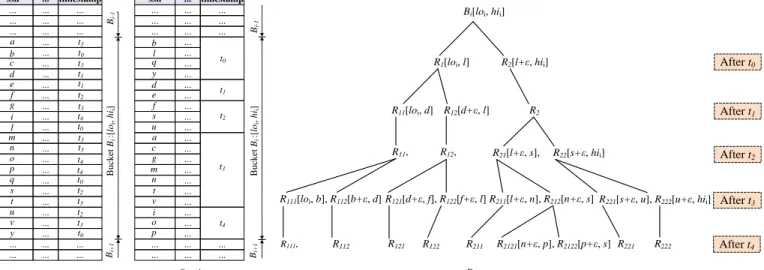
Illustrative Example: Assume that the ordered dataset ac-cessed by a data service DSi is shown in Figure 6
(part-a). For simplicity, the figure shows the content of only one bucket (i.e.,Bi). Each tuple in that dataset is time-stamped
(e.g., the tuple ahas the time-stampt3). Assume also that
x=q,k= 2, andα= 5. Assume also that after running the dataset based protocol(in the second step) the computed range that satisfies the conditionSe(R)≥α∗kisR=[f,v].
In the third step, the mediator asksDSi to compute the
candidate ranges that coverR. To this end,DSi finds the
buckets that coverRand computes their candidate ranges. As can be noticed from the dataset in Fig. 6 (part-a),R⊂Bi.
Figure 6 (part-b and part-c) shows how the ranges are computed. First, the service sorts the tuples insideBibased
on their timestamps (part-b). Then, it starts to consider the tuples inBi one by one and divideBi into ranges with at
leastk values. The tuplesb,l,q andy are considered first (they have the same time-stampt0), which results into two
Bi[loi, hii] R1[loi, l] R2[l+ε, hii] R11[loi, d] R12[d+ε, l] R2 R11, R12, R221[s+ε, u], R222[u+ε, hii] R111[loi, b], R112[b+ε, d]R121[d+ε, f], R122[f+ε, l]R211[l+ε, n], R212[n+ε, s] R2121[n+ε, p], R2122[p+ε, s] R21[l+ε, s], R22[s+ε, hii] R111, R112 R121 R122 R211 R221 R222 ssn ... ... a timestamp ... b ... c ... d ... e ... f ... g ... i ... l ... m ... n ... o ... p ... q ... s ... t ... u t0 ... v ... y t0 t0 t0 t1 t1 t2 t2 t2 t3 t3 t3 t3 t3 t3 t3 t4 t4 t4 ... a ... b ... c ... d ... e ... f ... g ... i ... l ... m ... n ... o ... p ... q ... s ... t ... u t0 ... v ... y t1 t2 t3 t4 ... ... ... ... ... ... ... ... ... ... ... ... ... ... ... B u ck et Bi :[ loi , h ii ] Bi+ 1 B i-1 ssn ... timestamp ... ... ... ... ... ... ... ... ... ... ... ... ... ... ... B u ck et Bi :[ loi , h ii ] Bi+ 1 B i-1
Part-a Part-b Part-c
After t3
After t2
After t1
After t0
After t4
Fig. 6. (a) a dataset partitioned into buckets; (b) data elements ordered by their time-stamps; (c) the computation of candidate ranges inside buckets.
Then, the tuples dand eare considered (as they have the same time-stampt1). The selectivity ofR1 becomes 4 (i.e.,
2k), and therefore it is split into two sub rangesR11[loi,d]
andR12[d+,l]. Similarly, when all the remaining tuples are
considered, we have as a result 9 ranges (shown in Fig 6 (part-c).
The rangeR =[f,v] computed in the second step inter-sects with seven ranges, i.e.,R121,R122,R211,R2121,R2122,
R221 and R222. Since the range R121 intersects partially
withR, it is merged withR122. The same applies toR222,
therefore it is merged withR221. The obtained five candidate
ranges are then sent back to the mediator, which will be able to select the final range with which the service will be invoked, i.e.,R2122[p+,s] (q∈R2122).
Our proposed protocol is implemented by two algo-rithms, one is implemented by the mediator for computing the initial range R≥α∗kand carrying out the service invo-cation (Algorithm 1) and one is implemented by the services for computing the candidate ranges (Algorithm 2), both are self-described.
Note that the ranges computed inside each bucket are deterministic, i.e., the protocol results always in the same ranges whenever the composition plan is executed, as they are computed using the data insertion order in the dataset (which is deterministic). The addition of new data elements to the dataset does not violate thek-Protection requirement, as it only results in splitting a range into a set of ranges that intersect with it by at leastkelements. For example, when x=q, if the plan was executed at an instantt wheret0 ≤
t≤t1then the service will be invoked with rangeR2, and
when it is executed at another instant t0 where t2 ≤ t0 ≤
t3, then the computed range will be R21 ⊂ R2. SinceR2
andR21intersect inR21which has at leastkvalues, i.e. the
k-Protection requirement still holds.
3.3.4 The effect ofαon privacy guarantee
We intuitively explain the effect ofαthrough an example. Consider the following dataset {a, b, c, d, e, f, g} and assume thatx=dandkis 2.
Whenα= 1, then the range R that is computed in the second step (of our protocol) could take two different values
[c,d] and [d,e] (because of data changes) with equivalent probabilitiesp= αk1 = 12. When the same query is replayed, the probability of one of these two ranges happening if the other range has already happened isp2
= (αk1)2 = 1 4.
Whenα= 2, then the range R that is computed in the second step could take four different values [a, d], [b, e], [c,f] and [d,g] with equivalent probabilitiesp= αk1 = 14. When the same query is replayed, the probability of [d,g] happening when [a, d] has already happened (these two ranges intersect ind) isp2 = 1
(αk)2 = 1
16. Similarly, whenα
= 5, the probability of such privacy breach becomes (αk1)2
= 1001 , and whenα = 10 this probability becomes 10002.5 . In conclusion, practical values ofα(e.g.,α≥5) cut down the probability of privacy breaches to an accepted threshold. The value ofαcan be computed as followsα=
p1
p k , where
pis the threshold of accepted probability.
4
E
VALUATIONIn this section, we present an evaluation study of our proposed approach, report on its performance and privacy preserving strength, and discuss some of the key applica-tions where it can be used.
4.1 Evaluation Setup
To evaluate our approach, we used a real dataset that was provided to us by the European project PAIRSE [17]. The dataset was created by merging data from seven real databases of three French hospitals (specialized in psychi-atry and cardiology). The dataset contained one big table with roughly 1,150,000 records (for approximately 850,000 patients). The table has the schemaR(ssn,disease,dob,sex, city,physician observations). The ssnvalues in the pro-vided table were replaced by synthetic numeric values by the original healthcare facilities. The same patient may have different rows in the table corresponding to the different diseases for which he or she has been treated.
We constructed three tables out of R: R1(ssn, disease, city), R2(ssn, disease) and R3(ssn,
Algorithm 1: k-Protection aware Service Invocation
Inputs: - The data service to be invoked Si($x, ?y),
- The set of input tuples IN
Variables & Functions:
- The protection degree k,
- A range of values R [a, b]
- Se(Si, R) : returns the selectivity Se of Si relative to R - Split(Si, R): returns a value mid such that mid is in the
middle of the ordered values set V for which Si has outputs
Begin
k = max (Sj.kj), where Sj is parent of Si
for each tuple t1 in IN R ← ]˗∞, +∞[ Se ← Se(Si, R) v ← Split(Si, R) while (Se ≥ 2αk) if t1.x≥ mid a ← mid else b ← mid Se ← Se(Si, R) mid ← Split(Si, R) Candidate Ranges M = CandidateRa(R)
Select R (R ϵ M) such that t1.x ϵ R
invoke (Si ($R, ?y))
for each obtained tuple t2 if t2.x ≠ t1.x discard t2 else add t2to OUT 1. 2. 3. 4. 5. 6. 7. 8. 9. 10. 11. 12. 13. 14. 15. 16. 17. 18. 19. 20.
Outputs:- The set of output tuples OUT
- CandidateRa(R): returns a set of candidate ranges
inside R
dob, sex). R1 contained only heart patients (with a total
number of 510,000 patients). R2 contained the patients
that have been treated for a mental illness (with a total number of 403,000 patients). For each of the tablesR1,R2
and R3, we constructed eight datasets of various sizes by
randomly selecting patients of the tables. The constructed datasets have the sizes: 50K, 100K, 150K, 200K, 250K, 300K, 350K, 400K. For each dataset, we developed a data service to access the dataset. These 24 services have the following three signatures: DS1(?ssn,?disease,$city),
DS2($ssn,?disease), DS3($ssn, ?dob,?sex), and were
deployed on independent servers (with independent resources).
In our experiments we used the following composition: DS1◦DS2◦DS3; DS1 is invoked with a given city name,
then for each obtained patient DS2 is invoked to verify if
the patient has been treated for some mental illness, then DS3is invoked with only those who have been treated for
a mental illness to retrieve their age and sex.
We implemented Algorithm 1 in Java and integrated it into the data integration system in [17]. Figure 7 shows the modified system, which consists of two main modules:
Algorithm 2:
Computing Candidate Ranges
Inputs: - I:An initial range computed by the mediator,
- k: The protection factor required by the mediator,
Variables & Functions:
- A: an empty bucket,
- Se(R) : returns the selectivity of R
Begin
for each bucket Bi[lo, hi] such that Bi ∩ R ≠ Φ - Order Bi based on time-stamps
- Initialize M: M ← [lo, hi] A.lo = Bi.lo; A.hi = Bi.hi - For each t ϵ Bi (after ordering it) - Insert t in A
- For each R ϵ M
- If Se(R) ≥ 2k (after the insertion) - Split R into R1 and R2
- Add R1 and R2 to M - Remove R from M
- For each R ϵ M
- Discard R if R∩ I = Φ
- Merge the first and the lastranges R0 and Rn with their neighbours (i.e. R0 with R1 and Rn with Rn-1) - Return M 1. 2. 3. 4. 5. 6. 7. 8. 9. 10. 11. 12. 13. 14. 15. 16. 17.
Outputs:- M: a set of candidate ranges,
service composition engineand thecomposition execution engine. The first module rewrites end-users queries into composi-tions of services. The second module executes the compo-sitions. We modified, as the figure shows, the composition execution engine to accommodate Algorithm 1. All services are deployed on GlasFish 3.0 servers and datasets are stored in MySQL servers. Algorithm 2 is implemented in Java on the server side and is accessed as a simple operation of each developed data service (i.e., each service provides an operation for querying its underlying dataset and a set of operations for participating in the proposed protocol, e.g., operations for computing the candidate ranges, computing the selectivity of a range, etc.).
We conducted our experiments on machines with 3.2GHz Intel Processor running Windows 7 with 8 GB RAM.
4.2 Performance Evaluation
Assumingnis the number of services in a composition,lis the average number a service is invoked in a composition and m is the average size of the datasets accessed by the services, the complexity of evaluating a query plan is of the order O(n∗l∗log2(αkm)∗ |Bucket|).
We conducted a set of experiments to evaluate the performance of our privacy-preserving query evaluation approach using real databases. Specifically, we evaluated the effects of (i) the protection factorβ=α∗kand (ii) the size of accessed datasets on the composition execution time.
We measured the composition execution time of our eight compositions; all compositions are identical, except
Query Rewriting Composition plan generator (1) Query Sa DB Client Service Registry WSDL-S Files WSDL-S Files WSDL-S Files
Composition Execution Engine
Encrypted Value Generalization Service Invocation Filtering False positives Composition Plan (2) Composition (3) Execution order (4) Privacy sanitized result
Service Composition Engine
Sb DB
Sc DB
Sn DB
Service Invocation
Service-oriented Data Integration System Data Services Data Sources App App App
App
Fig. 7. The Evaluation Architecture
50 100 150 200 250 300 350 400 Dataset Size (in Thousands)
C o m p o si ti o n E x ec u ti o n T im e in M in u te s
Invocation with precise input values
α = 5, k = 5 α = 10, k = 5 α = 20, k = 5 20 40 60 0 80 100
Dataset Size (in Thousands)
C o m p o si ti o n E x ec u ti o n T im e in M in u te s
Invocation with precise values Optimization 1 α = 5, k = 5 Optimization 2 20 40 60 0 80 100 Optimizations 1, 2 & 3 4 6 8 10
Size of Buckets (in Thousands)
C o m p o si ti o n E x ec u ti o n T im e in M in u te s 2 20 40 60 0 80 100 α = 5, k = 5, Dataset Size = 400,000 50 100 150 200 250 300 350 400 Optimization 3
Fig. 8. (a) The performance of the proposed approach as the size of datasets and the value ofα∗kincrease; (b) The effect of the bucket size on performance; (c) The performance before and after applying the optimizations.
that all services in each composition are accessing datasets of one of the aforementioned sizes. We set the bucket size to 10,000 records (i.e.,|Bucket|= 10,000) for all services. We chose three high values for the protection factorβ:β1= 25
(α= 5,k= 5),β2 = 50 (α= 10,k= 5) andβ3= 100 (α= 20,
k= 5). The probabilities of a privacy breach for these values are:prob1 = (β1 1)2 = 0.0016, prob2 = 1 (β2)2 = 0.0004,prob3= 1 (β3)2 = 0.0001.
The composition execution time was computed as fol-lows.R1contained patients from 47 cities (with an average
of 10,850 patients per city). Therefore, each composition was executed 100 times with each one of these 47 cities as input. Then, we computed the average execution time for each composition (i.e., for each one of the considered dataset sizes). Figure 8 (a) shows the obtained result together with the time required to execute the compositions without en-forcing thek-protection requirement.
The obtained result shows that, for all the considered dataset sizes, the overhead involved in enforcing the k -protection requirement does not exceed two orders of mag-nitude of the time required to execute the composition without a protection. We view this as reasonable compared to the cost incurred by private information retrieval and secure multi-party computation protocols which exceeds by hundred times the cost of the original query without a protection. The reader is referred to [15] for discussion about the practicality of these approaches in real life applications. The result shows also that increasing the values of the protection factorβ =α∗konly introduces a minimal addi-tional overhead. This means that services can choose large
values for k (thus providing better privacy protection to their outputs) and the mediator can choose large values for α(thus a very small probability of a privacy breach) without degrading the overall performance.
Figure 8 (b) shows the effect of changing the bucket size on the overall query evaluation time. Obviously, reducing the bucket size will reduce also the time required to compute the candidate ranges, and thus improve the overall perfor-mance. Please note that services are not required to use a large bucket size. It can be defined based on the accepted probability of a privacy breach. For example, if the bucket size was 2000, the probability of a privacy breach would be of the order(2000)1 2 = 0.00000025, which is a practical value.
Additionally, the cost incurred in computing the candidate ranges inside a bucket can be offset altogether by computing these ranges offline, as we show in the next subsection.
4.3 Discussion
As mentioned earlier, the value of k is selected by each individual service to limit the inference capability of other services in the composition/query about the data held by the service. The parameter α is an integer value (α ≥ 1) selected by the mediator to reduce the probability of a privacy breach (due to replay attacks) to a specific threshold. The higher the factorα∗k, the better the privacy protection. However, as the results show, the composition execution time increases also by increasing that factor.
The values of kand αcan be tuned to strike a balance between privacy protection and performance for the con-sidered application domain. For example, the experiments
show that if α= 10 andk =5 (α∗k = 50), the probability of inferring that a service holds a specific tuple is (α∗1k)2 =
1
2500 = 0.0004 (i.e., the same query needs to be replayed at
least 2500 times for that privacy breach to happen), and the composition execution time remains less than two times the time needed without any protection. In practice, the values ofkandαare selected such that the factor(α∗k)2is always
higher than the number of times the same query can be executed by the same end-user (the system can limit the number a same query can be executed by the same end-user within a specific time window).
4.4 Performance Optimization
The performance of our approach can be improved further by considering the following optimizations:
Optimization 1: Reuse of pre-computed selectivities and ranges. At the composition execution time, the same service is likely to be invoked multiple times for different input values. The ranges and the selectivities that were computed in previous invocations (within the same composition ex-ecution occurrence) can be reused, even partially, instead of re-computing them each time the same service is in-voked. Table 1 shows, for example, the numbers of patients returned by DS1 when invoked with the cities “Lyon 2”,
“Lyon 5” and “Lyon 8”, as well as the average number of the computed selectivities when DS2 is invoked. Without
this optimization, the number of computed selectivities would belog2(dataset size) = 18.6. The table shows also the
numbers of reused candidate ranges. TABLE 1 Experimental Results
City # Patients (byDS1) # Computed selectivities # Reused ranges
Lyon 2 13,738 7.3 257
Lyon 5 11,923 8.2 306
Lyon 8 9,736 8.7 119
Optimization 2: Use of user preferences. In real-life scenar-ios, many data subjects (e.g., patients, citizens, etc.) may accept to release some of their private data to some recipi-ents for some legitimate data uses (e.g., conducting medical research, law enforcement, etc.) without any protection. For example, the dataset R was provided to us along with a patient preferences table specifying some of the entities each patient accepts to disclose his data; nearly 19% of the patients accepted to share their medical data (including the ssn) with medical institutions for improving the healthcare system. In our second optimization, we exploit the prefer-ences of data subjects to lift the privacy protection when a data subject consents to data disclosure. For instance, in our running query the k-protection requirement could be lifted when DS2 and DS3 are invoked with input values
originating from those patients who accepted to disclose their data to medical institutions (such as those providing DS2andDS3).
Please note that, one would think that invoking a service with a precise input valuex1(of an individual who accepted
to release her identifier) could invalidate thek-protection for another input valuex2 (of another individual who did not
accept to release her identifier) ifx1happens to be one of the
kpossible values that match with the computed generalized value x02 (as the service would be able to eliminate one
value of thekpossible values matching withx02). However, this will not happen in the first place, as the output tuples corresponding to x1 will be retrieved when the service is
invoked with x02, and thus there is no need to invoke it again. That is, lifting the k-protection requirement for those patients who agreed to release their identifiers has no impact on the privacy protection provided for those who did not accept, as long as the services are invoked with input values of patients who did not agree to release their data before the ones who did.
Optimization 3: Off-line computation of k-protection ranges. Services incur an important computation cost when they divide their buckets (that are relevant to an invocation) into ranges respecting the k-protection requirement (i.e., Step 3 of the proposed hybrid protocol). However, this step can be carried out offline in an incremental fashion, as they insert new tuples.
We conducted a set of experiments to evaluate the per-formance improvement that could result from the optimiza-tions presented above. Figure 8 (c), shows the obtained results when (i) none, (ii) only one and (iii) all of the optimizations is/are applied. The result shows that apply-ing those optimizations substantially improves the perfor-mance. In fact, the query execution becomes less than two orders of magnitude of the query execution time when no protection is applied (regardless of the considered dataset size).
4.5 Privacy Analysis
Our protocol is immune against replay attacks. That is, even if the same composition was executed several times with the same inputs, data service providers cannot increase their confidence sufficiently to infer with certainty the identity of a data subject with which they are queried. For example, as explained when we analyzed the effect ofαon the privacy guarantee, ifαwas set to 20, andk was set to 5, then the probability of a privacy breach happening isprob= (αk1)2 =
1
10000; and whenα= 200 andk= 5, that probability becomes
1000000. That is, the same composition needs to be executed million times in order to have two candidate ranges (R=α∗k) whose intersection is the identifier of a targeted data subject. Some would argue that the order preserving encryption scheme (OPES) of Agrawal et al. [32] is insecure and can be broken by the mediator. However, for us, that scheme is only a means, not an end. We can use any of the recent OPESs reviewed in [34] or even a partial implementation of the Homomorphic encryption [35]. Our protocol requires only to allow the mediator to carry out equality and comparison operations (i.e., =,<,>) which could be realized with any of the aforementioned schemes.
One limitation of the approach is that when the domain X of the identifiers is small, if the mediator knows all of the values in X, then it can, after a certain number of queries (i.e., compositions), build a mapping table between the encrypted values and the real ones. However, this can be overcome by encrypting the identifiers with a different key every time a query is executed. Moreover, the proposed generalization protocol itself can be applied on both real