TENSOR LEARNING FOR RECOVERING MISSING INFORMATION: ALGORITHMS AND APPLICATIONS ON SOCIAL MEDIA
A Dissertation by
HANCHENG GE
Submitted to the Office of Graduate and Professional Studies of Texas A&M University
in partial fulfillment of the requirements for the degree of DOCTOR OF PHILOSOPHY
Chair of Committee, James Caverlee Committee Members, Frank M. Shipman
Xia Hu
Jianhua Huang Head of Department, Dilma Da Silva
December 2017
Major Subject: Computer Engineering
ABSTRACT
Real-time social systems like Facebook, Twitter, and Snapchat have been growing rapidly, producing exabytes of data in different views or aspects. Coupled with more and more GPS-enabled sharing of videos, images, blogs, and tweets that provide valu-able information regarding “who”, “where”, “when” and “what”, these real-time human sensor data promise new research opportunities to uncover models of user behavior, mo-bility, and information sharing. These real-time dynamics in social systems usually come in multiple aspects, which are able to help better understand the social interactions of the underlying network. However, these multi-aspect datasets are often raw and incomplete owing to various unpredictable or unavoidable reasons; for instance, API limitations and data sampling policies can lead to an incomplete (and often biased) perspective on these multi-aspect datasets. This missing data could raise serious concerns such as biased esti-mations on structural properties of the network and properties of information cascades in social networks. In order to recover missing values or information in social systems, we identify “4S” challenges: extremesparsityof the observed multi-aspect datasets, adoption of rich side information that is able to describe the similaritiesof entities, generation of robust models rather than limiting them on specificapplications, andscalabilityof mod-els to handle real large-scale datasets (billions of observed entries). With these challenges in mind, this dissertation aims to develop scalable and interpretable tensor-based frame-works, algorithms and methods for recovering missing information on social media. In particular, this dissertation research makes four unique contributions:
• The first research contribution of this dissertation research is to propose a scalable framework based on low-rank tensor learning in the presence of incomplete informa-tion. Concretely, we formally define the problem of recovering the spatio-temporal
dynamics of online memes and tackle this problem by proposing a novel tensor-based factorization approach tensor-based on the alternative direction method of multipli-ers (ADMM) with the integration of the latent relationships derived from contextual information among locations, memes, and times.
• The second research contribution of this dissertation research is to evaluate the gen-eralization of the proposed tensor learning framework and extend it to the recom-mendation problem. In particular, we develop a novel tensor-based approach to solve the personalized expert recommendation by integrating both the latent rela-tionships between homogeneous entities (e.g., users and users, experts and experts) and the relationships between heterogeneous entities (e.g., users and experts, topics and experts) from the geo-spatial, topical, and social contexts.
• The third research contribution of this dissertation research is to extend the pro-posed tensor learning framework to the user topical profiling problem. Specifically, we propose a tensor-based contextual regularization model embedded into a matrix factorization framework, which leverages the social, textual, and behavioral contexts across users, in order to overcome identified challenges.
• The fourth research contribution of this dissertation research is to scale up the pro-posed tensor learning framework to be capable of handling real large-scale datasets that are too big to fit in the main memory of a single machine. Particularly, we propose a novel distributed tensor completion algorithm with the trace-based regu-larization of the auxiliary information based on ADMM under the proposed tensor learning framework, which is designed to scale up to real large-scale tensors (e.g., billions of entries) by efficiently computing auxiliary variables, minimizing inter-mediate data, and reducing the workload of updating new tensors.
DEDICATION
ACKNOWLEDGMENTS
This dissertation would have never been done without a few great people who always supported, inspired and influenced me as well as my work. First and foremost, I would like to express all my gratitude to my advisor James Caverlee who is the best mentor, advisor and friend with his mentorship, guidance, a steady stream of supports and encouragement. One of my best choice I have ever made in my life is to choose him as my advisor for my PhD studies. I learned what the research is, how to do research and how to become a better man from him. His profession, kindness, and generousness are deeply engraved in my mind. I could spend many pages in expressing my gratitudes to Cav, but due to the limited space, I will just say that he is my role model and tirelessly shaped me into a better researcher and man.
I would also like to thank the rest of my dissertation committee, Frank Shipman, Xia Hu and Jianhuang Huang for their continuous advice and support during my PhD. Xia’s advice help and motivated me to successfully complete my dissertation. The discussion with Jianhua also inspired me to develop the tensor learning model. I would especially like to thank Frank for his amazing feedback for my dissertation. Besides of activities at Texas A&M University, I was fortunate to have opportunities to work with great people in the industry. I am very grateful to Guru Shivaswamy who offered me my first industry internship at eBay, and is a tremendous mentor giving me absolute freedom and thought-provoking hours of discussions, Lili Yuan who always supported and help me during my internship at eBay, and Jianwu Xu who is my mentor during the internship at NEC Labs America and made my summer of 2016 extremely wonderful and enjoyable. In addition, I also would like to thank Kai Zhang, Bo Zong, Zhengzhang Chen, Wei Cheng, Biplob Debnath, and Hui Zhang for their unselfish help and advice on my internship at NEC Labs
America. I also very enjoyed the discussions with my fellow interns, Ying Zou, Hengtong Zhang, and Fei Wu. Furthermore, I am very thankful to my former roommates of the past years, Chaoyi Gu, Fan Yin and Yi Wang who are my truly friends and people who I can always bounce ideas off, and my friends Nan Zhang, Gang Yang, Jianchao Ge, Gang Wang, Naibao Zhao who all made my journey full of unforgettable moments.
Many thanks to my awesome lab-mates at Infolab for their tremendous support and helpful discussions. I enjoyed all office discussions, jokes, and exchange of ideas. We share the wonderful moments of paper acceptance as well as sad moments of being re-jected. Former lab-mates Zhiyuan Cheng, Kyumin Lee, Krishna Kamath and Jeff McGee welcomed me to the lab and help me understand how to be a good graduate student and what I should prepare for the research. My buddies Cheng Cao, Wei Niu and Haokai Lu had a tremendous impact on my PhD. We worked together through these years and had wonderful discussions and collaboration on interesting projects. I would also like to thank my other lab-mates Vandana Bachini, Himanshu Barthwal, Zhijiao Liu, Yuan Liang, Amir Fayazi, Prithivi Tamilarasan, Majid Alfifi, Parisa Kaghazgaran, Xing Zhao, Yin Zhang and Habeeb Hooshmand.
I am deeply indebted to my parents, Yutong Ge, and Qiang Huang, for their love and endless support. They are my role models who were always encouraging me and having faith in me no matter I am in ups and downs in my life. My parents valued good education more than anything else and made sure we had the best environment for it growing up. Things I saw and learned from them encouraged me to be an honest man, an generous person and an excellent researchers. My family is my strongest backing on whatever I confronted and made, which guided me to keep moving forward. The rest of my family are equally amazing. I love you all. Without the endless love and support from them, none of this work would be possible.
CONTRIBUTORS AND FUNDING SOURCES
Contributors
This work was supported by a dissertation committee consisting of Professor James Caverlee, Professor Frank Shipman and Professor Xia Hu of the Department of Computer Science and Engineering and Professor Jianhua Huang of the Department of Statistics. All work conducted for the dissertation was completed by the student independently.
Funding Sources
Graduate study was supported by NSF grants IIS-1149383, IIS-1657196 and AFOSR grant FA9550-15-1-0149 as well as a Google Research Award.
TABLE OF CONTENTS
Page
ABSTRACT . . . ii
DEDICATION . . . iv
ACKNOWLEDGMENTS . . . v
CONTRIBUTORS AND FUNDING SOURCES . . . vii
TABLE OF CONTENTS . . . viii
LIST OF FIGURES . . . xiii
LIST OF TABLES. . . xvi
1. INTRODUCTION . . . 1
1.1 Motivation . . . 1
1.1.1 Multi-Aspect Data . . . 1
1.1.2 The Missing Data Problem . . . 2
1.1.3 Tensors and Tensor Learning . . . 3
1.2 Challenges . . . 4 1.3 Contributions . . . 5 1.4 Dissertation Overview . . . 7 2. BACKGROUND . . . 10 2.1 Introduction. . . 10 2.2 Tensor . . . 10 2.3 Tensor Decomposition . . . 13 2.4 Tensor Completion . . . 13 3. RELATED WORK . . . 15 3.1 Tensor Factorization . . . 15 3.1.1 Tensor Decomposition . . . 15 3.1.2 Tensor Completion . . . 15
3.2.2 Estimating Missing Spatio-Temporal Data . . . 17
3.3 Recommendation on Experts . . . 18
3.3.1 Finding Experts . . . 18
3.3.2 Systems towards Recommending Experts. . . 18
3.4 Learning User Topical Profiles . . . 19
3.4.1 Finding User Interests and Expertise . . . 19
3.4.2 Leveraging Contexts. . . 20
3.4.3 Factorization Models . . . 20
3.5 Scalable Tensor Algorithms . . . 21
3.5.1 Scalable Tensor Factorization . . . 21
3.5.2 Distributed Computing Frameworks. . . 23
4. AIRCP: A TENSOR-BASED APPROACH FOR RECOVERING MISSING SPATIO-TEMPORAL DYNAMICS OF ONLINE MEMES . . . 24
4.1 Introduction. . . 24
4.2 Problem Statement . . . 27
4.2.1 Spatio-Temporal Dynamics Recovery Problem . . . 28
4.2.2 Twitter Hashtags . . . 29
4.3 AIRCP: Auxiliary Information Regularized CP Model . . . 29
4.3.1 Modeling Recovery of Missing Data . . . 30
4.3.1.1 Modeling Spatial Relationships . . . 31
4.3.1.2 Modeling Hashtag Relationships . . . 34
4.3.1.3 Modeling Temporal Relationships . . . 35
4.3.1.4 Integrating Auxiliary Information . . . 35
4.3.2 Optimization Algorithm . . . 37
4.3.3 Recovery with Auxiliary Information . . . 39
4.4 Experiments . . . 40
4.4.1 Data . . . 40
4.4.2 Experimental Setup and Metrics . . . 43
4.4.3 Baseline Methods . . . 44
4.4.4 Evaluating AIRCP over Synthetic Data . . . 45
4.4.5 Evaluating AIRCP over Hashtag Data . . . 47
4.4.6 Recovery Under Constraints . . . 50
4.4.7 Effects of Auxiliary Information. . . 54
4.4.8 Effects of Regularization Parameters . . . 54
4.5 Conclusion. . . 56
5. TAPER: A CONTEXTUAL TENSOR-BASED APPROACH FOR PERSON-ALIZED EXPERT RECOMMENDATION. . . 57
5.1 Introduction. . . 57
5.2.1 Basic Recommendation by Tensor Factorization . . . 60
5.2.2 Research Challenges . . . 61
5.3 The TAPER Framework . . . 61
5.3.1 Evidence of Geo-Topical-Social Impact. . . 62
5.3.1.1 Geo-Tagged Twitter Lists . . . 62
5.3.1.2 Geo-Spatial Context . . . 63
5.3.1.3 Topical Context . . . 64
5.3.1.4 Social Context . . . 64
5.3.2 Integrating Contextual Preferences . . . 67
5.3.3 Modeling Geo-Spatial Preferences . . . 70
5.3.3.1 Relationships between Homogeneous Entities. . . 70
5.3.3.2 Relationships between Heterogeneous Entities . . . 72
5.3.4 Modeling Topical Preferences . . . 73
5.3.4.1 Relationships between Homogeneous Entities. . . 73
5.3.4.2 Relationships between Heterogeneous Entities . . . 74
5.3.5 Modeling Social Preferences. . . 75
5.3.5.1 Relationships between Homogeneous Entities. . . 75
5.3.5.2 Relationships between Heterogeneous Entities . . . 76
5.3.6 Solving TAPER . . . 76
5.4 Experiments . . . 79
5.4.1 Experimental Setup . . . 80
5.4.2 Baselines . . . 80
5.4.3 Results . . . 82
5.4.3.1 The Impact of Contextual Preferences . . . 84
5.4.3.2 The Impact of Negative Experts . . . 85
5.4.3.3 Varying the Amount of Training Data . . . 87
5.4.4 Parameter Analysis . . . 88
5.5 Conclusion. . . 89
6. T-CRM: LEARNING USER TOPICAL PROFILES . . . 90
6.1 Introduction. . . 90
6.2 Learning User Topical Profiles . . . 93
6.3 A Generalized Contextual Regularization Model . . . 94
6.3.1 Modeling Contexts . . . 94
6.3.1.1 Social Context . . . 95
6.3.1.2 Textual Context . . . 95
6.3.1.3 Behavioral Context . . . 97
6.3.2 CRM: A Contextual Regularization Model . . . 98
6.3.3 T-CRM: A Tensor-based Contextual Regularization Model . . . 102
6.4 Experiments . . . 106
6.4.1.2 Context . . . 107
6.4.1.3 Users . . . 107
6.4.1.4 Metrics . . . 108
6.4.1.5 Baselines . . . 108
6.4.1.6 Parameter Settings . . . 109
6.4.2 The Impact of Contexts . . . 109
6.4.3 Evaluating CRM and T-CRM . . . 111
6.4.4 Considering Other Variants . . . 113
6.5 Conclusion. . . 115
7. DISTENC: A DISTRIBUTED SCALABLE TENSOR COMPLETION ALGO-RITHM. . . 117
7.1 Introduction. . . 117
7.2 Preliminaries . . . 119
7.2.1 Tensor Completion with Auxiliary Information . . . 119
7.2.2 Optimization Algorithm . . . 121
7.3 Proposed Method. . . 122
7.3.1 Overview . . . 123
7.3.2 Calculating Inverse of Graph Laplacian Matrices . . . 123
7.3.3 Reducing Intermediate Data . . . 125
7.3.3.1 Load Balancing . . . 127
7.3.3.2 Computing MTTKRP . . . 128
7.3.3.3 CalculatingU(n)TU(n). . . 128
7.3.4 Computing the Updated Tensor . . . 129
7.3.5 Complexity Analysis . . . 130 7.3.6 Implementation on Spark . . . 134 7.4 Experiments . . . 135 7.4.1 Experimental Setup . . . 136 7.4.1.1 Cluster/Machines . . . 136 7.4.1.2 Datasets . . . 136 7.4.1.3 Baseline Methods . . . 138 7.4.2 Data Scalability . . . 139 7.4.2.1 Dimensionality . . . 139 7.4.2.2 Number of Non-Zeros . . . 140 7.4.2.3 Rank. . . 141 7.4.3 Machine Scalability . . . 141 7.4.4 Reconstruction Error . . . 142 7.4.5 Recommender System. . . 143 7.4.5.1 Netflix . . . 145 7.4.5.2 Twitter . . . 146 7.4.6 Link Prediction . . . 146
7.4.7 Discovery . . . 148
7.5 Conclusion. . . 148
8. CONCLUSIONS AND FUTURE RESEARCH OPPORTUNITIES . . . 150
8.1 Conclusions. . . 150
8.2 Future Research Opportunities . . . 152
LIST OF FIGURES
FIGURE Page
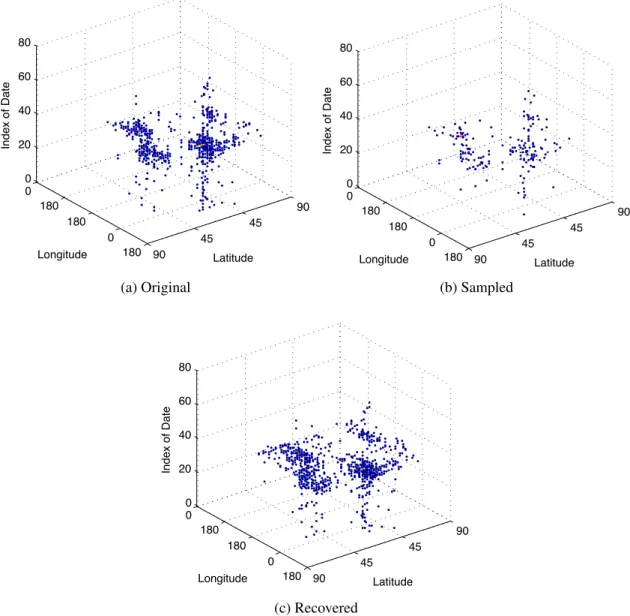
4.1 The proposed spatio-temporal dynamics recovery framework. . . 29 4.2 Distributions of three hashtags. . . 42 4.3 Comparison of recovery results over synthetic data. . . 46 4.4 An example recovery for the hashtag #mtvema when 85% of the data is
missing (Scenario 1).. . . 49 4.5 Recovering hashtag popularity: Accuracy@1, 5, 10, and 15 as the
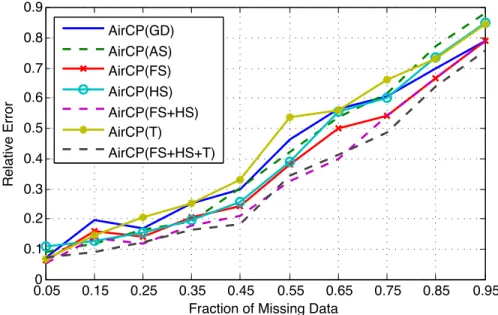
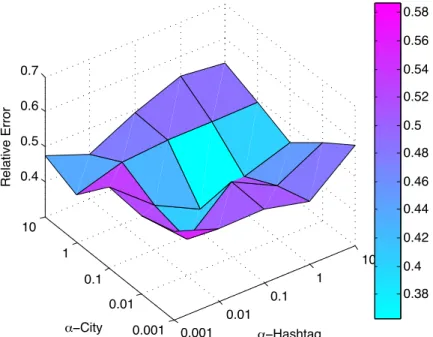
frac-tion of missing data varies from 25%, 55% to 85%. Though AIRCP only achieves slightly better performance than TFAI, it has much better time efficiency for the computation with around an order of magnitude faster speed. . . 53 4.6 Relative errors for different combinations of auxiliary information. . . 55 4.7 Relative errors for different parameter settings: α3(date) = 0.1with 55%
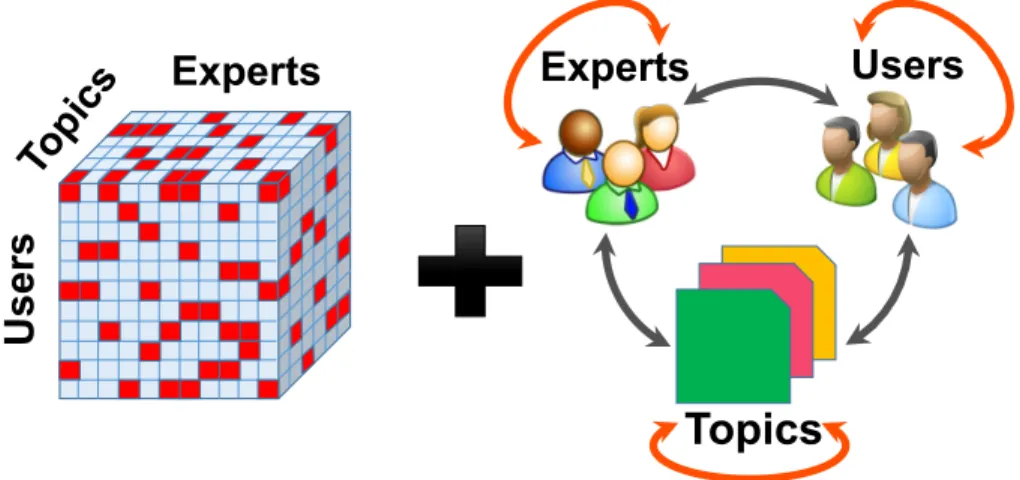
of the fraction of missing data. . . 56 5.1 Personalized expert recommendation with contextual factors: augmenting
the sparse tensor (left) with contextual factors (right) like the geo-spatial, topical, and social relationships between homogeneous entities (e.g., users and users) and between heterogeneous entities (e.g., users and experts). . . 59 5.2 Overview of the proposed tensor-based personalized expert
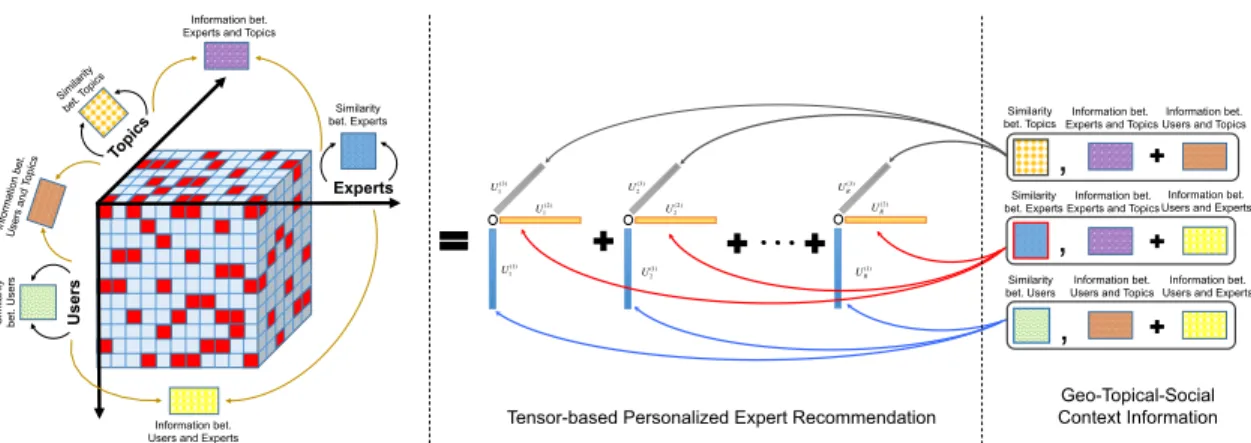
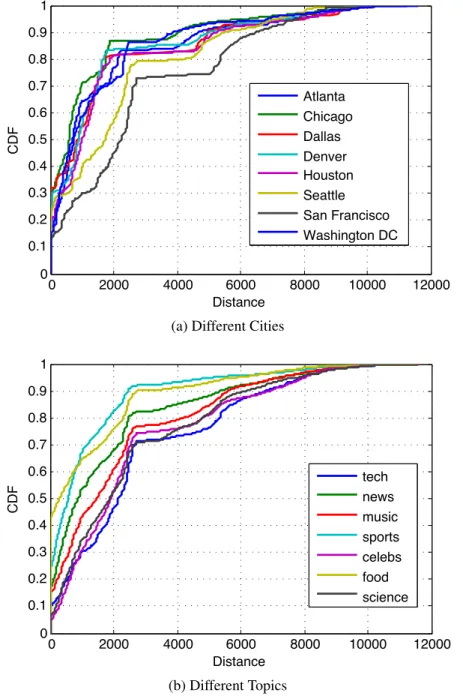
recommenda-tion framework. . . 62 5.3 The impact of distance on expert preferences by location (a) and by topic
(b). . . 65 5.4 The relationship between the number of shared topics and the similarity
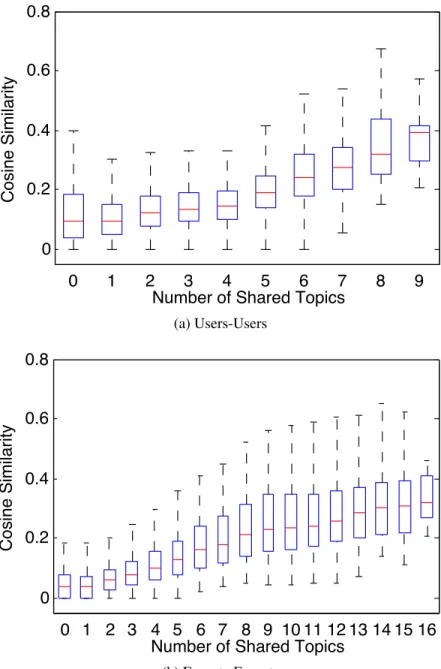
between users (a) and experts (b). . . 66 5.5 The impact of social connections on selecting experts for users (a) and
5.6 Precision@k: Comparing TAPER versus Alternative Methods. . . 82
5.7 Recall@k: Comparing TAPER versus Alternative Methods. . . 83
5.8 Effect of Number of Negative Experts. . . 86
5.9 Precison@10 by varying the amount of training data. . . 87
5.10 Recall@10 by varying the amount of training data. . . 88
5.11 Impact ofβ(for heterogeneous entities) andγ (for homogeneous entities). . 89
6.1 Examples of Textual Context on Learning User Topical Profiles. . . 96
6.2 Examples of Behavioral Context on Learning User Topical Profiles. . . 97
6.3 An Overview of CRM . . . 99
6.4 An Overview of T-CRM . . . 103
6.5 Comparisons Between Proposed Models and Alternative Baselines. . . 112
6.6 Comparisons Between CRM and Standard MF . . . 113
6.7 Comparisons between T-CRM and TFMF . . . 114
6.8 Comparisons Between Proposed Models and Alternative Baselines. . . 115
7.1 A 3-order Twitter List tensor withuser-expert-topictriples and three sim-ilarity matrices generated from auxiliary information of users, experts and topics, respectively. . . 120
7.2 Rank-RCP tensor completion of a 3-order tensor with auxiliary information.121 7.3 Memory access during the update ofAi,:in a 3-order tensor. . . 125
7.4 Data Scalability: Dimensionality . . . 139
7.5 Data Scalability: Number of Non-zeros. . . 140
7.6 Data Scalability: Rank . . . 141
7.7 Machine scalability of DISTENC compared with ALS and SCOUT. The proposed DISTENC has the best performance in terms of machine scal-ability with 4.9× speed-up, which also achieves a better linearity on the scalability with respect to the number of machines. . . 142
7.8 Reconstruction error on the synthetic data. . . 143
7.9 Results on recommender system with respect to RMSE. . . 144
7.10 Convergence rate for all methods on the Netflix data.. . . 145
7.11 Results on link prediction in terms of RMSE. . . 147
LIST OF TABLES
TABLE Page
2.1 Symbols and Operations. . . 11 4.1 Comparison between AirCP and the state-of-the-art. . . 26 4.2 Computation time (in seconds) over synthetic data as the fraction of
miss-ing data (FM) varies. . . 47 4.3 Relative errors for recovering missing hashtags as the fraction of missing
data varies from 25% to 55% to 85%. We observe that AIRCP is an order of magnitude faster than TFAI. . . 48 4.4 Relative errors for recovering appearances of hashtags as the fraction of
missing data varies from 25% to 55% to 85%. We witness that AIRCP is an order of magnitude faster than TFAI. . . 51 5.1 Dataset Summary . . . 63 5.2 What Impact Does Contextual Preference Have on Each Approach? Here
we compare contextual preferences of heterogeneous entities versus ho-mogeneous entities. . . 84 6.1 The Impact of Different Contexts for Learning User Topical Profiles . . . 110 7.1 Summary of the real-world and synthetic datasets used. K: thousand, M:
million,B: billion.. . . 137 7.2 Example of concept discovery results on DBLP dataset. . . 148
1. INTRODUCTION
1.1 Motivation
The Web and social media are data rich. With the prolific sharing of videos, images, blogs, and tweets, and the enormous amount of transactional behaviors like retweets, re-views, ratings, and purchase behavior, we increasingly have fine-grained access to the “who”, “where”, “when” and “what” of real-time human dynamics. This unprecedented data explosion promises new opportunities to uncover models and theories of user behav-ior, mobility, and information sharing, as well as lead to new algorithms and frameworks. 1.1.1 Multi-Aspect Data
These dynamics usually come inmultiple aspects. For instance, purchase behaviors of users at online stores can be expressed in millions ofuser-item-datetriplets, likeAdam boughtheadphonesonMonday. In this case, the user, item and date are the three aspects of the data. Together, these multiple aspects can help uncover important underlying phe-nomena. For example, the triplets in this case can uncover which items may be popular at different times, and which users are more likely to purchase which items. Similar multiple aspect data can be found in social networks such as Twitter, Snapchat and Facebook: for instance, we can model user-user-topic triplets to capture the kinds of posts that two users tend to share with one another. Alternatively, two friends can chat on both Snapchat and Facebook, and retweet each other on Twitter. All these multi-aspect datasets are able to help better understand the social interactions of the underlying network.
Indeed, discovery, modeling and analyzing multi-aspect data can benefit many do-mains beyond social media, including analysis of knowledge bases [1], chemometrics [2], signal processing [3, 4], computer vision [5, 6], climate dynamics [7, 8], neurology [9, 10], network traffic [11], Web graphs [12] and more. By gleaning hidden or latent features, the
multi-aspect data in these various domains can lead to new insights into applications such as anomaly detection [13, 14], recommender systems [15, 16] and correlation analysis [17], among many others.
1.1.2 The Missing Data Problem
Nevertheless, the raw multi-aspect datasets are often incomplete owing to various un-predictable or unavoidable reasons. The raw data revealing dynamics on social media are often restricted to proprietary data warehouses (e.g., requiring privileged access to In-stagram’s backend photo serving services), and so researchers and practitioners typically must rely on sampling-based methods to build models and conduct analysis. Of course, this sampling faces its own challenges – including API limitations and data sampling poli-cies that can lead to an incomplete (and often biased) perspective on the underlying dy-namics. Moreover, changes to data access policies can lead to additional challenges – as demonstrated by Twitter’s closing of their Firehose API in April 2015. Additionally, even a robust data sampling approach can still face errors due to missing data and errors in the data collection process. This missing data raises serious concerns such as significant bias on the estimation of structural properties of the network [18] and the properties of information cascades in a social network [19].
Already, we have witnessed considerable compelling studies on filling the missing or unobserved entries based upon partially observed data by adopting various techniques including multivariate interpolation [20], spectrum analysis [21], fuzzy neural network [22], and matrix factorization [23, 24]. For example, Candès at al. [25] recover a data matrix from a sampling of its entries via the convex optimization and find the matrix with minimum nuclear norm that fits the data. These methods have shown good success, but typically assume a simple inter-dependence among variables of interest (e.g., user-item, post-location), resulting in a challenge to handling correlations and complex
inter-dependencies among these different factors. 1.1.3 Tensors and Tensor Learning
In contrast, tensors, as a generalization of multi-way arrays, provide a compelling way to capture inter-dependencies among entities (i.e. more than two dimensions). Therefore, it is natural to represent the multi-aspect datasets as tensors. Indeed, in recent years, tensor factorization models have been widely studied and applied in many fields due to its essential nature well-suited for multi-aspect data analysis. Tensor completion has been a popular technique for estimating missing values or information in multi-aspect data with the assumption that the data of interest follows alow-rank model, which is accomplished by finding a low-rank tensor model for the observed data and leveraging such low-rank model to estimate the unobserved data. As we can see, it has been extensively studied and employed in applications such as tag recommendation [15], user group detection [26], link prediction [27] and more. For instance, computational phenotyping in electronic health records is further improved by tensor completion for discovering more meaningful and distinct phenotypes [28]. The TFMAP [29] has shown how to leverage tensor completion to boost the mobile app recommendation by treating the problem of predicting how a user will rate an app under some context as the estimation of missing values in a tensor. Researchers from Sandia National Laboratories [30] have tackled the missing data arisen in computer network traffic via tensor completion in order to avoid situation that important datasets are discarded or improperly analyzed due to missing data. Furthermore, some researchers [31, 32] incorporate contextual information into the completion problem for achieving better recovery accuracy instead of only utilizing the observed data. Some others [33, 34] scale up the tensor completion algorithms to handle real large-scale datasets.
1.2 Challenges
In the previous section, we described the problem of missing values or information in the multi-aspect datasets on social media and how to tackle this problem with the state-of-the-art methods. To satisfy the rapid growth of data in both its velocity and volume in the real-world, there are significant research gaps towards effectively and efficiently handling missing information in the large-scale multi-aspect datasets with rich contextual information. We now identify “4S” research challenges including sparsity, similarity, specificityand scalability, associated with recovering the missing information on social media under the background of large-scale data analytics as follows:
• Sparsity. With the consistently increasing volume of the multi-aspect data, it may have very large dimensions (e.g., over 1 million users on Netflix). As a result, prob-lems with high dimensionality lead to the fact that limited observed data points be-come extremelysparseas the dimensionality increase. In particular, users purchase limited items and provide few feedback on them. The collected data would be very sparse comparing with a large number of items online (over millions). The sparsity is able to degrade the performance of models with considerable bias and mislead-ing inference [35]. Given a very sparse multi-aspect data, how can we recover its missing information while perpetuating the systematical performance of models? • Similarity. Massive datasets on social media usually have multiple dimensions
(as-pects) with the high sparsity that leads to degrading performance of completion algo-rithms, especially for those with the low-rank assumption. Besides of the relational information among objects in the multi-aspect datasets, we usually have rich contex-tual information for each dimension, e.g., profile information of customers at Ama-zon and attributes of products purchased by customers, which are usually complex.
dimensions, and potentially exploited to improve the accuracy of recovering missing information in the sparse large-scale datasets. How can we model these contextual information? How can we incorporate them into the completion algorithms?
• Specificity. Most existing completion algorithms focus on recovering the miss-ing information from one specific dataset or with specified contextual information, which lack of generalization towards a variety of applications or different types of side information, and limit their applicability to real-world big data problems. How can we develop a generalized framework for the recovery of missing information with the integration of all potential pairwise relations, which can be utilized in vari-ous applications?
• Scalability. The scale of modern multi-aspect data poses the challenge for existing completion algorithms, most of which become entirely infeasible for the Gigabyte and Terabyte data sets that are fast becoming common and too large to fit in the main memory of a single machine. The need for scalable completion algorithms is over increasing, and there is a huge gap that needs to be filled. Can we handle the issue of scalability in order to appropriately recover missing information in large-scale datasets? How can we scale the completion algorithms to massive datasets while pertaining their performance with respect to estimate missing information?
1.3 Contributions
This dissertation seeks to integrate and leverage rich contextual information from so-cial networks to develop new scalable and interpretable algorithms for recovering missing values in big multi-aspect data by bridging Tensor Completion and Data Science for real-world applications. To combat identified challenges, we propose scalable tensor learning algorithms for recovering missing spatio-temporal dynamics of online memes, expanding
them to applications that are personalized expert recommendation and learning user topi-cal profiles, and improving the stopi-calability of tensor learning algorithms in social systems. Concretely, this dissertation makes the following four unique contributions:
• Overcoming Missing Spatio-Temporal Dynamics: First, in order to tackle the problem of missing spatio-temporal dynamics of online memes, this dissertation proposes a scalable low-rank tensor learning framework in the presence of incom-plete information. Concretely, we formally define the problem of recovering the spatio-temporal dynamics of online memes and solve this problem by proposing a novel tensor-based factorization approach based on the alternative direction method of multipliers (ADMM) [36]. The core insight of the proposed method is to care-fully take into account the latent relationships derived from contextual information among locations, memes, and times. We evaluate the performance of our tensor-based framework over both synthetic and Twitter datasets. Through extensive exper-imental study, we find that our proposed framework achieves an significant improve-ment on recovering missing spatio-temporal dynamics compared to state-of-the-art alternatives, while achieving significantly greater efficiency.
• Recommending Personalized Experts: Second, this dissertation evaluates the gen-eralization of the proposed tensor learning framework and applies it to the recom-mendation problem that is one of typical missing information problems on social media. Specifically, we present a novel tensor-based approach via the extension of the proposed tensor learning framework to personalized expert recommendation with the integration of both the latent relationships between homogeneous entities (e.g., users and users, experts and experts) and the relationships between hetero-geneous entities (e.g., users and experts, topics and experts) from the geo-spatial, topical, and social contexts. Through an experimental study, we find that the
pro-posed model can significantly improve the quality of the recommendation compared to several state-of-the-art baseline methods.
• Learning User Topical Profiles: Third, this dissertation extends the proposed ten-sor learning framework to the user topical profiling problem. Concretely, we propose a tensor-based contextual regularization model embedded into a matrix factorization framework, which leverages the social, textual, and behavioral context across users, in order to overcome identified challenges. We model all contextual signals into one tensor via calculating the user similarity in each of social, textual and behavioral contexts. After applying the tensor decomposition, the latent representation of users can be learned, which is further embedded into a matrix factorization framework in order to learn unknown user topical profiles.
• A Distributed Scalable Approach to Tensor Learning: Fourth, this dissertation enables the proposed tensor learning framework to handle real large-scale datasets that are too big to fit in the main memory of a single machine. We propose a novel distributed tensor completion algorithm with regularized trace of the auxiliary in-formation based on ADMM under the proposed tensor learning framework, which is designed to scale up to real large-scale tensors by efficiently computing auxiliary variables, minimizing intermediate data, and reducing the workload of updating new tensors. We successfully tackles the high computational costs and minimizes the in-termediate data and find that the proposed distributed scalable algorithm is capable of handling up to100x larger tensors than existing methods with much faster con-vergence rate, shows better linearity on the machine scalability, and achieves better accuracy in the applications such as recommender systems and link prediction. 1.4 Dissertation Overview
• Section 2: Background. In this chapter, we provide a brief background on tensors containing necessary tensor operations, basic definitions, and notation followed by the tensor decomposition and completion problems throughout this dissertation. • Section 3: Related Work. In this chapter, we discuss related work, specifically
tensor factorization, recovering missing information on social media over scenar-ios such as estimating spatio-temporal dynamics of online memes, recommending personal experts and learning user topical profiles, and scalable tensor algorithms. • Section 4: Recovering Missing Dynamics: A Tensor-based Approach with
Aux-iliary Information. In this chapter, we propose AIRCP, a novel tensor learning algorithm that leverages auxiliary information among locations, hashtags for recov-ering the spatio-temporal dynamics of online memes in the presence of incomplete information. Through experimental evaluation on both synthetic and real-world Twitter hashtag data, we see that the proposed framework outperforms alternative stateof-the-art methods with an average improvement of over 27%.
• Section 5: TAPER: A Contextual Tensor-Based Approach for Personalized Ex-pert Recommendation. In this chapter, we extend the proposed tensor learning al-gorithm to propose a tensor-based personalized expert recommendation framework that integrates these factors for revealing latent connections between homogeneous entities (e.g., users and users) and between heterogeneous entities (e.g., users and experts). Through extensive experiments over geo-tagged Twitter data, we find that the proposed framework can improve the quality of recommendation by over 30% in both precision and recall compared to the state-of-the-art.
• Section 6: T-CRM: Learning User Topical Profiles. In this chapter, we develop a tensor-based unified model for learning user topical profiles by simultaneously
tak-ing into account pairwise relations among multiple contextual information. Through extensive experiments, we find that the proposed model is capable of learning high-quality user topical profiles, and leads to a 10∼15% improvement in precision and mean average error versus a cross- triadic factorization state-of-the-art baseline. • Section 7: DISTENC: A Distributed Scalable Tensor Completion Algorithm.
In this chapter, we propose DISTENC, a distributed large-scale tensor completion algorithm with regularized trace of the auxiliary information based on ADMM run-ning on the Spark framework. Through evaluating for both synthetic and real-world large-scale datasets, experimental results demonstrate the superiority of DISTENC with up to 10∼1000×larger scalability than existing methods, much faster conver-gence rates, and better linearity on the machine scalability. Moreover, it achieves up to an average improvement of 23.5% in the accuracy in terms of the applications such as recommender systems and link prediction.
• Section 8: Conclusions and Future DirectionsWe conclude our dissertation with a summary of contributions, and discuss potential research extensions to the results presented here.
2. BACKGROUND
2.1 Introduction
In this chapter, we provide a brief background on tensors including tensor operations, basic definitions, and notation. We follow this background with an introduction to the tensor decomposition and completion problems at the core of this dissertation.* Recall that tensors are generalizations of multi-array arrays and have proven to be a very powerful tool in a variety of applications that inherently produce multi-dimensional (multi-aspect) datasets. Table 2.1 lists the definition of symbols applied throughout the entire dissertation. Note that we also introduce some specialized notation in some of the following chapters. 2.2 Tensor
Definition 2.1.1 (Tensor). A tensor is a multi-way array, whose dimension is calledmode or order. AnNth-order tensor is anN-mode array, denoted as X ∈ RI1×I2×···×IN. The
number of non-zero elements of a tensorXis denoted asnnz(X).
Definition 2.1.2 (Kronecker Product). Given two matrices A∈RI×J andB ∈
RK×L,
their Kronecker productA⊗Bgenerates a matrix of sizeIK×J Ldefined as:
A⊗B= a11B a11B · · · a1JB .. . ... . .. ... aI1B a11B · · · aIJB , (2.1)
Definition 2.1.3 (Khatri-Rao Product). It is a column-wise Kronecker product, denoted asABwhere bothA ∈RI×RandB ∈
RK×Rhave the same number of columns. Their
*Note that tensors introduced here are not the same as tensors in physics and engineering; those are generally referred to as tensor fields in mathematics.
Table 2.1: Symbols and Operations.
Symbols Definitions
R the set of real numbers
X tensor (Euler script letter)
X(n) n-mode matricization of a tensorXXX
X matrix (uppercase bold letter)
x column vector (lowercase bold letter)
x scalar (lowercase letter)
N order of a tensor (number of modes) [[·]] Kruskal operator
⊗ Kronecker product
Khatri-Rao product
∗ Hadamard product
◦ outer product
<∗,∗> inner product of matrices ×n n-mode tensor-matrix product
X−1 inverse of a matrixX
X† Moore-Penrose pseudo-inverse of a matrixX x(i) ith entry of a vectorx
X( :, i) the entireith column of a matrixX(same as tensor)
X(i,: ) the entireith row of a matrixX(same as tensor) kXk2
F Frobenius norm ofX
nnz(X) number of non-zero elements inX
Khatri-Rao product produces a matrix of sizeIK ×Rdefined as:
AB= [a1⊗b1,· · · ,aR⊗bR]. (2.2)
I×J, their Hadamard productA×Bis the element-wise matrix product, defined as: A×B= a11b11 a12b12 · · · a1Jb1J .. . ... . .. ... aI1bI1 aI2bI2 · · · aIJbIJ . (2.3)
Definition 2.1.5 (Tensor Matricization). Tensor matricization is to unfold a tensor into a matrix format with a predefined sequence of mode order. The n-mode matricization of a tensorX ∈ RI1×...×IN is denoted asX
(n) ∈ RIn×( Q
k6=nIk). The order of the other modes
except modencan be arranged randomly to construct the column ofX(n). For instance, we
matricize a 3-order tensorX ∈ RI×J×K in the following three ways that are X
(1) of size
(I×J K),X(2) of size(J×IK)andX(3)of size(K×IJ). These tensor matricizations
are mapped in the following way:
X(i, j, k)→X(1)(i, j + (k−1)J) (2.4)
X(i, j, k)→X(2)(j, i+ (k−1)I) (2.5) X(i, j, k)→X(3)(k, i+ (j−1)I) (2.6)
Definition 2.1.5 (n-mode Tensor-Matrix Product). Given an Nth-order tensor X ∈
RI1×I2×...×IN and a matrixA∈RIn×J, their multiplication on itsnth-mode is represented
asY =XXX×nAand is of sizeI1×. . . In−1×J×In+1. . .×IN. The element-wise result is demonstrated as: YYY(i1, . . . , in−1, j, in+1, . . . , iN) = In X k=1 X(i1, . . . , in−1, k, in+1, . . . , iN)A(k, j). (2.7)
2.3 Tensor Decomposition
Tensor decomposition has been widely used in tensor learning to discover latent rela-tions in the multi-aspect data. There are two widely used low-rank decomposirela-tions of ten-sors, the CANDECOMP/PARAFAC (CP) and the Tucker decompositions. The CP tensor decomposition is the most popular tensor decomposition method, independently proposed by [37, 38, 39]. Given anN-mode tensor X ∈ RI1×I2×IN, the CP tensor decomposition
method decomposes a tensorXinto a sum ofR min(I1, . . . , IN)rank-one tensors as:
X≈[[A(1), . . . ,A(N)]] = R
X
r=1
a(1)r ◦a(2)r ◦. . .◦a(rN), (2.8)
wherea(rn) is therth column of the factor matrix A(n) ∈ RIn×R at moden, andR is the
rank of a tensor X. Each rank-one component in the CP tensor decomposition can be interpreted as a latent “concept” (cluster) in the multi-aspect data, which can be treated as an explanatory model. In addition, the CP tensor decomposition also holds very good theoretical properties including uniqueness of solvers under very mild conditions. The definition of CP tensor decomposition is given below.
Definition 2.1.5 (CP Tensor Decomposition). Given an N-mode tensorX ∈ RI1×I2×IN
and rankR, the CP tensor decomposition solves the optimization problem:
minimize A(1),...,A(N),X 1 2kX− R X r=1 a(1)r ◦a(2)r ◦ · · · ◦a(rN)k2 F, whereA(n) ∈
R(In×R)is the factor matrix at mode-nof a tensorX.
2.4 Tensor Completion
Tensor completion is extensively applied in tensor mining to fill the missing ele-ments with partially observed tensors. Low rank is often a necessary hypothesis to
re-strict the degree of freedoms of the missing entries being intractable. Hence, we only focus on low-rank tensor completion (LRTC) problem in this dissertation. We introduce CANDECOMP/PARAFAC(CP)-based tensor completion. The CP tensor decomposition proposed by Hitchcock [37] is one of the most used tensor factorization models, which decomposes a tensor into a sum of rank-one tensors. It can be employed for the tensor factorization to the tensor completion problem. Before being actively researched in recent years, the LRTC problem is usually considered as a byproduct of the tensor decomposition problem with missing values. Given anNth-order tensor X∈RI1×I2×···×IN with the rank R min(I1, . . . , IN), the CP-based tensor completion solves:
minimize A(1),...,A(N),X 1 2kX−[[A (1),A(2), . . . ,A(N)]]k2 F + λ 2 N X n=1 kA(n)k2 F subject to Ω∗X=T,A(n) ≥0, n = 1,2,3.,
whereTdenotes the partial observations,A(n) ∈
RIn×Rare the factor matrices, andΩis
a non-negative weight tensor with the same size asX:
Ω(i1, . . . , in, . . . , iN) = 1 ifX(i1, . . . , in, . . . , iN)is observed, 0 ifX(i1, . . . , in, . . . , iN)is unobserved.
In practice, tensor completion is not only capable of recovering the missing information occurred in the original multi-aspect data well, but also providing the interpretation of latent factors. The CP-based tensor completion guarantees the uniqueness of latent factors that generated the variations in the data.
3. RELATED WORK
In this chapter, we summarize the state-of-the-art methods with respect to recovering missing values on social media from tensor factorization, a variety of applications and scalable tensor factorization algorithms.
3.1 Tensor Factorization
We begin in his section with a review of related work on tensor decomposition and tensor completion, respectively.
3.1.1 Tensor Decomposition
Compared to matrix factorization methods – which focus on two-way data, not multi-dimensional data – tensors, as a generalization of matrices, can naturally model higher-order relationships among entities (i.e. more than two dimensions). Tensor factoriza-tion models have been studied and applied in many fields due to their strong power on multi-dimensional data analysis. There are two widely used low-rank decompositions of tensors, the CANDECOMP/PARAFAC (CP) and the Tucker decompositions [40]. The most common methods used to factorize tensors include alternating least square (ALS) [6, 41, 42, 43], stochastic gradient descent (SGD) [44, 45] and coordinate descent (CDD) [33, 46].
3.1.2 Tensor Completion
Tensor completion is used to estimate missing values in tensors based on their low-rank approximations, which has been extensively studied and employed in applications such as recommendations [16, 15], user group detection [26], and link prediction [27]. Most these methods only focus on the sampled data when performing tensor completion without considering auxiliary information with which tensors usually come. These
aux-iliary information help us have a better performance in tensor completion [32]. Though several researchers incorporate contextual (external) information into the matrix factor-ization problem [31], few studies explore the tensor completion problem with auxiliary information. Technically, it is challenging to embed auxiliary information into a factor-ization model, especially with many heterogeneous contexts. Narita et al. [32] integrated auxiliary information into tensor decomposition methods, resulting in better performance compared with ordinary tensor decomposition methods. Nevertheless, they primarily fo-cus on general tensor decomposition rather than tensor completion. However, these models usually face some efficiency challenges since [32] requires solving the Sylvester equation with a high cost several times in each of iterations, making them infeasible for large-scale applications. Though several researchers incorporate auxiliary (external) information into the matrix factorization problem [31, 47], few studies explore the tensor completion prob-lem with auxiliary information. Technically, it is challenging to embed auxiliary infor-mation into a factorization model, especially with many heterogeneous contexts. Narita et al. [32] integrated side information into tensor decomposition methods, resulting in better performance compared with ordinary tensor decomposition methods. Nevertheless, they primarily focus on general tensor decomposition with auxiliary information, but not tensor completion. In this dissertation, we integrate rich contextual information among objects into a tensor completion framework and scale it up to be capable of handling real large-scale datasets in a variety of applications.
3.2 Estimating Missing Spatio-Temporal Dynamics of Online Memes
In this section, we review related work on spatio-temporal dynamics of online memes and corresponding methods on estimating their missing spatio-temporal dynamics.
3.2.1 Spatio-Temporal Dynamics of Online Memes
The increasingly mobile aspects of social media services like Instagram, Facebook, and Twitter have led to a number of studies on geo-spatial characteristics of users and in-formation sharing. For example, researchers have built models of geo-spatial properties to infer geographic information from tweets, such as spatial modeling to geolocate objects [48] and predicting user locations [49]. Other researchers have analyzed the geo-spatial properties of online memes on Facebook [50] and on YouTube based on propagation pat-terns [51]. On the other hand, much effort has focused on the temporal properties of online memes. Yang et al. [52] studied temporal patterns of online content including Twitter hashtags and online phrases. Matsubara et al. [53] explored temporal patterns of online information diffusion. Other researchers have focused on both spatial and temporal properties of online memes, like [54].
3.2.2 Estimating Missing Spatio-Temporal Data
Toward recovering missing spatio-temporal data, there have been many proposed meth-ods adopting techniques like multivariate interpolation [20], spectrum analysis [21], and matrix factorization [23, 55]. These methods have shown good success, but typically as-sume a simple inter-dependence among variables of interest (e.g., memes), space, and time, resulting in a challenge to handling correlations (and complex inter-dependencies) among these different factors. Recently, researchers employ tensor-based approaches to tackle the problem of recovering missing spatio-temporal data. Bahadori et al. [56] pro-posed a unified low-rank tensor learning framework on spatio-temporal data, under which either spatial or temporal information can be modeled, respectively. Yet, how to leverage both spatial and temporal information simultaneously was not investigated in their study. Zhou et al. [57] developed a Tucker-based tensor model called the spatio-temporal tensor completion to infer missing Internet traffic data by integrating spatio-temporal constraint
information as within-mode regularization. However, these models usually face some ef-ficiency challenges since [32] requires solving the Sylvester equation with a high cost several times in each of iterations, and [57] strongly relies on solving large-scale least square problems, making them infeasible for large-scale applications. In contrast, scalable completion algorithms proposed in this dissertation seek to overcome these challenges by developing an efficient tensor-based method that integrates rich contextual information among objects simultaneously. In addition, the proposed approach not only inherits ad-vantages of efficiency based on ADMM [58] and uniqueness of solutions enhancing the robustness, but also leads to better recovery by incorporating this contextual information. 3.3 Recommendation on Experts
In this section, we review related work on recommending experts for users which can be treated as estimating unobserved ratings of experts who have not been checked by users. 3.3.1 Finding Experts
Expert finding has been widely studied for many years. For instance, Weng et al. [59] proposed a PageRank-based approach to identify topic experts by applying both topical similarity between users and social link structure. Ghosh et al. [60] proposed the Cognos system to find topic experts by relying on Twitter lists. Zhang et al. [61] identified top experts in a Java forum by applying link analysis approaches such as PageRank and HITS. Hu et al. [62] proposed a more personalized recommendation by considering network semantic information, in addition to network topological measures for expert recommen-dation. Of course, there are many other efforts, including [63, 64, 65].
3.3.2 Systems towards Recommending Experts
One promising approach for recommenders is to cast the problem as a matrix factor-ization problem, in which user preferences may be projected into a lower dimensional
embedding space [66, 67, 68, 69]. In recent years, tensor factorization models are be-coming popular and successfully applied in the recommendation. Karatzoglou et al. [70] studied multi-dimensional recommendations by leveraging contextual information to build a User-Item-Context tensor model. Hidasi and Tikk [71] developed an Alternating Least Squares (ALS) based tensor factorization approach for context-aware recommendations. Bhargava et al. [72] applied a tensor factorization-based approach to provide collabo-rative recommendations for points of interest (POI) involving multi-dimensions such as locations, activities and time. Similarly, Lu et al. [67] introduced a matrix-factorization approach for personalized expert recommendation, but restricted to two-dimensional data (e.g., a user-expert matrix) and only considering user’s geo-spatial preferences on experts. In contrast, the proposed method described in this dissertation is the first to investigate tensor factorization for personalized expert recommendation by integrating user’s prefer-ences on experts from geo-topical-social contexts as well as valuable relationships between users, experts and topics, and to explore the impact of these contexts on such an approach. 3.4 Learning User Topical Profiles
In this section, we review related work on finding user interests and expertise, leverag-ing contexts and factorization models.
3.4.1 Finding User Interests and Expertise
Finding user interests and expertise has numerous applications, and one of the most popular tasks is personalized recommendation. Considerable research [73, 74, 75, 76, 77, 78, 79, 80] has assumed a user’s interests or expertise asimplicitpersonal preferences for building recommender systems in different domains, such as web search [77, 78], web content [80], rating systems [81, 76], and social media [74, 82, 75, 79].
For social media research, the latent factor model is a state-of-the-art method for user recommendation. Interpreting the latent factors as topics, approaches based on such a
model usually avoid explicitly identifying user interests but instead integrate the factors into a recommendation task. For example, Hong et al. applied matrix factorization on both users and tweets and focused on recommending user’s retweeting behavior [82]. Similarly, Jiang et al. presented a probabilistic matrix factorization method to recommend whether a user adopts an item on a social network [75]. Zhong et al. collected user’s webpage views to build a matrix factorization profile for web content recommendation [80].
3.4.2 Leveraging Contexts
A sequence of research has focused on using contexts to learn user interests. One of the most traditional information is textual context, upon which many works have built generative models like PLSA and LDA [83, 84, 59, 85]. Another popular context is social information (often via friendships)[75, 86, 87], with the natural assumption that friends tend to have similar profiles. In addition, behavioral context has become a newer factor; for example, Guy et al. used user’s tagging behavior as evidence for content recommendation in social media [73]. Lappas et al. considereduser endorsementas the behavioral context [88]. In [79], Zhao et al. focused on the behaviors of commenting, “+1”, and “like” on Google+. Typically, these contexts have been treated separately. URL sharing behavior for topical profiles has received some attention in social media research. Previous work looked into why and what content people share via URLs on social media [89, 90]. Some work has also mentioned the role of URL sharing in social spamming [91].
3.4.3 Factorization Models
Technically, it is challenging to embed context into a factorization model, especially with many heterogeneous contexts. A handful of studies have adopted a regularization model [92, 93, 76] for personalized recommendation, though typically focusing on only one context. In [81], assuming contexts are not independent, latent spaces are learned separately for each context. Tensor-based factorization methods [94, 95] have been used in
many applications such as behavior modeling, healthcare, and urban planning [96, 28, 97]. A more comprehensive survey of tensor factorization and its applications can be found in [40].
Several studies have focused on heterogeneous domains or entities, instead of con-texts. Yu et al. put multiple types of entities into a heterogeneous network and used a Bayesian ranking process to estimate user preferences [98]. Similarly, Hu et al. looked into a traditional user-item recommendation problem, presenting a factorization model across heterogeneous items. However, the network will quickly grow when users and items increase. Singh and Gordon proposed a framework to learn different types of rela-tions, where they iteratively do matrix factorization between all pairs of domains [99]. Hu et al. [100] adopted the existing PARAFAC2 factorization algorithm on a tensor model, which is obtained by combining user ratings of different merchandises like book, music, and movie. Zhong et al. [80] directly applies a matrix factorization model on Web users and their clicked content items.
In contrast, we focus on learning user topical profiles rather than rating recommenda-tion, and we are interested in leveraging heterogeneous contexts. We propose a generalized factorization model in which we simultaneously consider contexts via regularization. We further take care of context-wise relations by integrating both tensor decomposition and regularization together.
3.5 Scalable Tensor Algorithms
In this section, we review related works on scalable tensor algorithms, and distributed computing frameworks.
3.5.1 Scalable Tensor Factorization
We witness considerable efforts on developing scalable algorithms for tensor factoriza-tion, most of which focus on solving the intermediate data explosion problem. Concretely,
pioneers Bader and Kolda [42] develop efficient algorithms for sparse tensor decomposi-tion by avoiding the materializadecomposi-tion of very large, unnecessary intermediate Khatri-Rao products. Kolda and Sun [14] continuously work on the specific tensor decomposition method Tucker for sparse data and solve the intermediate explosion problem by calculat-ing the tensor-matrix multiplication one slice or fiber at a time. An alternative approach, DBN, is introduced in [101] where the authors use Relational Algebra to break down the tensor into smaller tensors, using relational decomposition, and thus achieving scalabil-ity. Kang et al. [102] first propose a scalable distributed algorithm GigaTensor under the MAPREDUCEframework for the specific tensor decomposition method PARAFAC by de-coupling the Khatri-Rao product and calculate it distributively column by column. Jeon et al. [103] improves on GigaTensor and propose HaTen2 that is a general, unified framework for both Tucker and CP tensor decomposition. There has been other alternatives on solving the intermediate data explosion problem of the pure tensor composition [33, 104, 105].
On the other hand, some researchers put their focus on developing scalable, distributed algorithms for the tensor decomposition with additional side information that is usually represented in a matrix, e.g., a similarity matrix between experts. Papalexakis et al. [45] propose an efficient scalable framework to solve the coupled matrix-tensor factorization problem by leveraging the biased sampling to split the original large data into samples, running the common solver to samples and merging the results based on the common parts in each sample. Beutel et al. [44] propose FLEXIFACT, a MAPREDUCEalgorithm to decompose matrix, tensor, and coupled matrix-tensor based on stochastic gradient descent. Jeon et al. [106] propose SCouT for scalable coupled matrix-tensor factorization. Shin et al. [46] propose two scalable tensor factorization algorithms SALS and CDTF based on subset alternating least square and coordinate descent, respectively. Livas et al. [107] develop a constrained tensor factorization framework based on ADMM. Smith et al. [34] optimize and evaluate three distributed tensor factorization algorithms based on ALS, SGD
and CDD, respectively, by extending SPLATT [108] that optimizes the memory usage. 3.5.2 Distributed Computing Frameworks
MAPREDUCE[109] is a distributed computing model for processing large-scale datasets that cannot be handled in a single machine, running in a massively parallel manner. MAPRE-DUCEhas been the most popular distributed computing framework due to its advantages including automatic data distribution, fault tolerance, replication, massive scalability, and functional programming by which users only define two functions map and reduce. HADOOP[110] is an open-source version of MAPREDUCE. Because of its excellent scal-ability and ease of use, it has been successfully applied in many data mining applications [102, 111, 112, 113]. However, HADOOPis inefficient to execute iterative algorithms due to its intensive disk accesses [109]. Apache Spark [114] is an in-memory MAPREDUCE, which provides a high-level interface for users to build applications with respect to large-scale data computation. Spark allows to store intermediate data in memory and performs efficient memory-based operations without requiring data to be spilled to disk (effectively reducing the number of disk Input/Output operations). Therefore, Spark is capable of per-forming iterative algorithms very efficiently. Due to these advantages, Spark has been used in applications [104, 115, 116].
4. AIRCP: A TENSOR-BASED APPROACH FOR RECOVERING MISSING SPATIO-TEMPORAL DYNAMICS OF ONLINE MEMES*
In this chapter, we tackle the challenges ofsparsityandsimilarityfor the problem of missing temporal dynamics of online memes. The raw data revealing the spatio-temporal dynamics of online memes are often incomplete and error-prone due to many reasons such as API limitations, data sampling policies, and necessary privilege accesses. Thus, we propose and evaluate a scalable framework based on low-rank tensor learning to recover these unobserved spatio-temporal dynamics of online memes. Our framework can effectively and efficiently recover missing dynamics of online memes in the presence of incomplete information. The core insight of the proposed method is to carefully take into account the latent relationships among locations, memes, and times; these relationships can then be embedded into a tensor completion framework for uncovering the approximate complete data based only on partial sparse observations.
4.1 Introduction
Many large-scale mobile social media services have been growing rapidly, enabling millions of users to generate and share location-associated content on a massive scale. For instance, many mobile image sharing services such as Instagram allow users to at-tach their latitude-longitude coordinates to shared photographs; location sharing services such as Foursquare and Glimpse enable billions of “check-ins”; and Twitter users gener-ate millions of geo-tagged tweets per day. In turn, these fine-grained spatio-temporal logs of user activities promise new research opportunities to uncover models of user behavior, *Reprinted with permission from “Uncovering the Spatio-Temporal Dynamics of Memes in the Pres-ence of Incomplete Information” by Hancheng Ge, James Caverlee, Nan Zhang and Anna Squicciarini, 2016. Proceedings of the 25th ACM International Conference on Information and Knowledge Management. Copyright 2016 by ACM. DOI: http://dx.doi.org/10.1145/2983323.2983782
mobility, and information sharing. Already, there have been efforts to improve location-based recommendations, targeted advertising, social media search, and event detection [48, 49, 54, 117, 118].
However, the data revealing these dynamics are often raw and incomplete due to var-ious unpredictable or unavoidable reasons such as restriction to proprietary data ware-houses, mal-operations, missing at random and API limitations. Since researchers and practitioners typically must rely on sampling-based methods to build spatio-temporal mod-els of user behavior, these data sampling policies can lead to an biased perspective on the underlying dynamics. For instance, Morstatter et al. [119] found significant differences in the quality and composition of sampled Twitter data by comparing different sampling policies over the streaming API and Twitter’s Firehose. Moreover, changes to data access policies can lead to additional challenges – as demonstrated by Twitter’s closing of their Firehose API in April 2015. Additionally, even a robust data sampling approach can still face errors due to missing data and errors in the data collection process. This missing data raises serious concerns. For example, Kossinets [18] found that missing data in a social network can significantly impact the estimation of structural properties of the network. Similarly, Sadikov et al. [19] pointed out that incomplete data may lead to critically dif-ferent properties of information cascades in a social network. As a result, models based on mobile social media traces may be of limited usefulness and generalizability in the presence of incomplete data traces.
Hence, in this chapter we explore new scalable methods for recovering the spatio-temporal dynamics of online memes – like shared images, hyperlinks, videos, or hash-tags – in the presence of incomplete information. Concretely, we propose a novel tensor-based factorization approach to recover the spatio-temporal dynamics of memes. The core insight of the proposed method is to carefully take into account the latent relationships among locations, memes, and times; these relationships can then be embedded into a
ten-sor completion framework for uncovering the approximate complete data based only on partial observations. We explore how to model and integrate this auxiliary information – here, in the form of relationships among locations, memes, and times – and show how the underlying tensor completion can be efficiently solved compared to existing methods.
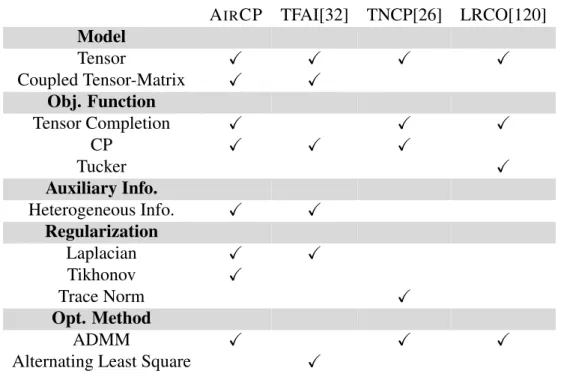
Table 4.1: Comparison between AirCP and the state-of-the-art. AIRCP TFAI[32] TNCP[26] LRCO[120] Model Tensor X X X X Coupled Tensor-Matrix X X Obj. Function Tensor Completion X X X CP X X X Tucker X Auxiliary Info. Heterogeneous Info. X X Regularization Laplacian X X Tikhonov X Trace Norm X Opt. Method ADMM X X X
Alternating Least Square X
Through this proposed spatio-temporal dynamics framework – called AIRCP that stands forAuxiliaryInformationRegularizedCANDECOMP/PARAFAC completion. In Table 4.1, we provide an overview of the state of the art. In short, AIRCP reigns, combin-ing capability of leveragcombin-ing heterogenous information as well as time efficiency, which is more feasible towards “big data”. We explore research questions like: Based on an inher-ently limited sample, can we recover the underlying distribution of memes at a particular location? And at a particular time? What impact does the amount of sampled data have
on the quality of this recovery? For example, can we build a high-quality model of meme spread with access to only 20% of actual data? Towards tackling these and related ques-tions, in this manuscript we formally define the problem of recovering the spatio-temporal dynamics of online memes by leveraging the latent relationships among memes, locations, and times, and develop approaches for modeling these latent relationships. Furthermore, we propose a novel framework for recovering spatio-temporal dynamics by a CP-based tensor completion model with regularized trace of the auxiliary information from memes, locations, and times, as well as Tikhonov regularization, which is efficiently solved by an efficient algorithm based on ADMM using less computation time than existing methods. We empirically evaluate the proposed framework on both synthetic and real-world Twitter hashtag datasets and find that the proposed method achieves an average over 27% improve-ment in recovering missing hashtags versus state-of-the-art alternatives, while achieving significantly greater efficiency.
4.2 Problem Statement
We assume that there exists a set of geo-temporal tagged online memesH. A meme in this case could correspond to a shared image, a hyperlink, video, or hashtag, among many other possibilities. Each memeh ∈ H can be expressed as a tuple(h, l, t) where
l is the location in which the meme is posted and t is the time at which the meme was posted. Suppose we haveN unique geo-temporal tagged memes,Llocations,M different timestamps and occurrences of memesO. Letoh
lt ∈ O be the number of occurrences of a memeh in a location l at a timestamp t. We view the spatio-temporal dynamics of geo-temporal tagged memes as a tensorX∈RN×L×M, in whichX(i, j, k)represents the count of a memehi in a locationlj at a timestamptk. Due to sampling errors, corrupted data, or other external factors, we further assume that we only can observe parts of the complete dynamics X; we denote this partially observed tensor as T ∈ RN×L×M, in which some
elements are missing or unobservable.
4.2.1 Spatio-Temporal Dynamics Recovery Problem
Given a set of geo-temporal tagged memes H with only partial knowledge of their dynamics – denoted as the tensorT – our goal is to learn a model to recover the missing spatio-temporal dynamics of the unobserved memes. But what entries in the partial tensor T are actually missing? We investigate three common situations:
• Scenario 1: Random Missing Observations.This first scenario captures the straight-forward case of random corruption or random data sampling errors in the dataset. We assume that some fraction of memes – that is, some of the meme, location, time counts(hi, li, ti)– are missing, and so our task is to estimate these missing counts based on the observations we do have.
• Scenario 2: Missing Entire Memes at Some Locations. The second scenario mod-els the case when the data collected has some systematic errors; specifically, we assume that rather than random missing observations (as the scenario 1), there are some memes that are completely missing for some locations. For example, a data sampling strategy may target the top-k online wmemes at a location, so some lo-cations will be missing memes outside of this top-k. Can we recover the missing counts for these lost memes?
• Scenario 3: Missing Entire Locations. The final scenario corresponds to the case of total data loss for some locations. For example, a data sampling strategy may target some locations exclusively, but miss others entirely. Can we recover what memes did occur in those missing locations?
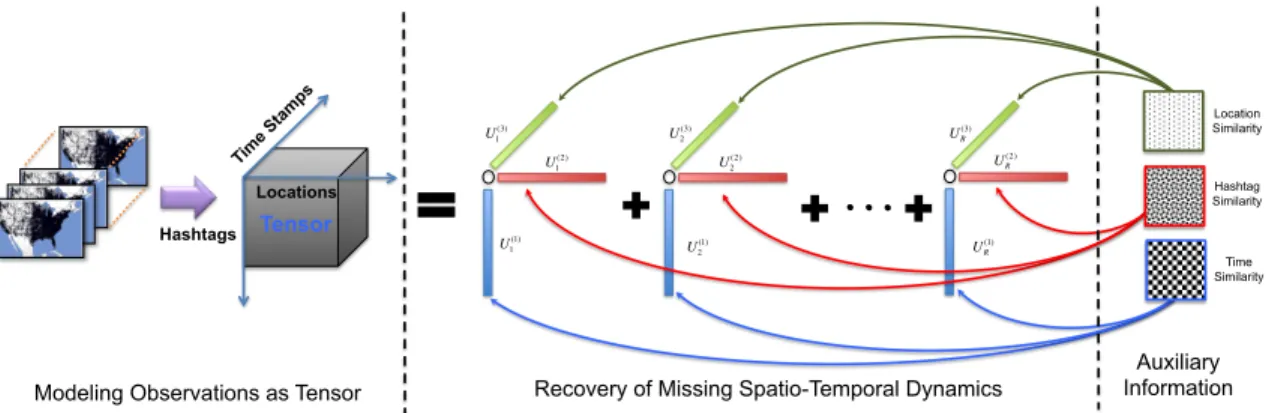
Tensor Hashtags Locations Tim e Sta mps U1 (3) U 2 (3) U1 (1) U2 (1) UR(1) UR (3) U1 (2) U 2 (2) U R (2) Location Similarity Hashtag Similarity Time Similarity Auxiliary Information Recovery of Missing Spatio-Temporal Dynamics
Modeling Observations as Tensor
Figure 4.1: The proposed spatio-temporal dynamics recovery framework.
4.2.2 Twitter Hashtags
We ground our discussion in the rest of the chapter with respect to Twitter hashtags. A Twitter hashtag is a popular type of online meme that arises on Twitter, spreads from person to person (and from place to place), resulting in a fine-grained spatio-temporal log of information sharing dynamics. Note that the methods presented here may be applied to any other dataset with meme, location, time characteristics.
4.3 AIRCP: Auxiliary Information Regularized CP Model
In this section, we propose new scalable methods for recovering the spatio-temporal dynamics of online memes. Concretely, we propose to (i) model and exploit the latent relationships among locations, memes and times; (ii) embed these latent relationships into a tensor completion framework for uncovering the approximate complete data based only on partial observations; and (iii) show how the underlying tensor factorization can be effi-ciently solved compared to many existing methods. The high-level outline of the proposed solution is presented in Figure 4.1. We model the observed data as a tensor (left), and seek to recover the missing spatio-temporal dynamics (center) by integrating auxiliary informa-tion like the relainforma-tionships between locainforma-tions, memes and times (right). A key aspect of the
proposed approach is an iterative method to overcome the problem of incomplete auxiliary information. In the following, we introduce each part of the proposed solution in detail. 4.3.1 Modeling Recovery of Missing Data
We propose to model the recovery of missing hashtag data based on tensor models. Since hashtags are usually adopted in a few locations within limited life-spans [54], result-ing in Xbeing super sparse and low-rank, this model is built on a CP tensor completion model which can be represented by the following optimization problem:
minimize U(n),X 1 2kX−[[U (1),U(2),U(3)]]k2 F + λ 2 3 X n=1 kU(n)k2 F subject to Ω∗X=T,U(n) ≥0, n= 1,2,3.,
where recall that X denotes the complete spatio-temporal dynamics of hashtags, T de-notes the observations we do have, U(1) ∈ RN×R, U(2) ∈
RL×R, and U(3) ∈ RM×R
are latent factor matrices for location, hashtag, and time dimensions, respectively, R
min(N, L, M)is the number of latent factors as the rank of a tensor, λ2 PN
n=1kU