A System for Energy-Efficient Data Management
Yi-Cheng Tu
1, Xiaorui Wang
2, Bo Zeng
3 1Dept. of Computer Science and Engineering, University of South Florida, U.S.A. 2
Dept. of Electrical and Computer Engineering, The Ohio State University, U.S.A. 3
Dept. of Industrial and Management Systems Engineering, University of South Florida, U.S.A. 1
[email protected], 2 [email protected], 3 [email protected]
ABSTRACT
Energy consumption of computer systems has increased at a steep rate in recent years. Following extensive energy-related research and practice in the hardware and OS communities, much attention has been paid to develop-ing energy-efficient applications. With database systems being a heavy energy consumer in modern data centers, we face the challenge of designing DBMSs with energy as a first-class performance goal. This paper presents our on-going work in designing and implementing a DB-MS that enables significant energy conservations while maintaining other performance targets. We follow two new strategies in DBMS implementation to achieve our system design goal. The first one is to change the re-source consumption patterns via energy-aware query op-timization and reorganizing data records to enable load consolidation in disks. The second strategy is active control of power modes of hardware (i.e., CPU and hard disks) toward energy reduction. Specifically, we use control-theoretic techniques to allow dynamic adjustment of CPU frequency and online data migration to achieve disk load consolidation. Preliminary results have shown the effectiveness of our design.
1.
INTRODUCTION
The past decade has witnessed prosperity in green computing research, with a focus on making low-level components (i.e., hardware and OS) of a com-puting system energy-efficient. Much interest has been shifted to the application level in the recent few years, with the belief that system-level energy management mechanisms can be ineffective without the assistance of energy-aware applications. We be-lieve databases serve as a salient example that sup-ports this view: a DBMS is much like an OS itself by managing resources (e.g., disk, memory buffer) acquired from the real OS for different tasks (i.e., query processing, indexing). Therefore, there is the need to develop DBMSs with energy efficiency as a first-class performance goal. Such work is also well motivated by the substantial economical benefits it
brings, as databases are found to be a major energy sink in a typical data center [13].
This paper presents our on-going work in
design-ing and implementdesign-ing an energy-efficient DBMS (E2
-DBMS) that enables significant energy conservation as compared to traditional DBMSs. Specifically, the design goal of E2
DBMS can be formulated as an
op-timization problem: minimize energy consumption
while maintaining a certain level of query process-ing performance. Note that the constraint of the problem is essential as efficient query processing is always the main concern in a database service.
Related Work. Our community has shown much interest in green databases over the past few years. The 2008 Claremont Report [2] suggested energy-aware databases as a promising research topic. Af-ter that, two position papers [6, 8] provided high-level ideas on improving energy efficiency of data-bases, and both emphasized energy-aware query op-timization. Another work [10] proposed query resche-duling and CPU frequency control as two means for green data management and supported their claims with experimental results. Various other topics such as energy quantification of database servers [13, 14, 17], benchmarking [15], cost-based query plan eval-uation [9] are also reported. As compared to the above projects, we focus on a systematic framework for energy conservation inside a DBMS rather than individual means. The key challenge is to identify the main components in existing DBMSs that lead to low energy efficiency and relevant mechanisms
to alleviate the problem. For that, work by Langet
al. [10, 11] is close in spirit to ours. The proposed E2
DBMS system, however, is unique in that: (1) we consider energy-aware storage management as a means for energy reduction, and (2) we use formal control-theoretic methods (instead of heuristics) in solving individual design problems.
2.
OVERVIEW OF OUR APPROACH
In E2
strategies to improve database energy efficiency.
Modifying resource consumption patterns. The main idea is to tune the DBMS towards energy-efficient computational paths and system configu-rations. The intuition behind this is: traditional DBMSs are optimized towards query performance only, therefore we can search the space of all sys-tem states to locate those that carry low power cost yet yield small performance degradation in database operations. Clearly, the effectiveness of such an idea depends on the existence of plans/configurations in the search space that provide aforementioned trade-off between energy and performance. While one re-port [17] showed concern on the existence of such tradeoffs, we believe there are abundant opportu-nities, as supported by our previous work [18] and evidence shown in this paper.
Harnessing low-power modes of hardware. While modifying resource consumption pattern achieves platform-free energy saving, controling the low-power modes of hardware may derive more dramatic gains. An effective way to reduce energy consumption of computer systems is to transition the hardware com-ponents from high-power states to low-power states [4] when performance allows. Most components in a modern database server such as processors [16], main memory [5], and hard disks [7] have adjustable power states. Components are fully operational, but consume much less power while having degraded functionality in low-power states.
In the following sections, we elaborate on con-crete mechanisms to implement the above strate-gies in a DBMS as well as the technical challenges. There are two important observations about our so-lutions. First, the mechanisms we propse do not aim at finding the fastest execution path for queries. In-stead, they often involve identifying the best trade-off between energy and performance. This also means that existing DBMSs optimized towards query pro-cessing time are not energy-efficient platforms. Sec-ond, such mechanisms will not be effective if de-ployed at the OS level, since the modeling, mon-itoring, and configuration of database system can only be realized inside the DBMS. This necessitates DBMS-level efforts in making databases green.
The following discussions are organized based on the target (hardware) resource of the relevant mech-anisms. Previous work [13, 17, 18] has shown that CPU and storage system are the main consumers of
active energy 1
in a typical database system. Mem-ory also draws significant amount of power but we
1
The portion of energy consumed by database workload
thus can be controlled by E2
DBMS. In opposite to that
is the base energy – energy consumed by the system
when no workload is issued and all hardware run on
20 40 60 80 100 120 140 160 180 200 10 30 50 70 90
Power Consumption (Watt)
CPU Utilization (%) DVFS-100%
DVFS-80% DVFS-65%
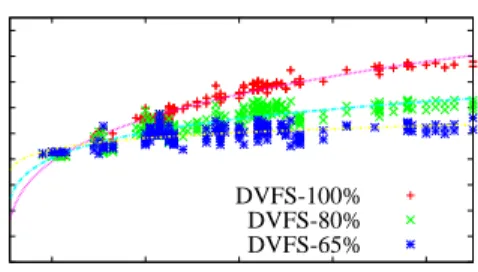
Figure 1: CPU power consumption in a
database server under different workload in-tensities and DVFS levels.
do not believe it provides meaningful energy sav-ings. Since the performance of database depends heavily on the amount of memory, turning mem-ory chips into sleep mode will lead to excessively long query processing time, thus eating the gain of running in low-power modes.
CPU Resource Control. The mechanism we
harness to change CPU usage pattern is
energy-aware query optimization. CPU is a power pro-portional hardware, meaning its power consump-tion is (roughly) proporconsump-tional to the intensity of the computational load it handles (Fig. 1). Sig-nificant power can be saved if we can find query execution plans that do not require as much CPU time as those found by existing query optimizers. Such plans will also be energy-efficient if they re-quire the same or slightly longer I/O time, and they are often ignored by the query optimizer in existing DBMSs since the latter only considers performance in the query cost model. In our previous work [18], we systematically studied the power profiles of var-ious database benchmarks, and found that queries with such low-CPU plans that are missed by tra-ditional query optimizers are very common (e.g., in 10 out of the 19 queries we studied in TPC-H). Therefore, we can design a novel query optimizer to identify such plans upon evaluating the energy cost of alternative plans. Note that hard disks are not energy-proportional therefore this mechanism has little effects on disk energy consumption.
For modern CPUs, it is well-known that the Dy-namic Voltage and Frequency Scaling (DVFS)
tech-nique can allow cubic reductions in power density
relative to performance loss [16]. This has been ver-ified using various database workloads in previous work [10] and our experiments (Fig. 1). Therefore, we propose a DVFS controller of CPUs as an inte-grated part of E2
DBMS to harvest the power ings generated by low DVFS levels. The power
c disk 1 disk 1 disk 2 disk 3 disk 2 disk 3 b a disk 1 disk 2 disk 3
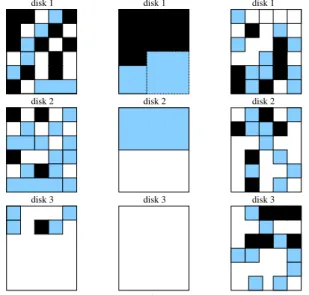
Figure 2: Three distributions of data blocks on three hard disks. Darker color means higher data popularity in block
ing potential from adjusting DVFS is significant: a 60W power difference can be observed in the server we tested (Fig. 1). This confirms the results from [10], in which a 45% reduction of active energy is re-ported. On the other hand, since query processing time is often dominated by I/O time (especially in I/O-bound workloads), a performance penalty as-sociated with low-power CPU modes will not affect system performance dramatically. Modern CPUs typically provide OS-level handles for efficient ad-justment of DVFS levels, making DVFS control ex-tremely light-weighted. Note that the proposed CPU control will not be effective if deployed on the OS level, since the control decisions depend heavily on the collection and analysis of database states.
Storage Management. Traditional multi-disk
storage systems seekload balancing to achieve best
I/O performance. In E2
DBMS, however, the
stor-age manstor-ager follows aload consolidation approach
by putting most I/O load into a subset of the phys-ical disks. By this, energy saving opportunities are created since disks with low I/O load can spin down or enter low power/performance mode. Specifically,
we explore an energy-aware data placement
mech-anism that changes the data access patterns in in-dividual disks via dynamically reconfiguring data
placement at runtime. Note that the key
prob-lem in load consolidation is to balance energy sav-ings and disk contention (i.e., data access perfor-mance). For example, the placement scheme shown in Fig. 2b will maximize power savings but yield unacceptable performance for disk 1. On the
con-Controller <DVFS level, n> DBMS
Performance metric (e.g., Throughput) DBA-specified Performance Target Disturbance (e.g, workload fluctuations)
+
-Figure 3: The feedback control loop for energy-efficient CPU usage
trary, Fig. 2a shows a better solution by distribut-ing hot items into two disks. In the load balancdistribut-ing scheme (Fig. 2c), blocks of all color depth will be randomly distributed into all disks thus energy re-duction will be minimized. The key issue for the data placement algorithm is to provide the highest level of load consolidation with a small overhead, and maintain the service quality. Obviously, this mechanism only provides higher level of load con-solidation - it requires the collaboration of low-level mechanisms that can change the power modes of disks to actually save energy.
Traditional disk farms are notoriously energy in-efficient: all disks used to hold the database keep spinning at full speed at all times while user ac-cesses are often skewed towards a very small frac-tion of the database [12]. This clearly implies a big waste of energy and also opportunities for optimiza-tion. Fortunately, most hard disks shipped today can be transitioned to low-power modes with a frac-tion of the power consumpfrac-tion in active mode. Fur-thermore, the emergence of multi-speed hard disks [7] offer more flexible power/performance tradeoffs. With the aforementioned dynamic data placement mechanism to generate opportunities for load con-solidation, the main problem is to develop a dy-namic power management (DPM) module to deter-mine the exact power mode for each disk.
3.
E
2DBMS DESIGN ISSUES
This section briefly introduces the technical
chal-lenges and our solutions in implementing E2
DBMS towards its design goal at runtime.
Energy-aware CPU control. For CPUs, we map the design problem into a feedback control loop (Fig. 3) that periodically changes the database and hardware configurations (i.e., the input signal in the loop) such that the system performance (i.e., the output signal) traces a target specified by the DBA. In this feedback loop, the system input (i.e., con-trol signal) is a multi-dimensional value: the DVFS
the preference of power over performance in query optimization . The output signal is a system-level performance metric such as query response time or throughput. The intuition of our design comes
from the fact that there is a monotonic
relation-ship between power and performance when the sys-tem runs under different configurations. Therefore, if the query processing performance of the DBMS is unnecessarily better than the threshold, we can decrease the DVFS level of the CPUs for power savings, or be more aggressive in choosing power-efficient query plans. If the system performance drops below the threshold, we can do the
oppo-site to achieve faster query processing. As long as
we keep the actual system performance on the de-sirable level, system power will be minimized. The first challenge is an actuator of the control signal, i.e., mechanisms to ensure the DBMS run in the state specified by the signal. The second challenge is the choice of the input signal whose value enables different tradeoffs between power and performance in query optimization. More importantly, we need to make the system trace the desired performance threshold in a dynamic environment.
The DVFS part of the control signal can be eas-ily enforced by a light-weighted system call. In the Intel CPU we tested, this can be done by writing the DVFS level into a cached system file with a 20 microsecond overhead. To enforce the tradeoff set by the parametern, our previous work [18] presents anenergy-aware query optimizer that selects query plans based on this signal. For each query plan, the
optimizer evaluates its running time T and power
cost P, and gives a score as C =P Tn
– the plan with the lowest score is selected. Here a big problem
is the accurate estimation of P, we propose a
two-level approach for this: we first use standard simple workloads to generate the static power cost of indi-vidual database operators, and use those as param-eters to derive the total cost of an entire plan. Then such parameters are updated periodically following aRecursive Least Squaremanner to gain better ac-curacy in a dynamic environment.
The second challenge is often seen in database tuning problems. We use well-established control-theoretic system modeling and controller design tech-niques to achieve our design goal. As compared to traditional heuristics-based database tuning meth-ods, control theory provides: (1) guaranteed control performance such as accuracy, stability, and short settling time; and (2) tolerance of modeling errors and fluctuations of system/workload features. The control loop design will begin by modeling the rela-tionship between system input (i.e., control signal)
and output (i.e., performance). We will usesystem
identification techniques to derive such models via experiments with standard inputs. The next step is to design the controller towards guaranteed per-formance. Our plan is to apply the Proportional-Integral (PI) control theory to achieve stability and zero steady state control – the latter ensures maxi-mal energy saving.
Energy-aware storage system. For the stor-age system, the main issue is to find the proper level of load consolidation and power modes in disk arrays to meet the performance and power require-ments. Here our system design goal can be viewed as a classical optimization with performance target as a constraint and energy as the optimization tar-get. As an input to this problem, the access rate of individual data items typically changes over time in a database system. This requires the optimization solution to be recomputed therefore efficient algo-rithm is needed. Another fact that complicates the problem is that the realization of a new optimiza-tion soluoptimiza-tion, unlike the adjustment of DVFS and query optimizer parameter, bears very high costs. For example, changing the data placement scheme (to reach a new level of load consolidation) involves significant I/O (and power) cost by moving data around. Transitioning disks to another state also in-volves a performance penalty on the level of seconds [7]. In this project, we tackle load consolidation in
storage systems by treating it as a dynamic
opti-mization problem and propose efficient algorithms with provable accuracy bounds.
The main task is to develop an integrated opti-mization model for data migration and disk state adjustment and efficient algorithms to achieve the optimal (or near-optimal) balance between power consumption and query performance. Starting from an M/G/1 queueing model for single-disk behaviour, we have developed a mixed integer programming model over multiple periods for inter-disk fragment migration and have tested it with industrial solvers. The next step would be to analyze the model to identify structural properties of optimal solutions for the purpose of creating guidelines to reduce search space for computing algorithms.
Another interesting problem is a DBMS mecha-nism to reorganize data records for greater chances of load consolidation. Our studies show that the data popularity can be traced down to individual tuple level in a typical database. Without extra efforts, a data page will hold records with differ-ent levels of popularity thus all pages have simi-lar aggregated page-level popusimi-larity. Referring this to Fig. 2, all blocks will have similar color depth
50 60 70 80 90 100 100 120 140 160 180 200 220 240 260 280
Relative Energy Consumption (%)
Relative Time (%) n=1 n=0 n=∞ 80 90 100 110 120 130 140 150 160 100 120 140 160 180 200 220 240 260 280
Relative Energy Consumption (%)
Relative Time (%) n=1 n=0 n=∞
Figure 4: Performance, power, and energy consumption of a database server under dif-ferent DVFS levels and n values
and load consolidation becomes impossible. We will use apopularity-based intra-disk data fragmentation
method to dynamically organize database records in a disk such that data items with similar tempera-ture are stored in consecutive pages. Specifically, we divide data on a disk into many fragments, each of which occupy a fixed number of consecutive pages. At runtime, we monitor the access frequency of data records and dynamically place records into a proper fragment according to their popularity. Such frag-ments will be used as the basic unit of data
migra-tion menmigra-tioned above. We propose an incremental
restoration algorithm to solve such a tuple packing problem – the main idea is to constrain data reor-ganization to resident (in-memory) pages as much as we can, thus minimizing extra I/O cost.
4.
PROGRESS AND INITIAL RESULTS
We are in the process of actively studying the above issues and implementing the system. An early version of E2
DBMS that augments the PostgreSQL kernel with the energy-aware query optimizer is made public [19]. In this section, we report part of our experimental results with a focus on revealing po-tential of the E2
DBMS system.
First, we tested our E2
DBMS prototype with a static plan cost model to investigate the potential of the CPU control loop. We fed the system with workloads based on TPC-H and TPC-C benchmarks
and measured theactual server power
consump-tionand query processing time under different
val-ues of DVFS levels and cost model parameter n.
Each line in Fig. 4 represents the active power and energy consumption of the database server
con-figured with one particular nvalue under different
DVFS settings (CPU voltage decreases monotoni-cally from left to right). The blue line corresponds to the conventional query optimizer in which only query performance is considered, the red line repre-sents the case ofn= 1 (i.e., energy-only optimizer), and the green line the case ofn= 0 (i.e., power-only
1 2 3 4 5 6 7 8 9 1 2 3 4 5 6 7 8 9 10 Total Energy (kJ)
Hot data spread out factor
λ=1000 λ=715 λ=455 λ=330 10-6 10-5 10-4 10-3 10-2 10-1 100 101 102 103 1 2 3 4 5 6 7 8 9 10
Average Response Time (sec)
Hot data spread out factor
λ=1000
λ=715
λ=455
λ=330
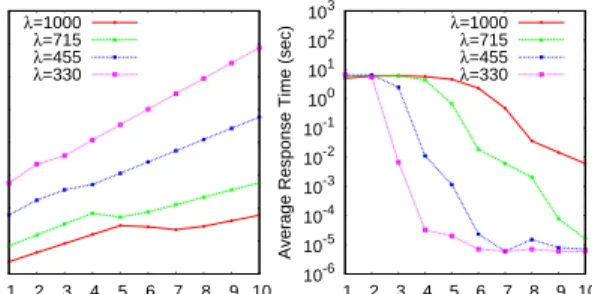
Figure 5: Energy cost and response time of a read-only workload on a 10-disk system optimizer). The position of each point shows the relative performance and power/energy consump-tion to those of the experiment under a tradiconsump-tional DBMS without DVFS control. From the left subfig-ure, we can see that the combination of DVFS and cost model tuning can yield a power saving up to
48%. Then= 0 case leads to the lowest total
sys-tem power yet its performance penalty is also high, leading to limited total energy savings. The
sys-tem withn = 1 provides several good cases where
the total energy saving is up to 20%, with a 20% performance penalty.
We also performed simulation experiments to ver-ify our ideas in power-aware storage management. In this set of experiments, we simulate a database table whose tuples span 10 hard disks. We
fol-low the well-established b/c model [12] in
generat-ing random read workloads. It is well known that database access patterns are highly skewed and can be described as an 80/20 or even a 90/10 model. Given the popularity of tuples, we implement a static
data fragmentation scheme such that thec% hot
tu-ples are placed into a variable numberF(calleddata spread-out factor) of the 10 disks. Disk specifica-tions are based on those of a commercial product – the Hitachi UltraStar 7K4000 [1]. Such disks have two power modes: a high power mode that con-sumes 11.4 watts at 7200rpm spinning speed and a low power mode with 4.6 watts at 6300rpm. We assume the hot disks always run at 11.4w/7200rpm and the cold disks at 4.6w/6300rpm.
Fig. 5 shows the energy consumption and perfor-mance of such schemes under four 90/10 workloads with task arrival rate ranging from 330/s to 1000/s.
By comparing the total consolidation (F = 1) case
with the load balancing (F = 10) case, energy
sav-ings of 50.8% (forλ= 1000) to 52.2% (forλ= 330)
can be observed.2
However, theF = 1 cases show
2
The low intensity workload consumed more energy be-cause our workload contains a fixed number (20,000) of operations. Disk idle time is longer in low intensity
bad performance - average read response time of all disks is on the level of seconds. However, the re-sponse time drops quickly when we spread the load to more disks. For example, it reaches the level of
milliseconds for λ = 330 when the hot items are
spread into only three disks. We believe the above results clearly show the potential of our idea of performing DBMS-level load consolidation.
Specif-ically, those F values in the middle range provide
desirable tradeoffs between energy and performance - about 50% energy can be saved with little perfor-mance degradation. OS-level consolidation, which
is simulated by those with high F vales, can only
reach a state of balanced load without saving any energy. Note that all results presented in this sec-tion only considered direct energy savings. If we
consider energy savings from cooling systems,3
the total energy reduction in our experiments will be even higher.
5.
SUMMARY
In this position paper, we argue for the great po-tential of energy-efficient database systems. Such potential can only be realized via designing DBMSs with energy consumption as a first-class performance goal. We present our work in building such a DBMS
named E2
DBMS, which achieves high energy effi-ciency via two strategies: modifying resource con-sumption patterns and controlling power modes of hardware. Such strategies are implemented through a series of mechanisms that target at the main ac-tive energy consumers in a typical database server:
CPU and disks. Experiments run on an initial E2
-DBMS prototype and simulation platform demon-strate significant energy savings.
Acknowledgements
This work is supported by US National Science Foun-dation (NSF) grants IIS-1117699 and IIS-1156435.
6.
REFERENCES
[1] Ultrastar 7k4000 OEM specification.
http://www.hgst.com/tech/techlib.nsf/products/ ultrastar 7k4000.
[2] R. Agrawalet al. The Claremont Report on
Database Research.Communications of ACM,
52:56–65, June 2009.
[3] F. Ahmad and T. N. Vijaykumar. Joint optimization of idle and cooling power in data
cases. This also shows that a higher percentage of en-ergy can be saved when system is not heavily loaded.
3
According to [3], for one watt of direct power saving, one to two watts can be saved from cooling.
centers while maintaining response time. In
ASPLOS’10, pages 243–256, 2010.
[4] R. Bianchini and R. Rajamony. Power and
energy management for server systems.IEEE
Computer, 37(11):68–74, 2004.
[5] W. Felteret al.A performance-conserving
approach for reducing peak power
consumption in server systems. InProcs. Intl.
Conf. Supercomputing (ICS), 2005. [6] G. Graefe. Database servers tailored to
improve energy efficiency. InProcs. EDBT
Workshop on Software Engineering for Tailor-made Data Management, 2008.
[7] S. Gurumurthiet al.DRPM: Dynamic Speed
Control for Power Management in Server
Class Disks. InISCA, pages 169–179, 2003.
[8] S. Harizopouloset al.Energy efficiency: The
new holy grail of data management systems
research. InCIDR, 2009.
[9] M. Kunjiret al. Peak Power Plays in
Database Engines. InEDBT, 2012.
[10] W. Lang and J. Patel. Towards eco-friendly
database management systems. InCIDR,
2009.
[11] W. Langet al.Rethinking Query Processing
for Energy Efficiency: Slowing Down to Win
the Race.IEEE Data Engineering Bulletin,
34(1):12–23, 2011.
[12] M. Nicola and M. Jarke. Performance modeling of distributed and replicated
databases.IEEE Trans. Knowledge and Data
Engineering, 12(4):645–672, Jul/Aug 2000. [13] M. Poess and R. Nambiar. Energy cost, the
key challenge of today’s data centers: a power
consumption analysis of TPC-C results.Proc.
of VLDB, 1(2):1229–1240, 2008.
[14] M. Poess and R. Nambiar. Tuning servers, storage and database for energy efficient data
warehouses. InICDE, 2010.
[15] M. Poesset al.Energy benchmarks: a detailed
analysis. InTPCTC, pages 131–140, 2010.
[16] K. Skadronet al. Temperature-aware
micro-architecture: Modeling and implementation.
ACM Trans. Architecture and Code Optimization, 1(1), 2004.
[17] D. Tsirogianniset al. Analyzing the energy
efficiency of a database server. InSIGMOD,
pages 231–242, 2010.
[18] Z. Xu, Y.-C. Tu, and X. Wang. Exploring power- performance tradeoffs in database
systems. InICDE, pages 485–496, 2010.
[19] Z. Xu, Y.-C. Tu, and X. Wang. PET: Redu-cing database energy cost via query