An EDF scheduling class for the Linux kernel
∗
Dario Faggioli, Fabio Checconi
Scuola Superiore Sant’Anna
Pisa, Italy
{
d.faggioli, f.checconi
}
@sssup.it
Michael Trimarchi, Claudio Scordino
Evidence Srl
Pisa, Italy
{
michael, claudio
}
@evidence.eu.com
Abstract
The Linux kernel is mainly used is general-purpose operating system, i.e., in server and/or desktop environments. During the last years, however, academic institutions and companies showed an increasing interest in using it for real-time and control applications as well.
However, since Linux has not been designed to be a real-time operating, the best-effort scheduling policy is not suited to provide high utilization and strong guarantees to time-sensitive tasks.
We present an enhancement of the Linux scheduler through the implementation of the well known Earliest Deadline First algorithm for real-time tasks, leaving the current behavior of existing policies unchanged. It is integrated with the latest Linux scheduler, support multicore platforms, it is available for embedded architectures (like ARM) and can be used with either periodic or aperiodic workloads.
1
Introduction
Linux is a General Purpose Operating System (GPOS) originally designed to be used in server or desktop environments. Since then, Linux has evolved and grown to be used in almost all computer areas. An important part of Linux is the process scheduler (or simply thescheduler). This component of the ker-nel selects which process to execute at any instant of time, and is responsible of dividing the finite resource of processor time between all runnable processes in the system.
During the last years, there has been a consid-erable interest in using Linux also for real-time and control, from both academic institutions and com-panies [15, 16]. Some reasons for this could be the free availability of its source code, the support for a
great number of architectures, a rich set of already developed device drivers and the existence of billions of applications running on it.
Unfortunately, Linux has not been designed to be a Real-Time Operating System (RTOS), thus not much attention has been given to real-time is-sues. Therefore, making a classical real-time feasi-bility study of the system under development is not possible, and developers cannot be sure that timing requirements of tasks will be met under every cir-cumstance. POSIX-compliant fixed-priority policies offered by Linux, on the other hand, are not much sophisticated and often do not suit the specific ap-plication requirements.
These issues are particularly critical when designing time-sensitive or control applications (e.g., MPEG players) for embedded devices like smart-phones. In
fact, when size, processing power, energy consump-tion and cost are tightly constrained, you need to efficiently exploit system resources, and at the same time meet the real-time requirements of the applica-tion.
It has to be said that companies exists that started selling modified versions of the Linux kernel with improved real-time support [17, 18, 19]. How-ever, these non-standard versions of Linux are often non-free, and can not avail themselves of the sup-port from the huge development community of the standard kernel.
Therefore, we believe that to be really “gen-eral”, Linux should also provide enhanced real-time scheduling capabilities. In this paper, thus, we pro-pose an implementation of the Earliest Deadline First (EDF) algorithm [1, 2], the well known real-time dynamic-priority scheduling algorithm.
The paper is organized as follows: at the be-ginning an overview of most notable real-time exten-sions for the Linux kernel proposed in the last decade is provided. Then, the current Linux scheduler is explained and the implementation of the proposed scheduling policy (SCHED EDF) is provided. Last but not least, our implementation is evaluated and vali-dated through a tests and experiments on real hard-ware, and finally, conclusions are driven.
2
Related work
During the last years, research institutions and inde-pendent developers have proposed several real-time extensions to the Linux kernel [4]. It must be said that, none of the extensions described in this section eventually became part of the official Linux kernel yet, thus making some of these projects obsolete.
First of all, in [20] we started investigating how an EDF policy could be implemented as a schedul-ing class of the new Linux modular schedulschedul-ing frame-work, but we concentrated in uniprocessor systems, while the implementation presented here is multipro-cessor. Moreover, the focus in [20] was on dealing with critical section, more than with scheduling it-self.
Deadline based scheduling is also involved in [21], an even more recent work. However, what we do in there is to assign deadlines to fixed-priority task groups in thesched rtclass. Thus, the group to be scheduled is chosen by its deadline, while the task to be scheduled from within the group is selected ac-cording to its priority. On the other hand, in this work, a new scheduling class is utilized, and tasks
have their own deadlines.
2.1
OCERA
A real-time scheduler for Linux 2.4 has been devel-oped within the OCERA European project, and it is available as Open Source code [3, 7, 8]. To minimize the modifications to the kernel code, the real-time scheduler has been developed as a small patch and an external loadable kernel module. All the patch does is exporting toward the module (by somehooks) the relevant scheduling events.
The approach is straightforward and flexible, but the position where the hooks have to be placed is real challenge, and it made porting the code to next re-leases of the kernel very hard.
2.2
AQuoSA
The outcome of the OCERA project gave birth to the AQuoSA [23] software architecture. It basically consists on the porting of OCERA kernel approach to 2.6 kernel, with a user-level library for feedback based scheduling added.
Unfortunately, it lacks features like support for mul-ticore platforms and integration with the latest mod-ular scheduler [5, 6] and the cgroups filesystem.
2.3
Frescor
A real-time framework based on Linux 2.6 has been proposed by the Frescor European project [9]. It is based on AQuoSA and further adds to it a contract-based API and a complex middleware for specifying and managing the system performances, from the perspective of the Quality of Service (QoS) it pro-vides.
Obviously, it suffers from all the above mentioned drawbacks as well.
2.4
LITMUS-RT
LITMUS-RT [10] is a plugin based scheduling frame-work with a wide variety of implemented real-time scheduling algorithms. The aim of the project, at least for now, is the evaluation of multiprocessor scheduling algorithms and synchronization protocols from research point of view.
Moreover, it only runs on Intel (x86-32) and Sparc64 architectures (i.e., no embedded platforms, the one typically used for industrial real-time and control).
2.5
RTLinux, RTAI, Xenomai
The so called interrupt abstractionapproach [4] ac-tually allows to schedule even hard real-time tasks on Linux. It consists of having an abstraction layer of virtual hardware below the Linux kernel, resulting in some kind of multithreaded RTOS with standard Linux and all its processes running as the lowest pri-ority thread.
This approach has been successfully implemented in several existing frameworks, the most notable exam-ples of which are RTLinux [12], RTAI [11] and Xeno-mai [13].
It is an efficient solution, as it allows to obtain very low latencies, but is also invasive, and, often, not all standard Linux facilities are available to tasks run-ning with real-time privileges.
3
Modular Scheduling
Framework
Recently (since release 2.6.23) the previous O(1) Linux scheduler has been replaced by a completely new modular scheduler implemented by Ingo Mol-nar [5, 6]. In this section we will try to point out some of its more important characteristics.
3.1
Scheduling classes
This “new” scheduler has been designed in such a way to introduce scheduling classes, an extensible set of scheduler modules. These modules encapsu-late specific scheduling policies details that the core scheduler needs not to know. The binding between each policy and the related scheduler is done through a set of hooks (i.e., function pointers) provided by each scheduling class and called by the core sched-uler.
Currently, Linux comes with two scheduling classes1
:
• sched fair: the “Completely Fair Sched-uler” (CFS) algorithm, forSCHED NORMAL and
SCHED BATCH policies. The idea here is to run tasks in parallel and at precise weighted speeds, in, so that each task receives a “fair” amount of processor share;
• sched rt: the POSIX fixed-priority real-time scheduling, for SCHED FIFO or SCHED RR poli-cies with 99 priority levels.
A (partial) list of the hooks a scheduling class may provide, by filling them in its own struct sched classstructure, follows:
• enqueue task(...): enqueues a task in the data structure used to keep all runnable tasks (runqueue); usually called when the task enters a runnable state;
• dequeue task(...): removes a task from the runqueue; usually called when the task stop being runnable;
• yield task(...): yields the processor for other tasks to have a chance to be run;
• check preempt curr(...): checks if a task shall preempt the currently running task;
• pick next task(...): chooses the most ap-propriate task eligible to be run next;
• put prev task(...): makes a running task no longer running;
• select task rq(...): chooses on which run-queue (i.e., on which CPU) a waking-up task has to be enqueued;
• task tick(...): accounts each periodic sys-tem tick to the running tasks.
3.2
Limits of current
scheduling classes
Real-time tasks arecomputational activities charac-terized, at least, by a worst case execution time and a timing constraint[2]. These tasks must be executed by the RTOS in a correct order, so that each one completes within its timing constraints. A typical constraint is thedeadline, i.e., is the instant the task execution is required to be completed, otherwise the results could turn out to be useless.
The default scheduling policies of Linux (i.e.,
SCHED NORMALand SCHED BATCHcannot provide the guarantees a time-sensitive application may require. This is mainly because no concept of timing con-straint (e.g. deadline) can be associated to a task in them. In fact, although it is possible to assign a share of the processor time to a task (or a group of tasks)2
, there is no way to specify that a task must execute for 20msec within 100msec, as it is possible with real-time scheduling algorithm, such as EDF. Moreover, the time elapsed between two consecutive executions of a task is not deterministic and can not
1
actually, a special idle scheduling class also exists to implement the idle task
2
be bound, since it highly depends on the number of tasks running in the system at that time.
Even POSIX-compliant fixed-priority policies (i.e.,SCHED RRandSCHED FIFO) diverges from what the real-time research community refer to as “real-time” [2, 14]. For instance, as best-effort policies, they do not allow to assign timing constraints to tasks. Moreover, it is well known [1] that they pro-vide lower performances in term of both schedulabil-ity guarantees [?] and flexibility (e.g., graceful
degra-dation and bounded tardiness), both on uniprocessor and multiprocessor systems.
4
SCHED EDF: features and
implementation
In this section we present our new scheduling class,
sched edf, implementing theSCHED EDFscheduling policy. The purpose of this paper is to give as much details as possible about this first implementation of the new policy.
As we will point out, thorough experimental eval-uation to validate, and maybe correct, some of the design choices we made, is the subject of ongoing and future work by us.
All the information about the code, together with links to installation and usage instructions can be found athttp://www.evidence.eu.com/sched edf/
4.1
Main features
Our scheduling class implements the Earliest Dead-line First (EDF [?]) algorithm and uses the Constant
Bandwidth Server (CBS [22]) to provide bandwidth isolation among tasks. They both are well known and discussed in the real-time community, thus we are not going into too much details of them here, for space reasons.
This scheduling class has been developed from scratch, without starting from any existing project, taking advantage of the modularity currently offered by the Linux scheduler.
The implementation is aligned with the current mainstream kernel, and it relies on standard Linux mechanisms (e.g., control groups) to natively sup-port multicore platforms and to provide hierarchical scheduling through a standard API.
4.2
Interaction with existing policies
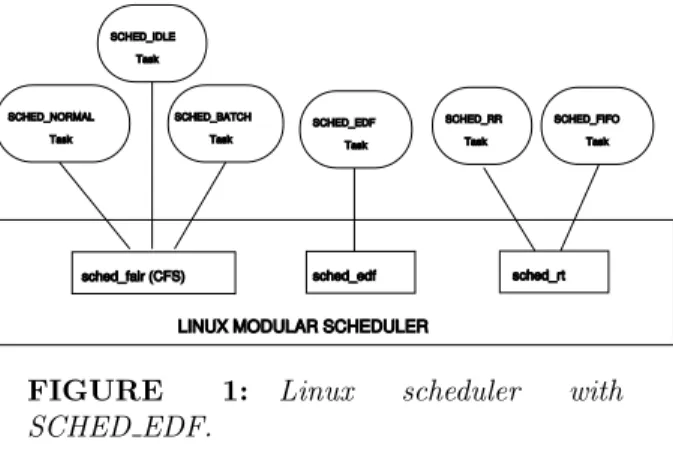
The addition of our scheduling class to the Linux kernel does not change the behavior of the existing scheduling policies, neither best-effort and real-time ones, as shown in Figure 1).
FIGURE 1: Linux scheduler with
SCHED EDF.
However, given the current Linux scheduler architecture, there is some interaction between scheduling classes. In fact, since each class is asked to provide a runnable task in the order they are chained in a linked list, “lower” classes actually run in the idle time of “upper” classes.
We decide to put our new scheduling class,
sched edf, in between the best-effort scheduling class,sched fair, and the POSIX real-time schedul-ing class sched rt. This means a ready EDF task always “win” the struggle for the CPU against a best-effort task, but always “loose” it against a fixed-priority POSIX real-time one. This has been done for the following reasons:
• backward application compatibility and (POSIX) standard compliance require
SCHED FIFO/RR tasks to run as soon as they can;
• it may be useful, either for the user or for the kernel (e.g. during system power down or CPU offlining), to have an easy way to specify an “al-ways winner” task, without the need of dealing with the deadlines that are present in the sys-tem at that particular instant;
• since EDF is more efficient than fixed-priority in term of schedulability, it will be easier for it to achieve high utilization even if it runs in the idle time of fixed-priority, than the vice-versa;
• real-time analysis techniques already exists to deal with exactly such scheduling architecture.
It should be easy to notice that this solution has the drawback that EDF tasks will suffer from the
interference of fixed-priority tasks, but it has to be said that:
• the amount of interference coming from the user’s SCHED FIFO/RRtasks can be taken into account given the techniques cited before;
• the amount of interference coming from Linux systemSCHED FIFO/RRtasks can be accounted for as system overhead;
• in recent kernels, the bandwidth the whole
sched rt scheduling class occupies, can be forced to stay below a certain limit3
.
Experimental evaluation of the overhead and the experienced latency under different load conditions, the actual system schedulability and predictability, etc., is deferred to future works.
4.3
Multiprocessor
scheduling
sup-port
In the real-time and scheduling community global and partitioned multiprocessor scheduling schemes exists. In global scheduling each task may be picked up and run on each CPU; in partitioned scheduling a task has its own CPU where it is always scheduled. Discussing advantages and drawbacks of both, is not in scope here, let us just say that the global case is usually thought and implemented by means of one global ready queue for all the CPUs, partitioning by one ready queue per CPU.
The way Linux deals with multiprocessor scheduling is often calleddistributed runqueue, which means each CPU as its own ready queue, as in par-titioning; however, tasks can, if wanted or needed, migrate between the different queues. This adds the overhead of migrations but, at least, make it easy to pin some task on some processor (scheduling affinity) and, more important, addresses the serious locking scalability issues that –it is easy to figure out– con-cerns the single-runqueue solutions.
We are interested, for our new scheduling class, in a general solution, i.e. a globally scheduled system in which it is easy to ask one or more tasks to stay on a pre-specified CPU (or set of CPU). Therefore, the easiest and simplest way of achieving this is to go for the same approach of Linux itself, which means:
• we have one runqueue for each CPU, imple-mented with a red-black tree, for efficient ma-nipulation;
• we migrate the tasks among the runqueues in a way such that:
– we always try to have, on anmCPU
sys-tem, the m earliest deadline ready tasks
running on the CPUs;
– we always respect the affinity the tasks
specify.
Therefore, if the affinity of a particular task is equal to only one precise CPU, that task will never be mi-grated and, when runnable, it always run only on it. Thus, it is sufficient that each EDF task in the system has its affinity correctly set, to achieve what we called partitioned scheduling, with very few over-head.
4.4
Tasks scheduling
Thesched edf scheduling class does not make any restrictive assumption on the characteristics of its task, thus, it can handle:
• periodic tasks, typical in real-time and control applications;
• sporadic tasks, typical in soft real-time and multimedia applications;
• aperiodic tasks.
A key feature of task scheduling in this schedul-ing class is that temporal isolationis ensured. This means, the temporal behavior of each task (i.e., its ability to meet its deadlines) is not affected by the behavior of any other task in the system. In other words, even if a task misbehaves, it is not able to ex-ploit larger execution time than it has been allocated to it and monopolize the processor.
In fact, each task is assigned a budget
(sched runtime) and a period, considered equal to itsdeadline (sched period). This means the task is guaranteed to execute for an amount of time equal tosched runtimeeverysched period(task utiliza-tion or bandwidth). When a task tries to execute more than itsbudgetit is slowed down, by stopping it until the time instant of its next deadline. When, at that time, it is made runnable again, its budget is refilled and a new deadline computed for him. This is how the CBS [22] algorithm works, in its hard-reservation configuration.
However, although the CBS algorithm is very ef-fective to encapsulate aperiodic or sporadic –real-time or non real-–real-time– tasks in a real-–real-time EDF
3
scheduled system, it imposes some overhead to “stan-dard” periodic tasks. Therefore, we make it possi-ble for periodic task to specify, before going to sleep waiting for the next activation, the end of the cur-rent instance. This avoid them (provided they be-have well!) being disturbed by the CBS.
4.5
API for tasks
The existing system callsched setscheduler()has not been extended, because of the binary compati-bility issues that modifying itsstruct sched param
parameter would have raised for existing appli-cations. Therefore, another system call, called
sched setscheduler ex(...) is implemented. It allows to assign or modify the scheduling param-eters described above (i.e., sched runtime and
sched period) for tasks running with SCHED EDF
policy. The system call has the following prototype:
#define SCHED EDF 6 struct sched param ex {
int sched priority; /* Backward compliance */ struct timespec sched edf period;
struct timespec sched edf runtime; };
int sched setscheduler ex(pid t pid, int policy, struct sched param2 *param);
For the sake of consistency, also
sched setparam ex(...)andsched getparam ex(...)
have been implemented.
On the other hand, we did not add any sys-tem call to allow a periodic task to specify the end of its current instance, and the semantic of
sched yield(...) for EDF tasks has been modi-fied for that purpose.
4.6
API for task groups
The scheduling class has also been integrated with the control groups mechanism in order to allow the creation of groups of tasks with a cap on their total utilization.
Therefore, the cgroups interface now pro-vides two new entries, cpu.edf runtime us and
cpu.edf period us. These files are created once the cgroup filesystem is mounted, to get and set the group bandwidth. In fact, a group has not actual budget or period/deadline, and these values are used to derive the utilization of the group. Consistency check is run when:
• a task is created or moved inside a group,
• the parameters of a task (if inside a group) are modified,
• a group is created or moved inside another group,
• the parameters of a group (if inside another group) are modified,
to check if the cumulative utilization of tasks and groups is below the one of the group that contains them (i.e., theirparentgroup).
On multicore platforms, tasks and task groups can be moved among different pro-cessors using existing Linux mechanisms, i.e.,
sched setaffinity(...) for tasks (either threads or processes), andcpuset.cpusfor task groups.
5
Evaluation
Given the preliminary status of this work we report here only a very simple example showing our new policy at work.
First of all we modified theschedtoolpackage to make it use the newsched setscheduler ex(...)
system call, and thus be able to set SCHED EDF as the scheduling policy of a task, with proper budget
and period. We then ran a simple yes Linux pro-cess as aSCHED EDFtask with 100mssched period
and 20ms sched runtime. The actual schedule is obtained by using thesched switchtracer from the
ftrace infrastructure, recently introduced into the kernel. Finally, the output has been converted to VCD format by means of the analyze 4
program. Thus, we can use GtkWave to visualize what hap-pens in the system. Notice that all the tools and programs mentioned above, are freely available and easy to install and use.
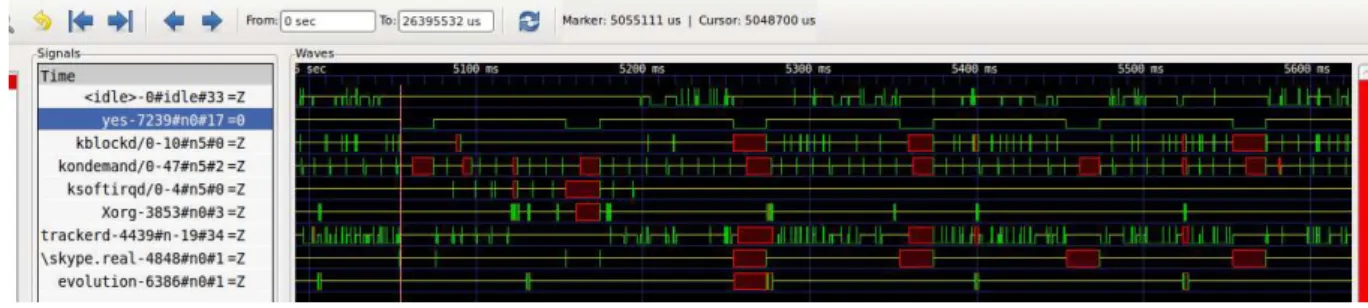
We can see what happens on the CPU where our
SCHED EDF yesprocess is being run in Figure 2). Green “low” lines correspond to task execution, while yellow “high” ones to task being not runnable. Red vertical lines happens when a task become ready to run, and thus dark red rectangle means the task is ready but not running, usually because some other task of higher priority or scheduling class is keep-ing it out from the CPU. The yes EDF task is at the second line in the Figure; other lines represent other tasks running on the same CPU, as shown in the Signals box on the left. All these tasks but
4
FIGURE 2: Scheduling trace with a SCHED EDFtask
yes, either being user or system tasks, run with
SCHED NORMALas their scheduling policy.
Looking at the figure we notice at least the fol-lowing:
• oursched edftask runs as soon as it become runnable, preempting or preventing to be run all the best-effort tasks;
• thanks to the bandwidth isolation enforcing mechanism, even if it would like to run con-tinuously, it is allowed to only exploit its full
sched runtimeeverysched period, i.e., 20ms every 100ms.
6
Conclusions
In this paper, we presented an implementation of the Earliest Deadline First (EDF) algorithm for the Linux kernel.
With respect to similar work proposed in the past, our implementation takes advantage of the modularity offered by the new Linux scheduler, leav-ing the current behavior of existleav-ing policies un-changed. The new scheduling class is integrated with the latest Linux scheduler, and relies on standard Linux mechanisms (e.g., control groups) to natively support multicore platforms and to provide hierar-chical scheduling through a standard API.
Our implementation does not make any restric-tive assumption on the characteristics of the task. Thus, it can handle periodic, sporadic and aperiodic tasks. Another interesting feature of this schedul-ing class is the temporal isolation among the tasks handled. The temporal behavior of each task (i.e., its ability to meet its deadlines) is not affected by the behavior of the other tasks: if a task misbehaves and requires a large execution time, it cannot jeopar-dize the processor. Thanks to the temporal isolation
property, each task executes as it were on a slower dedicated processor, so that it is possible to provide real-time guarantees on a per-task basis. Such prop-erty is particularly useful when mixing hard and soft real-time tasks on the same system.
References
[1] C.L.Liu, J.W.Layland, Scheduling Algorithms for Multiprogramming in a Hard-Real-Time En-vironment, Journal of the Association for Com-puting Machinery, 1973.
[2] John A. Stankovic, K.Ramamritham, M.Spuri, G.Buttazzo,Deadline Scheduling for Real-Time Systems: EDF and Related Algorithms, Kluwer Academic Pubishers, 1998.
[3] L.Abeni, G.Lipari, Implementing Resource Reservations in Linux, Real Time Linux Work-shop, 2002.
[4] G.Lipari, C.Scordino, Linux and Real-Time: Current Approaches and Future Opportunities, IEEE International Congress ANIPLA, 2006. [5] Design of the CFS scheduler, Linux
documen-tation, linux/Documentation/scheduler/sched-design-CFS.txt.
[6] I.Molnar, Modular Scheduler Core and Completely Fair Scheduler, http://lkml.org/lkml/2007/4/13/180
[7] I.Ripoll, P.Pisa, L.Abeni, P.Gai, A.Lanusse, S.Sergio, B.Privat, WP1 — RTOS State of the Art Analysis: Deliverable D1.1 — RTOS Anal-ysis, OCERA, 2002.
[8] C.Scordino, G.Lipari, A Resource Reservation Algorithm for Power-Aware Scheduling of Pe-riodic and ApePe-riodic Real-Time Tasks, IEEE Transactions on Computers, 2006.
[9] FRESCOR: Framework for Real-time Embedded Systems based on COntRacts, http://www.frescor.org
[10] J.Anderson and students, LITMUS RT: Linux Testbed for Multiproces-sor Scheduling in Real-Time Systems, http://www.cs.unc.edu/ anderson/litmus-rt/
[11] L.Dozio, P.Mantegazza, Real-Time Distributed Control Systems Using RTAI, IEEE Interna-tional Symposium on Object-Oriented Real-Time Distributed Computing, 2003.
[12] V.Yodaiken, The RTLinux Manifesto, Fifth Linux Expo, 1999.
[13] P.Gerum, The XENOMAI Project, Imple-menting a RTOS emulation framework on GNU/Linux, 2002.
[14] G.Buttazzo, Hard Real-Time Computing Sys-tems: Predictable Scheduling Algorithms and Applications, Springer, 2005.
[15] G.Francis, L.Spacek,Linux Robot with Omnidi-rectional Vision, TAROS06, 2006.
[16] F.Kanehiro, K. Fujiwara, S.Kajita, K.Yokoi K.Kaneko, H.Hirukawa, Y.nakamura, K.Yamane, Open Architecture Humanoid
Robotics Platform, IEEE International Confer-ence on Robotics and Automation, Washington DC, 2002.
[17] Windriver Linux, http://www.windriver.com/products/linux/ [18] Timesys Embedded Linux kernel,
https://linuxlink.timesys.com/3/Linux
[19] Montavista Real-Time Linux, http://www.mvista.com/real time linux.php [20] D. Faggioli, M. Trimarchi, F. Checconi, M.
Bertogna, A. Mancina, An Implementation of the Earliest Deadline First Algorithm in Linux, 24th ACM SAC, March 2009.
[21] Fabio Checconi, Tommaso Cucinotta, Dario Faggioli, Giuseppe Lipari, Hierarchical Multi-processor CPU Reservations for the Linux Ker-nel, 5th OSPERT Workshop, July 2009. [22] L. Abeni, G. Buttazzo,Resource Reservation in
Dynamic Real-Time Systems, Real-Time Sys-tems, Vol. 27, No. 2, pp. 123-167, July 2004. [23] T. Cucinotta, L. Palopoli, L. Marzario, G.
Li-pari,AQuoSA - Adaptive Quality of Service Ar-chitecture, Software: Practice and Experience, April 2008, doi 10.1002/spe.883 Expand Ab-stract.