Air Force Institute of Technology
AFIT Scholar
Theses and Dissertations Student Graduate Works
3-23-2017
Active Response Using Host-Based Intrusion
Detection System and Software-Defined
Networking
Jonathon S. Goodgion
Follow this and additional works at:https://scholar.afit.edu/etd
Part of theDigital Communications and Networking Commons, and theInformation Security
Commons
This Thesis is brought to you for free and open access by the Student Graduate Works at AFIT Scholar. It has been accepted for inclusion in Theses and Dissertations by an authorized administrator of AFIT Scholar. For more information, please [email protected].
Recommended Citation
Goodgion, Jonathon S., "Active Response Using Host-Based Intrusion Detection System and Software-Defined Networking" (2017).
Theses and Dissertations. 1575. https://scholar.afit.edu/etd/1575
ACTIVE RESPONSE USING HOST-BASED INTRUSION DETECTION SYSTEM AND
SOFTWARE-DEFINED NETWORKING
THESIS
Jonathan S. Goodgion, 2d Lt, USAF AFIT-ENG-MS-17-M-032
DEPARTMENT OF THE AIR FORCE AIR UNIVERSITY
AIR FORCE INSTITUTE OF TECHNOLOGY
Wright-Patterson Air Force Base, Ohio
DISTRIBUTION STATEMENT A:
The views expressed in this document are those of the author and do not reflect the official policy or position of the United States Air Force, the United States Department of Defense or the United States Government. This material is declared a work of the U.S. Government and is not subject to copyright protection in the United States.
AFIT-ENG-MS-17-M-032
ACTIVE RESPONSE USING HOST-BASED INTRUSION DETECTION SYSTEM AND SOFTWARE-DEFINED NETWORKING
THESIS
Presented to the Faculty
Department of Electrical and Computer Engineering Graduate School of Engineering and Management
Air Force Institute of Technology Air University
Air Education and Training Command in Partial Fulfillment of the Requirements for the
Degree of Master of Science in Cyber Operations
Jonathan S. Goodgion, B.S.C.S. 2d Lt, USAF
March 2017
DISTRIBUTION STATEMENT A:
AFIT-ENG-MS-17-M-032
ACTIVE RESPONSE USING HOST-BASED INTRUSION DETECTION SYSTEM AND SOFTWARE-DEFINED NETWORKING
THESIS
Jonathan S. Goodgion, B.S.C.S. 2d Lt, USAF
Committee Membership:
Barry E. Mullins, Ph.D., P.E. Chair
Timothy H. Lacey, Ph.D., CISSP Member
Michael R. Grimaila, Ph.D., CISM, CISSP Member
AFIT-ENG-MS-17-M-032
Abstract
Recent studies have shown information misuse is more abundant within
organi-zations, possibly from the modern proliferation of phishing and social engineering attacks. To address this problem, security experts have proposed local, internal in-spection, known as Host-based Intrusion Detection Systems (HIDS). This technique allows detection of malicious activity to occur at the endpoints – the individual hosts. This research proposes Active Host-based Network Security Response (AHNSR): a framework that utilizes HIDS with Software-Defined Networking (SDN) to enhance system security by allowing dynamic active response and reconstruction from a global network topology perspective. Vital to the operational architecture, SDN introduces new programming capabilities that resolve the rigid configurations of traditional net-works. This flexibility is essential in an era of rapidly evolving threats that require unique and adaptive security defenses, as SDN-software solutions enable more flex-ible security controls in both virtualized and enterprise environments. These SDN security controls aim at providing access to legitimate users, protecting systems from attacks, and providing mitigation or countermeasures when attacks do occur.
AHNSR is a complete and automated dynamic security solution, starting with alert generation and ending with an appropriate SDN-enabled response on physical switch flow tables. Responses include traffic redirection, host quarantining, filtering, and more. SDN allows greater flexibility and command/control compared to legacy, manual administrator response or the iptables solution of traditional IDS. By pushing security event information to a global controller, immediate and intelligent changes
can be made for packet forwarding devices across the network. When, not if, an
– a goal every incident response team should have.
This research compares different methods of pushing security event information from hosts and the resulting system performance at specified security level thresholds. A testable SDN-controlled network is constructed with multiple hosts, OpenFlow en-abled switches, and a Floodlight controller, all linked to a custom, novel interface for the Open-Source SECurity (OSSEC) HIDS framework. OSSEC is implemented in a server-agent architecture, allowing scalability and OS independence. System effective-ness is evaluated against the following factors: alert density and selective Floodlight module response types.. At the expected operational load of 500 events per second (EPS), results reveal a mean system response time of 0.5564 seconds from log gener-ation to flow table update via Floodlight’s Access Control List module. These results demonstrate the AHNSR framework as a dependable (100% successful alert genera-tion), effective (under 1 second), and efficient (under 35% CPU utilization) security solution in the emulated test network. Load testing further assesses performance of response methods at EPS levels 10—10000. A dynamic model is fit against the data, allowing for performance estimates of dynamic response policies found in real enterprise environments.
Acknowledgements
I am continually humbled by the blessings I receive, and must first give thanks to the Lord for providing it all.
I have learned so much in this program thanks to the educational passion demon-strated by AFIT faculty members like Dr. Barry Mullins, Dr. Timothy Lacey, and Dr. Michael Grimaila. They help make AFIT an institution that truly fosters, challenges, and mentors the future leaders of this great nation.
Lastly, I am beyond grateful for my beloved wife and her unending support. Thank you for being a light in my life, helping discern the Lord’s will for us in the marvelous mission to share love everywhere.
Table of Contents
Page
Abstract . . . iv
Acknowledgements . . . vi
List of Figures . . . xi
List of Tables . . . xiv
List of Abbreviations . . . xv I. Introduction . . . 1 1.1 Background . . . 1 1.2 Problem Statement . . . 1 1.3 Research Goals . . . 2 1.4 Hypothesis . . . 4 1.5 Approach . . . 4 1.6 Assumptions/Limitations . . . 5 1.7 Contributions . . . 6 1.8 Thesis Overview . . . 6
II. Background and Related Research . . . 7
2.1 Overview . . . 7
2.2 Networking . . . 7
2.2.1 History . . . 9
2.2.2 SDN Origination . . . 10
2.3 SDN Components . . . 11
2.3.1 Controller: A Networking Operating System . . . 12
2.3.2 Southbound Interface . . . 13
2.3.3 Northbound Interface . . . 15
2.3.4 Special/Optional Components . . . 15
2.4 Use Cases and Applications . . . 16
2.4.1 Access Control . . . 16
2.4.2 Mobility and Migration . . . 16
2.4.3 Fault Tolerance . . . 16
2.4.4 Dynamic Service Bandwidth . . . 17
2.4.5 Current Research Areas . . . 18
2.5 Security . . . 19
2.5.1 Attack Vectors . . . 19
2.5.2 Securing Using SDN . . . 20
2.6 Intrusion Detection Systems . . . 21
Page
2.6.2 Incident Response . . . 23
2.7 OSSEC: Open Source SECurity . . . 24
2.8 Advanced Message Queuing Protocol . . . 26
2.8.1 Brokers . . . 27
2.8.2 RabbitMQ . . . 28
2.9 Related Research . . . 28
2.10 Conclusion . . . 30
III. AHNSR Design . . . 31
3.1 Overview . . . 31
3.2 System Summary . . . 31
3.3 SDN Controller . . . 33
3.3.1 Reactive/Proactive Flow Entry . . . 35
3.4 OSSEC Configuration . . . 36 3.4.1 Agents . . . 37 3.4.2 Decoder/Rules . . . 38 3.4.3 Active Response . . . 41 3.4.4 SDN Response . . . 42 3.4.5 Database . . . 43 3.5 Security . . . 43
3.6 Complete AHNSR Response Flow . . . 46
3.7 Design Summary . . . 46
IV. Methodology . . . 48
4.1 Problem/Objective . . . 48
4.2 System Under Test . . . 49
4.2.1 Assumptions . . . 50
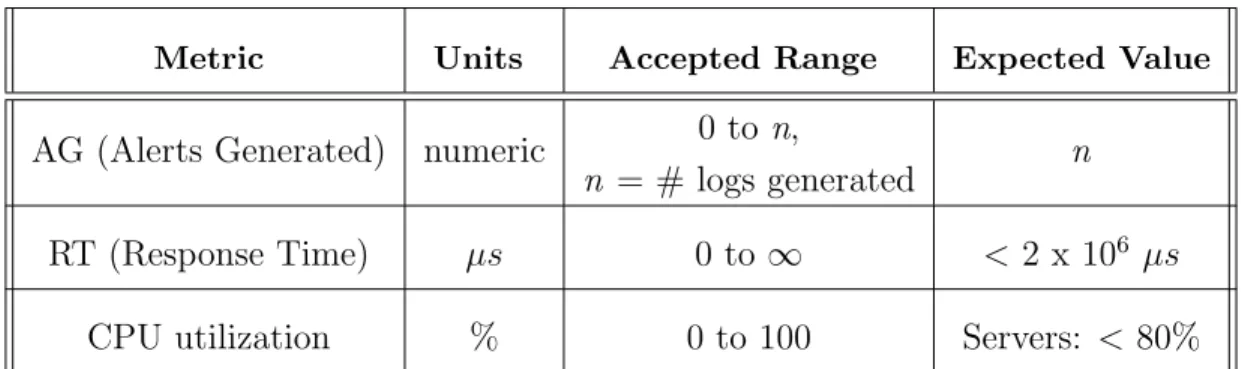
4.3 Metrics . . . 52
4.4 Experiment Factors . . . 53
4.5 Experiment Parameters . . . 55
4.6 Experimental Design . . . 55
4.6.1 Expected Load Level . . . 55
4.6.2 Treatments . . . 56 4.6.3 Testing Process . . . 56 4.6.4 Repeated Measures . . . 59 4.6.5 Timing . . . 59 4.7 Statistical Analysis . . . 61 4.8 Methodology Summary . . . 62
Page
V. Results and Analysis . . . 63
5.1 Overview . . . 63
5.2 OSSEC Log Collection Behavior . . . 63
5.3 Performance Under Expected Load . . . 67
5.3.1 Expected Load: Response Time . . . 67
5.3.2 Expected Load: CPU . . . 70
5.4 Load Testing . . . 73
5.4.1 AG . . . 76
5.4.2 Load Testing: RT . . . 76
5.4.3 Load Testing: CPU . . . 78
5.5 RT Performance Models . . . 79 5.5.1 Dynamic Model . . . 81 5.6 Chapter Summary . . . 85 VI. Conclusion . . . 87 6.1 Overview . . . 87 6.2 Research Conclusions . . . 87 6.3 Research Significance . . . 88 6.4 Future Work . . . 89 6.5 Chapter Summary . . . 90
Appendix A. Log Generation Script . . . 91
Appendix B. Experiment Management Script . . . 93
Appendix C. OSSEC Configuration . . . 96
Appendix D. Internal Options Configuration . . . 99
Appendix E. Floodlight Properties . . . 101
Appendix F. Active Response Script . . . 103
Appendix G. Data Parsing . . . 105
Appendix H. Networking Parameters . . . 109
Appendix I. R Analysis Script: Tests 1-4 . . . 110
Appendix J. R Analysis Script: Load Tests . . . 115
Appendix K. Trial Ranges . . . 120
Page Appendix M. Threat Level Classification . . . 124 Bibliography . . . 125
List of Figures
Figure Page
1 Layered view of the functional networking planes [1] . . . 8
2 Decoupling applications, operating systems, and hardware in network devices is similar to the transition in personal computing [2] . . . 10
3 SDN components [1] . . . 12
4 How flow tables are used in the SDN architecture [1] . . . 14
5 Possible attacks on OpenFlow enabled networks [3] . . . 20
6 OSSEC architecture [4] . . . 25
7 AMQP architecture [5] . . . 27
8 Dynamic Security Control using SDN (DSCS) process [6] . . . 29
9 Network diagram of AHNSR components . . . 32
10 AHNSR system design . . . 33
11 Floodlight architecture and module interaction [7] . . . 34
12 Reactive vs. proactive Floodlight modules . . . 36
13 OSSEC log flow in a server/agent architecture . . . 37
14 Decoding phases for sample log entry . . . 40
15 EER diagram of OSSEC database . . . 44
16 Response flow through agent, OSSEC, Floodlight, and switch . . . 47
17 System Under Test (SUT) and Component Under Test (CUT) . . . 50
18 Advanced network diagram between server and switch . . . 51
19 Log and alert timestamping through the AHSNR system . . . 60
Figure Page
21 Sample CPU-data.csv file . . . 61
22 Individual alert response time from 250 logs collected on one host . . . 64
23 Individual alert response time from 250 logs per host, from 10 hosts . . . 64
24 Sample log collection behavior with a 1 second timeout loop . . . 66
25 RT quartile ranges from 15 trials, 500 EPS, 10 active agents . . . 68
26 C.I. on the RT mean from 15 trials of 500 EPS, 10 active agents . . . 69
27 OSSEC and Floodlight CPU quartile ranges, 15 trials at 500 EPS . . . 71
28 C.I. on the Floodlight and OSSEC CPU mean, 15 trials of 500 EPS . . . 71
29 Mean RT for EPS levels 10 through 10000, 10 active agents . . . 77
30 Mean CPU utilization for EPS levels 10 through 10000, 10 active agents . . . 79
31 Fitting linear models where y = Response Time and x = EPS . . . 80
32 RT estimate in 80% Log, 10% ACL, 5% Firewall, 5% Static Flow model . . . 85
33 Dynamic model test result . . . 86
34 Static Flow RT quartile ranges (per trial at 500 EPS) . . . 120
35 Log-Only RT quartile ranges (per trial at 500 EPS) . . . 120
36 Firewall RT quartile ranges (per trial at 500 EPS) . . . 121
37 ACL RT quartile ranges (per trial at 500 EPS) . . . 121
Figure Page
39 Reduced OSSEC CPU utilization measurements (500
EPS) . . . 122
40 All Floodlight CPU utilization measurements (500 EPS) . . . 123
41 Reduced Floodlight CPU utilization measurements (500
List of Tables
Table Page
1 Performance metrics . . . 53
2 Experiment factors . . . 54
3 Treatments . . . 57
4 Repeated measures to meet minimum 7065 power sample size . . . 59
5 AHNSR performance results under 500 EPS load, 10 active agents . . . 67
6 Log-Only response load testing results . . . 74
7 ACL response load testing results . . . 74
8 Firewall response load testing results . . . 75
9 Static Flow response load testing results . . . 75
10 Dynamic model interpretation . . . 82
List of Abbreviations
Abbreviation Page
SDN Software-Defined Networking . . . 1
APT Advanced Persistent Threat . . . 1
ACL Access Control List . . . 3
PCI DSS Payment Card Industry Data Security Standards . . . 3
OSSEC Open Source SECurity . . . 5
IDS Intrusion Detection Systems . . . 7
TCP Transport Control Protocol . . . 7
IP Internet Protocol . . . 7
RTC Real-Time Communication . . . 9
OF OpenFlow . . . 11
ONF Open Networking Foundation . . . 11
NOS Network Operating System . . . 12
API Application Programmable Interface . . . 15
NFV Network Function Virtualization . . . 18
DoS Denial of Service . . . 20
ISP Internet Service Provider . . . 21
DoD Department of Defense . . . 22
NIDS Network-based Intrusion Detection Systems . . . 22
HIDS Host-based Intrusion Detection Systems . . . 22
USM Unified Security Management . . . 24
MOM Message Oriented Middleware . . . 26
Abbreviation Page
TLS Transport Layer Security . . . 26
DSCS Dynamic Security Control using SDN . . . 28
SIM Security Incident Management . . . 29
AHNSR Active Host-based Network Security Response . . . 31
REST REpresentational State Transfer . . . 32
JSON JavaScript Object Notation . . . 35
XML eXtensible Markup Language . . . 38
SSH Secure Shell . . . 39
MAC Media Access Control . . . 42
EER Enhanced Entity Relationship . . . 43
SSL Secure Sockets Layer . . . 44
PKI Public Key Infrastructure . . . 45
VM Virtual Machine . . . 49
NIC Network Interface Card . . . 50
AG Alerts Generated . . . 52
RT Response Time . . . 52
CPU Central Processing Unit . . . 53
CSV Comma Separated Values . . . 58
NTP Network Time Protocol . . . 60
ACTIVE RESPONSE USING HOST-BASED INTRUSION DETECTION SYSTEM AND SOFTWARE-DEFINED NETWORKING
I. Introduction
1.1 Background
The world is rapidly emerging as a network of networks, with millions of packet for-warding devices responsible for the successful delivery of any request across the Inter-net. However, traditional IP network configuration is complex, and once properly con-figured, usually remains as a semi-static architecture. Inevitably, the exponentially-advancing technology in the current age quickly outgrows the static limitations of traditional networks. Software-Defined Networking (SDN) is a possible solution to this problem. It is an emerging networking paradigm that gives hope in solving the limitations of current network infrastructures.
1.2 Problem Statement
According to annual cyber trend reports, half a billion personal records were stolen or lost in 2015 [8]. There is no argument here: any “hackivist” or state-sponsored entity has free reign on poorly-configured and vulnerable systems. Even well-vetted commercial cyber defense systems can fall victim to a Zero-Day vulnerability or Ad-vanced Persistent Threat (APT). Additionally, there is a trend of increasing insider involvement in data breaches; while it only accounted for around 10 percent of data breaches in 2014, insider involvement was present in 32 percent of the claims sub-mitted in 2015. With more than three-quarters of surveyed US government agencies
admitting they are more focused on combating insider threats today than one year ago, it corroborates the significance of the problem.
Even though threat detection is possible through various Commercial-Off-The-Shelf (COTS) products, it remains ineffective. Unfortunately, law enforcement and third party notification remained the top breach discovery methods in 2015 [8]. In 2015, 92.9% of compromises took minutes or less to complete, and when companies have to wait on external notification, it’s too late to secure, respond, and mitigate the active threat [9]. Therefore, it is apparent there is a problem in real-time threat detection and response from both external and internal originating intrusions.
Software-Defined Networking introduces a new framework for network configura-tion, security, and management. Researchers are investigating and developing a wide array of innovative and effective tools that utilize the fundamental architecture of a global controller in a Software-Defined Network. These new tools may help prevent and effectively respond to intrusions. When attackers gain unauthorized access to any given machine, their most common goal is to move laterally to extract the most infor-mation possible. Thus, the most effective methods in reducing data loss and damage are 1) preventing lateral access to locally networked machines and 2) responding to the breach as soon as possible.
1.3 Research Goals
In response to the problems of threat detection and response, this research seeks to expand on a process of actively responding to local host-based security violations by utilizing key technologies provided by Host-based Intrusion Detection Systems in combination with Software-Defined Networking. The ideal system would integrate seamlessly with existing systems, provide administrators with greater network control and insight, and significantly reduce the possibility of data loss/theft while
maintain-ing access to critical network services.
The research assesses the performance of four different methods to SDN response demanding alerts, in which immediate network reconfiguration by a SDN controller helps mitigate a potential active threat or intrusion. An open-source Host-based In-trusion Detection System provides the detection and alert mechanism, whereas the SDN controller is responsible for executing the response with flow table updates. The SDN controller Application Programming Interfaces (APIs) provide the four evalu-ated methods of responding to an alert: Firewall, Access Control List (ACL), Static Flow Entry, and Log-Only. Each method helps meet specific data security compli-ance requirements, such as those required by Payment Card Industry Data Security Standards (PCI DSS) 2/3.2 and the Health Insurance Portability and Accountability Act (HIPAA), which are furthered discussed in Section 2.7 [10] [11].
Specifically, this research seeks to expand on Todd’s Dynamic Security Control System (DSCS), discussed in Section 2.9 [6]. The limitations of Todd’s previous work in this area have been quantified, and this research seeks to mitigate shortcomings and expand functionality in the following ways:
Limitation Mitigations
• The use of Floodlight’s stateless firewall could not interrupt active connections
if they were found to be malicious. This research seeks a viable solution.
• The DSCS system was not interfaced with an actual IDS. This research seeks
to use industry standard software (OSSEC) and its APIs to generate alerts. Improvements
• A database schema is incorporated to allow alert sharing and archival tracking,
• Different approaches to intrusion response (firewall or access control list up-dates, first hop modifications, honeypot redirection, etc.) are allowed for more dynamic control.
• The AMQP publisher/broker model can be replaced with a similar messaging
design within a Security Incident Management (SIM) or Security Information and Event Management (SIEM) product.
• The programmability of the AMQP protocol can be replicated in a SDN
en-vironment because routing decisions are defined outside the network layer of packet forwarding devices.
1.4 Hypothesis
This research hypothesizes as the aggregate number of logs being generated by hosts increases, the response time will increase, the processor resource utilization will also increase, and the alert generation rate will remain above the protocol standard of 98%. At a normal operational load level, this research expects the average event response time to be under 1 second for near real-time reactivity. Additionally, when comparing the different response methods, the Access Control List response method will outperform the Firewall response method in both quantitative and qualitative metrics.
1.5 Approach
An experimental fully-switched network is configured, consisting of ten virtual agents with host-based intrusion monitoring, one management server, and one SDN controller. In order to emulate a full SDN network, packet forwarding is restricted to OpenFlow enabled switches on real hardware. High resolution timing scripts are
de-ployed and log generation is controlled while monitoring system performance through the detection/response workflow. An active response script is developed to query different modules provided by the SDN controller.
1.6 Assumptions/Limitations
The following assumptions/limitations are understood when designing and exe-cuting experiments for the active response system:
• The framework is dependent on well-configured host auditing and logging
poli-cies, as well as appropriate rule definitions on the management server.
• Triggers and definitions are limited by the features provided by the Host-based
IDS utilized in the research, Open Source SECurity (OSSEC), version 2.9 RC3. More specifically, alert triggers are limited to system log analysis, application log analysis, connection status, rootkit signature detection, selective registry changes, and/or selective file changes.
• Rule definitions are limited to the following: alert level, specific rule ID, event
frequency, maximum size, time frame, category, source IP, destination IP, user-name, hostuser-name, program user-name, URL, and/or matching regex parameters.
• This research does not examine identification accuracy (e.g., false positive
fre-quency) or use any datasets of captured attacks.
• The Floodlight controller has out-of-band management to all switches in the
network. If this is not true, it does not ensure dedicated OpenFlow channels that may become congested otherwise, which can invalidate the observed results.
• All switches must support OpenFlow 1.3 or higher, as some response modules
• A pre-configured flow is utilized for proactive forwarding to the IDS server. This would not be possible in a pure reactive forwarding environment.
• CPU utilization data collection frequency is limited to at most once per second.
This reduces the sample size for this metric significantly and can potentially be inaccurate or inconsistent between trials.
1.7 Contributions
This thesis contributes to the general SDN body of research. It helps answer questions about how SDN can be utilized in further securing local area networks by providing interfaces to already existing systems. It provides empirical evidence
that a complete SDN-interfaced intrusion detectionand response action is capable of
actively mitigating threats in near real-time.
1.8 Thesis Overview
This thesis document is arranged in six chapters. Chapter 2 presents fundamental concepts of networking, SDN, IDS, and other relevant research. Chapter 3 discusses the system design details and the necessary configuration in implementing an active response. The experiment methodology is presented in Chapter 4 along with the standard parameters, metrics, and testing process. Chapter 5 covers the results and necessary statistical analysis of the collected data. Lastly, Chapter 6 summarizes the research and discusses potential opportunities for future work in this domain.
II. Background and Related Research
2.1 Overview
This chapter discusses Software-Defined Networking (SDN), Intrusion Detection Systems (IDS), and the relevant bodies of research. Section 2.1 discusses the history of networking and the motivation of SDN development, while Section 2.2 further explains SDN fundamental components. Several application and use case proposals are addressed in Section 2.3, along with current research trends in this domain. One of these areas is security, which is discussed further Section 2.4, from both potential weakness and strength perspectives. In Sections 2.5 and 2.6, high-level concepts of Host-based Intrusion Detection Systems and the Advanced Message Queuing Protocol are introduced respectively, as they play key roles in the research methodology for security policy enforcement using SDN.
2.2 Networking
In order to reliably send data from one host to another, computers depend on switches, routers, and other packet forwarding devices to pass along the message. This
is necessary for both inter and intra network communication. Data is encapsulated
into packets and sent across various mediums utilizing transport and network layer protocols, most notably the Transport Control Protocol (TCP)/Internet Protocol (IP). These protocols establish a standard “language” and delivery method for the majority of traffic on the Internet. However, all machines cannot be directly connected to one another. Thus, packet forwarding devices act as the highway intersections, directing traffic towards individual, appropriate destinations.
Computer networks can be divided into three functional planes: data, control, and management [12]. The data plane is where the networking devices reside and is where
the raw bits are forwarded through to the next device. The control plane represents the protocols used to populate the forwarding tables of the data plane elements. Lastly, the management plane represents the services, software, and protocols used to remotely monitor and configure the control plane. Figure 1 depicts the combination of these three planes in a top-down, streamlined process of policy development to policy execution. Network policy is defined in the management plane, which is enforced via the control plane and ultimately executed at the physical data plane.
The most significant limitation of current packet forwarding devices is caused by their implementation of these three functional planes. Switches were designed to be resilient and independently capable, which resulted in a tight coupling of the data and control planes. Therefore, the routers are responsible for both packet forwarding (data plane), as well as managing a variety of distributed routing algorithms (control
plane). The control plane is responsible for any extra processing (e.g., Link Layer
Discover Protocol, Border Gateway Protocol) that is necessary to perform the basic data plane activities. Unfortunately routers are doing all of this extra work themselves in tracking topology changes, computing routes, and installing forwarding rules. In this framework, the devices themselves are independently responsible for both man-aging and executing their own forwarding tables. This breeds a decentralized, static
architecture – a contributing factor to the difficulty of innovation in this domain.
2.2.1 History.
There have been three distinct phases in the demands of networking over the past 20 years. Beginning in the late 1990s, as the Internet became a consumable service in both business and home, the focus was almost exclusively on bandwidth. Data rates were the only metric in considering the performance of file transportation from
point A to point B. It did not matter how data got to a destination. However, as
more services and protocols were introduced in networking, specifically Real-Time Communication (RTC) traffic, a new performance metric was introduced: latency.
In the 2005 time-frame, with the advent of video and audio streaming services such as YouTube, Skype, and Voice Over IP (VoIP), network administrators began to realize that latency was a real challenge with these services. This problem occurs
because the service depends on delivery timing of individual packets, far different
from the former concept of getting an entire file to a destination regardless of actual semantics. But as internal network RTC traffic volume increased, competition of those “intersection” resources at packet forwarding devices demanded the need to prioritize traffic type. As a result, Quality of Service (QoS) was introduced to prioritize the forwarding of individual packets (e.g., RTC traffic) to reduce latency for those services. Moving forward to present-day, networks have become increasingly complex. With more devices and more services than ever before, it is becoming clear that QoS stan-dards cannot accurately prioritize traffic all of the time. It is limited by strict as-sumptions, and fails to allow administrators to dynamically model and shape their traffic depending on the real-time needs of a business. There is a desperate need to programmatically respond to network resource demand by modifying certain priori-tization and flow controls.
2.2.2 SDN Origination.
SDN, in its simplest form, is pulling away the intelligence from switch hardware. This trend is already occurring in other domains with positive results. For example, file servers were originally dedicated to a particular service and all permissions, data, assets, and physical components were managed in a self-contained unit. These servers have been replaced by Storage Area Networks (SAN), allowing a consolidation of file systems to abstract the connections from a single operating system [13]. Similarly, virtualization tools are helping create multiple instances of software operate on the same hardware.
Investigating the history of basic computing reveals this trend. Nick McKeown highlights in Figure 2 the similarities between legacy mainframe computers and tra-ditional networking devices [2]. Both incorporate specialized applications, operating systems, and hardware in a vertically-locked environment. The shift to personal com-puting was revolutionary, yet required the separation of hardware and intelligence. While this trend grew rapidly in these other domains, the traditional IP networking architecture failed to follow suit – until SDN was introduced.
Vertically integrated Closed, proprietary Slow innovation Small industry Specialized Operating System Specialized Hardware App* App* App* App* App* App* App* App* App* App* App* Specialized Applications Horizontal Open interfaces Rapid innovation Huge industry Microprocessor Open Interface Linux* Mac*OS*
Windows*
(OS)* or or
Open Interface
Mainframes(
(a) Mainframe computer framework
Vertically integrated Closed, proprietary Slow innovation App* App* App* App* App* App* App* App* App* App* App* Horizontal Open interfaces Rapid innovation Control*
Plane* Control*Plane* Control* Plane* or or Open Interface Specialized Control Plane Specialized Hardware Specialized Features Merchant Switching Chips Open Interface
Routers/Switches(
(b) Traditional networking framework
Figure 2. Decoupling applications, operating systems, and hardware in network devices is similar to the transition in personal computing [2]
SDN originated from the work at Stanford University in 2007 by researcher Martin Casado [14]. His team successfully decoupled the control and data planes, resulting in the development of OpenFlow (OF), an open-source communication protocol used in the “southbound” control channel, which has become the standard interface between servers and SDN-enabled switches. Shifting the intelligence away from the physi-cal forwarding devices allows more flexibility in networking configuration than ever before.
According to the Open Networking Foundation (ONF), SDN is defined as a net-work architecture that “decouples the netnet-work control and forwarding functions en-abling the network control to become directly programmable and the underlying
infrastructure to be abstracted for applications and network services” [15]. Kreutzet
al go further in [1], defining SDN with four pillars:
1. The control plane functionality is decoupled from the data plan network devices. 2. Forwarding decisions are “flow” based versus strictly destination based (flows
are defined in Section 2.3.2).
3. Control logic is executed on an external device: the SDN controller.
4. Software applications running on top of the SDN controller are capable of in-teracting with the underlying data plane devices.
When a network builds upon these four pillars, it successfully forces the separation of management and execution.
2.3 SDN Components
By nature of the four pillars described, SDN requires distinct components that have already been mentioned in theory. Figure 3 depicts the SDN architecture and
its fundamental components. This section discusses the three central components unique to SDN: the Network Operating System, the southbound interface, and the northbound interfaces.
Figure 3. SDN components [1]
2.3.1 Controller: A Networking Operating System.
The controller, also known as the Network Operating System (NOS), is arguably the most important component in the SDN architecture. The purpose of any operat-ing system is to provide abstraction to higher level applications and communication to lower level components. It is also responsible for managing those resources and services. SDN incorporates this same paradigm in delivering and facilitating network management. At a minimum, a NOS provides the following functionality: maintain network state and topology information, discover new devices, and distribute network
configuration settings [12].
When designing the NOS architecture, the most significant consideration is whether it operates in a distributed or centralized structure. A centralized controller man-ages all data plane devices as a single entity. NOX, Floodlight, and Beacon have been designed as such [15]. However, centralized systems may introduce danger as a single point of failure; this threat has motivated others to develop distributed NOS controllers. Another advantage of a distributed system is scalability. Onix, ONOS, and Hyperflow are examples of distributed controllers, all capable of higher degrees of availability and resiliency by their fault tolerant design [16].
In this research, the Floodlight controller is used. It is an enterprise-class, Apache-licensed, and Java-based OpenFlow controller. This controller is selected due to its community support, open-source code base, centralized design, and implementation of a northbound interface.
2.3.2 Southbound Interface.
The southbound interface is the link between the NOS and the packet forwarding devices. The most commonly accepted protocol for this communication is Casado’s OpenFlow, which provides three sources of information for NOSs [14]. First, reactive messages are sent to the controller whenever links drop or port changes occur. Second, flow statistics and corresponding updates are sent to the controller. Last, “packet-in” messages are sent across the southbound interface whenever the switches/routers do not know what action to take on an incoming flow.
A flow is an important concept in SDN, and consists of three parts: 1) a matching rule, 2) actions to perform on matching packets, and 3) counters for statistical use. Flow generation is accomplished by utilizing the Ternary Content Addressable Mem-ories (TCAMs) that are already implemented by forwarding tables in typical modern
switching equipment [17]. The advantage in SDN is that flows are generated with a global perspective of the network. Flow rules are determined at the control and management level, and then disseminated throughout the network.
Figure 4 shows how upon packet arrival, if a match is determined against a rule in a flow entry, the corresponding action occurs. For example, it can forward to either a physical or virtual port, en-queue to a particular port, encapsulate and send to the controller, modify existing fields, or simply drop the packet. “Table Chaining” also introduces hierarchical look-up options by having an action link to another flow table or even a group table, defined as a specialized table which resembles a set of multiple actions to execute [1].
Figure 4. How flow tables are used in the SDN architecture [1]
Flow entries may be issued on a hard timeout or idle timeout basis. A hard timeout signals the switch or router to remove the entry after its single use, while an idle timeout allows the entry to remain until it has had no matches for a certain amount of time. Timeouts are helpful because a single flow can be decided once against the first packet in a targeted TCP connection and then used repeatedly for subsequent forwarding, increasing performance.
2.3.3 Northbound Interface.
The northbound interface is mainly a software domain that allows network ap-plications to function independent from the lower level SDN implementation, but also enables dynamic control of actual network resources. The Open Networking Foundation (ONF) framework describes customer and business applications having abstracted views and the ability to program specific needs across multiple domains [15].
While OpenFlow has emerged as the de facto standard on the southbound
inter-face, there is not an equivalent Application Programmable Interface (API) adoption for its counterpart north side. Whatever the case may be, an open-source north-bound interface is extremely important in keeping true portability and interoperabil-ity among SDN platforms.
2.3.4 Special/Optional Components.
Depending on the SDN deployment environment, there may be special require-ments or optional features that help improve performance. For example, in a dis-tributed controller environment, East/Westbound APIs are a special component in-volved. This horizontal interface is responsible for exchanging data between con-trollers, running consistency checks, and monitoring controller function status. SDNi is a protocol developed to coordinate flow setup across these distributed platforms [18].
In addition, the concept of virtualization allows an entire SDN to live as a virtual network. Open vSwitch is an open source virtual switch that can run as a stand-alone hypervisor switch, or as a distributed switch across multiple servers. The virtual switching occurs within the Virtual Machine Manager (VMM) and can therefore avoid physical hardware limitations. For example, Open vSwitch uses Link Aggregation
Control Protocol (LCAP), a method of combining multiple physical ports to form a single logical channel in parallel [19].
2.4 Use Cases and Applications
The programmability of SDN has presented a variety of use cases for real world scenarios. This section discusses a few examples, and explains how the benefits of SDN contributes to their potential.
2.4.1 Access Control.
In a dynamic access control model, SDN allows forwarding devices to “inspect” the first packet on any connection. They can then consult the access control policy via pre-determined flows in their tables (proactive modeling) or request an access policy from the controller (reactive modeling). SDN allows these rules to be instantiated at a global level to block or route traffic appropriately, and do not require manual configuration at each switch/router in the internal network. This research utilizes Floodlight’s proactive access control module as one response method.
2.4.2 Mobility and Migration.
SDN provides the ability for seamless migration of mobile clients. If a host mi-grates to a new location on the network, controller topology visibility is able to signal the change, and modify rules/routing information to optimally reroute traffic imme-diately.
2.4.3 Fault Tolerance.
A major issue with Shortest Path First (SPF) routing algorithms found on many networks today is the problem of non-deterministic failures. The failure of a link
between two nodes affects all nodes that use this link to reach some destinations. These nodes will change their routing tables and send out routing updates the first-hop devices, essentially competing over alternate links in the network. Latency is involved during the rebuild, and the algorithm’s non-deterministic nature does not guarantee the rebuild is the most optimal solution [20].
Alternatively, SDN guarantees fault tolerance by having an accurate global topol-ogy. When a link fails in a SDN environment, the controller can immediately establish optimal new flows for all connections affected by the fault.
2.4.4 Dynamic Service Bandwidth.
Bandwidth throttling is a current network practice designed to place limitations on the data capacity of certain services. For example, a company may allocate a maximum of 15% of their total bandwidth for File Transfer Protocol (FTP) traf-fic, 25% for VoIP traftraf-fic, and so forth. Even large cellular providers like T-Mobile automatically throttle bandwidth demanding video streaming traffic down to 480p resolution quality [21]. These throttles are strict boundaries manually configured at the currently coupled data/control plane. A consequence of bandwidth throttling is the lack of flexibility and utilization efficiency. The system is difficult to change and often results in unused bandwidth.
SDN offers the flexible and efficient solution of dynamic service bandwidth. This can meet the changing demands of a company’s network as it grows, adds services,
and responds to certain events. Additionally, bandwidth requesting becomes
pos-sible, where a traffic engineering server (possibly integrated into the NOS) receives bandwidth requests from applications. This reactive model presents a new concept of “on-demand” networking, where the network shapes itself based upon endpoint devices, considering their roles and needs.
Furthermore, Eli Etherton presents a possible use case of this dynamic control as an emergency alert system [22]. At the push of a button, SDN can shift all internal bandwidth to deliver pertinent emergency information, possibly allowing real-time high definition streaming to all end users of emergency notifications and instructions. Current networks would choke under QoS and divisional constraints, but SDN’s adap-tive abilities can overcome those limitations.
2.4.5 Current Research Areas.
SDN is still in the early stages of adoption and standardization. However, there are some themes in current research areas [1].
• Scalability: Partitioning and replicating the controller state to segment man-agement as networks grow [23].
• Testing and Debugging: Since the network depends on the execution of a program, bugs can be introduced. There is a need for testing techniques specific for controller applications [24].
• Network Function Virtualization (NFV): Moving current application layer services (DHCP, DNS, etc.) to layer 3 network services [25].
• Migration: Implementing hybrid deployment environments to ease the transi-tion into a full-scale SDN replacement [26].
• Software-Defined Environments (SDE): Combining SDN with
software-defined storage, software-software-defined computation, and software-software-defined manage-ment [27].
• Security and Dependability: Using technologies to improve resiliency and mitigating unrealized security threats on the control platform [28] [29].
This research looks at the themes of Security, Dependability and NFV by moving network security services closer to the network controller.
2.5 Security
While research and experimentation continue to develop with SDN, security con-tinues to be a top priority. The ability to view network status in real-time and programmatically control network behavior is a two sided coin: it opens new avenues of attack vectors for malicious users, but also grants the possibility of providing
fur-ther software-based security services. Aliet al divide current SDN-based security into
two categories: protect the network or provide security as a service [30].
2.5.1 Attack Vectors.
There are three new attack vectors introduced in an SDN environment [31]: 1. Controller: As mentioned earlier, pulling the network intelligence to a single
system naturally makes the controller a high profile target. If the NOS is
compromised, the forwarding devices it controls will be affected as well.
2. Southbound Interface: This is an interesting attack vector because it takes advantage of the fact that control messages must now occur between devices and the controller. If this OpenFlow communication is not sent over a secure channel, malicious users may be able to apply traditional techniques such as spoofing and man-in-the-middle (MITM) attacks to issue their own commands to switches and/or routers.
3. Flow Entries: Since flow rules are established at the management level, there may be errors in policy and decision making. Therefore, attackers may at-tempt to reverse engineer the flow tables and pinpoint weaknesses in the actual
implementation.
Additionally, a security assessment of the OpenFlow protocol presented a number of issues. The STRIDE methodology [3], summarized in Figure 5, identifies different attacks, examples, as well as their properties in reference the Confidentiality, Integrity, and Availability (CIA) triad [32].
Figure 5. Possible attacks on OpenFlow enabled networks [3]
2.5.2 Securing Using SDN.
Despite the introduction of new attack vectors, SDN also provides the ability to build application-level security for an entire network. The first direction of security mitigation efforts focuses on threat detection, remediation, and verification using SDN.
As examples, the controller may be able to infer a Denial of Service (DoS) attack from the internal network state, and respond by dynamically reprogramming the de-vices at gateway locations to drop the malicious traffic flow. RadWare has developed DefenseFlow [33], a commercially-available SDN application that does exactly this. DefenseFlow instructs the controller to collect statistics on traffic flow at a per second resolution, establishing baseline measurements to detect any patterns of suggestive DoS attacks.
Dealing with threat remediation, the only possible response in traditional net-works is to drop the offending the traffic. SDN, however, with its real-time
program-ming ability, gives a richer set of dynamic responses, including “emergency alarms, dynamic quarantine solutions, traffic redirection for forensics, and entrapment mech-anisms such as tarpits and honeypots” [30]. For instance, the FRESCO Application
layer prototype, propose by Shin et al, provides a Python scripting API that allows
programmers to develop reusable flow rule configuration modules. These modules are overseen by FORTNOX, a specialized security enforcement kernel supplement in the controller. Using FRESCO, the authors built Reflector Net, an application that de-tects and reroutes malicious scanners to isolated honeynets [34]. That traffic can then be dissected, promoting defense intelligence, instead of being immediately dropped at the network perimeter.
SDN can also provide subscription-like security, enabling services such as anonymiza-tion, enhanced trust, and remote management. AnonyFlow is a service that theo-retically allows an Internet Service Provider (ISP) to dynamically and temporarily assign IP addresses and flow-based identifiers to their customers [35]. This would al-low ISPs to mimic hierarchical network address translation (NAT) for entire regions or sub-regions.
SDN can also be utilized to secure data offloading from mobile and Bring-Your-Own-Devices (BYOD). There may exist a need to offload sensitive data from these devices for further processing, sharing, or archival. Enterprise-Centric Offloading Sys-tem (ECOS) is an enterprise-wide solution, enabling a SDN controller to negotiate with mobile applications on data offloading, encryption feasibility, privacy require-ments, and more [36].
2.6 Intrusion Detection Systems
In [37] Kizza describes the fundamentals of network intrusion detection and pre-vention. An intrusion is defined as a deliberate attempt, successful or not, to break
into, access, manipulate, or misuse some valuable property. The Department of De-fense (DoD) is responsible for an extensive amount of valuable property, in the form of national intelligence, personnel files, and any other classified information.
To protect this data, one or many Intrusion Detection Systems (IDS) are used to detect unauthorized intrusions into a network. Historically, Network-based Intrusion Detection Systems (NIDS), like SNORT [38], have been used to monitor network traffic from an external, passive perspective. Port mirroring is often utilized to submit network traffic to an IDS, which will then perform an anomaly and/or signature-based analysis.
However, recent studies [39] [40] [41] have shown that information misuse is more
abundantwithinorganizations, possibly from the modern proliferation of phishing and
social engineering attacks. To address this problem, security experts have proposed local, internal inspections, known as Host-based Intrusion Detection Systems (HIDS). This technique allows detection to occur at the endpoints, on individual hosts. This research utilizes an HIDS framework introduced in Section 2.7.
2.6.1 Alert Generation.
HIDS use software to monitor specific logs on the target systems. There are three models of generating alerts:
1. Anomaly-based detection: These systems compare network activity to a
fingerprint profile of “normal” activity. Any user behavior or system resource usage that deviates from the norm may indicate an intrusion. Training datasets are often used to establish the normal baseline.
2. Signature-based detection: These systems assume each intrusive activity can be individually identified by a unique pattern or signature. They work by
keeping an updated database of known malicious signatures and looking for these in current network activity.
3. Hybrid detection: Because of the potential shortcomings in both anomaly and signature based detection, a hybrid model combines both sources for alert generation.
The HIDS in this research utilizes a hybrid model in generating alerts.
2.6.2 Incident Response.
While much time is spent optimizing intrusion detection and prevention systems, there is little guidance offered for when an incident does occur. Network administra-tors have to invest in building a custom incident response strategy; if this is weak, it undermines the entire protection infrastructure.
The SANS institute suggests a simple tiered response and escalation procedure for detected intrusions [42]:
• Level 1: “Unfriendly” but harmless activity, such as port scanning. The re-sponse should be 1) record user/IP/domain of intruder, and 2) maintain vigi-lance for future intrusions.
• Level 2: An unsuccessful, yet clear attempt to obtain unauthorized information (password files, access restricted hosts, etc.). The response should be 1) research the attack origin, 2) analyze results, and 3) identify intrusion method risks.
• Level 3: Serious or successful attempt to breach security. The response should be 1) contain the intrusion immediately, 2) collect and protect information, 3) eliminate related vulnerabilities.
2.7 OSSEC: Open Source SECurity
OSSEC is an open-source HIDS platform capable of incident detection, response, and information management. It functions in either a local or server/agent deploy-ment and can provide host-based monitoring across Linux, Solaris, AIX, HP-UX, BSD, Windows, Mac and VMware ESX systems. OSSEC is used by Internet Service Providers (ISPs), universities, government agencies, and even large corporate data centers (Atomicorp, Wazuh) as their primary HIDS solution [43]. AlienVault’s Uni-fied Security Management (USM) subscription product also uses OSSEC in their core functionality.
OSSEC helps customers meet file integrity monitoring, log inspection/monitoring, and policy enforcement requirements by providing these key features [43]:
1. Log Analysis: OSSEC collects, analyzes, and correlates logs generated by operating systems, applications, and devices. This feature covers PCI DSS Section 10.
2. File Integrity Monitoring (FIM):Independent hosts can detect changes to any file and provide alerts when changes occur. This feature covers PCI DSS Sections 11.5 and 10.5.5.
3. Registry Integrity Checking: Similar to file integrity monitoring, agents can run checks against system registry values and alert when changes occur. This feature also covers PCI DSS Sections 11.5 and 10.5.5.
4. Host-based Anomaly Checking: OSSEC runs UNIX-based rootkit detection
scripts that can detect when a system is modified in a way matching common rootkit methods. For example, it looks for the presence of hidden processes by
is being used, but “ps” cannot see it, this likely indicates the presence of a kernel-level rootkit or a trojaned version of “ps”.
5. Active Response: This feature allows OSSEC to take immediate action when any specific (or generic) alert occurs.
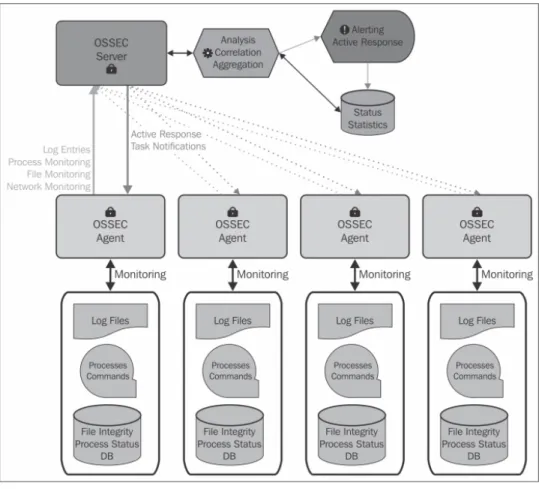
Figure 6 shows OSSEC’s structure and delegation between the management server and agents. Agents collect log files, command output, and maintain a small database for file integrity checking. However, the server is responsible for analysis through log decoding, archiving alerts, alerting through email, and initiating active response scripts.
Figure 6. OSSEC architecture [4]
OSSEC has an extensive code-base with active community development. It comes with hundreds of log decoders in a default installation and is customizable to
ad-ditional applications. Adad-ditionally, it offers the flexibility of “agentless” monitoring for systems such as routers, firewalls, etc. This feature allows it to stack intrusion detection power with other network-based products like SNORT while maintaining a centralized management architecture.
2.8 Advanced Message Queuing Protocol
Enterprise developers adopted Message Oriented Middleware (MOM) because of the desire for flexible communication while remaining reliable and secure. MOM allows efficient message delivery between applications on heterogeneous systems, ef-fectively bypassing the expensive use of explicit connections like Virtual Private Net-works (VPNs). Usually, this is accomplished with asynchronous message delivery through a queue framework directly on the MOM middleware. The Advanced Mes-sage Queuing Protocol (AMQP) aspires to define MOM, and has been widely adopted as an open standard for “business messaging” [44].
AMQP originated in 2006 due to the demand of interoperability within the finan-cial services industry [45]. It was developed as a binary, wire-level protocol, meaning the message format is strictly machine-readable as a stream of octets [46]. Its ubiq-uitous and pervasive nature allows AMQP to be highly scalable, proving itself as a high performance, fault-tolerant, and lossless messaging infrastructure. Security and message integrity is implemented through mutual authentication and the Transport Layer Security (TLS) encryption scheme. Figure 7 displays how AMQP relies upon a publish-and-subscribe model, consisting of three primary components:
• Publishers: Clients generating the messages
• Broker: A server or daemon program containing an exchange, one or more
• Consumers: Clients consuming one or more messages from the queue(s) on the broker
Figure 7. AMQP architecture [5]
2.8.1 Brokers.
The broker’s role is to receive messages from the publisher applications and route them to the appropriate consumer. This transfer is first accomplished using an ex-change module, which acts as a mailbox for any incoming messages. Exex-changes then copy and distribute the message to outbound queues using binding rules. The ac-tual delivery is initiated by the broker if the consumer is subscribed to the queue, or consumers can fetch/pull messages at their discretion.
As a programmable protocol, AMQP routing is defined at the application layer, then executed at the network layer. As a result, it is possible to build a scalable broker topology using a k-nomial tree scheme, varying in both depth and breadth [47]. While this only applies to a disjoint federation architecture, custom topologies can meet the routing needs of the target system.
2.8.2 RabbitMQ.
RabbitMQ is an open-source middleware, specifically acting as a message broker and queuing server. It supports many messaging protocols, including AMQP. In a multi-broker model, RabbitMQ can either be clustered together (forming a single, log-ical broker) or loosely connected through federation or tree structures. Additionally, it is officially supported on several operating systems and programming languages, including Java, Python, and C/C++ [5].
2.9 Related Research
This research aims to assist in the intrusion response process by utilizing SDN and HIDS together in a harmonious system with efficient message passing. Figure 8 illustrates Michael Todd’s Dynamic Security Control using SDN (DSCS) system pro-posal and how these can work together to provide an immediate response to actively quarantine potential intrusions. HIDS monitors the critical end systems, generating alerts which are passed to the AMQP Broker. A SDN controller subscribes to these alerts, and a network application interacts with the Northbound API in response to the alert. All of these components working together results in dynamic and automated flow table updates which monitor, isolate, and block security policy violations.
The limitations of Todd’s previous work have been quantified, and this research seeks to mitigate shortcomings and expand functionality in the following ways:
• The use of Floodlight’s stateless firewall could not interrupt active connections
if they were found malicious. This research seeks a viable solution.
• The DSCS system was not interfaced with an actual IDS. This research seeks to
use industry standard software (e.g., OSSEC) and its APIs to generate alerts.
tracking, meeting standard logging policy requirements and improving scalabil-ity.
• Different approaches to intrusion response (firewall updates, first hop
modifi-cations, honeypot redirection, etc.) can be tested for performance, efficiency, and/or latency.
• The AMQP publisher/broker model can be replaced with a similar messaging
design within a Security Incident Management (SIM) or Security Information and Event Management (SIEM) product.
• The programmability of the AMQP protocol can be replicated in a SDN
en-vironment because routing decisions are defined outside the network layer of packet forwarding devices.
2.10 Conclusion
This chapter explains SDN’s differences between basic networking and its his-torical development. It describes the fundamental components of SDN’s framework, and presents use cases of how it can help improve network capabilities. Lastly, it explores both the security liabilities and potential security applications that SDN could provide. The critical, legacy-style role of network architecture may make SDN a slow adopting technology, but the flexibility of dynamic programming proves itself priceless.
III. AHNSR Design
3.1 Overview
This research introduces the Active Host-based Network Security Response (AHNSR) framework, a redesign of the DSCS process discussed in Section 2.9. This chapter provides a detailed description of each component in the AHNSR system and its role in the experiment. In understanding the key technologies in SDN, the four main com-ponents of this new system under test can be defined: agent, OSSEC, flow profile, and the SDN controller. The interface between OSSEC and the SDN controller is a novel contribution that enables a well-vetted, open-source HIDS platform for generat-ing security events. A testable SDN-controlled network is constructed with multiple hosts, OpenFlow enabled switches, and a Floodlight controller, all linked to the novel interface for the HIDS framework.
3.2 System Summary
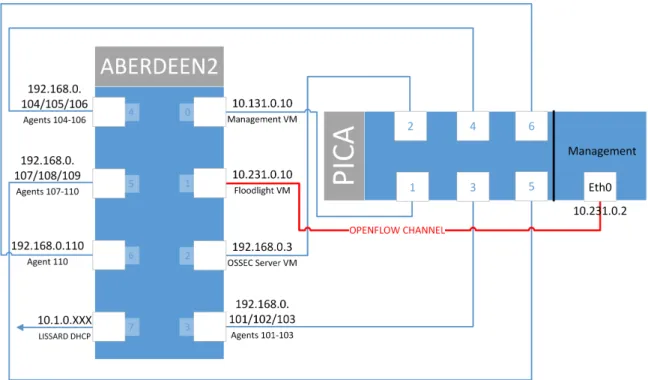
Figure 9 displays a simplified network diagram of all components described in the AHNSR design: SDN controller, OSSEC server, switches, and workstation agents. The boundaries are limited to these components, and do not include other services normally present in an enterprise network. However, as discussed later in Chapter 4, the test network does attempt to more accurately represent a real-world network by utilizing physical switches instead of virtual switches. Therefore, all Ethernet communication (including OpenFlow) between any two hosts are physically trans-mitted through independent network interface cards instead of residing within the same virtual bridge.
Figure 10 provides a high-level view of the AHNSR system, describing the inter-action between each component. The process follows this cycle:
Figure 9. Network diagram of AHNSR components
1. Individual agents register and connect with the OSSEC server during deploy-ment/configuration in a Software-Defined Network. While connected, OSSEC continually monitors the agents using multi-log analysis, rootkit detection, and file integrity checking. Based on rule-sets and threshold levels that represent the enterprise IT policy, security alerts are generated when an event occurs on any monitored agent.
2. The OSSEC server decodes, analyzes, and determines the appropriate active response to protect the network.
3. A custom active-response script then interacts with a secure REpresentational State Transfer (REST) API of the SDN controller in order to request flow entries be pushed to network switches.
4. The SDN controller then communicates via OpenFlow channels to the physical switches
5. These switches, in turn, accept the flow tables updates which ultimately isolate, block, or redirect traffic.
Figure 10. AHNSR system design
3.3 SDN Controller
The SDN controller is implemented using the master branch of open-source Flood-light project (commits made up to 23 September 2016), using a Java 1.8 compatible update. Figure 11 shows the relationship among the Floodlight controller, the ap-plications built as Java modules within Floodlight, and the apap-plications built over
the Floodlight REST API [7]. Internally, the Floodlight controller contains a set of common functionalities that control and inquire about an OpenFlow network, while applications on top of it utilize different features to solve user needs throughout the network.
Figure 11. Floodlight architecture and module interaction [7]
Upon execution, Floodlight and its set of Java module applications (those loaded in the Floodlight properties file) begin their services. The REST APIs exposed by
all running modules are available via the specified REST port (8080 and 8081 for HTTP/HTTPS, respectively). These modules allow the normally-abstracted OSSEC server to also function as a pseudo-REST application, and can retrieve information by invoking services through JavaScript Object Notation (JSON) constructed com-mands/requests sent to the controller REST port via HTTP/HTTPS. This request is demonstrated in Section 3.4.4, OSSEC’s SDN response.
This research selectively utilizes Floodlight’s StaticFlowEntryPusher, ACL
(Ac-cess Control List) andFirewall Java module applications. These modules allow the
AHNSR system to control flows at a very fine level, bypassing some limitations in previous related work. For example, active malicious connections can be immediately terminated by forcing the switch to create a new static flow, consequentially dropping those packets. However, these modules operate differently – the Firewall module uses reactive flow entries while the ACL and Static Flow Entry modules use proactive flow entries.
3.3.1 Reactive/Proactive Flow Entry.
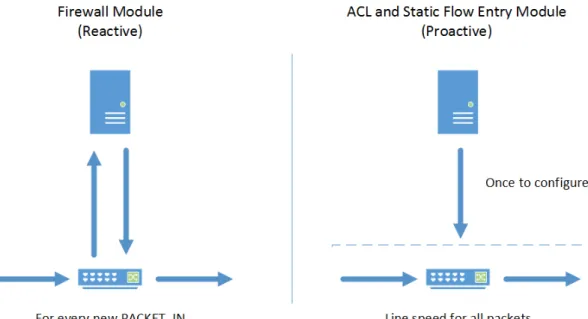
Figure 12 illustrates the difference between reactive and proactive operations. The Firewall module is designed reactively, meaning the switch must ask the controller how to handle new packets. After receiving the switch’s OpenFlow PACKET IN message, the controller triggers the Firewall module. This module operates by comparing each incoming PACKET IN message against its pre-configured allow/deny list from the highest priority until either a match is found or the list is exhausted. If a match is found, the rule’s action (ALLOW or DENY) is stored in a IRoutingDecision object to be passed on to the rest of the packet-in processing pipeline, which normally ends with the default Forwarding module. The forwarding module then reactively inserts flows in switches, effectively routing packets from the source to its destination.
Figure 12. Reactive vs. proactive Floodlight modules
Alternatively, proactive flow entries are sent by the controller before the switch
handles incoming packets. This requires a single OpenFlow FLOW MOD message – then all subsequent matching flows are automatically forwarded at line speed.
Both reactive and proactive methods are used in this research as they are inde-pendently executed by the Java application modules.
3.4 OSSEC Configuration
OSSEC is installed in a server/agent architecture, where agents communicate with a server for centralized analysis. The server and Linux agents are running OSSEC’s pre-release of version 2.9 (v2.9.0 RC3), while the Windows workstations are running OSSEC version 2.8.3 (the latest version available for Windows clients). Figure 13 provides a high-level view of the agent/server log flow and the various processes handling each action:
1. Agents are responsible for log collecting using the ossec-logcollector process.
messages encrypted with the blowfish algorithm and compressed using zlib [48].
This network communication is handled by the agentd and remoted processes,
located agent-side and server-side respectively.
2. The server’s ossec-analysisd process decodes the log using regex parameters,
determines the format, then matches it to any defined rules.
3. The server’s ossec-dbd process is responsible for storing alerts into a database,
while theossec-execd process executes any active-response actions that may be
necessary for the corresponding alert.
Figure 13. OSSEC log flow in a server/agent architecture
3.4.1 Agents.
Since the agents are responsible for monitoring log files, the experiment uses a simplified, consolidated adaptation to simulate security events logged to various places
on the workstation. During configuration, an empty plain-text file is created on
each agent, representing a no-noise syslog file. In order to have each agent’s
ossec-logcollector process actively monitor the experimentation log, this research includes a localfile element pointing to the local experimentation log. The format is specified as syslog – a generic format which parses one log per line.
3.4.2 Decoder/Rules.
Log rules are stored internally on the server in an eXtensible Markup Language (XML) tree structure, independent of the initial log format. For AHNSR experiments, this research constructs a custom decoder and ruleset to simulate security events by
adding the following construct to /var/ossec/etc/decoder.xml on the OSSEC server:
1 <decoder name="experiment1">
2 <prematch>^experiment1</prematch>
3 </decoder>
4 <decoder name="experiment-alert">
5 <parent>experiment1</parent>
6 <regex offset="after_parent">^an event occurred. LEVEL=(\d+)
ID=(\d+)</regex>
7 <order>extra_data, id</order>
8 </decoder>
This decoder successfully consumes any logs with the pattern “experiment1: an event occurred. LEVEL=# ID=#” Decoders provide a way to extract field data from the message to be used in context - this decoder utilizes this by extracting the
level information and storing it as extra data variable. The fields are described as
follows:
• Level: This is a threat severity level index used internally in the OSSEC IDS framework. Every rule is classified from the lowest threat (00) to the maximum level (15). The descriptions for each level are provided in Appendix M.
• Log ID: This is the log ID generated by the agents when they write a new line to the log file. It is used for message tracking during the tests.
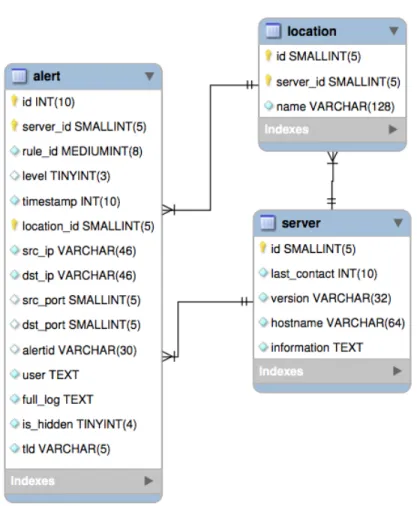
• Alert ID: This is a unique identifier assigned by OSSEC for every alert it generates. The number also acts as the primary key for the alert database described in Section 3.4.5.
![Figure 3. SDN components [1]](https://thumb-us.123doks.com/thumbv2/123dok_us/441777.2551102/30.918.215.704.219.656/figure-sdn-components.webp)