Documento de Trabajo
ISSN (edición impresa) 0716-7334 ISSN (edición electrónica) 0717-7593The Macroeconomics of Capital
Inflows: Some Recent
Experiences.
Vittorio Corbo
Leonardo Hernández
Nº 164
Diciembre 1993www.economia.puc.cl
ISSN:0716-7334
PONTIFICIA UNIVERSIDAD CATOLICA DE CHILE INSTITUTO DE ECONOMIA
Oficina de Publicaciones
Casilla 274 - V, Correo 21, Santiago
THE MACROECONOMICS OF CAPITAL INFLOWS: SOME RECENT EXPERIENCES*
Vittorio Corbo** Leonardo Hernández*** Documento de Trabajo Nº 164 Diciembre, 1993
* This is an extended version of a previous paper by the authors, which was specially prepared for presentation at a conference on portfolio investment in developing countries, organized by The World Bank. (See Corbo and Hernandez, 1993).
The opinions expressed in this paper are those of the authors and do not necessarily represent those of the World Bank or its Board of Directors.
** Professor of Economics, Catholic University of Chile
ABSTRACT
In recent years capital inflows to some developing countries have increased sharply. In fact the return of capital inflows so soon after the debt crisis has surprised many observers. This increase in capital inflows has provided much needed financing to increase the use of existing capacity and to increase investment levels. However, capital inflows can have their own problems. They can increase inflation and result in a real exchange rate appreciation. In this paper we review the macroeconomic repercussions of an increase in capital inflows. In general, it will result in a real exchange rate appreciation, a larger non-tradable sector, a smaller non-tradable sector, and a larger trade deficit. In a fixed exchange rate regime it will result also in an acceleration of inflation and in an accumulation of foreign reserves. We then discuss if there is a role for government intervention to minimize the effects and the size of the real exchange rate appreciation. The paper discusses the different mechanisms that can be used to limit the real exchange rate appreciation and the difference in this respect between portfolio investment and external debt. Finally, the paper reviews and compares the recent experiences of four Latin American countries and five ASEAN countries, and discusses how they have dealt with the macroeconomic side effects of capital inflows.
MACROECONOMIC ADJUSTMENT TO CAPITAL INFLOWS 1
1. INTRODUCTION
The debt crisis of 1982 was precipitated by a sudden reduction in capital inflows at a time when the highly indebted developing countries were facing a slow down of the world economy, a large increase in international interest rates, and a sharp loss in terms of trade. Weak economic policies and institutions exacerbated the effects of these shocks. Under these circumstances, the sharp cut-off of capital inflows forced a quick and sharp increase in the size of the net external transfer. In the short run, the increase in the external transfer took the form of a sharp reduction of imports with negative effects on economic activity, investment rates and future growth.
After the initial shock, most highly indebted countries occupied the rest of the decade adjusting their policies and institutions to the new scenario of a much more restricted availability of external financing. This adjustment process was intended to restore a sustainable balance of payments situation, while creating the basis for sustainable growth. Some countries had even the expectation of an eventual return to international capital markets, but this time to reduce their exposure to external shocks they wanted to rely less on debt and more on direct foreign investment and portfolio investment.
In the initial years following the debt crisis, most of the lending to developing countries took the form of official lending from International Financial Institutions. This lending supported reforms of policies and institutions to create the appropriate conditions to reestablish the macroeconomic balances and to lay the foundations for sustainable growth. In recent years private capital inflows towards countries that have advanced in their adjustment efforts have increased sharply. These inflows have taken the form of a combination of commercial lending from banks and suppliers, direct foreign investment, and portfolio capital. In fact, total private capital flows to developing countries are estimated to have increased from an average value of 67 billion dollars in the period 1982-88 to 95.2 billion dollars for the period 1989-92. Within the latter period they reached 130.4 billion dollars in 19921. The Portfolio Investment component increased
from 6.2 billion dollars in 1987 to 37.2 billion dollars in 1992, and reached 26.9 billion dollars in the first half of 1993 alone2. The direct foreign investment (DFI) component of capital flows
increased from and average of 13.3 billion dollars in the period 1982-88 to 39.3 billion dollars in 1992. There has been much interest in attracting DFI for its positive effect on access to new technologies and markets, as well as for the pro-cyclical character of dividend payments. For the case of portfolio investment the interest has arisen from the possibility of providing risk capital financing for the expansion of the private sector. The repatriation of the capital that had flown out of these countries in the early 1980s have financed part of these capital inflows.
1 World Economic Outlook, IMF, October 1993, Table 15. 2 Sudarshan Gooptu (1993) and John Williamson (1993).
2 DOCUMENTO DE TRABAJO Nº 164
The increase in DFI has been encouraged through a combination of the removal of restrictions, credible tax rules, and macroeconomic stability. A host of structural reforms implemented by developing countries have encouraged DFI by improving the business environment and decreasing the risk associated to this type of investment.
The increase in capital inflows that comes only a few years after the debt crisis is beneficial for the host countries because it relaxes the severe financial constraint that they faced during much of the 1980s. Also this new spell of capital inflows is different from the capital inflows that occurred in the late 1970's and early 1980's, because now the resources are going to the private sector and they are not in the form of mostly debt instruments.
With the debt crisis so close in time, it appears paradoxical that in the early 1990s there could be a problem of receiving "too much" capital inflows. Nevertheless, the increase in capital inflows to developing countries is a matter of concern because of the macroeconomic and other related effects that capital inflows could have on the recipient countries. Indeed, capital inflows could potentially be a problem if they are of a short term nature and highly volatile. This type of inflows, also called hot money, is usually attracted by some imperfections or policy mistakes that create a large gap between domestic and expected devaluation augmented foreign interest rates. This type of inflows could create undue instability in inflation rates and in the nominal and real exchange rates. If there are imperfections in capital markets and hysterisis type of effects in the export and import competing sectors, or real bankruptcy and reallocation costs, then these fluctuations could have important economic costs.
Not surprisingly, in many countries the economic authorities have tried to discourage hot money by lifting the imperfections that encourage it in the first place, or by controlling the side effects of capital inflows through different types of government intervention. Capital inflows of a more cyclical variety could also create cyclical fluctuations in the real exchange rate. The latter could create difficulties to the tradable sectors and to the overall macroeconomic management. This type of flows creates troubles similar to the traditional Dutch disease problem of a mineral discovery.
In this paper we first review the macroeconomic and other related effects of capital inflows. Second, we try to clarify the paradox mentioned above and discuss the reasons why a country could be concerned about receiving "too much" capital inflows. Third, we analyze the different economic policies that countries can use to deal with the side effects of capital inflows. Fourth, we study the actual way in which nine different developing countries, four Latin American and five ASEAN, have dealt with capital inflows in recent years. Finally, by comparing the actual experiencies of these countries, we draw some conclusions on how to manage capital inflows in order to minimize some of their side effects.
MACROECONOMIC ADJUSTMENT TO CAPITAL INFLOWS 3
2. THE MACROECONOMIC AND OTHER RELATED EFFECTS OF CAPITAL INFLOWS
2.1 The Macroeconomics of Capital Inflows
Capital inflows, by permitting a relaxation of the liquidity constraint facing recipient countries, may reduce domestic interest rates, and result in an increase in the level of domestic expenditures. The increase in private and public expenditures put in motion an economic adjustment process. For the purpose of the analysis suppose that the country produces and consumes three goods: an exportable good, an importable good, and a non-tradable good. Assuming that the terms of trade between the importable and the exportable goods are fixed, these two goods can be grouped into just one good that will be called tradable. Following an expenditure increase (made possible by an inflow of capital) and given a pattern of demand for this two types of goods, part of the increase in expenditures will go into tradable goods and part into non-tradable goods. The increase in expenditures on tradable goods will increase the size of the trade deficit and in this way will help to accommodate directly the capital inflow. If this were all, the adjustment would be easy. The only concern about capital inflows would be on the sustainability of the inflow and on the solvency of the country.
However, this is not all. The increase in the demand for non-tradable goods creates, at the existing relative price between tradable and tradable goods, an excess demand for non-tradable. The excess demand for non-tradable goods will result --independently of the exchange rate regime-- in an increase in the relative price of non-tradable goods; that is, an appreciation of the real exchange rate. The real exchange rate appreciation will, in turn, create incentives for the reallocation of factors from the tradable to the non-tradable sector, and for a switching of expenditures from non-tradable towards tradable goods. The final result is a real appreciation, a larger non-tradable sector, a smaller tradable sector, and a larger trade balance deficit. The real appreciation will occur either through an appreciation of the nominal exchange rate (under a floating exchange rate system), or through an increase in the nominal price of the non-tradable good (in a fixed or preannounced exchange rate system)3.
The real appreciation is the price mechanism at work. The increase in domestic expenditures, resulting from the initial increase in capital inflows, put the whole process in motion, and together with the real appreciation and the demand and supply characteristics for both types of goods, determines the final size of the trade balance deficit. This is the standard macroeconomics of the transfer problem. The same sort of process will be set in motion by an increase in short term borrowing, an increase in official capital, or an increase in direct foreign investment. However, the latter two types of capital inflows are mu ch less reversible and therefore
3 The dynamics of an economy with a floating exchange rate system is different from the one explained in this section, but the final result of a real exchange rate appreciation remains. See Dornbusch (1976) and Calvo and Rodriguez (1977).
4 DOCUMENTO DE TRABAJO Nº 164
the real appreciation will be much less volatile. But still the economic authorities may want to avoid a cyclical appreciation of the real exchange rate. Also a similar adjustment process would result from a mineral discovery or a permanent increase in terms of trade. The only difference is that in the latter case the export good that benefits from the increase in price will end up with an increase in production, while the rest of the tradable sector will lose resources to the expanding export good and to the non-tradable sector. This is the well known "Dutch disease problem" so well analyzed by Corden and Neary (1982) and Corden (1984).
2.2 Other Side Effects of Capital Inflows
There are two other effects related to an increase in capital inflows. First, the larger amount of capital brought into the country will increase the volume of funds being intermediated through the domestic capital markets, and will cause an expansion in the volume of domestic financial assets and liabilities. The size of the inflow may also depend on the credit expansion capacity of the financial system. If financial regulation and supervision is weak, this could be the source of a potential problem. Second, in a fixed or predetermined exchange rate system monetary policy will become less effective.
MACROECONOMIC ADJUSTMENT TO CAPITAL INFLOWS 5
3. WHY SHOULD A GOVERNMENT BE CONCERNED ABOUT AN INCREASE IN
CAPITAL INFLOWS? 3.1 The General Case
There are several reasons why recipient countries could be concerned about a large increase in capital inflows.
First, for those countries with a weak supervision of their financial system the increase in capital inflows could unleash a large expansion in domestic lending, exacerbating moral hazard problems and ultimately resulting in a financial bubble that could eventually lead to a financial crisis.
Second, in countries that have recently reformed their trade policies increasing their integration to the world economy, the real exchange rate appreciation associated to the transfer would erode the profitability of the trade oriented sectors, putting in jeopardy the undergoing trade reform. Reforming the trade regime to reduce the discrimination against exports entails tariff reforms, and an initial real depreciation accompanied from there on by a fairly stable real exchange rate adjusted for fundamentals (Thomas et. al. 1990). For countries that have initiated a trade reform, the real appreciation that goes with the higher expenditures could work at cross purposes with the liberalization of trade, and could eventually result in a loss of credibility on the sustainability of the reforms. The main concern here is on cyclical capital inflows that would result on a real exchange rate misalignment with important real costs. These costs will persist even after the reversal of the initial misalignment.
Third, in countries that are pursuing a stabilization program with a fixed or preannounced nominal exchange rate as an anchor for domestic prices, the authorities could be concerned about the monetization effects of large capital inflows. The expansion in high powered money caused by the larger capital inflows will have inflationary effects through the price of the non-tradable goods.
Fourth, if capital inflows are volatile and/or of a temporary variety, the reversibility of flows can have real adjustment costs that occur because of resource reallocation costs, bankruptcies, hysterisis or other market imperfections. If the capital inflows are considered to have a large temporary component, the country would try to avoid to go through a whole adjustment process to be reversed later on. Reversing an initial adjustment could be quite costly if there are irreversible costs involved. Related to this, for those countries with a more flexible exchange rate system the capital inflows could be the source of excessive volatility in the nominal and real exchange rate. This is particularly relevant for the case of hot money.
Fifth, the intertemporal solvency constraint requires the current account deficit to GDP ratio to be sustainable in the long run. A sharp increase in this ratio could increase the country
6 DOCUMENTO DE TRABAJO Nº 164
risk premium as well as restrict the future access to international capital markets. To avoid this type of problems a country would be interested in having a current account deficit to GDP ratio below a certain level.
Sixth, there is a political economy argument. In many countries the government could be subject to strong political pressure from interest groups in the exportable and import competing sectors, in order to avoid or to limit the size of the real exchange rate appreciation that could result from the capital inflows. In this case a government could be forced to undertake "exchange rate protection" actions.
Finally, in those countries with a fixed or preannounced nominal exchange rate the authorities could be concerned about the monetization effects of large capital inflows and their lack of control on monetary policy. Thus, there could be macroeconomic reasons related to the capacity to conduct monetary policy in countries with limited capacity to conduct fiscal policy. In a fixed exchange rate system with an open capital account and with domestic assets that are close substitutes for foreign assets, the effectiveness of monetary policy is severely impaired (Mundell, 1968).
3.2 What is different about Portfolio Investment?
In the previous section we briefly discussed the potential macroeconomic problems created by capital inflows. However, the previous discussion applies to capital inflows in general as we did not make any distinction among the different types of capital inflows. In this section we look at the particular features of portfolio investment and the specific macro problems related to it. 3.2.1 Volatility
The most outstanding feature of portfolio investment, as opposed to other forms of capital inflows --such as direct foreign investment, borrowing from international financial institutions, or long term bank loans-- is that they present a potential risk of a reversal of flows in a very short term; i.e., the possibility that foreign investors may suddenly decide to leave the country they are investing in. This potential risk of flow-reversal is only comparable to the case of short term bank loans (hot money) and may be very harmful in terms of either a greater exchange rate volatility or a greater interest rate volatility, or both. Furthermore, if the Central Bank lacks the necessary speed of reaction and the stock of international reserves is at a low level, it may cause a balance of payments crisis.
A negative shock --such as a disappointing political development, a sudden decrease in the price of the main exportable good or an increase in the price of the main importable good (i.e., a worsening in the terms of trade), or a change in taxes affecting the returns from these inflows-- may cause a sudden sale of domestic assets by foreign investors to take their money out of the country. Alternatively, they will be willing to keep their investment in place only if a
MACROECONOMIC ADJUSTMENT TO CAPITAL INFLOWS 7
higher return is provided. If that is the case they will react by selling the domestic stocks they are holding and, with the proceeds, will buy foreign currency. This will (initially) cause a fall in the general stock price index and, depending on the exchange rate system, either an increase in domestic interest rates and a loss of international reserves or a depreciation of the exchange rate, or a combination of both.
Under a floating exchange rate system, and if domestic assets are perfect substitutes for foreign assets, a large increase (with overshooting) in the price of the foreign exchange will occur. This will be such that the future expected appreciation of the domestic currency will exactly compensate foreign investors for the difference between the domestic interest rates (that stay at the same initial level) and the higher interest rates they demand after the negative shock occurs4.
Under a fixed exchange rate system, and again assuming perfect substitution between foreign and domestic assets, domestic stock prices will fall, the level of international reserves at the Central Bank will fall, and domestic interest rates will increase as domestic liquidity decreases. The exchange rate will stay the same (as long as the fixed exchange rate policy is credible).
Alternatively, if a favorable shock occurs such that foreign investors want to invest more in the host country, stock prices will increase, and depending on the exchange rate regime either domestic interest rates will drop and the stock of money will increase (under a fixed exchange rate system), or the exchange rate will appreciate up to a point where the expected depreciation compensate foreign investors for the lower expected return they demand after the favorable shock occurs (under a floating exchange rate system).
If foreign and domestic assets (i.e., stocks) are not perfect substitutes, then domestic interest rates may differ from the expected depreciation augmented foreign interest rates. In such a case the adjustment in interest rates (under a fixed exchange rate system) or in the exchange rate (under a floating exchange rate system) will be less severe, although it will follow the same pattern. Thus, if a negative shock occurs in a floating exchange rate system, stock prices will fall and domestic interest rates will increase (under perfect substitution domestic interest rates remain constant). Therefore the exchange rate will overshoot less than in the perfect substitution case. Under a fixed exchange rate system the same negative shock will cause a lower increase in domestic interest rates in the case of imperfect asset substitution than in the case of perfect asset substitution5.
4 In the analysis we are assuming that domestic prices do not adjust immediately, i.e., that commodity markets adjust slower than asset markets. See Dornbusch (1976) and Calvo and Rodríguez (1977).
5 It is important to notice that only in the case when substitution between foreign and domestic assets is less than perfect it is possible for the Central Bank to sterilize capital
8 DOCUMENTO DE TRABAJO Nº 164
All these price movements can be an important source of uncertainty that restrain investors (foreign and domestic) from investing in, and, at the same time, they can be very damaging for the economy as a whole if the fluctuations in interest rates or exchange rates are too wide. The loss for the economy as a whole occurs because of bankruptcies and hysterisis effects when interest rates increase and/or the exchange rate appreciates (the latter applies only for the exportable and import competing sectors).
In order to avoid all these adverse price movements the authority will have to intervene, either by selling or buying foreign currency in a floating exchange rate system, or through sterilization in the case of a fixed exchange rate. Either way the Central Bank will be, somehow, making the functioning of both exchange rate regimes very similar.
3.2.2 Portfolio Investment and Macroeconomic Fluctuations
Another important characteristic of portfolio investment, as opposed to other forms of capital flows such as bank loans, is its behavior during the different phases of the macroeconomic cycle. In fact it has been argued that bank borrowing exa cerbates the cycle because of its pro-cyclical pattern, i.e., banks are willing to lend more during the expansionary and recovery phases of the cycle than during recessions. However, because portfolio investment implies that private gains and losses occur whenever stock prices fluctuate, private investors will restrain from selling (or buying) every time stock prices are "too" low (or "too" high), i.e., they will try to avoid the realization of capital losses. This behavior will result in an endogenous smoothing mechanism of the cycle. Of course this reasoning applies only when domestic and foreign assets are not perfect substitutes.
inflows. This will show to be important later on when we discuss the actual country cases.
MACROECONOMIC ADJUSTMENT TO CAPITAL INFLOWS 9
4. WHAT CAN BE DONE TO DEAL WITH THE SIDE EFFECTS OF CAPITAL
INFLOWS?
Many countries have tried in recent years to gain access to international capital flows while, at the same time, protecting the macroeconomic situation from a large real appreciation and/or an acceleration of inflation. To deal with these potential problems caused by capital inflows countries can use either indirect methods, direct methods, or both. In this section we briefly discuss these methods.
4.1 Direct Methods
If capital inflows, due to their size or composition, are considered to create macroeconomic problems of the type discussed above, and they are motivated by imperfections in the domestic financial markets, countries may try to eliminate the distortion that is causing the capital inflow. The type of distortion that encourage short term capital inflows are, for example, keeping a high domestic interest rate while at the same time offering free currency risk protection through a swap facility at the Central Bank. Also, offering free deposit insurance at domestic commercial banks, along with a high domestic interest rate and a fixed nominal exchange rate, may cause an increase in capital inflows.
Short term speculative capital inflows (hot money) could also result from a restrictive monetary policy that accompany an expansionary fiscal policy. In the latter case changing the policy mix towards a more restrictive fiscal policy and a less restrictive monetary policy, by reducing domestic interest rates to a level closer to the sum of international interest rates and the expected rate of devaluation, i.e., getting closer to the interest rate parity condition, reduces the incentives for capital inflows of the type that respond mainly to interest rate differentials and/or to the expectation of a future drop in domestic interest rates, that is, bank loans and portfolio investment.
If the ultimate cause of the increase in capital inflows could not be dealt with, and the country is concerned with the macroeconomic effects of capital inflows, it could try direct methods to control the size of them. Direct methods consist of imposing restrictions on capital inflows in order to reduce their amount. Measures of this sort include ceilings on foreign borrowing, minimum reserve requirements on foreign loans, ceilings on foreign direct investment, etc. The authorities could also try to reduce the size of the inflows through taxation of the flows through a Tobin's interest rate equalization tax. These measures work only in the short run as it is very difficult to have effective ways to control capital flows in the long run (Mathieson and Rojas, 1993).
10 DOCUMENTO DE TRABAJO Nº 164
4.2 Indirect Methods
Indirect methods comprise the following:
• Intervention, i.e., the purchase of foreign currency by the Central Bank in order to support the nominal exchange rate. This can be of two types: sterilized and non sterilized. In the case of sterilized intervention the Central Bank also carries out open market operations to mope out the liquidity created by the initial purchase of foreign exchange. The sterilization could also be done by imposing other restrictions that work through a reduction in the money multiplier --such as an increase in commercial bank's required reserves or a ceiling in total commercial bank's credit-- that also helps to avoid the monetization effect of the purchase of foreign currency (i.e., limits the increase in the money supply). However, the room in this area is limited by the degree of substitution between foreign and domestic assets. In a fixed exchange rate or preannounced nominal exchange rate regime ("tablita"), the more open is the capital account and the higher is the degree of substitution between domestic and foreign assets, the less effective is this policy6.
Also this policy usually increases the quasi fiscal deficit of the Central Bank. The increase in the quasi-fiscal deficit of the Central Bank, in turn, will result in an expansion of expenditures and if it is not accompanied by a restrictive macroeconomic policy would result in a real appreciation, working at cross purposes with the original objective of avoiding a real appreciation.
In countries with a level of output close to the potential output, non sterilized intervention is usually implemented with another policy aimed at restricting aggregate demand. • Fiscal Adjustment. A restrictive fiscal policy is intended to have a macro effect and a composition effect. The first effect (ceteris paribus) attempts to counteract for the increase in aggregate demand that is created by the capital inflows. The second effect helps to keep a higher real exchange rate than otherwise, as government consumption is most likely more intensive in non-tradable goods than private expenditures.
• Current Account Liberalization. The liberalization of the Current Account helps to easy the pressure on the domestic economy by shifting consumption towards tradable (i.e., importable and exportable) goods. Like a restrictive fiscal policy it has a composition effect and helps to keep a higher real exchange rate than otherwise.
6 For a recent review of the basic economics of capital inflows in a IS-LM framework see Frankel (1993), for a recent review of Central Bank intervention see Edison (1993), and for a recent review of the policy issues associated to capital inflows see Calvo et. al (1993).
MACROECONOMIC ADJUSTMENT TO CAPITAL INFLOWS 11
• Capital Outflow Liberalization. The liberalization of capital outflows may induce domestic investors, such as pension funds, to take their capital abroad. This may partially compensate for the effects of capital inflows7.
• Move towards a basket of currencies and/or a floating exchange rate system. By moving to pegging to a basket of currencies or closer to a floating exchange rate regime, such as widening the band in a target zone exchange rate system, the exchange rate risk faced by market participants increases. Therefore, there will be less interest in bringing short term capital inflows.
4.3 Dealing with Volatility
The previous discussion refers to policies concerning the real exchange rate and inflation problems. In what follows we briefly discuss some potential policy measures to deal with the volatility associated to portfolio investment.
• Restricting capital outflows. The purpose of this policy is to reduce the risk of a flow reversal by limiting the amount of capital that foreign investors are allowed to take out of the country within a certain period of time. Although this policy can be quite effective in reducing the potential damage of a sudden capital outflow, it is also very likely to reduce the amount of portfolio investment in the first place, limiting the economic benefits of having access to foreign financing8.
• Lifting all restrictions on capital outflows. Given the previous result, one alternative policy is to allow domestic residents to invest in all kinds of foreign assets with no restrictions. This will have two different effects: first, as foreign investors will visualize the host country as less ris ky (in terms of a lower probability of getting stuck in it) it may increase the amount of capital inflows; second, as domestic assets will be better diversified internationally, the effects of a negative shock will be less severe in the first place. Overall, this policy may reduce the probability of a flow reversal.
• Opening the current account. A reasoning similar to the one in the previous paragraph implies that the opening of the current account may be useful in limiting the effects on the host country of a negative shock. The opening of the current account will usually mean that the host
7 This is an ambiguous result. In some models a liberalization of capital outflows cause a larger capital inflow. See Laban and Larrain (1993).
12 DOCUMENTO DE TRABAJO Nº 164
country's real assets will be more diversified. Therefore, the economy as a whole will be less affected by a negative shock affecting an specific productive sector.
• Maintaining a long-term fiscal and monetary targets. It should be clear at this point that the final purpose of any potential policy measure to deal with capital inflows should be to build an economy more resilient to external shocks, such that foreign investors do not want to leave the country when a negative shock occurs. In this respect having some fiscal flexibility is a necessary requirement in order to provide assurance that unexpected inflation will not be a way of financing government deficits. In parallel, monetary policy should also be geared towards the objective of generating low inflation. Ultimately, keeping an appropriate level of international reserves will help to deal with short term fluctuations in capital flows. It is also important to notice that holding more reserves and maintaining fiscal and monetary discipline helps not only because of the better shock absorber capacity of the economy, but also because of the "signaling" or "reputation effect" on foreign investors.
• Having greater flexibility. One useful policy tool which helps to build a stronger shock resistant economy, is to have a greater discretion in terms of forcing the allocation of resources in some specific uses. For example, forcing the investment of private savings -such as pension funds- in Central Bank's bonds (or in foreign assets), may help to sterilize the expansion in high powered money caused by a sudden capital inflow. Alternatively, a sudden capital outflow that heavily reduces the amount of (domestic) money may be compensated by forcing domestic institutional investors to hold less Central Bank's bonds. The latter has to be traded off against the advantage of having a less regulated and more competitive financial system.
In sum, dealing with the risk of potential flow reversal of portfolio investment is not a matter of restricting capital outflows, but building shock absorber mechanisms such that the effect of a negative shock to the economy is minimized.
MACROECONOMIC ADJUSTMENT TO CAPITAL INFLOWS 13
5. DEALING WITH CAPITAL INFLOWS: SOME RECENT COUNTRY EXPERIENCES
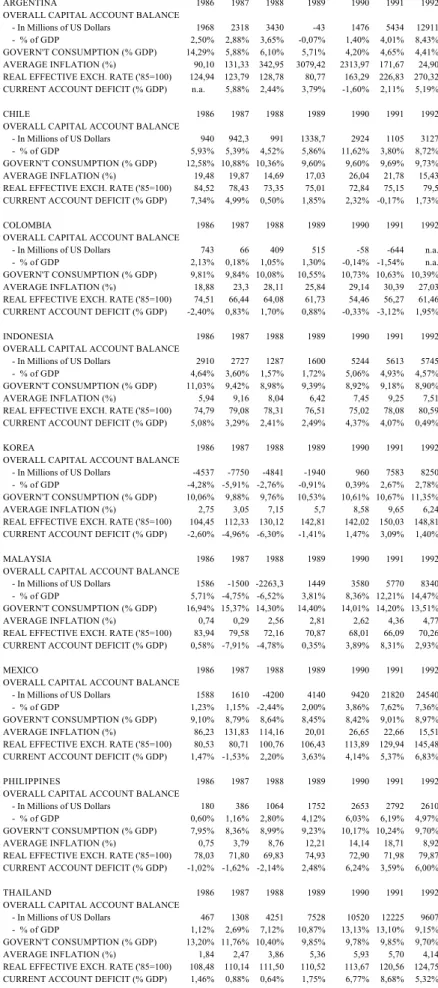
As capital inflows towards some developing countries resumed in the late 1980s and early 1990s, countries implemented different policies to deal with some of the potential macroeconomic problems created by these inflows and that we already discussed in the previous sections. In this section we review some specific country experiences. Tables 1 to 9 at the end of the paper present macroeconomic indicators and Balance of Payments statistics for each of the countries considered in this section.
5.1 Argentina
a) Background
Argentina, as the other countries analyzed in this paper, has received large amounts of capital inflows during the past two years. In fact it appears as the third largest recipient of portfolio investment flows among all Latin American countries during 1989-June 1993, after Mexico and Brazil. The cummulative portfolio investment flows to Argentina during this period have been larger than those to Venezuela and Chile9. However, the main difference between
Argentina and the other two countries is the pattern shown by the portfolio investment flows. In the case of Argentina the flows have occurred only in the last two years as they were almost negligible before 1991, while in the cases of Venezuela and Chile the portfolio capital inflows have occurred since 1989.
One potential reason that explains the different pattern followed by portfolio capital inflows in the three countries is that until very recently Argentina was suffering from a chronic fiscal deficit, hyperinflation and very poor economic growth10. In fact Argentina has been suffering slow economic growth since the 1940's and the 1980's was the longest stagnation period for the country during this century.
Several reasons explain the economic developments in Argentina during the past decade. First, during several decades economic policy in Argentina was used to favor different private groups with access to power. Consequently, a very distortive tax system with tax exemptions and subsidies of all kinds was built over the years. It is estimated that different tax exemptions and subsidies accounted for as high as 6% of GDP in 1987 and reached 8% of GDP in 198911. Second, the increase in foreign lending to developing countries during the 1970's allowed
9 See Gooptu (1993).
10 Annual GDP growth has been +2.6%; -1.9%; -6.2%; +0.06%; +8.9% and +8.7% in 1987, 1988, 1989, 1990, 1991 and 1992, respectively..
14 DOCUMENTO DE TRABAJO Nº 164
Argentina to run a fiscal deficit and to accumulate a large stock of foreign debt. The external borrowing also financed the capital flight that took place in the early eighties. The abrupt end to voluntary lending and the increase in international interest rates in the early eighties was the source of a severe crisis and a financial collapse in Argentina, which forced the Central Bank to takeover the failing financial institutions and to assume all foreign debt. In the end this worsened even more the already deteriorated overall public sector deficit. Third, tax collection was very low because of a poor enforcement of the tax law and a poor management of the Tax Administration Agency. This problem aggravated as inflation increased because of the related Olivera-Tanzi effect12. Tax revenues were as low as 13.5 percent of GDP in 198913. Fourth, the country got involved in the South Atlantic War against the U.K. in the early 1980's.
Overall, until very recently and for more than a decade inflation in Argentina has been persistently high (hyperinflation in 1989-90; see table 1). This was the result of a permanent fiscal deficit which had become entrenched in the system. Although a number of Ministers of Finance started their mandate with the stated purpose of reducing this deficit, political economy factors made the deficit reduction almost impossible. In fact the overall public sector deficit during 1983-89 was always higher than 5 percent of GDP. The failure of the Argentine government to achieve a balanced budget is the main reason why the first four stabilization programs implemented in Argentina after the country returned to a constitutional democratic regime in 1983 failed. As a consequence of the increasing inflation the stock of domestic financial assets held by the Argentine private sector became smaller as savings and financial investment were shifted abroad and into dollar denominated assets. By end-1990 the stocks of M1 and M2 in Argentina, measured in real terms, were 54% and 42% of their end-1985 levels, respectively. In terms of GDP M1 fell from 8.3% in end-1980 to less than 3% in end-1989. The demonetization of the Argentine economy increased the level of inflation for a given size of the public sector deficit, as it continuosly eroded the base for the inflation tax.
b) The Menem Administration
The current administration that took office in July 1989 has led the country into a new period of economic growth and low inflation. This has been achieved after a profound transformation of the economy which comprises major structural reforms to the Federal Government, the Central Bank, Public Enterprises, the tax system and both, the foreign exchange and foreign trade regimes.
12 In an inflationary economy the real value of tax revenues decreases in proportion to the inflation rate because of the lag between the date taxes are due and the date they are effectively collected. This is known as the Olivera-Tanzi effect. In a highly inflationary economy tax payers will tend to delay paying their taxes in spite of penalties because of this effect.
MACROECONOMIC ADJUSTMENT TO CAPITAL INFLOWS 15
The Menem administration inherited a large public sector with weak institutions, poorly managed non-profitable public enterprises, a large foreign and domestic debt, and a Central Bank with a running deficit of almost 6% of GDP (in 1989). In other words, the overall public sector at the time the Menem administration took office was insolvent.
The economic reform implemented by the Menem administration has been extremely profound and has proceeded very fast. Among the most significant and structural reforms are the following:
• In January 1990 the Central Bank forced the conversion of its short term interest bearing obligations with the public, mostly seven days maturity bills, into long term bonds with ten years maturity denominated in dollars. This step alone reduced the quasi fiscal deficit of the Central Bank in almost 4 percentage points of GDP.
• A major restructuring of the tax system, with more reliance on the VAT and an improvement in tax administration. This reform, together with the Olivera-Tanzi effect associated to the reduction of inflation, has enabled the government to increase its tax revenues in almost 8 percentage points of GDP, from 16.3% of GDP in 1989 to 23.8% of GDP in 1992.
• An administrative reform to reduce the size and the scope of the federal government and to improve the control mechanisms of public expenditures. As a result of this reform total employment in the federal government has fallen by more than 50% between 1990 and 1992, net federal expenditure fell 4 percentage points of GDP between 1989 and 1992, and the primary surplus of the public sector became positive for the first time in many years in 1991 (0.4% of GDP)14. As part of this reform the subsidies for industrial promotion purposes have been
severely cut.
• A major privatization program started in 1990 with the sale of the National Telecommunications Company in November of that year. Major privatizations have included the National Airline Company, TV stations, oil and oil related companies, electric companies, utilities and seaports. Since it began in 1990 the privatization program has allowed the government to receive almost six billion dollars in cash and to reduce its foreign debt by approximately 12 billion dollars15. The privatization of non profitable enterprises also improves the fiscal accounts because the government stop covering the losses of the privatized firms.
• In April 1991 the Government enacted the Law of Convertibility as an attempt to accelerate the stabilization process. Under this new exchange rate regime the nominal exchange rate is used as an anchor for the domestic price level. The law fully guarantees convertibility of
14 Total employment in the national administration fell from 671,479 in 1990 to 284,215 in 1992. Net federal expenditure fell from 28.7% of GDP in 1989 to 24.8% of GDP in 1992.
16 DOCUMENTO DE TRABAJO Nº 164
the local currency at a constant nominal rate of 1.00 A$/US$ and proscribes money creation except for the purchase of foreign assets. As a result the stock of high power money has to be fully covered by foreign assets.
• In September 1992 a new Central Bank law was enacted that makes it independent of the non financial public sector . The new Central Bank Charter prohibits lending to the non financial public sector and proscribes rediscounts (although in the latter case some special exceptions apply).
• In 1991 the government accelerated and completed a trade liberalization program that virtually eliminated all export taxes and all quantitative constraints to trade, except for automobiles. Also the maximum tariff on imports was reduced from 115% to 35%. Later on this was further reduced to a range between 0% and 20%.
c) The Results
The stabilization program implemented by the Menem administration has been very successful in reducing domestic inflation. In fact the average monthly inflation rate since the convertibility plan started in April 1991 has been 1.7%, while in 1989 it was 38% (again on a monthly basis). As a result of the lower inflation rate the stock of domestic financial assets has increased16 and the stock of foreign reserves at the Central Bank is at a very high level that covers the monetary base. In terms of economic growth the stabilization program has also been a success as the country began growing again at very high rates. Also, the privatization program has been the main reason why the country has been receiving large amounts of capital inflows. It is estimated that two thirds of all foreign capital entering Argentina in 1992 was due to privatizations17.
In terms of the real exchange rate the result has been a real appreciation of approximately 16% since the convertibility plan began in April 1991. However, the real exchange rate has been appreciating systematically for the last three years as a result of using the nominal exchange rate as an anchor for domestic prices in the current and previous stabilization plans.
In spite of all the favorable results mentioned above, it is still too early to claim that the stabilization program has been a complete success. In fact the final fiscal package that allowed the country to achieve price stability is as recent as February 1991 and the convertibility plan was implemented only in July 1991. Also several structural reforms are still undergoing and some important problems remain unsolved. The government remains highly indebted both domestically
16 M1 and M2, both measured in real terms, grew by 100% and 75% between 1990 and 1992. 17 Source: "Situacion Latinoamericana", N° 13, February 1993.
MACROECONOMIC ADJUSTMENT TO CAPITAL INFLOWS 17
and abroad and these obligations will deteriorate the fiscal budget in the next years. In fact, as part of the stabilization plan the government has been issuing public debt to postpone payments on the pension system and to suppliers of goods and services already provided to the government. Also, major reforms in the social security system, defense, and the national health insurance system will require increases in government expenditures in the future.
Although a major effort has been made in terms of both, increasing tax revenues and cutting expenditures at the federal government level, overall public expenditures have not fallen mainly because of an increase in transfers to the provinces and in expenditures at the provincial level. Also the privatization of public enterprises, transitory by nature, has allowed the government to receive extraordinary cash flows that have help to balance its budget in the past two years. In addition to the latter the increase in foreign savings has been partially compensated by a fall in domestic private savings. Overall, a significant effort in cutting public expenditures remains to be done, particularly at the provincial level.
Because some of the most important reforms have been enacted by law, there is a little chance of a major reversal in terms of the inflation rate. However, the fiscal situation remains fragile and any adverse shock such as a slowdown in economic growth, an increase in interest rates or the lack of a permanent source of external financing (a decreased interest of foreign investors to invest in Argentina) may force the Argentine economy into a crisis. This would occur because of the fixed exchange rate system and the remaining inflexibilities in the domestic labor market.
An important problem currently facing policy makers in Argentina is the highly appreciated real exchange rate. The latter has been recognized by the public and the government as one weakness of the current economic regime. In fact in October 1992 the government attempted to compensate the export and import competing sectors for the real exchange rate appreciation, by increasing in five percentage points the tax rebate allowed to exporters and in seven percentage points the flat tariff surcharge applied to imports. However this was interpreted by the public as a partial failure of the economic reforms and caused a run against the Argentine peso that forced the Central Bank to sell more than 300 million dollars in three days.
Overall, given the scope and the purpose of this paper it is extremely difficult to evaluate the outcome observed in Argentina, mainly because of the existing economic environment prior to the stabilization program. The existing conditions in Argentina during 1988-89 were completely different than those in Chile or Korea. In fact the appreciation of the real exchange rate in Argentina is more related to inflation inertia and the use of the nominal exchange rate as an anchor for domestic prices, than to the increase in aggregate domestic expenditures that is financed with the increased capital inflows, which is the case we are concerned with in this paper. Nevertheless it is still possible to argue that a more restrictive fiscal policy, specially at the provincial level, is required in Argentina. This is particularly true considering the increase in
18 DOCUMENTO DE TRABAJO Nº 164
private investment that is expected to occur in the future as the privatized firms will update their technologies.
From the review of this case study it is clear that Argentina decided not to use sterilized intervention, allowing the domestic interest rates to become aligned with the expected devaluation adjusted foreign interest rates. As the exchange rate has been kept fixed to the US dollar since the initiation of the convertibility program, the 'peso problem' has resulted in domestic interest rates above international levels without a mayor increase in short term capital inflows. However, the much improved prospects for the Argentina's economy has encouraged portfolio investment which through asset price revaluation has fueled an expenditure boom and a real appreciation. However, the real appreciation could also be due in part to the use of a fixed exchange rate as a nominal anchor for the price level in an economy that still had inflation inertia following 50 years of high inflation.
5.2 Chile
a) Introduction
The Chilean economy is today the fastest growing economy in Latin America. A host of structural reforms were introduced in Chile in the period 1973-1992. The main purpose of these reforms has been to restore the basic macroeconomic balances, to increase the role of markets in the production and distribution of goods and services, to open the economy to foreign trade, and to give an increasing participation to the private sector in the economy18.
What makes the Chilean economic performance more remarkable is that in the early 1970s and in the early 1980s Chile experienced two mayor economic crises. However, in between these two crises it initiated a profound structural transformation that was continued after the second crisis. After some confusion in the early years following the second crisis, starting in 1984 the government designed and implemented a comprehensive adjustment program aimed at restoring macroeconomic balances in a situation of restricted access to foreign borrowing. An aggressive devaluation policy was combined with severe monetary and fiscal discipline to achieve a large real depreciation and an increase in the competitiveness of the trade oriented sectors. As a result the real exchange rate depreciated by 89.1% between 1981 and 1986. These policies were also accompanied by periodic decreases in the maximum import tariff level. All this changed incentives drastically in favor of export oriented activities, initiating a period of export-led growth. As the export-export-led growth process gained momentum, large increases in efficiency started to be achieved in the export oriented sectors through improvements in quality control, better marketing and the adaptation and production of new technologies.
18 For a review of the reforms introduced in Chile in the last twenty years, and the causes of the crises, see Corbo (1993), and Corbo and Fischer (1993).
MACROECONOMIC ADJUSTMENT TO CAPITAL INFLOWS 19
Following this adjustment program, Chile entered into a period of export led growth that had lasted well into the 1990s. GDP growth reached 6.3% in 1984, 2.4% in 1985, and 5.7% in 1986. In the same years inflation reached 23.0%, 26.4%, and 17.4%, respectively19. In the meantime the unemployment rate that had reached close to 20% in 1982, without including the workers in the public work programs, was reduced to 10.8%.
In the post 1986 period growth continued. Furthermore, as the debt crisis was left behind, the positive results of the policy reforms of the previous 12 years started to emerge. With the model by now delivering growth above 5% per year and with the unemployment rate coming down rapidly, the public support for the economic policies started to increase. When the new coalition government came to power in March 1990, it kept the general market oriented open economy policies. Its main departure from the policies of the previous government has been on its concern for improving the access to education and health care for the poorest groups in the population. To accomplish this objective the new government early on negotiated a tax reform aimed at raising government revenues in around 2,8% of GDP, to finance a similar increase in expenditures in the social sectors.
As Chile entered a stage of sustainable growth, and as the new democratic government decided to maintain the main trust of the Chilean economic model, the time horizon for good policies was extended. The good prospects resulted in a sharp rise in foreign investment, and the combination of good policies and low interest rates in industrial countries set the stage for a sharp increase in net private debt. As in other countries, in this new setting the capacity to carry out an independent monetary policy was severely curtailed.
Since the mid 1980s the main instrument of monetary policy has been the 90-day real interest rate on Central Bank liabilities20. The real interest rate is adjusted when the level of aggregate demand is resulting in an acceleration of inflation, or in a size of the current account deficit that could lead to an excessive build up of foreign debt, or in a real appreciation that moves the real exchange rate away from its target level. Sometimes these three objectives come into conflict, and the Central Bank implicitly trade off between them21.
19 Year-end inflation.
20 As most financial contracts are indexed to future inflation, Chile can pursue a real interest rate policy . 21 See Corbo and Fischer(1993).
20 DOCUMENTO DE TRABAJO Nº 164
The newly independent Chilean Central Bank has also given a central stage to monetary policy. The bank is implicitly operating with target ranges (or upper limits) for both, the inflation rate and the current account deficit of the Balance of Payments (as a share of GDP), and with a lower limit for the real exchange rate. Of course, monetary policy alone cannot achieve so many objectives (i.e. the inflation rate, the real exchange rate, and the size of the current account deficit). Furthermore, with the increasing integration to world financial markets this type of monetary policy, in the context of a crawling exchange rate regime with a wide band, results in large one sided movements in the exchange rate market or, if the central bank intervenes to mitigate the movements in the exchange rate, in large movements in the level of foreign reserves with high costs in terms of the quasi-fiscal deficit.
These problems manifested very clearly in early 1990 when Chile was experiencing an investment boom, an export boom, a drop in international interest rates, and an acceleration of domestic inflation. To slow down the acceleration of inflation, the newly independent board of the Central Bank increased the 90 day real interest rate on Central Bank's papers in 230 basis points (from 6.9 to 9.2 percent per year) and a corresponding increase in papers of a longer maturity. As a result there was a large increase in capital inflows on top of the large increase on direct foreign investment that was already taking place. To avoid the excessive monetization of these inflows, or a sharp drop in the nominal exchange rate, the Central Bank practiced an aggressive policy of sterilized intervention. As a net result, in 1990 alone the Central Bank ended up accumulating 2.4 billion dollars in foreign reserves. Furthermore, the issuing of Central Bank debt to carry out the sterilization resulted in large losses for the Central Bank as it borrowed at high domestic interest rates to invest abroad at lower rates (adjusted for exchange rate changes)22.
As the level of foreign reserves increased sharply, the country risk decreased and as a consequence the ability to carry out an independent monetary policy geared to control aggregate demand was further reduced. In these circumstances short term macroeconomic management should have relied more on fiscal policy.
b) Policies to deal with the macroeconomic effects of capital inflows
The sharp increase in domestic interest rates, together with the increase in direct foreign investment and in long term capital inflows associated with the direct foreign investment, resulted in a large surplus in the capital account of the Balance of Payments. As the government was interested in avoiding a sharp real exchange rate appreciation, it opted for defending the exchange rate through massive sterilized intervention.
MACROECONOMIC ADJUSTMENT TO CAPITAL INFLOWS 21
As the Central Bank debt carried an interest rate much above the devaluation adjusted interest rate earned on Central Bank's holdings of foreign reserves, this policy resulted in an increase in the quasi-fiscal deficit of the Central Bank.
Furthermore, as reserves were accumulating while the current account of the Balance of Payments was showing a surplus and the interest rates in the U.S. started to decrease, the peso value of the dollar (through arbitrage) descended towards the lower bound of the exchange rate band. As a result it became each time more difficult and costly to pursue an independent monetary policy. Not willing to give up its monetary policy, in June 1991 the Central Bank started to accommodate a real appreciation and to take a set of actions to reduce capital inflows.
In June 1991 the central value of the exchange rate band was appreciated by 2%, a stamp tax was imposed on capital inflows, and minimum reserve requirements were imposed on short term (less than one year) foreign credits. At the same time a reduction from 15% to 11% in the maximum import tariff was approved. Then in January 1992, as it became increasingly difficult and costly to affect the trajectory of the nominal exchange rate through sterilization, the peso was revalued 5% and the width of the exchange rate band was increased from ±5% to ±10%. The first part of the measure was meant to "accept" a minor revaluation, and the second to increase the exchange rate risk and in this way to reduce the profitability of domestic bonds for foreign investors. At the same time the reserve requirements on foreign credit was extended to foreign currency bank deposits.
As the central bank continued its policy of increasing the domestic interest rate to control aggregate demand and inflation, these measures were not enough to discourage capital inflows. Then, to increase the exchange rate risk, in March 1992 the Central Bank announced that beginning that date it was going to intervene in the foreign exchange market even if the price of the dollar was well within the exchange rate band.
In May 1992 the reserve requirements on foreign credit was increased to 30%. The only exception was made for capital inflows with a maturity period longer than one year that were registered with the Central Bank under article 14 of the foreign exchange regulation. For the latter type of inflows the reserve requirement was set at 20%. In July 1992 the Central Bank modified the exchange rate mechanism. The peg was changed from the US dollar to a basket of currencies, retaining the size of the band around the central rate. The purpose of this measure was again to increase the uncertainty with respect to the evolution of the exchange rate. In August 1992 the reserve requirements on capital inflows that entered under article 14 of the foreign exchange law was also raised to 30%.
Finally, starting in 1992 a selective deregulation of capital outflows was introduced to give some breathing space to the expensive policy of reserve accumulation.
22 DOCUMENTO DE TRABAJO Nº 164
c) The Results
The Chilean experience with intervention reveals two main lessons. First, in the presence of an increasing integration to international capital markets even with an exchange rate band it becomes very difficult to pursue a restrictive monetary policy. The sharp increase in short term capital inflows makes this policy difficult to sustain. Second, when there is a sharp increase in capital inflows of the DFI type some real appreciation has to develop, and this is just the mechanism to allow the transfer of resources to materialize. Thus, in spite of the many attempts to minimize the size of the real appreciation, the real exchange rate appreciated 13.3% between the last quarter of 1990 and the third quarter of 1993.
5.3 Colombia
a) Introduction
Colombia's economic developments for the last two decades have been much affected by the coffee cycle, world economic conditions, and changes in domestic policies.
From 1967 to 1975 Colombia pursued a policy of stable real exchange rate and fiscal discipline. During this period GDP growth averaged 6.3% per year, and inflation averaged 17.4% per year. At the same time export earnings grew at an annual average rate of 18.1%, dominated by a strong development of non-coffee exports. The coffee boom of the period 1975-1978 led to a large increase in expenditures, a real appreciation and an acceleration of inflation. However, Colomb ia avoided the sharp increase in foreign debt of many other developing countries, and even accumulated foreign reserves and reduced its foreign debt during the coffee boom23. As a result, when the coffee boom ended in 1978 Colombia was left with low foreign debt. However, in 1979 Colombia initiated a public investment program as an aggregate demand policy to compensate for the drop in demand that followed the drop in coffee price. This typical counter cyclical policy led to a surge in foreign borrowing.
When coffee prices collapsed in 1981, the intensity of the counter cyclical policies was accelerated through expansionary fiscal and monetary policies. As a result the current account deficit started to increase and inflation accelerated. The growth of non-coffee exports slowed further as a result of the real exchange rate appreciation and the slow down in the world economy. The deficit in the current account of the balance of payments went from a small deficit in 1980 to a deficit close to 11% of GDP in 1983. Inflation accelerated to 24.6% per annum. As in Mexico, the rising current account deficit was faced early on with a progressive tightening of import restrictions. The latter acted as an export tax further to the slow down of export earnings. In the
23 In general the administration of commodity booms in Colombia has been much more prudent than in other countries (Corden,1990).
MACROECONOMIC ADJUSTMENT TO CAPITAL INFLOWS 23
period 1980-1983 the dollar value of exports decreased at an annual rate of 3.6% per year. GDP growth in the period 1980-1983 averaged only 1.6% per annum.
When the international debt crisis emerged in the second half of 1982, Colombia's access to international capital markets was reduced and foreign reserves were down, but the counter cyclical policies were intensified to compensate now for the slow down of the world economy. With a growing public sector deficit and reduced access to international capital markets, the policy had to be corrected towards 1985 with a fairly orthodox stabilization program, involving a large fiscal adjustment and a substantial depreciation.
The program was quite successful and by 1986 the current account achieved a surplus. However, inflation accelerated in the period following the large devaluation, increasing continuously from 18.9% in 1986 to 23.3% in 1987, 25.8% in 1989, and 29.1% in 1990. GDP growth reached 4.6% for the period 1986-1990.
In early 1990 the government formulated a medium term strategy aimed at a more radical transformation of the Colombian economy. The major objective of this strategy was to open up the economy to external competition to improve its efficiency, specially in the import competing sectors, to promote the growth of non-traditional exports, and ultimately to achieve sustainable growth. In the new strategy the continuous reduction of inflation is a key intermediate objective to provide an environment conductive to growth. Reforms were introduced in trade, financial, and labor policies, and in public enterprise management and privatization.
Much has been already accomplished in the reforms of the trade regime. Most nontariff barriers were eliminated and the average import tariff was reduced from 43.7% in December 1989 to only 11.7% in March 1992. By most standards this is a profound and rapid trade reform24.
Initially the reform was going to be gradual, but its pace was accelerated when the large surplus in the current account of the balance of payments was resulting in a large accumulation of foreign reserves (Ocampo, 1992). Restrictions on foreign exchange transactions were also liberalized in 1990, lifting the prohibition to have foreign accounts and allowing financial intermediaries to trade in foreign exchange.
The exchange rate system in Colombia is very special. The Central Bank fixes on a daily basis the value at which it buys and sells dollars, but to avoid excessive monetization it does an automatic sterilization by buying dollars and paying them with a one year dollar denominated bond. The price of settlements of these bonds in pesos is fixed by the central bank on a daily basis, but these are prices at the time of maturity of the bond. However, the bonds have a secondary market, and the discount in the market is determined mainly by the interest rate on certificates of deposits and the expected rate of devaluation. Through this discount for the
24 DOCUMENTO DE TRABAJO Nº 164
buying of dollars and no discount for the selling, the de facto exchange rate system is similar to the use of an exchange rate band (Cárdenas, 1993).
Reforms also included the liberalization of direct foreign investment regulations and the lifting of restrictions on profit remittances.
The opening up of the Colombian economy has been followed by a very robust current account performance. As shown in Table 3, the current account surplus reached 0.33% of GDP in 1990, and 3.12% in 1991. The improved policy environment, and the rapid improvement in the current account has most likely decreased Colombia's country risk just at a time of reduction in foreign interest rates. The Central Bank of Colombia has among its main objectives to gradually reduce inflation towards the one-digit annual level, and to avoid a real appreciation of the peso. As the main instruments to achieve these objectives the Central Bank keeps an upper bound on the growth of aggregate monetary indicators and has a preannounced exchange rate policy, where the value of the peso is depreciated on a continuous basis. As the Central Bank has been intervening through sterilized intervention, there has been a large build up of foreign reserves that has increased the quasi fiscal deficit of the Central Bank.
As the opening of the economy is fairly recent, and there has been much opposition to the opening from powerful groups associated to the previously heavily protected sectors, the Central Bank is especially interested at this time to avoid a real appreciation that could led to a reversal of the opening up policy. Thus, the protection of the real exchange rate has been the main purpose of the macroeconomic policy in Colombia. However, at times the Central Bank has also shown a preoccupation with the excessive growth in monetary aggregates for their potential effect in an acceleration of inflation. We will analyze now the different policies that were followed to deal with the downward pressures on the real exchange rate, and the excessive monetization. b) Macroeconomic Response to Balance of Payments surpluses
As shown in Table 3, the central problem of Colombia has been the side effects of the large current account surpluses. The liberalization of the economy together with a large boom in exports to Venezuela resulted in a large increase in output that was not matched by an increase in domestic expenditures. As a result there was a large increase in the current account surplus of the balance of payments in both 1990 and 1991. In both years the Central Bank intervened in the foreign exchange market with a large accumulation of foreign reserves.
To keep the growth of monetary aggregates within the targets, the Central Bank sterilized the monetary effects of the reserve accumulation with a very aggressive open market policy. This mopping up of liquidity resulted in a sharp increase in domestic interest rates, with the deposit rate increasing from 29.2% in March 1991 to 38.5% in December of the same year. Sterilization was also carried out by raising the reserve requirements on bank deposits. Initially the average reserve requirement rate was raised in 1990 and then, as foreign reserve accumulation
MACROECONOMIC ADJUSTMENT TO CAPITAL INFLOWS 25
continued, the marginal reserve requirement rate was raised to 100% in January of 1991. As a result there was a sharp increase in lending rates resulting from the increase in deposit rates and the increase in reserve requirements. As the increase in interest rates was slowing down the economy, in September 1991 the marginal reserve requirement was eliminated and the basic rate was raised 5 percentage points. These sterilization measures were accompanied by measures aimed at reducing the amount of reserve accumulation in the central bank. Thus, in the second half of 1991 banks were required to hold a minimum of their net worth in foreign exchange. Also the minimum period to pay for imports bills was reduced continuously during the period.
As pressure continued to build up for a reduction of interest rates, and as the quasi-fiscal deficit of the central bank was pressuring the public finances, the Central Bank changed its policy at the time it became independent and its first board was inaugurated. At that time monetary policy was changed from the control of monetary aggregates to the control of the lending rates of financial intermediaries. The drop in interest rates contributed to an increase in domestic expenditures and a slow down of short term capital inflows. The resulting reduction in the current account surplus and the decrease in capital inflows resulted also in a slow down in the accumulation of reserves. Therefore the need to carry out open market operations with Central Bank certificates has been reduced25.
c) Results
The experience of Colombia illustrates again the difficulties of pursuing an exchange rate and an interest rate target in an economy increasingly integrated to the world capital market. It is also apparent that Colombia suffers from the Japanese problem. A very robust current account, that will become even more robust with the oil discovery of Cuisiana, is resulting in strong pressures for a real appreciation. The way to deal with these surpluses is with an expansion of domestic activity and the real exchange rate appreciation is the price mechanism at work that will allow that part of the increase in expenditures find its way into the balance of payments. To minimize the real appreciation will require a more restrictive fiscal policy. In the meantime direct foreign investment and portfolio investment is called to play an important role on improving the efficiency of the Colombian economy, the first for the importance in the access to technology and the second for the development of a market for risk capital financing.
5.4 Indonesia
a) Introduction
25 Many other minor actions were also used during this period to deal with the excessive foreign reserve accumulation. For details see Carrasquilla (1993), and Cárdenas y Barrera (1993).