THE UNIVERSITY OF HULL
The Value of E-Banking Services in the Egyptian
Environment: An Integrated Model
Being a Thesis submitted for the Degree of Doctor of Philosophy
in the University of Hull
by
Rasha Abed El Aziz Ismail El Naggar
MSc in management, Helwan University, Egypt
MRes in Business and Management, University of Hull
Abstract
The Value of E-Banking Services in the Egyptian Environment:
An Integrated Model
Introduction: Driving the introduction of e-banking services in Egypt are structural changes, which have intensified competition across the banking sector. The value (net benefits) of e-banking services to their suppliers lies in their ability to attract new customers and retain those interested in using them. To achieve these objectives, requires an understanding of the value management process in e-banking services specifically within the Egyptian environment.
Study Problem: Extant literature lacks an integrated model of value management relevant to the e-banking services. Empirical studies addressing the value of e-banking services in terms of antecedents and consequence in general and in the Egyptian environment are limited. Moreover, customer relationship management (CRM) literature disagrees on the factors reflecting the role of the internal operating environment and overlooks the role of the external environment in affecting the ability of service suppliers to create and deliver the value of e-banking services.
Aim and objectives: This study sought to develop an integrated model for managing the value of e-banking services in the Egyptian environment through the following objectives. First, to identify the antecedents (requirements) and consequence of e-banking services perceived value from the demand side of e-e-banking services. Second, to explore factors shaping banks‟ ability to create and deliver value of offered e-banking services.
Paradigm and research methods: This study adopted the critical realism paradigm, an anti-positivist paradigm, which supports the exploratory and the abductive nature of this research. To identify the antecedents and consequence of e-banking services perceived value from the demand side of e-banking services, an exploratory sequential strategy, in which in-depth interviews preceded the survey phase, was conducted. To explore factors shaping the banks‟ ability to create and deliver the value of e-banking services, semi-structured interviews were used.
Key Findings: Findings related to the demand side indicated that improving e-banking services perceived value can significantly and positively strengthen the relationship between banks and customers. Antecedents of value were identified to be a combination of the explicit involvement of service suppliers in supporting face-to-face service encounters, e-banking services quality, and the role of external environment in promoting e-banking services.
The ability of banks to create and deliver value of e-banking services is affected by their positioning strategy, bank branch design, employment scheme, criteria of recruiting front-office employees, and criteria of evaluating front-office employees‟ performance. The nature of the Egyptian economy, output of education system and legal system development were defined as highly influential within this process.
Conclusion: It could be concluded that, managing the value of e-banking services is a dynamic process between service users and service suppliers.
Keywords: E-banking services, perceived value, loyalty, service quality, and customer relationship management (CRM).
Acknowledgements
First and foremost, thanks to Allah, the most Gracious and most Merciful
Finally, it is time to write my feelings freely without any references or any academic writing restrictions. I have recognized the meaning of PhD is a lonely and painful journey, after I experienced it. For me, it was much worse than a lonely journey and painful feelings. However, without the support of my Dad and Mum, I would have never completed this thesis. They always support me emotionally and financially. No words can express how I am truly indebted to them.
My thanks mixed with love are devoted to my lovely daughters, Merna and Malak, for their patience during the years of my study.
Especial thanks and deep appreciation go to my supervisor Dr. David Harness for his patience and supportive guidance, from inception to the last moment of writing this thesis. Many thanks to my supervisor professor Dr. Jon Reast for allocating whatever time to help me upgrade this thesis.
Finally, I gratefully acknowledge my country „Egypt‟, for supporting me financially during my years of study in the United Kingdom. Without this financial support, I would have never had this great opportunity.
i
Table of Contents ... i
List of Tables ... xi
List of Figures ... xiii
Chapter 1: Introduction ... 1
1.1 Introduction ... 2
1.2 Background of the Study ... 3
1.3 Research Problem ... 7
1.4 Research Aim and Objectives ... 10
1.5 Research Questions ... 14
1.6 Research Paradigm and Data Collection Methods ... 15
1.6.1 The Demand Side of E-Banking Services ... 15
1.6.2 The Supply Side of E-Banking Services... 16
1.7 Research Significance ... 18
1.7.1 Industry Related Significance ... 18
1.7.2 Theoretical Significance ... 18
1.8 Thesis Structure ... 19
Part 1: Research Context and Key knowledge Gaps:
Basis of Research Questions ... 22
Chapter 2: An Overview of the Egyptian Banking Sector ... 24
2.1 Introduction ... 25
2.2 Evolution of the Banking Sector in Egypt ... 25
2.3 Drivers of E-Banking services Introduction in the Egyptian Environment ... 28
2.3.1 Competitive Environment ... 29
2.3.2 Rapid Diffusion of IT Applications ... 31
ii
2.3.3 Overview of the Egyptian Market ... 31
I. Demographical Characteristics ... 32
II. Economic Environment ... 32
2.4 Overview of the E-Banking Services in the Egyptian Environment ... 34
2.4.1 ATMs and Electronic Plastic Cards ... 34
2.4.2 Internet Banking ... 35
2.4.3 Call Centres (phone banking) ... 36
2.5 Summary ... 36
Chapter 3: An Overview of Consumer Buying Behaviour in E-banking Services Context ... 38
3.1 Introduction ... 39
3.2 Evolution of Consumer Behaviour Science ... 40
3.3 Overview of Consumer Buying Behaviour Theories ... 42
3.4 Characteristics of E-Banking Services ... 47
3.5 Relationship Marketing Theory and Consumer Behaviour ... 48
3.5.1 Customer commitment (loyalty) ... 48
3.5.2 Trust ... 49
3.5.3 Perceived value (PV) ... 51
I. Defining perceived value ... 51
II. Perceived Benefits (the get dimension) ... 52
III. Costs and Perceived Risks (the give dimension) ... 53
3.6 Antecedents of E-Banking Services PV ... 54
3.6.1 Customer characteristics ... 56
3.6.2 Situational and contextual Factors ... 61
3.6.3 Product/service related factors ... 64
iii
II. Absence of clear quality dimensions ... 66
3.6.4 External environment ... 70
3.6.5 Supplier characteristics and Practices ... 72
3.7 Consequence of Perceived Value (PV) ... 74
3.7.1 Competing relationships ... 74
3.7.2 Rational for adopting the PV-Loyalty Relationship ... 76
3.8 Summary and the Conceptual Model ... 78
Chapter 4: Role of Customer Relationship Management (CRM) in Value Creation and Delivery ... 81
4.1 Introduction ... 82
4.2 Relationship Marketing Evolution ... 83
4.3 Relationship Marketing Defined ... 84
4.4 Applying RM in E-Banking Services Context ... 86
4.5 Customer Relationship Management (CRM) and RM ... 88
4.6 CRM Defined ... 89
4.7 Studies addressing CRM and Value ... 92
4.8 Requirements of Value Creation and Delivery ... 95
4.8.1 The extent of using information technology ... 96
4.8.2 Ability to manage changes ... 97
4.8.3 Customer oriented culture ... 98
4.8.4 Interdepartmental coordination and teamwork culture ... 100
4.9 Summary and Conceptual Framework ... 101
Part 2: Overview of Research Paradigm and Research
Methods Employed ... 103
Chapter 5: Research Paradigm and Research Methods ... 104
iv
5.2 Competing Paradigms ... 106
5.3 Paradigm Adopted in the Research ... 110
I. Gaps Informing the Study Paradigm ... 110
II.The Appropriate Ontological and Epistemological Perspectives ... 113
5.4 Triangulation ... 114
5.5 Operationalizing the Research Paradigm ... 116
5.5.1 The Demand Side of E-Banking Services ... 118
I. In-depth interviews (1st Phase) ... 119
II. Survey (2nd Phase) ... 120
5.5.2 The Supply Side of E-Banking Services... 121
I. Semi-Structured Interviwes ... 121
II. Secondary data (Documents and/or reports) ... 122
5.6 Sampling Strategy ... 123
5.6.1 The Interview Phase in the Demand Side ... 124
5.6.2 The Survey Phase... 125
5.6.3 The Supply Side ... 126
5.7 Sample Size ... 127
5.7.1 The Demand Side... 127
I.The interview phase (1st Phase) ... 127
II.The survey phase (2nd Phase) ... 129
5.7.2 The Supply Side ... 131
5.8 Summary ... 132
Part 3: Data Analysis, Findings and Answers to the
Research Questions ... 133
Chapter 6: Factors Shaping the Value of E-Banking Services: Findings from Interviews with the Demand Side ... 136
v
6.1 Introduction ... 137
6.2 Managing the Interviews ... 138
6.3 Overview of Data Analysis Process ... 139
6.3.1 Transcription and Translation ... 141
6.3.2 Overview of the Coding Process ... 142
6.3.3 Creating Codes ... 143
6.3.4 Coding process in Application: An Example ... 148
6.4 Factors Shaping the Value of E-Banking Services... 149
6.4.1 Findings ... 149
6.4.2 Commentary... 156
I. Information Availability ... 156
II. Front-line employees behaviour ... 157
III. Bank Branch features ... 159
A. Bank Branch location ... 159
B. Waiting Time ... 161
IV. E-banking services related features ... 162
A. Service Reliability ... 162
B. E-banking services security ... 163
V. Complaint handling through alternative channels ... 164
VI. External environmental Support ... 166
A. Role of Social Pressure ... 166
B. Intermediaries ... 167
6.5 Summary and Proposed Model ... 168
Chapter 7: The Design of the Survey Instrument (The Questionnaire) ... 171
7.1 Introduction ... 172
vi
7.2.1 Independent Variables: Antecedents of Perceived Value ... 174
7.2.2 Dependent Variables ... 175
I. Perceived value (the mediating variable) ... 175
II. Loyalty: the consequence of perceived value ... 176
7.2.3 Other Variables (Control Variables) ... 177
7.3 Selecting A Measurement Technique ... 180
7.3.1 Scale Used... 180
7.3.2 Number of Scale Points ... 181
7.4 The Questionnaire Layout ... 183
7.5 Administering the Questionnaire ... 185
7.6 Questionnaire Translation and Pretesting ... 186
7.6.1 Questionnaire Translation ... 186
7.6.2 Pretesting the Questionnaire ... 187
7.7 Summary ... 190
Chapter 8: Overview of the Statistical Techniques Employed ... 191
8.1 Introduction ... 192
8.2 Statistical Techniques Employed ... 192
8.2.1 Bivariate statistical techniques employed ... 194
I. Kruskall-Wallis test ... 194
II. Jonckeere-Terpstra Test... 194
III. Independent samples t-test ... 195
IV. Bivariate Correlation ... 195
V. Simple Linear regression ... 196
8.2.2 Scanning data for multivariate analysis ... 197
vii
II. Inspecting the normality, linearity and absence of outliers ... 199
8.2.3 Multivariate statistical techniques ... 201
I. Exploratory Factor Analysis (EFA) ... 201
A. Scanning the data for EFA ... 202
B. Preliminary Analysis ... 203
C. Construct validity ... 205
II. Stepwise regression ... 206
8.3 Summary ... 207
Chapter 9: Antecedents and Consequence of E-banking Services Perceived Value: Findings from a Quantitative Study ... 209
9.1 Introduction ... 210
9.2 Overview of the Key Findings ... 211
9.3 Overview of the Sample Profile ... 213
I.Socio-economic and demographic profile of respondents ... 214
II.Usage pattern of e-banking services ... 214
III.Socio-economic and demographic characteristics/ Usage pattern of e-banking services ... 215
9.4 Antecedents of E-Banking Services Perceived Value (1st Research Question) ... 216
9.4.1 E-Banking Value Drivers... 216
9.4.2 Usage Pattern and E-Banking Services‟ Value Drivers... 220
9.4.3 The Effect of E-Banking Value Drivers on the PV of E-Banking Services: 1st Research Question ... 225
9.5 Differences between Banks on the PV of E-Banking Services and its Antecedents ... 231
9.6 Consequence of Perceived Value (2nd Research Question) ... 234
9.7 Understanding the Context in which E-Banking Services Value-Adding Model might be generalized ... 236
viii
9.7.1 The Effect of Bank Membership Length on the Relationship between PV and
Loyalty ... 236
9.7.2 Differences between Socio-Economic and Demographic Groups on the Perceived Value of E-Banking Services ... 238
9.8 Summary ... 239
Chapter 10: Discussing Main Findings from the Demand Side of E-Banking Services ... 241
10.1 Introduction ... 242
10.2 Overview of Antecedents and Consequence of E-Banking Services Perceived Value (PV) ... 243
10.3 Theories Underpinning Antecedents of E-Banking Services Perceived Value ... 245
I.Organizational related practices in supporting face-to-face service encounter245 II. E-banking services quality ... 249
III. External environment in promoting e-banking services ... 250
10.4 Reflecting on Antecedents of E-Banking services perceived value in Detail ... 251
I.Service environment in the bank branch... 251
II.Complaints handling through alternative channel ... 253
III.Information availability ... 254
IV.Reliability of card usage ... 255
V.E-banking services‟ design ... 256
VI.Role of intermediaries ... 258
10.5 Consequence of E-Banking Services Perceived Value (PV) ... 258
10.6 Factors Affecting the Future Stability of the E-Banking Services Value-Adding Model ... 259
I.Customer involvement in the service... 259
II.Socio-demographic characteristics of customers ... 261
ix
Chapter 11: Factors Shaping the Creation and Delivery of E-Banking Services
Value: Supply Side Perspective ... 264
11.1 Introduction ... 265
11.2 Managing the Interviews ... 265
11.3 Data Analysis ... 267
11.3.1 Transcription and Translation Processes ... 268
11.3.2 Creating Codes ... 268
11.4 Factors Shaping Creating and Delivering the Value of E-Banking Services: Findings ... 270
11.5 Validating the Factors (Discussion) ... 276
11.5.1 First Category: Organizational Context ... 276
I.Positioning Strategy ... 276
II.Bank branch related factors ... 278
A. Design of bank branch ... 279
B. Employment scheme ... 280
C. Criteria of evaluating Font-Office employees‟ performance ... 281
D. Criteria of recruiting customer contact employees ... 282
11.5.2 Second Category: External Environment ... 283
I.The nature of the Egyptian economy ... 284
II. Output of education system ... 285
III. Legal system development ... 286
11.6 Summary and Proposed Model ... 288
Chapter 12:
Conclusion
... 29012.1 Introduction ... 291
12.2 Research Objectives and Questions: Revisited ... 291
12.3 Managing the Value of E-Banking Services: An Integrated Model... 295
x
12.4.1 Theoretical Contribution ... 299
12.4.2 Methodological Contribution ... 300
12.4.3 Managerial Contribution (Implications) ... 301
12.5 Study Limitations ... 302
12.6 Recommendations for Further Research ... 304
References
... 307Appendices
... 346Appendix 1: payment trends 1998 - 2005: Facts and Figures ... 347
Appendix 2: The appendix of the quantitative Data Analysis ... 348
Appendix 3: The English version questionnaire ... 364
xi
Table No. Topic Page No.
Table 3.1 Service Quality Models 67
Table 3.2 Previous studies addressing competing relationships 75 Table 3.3 Difference between Perceived value and Satisfaction 77 Table 4.1 Definitions of Relationship Marketing (RM) 84
Table 4.2 Two main perspectives for defining CRM 91
Table 5.1 Reasons for employing non-probability sampling in previous
studies 126
Table 6.1 Theoretical origin of codes 147
Table 6.2 Example of quotations supporting factors extracted 153-155 Table 7.1 Sources of items measuring the main constructs in the
questionnaire 179
Table 7.2 Scale points and ways of administering the Questionnaire 183
Table 7.3 Questionnaire Sections 184
Table 7.4 Outcome of the pretesting phase 188
Table 8.1 Statistical Techniques employed and their purpose 193 Table 8.2 Item-Total statistics and overall consistency of scale measuring
value 198
Table 8.3 Five-item Loyalty Scale items inter-correlation and overall
consistency 199
Table 9.1 Sample Profile 213
Table 9.2 Profile of e-banking services users 215
Table 9.3 E-banking value drivers 218
Table 9.4 Visa/master card usage pattern and e-banking value drivers 220 Table 9.5 Internet banking usage pattern and e-banking value drivers 221 Table 9.6 Phone banking usage and e-banking value drivers 222
Table 9.7 ATM usage and e-banking value drivers 223
Table 9.8 Visa /mater card * ATM Cross tabulation 224
Table 9.9 Call banking * ATM Cross tabulation 224
Table 9.10 Internet banking * ATM Cross tabulation 225 Table 9.11 Results of the stepwise regression perceived value of e-banking
services and the six e-banking value drivers 226 Table 9.12 Correlation between the six e-banking value drivers and the PV
of e-banking services 227
Table 9.13 Model Summary of E-banking value drivers and perceived
value of E-Banking services 228
Table 9.14 ANOVA 228
Table 9.15 Relative importance of E-banking value drivers (antecedents) in
explaining perceived value 230
Table 9.16 Mean differences between the two main bank types on the
perceived value and its drivers 231
xii
Table 9.17 Independent samples t-test 233
Table 9.18 Perceptions towards the value of e-banking services 234
Table 9.19 Loyalty to banks 235
Table 9.20 Model Summary of the relationship between Perceived value
of e-banking services and loyalty 235
Table 9.21 ANOVA for PV/ loyalty 235
Table 9.22 Correlation between perceived value, relationship length and
loyalty to banks 237
Table 9.23 Model Summary 237
Table 9.24 The relative importance of bank relationship length and PV in
explaining bank loyalty 237
Table 9.25 Relationship length with the bank /e-banking services usage
pattern 238
Table 9.26 Perceived value*demographic characteristics 238 Table 11.1 Sample of questions guiding interviews with banks 267
Table 11.2 Inferential and descriptive codes 269
Table 11.3 Examples of interviewees‟ quotes supporting factors extracted
at the supply side of e-banking services 273-275
Table 12.1 Research objectives, questions value management activity and study outcomes
xiii
List of Figures
Figure No. Topic Page
Figure 1.1 The structure of the introduction chapter 2
Figure 1.2 Classifying e-commerce according to the degree of involvement in organization
4 Figure 1.3 Research Objectives, research questions and research methods 17
Figure 1.4 Research stages and thesis structure 20
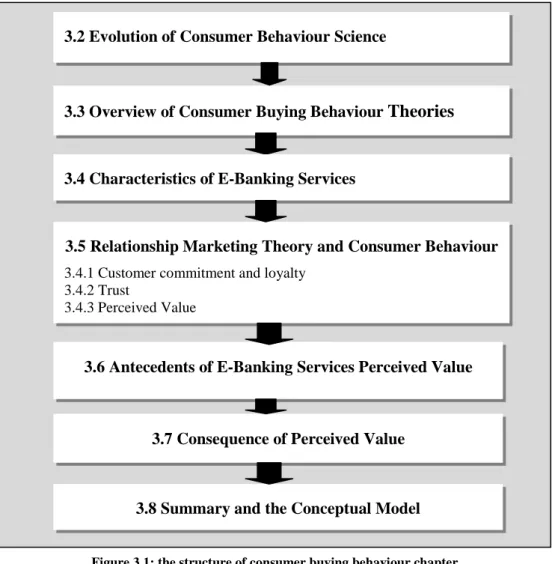
Figure 3.1 The structure of consumer buying behaviour chapter 40
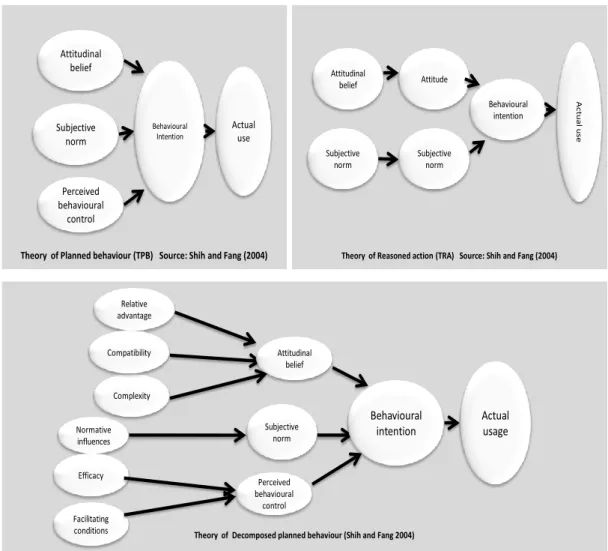
Figure 3.2 Basic Attitudinal Theories 43
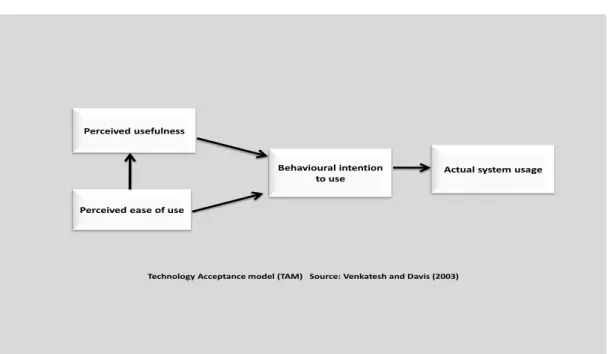
Figure 3.3 Technology Acceptance Model 44
Figure 3.4 Technology Task Fit Model 45
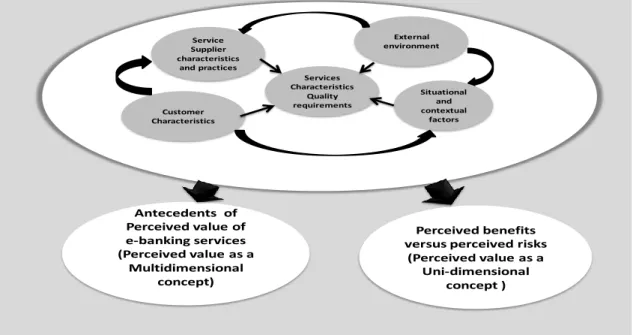
Figure 3.5 Sources of antecedents and benefits-versus-risks concept of perceived
value 56
Figure 3.6 Competing relationships and the adopted relationship 75 Figure 3.7 Conceptual e-banking services value-adding model 80
Figure 4.1 Structure of chapter 4 82
Figure 4.2 Studies Addressing CRM and value 94
Figure 4.3 Conceptual requirements for creating and delivering the value of
e-banking services 102
Figure 5.1 Structure of the methodology chapter 105
Figure 5.2 Conceptual framework and research questions 112 Figure 5.3 Research Paradigm, data collection methods and research questions 117
Figure 6.1 Structure of chapter 6 137
Figure 6.2 Example on the development of inferential and descriptive codes 148 Figure 6.3 The contribution of the proposed factors in explaining the perceived
value of e-banking services in the Egyptian environment 150 Figure 6.4 Classifying participants according to the type of banks 151 Figure 6.5 Classifying participants based on their experience with e-banking services
in the Egyptian environment 151
Figure 6.6 Proposed Factors shaping the value of e-banking services in the Egyptian
Environment 170
Figure 7.1 Questionnaire design stages 172
Figure 9.1 Structure of chapter 9 210
Figure 9.2 E-banking services value-adding model 212
Figure 10.1 Structure of chapter 10 242
Figure 10.2 E-banking services value-adding model with suggested constructs 244
Figure 11.1 Structure of chapter 11 265
Figure 11.2 Factors shaping the ability of banks to create and deliver value of
e-banking services 271
Figure 11.3 Level of bank participants in the sample 272
Figure 11.4 Factors shaping banks‟ ability to create and deliver the value of e-banking
services: A proposed model 289
Figure 12.1 Model for managing value 292
Figure 12.2 Managing the value of e-banking services in the Egyptian environment:
1
Chapter 1
Introduction
2
1.1 Introduction
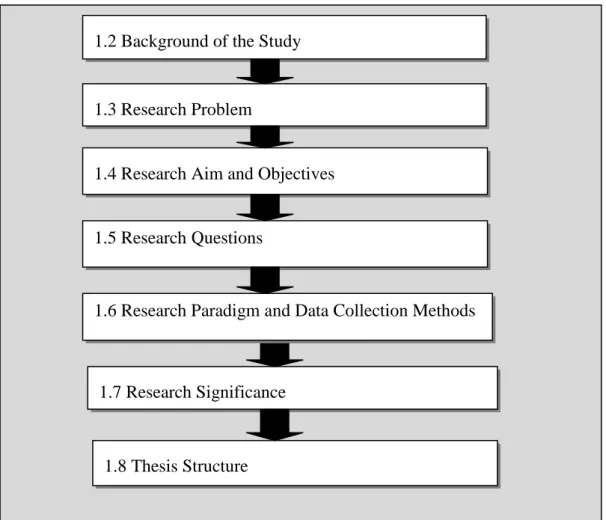
This chapter provides an overview of the study, which is concerned with e-banking services in the Egyptian environment, and highlights the research context. In doing so, this chapter serves three main purposes. First, it suggests a working definition of e-banking services, which is employed throughout the study. Second, it provides the rationale for the study. Third, is establishes the foundation for the research objectives and questions. The main areas discussed in this chapter are depicted in Figure 1.1.
Figure 1.1: The structure of the introduction chapter
1.2 Background of the Study
1.3 Research Problem
1.4 Research Aim and Objectives
1.5 Research Questions
1.7 Research Significance
1.8 Thesis Structure
3
1.2 Background of the Study
Information technology (IT) applications penetrate consumers‟ daily lives and the business environment, as well. This section overviews the impact of e-commerce as an IT innovation on the business environment in general and the banking industry in particular.
Information Technology applications have affected the way businesses are managed internally and externally by creating new goods, services, delivery channels and tools by which the organisation can enhance relationships with its customers (Karimi et al. 2001; Mulligan and Gordon 2002). They therefore provided a new basis for competition (Fraser et al. 2000; Rivard et al. 2006). A key example of this is e-commerce.
E-commerce, an IT innovation has affected the way an organisation is managed internally and how it manages relationships with its customers (Molla and Licker 2001). However, there is no consensus on a clear definition for e-commerce. Extant definitions differ on two criteria:
The first criterion is the range of IT applications or parties involved in the definition of e-commerce. For example, Eastin (2002) viewed e-commerce as the utilization of electronic information technology which might not include the internet to conduct business between trading partners. However, for others, e-commerce is viewed as the use of the internet and the www technology to conduct business-to-business or business to customer trading (Bin et al. 2003; Gibbs et al. 2003). This difference might be due to the research objectives and the environment the researcher investigates (Grandon and Pearson 2004).
The second criterion is the extended effect of e-commerce on the adopting organizations. Some view e-commerce as merely a channel that facilitates the act of buying and selling through the internet. Others adopt a wider perspective, viewing commerce as a business strategy. Those advocating the wider perspective consider e-commerce to be a strategic choice and a transformational force that requires reviewing of resource allocation to build competitive advantage.
4
Zwass (1996:3), for example, maintained a wider perspective by defining e-commerce as:
“the sharing of business information, maintaining business relationships and conducting business transactions by means of telecommunications networks”.
Also, Shalhoub and Al Qasimi (2006: 11) defined e-commerce from a wider perspective stating:
“E-commerce is not just a technology or tool, as a matter of fact it is a combination of technologies, applications, processes and business strategies”.
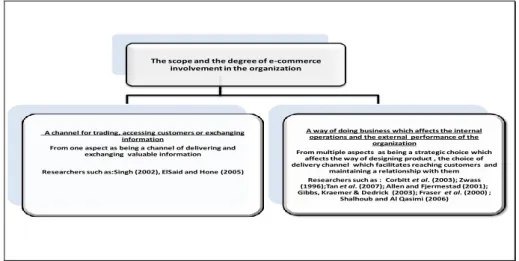
However, the ability of the organization to benefit from e-commerce depends on the existence of well structured strategies able to manage changes brought by the adoption of e-commerce (Jayawardhena and Foley 2000). Figure 1.2 presents two perspectives of e-commerce, based on the scope of and the degree of e-commerce involvement in organization activities.
The scope and the degree of e-commerce involvement in the organization
A channel for trading, accessing customers or exchanging information
From one aspect as being a channel of delivering and exchanging valuable information Researchers such as:Singh (2002), ElSaid and Hone (2005)
A way of doing business which affects the internal operations and the external performance of the
organization
From multiple aspects as being a strategic choice which affects the way of designing product , the choice of delivery channel which facilitates reaching customers and
maintaining a relationship with them Researchers such as : Corbittet al. (2003); Zwass (1996);Tan et al. (2007); Allen and Fjermestad (2001); Gibbs, Kraemer & Dedrick (2003); Fraser et al. (2000) ;
Shalhoub and Al Qasimi (2006)
Figure 1.2: Classifying e-commerce according to the degree of involvement in the organization
The rapid development of IT increases the technological gap between developing and developed countries. This necessitates adopting a holistic view of e-commerce to match the technological status of Egypt as a developing country. Accordingly, e-commerce
5
E-commerce is the use of information technology applications in business-to-customer or business-to-business contexts to attract new customers and strengthen relationships with existing ones, through improving internal processes, existing products, and enhancing customers’ experiences with product delivery.
The above definition does not restrict e-commerce to internet applications. It also considers the outcome of using e-commerce applications on the organization.
E-commerce has extended to affect the basic cost dimensions and the distribution structure for the financial services industry in most countries (Joseph et al. 2005). Moreover, it has affected the types of financial product launched to customers and the way such products are delivered (Lee 2002; Akinci et al. 2004). The application of e-commerce in the banking sector is known as e-banking services.
Researchers disagree on defining e-banking services. Most researchers use the terms „internet banking‟ or „online banking‟ as synonymous with e-banking (Gonzalez et al. 2004; Simpson 2002; Daniel 1999). Similarly, Shah et al. (2007) defined internet banking with e-banking, stating:
“Banks offer most financial products such as current accounts, saving accounts, and different payment services via the Internet, which collectively we refer to as e-Banking (EB)”
Others adopt a wider view of e-banking services to include a wide range of IT applications, rather than merely internet banking. Accordingly, they view e-banking services as the delivery of financial products using automatic teller machines (ATMs) electronic media such as personal computer (PC), and tele-banking which refers to the use of the telephone as a means of conducting business with the banks, as well as the internet (Joseph et al. 1999; Harden 2002; Yu and Hway-Boon 2003; Kolodinsky et al. 2004; Kamakodi and Khan 2008). A similar breadth can be inferred from Frambach et al. (1998:162) who described electronic banking services, as:
“a financial service innovation that offers banking firms opportunities to reduce costs of banking transactions, enhance the relationship with customers and to distribute wider range of semi-financial products”.
6
A working definition for E-banking services in the Egyptian environment
In the Egyptian environment, the adoption of e-banking services was stimulated by the entry of foreign multinational banks, with the aim of attracting and/or strengthening relationship with customers.
However, the nature of Egypt, as a developing country, might have delayed transfer of the full range and capabilities of e-banking services from the western culture to the Egyptian environment. In most western environments, all stages of the financial transaction cycle (information provision, initiation, negotiation, execution/settlement, after sales support) are processed electronically without the need for personal face-to-face interaction with employees (Bauer et al. 2005). In the Egyptian environment, internet banking or call banking are not yet sufficiently developed to provide all the above mentioned stages electronically. Although internet banking was adopted recently, ATMs and their related e-product plastic cards such as ATM cards, visa cards, and master cards continue to dominate the range of e-banking services offered by the Egyptian banks to their customers, while internet banking is the least common type of e-banking services offered by banks (Central Bank of Egypt 2009). This highlights the gap in IT applications involved in e-banking services between the western developed culture and the Egyptian environment.
From this brief review of the context that shaped the introduction and the nature of e-banking services in the Egyptian environment, e-banking services could be defined as:
Use of self-service technology, such as ATMs and their related plastic cards, phone and internet banking to strengthen the relationships between banks and customers interested in using these services.
Defining e-banking services in terms of self-service technology is consistent with Meuter et al. (2000). The above definition extends e-banking services applications beyond internet banking to include all forms of self service technology offered by the banking sector in the Egyptian environment.
E-banking services have proved to have several benefits to both the adopting banks and customers in western societies. From bank customers‟ perspective, they allowed customers to perform a variety of functions, ranging from basic information provision to
7
full transactional capability (Waite and Harrison 2002; Gurau 2002; Kaynak and Harker 2005).
Moreover, e-banking services proved to be of financial benefits to the adopting banks. For example, in India, Malhotra and Singh (2009) found that the asset quality and cost of operations are significantly better for banks offering internet banking than those not offering internet banking.
Although IT applications could enhance service delivery and potentially extends the market share, they may create a gap between customers and the service (Bitner et al
2000). Thus, grasping the full benefits of e-banking services from the supplier side depends on the way customers perceive the value of e-banking services. Without the continuous investigation of customers‟ perceived value with existing service offerings, service providers will be unable to survive in an increasingly competitive and technological market.
1.3 Research Problem
Financial services in general and banks in particular are amongst the service organizations that face severe competition all over the world (Leal and Pereira 2003). A highly competitive environment facilitates the copying of financial services features (Bick et al. 2004). This creates a necessity for financial services suppliers to distinguish their services and to position themselves relative to their competitors through offering value added services.
In Western developed countries such as the United Kingdom, the financial services industry has recognized the effect of adopting e-banking services on financial and marketing performance (Daniel 1999). Accordingly, banks have adopted e-banking services to defend their market share, i.e to retain existing customers.
Similarly, the adoption of e-banking services in the Egyptian banking sector was driven by several factors. First, is the growing competition between banks or between banks and other financial intermediaries, such as the capital market, in the Egyptian market. Second, is the invasion of technology in the banking services, due to the entry of
8
foreign banks, which led to emergence of e-banking services. Third, is the expected contraction in the demand for banking services in the Egyptian environment, due to deteriorating economic performance on the customer level (see chapter 2, section 2.3.3).
In response to these three factors, e-banking services were introduced by banks in the Egyptian environment to retain existing customers and/or attract those interested in using these services (Kamel and Hassan 2003). It is argued that the business value (net benefits) of e-banking services lies in their ability to attract new customers and retain those who are interested in their usage (Stamoulis et al. 2002; Lee 2002). Value management is considered a strategic tool in providing a superior service offering to retain customers (Woodruff 1997; Ulaga and Chacour 2001; Kale 2004). Thus, offering e-banking services of value to their users could enable financial institutions to retain their customers and create competitive advantage (Wang et al. 2004).
This highlights the concept of e-banking services‟ value and its effect on customer retention (commitment or loyalty). To improve the role of e-banking services in strengthening the relationship between banks and their customers, suppliers should understand what shapes the value of e-banking services from bank customers, who could be current or potential users of banking services (the demand side of e-banking services).
From a review of consumer buying behaviour theories and relationship marketing theory with a special focus on value-related literature, the following gaps could be highlighted:
Factors that explain the antecedents of e-banking value arise from the interaction among customers who are the current or potential users of services, culture, service features and their related product characteristics, the surrounding external environment, situational and contextual circumstances and service supplier practices. The definition of e-banking services adopted in this research differs from that adopted in most studies from western culture. This might emphasize certain quality dimensions in shaping the perceived value of e-banking services in the Egyptian environment. Moreover, situational and
9
contextual factors could have an indirect impact on the relative importance of certain quality dimensions in a given environment, to act as antecedents of e-banking services’ perceived value.
There is a lack of and/or disagreement among empirical studies addressing the role of e-banking services‟ perceived value in strengthening the relationship between banks and their customers (the marketing performance of e-banking services). Moreover, few if any empirical studies have addressed the role of e-banking services in strengthening the relationship between banks and their customers in the Egyptian environment (the consequence of e-banking services perceived value).
Moreover, studies addressing value were more concerned with defining value or its consequence. Value improvement requires linking antecedents with consequences. Empirical studies addressing the value of e-banking services in terms of antecedents and consequence in general and in the Egyptian environment are limited. This necessitates filling the gap of knowledge in this area by establishing e-banking services value-adding model.
Whilst filling those knowledge gaps would provide insight into the demand side of e-banking services, any attempt to improve the value of e-e-banking services, must take account of the dynamic process between the demand and the supply sides of the service. Hence, the supply side of e-banking services, the banks, must be included into the value management process. Creating and delivering the best possible value of e-banking services requires implementing a customer relationship management (CRM) strategy to manage people and technology to improve customers‟ experience with service delivery encounters (Payne and Frow 2005).
However, it is argued that the ability of CRM to create and deliver the required value depends to a large extent on the organization‟s internal operating and external environments (Plakoyiannaki and Tzokas 2002; Chen and Popovich 2003; Zablah et al. 2004; Zhu et al. 2004; Eid 2007; Becker et al. 2009). Despite this, the following gaps in CRM literature could be identified:
10
CRM literature shows no agreement on a list of factors reflecting the role of internal operating environment in value creation and delivery.
CRM literature gives little or no explicit consideration to factors reflecting the role of the external environment in value creation and delivery of e-banking services.
This necessitates filling the gap of knowledge in this area, by exploring those factors and explaining the extent to which they support or hinder the value of e-banking services in the Egyptian environment.
Bringing together the antecedents of e-banking services‟ perceived value revealed from the demand side, and factors affecting the ability of banks (the supply side) to create and deliver the required value of e-banking services would assist in providing an integrated model that guide value management of e-banking services in the Egyptian environment.
1.4 Research Aim and Objectives
The main aim of this research is to establish an integrated model that guides the value management process of e-banking services in the Egyptian environment. This is achieved via a systematic flow of research objectives, derived from the literature and guided by value management activities suggested by Payne and Holt (2001), as well as the customer value determination model established by Woodruff (1997). Value management of e-banking services is a reciprocal process between customers and service suppliers. Accordingly, both parties are involved in the study and reflected on the research objectives. The main aim is achieved through the following objectives: 1st Objective: To review and evaluate consumer buying behavior theories to understand customer usage of e-banking services, in general.
Reviewing and evaluating consumer buying behaviour theories and models in e-banking services usage context assists in addressing the knowledge gap in explaining usage behaviour.
11
This knowledge gap arises from failure of widely used models, such as the technology acceptance model (TAM) and task- technology fit (TTF) model, to consider explicitly the role of service supplier in explaining e-banking services usage. This calls for extending the relationship between customer and service to involve service supplier in the adoption decision, by considering Relationship Marketing theory and focusing on the concept of perceived value. This is because e-banking services are not only technological innovation, but rather financial services. They share financial services the characteristics of intangibility, inseparability and shared ownership.
In this study, perceived value, a key concept in relationship marketing, is seen from two perspectives. The first is a uni-dimensional perspective, where perceived value is simply perceived benefits versus perceived risks=net benefit.
The second is a multidimensional perspective, where perceived value is seen as a process having antecedents leading to an output (consequence). Defining value as a multidimensional concept requires explicit identification of antecedents, and assists in addressing the complex nature of customer perceived value.
As indicated previously, factors that explain the antecedents of e-banking value arise from the interaction among customers who are the current or potential users of services, culture, services features and their related products characteristics, the surrounding external environment, situational and contextual circumstances and service supplier practices. The definition of e-banking services adopted in this research might emphasize certain quality dimensions in shaping the perceived value of e-banking services in the Egyptian environment. Moreover, situational and contextual factors could have an indirect or moderating role on the relative importance of certain quality dimensions in a given environment.
The complex way in which these factors interact to generate antecedents of e-banking services value justifies the use of an exploratory sequential strategy to investigate the demand side of e-banking services in the Egyptian environment.
12
2nd Objective: To understand the role of customer relationship management (CRM) in creating and delivering value to e-banking service offering.
This objective is achieved by examining CRM literature, as an empirical interpretation of Relationship Marketing theory, in order to identify the requirements of creating and delivering value in general and value of e-banking services in particular. Fulfilling this objective assists in identifying gaps in the literature need to be addressed and filled by integrating the supply side of e-banking services into the value creation and delivery process.
The fulfillment of the first and second objectives provides the basis for establishing a conceptual framework to justify the methodology and guide the flow of the research methods.
3rd Objective: To identify antecedents and consequence of e-banking services perceived value in the Egyptian environment.
To retain customers, the organization should understand what their requirements from the service offering are (Gronroos 1984; Liao and Cheung 2002). Customers should be viewed as resources with whom value is created and improved (Lusch et al. 2008). Without feedback from customers, the service offering might lack its core value from the customer‟s perspective (Foss and Stone 2003: 205).
Feedback from customers has been proved to assist in designing products and services that maximize customer satisfaction (Devlin 1998; Krishnan et al. 1999). Similarly, Payne and Frow (2005: 172) addressed value assessment as a tool for improving products and services, stating:
“To determine the value proposition is likely to result in a superior customer experience, a company should undertake a value assessment to quantify the relative importance that customers place on a various attributes of a product”
Understanding the way customers perceive the service offering enables financial institutions to strengthen relationships with their customers (Zineldin 2005; Peppard 2000).
13
To identify factors shaping the perceived value of e-banking services in the Egyptian environment, in-depth interviews followed by questionnaire were conducted. This served two main purposes. The first was to gain an overall understanding of the factors affecting e-banking services perceived value in the Egyptian environment.
The second was to guide the design of the questionnaire in the subsequent quantitative phase, in order to identify the antecedents (requirements) and measuring the consequence of e-banking services perceived value, in the Egyptian environment. 4th Objective: To explore factors shaping the ability of banks to create and deliver the value of e-banking services offered in the Egyptian environment.
Understanding factors shaping e-banking services users‟ behaviour in the Egyptian environment is not enough to secure effective value creation and delivery. Accordingly, both customers and suppliers should be involved in the process of creating value (Brandnburger and Staurt 1996; Gronroos 1997).
Similarly, Khalifa (2004: 660) emphasized the role of suppliers in creating value, stating:
“To be able to offer customers superior value for exchange, a firm should understand how to generate and accumulate value for customers, what forms customer value may take, and what factors influence the accumulation of value”.
Thus, service suppliers are key players in the value management process. Their internal operating and external environments affect their ability to create and deliver the required e-banking services value.
However, little is known about factors reflecting the ability of banks in developing countries to manage the value of e-banking services. For this reason, semi-structured interviews were conducted with practitioners in Egyptian banks, to explore the factors that shape the ability of banks to achieve CRM requirements for value creation and delivery in e-banking services context.
14
5th Objective: To establish an integrated model to guide the value management process of e-banking services in the Egyptian environment.
Identifying reasons behind detected gaps between customer requirements and banks‟ ability to meet these requirements is a crucial phase in customer value management (Foss and Stone 2002: 204; Gunes and Aksin 2004). Accordingly, in this study, factors revealed from the supply side reflecting the internal and external environments affecting the way banking services are created and delivered, are linked to the antecedents of e-banking perceived value revealed from the demand side, in an integrated model. This assists in providing a wider view to guide the value management process of e-banking services in the Egyptian environment. This model also assists in identifying the reasons behind any perceived gap between e-banking services value (determinants) antecedents and what is currently offered.
1.5 Research Questions
This research aims at answering the following questions:
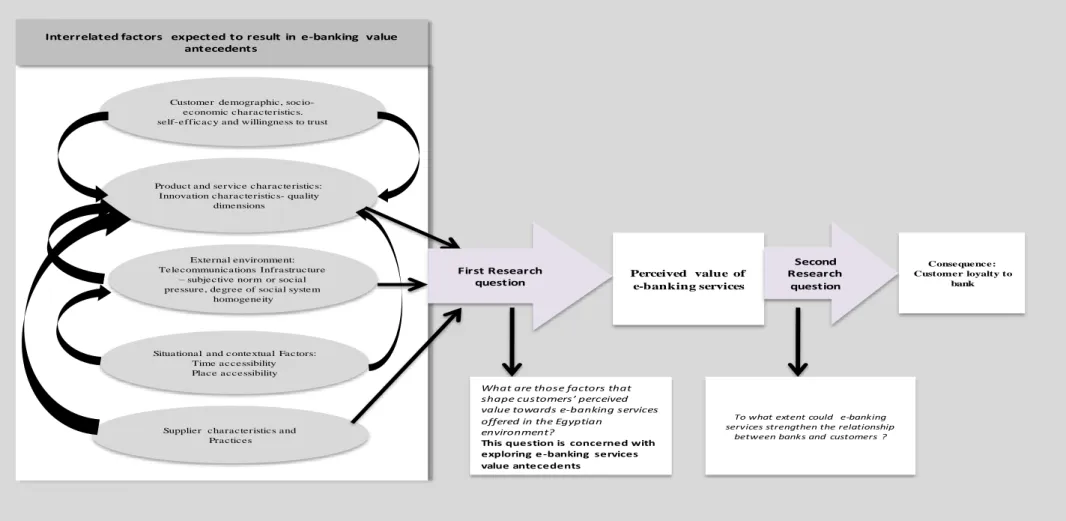
1. What are the factors shaping customers‟ perceived value of e-banking services offered in the Egyptian environment? (antecedents of e-banking services perceived value) RQ1
2. To what extent can e-banking services strengthen the relationship between banks and customers in the Egyptian environment? (consequence of e-banking services perceived value) RQ2
3. What are the factors shaping the ability of banks to create and deliver the value of e-banking services in the Egyptian environment? RQ3
4. How could the value of e-banking services be managed to strengthen the relationship between banks and customers in the Egyptian environment? RQ4
15
1.6 Research Paradigm and Data Collection Methods
The critical realism paradigm, an anti-positivist paradigm, dominated the whole study. The rationale behind employing the critical realism paradigm emerges from the theoretical background informing the research knowledge gaps concerning the demand and the supply sides of e-banking services. These knowledge gaps are driven by prior theories. As discussed before, the concepts of perceived value and CRM are established in literature. However, factors explaining the perceived value or those affecting the ability to implement CRM improve the value of services depend on the context under investigation. Exploring these factors in the Egyptian context could add new dimensions to the theory, which might have been overlooked in other contexts. On the other hand, it might validate existing, previously tested, dimensions and causal relationships. The dependence on prior theory, while considering the role of context in expanding and validating such theories is an indication of the abductive nature of this research. It also justifies the use of critical realism (anti-positive) paradigm along the whole study. Understanding the role of context in adding new dimensions to the theory or validating existing dimensions dictates considering banks‟ practices (supply side of e-banking services) and customers‟ behaviour and actions (demand side of e-banking services) as open systems. The nature of interaction between customers or organizations and their surrounding context creates and validates causal relationships. This implies that context shapes study findings, making it difficult to generalize relationships and outcomes to other contexts. Hence, relationships are seen as relative rather than fixed. This ontological perspective contradicts with that in purely positivistic paradigm.
The way critical realism paradigm is operationalized on the demand and supply sides of e-banking services are discussed below.
1.6.1 The Demand Side of E-Banking Services
Under the critical realism paradigm, customers‟ behaviour and action should always be understood within a context. Perceived value is one of the main determinants of customers‟ attitudes. However, factors that shape customers‟ perceived value of
e-16
banking services and affect their behaviour, result from the interaction of customer characteristics, contextual factors, external environment, service supplier and service or product characteristics. This made it difficult to generalize factors shaping perceived value towards e-banking services in the western culture, to the Egyptian environment. Accordingly, an exploratory sequential strategy was the most appropriate to employ in investigating the demand side of e-banking services and answering the first and second research questions. This was done by conducting in-depth interviews followed by survey.
1.6.2 The Supply Side of E-Banking Services
Banks‟ ability to implement CRM to improve the value of e-banking services is bounded by the internal operating and external environments. These two environments might influence the successful implementation of CRM, and hence, e-banking services value creation and delivery in the Egyptian environment. This necessitated exploring factors reflecting internal operating and external environments and explaining the way they contribute to the process of e-banking services value creation and delivery. This was achieved by employing data triangulation through conducting semi-structured interviews and secondary data analysis.
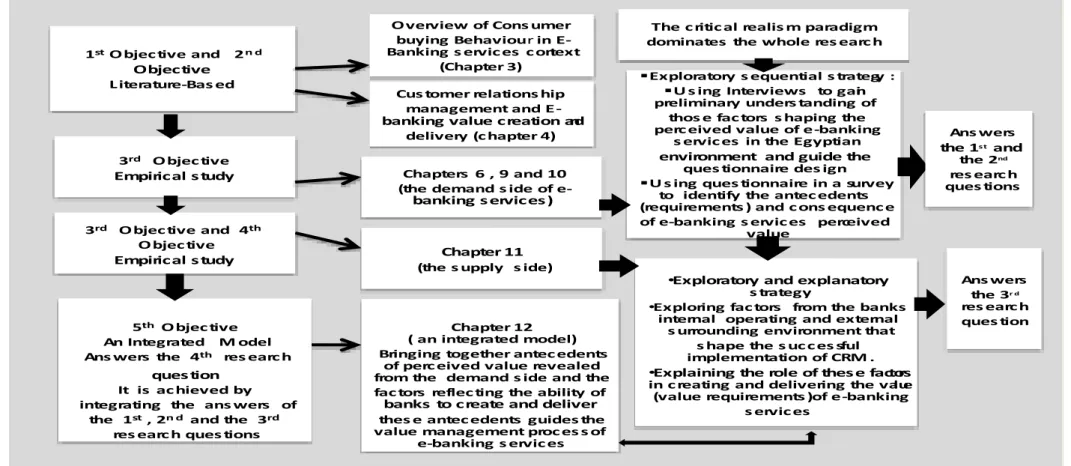
Figure 1.3 provides a comprehensive presentation of the research objectives linked to the research questions, the paradigm and the research methods employed to answer these questions.
17
1stO bjec tive and 2n d
Objective L iterature-Bas ed
5th O bjec tive
An Integrated M odel
Ans wers the 4th res earc h
ques tion It is ac hieved by integrating the ans wers of
the 1st, 2n d and the 3rd
res earc h ques tions
3rd O bjec tive
Empirical s tudy
O verview of Cons umer
buying Behaviour in
E-Banking s ervic es c ontext (Chapter 3)
Cus tomer relations hip management and E -banking value creation and
delivery (c hapter 4) Chapters 6 , 9 and 10 (the demand s ide of
e-banking s ervices )
Chapter 11 (the s upply s ide)
Chapter 12 ( an integrated model) Bringing together antec edents
of perc eived value revealed from the demand s ide and the fac tors reflec ting the ability of
banks to create and deliver thes e antec edents guides the value management proc es s of
e-banking s ervic es
Exploratory s equential s trategy :
U s ing Interviews to gain
preliminary unders tanding of thos e fac tors s haping the perc eived value of e-banking
s ervic es in the Egyptian environment and guide the
ques tionnaire des ign
U s ing ques tionnaire in a survey
to identify the antec edents (requirements ) and c ons equenc e of e-banking s ervic es perceived
value
•Exploratory and explanatory s trategy
•Exploring fac tors from the banks
internal operating and external s urrounding environment that
s hape the s uc c es sful implementation of CRM . •Explaining the role of thes e factors in c reating and delivering the value (value requirements )of e-banking
s ervic es
The c ritic al realis m paradigm dominates the whole res earc h
Ans wers the 1stand the 2nd res earc h ques tions Ans wers the 3r d res earc h ques tion
3rd O bjec tive and 4th
O bjec tive Empirical s tudy
18
1.7 Research Significance
The significance of this research stems from two main sources:
1.7.1 Industry Related Significance
Understanding Egyptian customers‟ behaviour towards e-banking services in the Egyptian banking will help in improving the expected role of these services in increasing and/or defending market share. Managing the value of e-banking services and improving their role in strengthening relationship between banks and their customers justifies the resource invested by banks in these services.
1.7.2 Theoretical Significance
Little is known about consumer buying behaviour in e-banking services in the Egyptian environment. Also, little is known about customer relationship management (CRM) success factors, in the Egyptian environment. The theoretical contribution of this research stems from four main areas:
This study extends the literature of consumer buying behaviour in e-banking services, and the literature of CRM to the Egyptian environment. This resulted in the explicit consideration of factors that have been overlooked in previous studies in western culture, to explain Egyptian behaviour towards e-banking services offered in the Egyptian environment. In examining CRM implementation in the Egyptian environment, factors reflecting the context of developing countries in general and the Egyptian environment in particular, are considered.
The critical realism paradigm adopted throughout the study resulted in new factors being considered in the consumer buying behaviour towards e-banking services, and the CRM literature, to reflect the Egyptian context.
Moreover, lack of studies addressing the value of services in general and e-banking services in particular, as a process having inputs (antecedents), leading to output (consequence) increases the theoretical significance of this study. This
19
study contributes in filling the knowledge gap in this area by presenting an e-banking services value-adding model, reflecting the Egyptian context.
Guiding the overall process of e-banking services value management requires integrating customer requirements with banks‟ ability to meet those requirements, by highlighting factors in the internal operating and external environments in the process of creating and delivering the value of e-banking services. However, literature lacks this integrated view of value management in e-banking services context. This study contributes to closing the knowledge gap in this area, by presenting an integrated model that brings the antecedents of e-banking services perceived value together with the factors shaping the ability of banks to create and deliver these requirements. This integrated view considers both demand and supply side of e-banking services and the reality of the Egyptian environment.
By identifying the above mentioned knowledge gaps in literature and the contribution of this study in closing these gaps, this study contributes to developing the consumer behavior, value and CRM theory.
1.8 Thesis Structure
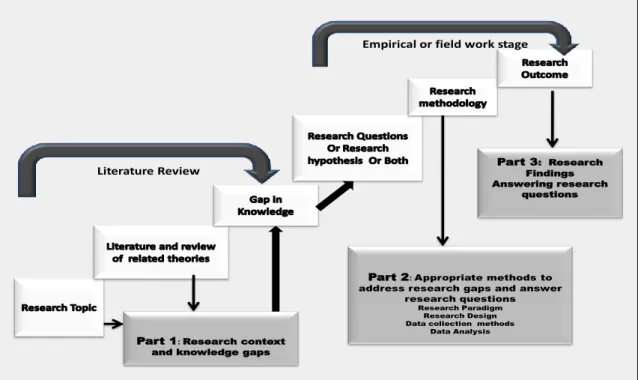
Figure 1.4 shows that the structure of this thesis follows the systematic flow of research methodology. It starts with examining the relevant literature to identify the research gaps and formulate research questions. Then, the thesis moves to decide on the appropriate paradigm and research methods to address gaps in knowledge and answer the research questions. Finally, answers to the research questions are reported.
20
Part 3: Research
Findings Answering research
questions
Part 2: Appropriate methods to
address research gaps and answer research questions
Research Paradigm Research Design Data collection methods
Data Analysis
Empirical or field work stage
Literature Review
Part 1: Research context
and knowledge gaps
Figure 1.4: Research stages and thesis structure
Source: Adapted from Lindgreen (2001: 76) and Collis & Hussey (2003: 16)
This thesis is divided into three interrelated parts: Part 1, Part 2 and Part 3. The objective of each part and the chapters included, are as follows:
Part 1 lays out the building blocks and the logical basis for the research context and questions. It incorporates chapters 2, 3 and 4.
Part 2 is concerned with identifying the research paradigm and the research methods (data collection tools) by which the first, second and third research questions will be answered. Part 2 includes chapter 5.
Part 3 is concerned with presenting findings and validating them through the analysis stages or techniques employed. This part is composed of seven chapters. Chapters 6, 7, 8, 9 and 10 are concerned with analysing, presenting and discussing findings revealed from searching the demand side of e-banking services.
Chapters 7 and 8 are concerned with discussing the methodology employed to answer the questions related to the demand side of e-banking services. Chapter 6, 9 and 10 are concerned with presenting the findings of the two stages used to investigate the demand side of the e-banking services.
21
Chapter 11 presents factors shaping the ability of Egyptian banks to support or add value to e-banking services in the Egyptian environment.
Chapter 12 concludes the research by presenting an integrated model for managing the value of e-banking services, developed by linking antecedents of e-banking perceived value revealed from the demand side, with factors shaping banks‟ ability to create and deliver value.
22
Part 1 lays out the building block and the logical basis for the research context and questions. It incorporates three chapters.
Chapter 2: This chapter overviews the evolution of the Egyptian banking sector, and highlights forces that drove the introduction of e-banking services in the Egyptian market, and justify their expected role in attracting and/or retaining bank customers. Chapter 3: This chapter examines theories relevant to understanding consumer buying (usage) behaviour in e-banking services context. This is done to identify gaps in explaining e-banking usage behaviour and highlight research problem required to be addressed by answering the first and second research questions. To answer the first two research questions, this chapter considers the importance of involving Relationship Marketing theory in explaining e-banking services usage behaviour. This is done by focusing on the concept of perceived value and loyalty (commitment), for being key aspects in strengthening the relationship between suppliers and customers through service offerings.
Chapter 4: This chapter is concerned with identifying requirements for creating and delivering of e-banking services value. This is achieved through reviewing and investigating customer relationship management (CRM) literature, for being the practical interpretation of Relationship Marketing (RM) theory. Reviewing and investigating CRM literature is done for two main purposes. First is to establish the conceptual framework highlighting the main requirements of e-banking services value creation and delivery. Second is to identify knowledge gaps required to be addressed by the third research question.
The following figure summarizes the chapters in this part and the purpose behind each chapter.
Part 1: Research Context and Key knowledge
Gaps: Basis of Research Questions
23
Chapter 2: Overview of the EgyptianBanking Sector
This chapter aims at providing an overview of the context in which e-banking services were offered in the Egyptian environment. This chapter ensures that e-banking services were provided to defend market share by some banks while increase market share by others. The chapter also provides an overview of the types and nature of e-banking services offered in the Egyptian environment.
Chapter 3: Overview of the Consumer Buyer Behaviour
Chapter 3 highlights the theoretical foundation supporting the first and second research questions.
Chapter 3 provides an overview on theories relevant in understanding consumer buying behaviour in e-banking services context. It focuses on the concept of perceived value as being the rational indicator for commitment and loyalty. It ends up with establishing a
conceptual e-banking services-value adding model.
Chapter 4: Role of Customer Relationship
Management (CRM) in Value Creation and Delivery Chapter 4 This chapter is concerned with identifying requirements for creating and delivering of value to e-banking services. This is achieved through reviewing and investigating customer relationship management (CRM) literature, for being the practical interpretation of Relationship Marketing (RM) theory. Reviewing and investigating CRM literature is done for two main purposes. First is to establish the conceptual framework highlighting the main requirements of e-banking services value creation. Second is to identify the gaps required to be addressed by the third research question.
Provide the basis for the first two research questions.
The first research question is concerned with those factors that shape customers‟ perceived value of e-banking services offered in the Egyptian environment.
The second research question is concerned with exploring the extent to which e-banking services could strengthen the relationship between banks and their customers (impact on bank loyalty) in the Egyptian environment.
Provide the basis for the third research question:
It is concerned with exploring the factors which shape the ability of banks to create and deliver the value of e-banking services in the Egyptian environment.
Output
Structure of Part 1
24