Air Force Institute of Technology
AFIT Scholar
Theses and Dissertations Student Graduate Works
3-22-2018
Critical Issues in the Air Force Medical Equipment
Procurement Process
Samuel H. Pang
Follow this and additional works at:https://scholar.afit.edu/etd Part of theOperations and Supply Chain Management Commons
This Thesis is brought to you for free and open access by the Student Graduate Works at AFIT Scholar. It has been accepted for inclusion in Theses and Dissertations by an authorized administrator of AFIT Scholar. For more information, please [email protected].
Recommended Citation
Pang, Samuel H., "Critical Issues in the Air Force Medical Equipment Procurement Process" (2018).Theses and Dissertations. 1857. https://scholar.afit.edu/etd/1857
Critical Issues in the Air Force Medical Equipment Procurement Process
Samuel H. Pang, Captain, USAF AFIT-ENS-MS-18-M-153
DEPARTMENT OF THE AIR FORCE AIR UNIVERSITY
AIR FORCE INSTITUTE OF TECHNOLOGY
Wright-Patterson Air Force Base, Ohio DISTRIBUTION STATEMENT A.
The views expressed in this thesis are those of the author and do not reflect the official policy or position of the United States Air Force, Department of Defense, or the United States Government. This material is declared a work of the U.S. Government and is not subject to copyright protection in the United States.
AFIT-ENS-MS-18-M-153
CRITICAL ISSUES IN THE AIR FORCE MEDICAL EQUIPMENT PROCUREMENT PROCESS
THESIS
Presented to the Faculty Department of Operational Sciences
Graduate School of Engineering and Management Air Force Institute of Technology
Air University
Air Education and Training Command In Partial Fulfillment of the Requirements for the
Degree of Master of Science in Logistics and Supply Chain Management
Samuel H. Pang Captain, USAF
March 2018
DISTRIBUTION STATEMENT A.
AFIT-ENS-MS-18-M-153
Critical Issues in the Air Force Medical Equipment Procurement Process
Samuel H. Pang Captain, USAF
Committee Membership: Chair: Maj Timothy Breitbach Member: Col Matthew Douglas
AFIT-ENS-MS-18-M-153
Abstract
The Air Force medical logistics community relies on multiple contracting offices to acquire medical equipment for the Air Force Medical Service. The perception is that burdensome regulations contribute to the challenges faced in the procurement process. This research takes a broader examination to understand the factors leading to long leadtimes and delayed procurements. Process mapping and interviews with the key stakeholders supporting medical equipment procurement determined that the critical issues were a lack of centralized medical equipment contracting authority, insufficient market research and inconsistent local knowledge on contracting processes. This research provides future recommendations for the Air Force Medical Service to improve the procurement process and reduce the contract backlog.
Acknowledgments
I extend deepest thanks to my faculty advisor, Maj Timothy Breitbach, for his guidance and support throughout the thesis process. Additionally, I would like to thank my sponsor AFMOA and the support staff in providing the research topic and flexibility in the
research efforts.
Dedication
I dedicate this to my family for their constant support through my efforts. And to my amazing wife whose love, understanding, and encouragement provided motivation in this journey.
Table of Contents
Page
Abstract ... iv
Acknowledgments...v
Table of Contents ... vii
List of Figures ... ix
List of Tables ...x
I: Introduction ...1
Air Force Medial Equipment Procurement ...1
Contract Background ...3
Problem Statement and Purpose of Research ...5
Desired Contribution ...6
Thesis Organization ...7
II. Literature Review ...8
Introduction ...8
General Contract Environment ...8
Contract Requirements ...11
Contract Challenges in the DoD ...18
Civilian Sector Procurement Considerations...20
Summary...22 III. Methodology ...24 Introduction ...24 Methodology...24 Sampling Technique ...25 Research Instruments...27
Procedure of Gathering the Data ...27
Coding ...28
Summary...30
IV. Results and Analysis ...31
Overall Findings ...32
Within Themes Breakouts ...33
Theme: Procurement Process and Environment ...34
Theme: Documentation Requirements ...42
Theme: Contract Rules and Process ...47
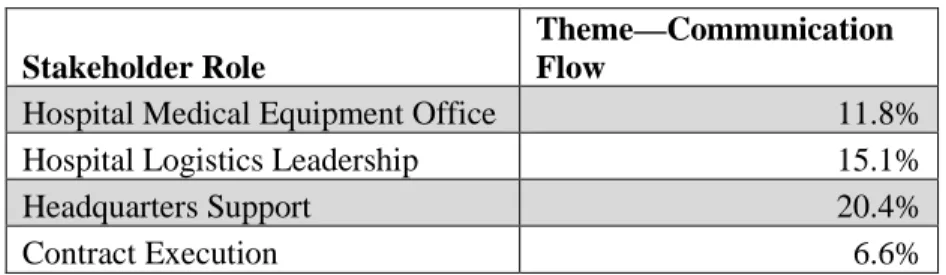
Theme: Communication Flow ...52
Summary...56
Chapter 5: Conclusion and Recommendation ...57
Findings ...57
Recommendation 1 ...59
Recommendation 2 ...60
Recommendation 3 ...60
Limitations ...61
Recommended Area for Future Research...61
Conclusion ...62
Appendix I: Sample Interview Guide Questions ...67
List of Figures
Page
Figure 1. Simplified Air Force Medical Equipment Procurement Overview ... 3
Figure 2. Commercial Item Determination ... 14
Figure 3. Competition Types ... 16
List of Tables
Table 1. Stakeholders Interviewed ... 26
Table 2. Interview Data... 31
Table 3. Stakeholder Breakout: Procurement Process and Environment Theme ... 34
Table 4. Stakeholder Breakout: Documentation Requirements Theme ... 42
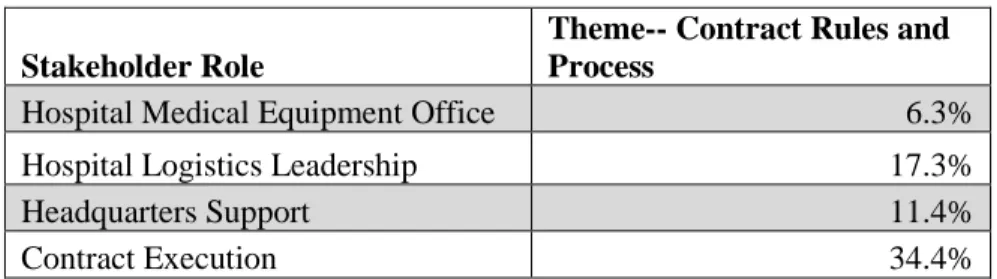
Table 5. Stakeholder Breakout: Contract Rules and Process Theme... 48
CRITICAL ISSUES IN THE AIR FORCE MEDICAL EQUIPMENT PROCUREMENT PROCESS
I: Introduction
Air Force Medial Equipment Procurement
The Air Force Medical Service (AFMS) webpage touts its service mantra: Trusted
Care, Anywhere. In delivering the “trusted care” tenets, the medical service depends on the Air Force Medical Operations Agency (AFMOA) in supporting endeavors that enhance health and performance of members of the military in healthcare operations throughout Air Force Military Treatment Facilities (MTFs), which this research
references as ‘hospitals.’ One of the support agencies under AFMOA is AFMOA/SGAL, more commonly known as the medical logistics headquarter. The medical logistics headquarter acts as the Air Force’s primary office on matters dealing with medical logistics plans, practices, and programs (AF Mission Directive 35, 2016).
Part of the medical logistics headquarter’s scope involves laying out the strategy in the procurement of Air Force medical materiel and equipment. In acquiring medical equipment, the medical logistics headquarter advises the base hospital medical equipment office, also known as the Medical Equipment Management Office (MEMO). The hospital medical equipment office is responsible for the facility’s medical equipment program. One significant role involves ordering new medical equipment for the hospital.
The hospital medical equipment office reviews all hospital equipment requests after receiving equipment packages from hospital custodians, who are the non-logistics equipment representatives located at the section level. (Throughout the rest of this research, custodians will be identified as ‘customers’). Once the customers submit a complete package to the hospital medical equipment office, the hospital medical
equipment office sends off an equipment package to the medical logistics headquarter for review and coordination (AFI 41-209, 2014). The medical logistics headquarter reviews the equipment package and advises the hospital medical equipment office in the
equipment procurement. A critical component in the headquarter review entails the sourcing recommendation in the acquisition process.
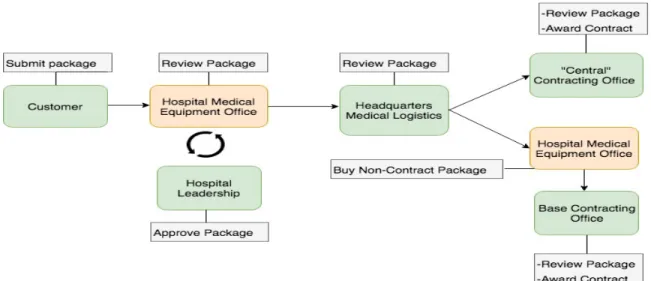
Simply put, two main sourcing avenues exist: non-contracting and contracting. In
the former case, equipment packages sourced through the non-contracting avenue are procured through the pre-established channels such as Defense Logistics Agency, Prime Vendor, or electronic catalogue. In the latter instance, if the equipment request cannot be accomplished via the pre-established channels outlined above, the package defaults to the contracting route. A basic overview of the Air Force medical procurement process is shown in Figure 1.
Up until fiscal year 2016, the Air Force medical service centralized its medical equipment contracting efforts. In this centralized contracting approach, the Air Force medical logistics community directed its contracting requirements to outside agencies, to include the Army Medical contracting office, Navy Medical contracting office, and the US Air Force Academy (USAFA) contracting office. This was due to the lack of a medical contracting office in the Air Force. As equipment requirements and contract
backlogs increased, the centralized contracting process transitioned to a decentralized approach where base hospitals were given the option to send packages to local base contracting offices. This created multiple channels for contracting as Figure 1 demonstrates.
Figure 1. Simplified Air Force Medical Equipment Procurement Overview The common thread in the centralized and decentralized contracting approaches is that once in the contracting channel, the factors associated with Department of Defense (DoD) acquisition came into play that impact the equipment procurement process.
Contract Background
By operating in the government context, the Air Force medical service
(2015) note how in the public procurement process for government, the contracting process is governed by regulations listed in the Federal Acquisition Regulation. Evolved from the Office of Federal Procurement Policy Act of 1974, the FAR extends rules and regulations across the federal government acquisition activities, including contracting efforts occurring in the DoD and its service branches. In guiding the procurement actions, the FAR states the following vision: “The vision for the Federal Acquisition System is to deliver on a timely basis the best value product or service to the customer, while
maintaining the public’s trust and fulfilling public policy objectives.”
Balancing “best value” while striving for public trust and public policy goals can
prove challenging in DoD acquisition. The DoD Inspector General (IG) reports in the
2017 Top DoD Management Challenges that effective acquisition and contract
management stand out as one of the top ten challenges facing the defense department (DoD IG, 2017). Additionally, it explains that the DoD spends $273 billion in pursuit of goods and services (DoD IG, 2017). While contracting represents a significant
acquisition tool in defense procurement, the contracting focus sometimes ends up more concentrated on the nitty-gritty contracting details rather than evaluating the true
requirement at-hand (DoD IG, 2017). This theme of acquisition challenges has persisted over the years. The 2006 GAO Forum “Federal Acquisition Challenges and Opportunities
in the 21st Century” forum brought together experts from inside and outside the
government to assess ways to improve federal acquisition conditions. An emerging discussion point from this GAO meeting centered on how to deal with the inefficient government processes. Participants cited how the federal procurement process, dictated
by public policy, misses out on supply management efficiencies and endures conflicting objectives (GAO Forum, 2006).
Similarly, the DoD medical community experiences acquisition challenges. The
DoD IG’s report on Direct Care Medical Service Contracts reviewed DoD medical
contracts and the contracting process to figure out whether the military branches acquired medical care in the most effective manner. Among the DoD IG findings reported were overlapping contracting efforts, inconsistent application of federal procurement regulation, and contracts introducing unnecessary administrative burden on the
government (DoD IG, 2004). These findings indicate acquisition concerns as a constant theme in the DoD sector, including the medical community. This research narrows the acquisition focus on the Air Force medical equipment process.
Problem Statement and Purpose of Research
In the Air Force medical logistics community, a common perception is that the
FAR contributes to the issues in equipment procurement and affects timelines. The research originally set out to determine the challenges associated with the FAR in the Air Force medical equipment contracts. In turn, the preliminary purpose of this study sought to understand how the FAR constrains or supports the medical equipment contracting process. However, upon conducting interviews with the stakeholders selected for the research, the feedback and sentiment encompassed factors beyond regulation affecting the Air Force medical equipment process. Ultimately, the research took a broader
examination at the procurement process and addressed the following:
Research Question:
• What critical factors shape the issues faced by the Air Force medical
stakeholders in the equipment contract process?
Desired Contribution
The goal of this research is to better understand the current environment facing the Air Force medical equipment contract process. By focusing on the input from distinct stakeholders involved in the equipment procurement, the Air Force medical community can concentrate efforts on affecting the contract process. The Air Force Medical Service stakeholders at the strategic level can build on the research findings to discuss ways to improve the equipment procurement process, which can address the long leadtimes and reduce contract backlogs. By identifying the key issues limiting the stakeholders, the policy makers can better direct reform efforts, and balance resources in effort to promote quality healthcare through timely delivery of medical equipment.
At the Air Force medical logistics tactical level, the stakeholders gain access to
contemporary considerations that frame how customers can be prepared to complete packages. Additionally, understanding the degree and types of training and education on the medical acquisition process can better prepare stakeholders who participate in the equipment procurement.
Thesis Organization
The thesis proceeds as follows: Chapter 2 is a discussion of the relevant literature
on DoD acquisition trends and civilian sector procurement practices. One of the goals of this work is to address the literature gap on how the Air Force medical equipment process is impacted by the contracting process. Chapter 3 addresses the methodology utilized in this study. The data review process and interview techniques are highlighted. In addition, the chapter looks at the Air Force medical procurement stakeholder roles and why the particular research participants were selected. An overview of the interview coding is discussed. Chapter 4 examines the data results from the interviews performed and explores the key themes across the various stakeholder groups. Chapter 5 concludes the research by summarizes the findings, presents the conclusions, and offers future
II. Literature Review
Introduction
The literature review in this chapter sets the basic foundation behind the
acquisition process in the Air Force. The chapter begins by examining the DoD contract environment in the broad context. Next, the chapter explores essential contract elements that carry significance in completing and awarding contracts. The chapter then reviews the challenges prevalent in the DoD acquisition community to set a frame of reference for the Air Force medical procurement setting. Lastly, the chapter looks at the civilian sector procurement practices to offer a contrasting view of non-DoD procurement methods. The central ideas outlined originate from reports and studies pertaining to the acquisition process. The goal is to develop a framework of understanding the factors in the medical acquisition and show the research gap pertaining to the Air Force medical equipment procurement issues.
General Contract Environment
Contracts are utilized as a key procurement vehicle in the DoD acquisition
process. In creating contracts, different contract environment factors come into play. One contract consideration is the location of contract execution. The contract execution can take place at the centralized regional level or locally at the decentralized, installation level, both promoting unique effects. The centralized contracting approach favors conditions for economies of scale, uniformity of procedures, and standard application of
contracting practices (Rendon, 2012). On the other end of the contracting spectrum is the decentralized contracting approach, which encourages ease in project management implementation and ability in defining contract requirements (Rendon, 2012). The Air Force medical logistics community faces a similar contract execution situation: a centralized contracting approach that relies on outsourced contracting agencies at a centralized office and more recently, a decentralized contracting approach performed at local base contracting offices. Whether contracts are conducted at the centralized level or decentralized level, the importance of contract interpretation of rules and regulations remains constant.
Contract rule interpretation counts on the knowledge of the contracting official,
which introduces subjectivity to the contracting process and variability in rule application and assessment. This interpretation issue develops from the complex and ambiguous nature of regulations. A 2004 Congressional Research Service report on federal regulation reform indicates that regulated agencies struggle with the lack of clarity in rules pushed federally (Copeland, 2004). Rules often contain legal jargon that clouds the
explanation behind what exactly is required and how compliance is achieved (Copeland,
2004). Contracting officials lend their knowledge in attempt to interpret unclear rules, making their role in the contract process crucial. In analyzing contract trends in the DoD, Rendon (2012) outlines how the Army, Navy, and Air Force manage the acquisition process. Rendon notes how contracting officials aid the development of the contract package and documentation by lending their business and procurement acumen (Rendon, 2012). The underlying notion is that the dependence on the contracting official
open-ended nature behind the contracting rules combined with interpretation by contracting officials is connected to how contracts are carried out. This spotlights the valuable role the contracting official serves in the interpretation of contract rules and regulations.
In addition to the interpretation considerations by contracting officials, complying
with procedures outlined in regulation contributes to unfavorable perceptions associated with the acquisition process. An example of regulation perception comes from an advisory panel report that discusses reducing regulation and the regulation challenges in
the DoD. The Section 809 Panel Interim Report (2017) observes how the sheer number
and complexity behind statutes and regulations and procedures hinder the acquisition process, limiting speed and efficiency for program management offices. Interestingly, the regulation complexities reported in the Section 809 Panel report stand contrast to an earlier acquisition study done by the RAND Corporation in 2007. Drezner et al. (2007) address the perception in the DoD acquisition community that program offices devote a considerable time battling statues and regulation prompted by compliance actions and informal processes. The RAND study found that compliance activities triggered by rules were not as time-consuming as generally perceived by acquisition officials (Drezner et al., 2007). Thus, this challenges the notion of acquisition being hindered by regulations, a common discussion point in the acquisition community. Though numerous studies concentrate acquisition regulation at the broad defense level, a narrow examination in the Air Force medical equipment environment remains to be explored. Thus, understanding how regulation fits into the overall the medical equipment process deserves an
Contract Requirements
In addition to the general contract environment, the different contract elements
that form a contract requirement will help explore the contract dimensions. To trace the foundations of contract requirements, the FAR offers a starting point considering that federal government executive agencies follow this guide. To develop a general sense of contracts, the ‘acquisition’ definition is explored in which the FAR Subpart 2.01 defines in the following manner:
“Acquisition” means the acquiring by contract with appropriated funds of supplies
or services (including construction) by and for the use of the Federal
Government through purchase or lease, whether the supplies or services are
already in existence or must be created, developed, demonstrated, and evaluated.
Acquisition begins at the point when agency needs are established and includes
the description of requirements to satisfy agency needs, solicitation and selection
of sources, award of contracts, contract financing, contract performance, contract
administration, and those technical and management functions directly related to
the process of fulfilling agency needs by contract.
As described above, the acquisition process begins once an agency identifies a
need, which is similar to how medical customers identify an equipment need in the hospital setting. In doing so, the requirement relies providing the details describe the need, which affects other acquisition aspects in the contract process. The key factors in
describing a contract requirement can be seen in FAR Part 11, Describing Agency Needs.
Specifically, it promotes the following guidelines (per FAR Subpart 11.002): (2) To the maximum extent practicable, ensure that acquisition officials --
(i) State requirements with respect to an acquisition of supplies or services in
(A) Functions to be performed; (B) Performance required; or
(C) Essential physical characteristics;
(ii) Define requirements in terms that enable and encourage offerors to supply commercial items, or, to the extent that commercial items suitable to meet the agency’s needs are not available, nondevelopmental items, in response to the agency solicitations;
(iii) Provide offerors of commercial items and nondevelopmental items an opportunity to compete in any acquisition to fill such requirements;
(iv) Require prime contractors and subcontractors at all tiers under the agency contracts to incorporate commercial items or nondevelopmental items as components of items supplied to the agency; and
(v) Modify requirements in appropriate cases to ensure that the requirements can be met by commercial items or, to the extent that commercial items suitable to meet the agency’s needs are not available, nondevelopmental item
From the details shown above, the essential description requirements revolve
around the form, fit and function. The DoD Guidebook for Acquiring Commercial Items
elaborates on these description factors below:
• Form refers to the physical characteristics of the item, such as the physical shape, size, material and weight. Form expands to the manufacturing process, packaging and handling requirements and any specialized coatings.
• Fit refers to the interface of the item with other systems and to any installation requirements. Form and fit can help support price analysis, but the function of an item is vital to support a commerciality determination.
• Function is the essential purpose of the part. For example, is the primary purpose for the Government item military-unique? (USD/AT&L, 2017; pg. 18)
The ability to properly describe the three elements of form, fit, and function set the stage in determining whether an item is commercially available or not. The
commercial aspect in the context above refers to as, “Any item, other than real property, that is of a type customarily used by the general public or by non-governmental entities for purposes other than governmental purposes.” (FAR Subpart 2.01) For medical procurement stakeholders, this can affect the procurement process as commercial items introduce certain contract actions.
The commercial item approach is a preferred way of fulfilling needs and applies
different acquisition procedures. In researching the benefits for the provisions for
commercial items, Johnson et al. (2006) explain how acquisition officials are encouraged to pursue the commercial acquisitions route for the following reason: “to maximize the utilization of existing technology, to allow the marketplace to determine a fair and
reasonable price for a product or service, and to increase efficiency in the entire process.” (Johnson et al., 2006; pg. 70) This commercial determination is worthy of consideration, given that healthcare and use of medical equipment occur inside and outside the military context. The process of determining whether an item qualifies as commercial item and studying the healthcare marketplace relies another acquisition principle, market research.
Market Research
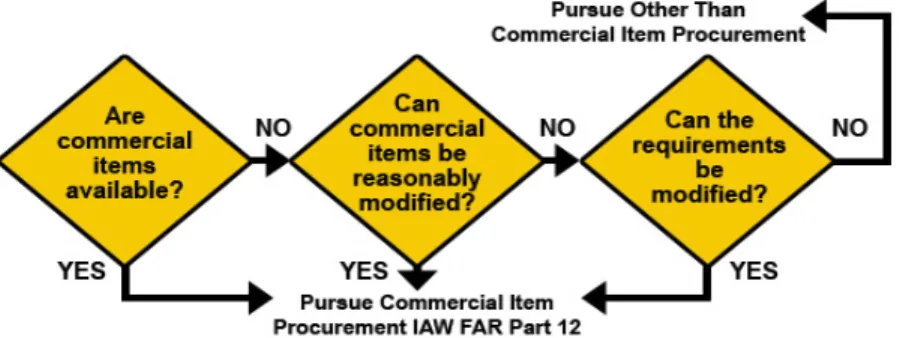
The commercial item determination revolves around market research when DoD
acquisitions take place. The DoD Guidebook for Acquiring Commercial Items helps
depicts the questions addressed by market research in commercial item determination (OSD/AT&L, 2017).
(Source: OSD/AT&L, 2017)
One may ask how market research addresses this aspect of commercial item availability. Market research is defined as “collecting and analyzing information about capabilities within the market to satisfy agency needs.” (FAR Subpart 2.001) Thus, market research seeks to study the market by assessing what the commercial sectors has to offer. Market research is prompted by certain circumstances, which FAR Part 10 helps outline:
(i) Before developing new requirements documents for an acquisition by that agency;
(ii) Before soliciting offers for acquisitions with an estimated value in excess of
the simplified acquisition threshold;
(iii) Before soliciting offers for acquisitions with an estimated value less than the simplified acquisition threshold when adequate information is not available and the circumstances justify its cost;
(iv) Before soliciting offers for acquisitions that could lead to consolidation or
bundling (15 U.S.C. 644(e)(2)(A) and 15 U.S.C. 657q);
(v) Before awarding a task or delivery order under an
indefinite-delivery-indefinite- quantity (ID/IQ) contract (e.g., GWACs, MACs) for a noncommercial item in excess of the simplified acquisition threshold (10 U.S.C. 2377(c)); and
(vi) On an ongoing basis, take advantage (to the maximum extent practicable) of
commercially available market research methods in order to effectively identify
the capabilities of small businesses and new entrants into Federal contracting, that
are available in the marketplace for meeting the requirements of the agency in
furtherance of—
(A) A contingency operation or defense against or recovery from nuclear,
biological, chemical or radiological attack; and
(B) Disaster relief to include debris removal, distribution of supplies,
reconstruction, and other disaster or emergency relief activities.
Across the varied procurement situations described above, the common link is
that market research functions as a critical step. The DoD acquisition community also underscores the market research value. Wesley and Chowdhury (2015) argue that “market research is the cornerstone of determining supply capabilities in DoD acquisitions.” The importance placed on market research matches the Defense
Acquisition University (DAU)’s position on market research, which offers that market research and its associated documentation help form the logic trail in supporting contracting actions (DAU, 2009). The implied notion is that by demonstrating a logic trail through market research, it encourages favorable contracting results. The outcome of an effective market research enables the DoD to buy smarter, expand small business participation, encourage competition, acquire better pricing, and maintain high quality in products and services (Wesley & Chowdhury, 2015). Considering the DoD wide
emphasis on the market research aspects, this research can illuminate the degree market research impacts medical equipment procurement in the Air Force.
Competition
Relevant to the market research discussion, competition stands out as another
factor reinforced by guidance and valued by procurement officials. In accordance with the responsibilities stated in the FAR, a contracting officer “must promote competition to the maximum extent practicable to obtain supplies and services.” (FAR Subpart 13) The competition requirements listed in FAR Part 6 fit into three broad categories, which the DoD Office of Small Business Program summarizes down below in Figure 3:
(Source: DoD Office of Small Business, 2012)
The interest in competition carries prevalence beyond the regulation context. One example is evident in a Center for Public Policy and Private Enterprise study that
examined competition in defense acquisitions. The study suggests that competition supports economic efficiency, innovation, quality, and performance (Gansler et al.,
2009). In the DoD’s Better Buying Power 2.0 Guidelines for Creating and Maintaining Competitive Environment for Supplies and Servicesin the DoD, the guide presents different reasons why competition remains important. One reason cited is that
“competition provides opportunities for capable small businesses to enter new markets.” (USD/AT&L, 2014; pg. 1) From the competition principles, the small business
consideration emerges as an underlying emphasis.
Small Business
Within the competition context, the small business set-aside aspect warrants
attention. According to the DAU’s overview on competition, procurement officials must balance the competition requirements covered under FAR Subpart 6.2, 6.302-5, and FAR Part 19 (DAU, 2010; FAR 2005). In addressing the specific type of business concerns, DAU highlights the seven small business concerns from the FAR:
• 6.202 -- Establishing or Maintaining Alternative Sources
• 6.203 -- Set-Asides for Small Business Concerns
• 6.204 -- Section 8(a) Competition
• 6.205 –- Set-asides for HUBZone Small Business Concerns
• 6.206 –- Set-asides for Service-Disabled Veteran-Owned Small Business
Concerns
• 6.207 – Set-asides for Economically Disadvantaged Women-owned Small
Business (EDWOSB) Concerns or Women-owned Small Business
(WOSB)Concerns Eligible Under the WOSB Program – under certain NAICS codes only
• 6.208 -- Set-asides for Local Firms During a Major Disaster or Emergency
(DAU 2010; FAR Subpart 6)
This competition orientation around small business reflects in the DoD’s business
2016, 22.9 percent of DoD’s contract actions favored small businesses, which translated to $57.8 billion in transactions (FPDS, 2018). Given the notable percentage of small business contracting actions, determining whether competition contributes to critical issues in the procurement of medical equipment can be better understood through this study.
Contract Challenges in the DoD
Examining the challenges stemming from DoD contracts lends a framework in assessing the Air Force medical context. One of the DoD challenges centers around the market research element. A 2014 GAO study on contract guidance for market research within the DoD and DHS showed several cases in which market research on lower dollar value contracts utilized market research information that was incomplete or outdated (GAO Rep No. 15-8, 2014). Furthermore, the GAO study found that DoD and DHS procurement officials used internal sources of information or simply notified potential vendors to award using sole-source basis as opposed to determining if the market offered alternative solutions (GAO Rep No. 15-8, 2014). In an earlier study, Skubic also explored the role of market research in DoD acquisitions. In interviewing different DoD
acquisition officials, Skubic found that the experience level and perceived value of market research stood in the way of effective market research (Skubic, 2001). Another notable finding was the inconsistency in market research documentation and data which affected contracting actions (Skubic, 2001). Assessing whether similar market research
struggles occur in the medical equipment buying process can illuminate where efforts can be applied in addressing medical procurement issues.
Competition remains another challenge area in DoD acquisitions. One
competition consideration is illustrated by a 2011 Congressional Research Service
inquiry on competition in federal contracts. The report recognizes how competition poses the risk that new contract companies are unable to meet requirements due to the lack of experience in meeting the needs of agencies or unfamiliarity with contracting paperwork (Manuel, 2011). The notion implied is that challenges with competition can stem from the small business considerations.
Another dimension to the small business concerns is the classification of small
businesses, which is done by the six-digit North American Industry Classification System, or NAICS code. As outlined by the US Census bureau, the NAICS is “an industry classification system that groups establishments into industries based on the
similarity of their production processes.” (US Census, 2017; pg. 14) The 2017 NAICS
Manual explains that the purpose of the NAICS code is to represent all aspects of the US economy through 20 sectors and over 1000 industries. This carries wide implications for the contracting actions as potential vendors are identified by NAICS code. Furthermore, in small business considerations, the NAICS code functions as an identifying tool.
The reliability and accuracy of NAICS code in representing the correct industry
capabilities remains questionable. A 2014 RAND study on small business and strategic sourcing opportunities highlights this issue. The study assesses that due the broad classifications in the NAICS code, small firms may undertake contract requirements outsides its scope (Mele et al., 2014). This suggests that in seeking small business
preferences in contract awards, a potential mismatch in contracts between suitable companies is a possible risk factor.
Civilian Sector Procurement Considerations
Surveying the principles exhibited in the civilian supply chain sector provides a contrasting viewpoint in the Air Force medical supply chain process. Dr. Schneller, Health Sector Supply Research Consortium’s founder, states that the supply chain
director has the opportunity to best maximize the materials environment by collaborating with the stakeholders in the process (Schneller, 2011). A key collaborator in the supply process is the Group Purchasing Organization (GPO), which is used throughout multiple aspects of the economic sector to include healthcare (HSCA, 2011). GPOs function as the purchasing mediators that create contracts between medical vendors (spanning
manufacturers, distributors, suppliers) and healthcare providers (GAO Rep No. 15-13, 2014).
According to the GAO, US hospitals rely on average two to four GPOs per
facility; this translates into 96-98 percent of healthcare facilities using GPO contracts (GAO Rep No. 15-13, 2014). The high reliance on GPOs amounts to significant financial impact. Schneller estimates that GPOs save the US healthcare sector $36 billion, with $2 billion in savings in administrative fees associated with the purchasing process
(Schneller, 2009). In addition, utilizing a focused group handling the hospital supply needs enables staff to focus on their primary and specialized training (Schneller, 2009). The implication is that not only can GPOs introduce cost savings, but also create less
administrative burden on clinical staff. The reliance and appeal of GPOs also stem from other advantages.
In using GPO for procurement needs, contracting benefits can also result. One
example is the long-term contract deals healthcare facilities establish with stakeholders. A 2014 GAO study found that GPOs employed dual-source or multi-source contracts in which three-year contracts with vendors were common durations (GAO Rep No. 15-13, 2014). Extended contract terms of 10-15 year contracts can appear in large scale hospital
networks according to the Journal of Healthcare Contracting. In 2014, Wharton School
researchers conducted a national survey with healthcare supply chain executives in
gathering insight on GPOs and found that hospitals remain loyal to GPOs with an average partnership of 11 years, with a majority (56 percent) of their purchases utilizing their GPOs (Burns & Yovovich, 2014). Advantages from multiple year contract lengths include lower prices obtained through advance commitments with supplier sources (O’Brien et al., 2017). With this in mind, factoring in the contract terms employed by Air Force contracting officials in the medical procurement process will help uncover if lengths in partnership impact the key issues in the buying process.
Another GPO aspect is the consolidation principles employed in the procurement
approach. Scott et al. (2014) present the case that the GPO framework applies pooling principles in purchases on behalf of customers that translate into lower prices. This argument is consistent with a different study by Schneller (2009) who proposes that consolidated buys attract high quality suppliers in the healthcare market, which promotes price reduction. GPOs take a centralized approach which achieves economies of scale, leading to discounts born out of volume based buys (Scott et al., 2014). Relating this to
the Air Force medical equipment process, understanding if consolidation efforts add to major issues experienced is worth consideration.
In addition to the utilization of GPOs, other supply chain factors affect the civilian
procurement context. Stakeholder input in the buying process stand as one of those
factors. A Healthcare Purchasing News article by Barlow discusses supply chain
challenges from healthcare equipment planners and contracting experts. Barlow (2017) points out how delayed supply chain stakeholder involvement hampers negotiations in contracts. Another point discussed is developing a uniform understanding in the needs of the procurement across participants, from clinical staff to supply chain stakeholders. Thus, the proper involvement of stakeholders in terms of comprehending the
requirement, as well as timely involvement appear to be key factors to the supply process. Similarly, in the Air Force medical equipment procurement process can discern how the timing of stakeholder involvement and understanding of requirements contribute to contract backlogs.
Summary
The literature review in this chapter provides a context in exploring the Air Force medical equipment contract process. The overall DoD acquisition trends frame the context in understanding the environment in which the contract activities take place. Recognizing the contract elements that are essential in creating contracts elements gives a basis for understanding which areas may be of consideration in contract reviews.
offers an opportunity to contrast how these dimensions carry over into the medical equipment procurement. Additionally, noting the civilian supply practices provides an alternative viewpoint of how the contracting process measures up to the non-DoD sector.
III. Methodology
Introduction
This chapter lays out the methods employed, the sampling technique applied, research instruments utilized, and the steps followed in obtaining interview data. In addition, the coding procedures adopted in analyzing the data are outlined. Data was collected from distinct Air Force medical equipment stakeholders ranging from participants located at the local military hospital to headquarter support offices. The stakeholders’ insights were surveyed in determining the significant issues surrounding the Air Force medical equipment procurement. The methodology below is the approach leveraged in collecting the various perspectives.
Methodology
The research can be noted as a case study approach in exploring the Air Force
medical equipment issues. Miles and Huberman (1994) explain that a case is a phenomenon occurring in a bounded context, and can also be recognized as a unit of analysis. Extending the case concept to this research, the Air Force medical equipment procurement process represents the unit of analysis in the Air Force medical context. In analyzing this particular case, the primary data source originates from interviews conducted with various participants involved in the medical procurement activities. The considerations below formed the basis for utilizing interviews for data collection.
component documented in the DoD contract database or Air Force medical data systems, performing interviews with the key stakeholders offered a viable method in acquiring information pertaining to the Air Force medical equipment procurement issues. Second, academic literature suggests that interviews are commonly known to offer first-hand accounts on a subject area. Marshall and Rossman (1995) explain how interviews help reveal a participant’s perspective on a phenomenon of interest. The perspectives shared in interviews often emerge through a controlled method of research questioning (Creswell, 2014). Methods of conducting interviews include face-to-face interviews and telephone interviews, both of which were administered in this research in effort to collect
perspectives on the equipment process (Creswell, 2014).
To facilitate the interview discussions, the research employed a semi-structured
interview approach in all of the stakeholder interviews. A semi-structured approach introduces a topic and guides discussion through asking specific questions (Rubin & Rubin, 1995). Furthermore, the semi-structured framework “encourages participants to offer comments, stories, and associations.” (Magnusson & Marecek, 2015; pg. 15) Using these principles, an interview guide was developed to encourage an open flow of
conversation while addressing the research concerns.
Sampling Technique
After consultation with the medical logistics headquarter support staff, it was
determined the interview participants would represent different stakeholder views whose roles covered varied aspects of the equipment process throughout diverse offices. The
targeted selection of respondents spanning distinct stakeholder roles is indicative of
purposive sampling. The purposive sampling technique is deliberate in picking data sources in order to generate the most information concerning a topic under inquiry (Leedy & Ormand, 2016). Another sampling consideration entails choosing participants representing different divisions in the area of study to help establish diverse points of view (Rubin & Rubin, 1995). With this in mind, this research sought to balance the variety of perspectives by selecting the stakeholder groups highlighted below.
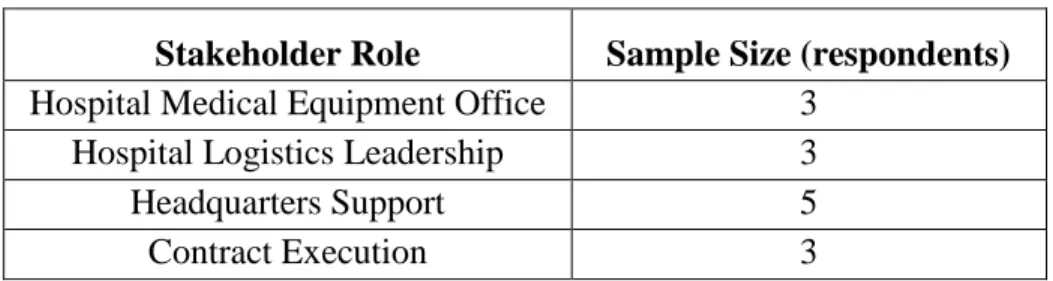
The stakeholders’ roles represented in the interviews include the following roles:
Hospital Medical Equipment Office, Hospital Logistics Leadership, Headquarters
Support Staff, and Contract Execution. The stakeholder interview sampling size is shown in Table 1.
Table 1. Stakeholders Interviewed
Stakeholder Role Sample Size (respondents)
Hospital Medical Equipment Office 3
Hospital Logistics Leadership 3
Headquarters Support 5
Contract Execution 3
One stakeholder group targeted was the Hospital Medical Equipment Office stakeholders at three large hospitals. Another stakeholder perspective came from the Hospital Logistics Leadership at the same large hospital locations. At the Headquarters Support group, the stakeholder perspectives stemmed from an Air Force medical headquarter and contracting headquarter in effort to capture the strategic outlook in the equipment process. Another interview perspective represented the Contract Execution
stakeholders, which were the participants involved in the actual contract award activities completed at the centralized contracting level and the decentralized contracting level. This sampling across the different stakeholder roles created an opportunity for an in-depth look in understanding the attitudes concerning the procurement process.
Research Instruments
In total 13 interviews were conducted in gathering the data with respondent’s
consent. Nine interviews occurred face-to-face while five interviews were carried out over the telephone. All interviews were recorded with the respondent’s consent. For recording the interviews, the iPhone’s ‘Voice Memo’ application served as the recoding mechanism in all of the interviews. The interview would only be recorded after
discussing the interview purpose and protocol. For the interviews conducted over the phone, a telephone functioned as the communication device in contacting the
interviewees. With the ‘speaker phone’ feature on the telephone enabled, the interview audio content was again captured using the iPhone’s ‘Voice Memo’ application. In transcribing the interview audio files, the InqScribe software was utilized in order to listen and develop interview transcripts. The Modern Day Scribe transcription service was also utilized in transcribing interviews.
Procedure of Gathering the Data
Prior to conducting interviews, the interviews were arranged according to an established time and date. The interview scheduling aspect employed a combination of
e-mail correspondence and telephone calls in reaching out to interview participants. After the interview dates were confirmed with each participant, interviews occurred according to a pre-defined schedule and format (face-to-face or telephone format).
The key tool in facilitating the interview flow was the interview question guide,
which was modified accordingly to the respective stakeholder group being interviewed. Using the semi-structured interview approach, the interview guide revolved around open-ended questions which covered various aspects relating to the Air Force medical
equipment procurement. As Magnusson and Marecek (2015) highlight, open-ended questions enable participants to speak in their own terms. Observing this principle, this research pursued open-ended question in effort to encourage the respondents to offer candid perspectives regarding the medical equipment process. A sample of the interview guide is shown in Appendix I. During and after each interview exchange, key
observations and notes were documented on memos from the stakeholder discussion.
Upon interview completion, the audio files of the interview were transferred from
the iPhone onto the computer. This afforded the ability to review to the interview audio file and generate near verbatim transcripts of the dialogue recorded.
Coding Pilot Coding
With the transcripts developed and reviewed, a pilot coding was completed that captured the overall meaning and themes from each stakeholder group surveyed. Miles and Huberman (1994) explain that codes, which work as tags or labels, give meaning to
information compiled in a study. The overall goal in coding promotes the categorization of sentences or paragraphs into categories, which sets the stage for analysis (Creswell, 2014; Miles & Huberman, 1994). In a similar manner, coding was carried out in this research to extract meaning and themes behind the issues the stakeholders discussed concerning the equipment process. And to enter the coding phase and organization of the data, initial coding was performed to begin the coding process.
Saldaña (2009) points out that initial coding is applicable for qualitative studies
that involve data forms such as interview transcripts. In addition, initial coding introduces a starting point for analysis as codes established during the first round of coding are tentative and can be changed as the coding analysis progresses (Saldaña, 2009). Applying this concept, this research formed a preliminary code list based off the pilot interviews and notes from the interviews. After the four initial (pilot) stakeholder group transcripts were initially coded, the pilot transcripts were further coded through axial coding, which revolved around the idea of coding until the point where no additional information emerged from coding the data (Strauss & Corbin, 1998). Applying this approach, the pilot interviews were reviewed and re-coded repeatedly by consolidating codes into similar ideas and sorting the ideas into broader themes until ideas could no longer be categorized. Once the codes in the pilot interviews could no longer be matched into similar codes and placed by overall themes, the remainder of the non-pilot interviews were reviewed according to the updated code list.
Coding Continued
The interview transcript coding followed the updated code list and underwent the
coding process. Each non-pilot interview transcript was reviewed by identifying relevant text connected to the research area and codes from the code list. Similar to the pilot coding procedures, text affiliated with the research topics would be matched into the applicable idea from the established code list and highlighted on the digital transcript file. Upon coding completion on the individual interview transcripts, the coding results and excerpts were reviewed collectively in effort to understand the overall theme and code trends.
Summary
This chapter covers the methodology behind the data review and approach. It explains why the particular respondents were selected in providing data concerning the procurement process. The research instruments are discussed along with the coding procedures utilized. Based off the interviews conducted, the coding techniques sought to uncover the dominant themes and ideas regarding the Air Force medical procurement. This coding technique contributed to the next phase in this research, the data analysis.
IV. Results and Analysis
This chapter presents the results and analysis from the interview data collected
from the stakeholders engaged in the Air Force medical equipment procurement process. The research aimed to address the following: What critical factors shape the issues faced by the Air Force medical stakeholders in the equipment contract process?
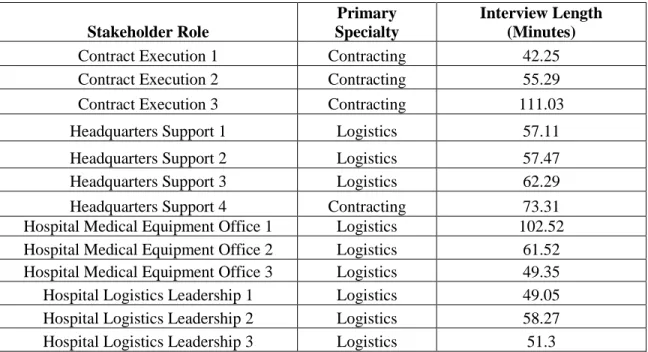
The data analysis of the interviews was carried out in accordance with the
procedures outlined in Chapter 3. A total of 14 participants provided responses across 13 interviews as shown in Table 2.
Table 2. Interview Data
Stakeholder Role
Primary Specialty
Interview Length (Minutes)
Contract Execution 1 Contracting 42.25 Contract Execution 2 Contracting 55.29 Contract Execution 3 Contracting 111.03 Headquarters Support 1 Logistics 57.11 Headquarters Support 2 Logistics 57.47 Headquarters Support 3 Logistics 62.29 Headquarters Support 4 Contracting 73.31 Hospital Medical Equipment Office 1 Logistics 102.52 Hospital Medical Equipment Office 2 Logistics 61.52 Hospital Medical Equipment Office 3 Logistics 49.35 Hospital Logistics Leadership 1 Logistics 49.05 Hospital Logistics Leadership 2 Logistics 58.27 Hospital Logistics Leadership 3 Logistics 51.3
The participants represented the medical logistics and contracting specialties. The interviewees occupied the following stakeholder roles: Hospital Medical Equipment Office (3 stakeholders), Hospital Logistics Leadership (3 stakeholders), Headquarters
Support (5 stakeholders), and Contract Execution (3 stakeholders). The average interview length totaled 63.9 minutes. Once all of the interviews were complete, the interview recordings were transcribed and coded for themes. The interview findings are discussed in the following sections.
Overall Findings
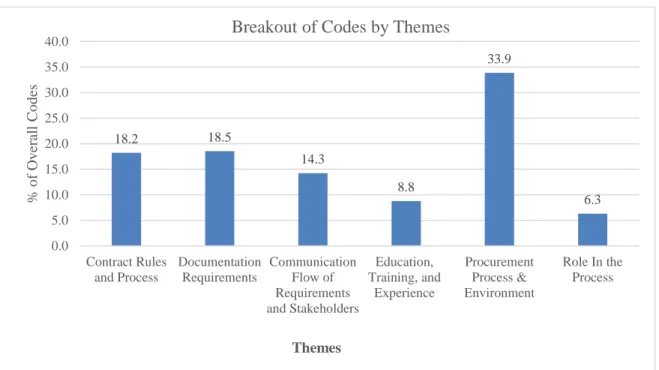
Figure 4 summarizes the themes that emerged across the interviews with the
stakeholders in the research. After coding analysis, six overall themes emerged from the interviews. Results indicate that the procurement process and environment theme constituted 40.2 percent of interview emphasis. This theme addressed the concern of the Air Force medical equipment procurement process and environment. The contract rules and process theme emerged as the second leading theme in terms of interview focus with 36.8 percent of coding representation. This theme captured the dimensions of contract package and how it communicated the needs, justification, and market research. The third leading theme in terms of degree of prevalence was the communication flow with 14.3 percent coding presence. The education, training, and experience theme marked an 8.8 percent interview coding representation while the role in the process showed 6.3 percent.
To further assess the trends in perspectives by stakeholder group, the results were broken out according to the stakeholder roles in the sections below.
Within Theme Breakouts
In the following sections, an examination of the themes split out by stakeholder
roles offered a more defined method to distinguish individual trends across the individual interview groups. The tables shown reflect the percentage a particular theme measured against the total themes coded within the respective stakeholder group and is then compared against other stakeholder groups. This normalized the measures across the stakeholder roles and offered a method to compare the results across the different stakeholder groups and within theme analysis.
18.2 18.5 14.3 8.8 33.9 6.3 0.0 5.0 10.0 15.0 20.0 25.0 30.0 35.0 40.0 Contract Rules and Process Documentation Requirements Communication Flow of Requirements and Stakeholders Education, Training, and Experience Procurement Process & Environment Role In the Process % o f O v er al l C o d es Themes
Breakout of Codes by Themes
Theme: Procurement Process and Environment
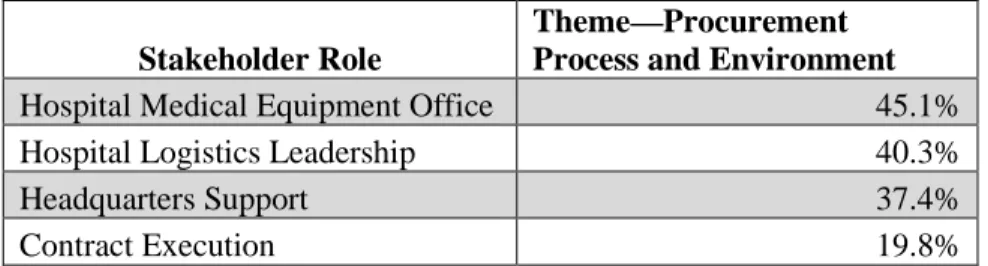
One of the prevalent themes centered on the procurement process and environment theme. Table 3 compares the results of the procurement process environment theme as an emphasis area across the stakeholder groups. Perspectives collected from this theme will be explored in the within theme analysis below. As noted in Table 3, this theme represented a major emphasis area for the Hospital Medical Equipment Office, Hospital Logistics Leadership, and Headquarters Support groups. Across these stakeholders and theme, different sub-themes under the procurement process and environment appeared as issues.
Table 3. Stakeholder Breakout: Procurement Process and Environment Theme
Stakeholder Role
Theme—Procurement Process and Environment
Hospital Medical Equipment Office 45.1%
Hospital Logistics Leadership 40.3%
Headquarters Support 37.4%
Contract Execution 19.8%
Decentralization of Contract Process
The decentralization of the contract process was one of the findings in the
procurement process and environment theme. Notably, this decentralization discussion appeared in all of the Hospital Medical Equipment Office interviews. The Hospital Medical Equipment Office stakeholders’ accounts of the shift from the centralized USAFA contracting office process to the decentralized local contracting office process carried different impressions for the Hospital Medical Equipment Office stakeholders. They agreed that the centralized to decentralized contract process transition hinged on
developing working relationships with their local contracting office. However, not all stakeholders experienced a similar transition. One stakeholder found the contracting office partnership as a seamless conversion while two other Hospital Medical Equipment Office stakeholders found the transition difficult. An example of this decentralization process and forging local contracting office partnership is demonstrated here:
“We had a meeting with contracting to give them what is going on with USAFA [contracting office].We gave the heads-up of what was going to happen, so they were expecting it. So that is why they created a medical team.”
(Hospital Medical Equipment Office Stakeholder 2)
The excerpt above illuminates the importance of relationship with the local
contracting office in the decentralization process. The Hospital Medical Equipment Office stakeholder mentions how giving an advance notice of the Air Force medical contract transition to local contracting office enabled the local contracting office to accommodate the new decentralized contracting process by developing a dedicated contract support team. The decentralized transition did not illicit the same local contracting office response and acclimation at other hospital sites.
On the other end of the spectrum, the transition proved challenging for some
Hospital Medical Equipment Office members. In discussing the local contracting office support, the Hospital Medical Equipment Office account below describes the challenges in the decentralized transition:
“Basically it [equipment package] would get sent to this person and this person, and nobody knows what is going on. Now we only have one POC (point of
contact). They will divy up the work, so if I have any questions for them, we do not have to go to a specific contract specialist...we can just go to our POC and they'll find out for us versus a million emails be thrown all over the place. That's pretty much helped a lot cause there is only one centralized POC for us to go to.
(Hospital Medical Equipment Office Stakeholder 3)
For this particular Hospital Medical Equipment Office stakeholder, the transition from the centralized contracting process developed in stages. It is noted that when the local contracting office relationship initially formed, contract packages were handled by multiple contracting point of contacts (POCs) without a central facilitator. After a single local POC was established, it helped the coordination and communication process. The variation in the transition experience appears as a critical factor in receiving local contracting office support in the equipment package process for the Hospital Medical Equipment Office stakeholders.
Timelines and Leadtimes
Another aspect related to the procurement process and environment theme
focused on the timelines and leadtimes for package review. One consideration to the timeline discussion was reviewers receiving packages in a timely manner. The timing of packages flowing through to the next level of review influenced the accuracy and currency of information contained in the contract package. The example below shows this timing issues when discussion of what prompted additional contract documentation follow-up:
“Here is the problem. When you submit the package to the company, [they] would put 30, 60 days of offer. Once that passed, AFMOA would say ‘okay the quote is already expired.’ And that's a common thing. There are a few companies that would not put expiration dates on the quotes, but the majority of them do.” (Hospital Medical Equipment Office Stakeholder 2)
The Hospital Medical Equipment Office insight demonstrates the issue with the
implications of the delayed package review. Because the content of the contract package carried a validity period on the information, problems would occur when contract
packages underwent review that contained outdated information. Another example of timeline review issues is seen below:
“Now customers are under the impression those [old] items are in process of being procured when now all those AFMOA (USAFA) folder will require paperwork and had to switchover to base contracting office. And we have to explain to them we need new documents...Customers are disgruntled due to paperwork.”
(Hospital Medical Equipment Office Stakeholder 1)
In this example, the Hospital Medical Equipment Office stakeholder describes the timeline review challenges prompting a restart of the request process, shifting customer expectations. With the decentralized the contracting process, the review of the packages prompted additional work on packages due to the expired documents and in turn resulted in disgruntled customers. This timeline challenge within the decentralization process
suggests more input and work by the customers, contributing to package issues. The timeline issue also reflected in the Hospital Logistics Leadership views.
Similar to the Hospital Medical Equipment Office stakeholders, the Hospital Logistics Leadership also highlighted the timeline issue from another angle. For this stakeholder group, it was commonly agreed that the end of fiscal year submission created short review timelines for processing packages despite the pre-established equipment suspense dates established throughout the year. The following excerpts point out the end of year timeline concerns:
“The big thing is to get people to understand you can’t come 28th September with an equipment you want to buy. It has to go through the review process.”
(Hospital Logistics Leadership Stakeholder 1)
“The level of effort is huge. And the sad thing is you see the level of effort go up September 20.” (Hospital Logistics Leadership Stakeholder 2)
These views indicate that the end of fiscal year equipment submission created challenges in having adequate package review time. In both examples above, the stakeholders experience package submissions close to the end of fiscal year. One issue cited is ensuring adequate review time. In another instance, the level of effort in
completing packages increases towards the end of fiscal year despite there being multiple equipment submission deadlines available throughout the fiscal year.
Lack of Enterprise Solution
Another issue discussed the push for a dedicated medical contract entity, ranging
from a central contracting staff setup to individual contracting support at the hospitals. One sentiment is shared when discussing the opportunities facing the equipment process: “If we can get an enterprise solution, to make contracting world amenable to making medical contracting shred-out and put them at AFMOA with the Log Chief and that be our central hub, that'd be terrific. Or maybe we embed in logistics or just send us to contracting training or have them be loggies, or build civilian directorate. But a medical contracting directorate to take care of
everything”.
(Hospital Logistics Leadership Stakeholder 1)
The stakeholder above explains the rationale for the single contracting entity below:
“Every base has different contracting officer who has different interpretation of the FAR and what they want to see and how they want to see it. So a standardized approach to handling medical contracting requirements.”
(Hospital Logistics Leadership Stakeholder 1)
The two examples demonstrate how the need for an Air Force medical contracting solution remains as an issue. The stakeholder recommends the opportunity of having a dedicated medical logistics entity, either through a central process or at the local base level where contract specialists are co-located in the medical logistics section. The
stakeholder assesses how the dedicated contracting staff would promote a standardization in the handling of medical packages. The need for an enterprise solution corresponds with the issues of another process and environment challenge, manning capacity.
Manning Challenges at the Central level
The procurement process and environment theme also captured the concern of
manning challenges. This sub-theme resonated deeply with the Headquarters Support stakeholders whose general sense suggested that the manning issues influenced the ability to support contract packages and review.
As one example, the next excerpt provides an assessment of the manning
challenges at the central contract execution level in the Air Force medical central contract process:
“Navy contracting could not, they could not keep up with our requirements… just the volume. They prioritized their [contract] over ours. Again, we were a
customer of them, [with] no control over that, so they turfed it back over to us. Then in ’15 we established a MOU with USAFA to have the 10th CONS kind of purchase our items. The problem is a lot of this is in piecemeal, and so it is temporary civilian hires that they had. They could not keep the personnel there, so it kind of imploded on itself, so we are back to square one where we do not have a dedicated contracting entity to procure these items.”
(Headquarters Support Stakeholder 2)
As the example above shows, the manning challenges persisted across the various Air Force medical central contracting arrangements. As the stakeholder explains, in both the Navy central contracting arrangement and the most recent USAFA central contracting arrangement, the designated contracting staff were unable to keep up with the volume of equipment packages brought forth by the Air Force Medical Service. It is noted that having a dedicated contracting entity supporting the medical requirements was a significant gap.
In another example, the manning shortfall for contracting support topic appeared
when discussing the timeline issues with the central Air Force medical contracting efforts:
“It depends on what part of the timeline, and I say that because I think what has happened is between the Navy and USAFA, neither one of them—they were willing to help us and were looking forward to the partnership, and I think that neither one of them had the capacity to handle the workload that we had.” (Headquarters Support Stakeholder 3)
This excerpt suggests that with the central contracting measures enacted by the Air Force Medical Service in relying on Navy medical logistics contracting and USAFA contracting, the designated contracting entities displayed commitment in supporting the Air Force Medical Service partnership. The challenge in this central contract support stemmed from the lack of capacity to handle the workload. This again hints at the central contracting ability to support Air Force medical equipment contracts.
The examples highlight the issues surrounding the procurement process and environment. One element in this context was how the decentralization of the contract process impacted stakeholders. Additionally, timelines reviews and submission windows appeared as concerns. Adding to the process and environment factors, the lack of an Air Force medical contracting cell and the lack of manning at the central contract solution signified importance.
Theme: Documentation Requirements
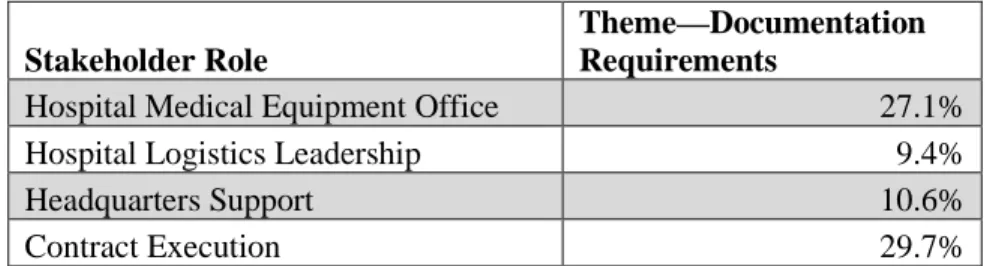
Another theme that prompted attention was the documentation requirements for contract packages. The documentation requirements theme signified a key discussion emphasis for the Hospital Medical Equipment Office stakeholders and Contract
Execution stakeholder as Table 4 indicates. These two groups placed higher emphasis on the documentation aspects when compared to the Hospital Logistics Leadership and Headquarters Support stakeholders.
Table 4. Stakeholder Breakout: Documentation Requirements Theme
Stakeholder Role
Theme—Documentation Requirements
Hospital Medical Equipment Office 27.1%
Hospital Logistics Leadership 9.4%
Headquarters Support 10.6%
Contract Execution 29.7%
Within this discussion three sub-themes appeared across all of the interviews. The
first was issue of describing the needs in a requirement. The strength of a package in its ability in justifying the requirement and need appeared as an important matter for the