
Fraud detection using data mining
90
0
0
Full text
(2) 10 .. E:A. PIE:.t-J FRAUD DETECTION USING DATA MINING. by. ABEL JACOBUS PIENAAR. SHORT DISSERTATION. submitted in partial fulfillment of the requirements for the degree. MASTER OF COMMERCE. in. COMPUTER AUDITING. in the. FACULTY OF ECONOMIC AND MANAGEMENT SCIENCES. at the. RAND AFRIKAANS UNIVERSITY. STUDY LEADER: PROFESSOR ANTON DU TOIT. JOHANNESBURG NOVEMBER 1997.
(3) FRAUD DETECTION USING DATA MINING.
(4) DECLARATION. I declare that this research essay submitted to Rand Afrikaans University for the degree Master of Commerce, except to the extent acknowledged in my text, is my own unaided work and has not been submitted previously for any degree to any other university.. ABEL JACOBUS PIENAAR.
(5) FRAUD DETECTION USING DATA MINING. Main Table of Contents. Page. OPSOMMING IN AFRIKAANS SYNOPSIS. .. '". iv. 1. CHAPTER 1 - INTRODUCTION......... CHAPTER 2 - FRAUD DETECTION. '". '". , '". '". CHAPTER 3 - DATA MINING.................................................. 17 39. CHAPTER 4 - A MODEL FOR FRAUD DETECTION USING DATA MINING............. 63. CHAPTER 5 - SUMMARY OF RESULTS AND CONCLUSiON...... 75. BIBLIOGRAPHy..................................... 78.
(6) BEDROGOPSPORING DEUR DIE MYN VAN DATA. deur. ABEL JACOBUS PIENAAR. OPSOMMING VAN SKRIPSIE INGEDIEN VIR DIE GRAAD. MAGISTER COMMERCII. in. REKENAAROUDITEURING. in die. FAKULTEIT EKONOMIESE EN BESTUURSWETENSKAPPE aan die. RANDSE AFRIKAANSE UNIVERSITEIT. STUDIE LEIER: PROFESSOR ANTON DU TOIT. JOHANNESBURG NOVEMBER 1997.
(7) FRAUD DETECTION USING DATA MINING. OPSOMMING IN AFRIKAANS. Die doel van hierdie opsomrninq is om die agtergrond, doelwitte, metodiek en gevolgtrekkings van die navorsing weer te gee en is onder die volgende hoofde uiteengesit: 1.. Agtergrond en Probleembeskrywing;. 2.. Doelwitte van die Navorsing;. 3.. Navorsingsmetodiek en -benadering; en. 4.. Gevolgtrekkings.. 1.. AGTERGROND EN PROBLEEMBESKRYWING. Bedrog is 'n probleem in Suid-Afrika en wereldwyd wat steeds aan die toeneern is.. Bestuur en ouditeure het nie 'n ge"integreerde model om bedrog in organisasies op te spoor nie en daarom is daar baie bedrog wat onopgespoor bly en nie aangespreek word nie. Navorsing het bewys dat organisasies tussen twae en vyf persentvan hulle omset verloor as gevolg van bedrog en daarom sal 'n ge'integreerde model, bestuur en die ouditeure help om bedrog in 'n organisasie op te spoor.. Dit is dus belangrik vir bestuur en ouditeure om bedrog op te spoor aangesien dit die verskil tussen winsgewendheid en bankrotskap van 'n onderneming kan beteken..
(8) FRAUD DETECTION USING DATA MINING. Van die bedrog wat gepleeg word, word gedokumenteer en vasqele in 'n databasis. Daar is dus baie data wat kan en behoort ontleed te word om bedrog in 'n organisasie op te spoor.. Nuwe tegnologie wat data 'myn', is die afgelope dekade ontwikkel en sal 'n groot hulp vir bestuur en ouditeure wees am bedrog in 'n organisasie op te spoor.. 2.. DOELWITTE VAN DIE NAVORSING.. Die hoofdoelwit van die navorsing is om vir bestuur, eksterne- en interne ouditeure 'n gei"ntegreerde model te ontwikkel wat hulle sal help om bedrog in organisasies op te spoor. Die model sluit die proses om data te myn in en dit sal verseker dat die opsporing van bedrog meer doeltreffend en doelmatig sal wees.. Verder moet die ge"integreerde model wat bestuur en ouditeure sal help om bedrog op te spoor, waarde byvoeg tot die organisasie.. 3.. NAVORSINGSMETODIEK EN BENADERING. Die navorsingsmetodiek wat gevolg is het uit die volgende komponente bestaan:. •. 'n Literatuurstudie van bestaande gesaghebbende literatuur oor bedrogopsporing en die myn van data;. •. 'n Model van bedrogopsporing is ontwikkel en die verskillende prosesse van kennisontdekking in databasisse (myn van data) ontleed; en. ii.
(9) FRAUD DETECTION USING DATA MINING. •. 'n Ge'integreerde model van bedrogopsporing deur gebruik te maak van die myn van data is ontwikkel.. 4.. GEVOLGTREKKING. Die ontwikkelde gei'ntegreerde bedrogopsporingsmodel sal bestuur en ouditeure help om bedrog in organisasies op te spoor. Beskikbare tegnologie (myn van data) sal ook help om die bedrog meer doelmatig en doeltreffend op te spoor.. iii.
(10) FRAUD DETECTION USING DATA MINING. SYNOPSIS. Fraud is a major problem in South Africa and the world and organisations lose millions each year to fraud not being detected.. Organisations can deal with the fraud that is known to them, but undetected fraud is a problem. There is a need for management, external- and internal auditors to detect fraud within an organisation. There is a further need for an integrated fraud detection model to assist managers and auditors to detect fraud.. A literature study was done of authoritative textbooks and other literature on fraud detection and data mining, including the Knowledge Discovery Process in databases and a model was developed that will assist the manager and auditor to detect fraud in an organisation by using a technology called data mining which makes the process of fraud detection more efficient and effective.. iv.
(11) FRAUD DETECTION USING DATA MINING. Chapter 1 : INTRODUCTION Table of Contents. Page. 1.1. BACKGROUND AND PROBLEM DESCRiPTION......... ........ 2. 1.2. OBJECTIVE OF THIS RESEARCH.................................... 6. 1.3. SCOPE AND EXCLUSIONS.... 7. 1.4. DEFINITIONS. 1.5. RESEARCH METHODOLOGy..................................... 13. 1.6. RESEARCH APPROACH............... 13. 1.7. SUMMARY OF RESULTS. 1.8. CONCLUSION.... '". '". '". ". 10. '". '". . 14 16. List of Figures Figure 1.1 - CALCULATION OF UNDETECTED FRAUD.................. 5. Figure 1.2 - DEALING WITH FRAUD: A PRO-ACTIVE MODEL.... 8. Figure 1.3 - STRUCTURE OF SHORT DISSERTATION........ , .... 14.
(12) FRAUD DETECTION USING DATA MINING. 1.1. BACKGROUND AND PROBLEM DESCRIPTION. Because of the problem of fraud in business (as discussed below), there is a need for an integrated fraud detection model to assist management and auditors to detect fraud. This integrated model will enable management and auditors of the organisation to identify previously undetected fraud and enable management to investigate and ultimately develop controls to prevent such fraud from recurring in the future. One of the technologies available to help with the detection of fraud is data mining.. In the section that follows the seriousness of , the fraud problem and the difficulty to detect it will be discussed. Secondly a method to calculate the potential undetected fraud in an organisation is explained and thirdly the need for using data mining to help to detect fraud. in organisations is .discussed.. 1.1.1 Fraud problem Fraud is a world wide problem and no organisation is totally immune to this problem.. Commercial crime has increased throughout the world, and South Africa is no exception. It is well documented that the financial costs of commercial crime far exceed the value of all street crime. According to official statistics of reported cases, more than 29 000 cases with an estimated cost of more than R7 billion were under investigation by the SAPS Commercial Branch .during 1996. About 80 percent of these cases involved fraud. In addition, the Office for Serious Economic Offences (OSEO) was investigating 33 cases involving approximately R8.5 billion (ISS,1997:11).. 2.
(13) FRAUD DETECTION USING DATA MINING. The Nedcor (1997:019) monthly overview of crime stated that the value of commercial crime cases reported to the commercial police had increased 37 percent to R3,8 Billion last year (1996) compared with 1995, clearly indicating South Africa's vulnerability to organised crime and money laundering.. Commercial crime that includes fraud can be a major threat to the continued existence of an organisation. Albrecht (1995:9) states that thirty percent of all business failures are caused by white-collar crime.. The above mentioned information clearly illustrates the serious threat fraud holds for South African business.. Furthermore fraud is a crime that is difficult to detect. Albrecht (1995:55) states the following: "Fraud is a crime that is seldom seen. If a body is discovered and the person has obviously been murdered, there is no question whether or not a crime has been committed. The dead body can be touched, seen, and even smelled. Likewise, if a bank is robbed, there is no question whether or not a crime has been committed. Everyone in the bank, including customers and employees, witnessed the robbery. In most cases, the entire episode is captured on video and can be replayed for evidence. But with fraud it is not initially certain that a crime has been committed. Onlv the fraud symptoms, red flags, or indicators are. seen. ". 1.1.2 Calculation of undetected fraud in an organisation ... '- ,,'-~. Action on reported (known) cases of fraud in an organisation is not difficult. It is the unreported (unknown) cases that are difficult to respond to.. 3.
(14) FRAUD DETECTION USING DATA MINING. To begin with, any manager or auditor can calculate the potential fraud problem in an organisation as shown by research outlined below: Research has shown that, in a broad cross-section of companies in both the US and Europe, an average of between 2 per cent and 5 per cent of turnover is lost to fraud every year. The· British home secretary has said that the current cost to industry in the UK is £10 billion annually, whilst losses in the USA have been described as somewhere between what the federal government spends on health and what it spends on defence. For some companies the losses clearly amount to millions. For others it can mean the difference between profit and loss, especially in the areas such as manufacturing where profits as a percentage of turnover are often expressed only in single figures. For hundreds of American banks, it can mean total collapse (Price, 1991:50).. By using the average of between 2 and 5 present of turnover as. indicated in the research a person can for example calculate the potential fraud that is undetected in an organisation. If company XYZ Limited's turnover is R100 million per year the company could lose between two and five million rand to fraud. The difference between the reported fraud in the company and the potential fraud is the undetected fraud. For example, if the reported fraud in XYZ Limited is R 1 million, then the undetected fraud will -. .. be between R1 million and R 5 million. Refer to Figure 1.1. Calculation of undetected fraud. After the identification of the potential undetected fraud management should take action to trace the undetected fraud. By developing an integrated fraud detection model management and auditors will be assisted in detecting fraud..
(15) FRAUD DETECTION USING DATA MINING. Figure 1.1 - Calculation of undetected fraud (Prepared by author) XYZ Limited R 5 Million (Potential) R 4 Million R 3 Million. UNDETECTED FRAUD. R 2 Million R 1 Million (Actual). REPORTED FRAUD FRAUD \. 1.1.3 Need for data mining Fraud is hidden in databases like diamonds in a mine. World-wide the contents and number of databases are growing rapidly. "By 1989 there were an estimated 5 million databases world-wide. The total amount of information in the world is estimated to be doubling every 20 months, and much of this is being stored in computer databases" (Davidson, 1993:28). .. Adriaans (1996:2) explains that hundreds of megabytes of data are distributed around the world every day, that the growth is exponential and that more data means less information.. Adriaans (1996:5) also states that the unbridled growth of data will inevitably lead to a situation in which it is increasingly difficult to access the desired information: it will be like looking for a needle in a haystack, only the amount of hay will be growing all the time. It is against this. 5.
(16) FRAUD DETECTION USING DATA MINING. background that the great interest that is being shown in the new field of 'data mining' or KDD (Knowledge Discovery in Databases) is understandable. When mining, enormous quantities of debris have to be removed before diamonds or gold can be found. The analogy that, with a computer, you can automatically find one 'information-diamond' among the tons of data-debris in your database, is of course very attractive.. Fayyad (1996: 1) states that the explosive growth of many business, government, and scientific databases has far outpaced our ability to interpret and digest thisdata, creating a need for a new generation of tools and techniques for automated and intelligent database analysis. These tools and techniques are the subject of the rapidly emerging field of knowledge discovery in databases (KDD) which includes data mining. Data mining technology turns raw data into information that can be used by an organisation and that can be acted upon and can also assist an organisation in detecting fraud and should form part of the integrated fraud detection model.. 1.2. OBJECTIVE OF THIS RESEARCH. The objective of this short dissertation is to develop an integrated fraud detection model that includes the use of data mining (included in the knowledge discovery process) to assist management, external auditors and internal auditors to detect fraud.. A further objective is that this fraud detection model should add value to organisations,. enabling them to detect efficient manner.. 6. fraud in a more effective and.
(17) FRAUD DETECTION USING DATA MINING. 1.3. SCOPE AND EXCLUSIONS. 1.3.1 Scope This short dissertation focuses on fraud detection with specific reference to identifying fraud symptoms, indicators and red flags and the most common frauds committed in business and the use of data mining to detect fraud. The Knowledge Discovery in databases (KDD) process will also be covered.. According to Adriaans (1996:37) this knowledge discovery process (which includes data mining), consists of six stages: •. Data selection;. •. Cleaning;. •. Enrichment;. •. Coding;. •. Data Mining; and. •. Reporting.. This dissertation will deal with each of the above-mentioned stages.. 1.3.2 Exclusions. There are twelve stages for dealing with fraud according to Albrecht (1995:278-281) as indicated in Figure 1.2. This dissertation only deals with stage twelve, namely pro-active fraud auditing (also known as fraud detection).. 7.
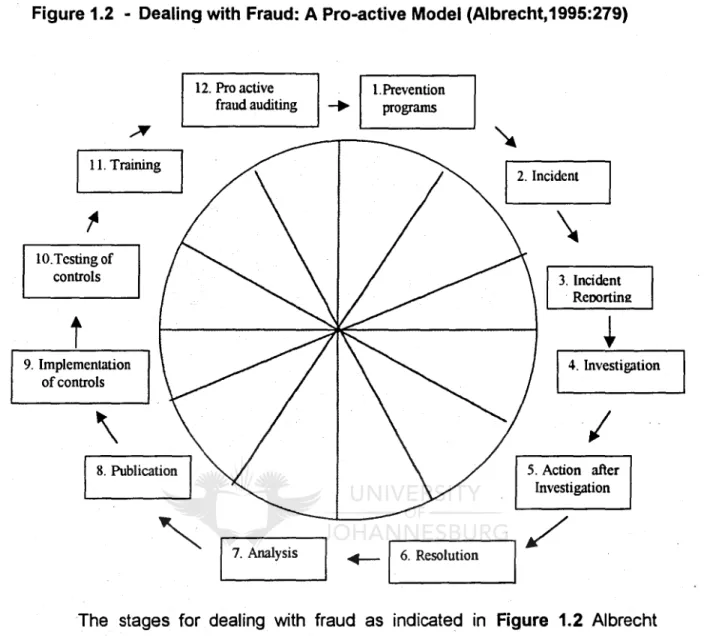
(18) FRAUD DETECTION USING DATA MINING. Figure 1.2 - Dealing with Fraud: A Pro-active Model (Albrecht,1995:279). 12. Pro active fraud auditing. -.. 1.Prevention programs. I. 11.Training. 2. Incident. \ 10.Testing of controls. 3. Incident Reoortinz. t. 9. Implementation of controls. 4. Investigation. I. \. I 8. Publication. 5. Action after Investigation. 1. 7. Analysis. I -1.. 6. Resolution. The stages for dealing with fraud as indicated in Figure 1.2 Albrecht (1995:278-281) are discussed below:. •. Stage 1 - Prevention program Stage 1 is the implementation of prevention programmes designed to educate employees about the seriousness of the problem and to tell them what to do if they suspect fraud.. •. Stage 2 - Incident The. second stage will. be a fraud incident.. Unfortunately, no. organisation can totally eliminate fraud, no matter how good its 8.
(19) FRAUD DETECTION USING DATA MINING. prevention programmes are. However, detecting fraud early is the key to minimising its impact on the organisation.. •. Stage 3 - Incident reporting. The third stage involves fraud reporting. It is extremely important that fraud reporting is facilitated.. •. Stage 4 - Investigation. The procedures are well established and includes: (a) who will the investigation; (b) how the matter will be communicated management; (c) whether and when law enforcement officials will contacted; (d) who will determine the scope of investigation;(e) who will determine investigation methods; (f) who will follow up on tips. of suspected fraud; (g) who will conduct interviews, review documents, and perform other investigation steps; and (h) who will ultimately determine the corporate response to fraud, disciplines, control, etc.. •. Stage 5 - Action. A strong prosecution policy must have the support of top management and top managers.. •. .. Stage 6 - Resolution. Resolution includes replacing the employee, counselling fellow . employees, entering into restitution agreements, and closing the case. •. Stage 7 - Analysis. Analysis involves determining how and why the fraud occurred by people in management, audit, security, human resources, control, and finance.. 9.
(20) FRAUD DETECTION USING DATA MINING. •. ,;. Stage 8 - Publication. Publication means depersonalising the case and publishing it internally in a newsletter or memo that is distributed to auditors" security personnel and appropriate management and employees. ;". •. Stage 9 - Implementation of controls. This stage involves the explicit implementation of the other measures necessary to prevent future occurrences of fraud.. •. Stage 10 - Testing for compliance. This stage includes the testing of controls for compliance.. •. ';c'i'. Stage 11 - Training. Involves the fraud training of appropriate audit, management:;;secJ;ity, and other personnel.. •. Stage 12 - Proactive fraud aUditing. Pro active fraud auditing (also known as fraud detection) involves proactively auditing for fraud, using discovery sampling and computer query procedures auditors identify fraud characteristics and search databases looking for them. This short dissertation covers only Stage 12 of the pro-active model for dealing with fraud.. 1.4. DEFINITIONS. A definition of the following words is needed to clarify the use of the ~rds . in this short dissertation:. 10.
(21) FRAUD DETECTION USING DATA MINING. •. Data. Adriaans (1996:133) defines data as any symbolic representation of facts or ideas from which information can potentially be extracted. Quantities or characters operated on by a computer (Oxford,1990:294).. •. Database. A database is a large collection of data, mostly, stored in a computer. system (Adriaans, 1996:133). A structured set of data held in a computer (Oxford, 1990:294).. •. Data Mining. The actual discovery phase of a knowledge discovery process (also refer to KDD) (Adriaans, 1996:133).. "Data. mining is the. process. of discovering. meaningful. new. correlations, patterns, and trends by sifting through large amounts of data. stored in repositories. and by using. pattern recognition. technologies as well as statistical and. mathematical techniques. The Gartner Group" (Berry, 1997:96).. •. Data warehouse. Adriaans (1996:133) defines a data warehouse as a subject-orientated, integrated, time-variant, non-volatile collection of data in support of management.. 11.
(22) FRAUD DETECTION USING DATA MINING. •. Effective. Having a definite or desired effect (Oxford, 1990:374).. •. Efficient. Productive with minimum waste or effort (Oxford, 1990:374).. •. Fraud. Snyman (1989:504) defines fraud as the unlawful and .intentional making of a misrepresentation which causes actual prejudice or which' is potentially prejudicial to another. Fraud is criminal deception; the use of false representations to gain an unjust advantage (Oxford, 1990:467).. •. Fraud Detection. Detection of fraud includes the steps or actions taken to discover fraud has been committed. Detection does not include investigative procedures. taken. to. determine. motive,. extent,. method. of. embezzlement, or other elements of the dishonest act (Albrecht, 1995:53). •. KDD. KDD is knowledge discovery in databases, the non-trivial extraction of implicit, previously unknown, and potentially useful information from data (Adriaans, 1995:135).. 12.
(23) 1..':".. :-,',. '".,. FRAUD DETECTION USING DATA:MINING. 1.5. RESEARCH METHODOLOGY. The following methodology was employed in performing the research:. •. A literature survey has been done of existing authoritative textbooks <.;. and other literature, as well as dlscussions.wtth people with technical knowledge, on fraud detection and data mirilng (chapters 2 and 3).. •. With all the information obtained in the literature survey, an integrated ,,;:::r~,~'<'. model for fraud detection using data miring, has been developed (chapter 4).. 1.6. RESEARCH APPROACH. This dissertation is summarised in. Figu~e 1.3: (p.14) "v)'". explained below:?~;,:,' '. and the rationale is .. ".'. .~ ~. '.,: ~. •. -: i:. •. Chapter 1 discusses the problem of fraud and establishes the need for an integrated fraud detection model.. •. In chapter 2, the role of management, external and internal auditors in fraud detection is discussed. The fraud detection process is also discussed in detail with specific reference to fraud symptoms, red flags, fraud indicators and the most commontypes of fraud.. •. Chapter 3 gives a description of data mining and discusses the evolution and techniques of data mining. The process of knowledge discovery, of which data mining is a part, is also described and reference is made to different frameworks.. 13.
(24) FRAUD DETECTION USING DATA MINING. •. In chapter 4, Fraud detection and data mining processes (discussed in chapter 2 and 3) are integrated and a model for fraud detection using data mining, is developed.. •. Finally, chapter 5 summarises the results, and concludes the short dissertation and indicates whether the objectives of this short dissertation have been met.. Figure 1.3 - Structure of short dissertation. (Prepared by author). Chapter 1. Introduction. +. Chapter 2,. Fraud Detection. +. Chapter 3. Data Mining. +. Chapter 4. A model for Fraud Detection using Data Mining. . + . Chapter 5. Summary of results and conclusion • 1.7. SUMMARY OF RESULTS. Chapter 2 - Fraud Detection The role of management, external and internal auditare discussed in this chapter. They all have a very important role to play in detecting fraud as could be seen from their responsibilities. 14.
(25) FRAUD DETECTION USING DATA MINING. A fraud detection process was also developed and the steps to detect fraud were set out as follows: •. Step 1 - Identify the fraud symptoms, indicators and red flags in the organisation;. •. Step 2 - Identify the common fraud areas in the organisation;. •. Step 3 - Identify the high fraud risk areas; and. •. Step 4 - Audit for fraud by using a technology called data mining.. Chapter 3 - Data Mining. Data mining is part of the knowledge discovery process and cannot be viewed in isolation. The knowledge discovery process was discussed in detail in this chapter and the main steps in the knowledge discovery process are the following: . •. Step 1 -. Information requirement;. •. Step 2 -. Data Selection;. •. Step ~ -. Data Cleaning;. •. Step 4 -. Data Enrichment;. •. Step 5 -. Data Coding I Reduction;. •. Step 6 -. Data Mining;. •. Step 7 -. Interpretation 1 Reporting;. •. Step 8 -. Action; and. •. Step 9 -. Measurement and Evaluation.. The fraud detection process as discussed in chapter 2 resorts under Step 1 of the knowledge discovery process and takes place before the. real knowledge discovery.. In chapter 4 the knowledge discovery processes discussed in this chapter are combined to best fit the integrated fraud detection model. 15.
(26) FRAUD DETECTION USING DATA MINING. Chapter 4 • Model for Fraud detection using Data Mining. An integrated model for fraud detection using data mining was developed which will assist management and the auditor to understand fraud detection and to detect fraud using data mining.. Management and the auditor need to understand that detecting fraud is not an easy task, but if the above-mentioned model is followed, it would help them to detect fraud in an organisation.. 1.8. CONCLUSION. Fraud is a serious problem for business in South Africa and the world. Management and auditors need a model to detect fraud in organisations. An effective and efficient way of detecting fraud is by using a technology called data mining.. The objectives set out in this chapter have been reached: An integrated fraud detection model has been developed for detection of fraud by using the data mining technology which forms part of the knowledge discovery process and the model will assist management, external and internal auditors to detect fraud ,when it is required of them to do so. This model will also add value to organisations and enable them to detect fraud in a more effective and efficient way.. A suggested area for further research could be to explore the other stages of the process of dealing with fraud as described in paragraph 1.3.2 (p.8). •. for example prevention, and link them to a relevant technology that can assist management and the auditor in their fight against fraud.. 16.
(27) FRAUD DETECTION USING DATA MINING. Chapter 2 : FRAUD DETECTION Table of Contents. Page. 2.1. INTRODUCTION....................................... 18. 2.2. NATURE OF LITERATURE SURVEy.......... 18. 2.3. SCOPE, LIMITATIONS AND EXCLUSIONS.... 19. 2.4. OBJECTIVES OF THIS CHAPTER.... 20. 2.5. ROLE OF MANAGEMENTAND AUDITORS IN FRAUD DETECTION... ... ... ... ... ... ... ... ... ...... ... ... ... ..... 2.6. 21. FRAUD SYMPTOMS, RED FLAGS AND FRAUD INDiCATORS....... 24. 2.7. COMMON FRAUD AREAS.... 35. 2.8. FRAUD DETECTION PROCESS...... ... ... ...... ...... ... ... ...... 36. 2.9. CONCLUSiON................... ·38. List of Figure Figure 2.1 - FRAUD DETECTION PROCESS.... 17. . 36.
(28) FRAUD DETECTION USING DATA MINING. 2.1. INTRODUCTION. Fraud is a serious business problem in South Africa today. Management and auditors need to know the process of detecting fraud in organisations to assist them in detecting fraud.. By detecting and dealing with fraud in an organisation, the organisation will be more profitable. The detection of fraud will also help the organisation to identify the areas of vulnerability. The organisation can then create and implement the necessary controls in those vulnerable areas to prevent fraud in the future.. 2.2. NATURE OF LITERATURE SURVEY. To ensure credibility and acceptance of the findings and proposals of this short dissertation, it is essential that the underlying concepts should be based on authoritative views and be generally accepted among management in general and audit professionals. References have been restricted to those published by fraud experts and to authoritive technical books and publications by computer experts. The main authors/publishers are: •. Albrecht, Wernz and Williams;. •. Huntington and Davies;. • Adriaans and Zantinge; and •. Berry and Linoff.. The reasons for choosing these authors are the following:. •. •. W. Steve Albrecht is the Director of the J. Willard and Alice S. Marriott School of Management at Brigham Young University. He has consulted with numerous organisations on the problem of fraud, including IBM, 18.
(29) FRAUD DETECTION USING DATA MINING. the FBI, Deere & Co, Caterpillar, Alcoa, Bank of America, and many others. Albrecht is the past president of the National Association of Certified Fraud Examiners. •. Ian Huntington is Head of Fraud Investigation at KPMG Forensic Accounting, London. He is one of KPMG's fraud specialists. KPMG Forensic Accounting has 90 specialist partners and staff in the UK assigned to investigate fraud and assisting with the litigation process full time.. •. Pieter Adriaans is a director of Syllogic, where he is responsible for the development of tools for the management of client/server systems and databases. The basis for Syllogic's activities in this area is the integration of artificial intelligence techniques, machine learning, object orientation and database management. This author has published extensively in the area of systems management, machine learning and client/server.. •. Michael J.A. Berry is a principal at MRJ Technology Solutions, a Pennsylvania-based firm specialising in data warehousing and data mining for business applications. He also conducts seminars on data mining for Fortune 100 companies.. 2.3. SCOPE, LIMITATIONS AND EXCLUSIONS. 2.3.1 Scope. Relevant literature was surveyed for any reference to fraud detection and data mining. The literature was then further surveyed to understand the processes involved in data mining (KDD) and the detection of fraud to develop an integrated model for fraud detection using data mining. 19.
(30) FRAUD DETECTION USING DATA MINING. 2.3.2 Limitations and exclusions The following limitations and exclusions were placed on the scope of the literature survey:. Fraud Detection. •. There is limited literature available that deals specifically with fraud detection.. •. Available literature is either criminal law and legal literature or literature covering the investigation of fraud.. •. Only fraud detection was focussed on, the other stages for dealing with fraud is excluded (refer to paragraph 1.3.2).. •. It was possible to get authoritive literature on fraud detection as used in this short dissertation.. Data Mining. 2.4. OBJECTIVES OF THIS CHAPTER The primary objective of this chapter is to describe the role of management, external and internal auditors in detecting fraud, as well as a utilising a method to detect fraud in a business environment by identifying 20.
(31) FRAUD DETECTION USING DATA MINING. fraud symptoms, red flags and fraud indicators and the more important common fraud areas in business to assist management and the auditor to detect fraud.. The secondary objective is to develop a fraud detection process diagramme for building an integrated fraud detection model in. ch~Pter 4,. that will help management,external and internal auditors to detect fraSd~)'"·· 2.5. ROLE OF MANAGEMENT AND AUDITORS IN FRAUD DETECTION. It is important to understand the role of management, external audit and internal audit in the detection of fraud. They all have a role to play in the detection of fraud as discussed below. 2.5.1 Role of Management and External Auditors In the statement of SAICA (1992: AU 005:3) the responsibility of management is described as follows:. "The responsibility for the prevention and detection of illegal acts, other irregularities and errors within the entity rests with management. Management of the entity act in a fiduciary capacity in relation to the property that is under their control and it is their responsibility to ensure that the entity's operations are conducted in accordance with all relevant legal obligations." In the statement of SAICA (1992: AU 005:4) the responsibility of the external auditor is described as follows:. "The auditor is not responsible for preventing. illegal acts, other irregularities and errors. The fact that an annual audit is carried out and. 21.
(32) FRAUD DETECTION USING DATA MINING. that the auditor would normally report on illegal acts, other irregularities and errors which come to his/her attention may act as a deterrent. Reports to management may highlight areas where illegal acts, other irregularities or errors could occur and suggest practical steps which, if implemented, may help to prevent illegal acts, irregularities or errors.. The auditor's responsibility is to plan, perform and evaluate audit work in such a way that there is a reasonable expectation of detecting material misstatements in the financial information which result from illegal acts, other irregularities and errors, and which affect the fair presentation of the financial information.". Sawyer (1988:1004), refers to the case of In re Kingston Cotton Mill Co., Limited (No.2), (1896 2 Ch.279) where the court determined the following: "It is the duty of an auditor to bring to bear on the work he has to perform that skill, care and caution which a reasonably competent, careful, cautious auditor would use... An auditor is not bound to be a detective, or, as was said to approach his work with suspicion or with the foregon.e conclusion that there is something wrong. He is a watchdog, but not a. bloodhound .,. If there is anything calculated to excite suspicion he should probe it to the bottom, but in the absence of anything of that kind, he is only bound to be reasonably cautious and careful.... II. Taking note of the above-mentioned, it is in my opinion still important that the external auditor will identify the material frauds during the external audit process. To assist him with this he should know the fraud symptoms, red flags, fraud indicators and common fraud areas.. Grant Thornton (1997:1) says that a new development is that the Auditing Standards Board (ASB) of the American Institute of Certified Public Accountants (AICPA) has released its proposed Statement on Auditing 22.
(33) ". FRAUD DETECTION USING DATA MINING -'.. Standards (SAS) titled Consideration of fraud in a Financial Statement Audit in May 1996 and that the driving force for the new standard is to enhance auditors' performance in detecting material misstatements of financial statements because of fraud. A key feature of the proposed standard is a list. '~f, fraud. factors that auditors should look for in every. engagement. These ifrau'(j' fa'~tors relate to fraud symptoms, indicators and red flags which'are discussed in section 2.6 of this chapter.. 2.5.2. Role of Internal Auditors. Sawyer" (1988:1006) refers to the Statement on Internal Auditing NO.3 which' expands'bri' the responsibilities of internal auditors with respect. fra~cl.The major60rich.JsionS of the statement regarding the detection of f~aud~re asf611~ws: to. "Internal aUditors should have sufficient knowledge of fraud to be able to identify. indicators that fraud might have been committed: If significant. cont~olT~eaknesses are. detected, additional tests conducted by internal. auditors should include tests directed toward identification of other indicators of fraud. Internal auditors are not expected to have equivalent to that of a person whose primary responsibility is to detect fraud.". Fraud is therefore a significant business issue and the internal auditors should be trained in and know fraud symptoms, red flags, fraud indicators and common fraud areas to help them detect fraud.. 23.
(34) FRAUD DETECTION USING DATA MINING. 2.6 FRAUD SYMPTOMS, RED FLAGS AND FRAUD INDICATORS. The detection of fraud begins with identifying symptoms, indicators, or red flags that can be associated with fraud (Albrecht, 1995:53).. The first step in detecting fraud in a business is to identify the fraud symptoms, indicators, or red flags in the business and it is very important for management and auditors to know what the fraud symptoms, indicators or red flags are to detect or identify a possible case of fraud. For this reason fraud symptoms, indicators or red flags are discussed in detail in this section.. Fraud symptoms, indicators and red flags are usually the only elements of an undetected fraud that are visible. The more symptoms, indicators and red flags recognised in an organisation, the greater the probability of fraud.. Fraud symptoms, indicators or red flags will be discussed under the following headings: •. Operating performance anomalies;. •. Organisational structure;. •. Management characteristics;. •. Accounting anomalies;. •. Relationships with other parties;. •. Extravagant lifestyle;. •. Unusual behaviour;. •. Tips and complaints; and. •. Investment fraud symptoms.. 24.
(35) FRAUD DETECTION USING DATA MINING'{ , ....•... ,. 2.6.1 Operating performance anomalies. ,. j.~~};;' ... ,\:\"; ,;{.". Albrecht (1995:60) states that operating performance'~n6malies include .1-'.'". red flags identified by analysing financial statements' ")and other .:,:/,. .:.;~. organisation reports. Common operating performance anomalies jnclude: •. Unexplained changes in financial statement balances;. •. Operating on an crisis basis;. •. Urgent need to report favourable earnings;. •. Unusual or large and profitable transactions near the end of accounting periods;. •. Deteriorating quality of earnings;. •. Insufficient capital;. •. High debt or interest burdens;. •. Difficulty in collecting receivables, or other cash flow problems;. •. Expenses increasing faster than revenues;. •. Dependence on only one or two products; and. •. Significant litigation.. f,i. Albrecht (1995:60) gives the folloWing. true example to explain' the. operating performance anomaly: "An example in which some of these symptoms indicated fraud was the recent financial statement fraud discovered at Comptronix Corporation. The fraud involved misstated financial statements and was supposedly . recognised by a college professor who, after analysing the company's annual report, noticed that sales increased but receivables didn't and that inventory increased but accounts payable and purchases didn't. These unexplained and irrational changes in financial statement relationships did not make sense. They occurred because the management of Comptronix overstated sales and inventory to increase reported net income." .. 25.
(36) FRAUD DETECTION USING DATA MINING. Other operating performance anomalies (business risks) are: •. Profits well in excess of industry norm; and. •. Liquidity problems (Huntington, 1994:18).. 2.6.2 Organisational structure anomalies. Organisational structure symptoms include attributes of an organisation that are unreasonable and/or do not have a legitimate reason for existence. Common symptoms of this type include: •. Unduly complex business structure;. •. Lack of effective internal audit staff;. •. High-risk industry;. •. Severe obsolescence of assets;. •. Changes in executives or directors; and. •. Significant transactions by related parties (Albrecht, 1995:62).. An specific example regarding organisational structure anomalies given by Albrecht (1995:63) was that of Charles Keating, creating a complex business structure at Lincoln Savings involving over 15 separate business entities. Having various subsidiaries sell and buy real estate, while other subsidiaries borrowed and loaned money, the impression was created that transactions were separate from each other. This complex business structure was set up to hide management fraud.. 2.6.3 . Management characteristics. Management characteristic symptoms include attributes of executives that signal a strong motivation to be dishonest or a high risk of fraud. According to Albrecht (1995:62) common fraud indicators of this type are: •. Executives with high personal debt or financial needs;. •. Executives with questionable or criminal backgrounds; 26.
(37) , FRAUD DETECTION USING DATA MINING. •. Executives who are involved extensively in gambling or speculative transactions;. •. Dishonest or unethical management;. •. Executives whose financial success is closely tied to the success of the .,\.: 51:. organisation; and ",';>. •. Executives who don't have lives separate from the organisation.. Huntington (1994:9-10) identifies other management. characteristic. symptoms as: •. Autocratic management style; and. •. Mismatch between personality and status. {".'::~~ ~. The following symptoms could be added to the list •. Executives that disregard internal controls and;. •. Executives. thatdii~r~ga;a' internal and external audit reports.. 2.6.4 Accounting anomalies. 27.
(38) FRAUD DETECTION USING DATA MINING. •. Document sequences that don't make sense;. •. Questionable handwriting on documents; and. •. Photocopied documents.. "A major difference between auditors and examiners who detect fraud and those who.don't, is that most auditors merely match documents to see whether support exists and is adequate. Auditors and examiners who detect fraud go beyond ascertaining the mere existence of documents to determine whether ,'. the documents are real or fraudulent, whether the '. ,. expenditures make .sense, and whether all aspects of the documentation are in order. (Albrecht, 1995:57).. Business Fraud Detection Services (1997:2) says that when funds,. merch"a~dise,' or assets are stolen and not covered by a fictitious entry, the general ledger will be out of balance. An inventory of the merchandise or . ','. cashIsneeded to confirm the existence of the missing assets. >'-'~',. It iSinlportantto: be aware of accounting anomalies, it could be an easy way. t~ dete6tf~aGd.. 2.6.5 Internal control weaknesses Internal control includes the control environment, the accounting system and control procedures. Albrecht (1995:93) states that common internal control fraud symptoms are: •. lack of segregation of duties;. •. lack of physical safeguards;. •. lack of independent checks;. •. lack of proper authorisation;. •. lack of proper documents and records;. •. Overriding of existing controls; 28.
(39) FRAUD DETECTION USING DATA MINING. •. Inadequate accounting system and that many studies have found that the element most common in frauds is the overriding of existing internal controls.. Usually internal controls do exist in an organisation but are overridden by management and staff to commit a fraud.. 2.6.6 Analytical anomalies Albrecht (1995:98-99) explains that analytical fraud symptoms are procedures or relationships that are too unusual or too unrealistic to be believable. Common examples of analytical symptoms include: •. Unexplained inventory shortages or adjustments;. •. Deviations from specifications;. •. Increased scrap;. •. Excess purchases;. •. Too many debit or credit memos;. •. Significant increases or decreases in account balances;. •. Physical abnormalities;. •. Cash shortages or overages;. •. Excessive late charges;. •. Unreasonable expenses or reimbursements; and. •. Strange financial statement relationships such as: ~. Increased revenues with decreased inventory;. ~. Increased revenues with decreased receivables;. ~. Increased revenues with decreased cash flows;. ~. Increased inventory with decreased payables;. ~. Increased volume with increased cost per unit; and. ~. Increased volume with decreased scrap.. Analytical tests can assist management and the auditor to detect fraud. 29.
(40) FRAUD DETECTION USING DATA MINING. 2.6.7 Relationships with other parties. Albrecht (1995:104) states that an organisation cannot exist without interacting extensively with other organisations, government agencies and individuals. Specific fraud symptoms involving relationships with others are: •. Relationships with lawyers: ~. Significant litigation; and. ~ Frequent changes in legal counsel.. •. Relationships with auditors: ~ Frequent changes in outside auditors;. ~ Reluctance to give auditors needed data; ~ Lack of internal auditors; and. ~ Adverse opinion or disclaimer of opinion on financial statements.. •. Relationships with board members: ~ Unexplained resignation of board members; and ~ Frequent turnover of board members.. •. Relationship with regulators and IRS (e.g. South African Revenue Services): ~. Revoke licences;. ~ Frequent reviewby regulators;. ~ Identification by regulators as being high-risk;. ~ Significant or frequent tax adjustments; and ~ Continuing problems with the IRS.. •. Relationships with management: ~ High turnover of management; and ~. •. New management.. Relationships with banks and other lenders; ~. High debt;. ~ Violation of debt restrictions;. ~ Use of several different banks; 30.
(41) FRAUD DETECTION USING DATA MINING. •. ~. Inability to borrow, or poor credit; and. ~. Existence of large contingent liabilities.. Relationship with related parties: ~. •. •. Existence of related-party transactions.. Relationships with other companies: ~. Pressure to merge, sell or be taken over; and. ~. Restructuring.. Relationships with vendors or customers: ~. High-volume new customers or vendors.. 2.6.8 Extravagant lifestyle. Albrecht (1995: 128) states that most people who commit fraud are under financial pressure. Sometimes the pressures are real, and sometimes mere greed. Once the perpetrators meet their financial needs, they usually continue to steal, using the embezzled funds to improve their lifestyles. Often they buy new cars. They may buy other expensive toys, take vacations, remodel their homes or move into more expensive houses, buy expensive jewellery or clothes, or just start spending more money on food and other day to day living.. "Lifestyle changes are often the easiest of all symptoms to detect. If managers, co-workers, and others would pay attention, they would notice embezzlers living lifestyles their incomes don't support". (Albrecht,. 1995:130).. Examples of expensive lifestyles that were given by Huntington (1994:11) were those of a manager who used to buy his staff champagne every Friday afternoon and another manager who changed his Jaguar every year.. 31.
(42) FRAUD DETECTION USING DATA MINING. Crumbley (1997:4) says that according to Joseph T. Wells, the founder of the Association of Fraud Examiners, the simple recipe for spotting fraud perpetrators is to look for flashy clothes and jewellery.. A fraud symptom would for example be if a low level clerk came to work in an expensive motor vehicle for e.g. a Ferrari!. 2.6.9 Unusual behaviour Albrecht (1995: 125) says that research in psychology reveals that when a person commits a crime, he or she becomes engulfed by emotions of fear and guilt. These emotions express themselves in an extremely unpleasant sensation called stress. Some recognisable behavioural changes are: •. Insomnia;. •. Increased drinking;. •. Taking of drugs;. •. Unusual irritability and suspiciousness;. •. Inability to relax;. •. Lack of pleasure in things the person usually enjoys;. •. Fear of getting caught;. •. Inability to look people in the eye;. •. Showing embarrassment around friends, co-workers and family;. •. Defensiveness or argumentativeness;. •. Unusual belligerence in stating opinions; and. •. Confessing.. Albrecht (1995:125) states that it is not any particular behaviour that signals fraud, rather changes in behaviour.. 32.
(43) FRAUD DETECTION USING DATA MINING. Business Fraud Detection Services (1997:1) explains that the perpetrator will often display unusual behaviour which, when taken as a whole, is a strong indicator of fraud. The fraudster may not ever take a vacation or call in sick in fear of being caught. He or she may not delegate or assign out work even when overloaded.. 2.6.10 Tips and complaints. Auditors are often criticised for not detecting more fraud. Albrecht (1995: 118) states that because of the nature of fraud, auditors are often in the worst position to detect its occurrence. He goes further by saying that one large company, that uncovered over 1,500 individual cases of fraud during 1992, discovered 43 percent of these cases as a result of customer complaints or employee tips. Whenever tips or complaints are received, they must be treated with care and considered only as fraud symptoms. Individuals should always be considered innocent until proved guilty and should not be unjustly suspected or indicated.. Business Fraud Detection Services (1997:1) explains that. complaints. have been known to be some of the best sources of fraud detection and should be taken seriously. Although, all too often the motives for the complaint may be suspect, the allegation usually has merit that warrants further investigation. 2.6.11 Investment fraud symptoms. Albrecht (1995:64) says that with investment fraud, perpetrators usually make fraudulent promises or misstatements of fact to induce people to make investments. There are numerous red flags or fraud symptoms that signal potential investment fraud: •. Unreasonable promised rates of return; 33.
(44) FRAUD DETECTION USING DATA MINING. •. Investments that do not make sound business sense;. •. Pressure to get in early on the investment;. •. Use of special tax loopholes or tax avoidance schemes;. •. A business that is new in town and does not offer an adequate history of its principals and their operations in previous locations;. •. A business with history of bankruptcy or scandals;. •. Appraisal figures and/or financial claims that have not been soundly verified;. •. Project dependency on kickbacks, complicated marketing schemes, special concessions to people who have money, or unwritten deals that can't be talked about because of domestic or foreign laws;. •. Unaudited financial reports or adverse opinions given on financial reports;. •. Investments that assume continued inflation or appreciation in predicting attractive rates of return and that are unrealistic over time;. •. Investment success that is dependent on someone's "unique expertise" for financial success;. •. Representation of the emotional desirability of holding an investment as its principal attraction;. •. Insufficient verification or guarantee of an investment;. •. Dependency on high financial leverage for success;. •. Investor liability for debts not paid;. •. Luxurious lifestyles of principals, even though the business is relatively. .. new; •. An investment that is not suitable for your risk tolerance;. •. Pressure to put all your savings into a particular investment;. •. Inability to withdraw or liquidate the investment; and. •. Inducements that make investors feel sorry for the principals and/or put in additional money to help overcome temporary problems.. 34.
(45) FRAUD DETECTION USING DATA MINING. 2.7. COMMON FRAUD AREAS. It is also very important for management and the auditor to know the. common fraud areas. This will help them to identify the high risk fraud areas in an organisation.. If the manager and the auditor know the areas in the organisation that is more susceptible to fraud and also know the symptoms, indicators or red flags as discussed above, he or she would be in a better position to detect fraud than the manager or auditor who do not know the common fraud areas, symptoms, indicators or red flags.. In the following section common forms of fraud in a business are discussed. These common forms of fraud. are not intended to be a. complete list of all types of fraud possible, but rather a list that will sensitise management and the auditors to the fact that fraud do exist and that they should take note of it.. In Sawyer (1988:1016) forty common forms of fraud are discussed. The more important forms are: •. Failing to record sales of merchandise, and pocketing the cash;. •. Overloading expense accounts or diverting advances for personal use;. •. Lapping collections on customers' accounts;. •. Pocketing payments on customers' accounts, issuing receipts on scraps of paper or in self- designed receipt books;. •. Issuing credit for false customer claims and returns;. •. Failing to make bank deposits daily or depositing only part of the money;. •. Altering dates on deposit slips to cover stealing;. •. Carrying fictitious extra help on payrolls or increasing rates or hours;. •. Carrying employees on the payroll beyond actual severance dates; 35.
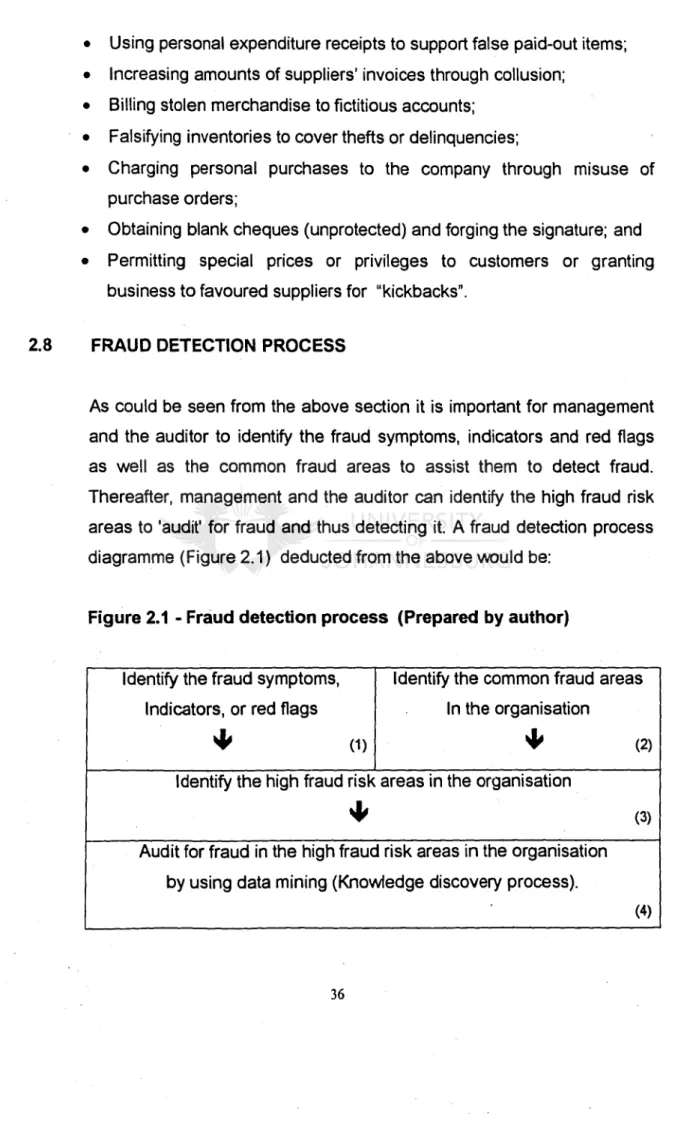
(46) FRAUD DETECTION USING DATA MINING. •. Using personal expenditure receipts to support false paid-out items;. •. Increasing amounts of suppliers' invoices through collusion;. •. Billing stolen merchandise to fictitious accounts;. •. Falsifying inventories to cover thefts or delinquencies;. •. Charging personal purchases to the company through misuse of purchase orders;. •. Obtaining blank cheques (unprotected) and forging the signature; and. •. Permitting special prices or privileges to customers or granting business to favoured suppliers for "kickbacks",. 2.8. FRAUD DETECTION PROCESS. As could be seen from the above section it is important for management and the auditor to identify the fraud symptoms, indicators and red flags as well as the common fraud areas to assist them to detect fraud. Thereafter, management and the auditor can identify the high fraud risk areas to 'audit' for fraud and thus detecting it. A fraud detection process diagramme (Figure 2.1) deducted from the above wou Id be:. Figure 2.1 - Fraud detection process (Prepared by author). Identify the fraud symptoms,. Identify the common fraud areas. Indicators, or red flags. In the organisation. ~. (1). ~. (2). Identify the high fraud risk areas in the organisation. ~. (3). Audit for fraud in the high fraud risk areas in the organisation by using data mining (Knowledge discovery process). (4). 36.
(47) FRAUD DETECTION USING DATA MINING. Figure 2.1 shows the relationship between the different steps that should be taken to detect fraud:. (1) Identify the fraud symptoms, indicators and red flags. This is the first step in identifying an undetected fraud. Management and auditors should know the fraud symptoms, indicators and red flags to assist them to identify fraud. The higher the number of fraud symptoms, indicators and red flags present in an organisation, the more probable fraud is in that organisation.. (2) Identify the common fraud areas in the organisation. This step could be done simultaneously with the first step, whichg is why it is shown on the same level as the first step. Management and auditors should know the common areas where fraud could occur in their organisation. This would help them to identify the high fraud risk areas.. (3) Identify the high fraud risk areas in the organisation. After identifying the common fraud areas and the fraud symptoms, indicators and red flags in the organisation, management and the auditor should be able to identify the high fraud risk areas in the organisation. The high fraud risk areas are those areas where fraud is more likely to occur in an organisation. Management and auditors can then draw up a document indicating the high fraud risk areas called a Business Fraud Risk Profile.. 37.
(48) FRAUD DETECTION USING DATA MINING. (4) Audit for fraud in the high fraud risk areas of an organisation. After management or the auditor have identified the areas where the organisation is more likely to have fraud, they can now audit for fraud in that area. To audit for fraud without the help of technology would be ineffective and inefficient. A technology. that. can. assist. management and the auditor to detect fraud is data mining (discussed in chapter 3).. 2.9. CONCLUSION. The role of management, external and internal audit has been discussed in this chapter. They all have a very important role to play in detecting fraud as could be seen from their responsibilities discussed above.. A fraud detection process was also developed and the steps to detect fraud described. They are: •. Step 1 - Identify the fraud symptoms, indicators and red flags in the organisation;. •. Step 2 - Identify the common fraud areas in the organisation;. •. Step 3 - Identify the high fraud risk areas; and. •. Step 4 - Audit for fraud by using a technology called data mining (Knowledge Discovery Process - discussed in chapter 3).. 38.
(49) FRAUD DETECTION USING DATA MINING. Chapter 3 : DATA MINING Table of Contents. Page. 3.1. INTRODUCTION. 3.2. OBJECTIVES OF THIS CHAPTER. 3.3. DATA MINING. 3.4. THE DATA MINING PROCESS - VIRTUOUS CYCLE -. 3.5. 40 40. BERRY FRAMEWORK. ". 50. ADRIAANS FRAMEWORK.. 53. THE KNOWLEDGE DISCOVERY PROCESS -. 3.7. '". THE KNOWLEDGE DISCOVERY PROCESS -. 3.6. 40. BRACHMAN AND ANAND FRAMEWORK. '". CONCLUSiON. 58 62. List of Figures and a Table Figure 3.1 - SERIOUS FRAUD OFFICE -. NETM~P. GRAPH. 49. Figure 3.2 - THE FOUR STAGES OF THE VIRTUOUS CYCLE OF DATA MINING........................................... 50. Figure 3.3 - THE KDD PROCESS - ADRIAANS FRAMEWORK... ...... ... 54. Figure 3.4 - THE KDD PROCESS - BRACHMAN & ANAND. 59. Table 3.1 - STEPS IN THE EVOLUTION OF DATA MINING. 43. 39.
(50) FRAUD DETECTION USING DATA MINING. 3.1. INTRODUCTION. Data mining is a new technology and has played a more predominant role in discovering treasures of information in databases in recent years. Data mining is part of the Knowledge Discovery Process as discussed in this chapter.. CWI (1997:1) states that companies accumulate more information in databases each year. As a result, these databases contain treasures of information on many of the company's processes. This information can be used to improve such processes and allows the company to detect trends and react to them. However, this information is hidden in the mountains of data and cannot be discovered using conventional database management systems. The solution is data mining.. 3.2. OBJECTIVES OF THIS CHAPTER. The objective of this chapter is to describe what data mining is, the evolution of data mining and techniques used in data mining. A further objective is to describe the more important knowledge discovery processes and to determine the relationship between data "mining and fraud detection. From the Knowledge Discovery Process frameworks discussed in this chapter, a model will be developed for the integrated fraud detection model described in chapter 4.. ~o.
(51) FRAUD DETECTION USING DATA MINING. 3.3. DATA MINING. 3.3.1 Introduction to data mining Here are some of the more important ideas on data mining:. •. "Data mining is the process of discovering meaningful. new. correlations, patterns and trends by sifting through large amounts of data stored in repositories, using pattern recognition technologies as well as statistical and mathematical techniques. The Gartner Group" (Clearsoft, 1997).. •. "Data mining provides a way to analyse organisational data, discovering hidden patterns within tremendous quantities of data, and providing an organisation with information it may not have been able to discover" (Toyota, 1997a).. •. "Data mining is defined as the extraction of hidden predictive and descriptive information from large databases" (Toyota, 1997b).. •. "The goal of data mining is still much like that of artificial intelligence. The data mining user doesn't exactly pose a question as much as ask the system to use a model to discover past patterns that predict future behaviour. This can result in valuable, previously unknown facts" (Gerber,1996:41).. •. Adriaans (1996:5) states that there is confusion about the exact meaning of the terms 'data mining' and 'KDD' as many authors regard them as synonymous. At the first international KDD conference in Montreal in 1995, it was proposed that the term KDD be employed to describe the Whole process of extraction of knowledge from data. In this context, knowledge means relationships and pattems between 41.
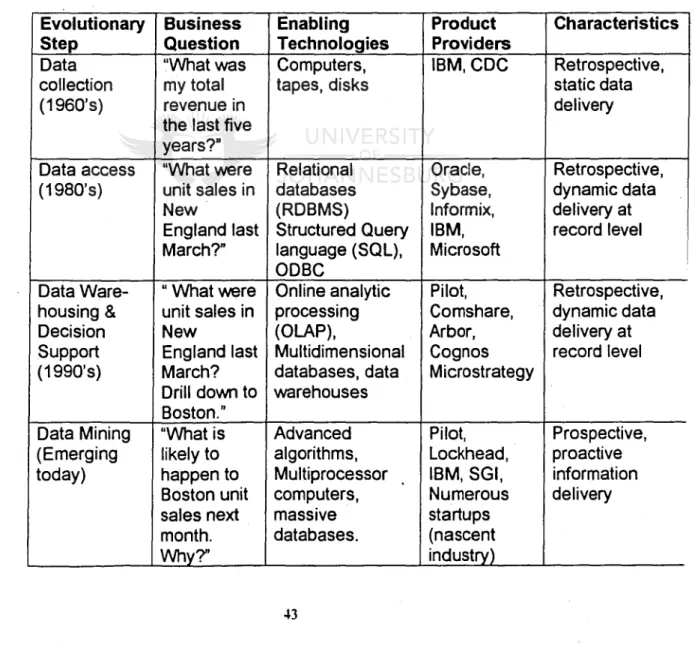
(52) FRAUD DETECTION USING DATA MINING. data elements. It was further proposed that the term 'data mining' should be used exclusively for the discovery stage of the KDD process. A more or less official definition of KDD is: 'the non-trivial. extraction of implicit, previously unknown and potentially useful knowledge from data.' So the knowledge must be new, not obvious, and one must be able to use it.. It is clear that data mining is technology that can assist management and the auditor to detect the hidden treasures in their data. The hidden treasures referred to here are the undetected cases of fraud. Data mining is a part of the overall Knowledge Discovery Process in databases.. 3.3.2 Evolution of data mining. Pilot Software (19978) says that data mining takes the evolutionary process beyond retrospective data access and navigation to prospective and proactive information delivery. Data mining is ready for application in the business community because it is supported by three technologies that are now mature, namely: •. Massive data collection;. •. Powerful multiprocessor computers; and. •. Data mining algorithms.. Data mining algorithms embody techniques that have existed for at least 10 years but have only recently been implemented as mature, reliable, understandable tools. that. consistently. outperform. older. statistical. methods. In the evolution from business data to business information, each new step has built upon the previous one. For example, dynamic data access is critical for drill-through in data applications and the ability to store large databases is critical to data mining. From the user's point of. 42.
(53) FRAUD DETECTION USING DATA MINING. view, the four steps listed in Table 3.1 were revolutionary because they allowed new business questions to be answered accurately and quickly.. Pilot Software (1997a) further states that the core components of data mining technology have been under development for decades in research areas such as statistics, artificial intelligence, and machine learning. Today the maturity of these techniques, coupled with high-performance relational database engines and broad data integration efforts, make these technologies practical for current data-warehousing environments.. Table 3.1 - Steps in the evolution of data mining (Pilot Software, 1997). Evolutionary Step Data collection (1960's). Data access (1980's). Data Warehousing & Decision Support (1990's). Data Mining (Emerging today). Business Question "Whatwas my total revenue in the last five years?" "What were unit sales in New England last March?". Enabling Technologies Computers, tapes, disks. Relational databases (RDBMS) Structured Query language (Sal), ODBC " What were Online analytic unit sales in processing (OLAP), New England last Multidimensional databases, data March? Drill down to warehouses Boston." Advanced "What is algorithms, likely to Multiprocessor happen to computers, Boston unit massive sales next databases. month. Why?". 43. Product Providers IBM,CDC. Characteristics. Oracle, Sybase, Informix, IBM, Microsoft. Retrospective, dynamic data delivery at record level. Pilot, Comshare, Arbor, Cognos Microstrategy. Retrospective, dynamic data delivery at record level. Pilot, Lockhead, IBM,SGI, Numerous startups (nascent industry). Prospective, proactive information delivery. Retrospective static data delivery. I.
(54) FRAUD DETECTION USING DATA MINING. The evolution of data mining (Table 3.1, p.43) indicate that data mining is a new technology that has evolved as software and hardware industries grew.. 3.3.3 Data mining techniques. The more important data mining techniques are the following:. •. Market Basket Analysis. Market basket analysis is a form of clustering used for finding groups of items that tend to occur together in a transaction (or market basket). The models that it builds give the likelihood of different products being purchased together and can be expressed as rules. It. is closely. related to analyses in the retail industry where information on products purchased together may be the only data available for mining customer patterns (Berry, 1997: 119).. •. Memory-Based Reasoning (MBR). MBR is a directed data mining technique that uses known instances as a model to make predictions about unknown instances. MBR looks for the nearest neighbours in the known instances and combines their values to assign classification or prediction values. For instance,. we. might maintain a database of claims and whether they were adjusted after investigation. If we want to determine if a new claim warrants further investigation,. we would find similar claims - neighbours - in the. database and make the 'investigate-further' or 'pay-immediately' decision based on the status of the neighbours. ,The distance to the neighbours gives a measure of correctness of the results (Berry, 1997:120). 44.
(55) FRAUD DETECTION USING DATA MINING. •. Cluster Detection. Cluster detection is the building of models that find data records that are similar to each other. These clumps of self-similarity are called clusters. This is inherently undirected data mining, since the goal is to find previously unknown similarities in the data. There. are several. techniques for finding clusters including geometric methods, statistical methods, and neural networks (Berry,1997:121).. •. Link Analysis. Link analysis follows relationships between records to develop models based on patterns in the relationships. This is an application of graph theory constructs to data mining. Relationships between customers are becoming increasingly important, especially as marketing groups focus more on customers, households and economic marketing units instead of specific accounts. The largest area where it is applied is actually in the law enforcement area, where clues about crimes are linked together to help solve them. The few tools available focus on visualising. the. links,. rather. than. analysing. the. patterns. (Berry, 1997:121).. KPMG (1997:3) explains relationship mapping as follows: "Relationship mapping is relatively new and uses a powerful minicomputer to map relationships from transaction files. The powerful feature of this type of program is that the output it generates is graphical i.e. the software uses certain rules and algorithms to draw relationships between items in a graphical format. This make the investigators work easier in the sense that instead of sifting through thousands of transactions, the computer can do this quicker and more effectively and highlight the areas where the person has to concentrate hislher efforts.".
(56) FRAUD DETECTION USING DATA MINING. •. Decisions Trees and Rule Induction. Decision trees are powerful models produced by a class of techniques that include classification and regression trees (CART) and chisquared automatic induction (CHAID). Decision trees are used for directed data mining, particularly classification. One of the chief advantages to decision trees is that the model is quite explainable since it takes the form of explicit rules (Berry, 1997:122). A description of decision trees given by Pilot Software (1997b) is the following: "Tree-shaped structures that represent sets of decisions. These decisions generate rules for the classification of a dataset. Specific decision tree methods include regression trees (CART) and Chi square Automatic Interaction Detection (CHAID)." A description of Rule induction given by Pilot Software (1997b) is the following: "The extraction of useful if-then rules from data based on statistical significance.". •. Artificial Neural Networks. Neural networks are probably the most common data mining technique. They are simple models of neural interconnections in brains, adapted for use on digital computers. One of the chief advantages. of. neural. networks. (Berry,1997: 122).. 46. is. their. wide. applicability.
(57) FRAUD DETECTION USING DATA MINING. Another description of artificial neural networks is a non-linear predictive model that learns through training and resembles biological neural networks in structure (Pilot Software, 1997b). •. Genetic Algorithms Genetic algorithms (GA) applies the mechanics of genetics and natural selection to a search used for finding the optimal sets of parameters that describe a predictive function. As such, it is used for directed data mining. Genetic algorithms are similar to statistics in that the form of the model needs to be known in advance. Genetic algorithms uses the selection, crossover, and mutation operators to evolve successive generations of solutions. As the generations evolve, only the most predictive survive until the functions converge on an optimal solution (Berry, 1997:123).. •. On-line Analytic Processing (OLAP) Not everything that is useful for data analysis is necessarily data mining. OLAP is a way of presenting relational data to facilitate understanding the data and important patterns inside it. Like visualisation, it is not specifically a tool for data mining, but it is an important tool in' the arsenal of weapons used for extracting and presenting information (Berry,1997:123).. The most common data mining techniques used for fraud detection and law enforcement is link analysis and clustering as illustrated by the actual case study below.. 47.
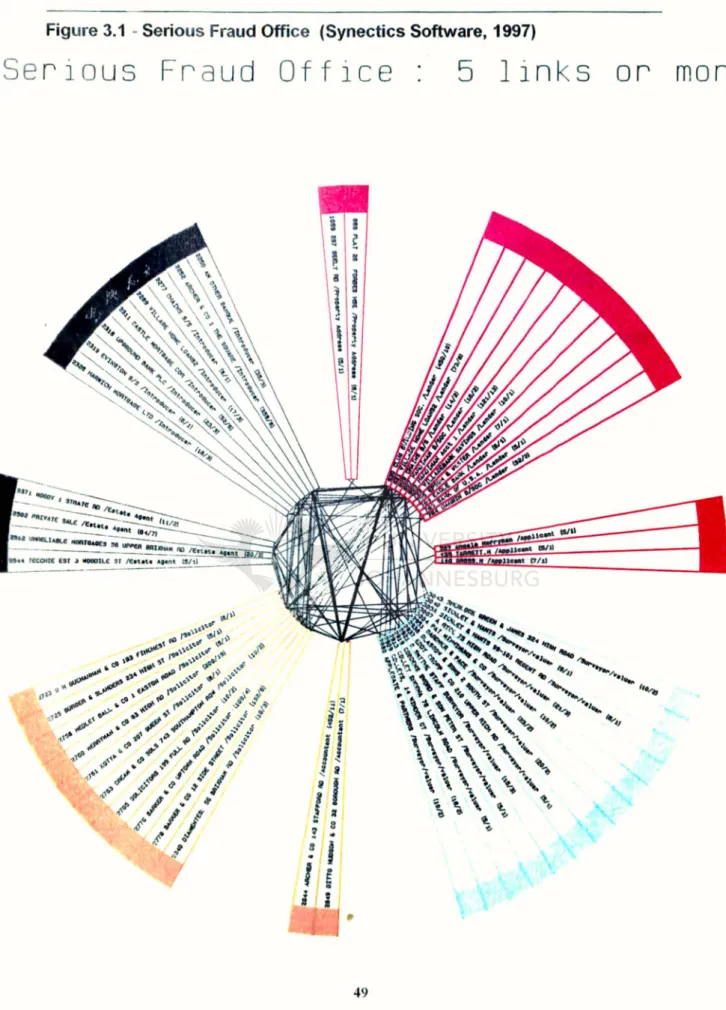
(58) FRAUD DETECTION USING DATA MINING. Davidson (1993:28) uses as example an actual. fraud case and states the. following:. When a major building society suspected it was the victim of an extensive fraud during the summer of 1987 it called in the police and eight policemen then spent. two years combing through the evidence. Finally, they identified a suspect and made an arrest. The suspect confessed to running a complex operation in which, under different company names, he had acted as introducer, layer or accountant for a number of fraudulent mortgage applications. A two-year investigation is not excessive for this kind of case. In 1989, the Serious Fraud Office decided to find out whether a computerised technique for analysing data could speed up the process. It called a group of consultants with expertise in data analysis, gave them all the information it had used in its initial inquiry, and asked them to identify the criminal or his mode of operation. The consultants quickly got to work, first converting the information to consistent data formats and then checking the data for errors, ambiguities and repetitions. This took three days. They then fed the data into a software package called Netmap. Within minutes, the software highlighted the links between the fraudulent mortgage applications and the fraudster with his operating companies.. One of the Netmap graphs of the above-mentioned case is displayed as Figure. 3.1· - Serious Fraud Office. The diagramme shows a trend between the introducer, accountant and bank. By visualising this trend/pattern, the undetected fraud was identified and the matter could be investigated immediately.. As can be seen from the above-mentioned example, using data mining techniques will make detecting fraud in organisations effective and efficient.. 48.
(59) FRAU D DETECTION USING DATA MINING Figure 3.1 - Serious Fraud Office (Synectics Software, 1997). Se r i ous Fr aud Of flce. • 49. cr•• ted. 3O-JUN - llIlI 7 14: 59. Plot t . d : 3O-JUN - llIlI7 15: 10. 5 lin ks or mor e.
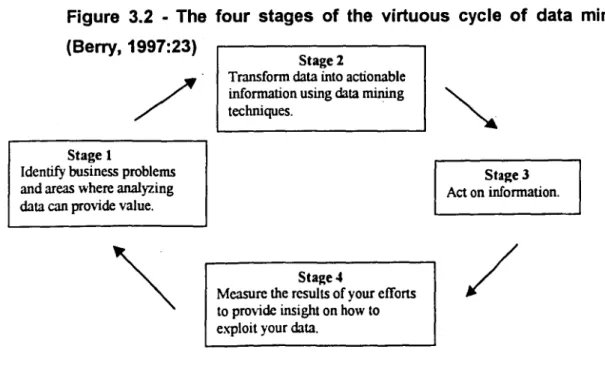
(60) FRAUD DETECTION USING DATA MINING. 3.4 THE DATA MINING PROCESS - VIRTUOUS CYCLE (BERRY FRAMEWORK). The promise of data mining is finding the interesting patterns lurking in all the billions and trillions of bytes of data. But merely finding patterns is not enough. You must be able to act on them, ultimately turning the data into information, the information into action, and the action into value. This is the virtuous cycle of data mining in a nutshell (Berry, 1997:18).. The Oxford Dictionary (1990:1371) defines a virtuous circle as follows: "It is a beneficial recurring cycle of cause and effect.". The four stages of the virtuous cycle of data mining are: •. Identify the business problem;. •. Use data mining techniques to transform the data into actionable information;. •. Act on the information; and. •. Measure the results (refer to Figure 3.2).. Figure 3.2 - The four stages of the virtuous cycle of data mining. (Berry, 1997:23). Stage 2 Transformdata intoactionable information using data mining techniques.. Stage 1 Identify business problems and areas whereanalyzing data can providevalue.. Stage 3 Acton information.. Sta2e 4 Measurethe resultsof your efforts to provideinsighton howto exploit your data.. 50. /.
(61) FRAUD DETECTION USING DATA MINING. As outlined in Figure 3.2, the key to success is incorporating data mining into business processes. These stages are highly interdependent: The results from one stage are the inputs into the next phase, much like the steps in a multi-step manufacturing process. The whole approach is driven by results. Each stage depends on the results from the previous stage (Berry, 1997:23).. Stage 1 - Identify the business opportunity. The purpose is to identify the areas where data can provide value. These, in turn, are the input in the Data Mining Stage. The goal is to identify areas where patterns in data have the potential of providing value (Berry, 1997:23).. Berry (1997:25) says that the information gathered ln.this step is critical to exploiting the virtuous cycle to its fullest.. In our scenario the business opportunity will be to detect fraud in the organisation and then to take the necessary steps to deal with it.. Stage 2 - Data Mining. This stage turns the data into information. Berry (1997:25) states that it takes data and business opportunities to produce actionable results for the. Take Action Stage and that. we need. to understand what results it must. produce to make the virtuous cycle successful.. Berry (1997:25) also identifies numerous pitfalls that can interfere with the ability to use the results of data mining. The more important pitfalls are:. 51.
(62) FRAUD DETECTION USING DATA MINING. •. Bad data formats, such as using a five-digit zip code when nine-digit zip codes are needed by a direct mail application;. •. Confusing data fields, such as a delivery date that means 'planned delivery date' in one system and 'actual delivery date' in another system;. •. Lack of functionality, such as a call-centre application that does not allow annotations on a per-customer basis;. •. Legal ramifications, such as having to provide a legal reason when rejecting a loan ( " my neural network told me so" is not acceptable);. •. Organisational factors, since some operational groups are reluctant to change their operations, particularly if they are not provided with incentives to change; and. •. Timeliness, since results that come a month late may no longer be actionable.. Management and the auditor should take note of these pitfalls to manage the data mining process and to get the best results from their data.. Stage 3 - Take Action. After the data has been transformed into information, the organisation can take the necessary action which is to its benefit.. This is also where the results from data mining are acted upon and results are fed into the Measurement Stage (Berry, 1997:27).. Berry (1997:27) states that by rsqumnq all business processes in an organisation to provide feedback before implementing any data mining solutions increases the risk of creating unnecessary delays. To avoid delays, plan for measuring the results a part of planning the initiative.. 52.
Figure


+7
Related documents