THE INFLUENCE OF SUPPLY CHAIN MANAGEMENT (SCM) PRACTICES ON ORGANIZATIONAL PERFORMANCE: KNOWLEDGE MANAGEMENT PROCESSES
AS MEDIATOR
BY
CHENG CHOON HO
Research report submitted in Partial Fulfillment of the requirements for the degree of Masters of Business Administration
UNIVERSITI SAINS MALAYSIA DECEMBER 2011
DEDICATION
To my family and my wife, Tan Chin Thin in recognition oftheir support, patience, understanding, and most of all love in completing this work.
TABLE OF CONTENTS DEDICATION ACKNOWLEDGEMENT TABLE OF CONTENTS LIST OF TABLES LIST OF FIGURES LIST OF APPENDICES ABSTRAK ABSTRACT CHAPTERl INTRODUCTION 1.1 Introduction
1.2 . Background of the Study 1.3 Research Problems 1.4 Research Objectives 1.5 Research Questions 1.6 Significance of Study 1.7 Definition of Variables
1.7.1 Supply Chain Management Practices 1.7.2 Knowledge Management Processes 1.7.3 Organizational Performances 1.8 Organization of Thesis Page I 11 111 V111 Xl XlI XIV XV 1 1 3 5 6 6 8 8 10 10 11
CHAPTER 2 LITERATURE REVIEW 2.1 2.2 2.3 2.4 Introduction Organizational Perfonnances
2.2.1 Measurement of Organizational Perfonnance 2.2.1.1 Organizational Financial Perfonnance 2.2.1.2 Organizational Non Financial Perfonnance 2.2.1.3 Summary
Supply Chain Management (SCM)
2.3.1 The Important of Supply Chain Management (SCM)
2.3.2 The Effect of Supply Chain Management Practices on Organizational
12 12 13 13 14 14 15 17 Perfonnance 18
2.3.2.1 Outsourcing and Organizational Perfonnance 20 2.3.2.2 Strategic Supplier Partnership and Organizational Perfonnance 21 2.3.2.3 Customer Relationship and Organizational Perfonnance 22 2.3.2.4 Infonnation Sharing and Organizational Perfonnance 23 2.3.2.5 Postponement and Organizational Perfonnance 24 . 2.3.2.6 Quality of Infonnation Sharing and Organizational Perfonnance 25
2.3.2.7 Lean Practices and Organizational Perfonnance Knowledge Management (KM)
2.4.1 Knowledge Management Processes 2.4.1.1 Knowledge Acquisition 2.4.1.2 Knowledge Sharing 2.4.1.3 Knowledge Application 26 27 28 31 33 34
2.4.2 Knowledge Management Processes and Organizational Performance 35 2.4.3 Supply Chain Management (SCM) Practices and Knowledge
Management (KM) Processes 36
2.4.4 Knowledge Management Processes as a Mediating Variable 37
2.5 Theoretical Framework 39 2.5.1
40
2.5.2 Know1,,-'40
2.5.3 Re, 41 2.6 Summary 53 CHAPTER3 3.1 Introduction 54 3.2 Research design 54 3.2.1 Population 55 3.2.2 Unit of Anal~ 56 3.2.3 Sample Size 56 3.3 Pilot Survey 57 3.4 Questionnaire Design 57 3.4.1 Questionnaire Cont 583.4.2 Variables and Measu; 59
3.4.2.1 Supply Chain 1
so
3.4.2.2 Knowledge Mam 3.4.2.3 Organizational Per
3.6 Statistical Analysis Techniques
68
3.7
Summary 71CHAPTER 4 DATA ANALYSIS AND RESULTS
4.1 Introduction 72
4.2 Response Rate 72
4.3 Profile of Respondents
73
4.4 Goodness of Measures
77
4.4.1 Factor Analysis 77
4.4.1.1 Factor Analysis of SCM Practices
78
4.4.1.2 Factor Analysis ofKM Processes 84
4.4.1.3 Factor Analysis of Organizational Performance
87
4.4.1.4 Summary of Factor Analysis 89
4.4.2 Reliability Analysis 89
4.5 Descriptive Statistics 90
4.5.1 Means and Standard Deviations of Study Variables 90
4.5.2 Correlations Analysis 91
4.6 Multiple Regression Analysis 93
4.6.1 The Relationship between SCM Practices and Organizational Financial
performance 95
4.6.2 The Relationship between SCM Practices and Organizational Non
Financial performance 97
4.6.3 The Relationship between SCM Practices and Knowledge Acquisition 99 4.6.4 The Relationship between SCM Practices and Knowledge Sharing 101 4.6.5 The Relationship between SCM Practices and Knowledge Application 103
4.6.6 The Relationship between
KM
Processes and Organizational FinancialPerfonnance 105
4.6.7 The Relationship between
KM
Processes and Organizational NonFinancial Perfonnance 107
4.7 Test of Mediation 108
4.7.1 The Mediation Effects of Knowledge Management Processes 109
4.8 Summary 117
CHAPTERS DISCUSSION AND CONCLUSION
5.1 Introduction 124
5.2 Recapitulation of the Study Findings 124
5.3 Discussion 126
5.3.1 SCM Practices and Organization Perfonnance 127
5.3.2 SCM Practices and KM Processes 131
5.3.3 KM Processes and Organization Perfonnance 133
5.3.4 The Mediating Role ofKM Processes 134
5.4 Implication of the Study 137
5.4.1 Theoretical Implication 137
5.4.2 Practical Implication 139
5.5 Limitations and Suggestions for Future Research 142
5.6 Conclusion 143
REFERENCES 144
LIST OF TABLES
Table No. Title of Table Page
Table 2.1 Supply Chain Management Practices by Scholars 19
Table 2.2 Knowledge Management Processes, by Scholars 31
Table 3.1 Distribution of Large Manufacturing Companies in Malaysia 55
Table 3.2 Survey Questionnaire Contents 58
Table 3.3 Measures of the Study 59
Table 3.4 Items Nominating Outsourcing 61
Table 3.5 Items Nominating Strategic Supplier Partnership 61
Table 3.6 Items Nominating Customer Relationship 62
Table 3.7 Items Nominating Information Sharing 62
Table 3.8 Items Nominating Postponement 63
Table 3.9 Items Nominating Quality of Information Sharing 64
Table 3.10 Items Nominating Lean Practices 64
Table 3.11 Items Nominating Knowledge Acquisition 65
Table 3.12 Items Nominating Knowledge Sharing 66
Table 3.13 Items Nominating Knowledge Application 66
Table 3.14 Items Nominating Financial Performance 67
Table 3.15 Items Nominating Non Financial Performance 68
Table 4.1 Profile of Participating Companies 73
Table 4.2 Profile of Respondents 75
Table 4.3 Descriptive Statistics of Participating Companies 76
Table 4.5 Results of Factor Analysis on Supply Chain Management
Practices Items 81
Table 4.6 Results of Factor Analysis on Knowledge Management
Processes Items 85
Table 4.7 Results of Factor Analysis on Organizational Performance Items 88 Table 4.8 Reliability Coefficients for Variables of the Study 89 Table 4.9 Mean Scores and Standard Deviations for Study Variables 91 Table 4.10 Pearson Correlations Matrix of Study Variables 92 Table 4.11 Regression Results of the Relationship between SCM Practices
and Organizational Financial Performance 96
Table 4.12 Regression Results of the Relationship between SCM Practices
and Organizational Non Financial Performance 98
Table 4.13 Regression Results of the Relationship between SCM Practices
and Knowledge Acquisition 100
Table 4.14 Regression Results of the Relationship between SCM Practices
and Knowledge Sharing 102
Table 4.15 Regression Results of the Relationship between SCM Practices
and Knowledge Application 104
Table 4.16 Regression Results of the Relationship between Knowledge
Management Processes and Organizational Financial Performance 106 Table 4.17 Regression Results of the Relationship between Knowledge
Management Processes and Organizational
Table 4.18 Summary ofthe Mediation Test of Knowledge Application on the Relationship between SCM Practices and Organizational
Financial Perfonnance 110
Table 4.19 Summary ofthe Mediation Test of Knowledge Acquisition on the Relationship between SCM Practices and Organizational
Non Financial Perfonnance 113
Table 4.20 Summary of the Mediation Test of Knowledge Sharing
on the Relationship between SCM Practices and Organizational
Non Financial Perfonnance 115
Table 4.21 Summary of the Mediation Test of Knowledge Application on the Relationship between SCM Practices and Organizational
Non Financial Perfonnance 116
LIST OF FIGURES
Figure No. Title of Figure
Figure 2.1 Research framework of the study
Figure 4.1 Mediation Model
Page
42
LIST OF APPENDICES
Appendix No. Title of Figure Page
APPENDIXA Introduction of Letter
157
APPENDIXB Research Instruments
158
APPENDIXC Factor Analysis of Supply Chain Management Practices
164
APPENDIXD Factor Analysis of Knowledge Management Processes
169
APPENDIXE Factor Analysis of Organizational Performance
172
APPENDIXF Reliability Test of Study Variables
174
APPENDIXG Regression Analysis of Supply Chain Management Practices
on Organizational Financial Performance
186
APPENDIXH Regression Analysis of Supply Chain Management Practices
on Organizational Non Financial Performance
189
APPENDIX I Regression Analysis of Supply Chain Management Practices
on Knowledge Acquisition
192
APPENDIX] Regression Analysis of Supply Chain Management Practices
on Knowledge Sharing
195
APPENDIXK Regression Analysis of Supply Chain Management Practices
on Knowledge Application
198
APPENDIXL Regression Analysis of Knowledge Management Processes
on Organizational Financial Performance
201
APPENDIXM Regression Analysis of Knowledge Management Processes
APPENDIXN
APPENDIX 0
APPENDIXP
APPENDIXQ
The Mediation of Knowledge Application on The Relationship between Supply Chain Management Practices and
Organizational Financial Performance
The Mediation of Knowledge Acquisition on The Relationship between Supply Chain Management Practices and Organizational Non Financial Performance
The Mediation of Knowledge Sharing on The Relationship between Supply Chain Management Practices and Organizational Non Financial Performance
The Mediation of Knowledge Application on The Relationship between Supply Chain Management Practices and Organizational Non Financial Performance
207
210
213
.ABSTRAK
Penyelidikan ini bertujuan untuk mengkaji kesan amalan pengurusan rantaian bekalan terhadap prestasi organisasi dan menyiasat kesan pengurusan pengetahuan proses sebagai pengantara dalam penentuan hubungan tersebut. Tujuh dimensi amalan pengurusan rantaian bekalan digunakan untuk menyiasat dua kesan berlainan dimensi dalam pre stasi organisasi manakala tiga dimensi pengurusan pengetahuan proses digunakan sebagai penguji pengantaraan ke atas hubungan tersebut. Kaedah kuantitatif digunakan dengan memperolehi data yang dikumpul melalui soal-selidik daripada sampel 138 syarikat-syarikat pengilangan yang tersenarai dalam Persekutuan Pengilang Malaysia (FMM). Analisis faktor digunakan untuk mengesahkan struktur faktor dan hubungan timbal-balik pembolehubah manakala regresi hierarki digunakan untuk memeriksa hubungan antara pembolehubah peramal dand pembolehubah kriteria. Keputusan menunjukkan bahawa pengurusan rantaian bekalan terhadap amalan perkongsian maklumat, perkongsian maklumat berkualiti dan amalan ketara adalah berkaitan dengan prestasi kewangan dan bukan kewangan organisasi. Ketiga-tiga dimensi proses pengurusan pengetahuan didapati merupakan pengantaraan hubungan antara perkongsian maklumat, perkongsian maklumat berkualiti dan amalan ketara terhadap prestasi bukan kewangan organisai. Selain itu, hanya satu dimensi proses pengurusan pengetahuan iaitu pengetahuan penerapan menjadi sebahagian pengantara hubungan antara hubungan pelanaggan, perkongsian maklumat, kualiti perkongsian maklumat dan amalan ketara terhadap prestasi kewangan organisasi. hnplikasi teori kajian ini menyediakan faktor yang lebih berpengaruhi terhadap prestasi organisasi dan implikasi praktikal membolehkan pengamal menjadikan amalan-amalan yang dikaji keberkesanannya tersebut diterima pakai untuk membantu meningkatkan prestasi organisasi. Cadangan untuk penyelidikan masa hadapan termasuk lain-lain faktor ukuran juga dibincangkan di akhiran kajian.
ABSTRACT
This research was aim to study on the impact of supply chain management practices toward organizational performance and investigate whether knowledge management processes serves as a mediator in determined on the above relationship. Seven dimensions of supply chain management practices were used to investigate on the impact of two difference dimensions in the organizational performance while three dimensions of knowledge management processes were us.ed to test on the mediator effect toward the above relationship. Qua.lltitative method was applied with data were obtained via questionnaires from a sample of 138 manufacturing companies listed in the Federation of Malaysia Manufacturers (FMM). Factor analyses were used to confirm on the factor structure, initial validity and interrelation of the variables while hierarchical regression was used to examine the relationship between predictor variables and criterion variables. Result showed that SCM practices of information sharing, quality of information sharing and lean practices were positively related to organizational financial and non financial performance. Three dimensions of knowledge management processes were found to be mediated the relationship between information sharing, quality of information sharing and lean practices toward organizational non financial performance. However, only one knowledge management processes of knowledge application was found to be partially mediates on the relationship between SCM practices. of customer relationship, information sharing, quality of information sharing and lean practices on organizational financial performance. The theoretical implication of the study provided a better understanding on the factor that influenced on organizational performance and practical implication enable practitioners to be more adopted on the practices that can help on influencing the organizational performance. Recommendation over future research included others measurement items were discussed as well in the end of the study.
1.1 Introduction
CHAPTER 1
INTRODUCTION
This chapter starts by introducing background of the study and the research problem of the study. It is then continued with research objectives and research questions. The chapter will end with significant of the study, definition of variables and a brief summary of the remaining chapter in this study.
1.2 Background of the Study
In the intensively competitive world, the competition exists not only between organizations but also among supply chains. Schneller & Smeltzer (2006) and White '& Mohdzain (2009) expressed that supply chain management (SCM) plays a very critical role as a key factor for an organization to gain competitive advantage and improve organizational perfonnance. The competitive environment requires organizations to provide high quality products and services, deliver rapid service response, and develop dynamic capabilities that are congruent with the rapid changing business environment (Fawcett and Magnan, 2001; Lin, 2005; Teece, 2009). Therefore, organizations have begun to realize that it is crucial to have competitive supply chain management practices so that they are able to stay in the competitive global business environment.
Supply chain management (SCM) help an organization to integrate on their internal functions and in force them with external parties like suppliers and customers so that they are able to improve their competitive performance. Supply chain integration advantage can be
succeed when the effectiveness use of different supply chain practices are link together on integrating the supply chain. Integrating an organizational internal cross functional boundaries and external integration of suppliers and customers are important aspect in SCM practices so that it can be able to gain superior and successful supply chain performance (Narasimhan, 1997). The important of supply chain management is no doubt and lots of studies have confirmed the importance of organizational supply chain level that will influence on the manufacturing agility and flexibility. Therefore, it is interest to study the supply chain management practices which has been widely adopted by manufacturing industry.
Organization with supply chain management practices have long shared data and information, jointly developed products, negotiation prices and terms, query potential partners on product specifications and discussed demand expectations with their customers and suppliers. These cooperative activities are essential to the successful of the organization. The implementation of knowledge management (KM) enables collaborative functions that allow supply chain to be more adaptive and responsive to the ultimate changes of information from the different working groups in the organization. Knowledge management involves the transformation of raw data from many sources into coherent information that is able to deliver to people who need it. Employees' skills, expertise and experiences must be captured and made readily available to enable employees and supply chain partners to gain access to this information. Therefore, knowledge management serves as the predictor to improve the organizational performance.
Against this backdrop, an organization with supply chain management practices shall share knowledge such as sources of manufacturing delays and customers' information and expectation internally as well as externally in order to ensure the integral supply chain network is
effective. Lacking of sharing information among supply chain members will significantly affect the total profitability of the organization (Anderson and fine, 1999). Given the importance of SCM practices to the organizational performance and the importance of knowledge management in enhancing the organizational performance, examining the effects of these variables is warranted.
In summary, the above phenomenon highlights the importance of SCM practices on
organizational performance. Moreover, understanding knowledge management processes as the intertwining effects on the relationship between supply chain management practices and organizational performance is vital. Hence, the study is carried out to determine the effect of SCM practices on knowledge management processes and organizational performance in Malaysia context especially in manufacturing sector which is the major contributor to the growth of Malaysia.
1.3 Research Problems
There are lots of method to measure against an organization perfonnance, one of the method is through the measurement of the organization's ability to perform against it competitor and it ability to stay competitive in the market whereby it is not only sustaining the business but also to the growth of the organization. Numerous researchers have studied on the relationship between supply chain management practices toward organizational performance and it had been confirmed the validity of the relationship between supply chain management practices and
organizational performance (Li, 2005; Ashih, 2007; Li, 2002; Sufian, 2010; Chee & John, 2005;
In Malaysia, Department of Statistics Malaysia (DOSM, 2010) discovered that the overall performance of the manufacturing sector has contributed to 30% of the total Gross Domestic Product (GDP) and the number is keep on increasing from year to year. Moreover, the statistics also shown that large manufacturing firms (firm with more than 150 employees is considered as large manufacturing firms) in Malaysia context, has contributed to the total of 70% of the total gross output (DOSM, 2010). By looking at the contribution of large manufacturing firms to Malaysian economy growth, the study at the large manufacturing firms is important and needed. SCM practices have been long practiced by large manufacturing firm in Malaysia which includes the large multinational firms, public listed and foreign manufacturing firms. Therefore, it is needed to explore the best extent of supply chain management practices that can derive on the organizational performance in Malaysia context especially manufacturing industries since these large manufacturing firms contribute the most to the growth ofthe nation.
On the other hand, knowledge management processes also widely confirmed by researchers that it will influence on an organizational performance as knowledge management deal with the management of knowledge related activities and using knowledge processes to create value for the organization (Gold, 2001; Lee & Yang, 2000; Wei & Gary, 2005; Niu, 2010). Although many researchers have confirmed on the relationship between supply chain management practices and organizational performance as well as knowledge management processes toward organizational performance, there is very less and no comprehensive study look into supply chain management practices with knowledge management processes as mediator effect on organizational performance.
Very less study looks into comprehensive knowledge management processes as study variables and majority of the study only focus on single knowledge management processes as
variable in the research. Wadhwa and Saxena (2005) in their studies used only knowledge sharing as one of the variable in the determination of the relationship between supply chain members and organizational performance. Meanwhile, Malhotra (2005) in his study used knowledge creation in collaborating supply chain partnership that influence on long term advantage to the organization. Wagner and Buko (2005) found that knowledge sharing activities in different supply chain members are influencing the firm performance.
Hence, this study is conducted to examine whether the selected supply chain management practices influence on the organizational performance and at the same time, examine whether the comprehensive of knowledge management processes which included knowledge acquisition, knowledge sharing and knowledge application mediated the relationship between SCM practices and the organizational performance.
1.4 Research Objectives
The study attempts to achieve four objectives as follows:
1. To examine the relationship between supply chain management practices and organizational performance.
2. To examine the relationship between supply chain management practices and knowledge management processes.
3. To examine the relationship between knowledge management processes and organizational performance
4. To examine whether knowledge management processes mediates the relationship between supply chain management practices and organizational performance.
1.5 Research Questions
Refer to the research objectives, the study attempts to answer the following research questions:
1. Do supply chain management practices influence on organizational performance? 2. Do supply chain management practices influence knowledge management processes? 3. Does knowledge management processes influence organizational performance?
4. Does knowledge management processes mediate the relationship between supply chain management practices and organizational performance?
1.6 Significant of the Study
Theoretically, this study contributes to the field of literatures on organizational performance, supply chain management practices and knowledge management processes. Resource-based and knowledge-based theory were utilizes in this study. Resource-based theory (Welnerfelt, 1984; Barney, 1991; Mahoney, 1992) argued that firm possessing resources whereby supp"ly chain management practices in this study are resources that could result in the ability of organizations to gain competitive advantage and affect on the organizational performance. In addition, knowledge-based theory (Grant, 1996; Foss, 1996 and Nickerson & Zenger, 2004) emphasize on the characteristic of the knowledge that applied on creation, sharing and application on the knowledge that enable an organization to use it to enhance on the organizational perfonnance. Thus, combination of these two theories will provide additional knowledge contributing to the supply chain management practices by suggesting that supply chain management practices can be enhanced through knowledge management processes
(knowledge acquisition, knowledge sharing and knowledge application) that will results In
improving organizational performance.
Practically, the study provides a further literature on the relationship between supply chain management practices and organizational performance especially within Malaysian manufacturing context. Although many researchers have proven the existence of relationship between supply chain management practices and organizational performance (Li, 2005; Ashih, 2007; Suhong Li, 2002; Sufian, 2010; Chee & John, 2005; Lenny & Mehmet, 2007) as well as knowledge management processes and organizational performance (Gold, 2001; Lee & Yang, 2000; Gary & Wei Zheng, 2005; Niu, 2010), there are none studies actually linked these variables together. Therefore, this study can help to confirm on the proposed relationship are valid and true in the extent of manufacturing industry.
On the other hand, through the finding of this study, it helps to serve as a guideline to the organizational through the proper planning and implementation of acquisition, sharing and application of knowledge in the supply chain management practices will definitely lead to the improvement of organizational perfonnance. At the same time, it is also proven with the finding by Claycomb (2001) and Spekman (2002) that many researchers have started to recognize knowledge management (KM) as one of the contributor that domain with the supply chain management. Moreover, supply chain management also known as the approach of coordinating. the functions and processes that associated starting from supplier to the end of consumer which involves numbers of various parties since it required cooperation from each others to make it success and competitive to others. The information and data flows from different parties in the supply chain have been argued significantly important and critical to make the whole supply
chain successful. Therefore, it is a must for the firms to manage well on the knowledge of their supply chains so that they are able to survive in the competitive business environment nowadays.
On a broader aspect, the findings from this study might be useful to help Malaysia manufacturing companies on useful information of how important is the knowledge management applied to the organization in order to manage well on the knowledge obtain through the supply chain management practices that they have adopted.
1.7 Definition of Variables
The following are the variables used in the study and it is defined to meet the purpose of understanding the concepts and further discussion in the study.
1.7.1 Supply Chain Management Practices
Supply Chain Management practices is defined as a set of activities undertaken in an organization to promote effective management of its supply chain (Li, 2005). Difference researchers have found that by implementing different SCM practices will execute to the improvement of firm performance. Tan (1998) describes that purchasing, quality and customer relations in his empirical study are the SCM practices that will help to improve firm performance while Donlon (1996) expressed that SCM practices include outsourcing, supplier partnership, cycle time compression, continuous process flow and information technology sharing. Chen and Paul raj (2004) uses long-term relationship, supplier base reduction, cross functional teams, communication and supplier involvement for SCM practices in their study. Overall different researchers will use different SCM practices to present on their study and for this study, seven imensions of SCM practices were examined, namely outsourcing, strategic supplier partnership,
customer relationship, information sharing, postponement, quality of information sharing and lean practices.
• Outsourcing is explained as the exercise of shifting internal activities of a firm to third parties. A more well known definition is a process of having suppliers or vendors to provide goods and services which were previously provided internally (Lambert, 2004). • Strategic supplier partnership is known as the long term relationship between its supplier
and the organization. The purpose of strategic supplier partnership is to leverage on the strategic and operational capabilities of individual participating organization in achieving significant ongoing benefit (Li, 2005).
• Customer relationship is the practices of serving the purpose on building long term relationship with customers, managing on customer complaints and improving customer satisfaction (Li, 2005).
• Information sharing is characterized as the impotency of the critical and proprietary information shared among the supply chain partner. (Li, 2005) and the information shared between the partner is very important contributor to the supply chain performance.
• Postponement is termed as the exercise of moving forward one or more operations or activities which is included making, sourcing and delivering to a later point in the supply chain. The moving forward is caused by internal, external or even customer (Li, 2005). • Quality of information sharing is termed with the information exchanged in the supply
chain is accurate, timely, complete, adequate and credible in order to make the entire supply chain more competitive and resourceful (Li, 2005).
• Lean practice is conceptualized as the exercise of ruining out the extra cost, time and other wastes from the supply chain. It will help the entire supply chain to be more competitive and comparable to compete among each others. (Li, 2005)
1.7.2 Knowledge Management Processes
Knowledge management processes is characterized as the processes that an organization used on managing the knowledge acquired, sharing and utilized to it employees and management. There are three dimensions of knowledge management processes, namely knowledge acquisition, knowledge sharing and knowledge application processes (Gold, 2001).
• Knowledge acquisition is termed as the process of acquiring knowledge by an organization from outside sources such as suppliers, vendors, customers, the market, competitors and other external sources.
• Knowledge sharing is termed as the process of transferring and distributing knowledge from one person to another person, from individual to groups, or from groups to another groups or even the entire organization.
• Knowledge application is referred as the process of utilization and implementating knowledge that is oriented to actual use of the knowledge obtains from internal or external from individual or group or organization.
1.7.3 Organizational Performances
An organizational performance IS defined as how well the organization works on improving the company financial condition and be able to compete again the competitor. In this
study, the organizational perfonnance is categorized into financial perfonnance and non financial perfonnance. Both of the dimensions are defined as follows:
• Financial perfonnance is telmed as perfonnance related to the financial prospect such as measurement of increase in portion of market share, returns of investment growing, increase profit margin and enhances competitive position (Stock, 2000).
• Non financial perfonnance is tenned as perfonnance related to operational prospect such as response time on product design changes, time for product volume changes, processes accurate orders, increase speed of order handling and so on which are related to the operational perfonnance that will not directly affect on the financial figure but will indirectly affect on the organizational perfonnance (LaLonde, 1998).
1.8 Organization of Thesis
Overall, this thesis is structured into five different chapters. Chapter one discusses on the background of the study, the research problem, research objectives and research questions, significance of the study and the definition of the variables. Chapter two presents on the literature review of the independent variables, dependent variables and mediating variables of the study. In addition, theoretical framework and several hypotheses are fonnulated based on the literature review. Chapter three focuses on the methodology which discuss on the population, sample size, unit of analysis, questionnaire design, data collection methods and statistical analysis techniques. Chapter four discusses on the results of the statistical analysis. Lastly, the final chapter presents on the discussion of the findings, implications, limitation of the study, recommendation and conclusion.
2.1 Introduction
CHAPTER 2 LITERATURE REVIEW
This chapter constitutes on a review of literature on supply chain management practices, knowledge management processes and organizational performances. The purpose of this chapter is to understand on the study of independent variables (supply chain management practices), mediating variables (knowledge management processes) and dependent variables (organizational performance) on how they contribute to the study. The proposed research framework and the development of hypothesis will be showed in the end ofthe chapter.
2.2 Organizational Performance
Organizational performance is constituted by organizational results which were evaluated against its intended objectives that have been setup by the organization. Richard (2009) mentioned that organizational performance includes three specific areas of firm outcomes which are financial performance, product market performance and shareholder return. Financial performance is measured on profits, return on investment (ROI) and return on assets (ROA) while product market performance is measured on market share captured compare against competitor. Shareholder return is measured on total shareholder return when an investor invests on the organization and the economic value added that counting on the organization future growth. Basically, others than product market performance and shareholder return, non financial performance that related to aspect of strategy and operational performance such as delivery, productivity, response time and distribution is also one of the firm outcomes that will determine
on the organizational performance. For this study, financial performance and non fmancial performance will be used to evaluate on organizational performance and it will be categorized accordingly in the following section.
2.2.1 Measurement of Organizational Performance
Organizational performance is typically refers to the ability of an organization to accomplish its markets and financial goals (Yamin, 1999) measured over the planned outcome and normally it is related to both financial performance and non financial performance. These two important dimensions of organizational performance and the classification for each of the specific dimensions of financial performance and non financial performance are discussed through following section.
2.2.1.1 Financial Performance
Numerous researchers (Yamin, 1999; Tan et aI, 1998; Holmberg, 2000; Stock, 2000 and Vickery, 1999) have confirmed on the financial performance are related to the measurement of increase and growing of market share, increase and growing of return on investment (ROJ), growing sales and increase of profit margin and overall competitive position. ROJ is a common measurement of profitability while profitability is refers to the independent goal of market share. Organizational financial performances are all commonly related to the sales and market share as well as the growth of ROJ. Holmberg (2000) has confirmed that organizational performance is evaluated over time through the use of financial metrics. Besides, Narasimhan and Carter (1998) in their study also proof that market share, sales and market position are the significant effect on firm financial performance.
2.2.1.2 Non Financial Performance
Despite that organizational performance IS eaSIer to measure over accounting data (financial indicators) as discussed in previous section but others researcher (Hax and Majluf, 1984) also argue that market or value measurement such as product quality and new product development are more appropriate than measuring accounting based measurements. Different argument has resulted in different measurement used to define on the dimension of non financial indicator that will affect on the organization performance. Tracey (1999) mentioned that whichever firms whose is able to achieve high customer satisfaction may result in enhancing competitive capabilities and further increase market performance that will help in increase organizational performance. LaLonde (1995) and Koufteros (2005) asserted short order cycle time, the high order fill rate, accurate order and shipment information will further enhance on the organizational performance. Harison and New (2002) in their study found that shorten production cycle time, reducing order cycle time, reducing inventory costs, and reducing delivery costs were important operational factor that determining organizational performance.
2.2.1.3 Summary
Many factors can influence on organizational performance. Basically, they are discussed III previous section that they can be divided into financial performance and non financial performance. However, current studies are more interested in finding out what can be implemented by organizational management in order to enhance on the organizational performance. Through the previous discussion, financial performance measurement which included market share, ROI, growing sales and profit margin were used to test in this study whereas response time, accurate order, order handling and cycle time were used as non financial
performance indicator to this study. Therefore, studying various aspect of organizational performance measurement importance and crucial in order to determine on the correct indicator on organizational performance.
2.3 Supply Chain Management (SCM)
Supply chain management has become extremely crucial in today's competition as the competition has been moved from organization versus organization to supply chain versus supply chain. Cohen and Roussel (2005) in their study found that market leaders in the retail industry are constantly search for new ways to add value and push the boundaries of performance by realizing the importance of managing their supply chains and concluded that supply chain management is used as a significant strategic tool for firms to survive and create competitive advantages in the competitive world today (Stalk and Hout, 1990; Quinn, 1997; Rich and Hines, 1997; Tan et aI., 2002).
The Council of Supply Chain Management Professionals (CSCMP) never stops on reviewing and amending the definition of supply chain management so that it is able to correspond to the growth of supply chain globally. The main reason of amending the definition is due to the broad coverage range of supply chain and most of time, SCM can be confused with logistics management definition. However, refer to CSCMP (2011), SCM comprehended planning and management of all activities involved procurement, sourcing and logistics arrangement. Furthermore, it is also included activities that work by different supply chain partner such as suppliers, internal organization and customer. Supply chain management is served as the purpose of integrating start from minor business functions to major business functions within and toward organization in order to create a high cohesive performance business
model. In order to do so, it needs to be collaborative whereby it need to include all manufacturing operation, logistics planning management, coordination of in process activities,
sales and marketing, and so on. In short, CSCMP explained that supply chain management
include the activities start from raw materials sourcing, management of supply and demand, manufacturing and production, inventory and logistics arrangement, order entry and order management as well as till the end of delivery the finish goods to customer.
Supply chain management is characterized as the philosophy of value add to customers through the business processes that integrating the information, products and services (Cooper et aI, 1997). Different authors have defined supply chain management differently, Simchi-Levi (2000) defined supply chain management as the purpose of trim down costs with maintaining the needed service level ()f all the key business processes among supply chain partner (Stapleton, 2004). Lambert (1998) defined that SCM is the combination of activities started from suppliers who supplier products, information and services that value add to customer and stake holders. SCM involved the entire activities starting from sourcing raw material, manufacturing and assembly, warehousing and inventory checking, order management, distributor and distributions until delivery to the end customer (Lummus and Vokurka, 1999).
Supply Chain Management was first introduced in 1982 by consultants and educators to ropose the structure and theory for executing the SCM. The solid finding from Cooper (1997) rther confirms that SCM and logistics are not distinguishable. Throughout the finding, many esearchers have widely researched SCM in various areas that related to customer management, istribution, transportation, manufacturing, marketing and so on. On the other hand, Lummus nd Vokurka (1999) added that SCM is a linkage of all departments within an organization to its ading partners and the whole supply chain will become competitive and successful through the
cooperation of the all parties whose work together. Efficiency of an organization cannot be improved through individual supply chain practices but it can be achieved through the combination of different supply chain practices.
2.3.1 The important of Supply Chain Management Practices
Supply Chain Management has been increasingly explored by academicians, consultants and business managers (Croom, 2000; Tan, 2002). They realized and recognized the important of SCM to contribute to the growth of organization and to sustain its competitiveness in the competitive world. Many researchers had studied the SCM practices from different aspects, such as in the area of purchasing, organizational behavior, operations and manufacturing, industrial organization, management information systems, logistics and transportation and transaction cost analysis. In fact, SCM practices are actually characterized as the set of activities that used by an organization to effectively manage on its supply chain (Li, 2005).
SCM practice is conceptualized to be a multi-dimensional concept whereby it is viewed toward more comprehensive concept that included supplier side, internal side and customer side approach. Chopra and Meindl (2001) mentioned that SCM practices can help on improving organizational long-term performance and supply chains performance with the practices of combining the cooperation in between manufacturers, distributors, suppliers and customers. SCM practices can be formed by different practices that related to entire supply chain in the organization. Donlon (1996) used supplier partnership, outsourcing, information sharing, cycle time compression, and continuous process flow as SCM practices in his study whereas Tan (1998) in his empirical study used quality, purchasing and customer relationship to represent SCM practices.
Lee (2004) identified five practices which are outsourcing, strategic supplier partnerships, customer relationships, and information sharing as well as product modularity to proof that they are key practices to enhance on the supply chain responsiveness that will lead to improve the organizational performance. Besides, Walton (1996) identified SCM partnership of planning, sharing benefits and burdens, operational information exchange and extendedness as SCM practices while Zhou and Benton (2007) in their study defined that there are only three categories of supply chain practices which are supply chain planning, just in time production and delivery practices. Besides, in the study of Chen and Paulraj (2004), they used long-term relationship, cross-functional teams, supplier base reduction and supplier involvement as SCM practices that will influence on organizational performance. In short, SCM practices are important so that it will help to improve the whole supply chain system and therefore, improving the organizational performance.
2.3.2 The effects of Supply Chain Management Practices on Organizational Performance
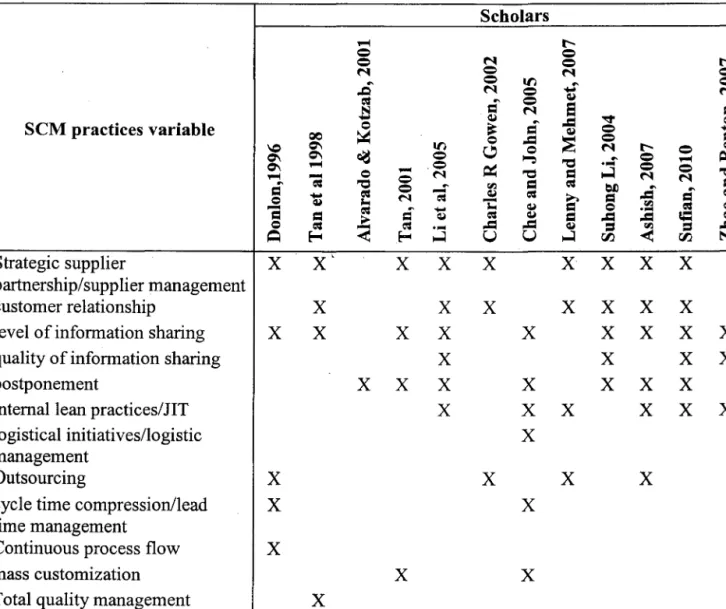
Although literature of SCM practices vary in different view and perspectives, its stand as a mutual understanding purpose of improving organizational performance. Over the literature of reviewing and consolidating that has been pointed out by different researchers, academicians and consultant, there are seven distinctive dimensions of SCM practices which are widely agreed by researchers and received the most consensuses in the researches. These seven dimensions are outsourcing, strategic supplier partnerships, customer relationships, information sharing, postponement, quality of information sharing and lean practices. Findings from these researchers argued that supply chain management practices can encourage the customer relationship and
smooth the information sharing and quality of information sharing flow across the supply chain processes including outsourcing, strategic supplier partnership, lean practices and postponement.
Moreover, such SCM practices were said to create the conclusive environment for enhancing organization performance. The following section will discuss on each of the selected SCM practices including outsourcing, strategic supplier partnership, customer relationship, lean practices, postponement, information sharing and quality of information and how each of them relates to organizational performance.
Table 2.1 Supply Chain Management Practices by Scholars.
Scholars ~
t--=
=
=
M=
t--M=
M=
.Q=
M I£l=
....
...=
M=
=-
=
Q,j .tl Ma
=-Q,j-=
~ 0 SCM practices variable 0 ~=-
=
....
QO ~ Q,j=
0-=
~=
I.C ~ I£l ~ 0 M t--=
Q,j ~ ~ ~=
~ "'CI ...=
~ ~ ~ ~=
....
=
0 ~ M ~ "'CI=
~=
"'CI ~-
=
M M=-
=
"'CI=
=
-
... <Il Q,j=
=
=
bJ) ..d'=
=-
=
....
M ~S
=
0 Q,j'"'
-
<Il-
~ ==-
'"'
Q,j 0....
~ 0= =
~ Q,j ~ Q,j=
-= -=
~ ~ 0 ~ ~....
-= -=
Q,j=
<Il=
-=
~ E---<
~ ~u
u
~ 00-<
00 N Strategic supplier X X' X X X X X X X partnership/supplier management customer relationship X X X X X X Xlevel of information sharing X X X X X X X X X
quality of information sharing X X X X
postponement X X X X X X X
internal lean practices/JIT X X X X X X
logistical initiatives/logistic X
management
Outsourcing X X X X
cycle time compression/lead X X
time management
Continuous process flow X
mass customization X X
2.3.2.1 Outsourcing and Organizational Performance
The definition of outsourcing is varied. Domberger (1998) defined outsourcing as the practices of moving out goods and services that previously carried out internally to an external party while Lankford and Parsa (1999) termed it as the purchasing of services or products from external sources of organization. In general, outsourcing consists of the transfer of responsibility for the part of an organization's operation and management to a third party. The outsourcing practice is believed to be able to sustain the organizational performance (Lankford & Parsa, 1999) as outsourcing practice is the trend of the future. Meanwhile, outsourcing practice has become an integral part of corporate strategy in an organization nowadays. Furthermore, Lankford and Parsa (1999) compromised that outsourcing enable costs reduction activities, improve productivity and reemphasize the organization to relook into their core business, refocus the organizations' strategy, reexamine the investment and help the organization to improve their efficiency and improve their performance.
Outsourcing practice has been given increasing attention as it has brought a significant profit to an organization and improves the organizational perfonnance (Hand field and Nicholas, 1999). Outsourcing practice is believed to be able to increase the flexibility of the organization operating activities as the practice allows them to transfer the operational risks to third party. Moreover, outsourcing is also considered as an important tool for an organization to gain as much benefit as possible. Therefore, this study has conceptualized outsourcing practices wi111ead to the increase of organizational performance.
2.3.2.2 Strategic Supplier Partnership and Organizational Performance
Not all suppliers can be considered as strategic supplier (Dyer, 1998). Thus, strategic supplier relationship is characterized as the long term relationship between its suppliers and the organization. The purpose of strategic supplier partnership is to leverage on the strategic and operational capabilities of individual participating organization in achieving significant ongoing benefits (Li, 2005). A strategic partnership stresses on cooperation of long-term association and inspires the joint understanding of efforts in problem solving solution (Gunasekaran, 2001). Yoshino and Rangan (1995) pointed that strategic partnerships among organizations are to encourage the collaboration and shared the advantages of key strategic areas like products, markets and technology that will increase and enhance organizational performance.
The work of the organizations will be more efficient through the strategic partnership with different suppliers that have been selected solely on the benefit of cost and also enable organization to work with them who are responsible and consenting to bear the liability toward the success or failure of the products. Besides, the benefit of early supplier participation enable an organization to have more cost effective design alternative, helping in selecting best component that will help in more appropriate design assessment (Monczka et aI, 1998). Strategically aligned organizations can work closely to eliminate wasteful time and effort (Balsmeier and Voisin, 1996). Hence, supplier partnership is considered as an important chapter in supply chain that will lead to better organizational performance (Noble, 1997).
Mentzer's (2001) study mentioned that intimate supplier relationship is the key to manage effectively in the global environment. Therefore, strategic partnership with supplier is not only applicable to the local suppliers but also applicable to the international suppliers. Besides, strategic supplier partnership is not only about buying goods and services from
suppliers but also impacting supplier systems and operational capabilities that will influence on the whole supply chain performance (Monczka et aI, 1998). Strategic partnership involves continuous improvement activities, sharing information and joint problem solving effort encourage suppliers to participate to the success of organizational performance (Stuart, 1997). Against this backdrop, strategic supplier partnership is then conceptualized as the predictor of . organizational performance.
2.3.2.3 Customer Relationship and Organizational Performance
Customer relationship is recognized as one of the important element in SCM practices whereby it involves customer relations practices of evaluating customer complaints, enhancing customer &UPport, follow up on customer feedback, predicting key factors affecting customer relationships, customer expectations, interacting wIth customer to set standards and measuring customer satisfaction (Aggarwal, 1997; Claycomb, 1999 and Tan, 1998). Li (2006) defined customer relationship as the practices that used to build long-term relationship with customer, managing customer complaints and improving customer satisfaction. Furthermore, study by Noble (1997) and Tan (1998) also concluded that customer relationship management is crucial
ill
SCM practices and Croxton (2001) further concluded that the customer and supplier relationship are the key SCM practices that will lead to organizational performance. Thus, customer relationship practices are very important and crucial to an organization as its affected the success of SCM and as a result, affected the organizational performance (Scott and Westbrook, 1991).Besides, Ulusoy in his study further suggest that customer relationships are included customer services, delivery performance and customer satisfaction which enable an organization
to improve it product design to meet customer requirement as well as expectations that will overcome the customer satisfaction. Bommer (2001) in his study also recognized that customer relationship can be us.ed as organization's marketing strategy to gain extra sales and profits. Good customer relationship will allow an organization to make itself different from its rivals and consequently retain the customer loyalty (Magretta, 1998). As a result, close and good customer relationship will definitely help in improving organizational performance.
2.3.2.4 Information Sharing and Organizational Performance
Monczka (1998) explained that information sharing among the supply chain partner is related to the degree of critical and proprietary information shared among each others. Mentzer (2000) mentioned that sharing information may be varied in nature especially customer information through the flow of information about logistic activities. Basically, information sharing involved information related to logistics, customer orders, forecasts, schedules, market and so on. Besides, information sharing is included the access of private data between trading partners so that they are able to follow up on the products status and the progress of the order through the supply chain system (Simatupang & Sridharan, 2002 and Zhao & Benton, 2007). Lalonde (1998) explained that information sharing has been recognized as one of the importance SCM practices that use to characterize on a solid supply chain relationship.
According to Stein and Sweat (1998), supply chain partners who exchange information frequently are able to respond to market change quicker as they understand the needs of the end customer and they are able to work as a single entity. Through information sharing, demand and product availability information flow in a correct and systematic manner will smoother the operation process. Moreover, information sharing and knowledgeable will helps to reduce
uncertainties in the market when supply chain members have information and knowledge about each other (Yu, 2001; Frazier, 1998) and organizations should share and exchange information with their supplier so that they are synergies with each other. Hence, information sharing enable the right information available for the right time, right place and right trading partner which will contribute to greater organizational performance.
2.3.2.5 Postponement and Organizational Performance
Postponement is characterized as the exercise of moving forward one or more operations or activities which is included making, sourcing, and delivering to a later point in the supply chain (Li et aI., 2006; Li et aI., 2005; Naylor et aI., 1999; van Hoek et aI., 1999; Beamon, 1998). The main reasons for a firm to adopt postponement strategies are to sustain competitive advantage over it competitors. Van Hoek (1999) mentioned that by keeping materials undifferentiated and inventories undifferentiated of a long period in their warehouse allow some organizations to improve their respond to customer in term of customer demanding and improve organization cost-effectiveness.
Organization is able to meet the customer changing needs, differentiate product and modify of demand function through postponement because postponement allows it to be elastic and limber in different version of the product. Basically, form, time and place are three different types of postponement. Form postponement refers to the delay of activities in determining the form and function of the product until customer fulfilled on the order. Time postponement refers to the delays of goods movement before getting customer's firm orders. Place postponement
refers to the goods positioning either forward or downward movement (Van Hoek, 1999). In