On: 17 October 2007
Access Details: [subscription number 783079146] Publisher: Routledge
Informa Ltd Registered in England and Wales Registered Number: 1072954 Registered office: Mortimer House, 37-41 Mortimer Street, London W1T 3JH, UK
Psychotherapy Research
Publication details, including instructions for authors and subscription information:
http://www.informaworld.com/smpp/title~content=t713663589
A meta-analytic examination of client-therapist
perspectives of the working alliance
Georgiana Shick Tryona; Sasha Collins Blackwella; Elizabeth Felleman Hammela aGraduate School and University Center of the City University of New York,
Online Publication Date: 01 November 2007
To cite this Article: Tryon, Georgiana Shick, Blackwell, Sasha Collins and Hammel, Elizabeth Felleman (2007) 'A meta-analytic examination of client-therapist
perspectives of the working alliance', Psychotherapy Research, 17:6, 629 - 642 To link to this article: DOI: 10.1080/10503300701320611
URL:http://dx.doi.org/10.1080/10503300701320611
PLEASE SCROLL DOWN FOR ARTICLE
Full terms and conditions of use:http://www.informaworld.com/terms-and-conditions-of-access.pdf
This article maybe used for research, teaching and private study purposes. Any substantial or systematic reproduction, re-distribution, re-selling, loan or sub-licensing, systematic supply or distribution in any form to anyone is expressly forbidden.
The publisher does not give any warranty express or implied or make any representation that the contents will be complete or accurate or up to date. The accuracy of any instructions, formulae and drug doses should be independently verified with primary sources. The publisher shall not be liable for any loss, actions, claims, proceedings, demand or costs or damages whatsoever or howsoever caused arising directly or indirectly in connection with or arising out of the use of this material.
Downloaded By: [Tryon, Georgiana Shick] At: 16:12 17 October 2007
A meta-analytic examination of client
therapist perspectives of the
working alliance
GEORGIANA SHICK TRYON, SASHA COLLINS BLACKWELL, &
ELIZABETH FELLEMAN HAMMEL
Graduate School and University Center of the City University of New York
(Received 30 December 2005; revised 12 February 2007; accepted 13 February 2007)
Abstract
Using 53 studies, comprising 52 separate data sets, published in refereed journals from 1985 through 2006, the authors conducted meta-analyses of the correlation and mean difference between clienttherapist alliance ratings. Client and therapist alliance ratings were moderately correlated (/r.36,SD.00); clients’ ratings were higher than ratings by their
therapists (/d.63, SD.42). Client disturbance was a significant moderator of clienttherapist alliance rating
discrepancies; clients with milder disturbances or with substance abuse problems tended to have larger rating discrepancies with their therapists than clients with more severe disturbances or moderate disturbance without substance abuse.
Several researchers have investigated client and therapist agreement on what is happening in therapy and found that convergent perspectives are asso-ciated with better outcomes (Cummings, Hallberg, Slemon, & Martin, 1992; Cummings, Martin, Hall-berg, & Slemon, 1992; Kivlighan & Arthur, 2000; Reis & Brown, 1999). The clienttherapist working alliance (also known as therapeutic alliance, working relationship, and helping alliance) is common to all psychotherapeutic interventions (Gelso & Carter, 1985). Although theorists differ somewhat in their conceptualizations of the alliance (Bordin, 1979; Hausner, 2000; Hentschel, 2005), most emphasize clienttherapist collaboration and consensus on the goals and tasks of therapy (Horvath & Bedi, 2002) as well an emotional bond between client and therapist (Martin, Garske, & Davis, 2000).
Despite the importance of clienttherapist colla-boration, Fitzpatrick, Iwakabe, and Stalikas (2005) indicated that therapist and client perspectives of the alliance do not always agree. Authors of numerous studies (Bachelor, 1991; Bachelor & Salame, 2000; Cecero, Fenton, Nich, Frankforter, & Carroll, 2001; Fitzpatrick et al., 2005; Hatcher, Barends, Hansell, & Gutfreund, 1995; Hilsenroth, Peters, & Acker-man, 2004; Mallinckrodt, 1991, 1993; Mallinckrodt & Nelson, 1991; Ogrodniczuk, Piper, Joyce, & McCallum, 2000; Tichenor & Hill, 1989) have observed that clients and therapists appear to view
the alliance differently, with clients generally giving higher alliance ratings. Some studies (Casey, Oei, & Newcombe, 2005; Kivlighan & Shaughnessy, 1995; Mallinckrodt & Nelson, 1991) also have reported relatively low correlations between client and thera-pist alliance ratings. Several factors appear to influ-ence the alliance, and some or all may relate to clienttherapist divergence in perspective. It is our goal to use meta-analyses to examine client thera-pist alliance ratings as well as factors that influence the alliance that might serve as possible moderators of these rating.
One of these factors is client disturbance. In a summary of 11 studies, Horvath (1991), as cited in Constantino, Castonguay, & Schut, 2002) reported that clients who have difficulty maintaining social relationships were more likely to have difficulty forming a working alliance. More severely disturbed clients generally have relationship problems, and several studies (Gaston, Thompson, Gallager, Cournoyer, & Gagnon, 1998; Gunderson, Najavits, Leonhard, Sullivan, & Sabo, 1997; Hersoug, Hoglend, Monsen, & Havik, 2001; Lingiardi, Filippucci, & Baiocco, 2005; Zuroff et al., 2000) indicated that more severe client disturbance is related to lower alliances ratings. In contrast to the often reported pattern of client alliance ratings being higher than ratings by therapists, severely disturbed clients in studies by Gehrs and Goering (1994) and
Correspondence concerning this article should be addressed to Georgiana Shick Tryon, The Graduate Center (CUNY), PhD Program in Educational Psychology, 365 Fifth Avenue, New York, NY 10016. E-mail: [email protected]
ISSN 1050-3307 print/ISSN 1468-4381 online#2007 Society for Psychotherapy Research
Downloaded By: [Tryon, Georgiana Shick] At: 16:12 17 October 2007
Gunderson et al. (1997) frequently rated the alliance lower than did their therapists. Others (Joyce & Piper, 1998; Paivio & Bahr, 1998), however, have not found a relationship between client disturbance and alliance ratings.
Within the larger category of degree of client disturbance, client diagnosis could be a factor that influences alliance ratings. Most client participants in alliance-rating studies, however, have several diagnoses that usually are listed by study authors, but generally alliance data are not presented or analyzed according to diagnoses. Some studies, however, use more homogeneous client samples. For example, several studies have used clients who were being treated for drug or alcohol problems (Barber et al., 1999; Calsyn, Klinkenberg, Morse, & Lemming, 2006; Cecero et al., 2001; Connors, Carroll, DiClemente, Longabaugh, & Donovan, 1997; Fenton, Cecero, Nich, Frankforter, & Carroll, 2001; Luborsky et al., 1996; Meier & Donmall, 2006; Meier, Donmall, Barrowclough, McElduff, & Heller, 2005; Meier, Donmall, McElduff, Barrow-clough, & Heller, 2006; Petry & Bickel, 1999). Some of these authors have commented about finding large alliance rating discrepancies, with clients with sub-stance abuse problems viewing the alliance much more positively than their therapists. Thus, some specific client diagnoses may impact alliance ratings. Another factor that may impact clienttherapist perspectives on the alliance is the experience level of the therapist. Experienced therapists have had both more opportunities to practice psychotherapy and a wider exposure to different types of clients than trainees, so their perceptions of the alliance may differ from that of trainees, and clients may also rate them differently than they do trainees. Hersoug et al. (2001) and Mallinckrodt and Nelson (1991) found that alliance ratings by both clients and therapists differed depending on therapist experience. Dunkle and Friedlander (1996), however, did not find such a relationship.
Length of therapy is another factor that may moderate clienttherapist alliance rating differences. It may be that rating convergence is greater in longer term therapy because it covers a longer period of time, during which client and therapist could pre-sumably develop similar perspectives. There have been alliance studies comparing longer and shorter term therapies (e.g., Stiles, Agnew-Davis, Hardy, Barkham, & Shapiro, 1998), but none have com-pared clienttherapist alliance perspective conver-gence for shorter relative to longer therapies.
Differences in clienttherapist alliance ratings may also depend on the scales used to assess the alliance. Several alliance-rating instruments have both client and therapist versions. These alliance
measures are based on various theoretical concep-tualizations of the alliance and generally have been found to correlate highly with each other (Cecero et al., 2001; Fenton et al., 2001; Hatcher & Barends, 1996; Stiles et al., 2002: Tichenor & Hill, 1989), confirming the common elements of the alliance. Although the various alliance instruments are simi-lar, they are not identical, and it is possible that clienttherapist convergence could be influenced by the alliance measure used.
Finally, the type of therapeutic treatment that clients receive could moderate clienttherapist alli-ance ratings. The allialli-ance is an important compo-nent of all types of treatment, and meta-analyses have shown that the relationship between alliance and treatment outcome is not moderated by type of treatment (Horvath & Bedi, 2002; Martin et al., 2000). Although the alliance is common to all therapies, different theoretical orientations empha-size different aspects of the alliance (Raue, Caston-guay, & Goldfried, 1993), and there is evidence that the theoretical orientation of the alliance rater may influence alliance ratings (Raue, Putterman, Goldfried, & Wolitzky, 1995). Thus, the type of treatment may impact therapists’ alliance ratings and play a role in clienttherapist alliance rating differ-ences.
Although convergence of client and therapist perspectives on what is happening in psychotherapy is desirable (Kivlighan & Arthur, 2000), the litera-ture that we reviewed suggests that, in regard to the alliance, clienttherapist perspective divergence may be the rule rather than the exception. To what extent do clients’ and therapists’ perceptions of the alliance converge? Are clienttherapist alliance perspectives moderated by factors such as client disturbance, therapist experience, length of therapy, alliance instrument, and treatment type? Over the past 21 years, several studies have assessed the alliance from both client and therapist perspectives. The aim of this study is to use meta-analyses to investigate the relationship between client and therapist alliance ratings by assessing (a) the correlation between client and therapist ratings of the alliance and (b) the mean differences in clienttherapist alliance ratings along with their possible moderating factors.
Method Selection of Studies
Our inclusion criteria, similar to those used in the alliancetreatment outcome meta-analyses by Hor-vath and Symonds (1991), HorHor-vath and Bedi (2002), and Martin et al. (2000), were as follows: (a) The study categorized the alliance as working
Downloaded By: [Tryon, Georgiana Shick] At: 16:12 17 October 2007
alliance, helping alliance, therapeutic alliance, work-ing relationship, or the alliance; (b) the study was published in a refereed journal between 1985 and 2006; (c) the study either listed a correlation between clienttherapist working alliance ratings or presented mean client and therapist working alliance ratings; (d) the study had to be a group design with at least five participants; (e) the psychological treatment had to be conducted in individual ses-sions; (f) the study had to have used client and therapist versions of the same instrument; (g) the study had to be published in English; and (h) the alliance was measured on adult clients. Also, because we wanted to examine effects associated with differ-ent alliance measures, we excluded a study when it was the only one that used a particular alliance measure.
We used two databases to search for articles: PsychInfo and Medline. Word searches yielded the following numbers of references: ‘‘therapeutic alli-ance,’’ 1,192 references; ‘‘therapeutic alliance or working alliance,’’ 3,123 references; ‘‘therapeutic alliance or working alliance and client and counse-lor,’’ 109 references; ‘‘therapeutic alliance or working alliance and client and counselor ratings,’’ two references. We cross-tabulated the references, vi-sually scanned the abstracts of the articles, and examined approximately 300 articles in greater depth. This resulted in the identification of 41 articles with both client and therapist working alliance data that met criteria. We examined the reference sections of the 41 articles and inspected the previous year of journals in which the articles appeared. We also used the phrases ‘‘client and therapist working alliance’’ and ‘‘client and counse-lor working alliance’’ in Google searches. These latter procedures resulted in the identification of 12 additional articles that met inclusion criteria. Thus, our search yielded 53 articles that presented clienttherapist working alliance correlational or mean data.
Recording Study Data for Analyses
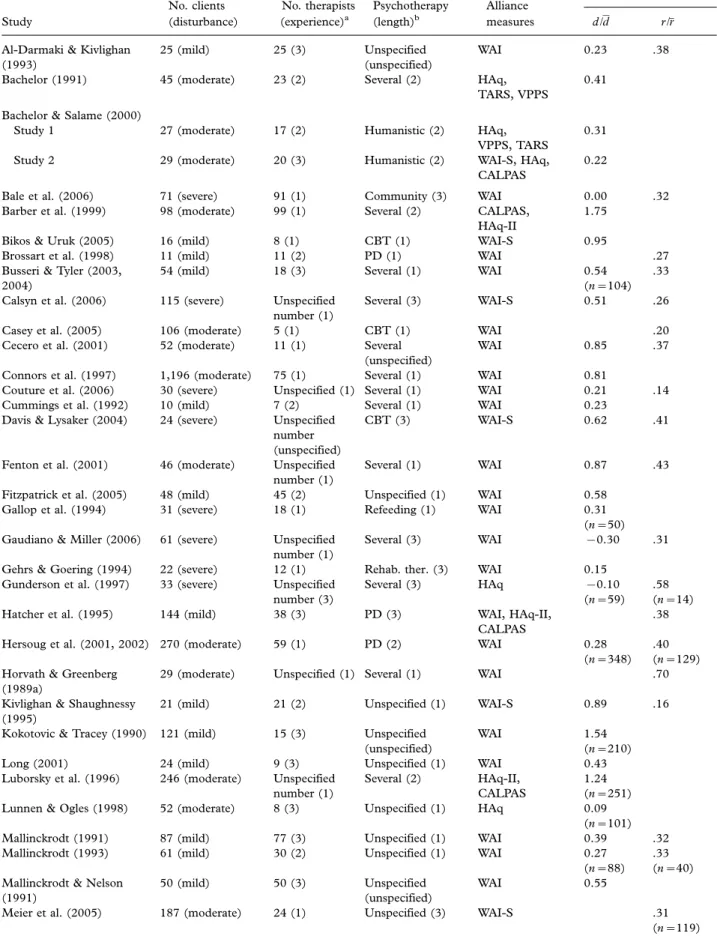
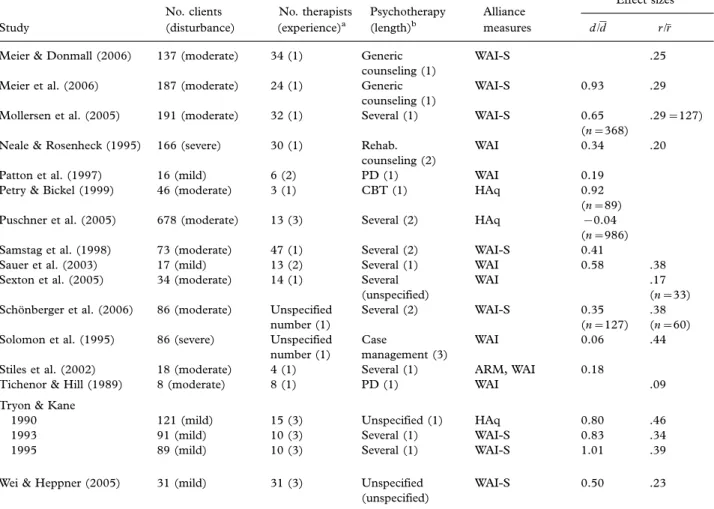
Table I presents information (i.e., number of parti-cipants, client disturbance, therapist experience, type of therapy, length of therapy, and alliance measure) recorded from the Method section of each study. At least two of the three of the current authors independently categorized the data, and if we disagreed on the categorization, we conferred to reach agreement.
As can be seen in Table I, Busseri and Tyler (2003, 2004) used the same client and therapist data, as did Hersoug et al. (2001, 2002), and Bachelor and Salame (2000) reported data from two studies.
Thus, the 53 articles yielded 52 different data sets that formed the bases for the meta-analyses; 44 of these data sets provided client and therapist mean alliance ratings and 32 provided clienttherapist alliance correlations.
Table I shows that, in most of the studies, the number of therapists is considerably less than the number of clients, because usually each therapist rated alliances with several clients. So, for example, in a hypothetical study having 27 clients and five therapists, the number of dyads on which a client
therapist correlation for this study is based would be 27. The total number of individual client and therapist ratings on which a mean difference effect is based, however, would be 54, because therapists rated 27 clients, and 27 clients rated therapists. Sometimes, as a result of attrition, the number of clients and therapists who actually provided alliance ratings is less than the number of clients and therapists reported by the authors in Participant sections. Thus, for effect sizes based on numbers of participant raters that differ from the client and therapist numbers given in Table I, the number of dyads (for correlations) and number of raters (for mean differences) are also presented with their respective effect sizes.
We classified client disturbance as mild if clients were volunteers who were recruited from college classes or had no formal psychiatric diagnoses. Many of these mildly disturbed clients were seen at training clinics. Table I shows that clients in 19 (37%) of the data sets were mildly disturbed.
Moderately disturbed clients had various psychia-tric diagnoses (usually including depression or anxi-ety), generally were identified by study authors as moderately disturbed, and were seen at outpatient clinics or drug treatment facilities. Table I shows that clients in 23 (44%) of the data sets were moderately disturbed. Within the moderately disturbed cate-gory, seven data sets had clients with substance-abusing clients. The other data sets in this category had clients with multiple diagnostic characteristics.
Clients in 10 (19%) data sets were identified by study authors as severely disturbed. These clients were either hospitalized or seen at outpatient clinics. Within this severely disturbed grouping, five data sets had clients with schizophrenia. One data set each had the following: clients with bipolar disorder; homeless, substance-abusing clients with severe mental illness of an unspecified type; clients with eating disorders; clients with borderline personality disorder; and clients with brain injuries and severe mental disturbance.
Therapists were trainees in nine (17%) data sets, experienced therapists in 27 (52%) data sets, and a mixture of trainees and experienced therapists in 15
Downloaded By: [Tryon, Georgiana Shick] At: 16:12 17 October 2007
Table I. Summary of Studies Used in Meta-Analysis.
No. clients No. therapists Psychotherapy Alliance
Effect sizesc
Study (disturbance) (experience)a (length)b measures d//d r//r
Al-Darmaki & Kivlighan (1993)
25 (mild) 25 (3) Unspecified
(unspecified)
WAI 0.23 .38
Bachelor (1991) 45 (moderate) 23 (2) Several (2) HAq,
TARS, VPPS
0.41 Bachelor & Salame (2000)
Study 1 27 (moderate) 17 (2) Humanistic (2) HAq,
VPPS, TARS
0.31
Study 2 29 (moderate) 20 (3) Humanistic (2) WAI-S, HAq,
CALPAS
0.22
Bale et al. (2006) 71 (severe) 91 (1) Community (3) WAI 0.00 .32
Barber et al. (1999) 98 (moderate) 99 (1) Several (2) CALPAS,
HAq-II
1.75
Bikos & Uruk (2005) 16 (mild) 8 (1) CBT (1) WAI-S 0.95
Brossart et al. (1998) 11 (mild) 11 (2) PD (1) WAI .27
Busseri & Tyler (2003, 2004)
54 (mild) 18 (3) Several (1) WAI 0.54
(n104) .33
Calsyn et al. (2006) 115 (severe) Unspecified
number (1)
Several (3) WAI-S 0.51 .26
Casey et al. (2005) 106 (moderate) 5 (1) CBT (1) WAI .20
Cecero et al. (2001) 52 (moderate) 11 (1) Several
(unspecified)
WAI 0.85 .37
Connors et al. (1997) 1,196 (moderate) 75 (1) Several (1) WAI 0.81
Couture et al. (2006) 30 (severe) Unspecified (1) Several (1) WAI 0.21 .14
Cummings et al. (1992) 10 (mild) 7 (2) Several (1) WAI 0.23
Davis & Lysaker (2004) 24 (severe) Unspecified number (unspecified)
CBT (3) WAI-S 0.62 .41
Fenton et al. (2001) 46 (moderate) Unspecified
number (1)
Several (1) WAI 0.87 .43
Fitzpatrick et al. (2005) 48 (mild) 45 (2) Unspecified (1) WAI 0.58
Gallop et al. (1994) 31 (severe) 18 (1) Refeeding (1) WAI 0.31
(n50) Gaudiano & Miller (2006) 61 (severe) Unspecified
number (1)
Several (3) WAI 0.30 .31
Gehrs & Goering (1994) 22 (severe) 12 (1) Rehab. ther. (3) WAI 0.15
Gunderson et al. (1997) 33 (severe) Unspecified
number (3)
Several (3) HAq 0.10
(n59) .58 (n14)
Hatcher et al. (1995) 144 (mild) 38 (3) PD (3) WAI, HAq-II,
CALPAS
.38
Hersoug et al. (2001, 2002) 270 (moderate) 59 (1) PD (2) WAI 0.28
(n348) .40 (n129) Horvath & Greenberg
(1989a)
29 (moderate) Unspecified (1) Several (1) WAI .70
Kivlighan & Shaughnessy (1995)
21 (mild) 21 (2) Unspecified (1) WAI-S 0.89 .16
Kokotovic & Tracey (1990) 121 (mild) 15 (3) Unspecified
(unspecified)
WAI 1.54
(n210)
Long (2001) 24 (mild) 9 (3) Unspecified (1) WAI 0.43
Luborsky et al. (1996) 246 (moderate) Unspecified number (1)
Several (2) HAq-II,
CALPAS
1.24 (n251)
Lunnen & Ogles (1998) 52 (moderate) 8 (3) Unspecified (1) HAq 0.09
(n101)
Mallinckrodt (1991) 87 (mild) 77 (3) Unspecified (1) WAI 0.39 .32
Mallinckrodt (1993) 61 (mild) 30 (2) Unspecified (1) WAI 0.27
(n88) .33 (n40) Mallinckrodt & Nelson
(1991)
50 (mild) 50 (3) Unspecified
(unspecified)
WAI 0.55
Meier et al. (2005) 187 (moderate) 24 (1) Unspecified (3) WAI-S .31
Downloaded By: [Tryon, Georgiana Shick] At: 16:12 17 October 2007
(29%) data sets. One study (2%) did not specify the therapists’ experience level.
Most studies indicated a specific treatment length; however, for those that did not, we used the average number of sessions as treatment length. We divided treatment length into three categories. The first category included studies that indicated 20 or fewer therapy sessions (n27 [52%]). The second in-cluded studies having between 21 and 39 sessions (n9 [17%]). The third category included studies with 40 or more sessions (n10 [19%]). Six (12%) studies did not specify treatment length.
Table I also shows the type of therapy provided in the study. In 34 (65%) data sets, authors either did not specify their treatment (n12 [23%]) or used more than one type of therapy (n22 [42%]). Four data sets (8%) used cognitivebehavioral therapy exclusively, five (10%) used psychodynamic therapy
exclusively, and two (4%) used humanistic therapy exclusively. The remaining seven data sets (13%) used other types of therapies, such as generic counseling, case management, refeeding, and reha-bilitation therapy, that we were not able to categorize. For the most part, the studies used one or more of the alliance measures that are common in the literature. The majority of data sets (n27 [52%]) used the Working Alliance Inventory (WAI; Horvath & Greenberg, 1989b) exclusively, and an additional 13 (25%) exclusively used the Working Alliance Inventoryshort version (WAI-S; Tracey & Kokoto-vic, 1989). Five (10%) data sets used the Helping Alliance Questionnaire (HAq; Alexander & Lu-borsky, 1989) only. Finally, seven (13%) data sets used more than one alliance measure. In addition to the WAI, WAI-S, or HAq, these data sets used one or more of the following measures: Agnew Relationship
Table I (Continued)
No. clients No. therapists Psychotherapy Alliance
Effect sizesc
Study (disturbance) (experience)a (length)b measures d//d r//r
Meier & Donmall (2006) 137 (moderate) 34 (1) Generic
counseling (1)
WAI-S .25
Meier et al. (2006) 187 (moderate) 24 (1) Generic
counseling (1)
WAI-S 0.93 .29
Mollersen et al. (2005) 191 (moderate) 32 (1) Several (1) WAI-S 0.65
(n368)
.29127)
Neale & Rosenheck (1995) 166 (severe) 30 (1) Rehab.
counseling (2)
WAI 0.34 .20
Patton et al. (1997) 16 (mild) 6 (2) PD (1) WAI 0.19
Petry & Bickel (1999) 46 (moderate) 3 (1) CBT (1) HAq 0.92
(n89)
Puschner et al. (2005) 678 (moderate) 13 (3) Several (2) HAq 0.04
(n986)
Samstag et al. (1998) 73 (moderate) 47 (1) Several (2) WAI-S 0.41
Sauer et al. (2003) 17 (mild) 13 (2) Several (1) WAI 0.58 .38
Sexton et al. (2005) 34 (moderate) 14 (1) Several
(unspecified)
WAI .17
(n33) Scho¨nberger et al. (2006) 86 (moderate) Unspecified
number (1)
Several (2) WAI-S 0.35
(n127) .38 (n60)
Solomon et al. (1995) 86 (severe) Unspecified
number (1)
Case
management (3)
WAI 0.06 .44
Stiles et al. (2002) 18 (moderate) 4 (1) Several (1) ARM, WAI 0.18
Tichenor & Hill (1989) 8 (moderate) 8 (1) PD (1) WAI .09
Tryon & Kane
1990 121 (mild) 15 (3) Unspecified (1) HAq 0.80 .46
1993 91 (mild) 10 (3) Several (1) WAI-S 0.83 .34
1995 89 (mild) 10 (3) Several (1) WAI-S 1.01 .39
Wei & Heppner (2005) 31 (mild) 31 (3) Unspecified
(unspecified)
WAI-S 0.50 .23
Note. ARMAgnew Relationship Measure; CALPASCalifornia Psychotherapy Alliance Scale; HAqHelping Alliance Questionnaire; HAq-IIRevised Helping Alliance Questionnaire; TARSTherapeutic Alliance Rating Scale; VPPSVanderbilt Psychotherapy Process Scale; WAIWorking Alliance Inventory; WAI-SWorking Alliance InventoryShort version; PDpsychodynamic; CBTcognitive behavioral therapy.
a
1experienced, 2trainees, 3both experienced and trainees. b1120 sessions; 22139 sessions; 340 or more sessions.
c
Subsample sizes in parentheses are the number of dyads (for correlations) and number of raters (for mean differences) if the number of dyads or raters differs from that listed in columns two and three.
Downloaded By: [Tryon, Georgiana Shick] At: 16:12 17 October 2007
Measure (ARM; Agnew-Davies, Stiles, Hardy, Bark-ham, & Shapiro, 1998), California Psychotherapy Alliance Scale (CALPAS; Gaston, 1991; Marmar, Gaston, Gallagher, & Thompson, 1989), revised Helping Alliance Questionnaire (HAq-II; Luborsky et al., 1996), Therapeutic Alliance Rating Scale (TARS; Marmar, Horowitz, Weiss, & Marziali, 1989), or Vanderbilt Psychotherapy Process Scale (VPPS; Suh & Strupp, 1989).
Estimation of Effect Sizes
In computing effect sizes for each study that reported client and therapist alliance means, we followed the formula provided by Hunter and Schmidt (2004, p. 277, Formula 7.6). We subtracted the mean of the therapist working alliance rating from the mean of the client working alliance rating, which was generally larger and would thus yield a positive effect size. We divided this figure by the pooled client and therapist standard deviation.
Whereas most data sets used just one alliance measure, others used two or more measures to assess alliance or to assess the alliance more than once during therapy. To obtain one averaged statistic for these data sets, we weighted each mean alliance rating by the number of participants who completed it and averaged these weighted means. We also weighted and pooled the standard deviations of each alliance measure. When a data set used two (or more) alliance measures, we corrected for differences in the number of rating points for alliance measures by multiplying the means and standard deviations of the measures with fewer rating points by a correction factor equal to the number of points in the scale with the larger number of rat-ing points divided by the number of ratrat-ing points in the scale with the smaller number of rating points. We then computed an aggregatedd for that data set by subtracting the average weighted therapist mean from the average weighted client mean and divided the resultant number by the weighted and pooled client and therapist standard deviation.
To obtain one average correlation, we weighted the individual correlations by the number of parti-cipants and averaged these weighted correlations to obtain a single r for each alliance assessment time period and the total data set. Effect sizes for client
therapist correlations and mean differences are presented in Table I.
Meta-Analyses
We conducted two large meta-analyses, one to obtain the correlation between clienttherapist alli-ance ratings and the second to obtain the mean
difference between client and therapist alliance ratings using the HunterSchmidt Meta-Analysis Programs package (Schmidt & Le, 2004). This software is commercially available and is described extensively in Hunter and Schmidt’s (2004)Methods of Meta-Analysis: Correcting Error and Bias in Research Findings (Appendix, pp. 517526). In a Monte Carlo study, Field (2005b) compared Hunter and Schmidt’s method of meta-analysis with that of another popular meta-analytic technique by Hedges and Vevea (1998) and found that the Hunter and Schmidt method ‘‘produced estimates of the average correlation with the least error’’ (p. 444). Hunter and Schmidt (2004) indicate that, although most meta-analytic methods only control for sampling error (Glass, 1976), it is important to control for measure-ment error in meta-analyses to obtain a more accurate measure of true effects. Hunter and Schmidt present a lengthy detailing of ‘‘the severe distorting effects’’ (p. xxxi) of measurement errors on the outcomes of both individual studies and meta-analyses.
The artifact distribution option allows correction of effect sizes for the unreliability of the measures used.1 To calculate r; we entered into the program, for each data set, the total correlation effect size,r or/ r; for that study and the number of dyads that provided ratings on which the correlation was based. We then entered the reliability estimates of both the therapist alliance instruments and the client alliance instruments to correct for measurement errors using the artifact distribution option. These reliability estimates were coefficient alphas. When they were available, we entered the coefficient alphas as reliability estimates for the alliance instruments based on that particular data set’s therapist and client samples as part of the artifact distribution. We also entered reliability coefficients for the alliance measures from other studies that used that particular alliance measure to correct for the unreliability of these measures on the outcome of the analysis. We obtained coefficient alphas for the client and thera-pist alliance measures from the Method section of each study and from other studies that used the same alliance measures (Alexander & Luborsky, 1989; Busseri & Tyler, 2003; Gaston, 1991; Hanson, Curry, & Bandalos, 2002; Hatcher, 1999; Hatcher, & Barends, 1996; Luborsky et al., 1996; Marmar, & Horowitz, et al., 1989; Suh, & Strupp, 1989; Tichenor & Hill, 1989; Tracey, & Kokotovic, 1989). The rationale for using this option is that a distribution of coefficient alphas across studies provides a better estimate of each test’s reliability than does any single study.
To calculate d; we again chose the artifact distribution option to correct for the unreliability
Downloaded By: [Tryon, Georgiana Shick] At: 16:12 17 October 2007
of the alliance measures used.2Thus, for each data set, we entered the total d or d calculated for that study and the number of participants (the total number of clients and therapists) providing alliance ratings. Following this, we entered coefficient alphas for all the alliance measures used in all the studies that we obtained from the studies themselves and from other studies that used those instruments (see prior discussion).
Thus, we had two large clienttherapist alliance ratings meta-analyses: one for r and one for d: Hunter and Schmidt (2004) indicate that if the variance observed in therord values after removal of the variance resulting from all study artifacts (i.e., the residual variance) is essentially 0, then modera-tors do not play a part in the relationship between client and therapist alliance ratings. Small residual variances may not indicate the presence of modera-tors because ‘‘it is never possible to correct for all artifacts that cause variation across studies’’ (p. 54). Hunter and Schmidt state that moderator analysis is complete when 75% of the variance is explained. To test for moderator variables, Hunter and Schmidt recommend (p. 78) that studies are divided into subsets representing levels of the possible moderator variable and that separate meta-analyses are con-ducted for each level. Residual variance that is minimal at the different levels of a possible mod-erator indicates that that modmod-erator is an important source of variation. If residual variance still exists (in excess of 25%), the search for potential moderators should continue. Although Hunter and Schmidt do not recommend moderator analysis when the resi-dual variance is less than 25%, we sought to explain more fully variance in reported results. To test differences between mean clienttherapist alliance rating effect sizes, we converted ds to correlations and conductedZ tests for independent correlations (Rosenthal & Rosnow, 1991).
To determine what moderators to examine when a meta-analysis had more than minimal residual var-iance, we examined the data for outliers using box-and-whisker plots that provided us with a visual representation of the effect size distributions (Field, 2005a, pp. 6669). When we found outlier data, we determined the subsample that they represented (e.g., clients with substance abuse issues) and grouped the data sets according to that subsample for moderator meta-analyses.
Results
Client
Therapist Alliance CorrelationsThirty-two data sets presented correlational data for clienttherapist alliance ratings. The total sample
size for the meta-analyses for these data was 2,331 clienttherapist dyads. The mean true correlation was r.36, SD.00. There was no residual var-iance, indicating that variation among studies is entirely accounted for by alliance measurement unreliability. Cohen (1992) indicates that a medium effect size for correlations is .30 and a large effect size for correlations is .50. Thus, .36 falls between a medium and a large effect size for the correlation between clienttherapist alliance ratings.
Client
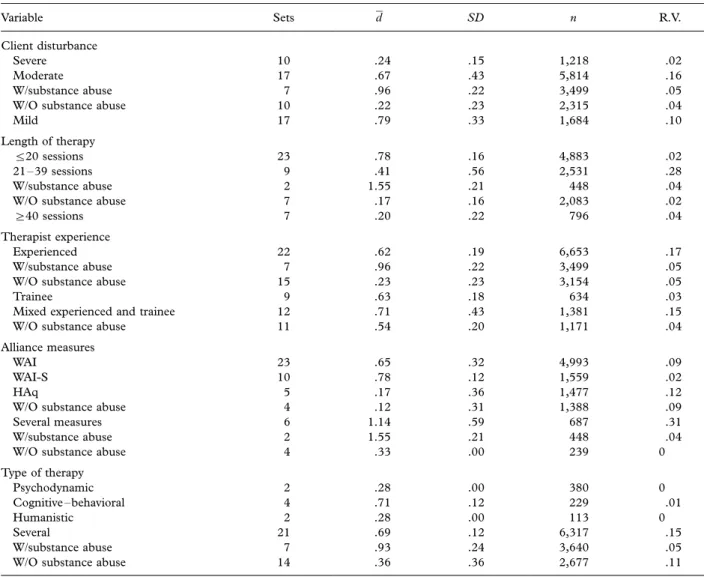
Therapist Mean DifferencesForty-four data sets with a total sample size of 8,716 client and therapist alliance ratings yielded a mean difference between client and therapist ratings of /d.63, SD.42. Cohen (1992) indicates that a large effect size for mean differences is .80, a medium size is .50, and a small effect size is .20. Thus, the effect size for client alliance rating minus therapist alliance rating is midway between a med-ium and a large effect size. Residual variance for this analysis, however, was .16, suggesting the possibility of moderators. We identified five possible modera-tors of the clienttherapist alliance rating differences (client disturbance, therapist experience, length of therapy, alliance measure, and type of treatment) in the literature. We had no reason to choose one of these moderators over the others, so we performed meta-analyses by dividing the data sets initially according to each of these moderators. Table II presents the results of these analyses.
Client disturbance .As seen in Table II, the client
therapist alliance rating discrepancy was smaller when clients had a severe disturbance than when they had either a moderate (Z6.67,pB.001) or a mild (Z7.11, pB.001) disturbance. Residual var-iance in the moderately disturbed category, however, suggested the presence of moderators. Using the box-and-whisker method described previously, we identi-fied data sets in the moderately disturbed category that appeared to have larger discrepancies when clients had substance abuse concerns. Table II shows that we reduced the residual variance of the moder-ately disturbed category by dividing it into data sets according to whether or not clients had a substance abuse problem and conducting separate meta-ana-lyses for these groups. Moderately disturbed clients with substance abuse problems had larger client
therapist alliance discrepancies than moderately dis-turbed clients without substance abuse concerns (Z
13.06, pB.001) and also had significantly larger clienttherapist discrepancies than severely disturbed (Z10.21, pB.001) or mildly disturbed (Z3.70,
Downloaded By: [Tryon, Georgiana Shick] At: 16:12 17 October 2007
severely disturbed clients and mildly disturbed clients without substance abuse were small effect sizes and did not differ from each other (Z.28, p.05). Thus, mildly disturbed clients and moderately dis-turbed clients with substance abuse had large client
therapist alliance rating discrepancies, whereas se-verely disturbed clients and moderately disturbed clients without substance abuse had much smaller discrepancies.
Length of therapy. Table II shows that in shorter term therapy (520 sessions), clienttherapist rating discrepancies are larger than those of clients and therapists in therapies lasting 21 to 39 sessions (Z7.20, pB.001) and in therapy lasting 40 or more sessions (Z7.31,pB.001). The difference in alliance discrepancies for 21 to 39 sessions compared with 40 or more sessions was also significant (Z2.44, pB.05). Thus, it seems that the client
therapist alliance rating discrepancy is less for longer than for shorter term therapy. The residual variance in the 21- to 39-session grouping, however, was large, so we inspected the data to find data sets with larger and smaller discrepancies. A box-and-whisker analysis led us to identify data sets with substance-abusing clients as having larger discrepancies than those with clients without substance abuse concerns. Meta-analyses on these data sets confirmed this (Z
12.12, pB.001). Clients with substance abuse problems and their therapists who were engaged in therapy lasting 21 to 39 sessions also had greater alliance discrepancies than did clients and their therapists in shorter term therapy (Z6.60,
pB.001) and those in therapy lasting 40 or more sessions (Z10.30, pB.001). Clients without sub-stance abuse problems and their therapists who were engaged in therapy lasting 21 to 39 sessions had small alliance rating differences that did not differ
Table II. Meta-Analyses of ClientTherapist Alliance Rating Differences Using Different Moderators.
Variable Sets /d SD n R.V.
Client disturbance
Severe 10 .24 .15 1,218 .02
Moderate 17 .67 .43 5,814 .16
W/substance abuse 7 .96 .22 3,499 .05
W/O substance abuse 10 .22 .23 2,315 .04
Mild 17 .79 .33 1,684 .10
Length of therapy
520 sessions 23 .78 .16 4,883 .02
2139 sessions 9 .41 .56 2,531 .28
W/substance abuse 2 1.55 .21 448 .04
W/O substance abuse 7 .17 .16 2,083 .02
]40 sessions 7 .20 .22 796 .04
Therapist experience
Experienced 22 .62 .19 6,653 .17
W/substance abuse 7 .96 .22 3,499 .05
W/O substance abuse 15 .23 .23 3,154 .05
Trainee 9 .63 .18 634 .03
Mixed experienced and trainee 12 .71 .43 1,381 .15
W/O substance abuse 11 .54 .20 1,171 .04
Alliance measures
WAI 23 .65 .32 4,993 .09
WAI-S 10 .78 .12 1,559 .02
HAq 5 .17 .36 1,477 .12
W/O substance abuse 4 .12 .31 1,388 .09
Several measures 6 1.14 .59 687 .31
W/substance abuse 2 1.55 .21 448 .04
W/O substance abuse 4 .33 .00 239 0
Type of therapy Psychodynamic 2 .28 .00 380 0 Cognitivebehavioral 4 .71 .12 229 .01 Humanistic 2 .28 .00 113 0 Several 21 .69 .12 6,317 .15 W/substance abuse 7 .93 .24 3,640 .05
W/O substance abuse 14 .36 .36 2,677 .11
Note. R.V.residual variance; WAIWorking Alliance Inventory; WAI-SWorking Alliance InventoryShort version; HAqHelping Alliance Questionnaire.
Downloaded By: [Tryon, Georgiana Shick] At: 16:12 17 October 2007
from those of clients and therapists in therapy of 40 or more sessions (Z.50,p.05).
Thus, clients in shorter term therapy had large clienttherapist alliance discrepancies that were larger than those of clients in therapy lasting 40 sessions or more (small effect) and clients without substance abuse in therapies of 21 to 39 sessions (small effect). Clients with substance abuse pro-blems, however, had the largest clienttherapist alliance discrepancies of all. It should be noted that there were no data sets with substance-abusing clients who were in shorter term therapy.
Therapist experience .Table II shows similar client
therapist alliance ratings discrepancies for clients of experienced, trainee, and mixed experience thera-pists. These moderate effects did not differ from each other (experienced therapists vs. trainees:
Z0.00, p.05; experienced vs. mixed: Z1.01,
p.05; trainees vs. mixed: Z.62, p.05). The residual variance for experienced therapists sug-gested the presence of a moderator. Box-and-whis-ker inspection of the data sets led us to divide the experienced data sets according to client substance abuse. Clients with substance abuse concerns had larger alliance rating discrepancies (large effect size) with their experienced therapists than did clients without substance abuse (small effect size;
Z13.03, pB.001). Clients without substance abuse with experienced therapists had smaller alli-ance discrepancies than did clients with trainee therapists (Z4.36, pB.001). It should be noted that data sets with trainee therapists exclusively tended to have clients with only mild disturbances. When the one data set with substance-abusing clients was removed from the mixed therapist experience grouping, the residual variance de-creased, and the clienttherapist alliance discre-pancy (moderate effect size) did not differ from that in data sets with trainee therapists (Z1.01,
p.05). Thus, type of client disturbance has a moderating effect on clienttherapist discrepancies with therapists of differing levels of experience.
Alliance measures . Table II shows that WAI and WAI-S clienttherapist discrepancies tended to be moderate to large effect sizes that did not differ from each other (Z1.38, p.05) but were significantly larger than those in data sets that used the HAq (Z8.10, pB.001, for WAI vs. HAq; Z7.70,
pB.001, for WAI-S vs. HAq). Removing the one outlier data set with substance-abusing clients from the HAq meta-analysis decreased residual variance, and the HAq clienttherapist discrepancy (small effect size) was still significantly smaller than in data
sets using the WAI (Z8.56,pB.001) or the WAI-S (Z8.12, pB.001).
Studies using several alliance measures had the largest effect sizes of all (vs. WAI,Z5.64,pB.001; vs. WAI-S, Z4.14, pB.001; vs. HAq, Z10.17,
pB.001), but there was considerable residual variance in the meta-analysis for several measures, indicating the presence of moderators. A box-and-whisker analysis of the several measure data sets led us to divide them according to data sets with substance-abusing clients and data sets with clients without substance abuse. The meta-analysis of data sets using several measures with clients with sub-stance abuse yielded larger discrepancies (large effect size) than did the analysis using several measures with clients without substance problems (small effect size; Z6.83, pB.001). Discrepancies with data sets using several measures with clients with sub-stance abuse had larger effect sizes than those using the WAI (Z7.88, pB.001), the WAI-S (Z6.51,
pB.001), and the HAq (Z11.65,pB.001).
Type of therapy. Table II also presents meta-analytic effect sizes for the clienttherapist alliance discrepancy according to type of therapy. The clienttherapist discrepancy for cognitive beha-vioral therapy data sets was significantly larger than that in data sets using psychodynamic (Z2.38,pB
.05) but not humanistic (Z1.72, p.05) therapy. We caution readers that these results are based on small numbers of data sets and clienttherapist dyads. The effect size for the meta-analysis of data sets that used several therapies was moderate to large, with residual variance suggesting moderators. Inspection of the data indicated that breaking this large set into smaller data sets of clients with and without substance abuse issues might reduce the residual variance. The meta-analysis effect for dis-crepancies for clients with substance abuse treated with several therapies was significantly larger than the effect for clients without substance abuse (Z10.60, pB.001), showing once again that clients with substance abuse tend to have larger clienttherapist alliance rating discrepancies than those without substance abuse problems.
File Drawer Analyses .It is possible that studies not included in the meta-analysis (i.e., in unpublished papers and book chapters) could have null results and that these studies, had we included them, would have reduced effect sizes substantially. We conducted file drawer analyses using formulas presented by Hunter and Schmidt (2004, p. 501) to determine how many studies with null results would have to have been included to reduce the effect sizes for the correlational meta-analysis to .05 and the mean
Downloaded By: [Tryon, Georgiana Shick] At: 16:12 17 October 2007
difference meta-analyses to .10. We chose these effect sizes because they are very small (Cohen, 1992) and would be of little importance. We used the following formula to calculatex, the number of studies with null results necessary to lowerrto .05:
xk r¯ k ¯ rc1 ;
where r¯k is the meta-analytic result and r¯cis the
comparison value that would lower effect size to .05. The result of this analysis showed that 233 studies with null results would be needed to do this. For mean difference results, we used the following formula to calculatex: x d¯ k ¯ dc 1 ;
where d¯k is the meta-analytic result and d¯c is the comparison value that would lower d to .10. This analysis indicated that 198 studies with null results would have to be added to the meta-analysis to lower the effect size to one that is very small. None of the studies in the current meta-analyses had null effect sizes, so the chances that there are 233 studies with null correlations or 198 studies with no mean difference discrepancies are practically nonexistent.
Discussion
The results indicate that client and therapist working alliance ratings illustrate both convergence and divergence. The correlational meta-analysis indicates that client and therapist alliance ratings are moder-ately positively related (/r0:36): This relationship, corrected for the unreliability of alliance measures, was not moderated by other variables. This result suggests that, when the internal consistency of alliance measures is controlled for, clients’ and therapists’ alliance ratings covary in a moderately consistent, positive way regardless of client distur-bance, therapist experience, therapy length, alliance measure, or type of treatment. The meta-analysis for clienttherapist differences in alliance ratings, con-trolling for the unreliability of alliance measures, indicated an overall medium to large effect for the difference between clients’ and therapists’ alliance ratings, with clients rating the alliance more favorably than their therapists (/d:63):
One might think that the correlation between client and therapist alliance ratings should be higher and the gap between client and therapist ratings smaller; after all, they are involved together in the same interactions. The level of rater agreement we found, however, is similar to that obtained in other areas of psychology. For example, in a large national survey, Reynolds and Kamphaus (1992) found that
parentteacher ratings of children’s personality and behavior correlated .35 and .37 for children and adolescents, respectively. Christensen, Margolin, and Sullaway (1992) also found similar correlations between mothers’ and fathers’ ratings of their children.
It seems that raters may bring different perspec-tives to their evaluations that lead to similar, but not identical, ratings. In the case of clients and thera-pists, therapists have experienced the alliance with other clients and may rate their alliances with current clients relative to those with previous clients. Clients may have had little prior experience in therapy and, therefore, have minimal comparison therapy experi-ence against which to judge their current alliances. Clients, however, may have had experience with other health service professionals and may rate the alliance in terms of this perspective. The medical literature (Morgan, 2003; Stewart & Roter, 1989) indicates that physicianpatient relationships may be characterized by paternalism, with the physician in the dominant role deciding what is best for the relatively passive patient. In contrast, psychologists usually seek a more collaborative role with their clients. Thus, if clients use their experiences with physicians as a reference, this may be a factor in their higher alliance ratings. Clients might also compare their experiences with therapists with interactions with friends, family members, or clergy. Future studies should examine the frames of reference of alliance raters. Several authors (Bachelor & Salame, 2000; Fitzpatrick et al., 2005; Hersoug et al., 2001; Hilsenroth et al., 2004) have commented on the consistent finding that clients tend to rate the alliance more highly than their therapists, but most do not speculate about the basis for this, and we did not find any studies that addressed the reasoning behind client and therapist alliance ratings. What therapists can take from the current meta-analyses is the expectation that their clients’ view of the alliance will vary with, but be more positive than, their own. Thus, if a client has a lower alliance rating than his or her therapist, this is unusual and may be an indicator that therapy is not progressing well.
Clienttherapist rating discrepancies, however, were not the same for all clients. Clients with substance abuse problems and those with mild disturbances tended to have larger clienttherapist rating discrepancies than did clients with moderate disturbances without substance abuse concerns and more severely disturbed clients. In fact, ratings using clients with substance abuse and mildly disturbed clients accounted for most of the residual variance in meta-analyses based on client disturbance, therapist experience, length of treatment, alliance measures, and treatment types. Fenton et al. (2001) indicated
Downloaded By: [Tryon, Georgiana Shick] At: 16:12 17 October 2007
that clients with substance abuse problems generally are provided treatment free of change and may, therefore, rate the alliance highly out of gratitude or fear of offending their therapists. Mildly disturbed clients were often volunteers or clients at university counseling centers where treatment usually is pro-vided at low or no cost. Thus, it seems possible that the cost of therapy may impact the alliance discre-pancy. Most authors do not include client fees in their studies, but the results of our analyses suggest that this variable bears examination.
In contrast to mildly disturbed clients and mod-erately disturbed clients with substance abuse con-cerns, moderately disturbed clients without substance abuse problems and severely disturbed clients had smaller clienttherapist alliance discre-pancies that did not differ from each other. This suggests that we could have collapsed the latter two groups into one category for analyses. Alliance studies do not separate clients by diagnoses. In the future, this should be done. It may be that clients with certain diagnoses have larger alliance rating discrepancies with their therapists than others.
The meta-analyses indicated that clients in cognitivebehavioral therapy had larger client
therapist rating discrepancies than clients in psycho-dynamic treatment but not those in humanistic treatments. These findings, however, are based on small samples. Most studies used more than one type of therapy or did not specify type of therapy. The emphasis in cognitivebehavioral and psycho-dynamic therapies differs. Cognitivebehavioral therapy, although stressing the importance of cli-enttherapist collaboration, focuses on modifying the client’s cognitions related to dysfunctional beha-viors (Meichenbaum, 1995). Psychodynamic ther-apy, in contrast, tends to focus more on the relationship between client and therapist, particu-larly in interpreting client transference (Luborsky & Crits-Christoph, 1990). This focus on the therapeu-tic dyad by psychodynamic therapists may lead to more similar clienttherapist alliance ratings than those provided by cognitivebehavioral therapists and their clients.
The clienttherapist alliance rating discrepancies using the WAI and the WAI-S were larger than those using the HAq, suggesting the need for more studies comparing these instruments. Hatcher and Gillaspy (2006) indicated that the HAq focuses on ‘‘colla-borative work and helpfulness, as opposed to agree-ment on goals’’ (p. 22) that are emphasized in the WAI and WAI-S. Bordin (1979) stressed collabora-tion in his alliance model. Hatcher and Gillaspy (2006) found that some WAI items focus on only one member of the dyad and thus do not assess
collaboration. It may be that when clients and therapists rate their collaborative effort, as they do when using the HAq, their ratings are more in agreement than when they also rate what they believe about the other person in the dyad, as some WAI items request. Hatcher and Gillaspy (2006) developed a revised short version of the WAI, the WAI-SR, for clients that corresponds more closely to Bordin’s (1979) theory than the WAI or WAI-S. We encourage these authors to develop a companion version of this scale for therapists.
As we have discussed, there are several next steps to be taken in clienttherapist alliance rating con-vergencedivergence research. In general, we need to know more about what impacts alliance ratings, particularly clients’ ratings. Instead of just speculat-ing about the reasons for client and therapist alliance ratings, future researchers should ask both parties for the frames of reference that they use in alliance ratings. This research could benefit from qualitative as well as quantitative data.
Notes
1
See Hunter & Schmidt’s (2004) Formula 4.4, Ave(r)
Ave(r)=E(A);whereAequals the compound attenuation factor (p. 142) and Formula 4.10, Var(r)[Var(r0)r¯2A¯2V]=A¯2;
whereVequals the sum of the variances (p. 145).
2 See Hunter & Schmidt’s (2004) Formula 7.60 (p. 309),
/E(d)E(d0)=E(a); and Formula 7.66 (p. 310), Var(d0) [E(a)]2Var(d)[E(d)]2Var(a)Var(e)ABC; whereA is the variance resulting from variation in true effect size (residual variance),Bis the variance resulting from variation in reliability, andC is the variance resulting sampling error.
References
References marked with an asterisk indicate studies included in the meta-analysis.
Agnew-Davies, R., Stiles, W. B., Hardy, G. E., Barkham, M., & Shapiro, D. A. (1998). Alliance structure assessed by the Agnew Relationship Measure. British Journal of Clinical Psychology,37, 155172.
*Al-Darmaki, F., & Kivlighan, D. M., Jr. (1993). Congruence in clientcounselor expectations for relationship and the working alliance.Journal of Counseling Psychology,40, 379384. Alexander, L. B., & Luborsky, L. (1989). The Penn Helping
Alliance scales. In L. S. Greenberg & W. M. Pinsof (Eds),The psychotherapeutic process: A research handbook (pp. 325366). New York: Guilford Press.
*Bachelor, A. (1991). Comparison and relationship to outcome of diverse dimensions of the helping alliance as seen by client and therapist.Psychotherapy,28, 534549.
*Bachelor, A., & Salame, R. (2000). Participants’ perceptions of dimensions of the therapeutic alliance over the course of therapy. Journal of Psychotherapy Practice and Research, 9, 3953.
*Bale, R., Catty, J., Watt, H., Greenwood, N., & Burns, T. (2006). Measures of the therapeutic relationship in severe psychotic
Downloaded By: [Tryon, Georgiana Shick] At: 16:12 17 October 2007
illness: A comparison of two scales. International Journal of Social Psychiatry,52, 256266.
*Barber, J. P., Luborsky, L., Crits-Christoph, P., Thase, M. E., Weiss, R., Frank, A., Onken, L., & Gallop, R. (1999). Therapeutic alliance as a predictor of outcome in treatment of cocaine dependence.Psychotherapy Research,9, 5473. *Bikos, L. H., & Uruk, A. C. (2005). Counseling outcome as a
function of counselor nationality for American expatriate clients.International Journal for the Advancement of Counselling,
4, 523539.
Bordin, E. S. (1979). The generalizability of the psychoanalytic concept of the working alliance.Psychotherapy: Theory, Research and Practice,16, 252260.
*Brossart, D. F., Patton, M. J., Wilson, V. L., Kivlighan, D. M., & Multon, K. D. (1998). A time series model of the working alliance: A key process in short-term psychoanalytic counseling.
Psychotherapy,35, 197205.
*Busseri, M. A., & Tyler, J. D. (2003). Interchangeability of the Working Alliance Inventory and Working Alliance Inventory, Short Form.Psychological Assessment,15, 193197.
*Busseri, M. A., & Tyler, J. D. (2004). Clienttherapist agree-ment on target problems, working alliance, and counseling outcome.Psychotherapy Research,14, 7788.
*Calsyn, R. J., Klinkenberg, W. D., Morse, G. A., & Lemming, M. R. (2006). Predictors of the working alliance in assertive community treatment.Community Mental Health Journal,42, 161175.
*Casey, L. M., Oei, T. P. S., & Newcombe, P. A. (2005). Looking beyond the negatives: A time period analysis of positive cognitions, negative cognitions, and working alliance in cogni-tive-behavior therapy for panic disorder. Psychotherapy Re-search,15, 5568.
*Cecero, J. J., Fenton, L. R., Nich, C., Frankforter, T. L., & Carroll, K. M. (2001). Focus on therapeutic alliance: The psychometric properties of six measures across three treat-ments.Psychotherapy,38, 111.
Christensen, A., Margolin, G., & Sullaway, M. (1992). Interpar-ental agreement on child behavior problems. Psychological Assessment,4, 419425.
Cohen, J. (1992). A power primer. Psychological Bulletin, 112, 155159.
*Connors, G. J., Carroll, K. M., DiClemente, C. C., Longabaugh, R., & Donovan, D. M. (1997). The therapeutic alliance and its relationship to alcoholism treatment participation and out-come.Journal of Consulting and Clinical Psychology, 65, 588 598.
Constantino, M. J., Castonguay, L. G., & Schut, A. J. (2002). The working alliance: A flagship for the ‘‘scientist-practitioner’’ model in psychotherapy. In G. S. Tryon (Ed.),Counseling based on process research: Applying what we know (pp. 81131). Boston: Allyn & Bacon.
*Couture, S. M., Roberts, M. A., Penn, D. L., Cather, C., Otto, M. W., & Goff, D. (2006). Do baseline client characteristics predict the therapeutic alliance in the treatment of schizophre-nia?Journal of Nervous and Mental Disease,194, 1014. Cummings, A. L., Hallberg, E. T., Slemon, A., & Martin, J.
(1992). Participants’ memories for therapeutic events and ratings of session effectiveness.Journal of Cognitive Psychother-apy,6, 113124.
*Cummings, A. L., Martin, J., Hallberg, E. T., & Slemon, A. (1992). Memory for therapeutic events, session effectiveness, and working alliance in short-term counseling. Journal of Counseling Psychology,39, 306312.
*Davis, L. W., & Lysaker, P. H. (2004). Neurocognitive correlates of therapeutic alliance in schizophrenia.Journal of Nervous and Mental Disease,192, 508510.
Dunkle, J. H., & Friedlander, M. L. (1996). Contribution of therapist experience and personal characteristics to the working alliance.Journal of Counseling Psychology,43, 456460. *Fenton, L. R., Cecero, J. J., Nich, C., Frankforter, T. L., &
Carroll, K. M. (2001). The predictive validity of six working alliance instruments. Journal of Psychotherapy Practice and Research,10, 262268.
Field, A. P. (2005a). Discovering statistics using SPSS(2nd ed., pp. 6669) . Thousand Oaks, CA: Sage.
Field, A. P. (2005b). Is the meta-analysis of correlation coeffi-cients accurate when population correlations vary?Psychological Methods, 10,444467.
*Fitzpatrick, M. R., Iwakabe, S., & Stalikas, A. (2005). Perspec-tive divergence in the working alliance.Psychotherapy Research,
15, 6979.
*Gallop, R., Kennedy, S. H., & Stern, S. D. (1994). Therapeutic alliance on an inpatient unit for eating disorders.International Journal of Eating Disorders,16, 405410.
Gaston, L. (1991). Reliability and criterion-related validity of the California Psychotherapy Alliance ScalesPatient version.
Psychological Assessment,3, 6874.
Gaston, L., Thompson, L., Gallager, D., Cournoyer, L. G., & Gagnon, R. (1998). Alliance, technique, and their interactions in predicting outcome of behavioral, cognitive, and brief dynamic therapy.Psychotherapy Research,8, 190209. *Gaudiano, B. A., & Miller, I. W. (2006). Patients’ expectancies,
the alliance in pharmacotherapy, and treatment outcomes in bipolar disorder.Journal of Consulting and Clinical Psychology,
74, 671676.
*Gehrs, M., & Goering, P. (1994). The relationship between the working alliance and rehabilitation outcomes of schizophrenia.
Psychosocial Rehabilitation Journal,18(2), 4354.
Gelso, C. J., & Carter, J. A. (1985). The relationship in counseling and psychotherapy: Components, consequences, and theore-tical antecedents.The Counseling Psychologist,13, 155243. Glass, G. V. (1976). Primary, secondary and meta-analysis of
research.Educational Researcher,5, 38.
*Gunderson, J. G., Najavits, L. M., Leonhard, C., Sullivan, C. N., & Sabo, A. N. (1997). Ontogeny of the therapeutic alliance in borderline patients.Psychotherapy Research,7, 301309. Hanson, W. E., Curry, K. T., & Bandalos, D. L. (2002). Reliability
generalization of Working Alliance Inventory scale scores.
Educational and Psychological Measurement,62, 659673. Hatcher, R. L. (1999). Therapists’ views of treatment alliance and
collaboration in therapy.Psychotherapy Research,9, 405423. Hatcher, R. L., & Barends, A. W. (1996). Patients’ view of the
alliance in psychotherapy: Exploratory factor analysis of three alliance measures.Journal of Consulting and Clinical Psychology,
64, 13261336.
*Hatcher, R. L., Barends, A., Hansell, J., & Gutfreund, M. J. (1995). Patients’ and therapists’ shared and unique views of the therapeutic alliance: An investigation using confirmatory factor analysis in a nested design.Journal of Consulting and Clinical Psychology,63, 636643.
Hatcher, R. L., & Gillaspy, J. A. (2006). Development and validation of a revised short version of the Working Alliance Inventory.Psychotherapy Research,16, 1225.
Hausner, R. S. (2000). The therapeutic and working alliances.
Journal of the American Psychoanalytic Association,48, 155187. Hedges, L. V., & Vevea, J. L. (1998). Fixed- and random-effects models in meta-analysis.Psychological Methods,3, 486504. Hentschel, U. (2005). Therapeutic alliance: The best synthesizer
of social influences on the therapeutic situation? Or links to other constructs, determinants of its effectiveness, and its role for research in psychotherapy in general. Psychotherapy Re-search,15, 923.
Downloaded By: [Tryon, Georgiana Shick] At: 16:12 17 October 2007
*Hersoug, A. G., Hoglend, P., Monsen, J. T., & Havik, O. E. (2001). Quality of working alliance in psychotherapy: Therapist variables and patient/therapist similarity as predictors.Journal of Psychotherapy Practice and Research,10, 206216.
*Hersoug, A. G., Monsen, J. T., Havik, O. E., & Hoglend, P. (2002). Quality of early working alliance in psychotherapy: Diagnoses, relationship and intrapsychic variables as predic-tors.Psychotherapy and Psychosomatics,71, 1827.
Hilsenroth, M. J., Peters, E. J., & Ackerman, S. J. (2004). The development of therapeutic alliance during psychological as-sessment: Patient and therapist perspectives across treatment.
Journal of Personality Assessment,83, 332344.
Horvath, A. O. (1991, June).What do we know about the alliance and what do we still have to find out? Paper presented at the annual meeting of the Society for Psychotherapy Research, Lyon, France.
Horvath, A. O., & Bedi, R. P. (2002). The alliance. In J. C. Norcross (Ed.),Psychotherapy relationships that work: Therapist contributions and responsiveness to patients (pp. 3769). New York: Oxford University Press.
*Horvath, A. O., & Greenberg, L. S. (1989a). Development and validation of the Working Alliance Inventory. Journal of Counseling Psychology,36, 223233.
Horvath, A. O., & Greenberg, L. S. (1989b). The development of the Working Alliance Inventory. In L. S. Greenberg & W. M. Pinsof (Eds.),The psychotherapeutic process: A research handbook
(pp. 529556). New York: Guilford Press.
Horvath, A. O., & Symonds, D. (1991). Relationship between working alliance and outcome in psychotherapy: A meta-analysis.Journal of Counseling Psychology,38, 139149. Hunter, J. E., & Schmidt, F. L. (2004).Methods of meta-analysis:
Correcting error and bias in research findings(2nd ed). Thousand Oaks, CA: Sage.
Joyce, A. S., & Piper, W. E. (1998). Expectancy, the therapeutic alliance, and treatment outcome in short-term individual psychotherapy.Journal of Psychotherapy Practice and Research,
7, 236248.
Kivlighan, D. M., & Arthur, E. G. (2000). Convergence in client and counselor recall of important session events. Journal of Counseling Psychology,47, 7984.
*Kivlighan, D. M., & Shaughnessy, P. (1995). Analysis of the development of the working alliance using hierarchical linear modeling.Journal of Counseling Psychology,42, 338349. *Kokotovic, A. M., & Tracey, T. J. (1990). Working alliance in the
early phase of counseling.Journal of Counseling Psychology,37, 1621.
Lingiardi, V., Filippucci, L., & Baiocco, R. (2005). Therapeutic alliance evaluation in personality disorders psychotherapy.
Psychotherapy Research,15, 4553.
*Long, J. R. (2001). Goal agreement and early therapeutic change.Psychotherapy,38, 219232.
*Luborsky, L., Barber, J. P., Siqueland, L., Johnson, S., Najavits, L. M., Frank, A., & Daley, D. (1996). The revised Helping Alliance Questionnaire (HAq-II): Psychometric properties.
Journal of Psychotherapy Practice and Research,5, 260271. Luborsky, L., & Crits-Christoph, P. (1990).Understanding
trans-ference: The core conflictual relationship theme method. New York: Basic Books.
*Lunnen, K. M., & Ogles, B. M. (1998). A multiperspective, multivariable evaluation of reliable change.Journal of Consulting and Clinical Psychology,66, 400410.
*Mallinckrodt, B. (1991). Clients’ representations of childhood emotional bonds with parents, social support, and formation of the working alliance. Journal of Counseling Psychology, 38, 401409.
*Mallinckrodt, B. (1993). Session impact, working alliance, and treatment outcome in brief counseling. Journal of Counseling Psychology,40, 2532.
*Mallinckrodt, B., & Nelson, M. L. (1991). Counselor training level and the formation of the psychotherapeutic working alliance.Journal of Counseling Psychology,38, 133138. Marmar, C. R., Gaston, L., Gallagher, D., & Thompson, L. W.
(1989). Alliance and outcome in late-life depression.Journal of Nervous and Mental Disease,177, 464472.
Marmar, C. R., Horowitz, M. J., Weiss, D. S., & Marziali, E. (1989). The development of the Therapeutic Alliance Rating System. In L. S. Greenberg & W. M. Pinsof (Eds), The psychotherapeutic process: A research handbook (pp. 367390). New York: Guilford Press.
Martin, D. J., Garske, J. P., & Davis, M. K. (2000). Relation of the therapeutic alliance with outcome and other variables.Journal of Consulting and Clinical Psychology,68, 438450.
Meichenbaum, D. H. (1995). Cognitive-behavioral therapy in historical perspective. In B. Bongar & L. E. Beutler (Eds),
Comprehensive textbook of psychotherapy: Theory and practice(pp. 140158). Oxford, England: Oxford University Press. *Meier, P., & Donmall, M. C. (2006). Differences in client and
therapist views of the working alliance in drug treatment.
Journal of Substance Use,11, 7380.
*Meier, P. S., Donmall, M. C., Barrowclough, C., McElduff, P., & Heller, R. F. (2005). Predicting the early therapeutic alliance in the treatment of drug misuse.Addiction,100, 500511. *Meier, P., Donmall, M. C., McElduff, P., Barrowclough, C., &
Heller, R. F. (2006). The role of the early therapeutic alliance in predicting drug treatment dropout. Drug and Alcohol Dependence,83, 5764.
*Mollersen, S., Sexton, H. C., & Holte, A. (2005). Ethnic variations in the initial phase of mental health treatment: A study of Sami and non-Sami clients and therapists in northern Norway.Scandinavian Journal of Psychology,46, 447457. Morgan, M. (2003). The doctor-patient relationship. In
G. Scambler (Ed.), Sociology as applied to medicine (5th ed., pp. 4965). Retrieved January 31, 2007, from http://www.fle-shandbones.com/readingroom/pdf/583.pdf
*Neale, M. S., & Rosenheck, R. A. (1995). Therapeutic alliance and outcome in a VA intensive case management program.
Psychiatric Services,46, 719721.
Ogrodniczuk, J. S., Piper, W. E., Joyce, A. S., & McCallum, M. (2000). Different perspectives of the therapeutic alliance and therapist technique in 2 forms of dynamically oriented psy-chotherapy.Canadian Journal of Psychiatry,45, 452458. Paivio, S. C., & Bahr, L. B. (1998). Interpersonal problems,
working alliance, and outcome in short-term experiential therapy.Psychotherapy Research,8, 392406.
*Patton, M. J., Kivlighan, D. M., & Multon, K. D. (1997). The Missouri Psychoanalytic Counseling Research Project: Relation of changes in counseling process to client outcomes.Journal of Counseling Psychology,44, 189208.
*Petry, N. M., & Bickel, W. K. (1999). Therapeutic alliance and psychiatric severity as predictors of completion of treatment for opioid dependence.Psychiatric Services,50, 219227. *Puschner, B., Bauer, S., Horowitz, L. M., & Kordy, H. (2005).
The relationship between interpersonal problems and the helping alliance.Journal of Clinical Psychology,61, 415429. Raue, P. J., Castonguay, L. G., & Goldfried, M. R. (1993). The
working alliance: A comparison of two therapies.Psychotherapy Research,3, 197207.
Raue, P. J., Putterman, J. T., Goldfried, M. R., & Wolitzky, D. L. (1995). Effect of rater orientation on the evaluation of the therapeutic alliance.Psychotherapy Research,5, 337342.
Downloaded By: [Tryon, Georgiana Shick] At: 16:12 17 October 2007
Reis, B. F., & Brown, L. G. (1999). Reducing psychotherapy dropouts: Maximizing perspective convergence in the psy-chotherapy dyad.Psychotherapy,36, 123136.
Reynolds, C. R., & Kamphaus, R. W. (1992).Behavior assessment system for children (BASC). Circle Pines, MN: American Guidance Services.
Rosenthal, R., & Rosnow, R. L. (1991).Essentials of behavioral research: Methods and data analysis (2nd ed). New York: McGraw-Hill.
*Samstag, L. W., Batchelder, S. T., Muran, J. C., Safran, J. D., & Winston, A. (1998). Early identification of treatment failures in short-term psychotherapy: An assessment of therapeutic alli-ance and interpersonal behavior. Journal of Psychotherapy Practice and Research,7, 126143.
*Sauer, E. M., Lopez, F. G., & Gormley, B. (2003). Respective contributions of therapist and client adult attachment orienta-tions to the development of the early working alliance: A preliminary growth modeling study.Psychotherapy Research,13, 371382.
Schmidt, F. L., & Le, H. (2004).Software for the Hunter-Schmidt meta-analysis methods. Iowa City: University of Iowa, Depart-ment of ManageDepart-ment & Organization.
*Scho¨nberger, M., Humle, F., & Teasdale, T. W. (2006). The development of the therapeutic working alliance, patients’ awareness and their compliance during the process of brain injury rehabilitation.Brain Injury,20, 445454.
*Sexton, H., Littauer, H., Sexton, A., & Tommeras, E. (2005). Building an alliance: Early therapy process and the client-therapist connection.Psychotherapy Research,15, 103116. *Solomon, P., Draine, J., & Delaney, M. A. (1995). The working
alliance and consumer case management.The Journal of Mental Health Administration,22, 126134.
Stewart, M., & Roter, D. (Eds). (1989). Communicating with medical patients .London: Sage.
*Stiles, W. B., Agnew-Davis, R., Barkham, M., Culverwell, A., Goldfried, M. R., Halstead, J., et al. (2002). Convergent
validity of the Agnew Relationship Measure and the Working Alliance Inventory.Psychological Assessment,14, 200220. Stiles, W. B., Agnew-Davis, R., Hardy, G. E., Barkham, M., &
Shapiro, D. A. (1998). Relations of the alliance with psy-chotherapy outcome: Findings in the Second Sheffield Psy-chotherapy Project. Journal of Consulting and Clinical Psychology,66, 791802.
Suh, C. S., & Strupp, H. H. (1989). The Vanderbilt Process Measures: The Psychotherapy Process Scale (VPPS) and the Negative Indicators Scale (VNIS). In L. S. Greenberg & W. M. Pinsof (Eds), The psychotherapeutic process: A research handbook (pp. 285323). New York: Guilford Press.
*Tichenor, V., & Hill, C. E. (1989). A comparison of six measures of the working alliance.Psychotherapy: Research and Practice,
26, 195199.
Tracey, T. J., & Kokotovic, A. M. (1989). Factor structure of the Working Alliance Inventory. Psychological Assessment, 1, 207210.
*Tryon, G. S., & Kane, A. S. (1990). The helping alliance and premature termination. Counselling Psychology Quarterly, 3, 233238.
*Tryon, G. S., & Kane, A. S. (1993). Relationship of working alliance to mutual and unilateral termination. Journal of Counseling Psychology,40, 3336.
*Tryon, G. S., & Kane, A. S. (1995). Client involvement, working alliance, and type of therapy termination. Psychotherapy Re-search,5, 189198.
*Wei, M., & Heppner, P. P. (2005). Counselor and client predictors of the initial working alliance: A replication and extension to Taiwanese client-counselor dyads.The Counseling Psychologist,33, 5171.
Zuroff, D. C., Blatt, S. J., Sotsky, S. M., Krupnick, J. L., Martin, D. J., Sanislow, C. A., & Simmens, S. (2000). Relation of therapeutic alliance and perfectionism to outcome in brief outpatient treatment for depression.Journal of Consulting and Clinical Psychology,68, 114124.