AIJR Preprints
Section: Coronavirus
Article Id: 99, Version: 1, 2020
URL:https://preprints.aijr.org/index.php/ap/preprint/view/99
{Click on above link to see the latest available version of this article}
Version 1: Received: 27 May 2020 / Approved: 10 June 2020 / Online: 13 June 2020
Copyright © 2020. The Author(s). This is an open access preprint (not peer-reviewed) article under Creative Commons Attribution-NonCommercial 4.0 International license, which permits any non-commercial use, distribution, adaptation, and reproduction in any medium, as long as the original work is properly cited. However, caution and responsibility are required when reusing as the articles on preprint server are not peer-reviewed. Readers are advised to click on URL/doi link for the possible availability of an updated or peer-reviewed version.
How to Cite:
Aborode et al “COVID-19 Pandemics: Effects and Prevention”. AIJR Preprints, 99, version 1, 2020.
https://preprints.aijr.org/index.php/ap/preprint/view/99
N O T P E E R - R E V I E W E D
COVID-19 Pandemics: Effects and Prevention
1Aborode Abdullahi Tunde; 2Winner Kubeyinje; 3Oni Ebenezer Ayomide
1Department of Chemistry, University of Ilorin, Ilorin, Nigeria;
2Department of Microbiology, University of Benin, Benin, Nigeria; 3Adekunle Ajasin University, Ondo, Nigeria Rank: 1Graduate Research Assistant; 2Best Graduating Student; 3Scientific Writer
A B S T R A C T
A new class of corona virus, known as SARS-CoV-2 (severe acute respiratory syndrome coronavirus 2) has been found to be responsible for occurrence of this disease. As far as the history of human civilization is concerned there are instances of severe outbreaks of diseases caused by a number of viruses. According to the report of the World Health Organization (WHO as of June 5, 2020), the current pandemic of COVID-19 has affected 6,749,371 people, 3,277, 596 recovered and killed 394,527 people in 215 countries throughout the world. Till now there is no report of any clinically approved antiviral drugs or vaccines that are effective against COVID-19. It has rapidly spread around the world, posing enormous health, economic, environmental and social challenges to the entire human population. The coronavirus outbreak is severely disrupting the global economy. Almost all the nations are struggling to slow down the transmission of the disease by testing and treating patients, quarantining suspected persons through contact tracing, restricting large gatherings, maintaining complete or partial lock down etc. This paper describes the effects of COVID-19 on society and global environment, and the possible ways in which the disease can be prevented or controlled.
Keywords: COVID-19; Pandemics; Effects; Environment; Health; Economy; Prevention.
1. INTRODUCTION
Pandemics in general are not merely serious public health concern, rather these trigger disastrous socio-economic and political crises in the infected countries. COVID-19, apart from becoming the greatest threat to global public health of the century, is being considered as an indicator of inequity and deficiency of social advancement. As is implied in the name COVID-19, ‘CO’ stands for ‘corona,’ ‘VI’ for ‘virus,’ and ‘D' for disease, and 19 represents the year of its occurrence. Coronaviruses belong to a large diverse family of viruses.
COVID-19 Pandemics: Effects and Prevention
AIJR Preprints Available online at preprints.aijr.org
These can be categorized into four genera namely, α-, β-, γ-, and δ. All the previously discussed coronaviruses responsible for worldwide spread of pandemic, namely SARS, MERS-CoV and SARS-CoV-2 are β-coronaviruses.
Coronavirus is a single stranded RNA virus with a diameter ranging from 80 to 120 nm. The first modern COVID-19 pandemic was reported in December 2019, in Wuhan, Hubei province, China and most initial cases were related to source infection from a seafood wholesale market (Huang et al., 2020). Since then, the disease rapidly circled the globe and has eventually affected every continent except Antarctica. It has been categorized as a pandemic by the World Health Organization (World Health Organization, 2020). International Committee on Taxonomy of Viruses (ICTV) named the virus as severe acute respiratory syndrome coronavirus 2 (SARS-CoV-2) (Gorbalenya et al., 2020). According to World Health Organization, in 2002–2003, more than 8000 people suffered and 774 died of a coronavirus, called SARS. In 2012, MERS-CoV pandemic broke out infecting more than 2494 persons and killing over 858 lives worldwide (WHO, 2004, 2013). Apart from COVID-19, the human civilization has witnessed at least five pandemics in the current century, e.g. H1N1 in 2009, polio in 2014, Ebola (out broke in West Africa in 2014), Zika (2016) and Ebola (Democratic Republic of Congo in 2019). Subsequently COVID-19 outbreak has been declared as the sixth public health emergency of international concern on 30 Jan 2020 by the WHO. These worldwide outbreaks triggered a large number of fatalities, morbidities, and cost billions of dollars (Allocati et al., 2016; Fan et al., 2019).
Compared to other diseases and their respective burdens, COVID-19 is likely to cause as much or greater human suffering than other contagious diseases in the whole world. In addition, other global environmental changes such as soil degradation, ozone layer depletion, pollution, and urbanization, changing environment creates an indisputable threat to our planet and human health. Global warming has its roots in industrial development, with the huge release of CO2 during the industrial revolution and beyond, finally
allowing the greenhouse effect to take place. To some extent COVID-19 outbreak may be considered as an indirect consequence of global environmental changes. Besides its upsetting effects on human life, the novel coronavirus disease (COVID-19) has the potential to significantly slowdown the economy not only of China, USA, or India but also of the world as a whole. Therefore, healthcare personnel, governments and the public in general need to show solidarity and fight shoulder to shoulder for prevention and containment of the pandemic (Yoo, 2020). In the present paper, our main focus is to highlight the effects of COVID-19 on environment, health; economy and attempt has been made to point out the preventive routes for minimizing the risk factors.
2. COVID-19 PANDEMICS
The outbreak of the new coronavirus infection, COVID-19 was initiated from the Hunan seafood market in Wuhan city of China in December 2019, and within a couple of months it has turned out to be a global health emergency. Live animals like bat, frog, snake, bird, marmot and rabbit are frequently sold at the Hunan seafood market (Wang et al., 2020b). Genomic analysis revealed that SARS-CoV-2 is phylogenetically related to severe acute respiratory syndrome-like (SARS-like) bat viruses, bats could therefore be the possible primary source. Although the intermediate source of origin and transfer to humans is not clearly known, the rapid human to human spreading capability of this virus has been established. As per the latest update of
World Health Organization on June 5
Approximately 394,527 people had died after contracting the r confirmed cases, whereas 3,277,596
rapidly. Daily infection of COVID
Figure 1: The comparative
Moreover, 215 countries/regions have reported confirmed COVID
Korea, India, Switzerland, Taiwan, USA, Sweden, Singapore, Sri Lanka, France, Australia, Malaysia, Spain, United Arab Emirates, UK, Nepal, Finland, Netherlands, Japa
Cambodia, Germany and so on (Figure 2).
Figure 2: Current distribution of COVID
After hitting China in January 2020, COVID
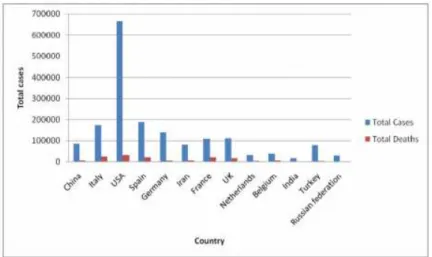
Italy in late February and early March, 2020. As far as the number of COVID infected patients is concerned, USA is at the top of the list followed by Spain (Figure 1). In USA, more than 30,000 people died of this
Aborode et al. AIJR Preprints
AIJR Preprints Available online at preprints.aijr.org
n June 5, 2020, the outbreak of COVID-19 had spread into
had died after contracting the respiratory virus out of nearly 6,749,371 nfirmed cases, whereas 3,277,596 people have recovered from the disease. These numbers are changing rapidly. Daily infection of COVID-19 has been steadily raising worldwide (Figure 1).
The comparative study of COVID-19 cases of USA with other Country (WHO, 2020). countries/regions have reported confirmed COVID-19 cases, including China, Italy, Iran, S. Korea, India, Switzerland, Taiwan, USA, Sweden, Singapore, Sri Lanka, France, Australia, Malaysia, Spain, United Arab Emirates, UK, Nepal, Finland, Netherlands, Japan, Belgium, Russia, Thail
(Figure 2).
: Current distribution of COVID-19 in different countries (WHO, 2020) After hitting China in January 2020, COVID-19 severely out broke in countries like
Italy in late February and early March, 2020. As far as the number of COVID infected patients is concerned, USA is at the top of the list followed by Spain (Figure 1). In USA, more than 30,000 people died of this
AIJR Preprints, 99, version 1, 2020 19 had spread into 215 countries. espiratory virus out of nearly 6,749,371 the disease. These numbers are changing
1).
with other Country (WHO, 2020). 19 cases, including China, Italy, Iran, S. Korea, India, Switzerland, Taiwan, USA, Sweden, Singapore, Sri Lanka, France, Australia, Malaysia, Spain, n, Belgium, Russia, Thailand, Philippines,
WHO, 2020)
19 severely out broke in countries like South Korea, Iran, and Italy in late February and early March, 2020. As far as the number of COVID infected patients is concerned, USA is at the top of the list followed by Spain (Figure 1). In USA, more than 30,000 people died of this
COVID-19 Pandemics: Effects and Prevention
disease. According to the report of the Chinese government and the WHO, the current outbreak has infected some 84,180 people in China out of which more than 4642 people have died so far as of April 18. The first case of coronavirus outbreak in India was reported on 30 January
student had returned home from Wuhan University in China (Rawat and Mukesh, 2020).
the very high transmissibility of the virus is responsible for its worldwide spread, the improvement an accessibility of international travel and tourism could be a reason for its further worldwide spread on the other hand. Every year, different parts of the world organize various religious, socio
and political mass gathering festivals. These types of mass gatherings are likely to exaggerate many of the risk factors of COVID-19, and have historically been associated with outbreaks of disease both in local and international levels. The emergence and spread of COVID
Europe represent a global pandemic threat.
3. EFFECTS OF COVID-19 ON GLOBAL HEALTH
The relationship between human health and disease is neither a new concept, nor a new subject. The emergence COVID-19 in China at
health issue. This virus is highly infectious and can be transmitted through droplets and close contact. The human to the human spreading of the virus occurs due to close contact wit
coughing, sneezing, respiratory droplets or aerosols (Figure 3). These aerosols can penetrate the human body (respiratory system) via inhalation through nose or mouth (Phan
Figure 3: Transmission dynamics of SARS The clinical spectrum for individuals with COVID
symptoms of acute respiratory illness such as fever, cough, fatigue, shortness of br
with respiratory failure and septic shock, which are very similar to other coronavirus diseases (Backer 2020). COVID-19 being a respiratory dis
report that other organs and tissues may also be affected. Since viral shedding in plasma or serum is common in respiratory tract infections, there is a possibility of transmission of coronaviruses through the transfusion
AIJR Preprints Available online at preprints.aijr.org
o the report of the Chinese government and the WHO, the current outbreak has infected some 84,180 people in China out of which more than 4642 people have died so far as of April 18. The first case of coronavirus outbreak in India was reported on 30 January 2020 in Kerala's Thrissur district when a student had returned home from Wuhan University in China (Rawat and Mukesh, 2020).
the very high transmissibility of the virus is responsible for its worldwide spread, the improvement an accessibility of international travel and tourism could be a reason for its further worldwide spread on the other hand. Every year, different parts of the world organize various religious, socio
estivals. These types of mass gatherings are likely to exaggerate many of the risk 19, and have historically been associated with outbreaks of disease both in local and international levels. The emergence and spread of COVID-19 from Asia to the Americas, Africa and the Europe represent a global pandemic threat.
19 ON GLOBAL HEALTH
The relationship between human health and disease is neither a new concept, nor a new subject. The 19 in China at the end of 2019 has caused a large global outbreak and is a major public health issue. This virus is highly infectious and can be transmitted through droplets and close contact. The human to the human spreading of the virus occurs due to close contact with an infected person exposed to coughing, sneezing, respiratory droplets or aerosols (Figure 3). These aerosols can penetrate the human body (respiratory system) via inhalation through nose or mouth (Phan et al., 2020; Riou and Althaus, 2020).
Transmission dynamics of SARS-CoV-2 infection in People The clinical spectrum for individuals with COVID-19 infection ranges from mild or non
symptoms of acute respiratory illness such as fever, cough, fatigue, shortness of breath, to severe pneumonia with respiratory failure and septic shock, which are very similar to other coronavirus diseases (Backer
19 being a respiratory disease, damage of the tissues of lungs is quite obvious, but there is eport that other organs and tissues may also be affected. Since viral shedding in plasma or serum is common in respiratory tract infections, there is a possibility of transmission of coronaviruses through the transfusion
o the report of the Chinese government and the WHO, the current outbreak has infected some 84,180 people in China out of which more than 4642 people have died so far as of April 18. The first 2020 in Kerala's Thrissur district when a student had returned home from Wuhan University in China (Rawat and Mukesh, 2020). On the one hand, the very high transmissibility of the virus is responsible for its worldwide spread, the improvement and accessibility of international travel and tourism could be a reason for its further worldwide spread on the other hand. Every year, different parts of the world organize various religious, socio-cultural, scientific, sport, estivals. These types of mass gatherings are likely to exaggerate many of the risk 19, and have historically been associated with outbreaks of disease both in local and o the Americas, Africa and the
The relationship between human health and disease is neither a new concept, nor a new subject. The the end of 2019 has caused a large global outbreak and is a major public health issue. This virus is highly infectious and can be transmitted through droplets and close contact. The h an infected person exposed to coughing, sneezing, respiratory droplets or aerosols (Figure 3). These aerosols can penetrate the human body
2020; Riou and Althaus, 2020).
2 infection in People
19 infection ranges from mild or non-specific signs and eath, to severe pneumonia with respiratory failure and septic shock, which are very similar to other coronavirus diseases (Backer et al., ungs is quite obvious, but there is eport that other organs and tissues may also be affected. Since viral shedding in plasma or serum is common in respiratory tract infections, there is a possibility of transmission of coronaviruses through the transfusion
Aborode et al. AIJR Preprints, 99, version 1, 2020
AIJR Preprints Available online at preprints.aijr.org
of labile blood products. The presenting features of COVID-19 disease in adults are pronounced. It is a matter of great importance to clarify the correlation between COVID-19 and immune-rheumatologic patients. Taking into consideration the quick and frantic spread of the epidemic, health of rheumatic patients is a matter of prime concern. COVID-19 is a major public health concern for the world's population and is a leading cause of hospitalization and death, particularly for middle and old age people in the affected countries. 4. EFFECTS OF COVID-19 ON GLOBAL ECONOMY
Loss of lives due to any pandemic causes definite irretrievable damage to the society. But apart from this, COVID-19 has severely demobilized the global economy. In order to restrict further transmission of the disease in the community, many of the affected countries have decided to undergo complete lock down. Major international flights and also all types of business transports have been deferred amid different countries. Due to lockdown all domestic flights, railway service (except goods trains), bus, truck, and vehicles transports are suspended with special exemption to those associated with essential commodities. In almost all the COVID-19 stricken countries, entire educational, commercial, sports and spiritual institutions are closed. Industries are suffering a lot as many of these excepting those related to essential amenities, are closed for a long time in many countries. People belonging to the tourism and transportation industry are also facing utmost difficulties. Production level has gone very low. Economy of many so called powerful countries are now facing the threat of high inflation and increasing unemployment as a result of lack of productivity and excessive expenditure for the treatment and rehabilitation of the COVID19 victims and their families (OECD Interim Economic Assessment, 2 March 2020).
Lockdown will directly affect the GDP of each country in the major economics. For each month there will be an approximate loss of 2% points in annual GDP growth. The tourism sector alone faces an output decrease as high as 50% to 70%. According to World Trade Organization (WTO) and Organization for Economic Cooperation and Development (OECD) have indicated COVID-19 pandemic as the largest threat to global economy since the financial emergency of 2008–2009. Some of the experts are even saying that human civilization has not faced such an unprecedented emergency after the World War-II. So, COVID-19 has undoubtedly put forth a remarkably bad effect on the day to day life of the entire human society and also on the world economy.
5. EFFECTS OF COVID-19 ON ENVIRONMENT
From the very beginning of civilization, human beings gradually started manipulating the nature for its own benefit. In order to satisfy the demand of increasing population industrialization and urbanization became inevitable, and the obvious significance was proved to be detrimental on the global environment. Further, environmental concerns include air pollution, water pollution, climate change, ozone layer depletion, global warming, depletion of ground water level, change of biodiversity and ecosystem, arsenic contamination and many more (Bremer et al., 2019; Coutts et al., 2010). Global warming is a result of the increasing concentration of greenhouse gases (CO2, CH4, N2O etc). Out of the desire to drive the nature as per their
own whims and desire, human beings started destroying the nature in numerous ways. As an inevitable consequence environment pollution has become a big issue of the present day. But, due to the unusual outbreak of COVID-19, almost every big and small cities and villages in the affected countries like China, Taiwan, Italy, USA, France, Spain, Turkey, Iran, Germany, S Korea, U.K, India, Australia and many more, is under partial of total lockdown for a long period of time ranging from a few weeks up to a few months. All
COVID-19 Pandemics: Effects and Prevention
AIJR Preprints Available online at preprints.aijr.org
local and central administrations worldwide have literally put a ban on free movement of their citizens outside their home in order to avoid community transmission. The various religious, cultural, social, scientific, sport, and political mass gathering events like, Hajj, Olympics etc. are cancelled. Various types of industries are not functioning; all types of travels are cancelled. Meanwhile, efforts to restrict transmission of the SARS-CoV-2, by restricting the movement have had an outstanding environmental effect.
Due to non-functioning of industries, industrial waste emission has decreased to a large extent. Vehicles are hardly found on the roads resulting almost zero emission of green-house gases and toxic tiny suspended particles to the environment. Due to lesser demand of power in industries, use of fossil fuels or conventional energy sources have been lowered considerably. Ecosystems are being greatly recovered. In many big cities the inhabitants are experiencing a clear sky for the first time in their lives. The pollution level in tourist spots such as forests, sea beaches, hill areas etc. is also shrinking largely. Ozone layer has been found to have revived to some extent. The pandemic has displayed its contrasting consequence on human civilization, in the sense that, on one hand it has executed worldwide destruction, but created a very positive impact on the world environment on the other hand.
6. THE GLOBAL STRATEGY FOR COVID-19 PREVENTION AND CONTROL
COVID-19 is a global threat that requires a global response involving all countries. Governments should be responsible for providing exact information to help the public face this novel infection. To decrease the damage connected with COVID-19, public health and infection control actions are immediately necessary to limit the global spread of the virus. Some Global strategies are discussed below to prevention and control COVID-19 disease.
7. RESTRICTING MASS GATHERING
Preventing SARS-CoV-2 transmission by restricting mass gathering is an important objective of public health care system. COVID-19 is spread from person to person through direct contact. Thus, the spread of respiratory illnesses during the mass gathering is a major public health concerns with the potential of distribution of these infectious diseases. Based on earlier knowledge of MERS and SARS infections, the WHO in order to reduce the general risk of transmission of COVID-19 has recommended some precautionary measures such as avoiding close contact with people suffering from acute respiratory illness, regular hand washing with soap and water or hand sanitizer particularly after direct contact with sick people or their environment, maintaining cough etiquette, and avoiding unprotected contact with farm or wild animals etc. Government of different countries postponed all types of religious, cultural, social, scientific, sport, and political mass gathering events in different parts of the world. Some international events such as Umrah, Hajj and the Olympic Games have already been suspended in order to avoid mass gathering. Media and information technology are providing significant support to the society for prevention and control of COVID-19 outbreak. So, restricting mass gathering could be the primary preventive strategy for COVID-19. 8. DRUG REPURPOSING AND DEVELOPMENT OF VACCINES
The outbreak of COVID-19 has become a clinical threat to the common population and healthcare workers worldwide. Since this is a very new virus, much knowledge about this novel virus is therefore not available. So far, there are no exact antiviral treatments or vaccines for COVID-19 disease. Therefore, it is an
Aborode et al. AIJR Preprints, 99, version 1, 2020
AIJR Preprints Available online at preprints.aijr.org
urgent necessity of time to develop a safe and stable COVID-19 vaccine. Anti-viral drugs like Chloroquine and hydroxychloroquine have been found to be effective against COVID-19 in laboratory studies and in-vivo studies (Rolain et al., 2007; WHO, 2020). A recent study revealed that remdesivir and chloroquine were highly effective in the control of 2019-nCoV in vitro (Wang et al., 2020a, b). Since SARS-CoV-2 is an RNA virus, any vaccines, effective against other RNA viruses such as measles, polio, encephalitis B and influenza, could be the most promising alternatives (Lu, 2020; Liu et al., 2020). So, research will continue to play an important role to discover new drugs or vaccines to prevent and control the COVID-19 infections.
9. CONCLUSION
Environment change is one of the biggest and most vital challenges of the 21st century. In spite of all their efforts to restore the nature during the last few decades, humans could only move a few steps forward. But during the last few months, consequences of the pandemic have successfully recovered the environment to a large extent that should definitely set positive impact on global climate change. Whatever be the cause or origin, the occurrence of COVID-19 has emphasized to improve the mutually-affective connection between humans and nature. At this point of time, it is indispensable to control the source of disease, cut off the transmission path, and use the existing drugs and means to control the progress of the disease proactively. Like all the preceding disasters on the earth, let all be optimistic enough that, human beings will definitely win over the pandemic in due course of time, but they should know the limits to which they can thrust nature, before it is too late.
DECLARATIONS ACKNOWLEDGMENTS
Sincere thanks to Dr. Atolani for his supervision and review for the valuable inputs and help in writing the manuscript.
AUTHORS CONTRIBUTION
The author equally contributed to the work which is reported in the present manuscript. Before publication of this manuscript all the authors sincerely agreed with the terms and conditions of AJIR Preprints.
COMPETING INTERESTS
The author declares no competing interests exist in the publication.
REFERENCES
Afelt, A., Frutos, R., and Devaux, C. (2018). Bats, coronaviruses, and deforestation: toward the emergence of novel infectious diseases? Front. Microbiol. 9:701-702.
Allocati, N., Petrucci, A.G., and Di Giovanni, P. (2016). Bat-man disease transmission: zoonotic pathogens from wildlife reservoirs to human populations. Cell Death Dis. 2:148-160.
Backer, J.A., Klinkenberg, D., and Wallinga, J. (2020). Incubation period of 2019 novel coronavirus (2019-nCoV) infections among travelers from Wuhan, China, 20–28 January 2020. Euro Surveill., 25(5):1–6. https://doi.org/10.2807/1560-7917.ES.2020.25.5. 20 0 0 062. Bremer, S., Schneider, P., and Glavovic, B. (2019). Climate change and amplified representations of natural hazards in institutional cultures.
Oxford Res. Encycl. Nat. Hazard Sci. 1:4-7. https://doi.org/10.1093/acrefore/9780199389407.013.354
Coutts, A., Beringer, J., and Tapper, N. (2010). Changing urban climate and CO2 emissions: implications for the development of policies for
sustainable cities. Urban Policy Res. 28:27–47.
COVID-19 Pandemics: Effects and Prevention
AIJR Preprints Available online at preprints.aijr.org
Gorbalenya, A.E., Baker, S.C., Baric, R.S., de Groot, R.J., Drosten, C., and Gulyaeva, A.A. (2020). Severe acute respiratory syndrome-related coronavirus: the species and its viruses—a statement of the Coronavirus Study Group. Bio Rxiv. 2(5):5-9. https://doi.org/10.1101/ 2020.02.07.937862 Feb 11.
Huang, C., Wang, Y., Li, X., Ren, L., Zhao, J., and Hu, Y. (2020). Clinical features of patients infected with 2019 novel coronavirus in Wuhan, China. Lancet 395:497–506. https:// doi.org/10.1016/S0140-6736(20)30183-5.
Intergovernmental Panel on Climate Change (IPCC). (2014). In: Pachauri, R.K., Meyer, L.A. (Eds.), Climate Change 2014: Synthesis Report. Contribution of Working Groups I, II and III to the Fifth Assessment Report of the Intergovernmental Panel on Climate Change. Core Writing Team. IPCC, Geneva, Switzerland. pp.151.
Liu, W., Morse, J.S., Lalonde, T., and Xu, S. (2020). Learning from the past: possible urgent prevention and treatment options for severe acute respiratory infections caused by 2019-nCoV. Chembiochem 4(3):7-11. https://doi.org/10.1002/cbic.2020 0 0 047 Feb 5 [Epub ahead of print].
Lu, H. (2020). Drug treatment options for the 2019-new coronavirus (2019-nCoV). Biosci Trends. 2(6): 8-13. https://doi.org/10.5582/bst.2020.01020 Jan 28 [Epub ahead of print].
OECD Interim Economic Assessment. (2020). Coronavirus: the world economy at risk. oecd.org/economic-outlook.
Olivero, J., Fa, J.E., and Real, R. (2017). Recent loss of closed forests is associated with Ebola virus disease outbreaks. Sci. Rep. 7:14-29. Phan, L.T., Nguyen, T.V., Luong, Q.C., Nguyen, T.V., Nguyen, H.T., and Le, H.Q. (2020). Importation and human-to-human transmission of a
novel coronavirus in Vietnam. N. Engl. J. Med. 382(9):872–874. https://doi.org/10.1056/NEJMc2001272.
Rawat, M. (2020). Coronavirus in India: tracking country's first 50 COVID-19 cases; what numbers tellhttps://www.indiatoday.in/india/story/coronavirus-in-india-trackingcountry-s-first-50-covid-19-cases-what-numbers-tell-1654468-2020-03-12 Retrieved 12 March 2020.
Riou, J., and Althaus, C.L. (2020). Pattern of early human-to-human transmission of Wuhan 2019 novel coronavirus (2019-nCoV), December 2019 to January 2020. Eurosurveillance 25(4): 4-8.
Rolain, J.M., Colson, P., and Raoult, D. (2007). Recycling of chloroquine and its hydroxyl analogue to face bacterial, fungal and viral infections in the 21st century. Int. J. Antimicrob. Agents 30:297–308. https://doi.org/10.1016/j.ijantimicag.2007.05.015.
Ruscio, B.A., Brubaker, M., Glasser, J., Hueston, W., and Hennessy, T.W. (2015). One health–a strategy for resilience in a changing arctic. Int. J. Circumpolar Health 74:13-27.
Shindell, D., Borgford-Parnell, N., Brauer, M., Haines, A., Kuylenstierna, J.C.I., Leonard, S.A., Ramanathan, V., Ravishankara, A., Amann, M., and Srivastava, L. (2017). A climate policy pathway for near- and long-term benefits. Science 356(6337):493–494.
Wang, M., Cao, R., Zhang, L., Yang, X., Liu, J., and Xu, M. (2020a). Remdesivir and chloroquine effectively inhibit the recently emerged novel coronavirus (2019-nCoV) in vitro. Cell Res. 30(3):269–271. https://doi.org/10.1038/s41422-020-0282-0.
Wang, C., Horby, P.W., Hayden, F.G., and Gao, G.F. (2020b). A novel coronavirus outbreak of global health concern. Lancet 3(5):12-18. World Health Organization. (2004). Summary of probable SARS cases with onset of illness from 1 November 2002 to 31 July 2003.
https://www.who.int/csr/sars/country/ table2004_04_21/en/, Accessed date: 5 February 2020.
World Health Organization. (2013). Middle East Respiratory Syndrome Coronavirus (MERSCoV). https://www.who.int/emergencies/mers-cov/en/, Accessed date: 5 February 2020.
World Health Organization. (2020). Clinical Management of Severe Acute Respiratory Infection When Novel Coronavirus (2019-nCoV) Infection Is Suspected: Interim Guidance.
Yoo, J.H. (2020). The fight against the 2019-nCoV outbreak: an arduous march has just begun. J. Korean Med. Sci., 2:35–56 https://doi.org/10.3346/jkms.2020.35.56.