AD-A273 512
M__________U11,1111
US Army Corps
of Engineers
Hydrologic Engineering Center
DTIC
Sf ELECTE
DECO 81993
A
The HEC NexGen Software
Development Project
Technical Paper No. 138
January 1993
Approved for Public Release. Distribution Unlimi •$J•
93-29806
Papers
in this series have resulted from technical activtes of the Hydrologic
Engineering Center. Versions of some of
these
have been published in
technical jourals or in conference proceedings. The purpose of
this
series
is to make
the
information available for use in
the
Center's taining program
and for distibution within the Corps of Engineers
The findings in this report are not to be construed as an official
Department
of the Army position unless so designated by other
authorized
documents.
The contents of this report are not to be used for advertising, publication,
or promotional purposes. Citation of trade names does not
constitute
an
The HEC NexGen Software Development Project' DARRYL W. DAVIS, BS, MS. Member ASCE
Director, Hydrologic Engineering Center, U.S. Army Corps of Engineers SUMMARY
The NexGen project, a five year project begun in 1990, is developing successor software packages to the existing family of HEC hydrologic engineering computer programs. The project is being accomplished through a management process that employs teams comprised of technical specialists, computer scientists, and consultants. Modem software engineering methods of
requirements analysis, prototype development, field testing, and feedback, are employed. Object-oriented program architecture implemented with C++ and advanced data features of FORTRAN 90 are being used. Prototype models of NexGen software packages in catchment and river analysis are now operational and beta-test versions will be completed at the end of this next year.
Final packages are expected to be completed on schedule. The packages will be functional for RISC-chip and Intel-chip based desktop computers.
1. INTRODUCTION
The existing family of HEC programs is the culmination of 25 years of program development activities. The programs are operational in a batch mode on mainframe and
minicomputers. For personal computers, they are assembled into packages comprised of one or more applications programs, supporting utilities, and a shell menu system for user interface. The
programs are advanced in terms of computation and display capabilities. The structure of the programs, their interaction with the computation environment, and their essential functioning remains batch. The programs are powerful, technical state-the-art software products. They will
be supported for the near-term, essentially as presently released.
The engineering applications computing environment is rapidly becoming that of the desktop computer, either high-end personal computers or engineering workstations. The
engineer-user expects software that is state-of-the-art in technical capability, highly interactive, supported by high quality graphics, and controlled via a graphical user interface. Because of their evolution, the HEC programs are not well structured for efficient adaptation to this new
environment. Also, the need to continually improve program capabilities makes it desirable to have computer code that can be easily modified and maintained.
A project, coined NexGen, was formulated to respond to these needs; that is, develop successor generation software to the present family of HEC programs. The project began in 1990 and is scheduled for completion in 1995. This paper describes the evolution and status of the
HEC family of programs, the objectives and management approach for NexGen, findings and
status of the project to date, and description of prototype models in river hydraulics and catchment analysis.
2. FAMILY OF HEC PROGRAMS
The present computer program library, documentation, and support activities are the cumulative result of three eras of HEC activities. The first decade (1964 -1973) was that of single purpose programs, limited types and numbers of mainframe computer systems, and direct
engineer to program user support activities. The second decade (1974 -1983) was that of packaged programs, integration of data management systems, improved graphics, mini- and mainframe-... computers and an expanded user community. The 1984 - 1993 decade is that of the personal computer characterized by a greatly expanded user community, increased attention to user
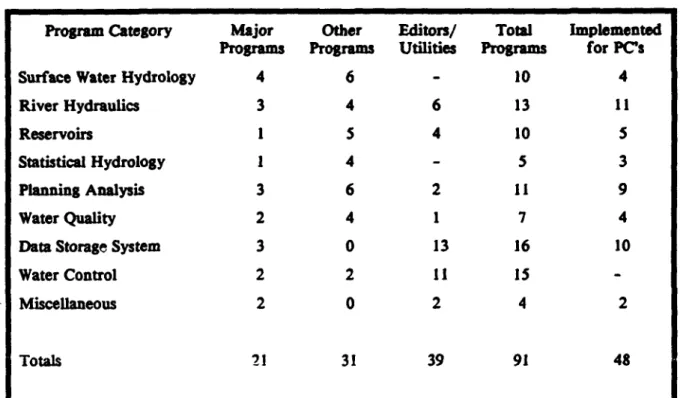
interface and graphics, and diffused program distribution and support. Table 1 is a summary of the existing software library.
i Or
Presented at WATERCOMP '93, 2nd Australasian Conference on Computing for the Water j1 • Industry - Today and Tomorrow, 30 March - 1 April 1993, Melbourne, Australia.
I)TIC,, 97T.177 ... TW3L
Program Category Major Other Editors/ Total Implemented Programs Programs Utilities Programs for PC's
Surface Water Hydrology 4 6 - 10 4
River Hydraulics 3 4 6 13 11
Reservoirs 1 5 4 10 5
Statistical Hydrology 1 4 - 5 3
Planning Analysis 3 6 2 11 9
Water Quality 2 4 1 7 4
Data Storage System 3 0 13 16 10
Water Control 2 2 11 15
-Miscellaneous 2 0 2 4 2
Totals 21 31 39 91 48
Table I Hydrologic Engineering Center Software Library
3. NexGeN PROJECT OBJECTIVES, TEAMS, AND MANAGEMENT
Begun in October 1990, the HEC-wide project is now in the third year of work. The first year was devoted to forming project teams, investigating the array of software engineering issues, and documenting the technical requirements of the software packages. Technical teams were formed and c~arged with developing preliminary requirements statements for the areas of
catchment analysis, river analysis, reservoir analysis, and flood damage analysis. Software support teams were similarly formed and charged with developing preliminary concepts for the areas of program architecture and design, graphical user interface, data base support, graphics, and program development environment and standards.
The teams were each headed by a senior HEC engineer or division chief and were
comprised of 3 to 5 technical staff. Some staff served on two teams and all 25 HEC technical staf" served on at least one team. Staff participated in team activities on a part-time basis while
continuing to perform their regular duties. The teams developed consensus on their respective assignments, developed plans for their accomplishment, and provided a study report of findings. The team leader provided direction, called meetings, recorded findings, provided for coordination with other teams, and performed briefings for HEC division chiefs and director. Project files were maintained on matters related to team activities with minutes recorded for meetings convened. The teams were encouraged to seek Center-wide participation in forming ideas and developing products through seminars and other forums and circulation of concept papers. The teams also brought in speakers and consultants with specialized knowledge from outside the Corps.
Team leaders reported to their respective division chief on NexGen project matters. Team leader duties were considered a normal assignment subject to common supervision and
performance appraisal. Direct contact and work with team members throughout HEC was encouraged. Management oversight was provided through an executive committee comprised of
the team leaders and chaired by the director. The oversight committee met monthly to monitor progress, ensure coordination, and surface for resolution common issues that might impede progress.
4. TEAM FINDINGS
The technical teams confirmed the NexGen goal of developing a family of hydrologic engineering software packages to serve the U. S. Army Corps of Engineers into the next century. The packages will be integrated and be designed for interactive use in a multi-tasking, multi-user network environment. The catchment and river analysis software packages were designated for accelerated prototype development. The findings and recommendations of the software support and technical teams are described below.
4.1 Program Architecture, Design, User Interface, and Development Environment
These three teams addressed the issues of computation environment, program architecture, coding language relationship to architecture, software engineering related to program design, and computer hardware and software industry standards. Specific items studied included: present and emerging desktop machines, concept of object-oriented design and programming [I], UNIX [2], X Windows (3], C [4] and C++ [5], Motif [6], FORTRAN 90 [7], and Microsoft Windows [8].
The teams concluded that development should target both RISC-chip based engineering workstations running standard AT&T UNIX [9], and high-end Intel-chip MS-DOS [10] based personal computers running in a window environment. Programs should be developed for use through a graphical user interface (GUI). In UNIX, development should follow the X Windows standard using Motif for the GUI. In MS-DOS, Microsoft Windows should be the development environment, with later consideration of Windows NT [1 I]. Object-oriented programming (OOP) concepts employing C++ and advanced features of FORTRAN 90 were recommended for
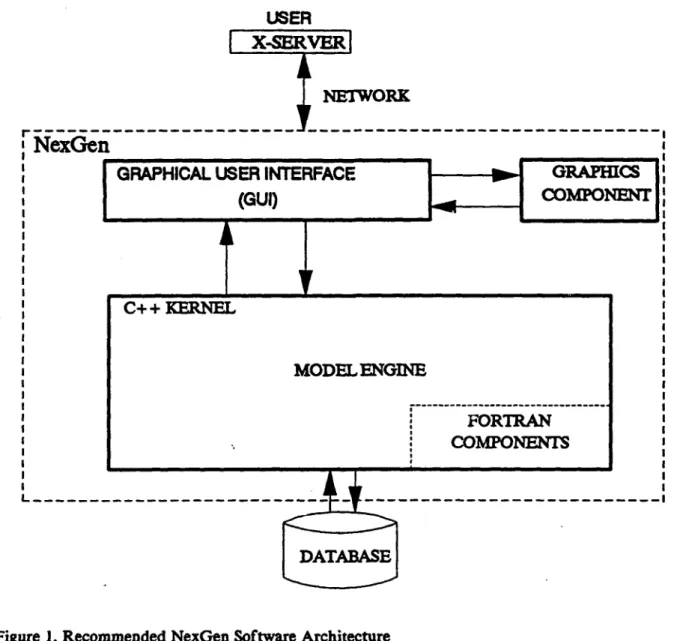
consideration for program coding. Program architecture, consistent with the above, was formulated and recommended for testing. Figure 1 is a diagram of the recommended NexGen software architecture. Note the deliberate separation of the GUI, graphics, compute engine, and date base in the program architecture.
4.2 Data Base Support
The team addressed the issue of providing for the data persistence necessary to support the GUI, graphics, and technical analysis envisioned for NexGen. Specific items investigated
included time-series, paired-function, model-parameter, geometry, spatial, and image data needs; and available commercial systems and associated licenses, fees, and platform portability.
The team concluded that the HEC-DSS system [12] best meets the time-series and paired-function data management needs. Model-parameter, and geometry data management needs were concluded to be relatively modest compared to the capabilities of commercial systems. Therefore, the need for a commercial data base management system was discounted. The team recommended that a study be initiated that would investigate the feasibility and design of additional data
conventions for HEC-DSS that would enable it to also manage these data types. No firm
conclusions were reached regarding spatial and image data management support for NexGen. The team recommended deferring decisions for these data types pending the outcome of other on-going work at HEC in geographic information systems. A key part of NexGen's contribution is
working with data in it's natural and logical format and not as concocted for input to the computer.
4.3 Graphics
The team addressed the issues of the nature and amount of data to display, types of displays, and approach to incorporate graphics into NexGen. Specific items investigated included on-the-fly versus exit/call concepts, commercial package capabilities, graphics standards, and compatibility of Windows and UNIX graphics.
USER
X-SERVER
NETWORK
GRAPHICAL USER INTERFACE
GRAPHICS
(GUQ
COMONENTr
I iC++ KERNEL
MODEL ENGINE
FORTRAN
COMPONENTS
L---IDATABASE
Figure 1. Recommended NexGen Software Architecture
The team concluded that graphics (often termed visualization) should follow published and
de facto industry standards such as X Windows, and be targeted for common display and output
devices. The team recommended use of high-level graphics packages rather that custom coding,
and that coding be performed in a modular manner to enable changes to other platforms and
graphics packages with minimum code re-write. The team recommended that the commercial
package UNIRAS [131 be tested for the UNIX environment and Visual Basic [14] and Windows
programming tools [15] be tested for the DOS environment.
4.4 River Analysis
The team recommended the River Analysis System as the successor to existing steady-flow
- HEC-2 [121, unsteady-flow - UNET [121, and movable boundary - HEC-6 [12] programs. The
team concluded that the package should comprise components that perform steady, unsteady, and
movable boundary hydraulics using common geometry data, and common geometric and hydraulic
computation routines. A GUI will be developed for data entry, execution control, and graphic
display. Capabilities of existing software packages are to be carried forward and new state-of-the
art algorithms added. For the steady-flow component, complete re-coding in FORTRAN 90 was
recommended and is underway, and algorithms for single execution subcritical and supercritical
profile computation have been developed. The existing bridge analysis will be reformulated into a
single bridge representation with automated determination of appropriate analysis method. The team recommended that development of a prototype of the steady-flow component be undertaken first. The team also recommended a study be made of the desirability of adding cross-sectional geometry data management to HEC-DSS.
For the unsteady-flow component, the culvert and bridge routines developed for the steady-flow component would be incorporated. Additional graphic editing and display capability will be incorporated. Similar improvements for the mobile boundary component are planned. The possibility of adapting the mobile boundary component to event analysis, in lieu of the present analysis using a representative flow-duration relationship, was recommended for study. 4.5 Catchment Analysis
The team recommended that the Catchment Analysis System be developed as the successor to the existing flood hydrograph package - HEC-l [12], and the several other hydrograph analysis related special purpose prog-ams in the HEC software library. The team concluded that initially, the catchment system should be an event analysis tool but that it should be designed and
developed for later extension to continuous simulation analysis. Capabilities of existing software packages, where appropriate, would be carried forward, with modest technical improvements made. Capability to perform event analysis from spatially varying precipitation patterns will be developed. New generation radar with such capability is expected to soon become available (16]. The team recommended that a catchment analysis system prototype be developed using object-oriented design and programming.
4.6 Reservoir System and Flood'Damage Analysis
These teams recommended that softw.re packages currently under development be continued as presently planned, thus deferring full NexGen related focus for a year. In the reservoir area, development of the prescriptive reservoir model - HEC-PRM [17], was
recommended for accelerated completion. It is now planned for release in early 1993. Later, need for improved low-flow simulation analysis and a dedicated, real-time flood control release model would be addressed. In the flood damage area, accelerated completion of the near real-time project benefits accomplishments package - HEC-PBA [18] was recommended. Requirements analysis studies of adapting to NexGen concepts of GUI's, integrated graphics, and relatively seamless integration with other NexGen software packages would be undertaken at a later date. 5. PROTOTYPE SOFTWARE PACKAGES
A development team reporting directly to the HEC director was formed to work
exclusively on the project during the second year to focus attention on critical decision items and produce an early stage working prototype. The team consisted of a senior HEC manager,
hydraulic engineer, computer system analyst, and software development consultant. The team was assigned the task of developing a functioning catchment model prototype implementing the
recommendations of the several software support teams.
The completed prototype performs precipitation, infiltration, runoff transform, routing, and network catchment modeling. The prototype was designed and developed following object-oriented principles. The basic program kernel and a few simple computation routines are coded in C++; coding for most computations and data base operations (HEC-DSS) come from existing FORTRAN routines. A commercial package - UIM/X [19] was used to develop the GUI.
UIM/X generates C code. The UNIRAS commercial graphics package is being evaluated for the display capability.
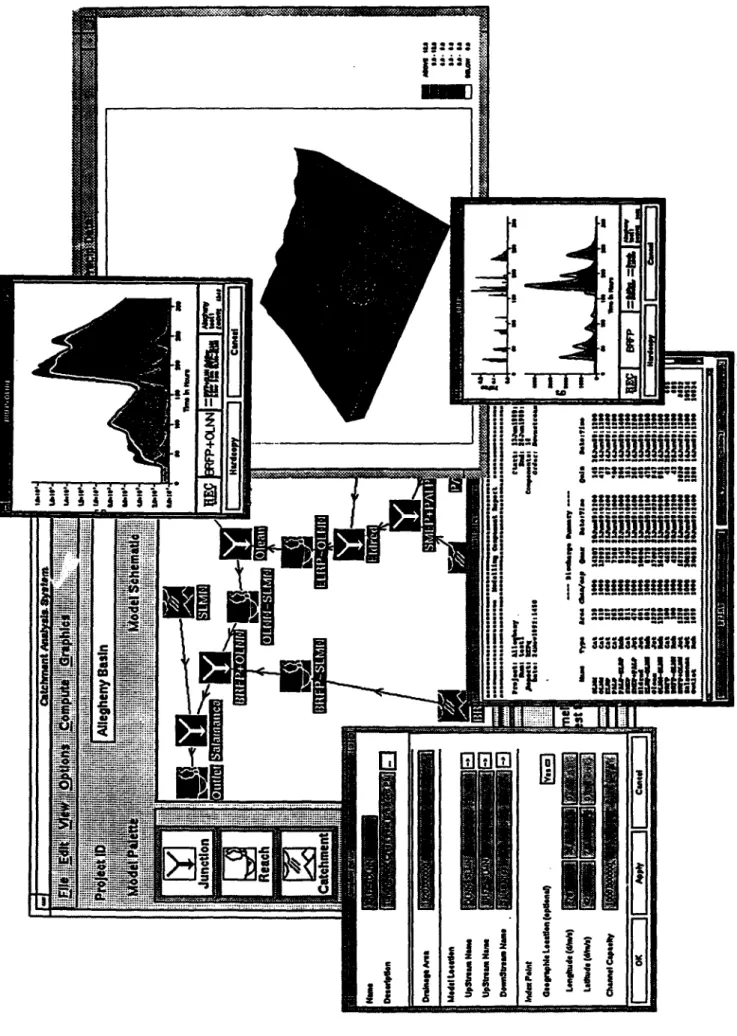
Figure 2 is a mosaic of display screens that might occur during a session with the prototype catchment model. The number of windows simultaneously open during a session is limited only by the size and resolution of the display monitor. The session might begin by calling up the program and retrieving a partially complete data set for the Allegheny basin. Basin
MINI H i
'Il
j
j
---
~
2i
I*
...
U
...
I
IMt
--
----
--gEw
configuration is expanded by positioning additional model palette items on the schematic. This is accomplished with click and drag mouse operations. Windows for the junction, reach, and catchment editors are opened and data entered or edited. The model may then be executed and text and graphic output for selected locations displayed. Comparison of runoff at several locations might also be graphically requested (via point and click operations) and displayed. The session might then continue with further editing, model configuration modifications, and executions.
In a complementary effort, the river analysis team developed a prototype model designed for Intel-DOS machines running under Microsoft Windows. Visual Basic is used to develop the GUI and some graphics and Windows programming tools are used for the graphics, display, and hard copy capability. New geometry and hydraulic properties, and steady-flow step backwater subcritical and supercritical routines were developed for the prototype model. The code is new and takes advantage of advanced data structures available in FORTRAN 90.
Figure 3 displays a screen that might occur during a session with the prototype river analysis model. The session might begin by calling up the program and retrieving an existing data set for the Red Fox river. Cross-sectional geometry, hydraulic roughness, and reach lengths for reach 1, river mile .03 is edited to reflect recently acquired field data. A plot of the edited cross section, requested through point and click mouse operations, is displayed to permit viewing the edited data. A culvert is added to the reach by selecting the appropriate item from the feature palette and inserting it into the reach schematic at the desired location. This is accomplished through click and drag mouse operations. The model is then executed and a profile plot requested and displayed. The computed profile indicates that a hydraulic jump will occur near the
transition from steep to mild slope. Further editing and model executions might then be
performed to test the profile sensitivity to model parameter values. Various profile plots could be superposed to assist in studying the results.
Both prototype models were completed and are being tested within the Corps. Recipients are asked to test the prototypes in a production environment. The models are complete and functional but of course of limited capability. Feedback from users, together with the experience gained in the prototype development efforts, will provide a firm basis for design and development of beta-test versions of these two NexGen software packages.
6. CURRENT NexGen ACTIVITIES
For the third year of the project, the NexGen development team is reassigned to the HEC division responsible for catchment analysis and tasked with taking the prototype catchment model forward toward the full model capability. The team leadership is reassigned to our senior
technical specialist in catchment analysis. The remainder of the NexGen team staff is intact. The team assignment is more production focused than the past year, but it still provides a focal point and leadership for the overall HEC NexGen project.
The river analysis team is tasked with further developing the prototype river model toward full steady-flow capability. Team composition and objectives remain unchanged. Both teams have been charged with cooperating on issues of mutual concern and ensuring that both beta-test models will be operational on RISC-chip and Intel-chip desktop computers. The beta-test versions are scheduled for release in 1994.
The flood damage and reservoir analysis NexGen teams will return to active status. The flood damage team will develop preliminary requirements for the NexGen successor to the existing flood damage analysis package - HEC-FDA [12]. The reservoir analysis team will develop preliminary requirements for a real-time flood control operation model. Some prototype development and testing is planned. Consideration is being given to porting the newly released prescriptive reservoir programs (HEC-PRM) and interior flooding hydrology program - HEC-IFH [12] to the NexGen environment. The graphics and data teams may be reactivated to serve in an advisory capacity. Team memberships are adjusted to reflect the past years accomplishments and changes in staff locations and assignments.
Eu..
ca CcU4
-U C uc m a 0W0 UI
m.
I. > EI 0 T4 0. -L7. CONCLUSIONS
The NexGen project will develop successor generation software packages for the engineering community of the US. Army Corps of Engineers. Concepts of object-oriented software design and development offer significant potential benefit in NexGen software
development. Adherence to pu' •,shed hardware and software standards where available, and de facto standards otherwise, ik. ,fical to NexGen success. Developing prototype catchment and river analysis models prov, I to be essential to surfacing and resolving critical technical and software engineering issues. A structured management approach which employs investigative and development teams is being successfully followed. The NexGen project is expected to be
completed on schedule in 1995. 8. AC^, NOWLEDGEMENTS
The NexGen project is an HEC-wide undertaking and as such, has involved all technical staff. Individuals that have thus far played key roles are: NexGen Development Team - Art Pabst, leader, Bill Charley, hydraulic engineer, Tony Slocum, consultant; River Analysis Team Mike Gee, team leader, Gary Brunner, senior hydraulic engineer, Catchment Analysis Team -David Goldman, team leader, John Peters, senior technical specialist; HEC division chiefs (served as software support team leaders) - Mike Burnham (also flood damage team leader), Vern Bonner (also reservoir analysis team leader), and Arlen Feldman.
9. REFERENCES
1. Open Software Foundation, "Object-Oriented Programming: An Evolutionary Approach', Addison-Wesley, 1986.
2. Rosen, Kenneth H., Rosinski, Richard, R., and Farber, James M., "UNIX System V Release 4: An Introduction', Osborne McGraw-Hill, 1990.
3. Asente, Paul, and Swich, Ralph, "The X Window System Toolkit', DEC Press, 1990. 4. Kernigham, Brian W., Ritchie, Dennis M., 'The C Programming Language', Prentice Hall,
1988.
5. Ellis, Margaret A., and Stroustrup, Bjarne, 'The Annotated C++ Reference Manual, Addison-Wesley, 1990.
6. Open Software Foundation, "OSF/Motif Programmer's Reference', Prentice Hall, 1991. 7. Microsoft Corporation, "Microsoft FORTRAN Version 5. 1, Reference Guide', Microsoft
Corptvration, 1992.
8. Microsoft Corporation, "Microsoft Windows Version 3.1 User's Guide', Microsoft Corporation, 1992.
9. Levine, Donald A., "Posix Programmer's Guide', O'Reilly & Associates Inc., 1991. 10. Microsoft Corporation, "MS-DOS User's Guide and Reference Version 5.0", Microsoft
Corporation, 1991.
11. Microsoft Corporation, "Microsoft WIN32 SDK for Windows NT (Preliminary)', Microsoft Corporation, 1992.
12. USACE Hydrologic Engineering Center, "Computer Program Catalogue', Hydrologic Engineering Center, 1991.
13. UNIRAS A/S, "agX/Toolmaster Reference Manual, UNIRAS A/S, 1991.
14. Microsoft Corporation, "Microsoft Visual Basic, Programmer's Guide', Microsoft Corporation, 1991.
15. Microsoft Corporation, 'Microsoft Windows Software Development Kit Programmer's Reference', Microsoft Corporation, 1990.
16. The NEXRAD Joint System Program Office, "Next Generation Weather Radar Product Description Document', The NEXRAD Joint System Program Office, 1986.
17. USACE Hydrologic Engineering Center, Missouri River System Analysis Modelt Phase It', USACE Hydrologic Engineering Center, 1992.
18. USACE Hydrologic Engineering Center, "1991 Annual Report', USACE Hydrologic Engineering Center, 1991, p. 17.
19. Visual Edge Software Ltd., 'UIM/X Release 2.0 Standard', Visual Edge Software Ltd., 1991.
TECHNICAL PAPER SERIES
($2
per papm)
TP-1 Use of Interrelated Records to Simulate TP-37 Downstream Effects of the Levee Overtopping at Streamflow Wilkes-Barre, PA. During Tropical Storm Agnes TP-2 Optimization Techniques for Hydrologic TP-38 Water Quality Evaluation of Aquatic Systems
Engineering TP-39 A Method for Analyzing Effects of Dam Failures TP-3 Methods of Determination of Safe Yield and in Design Studies
Compensation Water from Storage Reservoirs TP-40 Storm Drainage and Urban Region Flood Control TP-4 Functional Evaluation of a Water Resources Planning
System TP-41 NEC-5C, A Simulation Model for System TP-5 StreamfLow Synthesis for Ungaged Rivers Formulation and Evaluation
TP-6 Simulation of Daily Streamflow TP-42 Optimal Sizing of Urban Flood Control Systems TP-7 Pilot Study for Storage Requirements for TP-43 Hydrologic and Economic Simulation of Flood
Low Flow Augmentation Control Aspects of Water Resources System TP-8 Worth of Streamflow Data for Project TP-44 Sizing Flood Control Reservoir Systems by
Design - A Pilot Study Systemsm Analysis
TP-9 Economic Evsluation of Reservoir System TP-45 Techniques for Real-Time Operation of Flood Accomplishments Control Reservoirs in the Merrimack River
,P-1O Hydrologic Simulation in Water-Yield Basin
Analysis TP-46 Spatial Data Analysis of Nonstructural TP-11 Survey of Programs for Water Surface Measures
Profiles TP-47 Comprehensive Flood Plain Studies Using TP-12 Hypothetical Flood Computation for a Spatial Data Management Techniques
Stream System TP-48 Direct Runoff Hydrograph Parameters Versus TP-13 Maximum Utilization of Scarce Data in Urbanization
Hydrologic Design TP-49 Experience of NEC in Disseminating Information TP-14 Techniques for Evaluating Long-Term on Hydrological Models
Reservoir Yields TP-50 Effects of Dam Removal: An Approach to TP-15 Hydrostatistics - Principles of Sedimentation
Application TP-51 Design of Flood Control improvements by TP-16 A Hydrologic Water Resource System System Analysis: A Case Study
Modeling Techniques TP-52 Potential Use of Digital Computer Ground Water TP-17 Hydrologic Engineering Techniques for Models
Regional Water Resources Planning TP-53 Development of Generalized Free Surface Flow TP-18 Estimating Monthly Streamflows Within a Models Using Finite Element Techniques
Region ' TP-54 Adjustment of Peak Discharge Rates for TP-19 Suspended Sediment Discharge in Streams Urbanization
TP-20 Computer Determination of Flow Through TP-55 The Development and Servicing of Spatial Data Bridges Management Techniques in the Corps of
TP-21 An Approach to Reservoir Temperature Engineers
Analysis TP,56 Experiences of the Hydrologic Engineering TP-22 A Finite Difference Method for Analyzing Center In Maintaining Widely Used Hydrologic
Liquid Flow in Variably Saturated Porous and Water Resource Computer Models
Media TP-57 Flood Damage Assessments Using Spatial Data TP-23 Uses of Simulation in River Basin Planning Management Techniques
TP-24 Hydroelectric Power Analysis in Reservoir TP-58 A Model for Evaluating Runoff-GuaLity in Systems Metropolitan Nester Planning
TP-25 Status of Water Resource Systems Analysis TP-59 Testing of Several Runoff Models on an Urban TP-26 System Relationships for Panuaa Canal Watershed
Water Supply TP-60 Operational Simulation of a Reservoir System TP-27 System Analysis of the Panama Canal Water with Pusped Storage
Supply TP-61 Technical Factors in Small Hydropower Planning TP-28 Digital Simulation of an Existing Water TP-62 Flood Hydrograph and Peak Flow Frequency
Resources System Analysis
TP-29 Computer Applications in Continuing TP-63 NEC Contribution to Reservoir System Operation Education TP-64 Determining Peak-Discharge Frequencies in an TP-30 Drought Severity and Water Supply Urbanizing Watershed: A Case Study
Dependability TP-65 Feasibility Analysis in Small Hydropower TP-31 Development of System Operation Rules for Planning
an Existing System by Simulation TP-66 Reservoir Storage Determination by Computer TP-32 Alternative Approaches to Water Resource Simulation of Flood Control and Conservation
System Simulation Systems
TP-33 System Simulation for Integrated Use of TP-67 Hydrologic Land Use Classification Using Hydroelectric and Thermal Power Generation LANDSAT
TP-34 Optimizing Flood Control ALlocation for a TP-68 Interactive Nonstructural FLood-Control Multipurpose Reservoir Planning
TP-35 Computer Models for Rainfall-Runoff and TP-69 Critical Water Surface by Minimu Specific River Hydraulic Analysis Energy Using the Parabolic Method
TP-36 Evaluation of Drought Effects at Lake TP-70 Corps of Engineers Experience with Automatic Atittan Calibration of a Precipitation-Runoff Model
TP-71 Determination of Land Use from Satellite TP-104 ModeLing Water Resources System for Wanter
Imagery for Input to Hydrologic Models Quality
TP-72 Application of the Finite Element Method TP-105 Use of a Two-Oimensional Flow Model to to Vertically Stratified Hydrodynamic Flow Quantify Aquatic Habitat
and Water Quality TP-106 Flood-Runoff Forecasting with NEC-iF
TP-73 Flood Mitigation Planning Using NEC-SAN TP-107 Dredged-Materiat Disposal System Capacity TP-74 Hydrographs by Single Linear Reservoir Expansion
Model TP-108 Rote of Small Computers In Two-Dimnsional
TP-75 NEC Activities in Reservoir Analysis Flow Modeling
TP-76 Institutional Support of Water Resource TP-109 One-Dimensional Model For Mud Flows
Models TP-110 Subdivision Froude Number
TP-77 Investigation of Soil Conservation Service TP-111 NEC-SO: System Water Quality Modeling
Urban Hydrology Techniques TP-112 Mew Developments in NEC Programs for Flood TP-78 Potential for Increasing the Output of Control
Existing Hydroelectric Plants TP-113 Modeling and Managing Water Resource System TP-79 Potential Energy and Capacity Gains from for Water Quality
Flood C.ontrol Storage Reallocation at TP-114 Accuracy of Computed Water Surface Profiles
-Existing U. S. Hydropower Reservoirs Executive Sumary
TP-80 Use of Non-Sequential Techniques in the TP-1iS Application of Spatial-Data Management
Analysis of Power Potential at Storage Techniques in Corps Planning
Projects TP-116 The NEC's Activities in Watershed Modeling
TP-81 Data Management Systems for Water TP-117 NEC-1 and HEC-2 Applications on the Resources Planning 1icroComputer
TP-82 The New NEC-i Flood Hydrograph Package TP-118 Real-Time Snow Simulation Model for the TP-83 River and Reservoir System Water Quality Monongahela River Basin
Modeling Capability TP-119 Nutti-Purpose, Nutti-Reservoir Simulation on a TP-84 Generalized Real-Time Flood Control System PC
Model TP-120 Technology Transfer of Corps' Hydrologic TP-85 Operation Policy Analysis: Sam Rayburn Models
Reservoir TP-121 Development, Calibration and Application of TP-86 Training the Practitioner: The Hydrologic Runoff Forecasting Models for the Allegheny
Engineering Center Program River Basin
TP-87 Documentation Needs for Water Resources TP-122 The Estimation of Rainfall for Flood
Models Forecasting Using Radar and Rain Gage Data
TP-88 Reservoir System Regulation for Water TP-123 Developing and Managing a Comprehensive Quality Control Reservoir Analysis Model
TP-89 A Software System to Aid in Making TP-124 Review of the U.S. Army Corps of Engineering Real-Time Water Control Decisions Involvement With Alluvial Fan Flooding TP-90 Calibration, Verification and Application Problems
of a Two-Dimensional Flow Model TP-125 An Integrated Software Package for Flood TP-91 NEC Software Development and Support Damage Analysis
TP-92 Hydrologic Engineering Center Planning TP-126 The Value and Depreciation of Existing Models Facilities: The Case of Reservoirs TP-93 Flood Routing Through a Flat, Complex TP-127 FLoodpLain-1anagement Plan Enumeration
Flood Plain Using a One-Dimensional TP-128 Two-Dimensional FLoodplain Modeling Unsteady Flow Computer Program TP-129 Status and New Capabilities of Computer TP-94 Dredged-Material Disposal Management Model Program HEC-6: "Scour and Deposition in TP-95 Infiltration and Soil Moisture Rivers and Reservoirs"
Redistribution in HEC-i TP-130 Estimating Sediment Delivery and Yield on TP-96 The Hydrologic Engineering Center Alluvial Fans
Experience in Nonstructural Planning TP-131 Hydrologic Aspects of Flood Warning -TP-97 Prediction of the Effects of a Flood Preparedness Program
Control Project on a Meandering Stream TP-132 Twenty-five Years of Developing, Distributing, TP-98 Evolution in Computer Programs Causes and Supporting Hydrologic Engineering Computer
Evolution in Training Needs: The Programs
Hydrologic Engineering Center Experience TP-133 Predicting Deposition Patterns in Small Basins
TP-99 Reservoir System Analysis for Water TP-134 Annual Extreme Lake Elevations by Total
Quality Probability Theorem
TP-1O0 Probable Maximum Flood Estimation - TP-135 A Muskingum-Cunge Channel Flow Routing Method
Eastern United States for Drainage Networks
TP-101 Use of Computer Program NEC-5 for Water TP-136 Prescriptive Reservoir System Analysis Model
-Supply Analysis Missouri River System Application
TP-102 Role of Calibration in the Application of TP-137 A Generalized Simulation Model for Reservoir
HEC-6 Systm Analysis
TP-103 Engineering and Economic Considerations in TP-138 The NEC NexGen Software Development Project Formulating TP-139 Issues for Applications Developers
WOUNCAS I FI ED
SECURITY CLASSIFICATION OF THIS PAGE'
Form Approved
REPORT DOCUMENTATION PAGE
OMBNoO7.O4188
I
la. REPORT SECURITY CLASSIFICATION 1b. RESTRICTIVE MARKINGS
UNCLASSIFIED
2a. SECURITY CLASSIFICATION AUTHORITY 3. DISTRIBUTION /AVAILABILITY OF REPORT
UNLIMITED
2b. DECLASSIFICATION / DOWNGRADING SCHEDULE
4. PERFORMING ORGANIZATION REPORT NUMBER(S) S. MONITORING ORGANIZATION REPORT NUMBER(S)
TECHNICAL PAPER NO. 138
6a. NAME OF PERFORMING ORGANIZATION 6b, OFFICE SYMBOL 7a. NAME OF MONITORING ORGANIZATION
HYDROLOGIC ENGINEERING CENTER (If applicable)
USA CORPS OF ENGINEERS CEWRC-HEC
6c. ADDRESS (City, State, and ZIP Code) 7b. ADDRESS (City, State, and ZIP Code)
609
SECOND STREETDAVIS, CA 95616-4687
Sa. NAME OF FUNDING/SPONSORING
1b.
OFFICE SYMBOL 9. PROCUREMENT INSTRUMENT IDENTIFICATION NUMBER ORGANIZATION (If applicable)WATER RESOURCES SUPPORT CENTER CEWRC
8c. ADDRESS (City, State, and ZIP Code) 10. SOURCE OF FUNDING NUMBERS
CASEY BUILDING # 2594 PROGRAM PROJECT TASK WORK UNIT
FT BELVOIR, VA 22060-5586 ELEMENT NO. NO. NO. rCCESSION NO. 11. TITLE (Include Security Classification)
The HEC NexGen Software Development Project 12. PERSONAL AUTHOR(S)
DARRYL W. DAVIS
13a. TYPE OF REPORT 13b. TIME COVERED 14. DATE OF REPORT (Year, Month, Day) 15. PAGE COUNT
TECHNICAL PAPER FROM TO 1993 JANUARY 13
16. SUPPLEMENTARY NOTATION
17. COSATI CODES 18. SUBJECT TERMS (Continue on reverse if necessary.and identify by block number)
FIELD GROUP SUB-GROUP computer software, computer applications, computer models, water resources, hydrology, hydraulics
19, ABSTRACT (Continue on reverse if necessary and identify by block number)
The NexGen project, a five year project begun in 1990, is developing successor software packages to the existing family of HEC hydrologic engineering computer programs. The project is being accomplished through a management process that employs teams comprised of technical specialists, computer scientists, and consultants. Modern software engineer-ing methods of requirements analysis, prototype development, field testing, and feedback, are employed. Object-oriented program architecture implemented with C++ and advanced data features of FORTRAN 90 are being used. Prototype models of NexGen software packages in catchment and river analysis are now operational and beta-test versions will be completed at the end of this next year. Final packages are expected to be completed on schedule. The packages will be functional for RISC-chip and Intel-chip based desktop computers.
20. DISTRIBUTION/AVAILABILITY OF ABSTRACT 21. ABSTRACT SECURITY CLASSIFICATION COUNCLASSIFIED/UNLIMITED
0
SAME AS RPT. 0 DTIC USERS UNCLASS I F I ED22a. NAME OF RESPONSIBLE INDIVIDUAL 22b. TELEPHONE (Include Area Code) 22c. OFFICE SYMBOL
DARRVI Lt 1nAvi; q16) 7s6C-104 WR(-HEC
DD Form 1473, JUN 86 Previous editions are obsolete. SECURITY CLASSIFICATION OF THIS PAGE