A Hybrid Multithreading/Message-Passing Approach for Solving
Irregular Problems on SMP Clusters
Jan-Jan Wu
Institute of Information Science
Academia Sinica
Taipei, Taiwan, R.O.C.
Chia-Lien Chiang
Nai-Wei Lin
Dept. Computer Science
National Chung Cheng Univ.
Chia-Yi, Taiwan, R.O.C.
Abstract
This paper reports the design of a runtime library for solving irregularly structured problems on clusters of symmetric multiprocessors (SMP clusters). Our design algorithms exploit a hybrid methodology which maps directly to the un-derlying hierarical memory system in SMP clusters, by combining two styles of programming methodolo-gies { threads (shared memory programming) within a SMP node and message passing between SMP nodes. This hybrid approach has been used in the implementation of a runtime library supporting the inspector/executor model of execution for solving irregular problems. Experimental results on a clus-ter of Sun UltraSparc-II workstations are reported.Keywords: data-parallel programming,
worksta-tion clusters, symmetric multiprocessor, multi-threaded message-passing, collective communica-tion
1 Introduction
High performance parallel computers incorpo-rate proprietary interconnection networks al-lowing low-latency, high bandwidth interpro-cessor communications. A large number of scientic computing applications have benet from such parallel computers. Nowadays, the current level of hardware performance that is found in high-performance workstations, to-gether with advances in distributed systems ar-chitecture, makes clusters of workstations (so called NOW systems) one of the highest per-formance and most cost eective approaches
to computing. High-performance workstation clusters can been realistically used for a variety of applications to replace vector supercomput-ers and massively parallel computsupercomput-ers.
In recent years, we have seen a number of such workstations (or PCs) introduced into the market (e.g. the SGI PowerChallenge, Sun Ul-tra Enterprise Series, DEC AlphaServers, IBM RS6000 with multiple CPUs, and Intel Pen-tium with two or four CPUs.) The largest commercially available SMPs today (e.g. SGI PowerChallenge with 32 processors) can deliver peak rates of over one billion oating point operations per second; this is projected to in-crease by over an order of magnitude within the next few years. Such computing power will make this class of machines an attractive choice for solving large problems. It is predicted that SMPs will be the basis of future workstation clusters [9].
Processors within a SMP share a common memory, while each SMP has its own mem-ory which is not directly accessible from pro-cessors resided on other SMPs. The perfor-mance of a distributed memory computer de-pends to a large extent on how fast data move-ment can be performed. Despite signicant improvement in hardware technology, the im-provements in communication cost are still be-hind those in the computation power of each processing node. As a result, optimization for communication remains an important issue for SMP clusters.
and PVM becoming available, parallel pro-gramming on workstation clusters has become an easier task. Although MPI and PVM can also be used to manage communication in SMP clusters, they are not necessarily the most e-cient methodologies. Our approach exploits a hybrid methodology which maps directly to the underlying hierarical memory system in SMP clusters, by combining two styles of program-ming methodologies { threads (shared memory programming) within a SMP node and message passing between SMP nodes.
Our previous experiences with the hybrid methodology for regular data-parallel compu-tation (i.e. where reference patterns of each data element are uniform and predictable) are reported in [3]. In this paper, we extend our previous work to support irregular computa-tions, where reference patterns may depend on input data or runtime-computed values. This paper gives an overview of the hybrid method-ology for solving irregular problems and re-ports the algorithmic design of a runtime li-brary based on this hybrid methodology. The library collects a set of computation and com-munication primitives that form the runtime kernel for supporting the inspector/executor model of execution on distributed-memory multiprocessors.
Our design goals center on high portabil-ity, based on existing standards for lightweight threads and message-passing systems, and high eciency, based on the utility of threads to improve eciency of data movement. The li-brary is intended to be used to support direct programming or as a runtime support library for high-level languages (e.g. HPF2) target-ing for SMP clusters. Our preliminary experi-mental results on a cluster of Sun UltraSparc-II dual-CPU workstations demonstrate perfor-mance improvement of the hybrid methodology against message-passing implementation.
2 Overview
Preprocessing for Irregular
Computa-tion
The most commonly used model for explicit data-parallel programming on distributed-memory multiprocessors is the Single
Pro-gram Multiple Datamodel, where data are
dis-tributed among available processors, and the same program is executed concurrently on the processors with each processor only responsible for the computation of a portion of the data.
For cases where data are uniformly dis-tributed, the location of an data element can be determined statically. In many situatations dynamic and irregular data distribution is re-quired to obtain load balancing and data local-ity. It is not possible to express irregular data distribution in a simple way. The mapping of data is usually described by a distributed
map-ping table dened by a partitioning algorithm.
During the preprocessing or inspector phase, we carry out a set of interprocessor commu-nications that allows us to anticipate exactly which send and receive communication calls each processor must execute [1]. Once pre-processing is completed, we are in a position to carry out the problem's communication and computation; this phase is called the executor [1]. The exchange of interprocessor distributed array elements data follows the plains estab-lished by the inspector. O-processor data are appended to the end of the local array. Once a communication phase is over, each proces-sor carries out its computation entirely on the locally stored data without further communi-cation. Writes to o-processor data elements are also appended to the end of the local ar-ray. When the computational phase is nished, array elements to be stored o-processor are obtained from the end of the local array and sent to the appropriate o-processor locations. We use the Parti library (single thread on each process) as the basis for our multithreaded implementation. The Parti/Chaos runtime li-brary developed by [1, 11] aims to support the inspector/executor style of programming using
arrays as the main data structures. The Parti runtime primitives include communication rou-tines designed to support irregular data dis-tribution and irregular patterns of distributed array access (Figure 3). Figure 1(a) shows the data-parallel code segment for a sparse matrix-vector multiply. Figure 1(b) depicts the SPMD implementation with the Parti library.
In the inspector phase,index-translation
translates the indirect data reference
sub-scripts (given by array col) to pairs of
process index and local index (Proc, Loc).
build-schedule determines which process
should send/receive which data elements to/from which processes (called communica-tion schedule). In the executor phase, o-processor data are gathered from remote pro-cessors according to the planned communica-tion schedule and stored at the end of the local
array x. The local index arrayLocis updated
accordingly to reect the actual location of the
remotely fetched data in local array x. Then
the two nested loops carry out the
matrix-vector multiply entirely on the local arrayx.
Hybrid Model of Execution
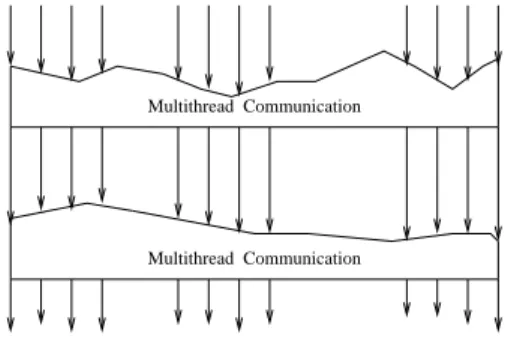
Our model of loosely synchronous execution for SMP clusters is depicted in Figure 2. When assigned a task, each SMP node creates a initial thread for housekeeping node execu-tion. The initial thread then launches a num-ber of work threads, each assigned to a proces-sor within that node, that execute in parallel and coordinate with each other via the shared memory (computation phase). When remote accesses to other SMP nodes are required, the work threads may synchronize and enter the communication phase. When the communica-tion is completed, all the threads proceed to next computation phase, and so on.
Multithreaded Runtime Library
Based on the loosely synchronous execution model, we design a multithreaded runtime li-brary. The same set of threads that partic-ipate in parallel computation within a SMP
(a) data-parallel program do i=1, NRows
sum = 0
do j=1,ncols(i)
sum = sum + f(j,i)*x(cols(j,i)) enddo
y(i) = y(i) + sum enddo
(b) SPMD program !! the inspector phase
call index-translation(Proc,Loc,cols) sched = build-schedule(Proc,Loc) !! the executor phase
call gather(x,x,sched,Loc) count=0
do i=1, LocNRows sum = 0
do j=1,ncols(i)
sum = sum + f(j,i)*x(Loc(count)) count += 1
end do
y(i) = y(i) + sum enddo
Figure 1: Inspector/Executor implementation of sparse matrix-vector multiply
Multithread Communication Multithread Communication
threads threads threads NODE 0 NODE 1 NODE N-1
computation phase communication phase computation phase
communication phase computation phase
Figure 2: Loosely synchronous execution model for SMP cluster
node during the computation phase also work together to optimize the communication phase. We have designed several optimizations for col-lective communications.
Use multiple threads to speed up local
data movement,
Hide message latency by overlapping local
memory copy and sending/receiving mes-sages, by using dierent threads for these two tasks,
Pipeline multiple messages to the network
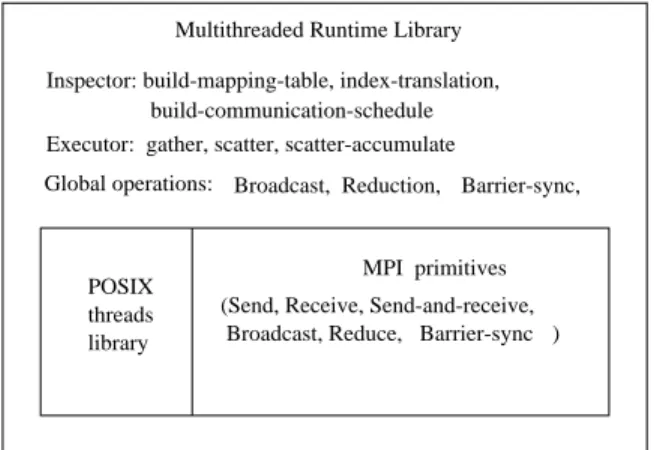
interface by using multiple threads for sending/receiving multiple messages. Figure 3 shows the organization of the mul-tithreaded runtime library. POSIX threads primitives are used to parallelize local mem-ory computation and message buering within a SMP node. MPI primitives are used for mes-sage passing between SMP nodes.
POSIX threads library
(Send, Receive, Send-and-receive, Broadcast, Reduce, Barrier-sync
MPI primitives ) build-communication-schedule
Multithreaded Runtime Library
Global operations: Broadcast, Reduction, Barrier-sync, Executor: gather, scatter, scatter-accumulate
Inspector: build-mapping-table, index-translation,
Figure 3: Organization of the multithreaded runtime library
3 Runtime Primitives
Currently, the library supports a set of global operations (barrier synchronization, broad-cast, reduction), inspector operations (index translation, build communication schedule) and collective communication (gather, scatter, scatter-accumulate), which alltogether form the runtime kernel for multithreaded execution
of the inspector/executor model. This section describes the algorithms for some of the prim-itives.
3.0.1 Broadcast and Reduction
A reduction operation on a SMP cluster is carried out in two steps: shared-memory re-duction among multiple threads within a SMP node, and then distributed-memory reduction between SMP nodes.
Algorithm reduce(op, source, target, ndata) op is a binary associative operator,
source is the data array on which the reduction is to be performed, target stores the reduction result,
{
Assuming k threads will be used for the reduction on a SMP node, and the data elements are evenly partitioned to these k threads.
1. For each thread do
/* computes the reduction on the section of the data array that the particular thread is responsible for, and store the result to a local buffer for this thread. */
local-memory-reduce(op,
starting_addr_in_source_for_my_thread, local-buffer-for-my-thread, ndata/k); 2. Combine the partial results from these threads.
If k is small, the partial results can be combined using a simple locking mechanism: Two shared variables are used:
number-of-threads, initialized with k
temp: to hold the combined partial result from the k threads
For each thread do mutual_exclusion_lock
accumulate local-buffer-for-my-thread to temp decrease number-of-threads by 1
if number-of-threads=0 (i.e. the last thread) then call MPI_Reduce(temp,target,...) to
combine final results from all these SMP nodes, and wake up all the other threads else wait for other threads to finish mutual_exclusion_unlock
3.0.2 Gather/Scatter Communication
Data movement, such as gather and scat-ter, in irregular computation can all be for-mulated as all-to-some personalized commu-nication, in which each SMP node trans-mits a distinct block of data to a subset of SMP nodes. The following algorithm performs all-to-some gather communication with single thread per SMP node. The data structure \sched" describes the communication sched-ule (including the number of data elements and the local indices of the data elements to send/receive) on this node. A node sends
sched:n data to send[j] of data elements in the
source array, indexed by sched:n send list[i],
to node j and store the received data into
proper locations in the target array.
Algorithm gather(source,dest,sched) void *source, void *dest;
SCHEDULE *sched; {
/* send data */
for(i=0;i<num_nodes;i++){
if(sched.n_data_to_send[i]>0) {
copy the requested data elements from the source array to ith section of the buffer, and send the buffer data to node i
}}
/* receive data */
for(i=0;i<sched.n_msgs_to_recv;i++){ poll for incoming message,
copy the received data to proper locations in target array
} }
Multithreaded Gather
Suppose there arek CPUs on each SMP node, and k is smaller
than the number of SMP nodes (num nodes),
then the gather communication can be further
parallelized by usingk threads { each thread is
responsible for the execution of num nodes=k
send-loop iterations. That is, each thread
han-dles the communicationm with num nodes=k
SMP nodes. Multithreading also parallelizes local memory copy to message buers. If source and destination are dierent arrays, then each thread accesses dierent memory lo-cation and thus no memory locking is required.
Depending on the characteristics of the tar-get machine, number of threads involved in the gather communication may be tuned to achieve optimal performance.
4 Experimental Result
The experiments were conducted on a net-work of four Sun UltraSparc-II net-workstations located in the Institute of Information Science, Academia Sinica. The workstations are con-nected by a fast Ethernet network capable of 100M bps per node. Each workstation is a SMP with two 296MHz CPUs, running the multithread OS SUNOS 5.5.1. The communi-cation library in the framework is implemented on top of the MPICH implementation of MPI. We compared two implementation ap-proaches, one using the hybrid thread+MPI methodology, and the other using MPI only. For the hybrid version, we created four SPMD processes by the command \mpirun -np 4", which maps each of the four processes to a distinct workstation. Each process launches two threads, which were then automatically as-signed to dierent CPUs by the Operating Sys-tem. Threads within a process communicate by shared variables and memory locks, while processes communicate with each other by passing messages. For the MPI-only version, eight processes, each running a single thread, were created using the command \mpirun -np 8", which assigns each process to a distinct CPU. All processes communicate with each other by passing messages.
Figure 4(a) shows the eectiveness of using multiple threads in global reduction. Using two threads per process improves performance by about 70%. The result also shows that the overhead of shared-memory synchronization in the hybrid approach for summing up partial reduction results from multiple CPUs within a SMP node is negligible compared with the MPI-only implementation.
Figure 4(b) reports the execution time of all-to-some gather communication. Using two threads per process achieves a speedup factor
of 1.5, due to the eect of multithreading in overlapping local memory copying with inter-process communication. The advantage of the hybrid approach over MPI-only implementa-tion is even more signicant. This is because by the hybrid approach, each process needs to sends/receives less messages than the MPI-only implementation. We expect more perfor-mance improvement on large number of SMP nodes, where the advantage of reducing num-ber of messages will become more evident.
Figure 4(c) shows the execution time of the sparse matrix-vector multiply by partitioning the sparse matrix into blocks of rows. Using two threads per process shortens the commu-nication time for both the inspector phase and the executor phase. The computation time is competitive to that of the MPI-only implemen-tation, resulting in overall speedup factor of 1.5.
5 Related Work
A number of thread package support interpro-cessor communication mechanisms. Nexus [5] provides a thread abstraction that is capable of interprocessor communication in the form of Active Messages (asynchronous remote pro-cedure calls). Nexus has not supported ei-ther point-to-point communication or collec-tive communication. Panda [2] has simi-lar goals and approaches to Nexus. It also supports distributed threads. Chant [6] is a thread-based communication library which supports both point-to-point primitives and remote procedure calls. Ropes [7] extends Chant by introducing the notion of \context", a scoping mechanism for threads, and provid-ing group communication between threads in a specic context. Some simple kinds of collec-tive operations (e.g. barrier synchronization, broadcast) are supported. The MPC++ Mul-tithread Template Library on MPI [8] is a set of templates and classes to support mul-tithreaded parallel programming. It includes support for multi-threaded local/remote func-tion invocafunc-tion, reducfunc-tion, and barrier
syn-0 1 2 3 4 5 6 7 0 10 20 30 40 50 60 70
execution time (seconds)
data size (x 1000k)
4 processes, each uses 1 thread 4 processes, each uses 2 threads 8 processes, each uses 1 thread
(a) global reduction
0 0.005 0.01 0.015 0.02 0.025 0.03 0.035 8 8.5 9 9.5 10 10.5 11
execution time (seconds)
data size n (matrix size = 2^n * 2^n) Hybrid, 1 thread per process Hybrid, 2 threads per process MPI-only (b) all-to-some communication 0 0.01 0.02 0.03 0.04 0.05 0.06 0.07 8 8.5 9 9.5 10 10.5 11
execution time (seconds)
data size n (matrix size = 2^n * 2^n) Hybrid, 1 thread per process Hybrid, 2 threads per process MPI-only
(c) sparse matrix-vector multiply Figure 4: Execution time of some collective communications on a cluster of four dual-cpu workstations. Compare three versions: hy-brid thread+MPI with single thread per pro-cess, hybrid thread+MPI with two threads per process, and MPI-only (8 processes, no multi-threading).
chronization.
On the part of Message Passing Interface, Skjellum etcl. [4] addresses the issue of mak-ing MPI thread-safe with respect to internal worker threads designed to improve the e-ciency of MPI. Later, the same group propose many possible extensions to the MPI standard, which allows user-level threads to be mixed with messages [13, 12].
Just recently, there are some new results from the Industry. For example, new version of HP MPI (released in late June this year) [10] incorporates support for multithreaded MPI processes, in the form of a thread-compliant library. This library allows users to freely mix POSIX threads and messages. However, it does not perform optimization for collective communication like we do.
6 Conclusion
In this paper, we present a hybrid threads and message-passing methodology for solving irreg-ular problems on SMP clusters. We have also described the implementation of a set of col-lective communications based on this method-ology.
Our preliminary experimental results on a network of Sun UltraSparc-II shows that the hybrid methodology improves performance of global reduction by about 70% and the per-formance of all-to-some gather by about 80%, compared with MPI-only, non-threaded imple-mentations.
As threads are commonly used in support of parallelism and asynchronous control in appli-cations and language implementations, we be-lieve that the hybrid threads/message-passing methodology has advantage of both exibility and eciency.
Support for this work is provided by Na-tional Science Council of Taiwan under grant 88-2213-E-001-004.
References
[1] H. Berryman, J. Saltz, and J. Scroggs. Execution time support for adaptive scientic algorithms on
distributed memory architectures. Concurrency:
Practice and Experience, 3(3):159{178, 1991. [2] R. Bhoedjang, T. Ruhl, R. Hofman, K.
Langen-doen, H. Bal, and F. Kaashoek. Panda: A portable platform to support parallel programming
lan-guages. In Symposium on Experiences with
Dis-tributed and Multiprocessor Systems, San Diego, CA, 1993.
[3] C.-L. Chiang, J.-J. Wu, and N.-W. Lin. Toward Supporting Data-Parallel Programming for
Clus-ters of Symmetric Multiprocessors. In
Interna-tional Conference on Parallel and Distributed
Sys-tems, Tainan, Taiwan, 1998.
[4] A. K. Chowdappa, A. Skjellum, and N. E. Doss. Thread-safe message passing with p4 and mpi. Technical Report TR-CS-941025, Computer Sci-ence Department and NSF Engineering Research Center, Mississippi State University, April 1994. [5] Ian Foster, C. Kesselman, R. Olson, and S. Tuecke.
Nexus: An interoperability layer for parallel and distributed computer systems. Technical report, Argonne National Labs, Dec. 1993.
[6] M. Haines, D. Cronk, and P. Mehrotra. On the design of Chant: a talking threads package. In
Proceedings of Supercomputing'94, 1994.
[7] M. Haines, P. Mehrotra, and D. Cronk. ROPES: Support for collective operations among dis-tributed threads. Technical report, ICASE, NASA Langley Research Center, May 1995.
[8] Yutaka Ishikawa. Multithread template library in c++. http://www.rwcp.or.jp/lab/pdslab/dist. [9] William E. Johnston. The case for using
commer-cial symmetric multiprocessors as supercomputers. Technical report, Information and Computing Sci-ences Division, Lawrence Berkeley National Labo-ratory, 1997.
[10] Hellat Packer. Hp message passing interface. http://www.hp.com/go/mpi.
[11] R. Ponnusamy. A manual for the chaos runtime li-brary. Technical Report TR93-105, Computer Sci-ence Dept. Univ. of Maryland, Dec. 1993. [12] A. Skjellum, N. E. Doss, K. Viswanathan,
A. Chowdappa, and P. V. Bangalore. Extending the Message Passing Interface (MPI). Technical re-port, Computer Science Department and NSF En-gineering Research Center, Mississippi State Uni-versity, 1997.
[13] A. Skjellum, B. Protopopov, and S. Hebert. A Thread Taxonomy for MPI. Technical report, Computer Science Department and NSF Engineer-ing Research Center, Mississippi State University, 1996.