2
3
4
Architecture for Managing Clouds
A White Paper from the Open Cloud Standards Incubator
Version: 1.0.0
5Status: DMTF Informational
6Publication Date: 2010-06-18
7Document Number: DSP-IS0102
9 10 11 12 13 14 15 16 17 18 19 20 21 22 23 24 25 26 27 28
Copyright © 2010 Distributed Management Task Force, Inc. (DMTF). All rights reserved.
DMTF is a not-for-profit association of industry members dedicated to promoting enterprise and systems management and interoperability. Members and non-members may reproduce DMTF specifications and documents, provided that correct attribution is given. As DMTF specifications may be revised from time to time, the particular version and release date should always be noted.
Implementation of certain elements of this standard or proposed standard may be subject to third party patent rights, including provisional patent rights (herein "patent rights"). DMTF makes no representations to users of the standard as to the existence of such rights, and is not responsible to recognize, disclose, or identify any or all such third party patent right, owners or claimants, nor for any incomplete or
inaccurate identification or disclosure of such rights, owners or claimants. DMTF shall have no liability to any party, in any manner or circumstance, under any legal theory whatsoever, for failure to recognize, disclose, or identify any such third party patent rights, or for such party’s reliance on the standard or incorporation thereof in its product, protocols or testing procedures. DMTF shall have no liability to any party implementing such standard, whether such implementation is foreseeable or not, nor to any patent owner or claimant, and shall have no liability or responsibility for costs or losses incurred if a standard is withdrawn or modified after publication, and shall be indemnified and held harmless by any party implementing the standard from any and all claims of infringement by a patent owner for such implementations.
For information about patents held by third-parties which have notified the DMTF that, in their opinion, such patent may relate to or impact implementations of DMTF standards, visit
http://www.dmtf.org/about/policies/disclosures.php. 29
Abstract 31 32 33 34 35 36 37 38 39 40 41 42 43 44 45 46 47 48 49 50 51 52 53 54 55 56 57 58 59 60 61 62 63
This white paper is one of two Phase 2 deliverables from the DMTF Cloud Incubator and describes the reference architecture as it relates to the interfaces between a cloud service provider and a cloud service consumer. The goal of the Incubator is to define a set of architectural semantics that unify the
interoperable management of enterprise and cloud computing.
Acknowledgments
The Open Cloud Standards Incubator wishes to acknowledge contributions from the following people:
• Kane, Valerie – Advanced Micro Devices
• Vancil, Paul – Advanced Micro Devices
• Kowalski, Vincent – BMC Software
• Lipton, Paul – CA, Inc.
• Moscovich, Efraim – CA, Inc.
• Waschke, Marvin – CA, Inc.
• Armstrong, Joseph – Cisco
• Sankar, Krishna – Cisco
• Serr, Frederick – Cisco
• Siefer, Mike – Cisco
• Tomsu, Peter – Cisco
• Wheeler, Jeff – Cisco
• Pardikar, Shishir – Citrix Systems Inc.
• Sirjani, Abolfazl – Citrix Systems Inc.
• Landau, Richard – Dell
• Ericson, George – EMC
• Linn, John – EMC
• Durand, Jacques – Fujitsu
• Song, Zhexuan – Fujitsu
• Aguiar, Glaucimar – Hewlett-Packard Company
• Cook, Nigel – Hewlett-Packard Company
• Maciel, Fred – Hitachi, Ltd.
• Baskey, Michael – IBM
• Johnson, Mark – IBM
• Pendarakis, Dimitrios – IBM
• Cox, Billy – Intel Corporation
• Raghu, Rekha – Intel Corporation 65 66 67 68 69 70 71 72 73 74 75 76 77 78 79 80 81
• Parchem, John – Microsoft Corporation
• Carter, Steve – Novell
• Jose, Jaimon – Novell
• Carlson, Mark – Oracle
• Vambenepe, William – Oracle
• Yu, Jack – Oracle
• Owens, Ken – Savvis
• Qualls, Richard – Sun Microsystems, Inc.
• Norbeck, Don – SunGard Availability Services
• Ronco, Enrico – Telecom Italia
• Galán Márquez, Fermín – Telefónica
• Bumpus, Winston – VMware Inc.
• Lamers, Lawrence – VMware Inc.
CONTENTS
82 83 84 85 86 87 88 89 90 91 92 93 94 95 96 97 98 99 100 101 102 103 104 105 106 107 108 109 110 111 112 113 114 115 116 117 118 119 120 121 122 123 124 1 Scope ... 7 2 References ... 73 Terms and Definitions ... 8
4 Symbols and Abbreviated Terms... 12
5 Introduction... 14
6 Reference Architecture Overview ... 16
6.1 Service Lifecycle and Use Cases ... 16
6.2 Resource Models ... 17
6.3 Interaction Patterns... 18
6.4 Security Architecture... 20
6.5 Role of Rules, Policies, and Constraints... 21
7 Requirements ... 23
7.1 Protocol Stack... 23
7.2 Resource Model... 23
7.3 Adoptability ... 24
7.4 Internationalization... 24
7.5 Rules, Constraints, and Policies ... 24
7.6 Cloud Management Interface Security ... 25
7.7 Data and Storage... 26
7.8 Logs, Event Management, Incident Response, and Notification ... 26
7.9 Audit, Legal, and Compliance Monitoring ... 27
7.10 Security Considerations for Virtualization Technology ... 27
7.11 Portability and Interoperability for Secure Migration... 27
8 Protocol Examples ... 28
8.1 Message Exchange Patterns ... 28
8.2 Infrastructural Aspects Affecting the Choice of MEP and Its Execution Mode ... 34
9 Cloud Ecosystem ... 34
9.1 Architectural Impact on Data Artifacts ... 36
9.2 Cloud Service Provider Identity/Key Store [200] ... 37
9.3 Cloud Service Provider Policy Store [205]... 38
9.4 Cloud Service Provider Service Store [210] ... 39
9.5 Cloud Service Provider Billing/Compliance Event Store [215] ... 39
9.6 Cloud Service Provider Deployment [300]... 40
10 Conclusion and Next Steps ... 40
10.1 Standards Development Steps ... 40
10.2 Important Extensions to Be Considered ... 40
10.3 Integration with Alliance Partner Frameworks ... 41
11 Future of the Cloud Incubator ... 41
Annex A (informative) Message Exchange Protocol Examples... 42
Annex B (informative) Policy Discussion ... 52
Figures
125 126 127 128 129 130 131 132 133 134 135 136 137 138 139 140 141 142 143 144Figure 1 – Scope and Benefits of DMTF Open Cloud Standards Incubator... 15
Figure 2 – Cloud Service Reference Architecture ... 16
Figure 3 – Cloud Service Lifecycle States and Use Cases ... 17
Figure 4 – Interaction Patterns... 19
Figure 5 – Example of Interaction Patterns for a Provision Service Use Case ... 20
Figure 6 – Security Context... 20
Figure 7 – Constraints Flow ... 22
Figure 8 – One-Way MEP Execution Modes ... 30
Figure 9 – Two-Way/Sync MEP Execution Mode ... 31
Figure 10 – Two-Way/Push-and-Push MEP Execution Mode ... 32
Figure 11 – Two-Way/Push-and-Pull MEP Execution Mode ... 33
Figure 12 – High-Level Architecture ... 35
Figure 13 – Expanded Architecture ... 36
Figure B-1 – Policy Model ... 52
Tables
Table 1 – Cross-Mapping of Elements in Figure B.1 with Elements in Figure 13 ... 381
Scope
145 146 147 148 149 150This document is one of two documents that together describe how standardized interfaces and data formats can be used to manage clouds. This document focuses on the overall architecture; the other document focuses on interactions and data formats.
The scope of this architecture document includes:
• Reference architecture for managing clouds. This reference architecture was introduced in the DMTF Interoperable Clouds white paper (DSP-IS0101). The concepts are further explored and described in this document.
151 152 153 154 155 156 157 158 159 160 161 162 163 164
• Requirements. These requirements are for the architected interfaces in general, including requirements for the protocols, resource model, and security mechanisms.
• Role of policies and constraints. Given the focus on the interfaces for managing clouds rather than on the internal details of a cloud implementation, a useful abstraction is to define the desired capabilities of the cloud using policies and constraints. These are interpreted to be what
the cloud service provider should offer rather than how it offers it.
• Patterns for interactions. These patterns of consumer/provider interactions repeat across many use cases with different operations and data payloads, depending on the use case.
• An example cloud ecosystem. To aid comprehension, an example of how a cloud service provider might design the management interfaces is provided, with a discussion of design considerations. It should be emphasized that this section is not prescriptive; rather, it is illustrative.
165 A companion white paper to this document, Use Cases and Interactions for Managing Clouds (DSP-IS0103), describes other aspects of managing clouds, namely:
166 167 168 169 170 171 172 173 174 175 176 177 179
• management use cases across the entire lifecycle of a cloud service
• interaction sequences among consumers, developers, and providers to implement the use cases
• data artifacts exchanged in the interaction sequences
The following aspects of clouds are specifically out of the scope of this document:
• The architecture addresses management function only; it does not address how general business applications use business services exposed by a cloud, or the applications deployed into a cloud.
• The architecture does not address how to build management function in a cloud. Instead, it focuses on the management interfaces to the cloud. Providers are free to implement the services behind these interfaces in any way.
2
References
178
Cloud Security Alliance, Security Guidance for Critical Areas of Focus in Cloud Computing 2.1,
http://www.cloudsecurityalliance.org/csaguide.pdf 180
181 DMTF DSP0243, Open Virtualization Format Specification 1.1,
http://www.dmtf.org/standards/published_documents/DSP0243_1.1.pdf 182
183 DMTF DSP1001, Management Profile Specification Usage Guide 1.0, http://www.dmtf.org/standards/published_documents/DSP1001_1.0.pdf 184
DMTF DSP-IS0101, Interoperable Clouds, A White Paper from the Open Cloud Standards Incubator 1.0, 185
http://www.dmtf.org/standards/published_documents/DSP-IS0101_1.0.pdf 186
187 DMTF DSP-IS0103, Use Cases and Interactions for Managing Clouds, A White Paper from the Open Cloud Standards Incubator 1.0, http://www.dmtf.org/standards/published_documents/DSP-IS0103_1.0.pdf 188
189 ITIL® V3 Glossary, Glossary of Terms, Definitions, and Acronyms, v3.1.24, 11 May 2007, http://www.best-management-practice.com/gempdf/ITIL_Glossary_V3_1_24.pdf
190
191 National Institute of Standards and Technology, The NIST Definition of Cloud Computing, http://csrc.nist.gov/groups/SNS/cloud-computing/cloud-def-v15.doc
192
193 OASIS, ebXML Messaging Services Version 3.0,
http://www.oasis-open.org/committees/download.php/24618/ebms_core-3.0-spec-cs-02.pdf 194
OASIS, Web Services Make Connection (WS-MakeConnection) Version 1.1, http://docs.oasis-195
open.org/ws-rx/wsmc/200702/wsmc-1.1-spec-os.html 196
197 Storage Networking Industry Association, Cloud Data Management Interface Version 1.0g,
http://www.snia.org/tech_activities/publicreview/Cloud_Data_Management_Interface_Draft1.0.pdf 198 200 202 203 205 206 208 209 210 211 212 213 214 216 217 219 220 222 223 224 225
3
Terms and Definitions
199
For the purposes of this document, the following terms and definitions apply. 3.1
201
client
runs proprietary cloud software stacks side-by-side with DMTF standards-based protocol software stacks 3.2
204
cloud service
a publicly available service or a private service that is used within an enterprise 3.3
207
cloud service consumer
• approves business/financial expenditures for consumed services • maintains accounts for used service instances
• requests service instances and changes to service instances (typically on behalf of the consumer business manager)
• provides access to services for service users See Figure 2.
3.4 215
cloud service developer
designs, implements, and maintains service templates (see Figure 2) 3.5
218
cloud service provider
an organization that supplies cloud services to one or more internal or external consumers (see Figure 2) 3.6
221
configuration management database CMDB
as used in the IT Infrastructure Library® context, a repository of information that represents authorized configuration of all the components of an information system
3.7 226
data artifacts 227
as used in this document, the control and status elements exchanged across the provider interface using the infrastructure 228 229 231 232 233 235 236 3.8 230 deployment
the process of creating a service instance in a reserved or prepared environment
NOTE: This may be more suitable for software or configuration deployment to existing running services.
3.9 234
infrastructure
as used in this document, the means by which control and status elements are exchanged between the cloud service provider and the cloud service consumer
237
The elements so exchanged are referred to as data artifacts. 238 240 241 242 243 244 245 246 3.10 239 Infrastructure as a Service IaaS
the capability provided to the consumer to provision processing, storage, networks, and other
fundamental computing resources where the consumer is able to deploy and run arbitrary software, which can include operating systems and applications
The consumer does not manage or control the underlying cloud infrastructure but has control over operating systems, storage, deployed applications, and possibly limited control of select networking components (for example, host firewalls). (Source: NIST)
247 249
3.11 248
notification
a signal from the cloud service provider to the cloud service consumer that a condition exists that requires attention 250 251 252 254 255
A notification can be either polled or sent asynchronously. 3.12
253
profiles
a specification that defines the CIM model and associated behavior for a management domain (for example, Server Virtualization) (Source: DSP1001)
256 257 258 260
The CIM model includes the CIM classes, associations, indications, methods, and properties. The management domain is a set of related management tasks.
3.13 259
provider interface
the interface through which cloud service consumers may access and monitor their contracted services 261
The interface covers SLO negotiation and measurement, service access, service monitoring, and billing. This interface is also the interface through which a
262
cloud service developer interacts with a cloud service 263
provider to create a service template that could be added to the service catalog. Service offerings, which contain the service template, are configured by providers. Cloud service consumers can then select the service offerings for their use. See
264 265
3.14 267 provisioning 268 269 270 271 272 273 274 275 276 277 279 280
the process of selecting, reserving, or creating an instance of a service offering
Service offerings are selected from the service provider’s service catalog and are then provisioned into service instances.
Provisioning is also the process of selecting or reserving service resources from available pools, assembling them together, and configuring them based on a specific request in the contract, in order to fulfill the contract.
For example, a server instance can be created from a template; assigned CPU, memory, storage, and network resources; and configured for the consumer to satisfy the contract requirements (apply patches, adjust security, configure firewall, and so on).
3.15 278
security manager
responsible for managing the credentials and authentication processes as they relate to the operations across the provider interface
281 282 283 284 286 287 288
Security requirements for the cloud include user authentication, identity and access management, data protection, multi-tenancy resource isolation, monitoring and auditing for compliance, incident response, user and customer privacy, and the underlying portability and interoperability of security components. 3.16
285
service catalog
a database of information about the cloud services offered by a service provider
The service catalog includes a variety of information about the services, including description of the services, the types of services, cost, supported SLAs, and who can view or use the services. More generally, the service catalog contains information about services through their entire lifecycle. It contains service templates (created by developers), service offerings (created by providers), and deployed service instances. 289 290 291 292 294 3.17 293 service contract
an agreement between the cloud service provider and cloud service consumer to state the terms of service usage by the cloud service consumer
295 296 298 299 300 301 302 303 305 306 308 309 310 3.18 297 service entity
the representation of an identifiable logical element that serves and satisfies a list of operations For example, a server (both physical and virtual) that contains an OS stack is a service entity that
supports the prescribed operations defined on the particular OS. In addition, a service entity can contain a composite of other service entities or elements, as long as the group of these entities and elements satisfies, collectively, the prescribed operations.
3.19 304
service instance
the instantiation of a service request 3.20
307
service offering
a service template combined with service-level agreements, constraints, costs, billing information and other data necessary to offer the service described in the template to a consumer
3.21 311 service request 312 313 314 316 317
a request by a consumer to instantiate a service offering. Requests require service contracts, which may be created prior to or simultaneously with service requests
3.22 315
service template
a collection of items (machine images, connectivity definitions, storage, and so on) that are stored in the service catalog and can be provisioned at the cloud service provider (see Figure 3)
318 320 321 3.23 319 service-level agreement SLA
in the context of cloud service providers, a negotiated, legally binding contract between the cloud service provider and
322
cloud service consumer 323 324 325 326 327 328 330 331
The SLA includes agreements about services and responsibilities for service availability, performance, and billing. The SLA must be structured such that it can be propagated to all involved cloud service providers. The consumer contracts services from one cloud service provider who could be a broker, federator, or non-broker/non-federator, and that SLA is used as the basis for the broker or federator to programmatically contract for services from other cloud service providers.
3.24 329
service-level objective SLO
a unique, distinct, and measurable aspect of an SLA 332 333 334 335 336 338 339 340 341 342 344 345 346 347 349
All parties of the SLA must agree that sets of SLOs and their measurement, correlation, and reporting will represent the compliance or non-compliance of unique stipulations within the SLA. The output of one or more correlated SLOs must be deterministic and supported by audit logs that allow interested parties to prove the output of an SLO or the correlation of the output of several SLOs.
3.25 337
service manager
responsible for managing the service instance and service topology
The service manager provides facilities to an administrator to create virtual machine instances and services. The service manager also provides mechanisms for creation, monitoring, control, and reporting of services.
3.26 343
strong authentication
authentication that requires more than the customary UserID and password. For example, biometric (fingerprint), certificate (X.509), smartcard, extra questions (for example, mother's maiden name) are used in addition to UserID and password to elevate the claim that the authentication is of high quality. 3.27
348
virtual image
virtual Image is an element (often as part of a package using the Open Virtualization Format), that encapsulates a workload consisting of all the code necessary to run the workload together with the metadata that is necessary to configure the environment in which to run it
350 351 352 354 3.28 353 workload portability
provides the capability for the cloud service consumer to create a service package and then provision that package in different
355
cloud service providers without substantial modifications 356
4
Symbols and Abbreviated Terms
357 4.1 358 API 359 360 362 363 365 366 368 369 371 372 374 375 377 378 380 381 383 384 386 387 389 390 392 393 395 396application programming interface 4.2
361
CMDB
Configuration Management Database 4.3
364
CMIWG
Cloud Management Interface Working Group 4.4
367
CMMWG
Cloud Management Model Working Group 4.5
370
CSP
cloud service provider 4.6
373
CSPI
cloud service provider interface 4.7 376 DoS denial of service 4.8 379 DPI
deep packet inspection 4.9
382
HTTP
Hypertext Transfer Protocol 4.10 385 IaaS Infrastructure as a Service 4.11 388 IDS intrusion-detection system 4.12 391 MEP
Message Exchange Pattern 4.13
394
MOF
4.14 397 NIC 398 399 401 402 404 405 407 408 410 411 413 414 416 417 419 420 422 423 425 426 428 429 431 432 434 435
Network Interface Card 4.15
400
NIST
National Institute of Standards and Technology 4.16
403
OVF
Open Virtualization Format 4.17 406 PaaS Platform as a Service 4.18 409 QoS quality of service 4.19 412 RBAC
role-based access control 4.20
415
RDF
Resource Description Framework 4.21
418
REST
Representational State Transfer 4.22
421
RPC
Remote Procedure Call 4.23
424
SIP
Semantic Interaction Pattern 4.24 427 SLA service-level agreement 4.25 430 SLO service-level objective 4.26 433 SNIA
4.27 436 SOAP 437 438 440 441 443 444 446 447 449 450 452 453 455
Simple Object Access Protocol 4.28
439
SSL
Secure Sockets Layer 4.29
442
TCP
Transmission Control Protocol 4.30
445
TLS
Transport Layer Security 4.31
448
UDP
User Datagram Protocol 4.32
451
URI
Uniform Resource Identifier
5
Introduction
454
This document follows the definitions of cloud computing from work by the National Institute of Standards and Technology (NIST Definition of Cloud Computing, version 15). In part, NIST defines cloud computing as “… a model for enabling convenient, on-demand network access to a shared pool of configurable computing resources (for example, networks, servers, storage, applications, and services) that can be rapidly provisioned and released with minimal management effort or service provider interaction.” 456 457 458 459 460 461 462 463 464 465 466 467
NIST defines four cloud deployment models:
• public clouds (cloud infrastructure made available to the general public or a large industry group)
• private clouds (cloud infrastructure operated solely for an organization)
• community clouds (cloud infrastructure shared by several organizations)
• hybrid clouds (cloud infrastructure that combines two or more clouds)
The environment under consideration by the Open Cloud Standards Incubator includes all of these deployment models. The main focus of the Incubator is management aspects of Infrastructure as a Service (IaaS), with some common characteristics that might be applicable to other service stacks like the PaaS. These aspects include service-level agreements (
468
SLAs), service-level objectives (SLOs), quality of service (QoS), workload portability, automated provisioning, accounting, and billing.
469 470 471 472 473 474
The fundamental IaaS capability made available to cloud consumers is a cloud service. Examples of services are computing systems, storage capacity, and networks that meet specified security and performance constraints. Examples of cloud service consumers are enterprise datacenters, small businesses, and other clouds.
475 476 477 478 479 480 481 482
Many existing and emerging standards will be relevant in cloud computing. Some of these, such as security-related standards, apply generally to distributed computing environments. Others apply directly to virtualization technologies, which are currently considered one of the important building blocks in cloud implementations. (The dynamic infrastructure enabled by technologies such as virtualization aligns well with the dynamic on-demand nature of clouds.) Examples of standards include SLA management and compliance, federated identities and authentication, and cloud interoperability and portability.
Figure 1 shows the scope of the Open Cloud Standards Incubator and the benefits of extending management standards. 483 484 485 486 487 488 489 490 491 492 493 494 495
Figure 1 – Scope and Benefits of DMTF Open Cloud Standards Incubator
The Open Cloud Standards Incubator addresses the following aspects of the lifecycle of a cloud service:
• description of the cloud service in a template
• deployment of the cloud service into a cloud
• offering of the service to consumers
• consumer entrance into contracts for the offering
• provider operation and management of instances of the service
• removal of the service offering
When practical, existing standards (or extensions to them) will be integrated into the recommended solution. Examples of standardization areas include resource management protocols, data artifacts, packaging formats, identity protocols, key management protocols, audit formats, compliance formats, and security mechanisms to enable interoperability.
6
Reference Architecture Overview
496
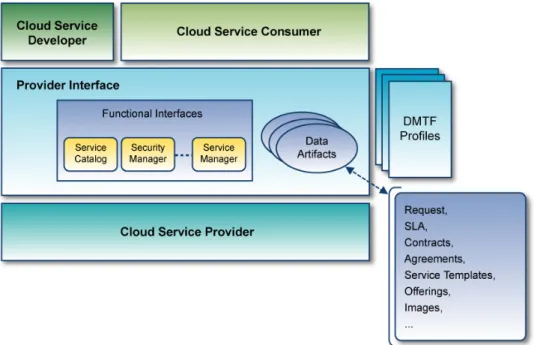
The lifecycle narrative contained in this document cites example functional interfaces that cloud consumers need to establish with the cloud service provider. This section provides a cloud service reference architecture ( 497 498 499 500 501 502 503
Figure 2) that describes key components such as actors, interfaces, data artifacts, and profiles with an indication of interrelationships among these components. This section contains a high-level discussion of the architecture, and section 9 contains more details about an expansion of the architecture. The discussion herein provides a functional description that is non-normative and profitable for study in determining architectural elements that a cloud service provider should make available.
504 505 507 508 509 510 511 512 513 514 515 516 517 518 519 520
Figure 2 – Cloud Service Reference Architecture
6.1
Service Lifecycle and Use Cases
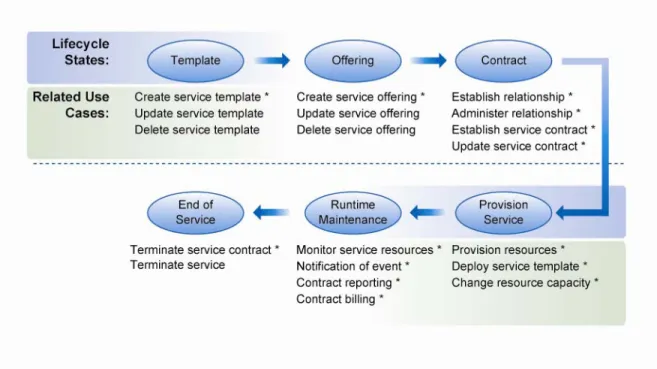
506Figure 3 shows the six lifecycle states of a typical cloud service with the use cases that are most relevant to each state.
• Template: A developer defines the service in a template that describes the content of and interfaces to a service.
• Offering: A provider applies constraints, costs, and policies to a template to create an offering available for request by a consumer.
• Contract: A consumer and provider enter into a contract for services, including agreements on costs, SLAs, SLOs, and specific configuration options.
• Provision Service: A provider deploys (or modifies) a service instance per the contract with the consumer.
• Runtime Maintenance: A provider manages a deployed service and all its resources, including monitoring resources and notifying the consumer of key situations.
• End of Service: A provider halts a service instance, including reclaiming resources for redeployment to support other service.
521 522 523
Figure 3 – Cloud Service Lifecycle States and Use Cases
The use cases with asterisks in Figure 3 are described in detail in the Use Cases and Interactions for Managing Clouds white paper (DSP-IS0103).
524 526 527 528 529 530 531 532 533 534 535 536 537 538 539 540 541 542 543 544 545 546 547
6.2
Resource Models
525Any programmatic API has an underlying resource model, whether implicit or explicit. In the IT
management domain, the practice has long been to make resource models explicit and clearly separated from the protocols used to manipulate model elements. The DMTF CIM model is an example of such a protocol-independent model, for which several access protocols have been defined, supporting various interaction patterns. For large domains, such as cloud computing, there is typically not just one resource model but a series of related models. The boundaries between them are established based on
considerations of reusability and complementarity. Some entities (such as customer, provider, service, and policy) are applicable independently of the type of cloud resources provided, while others (such as
host and disk image) describe a specific type of cloud resources. These type-specific model entities are grouped based on the likelihood of being offered and consumed simultaneously. For example, a host and a volume are typically considered part of the same domain of cloud resources (typically called IaaS — Infrastructure as a Service). Application data storage resources (such as a SQL engine or other structured data store) would typically be grouped as part of another resource domain. In addition to deciding how to group model entities, the other key design decision is the choice of a meta-model (for example, MOF or RDF) in which the model is represented.
After the meta-model and models have been determined, the way the resource model is made accessible through the management interface represents the next set of design decisions. These decisions depend on how model-centric the protocol is — whether the protocol granularity corresponds exactly to the resource model granularity (resources are individually addressable and the logical protocol endpoints correspond to the model entities) or whether the model is used to describe and document the operations in the interface but the operations can take place at a different level of granularity. These
548 549 551 552 553 554 555 556 557 558 559 561 562 563 564 565 566 567 569 570 571 572 573 574 575 577 578 579 580 581 582 583 584 585 586 587 588 589 590 591
invocation of operations. Other decision points include the interaction patterns and security requirements and are described elsewhere in this document.
6.2.1 Service Offering Model 550
To manage cloud resources of various types, a provider/consumer resource model must exist. That model describes the way in which an offering is presented and consumed. It can be abstracted from the specific type of cloud resources offered. The service offering model defines entities for the service consumer and the service provider. Service templates are used to describe in a general form what a provider can offer, and a specific provider turns a service template into a specific offering. A catalog or other mechanism is used to query and retrieve service templates and offerings. The consumer can request a service instance of a service offering. Resource model elements define the lifecycle of a request. The actual service delivery is modeled through domain-specific model entities, such as those in the IaaS model (see 6.2.3).
6.2.2 Identity Model 560
Although cloud computing brings new use cases and threats, it does not by itself require a new identity model. Existing enterprise identity models are appropriate but should be integrated, as discussed later in this document. What may change is the amount of auditing kept and the precision of the user definitions (individual user and organization). However, the introduction of a multi-tenant model as a cloud service provider business accelerator may require more consideration. The intermingling of identity and attribute information of multiple cloud service provider consumers will require careful data modeling to prevent accidental disclosure.
6.2.3 IaaS Model 568
The IaaS domain is usually defined to include resources of the following types: server, whether virtual or physical; storage; network connections; and IP addresses, public or private, exposed by the network interfaces. In addition, the resource model for the IaaS layer may include resources that represent additional features of the infrastructure, such as network features (for example, load balancing),
templates (for deployment), and snapshots. Data storage elements (for example, volume) have quality-of-service elements of their own (for example, deduplication, encryption, backup), but these are usually captured in a separate resource model (for data and storage) outside of the scope of this work.
6.3
Interaction Patterns
576
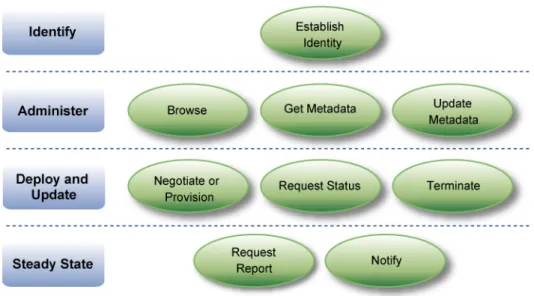
An analysis of various cloud management use cases revealed that each use case could be decomposed into a combination of interaction patterns. An interaction pattern consists of a sequence of messages. For any interaction pattern, the specific messages may vary from use case to use case, but the messages have similar characteristics at an architectural level, particularly the protocol and security considerations. Figure 4 shows the interaction patterns, grouped in four broad categories.
• Identify: A person or entity that interacts with the cloud service provider establishes their identity and receives appropriate credentials, such as a session token. An identity token may also be obtained through an external identity provider that has a trust relationship with the cloud service provider. Operations and data are made accessible to the connection authenticated by the credentials or identity token.
• Administer: These patterns work with the data that describe offerings, users, and other administrative metadata information needed for interactions with the cloud service provider. For example, an administrator or operator may browse a list of available offerings to select one, to update its metadata to configure it for a particular purpose, and to retrieve details about how to access instances of a service that is part of the offering.
• Deploy and Update: These patterns (there are actually two types of Negotiate/Provision Resources) are used when selecting services and resources, and then making them into services. Included are any needed negotiations about the amount and type of resource,
operations to provision services including the infrastructure that supports them, and tracking the status of what may be long-running operations.
592 593 594 595 596 597 598 599 600
• Steady State: These patterns are used after services and resources have been provisioned and are in use. They include client-initiated requests such as a report request and notifications from a provider about situations that are of interest to a consumer and that may require remediation actions. 601 602 603 604 605 606 607 608 609 610 611 612
Figure 4 – Interaction Patterns
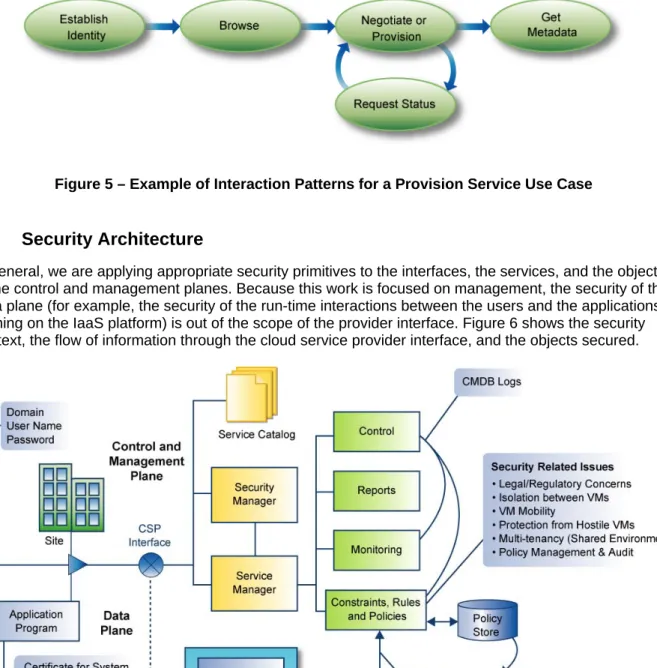
Figure 5 shows an example of how interaction patterns can be combined to represent a use case. Provisioning a service follows the following sequence:
1) Establish the identity of the accessing entity. 2) Browse available offerings.
3) Submit and execute a request to provision a service, including supporting resources. The request may require negotiation before the consumer and provider agree to an acceptable request.
4) The status of a possibly long-running provisioning process may be requested while in process. 5) The consumer gets metadata about the provisioned service, such as the network addresses to
613 614 616 617 618 619 620
Figure 5 – Example of Interaction Patterns for a Provision Service Use Case
6.4
Security Architecture
615In general, we are applying appropriate security primitives to the interfaces, the services, and the objects in the control and management planes. Because this work is focused on management, the security of the data plane (for example, the security of the run-time interactions between the users and the applications running on the IaaS platform) is out of the scope of the provider interface. Figure 6 shows the security context, the flow of information through the cloud service provider interface, and the objects secured.
621
623 The cloud service provider (CSP) interface provides access to the logical endpoints, including the security 624 625 626 627 628 629 630 631 632 633 634 635 636
manager, service manager, and the service catalog. These endpoints provide the various services to interact with service entities (such as VMs, volumes, networks, and composite applications), get audit reports, and perform a host of other activities required to fulfill and maintain a cloud infrastructure. The major categories of objects that are managed by the service manager are control, monitor, and report objects, access to which may be controlled by role-based access control (RBAC).
The Constraints, Rules, and Policies objects are consumed by the cloud infrastructure, and the function of the provider interface is to manage the content of these policy-related elements. The cloud infrastructure (IaaS) is a “black box” to the provider interface, and how the policies are implemented is left to the cloud service provider. But the fact that the various constraints, rules, and policies are being implemented is verified by the audit events.
The two categories of actors who interact with the CSP interface are human users and application programs (such as management, automatic provisioning, billing, or audit applications). The human user might also be interacting through a portal interface, usually using a web browser. The portal interface will be developed using the cloud service provider interfaces. Both actors would be authenticated at the CSP interface by the security manager or present an identity token to the security manager.
637 638 639 640 641 642 643 644 645 646 647 648 650 651 652 653 654
Traditionally, the human user uses a user name and password as credentials for authentication; however, stronger mechanisms (identity federation and assertion provisioning) should be used. Commonly, an application program uses certificates. However, it is deemed insecure to embed user names and passwords in application programs. In this case as well, tokenized identity can be profitably used to provide a higher standard of security.
These are common examples, but they are not prescriptive. Humans might use authenticator tokens, for example, or applications might use Kerberos tickets. Appropriate mechanisms may vary in different environments. Trust relationships may be employed to strengthen the authentication and authorization mechanisms. Our intention is not to declare an exhaustive list of acceptable authentication mechanisms, but to establish a good starting point.
6.5
Role of Rules, Policies, and Constraints
649Policies and constraints are expected to play a major role in the management of clouds. Given the focus on the interfaces for managing clouds rather than the internal details of a cloud implementation, a useful abstraction is to define the desired capabilities of the cloud using policies and constraints. These are interpreted to be what the cloud service provider should offer rather than how it offers it.
There will be several types of policies, such as service-level agreements (SLAs), service-level objectives (SLOs), deployment constraints (for example, those in OVF, now and proposed), data residency
constraints, auditability constraints, security constraints, and so on. After a consumer or developer and a provider agree to a set of constraints, these constraints will govern how each (especially the provider) acts.
655 656 657
659 660 661 662 663 664 665 666 667 668 669 670 671 672 673 674 675 676 677 678 679 680 681 682 683 684 685
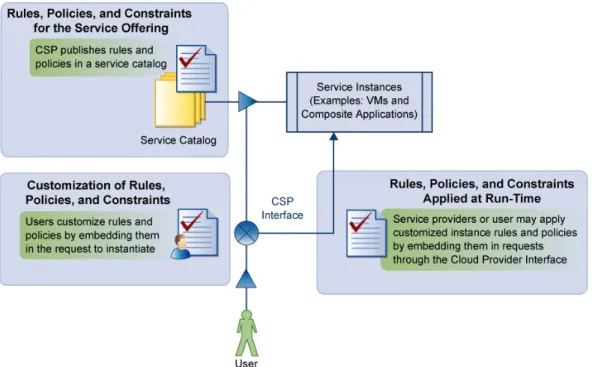
Figure 7 – Constraints Flow
The cloud service provider publishes various relevant constraints, rules, and policies and may include them as a part of the service offering in the service catalog. These become part of the instance when a service entity (for example, a VM or a composite application) is instantiated from the template.
The user can customize the constraints, policies, and rules as a part of the service request to instantiate a service. Users might not be able to customize some policies and constraints from the service provider. The instantiate request will include sections to add and modify the constraints bundle. Then the instance will have an aggregate of the constraints, rules, and policies. The modified constraints have to be applied to the instance throughout its lifecycle (for example, suspend/resume or migrate).
After a service instance (for example, a VM or a composite application) is running, the CSP or user may request to change the policy set, within limits. It may not always be appropriate or feasible for a CSP to change the policies applied to a live service entity, which might impact the characteristics that were agreed upon before instantiation.
Examples of constraints are security policies. A number of different security policies can be applied to offerings in the service catalog or instances. A few simple examples follow:
• Access control. A service instance may be accessible only to a subset of cloud users (for example, users belonging to an enterprise or users with appropriate authorization levels). In addition, policies may specify which users are entitled to modify an instance and where and when they can deploy it.
• Network security policies. Such policies may specify how a service instance in a template may be connected with other service instances or resources outside the cloud. These could take the form of traffic filtering (for instance, firewall) rules and requirements for configuring traffic inspection for intrusion detection and prevention.
• “Scope” of the security policies.The offering may specify where instances may run; for example, they may be constrained within a particular cloud service provider’s infrastructure, enterprise zone, or geographic region.
7
Requirements
686 687 688 689 690 692 694 695 697 699 700 702 704 707 709 710 711 712 713 714 716 718 719 720 722 723 724 725 726 727 729This section describes the high-level requirements that a cloud service provider should make available as a part of the cloud service offering. The list should not be considered exhaustive but rather indicative of the types of functionality that should exist in a well-rounded and exemplary cloud service provider offering.
7.1
Protocol Stack
691The following requirements are related to the protocol stack:
• The interface should support all Message Exchange Patterns (MEPs) relevant to this domain. This 693
includes one-way MEP (push and pull) and two-way MEP (synchronous and asynchronous) over a request-response transport like HTTP.
• Programmatic access to various cloud provider services should be provided using industry-standard 696
mechanisms such as REST, SOAP, and so on.
• Payloads may vary dramatically in size from a few bytes to many gigabytes, and may flow between a 698
consumer or developer and a provider in either direction. Appropriate choices must be made based on the situation, and the protocol should enable any of these choices.
• The stack should be able to carry additional contextual information such as authentication 701
information.
• The stack should adapt to client capability, such as availability of client address, payload size, 703
processing duration, and throughput, and use the most appropriate message pattern.
• The stack should support client- or server-initiated cancellations and restart of a large transfer. 705
7.2
Resource Model
706The following requirements are related to the resource model:
• The resource model should be separated from the interfaces and mechanisms. Separating the 708
resource model from the protocol allows the consumer (and provider) applications to be isolated from the protocol. As long as the applications’ features are implemented based on the resource model (entity types, corresponding data, associations between them, operations), they can be mapped to any protocol over which the management interactions take place. This separation also allows new entities, from contiguous domains, to be added to the resource model without needing to change any part of the protocol design and implementation.
• The resource model should support instantiating and addressing a large number (100,000) of 715
artifacts.
• Any resources exposed at the provider interface may need to be individually addressable, at least for 717
purposes of identification, even if a resource does not support direct operations. The access to various resources should have appropriate authentication (for example, discoverable resources might need to expose metadata without authentication).
• Many actors may need access to resources. They will have varying entitlements, and the model 721
must support authorizations at all levels. Policies such as role-based access controls (RBACs) should authorize access to and control all the resources, with visibility rules enforceable based on context. Examples of the resources and capabilities whose access should be controlled include the ability to create and manipulate aggregates (like virtual datacenter, virtual application stack elements like VMs, network and storage, images, templates, offerings and so on), the ability to monitor
resources, and the ability to ask for and receive audit information about these resources.
• The metadata endpoints need not be same as the resource endpoints. For example, an audit report 728
730 731 733 734 736 738 740 742 744 747 748 749 751 753 754 756 757 758 759 760 762 763 764 765 767 768 769 770
not need to connect directly to a VM but rather to a resource representation of the VM (for example, a message queue).
• If versioning is supported, the resource model should have the capability to create and read versions 732
of all the persistent resources, particularly those that are accessed by multiple actors and are mutable.
• Providers must be able to expose resource metadata that may be needed by clients, such as the 735
geographical location in which data is stored.
7.3
Adoptability
737
The following requirements are related to adoptability:
• The service offerings should integrate with commonly found IT mechanisms, such as authentication 739
and networking.
• The service offerings should use easily and widely understood programming models and 741
programmer skills.
• The service offerings should be able to federate with other clouds, especially those that support the 743
same standards-based interfaces.
• Standard syntax, open APIs, and open standards should be used whenever possible. 745
7.4
Internationalization
746Given that clouds are easily accessible world-wide, the interface should impose no restrictions on the location and language of users, managed resources, and data. While a provider may implement restrictions, the interface should not constrain the provider's choices.
7.5
Rules, Constraints, and Policies
750The following requirements are related to rules, constraints, and policies:
• The cloud service provider should allow the definition of policy per consumer that will define how 752
service entities (virtual machines, network conductivity, storage, and so on) are to be treated by the cloud service provider on behalf of the consumer.
• Whenever services are deployed by the consumer in the cloud service provider infrastructure, the 755
policies and rules imposed by the cloud service provider must be augmented by the policy of rules specified by the consumer before making the images operational in the cloud service provider’s infrastructure. If there are any conflicts concerning policy specifications between the cloud service provider and the cloud service consumer, those conflicts should be communicated to the cloud service consumer for resolution.
• The system shall have capabilities to declaratively specify the various relevant constraints through 761
exchange of rules and policies and have the ability to verify the implementations of the said
constraints through audit reports. The various security threats will be mitigated by specifying policies and then inspecting auditing information. How these are implemented is beyond the scope of the provider interface.
• The rules and constraints should include: 766
– elasticity rules and constraints for compliance in terms of geographical constraints – adjacency rules regarding data and processing adjacency
– performance affinity rules between VMs, applications, and so on – anti-affinity rules for PCI compliance
• In the case of a virtualized infrastructure, there should be mechanisms to capture the hypervisor 771
security capability as well as to push policies and rules to reflect the VM security primitives. The service catalog and offering should reflect these rules and constraints.
772 773 775 777 779 780 782 784 785 786 788 789 790 792 793 794 795 797 798 799 800 802 803 804 805 807 808 810 811 813 814 815 816 817
• The interface should be capable of multi-tenant security specification of items including resource and 774
data isolation, network isolation with security of virtualized networks, and so on.
7.6
Cloud Management Interface Security
776
The following requirements are related to cloud management interface security:
• Access to the cloud service provider interface endpoints and controlled resources should be secure 778
through standardized techniques. (Examples of endpoint security for cloud service providers include providing protection for REST-based URLs, URL routers, and so on.)
• Programmatic and manual access to cloud provider services and content flow should be protected 781
by using industry-standard protection mechanisms such as SSL, TLS, and so on.
• The cloud service provider should assure that all access or changes to cloud services, resources, 783
and data produce auditable records regardless of success or failure, and that these audit records can be compiled into a consistent audit trail that can correlate to end user- or service-initiated actions. Audit records should include clear indication of any delegations of identity or authorizations.
• In cases where anonymous access is required, anonymous access should be allowed only through 787
the security manager.These cases should be recorded as exceptions and logged in the audit database with clear descriptions of reasons for the exceptions and actions taken by the security manager.
• The cloud service provider should provide services that establish trust relationships between itself 791
and customers or other service providers using standardized techniques; these standard
mechanisms include the exchange of certificates, cryptographic materials (for example, keys), and root identities, as well as security policies that can be used to establish subsequent trust
relationships and policies.
• The cloud service provider should provide identity services that permit customers to provision and 796
manage identities that can be authenticated and authorized to access cloud services using standardized mechanisms. These services should consider the need to provision identities either manually or by automated means and the need to synchronize or collaborate with external identity provider services.
• The cloud service provider should allow its customers to control and manage the cryptographic 801
materials and methods used to protect its applications and data, whether in motion or at rest, when entering, exiting, or residing within the cloud service provider's infrastructure. The minimum
functionality would allow an administrator to enter this information manually, with more functionality allowing secure synchronization.
• Cloud service providers should provide industry-standardized entry points into their identity provider 806
service. Such entry points allow for consumers to establish appropriate trust relationships with a cloud service provider.
• The cloud service provider should provide services that can authenticate the identity of customers or 809
services and produce security information that can be consumed by cloud services to enforce security policy and access control.
• Identity functionality provided by the cloud service provider may allow for the delegation of identity 812
and authorization information using standardized mechanisms such as authentication tokens. Any representation of identity and authentication information, either direct or delegated, should be secured and provided for. Delegation gives an account holder the ability to grant access to someone who does not have an account on the service by giving them time-limited access to a specific resource. Part of delegation is also auditing and keeping track of usage from these delegated
818 819 821 823 825 826 827 829 830 831 833 834 835 836 837 838 840 842 843 845 846 848 850 853 854 855 856 858 859 860
accesses. Further capabilities may include the ability to create an account for these accesses so that the delegated client can be billed for their usage.
7.7
Data and Storage
820The following requirements are related to data and storage:
• The cloud service provider should provide customer transparency regarding how data integrity is 822
maintained throughout the lifecycle of the data.
• Encryption and key management should use industry and government standards. The cloud service 824
provider should provide role management and separation of duties for data access controls.
Encryption and key management should be able to handle data isolation for multi-tenant storage and separation of customer data from operational data from the service provider.
• Sensitive customer data should be encrypted in transit over the cloud service provider’s internal 828
network, in addition to being encrypted at rest. The transport access to the provider interface may be secured by TLS/SSL with a server certificate, and for increased security, mutual authentication at the TLS layer may be optionally implemented, based on client certificates.
• In accordance with regulatory requirements, the cloud service provider should provide appropriate 832
notification to data owners when data can be (or has been) seized by a third party (for example, a supply chain or the government) for content discovery.
– Whether data can be seized by a third party could be part of the definition of the provider’s offering, and no notification might be meaningful there.
– When data is seized, the decision to notify the owner of the data should be based on the provider’s governance.
• Data backup and recovery schemes for the cloud must be in place and effective in order to prevent 839
data loss, unwanted data overwrite, and destruction.
• Geographic data location should be exposed to the cloud consumer where appropriate. Knowing 841
where the cloud service provider will host the data and implement required measures ensures compliance with local laws that restrict the cross-border flow of data.
• Data retention and secure destruction capabilities should be provided. The service provider should 844
be able to completely and effectively locate data in the cloud to be removed and provide a level of assurance and evidence regarding data destruction.
7.8
Logs, Event Management, Incident Response, and Notification
847The following requirements are related to logs, event management, incident response, and notification:
• Cloud service providers should provide incident and alert information to the customer by using 849
defined interfaces.
• Cloud service providers should maintain the confidentiality of customer incident data. 851
• The event management interface should have rich semantics with identifiable data sources 852
(application logs, firewall logs, IDS logs, and so on) so that the cloud consumers can make inferences about their systems. The events and information should enable the cloud service consumer for the verification of billing, the providing of audit events, verification of regulatory compliance, the monitoring of operational characteristics, and so on.
• During the operation of service entities (for example, VMs or other services) in the cloud, the cloud 857
service provider should be monitoring the service entities to log events concerning operations, billing, compliance, and so on. The cloud service provider should make this information available to the cloud service consumer in accordance with the SLA in real-time, batch mode, or both.
• The event interface should also be versatile enough to address incident notification, incident 861
response, containment, and remediation. 862 865 867 869 871 873 875 877 879 881 882 884 885 887 889 890 892 894 896 897 899 900
• There should be error handling mechanisms, with error messages that are descriptive. 863
• Operation logs should be available in accordance with the SLA that defines the log persistence 864
duration.
• Appropriate log preservation and integrity mechanisms, such as digital signature and storage 866
devices with write-once media, should be employed.
7.9
Audit, Legal, and Compliance Monitoring
868The following requirements are related to audit, legal, and compliance monitoring:
• Cloud service providers should include metrics and controls that customers can leverage to 870
implement their information risk management requirements.
• Cloud service providers should provide evidence on how customer security requirements are being 872
met.
• Cloud service providers should provide the interfaces to perform an external audit, where 874
appropriate.
• Cloud service providers should comply with appropriate auditing standards, such as SAS70, as 876
required by the business models and industry regulations.
7.10 Security Considerations for Virtualization Technology
878The following requirements are related to security considerations for virtualization technology:
• Administrative access and control of virtualized operating systems should integrate with strong 880
authentication, identity management, RBAC (with separation of duty — SoD), as well as logging and integrity monitoring tools.
• The cloud service provider should expose capabilities for segregating the VMs and creating security 883
zones by type of usage (for example, desktop versus server), production stage (for example, development, production, and testing), location of the VM, and sensitivity of data.
• The reporting mechanism through the event management interface should provide the information 886
necessary to show data isolation and separation-of-duty in a multi-tenant environment.
• The cloud service provider should allow for the definition of virtual machines and application 888
services. The definition of such virtual machine images and services must be protected so that, if required by the consumer, the images are protected from other consumers’ view and reference.
7.11 Portability and Interoperability for Secure Migration
891
The following requirements are related to portability and interoperability for secure migration:
• Service entities (for example, VMs) should be able to migrate across organizational and ownership 893
boundaries (for example, between an enterprise and a service provider’s IaaS infrastructure).
• In the case of a virtualized infrastructure, VM migration should address secure deprovisioning 895
(removal of the VM image after it is ported to a different location or service provider) and partial migration (cloud burst: secure integration between old and new locations and service providers).
• Service providers should provide assurance on the consistency of control effectiveness, 898
management, monitoring, and reporting interfaces and their integration across old and new locations and providers.
• If storage migration capabilities are provided, the service provider should have verified functionalities 901
for secure data transfer including encryption, access control, key management, decommissioning of storage devices, and destruction of data after migration.
902 903 905 906 907 908 909 910 911 912 913 914 915 916 917 918 919 920 921 922 923 924 925 926 927 928 929 930 932 933 934 935 936 937 938 939 940 941 942 943
8
Protocol Examples
904A discussion on cloud infrastructure needs to include rendering of the identified uses cases into commonly used protocols. During the analysis work undertaken to identify requirements from an
infrastructure standpoint, different approaches to analysis were explored. A set of criteria roughly divided into the following different categories was used to analyze every use case:
• interaction characteristics
• resource requirements
• deployment requirements
• security requirements
During the analysis work for use case interactions, it was observed that a simpler set of interaction patterns were repeating in different combinations of all the use cases. It was further observed that a set of nine smaller patterns combined in various ways could render every use case that had been identified. These building blocks were termed Semantic Interaction Patterns (SIPs). As an example, Status Request is involved in many use cases and hence is considered a separate interaction pattern. Some others include Resource Negotiation and Change Notification, which get used in various use cases. The SIPs were then used in the infrastructure analysis based on the preceding categories of criteria. This section focuses on the patterns of message exchange and provides examples of how to render these patterns into commonly observed protocol styles. Using HTTP as the transport protocol, from among various styles of protocol rendering, two popular styles in IT management domain are considered: Remote Procedure Call (RPC) and Representational State Transfer (REST).
Some distinguishing features of each of these styles are as follows:
• RPC style assumes that each resource class provides a specific interface for manipulating the resource. Two variants can be considered: RPC over HTTP, and SOAP RPC. Both use an XML payload for method invocation and use the HTTP POST method to deliver it.
• REST style uses a hypertext driven paradigm with protocols such as HTTP with standard methods GET, POST, PUT, DELETE, and others as the interfaces to a resource. Each resource is identifiable with a URI.
8.1
Message Exchange Patterns
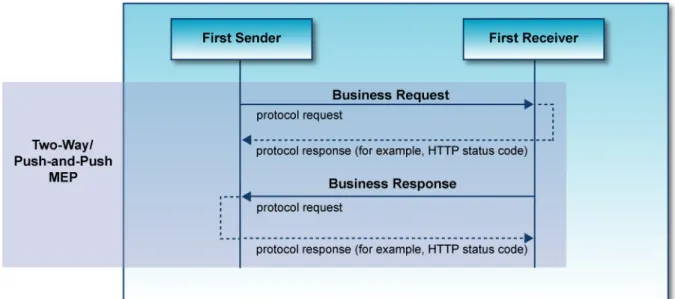
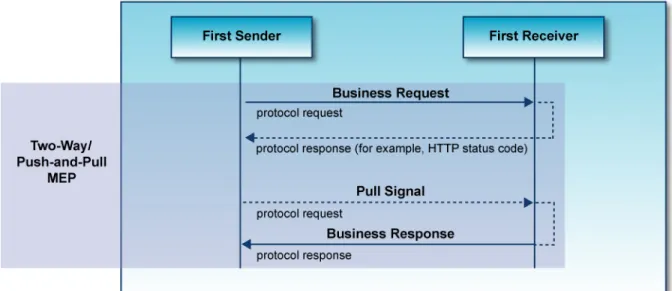
931Two message exchange patterns, or MEPs, can be used to render a semantic interaction between a cloud user and cloud service: a one-way MEP, and a two-way MEP. Furthermore, to reflect various connectivity constraints or user profiles, it is useful to define “execution modes” for these MEPs that can be associated with specific requirements or environment constraints. This section illustrates a few execution modes as applicable to one-way and two-way MEPs. The execution modes pertain to the two actions “push” and “pull” that the sender and the receiver may take in order to complete the interaction. It should be noted that sender and receiver are generic terms and that the entity sending back the response may not be the same addressable entity that received the request.
The protocol options show a few variants in using HTTP. A protocol solution has several aspects: RPC versus Document styles, RPC versus REST, plain HTTP with REST-style versus SOAP-based solutions. The focus here is on REST versus RPC. Some SOAP-based solutions that do not rely on RPC (for example, document/literal SOAP style) are not described here.
8.1.1 One-Way MEP 944 945 946 947 948 949 950 951 952 953 954 955 956 957 958 959 960 961 962 963 964 965 966 967 968 969
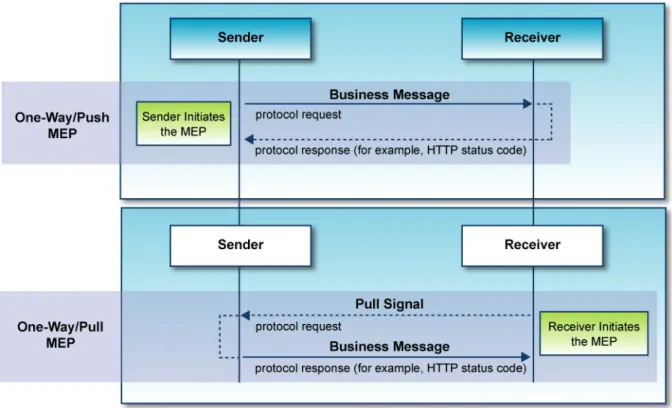
Execution modes for one-way MEP, as illustrated in Figure 8, are as follows:
• The One-Way/Push MEP, or “push” mode, where the sender takes the initiative of sending the business message to the receiver (for example, over an HTTP request). This mode assumes that the receiver has an IP address. An example would be a change notification interaction where the notified party — the user — is addressable.
– Typical steps by a client and service for a one-way/push MEP using RPC:
1) The client (here the sender) issues an HTTP POST request with an RPC payload that contains the object instance ID, method call, and parameters.
2) The service sends an HTTP response — a status code that indicates success or failure. No RPC payload is expected.
– Typical steps by a client and service for a one-way/push MEP using REST:
1) The client (here the sender) issues an HTTP command (PUT, POST, or DELETE) to a URI that represents the particular resource.
2) The service responds with an HTTP success or failure response. See Annex A for protocol examples using HTTP.
• The One-Way/Pull MEP, or “pull” mode, where the receiver takes the initiative of pulling the business message from the sender (for example, by initiating an HTTP request that contains a pull signal for a particular queue or mailbox). The response is sent over the HTTP response. This mode allows receivers that do not have an address to receive business messages.
An example would be a change notification interaction in which the notified party — the user — is not addressable and must pull notifications that are obtained on the protocol back-channel (for example, HTTP response).
In the pull mode, the receiver might periodically send several pull signals before a successful MEP is complete (for instance, including a business message on the response leg). These pull signals are typically scheduled automatically within the underlying messaging layer (for
example, using WS-MakeConnection [Web Services Make Connection (WS-MakeConnection)
970
971 Version 1.1], issuing an HTTP GET, or using a PullRequest signal in OASIS ebXML Messaging Services Version 3.0. Such pull signals contain only the absolute minimal information necessary to pull (for example, a queue ID, a channel ID) and no other business information.
972 973 974 975 976 977 978 979 980 981 982 983 984 985 986
Here it is assumed that the client can provide a client side URI prior to or as a part of the call that is issued. In other pull variants, a queue ID or mailbox ID is provided to the client for use in all its subsequent pulls from the service.
– Typical steps by a client and service for a one-way/pull MEP using RPC:
1) Optionally, the client receives a notification with an RPC payload on the URL provided with an event ID.
2) The client issues an HTTP GET or POST with an event ID (or a queue ID) as a parameter to get the details.
3) The responding party sends back a payload about resource information that corresponds to the event ID.
– Typical steps by a client and service for a one-way/pull MEP using REST: 1) Optionally, the client receives a notification on the URI of the event. 2) The client issues an HTTP GET of the event’s URI.
988 See Annex A for protocol examples using HTTP. 989 990 992 993 994 995 996 997 998
Figure 8 – One-Way MEP Execution Modes
8.1.2 Two-Way MEP 991
Execution modes for two-way MEP are as follows:
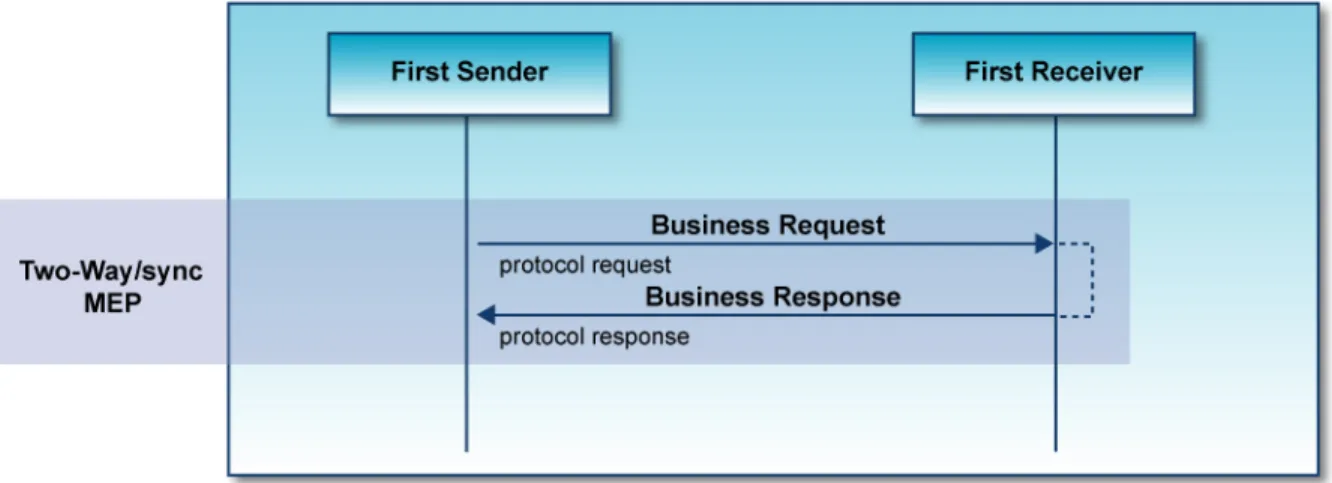
• In the Two-Way/Sync MEP, or “sync” mode, the sender takes the initiative of sending the business request to the receiver and gets the business response over the same connection (in case of a request-response transport such as HTTP). This mode does not require the sender to be addressable. An example would be requesting status interaction, assuming that the
generation of the status information is quick and can accommodate a single HTTP request-response exchange. Figure 9 shows an illustration.