
Improving Visual Speech Synthesis using
Decision Tree Models
by
Christiaan Frans Rademan
Thesis presented in partial fulfilment of the requirements for
the degree of Master of Science in Electronic Engineering in
the Faculty of Engineering at Stellenbosch University
Supervisor: Prof. T.R. Niesler March 2016
Declaration
By submitting this thesis electronically, I declare that the entirety of the work contained therein is my own, original work, that I am the sole author thereof (save to the extent explicitly otherwise stated), that reproduction and publication thereof by Stellenbosch University will not infringe any third party rights and that I have not previously in its entirety or in part submitted it for obtaining any qualification.
Copyright © 2016 Stellenbosch University All rights reserved.
i
Abstract
Improving Visual Speech Synthesis using Decision Tree Models
C.F. RademanDepartment of Electrical and Electronic Engineering, University of Stellenbosch,
Private Bag X1, Matieland 7602, South Africa. Thesis: MScEng (Elec)
March 2016
Visual speech synthesis is essential for believable virtual character interaction. Tradition-ally, animation artists recreate the oral motions expected from speech utterances.
In response, we present decision tree-based clustering techniques which are employed in automating visual speech animation. This is achieved using a small dataset of phonetically-annotated audiovisual speech.
Our work focuses on extending existing tree-based clustering algorithms by improving on the modelling of coarticulation effects. This is accomplished by capturing the mo-tion of natural speech segments, referred to as dynamic visemes, and conserving their parameters during clustering and speech synthesis. Dynamic visemes are defined as the trajectories of oral features segmented by triphone boundaries. By applying simple search and concatenation criteria, our visual speech synthesis system uses decision trees to better predict which dynamic visemes to use.
Experimentation guided all design decisions, suggesting which oral features were of greatest importance, identifying an appropriate dynamic viseme length and finding an effective interpolation method for conserving coarticulation.
We evaluate the performance of our visual speech synthesis models by computing squared error differences between synthesised and measured feature trajectories. Per-ceptual tests also asked participants to compare virtual characters animated by model outputs. Both measured and perceptual tests show that our approaches lead to a clear improvement over a comparable baseline.
Through our research, we intended on making speech synthesis more accessible. There-fore, the conversational agents are based on the freely available MakeHuman and Blender software components. The customised oral feature motion capture system is also easily reproduced and requires only consumer grade recording equipment.
Uittreksel
Verbetering Visuele Spraaksintese Behulp Besluitnemingsboom
Modelle
(“Improving Visual Speech Synthesis using Decision Tree Models”) C.F. Rademan
Departement Elektriese en Elektroniese Ingenieurswese, Universiteit van Stellenbosch,
Privaatsak X1, Matieland 7602, Suid Afrika. Tesis: MScIng (Elec)
Maart 2016
Visuele spraaksintese is noodsaaklik om geloofwaardige interaksie met virtuele karak-ters moontlik te maak. In die verlede het animasiekunstenaars mondbewegings vanaf werklike spraak nageboots. In hierdie studie bied ons tegnieke aan wat gebaseer is op saambondeling met behulp van besluitnemingsbome. Hierdie tegnieke word gebruik om die animasie van visuele spraak te outomatiseer, en maak gebruik van ’n klein datastel van foneties geannoteerde oudiovisuele spraak.
Ons werk fokus op die uitbrei van bestaande besluitnemingsboom-saambondelingsal-goritmes, deur die modellering van koartikulasie-effekte te verbeter. Dit word moontlik gemaak deur eers die beweging van natuurlike spraaksegmente (viseme) vas te vang, en dan hul parameters te bewaar tydens die saambondeling en spraaksintese.
Dinamiese viseme word gedefinieer as die trajekte van mondeienskappe, gesegmenteer deur trifoongrense.
Deur eenvoudige soek- en saamvoegingskriteria toe te pas, kan ons visuele spraak-sintesestelsel van besluitnemingsbome gebruik maak om beter te voorspel watter viseme aangewend moet word.
Alle ontwerpsbesluite is deur ekspermintering gelei, om bv. die mondeienskappe van grootste belang te identifiseer, om ’n gepaste viseemlengte vas te stel, en om ’n effektiewe interpolasiemetode te vind wat koartikulasie bewaar.
Ons evalueer die werksverrigting van ons visuele spraaksintesemodel deur die kwa-draatfout tussen die gesintetiseerde en gemete eienskaptrajekte te bereken. Tydens per-septuele toetse is deelnemers gevra om die geloofwaardigheid van virtuele karakters, gedryf deur die modeluittrees, te beoordeel. Beide gemete en perseptuele toetse het aan-gedui dat die voorgestelde tegnieke ’n duidelike verbetering bo ’n geskikte basislynmeting toon.
Die doel van hierdie navorsing is om spraaksintese meer toeganklik te maak. Om hier-die rede is hier-die gespreksagente gebou op hier-die vrylik beskikbare MakeHuman- en Blender-sagtewarekomponente. Die pasgemaakte mondeienskap-bewegingsaftaster is ook eenvou-dig om te herproduseer, en benoeenvou-dig slegs verbruikersgraad-opneemtoerusting.
Publication
Part of this thesis’ findings were presented and published in the proceedings of FAAVSP ’15 in Vienna, Austria. The paper can be accessed in the ISCA archive available at:
http://www.isca-speech.org/archive/avsp15.
Bibliographic reference: Rademan, C.F., Niesler, T.: Improved visual speech synthesis using dynamic viseme k-means clustering and decision trees. In: FAAVSP’15-The 1st Joint Conference on Facial Analysis, Animation, and Auditory-Visual Speech Processing, pp. 169-174. 2015.
Acknowledgements
The author would like to thank Prof. T.R. Niesler for his unwavering guidance and sup-port throughout this work. This work was supsup-ported in part by the National Research Foundation of the Republic of South Africa (grant TP13081327740) and the MIH Media Lab. The author would also like to thank Alison Wileman for her phonetic annotations and the Blender and Python on-line communities for sharing their knowledge.
Dedications
This thesis is dedicated to Chris, Linda and Kathleen Rademan, Candice Townsend and all the friends I made along the way.
To the reader, I can only hope that my work inspires you to discover and enjoy the complexity of life’s everyday.
Contents
Declaration i Abstract ii Uittreksel iii Publication iv Acknowledgements v Dedications vi Contents vii List of Figures ixList of Tables xii
Nomenclature xiii
1 Introduction 1
1.1 Problem Statement . . . 1
1.2 Limitations and Assumptions . . . 2
1.3 Significance . . . 3
1.4 Scope . . . 3
2 Introduction to Speech Communication 4 2.1 Anatomy of the Human Speech System . . . 4
2.2 Phonetic Description of Speech . . . 4
2.3 Relating Sound to Mouth Shape . . . 6
2.4 Conversational Agent Interaction Theories . . . 6
2.5 Conclusion . . . 9
3 Facial Animation Techniques 11 3.1 Introduction to Computer Animation . . . 11
3.2 Facial Animation Techniques . . . 12
3.3 Formalised Facial Parametrisation . . . 15
3.4 Animation Software . . . 16
3.5 Conclusion . . . 20
4 Visual Speech Synthesis Overview 21 vii
CONTENTS viii
4.1 Gestural Speech Models . . . 21
4.2 Probabilistic Visual Speech Models . . . 25
4.3 Conclusion . . . 31
5 Data Compilation 32 5.1 Motion Capture . . . 32
5.2 Establishing Viseme Units . . . 35
5.3 Establishing the Viseme Interpolation Function . . . 38
5.4 Database Construction . . . 42
5.5 Conclusion . . . 43
6 Implementation 44 6.1 Framework for All Decision Tree Algorithms . . . 44
6.2 Baseline Minimum Deviation Algorithm . . . 46
6.3 k-means CART Algorithm . . . 47
6.4 Maximum Log-Likelihood Algorithm . . . 50
6.5 Conclusion . . . 50
7 Evaluation 51 7.1 Training Set Size . . . 51
7.2 Meta Parameter Evaluations . . . 52
7.3 Perceptual Tests . . . 55
7.4 Discussion of Evaluation . . . 57
7.5 Conclusion . . . 59
8 Summary and Conclusion 60 8.1 Summary and Conclusion . . . 60
8.2 Contributions . . . 61
8.3 Application of Work . . . 62
8.4 Future work . . . 63
Bibliography 66
Appendices 74
A Scripted Bone-Driven Shape Key Animation 75 B International Phonetic Alphabet 78 C Alternative Objective Tests 80
List of Figures
2.1 Left: Anatomy of the human speech system. Reproduced from [10]. Right: labelled oral muscles and their directions of contraction (A: levator labii supe-rioris, B: zygomaticus minor, C: zygomaticus major, D: risorius, E: depressor anguli oris, F: labii inferioris, G: orbicularis oris). Reproduced from [11]. . . . 5 2.2 Illustrated example of the Preston Blair viseme-phoneme paring series.
Re-produced from [15]. . . 6 2.3 Graph illustrating the Uncanny Valley effect with examples (including
com-parisons to traditional Japanese theatre masks and puppets). Reproduced from [23]. . . 8 2.4 Example of a speech cycle’s summation of mouth poses, which give the
im-pression of articulated speech, adapted from [4]. . . 9 3.1 Taxonomy of approaches to control computer facial animation. Reproduced
from [33]. . . 12 3.2 Examples of mixed machine and computer graphic interaction technologies.
Left image: RoboThespian (left) and SociBot (right). Centre and right images: Furhat. Reproduced from [41] and [42] respectively. . . 14 3.3 Face Animation Parameters (FAPs). Reproduced from [33]. . . 16 3.4 A rigged character with bones (left) with highlighted example of a bone weighted
to the character’s mesh (right). Reproduced from [54]. . . 18 3.5 Example of a shape key that characterises the closing of the characters mouth
to form a B,M,P viseme, adopted from [55]. . . 18 3.6 Example of bone-driven shape key animation controlling the MakeHuman
char-acter’s ‘open jaw’ shape key animation. . . 19 4.1 The left graph represents the dominance of articulatory features over time for
a typical speech segment (as adopted by [58] from [59]). The right reveals synthesised plots representing time-dominance (top right) and time-resultant displacement (bottom right) values for a VCV word. The circles represent usual static vowel or consonant viseme displacement values, known as target control parameters [58]. . . 22 4.2 Lip trajectories for the measured/apa/non-sense word and the RBF’s
approx-imated trajectory. The vertical lines represent silence-VCV-silence phonetic segmentation. Reproduced from [33; 60]. . . 23 4.3 Graphs representing lip protrusion trajectories synthesised by the look-ahead,
time-locked and hybrid models, for VCV (represented by the top lines) and VCCV (represented by the bottom lines) nonsense words. Reproduced from [58]. Note, that for the hybrid model, the rule phase transition is marked with an ‘X’. 24 4.4 HMM-based text-to-audio-visual speech synthesis system. Reproduced from [77]. 26
LIST OF FIGURES x
4.5 Left: rule-based text-to-image conversion model. Middle left: VQ-based speech-to-image conversion model. Middle right: ANN-based speech-speech-to-image con-version model. Right: Illustration of the ANN used for audio-to-visual speech synthesis. Reproduced from [84]. . . 27 4.6 Example of a Gaussian mixture-based audio-to-visual parameter prediction.
Reproduced from [73]. . . 29 5.1 Popular fiduciary marker layout (left) demonstrated by De Martinoet al.. A
frame sample from the left side camera reveals their head apparatus (right). Reproduced from [93]. . . 33 5.2 Facial feature marker trajectory tracking. . . 33 5.3 Selected MakeHuman oral shape key animations. . . 34 5.4 Two sets of comparative graphs illustrating biviseme (a and b) and triviseme
(c and d) trajectories for a chin feature. Plots (a) and (c) show: (i) thin lines representing the individual biviseme and triviseme trajectories and (ii) a thick line representing the measured trajectory. Plots (b) and (c) show: (i) a thin line indicating the interpolated biviseme and triviseme trajectories and (ii) a thick line representing the measured trajectory. All plots use vertical lines to show phoneme boundaries. . . 38 5.5 Illustration of how three successive overlapping dynamic visemes p[n-1], p[n]
and p[n+1] are interpolated to create a continious feature trajectory. The over-lapping portions of the visemes are combined using a piecewise linear weighting which accentuates the centres of each dynamic viseme. The highlighted portion indicates how the overlapping interpolation functions always sum to one. . . . 40 5.6 Triviseme VSS feature trajectories resulting from different weightings used by
interpolation functions. Top: represents a fast increment with heavy centre weightings. Bottom: represents a slow increment with lesser central weighting. 41 5.7 The measured trajectories of the chin feature for six repetitions of the same
sentence. . . 41 6.1 Illustration of the decision tree clustering dynamic viseme trajectories with
similar morphologies based on their phonetic attributes. . . 45 6.2 Flow diagram representing the framework of the decision tree’s training
algo-rithm. . . 46 6.3 Flow diagram for employing the decision tree for VSS. . . 46 6.4 Illustration of the KM-CART algorithm, showing how thek-means (k=2)
sifier assigns the dynamic visemes a class type. Subsequently, the CART clas-sification algorithm finds the phonetic attribute question which splits the par-ent node’s dynamic visemes into two child nodes which best match the clusters produced by the k-means algorithm. . . 49
7.1 RMSE results using incremental training subsets for MD-CART, KM-CART and SS-CART algorithms. . . 52 7.2 Graph showing 11-fold CV RMSE results using incremental minimum
occupa-tion criteria for MD-CART, KM-CART and SS-CART algorithms. . . 53 7.3 RMSE results using incremental improvement in deviation threshold criteria
7.4 Example frame taken from a video used in the perceptual test. In this case the left and right avatars were driven by KM-CART and MD-CART algorithms, respectively. The frames show the articulation of the sound “K”. . . 55 7.5 Perceptual test results showing participant preferences as a percentage.
Test-ing compared avatars animated by motion capture data (MOCAP), MD-CART and KM-CART algorithms. The “Both” option indicates when participants could not differentiate between the two avatars. . . 56 7.6 Synthesised bottom lip feature trajectories for the test sentence “His sudden
departure shocked the cast”. From top to bottom, the graphs are for the MD-CART, KM-CART and SS-CART algorithms. The continuous dashed lines (blue) are the final synthesised trajectories, the short lines (red) are the triphone-based dynamic visemes and the continuous solid lines (black) are the measured motion capture feature trajectories. The vertical green lines indicate phone boundaries. . . 58 A.1 Rigged character head with bone-driven shape key animation set up exhibiting
jaw cube’s bone control over the open mouth shape key. . . 76 A.2 Rigged character head with logic blocks set up to permit script based animation
using bone-driven shape key animation in Blender’s Game Engine. . . 77 C.1 R2 results using incremental training subsets for MD-CART, KM-CART and
SS-CART algorithms. . . 80 C.2 R2 results using incremental minimum occupation stopping criteria for
List of Tables
2.1 Classification of audio speech components. Reproduced from [13]. . . 5 5.1 Shape key animation and facial marker relationships. . . 35 7.1 RMSE and RMSE standard deviation (STD) using all 108 training sentences
to synthsise the independent test set’s twelve sentences. . . 52 7.2 Averaged RMSEs and RMSE standard deviations (STD) for the three
algo-rithms trained on all training sentences and synthsising only the independent test senteces. Each algorithim is trained using its stated optimal node occu-pancy and minimum improvement in deviation threshold ( Dmin). . . 54
Nomenclature
Glossary Of Abbreviations
3D Three Dimensional
ANN Artificial Neural Network BAP Body Animation Parameters CV Cross-Validation
FA Facial Animation
FACS Facial Action Coding System FAP Face Animation Parameters FPS Frames Per Second
IPA International Phonetic Alphabet HMI Human Machine Interfacing HMM Hidden Markov Model HCI Human Computer Interaction LPC Linear Predictive Coding PDF Probability Density Function RBF Radial Basis Function
RMSE Root Mean Squared Error TTS Text To Speech Engine
TDNN Time Delay Neural Network VTTS Visual Text To Speech VSS Visual Speech Synthesis VQ Vector Quantization
X-SAMPA Extended Speech Assessment Methods Phonetic Alphabet
Chapter 1
Introduction
Advances in technology have increased the demand for natural, human-like communication interfaces. For example, virtual conversation agents can be found in computer games and in other human-like interface mediums, such as public or personal assistance avatars. Character-based visual speech synthesis (VSS) plays a critical role in these interactions. In response, this thesis presents models for improving virtual character-based VSS. This research falls within human-computer interaction (HCI) research and can be extended into the subject area of human-machine interfacing (HMI).
VSS deals with the reproduction of visual speech cues expressed by the human face during speech articulation. Our primary aim is to select and improve upon a suitable approach to VSS. Our secondary aim is to make our solution accessible by using open source software and readily available consumer equipment.
The project’s primary aim is motivated by the importance of bimodal audiovisual com-munication for aiding conversational interpretation. Agelforet al. [1] and Summerfield [2] demonstrate the importance of lip reading, concluding that a conversational agent’s visual speech can compensate for deficiencies in the audio. Conversational agents also deepen the level of engagement with an interface, making it more life-like and engaging compared to audio alone [3].
The secondary aim will allow others to efficiently develop their own avatars for research purposes. There are currently no existing simple-to-use toolkits or flexible platforms for dynamic character generation and control. The pipeline developed in this study makes VSS, as well as other forms of data-driven or algorithmic control of virtual characters, more accessible.
Both aims are developed to allow VSS to exist in a resource limited environment. This means that, besides using ‘off-the-shelf’ equipment and open source software, the VSS algorithms must require relatively little training data and the chosen software and programming languages should have active online support communities.
1.1 Problem Statement
The mapping of audio-to-visual speech is not one-to-one. In fact, visual speech alone has no accepted pre-defined units, making its segmentation and its mapping to audio units an open-ended problem.
A simplistic, but often unconvincing approach to VSS can be achieved by relating a set of static visual speech cues, known as visemes, to audio speech [4; 5; 6]. When automating this approach, however, visual speech realism comes at the price of an ever
larger set of static visemes, which, in turn, require a more complex audio-to-visual speech mapping. Using a corpus of static visemes is thus resource-intensive and is inherently subject to limitations.
Therefore, the research objective of this work is to identify and improve data-sparse approaches to modelling many-to-many audio-to-visual speech mappings. This requires a number of sub-problems to be addressed. The VSS system must be able to naturally capture coarticulation effects. It will also need to synthesise new speech sequences based on pre-formulated audio-visual relationships. This requires an elegant visual speech clus-tering and mapping method. Once created, this mapping must be coupled with a search and concatenation algorithm to synthesise new visual speech. The VSS systems’ output must then be used to control a virtual avatar. Consequently, a motion capture and control system for the virtual avatar must also be developed. Once completed, the VSS system should be assessed using subjective and perceptual evaluations.
Furthermore, the VSS system must be attractive to individuals in under-resourced work environments. This is critical for making HCI research accessible in new settings, particularly in those with unexplored languages, a category under which much of sub-Saharan Africa falls. Therefore, the implementation of a VSS solution will rely on a versatile and automated animation pipeline that is adaptable to many languages. To further comply with low-resource requirements, the VSS approach must employ accessi-ble software resources and avoid advanced video capturing equipment and data-intensive training algorithms.
1.2 Limitations and Assumptions
Conversational agents touch upon many aspects of study in the field of motion in graphics. Therefore, it is important to define the limitations and assumptions relating to data collection, clustering algorithms, and animation techniques.
Data limitations are a result of the high expense and level of difficulty incurred from audio phonetic annotation. To compensate for these limitations, the recorded speech should be taken from a phonetically rich dataset. To determine the effects of this lim-itation, the VSS system must be tested using variously sized training data sets. One objective is to gauge if there is an optimal dataset size for the developed VSS system.
The method of data capture will be dictated by the animation control technique. The recording procedure must also be easily to reproduce and cost effective, using simple and locally sourced equipment. These specifications will impact the precision and diversity of the captured data. It is also assumed that only the monitoring of speech-related, external oral features is feasible for this work. Therefore, no tongue, greater facial, eye, neck or chest motion capture recordings are considered. Instead these will remain the domain of future work.
The data clustering algorithm must be suitable for implementation on a standard desktop computer. Real-time synthesis is beyond the scope of this work, though the final VSS system should preferably be suitable to this type of usage.
The VSS clustering algorithm will be limited to speech synthesis in English using the Extended Speech Assessment Method Phonetic Alphabet (X-SAMPA) for phonetic annotations. It is assumed that the VSS technique employed will serve as a proof of concept for synthesis in other languages since X-SAMPA covers a wide spread of other languages.
CHAPTER 1. INTRODUCTION 3
The avatar generation and manipulation systems should allow for maximum diversity in human-like character design and usage. That said, there will inevitably be limitations to the characters’ graphic realism and VSS. The consequences of these limitations must be considered in terms of interaction psychology and intelligibility. Perceptual tests should assess these limitations and their effects on the user.
1.3 Significance
In the course of this work, decision tree-based, time-series clustering algorithms are devel-oped. The performance of these algorithms as VSS models is evaluated through objective and subjective analyses, which demonstrate improvement over an adapted baseline algo-rithm. Testing also revealed the limitations of mean squared error evaluations for pre-dicting visual speech perception. These findings have been published in a peer-reviewed international conference paper [7] which is included in Appendix D.
As mentioned in Section 1.1, the developed system is attractive in constrained sit-uations where neither advanced motion capture equipment nor much phonetically tran-scribed audio data is available. By making use of freely-available software tools, the proposed system enables small research groups in poorly resourced environments to pro-duce flexible virtual avatars capable of VSS.
There is also an array of applications for the VSS system which go beyond the research scope of this work. These include: HCI; conversational and interactional psychology research; usage as a tool for efficient, digital media content production, as well as assisting in studying the intelligibility of visual speech and language learning.
1.4 Scope
This thesis has identified and implemented an appropriate set of facial animation tools. This involved using the open source software MakeHuman [8], for character generation, and the Blender Game Engine [9] as the animation control environment. Subsequently, a unique control technique has been implemented, referred to as scripted bone-driven shape key animation, allowing visual speech reproduction to be mastered.
In the process of developing the facial animation system, a motion capture system was devised. This identified and captured a minimised set of oral facial features, which were used to animate that character’s visual speech.
A database of audio and tracked visual speech was also created using the motion capture system. Testing revealed the best method of segmenting and joining the data so to conserve and preserve coarticulation effects during VSS. The database contained oral feature trajectories, which were segmented into triphones and joined for VSS using an interpolation algorithm.
The developed algorithms were evaluated with respect to each other, as well as the training set size, and decision tree meta parameters. Testing revealed a set of suitable parameters as well as improvements on the baseline algorithm.
Chapter 2
Introduction to Speech Communication
Communication is vital to human beings, with face-to-face conversation being our pri-mary means of exchanging information. Speech is, however, a bimodal form of commu-nication, being both audible and visual. Visual speech deals with the visible oral cues associated with audio speech, specifically the lips, tongue and jaw, in the context of this work. Humans are well versed in interpreting oral movements, which contribute to the intelligibility of face-to-face conversation. Reproducing or synthesising these subtle and intricately linked audiovisual gestures is a non-trivial task.
To fully comprehend synthesis of visual speech, one needs insight into a number of fields, including articulatory speech, visual speech animation techniques and theories of social interaction. This chapter will introduce the key concepts in each of these fields.
2.1 Anatomy of the Human Speech System
To produce speech, the human body tensions the diaphragm to compress the lungs and consequently push air through the larynx and out via the mouth and/or nasal cavity (Figure 2.1). The tension of the vocal cords in the larynx, as well as the mouth shape and tongue position, coupling with the nasal cavity, leads to the production of different sounds as air is expelled. For example, a ’h’ sound is produced by forcing air through a tightened glottis and open mouth and an ’f’ is generated by forcing air through the lower lip and top front teeth which are in contact with each other [10]. The left hand diagram in Figure 2.1 reveals that most of the anatomical mechanisms of sound production are hidden from view during visual speech. The anatomy of the oral features, visible during speech, are therefore of greater relevance.
The right side of Figure 2.1 illustrates the intricate arrangement of muscles around the mouth, labelled A to G. For example, the orbicularis oris (G) is a complex of muscles that is used to close the lips. Consequently, when reproducing the many visual speech poses that need to be simulated for realistic animation, it is important to note the direction and magnitude of skin region displacement effected by these muscles. This is, however, an extremely complex task, with many levels of abstraction discussed further in Section 3.2, with Section 3.2.3 specifically investigating approaches to oral muscle simulation.
2.2 Phonetic Description of Speech
Each speech sound in the English language can be classified based on the place and manner of its articulation. These units of speech are known as phonemes. Referring back
CHAPTER 2. INTRODUCTION TO SPEECH COMMUNICATION 5
Figure 2.1: Left: Anatomy of the human speech system. Reproduced from [10]. Right: labelled oral muscles and their directions of contraction (A: levator labii superioris, B: zygomaticus minor, C: zygomaticus major, D: risorius, E: depressor anguli oris, F: labii inferioris, G: orbicularis oris). Reproduced from [11].
to the examples used in Section 2.1, a ’h’ sound can be described as an unvoiced glottal fricative, while an ’f’ is an unvoiced labiodental fricative, as defined by the International Phonetic Alphabet (IPA) [12]. The full IPA chart can be found in Appendix B. Table 2.1 classifies phonemes, into a variety of pronunciation categories. These classifications are important for relating oral cues to audio, as discussed in Section 2.3.
Table 2.1: Classification of audio speech components. Reproduced from [13].
Since its introduction, the IPA has been extended to include sounds from many lan-guages as well as computer-readable encodings. These extensions have lead to the ex-tended speech assessment methods phonetic alphabet (X-SAMPA), which is used in this work.
By using X-SAMPA, our proposed methods can, in principle, be extended to include the diversity of languages in sub-Saharan Africa and beyond.
2.3 Relating Sound to Mouth Shape
The key to good visual speech synthesis is the appropriate reproduction of the relation-ships between audio and visual speech. In the entertainment industry, VSS has tradi-tionally been achieved by trained animators. Their work involves the painstaking genera-tion of visual speech animagenera-tion sequences that are aligned with spoken audio recordings. This process can be simplified and made more efficient by the definition of visual speech-phoneme pairings, known as visemes, such as those shown in Figure 2.2. The word viseme is a contraction of the words “visual" and “phoneme" [14].
Figure 2.2: Illustrated example of the Preston Blair viseme-phoneme paring series. Reproduced from [15].
Although static viseme-phoneme pairing systems have been proposed, the compila-tion of a corpus of visemes diverse enough to fully capture the intermediate coarticula-tory speech poses would be a difficult and laborious process. The animator’s solution to producing seamless visual speech sequences, known as ’speech cycles’ [4], is to use com-puter graphic software components. These software options provide tools to efficiently interpolate static visemes and tailor visual speech sequences to the level of realism and intelligibility required of the virtual character (also referred to as an embodied conversa-tional agent or avatar).
The shape of the mouth is influenced by the articulation and inertia of the surrounding units of speech [16]. Therefore, the limitations of static visemes can be attributed to their inability to account for these coarticulatory effects. With this in mind, this work explores models for phoneme-to-viseme clustering for visual speech synthesis taking into account coarticulatory effects.
2.4 Conversational Agent Interaction Theories
Before discussing visual speech animation and synthesis, it is important to have a broad understanding of interaction theory, focusing on the cognitive and psychological under-pinnings of virtual characters capable of audiovisual speech.
CHAPTER 2. INTRODUCTION TO SPEECH COMMUNICATION 7
2.4.1 Confluence of Seeing and Hearing
Visual speech has been shown to increase the intelligibility of auditory information [17]. For example, the “cocktail party effect" has shown that a listener is able to pick up significantly more information during conversation, whilst surrounded by other active speakers, by focusing their attention on the speakers lips [18]. This is particularity useful for those in noisy environments or who are hard of hearing.
Brain imaging research suggests that humans anticipate audio speech based on visual speech [17]. These anticipatory gestures are perceived as natural when observed 100ms to 300ms before the audio [19; 20]. However, there is no known rule for determining by how much the mouth movements should precede the audible speech. The timing between audio and visual cues also varies between different parts of words and between vowels and consonants. Capturing and reproducing these subtleties is key to good a VSS system.
As part of the reproduction of good VSS, mismatched audio and visual speech must be avoided. In some cases, this can lead to an auditory illusion, known as the “McGurk effect"; caused by visual information (from the speaker’s lip movements) conflicting with the audio information, and may result in the perception of a sound matching neither the audio or the visual output [21; 22]. The most common example is the visual cue /ga/ with an auditory /ba/, which usually result in the perception of /da/. The McGurk effect is relevant to the understanding of atypical audio and visual speech on facial animation. Other basic concepts to consider for clear audiovisual speech perception include clear visibility of the mouth and a natural speech rate. The latter can be difficult to synthesis as speech has many dynamic properties, including accent, stress and context related accentu-ations. The captured visual speech data must therefore be clearly pronounced/enunciated at a natural speech rate. This data must then be accurately reproduced by the virtual avatar from the captured recordings.
2.4.2 Realism and the Uncanny Valley
For our synthetic system to have human-like realism, it must perfectly imitate a human’s visual speech. The conversation agent’s appearance and motion play a critical role in the perceived quality and emotional response experienced by the observer. Therefore, the study and identification of attributes effecting realism, for example, human-likeness and the naturalness of motion, are important.
The study of humanoid robotics has revealed that the affinity felt towards objects of increasing human-likeness grows, until a point is reached where discerning what is real and what is not becomes difficult, and the onlooker experiences an eerie or uncomfortable sensation. This cognitive dissonance subsides when the observed entity reaches complete naturalness. Figure 2.3 illustrates this effect, referred to as the ’Uncanny Valley’, with the observable dip in affinity [23]. For moving or animated characters, the graph’s hypo-thetical peaks and valleys are amplified [24].
The Uncanny Valley effect is not as easily reproduced as might be expected from Figure 2.3 [25; 26; 27]. Avoiding it requires an understanding of the interplay between appearance, movement and realism of interaction. When these fall just short of human-likeness, users may find the interaction disturbing [28]. To avoid the phenomenon during virtual character development, the theories below, which reveal the intricate mix of psy-chological phenomena associated with the Uncanny Valley effect, must be considered.
• The theory of evolutionary aesthetics suggests the avoidance of the Uncanny Valley by making the face appealing and/or attractive [29]. This is, for example, achievable
Figure 2.3: Graph illustrating the Uncanny Valley effect with examples (including comparisons to traditional Japanese theatre masks and puppets). Reproduced from [23].
with the use of a symmetrical face with good skin. In line with these requirements, the face’s proportions must be within those of human norms, especially for the eyes [30].
• Rozin’s theory of disgust is related to theories of disease avoidance [29]. It stresses the tendency for humans to avoid those with poor health indications, namely; bad colouring, jerky movements and dozy looking eyes. The face’s skin should therefore be smooth to give the impression of the character being of good health [30].
• The Uncanny Valley effect can also be attributed to paradoxes involving personal and human identity. This occurs when a human’s cognitive conceptualization of being, which is brought about when observing a human-like entity, causes the on-looker to grapple with the paradox of dealing with something that is neither human nor machine [31]. MacDorman et al. [29] adopt this idea suggesting that eeriness is experienced when the cognitive act of linking quantitative metrics between qual-itatively dissimilar subjects (i.e. a human face against a computer generated face) calls into question the original differentiation between the two categories.
• Terror management theories postulate that machines with human characteristics can elicit a fear of death. Human-like machines can evoke thoughts of soulless-ness, mortality or the fear of being replaced [29]. A simple solution is to give the characters the appearance of a full body that appears natural, lively and preventing the face from having an overall scared or menacing appearance.
• Expectation violation theory suggests that irregular social behaviour can cause an interaction to feel eerie [29]. The solution to this problem, although beyond this work’s scope, is to implement realistic, contextually relevant gestures and responses to fulfil the users normal social interaction expectations. Grafet al. [32] suggest the addition of head movements to avoid the Uncanny Valley effect, even if they are not related to the speech’s context. The authors also recommended that the appearance
CHAPTER 2. INTRODUCTION TO SPEECH COMMUNICATION 9
of having a full body is important as a ‘floating head’ is judged by most viewers as eerie.
MacDorman et al.’s [30] mention a few design choices to avoid the Uncanny Valley effect. First, is to refrain from using photo-realistic texturing on the character. Addi-tionally, the authors suggest avoidance of inconsistencies in the level of human-likeness in character features. By avoiding near or mixed photo-realistic character components, the need for near-perfect visual speech is prevented. Other attributes to avoid, which are more common to VSS and graphics, include penetration of colliding surfaces or facial tissue and the prevention of unnatural mouth shapes and movements.
2.4.3 Realism in Visual Speech
There is a perceptual relationship between character realism and movement that is evident in visual speech. For example, the ability to correctly interpret poorly animated, non-human-like cartoon character speech demonstrates that an approximate representation of visual speech can be sufficient. As a result, it is justifiable to state that the level of graphic realism can govern the required level of visual speech realism and that the chosen level of character realism sets the minimum standard required for passable visual speech. According to Osipa [4], the most important aspect of lip syncing is achieving the simple but well timed motions of opening and closing and widening and narrowing of the mouth. By morphing between these various shapes, the observer can get a basic impression that the character is mouthing the words it is saying, as demonstrated in Figure 2.4.
Figure 2.4: Example of a speech cycle’s summation of mouth poses, which give the impression of articulated speech, adapted from [4].
Identifying visual speech errors that are acknowledged by animators will help in the VSS systems’ assessment. Key attributes to avoid are overly active lips and over enunci-ation, which can result in disjointed or jumpy looking visual speech [4]. Visual speech is often relaxed, with the mouth only slightly opening and closing, and the tongue playing a minor role.
2.5 Conclusion
This introduction to audiovisual speech highlighted the anatomy of the mouth and the techniques used by artists, leading to a cognisance of speech coherency and interaction theory. It can be concluded that VSS should not rest in identifying a set of defined
visemes, but focus on capturing and incorporating the natural gestures and coarticulation effects of visual speech. A good impression of visual speech can be generated provided the captured mouth shapes are diverse, adaptable and that the VSS system’s synthesises speech with the correct timing in relation to the phonemes’ utterances, while accounting for coarticulation effects. The appearance of the conversational agent must also avoid the attributes which supposedly elicit the Uncanny Valley effect.
Chapter 3
Facial Animation Techniques
The previous chapter presented a broad background of visual speech and interaction with virtual characters. The focus will now shift toward identifying the most appropriate facial animation (FA) technique for this project.
3.1 Introduction to Computer Animation
From the perspective of a computer animation artist, a scene can be broken down into five procedural elements: forming, surfacing, lighting, motion and rendering. All are considered to be of equal importance for good animation. In the context of this work, however, the focus will be on motion. Forming, surfacing lighting and rendering are all of secondary importance as they are only a means towards creating the virtual character.
As motion is usually the last step addressed in computer animation, the secondary goals will be explained first. To start, forming involves the creation of three dimensional (3D) virtual objects. Forming a 3D object is accomplished with a computer generated mesh; a net-like polygonal geometric surface consisting of edges linked by vertices to create an intricate multi-faced object. A mesh’s form represents the outer shape of an object. Surfacing is the process of colouring each of the mesh’s multiple surface faces, giving the object the appearance associated with the materials it is made of. For a human-like character’s facial mesh, a dynamic colouring scheme is required to represent the expected colour variations of healthy skin. Lighting and rendering are also important as they effect realism. The lighting must sufficiently illuminate the character. Rendering involves the generation of each pixel of the final 2D projection of the 3D scene from the camera’s perspective. Section 3.4 addresses the selection and use of the animation software options capable of forming, surfacing, lighting and rendering the virtual character.
Returning to the primary focus of character motion, computer animation techniques used in the movie industry have many parallels with stop-motion animation, where an animator must create a character’s poses for every scene. In computer animation, each of these unique poses, known as keyframes, can be interpolated between, thereby automating much of the animation process. Motion, in the context of this work, will, however, be achieved by animating the avatar using the output of the developed VSS system. There are many approaches toward using this output to generate motion in graphics, which will be discussed next in Section 3.2.
3.2 Facial Animation Techniques
The current approaches to FA are laid out in Figure 3.1.
Figure 3.1: Taxonomy of approaches to control computer facial animation. Reproduced from [33].
Low-level FA (the left topmost branch of Figure 3.1) concerns the way in which basic motion is parametrised and achieved. This involves the morphological processes carried out on the 3D object’s mesh.
High-level FA concerns the production of whole animation sequences, hence high-level FA can be considered a tier above low-level FA as it governs the large scale motion processes, which are translated into virtual object surface manipulations by low-level FA. The boundaries between high and low-level FA depend on the control technique used and, in practice, are not necessarily split as clearly as suggested by the figure. The main sub-branches of FA will now be considered, starting from low-level FA on the left to high-level FA on the right of Figure 3.1.
3.2.1 Interpolation
Interpolation translates the geometric representation of an animated character’s mesh from one configuration to another over time. For example, linear interpolation allows a key expression of a character’s mesh to morph to a subsequent key expression along a straight path (usually using the vertices), within a specified time [9]. As mentioned, these key expressions are commonly referred to askeyframes; extreme positionings of a character at a particular frame number in an animated sequence [34]. Keyframe morphological tools commonly available in animation software include linear, polynomial and spline interpolation as well as Bézier curves. Bézier curves are popular for generating curvaceous regional interpolations, allowing for more flexible and thus more natural pose transition rates.
CHAPTER 3. FACIAL ANIMATION TECHNIQUES 13
Interpolation styles are important because they must smoothly link the VSS system’s outputs, which are going to be in the form of time-positional data segments. It is rec-ommended that the influences of the interpolation style used joining the visual speech segments should be experimented with to consider their affects on speech realism.
3.2.2 Direct Parametrization
Direct parametrization attempts to surpass the limitations of interpolation methods [35]. In direct parametrization, a set of parameters are defined, for example the distance be-tween two vertices of a mesh. By altering the parameter’s value, the mesh is deformed using basic geometric transformations, including scaling, rotation, translation and interpo-lation. This technique allows a variety of dynamic shapes to be controlled by modulating the appropriate set of parameters.
Although direct parametrization allows for efficient computation, setting up these parameters is very time consuming for geometries composed of many vertices. It can also lead to unnatural results if, for example, an individual or mixture of parameter changes excessively exaggerate a facial mesh deformation, thereby causing the virtual model to assume an unnatural pose. If direct parametrization is implemented, it must be done so with great caution so to avoid unnatural facial poses or movements, which could cause the cognitive discomforts related to the Uncanny Valley effect.
3.2.3 Pseudomuscle and Muscle Simulation Models
Pseudomuscle models use parameters, which are related to mesh deformations, to emulate muscle movements [36]. Pseudomuscle visual speech models attempt to replicate the mag-nitude and direction of skin movements induced by bones, tissue and muscles, requiring far more detailed knowledge of human anatomy than that presented in Section 2.1.
Physics-based muscle models often simulate muscle and skin layers as interacting mass and spring structures, exhibiting near-anatomic correctness [37; 38]. Simpler muscle simu-lation models create facial actions by modelling more generalised mesh topology transfor-mations which are not limited by a set number of parameters or by the facial topology [39]. The complex development of physics-based muscle simulations pushes it beyond the scope of this project. However, emulating facial movements using a set of pseudomuscle-like parameters is a viable option, depending on the mechanisms driving the FA. This will be revisited in Sections 5.1 and 3.4.
3.2.4 Script Based Animation
High-level script-based FA is driven by a program that relates text-based dialogues to ani-mations. These algorithms work with text input or orthographic transcriptions of recorded speech to produce visual speech synchronised with audio. Tagged facial-animation-from-text systems, such as that described by Albrecht et al. [40], include expressive tags in their text input, as well as text-to-speech (TTS) engines, for generating synchronised visual and audio speech-related expressions during VSS.
Script based speech animation algorithms are advantageous over other high-level FA techniques because they allow for accurate audio to visual speech stochastic modelling. This is because the algorithms are based on accurate transcriptions of audio speech, resulting in better audio to visual speech predictive models. Chapter 4 explores script-based animation techniques and algorithms for VSS.
3.2.5 Manual Animation
Manual animation is the working realm of artists. As mentioned in Section 3.1, animators go through the time consuming process of creating a character’s form, surfacing, lighting, animating motion and lastly rendering. These processes require an excellent technical knowledge of graphics and the graphics software. To reduce the need for developing this technical knowledge, Sections 3.4 and 5.1 identify processes for automating dynamic virtual character formation, surfacing and animation. This will allow the developed VSS pipeline to be implemented in under-resourced environments, where the technical skills and tools required for manual animation are not available.
3.2.6 Speech Driven Animation
Speech-driven animation attempts to match audio speech with lip motions by identifying patterns that can be used to map audio signals to their naturally occurring visual speech counterparts [33]. In contrast to script-based animation, no orthographic or phonetic transcript is required. Stochastic modelling approaches are generally used, which can include volume tracking, artificial neural networks and linear predictive coding (LPC).
3.2.7 Pupeteering
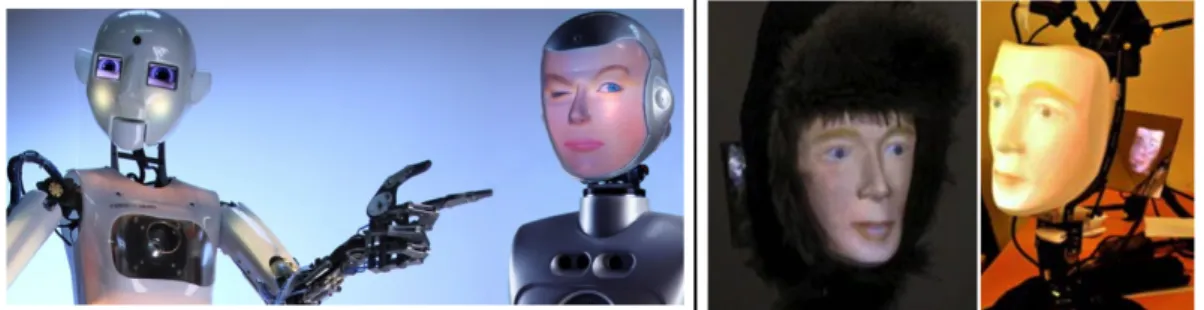
Puppeteering, animatronics and humanoid robotics refer to the use of electronically con-trolled hardware to represent a human-like form. Figure 3.2 demonstrates three im-plementations of back projected robot heads, created using a combination of both elec-tromechanical and graphical systems. These mixed medium systems also claim to improve engagement and speech intelligibility [41; 42].
Figure 3.2: Examples of mixed machine and computer graphic interaction technologies. Left image: RoboThespian (left) and SociBot (right). Centre and right images: Furhat. Reproduced from [41] and [42] respectively.
Research using mixed electromechanical and graphical robots has shed light on a relevant hypothesis which relates forward facing two-dimensional head positioning to in-telligibility. This hypothesis is based on the Mona Lisa effect, which describes the fixated gaze experienced by an observer of a forward looking facial image. Al Moubayed et al.[42] attribute the Mona Lisa effect to improving a user’s intelligibility of forward fac-ing screen-based conversational agents’, specifically when observed from an angle. This bodes well for the proposed screen-based avatar, which should face directly toward the camera, thereby reproducing the supposed benefits associated with the Mona Lisa effect.
CHAPTER 3. FACIAL ANIMATION TECHNIQUES 15
3.2.8 Performance Animation and Control Parametrization
Performance animation employs motion data captured from a human actor, through the use of motion tracking software, to drive virtual characters. The adopted motion capture technique will largely influence the digital representation of visual speech. In turn, this will influence the control parametrization technique appropriate for visual speech ani-mation as well as the VSS’s audio-to-visual speech mapping algorithms. The interplay of these components highlights the importance of correctly selecting animation software with a suitable set of control parametrization tools. Section 5.1 delves further into motion capture and performance animation techniques relevant to the selected FA system.
3.2.9 Hybrid Animation Techniques
Conversational agents using hybrid animation systems explore the combined synthesis of visual and audio speech synthesis. While audio synthesis is out of the project’s scope, the processes used to map audio signals to visual speech images is useful, and will be considered in Chapter 4.
3.3 Formalised Facial Parametrisation
The primary advantages of formalising facial parametrisation is to allow more comparable systems and to allow easier collaboration in research.
Park [43] created the first virtual talking head. He did so by experimenting with polygons painted onto a face, which he used as a basis to guide virtual face mesh topolo-gies. Park applied direct parametrization to allow the mesh to morph into expressions. Though successful, this technique was never formalised. Only later, in the pioneering work of Ekmanet al. [44], were means identified to recognise the emotions surprise, fear, anger, disgust, sadness and happiness. This led to the development of the Facial Action Coding System (FACS), which separated observable components of facial muscle move-ments called Action Units (AUs) [45]. Eventually this influenced the development of the computer animation MPEG-4 parametrised control standard [33]. The MPEG-4 standard uses Face Animation Parameters (FAPs), marked in Figure 3.3, and Body Animation Pa-rameters (BAPs). Both FAPs and BAPs are derived from geometric parametrization of the face and body.
There are a number of disadvantages of using pre-defined standards, like MPEG-4. Firstly, the motion capture technique needs to match a specific set of facial parameters, therefore requiring a specific animation model and control system to be used. This can be time consuming to reproduce and limit the flexibility of the animation and control techniques. Standardised parameters may also limit new insight into articulatory gestures. Therefore, this work has focused on meeting the accessibility and reproducibility issues mentioned in Section 1.1. This does not mean to say that selection of an optimal set of parameters for facial control was neglected. It is discussed further in Section 5.1.
Figure 3.3: Face Animation Parameters (FAPs). Reproduced from [33].
3.4 Animation Software
3.4.1 Software Selection
For a preferable FA technique to be identified, it is necessary to asses the suitability of the development environments in which such a system will be created. Three such environments are considered here.
The most basic type of development environment is a graphic rendering application programming interface. This provides for efficient coding of every aspect of the virtual character and its control parameters. An example of such a development environment is OpenGL [46]. By implementing specially-written software, the animation control system would be optimised for usage with the virtual agent. The disadvantages of this approach would be the time consuming programming required to develop the control and rendering systems and the resultant complexity limitations imposed. Both these disadvantages may also negatively effect those trying to improve this system at a later stage. Character formation would also be required, a complex task ill-suited to those unfamiliar with 3D animation.
Environments with pre-determined character control systems are available. Freely available options include agents with control parameters, for example: Xface [47], RUTH: Rutgers University Talking Head [48], GRETA (a real-time 3D embodied conversational agent) [49] or USCICT’s Virtual Human Toolkit [50]. These tools are freely available, save time generating a character and are already equipped with a control system. Editing the input and control systems is, however, either not possible or difficult to reverse engineer. Without the needed flexibility for developing the input and control systems, these tools limit their usability for VSS experimentation.
Animation and game engine software are an intermediate option between the first ‘build-all’ and second ‘already-made’ character development environments. These soft-ware options provide customisable high-level FA and pre-defined low-level FA control parameters. Examples include Maya [51], the Unity game engine [52] and Blender [9]. These packages are cost effective since they are often free for research purposes, and in Blender’s case, open source. They are also highly accessible, have online software support
CHAPTER 3. FACIAL ANIMATION TECHNIQUES 17
resources and are compatible with multiple operating systems. The high and low-level FA systems are appropriate for the types of graphic manipulations required for this work. This is because the means to control the complex low-level FA systems have already been established. the high-level FA can be controlled using script-based animation, greatly simplifying the requirements for a VSS control system.
In practice, the selection process was iterative. However, the advantages of game engines, specifically Blender’s game engine (BGE) [9], made it the obvious choice for the character control and animation development environment. The use of graphic application programming interfaces would take too long to develop and software options with pre-built agents were found to be too limited in animation and control diversity.
Blender is a feature rich open source 3D animation software package. It has minimal computational requirements and is compatible with several major operating systems. Its integrated game engine control parametrization tools have the major advantage of com-bining easy to use game logic controllers (elaborated on in Section 3.4.2) with Python scripts to control events in a virtual scene. This is an accessible programming language, particularly when it comes to availability and diversity of its libraries. Although scripted control of features is not unique to the BGE, it is the most powerful freely-available option and is well documented with active online communities. Furthermore, Blender 2.70 includes integration with the NumPy Python library [53], which provides access to advanced numeric operations useful for character control.
A secondary advantage to using the BGE was its compatibility with MakeHuman [8], an open source 3D customisable character generation software. Forming, surfacing and rigging (defined in Section 3.4.2) are major obstacles to overcome in creating a virtual character. By using MakeHuman, our VSS system could avoid the need for a background understanding of computer game character development.
MakeHuman provides over 1000 customisable character topologies and surfacing fea-tures for the body and face and is compatible with major operating systems. The software also automates the creation of a consistent and extensive set of animation tools, which accompany the character when imported into Blender. These animation tools include a large selection of oral gestures with the potential to collectively represent any visual speech unit.
3.4.2 Animation Tool Selection
The characters created by the MakeHuman software are automatically paired with two forms of animation tool, namely bone-driven animation and shape key animation. First an introduction to these tools will be given, followed by a motivation and method for selecting the latter as the character’s VSS animation control system.
Once a character is formed, and before animation can begin, a binding and control structure, commonly known as an armature, is created through a process called rig-ging [4]. For human-like characters, their armature often resembles a skeleton-like system that consists of kinematic chains called bones, with which the character can be ani-mated. The function of the bones in a rigged character has been described as “digital orthopaedics", because bones manipulate the areas of the character’s mesh to which they are bound, in a way that is reminiscent of how human bones manipulate skin [54]. Fig-ure 3.4 illustrates bones, seen as linked grey octahedrons in the left image and straight line-segments in the central and right hand images. The colour variation, seen in the right hand image in Figure 3.4, reveals the extent to which the torso bone is associated (or weighted) to the chest area of the character’s mesh. By this mechanism, the torso area
is moved by angling the chest bone relative to the hip bone, giving rise to a bend which is similar to a human’s back movement. This is referred to as bone-driven animation.
Figure 3.4: A rigged character with bones (left) with highlighted example of a bone weighted to the character’s mesh (right). Reproduced from [54].
Shape keys (also known as morph targets or blend shapes) are another commonly available animation tool. They remove the need for individual bones to be repetitively moved to produce frequent gestures. Animators use shape keys to create a library of character mesh deformations with which to speed up the animation process [54].
A shape key is created by saving a deformation of the character’s mesh, usually rel-ative to its neutral state. It is then possible to use the software to interpolate between the neutral and fully-formed poses [54]. Figure 3.5 demonstrates a shape key, which in-terpolates between a neutral base position (left) and an extreme pose (right) in which the character’s mouth is closed. Shape key animation has many parallels with a system which couples a low-level FA direct paramaterization system with a high-level FA pseudomuscle model (discussed in Sections 3.2.2 and 3.2.3 respectively).
Figure 3.5: Example of a shape key that characterises the closing of the characters mouth to form a B,M,P viseme, adopted from [55].
Revisiting the character imported from MakeHuman, either bone-driven animation or shape key animation could be used to animate the character in the BGE. Implementing bone-driven animation is, however, unnecessary. This is because the imported MakeHu-man character already has a large selection of oral shape keys, which have the potential to collectively represent any visual speech unit.
For game engine control, it was found that the interaction of multiple bone-driven ani-mations becomes cumbersome when trying to achieve the mesh deforani-mations necessary to mimic the subtle facial movements required for speech. This is because bones manipulate only the areas of the mesh they are associated with. Combining multiple bone movements
CHAPTER 3. FACIAL ANIMATION TECHNIQUES 19
can result in unnatural mesh deformations which are difficult to detect and prevent. The use of shape keys can overcome this problem. This is because shape keys are limited to a specific manipulation of the mesh. The interaction of the extremes of these manipulations is also better coordinated during shape key formation.
The use of shape key animations as the character’s VSS animation control system presented two problems. First, shape keys cannot be accessed directly through Python scripts in the BGE. Second, an oral feature motion capture system must be created, which must also consider the selection of facial markers and their related shape key animations. Solving the first problem was crucial because, without the BGE Python scripts having access to the MakeHuman character’s shape keys, the automation of the visual speech animations could not be realised. This problem was solved using a non-trivial and undoc-umented script-based animation process, referred to as scripted bone-driven shape key animation. This uses bones as a proxy to control shape keys, and is achieved with the use of a script. Note, that in the context of this work, a script is a short Python program is written to automate the task of bone-driven shape key animation.
Appendix A provided a detailed explanation of how scripted bone-driven shape key animation is be achieved. Figure 3.6 shows one of the MakeHuman character’s bone-driven shape key animations, which controls mouth opening.
Figure 3.6: Example of bone-driven shape key animation controlling the MakeHuman charac-ter’s ‘open jaw’ shape key animation.
The second problem, namely the development of the oral feature motion capture sys-tem, is discussed in Section 5.1. The key point to understand here is that a custom motion capture system was developed to track oral features. The MakeHuman charac-ter’s oral bone-driven shape key gestures are then animated using a Python script, which is given access to the tracked facial features. These facial marker placements can be seen in Figure 5.2 and their relationship with the MakeHuman character’s oral shape keys is discussed in Section 5.1.2.
3.5 Conclusion
This chapter has surveyed current techniques of FA. Drawing from these insights, a suit-able open source tool for animation control was identified. The motion capture system compatible with the characters scripted bone-driven shape key animations is also men-tioned. With the character’s facial animation control system established, different ap-proaches to VSS can be addressed.
Chapter 4
Visual Speech Synthesis Overview
Chapter 3 explored animation techniques with a special focus on the character’s visual speech control system, which used scripted bone-driven shape key animations. Our at-tention will now turn to visual speech modelling and synthesis techniques.
According to Chen et. al [56], VSS has two common approaches. The first approach uses audio-to-visual mapping rules that are often derived from observations of utterances, which lead to gestural speech models. The second approach uses functional approxi-mations, generating probabilistic visual speech models which emulate the relationship between the sounds produced and their corresponding oral features or mouth shapes. This chapter will identify which of these VSS models is suited to this work’s objectives.
4.1 Gestural Speech Models
In the context of this work, a gestural speech model implies a VSS system which uses predefined deterministic models. These models commonly employ parametrised gestural dominances to static visemes in an attempt to reproduce natural coarticulation effects.
4.1.1 Rule-Based Visual Speech Models
Rule-based VSS attempts to create a theoretical representation of visual speech which mimics the process of coarticulation. Parke’s [43] pioneering work, referred to in Sec-tion 3.3, is considered a rule-based VSS model because it uses a simple cosine interpola-tion scheme to compute the intermediate frames between predefined static visemes. These simple rules, in combination with a parametrically controlled polygon 3D face topology, allowed both visual speech and expressions to be interpolated [57]. Parke estimated the control parameter values by recording and studying his own visual speech. This simple interpolative method is ill suited to automated visual speech as it requires parameters to be manually adjusted to suit each speech sequence.
Cohen et al. [58] used Park’s parametrized facial animation model to create a more complex rule-based VSS system, derived from Löfqvist’s [59] theories on visual speech gestural patterns, coherency and aggregation, as well as observations of oral feature dom-inance over time. The model assigns a domdom-inance to each vocal articulator, which, over time, increases and then decreases in priority of physical articulation over the surround-ing speech segments. The top right of Figure 4.1 illustrates the dominance of two vowels in a VCV sequence. Articulatory dominance is modelled by decay functions, like Equa-tion 4.1.1, which differ in time offset, duration, and magnitude.
The bottom right of Figure 4.1 illustrates the physical displacement of a vocal articula-tory feature relative to its neutral/rest position. This continuous trajecarticula-tory is synthesised based on the overlapping dominance speech parameter functions in the top right graph of Figure 4.1. In other words, the temporal weightings determine the visual importance of an articulatory feature’s displacement at each instance in time [58]. On the left of Figure 4.1 is an example set of dominance functions for all vocal articulators for a single speech segment.
Figure 4.1: The left graph represents the dominance of articulatory features over time for a typical speech segment (as adopted by [58] from [59]). The right reveals synthesised plots representing time-dominance (top right) and time-resultant displacement (bottom right) values for a VCV word. The circles represent usual static vowel or consonant viseme displacement values, known as target control parameters [58].
The dominance speech parameter function, Dsp, developed by Cohen et al. [58] is
expressed by Equation 4.1.1. Here,↵sp affects the magnitude of dominance,✓sp represents
the increment rate before or after the dominance peak point and the power, c, modifies
the rate parameter✓. The magnitude of⌧ is the amount of time before or after the target control parameter.
Dsp =↵spe ✓sp|⌧|c (4.1.1) Cohen et al. do not provide a ‘correct’ set of values for the parameters in Equa-tion 4.1.1. Instead, they subjectively discuss their use of various theories on speech patterns, like those related to Löfqvist’s works, which influenced their chosen values.
Pelachaud [60] extended Cohen et at.’s dominance model by adapting the rule-based VSS technique to automatically tune the parameters of a dominance functions to synthe-sise VCV sequences. This used a neural network to minimise the difference between a feature’s synthesised VCV parameters and its measured parameters. The neural network used radial basis functions to determine the j and j parameters of the dominance
func-tion, represented by fi in Equation 4.1.2. This involves using quasi-Newton algorithms
for unconstrained non-linear optimization. Equation 4.1.2 represents the dominance of a visual speech feature’s parameter as a summation of nine target control parameters per VCV utterance. fi(t) = 9 X j=1 je |t time(tj)|2 2 j (4.1.2)
CHAPTER 4. VISUAL SPEECH SYNTHESIS OVERVIEW 23
Figure 4.2 illustrates a synthesised VCV trajectory, “/apa/”, whose dominance function
values have been automatically determined.
Figure 4.2: Lip trajectories for the measured /a p a/ non-sense word and the RBF’s
ap-proximated trajectory. The vertical lines represent silence-VCV-silence phonetic segmentation. Reproduced from [33; 60].
Pelachaud’s model is limited to VCV segments, and requires the dominance function’s parameters to be tailored to the particular VCV sequence for accurate synthesis. These limitations make dominance functions unsuitable for continuous visual speech synthesis.
Caldognetto et al. [61] extended the dominance functions presented by Cohen et al. with the addition of temporal resistance functions and shape functions. The temporal resistance functions consider the rate at which each segment is uttered, altering the dom-inance of a segment accordingly. The benefit of this temporal awareness is its ability to vary the physical displacement of vocal articulators for fast or slow speech rates. The shape function synthesises distinctive feature trajectories, which may otherwise not a be achievable by considering dominance functions alone. In both functions, an automatic op-timization algorithm is used to estimate the parameters. This is based on a least squared minimization of the error between measured data and modelled trajectories. This VSS approach is again limited to VCV sequences, and also requires manual correction if the error minimization algorithm produces undesired results.
Rule-based VSS models using phonetic tokens to define lip movements are a poten-tially viable method for synthesis, however, they have a number of limitations. For ex-ample, because rule-based model’s relationships are based on pre-defined phoneme-to-viseme mappings, the phoneme-to-visemes and model parameters must be defined separately. This is a counter-intuitive approach because the model’s parameters and viseme corpus cannot effectively reproduce coarticulation if considered independently. This is because optimiz-ing the synthesis algorithm to assign a multitude of dominance rankoptimiz-ings to speech tokens in varying contextual situations becomes cumbersome as the viseme corpus expands. Us-ing pre-defined visemes in VSS also ignores the difficult problems of clustering visemes and relating them to phonemes. Bailly et al. [62] and Kent et al. [63] conclude that the only way to improve models based on a finite set of pre-defined visemes is to increase the
![Figure 2.1: Left: Anatomy of the human speech system. Reproduced from [10]. Right: labelled oral muscles and their directions of contraction (A: levator labii superioris, B: zygomaticus minor, C: zygomaticus major, D: risorius, E: depressor anguli oris, F:](https://thumb-us.123doks.com/thumbv2/123dok_us/1583451.2712901/19.893.146.742.109.377/anatomy-reproduced-directions-contraction-superioris-zygomaticus-zygomaticus-depressor.webp)
![Figure 2.2: Illustrated example of the Preston Blair viseme-phoneme paring series. Reproduced from [15].](https://thumb-us.123doks.com/thumbv2/123dok_us/1583451.2712901/20.893.152.740.328.595/figure-illustrated-example-preston-blair-viseme-phoneme-reproduced.webp)

![Figure 2.4: Example of a speech cycle’s summation of mouth poses, which give the impression of articulated speech, adapted from [4].](https://thumb-us.123doks.com/thumbv2/123dok_us/1583451.2712901/23.893.144.741.621.815/figure-example-speech-summation-impression-articulated-speech-adapted.webp)
![Figure 3.1: Taxonomy of approaches to control computer facial animation. Reproduced from [33].](https://thumb-us.123doks.com/thumbv2/123dok_us/1583451.2712901/26.893.150.743.207.567/figure-taxonomy-approaches-control-computer-facial-animation-reproduced.webp)
![Figure 3.3: Face Animation Parameters (FAPs). Reproduced from [33].](https://thumb-us.123doks.com/thumbv2/123dok_us/1583451.2712901/30.893.190.702.104.416/figure-face-animation-parameters-faps-reproduced.webp)
![Figure 3.5: Example of a shape key that characterises the closing of the characters mouth to form a B,M,P viseme, adopted from [55].](https://thumb-us.123doks.com/thumbv2/123dok_us/1583451.2712901/32.893.144.745.734.872/figure-example-shape-characterises-closing-characters-viseme-adopted.webp)

![Figure 4.1: The left graph represents the dominance of articulatory features over time for a typical speech segment (as adopted by [58] from [59])](https://thumb-us.123doks.com/thumbv2/123dok_us/1583451.2712901/36.893.143.747.281.489/figure-represents-dominance-articulatory-features-typical-segment-adopted.webp)
