Calhoun: The NPS Institutional Archive
Theses and Dissertations Thesis Collection
2005-06
Performance based budgeting a model
for the Indonesian DoD
Syukri, Hendri.
Monterey, California. Naval Postgraduate School
NAVAL
POSTGRADUATE
SCHOOL
MONTEREY, CALIFORNIA
THESIS
Approved for public release; distribution is unlimited PERFORMANCE BASED BUDGETING: A MODEL FOR
THE INDONESIAN DOD by
Hendri Syukri June 2005
Principal Advisor: Jerry L. McCaffery Associate Advisor: Lawrence R. Jones
REPORT DOCUMENTATION PAGE Form Approved OMB No.
0704-0188
Public reporting burden for this collection of information is estimated to average 1 hour per response, including the time for reviewing instruction, searching existing data sources, gathering and maintaining the data needed, and completing and reviewing the collection of information. Send comments regarding this burden estimate or any other aspect of this collection of information, including suggestions for reducing this burden, to Washington headquarters Services, Directorate for Information Operations and Reports, 1215 Jefferson Davis Highway, Suite 1204, Arlington, VA 22202-4302, and to the Office of Management and Budget, Paperwork Reduction Project (0704-0188) Washington DC 20503.
1. AGENCY USE ONLY (Leave blank)
2. REPORT DATE
June 2005
3. REPORT TYPE AND DATES COVERED
Master’s Thesis
4. TITLE AND SUBTITLE: Performance Based Budgeting: A Model for the Indonesian DOD
6. AUTHOR(S) Hendri Syukri
5. FUNDING NUMBERS
7. PERFORMING ORGANIZATION NAME(S) AND ADDRESS(ES)
Naval Postgraduate School Monterey, CA 93943-5000
8. PERFORMING ORGANIZATION REPORT NUMBER
9. SPONSORING /MONITORING AGENCY NAME(S) AND ADDRESS(ES)
N/A
10. SPONSORING/MONITORING AGENCY REPORT NUMBER 11. SUPPLEMENTARY NOTES The views expressed in this thesis are those of the author and do not reflect the official policy or position of the Department of Defense or the U.S. Government.
12a. DISTRIBUTION / AVAILABILITY STATEMENT
Approved for public release; distribution is unlimited
12b. DISTRIBUTION CODE 13. ABSTRACT (maximum 200 words)
A dramatic increase in the past three years in the Indonesian defense budget, from approximately US$800 million (FY2002$) in 2002 to approximately US$ 2.4 billion (FY2005$) in 2005, has created the need for the Indonesian Department of Defense (DOD) and National Armed Forces (TNI) to enhance performance and accountability for effective and efficient use of state funding. It is imperative that DOD and TNI move to better inform the public and high level government officials by increasing transparency on how the defense budget is allocated and spent. Current DOD and TNI performance evaluation tools and financial management measurement and reporting methodologies are ineffective, particularly because they do not link performance assessment to the budget and the budget process.
Reform is needed to implement Performance Based Budgeting (PBB) to create direct linkages between allocation of resources in the budget, performance measurement, and strategic planning relative to defense policy objectives so as to bolster public accountability for the DOD and TNI.
This thesis analyzes implementation of the Government Performance Results and Act of 1993 in the US Federal Government and specifically in the US Department of Defense, to develop a PBB model for the Indonesian DOD/TNI. The thesis addresses critical factors and the steps and processes necessary to create a performance-based budget including strategic planning, performance measurement, and methods to link performance to budgets.
15. NUMBER OF PAGES 217
14. SUBJECT TERMS Performance Based Budgeting, Government Performance Results Act, Performance Measures, Linking Performance to Budget 16. PRICE CODE 17. SECURITY CLASSIFICATION OF REPORT Unclassified 18. SECURITY CLASSIFICATION OF THIS PAGE Unclassified 19. SECURITY CLASSIFICATION OF ABSTRACT Unclassified 20. LIMITATION OF ABSTRACT UL
NSN 7540-01-280-5500 Standard Form 298 (Rev. 2-89) Prescribed by ANSI Std. 239-18
Approved for public release; distribution is unlimited
PERFORMANCE BASED BUDGETING: A MODEL FOR THE INDONESIAN DOD
Hendri Syukri
Civilian, Audit Board of the Republic of Indonesia B.A., University Satya Negara Indonesia, 1999
Submitted in partial fulfillment of the requirements for the degree of
MASTER OF BUSINESS ADMINISTRATION IN FINANCIAL MANAGEMENT
from the
NAVAL POSTGRADUATE SCHOOL June 2005
Author: Hendri Syukri
Approved by: Jerry L. McCaffery
Principal Advisor
Lawrence R. Jones Associate Advisor
Douglas A. Brook
Dean, Graduate School of Business and Public Policy
ABSTRACT
A dramatic increase in the past three years in the Indonesian defense budget, from approximately US$800 million (FY2002$) in 2002 to approximately US$ 2.4 billion (FY2005$) in 2005, has created the need for the Indonesian Department of Defense (DOD) and National Armed Forces (TNI) to enhance performance and accountability for effective and efficient use of state funding. It is imperative that DOD and TNI move to better inform the public and high level government officials by increasing transparency on how the defense budget is allocated and spent. Current DOD and TNI performance evaluation tools and financial management measurement and reporting methodologies are ineffective, particularly because they do not link performance assessment to the budget and the budget process.
Reform is needed to implement Performance Based Budgeting (PBB) to create direct linkages between allocation of resources in the budget, performance measurement, and strategic planning relative to defense policy objectives so as to bolster public accountability for the DOD and TNI. This thesis analyzes implementation of the Government Performance Results and Act of 1993 in the US Federal Government and specifically in the US Department of Defense, to develop a PBB model for the Indonesian DOD/TNI. The thesis addresses critical factors and the steps and processes necessary to create a performance-based budget including strategic planning, performance measurement, and methods to link performance to budgets.
TABLE OF CONTENTS
I. INTRODUCTION...1
A. BACKGROUND...1
B. OBJECTIVES...4
C. RESEARCH QUESTIONS...5
D. SCOPE AND LIMITATIONS...6
E. RESEARCH METHODOLOGY...6
F. ORGANIZATION OF STUDY...7
II. GOVERNMENT PERFORMANCE AND RESULTS ACT 1993...9
A. INTRODUCTION...9
B. PERFORMANCE BUDGETING EVOLUTION IN UNITED STATES...9
C. GPRA OVERVIEW...18
D. GPRA MAIN ELEMENTS...21
E. BUDGET AND PERFORMANCE INTEGRATION...25
F. GPRA IMPLEMENTATION IN THE FEDERAL GOVERNMENT...29
G. DOD IMPLEMENTATION OF GPRA...36
H. COMPARATIVE EXPERIENCE WITH OTHER COUNTRIES...48
1. Britain...48
2. Canada...53
3. Australia...54
I. CHAPTER SUMMARY...58
III. PERFORMANCE BASED BUDGETING...61
A. INTRODUCTION...61
B. OVERVIEW...61
C. STRATEGIC PLANNING...64
D. PERFORMANCE MEASURES...73
E. LINKING PERFORMANCE TO BUDGET...82
F. CHAPTER SUMMARY...90
IV. A MODEL FOR INDONESIAN DOD...93
A. INTRODUCTION...93
B. OVERVIEW...93
C. PERFORMANCE BASED BUDGETING IN INDONESIA...96
D. PBB MODEL FOR DOD...103
1. Overview...103
2. The Cascade Model of Performance Based Budgeting for Indonesian DOD/TNI...109
E. CHAPTER SUMMARY...116
V. CONCLUSIONS AND RECOMMENDATIONS...119
B. RECOMMENDATIONS FOR FUTURE RESEARCH...122
LIST OF REFERENCES...125
APPENDIX A. PROGRAM ASSESSMENT RATING TOOL TYPES OF PROGRAMS...131
APPENDIX B. PROGRAM ASSESSMENT RATING TOOL QUESTIONS...135
APPENDIX C. SCORECARD CORE CRITERIA...195
LIST OF FIGURES
Figure 1: Hierarchical Position of Six Supreme Institutions in Indonesia...94
Figure 2: Performance Based Budgeting Process...110
Figure 3: Example of DOD/TNI Strategic Plan...111
LIST OF TABLES
Table 1: Agencies Status on Allocation of Program Activity Funding to Performance
Goals ...31
Table 2: United States DOD Mission, Vision, Goals ...39
Table 3: Weaknesses in DOD strategies for achieving unmet performance goals in the future ...43
Table 4: Scoring Comparison Between DOD and Other Federal Agencies for FY 2003 and FY 2004...46
Table 6: Example of Outputs and Outcomes measures ...76
Table 7: Performance Measures on Job Training Program ...77
Table 8: Overview of Sections of PART Questions ...86
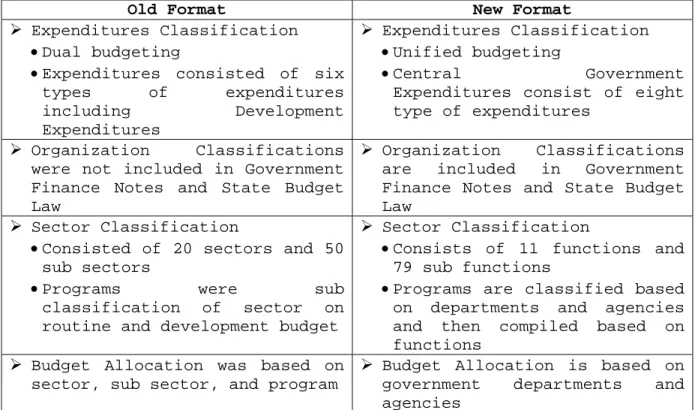
Table 9: Changes on Budget Format Due to the Implementation of Unified Budget and Budget Accounts Reclassification ...100
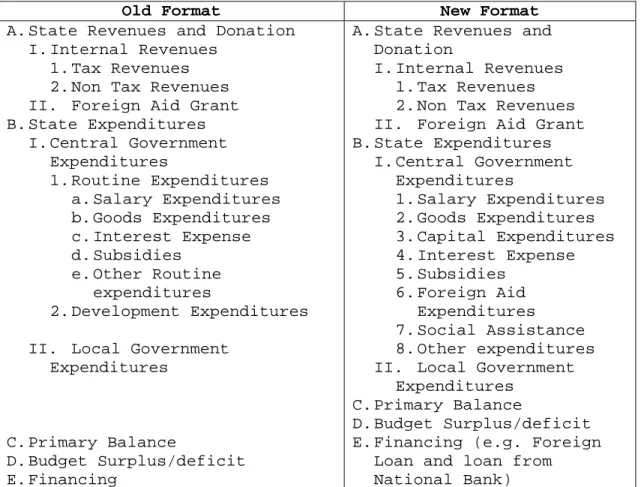
Table 10: Conversion State Expenditures Based on Expenditures Types ...101
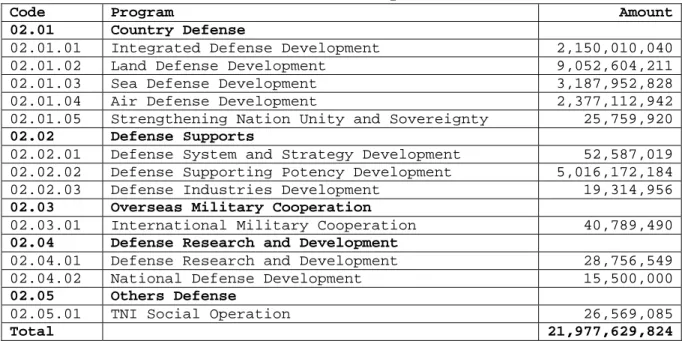
Table 11: Indonesian DOD Budget FY 2005 Based on Functions (in thousands, Rupiah)...107
ACKNOWLEDGMENTS
I would like to appreciate the insights, patience and encouragement given by my advisors Professor Jerry L. McCaffery and Professor Lawrence R. Jones. I also acknowledge the support of my co-workers at the Audit Board of the Republic of Indonesia and Indonesian National Armed Forces, who were ready and willing to support my research by providing data and answering my questions. Lastly I would like to thank my wife, Merna, and my daughter, Shabrina, for their understanding, patience, and support during this long process.
EXECUTIVE SUMMARY
In essence, Performance Based Budgeting is a set of processes translating the strategic planning framework into performance measures in terms of input, output, and outcome to be tied into resource allocation in the budgeting process to seek greater efficiency and effectiveness.
Past initiatives and experience as well as support from the President and Congress have made GPRA a prominent best practice to implement performance based budgeting in the US federal government. Specifically in the DOD, facing the complexities of its gigantic budget and business activities plus the daunting task inherent in developing measures of ultimate performance, progressively DOD has tried to incorporate links between budget development under OMB guidance and resource the allocation decision making process PPBS.
To be able to implement PBB in 2006, the Indonesian Government and especially DOD has to better prepare the strategic framework and implementation guidance of PBB, especially the performance assessment tool to be used to link performance to budgets. There are two key challenges for the Indonesian DOD and TNI to succeed in implementing PBB. First, DOD and TNI must provide a unitary strategic plan that requires a total fusion of DOD and TNI goals and objectives. Second, PBB requires transparency. The degree of confidential justification in the defense sector needs to be examined and redefined so that transparency in cooperating with the stakeholders in designing performance measurement systems and linking performance to budgets will enhance public accountability in allocating and managing limited budget and resources.
I. INTRODUCTION
A. BACKGROUND
In the past two decades, there have been radical changes in public sector management. Although the issues between developed and developing countries are different, in essence, the main political theme is how to bolster public management accountability. Key stakeholders such as the public and the legislature have become increasingly interested in how public funds are allocated and spent and how to reduce public spending and to save the taxpayer money coupled with attempts to eliminate a large portion of moral hazard, the risk that the presence of action will affect other parties, and adverse selection, a situation where asymmetric information results in harming other parties, in the public sector.
One of the attempts is to fundamentally restructure the budget management system. Shifting from the previous view of highly centralized budget management focused primarily on resource allocation and input control to a new budget management model, called “performance budgeting,” aimed to create a direct linkage between allocating resources through the budget and performance integration in reaching stated objectives has become a prominent reform. Although the systems and implementations vary from country to country, the objective is solely directed to provide public sector budgeting information on an outcome basis seeking greater efficiency and effectiveness.
The idea of performance budgeting in the United States was initiated in the 1950’s based on Hoover Commission recommendation. However, changes in administration have
also created changes in the budget management system. From the Hoover recommendation, to Planning, Programming and Budgeting System (PPBS), Management by Objectives (MBO), Zero Based Budgeting, and finally Performance Based Budgeting has enriched the evolution of using performance measurement in budgeting process.
The GPRA is the recent attempt of introducing performance-based management and budgeting techniques in the United States. The Recent economic downturn coupled with fiscal stress caused by September 11 attacks and its further effort in war of terrorism has created significant budget pressures not only in federal government but also state government as well as an increasing demand from the taxpayer for government efficiency and effectiveness. This emphasizes the need for reform. The information about the performance of programs has never been more important.
The role of United States Department of Defense in performance budgeting evolution is very important. PPBS which was initiated by Robert McNamara, former Secretary of Defense, has provided an introduction of a decision-making framework to the executive branch budget formulation process by presenting and analyzing choices among long-term policy objectives and alternative ways of achieving them as well as a basis in developing performance plans and measurement system.
Indonesia, as a developing country and fledging country in democracy, since a tragic monetary and economic crisis in 1998, has experienced a number of reform actions towards how government can run like a business. The country has faced remarkable challenges: economic reform, a transition to democracy after 30 years under military rule,
state owned enterprises restructuring and privatization, rising unemployment and poverty and a massive decentralization of power to nearly 400 local governments. The country still continues to suffer due to political and economic uncertainty. Other public accountability problems such as waste and inefficiencies, overseas loan management, and endemic corruption have really caught public attention and creditor interests.
The effort to use performance budgeting in state government is still in process in setting up the performance measurement system and preparing the regulation to support the program. Although in some local governments performance budgeting has been initiated by having assistance from some Non Governmental Organizations (NGO), the standardized benchmarking performance measurement system is still not available. Past initiatives to implement a government performance evaluation tool had always failed because the government itself was not serious or even some feel reluctant to implement it.
In the defense sector, a series of reform agenda has been undertaken to alter Indonesian National Armed Forces, TNI (Tentara Nasional Indonesia), and dominant role during the years of Soeharto’s New Order regime into a new paradigm of military reform. Challenges such as controversy on division of authority between TNI and Department of Defense, military business under TNI Foundation funds, minimum defense budget allocation coupled with lack of deployment readiness due to inappropriate and obsolete main weaponry system, and inefficiency and ineffectiveness in resource allocation are still major concerns for the future.
DOD/TNI has already implemented the PPBS system in which initial efforts to measure performance had already begun. However, my organization, The Audit Board of the Republic of Indonesia faced difficulties in obtaining and evaluating information because there is no standard or benchmarking to be compared with and there is no law that forces them to disclose it to the Audit Board. Confidential justification to protect national security is always used to cover many issues in some areas of the military sector to avoid scrutiny from the stakeholders.
As a result, the Audit Board, as an independent high state institution and government’s accountability watchdog, will face enormous challenges in its function as an external control towards government accountability in utilizing and managing the state’s finances to create good governance. The task is even much more difficult with the Law No. 7/2003 on State Budget because the law mandates the Audit Board to conduct audits on government performance. On the other hand, the current government performance evaluation tool still can not represent an ideal performance measurement system due to lack of strategic planning and inappropriate performance measures.
Based on above circumstances, new tools to enhance government accountability and to cure all endemic and systematic government problems have to be found. Hopefully, Performance Based Budgeting will be one of them.
B. OBJECTIVES
The objective of this thesis is to investigate and analyze the implementation of Performance Based Budgeting (PBB) in US Federal Government especially in DOD as well as
to provide and promulgate a PBB model for Indonesian DOD/TNI. In addition, this research will address the historical perspective of PBB; steps and processes to implement PBB; the current implementation Government Performance and Results Act (GPRA) of 1993 including policy, guidance, tools and lessons learned; Recommendations will include why the PBB model is important for Indonesian DOD/TNI and how PBB might be implemented throughout the Indonesian DOD/TNI. To conclude, this study will provide conclusions and recommendations that could promulgate the implementation of PBB in all branches of the Indonesian government especially in DOD/TNI.
C. RESEARCH QUESTIONS
The research questions that will be investigated and analyzed in this project report are as following:
• How has Performance Based Budgeting evolved
historically in United States?
• What are GPRA elements, budget and performance
integration and Program Assessment Rating Tool?
• How is the implementation of GPRA and specifically
at Department of Defense?
• How does the US experience differ from other
countries (Britain, Canada, Australia)?
• What is Performance Based Budgeting and what are the
principles in PBB?
• What are steps and processes that must be done in
implementing Performance Based Budgeting?
• How is the current budgeting process in Indonesia and specifically at DOD/TNI?
• How might Performance Based Budgeting be implemented
trough Indonesian DOD?
D. SCOPE AND LIMITATIONS
This study provides a broad overview of performance based budgeting especially the Government Performance Results and Act (GPRA) 1993. The focus is on the strategic framework and the basic process of performance based budgeting to appropriately provide a basic model for PBB for Indonesian DOD/TNI. Due to the study solely based on the literature review, it does not address any detailed implementation of GPRA in the federal government and U.S. DOD as well as any detailed model including evaluation for Indonesian DOD/TNI. It simply provides the foundation for further action or research into the potential creation of such model as the performance based budgeting in Indonesia concept is still in the developmental stages.
E. RESEARCH METHODOLOGY
The methodological approach used in this MBA Project consists of conducting a literature review of Performance Based Budgeting theory, best practice, policy and guidelines, use of library information resources, and websites. It evolved as the research project and process for a period of approximately nine months. Initial stages were begun by performing an extensive literature review of the performance based budgeting in United States as well as the GPRA. It was followed by examining the conditions in Indonesia which includes the budgeting process and the
performance budgeting efforts. After deriving a number or lessons from those reviews, the focus shifted to a comprehensive review of performance measurements system by examining performance measurement theory, policy and guidelines, and best practice or worldwide benchmarking.
F. ORGANIZATION OF STUDY
The study is organized into five chapters. Chapter I provides the research background as well as delineates the objectives, research questions, scope and limitations and methodologies of the study.
Chapter II describes PBB evolution in U.S., discuss GPRA including its elements, budget and performance integration, general implementation in federal government and specific implementation in DOD and finally provides some comparative studies in other countries, Britain, Canada, and Australia.
Chapter III introduces the performance based budgeting and describes the literature review of Performance Based Budgeting including strategic planning, performance measures, and linking performance and budget.
Chapter IV discusses the current condition in Indonesia including the budgeting process and performance budget efforts with focus on Indonesian Department of Defense and provides model and an example for Indonesian DOD about implementing the performance based budgeting.
Chapter V provides the conclusions from the research concerning the performance based budgeting and recommendations for further study.
II. GOVERNMENT PERFORMANCE AND RESULTS ACT 1993
A. INTRODUCTION
This chapter lays out the literature review of the Government Performance and Results Act (GPRA) 1993. Section B describes the performance budgeting evolution in United States. Section C provides the GPRA overview and the followed by the GPRA main elements in Section D. Section E outlines the Budget and Performance Integration as well as the balance scorecard. Section F mainly discusses the Program Assessment Rating Tool (PART) system. Section G discusses general implementation of GPRA in Federal Government. Section H, reviews specifically the implementation of the GPRA in DOD. Section I reviews the comparative review of three countries, Britain, Canada and Australia. A summary is provided at the end of the chapter in Section J.
B. PERFORMANCE BUDGETING EVOLUTION IN UNITED STATES
Budgeting in the United States has experienced at least five emphases, starting with control at the turn of the century, moving to management in the New Deal and post-World War II period, to planning in the 1960s, prioritization in the 1970s and 1980s and to accountability
in the 1990s.1 GAO observes that:
At the federal level, interest in performance budgeting has led to numerous initiatives since World War II, including four that were government wide in scope: (1) reforms flowing from the first Hoover Commission in its efforts to downsize the
1 Charlie Tyer and Jennifer Willand, "Public budgeting in America: A twentieth century retrospective," Journal of Public Budgeting, Accounting & Financial Management 9, no. 2 (1997): 189.
post-World War II government, (2) Planning-Programming-Budgeting-System (PPBS) begun in 1965 by President Johnson, (3) Management by Objectives (MBO) initiated in 1973 by President Nixon, and (4) Zero-Base Budgeting (ZBB) initiated in 1977 by President Carter. Each of these efforts established unique procedures for
linking resources with results.2
Budget reform was initiated in 1910 by President Taft by forming the Commission on Economy and Efficiency. The
report from commission entitled The Need for a National
Budget was presented to Congress in 1912 and it focused national attention on budgeting and sound fiscal management. Among major recommendations made were the following:
1.The President should prepare and present a
budget to Congress (the executive idea).
2.A budget message should accompany the budget
and should outline policy proposals of the President as well as include summary financial information.
3.The Secretary of the Treasury should submit a
consolidated financial report to Congress.
4.Each Agency should submit to Congress an annual
financial report.
5.Agencies should establish and maintain a
comprehensive accounting system.3
These recommendations became the foundation for the Budget and accounting Act of 1921 which established an executive budget at the national level in the United States and became the foundation for present day budgeting at the federal level.
2 United States. General Accounting Office, Performance budgeting : past initiatives offer insights for GPRA implementation, (Washington, D.C: The Office, 1997), 54.
3 Cozzettom Kweit and Kweit, 1995: 20-21; in Tyer and Willand, Public budgeting in America: A twentieth century retrospective, 189.
Performance budgeting itself had been initiated since 1950s based upon the 1949 Hoover Commission recommendations, first, as “…..a focus of attention on the ends to be served by the government rather than on the
dollars to be spent”4 and second, “…a budget based on
functions, activities and projects, called a ‘performance budget,’ be adopted…” (Hoover Commission, 1949, p. 8.). The Commission observed that if the federal budget were prepared on a performance basis, focusing attention on the amount of work to be achieved, and the cost of this work, Congressional action and executive direction of the scope and magnitude of different federal activities could then be appropriately emphasized and compared in the resource
allocation process.5
With the expansion of governmental activity during the New Deal and World War II, attention began to shift to management efficiency and led to wider interest in performance budgeting, particularly at the national level. Budget information for the national government would be structured in terms of activities rather than line items, and that performance measurement is provided along with
performance report.6
Consistent with the Hoover Commission’s recommendations, the Congress enacted the Budget and
4 Seckler-Hudson, C. Advanced Management.: 1953, reprinted in 1978. In Bernard Pitsvada and Felix LoStracco, "Performance budgeting--the next budgetary answer. But what is the question?" Journal of Public Budgeting, Accounting & Financial Management 14, no. 1 (2002): 53.
5 Jerry McCaffery and L. R. Jones, Budgeting and financial management in the federal government, (Greenwich, CT: Information Age Publishing, 2001), 472.
6 J. Burkhead, Government Budgeting, New York: John Wiley and Sons, 1956, In Tyer and Willand, Public budgeting in America: A twentieth century retrospective, 189.
Accounting Procedures Act of 1950 (BAPA), which, among other things, required the President to present in his budget submission to the Congress, the “functions and activities” of the government, ultimately institutionalized
as a new budget presentation: “obligations by activities.”7
GAO further states that these presentations were intended to describe the major programs, projects, or activities associated with each federal budget request—in a sense, the “performance budget” of a government which at that time was primarily involved in directly providing specific goods and services. Workload and unit cost information began to appear in the President’s Budget, associated with the “obligations by activities” presentations, providing a means of publicly reporting the outputs of federal spending.
Particularly at the national level, however, performance budgeting encountered a number of problems and performance budgeting did not work very well. Budget estimates were no more meaningful than those in line item budgets, works measurement presented problems, measuring the output of governmental services was imprecise, input could be easily measured but not outputs, and, finally, there was a lack of tools to deal with the long range
problems.8
When Robert McNamara led the Defense Department, he
initiated a specific form of program budgeting called Program, Planning and Budgeting System (PPBS) in 1962 and
7 United States. General Accounting Office, Performance budgeting : past initiatives offer insights for GPRA implementation, 54.
8 Miller, G.J., Productivity and the Budget Process,” in Tyer and Willand, Public budgeting in America: A twentieth century retrospective, 189.
in few years, President Lyndon Johnson extended PPPBS to the entire federal government. Performance budgeting, as a subset of program budgeting, suffered the same fate as program budgeting in most agencies when the Nixon Administration abandoned it in 1969. However, where remnants of PPBS survived, so did performance measurements; in some respects, the Pentagon led the recent march back to performance budgeting because PPBS remains its operative
budget system.9
According to Allen Schick,10 several other arguments
that made PBBS failed are:
• It was introduced across the board without much
preparation
• It flew in the face of existing budgetary
traditions and relationships; in particular, many people strongly objected to the suggestion that the budgetary process, which is inherently political, could be made “rational.”
• It was not given adequate resources, and top
managers were not entirely committed to it.
• Good analysis and data were in short supply,
and they were necessary to produce the kind of information crucial to the success of PPBS.
• Because PPBS was intended to require a review
of all activities in each year, the reform caused so much conflict that the political system was not able to handle it.
• PPBS clearly assumed that efficiency was the
primary value to be considered in evaluating the usefulness of programs, which was not generally agreed to and is a difficult assumption to make in the case of a public program.
9 United States. General Accounting Office, Performance budgeting : past initiatives offer insights for GPRA implementation, 54.
10 Schick, Allen. “A Death in the Bureaucracy: The Demise of Federal PPB.” Public Administration Review, 1973, 33(2), 146-156. In Philip G. Joyce, "Performance Based Budgeting," in Handbook of Government Budgeting, ed. Roy T. Myers. Anonymous (San Fransisco: Josey-Bass Publishers, 1999), 597-619.
• PPBS was an executive budget system, and largely ignored the role of Congress in the budgetary process. The result was that Congress ignored the system in favor of its established procedures.
According to GAO in its 1997 report, the performance measurements or performance factors became vital components in PPBS analyses and PPBS had successfully introduced a decision-making framework to the executive branch budget formulation process by presenting and analyzing choices among long-term policy objectives and alternative ways of achieving them. Performance was generally defined as agency outputs, with an agency’s program structure linking outputs to long-term objectives. Systems analysis and other sophisticated analytical tools were an intrinsic part of PPBS, with measurement seen as an essential means to better
understand federal outputs, benefits, and costs.11
In 1973, President Nixon initiated Management by Objectives, which was primarily a federal management improvement initiative. GAO observes that MBO put in place a process to hold agency managers responsible for achieving agreed-upon outputs and outcomes. Agency heads were accountable to achieve presidential objectives of national importance; managers within an agency would be held accountable for objectives set jointly by supervisors and subordinates. Performance was primarily defined as agency outputs and processes, but efforts were also made to define performance as the results of federal spending—what would today be called “outcomes.”
11 United States. General Accounting Office, Performance budgeting : past initiatives offer insights for GPRA implementation, 54.
Initiated in 1977 by President Carter, Zero-Base Budgeting (ZBB), an executive branch budget formulation process, was introduced into the federal government. Zero Based Budgeting, a bottom-up concept in which all programs have no funding at the beginning of each budget cycle, required all departments to identify their programs, and to rank and justify the existence of each program in order of priority. GAO claims that:
ZBB main focus was on optimizing accomplishments available at alternative budgetary levels and under ZBB agencies were expected to set priorities based on the program results that could be achieved at alternative spending levels, one of which was to be below current funding. In developing budget proposals, these alternatives were to be ranked against each other sequentially from the lowest level organizations up through the department and without reference to a past budgetary base. In concept, ZBB sought a clear and precise link between budgetary resources and
program results.12
Related to the idea of Hoover Commission, PPBS, MBO
and ZBB, according to GAO13, past initiatives, although
generally perceived as having fallen far short of stated goals, contributed to the evolution of performance-based measurement and budgeting in the federal government, and many concepts introduced by these initiatives became absorbed in the federal government and persisted long after their origins in PPBS, MBO, or ZBB had been forgotten. For example, first, the “obligations by activities” presentations established in response to the Hoover
12 United States. General Accounting Office, Performance budgeting : past initiatives offer insights for GPRA implementation, 54.
Commission’s performance budgeting recommendations continue today, although they are now referred to as “program activities.” Second, PPBS and MBO fostered exploration of difficult performance measurement issues, ultimately demonstrating the inherent limitations of analysis in a political environment and the often complex and uncertain relationship between federal activities, outputs, and
outcomes. Finally, ZBB illustrated the usefulness of
presenting alternative funding levels and expanded participation of program managers in the budget process.
When viewing collectively the past initiatives, GAO suggests two common themes. First, any effort to link plans and budgets must explicitly involve both branches of government, executive and Congress. The failure of PPBS and ZBB was solely caused by lack of Congressional involvement. Second, with all past initiatives and efforts from Hoover Commission, PPBS, and ZBB, it is more likely that the
concept of performance continues to evolve. 14
During the Reagan presidency, major adds to defense
spending compared to cuts on non-defense spending, led to enormous increasing spending on discretionary accounts that caused incremental reductions to federal government agency programs and substantial growth in the federal budget. By the end of 1990s, the country condition was even worst with dollars overflowing the Treasury, the caps could not restrain political will and the budget continued to expand.
14 United States. General Accounting Office, Performance budgeting : past initiatives offer insights for GPRA implementation, 54.
All of this leads to think about implementing performance
budgeting. 15
In the 1990s, considerable attention has been refocused upon performance budgeting, resulting in a new notion of performance budgeting to what called
“Entrepreneurial Budgeting.16 One influence was the 1992
publication of “Reinventing Government, How the Entrepreneurial Spirit is Transforming the Public Sector” by David Osborne and Ted Gaebler. The idea was to hold governments accountable for results rather than focus upon inputs as traditional budgets and management did. Cost saving and entrepreneurial spirit would be rewarded. A long term view would be facilitated in terms of strategy, costs
and planning for programs.17
Drawing on this attention, the Government Performance and Results Act (GPRA) of 1993 (PL. 103-62) was passed by Congress. The GPRA drew upon earlier antecedents, such as a report submitted during the Reagan Administration and a bill introduced in 1991 by Senator William Roth that had
not been enacted, but was revised and became the GPRA.18
Initially, the act specifically focused attention on results and performance budgeting. It requires federal agencies to prepare strategic plans by 1997, to prepare annual performance plans starting with fiscal year 1999,
15 H. Heclo, Executive Budget Making. In Pitsvada and LoStracco,
Performance budgeting--the next budgetary answer. But what is the question?, 53.
16 D.A. Cothran, Entrepreneurial Budgeting: An Emerging Reform, (1993) in Miller, G.J., Productivity and the Budget Process,” in Tyer and Willand, Public budgeting in America: A twentieth century retrospective, 189.
17 ibid.
18 W. Groszyk, Implementation of the Government Performance and Results Act of 1993, 1995, November, in ibid.
and submit an annual program performance report to the President and Congress comparing actual performance with their plans beginning in the year 2000.
Basically, the new performance budgeting has been drawn from previous performance budgeting ideas and program budgeting/PPBS concept as well. The mechanism for the transformation of budgeting was a blend of rationality and
Reaganism.19 Also, like the previous reforms, performance
budgeting was built on assumptions about the ability of a change in process to change outcomes, without understanding the mechanism by which that would be accomplished in a
political system.20
An important distinguishing aspect of GPRA is that it is a law; the others, PPBS and ZBB, were established through Presidential directive. Therefore, GPRA is created by both President and Congress and. It is expected that GPRA would not repeat the failure its predecessor. To maintain the efforts, OMB needs to be more highly cooperative not only with agencies but also with other stakeholders, GAO and more importantly the Congress.
C. GPRA OVERVIEW
For decades, there has been a perception from the public that American government institutions and Congress are not working well and held in low esteem by the American People. The Committee on Government Affairs believes that part of the explanation for this apparent inconsistency
19 Janet M. Kelly, "The long view: Lasting (and fleeting) reforms in public budgeting in the twentieth century," Journal of Public Budgeting, Accounting & Financial Management 15, no. 2 (2003): 309.
20 R.C. Moe, The “reinventing government” exercise: misinterpreting the problem, misjudging the consequences, Public Administration Review, 54(2), 111-122, 1994. In ibid.
could be seen from a public opinion poll which showed that Americans, on average, believe that as much as 48 cents out of every Federal tax dollar is wasted. In other words, the public believes that it is not getting the level and
quality of government service for which it is paying.21
The committee also realizes that, first, waste and inefficiency in Federal programs undermine the confidence of the American people in the Government and reduce the Federal Government's ability to adequately address vital public needs. Second, Federal managers are seriously disadvantaged in their efforts to improve program efficiency and effectiveness, because of insufficient articulation of program goals and inadequate information on program performance. Finally, congressional policymaking, spending decisions and program oversight are seriously handicapped by insufficient attention to program performance and results.
The purposes of GPRA are to-(1) improve the confidence of the American people in the capability of the Federal Government, by systematically holding Federal agencies accountable for achieving program results; (2) initiate program performance reform with a series of pilot projects in setting program goals, measuring program performance against those goals, and reporting publicly on their progress; (3) improve Federal program effectiveness and public accountability by promoting a new focus on results, service quality, and customer satisfaction; (4) help Federal managers improve service delivery, by requiring that they plan for meeting program objectives and by
21 Committee on Governmental Affairs United States Senate, Government Performance and Resultas Act of 1993 Report,Anonymous , 1993), 1-55.
providing them with information about program results and service quality; (5) improve congressional decision-making by providing more objective information on achieving statutory objectives, and on the relative effectiveness and efficiency of Federal programs and spending, and (6) improve internal management of the Federal Government. GPRA is a potentially far reaching piece of legislation and it seeks to make government agencies more effective and accountable by enhancing their strategic planning, establishing measurable performance objectives, and eventually tying agency budgets to the accomplishment of
those objectives22
The concept draws on (indeed, transplants) concepts from private sector management models and establishes a system in which market-like discipline could be used to
improve federal government management.23 As noted in
President Bush’s 2003 budget submittal, the ultimate objective is to move the budget debate from “what will the federal government spend?” to “what will the federal
government achieve?”24 The Bush administration has continued
and expanded the efforts of the Clinton administration to integrate performance information in the federal budget process and to increase managerial flexibility. The performance information from the GPRA process is to be used
22 Manuel R. Gomez, "Exposure Surveillance tools needed in agency GPRA plans," American Industrial Hygiene Association Journal 59, no. 6 (1998): 371.
23 Beryl A. Radin, "The Government Performance and Results Act (GPRA): Hydra-Headed Monster or Flexible Management Tool?" Public administration review 58, no. 4 (1998): 307-316.
24 Office of Management and Budget, Budget of the United States Government, Fiscal Year 2003 (Washington, DC, 2002): 47-52. in R. M. McNab and F. Melese, "Implementing the GPRA: Examining the Prospects for Performance Budgeting in the Federal Government," Public Budgeting and Finance 23, no. 2 (2003): 73-95.
to score agencies on their performance, allocate (and reallocate) funds among competing programs, and consolidate
and terminate unnecessary programs.25
According to Wildavsky and Caiden26, there are three
key challenges for the GPRA to be considered a success. First, the GPRA should assist in the creation of an institutional framework conducive to forming consensus on a unique set of objectives among conflicting stakeholders. Second, GPRA implementation must support the ultimate stated objective of linking resources to results-or to relate data on program performance to appropriation account structures-for the conjectured efficiency gains to be realized. Finally, the GPRA must overcome a traditional system of budgeting that, while often criticized and the focus of almost continuous reform efforts, has survived to this day.
D. GPRA MAIN ELEMENTS
The conceptual entirety of GPRA is fused from three basic elements: (1) strategic planning, (2) performance measurement (which covers goal setting, measurement, and reporting and (3) greater flexibility for managers in
return for greater accountability for results.27
A strategic plan of program activities covers at least a five year period and is updated at least every three years. The strategic plan contains a comprehensive mission
25 Office of Management and Budget, Budget of the United States Government, Fiscal Year 2003 (Washington, DC, 2002): 47-52. in ibid. 26 Aaron Wildavsky and Caiden, The New Politics of the Budgetary Process (New York: Harper Collins, 1992) in ibid.
27 Groszyk, Implementation of the Government Performance and Results Act of 1993,
statement for the agency, a specification of general goals and objectives (including outcome-related goals and objectives) as well as how they will be achieved, the relationship between the general goals and objectives and performance goals, identification of key factors that could affect the achievement of the goals and objectives, and a description of the program evaluations used in establishing or revising the goals and objectives. Each agency has to present the plan to Congress and others interested in or affected by the plan (the stakeholders).
The strategic plan must contain a description of how the agency intends to achieve the general goals and should cover the overall approach that will be taken over the time period covered by the plan, including a schedule for significant actions and the needed resources. It should indicate how the goals of the annual performance plans will be used to measure progress in achieving the general goals of the strategic plan, and the underlying basis for any
assumptions or projections.28
The annual performance plan includes not only an agency's annual performance plan but also the Federal Government performance plan for the overall budget. Whereas the agency plans are submitted to OMB for use in preparing the overall government-wide performance plan, the Federal Government plan is to be submitted to Congress as part of the Budget of the United States.
The Annual performance plans provide the direct linkage between an agency's longer-term goals defined in
28 Committee on Governmental Affairs United States Senate, Government Performance and Resultas Act of 1993 Report, 1-55.
the strategic plan and the daily basis activities. The plans include performance goals that define the level of performance to be achieved by a program activity in quantifiable, and measurable form; indicate the operational process, skills, technology, and resources required; provide performance indicators to be used in measuring relevant outputs; establish a basis for comparing actual program results with the established performance goals; and specify the means to be used to verify and validate
measured values.29
Annual program performance reports contain two main parts: a report on the actual performance achieved compared to the performance goals expressed in the performance goals plan; and of the steps to be taken to achieve those goals that were not met. The reports provide comparison of the actual performance of each program activity to the performance goals in the Annual Performance Plan for a fiscal year. In this report, the agencies have to explain what goals have or have not been achieved, why certain performance goals have not been met in how to provide plans for achieving the goals in the future or to modify the goal if it is not appropriate.
The agency's performance report must be submitted to the appropriate authorization and appropriations committees of the Congress and upon request, the Committee can ask more specific information on the actual performance for any performance indicator established in its annual performance plan. Agencies are required to begin reporting performance trends, on a phased-in basis, so that for FY 2002 and
29 Radin, The Government Performance and Results Act (GPRA): Hydra-Headed Monster or Flexible Management Tool?, 307-316.
thereafter, performance data will be shown for each of the
most recent four years.30 The annual performance reports
provide feedback to managers, policymakers, and the public about the accomplishment of the resources expended or the original goals. The reports must correlate between performance measurement information and program evaluation findings to provide a clear picture of the agency's performance and its efforts at improvement.
In the managerial flexibility section, OMB had to select at least five agencies to participate in pilots from among eligible GPRA performance planning and reporting agencies during fiscal years 1994 to 1996. Agency proposals were to identify the constraining requirement to be waived, quantify how relief would affect performance, and compare the anticipated performance improvements with current performance levels versus levels that could be expected
without the waiver.31 Performance report shall also describe
the use and assess the effectiveness of any waiver of administrative requirements and controls, and summarize the findings of those program evaluations completed during the year covered by the report. If the agency has prepared a classified or non-public annex to its annual performance plan, then those same items shall be covered in a
classified or non-public annex to the performance report.32
Any agency is not allowed to have authority to waive administrative requirements established in law. However, if
30 Committee on Governmental Affairs United States Senate, Government Performance and Resultas Act of 1993 Report, 1-55.
31 Jonathan D. Breul, "The Government Performance and Results Act--10 years later," The Journal of Government Financial Management 52, no. 1 (2003): 58.
32 Committee on Governmental Affairs United States Senate, Government Performance and Resultas Act of 1993 Report, 1-55.
an agency has authority under a law other than this Act to waive a statutory requirement or control, it may do so and
need satisfy only the requirements of that law.33
Requirements and controls that may be waived are those imposed across the government agency which has a central management role, and cover areas such as financial
management, personnel, supply buildings etc.34
E. BUDGET AND PERFORMANCE INTEGRATION
Budget and Performance Integration (BPI) is one of the most important of the reforms on the President's Management Agenda. OMB made this point explicitly when first announcing the management agenda by stating, "Improvements in the management of human capital, competitive sourcing, improved financial performance, and expanding electronic government will matter little if they are not linked to
better results."35 According to OMB, the reasons why budget
and performance integration is very important in President’s Management Agenda because scarce federal resources are seldom be allocated with convincing accounts of the results and agency performance measures are improperly integrated into agency budget submissions and the management and operations of agencies.
To solve the problems and improve financial performance, OMB suggested several reform actions to the
33 Committee on Governmental Affairs United States Senate, Government Performance and Resultas Act of 1993 Report, 1-55.
34 Groszyk, Implementation of the Government Performance and Results Act of 1993,
35 "Budget and Performance Integration: The Reform " [cited 2004]. Available from http://www.john-mercer.com/bpi_reform.htm
Administration such as integrating performance review with budget decisions, identifying high quality outcome measures which accurately monitor the performance of programs, integrating more completely information about costs and program performance in a single oversight process which include budgeting for the full cost of resources where they are used, making budget programs and activity lines more parallel with outputs, and where useful, improving
alignment of budget accounts.36
By, this initiative, OMB expects some expected results to be achieved so that federal managers would have better program performance and better cost control and accountability. First, OMB expects agencies to implement performance budgeting, in which each agency and program funding to be based on tangible results and to use comparisons between various programs to make such budget decisions. Starting in 2003, the President's Budget will shift budgetary resources among programs devoted to similar goals to emphasize those that are more effective and the Administration will set performance targets for selected
programs along with funding levels.37
Second, OMB expects that by early 2004, agencies will fully understand and facilitate the Program Assessment Rating Tool (PART) to obtain an immediate impact on OMB’s decisions on program funding levels. Finally, OMB expects agencies to have the necessary financial management and accounting systems. The principles of managerial cost
36 "Budget and Performance Integration: Expected Results," [cited 2004]. Available from http://www.john-mercer.com/bpi_results.htm
accounting, and especially Activity Based Costing and Cost Management (ABC/M), are key enablers for the agency to realize the full benefits of performance-based budgeting through improved day-to-day program management. OMB mentions the following as being among the expected long-term benefits of this reform:
o "Better performance…"
o "Better control over resources used and
accountability for results by program managers…"
o "Better service…"
o "Standard, integrated budgeting, performance,
and accounting information systems at the program level that would provide timely feedback for management and could be uploaded and consolidated at the agency and government levels. This would facilitate the goals of the President's initiative to improve financial
performance."38
To provide a consistent approach to rating programs across the Federal government, OMB suggested to use an assessment took called The Program Assessment Rating Tool (PART). “The Program Assessment Rating Tool (PART) is a series of questions designed to provide. The PART is a diagnostic tool that relies on objective data to inform evidence-based judgments and to assess and evaluate programs across a wide range of issues related to
performance.”39 As a central to the budget and performance
integration initiative, the PART is meant to strengthen the process for assessing the effectiveness of programs by making that process more robust, transparent, and
38 "Budget and Performance Integration: Expected Results," [cited 2004]. Available from http://www.john-mercer.com/bpi_results.htm
39 "Program Assessment Rating Tool (PART): Overview," [cited 2004]. Available from http://www.john-mercer.com/omb_part.htm
systematic. The PART covers seven categories of Federal Programs are: Direct Federal Programs, Competitive Grant Programs, Block/Formula Grant Programs, Regulatory Based Programs, Capital Assets and Service Acquisition Programs, Credit Programs, and Research and Development.
According to OMB in its fiscal year 2006 PART
Instruction,40 the PART strengthens and reinforces
performance measurement under GPRA by encouraging careful development of performance measures according to the outcome-oriented standards of the law and by requiring that agency goals be appropriately ambitious. Therefore, performance measures included in GPRA plans and reports and those developed or revised through the PART process must be consistent. OMB further states that the PART also extends the usefulness of performance information by defining programs that comprise activities about which management and budget decisions are made.
In its review of the first year of PART, by performing
a simple regression analysis, GAO41 found that PART scores
have a positive and statistically significant effect on recommended levels in the president’s budget, although great deal of variance was left unexplained. To examine the effect of program size on the results, GAO divided all programs equally into three groups-small, medium, and large- based on their fiscal year 2003 funding estimate. Regression then was performed for discretionary programs in each group. The
40 Office of Management and Budget, OMB's Program Assessment Rating Tool: FY 2006 PART Instructions,
www.whitehouse.gov/omb/budget/fy2006/part.htmled.
41 United States. General Accounting Office, Performance budgeting [electronic resource] : observations on the use of OMB's program assessment rating tool for the fiscal year 2004 budget, (Washington, D.C: U.S. General Accounting Office, 2004)
results suggest that the statistically significant effect of overall scores on budget outcomes exists only for the smaller programs. The regression analysis also shows that PART scores have a positive and statistically significant effect on discretionary program funding. Regression results for mandatory programs showed-as expected-no relationship between PART scores and the level of funding in the President’s Budget Proposal. Assessment ratings, however, can potentially affect the funding for discretionary programs either in the President’s Budget proposal or in
congressional deliberations on spending bills.42
F. GPRA IMPLEMENTATION IN THE FEDERAL GOVERNMENT
Although the act was passed in 1993, the deadline for implementation was 1997, the time when all executive agencies were required to submit a five-year strategic plan to OMB and Congress. To start the implementation of the GPRA, the act mandated a series of pilot projects to provide experience and lessons for government agencies. The pilot projects for performance measurement were undertaken in 28 designations, 14 cabinet departments and 14 independent agencies. Those pilot projects were finally started in fiscal 1998 after being delayed for at least a year by OMB.
During earlier implementation, there were massive critiques of the adequacy of the act to fulfill its goals and objective as well as the willingness of the federal agencies to seriously implement it. In a few months in
42 United States. General Accounting Office, Performance budgeting [electronic resource] : observations on the use of OMB's program assessment rating tool for the fiscal year 2004 budget, (Washington, D.C: U.S. General Accounting Office, 2004)
1998, the Washington press (which is rarely interested in management issues) had focused unusual intention to the implementation of GPRA, reporting various pronouncements from the GAO, OMB and the Republican leadership in Congress about the relative success or failure of federal agencies to comply with its initial requirements related strategic
planning.43
Beryl Radin44 also claims that the directions for the
implementation of GPRA that did emerge from OMB were variable. She said that in some instances, OMB staff acted as a cheerleader but did not provide clear instructions to agencies on what was expected, while in other instances, OMB provided the sophisticated equivalent of a paint-by-numbers exercise. She continues by observing that there was very little attention to process measures and the relationship between process activities and output or outcome performance.
GAO in its 1999 report45 observes that there were a
variety and complexity of agency planning and budget structures. These necessarily resulted in a range of approaches to present and link the performance information. Based on their analysis, GAO concluded that some agencies were able to develop informative approaches to connect budgetary resource to results, while some were not. Most of agencies still kept their plans separated with their budget submissions and only 6 of the 35 plans had been fully
43 Radin, The Government Performance and Results Act (GPRA): Hydra-Headed Monster or Flexible Management Tool?, 307-316.
44 ibid.
45 United States. General Accounting Office, Performance Budgeting: Initial Experiences Under The Results Act in Linking Plans with Budgets... 162173... U.S. GAO..Anonymous (General Accounting Office April 12:, 1999)
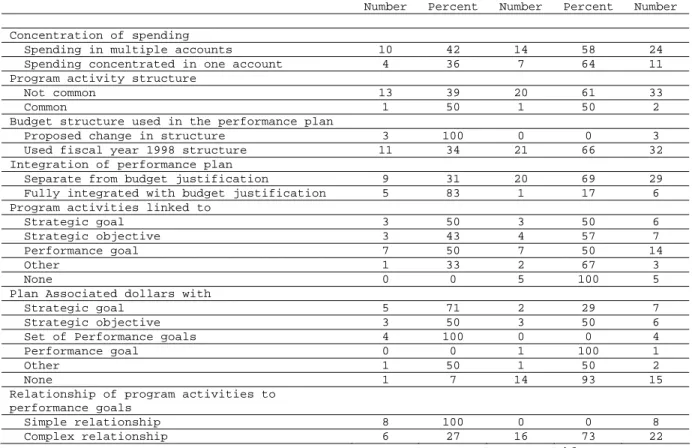
integrated into the agency’s budget justification. This can be seen in following table:
Table 1: Agencies Status on Allocation of Program Activity Funding to Performance Goals
Nonnumeric characteristics Allocated program activity funding to performance goals
Did not allocate program activity funding to performance goals
Total
Number Percent Number Percent Number
Concentration of spending
Spending in multiple accounts 10 42 14 58 24
Spending concentrated in one account 4 36 7 64 11
Program activity structure
Not common 13 39 20 61 33
Common 1 50 1 50 2
Budget structure used in the performance plan
Proposed change in structure 3 100 0 0 3
Used fiscal year 1998 structure 11 34 21 66 32 Integration of performance plan
Separate from budget justification 9 31 20 69 29 Fully integrated with budget justification 5 83 1 17 6 Program activities linked to
Strategic goal 3 50 3 50 6
Strategic objective 3 43 4 57 7
Performance goal 7 50 7 50 14
Other 1 33 2 67 3
None 0 0 5 100 5
Plan Associated dollars with
Strategic goal 5 71 2 29 7
Strategic objective 3 50 3 50 6
Set of Performance goals 4 100 0 0 4
Performance goal 0 0 1 100 1
Other 1 50 1 50 2
None 1 7 14 93 15
Relationship of program activities to performance goals
Simple relationship 8 100 0 0 8
Complex relationship 6 27 16 73 22
Source: From GAO Report: GAO/AIMD/GGD-99-67, Appendix II46
On January 18, 2001, based on review on the results of some performance budgeting pilots, in its report, OMB reported that the pilots demonstrated that assuring further performance measurement improvements and steadily expanding the scope and quality of performance measures was paramount, and that the existing statute provides
46 United States. General Accounting Office, Performance Budgeting: Initial Experiences Under The Results Act in Linking Plans with Budgets... 162173... U.S. GAO..Anonymous (General Accounting Office April 12:, 1999).
sufficient latitude for such improvement.47 In the same report, OMB also concluded that the pilots raised several key challenges about performance budgeting such as:
• In many instances, measuring the effects of
marginal, annual budget changes on performance is not precise or meaningful.
• While continuing to change from an almost total
reliance on output measures to outcome measures, it will be much more difficult to associate specific resource levels with those outcomes, particularly over short periods of time.
• Establishing clear linkages between funding and
outcomes will vary by the nature of the program and the number of external factors.
• Delays in the availability of performance data,
sometimes caused by agencies reliance on nonfederal program partners for data collection, will continue to present synchronization problems during the budget
formulation.48
In maximizing the effort to support GPRA, in April 2001, OMB introduced a new approach, a sweeping reorganization to “better integrate the budget analysis, management review and policy development roles. OMB also merged OMB’s separate budget and management functions into five resource management offices (RMOs). The new offices were assigned responsibility for not only formulating and reviewing the budget request, but also assessing program effectiveness, conducting mid and long range policy and
47 United States. General Accounting Office, Results-Oriented Government: GPRA Has Established a Solid Foundatuon for Achieving Greater Results, (Washington D.C.: U.S. General Accounting Office, 2004), 270.
program analysis, and implementing government wide
management policy and program evaluation.49
Jonathan D. Breul, a fellow and member of the Board of Trustees of the National Academy Public Administration and former senior advisor to the deputy director for Management in OMB, elaborated his review on GPRA in 2003 after its 10 years of implementation. Of all GPRA features, he found that three features of GPRA have worked and four features have not worked.
Three features that have worked are bipartisan statutory framework, strategic planning, and performance measurement. For bipartisan statutory framework, the GPRA has been supported by both Democrat and Republican, in which it was conceived by Republican senator, passed under a Democrat committee chair and signed by Democrat President. Even, President Bush has articulated the GPRA through its budget performance integration as a key of his Management Agenda.
In implementing strategic planning, there have been dramatic changes in federal agencies. Before GPRA implemented, there was no single strategic plan in the federal government; nowadays it exists in every department and agency. However, according to Breul, the requirement to update the plan at least once every three years has proved to be awkward because it is out of synch with the four-year presidential cycle.
For performance measurement, currently the federal agencies have improved in designing their performance information as useful baselines in assessing future program
49 Breul, The Government Performance and Results Act--10 years later,
performance. However, Breul observes that developing credible information on program results remains a work in progress, as agencies struggle not only to define their contribution to outcomes- which in many cases are influenced only partially by federal intervention with funds, regulations, etc.- but also to assure the reliability of their performance data.
The four features of GPRA that have not worked are managerial flexibility pilots, performance budgeting pilots, government wide performance plan and a paper exercise. For managerial flexibility, of 61 waiver proposals submitted by pilot project agencies, OMB did not approve any of them, and even three quarters of them were simply not approved for statutory or other reasons. For the remaining proposals, according to Breul, OMB or other central management agencies developed compromises by using authorities that were already available independent of GPRA. Breul further claims several factors contributed to the failure of the managerial flexibility pilots: first were changes in federal management practices and laws that occurred after GPRA was enacted; second is that GPRA was not the only way agencies could seek relief. In addition to other pre-existing authorities, Vice President Gore’s National Performance Review had launched about 185 reinvention labs to provide managers added operational
authority, quite independent of GPRA.50
However, the pilot process did provide some important lessons for government wide implementation. Breul continues by observing that: OMB and the agencies learned that the
50 Breul, The Government Performance and Results Act--10 years later, 58.