Operational Organizations
Jo Ann Lane1 and Richard Turner2
1University of Southern California, Los Angeles, CA, USA 2Stevens Institute of Technology, Hoboken, NJ, USA
[email protected], [email protected]
Abstract. In large operational systems, understanding the status of evolutionary capability development is often difficult. This is particularly true where capabilities depend on significant software components that are managed and operated as interacting subsystems. Schedules are rarely stable due to significant external drivers, thus integrated master schedules are hard to maintain and update. On-demand (pull) scheduling methods have been shown to smooth flow and maximize value across a process. The mechanics of these methods enhance visibility by forcing informed discussions on value, capability, and priority and by providing timely, relevant information to higher-level engineering organizations. This paper uses a notional information management system supporting a large health care system as an illustration of a management architecture that supports such an approach. The architecture includes a network of kanban-based scheduling systems, enhanced visualization, and employs a services approach to systems engineering that allows its work to be quantized as part of the overall development flow. Keywords: systems engineering, software engineering, kanban, pull scheduling, systems of systems, management visibility
1
The story so far…
In the summer of 2011, the US Department of Defense presented the Systems Engineering Research Center with a critical problem: how to replace complex integrated master schedules and plans and provide more effective management within a large, evolving operational system of systems. Additional concerns included the inability of scarce systems engineering (SE) resources to support schedule-driven projects, decisions made late or at a level removed from the context, and a lack of visibility into the status of system-wide capability developments—similar to issues already documented by a defense industry organizations [1]. Lean approaches based on Deming and The Toyota Production System have been deployed in manufacturing for decades and are well documented in the business and academic literature. In the last few years, however, on-demand scheduling techniques, such as the lean practice
of kanban, have been successfully modified and adapted to support more agile,
issue, we decided to investigate the compatibility of the lean concepts with the sponsor’s needs. Could they be applied to managing systems at a larger scale such as complicated systems of systems, and could they be used for systems engineering activities both at the portfolio and project levels of abstraction? Could they also be used across contracts, where non-governmental organizations were developing individual projects without close inter-project communication?
The result was an investigation into lean management, and a series of thought and simulation experiments on how to scale the kanban concept [6]. These in turn led to the need to consider systems engineering as a service, understand how communication between kanban systems could be accomplished, how to establish the comprehensive and current values for work items, how resources could be shared across kanban systems, and what types of controls were best to manage flow and protect resources [7].
It became apparent that discussions, arguments and whiteboard work were not converging, and it was necessary to apply the ideas to a specific, real environment. This paper describes an architecture for managing flow through a highly specialized information system of systems (SoS) as represented by a large health care system.
2
Concerning Kanban-based Scheduling System Networks
In [6], we created the fundamental building block of the architecture – The Kanban-based Scheduling System (KSS). Illustrated in Figure 1, the KSS is designed to be replicable as a single system (made up of multiple KSS building blocks) or a network of such systems. Its functional requirements were to:
─ Coordinate multiple levels of development activity
─ Support analysis and decision making at every level
─ Flexibly schedule work considering value across the system of systems
─ Balance work in progress (WIP) across resources with organizational capacity to improve flow
─ Make visible to all levels progress of capability development and deployment
─ Establish a basis for continuous improvement in a rapidly changing environment The fundamental concept is that each organizational entity adopts a hybrid system and organizational value-driven KSS designed by the organization to meet their specific needs. Each KSS includes a kanban board with specific and public management controls designed to integrate the KSS with others. The kanban board is a working tool used to track work and collect typical statistics such as cumulative flow diagram information. An organization with many sub-organizations may choose to have a dashboard that rolls up the information from the LSSs within it (or tasked by it) into a more informative visual tool. Such dashboards act as information radiators at all levels of development activity. The result of the system is that each KSS provides current, consistent information that flows up, down and across the organizations as needed.
Figure 1. The KSS Building Block [6]
Each KSS has a single backlog of unlimited length and a single acceptance queue with a capacity-informed limit. Each also has a queue where completed items are reacquired by the source KSS or forwarded to a downstream KSS. The organizational KSS may include lower-level KSSs if appropriate. Table 1 shows the template designed to characterize a KSS within the network.
Table 1. KSS Summary Template KSS Name
Demand:
Work sources Organizations that can assign work items to the KSS
Resources:
Dedicated Resources under control of this KSS
Shareable Resources available to share on teams with other orgs
Sourced Organizations (KSSs) to which work items can be assigned
Managed resources Any specialists that are managed individually
Activities:
Description WIP Limit Resource Type Cohesion
Internal, Sourced, or X-discipline team
Interruptible or Must complete
Flow and Visibility:
Additional CoS handled CoS beyond the system-wide that are recognized by this KSS
Additional CoS introduced CoS defined for work this org assigns to other KSSs
Work Selection Value Adjustments:
Source-based CoS-based Resource-based Completion-based
Goals From GQK analysis
Questions answered From GQK analysis
Data maintained/used From GQKanalysis
Information shared e.g. Avg. Lead time, Avg. blocked tasks. Avg. time blocked
2.1 Work items
In most systems of systems, capabilities are identified at a high level. Systems engineering decomposes these into requirements, which are further decomposed into
Ac#vity(( ECoS,"WL=1,"(extends" "ac0vity"WL"if"necessary)" SCoS,"WL=1"(included"" In"ac0vity"WL)" Ready(Queue( Work(Flow( WIP$ Ex" Completed( Work( Ex" (WIP"Limit=8,"Resources=4) 1( 2( 3( 4( 1( NCoS,"(WL=5)& (Limit=6) Upstream( Customers’( Work((Backlog()(( Normal"Class"of"Service"Work"Item"(NCOS)" Special"Class"of"Service"Work"Item"(SCOS)" 1" Resource"(Individually"numbered)" Ex" Expedite"Class"of"Service"Work"Item"(ECOS)" Work"Item"wai0ng"for"selec0on"
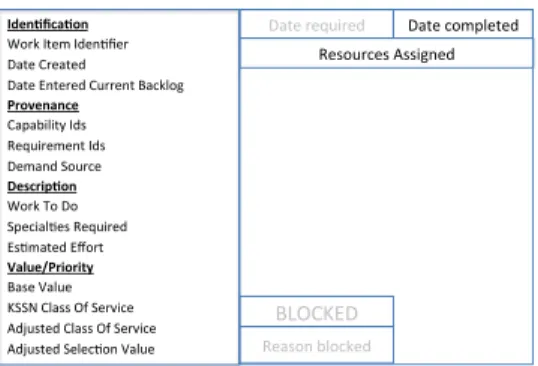
software features or hardware components. Any of these can be considered a work item. Work items flow through the system, and are characterized as shown in Table 2. A work item is created within a KSS, assigned certain attributes – class of service, value, associations – and may flow from KSS to KSS until it is complete and then either returns to the source KSS or notifies the source KSS and passes downstream. Work items may be decomposed, assigned to (or selected by) individual or multiple resources, and are pulled through the individual KSS in a normal kanban board fashion. While each work item has information that is carried along with it, its value is dependent on many factors – local and systemic. It may be associated with other work items in such a way as to comprise a higher level accomplishment – for example several work items assigned to different KSSs may actually make up the necessary features to meet a particular requirement.
Table 2. Generic Work Item
2.2 Network Flow
Work items flow by negotiation between the KSSs, with each organization agreeing to what is essentially a service contract for the work item. Backlog mechanics operate with mutually agreed to rules as to when and how prioritization and selection take place. Value parameters and functions, Classes of Service, and service level agreements may be established as network wide or KSS controls. Network-wide controls generally take precedence over local controls. The network also communicates the status of each work item as it flows through the system.
It should be noted that this is not a value stream analysis nor model. It is, however, a scheduling system that if used correctly, may identify the type of information often sought in such analyses from the current data on the kanban boards and dashboards.
Because kanban concepts have been primarily used with single level value streams, we wanted to understand the information needed for decision making, including scheduling and flow monitoring/control, at each level of SE activity or utilization. This would allow us to construct a KSS that would support visualization of WIP and status for each specific level. It would also provide insight into the information flow required. To accomplish this, we turned to the Basili, Caldieri, and Rombach Goal- Question-Metric approach [8, 9]. For each level we defined the goals and the questions that made sense to ask in order to determine if the goals were being met.
Work%Item%Iden,fier% Resources%Assigned% Date%Entered%Current%Backlog% Capability%Ids% Requirement%Ids% Base%Value% KSSN%Class%Of%Service% Adjusted%Class%Of%Service% Date%Created% Provenance) Value/Priority) Iden3fica3on) Work%To%Do% Descrip3on) Demand%Source% Special,es%Required% Es,mated%Effort%% Adjusted%Selec,on%Value% BLOCKED% Reason%blocked% Date%completed% Date%required%
Given our research is to investigate KSSs, we decided to fully utilize the metrics available from flow and pull concepts. To acknowledge this, we affectionately referred to the results as goal-question-kanban (G-Q-K) information.
2.3 Systems Engineering as a Service?
The idea of applying SE as a service within an on-demand scheduling system is not as farfetched as it may seem to some systems engineers. It effectively merges the SE flow and the software development project flow. These services act as any other work item in the KSS. SE performs early definitional activities, like operational concepts, architecture, and functional allocation. Other activities are ongoing like incremental verification and validation. Still others are performed at the request of a project and include trade studies, specialty engineering (like safety or security), and impact assessments. All involve maintenance and evolution of long-term, persistent artifacts that support development across multiple projects.
With the knowledge in these persistent artifacts, SE can be opportunistic in applying its cross-project view and understanding of the larger environment to specific projects individually or in groups. It can also broker information between individual projects where there may be contractual or access barriers. When a system-wide issue or external change occurs, SE can ensure that the broader issue is handled in an effective and compatible way. [7]
3
The Health Care System Environment
We decided to use a health care system as the target for our prototypical architecture because of its similarity to many operational defense and intelligence community systems. The target system is a set of integrated medical information management systems. It consists of hardware, over two million lines of source code, numerous commercial-off-the shelf (COTS) software products and communications networks. Its primary goal is to support the administration and delivery of health care in networked set of hospitals and clinics in a timely and safe manner, coordinating a variety of providers and specialists. Key overarching requirements are to ensure patient safety and protect patient information according to regulations.
The Health Care Development Organization is around 1000 engineering professionals, some of whom are out-sourced, consists of three groups. The systems
engineering group performs analyses related to new or enhanced capabilities,
requirements development and allocation, evaluations of medical devices for integration, system performance assessments and upgrade recommendations, deployed and development networks, specialty engineering, SoS-level integration and acceptance testing. Product teams are responsible for software maintenance and enhancement for the custom constituent systems or products; database structures and embedded procedures, COTS product tailoring, integration, and upgrades; licensed data upgrades such as pharmacy approved formularies; and, responding to issues
beyond the scope of the user help desk. The user support group runs the help desk, site configuration management, and site installations and upgrades.
Key custom software includes user access management, patient management, pharmacy, laboratory, radiology, and patient telemetry. The constituent systems share a single database that maintains the information for all of the patients and personnel related to a given health care site. There are also interfaces to other health care systems, including custom legacy systems, COTS products, and electronic medical devices such as heart rate monitors and infusion pumps.
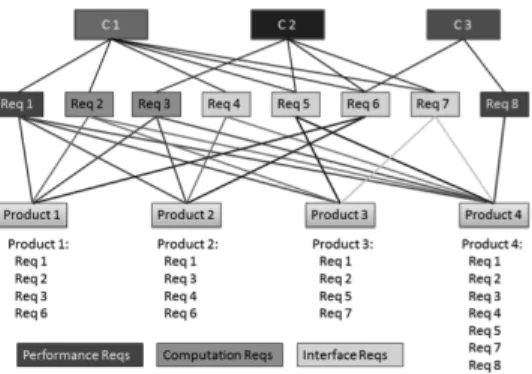
The current systems engineering and software engineering organizations are fully staffed with respect to development budget. When new needs or capabilities are identified, systems engineering analyzes the new needs/capabilities in terms of the given systems and decides how address them. Often multiple new needs/capabilities are analyzed together to facilitate the identification of common solutions that can support more than one need/capability as well as support performance upgrades and technology refresh. The results of the analysis activities are a set of requirements. The next step in the process is to allocate those requirements to one or more products for implementation. Figure 2 provides an example that illustrates how multiple requirements are derived from one or more needs and then mapped to the enterprise products for implementation.
Figure 2. Capabilities to requirements to products
Once the requirements are allocated to the products, the product teams analyze them and convert them into features and stories for implementation. Systems engineering monitors the capability “pieces” to guide their system integration and testing activities. When all of the capability requirements are implemented in the affected products and deployed, the mission capability is considered “completed.”
Several issues exist. There is no visibility at the capability level showing which user stories are related to which capabilities and which products are implementing pieces of the capability. The systems engineering resources are hampered by variable, multiple tasks, and rapidly changing priorities. Software tasks become blocked waiting for systems engineering tasks to complete. As a result, started tasks are difficult to complete in a timely manner.
4
The Health Care KSS Network
The KSS Network prototype defines a 3-tiered management architecture: 1. Executive/Stakeholder Management (ESM)
2. Capability Engineering (CE) 3. Product/Domain Engineering (PDE)
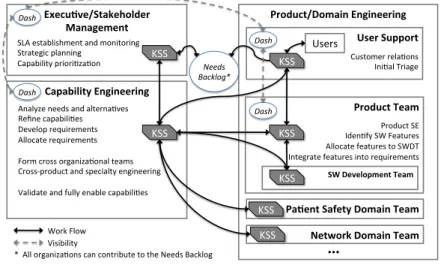
Figure 3 provides an overview of the Health Care System KSS-network showing function levels, KSS elements for monitoring and control, and Dashboards for providing information from multiple KSSs.
Figure 3. Overview of KSS Network
Classes of service (CoSs) provide a variety of handling options for different types
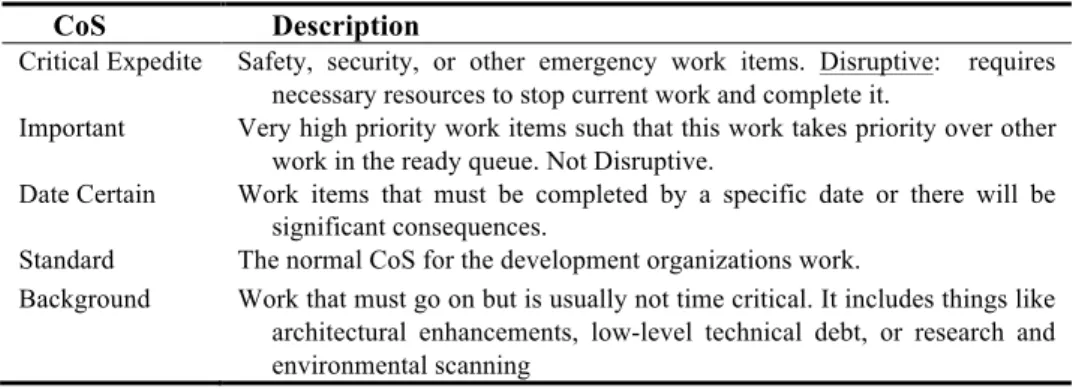
of work and affect the next work item selection value for KSSs. They may be aligned with Service Level Agreement priorities. Most CoSs are intended to ensure priority rather than force immediate execution. There are CoSs that are disruptive–that is, they can suspend current work in progress. These are associated with critical or expedited work to allow swarming of all appropriate resources to ensure completion as soon as possible. However, disruptive CoSs are minimized because they counter the normal kanban philosophy of completing work rather than interrupting it. While most CoSs are shared across the entire KSS network, individual KSSs may define additional
KSS-Specific CoSs to handle flow specific to their types of work. Table 3 shows the
COSs that apply to all the work in the KSS Network.
The calculation of the selection value of each work item depends on its inherent static value as assigned at it’s creation, it’s inherited value by being associated with the value the requirements and capabilities it supports, and the state of the development process (e.g. the status of capabilities, requirements and other work items). One simple calculation of this could be:
Capability)Engineering) Product)Team) Execu7ve/Stakeholder)) Management) SLA$establishment$and$monitoring$ Strategic$planning$ Capability$priori7za7on$ Dash% Analyze$needs$and$alterna7ves$$ Refine$capabili7es$ Develop$requirements$ Allocate$requirements$ $ Form$cross$organiza7onal$teams$ Cross@product$and$specialty$engineering$ $ Validate$and$fully$enable$capabili7es$ Network)Domain)Team) Pa7ent)Safety)Domain)Team) Users$$$$$$$$$$User)Support) $ Product/Domain)Engineering) KSS$ KSS$ Dash% KSS$ Customer$rela7ons$ Ini7al$Triage$ Product$SE$ Iden7fy$SW$Features$ Allocate$features$to$SWDT$ Integrate$features$into$requirements$ SW)Development)Team$$ Dash% KSS$ KSS$ KSS$ Dash% Work$Flow$ Visibility$ KSS$ Needs% Backlog*% *$$All$organiza7ons$can$contribute$to$the$Needs$Backlog$
Vt = Vinh + Vstat +Vbase; where Vinh = Sum of all the current values of the requirements the work item supports (with each requirement also includes additional value for multiple capabilities that it supports); Vstat = Adjustments due to the status of work, such as additional value added for near completion of requirements or capabilities, or a negotiated value between the work item owner and the work provider (an example might be the reduction of value to group certain work items that require special handling like certification); and, Vinit is the initial value defined. Regardless of the value, the item’s current class of service controls the rules by which the work item may be selected.
Table 3. General Classes of Service
CoS Description
Critical Expedite Safety, security, or other emergency work items. Disruptive: requires necessary resources to stop current work and complete it.
Important Very high priority work items such that this work takes priority over other work in the ready queue. Not Disruptive.
Date Certain Work items that must be completed by a specific date or there will be significant consequences.
Standard The normal CoS for the development organizations work.
Background Work that must go on but is usually not time critical. It includes things like architectural enhancements, low-level technical debt, or research and environmental scanning
5
KSS Descriptions
Each KSS is based on the workflow, the G-Q-K information, and the special circumstances and needs of each organization of resources represented by the KSS. There are nearly as many ways to define a KSS as there are to define a system. We simply recommend processes and visualizations appropriate to our target organization. Each description includes a summary, process flow descriptions, and visualization tools.
5.1 Executive/Stakeholder Management (ESM)
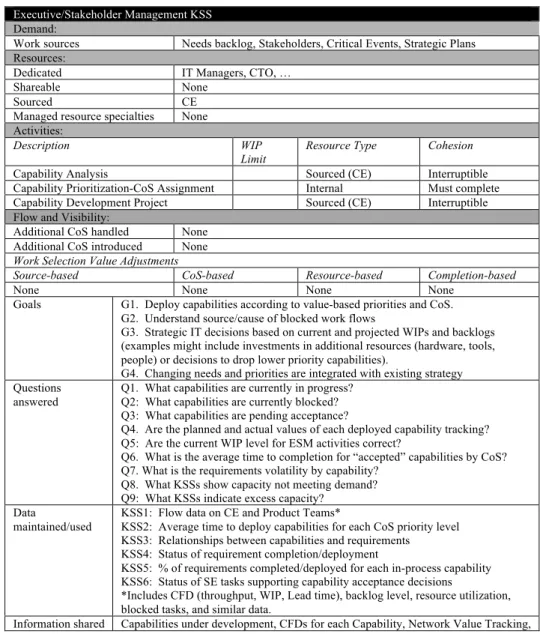
The ESM level determines which proposed capabilities (or capability enhancements) are going to be approved for development. As part of this process, ESM assesses the value of the capability against its expected cost and schedule to develop. This highest-level in the KSS network is concerned primarily with the current status of identified capabilities (or needs) as represented by the development state of each “not fully deployed” but “approved for development” capability – essentially WIP. At this level, the KSS is tracking capabilities and their priority. The insight it provides should inform decisions about overall organizational strategy, resource staffing, and development funding priorities. Table 4 provides the ESM KSS Summary.
Accepting/Selecting Next Work Item. Requests for system capabilities come from the users, systems engineering groups, and strategic initiatives. There is always a backlog of ideas needs, and wants. ESM must identify the highest priority capabilities. They must balance adding new capabilities with improving existing system capabilities and maintaining the infrastructure. They must also act on critical issues regarding patient safety, infrastructure failure, and regulatory changes. The outcome of this process is sending only the highest value and most critical work to the systems engineering group to analyze and develop.
Table 4. ESM KSS Template
Executive/Stakeholder Management KSS Demand:
Work sources Needs backlog, Stakeholders, Critical Events, Strategic Plans
Resources:
Dedicated IT Managers, CTO, …
Shareable None
Sourced CE
Managed resource specialties None
Activities:
Description WIP
Limit
Resource Type Cohesion
Capability Analysis Sourced (CE) Interruptible
Capability Prioritization-CoS Assignment Internal Must complete
Capability Development Project Sourced (CE) Interruptible
Flow and Visibility:
Additional CoS handled None
Additional CoS introduced None
Work Selection Value Adjustments
Source-based CoS-based Resource-based Completion-based
None None None None
Goals G1. Deploy capabilities according to value-based priorities and CoS.
G2. Understand source/cause of blocked work flows
G3. Strategic IT decisions based on current and projected WIPs and backlogs (examples might include investments in additional resources (hardware, tools, people) or decisions to drop lower priority capabilities).
G4. Changing needs and priorities are integrated with existing strategy Questions
answered
Q1. What capabilities are currently in progress? Q2: What capabilities are currently blocked? Q3: What capabilities are pending acceptance?
Q4. Are the planned and actual values of each deployed capability tracking? Q5: Are the current WIP level for ESM activities correct?
Q6. What is the average time to completion for “accepted” capabilities by CoS? Q7. What is the requirements volatility by capability?
Q8. What KSSs show capacity not meeting demand? Q9: What KSSs indicate excess capacity?
Data
maintained/used
KSS1: Flow data on CE and Product Teams*
KSS2: Average time to deploy capabilities for each CoS priority level KSS3: Relationships between capabilities and requirements KSS4: Status of requirement completion/deployment
KSS5: % of requirements completed/deployed for each in-process capability KSS6: Status of SE tasks supporting capability acceptance decisions
*Includes CFD (throughput, WIP, Lead time), backlog level, resource utilization, blocked tasks, and similar data.
Some work items initiated within the ESM level are special studies related to the prioritization of capabilities and the possible combination of multiple needs into a more effective capability need. This work includes cost and schedule estimations, Ops Concept development, COTS evaluations, and other traditional early SE activities.
Allocating Resources and Team Development. ESM must understand the overall
capacity, work in progress, and resource distribution across CE and PDE teams in order to determine the highest priority capabilities and decide how to meet strategic needs and balance ongoing tasks. Starting too many capability developments can lead to less effective execution, while starting too few may jeopardize stakeholder satisfaction. This organization must work closely with the CE organization and User Support to map the landscape reflected in the needs backlog.
Completion and Disbursement. While the decision to deploy is a systems
engineering or PDE decision, the declaration of a capability being “finished” (i.e. fully implemented and deployed) is usually reserved for the ESM.
KSS review at this level examines the work in progress, demand, capacity, and
performance to ensure it is focused on achieving capabilities and handling critical events. Resource management, including budgeting, requires an understanding of how development resources are being utilized throughout the system, what is in the backlog of desired capabilities, and areas where there is excess capacity or capacity is insufficient for the projected demand. Budgeting is a factor in determining how much demand is realistic regardless of capacity. Strategic changes to resource mix across the SoS may be needed through hiring, contracting, or moving resources.
5.2 Capability Engineering (CE)
CE represents all capability-related SE activities, specialty SE support for product teams, including software system engineering tasks, where software is a key component in the requirements allocation. CE is responsible for creating capability descriptions that incorporate the needs identified and prioritized by the ESM level. CE must balance the various SE resources as they work with both internal activities and lead cross-organizational teams in CE-related activities. Decisions and scheduling of the SE resources must include front-end and ongoing architectural work as well as supporting development, integration, verification and validation with product teams.
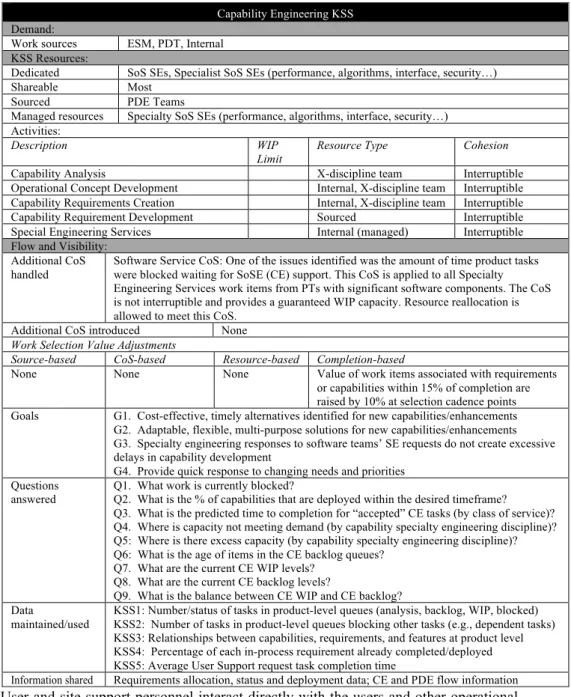
The CE KSS represents multiple levels of activity and may choose to break into multiple KSSs as the complexity grows. However, the initial concept is a single KSS that handles a variety of different activities. First, the CE must respond to the ESM requests for analysis and SE support to ESM decision activities and for the development of capabilities that are the highest priority to the SoS. The CE also provides SoS analysis support to the various PDE Teams and manages the limited number of SoS specialty engineering resources. Given the goals associated with this level, both the kanban board and the dashboard will be somewhat “busy” in terms of information. Table 5 presents the CE KSS template.
Accepting/Selecting Next Work Item. As requests come in for systems engineering
services, they are accepted, roughly estimated, possibly broken into smaller tasks, and valued. An additional CoS is assigned as necessary and then the work items are added
11 to the backlogs for the appropriate resource. Queue length limits are usually maintained for backlogs, and the level of the queue in terms of a percentage is a reasonable measure of demand.
Allocating Resources and Team Development. Many CE tasks will require a team
with expertise in one or more specialty engineering areas or may require collaborative support from one or more PDE Team SEs. The CE negotiates with the appropriate teams for the specific resources they need. CoS, nearness to completion of the requirement, and other factors are considered. For requests from software teams, the special software CoS is applied as described in the summary. Capability Requirements Development work items are created, sourced to the various PDE Teams, and tracked to completion. Any negotiation required is accomplished before CE or the PDE Team accepts the work.
Completion and Disbursement. As CE completes ESM analysis work items, they
are delivered directly to the ESM and identified as “done” on both the ESM and CE boards. Analysis tasks from PDTs are handled the same way. Work sourced to the PDE Teams may be completed and deployed by the PDE Team. The PDE Team will share data to update the CE KSS and Dashboard. There could be an activity to provide requirement completion verification and validation within the CE KSS, but in this initial concept, it is handled within PDE. Data is passed to the ESM dashboard.
KSS Review. Walking the CE KSS involves tracking the work in progress,
identifying flow problems and blockages, resolving resource issues and blockages, and monitoring the demand queue so that when resources are available the next most valuable piece of work is accepted. The review tracks the WIP-level and demand for specialty resources to avoid blockage, overwork, or underutilization. Work items should be scanned for adjustment to work value or priority on completion-based criteria. Technical or PDE Team issues should be reviewed, and often it is good to include members of critical PDE Teams in the review.
5.3 Product/Domain Engineering (PDE)
At the PDE level, there are separate KSSs for each product or domain team in the enterprise. The PDE KSSs are similar to those used in many software development organizations today, with the added requirement for systems engineering within the product or domain scope. Constituent systems/products need to provide information to higher level KSSs and dashboards all the way to the ESM level.
The User Support (US) Team operates at the PDE level because it interfaces with the product and domain teams. There are occasions, however, when it influences the needs backlogs, or when it uncovers an issue (e.g. patient safety or privacy) that requires engagement with ESM and CE to handle the solution. Each product or domain team is responsible for responding to problems the US team can’t handle.
Each product team creates its own organization. If outsourced, contractual requirements and its corporate governance influence the KSS implementation. For example, if the company operating the product team uses a matrix organization for SE, they may create a separate KSS for the SE resources that might cross product
team boundaries. If the SE resources are each dedicated to a specific product, then their tasks can be included in the product or the software development KSS.
Table 5. CE KSS Template
User and site support personnel interact directly with the users and other operational stakeholders for the system of systems. They provide insight and triage for user
Capability Engineering KSS Demand:
Work sources ESM, PDT, Internal
KSS Resources:
Dedicated SoS SEs, Specialist SoS SEs (performance, algorithms, interface, security…)
Shareable Most
Sourced PDE Teams
Managed resources Specialty SoS SEs (performance, algorithms, interface, security…)
Activities:
Description WIP
Limit Resource Type Cohesion
Capability Analysis X-discipline team Interruptible
Operational Concept Development Internal, X-discipline team Interruptible
Capability Requirements Creation Internal, X-discipline team Interruptible
Capability Requirement Development Sourced Interruptible
Special Engineering Services Internal (managed) Interruptible
Flow and Visibility: Additional CoS handled
Software Service CoS: One of the issues identified was the amount of time product tasks were blocked waiting for SoSE (CE) support. This CoS is applied to all Specialty Engineering Services work items from PTs with significant software components. The CoS is not interruptible and provides a guaranteed WIP capacity. Resource reallocation is allowed to meet this CoS.
Additional CoS introduced None
Work Selection Value Adjustments
Source-based CoS-based Resource-based Completion-based
None None None Value of work items associated with requirements
or capabilities within 15% of completion are raised by 10% at selection cadence points
Goals G1. Cost-effective, timely alternatives identified for new capabilities/enhancements
G2. Adaptable, flexible, multi-purpose solutions for new capabilities/enhancements G3. Specialty engineering responses to software teams’ SE requests do not create excessive delays in capability development
G4. Provide quick response to changing needs and priorities Questions
answered Q1. What work is currently blocked? Q2. What is the % of capabilities that are deployed within the desired timeframe?
Q3. What is the predicted time to completion for “accepted” CE tasks (by class of service)? Q4. Where is capacity not meeting demand (by capability specialty engineering discipline)? Q5: Where is there excess capacity (by capability specialty engineering discipline)? Q6: What is the age of items in the CE backlog queues?
Q7. What are the current CE WIP levels? Q8. What are the current CE backlog levels?
Q9. What is the balance between CE WIP and CE backlog? Data
maintained/used
KSS1: Number/status of tasks in product-level queues (analysis, backlog, WIP, blocked) KSS2: Number of tasks in product-level queues blocking other tasks (e.g., dependent tasks) KSS3: Relationships between capabilities, requirements, and features at product level KSS4: Percentage of each in-process requirement already completed/deployed KSS5: Average User Support request task completion time
13 requests; they aggregate and categorize desired capabilities or required maintenance actions, and forward them for resolution to the CE or PDE Teams as appropriate.
The US KSS is set up to manage the resources of the personnel handling the triage
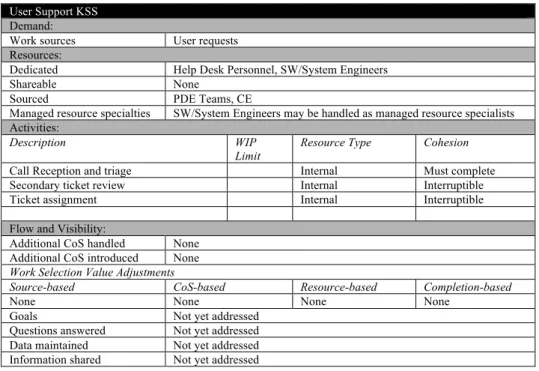
function and to identify critical issues rapidly. They track issues to completion and support information requests on the status of specific issues. This KSS is modeled on the system developed by Joshua Bloom at The Library Corporation, and the authors appreciate his support in this research. Table 6 provides the US KSS Template.
Accepting/Selecting Next Work Item. US is the connection between the
development system and the user population. Many user calls do not require development and are managed through the US KSS alone. Tickets for problems that require technical development work are written up and entered into the KSS demand queue. Initial estimations are of the “t-shirt size” variety and tickets are classified according to product, domain or other attribute. Any tickets critical to patient safety or require expedited activity are immediately handed off to the ESM, CE, and PDE teams to swarm and resolve quickly. Otherwise, initial classes of service are assigned.
Allocating Resources and Team Development. Once a ticket is entered into the
demand queue, it is determined to be product specific and sent to a PDE team, it is determined to involve multiple products/domains and is entered into the ESM needs backlog as a systems of systems capability issue, or, it is not immediately understood and so sent to the SoS team to analyze and recommend action. All such tickets are maintained in the KSS as in-process work and tracked through the system to completion so US can provide feedback on its status to users.
Table 6. User Support KSS Template
User Support KSS Demand:
Work sources User requests
Resources:
Dedicated Help Desk Personnel, SW/System Engineers
Shareable None
Sourced PDE Teams, CE
Managed resource specialties SW/System Engineers may be handled as managed resource specialists
Activities:
Description WIP
Limit
Resource Type Cohesion
Call Reception and triage Internal Must complete
Secondary ticket review Internal Interruptible
Ticket assignment Internal Interruptible
Flow and Visibility:
Additional CoS handled None
Additional CoS introduced None
Work Selection Value Adjustments
Source-based CoS-based Resource-based Completion-based
None None None None
Goals Not yet addressed
Questions answered Not yet addressed
Data maintained Not yet addressed
Completion and Disbursement. When PDE Team or CE development work is done, the US advises the ticket requestor(s) the ticket has been resolved and provides a resolution to the user: a software patch, workaround, or fix deployment date.
KSS Review is focused on the ability to effectively triage and assign tickets.
Surveillance of the status of the technical work that entered through the US KSS provides a measure of response time to user requests and may be accompanied by user satisfaction information. Because of the rapidity with which most help desk activities occur, the dashboard provides the information of a kanban board.
The PDE Product Teams are responsible for one or more of the Health Care
System products. The teams include systems engineers, specialty engineers, software engineers, hardware engineers, and often subject matter experts that support feature determination and development. System of system capabilities may require multiple product teams to create or enhance features, implement similar features in different ways, or collaborate to develop a common solution for the specific systems. If CE is the heart of the system of systems, the product team is the arms and legs.
A PT KSS is focused on maintaining the product at a high level of effectiveness and evolving it to support system capabilities as well as product capabilities. There is always some tension among the new feature development, older feature enhancement, and typical maintenance that is required in a technology and safety critical environment. The KSS uses the various CoS defined for the system to manage flow so that major capability developments proceed at a reasonable pace without significant impact on ongoing project level work. Table 7 provides the PT KSS Template.
Accepting/Selecting Next Work Item. Selection at this level is all about balancing:
the capacity with the demand, new work with ongoing activity, and SoS value with product value. While selection decisions are supported by the inherited value determination and CoSs, the product teams still negotiate the flow. The sourcing customers and PT members look at the mix of tasks in the demand queue, evaluating each according to the system values, product values and resources available, as well as considering what items represent the final parts of a requirement or capability.
Allocating Resources and Team Development. Most of the PT work is performed
by groups of resources, often in a multi-discipline project team. Individual SE resources must also be available to participate in the cross-discipline/cross-system teams used in the CE in capability analysis, so there may be a reason to apply some sort of Project-level CoS that reserves some capacity for supporting those activities.
Completion and Disbursement. Since PTs are responsible for integration, V&V
and deployment, their kanban board addresses these activities. Data on status, acceptance and availability for inclusion of the various work items in completing capability implementation is always provided upstream to the sourcing KSS.
KSS Review. Walking the kanban board and reviewing the dashboard at the product
level consists of looking for blocked work—resource conflict issues, sourcing delays, and rework are the main sources here. If the PT cannot complete work items within the established statistical bounds, changes must be made quickly to balance demand.
15 Table 9. Product Team KSS Template
Product Team Demand:
Work sources US, CE, Internal, other PDE Teams
Resources:
Dedicated SEs, HW and SW developers
Shareable SEs
Sourced SW Developers (SDPT), Specialty Engineers (CE), Domain Specialists
Managed resource specialties Varies by team
Activities:
Description WIP Limit Resource Type Cohesion
Requirements analysis & feature definition
Internal, X-discipline team Interruptible
Feature development and integration Internal, Sourced Interruptible
Requirements V&V Internal, Sourced Interruptible
Deployment Internal, Sourced Must complete
Flow and Visibility: Additional CoS handled
Software Service CoS: One of the issues identified was the amount of time product tasks were blocked waiting for SoSE (CE) support. This CoS is applied to all Specialty Engineering Services work items from software PTs. The CoS is not interruptible and provides a guaranteed WIP capacity. Resource reallocation is allowed to meet this CoS. Additional CoS
introduced Certification required – Applies where work is bundled to prevent costly recertification.
Work Selection Value Adjustments
Source-based CoS-based Resource-based Completion-based
Varies by team Varies by team Varies by team Support to work associated with requirements or
capabilities within 15% of completion are raised by 10% at selection cadence points
Goals G1. Capability-allocated requirements are developed and deployed according to value
G2: Product requirements/features allocated to increments and spins based on value G3. Product team responds quickly to changing product needs and priorities G4. Minimize workflow disruptions in product increments and spins G5. Minimize rework due to poorly understood capability requirements G6. Product team provides timely responses to user support issues/problems Questions answered Q1. Value of product-level work currently blocked?
Q2. What is the % of requirements completed within the desired timeframe? Q3. Where is PT capacity not meeting demand?
Q4: Where is there excess PT capacity?
Q5: How often is the average item age in product backlogs outside expected levels? Q6. What are the current product-level WIP levels?
Q7. What are the current product-level backlog levels? Q8. What is the product-level response time to SW requests?
Data maintained KSS1: Flow data on Product Team*
KSS2: Number/status of tasks in demand queues
KSS3: Number of tasks in product-level activities that are blocking other tasks KSS4: Relationships between capabilities, requirements, and features at product level KSS5: Percentage of each in-process requirement already completed/deployed KSS6: Average User Support request task completion time
*Includes CFD (throughput, WIP, Lead time), backlog level, resource utilization, blocked tasks, and similar data.
6
Conclusions and Further Research
Much of this work has been engaged in thinking through the various scenarios that exist in highly complex system development, sustainment and evolution. The team is convinced of the validity, and is moving forward with the research, pending further funding. We have begun to develop simulations of this KSS instantiation, and have initiated conversations with major aerospace companies to support a multi-stage analysis, investigation and piloting of the concept.
Acknowledgements
This material is based upon work supported, in whole or in part, by the U.S. Department of Defense through the Systems Engineering Research Center (SERC) under Contract H98230-08-D-0171. SERC is a federally funded University Affiliated Research Center managed by Stevens Institute of Technology. Addressing the problems also required support from practitioners and experts. A volunteer industrial working group provided their experience to the research. Of particular value were David Anderson, Curt Hibbs, Suzette Johnson, Don Reinertsen, and Jim Sutton.
References
1. NDIA-National Defense Industrial Association (2010). Top Systems Engineering Issues In US Defense Industry. Systems Engineering Division Task Group Report. http://www.ndia.org/Divisions/Divisions/SystemsEngineering/Documents/Studies/To p%20SE%20Issues%202010%20Report%20v11%20FINAL.pdf. September, 2010. 2. Poppendiek, Mary. (2007). Implementing Lean Software Development. Boston, MA:
Addison Wesley.
3. Larman C. and Vodde, B. (2009). Scaling Lean & Agile Development. Boston, MA: Addison Wesley.
4. Anderson, David. (2010). Kanban: Successful Evolutionary Change for Your Technology Business. Sequim, WA: Blue Hole Press
5. Reinertsen, Donald G. (2010). The Principles of Product Development Flow. Redondo Beach, CA: Celeritas Publishing.
6. Turner, R., Madachy R., Ingold D., and Lane J., “Improving Systems Engineering Effectiveness in Rapid Response Development Environments,” Proceedings of the International Conference on Software and System Process 2012, 2012.
7. Turner, R., Madachy R., Ingold D., and Lane J., Anderson D., “Effectiveness of kanban approaches in systems engineering within rapid response environments,” Proceedings of the Conference on Systems Engineering Research 2012, Procedia Computer Science, Vol. 8 - 2012, Elsevier, March, 2012.
8. V. Basili and D. Weiss, "A Methodology for Collecting Valid Software Engineering Data," IEEE Transactions on Software Engineering, vol.10(3): 728-738, November 1984.
9. Basili, Victor R., and Carolyn Seaman, "Metric-Based Quality Management", Software Engineering for Embedded Systems Series, Fraunhofer IESE, Kaiserslautern, Germany, 2010.
![Figure 1. The KSS Building Block [6]](https://thumb-us.123doks.com/thumbv2/123dok_us/1040848.2637814/3.892.248.619.232.434/figure-the-kss-building-block.webp)