Do ETFs Increase Volatility?
Itzhak Ben-David
Fisher College of Business, The Ohio State University, and NBER
Francesco Franzoni
University of Lugano (USI) and the Swiss Finance Institute
Rabih Moussawi
Villanova School of Business, Villanova University and WRDS, The Wharton School, University of Pennsylvania
March 2015
Abstract
Due to their exceptional liquidity, ETFs are likely to be a catalyst for noise traders. This noise can propagate to the underlying securities through the arbitrage channel. Therefore, we explore whether ETFs increase the non-fundamental volatility of the securities in their baskets. We exploit exogenous changes in index membership, and find that stocks with higher ETF ownership display significantly higher volatility. ETF ownership is also related to significant departures of stock prices from a random walk at the intraday and daily frequencies. Additional time-series evidence suggests that ETFs introduce new noise into the market, as opposed to just reshuffling existing noise across securities.
Keywords: ETFs, volatility, arbitrage, fund flows JEL Classification: G12, G14, G15
____________________
We are especially grateful to Martin Oehmke (NBER discussant), Robin Greenwood (AFA discussant), and Dimitri Vayanos. We thank Yakov Amihud, George Aragon, Hank Bessembinder, Pierre Collin-Dufresne, Chris Downing, Andrew Ellul, Vincent Fardeau, Thierry Foucault, Rik Frehen, Denys Glushkov, Jungsuk Han, Harald Hau, Joan Hombert, Augustin Landier, Ananth Madhavan, David Mann, Rodolfo Martell, Albert Menkveld, Robert Nestor, Marco Pagano, Ludovic Phalippou, Scott Richardson, Anton Tonev, Tugkan Tuzun, Scott Williamson, Hongjun Yan, and participants at seminars and conferences at NBER Summer Institute (Asset Pricing), Insead, HEC Paris, Cambridge Judge Business School, Villanova University, University of Lugano (USI), the 4th Paris Hedge Funds Conference, the 5th Paul Woolley Conference (London School of Economics), the 8th Csef-IGIER
Symposium (Capri), the 5th Erasmus Liquidity Conference (Rotterdam), the 1st Luxembourg Asset Pricing Summit, the Center for
Financial Policy Conference at the University of Maryland, Jacobs Levy’s Quantitative Financial Research Conference at the Wharton School, the Geneva Conference on Liquidity and Arbitrage, the 20th Annual Conference of the Multinational Finance
Society, the 7th Rothschild Caesarea Conference, the Swedish House of Finance, the FIRS conference (Toronto), and SAC Capital
Advisors for helpful comments and suggestions. Ben-David acknowledges support from the Neil Klatskin Chair in Finance and Real Estate and from the Dice Center at the Fisher College of Business. An earlier version of this paper circulated under the title “ETFs, Arbitrage, and Shock Propagation.”
1
1
Introduction
Passive investing is gaining popularity in the asset management industry. In 1980, almost all mutual funds followed active strategies, but by the end of 2014, 30% of assets were in passive allocations (Morningstar, 2015). Exchange Traded Funds (ETFs) are playing the leading role in the rise of passive investing. These vehicles were non-existent in the U.S. in 1993, when the first ETF tracking the S&P 500 was launched. At the end of 2014, they had a market capitalization of $2 trillion, which is almost half of the passive mutual fund industry.1 Some authors argue that the
shift to passive investing is welfare improving, given the drop in intermediation fees and the improvement in portfolio diversification that index funds provide (French, 2008). Furthermore, Stambaugh (2014) argues that the rise in passive investing is symptomatic of improved market efficiency, as profit opportunities for active managers are shrinking.
However, because of their peculiar characteristics, ETFs do not conform to the traditional view of passive funds as buy and hold investors. For example, ETFs provide intraday liquidity to their investors. As a result, they attract high-frequency demand, which translates into price pressure on the underlying securities, due to the arbitrage relation between the ETF and its basket. This trading activity is potentially destabilizing for the underlying securities’ prices because it likely reflects non-informational motives. (Arguably, informed traders exploit their advantage by exchanging individual securities, as opposed to index products, such as ETFs.) To compound this effect, the lower trading costs of ETFs relative to the underlying securities can increase the rate of arrival of demand shocks to the market. Specifically, trading strategies that were too expensive without ETFs suddenly become affordable thanks to these instruments. Noise trading can therefore leave a bigger footprint on security prices because of ETFs, suggesting that ETFs may pose new challenges to the efficient pricing of the underlying securities.
Despite the ways in which ETFs differ from traditional passive funds, and despite their prominent role in today’s investment space, there has been virtually no work exploring ETF’s potential to impound noise in the underlying securities.2 This paper aspires to fill this gap by
1 ETFs, along with other exchange traded products (ETPs), have reached $2.8 trillion of assets under management (AUM) globally as of December 2014 (BlackRock, December 2014). Also important, ETPs are involved in an increasing share of transactions in equity markets. For example, in August 2010, exchange traded products accounted for about 40% of all trading volume in U.S. markets.
2 A few papers test whether ETFs have a destabilizing effect, but most of them focus on specific types of ETFs or specific events. Cheng and Madhavan (2009) and Trainor (2010) investigate whether the daily rebalancing of
2
providing the first large sample evidence on the role of ETFs in propagating noise. We study whether the prices of the securities with higher ownership by ETFs display higher volatility and are more likely to depart from a random walk. The analysis focuses on plain vanilla ETFs that physically replicate U.S. stock indexes, which hold the large majority of assets in the industry (81% of AUM in U.S. ETFs).
The conjectured channel of noise propagation is arbitrage trading. The demand shocks in the ETF market put pressure on ETF prices. To the extent that the ETF price deviates from the net asset value (NAV) of the portfolio holdings, arbitrageurs trade the underlying securities in the same direction as the initial price pressure. Thus, arbitrage can transfer price pressure from the ETF market to the portfolio holdings. This effect is similar to that of mutual fund flows on the prices of the portfolio holdings (Coval and Stafford, 2007; Lou, 2012). The main difference relative to mutual funds is that transactions in ETFs, as well as arbitrage activity, take place continuously throughout the day. This fact makes ETFs a more rapid conduit for the propagation of demand shocks than other managed portfolios.
Our empirical analysis starts by showing that ETFs attract short-term investors. ETFs are, on average, significantly more liquid than the basket of underlying securities in terms of bid-ask spread, price impact, and turnover. For example, the value-weighted portfolio of all equity-based ETFs in the U.S. trades at a bid-ask spread that is 20 basis points (bps) lower than the spread for the equivalent portfolio of underlying stocks. Theories positing that short-horizon clienteles self-select into assets with lower trading costs (Amihud and Mendelson, 1986) suggest that ETFs should be the preferred habitat of high-turnover investors. Indeed, using 13-F institutional holdings data, we find that the institutions holding ETFs have a significantly shorter horizon than those holding the underlying securities. We take this evidence as satisfying a necessary condition for the argument that ETFs are more appealing than stocks for noise traders who wish to express their views at a low cost and high frequency.
In the core of our analysis, we test whether there is a positive causal link between ETF ownership and noise in stock prices. ETF ownership is the total fraction of a stock’s capitalization
leveraged and inverse ETFs increases stock volatility; they find mixed evidence. Bradley and Litan (2010) voice concerns that ETFs may drain the liquidity of already illiquid stocks and commodities. Madhavan (2012) relates market fragmentation in ETF trading to the Flash Crash of 2010. In a recent study, Da and Shive (2014) find that ETF ownership increases the comovement of stocks in the same basket.
3
that is held by ETFs. We find a positive relation between ETF ownership and stock volatility. We can argue that the relation is causal thanks to the natural experiment provided by the Russell index reconstitution. In addition, prices of stocks with higher ETF ownership display stronger deviations from a random walk at the intraday and daily frequencies, which is consistent with the increase in volatility being due to noise
We use two different empirical strategies to generate these results. In our first strategy, we use OLS regressions of daily volatility on ETF ownership at the stock level and at a monthly frequency. In this analysis, a one-standard-deviation increase in ETF ownership is associated with a statistically significant increase in daily volatility that ranges between 9% and 15% of a standard deviation, for S&P 500 stocks. The effect is, therefore, economically significant. The magnitude is smaller by a factor of four, but still statistically significant, when we extend the sample to a universe that includes smaller firms (Russell 3000). The effect is weaker for these stocks, probably because ETF arbitrageurs focus on the largest stocks in each basket when trading the replicating portfolios, in order to minimize transaction costs and to achieve larger profits.
The observed increase in volatility is consistent with greater noise in stock prices. However, it could also reflect higher investor attention, which makes prices react more strongly to fundamental information, as shown by Andrei and Hasler (2015). To investigate whether the increased volatility reflects an increase in noise, we measure the impact of ETFs on the mean-reverting component of prices. First, we construct the absolute difference from one of intraday and daily variance ratios of stock returns (when the variance ratio equals one, prices follow a random walk (Lo and MacKinlay, 1988; O’Hara and Ye, 2011). We find that the deviation in the variance ratios of stock returns from unity increases with ETF ownership, suggesting a link between the presence of ETFs and lower price efficiency of the underlying securities. We also estimate predictive regressions of stock returns as a function of ETF flows at the stock level and daily frequency. We find that almost half of the contemporaneous positive impact of flows reverts over the next twenty days, confirming that the presence of ETFs is significantly related to the mean-reverting component of prices.
Our second empirical strategy aims at identifying truly exogenous variation in ETF ownership. Although the OLS regressions control for observable stock characteristics and include
4
stock fixed effects, there is a legitimate concern that ETF ownership is an endogenous variable.3 To address this concern, we rely on the natural experiment provided by the annual reconstitution of the Russell indexes. We draw inspiration from Chang, Hong, and Liskovich (2015) who implement a regression discontinuity design (RDD) exploiting the mechanical rule allocating stocks between the Russell 1000 (top 1000 stocks by market capitalization) and the Russell 2000 (next 2000 stocks by market capitalization) indexes in June of each year. Due to the large difference in index weights, the top stocks in the Russell 2000 receive significantly larger amounts of passive money than do the bottom stocks in the Russell 1000. For our purpose, a switch to either index generates a large amount of exogenous variation in ETF ownership, which we use to identify the effect of interest in a close neighborhood of the cutoff.
This empirical methodology confirms that the impact of ETF ownership on volatility is positive and strongly statistically significant. The RDD estimates exceed those from the OLS regressions, averaging around 55% of a standard deviation, which suggests a negative omitted variable bias in the OLS specifications. The replication of the variance ratio exercise within the RDD context also confirms the sign and significance of the OLS results with a larger magnitude. To make sense of the larger RDD coefficients, we also note that the RDD slopes measure the weighted average effect across the units in the sample, giving more weight to units that are more likely to receive treatment (the ‘index switchers’, in our context). Hence, for stocks far away from the cutoff, the effect is likely to be closer to the smaller OLS estimates.
We provide additional evidence on the channel that drives the effect of ETFs on volatility. According to the main hypothesis of the paper, the impact of noise traders on ETF prices propagates to the prices of the underlying securities because arbitrageurs take hedging positions in portfolios replicating the ETF basket. These trades occur whenever the ETF price diverges from the NAV. To test this channel, we ask whether the impact of ETF arbitrage activity on stock prices is weaker for securities that display higher arbitrage costs. Indeed, we find that a proxy for arbitrage activity (the difference between the ETF price and the NAV, labeled ‘mispricing’) has a smaller effect on volatility and noise for stocks in the top half the distribution of the bid-ask spread and of
3 For example, new ETFs might track investment themes that have gained popularity among investors. The stocks in these segments of the market might be more volatile because of the attention they already receive, not because ETFs attract noise trading. This mechanism would generate a positive bias in the OLS estimates. Alternatively, index members, which end up in ETF portfolios, might systematically be less volatile than non-index members because they are more established companies. This fact would generate a negative omitted variable bias.
5
share-lending fees, i.e., for stocks with higher limits to arbitrage. Moreover, strongly supporting the arbitrage channel, the coefficient on share-lending fees is significant only in the subsample for which the arbitrage trades involve shorting the stock (that is, when mispricing is negative).
Thanks to the possibility of identifying exogenous variation in ETF ownership, we can conclude that ETFs increase noise in the prices of the stocks that they own. This result is sufficient to establish a new dimension along which institutional trading can destabilize prices, and it runs contrary to the belief that the rise in passive investing is unambiguously related to increased pricing efficiency.
This cross-sectional evidence, however, could follow from a migration of noise traders from securities with low ETF ownership to those with high ownership. Therefore, in the last part of our analysis, we address the question of whether ETFs induce an increase in the overall noise in the stock market, as opposed to just a redistribution of noise across securities. ETFs can attract new noise traders because of their innovative characteristics. Specifically, relative to standard mutual funds, which clear trades once a day, ETFs permit continuous intraday trading at low cost. In addition, ETFs provide a variety of investment themes previously not offered by mutual funds. Finally, ETFs allow the expression of negative views through short selling, which is not possible with mutual funds. In general, it is plausible that ETFs enable investors to take long and short positions at higher frequency and lower cost, on a wider range of asset classes. Consequently, noise trading has the potential to leave a bigger footprint in the market thanks to the introduction of ETFs.
In support of this conjecture, we provide suggestive time-series evidence that the average share of ETF ownership in the market is positively associated with average stock volatility. The effects persists when we control for aggregate ownership by other mutual funds and include a time trend, which helps to absorb omitted factors. Although the identification strategy does not allow us to make unambiguous causal inference from these times-series estimates, the finding is fully consistent with the view that ETFs attract non-fundamental demand that would not otherwise reach the stock market if ETFs did not exist. In other words, the overall noise appears to increase because of ETFs.
Our study relates to different strands of the literature. There is mounting evidence on the role of institutions in impounding non-fundamental shocks into asset prices as a result of flows
6
from their investors (Brunnermeier and Nagel, 2004; Coval and Stafford, 2007; Ben-David, Franzoni, and Moussawi 2012; Cella, Ellul, and Giannetti, 2013; Lou, 2012; Vayanos and Woolley, 2013). We highlight a previously unexplored channel that is typical of a new class of institutional portfolios: arbitrage activity between ETFs and the underlying baskets. Our paper indirectly relates to the rich literature on the effect of indexing (Shleifer, 1986; Barberis, Shleifer, and Wurgler, 2005; Greenwood, 2005; Wurgler, 2011; Chang, Hong, and Liskovich, 2015). The trigger for the effect that we measure is trading in ETFs, as opposed to index reconstitution. Index membership matters only in defining the stocks that are affected by ETFs. Moreover, by documenting an effect of institutional ownership on volatility, we join a body of work that focuses on the impact of institutions on the second moments of returns (Greenwood and Thesmar, 2011; Anton and Polk, 2014; Lou and Polk, 2014). Closely related, Basak and Pavlova (2013a, 2013b) argue theoretically that the inclusion of an asset in an index tracked by institutional investors increases the non-fundamental volatility in that asset’s prices.
Another theme in the literature that our study relates to is the long-running debate on the effect of derivatives on the quality of the underlying securities’ prices. On one side of the debate is the concern that liquidity shocks in derivatives markets can trickle down to the cash market, adding noise to prices. For example, Stein (1987) shows that imperfectly informed speculators in futures markets can destabilize spot prices. Among the supporters of the alternative view, Grossman (1989) argues that the existence of futures provides additional market-making power to absorb the impact of liquidity shocks. As a result, volatility in the spot market is reduced (see also Danthine, 1978; Turnovsky, 1983).4 We contribute to this literature by providing systematic evidence from a new type of derivative, ETFs. In December 2014, the assets under management in ETFs tracking the S&P 500 surpassed the open interest in futures on the same index, suggesting that ETFs are becoming the derivative of choice to achieve exposure to the stock market (Amery, 2015).
4 Earlier studies that examine the impact of derivatives on volatility focused on futures. The proposed economic channel in this literature is the same as the one that we test in this paper. In a cross-sectional analysis, Bessembinder and Seguin (1992) find that high trading volume in the futures market is associated with lower equity volatility. However, consistent with the idea that non-fundamental shocks in the futures market are passed down to the equity market, they find that unexpected futures trading volume is positively correlated with equity volatility. Chang, Cheng, and Pinegar (1999) document that the introduction of futures trading increased the volatility of stocks in the Nikkei index stocks. Roll, Schwartz, and Subrahmanyam (2007) find evidence of Granger causality between prices in the futures and equity markets: price shocks are transmitted from the futures market to the equity market and vice versa.
7
The paper proceeds as follows. Section 2 provides institutional details on ETFs and develops the testable hypotheses, while Section 3 describes the data. Section 4 presents the main evidence of the effect of ETF ownership on stock volatility and noise. In Section 5, we provide evidence on the role of arbitrage in driving the main effect on volatility and noise. Section 6 addresses the question of whether ETFs attract a “new layer” of volatility to the stock market. Section 7 concludes.
2
Institutional Details and Hypotheses Development
2.1 Mechanics of ArbitrageExchange traded funds (ETFs) are investment companies that typically focus on a single asset class, industry, or geographical area. Most ETFs track an index, very much like passive index mutual funds. Unlike index funds, ETFs are listed on an exchange and trade throughout the day. ETFs were first introduced in the late 1980s and became popular with the issuance in January 1993 of the SPDR (Standard & Poor’s Depository Receipts, known as “Spider”), which is an ETF that tracks the S&P 500 (ticker: SPY). SPY is currently the largest ETF in the world, with about $181 billion of assets (December 2014). In 1995, another SPDR, the S&P MidCap 400 Index (ticker: MDY) was introduced, and the number of ETFs subsequently exploded to more than 1,600 by the end of 2012, spanning various asset classes and investment strategies.
To illustrate the growing importance of ETFs in the ownership of common stocks, we present descriptive statistics for the S&P 500 and Russell 3000 universes in Table 1. Due to the expansion of this asset class, ETF ownership of individual stocks has increased dramatically over the last decade. For S&P 500 stocks, the average fraction of a stock’s capitalization held by ETFs has risen from 0.22% in 2000 to 3.90% in 2012. The table shows that the number of ETFs holding the average stock in the S&P500 universe grew from about 2 to about 49 during the same period. The average assets under management (AUM) for ETFs holding S&P 500 stocks was, in 2012, about $5bn. The statistics for the Russell 3000 universe paint a similar picture.
Unlike futures, ETFs do not involve a rollover of the expiring contract. Rollover can erode performance for investors with horizons spanning beyond the short maturity of a futures contract. According to BlackRock, the annualized rollover cost of a futures position in large cap stocks
8
(S&P 500, Euro Stoxx 50, FTSE 100) ranges from 0.9% to 1.4%. The total expense ratio for an ETF on the same indexes can be as low as 0.05% (e.g., the Vanguard S&P 500 ETF, ticker: VOO). This lower cost can explain the fact that in December 2014 the assets in ETFs tracking the S&P 500 surpassed the open interest in futures contracts for the first time (see Amery, 2015).
In our analysis, we focus on ETFs that are listed on U.S. exchanges and whose baskets contain U.S. stocks. The discussion that follows applies strictly to these “plain vanilla” exchange traded products that do physical replication, that is, they hold the securities of the basket that they aim to track. We omit from our sample leveraged and inverse leveraged ETFs that use derivatives to deliver the performance of the index, which represent at most 2% of the assets in the sector according to BlackRock (December 2014). These more complex products are studied by Cheng and Madhavan (2009), among others. We also omit active ETFs that are still below 1% of AUM in the sector.
ETFs are traded in the secondary market by retail and institutional investors, in a similar fashion to closed-end funds. However, unlike closed-end funds, new ETF shares can be created and redeemed. Because the price of ETF shares is determined by the demand and supply in the secondary market, it can diverge from the value of the underlying securities (the NAV).5 Some institutional investors (called “authorized participants,” or APs) who are dealers that have signed an agreement with the ETF provider can trade bundles of ETF shares (called “creation units,” typically 50,000 shares) with the ETF sponsor. An AP can create new ETF shares by transferring the securities underlying the ETF to the ETF sponsor. These transactions constitute the primary market for ETFs. Similarly, the AP can redeem ETF shares and receive the underlying securities in exchange. For some funds, ETF shares can be created and redeemed in cash.6
To illustrate the arbitrage process through the creation/redemption of ETF shares, we distinguish the two cases of (i) an ETF premium (the price of the ETF exceeds the NAV) and (ii) an ETF discount (the ETF price is below the NAV). In the case of a premium, APs have an incentive to buy the underlying securities, submit them to the ETF sponsor, and ask for newly
5 Unlike premia and discounts in closed-end funds (e.g., Lee, Shleifer, and Thaler, 1991; Pontiff, 1996), price divergence between the ETF and the NAV can be more easily arbitraged away thanks to the possibility of continuously creating and redeeming ETF shares. As a result, ETF premia/discounts are orders of magnitude smaller than for closed-end funds.
6 Creation and redemption in cash is especially common with ETFs on foreign assets or for illiquid assets, e.g., fixed income ETFs.
9
created ETF shares in exchange. Then the AP sells the new supply of ETF shares on the secondary market. This process puts downward pressure on the ETF price and potentially leads to an increase in the NAV, reducing the premium. In the case of a discount, APs buy ETF units in the market and redeem them for the basket of underlying securities from the ETF sponsor. Then the APs can sell the securities in the market. This generates positive price pressure on the ETF and possibly negative pressure on the NAV, which reduces the discount.
Creating/redeeming ETF shares has limited costs in most cases, especially for equity-focused funds. These costs include the fixed creation/redemption fee plus the costs of trading the underlying securities. Petajisto (2013) describes the fixed creation/redemption costs as ranging in absolute terms from $500 to $3,000 per creation/redemption transaction, irrespective of the number of units involved. This fee would amount to, at most, 2.9 bps for a single creation unit in SPY (that is, 50,000 shares worth about $10.2 million as of December 2014), or 0.6 bps for five creation units. During our sample period (2000–2012), share creation/redemption occurs on 9.2% of the trading days for the average ETF. However, a share creation event occurs on 72% of the trading days in our sample, across all ETFs. For the largest ETF, the S&P 500 SPDR, flows into and out of the fund occurred almost every day in 2012 (99.2% of the trading days).
While the occurrence of share creations/redemptions for the average ETF is not frequent enough to justify an impact on price volatility, ETF arbitrage also takes place continuously throughout the day as a result of the activity of hedge funds and high-frequency traders. These investors do not need to engage in primary market trades. On the secondary market, they can buy the inexpensive asset and short sell the more expensive one between the ETF and the basket of underlying securities. They hold the positions until prices converge, at which point they close down the positions to realize the profit. ETF sponsors facilitate arbitrage activity by disseminating NAV values at a 15-second frequency throughout the trading day. They do so because the smooth functioning of arbitrage is what brings about the low tracking error of these instruments. As a result of the low trading costs and availability of information, arbitraging ETFs against the NAV has become a very popular trading strategy in recent years. According to some industry participants, statistical arbitrage accounts for 50% of the volume in the S&P 500 SPDR, which is the most
10
traded security in the U.S. with $26 billion average daily volume (last 3 months of 2014).7 This intraday arbitrage is the most relevant channel of propagation of noise from the ETF market to the underlying securities, according to the main testable hypothesis of this paper.8
These institutional details, with some modifications, also apply to synthetic ETFs, which replicate the performance of the index using total return swaps and other derivatives, and for which creation and redemption are handled in cash. The secondary market arbitrage still involves transactions in the underlying securities. Thus, the potential for the propagation of demand shocks from the ETF market to the underlying securities via arbitrage is also present among synthetic ETFs. Similarly, the arbitrage process is an inherent characteristic of all types of ETFs, beyond the equity-based ones that are studied here. Hence, one should expect the effects that we describe in this paper to play out for all types of underlying assets.
2.2 ETFs vs. Stocks: Liquidity, Investor Types, and Trading Horizon
The main testable hypothesis of the paper, discussed in detail below, posits that ETFs are appealing to noise traders because they are more liquid than the underlying securities. In this subsection, we study how ETF liquidity contrasts to that of their portfolio constituents. Moreover, in order to provide a description of the users of ETFs, we compare the clienteles of ETFs and common stocks in terms of their trading horizon and institutional type.
The bid-ask spreads on ETFs are particularly low, potentially due a lack of information asymmetry. For a few representative ETFs, Madhavan and Sobczyk (2014) provide evidence that the bid-ask spread is lower than the average spread in the corresponding basket. These authors put forward a convincing argument for the higher liquidity of ETFs. Informed investors are more likely to trade individual securities and market makers impose higher bid-ask spreads to overcome
7 http://ftalphaville.ft.com/blog/2009/07/30/64451/statistical–arbitrage–and–the–big–retail–etf–con/. Also see
http://www.indexuniverse.com/publications/journalofindexes/joi–articles/4036–the–etf–index–pricing–
relationship.html for a detailed example of ETF arbitrage. See http://ftalphaville.ft.com/2011/05/18/572086/how-profitable-is-etf-arbitrage/ and http://ftalphaville.ft.com/blog/2011/06/06/584876/manufacturing–arbitrage–with– etfs/ for the profitability of ETF arbitrage. ETF prices can also be arbitraged against other ETFs (Marshall, Nguyen, and Visaltanachoti, 2013) or against futures contracts (Richie, Daigler, and Gleason, 2008).
8 To be precise, although these trading strategies involve claims on the same cash flows, they may not be arbitrages in the strict sense because they can involve some amount of risk. In particular, market frictions can introduce noise into the process (e.g., execution may not be immediate, shares may not be available for short selling, or mispricing can persist for longer than the arbitrageurs’ planned horizon for the trade). In the remainder of the paper, when referring to arbitrage, we imply the broader definition of “risky arbitrage.”
11
adverse selection. In contrast, investors who place uninformed directional bets or trade for hedging purposes are more likely to trade entire baskets, such as ETFs. As a result, ETF spreads do not contain an adverse selection premium.
We carry out a similar analysis in our sample covering all U.S.-equity-based ETFs listed on U.S. exchanges (660 different products; see Section 3 for details on sample construction). In Table 2, Panel A, we present systematic evidence on the difference in liquidity between ETFs and the underlying portfolios along three dimensions: the percentage bid-ask spread, the Amihud (2002) measure of price impact, and turnover. For all the ETFs in our sample, we compute the average of each liquidity measure across all the stocks in the basket in a given quarter. Then, to replicate the strategy of an investor that allocates funds to all ETFs according to their market capitalization, we take the value-weighted mean of these measures across all ETFs in a given quarter. The table reports the time-series average of these means in the 52 quarters of the sample (2000:Q1-2012:Q12), along with the results of tests for the statistical significance of their difference. Along all three dimensions, the average ETF is significantly more liquid than its basket stocks. The bid-ask spread is lower by about 20 bps. Price impact, as measured by the Amihud ratio, is also significantly lower for ETFs. Finally, ETFs’ turnover is higher by about 8.3%.
A corollary of the conjecture that ETFs are more liquid than the underlying baskets is that ETF investors should display higher turnover. This prediction stems, for example, from Amihud and Mendelson’s (1986) clientele effect, whereby short-horizon investors choose to trade in more liquid securities. The bottom of Table 2, Panel A supports this conjecture. We compare ETFs to their underlying baskets in terms of two measures of the investor churn ratio. The first measure comes from Cella, Ellul, and Giannetti (2013), who compute an institutional-investor-level churn ratio as the sum of quarterly absolute changes in dollar holdings over average assets under management, using institutional holdings in the 13-F filings. This measure is then averaged across institutions at the stock level using the fraction of a company held by each institution as weight. The second measure differs only in that the investor-level churn ratio is computed as the minimum between the absolute value of buys and sells, divided by prior quarter holdings.9 In Table 2, Panel A, we note that the average ETF has a significantly higher investor churn ratio than its underling
9 Buys (sells) are the sum of the dollar value of the quarterly positive (negative) changes in stock holdings for a given institutional portfolio, as reported in the SEC 13-F form. Values are computed using beginning-of-quarter prices.
12
basket by about 6.7% per quarter, for the first measure, and 2.9%, for the second measure. These differences are economically significant as the average churn ratio for the basket of stocks is 24% and 12.5%, respectively, for the two measures. The evidence confirms that ETFs, rather than stocks, are the preferred habitat of investors with a short trading horizon.
Next, we compare classes of ownership for all ETFs in our sample and all common stocks in CRSP. Panel B of Table 2 uses Thomson-Reuters’ classification of institutional owners filing the 13-F form. We provide variable definitions in Appendix Table A1 and the detailed definition of various investor classes in Appendix Table A2. The panel reports shares held by each group as a fraction of total shares outstanding. The first striking fact is that the institutional ownership of ETFs is by far smaller (at 47.4% on average) than the institutional ownership of stocks (at 62.1% on average) throughout the entire sample period.10 One can roughly infer retail ownership as the complement to one of institutional ownership.11 Based on Stambaugh’s (2014) argument that noise traders are mostly present among retail investors, this evidence suggests a higher density of uninformed investors among ETF clients.
In analyzing Table 2, Panel B, two additional patterns emerge. First, investment companies, which are mostly comprised of mutual funds, have minimal investments (1.7%) in ETFs, compared to stocks (16.3%). Mutual funds only use ETFs to temporarily park their cash and avoid accumulating tracking error with respect to their benchmark. Second, research firms, which include broker-dealers, have greater ETF ownership (5.8%) than ownership of stocks (0.6%). This class of owners, along with hedge funds, corresponds to ETF arbitrageurs and market makers (including APs). In sum, Panel B of Table 2 paints a picture in which ETFs are mostly traded by retail investors, who are more likely to act as noise traders. Arbitrageurs are also overrepresented by virtue of the peculiar arbitrage mechanism that keeps ETF prices in line with the NAV.
10 It is worth noting that part of the direct institutional ownership in stocks is through ETFs.
11 This way of computing retail ownership is an approximation due to two elements. First, small institutions managing less than $100 million and professional investors managing solely their own proprietary accounts are not required to file a 13-F form. Second, reported shares include shares that are short-sold. Because we compute ownership as a fraction of shares outstanding, total institutional ownership for a firm could exceed one. This issue is especially relevant for ETFs, as short interest for some ETFs can be very large (even exceeding the total shares outstanding). However, expressing ownership as a fraction of the shares outstanding plus shares short sold would give an even higher estimate of retail ownership: 1 – Institutional Shares / (Shares Outstanding + Shares Sold Short) > 1 – Institutional Shares / Shares Outstanding.
13
From Panel A of Table 2, we learn that ETF investors have a significantly shorter investment horizon than investors in the underlying baskets. A related question is whether all
investor classes turn over their ETF portfolio more often than they turn over their stock portfolio. Panel C of Table 2 addresses this issue by computing separately the quarterly churn ratio of the ETF and stock portfolios, for each institution filing a 13-F form, using Cella, Ellul, and Giannetti’s (2013) churn ratio as defined above. The churn ratio is then averaged within each investor class. The striking evidence is that all groups of institutions trade their ETF portfolios faster than their stock portfolios, except for Venture Capital, which nevertheless holds a negligible fraction of ETFs (Panel B).
The institutional class with the fastest turnover in ETFs is hedge funds (85.9% quarterly). Besides being arbitrageurs in the ETF market, hedge funds use ETFs to take directional bets on specific market segments or asset classes. Also, ETFs are part of statistical arbitrage strategies to hedge market or industry risk when taking positions in mispriced securities. In the next subsection, we argue that the arbitrage trades employing ETFs have the potential to propagate mispricing to the underlying securities.
2.3 Hypotheses Development
Our empirical analysis draws inspiration from the literature on the destabilizing impact of institutional flows (e.g., Coval and Stafford, 2007; Lou, 2012; Vayanos and Woolley, 2013). The ETF market that we study differs from the typical framework of this prior work by the fact that investors can trade ETF shares in the secondary market continuously throughout the day. This high-frequency arbitrage activity can transfer the price pressure from the ETF market to the prices of the underlying securities. As a result, the demand for ETF shares translates into demand for the underlying securities, similarly to the effect of mutual fund flows. What makes ETFs special, relative to standard mutual funds, is that ETFs allow investors to access the market continuously and at a low trading cost. Hence, ETFs attract potentially more noise trading than standard mutual funds do.
The main testable hypothesis of the paper is that ETFs are a catalyst for noise traders and that noise propagates to the underlying securities via arbitrage. According to this hypothesis, stocks
14
with higher ETF ownership should display higher non-fundamental volatility, everything else being equal.
To illustrate the arbitrage channel for noise propagation, we imagine a situation in which the ETF price and the net asset value (NAV) of its portfolio are aligned at the level of the fundamental value, as in Figure 1a. Then, a noise trading shock, i.e., one that is unrelated to fundamentals, hits the ETF market. Arbitrageurs absorb the liquidity demand by shorting the ETF. Because they are risk averse, arbitrageurs require compensation for the (negative) inventory in the ETF that they are taking on. Hence, the ETF price has to rise (Figure 1b). At the same time, to hedge their short ETF position, arbitrageurs take a long position in the securities in the ETF basket. Again, to compensate the arbitrageurs for the risk that they take, the prices of the basket securities have to rise, as in Figure 1c. Eventually, when other sources of liquidity materialize, prices revert to fundamentals (Figure 1d).12
To make a concrete example of this channel, consider hedge funds’ trading practices in ETFs. This group of institutions has the highest turnover (see Table 2, Panel C) and, therefore, has a high likelihood of being the marginal investor in the ETF market. Some hedge funds that specialize in high-frequency strategies carry out arbitrage trades of ETFs against the underlying baskets. These trades conform to the mechanism described in Figure 1. In addition, hedge funds can impound mispricing indirectly through their use of ETFs in statistical arbitrage. Suppose hedge funds buy an underpriced stock and hedge the industry risk by shorting the corresponding sector ETF. This trade puts downward pressure on the ETF price (as in Figure 1b). Then, cross-market arbitrageurs transfer the price pressure to the securities in the ETF basket (as in Figure 1c). This argument suggests that ETFs can propagate mispricing to the underlying securities not only because they are traded directly by uninformed investors, but also because they are traded indirectly through their participation in long-short strategies that involve other mispriced securities.
We note that the sequence of events in Figure 1 generates predictions that partly overlap with those from an alternative scenario positing gradual price discovery after a fundamental shock, as opposed to noise trading. If price discovery occurs first in the ETF market, ETF prices adjust
12 The maintained assumption is that arbitrageurs have limited risk-bearing capacity. A similar effect arises in models with risk averse market makers, such as Grossman and Miller (1988) and Greenwood (2005).
15
immediately to the new information, while the underlying securities’ prices remain temporarily fixed (“stale pricing”). We illustrate this scenario in Figure 2. The initial equilibrium (Figure 2a) is perturbed by a shock to the fundamental value of the ETF components (Figure 2b). The ETF price moves first because of price discovery (Figure 2c), and the prices of the underlying securities move with a delay because of stale pricing (Figure 2d). In this alternative situation, ETFs improve price discovery and the arbitrage activity facilitates the adjustment of prices to fundamentals. As a result, there could be a positive link between ETF ownership and “good” volatility (i.e., fundamental volatility). To disentangle the two scenarios, it is not sufficient to show that stocks with higher ETF ownership display higher volatility. We also need to show that ETFs are associated with increased mean reversion in prices, which follows from the propagation of noise (as per Figure 1).
The testable hypothesis spelled out above actually posits an increase in noise trading in the underlying securities because of ETF ownership. If the same amount of noise traders merely shifted from trading a given stock to trading the ETFs holding that security, the noise in the stock’s price would not increase. To observe an increase in noise, one also needs the additional assumption that noise traders prefer ETFs to stocks as their preferred habitat. Under this assumption, the creation of ETFs entails a migration of noise traders from stocks with low ETF ownership to stocks with high ETF ownership. Noise traders, especially those that affect price volatility at high frequency, are likely to be short-horizon investors. Table 2, Panel A reveals that ETFs are more liquid than the underlying securities and, as a result, they attract investors with higher turnover. Therefore, Table 2 provides background evidence that supports the main hypothesis.
Rather than simply redistributing existing noise from securities with low ETF ownership to those with high ownership, this new asset class can cause a new layer of noise to materialize in the stock market. The effect could follow from the enhanced trading opportunities that come with ETFs. For example, relative to standard mutual funds (including index funds), ETFs allow intraday trading and shorting at a low cost in a wide variety of market segments.13 Hence, noise traders can
13 As an example, the Vanguard 500 Index Fund is a passive mutual fund tracking the S&P 500 with AUM equal to $198.7 billion as of January 2015. It has the same portfolio as the Vanguard S&P 500 ETF, which has AUM of $28.12 billion for the same date. The index mutual fund has total expense ratio of 0.17% for Investor Shares (minimum investment of $3,000) and 0.05% for Admiral Shares (minimum investment of $10,000). The ETF’s expense ratio is 0.05% (with no minimum investment). As per the index fund prospectus, Vanguard discourages frequent trading in its funds, with the exception of ETFs. Therefore, the company reserves the right to reject any purchase request of index fund shares without notice and regardless of size. Moreover, Vanguard prohibits investors’ purchases into the
16
gain access to previously unavailable opportunities to express their views. The possibility that ETFs attract a new layer of noise qualifies as a second testable hypothesis of the paper.
To test this conjecture, we shall look for a significant positive relation between the average stock volatility in the market and the average ETF ownership of stocks, in the time series. To measure the effect of interest more closely, we will need to control for other contemporaneous developments in the market. Admittedly, the time-series tests can never completely rule out omitted factors, so that the evidence in favor of this second testable hypothesis will remain suggestive.
3
Data
We use Center for Research in Security Prices (CRSP), Compustat, Bloomberg, and OptionMetrics data to identify ETFs traded on the major U.S. exchanges and to extract returns, prices, and shares outstanding. We first draw information from CRSP for all securities that have a historical share code of 73, which exclusively defines ETFs in this data set. We then screen all U.S.-traded securities in the Compustat XpressFeed and OptionMetrics data, identifying ETFs using the security-type variables, and merge this sample with the CRSP ETF sample.14 Our initial sample consists of 1,673 ETFs between 1993 and 2012.
Because very few ETFs traded during the 1990s, we restrict the sample to the 2000–2012 period. We further restrict our sample to ETFs that invest primarily in U.S. domestic equity stocks, because they are not plagued with stale pricing issues (global equity or bond ETFs) or other issues affecting the ease of replication (short bias, volatility, and futures-based ETFs, commodities, etc.). Therefore, we exclude leveraged ETFs, short equity ETFs, and all ETFs that invest in international or non-equity securities, or in futures and physical commodities. We also eliminate active and long/short ETFs as well as dedicated short bias funds and focus on plain vanilla U.S. domestic long equity ETFs. To do so, we use both the CRSP Style Codes and Lipper prospectus objective
index fund for 60 days after an investor has redeemed out of that fund. Given the higher costs and restrictions of index funds, it seems reasonable to conclude that noise traders with short investment horizons will prefer ETFs to index funds.
14 Note that in 2011, the time of the first draft of this paper, the CRSP-Compustat merged product did not correctly link ETF securities in the CRSP and Compustat universes. For this reason, we use historical CUSIP and ticker information to map securities in the CRSP, Compustat, and OptionMetrics databases.
17
codes in the CRSP Mutual Fund Database and restrict our sample to the fund objectives that span broad-based U.S. Diversified Equity funds and U.S. sector ETFs that invest in equities (e.g., U.S. companies investing in oil and natural resources vs. those investing in oil or commodity futures).15 We end up with 660 distinct equity ETF securities.
We obtain quarterly holdings information using the Thomson-Reuters Mutual Fund holdings database. ETFs are subject to Investment Company Act reporting requirements, and similar to mutual funds, they have to disclose their portfolio holdings at the end of each fiscal quarter.16 We use these data to align ETF ownership every month using the most recently reported holdings. Then, for every stock, we sum the total ownership by various ETFs to construct our ETF ownership measure. We also use the Thomson-Reuters Mutual Fund holdings database to compute the ownership by mutual funds other than ETFs, that is, index funds and active funds. To do that, we use the index fund flag in the CRSP Mutual Fund Database, and merge it with Thomson-Reuters holdings data using WRDS MFLinks. Similar to how ETF ownership is calculated, we compute monthly index and active fund ownership by using the most recently reported holdings.
We use total shares outstanding at day-end to compute the daily market capitalization of each ETF and to measure the net share creations/redemptions (i.e., flows) for each ETF daily. Because CRSP shares outstanding figures are stale during the month, we assess the accuracy of three databases that provide data on shares outstanding at a daily frequency: Bloomberg, Compustat, and OptionMetrics. Thanks to direct validation by BlackRock, we concluded that Bloomberg is more accurate and timely in updating ETF shares outstanding when newly created or redeemed shares are cleared with the Depository Trust & Clearing Corporation (DTCC). On many occasions, Compustat and OptionMetrics shares outstanding data lag Bloomberg by up to
15 The Lipper Asset Code is not sufficient to accurately filter for U.S. domestic equity funds, because the Equity Funds code comprises a wide array of U.S. and global funds that implement various direct investment or alternative/inverse strategies. Instead, we use the Lipper Objective Code classifications that are assigned by Lipper to a specific population of equity funds and that are based on how the fund invests by looking at the actual holdings of the fund to determine market cap and style versus a benchmark. We restrict our sample to the following Lipper Objective Codes: Broad Based U.S. Equity: S&P 500 Index Objective Funds, Mid-Cap Funds, Small-Cap Funds, Micro-Cap Funds, Capital Appreciation Funds, Growth Funds, Growth and Income Funds, and Equity Income Funds (CA, EI, G, GI, MC, MR, SG, and SP respectively). We also include Sector Funds that invest in U.S. companies: Basic Materials, Consumer Goods, Consumer Services, Financial Services, Health/Biotechnology, Industrials, Natural Resources, Real Estate, Science and Technology, Telecommunications, Specialty/Miscellaneous Funds, and Utilities (BM, CG, CS, FS, H, ID, NR, RE, TK, TL, S, and UT, respectively).
16 We find that until mid-2010, Thomson Mutual Fund Ownership data are more reliable and more complete than CRSP Mutual Fund Holdings.
18
three and sometimes as many as five days. Therefore, Bloomberg is our primary source for shares outstanding and the related net flow measures. We use Compustat and OptionMetrics to complement the ETF series when there are gaps in the Bloomberg data.
As a dependent variable of our main tests, we compute daily stock volatility at the monthly frequency as the standard deviation of daily returns within a month. For the tests that are reported in the appendix, we compute volatility at a daily frequency using second-by-second data from the Trade and Quote database (TAQ). For each stock, we compute a return in each second during the day using the last trade price at the end of each second during market hours (between 9:30 am and 4:00 pm). Then, we compute the standard deviation of those second-by-second returns as the intraday volatility measure.17
We extract stock lending fees from the Markit Securities Finance (formerly Data Explorers) database.18 We use the variable that reports the average lending fee over the prior seven days. Table 3 reports summary statistics for the variables that we use in the analysis. Panel A presents summary statistics for the monthly-stock-level sample of our main regressions; Panel B reports the correlations for the same variables. Panel C presents summary statistics for the variables that are used in the return regressions at the daily frequency. Panel D presents statistics for the stock-day-level sample. We further describe these variables in later sections and provide definitions in Appendix Table A1.
4
The Effect of ETF Ownership on Volatility
4.1 ETF Ownership and Volatility: OLS RegressionsWe start by asking whether ETF ownership leads to an increase in the volatility of the underlying securities. In our first set of tests, we exploit variation in ETF ownership across stocks and over time in a simple OLS framework.
17 We also compute intraday volatility using intraday returns based on National Best Bid and Offer (NBBO) midpoints; the results are similar.
18 The database contains about 85% of the over-the-counter (OTC) security-lending market, with historical data going back to 2002. In constructing the aggregate security loan fee, Markit extracts the agreed fees from contract-level information and computes a fee value that is the volume-weighted average of each contract-level security loan fee.
19
ETF ownership of stock i in month t is defined as the sum of the dollar value of holdings by all ETFs investing in the stock, divided by the stock’s capitalization at the end of the month:
𝐸𝑇𝐹 𝑜𝑤𝑛𝑒𝑟𝑠ℎ𝑖𝑝𝑖,𝑡 =
∑𝐽𝑗=1𝑤𝑖,𝑗,𝑡𝐴𝑈𝑀𝑗,𝑡
𝑀𝑘𝑡 𝐶𝑎𝑝𝑖,𝑡
,
(1) where J is the set of ETFs holding stock i; 𝑤𝑖,𝑗,𝑡 is the weight of the stock in the portfolio of ETF
j, which is extracted from the most recent quarterly report; and 𝐴𝑈𝑀𝑗,𝑡 is the assets under management of ETF j at the end of the month.
Based on Equation (1), variation in ETF ownership comes from three sources. First, stocks are typically part of multiple indices (e.g., a stock might be part of the S&P 500, the S&P 500 Value, the Russell 3000, and a sector index). Second, there is variation in ETFs’ assets under management over time and across products. Third, there is variation in weighting schemes. For example, the S&P 500 and the Russell 2000 are capitalization-weighted, but the Dow Jones is price-weighted; also, our sample contains 17 equal-weighted products.
The three sources of variation in ETF ownership present different degrees of exogeneity with respect to the dependent variable of interest, stock volatility. The portfolio weights follow the weighting scheme of the index mechanically. Hence, they are the most exogenous component in Equation (1). One caveat is that, if the weights do not grow at the same rate as the market capitalization at the denominator (e.g., for equal-weighted indexes), there could be a spurious link between ETF ownership and volatility resulting from the correlation between stock size and volatility. To avoid this issue, we include market capitalization (in logarithm) as a control in our regressions. Instead, ETF’s AUM as well as the number of ETFs covering a stock are admittedly less exogenous. For example, investors’ demand for existing or new ETFs may relate to how popular a given sector or asset class is at a given point in time. This popularity also affects the amount of trading intensity and the volatility of the underlying securities. This argument can generate a positive relation between ETF ownership and volatility that confounds the causal effect that we are trying to identify. On the other hand, the number of ETFs tracking a given stock depends on the number of indexes in which a stock appears. If established, less volatile firms are more likely to be members of an index, then there can be a negative bias in the relation between ETF ownership and volatility.
20
In our tests, we take several steps to guard against potentially omitted variables. First, we include stock and month fixed effects. In addition, we control for stock size and liquidity as observable characteristics that relate to volatility. Yet, we cannot entirely avoid the concern that ETF ownership is an endogenous variable within this framework. For this reason, in the next subsection, we provide additional analysis that derives exogenous variation of ETF ownership from the annual reconstitution of the Russell indexes.
With this caveat in mind, we start by reporting the results of OLS regressions of daily volatility in a given month on ETF ownership at the end of the prior month. In Table 4, we present separate regressions for S&P 500 stocks and for the broader sample of Russell 3000 stocks. The goal is to assess how the effect of interest varies with firm size. Besides the log of market capitalization, we include controls for liquidity: the inverse of the stock price, the Amihud (2002) illiquidity measure of price impact, and the bid-ask spread. All the controls date from the end of the prior month. We also include stock and month fixed effects in all regressions. Standard errors are clustered at the stock level.
The results of the analysis are presented in Table 4. To ease interpretation, we standardize volatility and ETF ownership by subtracting the sample mean and dividing by the sample standard deviation. From Column (1) of Table 4, we infer that the relationship between ETF ownership and volatility is positive and strongly statistically significant. The economic magnitude is also large, as a one-standard-deviation move in ownership is associated with 15% of a standard deviation change in daily volatility. This result provides full support for the hypothesis that ETFs impound noise in the underlying securities’ prices.
Next, we test whether ETF ownership captures a different effect from the ownership of other institutional investors. Among these, open-end mutual funds are the most similar to ETFs because they also receive daily flows. ETFs are, however, different from other open-end funds in that they allow intraday trading. In Column (2) of Table 4, we include lagged ownership by active and index mutual funds, measured in the same way as ETF ownership (and standardized). The coefficients on both mutual fund ownership variables are positive and significant. However, the point estimates of both mutual fund ownership variables are less than a quarter in magnitude than the slope on ETF ownership, which remains intact. Thus, it appears that ETF ownership has an
21
independent and stronger tie to volatility, which, according to the main hypothesis, depends on the fact that ETFs attract high-turnover investors.
In Column (3) of Table 4, we include the lagged dependent variable to address the concern that the persistence in volatility could introduce reverse causality. The coefficient on ETF ownership remains large and significant at 9.3% of a standard deviation.
Extending the universe to smaller stocks (Columns (4) to (6)), the relationship between ETF ownership on volatility is weaker, amounting to about 3.7% of a standard deviation. Moreover, the slope is no longer statistically distinguishable from the coefficients for other mutual funds (Column (5)).
The lower sensitivity of volatility to ETF ownership in a sample that is dominated by small stocks is consistent with the main hypothesis. The arbitrage activity that occurs at high frequency throughout the day does not require the creation or redemption of ETF shares. Hence, arbitrageurs can choose to concentrate on the larger stocks in the ETF baskets when constructing the replicating portfolio, in order to minimize transaction costs. Such behavior, called ‘optimized replication’ or ‘representative sampling,’ can explain why smaller stocks inherit less of the noise coming from the ETF market.
Given that ETF trading and the arbitrage activity involving the underlying securities occur intraday, one should expect the effect that we identify to also be visible at higher frequencies. In Appendix Table A3, we replicate the analysis of Table 4 using intraday volatility as the dependent variable, computed from second-by-second returns within a day. We also update ETF ownership on a daily, as opposed to a monthly, basis, and lag it by one day. The results from these daily stock-level regressions confirm the sign and significance from the monthly sample. The economic magnitude is also in the same ballpark (the variables of interest are standardized). This evidence confirms that the effect that we identify relates to the intraday frequency at which ETFs trade. We give more emphasis to the results using daily volatility (Table 4) to stress the fact that we are not merely identifying a microstructure effect that washes out at lower frequencies.
22
4.2 Identification Using a Regression Discontinuity Design
An identification based on cross-sectional and time-series variation in ETF ownership, which underlies the OLS results in Table 4, can raise doubts if the stock-level controls fail to capture characteristics that co-determine ETF ownership and volatility. For this reason, in this subsection we corroborate our main results with a more robust identification approach.
Chang, Hong, and Liskovich (2015) devise an identification strategy that exploits the exogenous variation in the membership of the Russell 1000 and the Russell 2000 indexes; they cast it within a regression discontinuity design (RDD). The identifying assumption in an RDD is that the treated units (in our case, the firms) have imprecise control over the treatment variable (in our case, the assignment to an index). If this is the case, the treatment is “as good as” randomly assigned around the cutoff (Lee and Lemieux, 2010).
The reconstitution of the Russell indexes provides a natural experiment that lends itself nicely to an RDD. The Russell 1000 index is comprised of the top 1000 stocks by market capitalization, while the Russell 2000 includes the next 2000 stocks. Russell Inc. reconstitutes the indexes in June of each year based only on end-of-May stock capitalization; hence, no discretion is involved in index assignment. Index composition remains constant for the rest of the year. For stocks in a close neighborhood of the cutoff, changes in index membership are exogenous events, as they result from random variation in stock prices at the end of May.
Chang, Hong, and Liskovich (2015) corroborate the validity of the RDD in the context of the Russell 1000/Russell 2000 experiment.19 The authors show that, although the amount of passive assets benchmarked to the Russell 1000 is 2 to 3.5 times larger than those tracking the Russell 2000, the weights of the top stocks in the Russell 2000 are about 10 times larger than those for the bottom stocks in the Russell 1000. Consequently, a significantly larger amount of passive money tracks the top Russell 2000 stocks.
Figure 3 provides evidence that is consistent with the latter finding in the context of ETFs. The figure plots average ETF ownership as a function of market capitalization rankings for the
19 In particular, they show that firms close to the cutoff are similar in terms of the distribution of some baseline covariates (returns in the month before reconstitution, assets, and earnings per share), a condition necessary for a valid RDD. In addition, they test for manipulation of the ranking variable using McCrary’s (2008) methodology and reject this hypothesis.
23
Russell 3000 universe, in bins of 10 stocks. We note that around the 1000th position, there is a discontinuity in ownership. Stocks immediately after the cutoff appear to display higher ownership than stocks immediately to the left.20 Spurred by this evidence, we focus on stocks that switch between indexes, and we use the event of a switch as an instrument for ETF ownership. Then, we regress our outcome variable, daily stock volatility, on instrumented ETF ownership. To identify the effect of interest, we rely on the insight from the RDD that variation in ETF ownership around the cutoff is exogenous, once we control for the ranking variable (i.e., market capitalization).
An additional identifying assumption that needs to be satisfied is excludability (or “the exclusion restriction”), that is, the requirement that the event affects the outcome variable only through the treatment variable. In our context, this translates into the condition that a switch in index membership only affects volatility through ETF ownership. Later in this section, we discuss reasons why this assumption may fail and we propose solutions.
Following Chang, Hong, and Liskovich (2015), we cast our analysis at the monthly frequency. The first index reconstitution in our sample occurs in May 2000. Thus, we include all months between June 2000 and December 2012. We need to restrict the sample to stocks in the neighborhood of the cutoff in order to compare ex-ante identical units. Rules for defining the cutoff changed during the sample period. Until 2006, the cutoff was simply the 1000th position in terms of market capitalization. Starting with the 2007 reconstitution, Russell Inc. adopted a banding rule whereby stocks only switch from their current index if they move beyond a 5% range around the market capitalization percentile of the 1000th stock. To account for this effect, we use membership data and market capitalization directly provided by Russell Inc. to compute index switches and cutoffs for every year in the sample. Finally, Chang, Hong, and Liskovich (2015) argue that the optimal bandwidth is about 100 stocks around the cutoff. To be conservative, we consider bandwidths of 50, 100, 150, and 200 stocks on each side of the cutoff.
We carry out a two-stage least squares estimation. In each stage, we run our regressions on two separate groups of stocks: those that in May, before index reconstitution, are in the Russell 1000 and those that are in the Russell 2000. The sample composition remains constant for all the
20 For stocks in the Russell 1000 (to the left of the cutoff), Figure 3 highlights a decrease in ETF ownership as market capitalization increases (moving towards the origin in the graph). This fact is consistent with the negative unconditional relationship between ETF ownership and size (Table 3, Panel B). The negative sign is likely due to the fact that not all ETFs use value weighting, so that portfolio weights do not grow as fast as market capitalization.
24
months between June, the first month after index reconstitution, and May of the next year. The first stage consists of a regression of ETF ownership on an indicator variable for whether the stock switches index membership in June. For the Russell 1000 sample, the indicator variable flags stocks that switch to the Russell 2000. Vice versa, for the Russell 2000 sample, the dummy captures a switch to the Russell 1000. In the second stage, for the same two separate groups of stocks, we regress volatility on the fitted value of ETF ownership from the first stage.
In all specifications, we add the usual set of controls for size and liquidity. Although a well-specified RDD does not require the inclusion of covariates for identification, Lee and Lemieux (2010) suggest that covariates help improve estimation efficiency. In addition to stock characteristics, we include controls for ownership by other institutions that can also increase their holdings of a stock after it becomes part of an index (index and active mutual funds). While time fixed effects are part of the regression, we do not include stock fixed effects because identification in an RDD is inherently cross sectional. Standard errors are clustered at the monthly level. We standardize the ownership variables and volatility in the relevant samples to ease interpretation. Finally, following the requirements of an RDD, we include first (Panels A and B of Table 5) and second degree (Panel C of Table 5) polynomials of the ranking variable (i.e., market capitalization), whose estimates we do not report to save space.
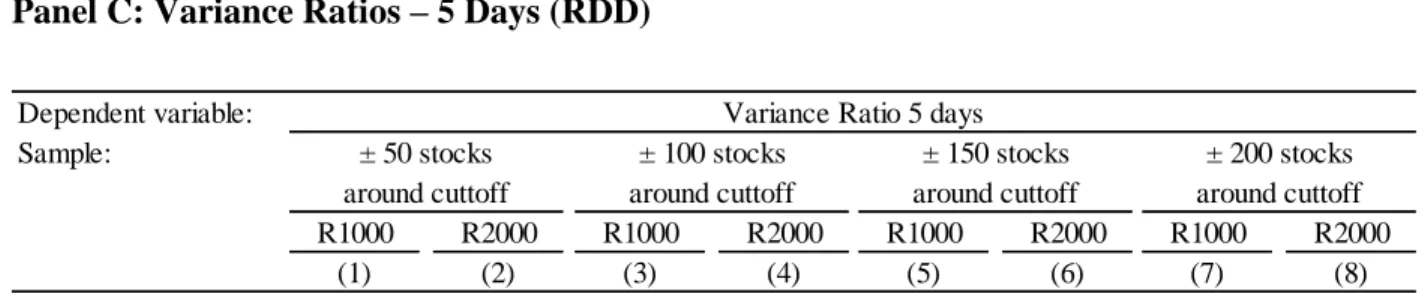
Table 5, Panel A shows the first stage regressions. We separately consider stocks that belong to the Russell 1000 before index reconstitution (Columns (1), (3), (5), and (7)) and stocks belonging to the Russell 2000 before index reconstitution (Columns (2), (4), (6), and (8)). The instrument is an indicator for whether the stock switches to the other index. The dependent variable (ETF ownership) is measured in each month following the index reconstitution. To illustrate the setting, consider Column (1). The sample includes stocks that are in the Russell 1000 index in May (prior to the reconstitution). We use the end-of-May cutoff to determine the stocks that are included in the sample (±50 stocks around the cutoff). The stocks remain in the sample in all months between June (after reconstitution) and May of next year. The indicator variable flags the stocks that switch to the Russell 2000 after reconstitution. The slope on the switch indicator in Column (1) suggests that ETF ownership in the twelve months after reconstitution increases for the stocks switching to the Russell 2000 by about 12.6% of a standard deviation. Column (2) focuses on stocks that start out in the Russell 2000 in May prior to reconstitution, with the same bandwidth