A Better Use of Your Data to Quickly Reduce
Return Rates and Improve Operating Margin
Sarah McVittie, Co-Founder, Dressipi
Introduction
Over the last 5 years, we have spent a lot of time with fashion retailers taking the time to understand the key drivers behind their return rates. In today’s increasingly volatile environment, controlling return rates is a good way to maintain and even grow your operating profit.As we investigate this area further, we have come to realise that every retailer has a unique return rate profile. There are a couple of simple pieces of analysis every retailer can do to understand the key areas driving their returns, resulting in a clear view on where the low hanging fruit is to drive the return rate down without having to lose revenue.
1. Why Understanding Your Return Drivers
is Important to Your Business
Garment return rates are inevitable for online fashion
businesses and they are, to some extent, a natural cost of doing business online. The primary goal, therefore, is to understand which of the returns can be avoided and the natural steady-state return rate for each retailer. Returns at their current levels are expensive and unsustainable. As every retailer knows, it’s not simply the cost of sending out the items and getting them sent back. There are three other key areas of costs:
• Costs of getting products back into circulation
This is getting it back to the warehouse, repackaging, cleaning and returning it to the shop floor or distribution centre. These costs can vary from £4 to £20 depending on the retailer.
• Opportunity cost of not having available stock
This is particularly the case in fashion with regular seasons/ product drops. Depending on when an item is purchased, and how long the return cycle takes (typically 2-6 weeks), it may well end up being returned and having to go straight into discounting/markdowns rather than having been made available for someone else to purchase.
• Costs of restocking
Typically garments take between 2-6 weeks to get returned so depending on the sales volume of an item, retailers can either order more stock or wait for the returns to come back in. If they order in more stock and that garment has a high return rate, this typically ends up with retailers ordering more stock than they can sell – therefore decreasing sell-through rates and increased markdowns.
2. Quantity and Quality of Data
The poor quality of data held by most retailers continues to be a challenge. Everything from the lack of data on the customer, the transactions data (often incomplete and housed in various locations) and the product data (sparsely and inaccurately attributed). The data held by retailers is rarely good enough (in both quantity and quality) to predict and reduce returns.At Dressipi, we have very detailed data on every customer and our taxonomy for every product category, tagging every single product with up to 40-50 features. This enables us to do far
3. Focus on the Right Metrics to Drive Up
Revenues
and Margins
Retailers typically focus on conversion and gross sales but this can be misleading and won’t always lead to margin
improvement. For example, if retailers push a high sales volume garment without understanding that the return rate is greater than 60/70% then it will end up significantly decreasing profitability.
We tend to use Net Demand Per Visitor as our key metric and then break that metric down by the relative impacts on Average Order Value (AOV), Conversion Rates, Frequency of Purchases and Return Rates.
You should always be optimising to ensure you are increasing the revenue per visitor as well as ensuring each customer is keeping more of what they buy.
4. Analyse Your Data to Understand Your
Key Drivers
The key reasons behind returns will vary by retailer but given our experience, they broadly fall into the following areas:
• Size vs Style
To understand whether finding the right size or the right style is a bigger issue for that retailer’s customer base.
• Product Specific Analysis
Identify the high volume, high returning product lines (over time).
• Inventory Management
Optimise the buy of each product at a size level. We map customers’ overall propensity to buy and keep specific features and sets of features at a garment and size level.
• Customer Analysis
Understand the key customers responsible for most returns. Model out your profitable and unprofitable returners
more accurate propensity modelling on customer profile
features and their propensity to buy and to keep certain garments. We can see, for example, that women with a certain bust size will tend to keep garments with certain necklines but are very likely to return garments with other necklines.
5. Simple Analysis Every Retailer Can Do
We do a lot of analysis when we start working with our retail partners and much of that is based on the specific customer and garment data that we apply. Where is the lowest hanging fruit and how can we help make the biggest impact?There are also some simple things you can do now as a retailer. If for example, you wanted to understand whether giving sizing advice or style advice was going to drive a bigger reduction in return rates, you can do the simple analysis below.
In this piece of analysis, we take historic transaction data and look at 2 sets of behaviour:
• Size
We look at customers who bought the same item in multiple sizes (across any number of orders in 3 months) and sent at least 1 back – this suggests that sizing is the issue.
• Style
We look at customers who bought multiple options of the same garment category (removing the multiple size purchases) within the same order and sent at least 1 back – this suggests that the customer is looking for their best style of that particular garment category.
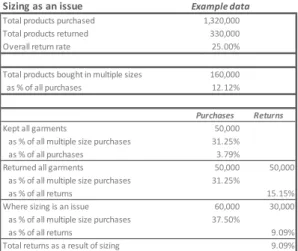
Table 1 – Sizing as an issue
Look at customers who have purchased multiple sizes of the same items (across any time period/number of orders) and have sent at least one item back – this suggests that sizing is the primary returns issue.
Table 2 – Style as an issue
Look at customers who have bought multiple options within the same garment category and have sent at least one back – this suggests that styling and what suits them / works with their wardrobe is the primary returns issue.
Sizing as an issue Example data Comments
Total products purchased 1,320,000 Total products purchased in time period
Total products returned 330,000 Total products returned in time period
Overall return rate 25.00% (Total products returned)/(Total products purchased)
Total products bought in multiple sizes 160,000 Same product bought in 2+ sizes by same customer across multiple orders as % of all purchases 12.12% (Total products bought in multiple sizes)/Total products purchased)
Purchases Returns
Kept all garments 50,000 Where the customer kept both items
as % of all multiple size purchases 31.25%
as % of all purchases 3.79%
Returned all garments 50,000 50,000 All items are returned (suggests sizing and/or style is the main issue) as % of all multiple size purchases 31.25%
as % of all returns 15.15%
Where sizing is an issue 60,000 30,000 Where at least 1 item is kept but the others are returned as % of all multiple size purchases 37.50%
as % of all returns 9.09%
Total returns as a result of sizing 9.09% Returns due to sizing issue
Style as an issue Example data Comments
Total products purchased 1,320,000 Total products purchased in time period
Total products returned 330,000 Total products returned in time period
Overall return rate 25.00% (Total products returned)/(Total products purchased)
Total products bought in multiple styles 570,000 Multiple options same garment category bought by customer within one order as % of all purchases 43.18% (Total products bought in multiple styles)/Total products purchased)
Purchases Returns
Kept all garments 370,000 Where the customer kept both items
as % of all multiple style purchases 64.91%
as % of all purchases 28.03%
Returned all garments 50,000 50,000 All items are returned (suggests that style is the main issue) as % of all multiple style purchases 8.77%
as % of all returns 15.15%
Where style is an issue 150,000 85,000 Where at least 1 item is kept but the others are returned as % of all multiple style purchases 26.32%
as % of all returns 25.76%
Total returns as a result of style 40.91% Returns due to style issue
At Dressipi, we find that style is typically a bigger issue than size in terms of reducing returns across our range of partners.
Our Fashion Prediction Platform allows retailers to create highly personalised shopping experiences for their customers that understand them, their style and their preferences. This
helps customers choose items that are more likely to appeal to them, not only increasing revenue but also reducing returns, resulting in an increase in margins at the same time.
There are many other quick ways to reduce returns but these all require a deeper understanding of both the customer base and the product features/attributes and are surfaced as part of the Dressipi service offering.
Summary
Returns are expensive and carry a hidden cost as they canimpact so many areas of a retailer’s operation. The poor quality and sparsity of the data held by many retailers on both the customers and the products serve to exacerbate the issue.
There is no silver bullet for solving this problem, as there are several reasons why items are returned (and each of these reasons will impact each retailer differently).
It is firstly important to get the right data in place, and to then use that data to understand the quickest and easiest way to reduce returns without impacting or reducing revenue or sales: is it customer behaviour, product/feature mix or different marketing behaviour?
Having real clarity as to the key metrics that can drive revenue growth alongside profit/margin growth also represents an important element of this process.
At Dressipi, not only do we now understand the detailed data that is required to apply at both the customer and the product level but we also run 4 or 5 pieces of analysis to understand where to focus our efforts if reducing returns is a KPI that is important for our partners. The results are impressive with our partners enjoying up to 15% reductions in returns.
Sarah McVittie London, September 2019
[email protected] www.dressipi.com
Understanding Your Unique Return Rate Profile: A Better Use of Your Data to Quickly Reduce Return Rates and Improve Operating Margin
Sarah McVittie, Dressipi Copyright © Dressipi 2019
All rights reserved. No part of this publication may be reproduced, stored in a retrieval system or transmitted in any form by any means without the prior permission of the copyright owner. This publication may not be sold or resold for any fee, price or charge without the written permission of the copyright owner. Every effort has been made to ensure that this publication is free from error or omissions. However, the author shall not accept any responsibility for the accuracy of the information contained within, or liability for the consequences of anyone relying on, or acting upon the information contained here within. This guide is for reference only and does not constitute professional advice. Where companies are named it is for illustrative reasons and does not indicate an endorsement.
profitability and giving shoppers the best possible experience. Dressipi uses a comprehensive set of Machine Learning and AI technologies developed to specifically address the data modelling and prediction challenges across fashion retail. The platform delivers best in class product/outfit prediction scores/recommendations for each shopper and a range of dynamic decision-making tools for retailers to optimise supply operations.
Dressipi has a unique database of over 5 million connectable fashion customers. Customers can now connect their profile across retailers and channels. This is the most powerful version of the Fashion Prediction Platform, delivering more data, better customer experiences and even better results.
Contact Dressipi
To learn more about how Dressipi’s data-driven approach accelerates leading retailers to be truly predictive, get in touch today.
[email protected] www.dressipi.com