University of Bradford eThesis
This thesis is hosted in
Bradford Scholars
– The University of Bradford Open Access
repository. Visit the repository for full metadata or to contact the repository team
© University of Bradford. This work is licenced for reuse under a
Creative Commons
Licence
.
THE IMPACT OF FISCAL DEFICITS ON ECONOMIC GROWTH IN DEVELOPING
COUNTRIES:
EMPIRICAL EVIDENCE AND POLICY IMPLICATIONS
JOHN SHOFEL RUZIBUKA
Submitted for the Degree
of
Doctor of Philosophy
BRADFORD CENTRE FOR INTERNATIONAL DEVELOPMENT
SCHOOL OF SOCIAL AND INTERNATIONAL STUDIES
UNIVERSITY OF BRADFORD
i
THE IMPACT OF FISCAL DEFICITS ON ECONOMIC GROWTH IN
DEVELOPING COUNTRIES: EMPIRICAL EVIDENCE AND POLICY
IMPLICATIONS
JOHN SHOFEL RUZIBUKA
Abstract
This study examines the impact of fiscal deficits on economic growth in developing countries. Based on deduction from the relevant theoretical and empirical literature, the study tests the following hypotheses regarding the impact of fiscal deficits on economic growth. First, fiscal deficits have significant positive or negative impact on economic growth in developing countries. Second, the impact of fiscal deficits on economic growth depends on the size of deficits as a percentage of GDP – that is, there is a non-linear relationship between fiscal deficits and economic growth. Third, the impact of fiscal deficits on economic growth depends on the ways in which deficits are financed. Fourth, the impact of fiscal deficits on economic growth depends on what deficit financing is used for. The study also examines whether there are any significant regional differences in terms of the relationship between fiscal deficits and economic growth in developing countries.
The study uses panel data for thirty-one developing countries covering the period 1972-2001, which is analysed based on the econometric estimation of a dynamic growth model using the Arellano and Bond (1991) generalised method of moments (GMM) technique. Overall, the results suggest the following. First, fiscal deficits per se have no any significant positive or negative impact on economic growth. Second, by contrast, when the deficit is substituted by domestic and foreign financing, we find that both domestic and foreign financing of fiscal deficits exerts a negative and statistically significant impact on economic growth with a lag. Third, we find that both categories of economic classification of government expenditure, namely, capital and current expenditure, have no significant impact on economic growth. When government expenditure is disaggregated on the basis of a functional classification, the results suggest that spending on education, defence and economic services have positive but insignificant impact on growth, while spending on health and general public services have positive and significant impact. Fourth, in terms of regional differences with regard to the estimated relationships, the study finds that, while there are some regional differences between the four different regions represented in our sample of thirty-one developing countries - namely, Asia and the Pacific, Latin America and the Caribbean, Middle East and North Africa, and Sub-Saharan Africa – these differences are not statistically significant.
On the basis of these findings, the study concludes that fiscal deficits per se are not necessarily good or bad for economic growth in developing countries; how the deficits are financed and what they are used for matters. In addition, the study concludes that there are no statistically significant regional differences in terms of the relationship between fiscal deficits and economic growth in developing countries.
ii
ACKNOWLEDGEMENTS
I would like to acknowledge various people who supported me in one way or another in the process of preparing this PhD thesis. First of all, I am greatly indebted with profound gratitude to my supervisors, Dr David Potts and Professor John Weiss, for their valuable support and assistance throughout the process of undertaking this study. In particular, I appreciate their valuable comments on the chapters of this thesis, understanding, patience, kindness and encouragement during the entire period of preparing this thesis. My gratitude also goes to Dr Anca Porojan and Dr Zongmin Wu who supervised me at some stages of my PhD programme but left the university before the completion of this thesis.
I am grateful to Dr Behrooz Morvaridi and Dr Hossein Jalilian for the support and assistance I received from them in their capacity as Doctoral Programme Co-ordinators at the Bradford Centre for International Development during different stages of my doctoral programme. I also wish to thank all other staff at the Bradford Centre for International Development and the School of Social and International studies for their support and encouragement throughout the programme and for making the centre and the school at large a pleasant environment to study in. The graduate school staff, student administration staff and library staff at the university were also very helpful and I would like to thank them too.
Special thanks to my family who offered me unconditional love and support throughout the course of doing this research, and especially for their priceless support during a number of very difficult personal and family problems I faced during the study programme. For this, I have dedicated this thesis to them.
iii
DEDICATION
To my family, who offered me unconditional love and support throughout the course of doing this research.
iv
TABLE OF CONTENTS
ABSTRACT i ACKNOWLEDGEMENTS ii DEDICATION iii TABLE OF CONTENTS ivLIST OF FIGURES vii
LIST OF TABLES viii
LIST OF APPENDICES ix
CHAPTER ONE: INTRODUCTION 1
1.1 Background 1 1.2 Research Problem 3 1.3 Research Objectives 6 1.4 Research Hypotheses 6 1.5 Methodology 7 1.6 Thesis Structure 10
CHAPTER TWO: FISCAL DEFICITS: DEFINITION, MEASURES AND THEIR EFFECTS ON THE MACROECONOMY 12
2.1 Introduction 12
2.2 Definition of Fiscal Deficit 13
2.3 Means of Financing Fiscal Deficits 16
2.4 Measures of Fiscal Deficits 19
2.5 Effect of Fiscal Deficits on the Macroeconomy – An Overview 35
2.6 Conclusion 38
CHAPTER THREE: THE IMPACT OF FISCAL DEFICITS ON ECONOMIC GROWTH: A CRITICAL REVIEW OF LITERATURE 42
3.1 Introduction 42
3.2 Theoretical Literature 44
3.2.1 The Keynesian Perspective 44
3.2.2 The Neo-Classical Perspective 60
3.2.3 The Ricardian Perspective 63
3.2.4 A critical Assessment of the above three Theoretical Perspectives on the Impact of Fiscal Deficits on Economic Growth 64
3.3 Empirical Evidence 83
3.3.1 Evidence Based on Estimation of St. Louis Model 84
3.3.2 Evidence Based on Estimation of Growth Models 97
3.4 Policy Implications 108
v
CHAPTER FOUR: METHODOLOGICAL FRAMEWORK 113
4.1 Introduction 113
4.2 Theoretical Model 115
4.3 Empirical model and Estimation Strategy 122
4.4 Data and Data Sources 131
4.5 Econometric Method 133
4.6 Conclusion 141
CHAPTER FIVE: DESCRIPTIVE ANALYSIS OF THE TRENDS IN FISCAL DEFICITS AND ECONOMIC GROWTH IN DEVELOPING COUNTRIES 143
5.1 Introduction 143
5.2 Trends in Fiscal Deficits 145
5.3 Trends in Economic Growth 149
5.4 Trends in Government Expenditure and its Composition 151
5.5 Fiscal Deficits, Government Expenditure and Economic Growth 159
5.6 Trends in Control Variables 163
5.7 Conclusion 169
CHAPTER SIX: ECONOMETRIC ANALYSIS OF THE IMPACT OF FISCAL DEFICITS ON ECONOMIC GROWTH IN DEVELOPING COUNTRIES 172
6.1 Introduction 172
6.2 Regression Diagnostics 177
6.3 Fiscal Deficits and Economic Growth 182
6.4 Deficit Financing and Economic Growth 197
6.5 Composition of Government Expenditure and Economic Growth 204 6.6 Analysis of the Results on Control Variables 218
6.7 Analysis of Regional Differences 235
6.8 Conclusion 238
CHAPTER SEVEN: DISCUSSION OF POLICY IMPLICATIONS 240
7.1 Introduction 240
7.2 Fiscal Deficits 241
7.3 Deficit Financing 244
7.4 Composition of Government Expenditure 250
7.5 Policy Implications of the Results for Other Variables 255
7.6 Conclusion 266
CHAPTER EIGHT: SUMMARY AND CONCLUSION 269
8.1 Introduction 269
8.2 Summary of the Study 269
8.3 Main Findings and Policy Implications 275
8.4 Contribution to Knowledge 278
8.5 Problems and Limitations of the Study 281
vi
BIBLIOGRAPHY 287
vii
LIST OF FIGURES
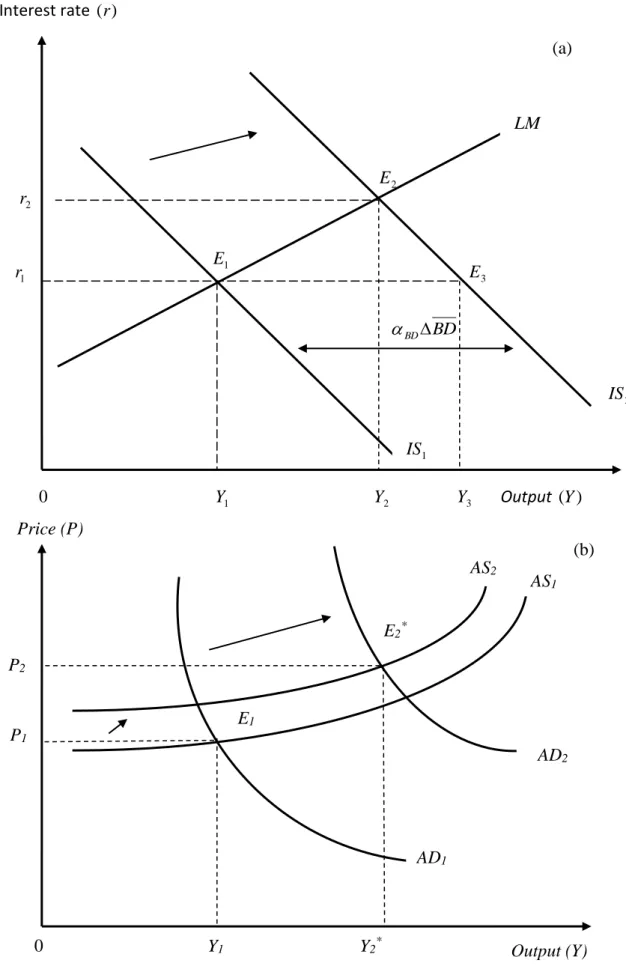
Figure 3.1 The impact of bond-financed fiscal deficits on output 47
Figure 3.2 Monetary accommodation of fiscal expansion and its impact on output 51
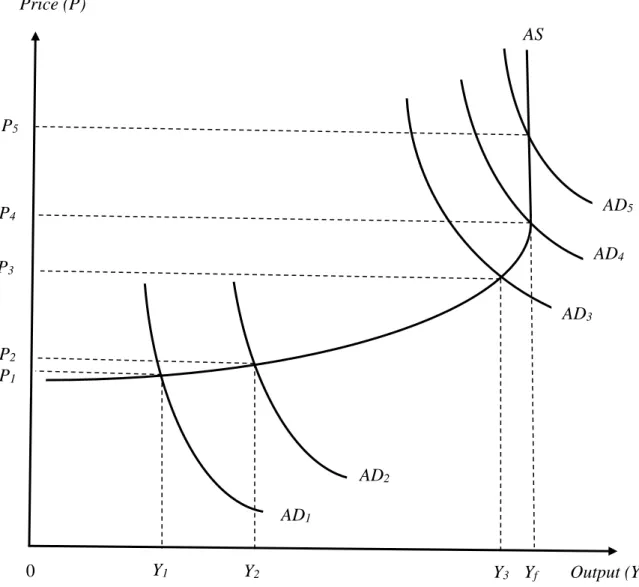
Figure 3.3 The efficacy of deficit policy at relatively low and high levels of output 71
Figure 3.4 The Efficacy of deficit spending policy on output 73
Figure 5.1 Fiscal deficit as a percentage of GDP, 1972-2001 147
Figure 5.2 GDP growth rate, 1972-2001 150
Figure 5.3 GDP growth rate, fiscal deficit and deficit financing as a percentage of GDP, 1972-2001 159
Figure 5.4 GDP growth rate and government current and capital expenditure as a percentage of GDP, 1972-2001 161
Figure 5.5 GDP growth rate and functional composition of government expenditure as a percentage of GDP, 1972-2001 162
Figure 6.1 Fiscal deficits and economic growth in developing countries during the period 1972-2001 185
Figure 6.2 Fiscal deficits and economic growth in different regions of the developing world during the period 1972-2001 185
viii
LIST OF TABLES
Table 5.1 Deficit as a percentage of GDP by region, 1972-2001 146
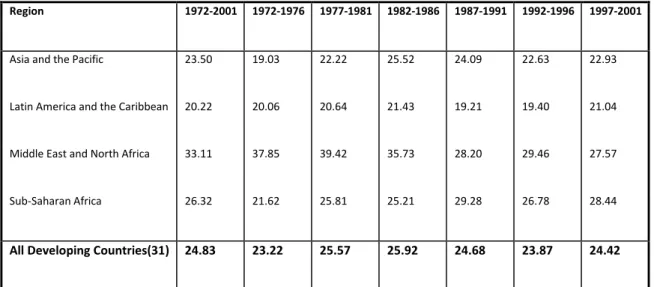
Table 5.2 Deficit financing as a percentage of total deficit by region, 1972-2001 148
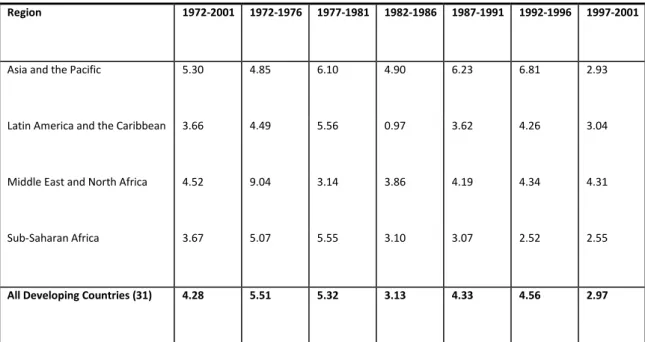
Table 5.3 GDP growth rate by region, 1972-2001 149
Table 5.4 Government expenditure as a percentage of GDP, 1972-2001 152
Table 5.5 Economic classification of government expenditure: current expenditure and capital expenditure (as percentage of total expenditure), 1972-2001 155
Table 5.6 Functional classification of government expenditure (as percentage of total expenditure), 1972-2001 157
Table 5.7 Trends in population growth rate (in percentage), 1972-2001 163
Table 5.8 Trends in inflation rate (in percentage), 1972-2001 165
Table 5.9 Trends in the level of investment (as a percentage of GDP), 1972-2001 166
Table 5.10 Trends in the degree of openness, 1972-2001 167
Table 5.11 Trends in the degree of financial deepening, 1972-2001 169
Table 6.1 Descriptive statistics 178
Table 6.2 Correlation matrix 180
Table 6.3 Results on the effect of total fiscal deficits on economic growth 188
Table 6.4 Results on the effect of the alternative ways of deficit financing on economic growth 199
Table 6.5(a) Results on the effect of capital and current expenditure on Economic growth 209
Table 6.5(b) Results on the effect of government functional expenditure on economic growth 215
Table 6.6 Summary of the results on control variables 219
ix
LIST OF APPENDICES
Appendix A: Philosophical Approach of the Study 312 Appendix B: Theoretical Aggregation of Functional Classification of Taxes
and Government Expenditure by Kneller et al. (1999) 318
Appendix C: Theoretical Functional Classification of Fiscal Policy Instruments
By Benos (2009) 319 Appendix D: Hypothesis Underlying the Formulations of the St. Louis Model
Estimated by Andersen and Jordan (1968) 320 Appendix E: Changes in the Methodology of Construction and Classification
of Fiscal Variables in the IMF’s Government Finance Statistics
Since 2001 322 Appendix F: Sample Countries 328 Appendix G: Data Summary 329
1
Chapter One
INTRODUCTION
1.1 Background
Over the past few decades, fiscal deficits have been at the forefront of macroeconomic reforms in both developed and developing countries. In developing countries, in particular, governments have been urged to reduce fiscal deficits as one of the measures to lead them out of the economic malaise many have experienced such as unsustainable levels of public debt, high inflation, balance of payments problems, poor investment and low economic growth. In fact, international development agencies, such as the World Bank (WB) and the International Monetary Fund (IMF), and donor countries have required many governments in developing countries to reduce the size of fiscal deficits as one of the pre-conditions for obtaining development aid and other forms of economic assistance (Tarp, 1993; Easterly and Schmidt-Hebbel, 1994; Nelson and Singh, 1994; Jha, 2003).
On the other hand, however, debate remains about the effect of fiscal deficits on economic performance. Since the Keynesian revolution in macroeconomics, many economists and policy makers have argued that deficit spending can be used as one of the effective measures to promote economic growth and employment (Chrystal and Thornton, 1988). This view of deficit spending is based on the well-known Keynesian premise that the market economy left to itself will not always be able to sustain aggregate demand at a level consistent with full employment. Keynesian
2
economists have particularly argued for the need to use government budget deficits as one of the corrective measures to fight poor economic growth and high levels of unemployment in industrialised countries during economic downturns. In the context of developing countries, too, some economists and policymakers have argued that deficit spending would be an effective economic policy tool to promote economic growth and employment given the large amount of unemployed and underemployed human and other economic resources that exist in most of these countries (Nelson and Singh, 1994). Indeed, as Nelson and Singh further argue, if used wisely, such fiscal policy action would help developing countries to invest in much-needed infrastructure and other development projects.
However, the Keynesian view of deficit spending policy has been challenged over the years by two other theoretical viewpoints. The first is the Neo-classical viewpoint in which it is argued that deficit spending has little or no effect on employment and economic growth, and that it primarily results in a re-distribution of resources from the private sector to the public sector through the so-called crowding-out effect. Proponents of this viewpoint also warn of the potentially harmful macroeconomic effects of running high levels of public sector debt caused by deficit spending policy (Chrystal and Thornton, 1988; Bernheim, 1989).
The second viewpoint that has challenged the Keynesian analysis of fiscal deficits is the so-called Ricardian theory (also known as the Ricardian Equivalence Hypothesis)
3
which argues that deficit spending policy has no real economic effects.1 According
to this theory, government debt generated through borrowing to finance deficit spending will in the long run be paid-off by future tax increases, and far-seeing taxpayers, who also care enough about their future prosperity and the prosperity of future generations, would foresee this tax increase and therefore adjust their present consumption and savings accordingly (Bernheim, 1989).2 This means that
the stimulative effects of deficit spending policy on aggregate demand will be offset by a shift away from current consumption and in to current savings, thus leaving net aggregate demand unchanged. Consequently, with no change in aggregate demand, there will be no real economic effects - that is, deficit spending policy will have no effect on output and other macroeconomic variables (Barro, 1989; Bernheim, 1989; Fischer and Easterly, 1990; Saleh, 2003).
1.2 Research Problem
Despite the ongoing pressure by the international development agencies and donor countries on developing countries to reduce the size of budget deficits and the debate on the effect of fiscal deficits on economic performance, there is still a lack of detailed empirical investigation on the effect of fiscal deficits on economic performance in developing countries. As Nelson and Singh (1994) argue, literature
1The Ricardian theory was originally introduced by David Ricardo and later developed by the
American economist Robert Barro.
2This Ricardian analysis of deficit spending policy is based on a number of assumptions such as (1)
consumers/taxpayers are rational and farsighted; (2) successive generations of consumers are linked by altruistically motivated transfers; (3) all taxes are non-distortionary – among others (Bernheim, 1989, p. 63)
4
shows that most of the existing empirical studies on this topic have focused much on the developed countries, particularly the United States.3 This study, therefore,
aims to contribute in filling an important existing gap in the empirical literature on the impact of fiscal deficits on economic performance in developing countries. In doing this, the study particularly examines the specific case of the impact of fiscal deficits on economic growth.
In addition, a critical analysis of the few existing empirical studies on the impact of fiscal deficits on economic growth shows that there a lack of thorough empirical investigation on this specific issue; for, most of these studies have only considered the impact of fiscal deficits per se on economic growth. Yet, the theoretical literature (as discussed later in Chapter Three) suggests that the impact of fiscal deficits on growth depends on other factors such as the level of fiscal deficits (as a percentage of GDP or GNP), the ways in which fiscal deficits are financed, and what deficit financing is used for in an economy. This study also contributes to the literature on the specific issue of deficit-economic growth connection by considering all these factors.
Our study is unique in the following ways. First, as argued above, while most of the existing empirical studies on the impact of fiscal deficits on growth have only considered the impact of fiscal deficits per se on economic growth, our study goes further than this and considers other factors which theory suggests may be important in determining the impact of fiscal deficits on economic growth. These
3 These studies have empirically examined the effects of fiscal deficits on interest rates, inflation,
5
factors include the size of fiscal deficits as a ratio of GDP, how the deficit is financed and what deficit financing is used for.
Second, following recent developments in econometric methodology, we employ a Generalised Method of moments (GMM) in estimating the impact of fiscal deficits on economic growth. This estimation technique produces more reliable coefficient estimates for dynamic models like ours and controls for the potential endogeneity problem associated with growth model estimation. These issues can be difficult to deal with when using ordinary least square (OLS) technique and other estimation techniques which have been employed in earlier studies. Finally, several existing studies on the impact of fiscal deficits on economic growth in developing countries - such as Nelson and Singh (1994) and Adam and Bevan (2005) - provide results and draw conclusions based on large sets of countries from different regions of the developing world. Economic characteristics of countries from different regions of the developing world are, however, different and hence may make the results and policy conclusions based on the analysis of data pooled in this way potentially misleading. We take account of this issue in our study and check whether there are any significant regional differences in the sample of developing countries considered in this study before we discuss our results and draw any conclusions.
6
1.3 Research Objectives
The objectives of this study are three-fold:
(1) To empirically examine the impact of fiscal deficits on economic growth in developing countries;
(2) To examine whether there are any significant regional differences in terms of the relationship between fiscal deficits and economic growth in developing countries; and
(3) To discuss the policy implications of the findings in relation to the first two research objectives.
1.4 Research Hypotheses
Based on deduction from the existing theoretical and empirical literature on the relationship between fiscal deficits and economic growth (see discussion in Chapter Three), this study tests the following four research hypotheses:
(1) Fiscal deficits have a significant positive or negative impact on economic growth in developing countries;
7
(2) The impact of fiscal deficits on economic growth depends on the size of deficits as a percentage of GDP – that is, there is a non-linear relationship between fiscal deficits and economic growth;
(3) The impact of fiscal deficits on economic growth depends on the ways in
which deficits are financed; and
(4) The impact of fiscal deficits on economic growth depends on what deficit
financing is used for.
1.5 Methodology
There are two main approaches to social science research; deductive approach and
inductive approach. The deductive approach to research begins from a more
general theory about the topic of interest to a more specific hypothesis. The hypothesis is then tested using observations or data analysis in order to confirm or falsify the original theory. On the other hand, the inductive approach starts with specific observations or data analysis and ends up with developing a general conclusion or theory (May, 2001; Robson, 2002; Blaikie, 2003; Bryman, 2004; Saunders and Lewis, 2012). Our study follows the former approach; based on the deductions from relevant literature on fiscal deficits and economic growth, we establish some key research hypotheses on the relationship between deficits and growth. We then formulate the theoretical and empirical model on the relationship between fiscal deficits and economic growth. Finally, we estimate this model to test
8
the established hypotheses on the relationship between fiscal deficits and economic growth in developing countries. However, it should be noted that our study’s aim is not to falsify the economic theory on the deficit-economic growth connection in the context of developing countries we consider in this study. We will confirm the theory if the results support or confirm it. However, if the results are not in favour of the theory then, instead of falsifying it, we will examine the possible causes of these results and their implications in terms of economic policy.4
The study can also be classified as quantitative in nature; for, it seeks to estimate empirically the impact of fiscal deficits on economic growth. On this basis, the study uses quantitative data on economic growth, fiscal deficits and other control variables considered in our empirical model. As far as data collection is concerned, the IMF’s Government Finance Statistics and the World Bank’s World Development Indicators served as the main sources of data.
In terms of data analysis, the study employs econometric analysis of panel data to estimate the relationship between fiscal deficits and economic growth. The choice of panel data study was mainly influenced by a number of important advantages this type of study has over the conventional time-series or cross-sectional studies. First, the use of panel data normally allows a researcher to get a larger number of data points (larger data set), more informative data and degrees of freedom as compared to time-series or cross-sectional data sets. This is especially important in a study like ours, given the problem of data availability on a number of variables
9
considered in our empirical model. As is well documented in the literature, data for many economic variables, especially fiscal variables, are not consistently available for many developing countries, thus making it difficult to get a reasonably large and good time-series or cross-sectional data set to use in the empirical part of the study. Using panel data, however, can help to minimise this problem. Second, while time-series and cross-sectional studies are likely to suffer from the omitted variable bias problem, using panel data analysis can help to control for this. Third, the panel data approach gives more variability and less collinearity among the explanatory variables – hence providing more efficient econometric estimates. Finally, the use of the panel data framework allows one to control for the likely endogeneity of one or more explanatory variables, and measurement errors by using lags of the regressors as instruments where needed (Judson and Owen, 1996; Hsiao, 1986, 2003; Bond et al., 2001; Wansbeek, 2001; Baltagi, 2008 - among others).
It is worth noting, however, that a number of econometric issues may arise when a panel data framework is used in economic growth studies like ours. For instance, there may be two-way causality between some of the explanatory variables and economic growth (independent variable). In addition, there may be some outlying observations resulting from the differences in economic characteristics and performances of countries included in the panel. Furthermore, for a dynamic growth model like the one we are estimating in this study, the unobserved country-specific factors will be most likely correlated with the lagged dependent variable (Hsiao, 1986, 2003; Kiviet, 1995; Bond et al., 2001; Arellano and Bond, 1991;
10
model using the Arellano and Bond (1991) generalised method of moments (GMM) estimation technique. As Arellano and Bond (1991) and other studies have demonstrated, this estimation technique controls for all these issues and produces more consistent and efficient econometric results than other estimators – such as ordinary least square (OLS), fixed effect (FE) and random effect (RE) estimation techniques.
The detailed methodological framework followed in undertaking this study is discussed later in Chapter Four.
1.6 Thesis structure
This thesis is organised into eight chapters. Following this introductory chapter, Chapter Two presents some key issues related to fiscal deficits. It includes definitions and measurements of fiscal deficits, discussion of the alternative ways of deficit financing, and discussion of the general macroeconomic effects of fiscal deficits. Chapter Three presents a critical review of the existing literature on the impact of fiscal deficits on economic growth. This includes both the theoretical and empirical literature. Chapter Four discusses the methodological framework used in carrying out this study. It presents discussion of the theoretical model employed in carrying out the study - based on which the empirical model used to estimate the impact of fiscal deficits on economics growth is built, outlines the empirical model and estimation strategy used in the study, discusses data and data sources, and discusses the econometric methods used in data analysis. Chapter Five presents a
11
descriptive analysis of data on the major variables included in our empirical model. In doing this, the chapter presents the analysis of the trends in fiscal deficits, economic growth and other control variables. It also examines whether there exist any significant differences in the trends of these variables between different regions of the developing world considered in our study. Chapter Six presents the econometric analysis of the impact of fiscal deficits on economic growth in developing countries using data from a sample of thirty-one countries. Chapter Seven discusses the policy implications of our empirical results on the impact of fiscal deficits and other policy variables on economic growth in developing countries. Finally, Chapter Eight presents a summary and conclusions of the study.
12
Chapter Two
FISCAL DEFICITS: DEFINITION, MEASURES AND THEIR EFFECTS ON THE MACROECONOMY
2.1 Introduction
Public finance literature shows that there are a number of different definitions and measures of fiscal deficit. The existence of alternative definitions and measures of the fiscal deficit raises the question as to which is the appropriate measure of the fiscal deficit in assessing fiscal stance, sustainability and the effects of fiscal deficits (or fiscal policy in general) on the macroeconomy. Various studies (such as Easterly
et al., 1994; Jacobs et al., 2002; Jacobs, 2002; among others) show that the choice
between the alternative definitions and measures of the deficit depends mainly on the purpose it is intended for (or in other words, the type of analysis one wants to undertake in a particular study). It follows, therefore, that it is important that the differences between the alternative definitions and measures of deficit, together with their analytical and policy-motivated foundations, are well understood before one chooses a particular measure of the fiscal deficit to use in the assessment of the impact of fiscal deficits on economic performance. On this basis, therefore, this chapter is devoted to the discussion of the alternative definitions and measures of fiscal deficits and the ways fiscal deficits are financed, before we proceed with the analysis of the impact of fiscal deficits on economic growth in developing countries (which is the main focus of this study) in the subsequent chapters. The chapter also discusses briefly the available alternative ways of covering fiscal deficits and
13
presents an overview of the likely effects of fiscal deficits on the macroeconomic performance.
The chapter is organised as follows. Following this introductory section, section 2.2 presents some definitions of the fiscal deficit. Section 2.3 discusses the alternative ways of financing fiscal deficits. Section 2.4 discusses the alternative measures of fiscal deficits. Section 2.5 presents an overview of the effects of fiscal deficits on the macroeconomy. Finally, section 2.6 concludes.
2.2 Definition of Fiscal Deficit
Public finance literature shows that there are numerous definitions of fiscal deficit, depending on how the deficit is measured. However, the widely accepted definition, and the one we will use in this study, is that fiscal deficit is the excess of government expenditure over government revenue receipts taken in from taxes, fees and charges levied by government authorities (Hyman, 1996). A fiscal deficit generally suggests an expansionary fiscal stance. Contrary to this is the fiscal or budget surplus, which may be an indication of contractionary fiscal stance.
Fiscal deficit can be measured on a cash basis or an accrual basis. In the first case, the deficit measures the excess of total government cash outlays over total government cash revenues. On the other hand, in the second case, the deficit measures the excess of accrued spending over income (Agenor and Montiel, 1999; Jacobs et al., 2002).
14
According to public finance literature and practices by governments and institutions such as the World Bank and the International Monetary Fund, fiscal deficits (or fiscal balance in general) have been commonly reported for three different scopes (sizes or coverage) of government worldwide. These are: (i) budgetary central government; (ii) consolidated central government; and, (iii) consolidated general government (Blejer and Cheasty, 1991; Buiter, 1997; Legeida, 2000; Agenor, 2004; and, IMF – various issues).
Budgetary central government fiscal balance (deficit/surplus) is the narrowest measure of fiscal stance as far as the coverage of the public sector is concerned. This includes the deficit of the “central government” component of government only; i.e., budgetary central government deficit equals the difference between budgetary central government revenues and expenditures. This is expressed as follows:
Budgetary central government budget balance = budgetary central government revenue – budgetary central government expenditures
Where, centralgovernment includes all units representing the territorial jurisdiction of the central authority throughout a country (IMF, various issues).
Consolidated central government fiscal balance (deficit/surplus) includes deficits for budgetary central government, social security funds and extra-budgetary
15
funds/accounts5. According to the IMF manuals on Government Finance Statistics
(various issues), the consolidated central government budget balance equals the following fiscal stance:
Consolidated central government budget balance = central government budget
balance + social security funds balance + extra-budgetary accounts balance
Finally, the consolidated general government fiscal balance (deficit/surplus) includes the total of deficits for central, state and local governments, and for any supranational authorities operating in a country, excluding all identifiable transactions between different levels of government. This can be expressed as follows:
Consolidated general government budget balance = central government budget balance + total state governments budget balance + total local governments budget balance + total budget balance (deficit/surplus) of supranational authorities – identifiable transactions between different levels of government
Where, central government is as defined above. State (or provincial, or regional)
governments are defined as governments that exercise authority independent of
central government in specific sections of a country’s territory (encompassing a number of smaller localities). Local governments consist of government units that
exercise an independent authority in the various urban and/or rural jurisdictions of
5Note, extra-budgetary funds are funds associated with institutions or units outside the budget that
raise money through the imposition of tax or compulsory levies, or are created with some charitable purpose, and which deals with provision of non-marketable goods or services (IMF Manuals of GFS, various issues; Legeida, 2000)
16
a country’s territory. Supranational authorities consist of the international
governmental organisations (also known as intergovernmental organisations), other than their headquarters units, operating in a country.
Critical analysis of the above-discussed scopes of budget stance measures shows that the consolidated measures of fiscal stance (consolidated general government or consolidated central government) represent the most accurate measures of the fiscal position of the country, and as such these measures should be used (whenever available) in assessing fiscal sustainability and the economic effects of fiscal deficits or surplus. This is because the unconsolidated measures of fiscal stance do not encompass the fiscal content of institutions such as public enterprises, the central bank, and the public financial institutions, which in practice carry out government-like transactions that can be relevant when measuring the impact of fiscal deficit. On this basis, therefore, our study use only the consolidated general government measure of fiscal variables in the empirical analysis part.
2.3 Means of Financing Fiscal Deficits
When government spending exceeds revenues, the resulting budget deficit must be financed in one way or another in order for the government to meet its financial obligations. Following Sachs and Larrain, 1993; Weiss, 1995; and Agenor, 2004, various ways of financing government budget deficit can be explained using the government budget constraint. This is as expressed in equation 2.1 below:
17 g t g t g t D P G R i D D DFCT 1 ( ) 1 ………... (2.1)
Where; DFCT is government fiscal deficit, g t g t D
D 1 is the change in government
debt between the current and previous period, P is the price level, G is total government expenditure, R is total revenue receipts (raised from taxes, fees and charges levied by government authorities) and g
t
D
i. 1 is interest payments on previously issued government debt.
Government debt can be held by the central bank and by the public (domestic or foreign). Assuming, for simplicity, that lending by the central bank to the banking sector does not change over time, then the change in monetary base
)
(mt mt1 will be equal to the change in the stock of government debt held by the central bank (Dcg(t) Dcg(t1)) plus the change in foreign exchange reserves
) ( *() *(1
Bct Bct
E - where Estands for the nominal exchange rate and * ) 1 ( * ) (t ct c B B
is the change in the foreign reserves held by the central bank between the current and previous period.
From the above, we get the following:
) ( ) ( ) ( ) ( *( 1 * ) ( ) 1 ( ) ( 1 1 ct ct g t p g t p t t g t g t D m m D D E B B D DFCT .…… (2.2)
18 Where; g t p g t p D
D () (1) is government debt (both domestic and foreign) held by the public, and others are as defined above.
Equation 2.2 implies in essence that there are four ways of financing a government budget deficit (Sachs and Larrain, 1993; Tarp, 1993; Weiss, 1995; Agenor, 2004):
(1) borrowing from the central bank (also known as monetization of the deficit) (2) increasing the level of domestic debt
(3) increasing the level of foreign debt (4) running down foreign exchange reserves
Bringing all these ways of financing fiscal deficit together, we obtain:
Fiscal Deficit = (Borrowing from the central bank + Domestic Borrowing + External Borrowing + Foreign Reserve Use)
These ways of financing fiscal deficits have been discussed in details by (Fischer and Easterly, 1990; Tarp, 1993; Weiss, 1995; Piontkivsky et al., 2001; among others).
Borrowing from the central bank occurs when the central bank finances the budget deficit by directly lending the funds needed by the government to meet its expenditures or indirectly by purchasing government debt at the time of its issuance or later through open market operations (Weiss, 1995; Piontkivsky et al.,
2001). Domestic borrowing can be exercised voluntarily or on a compulsory basis. In the economies where capital markets are well developed, it can be possible for governments to finance the deficit by issuing bonds that are voluntarily purchased
19
by the private sector. Elsewhere, different forms of compulsory purchase of government debt can be used: these include setting reserve requirements for financial institutions operating in the domestic economy, introduction of compulsory purchase of government bonds by commercial banks, and accumulation of arrears of government payments on debts to the private sector (Fischer and Easterly, 1990; Weiss, 1995). Foreign borrowing involves increase in the government’s holding of foreign debt. As noted in Weiss (1995), this means of deficit financing is, however, only useful in economies that are creditworthy. Finally, financing of a fiscal deficit by running down foreign exchange reserves usually occurs by the central bank first purchasing government debt on the primary or secondary market (or simply granting a loan to the government) thereby injecting additional reserves to the economy and then trading available foreign exchange reserves for domestic currency (Sargent and Wallace, 1981; Ouanes and Thakur, 1997; Piontkivsky et al., 2001).
2.4 Measures of Fiscal Deficits
Economic literature shows that various measures of fiscal deficits have been used in assessing fiscal stance and the effects of fiscal deficits on economic performance. These measures can be grouped into the following two main categories (Blejer and Cheasty 1993; Jacobs, 2002; Jacobs et al., 2002):
The conventional (also called accounting) measures of the fiscal deficit. This is the measure of the fiscal deficit that governments normally report in their budgets; and,
20
Refinements of the conventional measure of the fiscal deficit (also called special-purpose deficit measures). These are special-purpose deficit measures that attempt to isolate from the conventional deficit the components that are relevant for assessment of specific fiscal stance or impact of various budgetary transactions.
These measures of the fiscal deficit are discussed in more detail below.
2.4.1 Conventional Measures of the Fiscal Deficit
The conventional measure of the fiscal deficit generally measures the amount of resources utilised by the government in a given fiscal period, usually a year, that need to be financed after total revenue has been deducted from total expenditure (Blejer and Cheasty, 1991, 1993; Jacobs et al., 2002; among others). It is thus
defined as the difference between total budgetary expenditures and total budgetary revenues of the government that needs to be covered by some forms of deficit financing. According to Jacobs (2002, pp. 5-6), citing Tanzi et al. (1988), the
conventional measure of the budget deficit (or the budget balance in general) was originally developed in an attempt to provide, among other things, a measure of the government’s contribution to aggregate demand in the economy and the lack of equilibrium in the current account of the balance of payments, or to measure the crowding-out of the private sector.
21
According to the IMF’s Manuals on Government Finance Statistics (various issues), the conventional budget balance (deficit/surplus) is measured as follows:
Conventional Fiscal Balance = ((Government expenditure + Net lending) -
(Government’s total revenue receipts))
Where; Net lending equals lending minus repayments, and government’s revenue
receipts include both tax and non-tax revenue receipts.
Analysis shows that governments worldwide usually report their deficits using the above IMF measure of conventional fiscal deficits. However, the economic literature shows that several variants of the conventional measure of the deficit exist. According to Blejer and Cheasty (1991, p.1646), there are two main areas/causes of variance:
the distinction between the budgetary items that determine the fiscal deficit (revenues and expenditures) on the one hand and the items that finance it on the other, and
specification of the time period at which the resource use is measured (cash deficit or accrual deficit)
22
(1) The distinction between the items that determine the deficit (revenues and expenditures) and the items that finance it
There are two main criteria used to distinguish between the items that determine the deficit (revenue and expenditure) and the items that finance it: the government
debt criterion and the public sector policy criterion. In the first case, transactions are
considered as deficit-determining, and are therefore classified as either revenue or expenditure, when they do not create or change a liability for the government, and those that change the level of government liability are considered as deficit financing. In the second case, transactions are considered deficit-determining, and are therefore classified as either revenue or expenditure, instead of deficit financing, when they are used to pursue policy goals rather than being part of public sector liquidity management (Blejer and Cheasty, 1991, pp. 1646-1649).
These two criteria for distinguishing between the items that determine the deficit (revenue and expenditure) and the items that finance it can lead to significant discrepancies in the sizes of the conventional deficit reported using the two criteria. According to Blejer and Cheasty (1991, p.1647), at least three types of transactions can cause discrepancies in the two criteria: budgetary net lending; external grants; and, debt service.
Budgetary net lending - Unlike other government expenditures, government lending to the private sector may involve liability management, and for this reason, under the government debt criterion, should be classified as
deficit-23
financing type of transactions. However, it is also possible that a significant proportion of government lending to the private sector may be composed by the mix of direct capital infusion and of government credit programmes undertaken in order to pursue certain policies goals (for example, to supply credit to some selected sectors of the economy). Given the subsidy element of this transaction and the possibility that part of the government lending to the private sector may not be paid back, “net lending” cannot be defined as pure deficit financing, and the public policy criterion would then classify it as part of government expenditure - and hence classified as deficit-determining.
External grant - External grants represent, in essence, government financing without any liability. It follows therefore that grants will be treated as one of the components of government revenue, and therefore a deficit-determining transaction, in the government debt criterion. However, under the public policy criterion, grant aid would be included in the other forms of foreign financing, and thus classified as deficit financing.
Debt service - In some countries, levels of public debt may already be too high and unsustainable to the extent that amortised debt may not be easily and voluntarily re-invested in new government bonds. In such a situation, replacement financing for amortisation could require a policy effort by the government similar to that of generating extra tax revenue. Hence, in this situation, in contrast to the government debt criterion, which considers
24
debt amortisation as deficit financing, the public policy criterion would consider debt amortisation as a deficit determining transaction.
Indeed, these divergences in classification of the above three transactions can lead to significant discrepancies in the size of conventional budget balance estimated using the government debt criterion and the public policy criterion. According to the
IMF’s Government Finance statistics (IMF’s GFS) manuals of 1986 and 2001, IMF followed the former methodology in compiling and reporting data on fiscal policy variables until 2001 when it switched to the later methodology of compiling and reporting data (Appendix C summarises these methodological differences between
the 1986 GFS system and 2001 GFS system). As discussed later in the methodology
chapter, this study use fiscal data which were compiled in accordance to the government debt criterion (1986 GFS system).
(2) Specification of the time at which the resource use is measured (Cash and accrued deficits)
Another main source of variation between the conventional deficit measures is the specification of the time at which resource use is measured (that is, the choice between cash deficit and accrual deficit approaches). As discussed earlier, cash
deficit captures the budget balance of only government expenditures for which cash has been disbursed and only actual cash revenues received during a specific single budget period. On the other hand, accrual deficit captures the actual net resource flows in government transactions – that is, it captures the consequences
25
of government’s fiscal policy decisions - during the budget period, regardless of whether or not transactions have actually been paid for (Blejer and Cheasty, 1991; Jacobs, 2002; Jacobs et al., 2002). This is another main area of differences between
the IMF’s GFS data compiled and reported in accordance to the 1986 GFS system (the data we have used in this study) in which cash basis is used in constructing
fiscal variables, and the data compiled and reported in accordance to the 2001 GFS system in which countries are encouraged to report fiscal data on accrual basis.6
Such differences in specification of the time at which resource use is measured result in significant differences between the size of the fiscal deficit calculated on a cash and accrual basis. In practice, however, it is difficult to follow either the purely cash or purely accrual approach, and countries usually report deficits which lie somewhere between the complete cash and complete accrual deficit measures. As noted in Blejer and Cheasty (1991, pp. 1649-1650), for instance, even for countries which have opted for a Public Sector Borrowing Requirement (i.e., cash deficit), interest payments are usually measured as they accrue, rather than when they are actually paid. On the other hand, government revenues are usually reported on cash or quasi-cash basis. Hence, in the light of such problems associated with the measurement of the conventional deficit on purely cash or accrual basis, the cash and accrual accounting approaches have been reconciled on the basis of arrears that led to the measurement of the deficit on a commitment basis. This practice has resulted in the following measurement of conventional fiscal deficit/balance (Legeida, 2000):
6See Appendix C for more details on these methodological differences between the 1986 GFS system
26
Fiscal Deficit on commitment basis = Revenue receipts – Non-interest government expenditures – Scheduled interest payment = Commitment budget deficit = (-) Deficit financing = New external borrowing – Scheduled external debt amortisation + Change in arrears + Net domestic borrowing
To sum up on the conventional measure of the budget deficit, this is generally regarded as the financing gap during a fiscal year after the government’s total revenue (including tax and non-tax revenue) has been deducted from total government expenditure. Analysis shows that this is the main measure of the fiscal deficit that governments worldwide usually report in their budgets. In addition, analysis of the literature shows that, given its easy and wide availability, the conventional measure of the fiscal deficit has been the most widely used measure of the deficit in the studies on fiscal sustainability and the effects of fiscal deficits on economic performance (Blejer and Cheasty, 1991; Jacobs et al., 2002).
2.4.2 Special – Purpose Deficit Measures
As pointed out earlier, there exist some special-purpose measures of the fiscal deficit other than the conventional measure. According to the literature, these measures have been developed by economists and policymakers in an attempt to isolate from the conventional deficit measure the magnitudes that are more relevant for assessment of specific fiscal stance or economic impact of various budgetary transactions. Some of the main types of special-purpose deficit measures that have been widely calculated include: i) primary deficit; ii) current deficit; iii) domestic and foreign deficits; iv) deficit that measures the contribution
27
of different elements of government transactions to aggregate demand; v) operational deficit; and vi) full-employment and cyclically adjusted deficits (Blejer and Cheasty, 1991, 1993; Weiss, 1995; Legeida, 2000; Jacobs, 2002; Jacobs et al.,
2002). These measures should not be looked at as either good or bad, as each of the measure reveals only a specific aspect of the government fiscal stance and can be useful depending on the purpose they are intended for. Hence, understanding what all these measures reveal, together with their analytical and economic rationale, can be useful.
i. The primary deficit
The conventional deficit measures the difference between government outlays and income, where outlays include interest payments on the stock of public debt. This measure, therefore, is influenced by the size of previous deficits. In order to remove the effects of the previous deficits on the budget, economists calculate the primary
deficit (also called “non-interest deficit”) by omitting interest payments from the
budget. Thus, the primary deficit equals the following fiscal stance:
Primary deficit = Conventional deficit – Interest payments
The primary deficit, therefore, measures the impact of the discretionary government budget (Barth et al., 1989). It seems that the main economic rationale
for estimating the primary deficit is to remove the interest payments (which are the result of past decisions) from the budget in order to get a more accurate picture of
28
the government’s current fiscal policy. In that way, one of the uses of the primary deficit could be the assessment of the success or failure of the government’s current policies in moving the economy towards a sustainable funding path.
ii. The current deficit
Unlike the conventional deficit measures, which include both current and capital transactions in their calculations, the current deficit measure considers only the difference between current revenues and expenditures. This gives the following fiscal stance:
Current fiscal balance = Total current revenues – Total current expenditures
The current deficit can be useful to economists and policymakers in assessment of whether the government can finance its consumption expenditures from its revenues (IMF, 1995). Moreover, it can be argued that, if separate and conceptually correct current and capital accounts were maintained, the deficit on current account would be the “true deficit”. This is because, unlike the current account, for the capital account, any excess of outlays over revenues does not cause any changes to the net asset position of the government as the new debt is matched by a new government asset (Boskin, 1982).
29 iii. The domestic and foreign Deficits
Some economists have argued that the conventional measure of the deficit can be somewhat misleading when the public sector has sizeable trade or capital flows to and from the rest of the world. As noted in Blejer and Cheasty (1991, pp. 1652-1653), for instance, expenditure on domestic goods that is fully financed by external grants increases aggregate demand without any offsetting withdrawals. In addition, government imports financed by domestic taxes reduce aggregate demand by the full amount of the import bill – a scenario where government expenditure may have contractionary rather than expansionary effects. It follows, therefore, that the overall deficit could well be zero in each of the above two examples, though each implies an opposite domestic impact. To isolate the effects of the government and the external sector on aggregate demand in an open economy, therefore, the domestic deficit and the foreign (or external) deficit have been calculated separately by economists.
The domestic deficit (or, domestic budget balance in general) is measured by including in the calculation only those budgetary transactions taking place within the domestic economy and excluding those that directly influence the balance of payments. This equals the following fiscal stance:
30
On the other hand, the foreign deficit (or “foreign/external budget balance” in general) is measured by including in the calculations only those budgetary transactions that are directly connected with the foreign sector.
iv. Deficit that measures the contribution of different elements of government transactions on aggregate demand
It is argued that different elements of government transactions (expenditures and revenues) generate different net increases to, and withdrawals from, aggregate demand. As a result, economists have sometimes attempted to isolate in the fiscal deficit measure the contribution by the government to aggregate demand (Blejer and Cheasty, 1991). The most commonly used deficit measures of the contribution of different government transactions to aggregate demand separates the exhaustive expenditure (spending on goods and services) from spending on transfers. In this case, for example, the deficit measure that considers only the exhaustive expenditure is measured as:
Budget balance = conventional fiscal deficit - government spending on transfers
The main economic rationale of estimating deficit measures that separate exhaustive expenditures and transfers is that the impact of these two categories of government expenditure on aggregate demand will be different. For instance, tax-financed transfers such as pension and unemployment benefits merely redistribute resources from one part of the private sector to another in the economy. In addition, in terms of their impact on aggregate demand, tax-financed transfers are
31
similar to negative taxes rather than to government’s expenditure on goods and services. Analysis also shows that the inclusion of transfers in government spending may at times overestimate the government’s contribution to aggregate demand due to the time lags in the actual spending of transfers. As noted in Blejer and Cheasty (1991, p.1652), this problem may especially occur in economies where there are different levels of government. In this case, for example, a transfer from one level of the government to another – say, from the central government to the local government level, may not increase aggregate demand until the year or years after it was recorded in the budget of the central government. Clearly, including such a transfer in the current year’s government spending will overestimate the government’s contribution to aggregate demand.
v. The operational deficit
Fluctuations in inflation can significantly change the size of the government budget deficit, and when this happens, the conventional measure of the budget deficit may not give a true picture of the impact of government activity on aggregate demand (Weiss, 1995). According to economic theory, fluctuation in inflation affects the government budget in many ways. For instance, it causes distortionary effects on real revenues collected by the government. In addition, inflation affects the real value of government assets and liabilities (Tanzi, 1977; Blejer and Cheasty, 1991). One important implication of these effects of inflation on the government budget is that inflation may reduce the real value of the outstanding public sector debt, while at the same time compensating holders of the government debt for such a reduction in their real assets through higher nominal interest rates. This implies
32
that some of the government’s interest payments on its debt will in reality be part of the amortisation of that government debt in an inflationary situation. It follows therefore that, if the inflationary component of interest payments is not removed from the interest bill, the size of the government budget deficit will be over-stated by the size of the amortisation component included in the total outstanding government debt (Blejer and Cheasty, 1991, p. 1655-1656; Weiss, 1995, p. 34).
To remove the inflation-induced component of interest payments from the fiscal deficit calculation, economists have suggested the use of the operational deficit. This is simply measured as follows:
Operational deficit = primary deficit + real interest payments
According to Blejer and Cheasty (1991) and Weiss (1995), the main economic rationale in the calculation of the operational deficit is to remove the inflation component of interest payments from the deficit on the basis that this is simply similar to amortisation payments, which do not represent any new income to recipients and the economy in general.
vi. The full-employment and cyclically adjusted deficits
Economists have also attempted to calculate deficit measures that remove the effects of fluctuations in economic activity on the budget (Agenor, 2004). There are two main types of these measures: the high or full-employment deficit (also known
33
as high-employment deficit or structural deficit) and the cyclically adjusted deficit
(also known as trend deficit). These deficit measures have been surveyed in Blinder
and Solow (1974), De Leeuw and Holloway (1982, 1983, 1985), and Heller et al.
(1986).
The full-employment deficit measures the deficit at some arbitrarily defined full employment or potential output level of economic activity (De Leeuw and Holloway, 1982; Dornbusch et al., 2001). This measure was developed by economists in the
belief that “a small surplus in the full employment budget would ensure a high level of national saving while permitting built-in fiscal stabilizers to damp cyclical fluctuations” (Blejer and Cheasty, 1991, pp. 1653-1654, citing De Leeuw and Holloway, 1983, p. 27).
The full-employment deficit measure, however, suffers from the limitation that using it could result in the expansion of the public debt since, on average, economies usually operate below full-employment level, so that, on average, government expenditure would exceed government revenue. To address this limitation of the high-employment deficit measure, economists developed the cyclically adjusted deficit (or trend deficit) to provide a budget balance rule that would maintain a constant level of public liabilities in budget preparations (Blejer and Cheasty, 1991).
34
Calculation of the cyclically adjusted budget balance (deficit or surplus) involves the following steps (De Leeuw and Holloway, 1985, p.232; Blejer and Cheasty, 1991, p.1654):
1) Choosing a reference trend for GDP/GNP that is free from short-run fluctuations,
2) Determining the responsiveness of government transactions (expenditures and revenues) to short-run fluctuations in GDP/GNP,
3) Applying the responsiveness of expenditures and revenues to any gaps between trend GDP/GNP and actual GDP/GNP, and
4) Finally, adding the expenditures and receipts “gross-ups” obtained in step 3 to the actual budget to obtain a cyclically adjusted budget balance.
A comparison between the cyclically adjusted deficit and the full employment deficit shows that they both measure the budget deficit that would occur if the economy were at full employment. However, these measures differ on the GDP or GNP reference trends that are used in their calculation: a cyclically adjusted deficit is constructed using a GDP or GNP that is free from short-run fluctuations as the reference trend, while a full employment deficit is constructed using potential output as the GDP or GNP reference trend.
35
Analysis shows that these special-purpose deficit measures can be very useful, some even more useful than the conventional measure of the deficit, for analysing fiscal stance (Agenor, 2004) and the effects of fiscal deficits on other macroeconomic variables (such as aggregate demand, inflation, balance of payments, economic growth, etc.). However, the problem is that most of these are difficult to calculate, and for this reason not easily available, especially for the case of developing countries. In fact, most governments worldwide only report the conventional budget balance (deficit or surplus) in their budgets. This has made this measure the more widely used measure of the fiscal deficit in assessment of fiscal stance, sustainability and the effects of fiscal deficits on economic performance.
2.5 Effect of Fiscal Deficits on the Macroeconomy – An Overview
The relationship between fiscal deficits and other macroeconomic variables represents one of the most widely debated issues in economics.7 Since the
Keynesian revolution in macroeconomics, many economists and policymakers (the so-called Keynesians) have argued that deficit spending could be used as one of the effective measures to achieve two of the stated national economic objectives: a high rate of economic growth and full employment. In particular, these economists and policymakers believe that deficit spending would be required to promote economic growth and fight unemployment during periods of recession, or when the economy is operating far below its full capacity. Keynesians believe that economies can benefit from deficit spending policy during economic recession because of the
7 We briefly discuss this here because understanding of these macroeconomic relationships can help
to explain some of the transmission mechanisms through which fiscal deficits affects economic growth.