Block Structure Multivariate Stochastic Volatility Models
Manabu Asai* Faculty of Economics Soka University Japan Massimiliano Caporin†Department of Economics and Management “Marco Fanno” University of Padova
Italy
Michael McAleer‡ Econometric Institute Erasmus University Rotterdam Erasmus School of Economics
and Tinbergen Institute
The Netherlands
EI 2009-51
First draft: June 2007 Revised: December 2009
* Corresponding author: 1-236 Tangi-cho, Hachioji, Tokyo 192-8577, Japan, tel. +81-42-691-8163, email: [email protected]
† Dipartimento di Scienze Economiche “Marco Fanno” – Università degli Studi di Padova – Via del Santo, 33 – 35123 Padova, tel. +39-049-8274258, email: [email protected]
‡ The third author is most grateful for the financial support of the Australian Research Council, National Science Council, Taiwan, and Center for International Research on the Japanese Economy (CIRJE), Faculty of Economics, University of Tokyo. [email protected]
Abstract
Most multivariate variance models suffer from a common problem, the “curse of
dimensionality”. For this reason, most are fitted under strong parametric restrictions that
reduce the interpretation and flexibility of the models. Recently, the literature has focused
on multivariate models with milder restrictions, whose purpose was to combine the need
for interpretability and efficiency faced by model users with the computational problems
that may emerge when the number of assets is quite large. We contribute to this strand of
the literature proposing a block-type parameterization for multivariate stochastic
volatility models.
Keywords: block structures; multivariate stochastic volatility; curse of dimensionality
1. Introduction
Classical portfolio allocation and management strategies are based on the assumption that
risky returns series are characterized by time invariant moments. However, the
econometric literature of the last few decades demonstrated the existence of dynamic
behaviour in the variances of financial returns series. The introduction of such empirical
evidence may constitute an additional source of performance for portfolio managers, as
evidenced by Fleming, Kirby and Ostdiek (2001), or may be relevant for improving the
market risk measurement and monitoring activities (see, for example, Hull and White
(1998) and Lehar et al. (2002)). Two families of models emerged in the literature, namely
GARCH-type specifications (see Engle (2002)), and Stochastic Volatility models (see
Taylor (1986) and Andersen (1994)).
However, portfolio management strategies often involve a large number of assets
requiring the use of multivariate specifications. Among the possible alternative models,
we cite the contributions of Bollerslev (1990), Engle and Kroner (1995), Ling and
McAleer (2003), Asai and McAleer (2006, 2009), and the surveys in McAleer (2005),
Bauwens, Laurent and Rombouts (2006), and Asai, McAleer and Yu (2006). Most models,
if not all, suffer from a common problem, the well-known “curse of dimensionality”,
whereby models become empirically infeasible if fitted to a number of series of moderate
size (in some cases, the models may become computationally intractable with even 5 or 6
assets). In order to match the need of introducing time-varying variances with practical
VECH specifications suggested by Bollerslev et al. (1988), the scalar VECH and BEKK
models proposed by Ding and Engle (2001), the CCC model of Bollerslev (1990), and the
dynamic conditional correlation models of Engle (2002) and Tse and Tsui (2002).
However, the introduction of significant and strong restrictions reduces the interpretation
and flexibility of the models, possibly affecting the purportedly improved performance
they may provide and/or the appropriateness of the analysis based on their results.
Recently, the literature has focused on multivariate models with milder restrictions, whose
purpose was to combine the need for interpretability and efficiency faced by model users
with the computational problems that may emerge when the number of assets is quite
large. Among the contributions in this direction, we follow the approach of Billio,
Caporin and Gobbo (2005). They proposed specifying the parameter matrices of a general
multivariate correlation model in a block form, where the blocks are associated with
assets sharing some common feature, such as the economic sector. Our purpose is to adopt
this block-type parameterization and adapt it to multivariate stochastic volatility models.
In general terms, Multivariate Stochastic Volatility (MSV) models have a parameter
number of order O(n2), where n is the number of assets. With the introduction of block
parameter matrices, we may control the number of parameters and obtain a model
specification which is feasible, even for a very large number of assets. Furthermore, as in
the contribution of Billio et al. (2005), the models we propose follow the spirit of
sectoral-based asset allocation strategies since they will presume the existence of
common dynamic behaviour within assets or financial instruments belonging to the same
factor driving all the variances and covariances, since the financial theory may suggest the
existence of sector-specific risk factors (sectoral asset allocation is often followed by
portfolio managers and characterized by a number of managed financial instruments).
As distinct from an extremely restricted model, we also recover part of the spillover effect
between variances, which allows monitoring of the interdependence between groups of
assets, an additional element which may be relevant. Within our modeling approach, the
coefficients may be interpreted as sectoral specific, while the assets will be in any case
characterized by a specific long term variance through the introduction of unrestricted
constants in the variance equations.
Clearly, the restrictions proposed may not necessarily be accepted by the data, as more
‘complete’ models will, in general, provide better results. We will show that the
introduction of such restrictions provides limited losses, while yielding a significant
improvement over the more restricted specifications. We will evaluate and compare the
alternative models following the Monte Carlo likelihood (MCL) estimation approach for
both univariate and multivariate SV models, as in Sandmann and Koopman (1998) and
Asai and McAleer (2006).
The plan of the remainder of the paper is as follows. Section 2 presents the block-structure
modelling approach within a general MSV framework, and also compares the model to
Factor SV specifications, and addresses some estimation issues. Section 3 presents an
empirical example based on US stock market data for selected firms. Section 4 gives some
2. MSV Models
The block-structure model we present can be considered as a restricted specification of a
general MSV model. In fact we will show how the modelling approach consists in
defining a set of parametric restrictions that makes the model feasible, but without losing
the interpretation of coefficients.
Consider a general MSV model that will be used as reference model. Let Rt be the return series on an asset, and define yt RtE R
t t1
as the mean-adjusted return. Then, the basic SV model is defined as
2
1 exp 0.5 , 0,1 , , 0, , t t t t t t t t y h N h h N (1)where E
t s
0 for all t and s. By setting gt ht , where 2 ln , we have an alternative representation, namely yt
texp 0.5
gt
and gt1
gt
t.For the M-dimensional stochastic vector, the MSV model of Harvey, Ruiz and Shephard (1994) is defined by
1,
2,
,
, 0, , diag ,diag exp 0.5 exp 0.5 , exp 0.5 ,...exp 0.5 ,
t t t t t t t t M t y DD N P D D h diag h h h (2)
where P is the correlation matrix,
is the M-vector of standard deviation parameters, and ht is M-vector of the stochastic components, which follows a VAR(1) process given as
1 , 0, , t t t t h h N (3)where the operator denotes the Hadamard (or element-by-element) product, is an
M-dimensional coefficient vector and is the covariance matrix. For convenience, we call this type of MSV model the ‘basic MSV’ model.
In the following, we present a closely related specification, the Factor MSV model, and
then we introduce the Block-Structure MSV model.
2.1. Factor MSV model
extended by Jacquier et al. (1995, 1999), and Chib et al. (2006), among others. The basic
model has the following structure:
2 2 2 1 2 , , , , , 1 , , 2 , 0, diag , ,... , exp 0.5 , 1, 2,... 0,1 , , 0, , t t t t M i t i t i t i t i t i i t i t t k y Df N f h i k N h h N I (4)where D is the m k matrix of factor loadings, ft is the k-dimensional vector of factors, which follow univariate SV models, and all the innovation terms are mutually
uncorrelated. This model has a limited number of parameters, but also has some
drawbacks. In fact, as shown in Asai et al. (2008), the conditions imposed on the mean
innovations,t, that is, homoscedasticity and diagonality of the covariance matrix, are too restrictive and not consistent with the empirical evidence. This is particularly evident
when the number of factors, k, is much smaller than the number of assets, M. In this case, if the assets are used to create a portfolio, there must exist at least one vector of weights
2.2. Block Structure Model
We now assume that the M assets are divided into B groups, with the i-th group containing
i
m assets (M m1m2 mB). We define a block structure for the volatility by assuming that each group of assets is characterized by a common parametric behaviour in
the volatility equation. Consider the variance dynamics of the Harvey et al. (1994) model
in equations (1)-(3):
1 , 0, , t t t t h h N (5)where the matrix of parameters of persistence, , and the covariance matrix of log-volatility, , will have constraints given by block structures. We define
1 2 1 1 2 1 2 1 2 2 1 2 1 2 ,11 ,21 , , 1 , ,21 , ,22 , 2 , , 1 , , 2 , , , , B B B B B B m m B m u m u m m u B m m u m m u m u B m m u B m m u B m m u BB m I O O O O I O O O O O O O O I I L L L I L L L I (6)
the number of assets in each block is the same, namely miM B , we have
1
diag , ,B IM
and u IM , where u
u ij, , and is the Kronecker product. By construction, the vector of volatilities has a block-structure given that the factors affecting the overall volatilities are sector or block specific. Hereafter, we refer tothe model in equations (2), (5) and (6) as the Volatility Block Structure (VBS) MSV
model.
For convenience, we will show the structure of each block in detail. Denote the vector of
filtered returns of the i-th group as
1 , 2 , ,
i
i i i
it t t m t
y y y y , where y jti is the filtered return of the j-th asset in the i-th group. Similarly, denote
1 , 2 , ,
i
i i i
it t t m t
h h h h . For the mean-adjusted returns of the i-group, we have the following structure:
, 1 , , 0, , diag , diag exp 0.5 , 0, , i it i it t t i i i it it i t i it it it u ii m y D D N P D D h h h u u N I (7)where Pi is the correlation matrix,
1 , ,
i
i i
i m
, and ji , i and u ii, are scalar parameters. We refer to this as the ‘one-block SV’ model.
Now we turn to the vector of volatilities of the i-th block, which is defined as
diag exp 0.5
it i it
Thus, the vector of volatilities for all assets is given by vt
v1t,,vBt
. We specify the mean equation of yt
y1t,,yBt
as
, 0, t t t t y V N P , (9)where Vt diag
vt , and P is the correlation matrix.The numbers of parameters in
1,,B
and P are M and M M
1 2
, respectively. For the equation of the main components, the numbers of parameters in and u are B and B B
1 2
, respectively. When M 12 and B4 (M 50 and5
B ), the number of parameters in the BS-MSV model is 92 (1295). For the MSV model of Harvey, Ruiz and Shephard (1994), the number of parameters for the case M 12
(M 50) is 168 (2600). Thus, the BS-MSV model is parsimonious in terms of the number of parameters.
The BS-MSV model still suffers from the number of parameters, which increases with the
speed of M2. Thus, we propose the Complete BS (CBS) model, which consists of equations (2), (5) and (6), subject to the restriction:
1 12 12 1 1 12 12 2 2 2 1 1 2 2 B B B B B B B B B P q J q J q J P q J P q J q J P (10)
where Pi
p jki and Q
qlm are the m mi i and B B correlation matrices, respectively, and Jij is an m mi j matrix of ones. In this model, Q captures the correlations between the blocks. As the number of parameters in P is given by
1 1 2 1 2 B i i i B B m m
, the CBS-MSV model has 2
1 1 2 B i i i M B B m m
parameters. In the limiting case of blocks characterized by the same number of assets,
when 12M and B4 (M 50 and B5), the number of parameters in the CBS-MSV model is 56 (305). Therefore, the CBS model drastically reduces the number
of parameters. With the further restriction that p jki p i , the CBS-MSV model has
2
2
M B B parameters. In this case, assuming again that each block includes M/B series, 12M and B4 (M 50 and B5) yields 36 (85) parameters.
Note that similar block structures could be used for the specification of the factor loading
matrix, D, of the model in (4). In this alternative representation, the latent factors could be associated with the specific blocks created with the assets. Alternatively, making the D matrix unrestricted, block specifications could be used to generalize the model in (4) by
introducing spillovers across the factor variances and by removing the diagonality
2.3 Model estimation
For the estimation of the MSV models, we use the Monte Carlo likelihood (MCL)
approach proposed by Durbin and Koopman (1997). Sandmann and Koopman (1998)
applied the MCL method to the univariate SV model, while Asai and McAleer (2006)
adapted it for the MSV model. These two papers rely on the logarithmic transformation of
squared returns, as in Harvey, Ruiz and Shephard (1994), allowing a state-space form with
non-Gaussian measurement errors. In the MCL method, the likelihood function can be
approximated arbitrarily by decomposing it into a Gaussian part, which is constructed by
the Kalman filter, and a remainder function, for which the expectation is evaluated
through simulation.
3. Empirical analysis
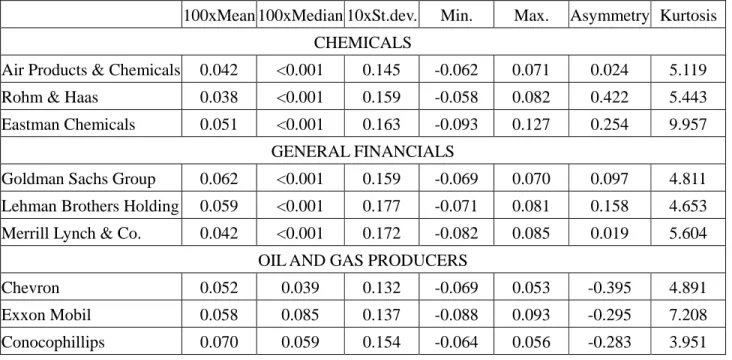
Three groups of three assets from three different sectors (B=3 and M=9) are used, namely Chemical, General Financials, and Oil and Gas Producers. Table 1 reports the selected
stocks and a descriptive analysis of their returns. These assets have been selected from
among a small list of the largest companies between each sector on the basis of the
correlations between the squared returns. All the selected stocks belong to the large cap
segment of the NYSE, and enter the S&P 500 index. Given the approach followed in the
asset selection, intuitively there possibly exist common patterns in the variances. We
chose such a selection approach in order to provide an example where the proposed
modelling approach may be useful. We believe that the block structur MSV model may be
characterized by low correlations.
The series considered are total return indices, collected in the sample period 2 January
2002 to 10 April 2007, giving T=1375 observations. Note that the period covered excludes the effects of the technology market drawdown, while it may be influenced by
the wars in Afghanistan and Iraq and by the increasing trend in oil prices. Furthermore, we
exclude the global financial crisis period.
Table 1 reports a preliminary descriptive analysis of the 9 stocks, showing that in the
period considered the average returns are positive (the stock market was characterized by
an upward trend in prices), and very close between assets of the same sector, while there is
a slight difference between sectors: the chemical sector has lower returns than the general
financial sector which is, in turn, dominated by the oil and gas producer sector. This is a
somewhat expected result, given the relevant increase in the oil prices in the later years of
the sample. The standard deviations of the oil sectors are the smallest, while the General
Financial sector has the highest risk. The Chemical sector has the most leptokurtic
densities; the Oil and Gas Produces stocks are negatively skewed, while the others are all
positively skewed, a fact that is also reflected in the median returns.
The correlations within each sector are quite high, around 0.65 for the Chemical sector,
about 0.8 for the General Financial stocks, and close to 0.75 for the Oil and Gas Producers
firms. Between sectors, the correlations are lower and vary between 0.32 and 0.54.
Notably, the correlations between assets of different sectors have a block-like structure:
higher than the correlations between a chemical and an oil producer firm, at around 0.4.
Finally, the correlations between a general financial firm and an oil producer firm are
again close to 0.4.
In order to develop the conditional mean for each return, we used the following data sets;
a set of interest rates (US Treasury bond 3 months, 6 months, 9 months, 1-3 years, 3-5
years, 5-7 years), oil prices, and two dummies (January and Monday). Interest rates are in
the form of bond indices. Following Ait-Sahalia and Brandt (2001) and Pesaran and
Timmerman (1995, 2000), we fit the conditional mean returns with the constant term, the
lagged return, the contemporaneous dummies, the lagged Oil returns, and the deviations
between the returns of the rates (the following differences between bond indices returns: 6
months minus 3 months, 1-3 years minus 6 months, and so on), giving 10 explanatory
variables, as follows:
1 2 1 3 4 5 6 1 10 5Jan Mon Oil
t t t t t t t
E R
R
D
D
R
V
V .The deviations between the rates, Vit, can be considered as a proxy for the curvature of the yield curve, and hence may be useful in predicting stock movements.
In the proposed equation, the curvature of the yield curve and the oil returns are
contemporaneous. Clearly, the model may suffer from simultaneity problems, given that
the explanatory variables may be predictable, and we are not including an appropriate
equation for their behaviour. In order to validate the returns model, we run a set of
bidirectional causality. In the first case, we run standard causality tests based on a lagged
relation between variables for all pairs of stock returns and explanatory variables. In all
cases we have limited evidence of causality (few tests have p-values below 0.2, and none
is below 0.05).
In order to implement the bidirectional causality test, we estimated two simultaneous
systems, the restricted version without contemporaneous feedback from the explanatory
variables to the stocks. In this case (we have 54 restrictions, 6 restrictions on each
equation, the 5 variables related to the bonds and the oil price, for the 9 stocks), the
restricted likelihood is 97571.22, the full likelihood is 97605.34, and the LR test statistic
is 68.24. Assuming an asymptotic density following a chi-square distribution with 54
degrees of freedom, we have a p-value of 0.092. We interpret this result as a rejection of
the bidirectional causality (even if the decision was not extremely clear). Given the
outcome of the tests, we can safely run the analysis on the equation with a
contemporaneous relationship.
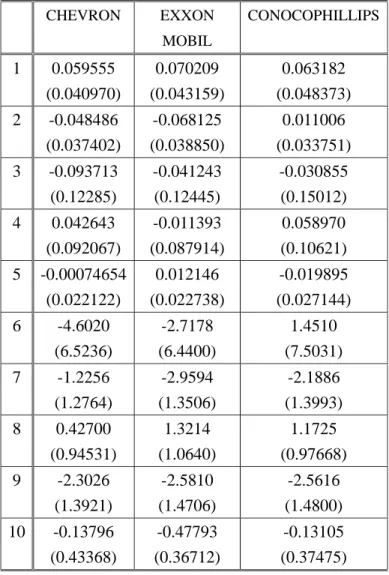
Table 2 gives the results for the conditional mean equation. The number in the first column
denotes the corresponding explanatory variable. For instance, #1 is the constant term, and
# 2 is the AR(1) coefficient. The heteroskedasticity consistent standard errors are given in
parentheses. Although most of the parameter estimates are insignificant, there are some
exceptions, such as Rt and V2t for AIR PRDS. & CHEMS.
For the volatility equation, we first estimated the univariate SV models defined in
estimates of for the financial sector are relatively low, the estimates are typical of those available in the literature for SV models. Furthermore, we note a similarity between the
volatility constants, σ, associated with the stocks belonging to the same sector.
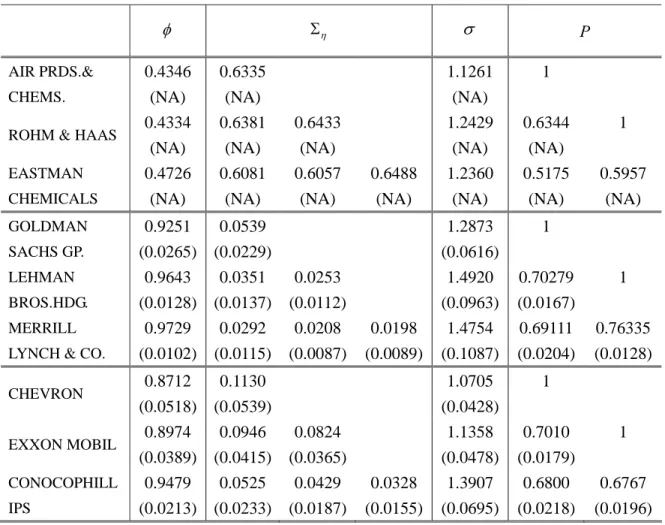
We also estimated the basic trivariate SV models (2) and
Error! Reference source not found. for the three sectors, and Table 4 presents the results.
By introducing the off-diagonal elements of and P, the estimates of are smaller than the corresponding estimates in Table 3 for all the sectors. The correlation coefficients
based on are very high and replicate the ordering of Table 1, with the Chemical sector characterized by lower correlations between assets. As the estimate for is very close
to a singular matrix for the chemical sector, the standard errors are unreliable, and hence
are not reported. As the values of are close to each other in each sector, and since the estimates of indicate the existence of common movements in t, we need to consider common structures by using factor models and/or the BS models.
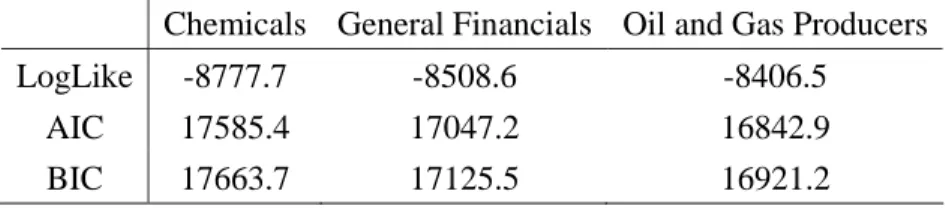
Table 5 shows the log-likelihood, AIC and BIC for the trivariate SV model. Comparing
these values with those in Table 3, we conduct an LR test for the off-diagonal elements of
and P. The test statistic has a
2
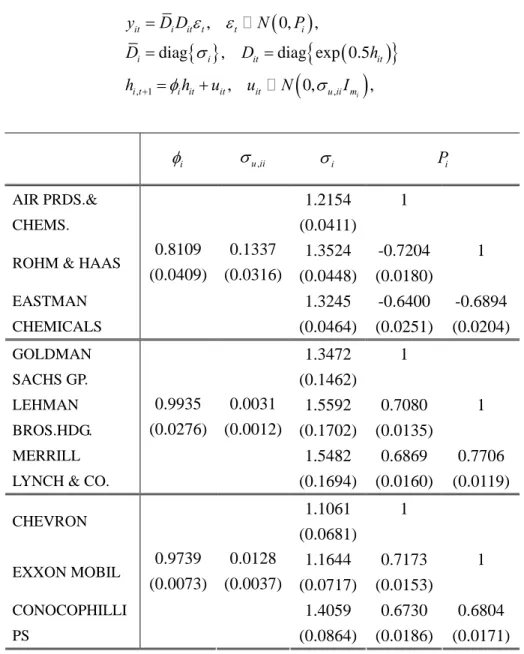
6 asymptotic density, and we are able to reject the null hypothesis that all the off-diagonal elements of and P are equal to zero for all three sectors.the three sectors. Table 6 shows the MCL results for the one-block model. Due to the BS
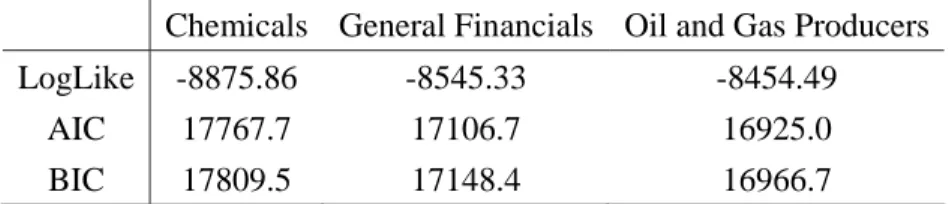
approach, the estimates of are less than the smallest values of the corresponding sector in Table 3. Table 7 gives the log-likelihood, AIC and BIC for the one-block model. The
one-block model for the chemical sector has smaller AIC and BIC values than the basic
MSV model in (2) and Error! Reference source not found.. For the remaining two
sectors, BIC favours the one-block model, while AIC chooses the basic MSV model. As a
result, we find that the BS approach would be a good candidate for effectively reducing
the number of parameters for high dimensional models.
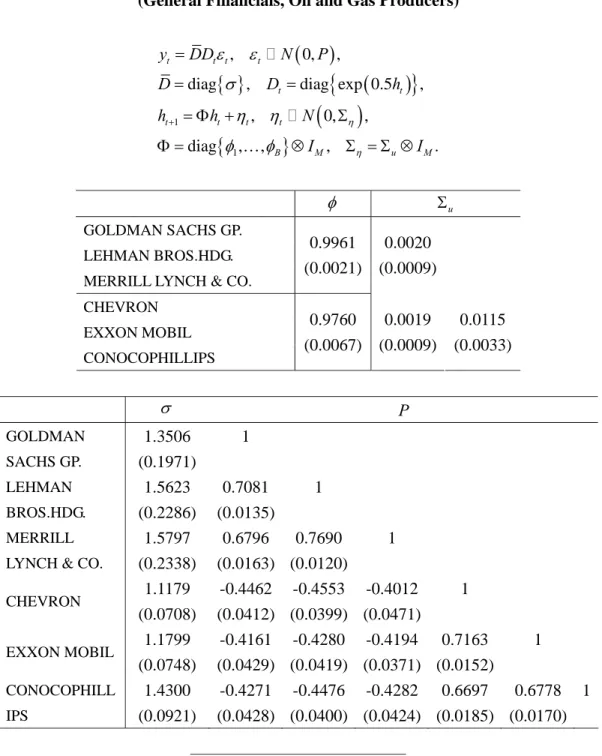
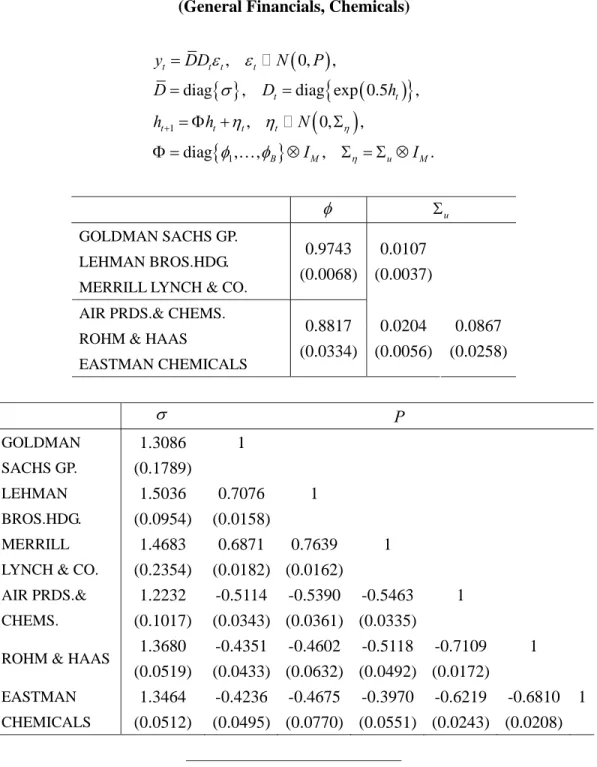
Next, we consider the 6-variate SV model with 2 blocks. Tables 8-10 show the MCL
estimates for the combination of sectors {(General Financials, Oil and Gas Producers),
(General Financials, Chemicals) and (Oil and Gas Producers, Chemicals)}. With respect
to Tables 9 and 10, the estimates of became relatively low by including the chemical sector. Finally, we report in Table 11 the estimates of the full 9-variate model with three
blocks associated with the three economic sectors. The parameter estimates are in line
with those reported in Tables 8-10.
A direct comparison of the BS specifications with the full model estimate is not directly
available due to the computation complexity of the 6-variate and 9-variate full models.
Only three-variate specifications are available, both in their full and BS specifications,
and standard likelihood ratio tests clearly favour the full models. However, when the
cross-sectional dimensions increase, the BS specifications remain feasible, while the full
SV models are not. This is a particularly strong advantage of the model presented in the
innovations as the matrices P and are not restricted to be diagonal or block-diagonal.
A more detailed comparison of the full and BS specifications for stochastic volatility
models is left to future research.
4. Conclusion
In this paper we presented a class of multivariate stochastic volatility models which is
nested in the model of Harvey et al. (1994). A distinctive feature of our model is that,
contrary to fully parameterized MSV models, it remains feasible in moderate to large
cross-sectional dimensions. This result is achieved by imposing a block structure on the
model parameter matrices. The variables could be grouped by using some economic or
financial criteria, or could follow data-driven classifications. In addition, by the
introduction of blocks, if these have an economic interpretation, the model proposed
preserves the interpretation of the coefficients, a feature which is generally lost in feasible
MSV models.
We also presented an empirical application where the proposed model was estimated for a
set of US equities, showing its feasibility. A more advanced comparison between the BS
References
Ait-Sahalia, Y., and M.W. Brandt (2001), Variable selection for portfolio choice, Journal
of Finance, 54-4, 1297-1351
Asai, M. and M. McAleer (2006), Asymmetric multivariate stochastic volatility,
Econometric Reviews, 25, 453-473.
Asai, M. and M. McAleer (2009), The structure of dynamic correlations in multivariate
stochastic volatility models, Journal of Econometrics, 150, 182--192.
Asai, M., M. McAleer and J. Yu (2006), Multivariate stochastic volatility: A review,
Econometric Reviews, 25, 145-175.
Andersen, T.G. (1994), Stochastic autoregressive volatility: A framework for volatility
modeling, Mathematical Finance, 4, 75-102.
Bauwens, L., S. Laurent and J.V.K. Rombouts (2006), Multivariate GARCH: A survey,
Journal of Applied Econometrics, 21, 79-109.
Billio, M., M. Caporin and M. Gobbo, (2006), Flexible dynamic conditional correlation
multivariate GARCH for asset allocation, Applied Financial Economics Letters, 2,
Bollerslev, T., R.F. Engle and J.M. Wooldridge, (1988), A capital asset pricing model with
time varying covariances, Journal of Political Economy, 96, 116-131
Bollerslev T., (1990), Modelling the coherence in short-run nominal exchange rates: A
multivariate generalized ARCH approach, Review of Economic and Statistics, 72,
498-505.
Chib, S., F. Nardari and N. Shephard (2006), Analysis of high dimensional multivariate
stochastic volatility models, Journal of Econometrics, 134, 341-371.
Ding, Z. and R.F. Engle, (2001), Large scale conditional covariance matrix modeling,
estimation and testing, Academia Economic Papers, 29-2, 157-184.
Durbin, J. and S.J. Koopman (1997), Monte Carlo maximum likelihood estimation for
non-Gaussian state space models, Biometrika, 84, 669-684.
Engle, R.F. (2002), Dynamic conditional correlations - a simple class of multivariate
GARCH models, Journal of Business and Economic Statistics, 20, 339-350.
Engle R.F. and K.F. Kroner (1995), Multivariate simultaneous generalized ARCH,
Econometric Theory, 11, 122-150.
Fleming, J., C. Kirby and B. Ostdiek (2001), The economic value of volatility timing,
Harvey, A.C., E. Ruiz and N. Shephard (1994), Multivariate stochastic variance models,
Review of Economic Studies, 61, 247-264.
Hull, J. and A. White (1998), Incorporating volatility up-dating into the historical
simulation method for VaR, Journal of Risk, 1, 5-19.
Jacquier, E., N.G. Polson and P.E. Rossi (1995), Models and priors for multivariate
stochastic volatility, CIRANO Working Paper No. 95s-18, Montreal.
Jacquier, E., N.G. Polson and P.E. Rossi (1999). Stochastic volatility: univariate and
multivariate extensions, CIRANO Working paper 99s-26, Montreal.
Lehar, A., M. Scheicher and C. Schittenkopf (2002), GARCH vs. stochastic volatility:
Option pricing and risk management, Journal of Banking and Finance, 23, 323-345.
Ling, S. and M. McAleer (2003), Asymptotic theory for a vector ARMA-GARCH model,
Econometric Theory, 19, 278-308.
McAleer, M. (2005), Automated inference and learning in modeling financial volatility,
Econometric Theory, 21, 232-261.
Pesaran, M.H. and A. Timmerman (1995), Predictability of stock returns: Robustness and
Pesaran, M.H. and A. Timmerman (2000), A recursive modeling approach to predict UK
stock returns, Economic Journal, 110-460, 159-191.
Sandmann, G. and S.J. Koopman (1998), Estimation of stochastic volatility models via
Monte Carlo maximum likelihood, Journal of Econometrics, 87, 271-301.
Taylor, S.J. (1986), Modelling Financial Time Series, Chichester, Wiley.
Tse, Y.K. and A.K.C. Tsui, (2002), A multivariate GARCH model with time-varying
Table 1: Descriptive Statistics, and Covariance and Correlation Matrices
Panel a: Descriptive Statistics
100xMean 100xMedian 10xSt.dev. Min. Max. Asymmetry Kurtosis CHEMICALS
Air Products & Chemicals 0.042 <0.001 0.145 -0.062 0.071 0.024 5.119 Rohm & Haas 0.038 <0.001 0.159 -0.058 0.082 0.422 5.443 Eastman Chemicals 0.051 <0.001 0.163 -0.093 0.127 0.254 9.957
GENERAL FINANCIALS
Goldman Sachs Group 0.062 <0.001 0.159 -0.069 0.070 0.097 4.811 Lehman Brothers Holding 0.059 <0.001 0.177 -0.071 0.081 0.158 4.653 Merrill Lynch & Co. 0.042 <0.001 0.172 -0.082 0.085 0.019 5.604
OIL AND GAS PRODUCERS
Chevron 0.052 0.039 0.132 -0.069 0.053 -0.395 4.891
Exxon Mobil 0.058 0.085 0.137 -0.088 0.093 -0.295 7.208
Conocophillips 0.070 0.059 0.154 -0.064 0.056 -0.283 3.951
Panel b: Covariance and Correlation Matrices
1 2 3 4 5 6 7 8 9 1 0.00021 0.73269 0.61095 0.53726 0.51572 0.52548 0.40045 0.46694 0.35719 2 0.00017 0.00025 0.67517 0.53321 0.51677 0.52087 0.39271 0.46088 0.32575 3 0.00014 0.00017 0.00026 0.46894 0.45004 0.46141 0.38057 0.42790 0.32588 4 0.00012 0.00014 0.00012 0.00025 0.82244 0.80014 0.37420 0.42386 0.33972 5 0.00013 0.00015 0.00013 0.00023 0.00031 0.79181 0.38655 0.42824 0.34614 6 0.00013 0.00014 0.00013 0.00022 0.00024 0.00030 0.39852 0.44392 0.34378 7 0.00008 0.00008 0.00008 0.00008 0.00009 0.00009 0.00017 0.81550 0.76500 8 0.00009 0.00010 0.00010 0.00009 0.00010 0.00010 0.00015 0.00019 0.74794 9 0.00008 0.00008 0.00008 0.00008 0.00009 0.00009 0.00015 0.00016 0.00024
Note: The numbers in the first column and first row identify the assets following the asset order included in the first panel. The main diagonal contains the variances, the lower triangular portion of the matrix contains the covariances, and the upper part contains the correlations. Entries in bold identify correlations between assets belonging to the same group.
Table 2: OLS Estimates for AR(1)+X Filter
1 2 1 3 4 5 6 1 10 5Jan Mon Oil
t t t t t t t E R
R
D
D
R
V
V AIR PRDS.& CHEMS. ROHM & HAAS EASTMAN CHEMICALS GOLDMAN SACHS GP. LEHMAN BROS.HDG. MERRILL LYNCH & CO. 1 0.052257 (0.046047) 0.084552 (0.050201) 0.067398 (0.050442) 0.054578 (0.050055) 0.039213 (0.056137) 0.080864 (0.052324) 2 -0.077430 (0.037420) -0.069550 (0.035631) -0.018482 (0.038766) -0.024159 (0.032569) -0.016149 (0.031604) 0.021568 (0.032707) 3 -0.074751 (0.13259) -0.14643 (0.14241) -0.31699 (0.16288) 0.010587 (0.12788) 0.090702 (0.13867) -0.13165 (0.14648) 4 0.014976 (0.090221) -0.11898 (0.099846) 0.084124 (0.10393) 0.088226 (0.10812) 0.065721 (0.12071) -0.095373 (0.11541) 5 0.013533 (0.024869) -0.028756 (0.025734) -0.027399 (0.028098) -0.033285 (0.026247) -0.018488 (0.029564) -0.046207 (0.028043) 6 3.1120 (6.4079) 2.8912 (7.2347) 8.4777 (7.3226) -0.38731 (7.0470) 6.3135 (7.8102) 0.78673 (7.5957) 7 -3.2335 (1.4022) -3.1210] (1.5698) -2.5573 (1.5909) -3.9432 (1.6209) -5.6362 (1.7475) -4.2337 (1.7772) 8 0.38499 (1.0361) -0.13320 (1.1541) -0.14864 (1.1445) 1.1068 (1.2072) 1.9268 (1.3164) 0.33607 (1.3198) 9 -2.6849 (1.4334) -2.7242 (1.6277) -3.0337 (1.5659) -4.7312 (1.6841) -3.6699 (1.9407) -4.3171 (1.8594) 10 -0.22876 (0.30836) 0.047840 (0.31261) 0.21566 (0.27479) 0.35943 (0.51958) 0.019772 (0.56653) 0.18090 (0.42547)Note: The explanatory variables are explained in the text. The heteroskedasticity consistent standard errors are given in parentheses.
Table 2 (Cont.): OLS Estimates for AR(1)+X Filter
1 2 1 3 4 5 6 1 10 5Jan Mon Oil
t t t t t t t E R
R
D
D
R
V
V CHEVRON EXXON MOBIL CONOCOPHILLIPS 1 0.059555 (0.040970) 0.070209 (0.043159) 0.063182 (0.048373) 2 -0.048486 (0.037402) -0.068125 (0.038850) 0.011006 (0.033751) 3 -0.093713 (0.12285) -0.041243 (0.12445) -0.030855 (0.15012) 4 0.042643 (0.092067) -0.011393 (0.087914) 0.058970 (0.10621) 5 -0.00074654 (0.022122) 0.012146 (0.022738) -0.019895 (0.027144) 6 -4.6020 (6.5236) -2.7178 (6.4400) 1.4510 (7.5031) 7 -1.2256 (1.2764) -2.9594 (1.3506) -2.1886 (1.3993) 8 0.42700 (0.94531) 1.3214 (1.0640) 1.1725 (0.97668) 9 -2.3026 (1.3921) -2.5810 (1.4706) -2.5616 (1.4800) 10 -0.13796 (0.43368) -0.47793 (0.36712) -0.13105 (0.37475)Note: The explanatory variables are explained in the text. The heteroskedasticity consistent standard errors are given in parentheses.
Table 3: MCL Estimates for Univariate SV Models
2
1 exp 0.5 , 0,1 , , 0, t t t t t t t t y h N h h N
LogLik AIC BICAIR PRDS.& CHEMS. 0.9221 (0.0346) 0.2418 (0.0670) 1.2607 (0.0598) -3002.03 6010.06 6025.72
ROHM & HAAS 0.7944 (0.0732) 0.4132 (0.0854) 1.3517 (0.0486) -3054.91 6115.82 6131.48 EASTMAN CHEMICALS 0.8234 (0.0477) 0.4563 (0.0628) 1.2933 (0.0546) -3029.88 6065.76 6081.41 GOLDMAN SACHS GP. 0.9626 (0.0199) 0.1494 (0.0450) 1.4251 (0.0819) -3015.25 6036.51 6052.17 LEHMAN BROS.HDG. 0.9806 (0.0095) 0.1197 (0.0299) 1.5830 (0.1335) -2968.64 5943.27 5958.93
MERRILL LYNCH & CO. 0.9929 (0.0046) 0.0740 (0.0193) 1.5414 (0.2060) -2964.94 5935.88 5951.54 CHEVRON 0.9575 (0.0158) 0.1543 (0.0308) 1.1952 (0.0629) -2903.96 5813.92 5829.58 EXXON MOBIL 0.9717 (0.0125) 0.1365 (0.0309) 1.1995 (0.0803) -2925.08 5856.16 5871.82 CONOCOPHILLIPS 0.9858 (0.0074) 0.0935 (0.0226) 1.3946 (0.1231) -2926.95 5859.90 5875.56
Table 4: MCL Estimates for Basic Trivariate SV Models
1 , 0, ,diag , diag exp 0.5 ,
, 0, t t t t t t t t t t y DD N P D D h h h N
P AIR PRDS.& CHEMS. 0.4346 (NA) 0.6335 (NA) 1.1261 (NA) 1ROHM & HAAS 0.4334 (NA) 0.6381 (NA) 0.6433 (NA) 1.2429 (NA) 0.6344 (NA) 1 EASTMAN CHEMICALS 0.4726 (NA) 0.6081 (NA) 0.6057 (NA) 0.6488 (NA) 1.2360 (NA) 0.5175 (NA) 0.5957 (NA) GOLDMAN SACHS GP. 0.9251 (0.0265) 0.0539 (0.0229) 1.2873 (0.0616) 1 LEHMAN BROS.HDG. 0.9643 (0.0128) 0.0351 (0.0137) 0.0253 (0.0112) 1.4920 (0.0963) 0.70279 (0.0167) 1 MERRILL LYNCH & CO.
0.9729 (0.0102) 0.0292 (0.0115) 0.0208 (0.0087) 0.0198 (0.0089) 1.4754 (0.1087) 0.69111 (0.0204) 0.76335 (0.0128) CHEVRON 0.8712 (0.0518) 0.1130 (0.0539) 1.0705 (0.0428) 1 EXXON MOBIL 0.8974 (0.0389) 0.0946 (0.0415) 0.0824 (0.0365) 1.1358 (0.0478) 0.7010 (0.0179) 1 CONOCOPHILL IPS 0.9479 (0.0213) 0.0525 (0.0233) 0.0429 (0.0187) 0.0328 (0.0155) 1.3907 (0.0695) 0.6800 (0.0218) 0.6767 (0.0196)
Note: Standard errors are given in parentheses. Given that is close to singular, the standard errors are unreliable and hence are not reported.
Table 5: AIC and BIC for Basic Trivariate SV Models
Chemicals General Financials Oil and Gas Producers LogLike -8777.7 -8508.6 -8406.5
AIC 17585.4 17047.2 16842.9
Table 6: MCL Estimates for One-Block Trivariate SV Models
, 1 , , 0, ,diag , diag exp 0.5
, 0, , i it i it t t i i i it it i t i it it it u ii m y D D N P D D h h h u u N I i u ii, i Pi AIR PRDS.& CHEMS. 1.2154 (0.0411) 1
ROHM & HAAS 1.3524
(0.0448) -0.7204 (0.0180) 1 EASTMAN CHEMICALS 0.8109 (0.0409) 0.1337 (0.0316) 1.3245 (0.0464) -0.6400 (0.0251) -0.6894 (0.0204) GOLDMAN SACHS GP. 1.3472 (0.1462) 1 LEHMAN BROS.HDG. 1.5592 (0.1702) 0.7080 (0.0135) 1 MERRILL LYNCH & CO.
0.9935 (0.0276) 0.0031 (0.0012) 1.5482 (0.1694) 0.6869 (0.0160) 0.7706 (0.0119) CHEVRON 1.1061 (0.0681) 1 EXXON MOBIL 1.1644 (0.0717) 0.7173 (0.0153) 1 CONOCOPHILLI PS 0.9739 (0.0073) 0.0128 (0.0037) 1.4059 (0.0864) 0.6730 (0.0186) 0.6804 (0.0171) Note: Standard errors are given in parentheses.
Table 7: AIC and BIC for One-Component Trivariate SV Models
Chemicals General Financials Oil and Gas Producers LogLike -8875.86 -8545.33 -8454.49
AIC 17767.7 17106.7 16925.0
Table 8: MCL Estimates for BS-MSV Models (General Financials, Oil and Gas Producers)
1 1 , 0, ,diag , diag exp 0.5 ,
, 0, , diag , , , . t t t t t t t t t t B M u M y DD N P D D h h h N I I u GOLDMAN SACHS GP. LEHMAN BROS.HDG. MERRILL LYNCH & CO.
0.9961 (0.0021) 0.0020 (0.0009) CHEVRON EXXON MOBIL CONOCOPHILLIPS 0.9760 (0.0067) 0.0019 (0.0009) 0.0115 (0.0033) P GOLDMAN SACHS GP. 1.3506 (0.1971) 1 LEHMAN BROS.HDG. 1.5623 (0.2286) 0.7081 (0.0135) 1 MERRILL LYNCH & CO.
1.5797 (0.2338) 0.6796 (0.0163) 0.7690 (0.0120) 1 CHEVRON 1.1179 (0.0708) -0.4462 (0.0412) -0.4553 (0.0399) -0.4012 (0.0471) 1 EXXON MOBIL 1.1799 (0.0748) -0.4161 (0.0429) -0.4280 (0.0419) -0.4194 (0.0371) 0.7163 (0.0152) 1 CONOCOPHILL IPS 1.4300 (0.0921) -0.4271 (0.0428) -0.4476 (0.0400) -0.4282 (0.0424) 0.6697 (0.0185) 0.6778 (0.0170) 1
LogLike AIC BIC -16939.6 33931.2 34066.9 Note: Standard errors are given in parentheses.
Table 9: MCL Estimates for BS-MSV Models (General Financials, Chemicals)
1 1 , 0, ,diag , diag exp 0.5 ,
, 0, , diag , , , . t t t t t t t t t t B M u M y DD N P D D h h h N I I u GOLDMAN SACHS GP. LEHMAN BROS.HDG. MERRILL LYNCH & CO.
0.9743 (0.0068)
0.0107 (0.0037)
AIR PRDS.& CHEMS. ROHM & HAAS
EASTMAN CHEMICALS 0.8817 (0.0334) 0.0204 (0.0056) 0.0867 (0.0258) P GOLDMAN SACHS GP. 1.3086 (0.1789) 1 LEHMAN BROS.HDG. 1.5036 (0.0954) 0.7076 (0.0158) 1 MERRILL LYNCH & CO.
1.4683 (0.2354) 0.6871 (0.0182) 0.7639 (0.0162) 1 AIR PRDS.& CHEMS. 1.2232 (0.1017) -0.5114 (0.0343) -0.5390 (0.0361) -0.5463 (0.0335) 1
ROHM & HAAS 1.3680 (0.0519) -0.4351 (0.0433) -0.4602 (0.0632) -0.5118 (0.0492) -0.7109 (0.0172) 1 EASTMAN CHEMICALS 1.3464 (0.0512) -0.4236 (0.0495) -0.4675 (0.0770) -0.3970 (0.0551) -0.6219 (0.0243) -0.6810 (0.0208) 1
LogLike AIC BIC -17311.2 34674.5 34810.2 Note: Standard errors are given in parentheses.
Table 10: MCL Estimates for BS-MSV Models (Oil and Gas Producers, Chemicals)
1 1 , 0, ,diag , diag exp 0.5 ,
, 0, , diag , , , . t t t t t t t t t t B M u M y DD N P D D h h h N I I u CHEVRON EXXON MOBIL CONOCOPHILLIPS 0.9597 (0.0101) 0.0178 (0.0051)
AIR PRDS.& CHEMS. ROHM & HAAS
EASTMAN CHEMICALS 0.8413 (0.0353) 0.0150 (0.0054) 0.1080 (0.0261) P CHEVRON 1.1108 (0.0555) 1 EXXON MOBIL 1.1688 (0.0595) 0.7245 (0.0154) 1 CONOCOPHILL IPS 1.4075 (0.0734) 0.6777 (0.0191) 0.6883 (0.0174) 1 AIR PRDS.& CHEMS. 1.2169 (0.0436) -0.3623 (0.0687) -0.4741 (0.0409) -0.4139 (0.0478) 1
ROHM & HAAS 1.3572 (0.0190) -0.5088 (0.0365) -0.4591 (0.0386) -0.4648 (0.0375) -0.7127 (0.0177) 1 EASTMAN CHEMICALS 1.3285 (0.0477) -0.3989 (0.0520) -0.4789 (0.0396) -0.3859 (0.0551) -0.6237 (0.0252) -0.6810 (0.0207) 1
LogLike AIC BIC -17260.4 34572.7 34708.4 Note: Standard errors are given in parentheses.
Table 11: MCL Estimates for BS-MSV Models (General Financials, Oil and Gas Producers, Chemicals)
1 1 , 0, ,diag , diag exp 0.5 ,
, 0, , diag , , , . t t t t t t t t t t B M u M y DD N P D D h h h N I I u GOLDMAN SACHS GP. LEHMAN BROS.HDG. MERRILL LYNCH & CO.
0.9873 (0.0058) 0.0043 (0.0012) CHEVRON EXXON MOBIL CONOCOPHILLIPS 0.9618 (0.0094) 0.0019 (0.0012) 0.0171 (0.0049)
AIR PRDS.& CHEMS. ROHM & HAAS
EASTMAN CHEMICALS 0.8598 (0.0489) 0.0096 (0.0040) 0.0143 (0.0052) 0.0902 (0.0326)
LogLike AIC BIC -25660.0 51428.0 51709.8