Performance-Sensitive Debt
∗Gustavo Manso† Bruno Strulovici‡
Alexei Tchistyi§ March 5, 2010
forthcoming in The Review of Financial Studies
Abstract
This paper studies performance-sensitive debt (PSD), the class of debt obligations whose interest payments depend on some measure of the borrower’s performance. We demonstrate that the existence of PSD obligations cannot be explained by the trade-off theory of capital structure, as PSD leads to earlier default and lower equity value compared to fixed-rate debt of the same market value. We show that, consistent with the pecking order theory, PSD can be used as an inexpensive screening device, and we find empirically that firms choosing PSD loans are more likely to improve their credit ratings than firms choosing fixed-interest loans. We also develop a method to value PSD obligations allowing for general payment profiles and obtain closed-form pricing formulas for step-up bonds and linear PSD.
JEL Classification: G32, G12
Keywords: Capital Structure, Financial Innovation, Step-up bonds, Performance-Pricing
Loans, Default, Efficiency, Screening
∗We are extremely grateful to Darrell Duffie for insightful comments and advice throughout the development
of the paper. We also thank Paul Asquith, Antje Berndt, Jos´e Blanchet, Albert Chun, Peter DeMarzo, Michael Harrison, Allan Mortensen, John Roberts, Antoinette Schoar, Ilhyock Shim, Joe Weber, Robert Wilson, three anonymous referees, the Editor, and seminar participants at University of Maryland, University of Lausanne, Vienna University of Economics and Business Administration, the 2006 WFA conference, and at the Finance 622 class project at Stanford University for helpful comments and Sulinya Ramanan and Daniel Chen for excellent research assistance. E-mail: [email protected], [email protected], [email protected].
†MIT Sloan School of Management. ‡Northwestern University.
1
Introduction
This paper studiesperformance-sensitive debt (PSD), the class of debt obligations whose interest payments depend on some measure of the borrower’s performance. For instance, step-up bonds compensate credit rating downgrades with higher interest rates and credit rating upgrades with lower interest rates.1 The vast majority of PSD obligations charge a higher interest rate as the borrower’s performance deteriorates. We refer to such obligations as risk-compensating PSD obligations.
This paper addresses two questions. Why do firms issue PSD obligations? How should PSD obligations be valued? We propose a method to price PSD obligations and use it to prove that, in a setting with no market imperfections other than bankruptcy costs and tax benefits of debt, risk-compensating PSD schemes have an overall negative effect on the issuing firm. Thus, the existence of risk-compensating PSD obligations cannot be explained by the popular trade-off theory of capital structure and should be explained by other market frictions. We show that PSD obligations can be used as a screening device in a setting with asymmetric information. Using data on loan contracts between 1995 and 2005 from Thomson Financial’s SDC database, we find that firms whose loans have performance pricing provisions are more likely to be upgraded and less likely to be downgraded one year after the closing date of the loan than firms with fixed-interest loans.
Our paper builds on Leland (1994), in which the firm’s equityholders choose the default time that maximizes the equity value of the firm. We model performance-sensitive debt as a function
C : Π 7→ R+ mapping some performance measure π to the interest rate C(π). In this setting, the equity value associated with a given PSD profile satisfies an ordinary differential equation. We obtain closed-form pricing of PSD in important special cases, including step-up bonds with an arbitrary number of rating triggers. Considering general diffusions allows one to model such stochastic features as mean reversion of the cash-flow process or the negative relation between cash-flow volatility and level.2
For PSD obligationsC and Dthat are based on the same performance measure, we say that
1The term “step-up bonds” has dual use. We use it only to refer to performance-sensitive issues. The term is
sometimes also used to denote bonds with time-dependent coupons.
2Bhattacharya (1978) is an early advocate of the explicit consideration of mean-reverting cash flows in financial
models. Sarkar and Zapatero (2003) show that some predictions of the trade-off theory (the positive relation between earnings and leverage) can be reversed when one allows for mean-reverting cash flows, reconciling the
trade-off theory with empirical facts. For the negative relation between cash-flow volatility and level, see for example Myers (1977), Froot, Scharfstein, and Stein (1993), and Smith and Stulz (1985).
C ismore risk compensating thanDifC−D is non-increasing and non-constant. We prove that if C and D raise the same amount of cash, and if C is more risk compensating than D, then C
is less efficient than D, in the sense thatC induces an earlier default time, which means a higher present value of bankruptcy costs and lower equity equity value. In particular, a PSD obligation is less efficient than a debt obligation with a fixed interest rate of the same market value.
To explain the existence of risk-compensating PSD, we develop a screening model,3 in which the future growth rate of the firm is unknown to the market, but known to the firm’s manager. We demonstrate that there exist separating equilibria, in which the high-growth firm issues a risk-compensating PSD obligation, while the growth firm issues fixed-interest debt. The low-growth firm does not want to mimic the high-low-growth firm because for a given risk-compensating PSD obligation the low-growth firm will likely pay higher interest in the future than the high-growth firm. As it separates different types through different interest payments, not through different bankruptcy costs, issuing a risk-compensating PSD is an inexpensive way for the high-growth-type firm to signal its type.4
The separating equilibrium studied here is related to the pecking-order theory, first introduced by Myers (1984) and Myers and Majluf (1984).5 We show that PSD can be less sensitive to the private information of the firm than fixed-interest debt. Therefore, risk-compensating PSD is preferred to fixed-interest debt.
Our screening hypothesis predicts that high-growth firms issue risk-compensating PSD obliga-tions to separate themselves from low-growth firms. Issuing a risk-compensating PSD obligation should thus be followed by an improvement in the credit rating of the issuing firm. To test this prediction, we obtain bank loan data on 5,020 loans to public firms between 1995 and 2005 from
3Previous research has studied the use of financial securities for signaling or screening purposes. See, for example,
Ross (1977), Leland and Pyle (1977), Myers (1984), Myers and Majluf (1984), and DeMarzo and Duffie (1999). These studies, however, restrict themselves to a static setting and fixed-interest debt. Flannery (1986) and Diamond (1991) study signaling through the choice of debt maturity. Sannikov (2009) studies dynamic screening with increasing lines of credit and fixed-interest debt. Hennessy, Livdan, and Miranda (2009) study a repeated signaling setting in which the type of the firm changes over time and the firm can borrow by issuing equity or one-period debt.
4This result relates our paper to the literature on non-dissipative signaling. See, for example, Bhattacharya
(1980).
5Several papers have found empirical evidence supporting the predictions of the pecking-order theory. For
example, Asquith and Mullins (1986) find that a stock issue drives down the stock price by roughly 3%. Dierkens (1991) and D’Mello and Ferris (2000) find that the price impact of a stock issue announcement is greater for firms in which the information asymmetry is large. Eckbo (1986) and Shyam-Sunder (1991) find that the announcement of a debt issue has a smaller downward impact on stock price than the announcement of an equity issue.
Thomson Financial’s SDC database. Approximately 40% of our sample consists of loans with per-formance pricing provisions. Controlling for firm and loan characteristics, we show that borrowers whose loans have performance pricing provisions are more likely to be upgraded and less likely to be downgraded one year after the closing date of the loan than borrowers with fixed-interest loans. This result supports our screening hypothesis, since a prediction of our model is that in equilibrium high-growth borrowers issue risk-compensating PSD, while low-growth borrowers issue fixed-interest debt. The result is robust to a variety of empirical specifications.
Models of the valuation of risky debt can be divided into two classes. Our model belongs to the class that treats a firm’s liabilities as contingent claims on its underlying assets, and bankruptcy as an endogenous decision of the firm. This class includes Black and Cox (1976), Fischer, Heinkel, and Zechner (1989), Leland (1994), Leland and Toft (1996) and Duffie and Lando (2001). In the second class of models, bankruptcy is not an endogenous decision of the firm. There is either an exogenous default boundary for the firm’s assets (see Merton (1974) and Longstaff and Schwartz (1995)), or an exogenous process for the timing of bankruptcy, as described in Jarrow and Turnbull (1995), Jarrow, Lando, and Turnbull (1997) and Duffie and Singleton (1999).
Das and Tufano (1996), Acharya, Das, and Sundaram (2002), Houweling, Mentink, and Vorst (2004), and Lando and Mortensen (2005) obtain pricing formulas for step-up bonds using the second class of models of the valuation of risky debt. Since they examine only an exogenous default process, the effect of performance-sensitive debt on the default time is not apparent in their models.
The remainder of the paper is organized as follows. Section 2 introduces our general model and formalizes the notion of PSD. Section 3 analyzes the case of asset-based PSD obligations, demonstrating their relative efficiency. In Section 4, we explicitly derive the valuation of linear PSD obligations. Section 5 deals with general performance measures, and solves for the case of ratings-based PSD. Section 6 demonstrates that risk-compensating PSD can be used as a screening device in a setting with asymmetric information. Section 7 contains the empirical analysis. Section 8 discusses other reasons that may explain the existence of different types of PSD and extensions of the analysis. Section 9 concludes. All proofs are in the Appendix.
2
The General Model
We consider a generalization of the optimal liquidation models of Fischer, Heinkel, and Zechner (1989) and Leland (1994). A firm generates after-tax cash flows at the rateδt, at each timet. We
assume that δ is a diffusion process governed by the equation
dδt=µδ(δt)dt+σδ(δt)dBt, (1)
whereµδandσδ satisfy the classic assumptions for the existence of a unique strong solution to (1)
and B is the standard Brownian motion.
Agents are risk neutral and discount future cash flows at the risk-free interest rate r. The expected discounted value of the firm at time tis
At=Et Z ∞ t e−r(s−t)δsds <∞ (2)
which is finite if the growth rate µδ is less than the discount rate r. By the Markov property,At
only depends on cash-flow history through the current cash-flow δt, implying that{At}t≥0 is also a diffusion with some drift µand volatility σ:
dAt=µ(At)dt+σ(At)dBt. (3)
The asset levelAt is increasing in the current cash flowδt (this intuitive statement is proved
in the Appendix). Therefore, there exists an increasing functionδ :R→Rsuch that current cash flow is a function of current asset level: δt=δ(At).
We consider a performance measure represented by a stochastic process{πt}t≥0 taking values in some ordered space Π. The performance πt can be any statistic measuring the firm’s ability
and willingness to serve its debt obligations in the future. Financial ratios and credit ratings are among commonly used performance measures.
A performance-sensitive debt (PSD) obligation is a claim on the firm that promises a non-negative payment rate that may vary with the performance measure of the firm. Formally, a PSD obligation C(·) is a functionC : Π→R, such that the firm paysC(πt) to the debtholders at time t.6 For example, the consol bond of Leland (1994) is a degenerate case of PSD. The reader should note that, while our earlier sections dealt mostly with “risk-compensating” PSD (that pay higher coupons when performance worsens), our definition encompasses more general kinds of PSD. It is also worth noting that C represents the total debt payment. If the firm has a complex capital structure that includes various issues of PSD obligations and also fixed-coupon debt, then C(πt)
6We are considering perpetual debt, which is a standard simplifying assumption for the endogenous default
framework. See, for example, Leland (1994). However, our model can be extended to the case of finite average debt maturity, if we assume that debt is continuously retired at par at a constant fractional rate. See Leland (1998) for more on this approach.
is the sum of the payments for each of the firm’s obligations at timet given7 the performanceπt.
In other words, a combination of PSD obligations is a PSD obligation.
Given a PSD obligationC, the firm’s optimal liquidation problem is to choose a default time b
τ to maximize its initial equity valueWC
0 , given the debt structure C. That is,
W0C ≡sup b τ∈T E "Z τb 0 e−rt[δt−(1−θ)C(πt)]dt # , (4)
where T is the set of Ft stopping times, θ is the corporate tax rate, and (1−θ)C(πt) is the
after-tax effective coupon rate. Ifτ∗ is the optimal liquidation time, then the market value of the equity at time t < τ∗ is WtC =Et "Z τ∗ t e−r(s−t)[δs−(1−θ)C(πs)]ds # . (5)
Analogously, the market value UC
t of the PSD obligation C at timet is
UtC ≡Et "Z τ∗ t e−r(s−t)C(πs) ds # +Et h e−r(τ∗−t)(Aτ∗−ρ(Aτ∗)) i , (6)
where ρ(A) is the bankruptcy cost. We assume thatρ(A) is increasing in A and is less than the asset level at time of default.
Ifδtis lower than (1−θ)C(πt), equityholders have a net negative dividend rate.8 Equityholders
will continue to operate a firm with a negative dividend rate if the firm’s prospects are good enough to compensate for the temporary losses.
3
Asset-Based PSD
Since the market valueA of assets is a time-homogeneous Markov process, the current asset level
At is the only state variable in our model, and any measure of the borrower’s earnings prospect
at time t is determined solely by At. Therefore, the asset level At itself can be taken as the
performance measure. An asset-based PSD is a PSD whose coupon rate C(At) depends only on
the current asset level.
7If different PSD obligations issued by the firm depend on different performance measures, the total debt payment
by the firm can be represented as PSD that depends on a single performance measure. This is possible because, as we will see later, any relevant performance measure can be described by the current asset level and the asset level at which the firm goes bankrupt.
8Limited liability is satisfied if the negative dividend rate is funded by dilution – for example, through share
3.1 Valuation
Given an asset-based PSD, the initial value of the equity is:9
W(A0)≡sup b τ∈T E "Z bτ 0 e−rt[δ(At)−(1−θ)C(At)] dt # .
The optimal default time is of the formτ∗=τ(A
B), whereτ(A) denotes the first (“hitting”) time
that the asset level hits the threshold A. Therefore, the equityholders’ optimal problem can be expressed as: W(x) = sup y<x ˜ W(x, y), (7) where ˜ W(x, y)≡Ex "Z τ(y) 0 e−rt[δ(At)−(1−θ)C(At)]dt # .
The function ˜W(x, y) represents the equity value if shareholders decided to default at the threshold
y and the current asset value is x. We assume that C grows at most linearly in x and require that C be right-continuous with left limits. The exact technical conditions and the proof of the following theorem are provided in the Appendix. In what follows, ¯xis the asset level below which the coupon payment rate exceeds the cash-flow rate, as defined in Condition 3 of the Appendix. Theorem 1 Optimal default triggering levelAB and corresponding equity value W(x) are
char-acterized by the following conditions: (i) AB ∈(0,x¯).
(ii) W is continuously differentiable andW0 is bounded and left and right differentiable.
(iii) W is equal to zero on [0, AB]and satisfies the following ODE at any point of continuity of C: 1 2σ 2(x)W00(x) +µ(x)W0(x) −rW(x) +δ(x)−(1−θ)C(x) = 0. (8) for x≥AB.
Continuous differentiability ofW and the fact thatW vanishes on [0, AB] imply thatW0(AB) =
0, which is known as the smooth-pasting condition. Theorem 1 provides a method for solving the firm’s optimal liquidation problem.
1. Determine the set of continuously differentiable functions that solve ODE (8) at every continuity point of C. It can be shown that any element of this set can be represented with two parameters,10 say L1 and L2.
2. Determine AB,L1, and L2 using the following conditions:
a. W(AB) = 0.
b. W0 is bounded. c. W0(A
B) = 0.
d. AB∈(0,x¯).
We interpret (a) as the boundary condition of the solution at the pointAB. Condition (b) says
that W0(x) remains bounded as the asset level gets arbitrarily large, and constitutes the second boundary condition of the solution. The smooth-pasting condition (c) is a first-order optimization condition that defines the optimal bankruptcy boundary. Condition (d) ensures that, with the solution found above, default occurs when coupon payments are higher than the cash-flow rate. Necessity is an important part of Theorem 1, establishing that the optimal stopping rule can be determined by resolution of (8). In particular, Theorem 1 implies that the value function is continuously differentiable and not merely a “viscosity solution” of the optimal control problem faced by equityholders.
Using the fact that the sum of the equity value, the PSD value, and the expected losses resulting from the bankruptcy is the sum of the asset level and the present value of the tax benefits,11 we obtain the PSD pricing formula:
U(At) =
1
1−θ[At−W (At)−[ρ(AB) +θ(AB−ρ(AB))]ξ(At, AB)] (9)
where ξ(x, y) = Ex[e−τ(y)r] is the expected discount factor between current time and default,
when current asset level is x and default triggering level isy.
10In fact, we really consider here solutions of coupled equations (36) and (37), which boil down to the ODE (8)
at any continuity point of C. One can easily check that the set of solutions of the coupled equations is still a two-dimensional vector space.
11Bankruptcy cost is ρ(A
B)ξ(At, AB). The tax benefits are given by T B(At) = R τ(AB)
0 e
−rtθC(A t)dt =
3.2 The Relative Efficiency of Asset-Based PSD
In this subsection, we derive a partial order, by “efficiency,” among alternative PSD issues that raise the same amount of cash. We need the following definitions and condition, that we state in terms of a general performance measure π. These will also be used in Section 5 for the case of credit ratings.
Definition 1 (Relative Efficiency). LetC and D be PSD that raise the same funds, U0C =U0D. We say that C is less efficient than Dif it determines a lower equity price, that is, if WC
0 < W0D.
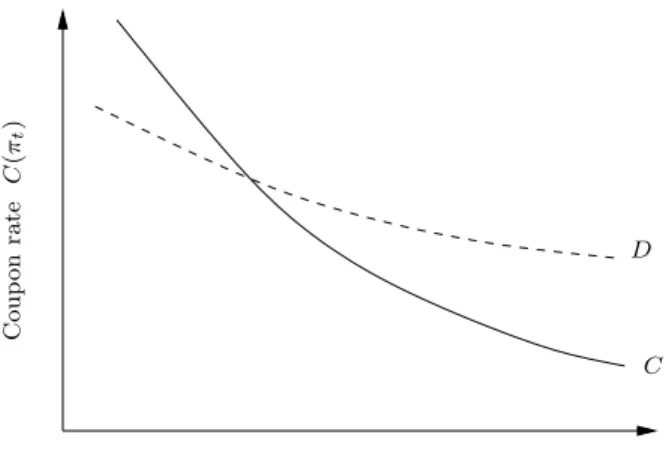
Definition 2 (Risk Compensating). LetC andD be PSD issues based on the same performance measure. We say that C is more risk compensating than D if C−D is a non-increasing, not constant function.
A fixed-coupon bond is a natural benchmark to compare PSD obligations. We will refer to PSD obligations that are more risk compensating than a fixed-coupon bond simply as risk-compensating PSD obligations.
Figure 1 illustrates the “risk-compensating” concept. [Figure 1 about here.]
Condition 1 (Efficiency Domain). A PSD obligation C is said to be in the efficiency domain if, for any constant α > 0, we have U0C−α < U0C, where C−α denotes a PSD issue that pays
C(At)−α at time t.
Condition 1 means that it is not possible to raise the same amount of cash asC by a constant downward shift in its coupon rate. For example, a bond paying a fixed-coupon rate c raises an increasing amount of cash as c increases, until c reaches a point at which the loss due to precipitated default dominates the gain due to the increase of coupon payment (as in Figure 2). Theorem 2 Suppose C and D are asset-based PSD satisfying12 U0C =U0D and Condition 1. If
C is more risk compensating than D, then C is less efficient than D.
The above result is supported by the following intuition. Equityholders decide to declare bankruptcy when coupon payments become too high compared with the future prospects of the
12Throughout this section, we also assume the technical conditions required for analysis of the previous section
firm. At this time, the firm pays higher interest rates with C than with D. While there is a possibility that the situation will be reversed in the future, the urgency of the current situation increases the firm’s incentive to declare bankruptcy.
The intuition can be further illustrated by the opposite, extreme example of a bond paying an after-tax coupon rate equal to the after-tax cashflow rate (1−θ)C(At) =δ(At). This coupon rate
decreases to zero as the asset level goes to zero. The coupon payments never exceed the cash flow, so the firm never goes bankrupt. Such a bond transfers all the value of the firm to debtholders, and, if it could qualify as “debt” for tax purposes, would reduce tax payments to zero since the tax benefit resulting from coupon payments is equal to the tax on the dividends.
[Figure 2 about here.]
Corollary 1 Let C be a PSD issue satisfying Condition 1. If C is non-increasing and not con-stant, it is less efficient than the fixed-interest PSD issue raising the same amount of cash and verifying Condition 1. If C is non-decreasing and not constant, it is more efficient than any fixed-interest PSD issue raising the same amount of cash.
The result suggests that, in many settings, the issuer would choose the least risk-compensating form of debt that qualifies as “debt” for tax treatment. In practice, various forms of PSD are observed. Although many debt obligations with performance-pricing provisions are more risk compensating than flat-rate debt, others reduce debt payments when the firm performs poorly. For example, catastrophe bonds, usually issued by insurance companies, promise coupons that are contractually reduced in case total losses in the insurance industry are above a pre-specified threshold. Income bonds require the issuer to make scheduled coupon payments only if the issuer has enough earnings to do so. Renegotiation of bank loans often leads to lower interest payments when the firm is financially distressed, which in fact is implicit performance pricing. Hackbarth, Hennessy, and Leland (2007) study renegotiation of bank loans in a setting with endogenous default. When firms engage in risk management activities, they typically enter into financial contracts whose payoffs reduce the debt burden when the firm performs poorly.13
13Morellec and Smith (2007) study the role of risk management in resolving the underinvestment and free
4
Example: Linear PSD
In this section, we solve our model explicitly for linear PSD. The Appendix contains a closed-form solution for step-up PSD. Throughout this section, we assume that the asset process is a geometric Brownian motion with driftµand volatility σ2. This implies thatδ(x) = (r−µ)x, and that ξ(x, y) =xy−γ1, whereγ1 =
m+√m2+ 2rσ2
σ2 and m =µ−
σ2
2 . We consider the coupon scheme given by C(x) =β0−β1x , withβ0 >0.
Applying Theorem 1, the corresponding equity value is
W(x) =λ x−AB x AB −γ1! −βr0 1− x AB −γ1! , (10)
and the optimal bankruptcy boundary is
AB=
γ1β0
λ(1 +γ1)r
, (11)
where λ= r−µ+β1
r−µ . Given equation (9), the value of PSD C is U(x) = 1 1−θ " β0 r − β1x r−µ − x AB −γ1β 0 r − β1AB r−µ −(1−θ) (AB−ρ(AB)) # (12) When β1 = 0, formulas (10) and (12) correspond to the fixed coupon case with C=β0.
5
Ratings-based PSD
In practice, PSD contracts are usually written in terms of performance measures such as credit ratings and financial ratios. In the Appendix we show that the results we derived in Section 3 for asset-based PSD obligations are also true for PSD obligations based on general performance measures. In this section, we specifically consider PSD obligations based on the company’s credit rating. We assume throughout the section that the asset process follows a geometric Brownian motion and that the bankruptcy costρ(A) is proportional to the asset level at the time of default. Credit ratings differ from other measures because of the circularity issues that are imposed. In a ratings-based PSD obligation, the rating determines the coupon rate, which affects the optimal default decision of the issuer. This, in turn, influences the rating. In this section, we derive a valuation formula for ratings-based PSD that deals with these circularity issues. The value of ratings-based PSD is the unique solution of a fixed-point problem.
We considerI different credit ratings, 1, . . . , I, with 1 the highest (“Aaa” in Moody’s ranking) and I the lowest (“C” in Moody’s ranking). We letRt denote the issuer’s credit rating at timet.
We say that C∈RI is a ratings-based PSD obligation if it pays interest at the rate Ci whenever Rt = i, with Ci+1 ≥ Ci > 0, for i in {1, . . . , I −1}. Thus, a ratings-based PSD is more risk
compensating than a fixed-coupon PSD.
We assume that the rating agency assigns credit ratings based on the probability of default over a given time horizonT.14 Naturally, higher ratings correspond to lower default probabilities. The default time for a ratings-based PSD is a stopping time of the form τ(AB) = inf{s : As ≤ AB}, for some AB. Therefore, the current asset level At is a sufficient statistic for P(τ(AB) ≤ T| Ft), for any T ≥ t. A rating policy is thus given by some G : R 7→ RI+1
that maps a default boundary AB into rating transition thresholds, such that Rt =i whenever At∈[Gi+1(AB), Gi(AB)). In our setting, this policy has the form15
G(AB) =ABg, (13)
where g∈RI is such thatg1 = +∞,gI+1 = 1, andgi ≥gi+1.
The results developed for step-up PSD can be applied to ratings-based PSD. In particular, the maximum-equity-valuation problem (4) is solved by τ(AB) = inf{s : As ≤AB}, where AB
solves equation (30).
Plugging (13) into (30), we obtain
AB = γ1 (γ1+ 1)r b C, (14) where b C = I X i=1 " 1 gi+1 −γ2 − 1 gi −γ2# ci,
and ci = (1−θ)Ci. We note that the ratings-based PSD issueC has the same default boundary AB as that of a fixed-coupon bond paying coupons at the rateCb.
Plugging (14) into (26)-(29), (21), and (6), we obtain closed-form expressions for the market value W of equity and the market value U of debt for any ratings-based PSD obligation.
14Standard and Poor’s assigns ratings based on the probability of default. Moody’s assigns ratings based on the
recovery rate and probability of default. Conditional on a particular recovery rate, the credit rating depends only on the probability of default.
15SinceA
tis a geometric Brownian motion, its first-passage time distribution is an inverse Gaussian:
P(τ(AB)≤T| Ft) = 1−Φ m(T−t)−x σ√T−t +e2σmx2 Φ x+m(T−t) σ√T−t , where, x=lnAB At ,m=µ−1 2σ 2,A
t is the current level of assets, and Φ is the normal cumulative distribution
We now derive the inefficiency theorem for the case of ratings-based PSD. We keep the same definitions as in Section 3, except that the performance measure now corresponds to credit ratings, and not asset levels.
Theorem 3 Suppose C andD are ratings-based PSD, satisfying UC
0 =U0D and Condition 1. If
C is more risk compensating than D, then C is less efficient than D.
Corollary 2 Let C be a ratings-based PSD issue satisfying Condition 1. IfC is not constant, it is less efficient than any fixed-interest PSD issue raising the same amount of cash and satisfying Condition 3.
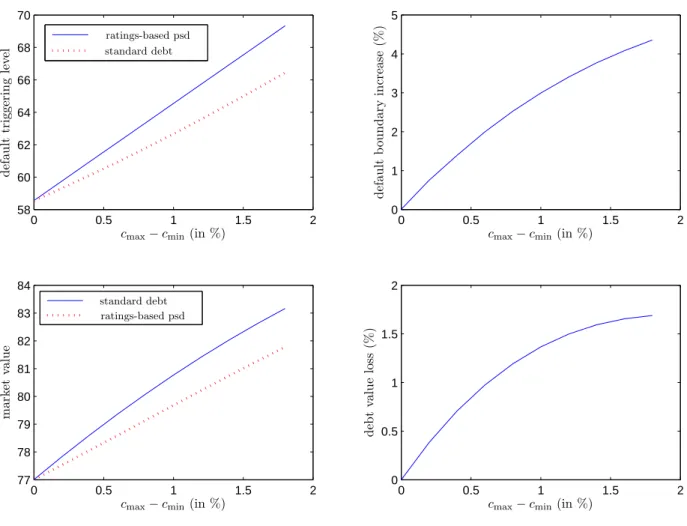
The above valuation results allow us to numerically assess the inefficiency resulting from the issuance of ratings-based PSD, compared to standard debt. We report the absolute and relative differences in debt value and rating triggers of ratings-based PSD and standard debt on Figure 3. Ratings thresholds are computed by inversion of smoothed one-year risk-neutral default probabilities taken from Driessen (2005).
In the first computation, we compare default triggering levels of ratings-based PSD and stan-dard debt with identical market value. The second computation compares the market value of ratings-based PSD and standard debt with identical default threshold. In both computations, parameters are fixed as follows: r = 6%, µ = 2%, σ = 25%. Asset value is normalized to 100. Debt value, coupon differentials, and default triggering levels are expressed as a percentage of asset level. The lowest coupon, which corresponds toAAAdebt, is fixed at 40 basis points above
r. The x-axis represents the gapcmax−cmin; hence the steepness of the ratings-based PSD. The
case cmax−cmin = 0 corresponds to standard debt. As Figure 3 indicates, a spread in coupon
rate between AAA-debt andCCC-debt of 100 basis points16 increases default triggering level by 3% compared to standard debt with identical market value, and decreases market value by 1.2% compared to standard debt with identical default triggering level.
[Figure 3 about here.]
6
PSD as a Screening Device
Thus far, we have shown that more risk-compensating PSD is less efficient than fixed-coupon debt when market frictions are limited to tax benefits and bankruptcy costs. This result is robust, as it
16This is the median spread across loans with performance pricing provisions in the sample of bank loan contracts
holds for a general class of cash-flow processes and performance measures. Despite this inefficiency, risk-compensating PSD obligations are widely used in practice. In this section, we show that PSD can be optimally used as a screening device in a setting with asymmetric information between the manager of the firm and the bank.
A firm needs to raise a fixed amount M of capital at time zero to finance some investment. We assume for simplicity that the firm’s cash-flow process is a geometric Brownian motion. The initial cash flow δ0 and the volatility σ are publicly known. The future growth rate (drift) of the cash-flow process, which depends on the quality of the firm’s investment opportunities, is either low µL or high µH, µH > µL. Given the initial cash flow δ0, the initial asset levels are
AL=δ0/(r−µL) for the low-growth firm andAH =δ0/(r−µH) for the high-growth firm. We
assume that M < AL, so that even the low-growth firm can raise this amount. We assume that
if the firm does not undertake the investment, the firm’s growth rate is sufficiently low so that it is optimal for the low-growth firm to raise M and invest.
The growth rate is known to the manager of the firm and to the existing shareholders. The market and the bank observe the cash-flow realizations δt of the firm, but are not able to
ob-serve the firm’s growth rate directly. The firm’s market capitalization, which reflects this partial information, may thus be different from the firm’s actual equity value. The manager maximizes a weighted average of equity value W and market capitalization ˆW: ϕW + (1−ϕ) ˆW, where 0 ≤ ϕ ≤ 1.17 Since the default happens when the shareholders stop supporting the financially distressed firm, the default time should not depend on ϕ, as long as the shareholders maximize the intrinsic value of the firm. For simplicity, we assume that the firm has no debt outstanding and no cash reserves at time zero and there are no tax benefits associated with debt.18
Banks can offer a menu of contracts to screen firms by their type. For simplicity, we restrict our attention to the class of linear asset-based PSD C1(A) =β0−β1A, with β1 ≥0, which includes fixed-interest debt (β1 = 0). According to Theorem 2, keeping the market value constant, an increase inβ1 makes a linear PSD obligation more risk compensating and less efficient.
We construct a separating equilibrium in which banks offer a menu of contracts consisting of a fixed-interest debt obligation C0 and a risk-compensating PSD obligation C1, such that
UC1
H (AH) =U C0
L (AL) =M.
17This assumption is standard in the literature. See, for example, Ross (1977) and Miller and Rock (1985). 18Our argument could be extended to a setting with a more complex capital structure and tax benefits of
debt. Considering an all-equity firm with no cash reserves, however, significantly simplifies the presentation of our argument.
The low-growth firm chooses to take the fixed-interest loan, while the high-growth firm chooses to take the risk-compensating PSD loan.
In this equilibrium, if the low-growth firm deviates and chooses the risk-compensating PSD obligation, it will be perceived as a high-growth firm. That is, the market believes that the asset level of this firm at timetisA0t=δt/(r−µH), whereas its actual asset level isAt=δt/(r−µL)< A0
t. The interest payment for the low-growth firm in deviation before the growth rate is revealed
is given by C10(At) =C1 A0t =C1 r−µL r−µH At =β0−β10At, where β10 =β1 r−µL r−µH . (15)
Therefore, issuingC1means that the low-growth firm will be actually payingC10(At) =β0−β10At.
Even if the low-growth firm is perceived by the market as the high-growth firm, it will make higher interest payments on the PSD than the high-growth firm. This is because the perceived asset level depends on the observable cash flowsδt, which are likely to be lower for the low-growth firm.
If the low-growth firm issues PSDC1, it will be perceived as the high-growth firm, and the market value of its equity will be equal to WC1
H (AH) after the issuance. Thus, the incentive
compatibility constraints are given by
WC0
L (AL)≥ϕW C0
1
L (AL) + (1−ϕ)WHC1(AH) (16)
for the low-growth firm, and
WC1
H (AH)≥ϕWHC0(AH) + (1−ϕ)WLC0(AL) (17)
for the high-growth firm. Among the pairs (C0, C1) of contracts that satisfy (16) and (17), we select the contract C1 with the smallestβ1.
With the above menu of contracts banks make zero profit and have no profitable deviations. High-growth firms choose the risk-compensating PSDC1, while low-growth firms choose the fixed-interest debtC0. The proposed menu of contracts is thus a separating equilibrium of the screening game.
Risk-compensating PSD screensdifferent types through different coupon payments, not through bankruptcy costs. The firm issuing a risk-compensating PSD commits to pay a higher coupon in the future, if it turns out that its type is not what it says.19
19We note that the debt issued by the firm is risky even when there are no bankruptcy costs. Indeed, for
fixed-coupon bond C0, the recovery value AB = (1+γ1Cγ10)r is less than C0/r. In addition, the coupon rate on PSD C1
Theorem 4 If the bankruptcy cost is zero and
ϕ≥ AH −AL
AH −M
, (18)
there exists a screening equilibrium in which the high-growth firm issues a risk-compensating PSD, while the low-growth firm issues fixed-interest debt.
Theorem 4 demonstrates that a risk-compensating PSD obligation can be used as a screening device even when the bankruptcy cost is zero. SinceAL> M, Condition (18) is always satisfied
when the manager’s incentives are perfectly aligned with those of equityholders (i.e. ϕ= 1). We prove Theorem 4 by explicitly constructing a risk-compensating PSD that i) has market valueM if issued by the high-growth firm, and ii) requires such high interest payments in case of low performance that the low-growth firm would prefer to default immediately if it had to issue it, hence forgoing all of its assets to the debtholders of the firm. Since these assets add up to
AL> M, if condition (18) is satisfied, then the manager of a low-growth firm prefers to issue the
fixed-rate rate with market value M, which results in the wished separation.
Example We use the following parameters to demonstrate the properties of the screening equi-librium:
r = 0.05, σ= 0.2, µL= 0, µH = 0.02, ρ(AB) = 0.5AB, δ0= 5, M = 50, ϕ= 1.
In the separating equilibrium, the high-growth firm issues C∗
1(A) = 4.2461−0.0051A. The low-growth firm is indifferent between issuingC0andC1∗, and its equity value isWLC0(AL) = 45.15.
In contrast, issuing C∗
1 increases the equity value of the high-growth firm from 105.87 to 113.91. The market value of PSD C∗
1 is less sensitive than C0 to the type of the issuing firm. The value of C0 issued by the high-growth firm is 58.86 vs. 50, when C0 is issued by the low-growth firm. In contrast, if the low-growth firm issues C1∗, the actual value ofC1∗ would be 48.23, which is fairly close to 50. Consistent with the pecking-order theory, the high-growth firm issues the less information sensitive obligation C1∗.
7
Empirical Analysis
In this section, we provide empirical support to the screening hypothesis developed in Section 6 using bank loan data.20
20Firms also issue public performance-sensitive debt, in the form of step-up bonds. See, for example, Houweling,
Data Description We obtain bank loan data from Thompson Financial’s SDC database. We obtain additional financial information for the borrowers from COMPUSTAT and CRSP databases.
From the SDC database, we collect data on deals to public firms from 1995 to 2005. We exclude from our sample debt contracts without information on loan size and loan maturity. Of the remaining loans, we exclude any loan to a firm that does not have a credit rating available in Compustat both for the closing date of the loan and also for one year after the closing date of the loan. Our final sample has 5,020 loans.
Our analysis is done at the loan deal level. A loan deal may contain more than one loan tranche. In our sample, 31% of the loan deals contain more than one tranche. A deal-level analysis, as opposed to a tranche-level analysis, is appropriate because it may be enough for one tranche of a deal to have performance pricing provisions for a firm to signal its type to the market. In addition, because multiple tranches of the same loan deal cannot be treated as independent observations, a tranche-level analysis produces standard errors that are improperly small. In our analysis, the size and maturity of a loan are calculated at the deal level.
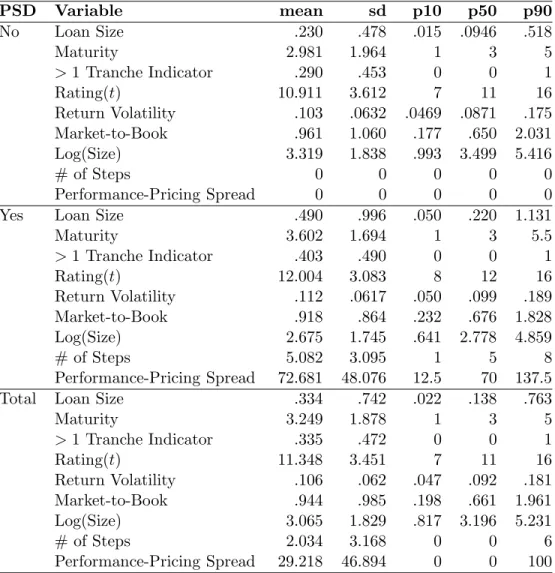
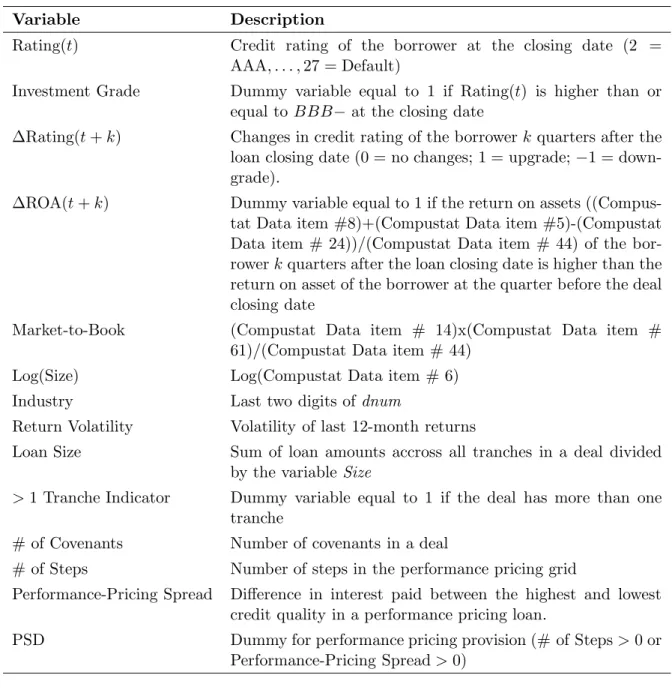
Table 1 reports descriptive statistics on the borrowing firms and structure of the loan contracts in our sample.21 The table is divided into contracts that have performance pricing provisions and those that do not have performance pricing provisions. In our sample, 40% of the loans have performance pricing provisions. This shows that performance-sensitive debt is an important but not universal part of the bank loan market. Among loans with performance pricing provisions, the median number of steps is five and the median spread in interest paid by the lowest and highest credit rating is 70 basis points.
[Table 1 about here.]
Looking further into the characteristics of loan contracts, we find that in our sample credit rating is the most commonly used performance measure. Approximately 52% of the loans con-taining performance pricing provisions are based on credit ratings of the borrowing firm. Other commonly used measures are leverage, debt/cash flow ratio, interest coverage ratio, debt/net worth ratio, EBITDA.
Model Specification Our screening model predicts that issuing performance-sensitive debt conveys information to the market that the firm is of a high-growth type. To test this hypothesis,
prevalent in bank loans.
we estimate the following ordered probit model:
∆ Rating(t + 4) =α+β1PSD +β2X+β3Y +. (19)
The left-hand-side variable reflects changes in the credit rating of the borrower one year after the loan closing date. It can take three values: 0 if after one year the borrower has the same rate as when the deal was closed, 1 if the borrower has been upgraded, −1 if the borrower has been downgraded. The key right-hand-side variable of interest is PSD, which is a dummy variable that is equal to one when the loan has performance pricing provisions. The key coefficient of interest is β1, which measures how the presence of performance pricing provisions is correlated with the future changes in the credit rating of the borrowing firm. Our hypothesis is that β1 is positive, meaning that after the deal is closed, firms with performance-sensitive loans are more likely to experience positive changes in their credit rating than firms with fixed-interest loans. The variable
X includes a variety of controls for other loan characteristics, while the variable Y includes a variety of controls for firm characteristics. Finally, all standard errors are heteroskedacity robust, and clustered at the borrowing firm.
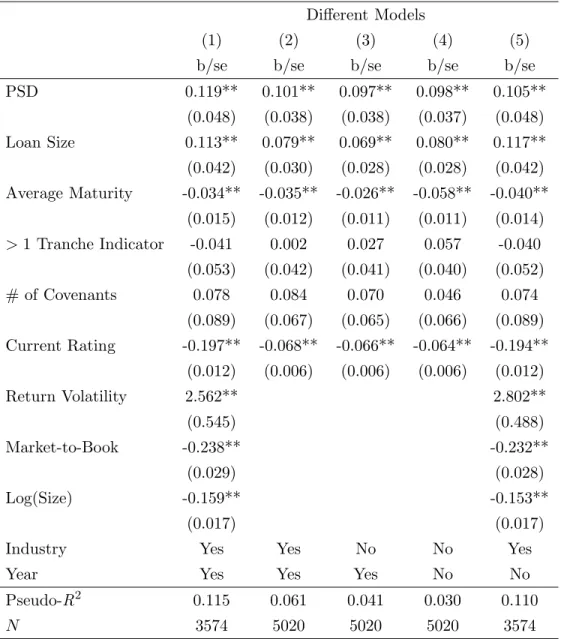
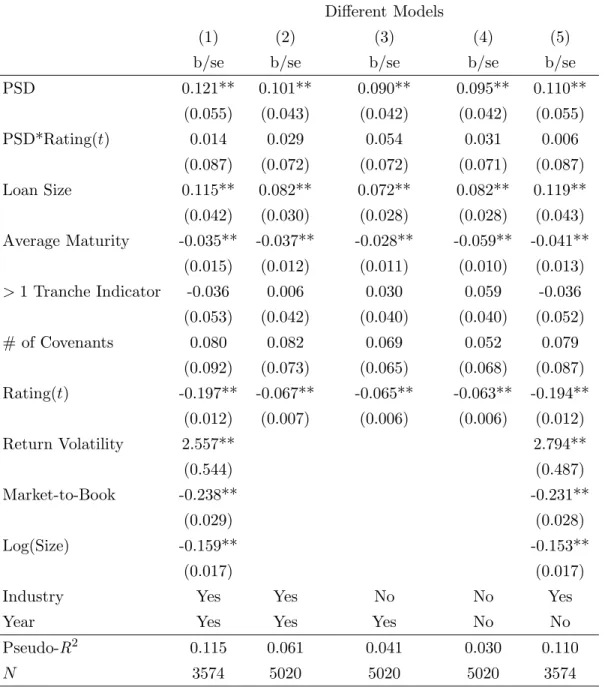
Results The results in Table 2 support the screening hypothesis outlined above. Firms with performance-sensitive loans are more likely to have a higher credit rating one year after the loan closing date than firms with fixed-interest loans. The results are significant at the 5% statistical level. In terms of magnitudes, the results in column (1) imply that firms that have PSD are 22.9% less likely to be downgraded and 20.1% more likely to be upgraded one year after the closing date of the loan than firms that have fixed-interest loans.
[Table 2 about here.]
Analyzing the estimated coefficients of the control variables also yields some interesting results. For example, the coefficients on loan size and average maturity imply that larger size and shorter maturity loans increase the likelihood of an upgrade and decrease the likelihood of a downgrade. This is consistent with asymmetric information models in which firms signal their type through debt level (Ross (1977)) and maturity (Flannery (1986), Diamond (1991)). Finally, size and market-to-book ratio have a negative impact on future ratings, while return volatility has a positive impact on future ratings.
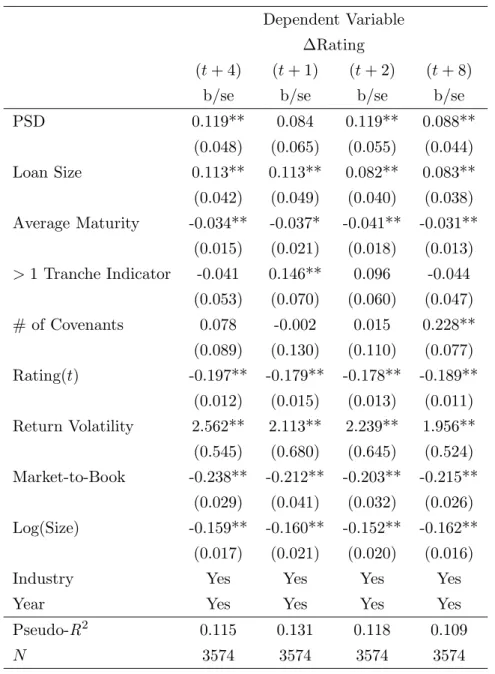
Table 3 shows that the results are robust to different time horizons of the dependent variable. If, in our screening model, the rating agency understands the separating equilibrium, then the
credit rating must immediately reflect the positive information about the borrower’s type conveyed by PSD issuance. However, even if the rating agency ignores (unlike investors) the informational value of PSD issuance, credit ratings should gradually reflect the high-growth type of the firm, as its cash flows evolve according to a higher drift than those of a low-growth firm. As Table 3 illustrates, the effects of PSD loans on the credit rating of the company become gradually more significant as we move further away from the deal closing date, suggesting that it takes time for credit rating agencies to incorporate information into their ratings.
[Table 3 about here.]
Is the effect of PSD on credit ratings the same across firms of different credit quality? To answer this question we add to our model specification an interaction term between the PSD dummy and the credit rating of the borrowing firm at the loan closing date. Table 4 shows that the coefficient associated with this interaction term is not significantly different from zero. This result suggests that the screening mechanism works equally well for firms of different credit qualities.
[Table 4 about here.]
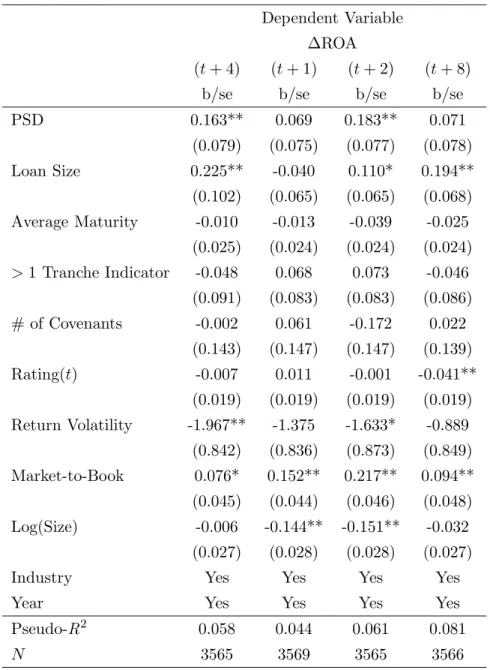
Finally, for a robustness check, we extend our analysis to study the relation between PSD and future return on assets (ROA) growth of the borrowing firm. For that we use the same specification as above with the variable ∆ROA(t+k) in place of the variable ∆Rating(t+k). The variable ∆ROA(t+k) is equal to 1 if the borrowing firm cash flow scaled by total assets grows in the first k quarters after the deal closing date and 0 otherwise. According to our model, the ROA of firms that issue PSD are more likely to grow after the deal is closed than the ROA of firms that issue fixed-interest debt. Table 5 shows that firms that issue PSD are more likely to experience ROA growth in the two and four quarters following the deal closing date.
[Table 5 about here.]
Another empirical implication of our signaling model is that the equity price should react positively to the issuance of PSD. We do not test this prediction, however. It is difficult to measure stock reaction at time of issuance directly, since we do not know exactly when the market learns about performance-pricing covenants. This information may leak before the deal is closed when the contract is being negotiated, may be disclosed at the time the deal is closed, or may be disclosed with some delay.
8
Additional Discussion
Section 6 showed that PSD can be used as a screening device when there is asymmetric information between investors and the borrowing firm. This section considers other motivations to issue PSD and relates our results to empirical findings and possible extensions.
Moral hazard can justify the use of risk-compensating PSD. A scheme that punishes bad performance with higher interest rates could serve as an additional incentive for the firm’s manager to exert effort. It could also discourage the manager from undertaking inefficient investments. Tchistyi (2009) shows that risk-compensating performance pricing can be part of an optimal contract in a situation in which the manager of the firm can privately divert the firm’s cash flows for his own consumption at the expense of outside investors. Bhanot and Mello (2006) show that rating triggers that increase coupon rates are in general inefficient in preventing asset substitution.22
Contracting costs may be another reason for some types of PSD. When the credit quality of the borrower changes, the issuer and the investors in its debt often get involved in costly negotiation over the terms of the debt. Some types of PSD may resolve the renegotiation problem by automatically adjusting the interest rates.
Asquith, Beatty, and Weber (2005) provide empirical evidence that private debt contracts are more likely to include performance pricing schemes that increase interest rates in times of poor performance when agency costs associated with asymmetric information, moral hazard, or recon-tracting costs are significant. In their sample, over 70% of commercial loans have performance pricing provisions.
We have assumed throughout the paper that all the agents in the economy are risk neutral. It is straightforward, however, to extend our results to the case of risk-averse agents, in the absence of arbitrage (specifically, assuming the existence of an equivalent martingale measure).
If markets are incomplete, performance-sensitive debt might be issued to meet the demands of risk-averse investors, providing them with hedge against credit deterioration of the firm. Our results suggest, however that financial guarantors, rather than the debt issuing firms, should be providing this kind of hedge.
For simplicity we assumed that the tax benefits are proportional to the coupon payments. This is a standard assumption in the structural model literature. In practice, the tax benefits are
22Bhanot and Mello (2006) also demonstrate that rating triggers that force early payment of debt can prevent
lower in the states with negative net cash flows. However, this makes our efficiency results even stronger.
9
Conclusion
Using an endogenous default model, we develop a method of valuing different types of performance-sensitive debt and prove that, given the same initial funds raised by sale of debt, more risk-compensating PSD leads to earlier default and consequently lowers the market value of the issuing firm’s equity. Despite its inefficiency, risk-compensating PSD is a widespread form of financing. To explain the existence of PSD obligations, we propose a screening model in which the future growth rate of the firm is unknown to the market but known to the firm’s manager. We show that there exists a separating equilibrium in which the high-growth firm issues a risk-compensating PSD obligation, while the low-growth firm issues fixed-interest debt. Controlling for firm and loan characteristics, we find empirically that firms whose loans contain performance pricing provisions are more likely to be upgraded and less likely to be downgraded one year after the closing date of the loan than firms with fixed-interest loans.
In the paper, we have discussed PSD obligations that have explicit performance pricing provi-sions, such as step-up bonds, performance-pricing loans, and catastrophe bonds. However, PSD obligations may be implicitly performance-dependent. For example, with short-term debt, such as commercial paper, the coupon rises and falls continuously with the credit quality of the borrower. Performance-sensitive debt may also result from an optimal dynamic capital structure strategy. In a setting with taxes and bankruptcy costs, the optimal amount of debt outstanding varies with asset level. When the asset level increases, issuers are better off issuing more debt, since this gives them higher tax benefits. On the other hand, when the asset level decreases, debt reductions are optimal, ignoring transaction costs, as they reduce the present value of bankruptcy costs. The net effect, under some conditions, is PSD.23 We believe that our model is useful in understanding these types of PSD obligations.
10
Appendix
10.1 Technical Conditions
We assume a fixed probability space (Ω,F, P) in which the filtration (Ft) is generated by the
standard Brownian motion B. For the diffusions to be well defined, we assume that drift and volatility functions are continuous and bounded (see Karatzas and Shreve (1991)). For the asset value to be finite, we assume that the growth rate function µδ is uniformly less than r −ε for
some constant ε >0.
The results of the paper also assume the following technical conditions, whose intuitive justi-fications are described in the main text.
Condition 2 µ andσ imply the existence of a unique strong solution of (1).24
Condition 3 There exist levelsx
¯ <x¯ and a positive constant¯c such that 1. (1−θ)C(x)≥δ(x) if and only if x≤x¯.
2. (1−θ)C(x)≥δ(x) +c
¯ for x≤¯x.
Condition 4 The PSD obligation C is such that:
1. There exist non-negative constants k1 andk2 that satisfy
0≤(1−θ)C(y)≤k1+k2y.
2. C is right continuous on [0,∞) and has left limits on (0,∞).
10.2 Example: Step-Up PSD
We assume that the asset process is a geometric Brownian motion as in Section 4. Step-up performance-sensitive debt is defined as a PSD obligation whose coupon payment is a non-increasing step function of the asset level. For a decreasing sequence {Gi}Ii=1+1 of asset levels
such that G1 = +∞ and GI+1 = AB, the coupon rate of a step-up PSD obligation can be
represented as
C(At) = ¯Ci whenever At∈[Gi+1, Gi), (20)
24This condition holds ifµandσare continuously differentiable and bounded andσis uniformly bounded below
by some positive constant. Weaker conditions guaranteeing existence and uniqueness of a solution to (1) can be considered as well, which would allow for example square-root processes. See Yamada and Watanabe (1971).
where {C¯i}Ii=1 is an increasing sequence of constant coupon rates. With this coupon structure, the general solution of the ODE (8) is
W(x) = 0, x≤AB, L(1)i x−γ1 +L(2) i x−γ2 +x− (1−θ) ¯Ci r , Gi+1≤x≤Gi, (21) for i= 2, . . . , I+ 1, where γ1 = m+√m2+ 2rσ2 σ2 , γ2= m−√m2+ 2rσ2 σ2 , m=µ− σ2 2 , and where L(1)i andL(2)i are constants to be determined shortly. According to Theorem 1,
W(AB) = 0 (22)
and
W0(AB) = 0, (23)
and W (·) is continuously differentiable. In particular, fori= 2, . . . , I,
W (Gi−) =W (Gi+) , W0(Gi−) =W0(Gi+) . (24)
Because the market value of equity is non-negative and cannot exceed the asset value,25
L(2)1 = 0. (25)
The system (22)-(25) has 2I+1 equations with 2I+1 unknowns (L(ij),j∈ {1,2},i∈ {1, . . . , I}, and AB). Substituting (21) into (22)-(25) and solving gives
L(1)I = (γ2+ 1)AB−γ2 c2 r (γ1−γ2)A−Bγ1 , (26) L(2)I = −(γ1+ 1)AB+γ1 c2 r (γ1−γ2)A−Bγ2 , (27) L(1)j = L(1)I + γ2 (γ1−γ2)r I−1 X i=j ci+1−ci G−γ1 i+1 , j= 2, . . . , I , (28) L(2)j = L(2)I − γ1 (γ1−γ2)r I−1 X i=j ci+1−ci G−γ2 i+1 , j= 2, . . . , I , (29) 0 = −(γ1+ 1)AB+ γ1 r cI− I−1 X i=1 (ci+1−ci) AB Gi+1 −γ2! , (30)
where, for convenience, we let ci ≡(1−θ) ¯Ci.
25Sinceγ
1 >0 andγ2 <0, the termL2Kx−γ2 would necessarily dominate the other terms in the equation (21)
violating the inequality 0≤W(x)≤x, unlessL2
10.3 General Performance Measures
We assume that performance measures reflect the borrower’s capacity and willingness to repay the debt. With µand σ given, the borrower’s asset level At and chosen default triggering boundary AB fully determine its default characteristics at any timet. SinceAB is not directly observed by
outsiders, the performance measureπtis a function ¯π(At,A˜B), where ˜AB is the perceived default
triggering level of assets.
A PSD obligationC therefore pays the couponC(πt) =C(¯π(At,A˜B)). The Markov structure
and the time homogeneity of the setting imply that any optimal default time of the firm can26 be simplified to a default triggering boundary hitting time τ(AB). In this setting, a consistency
problem arises, as the default triggering level chosen by the firm may depend on the perceived default triggering level. With y denoting the actual default triggering level of the firm, the value of the equity is ˜ W(x, y,A˜B) =Ex "Z τ(y) 0 e−rthδt(At)−(1−θ)C(¯π(At,A˜B)) i dt # .
Knowing that the firm seeks to maximize the value of the equity, the rating agency therefore chooses an ˜AB that solves the fixed point equation:
AB∈arg max y≤x
˜
W(x, y, AB). (31)
This equation may have one or several solutions, or no solution at all. To avoid ambiguity, we impose the following condition.
Condition 5 There exists a unique positive solution of equation (31).
Given Condition 5, the coupon rate paid by the PSD obligation at time t is C(¯π(At, AB)).
Since AB does not change over time, this PSD, which is defined under performance measure π,
is equivalent to an asset-based PSD ˜C, defined by ˜C(At)≡C(¯π(At, AB)). Equation (31) implies
that C and ˜C have the same optimal default boundary AB. Hence, provided that ˜C satisfies
Condition 1, we can compare C in terms of efficiency with asset-based PSD obligations that satisfy the same conditions by applying Theorem 2. In particular, if ˜C(At) is a nonincreasing
non-negative function, then a fixed-coupon bond with the same market value is more efficient than C. This proves the following theorem.27
26In this section, we assume that technical conditions 3 and 4, used in Section 2, hold. 27Ifπtakes a finitely many values, then ˜C(A
Theorem 5 Suppose that a performance measureπ can take only a finite number of values, and that a PSD C is nonincreasing and nonnegative. Suppose Conditions 1 and 5 are satisfied. Then, a fixed-coupon PSDDthat satisfies Condition 1, and has the same market value asC(U0C =U0D), is more efficient than C.
10.4 Proofs
We first justify the existence of an increasing function δ such that δt = δ(At). Since Et[δs] is
increasing28 in δt, At(·) is increasing in δt, which implies the existence of a continuous inverse
functionδ :R→R such thatδt=δ(At).
We now show that the optimal default policy takes the form of a default triggering level. The value of equity is:
W(A0)≡sup b τ∈T E "Z bτ 0 e−rt[δ(At)−(1−θ)C(At)] dt # .
The Markov property and time homogeneity imply that there exist asset levels AB and AH
with AB < A0 < AH, such that an optimal default time of the firm is of the form τ∗ =
min(τ(AB), τ(AH)), where τ(x)≡inf{t:At=x}. Even though the existence of an upper asset
boundaryAH above which the firm would default is mathematically possible, this unnatural
pos-sibility is excluded by Condition 3. The first part of Condition 3 states that for asset levels higher than ¯x, the cash flow rate is higher than the coupon payment rate. It can be easily verified that, under this condition, AH = +∞, so that the optimal default time simplifies toτ∗ =τ(AB). The
second part of Condition 3 ensures that the company will default at some positive asset level. Lemma 1 Under Condition 3, there exists a levelx˜ such that any optimal default timeτ satisfies
τ ≤τ(˜x) almost surely.
The proof of the lemma is based on the following result.
Claim There exists a level ˜x such that∀x≤x˜,W(x) = sup
τ W(x, τ) = 0.
Proof. From Condition 3, there exist positive constantsx
¯ andc¯such that (1−θ)C(x)> δ(x) +¯c
28E
t[δs] is increasing inδtbecause, given any path of the underlying Brownian motion, the trajectory of the cash
flow process starting at pointδ0
for all x≤x
¯. Let Ξ = supτ W(x¯, τ)<∞. For any stopping time τ and x < x¯, W(x, τ) = Ex 1τ <τ(x ¯) Z τ 0 e−rt(δ(At)−(1−θ)C(At))dt +Ex 1τ >τ(x ¯) Z τ 0 e−rt(δ(At)−(1−θ)C(At))dt ≤ −¯c rEx[ 1−e −rτ1 τ <τ(x ¯)] +Ex nh −¯c r 1−e−rτ(x¯)+ξ(x, x ¯)Ξ i 1τ >τ(x ¯) o .
Letx∗ >0 be the unique solution (inx) of−c
¯r 1−e−rτ(x¯)
+ξ(x, x
¯)Ξ = 0. Sinceξis nondecreas-ing in x, we have for all x ≤ x˜ =x
¯∧x
∗, W(x, τ) ≤ −c
¯rE[(1−e
−rτ) 1
τ <τ(˜x)]≤0, the optimum
W(x, τ) = 0 being reached forτ ≡0. This claim proves that, starting from any levelxand for any stopping timeτ, the stopping time τ−=τ∧τ(˜x) is at least as good asτ. In other words, we can restrict ourselves, in our search for optimality, to the set of stopping times ˜T ={τ s.t. τ ≤τ(˜x)}.
Proof of Theorem 1. By the strong Markov property of the asset process, ˜
W(x, y) =f(x)−ξ(x, y)f(y) (32)
forx≥y and ˜W(x, y) = 0 forx < y, where29
ξ(x, y) =Ex[e−τ(y)],
29Previous assumptions on µ andσ imply thatξ is well defined, continuous, differentiable forx
6
=y, with left and right derivatives at x=y, and less than 1 (see Karatzas and Shreve (1991)). Theorem 1, which exploits the smooth-pasting property, requires that the default triggering level be reached with positive probability. This is always the case if σ is coercive (see Fleming and Soner (1993) for a detailed treatment). Otherwise,ξ(x, y) and
W(x, y) may be discontinuous. In such case, the procedure described in Theorem 1 can be adapted as follows. If the current cash-flow rate is δ (supposed high enough that default does not occur at δ – e.g. if the net payoff rate is positive), let ¯δ denote the smallest cash-flow level belowδ that can be reached in finite time with positive probability. If the smooth-pasting approach yields a default triggering boundary strictly above ¯δ, then it is valid. Otherwise, default may only occur at ¯δ, since the cash-flow rate cannot go below that level. It then suffices to determine whether it is optimal to default at ¯δ, which can be done easily, for example, if the cash flow process has zero volatility. Otherwise, the default decision at ¯δmay still be determined directly, and one must differentiate the case in which ¯δis an absorbing state and that in which it is a reflecting state. In the former case, the value function can be easily computed at ¯δ, while in the latter case, default cannot be optimal at ¯δ, otherwise a higher default boundary would have existed. Another approach to dealing with processes where volatility vanishes is to solve an approximate problem where the volatility is everywhere positive and coercive, and take the limit as volatility converges to the initial problem.
and f(x) =Ex Z ∞ 0 e−rt[δ(At)−(1−θ)C(At)]dt .
f(x) is the present value of equity if initial asset level isxand shareholders never default (τ =∞). We first prove necessity of the conditions stated by Theorem 1, then their sufficiency.
1. The proof of the necessary conditions is based a series of lemmas:
Lemma 2 Under Conditions 2–4,f is continuously differentiable and f0 is bounded and left and right differentiable. Moreover, f satisfies the following equations:
1 2σ2(x)fl00(x) +µ(x)f0(x)−rf(x) +δ(x)−(1−θ)Cl(x) = 0 1 2σ2(x)f 00 r(x) +µ(x)f0(x)−rf(x) +δ(x)−(1−θ)C(x) = 0 , (33)
where fl00(x) (resp. fr00(x)) is the left (resp. right) derivative off0 atx, andCl(x) is the left limit
of C at x.
Proof ¿From Condition 2, there exists a fundamental solution30 ζ(x, s, y, t) with the same gen-erator as {At}t≥0, such that for s < t,
Px,s[At∈ B] =
Z B
ζ(x, s, y, t)dy
for any Borel subset B ofR and 1 2σ 2(x)∂2ζ ∂x2(x, s, y, t) +µ(x) ∂ζ ∂x(x, s, y, t) + ∂ζ ∂s(x, s, y, t) = 0. (34)
If C is continuous, letting φ(x) =δ(x)−(1−θ)C(x), Friedman (1975) and an application of the Fubini theorem imply that
f(x) = Z R φ(y) Z ∞ 0 e−rtζ(x,0, y, t)dt dy,
which, by time homogeneity of {At}t≥0, implies that
f(x) = Z R φ(y) Z ∞ 0 e−rtζ(x,−t, y,0)dt dy. (35)
When C is discontinuous, the second part of Condition 4 implies that there is a countably finite number of discontinuities. A limit argument using approximating continuous functions then shows that (35) also holds in this case. To derive an ODE when C is continuous, a straightforward
differentiation of (35) using (34) shows (33), which boils down to a single equation at any continuity point. When C is discontinuous, differentiation applied to all continuity points ofC shows that (33) holds at such points, while right and left limit arguments at discontinuity points show that (33) holds at these points as well. The boundedness off0 comes from the boundedness of ∂ζ
∂x(x, v),
proved in Friedman (1975), and the fact that µδ is uniformly bounded away fromr.
Corollary 3 W satisfies the following equations on (AB,∞):
1 2σ 2(x)W00 l (x) +µ(x)W0(x)−rW(x) +δ(x)−(1−θ)Cl(x) = 0 (36) 1 2σ 2(x)W00 r(x) +µ(x)W0(x)−rW(x) +δ(x)−(1−θ)C(x) = 0, (37) where W00
l (x) (resp. Wr00(x)) is the left (resp. right) derivative of W0 at x, and Cl(x) is the left
limit of C at x. In particular, W solves ODE (8) at any continuity point ofC.
Proof From Lemma 2 and (32), ˆW(x, y) is continuous with respect to y. From Lemma 1, and compactness of [0, x] there exists a levelAB>0 such thatW(x) = ˆW(x, AB). The proof is then
straightforward from Lemma 2 and (32).
Corollary 4 If a PSD obligation C satisfies Conditions 2–4, then W˜(x, y) is continuously dif-ferentiable in both components for x > y, and ∂∂xW˜ is left and right differentiable in x.
Proof This comes directly from the Lemma 2 and (32).
Corollary 5 Forx6=AB, W is differentiable and W0 is bounded on [0,∞).
Proof Straightforward, from Corollary 4 and the facts that W(x) = ˜W(x, AB) and that f0 is
bounded on [0,∞).
Lemma 3 If a PSD obligation C satisfies Conditions 2–4, then W is differentiable at AB and W0(A
B) = 0.
Proof Optimality of AB implies that ˜Wy(x, AB) = 0 for all x > AB. Taking the right limit
of this expression, ˜Wy,r(AB, AB) = 0. Moreover, we have for any y, ˜W(y, y) = 0.
Right-differentiating this equation and evaluating aty =AB yields ˜Wx,r(AB, AB) + ˜Wy,r(AB, AB) = 0,
hence ˜Wx,r(AB, AB) = 0. Since the left derivative is also 0, this implies that W is differentiable
It remains to show thatAB≤x¯, which is immediate since, forAt>x¯, the cash flow rate exceeds
the coupon rate, implying that it is never optimal to default at this level.
2. The verification of the sufficient conditions is similar to the proof of Proposition 2.1 in Duffie and Lando (2001). Define a stochastic process χt as
χt=e−rtW (At) +
Z t
0
e−rsφsds ,
where for x > AB,W(x) is the solution of the ODE that satisfies all the conditions listed in the
theorem, andW (x) = 0 forx≤AB˙.
Since W isC1, an application of Itˆo’s formula leads to
dχt=e−rtd(At) dt+e−rtW0(At)σ(At)dBt, (38) where d(x)≡ 1 2W 00(x)σ2(x) +W0(x)µ(x) −rW(x) +φ(x).
Since by assumptionW0 is bounded, the second term is a martingale, and since
Ex Z ∞ 0 e−rtW0(At)σ(At)2dt <∞, Rt
0e−rsW0(As)σAsdBs is a uniformly integrable martingale, which implies that
Ex Z τ 0 e−rsW0(As)σAsdBs = 0 for any stopping time τ. By the assumptions of the theorem
φ(AB)≤0. (39)
This inequality means that when the firm declares bankruptcy, its cash flowδ = (r−x)ABis less
than the coupon payment. It is easy to verify that the drift ofχtis never positive: d(x) vanishes
for x > AB sinceW solves the ODE, and is negative for x < AB, because of the inequality (39)
and W(x) = 0 for x < AB. Because of the non-positive drift, for any stopping time T ∈ T, q0≥E(χT), meaning W (A0)≥E T Z 0 e−rsφsds+e−rTW (AT) .
For the stopping time τ, we have
W (A0) =E τ Z 0 e−rsφsds ≥E T Z 0 e−rsφsds ,
where the inequality follows from non-negativity of W. Therefore, the stopping time τ maximizes the value of the equity.
Proof of Theorem 2. The proof is based on the following lemma:
Lemma 4 Let C and D be asset-based PSD satisfying Conditions 2–4, and AC
B ≤ADB. If h ≡ C −D is not constant on [AD
B,∞) and changes sign at most once from positive to negative on
[AD
B,∞), then,W0C(x)> W0D(x) for any starting asset level x∈(ACB,∞).
Proof First, assume that AC
B =ADB = AB. Since h changes sign at most once from positive to
negative on [AB,∞), there exist constantsA1,A2 verifying AB ≤A1 ≤A2 and such that h >0 forA∈[AB, A1),h= 0 forA∈(A1, A2), andh <0 for A∈(A2,∞).31
We first consider the case where A1 = AB. Then necessarily A2 < ∞, otherwise h would be constant on [AB,∞). Thus,h vanishes on [AB, A2) and negative on (A2,∞). It is easy to verify that for any PSD C with initial asset level x and defaulting boundaryAB, we have
U0C(x) =Ex "Z τ(AB) 0 e−rsC(As)ds # + (AB−ρ(AB))ξ(A0, AB). (40)
Since (A2,∞) has a positive measure, (40) implies that U0D(x) > U0C(x) for all x ∈ (AB,∞).
Equation (9) then allows one to conclude that WC
0 (x)> W0D(x) for all x∈(AB,∞).
Now we consider the case in whichA1 > AB. Thus,h(AB)>0. We will first show thatW0C(x)>
WD
0 (x) for allx∈(AB, A1). From equations (36) and (37), we have forH(x)≡W0C(x)−W0D(x): 1 2H 00 l(x)σ2(x) +H0(x)µ(x)−rH(x)−(1−θ)hl(x) = 0 (41) 1 2H 00 r(x)σ2(x) +H0(x)µ(x)−rH(x)−(1−θ)h(x) = 0, (42) where H00
l(x) (resp. Hr00(x)) is the left (resp. right) derivative of H0 at x, and hl(x) is the left
limit of h at x, which exists according to Condition 4 and Theorem 1. Also from Theorem 1, Wi(A
B) = 0 and (Wi)0(AB) = 0 for i = C, D. Therefore, H(AB) = H0(AB) = 0. Since h(AB) > 0, it follows from equation (42) that Hr00(AB) > 0. This implies that H0(x) > 0 and H(x) > 0 in a right neighborhood of AB. Precisely, there exists η > 0, such that H0(x) > 0
and H(x) >0 for x∈(AB, AB+η). We will now prove by contradiction thatH0(x) >0 for all x ≤A1. Letting y denote the first time when H0(y) = 0, we have necessarily H(y) >0. From equation (41) and the fact that h(y)≥0 fory≤A1, it follows thatHl00(y)>0, contradicting the
31By convention [a,a) and (a,a) equal the empty set. The precise values atA
![Figure 2: A fixed-coupon bond is in its efficiency domain if c ∈ [0, ¯c].](https://thumb-us.123doks.com/thumbv2/123dok_us/9966891.2489171/40.918.296.628.425.694/figure-fixed-coupon-bond-efficiency-domain-c-c.webp)