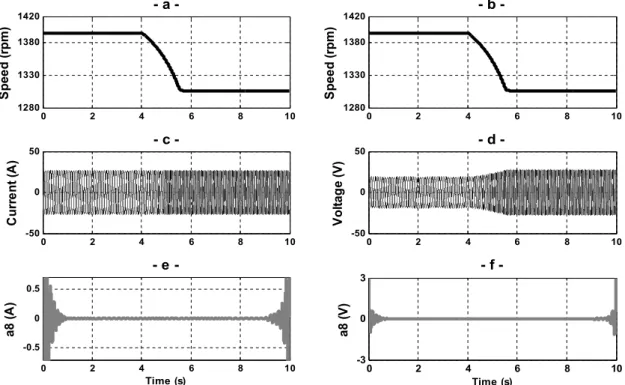
Department of Electrical, Electronic, and Information Engineering
“Guglielmo Marconi”
Ph.D thesis of:
Yasser Gritli
Ph.D. in Electrical Engineering
XXVI Cycle
Power Electronics, Electrical Machines and Drives (ING-IND/32)
Diagnosis and Fault Detection in
Electrical Machines and Drives
based on Advanced Signal
Processing Techniques
Tutor :
Prof. Fiorenzo Filippetti
Ph.D. Coordinator:
CONTENT Content ... i Liste of figures ... iv List of tables ... x Nomenclature ... xi Preface ... 1
Chapter 1 : State of art in diagnostic for electrical machines ... 4
1.1 Introduction ... 5
1.2 Stator related-faults ... 6
1.2.1 Stator faults physics ... 6
1.2.2 Stator fault components propagation ... 7
1.3 Rotor related-faults ... 9
1.3.1 Rotor faults physics ... 9
1.3.2 Rotor fault components propagation ... 11
1.4 Signal processing techniques for electrical machines diagnosis ... 12
1.5 Conclusion ... 15
References ... 16
Chapter 2 : Developed approach for diagnosing electrical machines ... 23
2.1 Introduction ... 24
2.2 Signals and processing tools for faults characterization ... 24
2.2.1 Signals selection for processing... 24
2.2.2 Signal Processing tools ... 25
2.2.2.1 Fourier Transform ... 25
2.2.2.2 Short Time Fourier Transform ... 26
2.2.2.3 Wavelet Transform ... 27
2.3 Problematic and developed Diagnosis approach... 30
2.4 Proposed diagnostic approach ... 34
2.5 Conclusion ... 39
References ... 40
Chapter 3 : Analysis of stator and rotor faults in wound rotor induction machines44 3.1 Introduction ... 45
3.2 System description ... 45
3.2.1 WRIM Control system ... 45
3.2.2 Experimental system ... 49
3.3.1 Fault detection under speed-varying condition... 51
3.3.1.1 Stator dissymmetry detection ... 52
3.3.1.2 Rotor dissymmetry detection ... 55
3.3.2 Fault detection under fault-varying conditions ... 56
3.3.2.1 Stator progressive dissymmetry detection ... 58
3.3.2.2 Rotor progressive dissymmetry detection ... 60
3.4 Fault quantification ... 60
3.5 Conclusion ... 65
References ... 66
Chapter 4 : Analysis of rotor faults squirrel cage induction machines... 68
4.1 Introduction ... 69
4.2 Analysis of rotor fault in single cage induction machine ... 69
4.2.1 System description ... 69
4.2.2 Results ... 70
4.2.2.1 Fault detection under speed-varying conditions ... 70
4.2.2.2 Fault quantification ... 74
4.3 Analysis of rotor fault in double cage induction machine ... 76
4.3.1 Motor Current Signature Analysis ... 78
4.3.1.1 System description ... 78
4.3.1.2 Results ... 78
4.3.2 Motor Vibration Signature Analysis ... 83
4.3.2.1 System description ... 84
4.3.2.2 Results ... 85
4.4 Conclusion ... 90
References ... 91
Chapter 5 : Fault diagnosis extension for multiphase electrical machines... 94
5.1 Introduction ... 95
5.2 Characterization of Rotor Demagnetization in Five-Phase Surface–Mounted Permanent Magnet Generator ... 95
5.2.1 System description ... 95
5.2.1.1 Results ... 102
5.2.1.2 Fault quantification ... 104
5.3 Characterization of stator fault in seven-phase induction machine ... 104
5.3.1 System description ... 105
5.3.2 Results ... 106
5.4 Conclusion ... 109
References ... 110
Conclusions ... 112
Appendix. 1: WRIM Model ... 114
LISTE OF FIGURES
Fig. 1.1 Distribution of failures by motor component ... 5
Fig. 1.2 Pareto of problems resulting in reduced motor efficiency (increased electrical losses) in electrical distribution systems. ... 7
Fig. 1.3 Frequency domain propagation of a stator fault. ... 9
Fig. 1. 4 Rotor fault repartition in squirrel cage induction motors. ... 10
Fig. 1. 5 Example of 3.3 kV, 800kW double cage induction motor failure due to outer cage damage: (a) outer bar damage, (b) stator end-winding insulation failure due to broken copper fragments from outer bar ... 11
Fig. 1.6 Frequency domain propagation of a rotor fault. ... 12
Fig. 1.7 Block topology of signal-based diagnostic procedure ... 13
Fig. 2. 1 Constant resolution in time-frequency plane using Short-time Fourier Transform ... 27
Fig. 2. 2 Multiresolution in time-frequency plane using Wavelet Transform ... 28
Fig. 2. 3 Wavelet Transform using a filter banks ... 29
Fig. 2. 4 Percentage of wavelet applications for different power system areas ... 30
Fig. 2. 4 Experimental results: Rotor modulating signal spectrum for large speed transient under healthy (red line) and stationary stator High-resistance connection (blue line). ... 32
Fig. 2. 5 Experimental results: Rotor modulating signal spectrum for intermittent stator High-resistance connection ... 32
Fig. 2. 7 High-level wavelet signals resulting from the DWT of the startup current for: (a) healthy machine and (b) machine with two broken bars. ... 33
Fig. 2. 8 Time-frequency propagation of a stator fault. The minus sign (–) identifies current inverse sequence components ... 35
Fig. 2. 9 Time-frequency propagation of a rotor fault. The minus sign (–) identifies current inverse sequence components ... 35
Fig. 2. 10 The DWT filtering process for decomposition of signal into predetermined frequency bands ... 37
Fig. 2. 11 Principle of time interval calculation as a function of the Time Interval
Number (TIN) ... 38
Fig. 3. 1 Block-scheme representation of the complete WRIM control system ... 48 Fig. 3. 2 Experimental set-up. a) Power converter cabinet. b) WRIM and prime
mover. c) Schematic diagram of the test bench and position of the current and voltage sensors. ... 50 Fig. 3. 3 Discrete WT of krs
sl
I and krs
sl
V in healthy condition (Radd=0) under speed
transient... 53 Fig. 3. 4 Discrete WT of krs
sl
I andVslkrsin faulty condition (Radd=Rs) under speed
transient... 54 Fig. 3. 5 Discrete WT of krs
sl
I and krs
sl
V in healthy condition (Radd=0) under speed
transient (experimental results) ... 54 Fig. 3. 6 Discrete WT of krs
sl
I and krs
sl
V in faulty condition (Radd=Rs) under speed
transient (experimental results) ... 55 Fig. 3. 7 DWT of the signals krr
sl
I and krr
sl
V in healthy condition (Radd=0) under speed
transient (simulation results) ... 56 Fig. 3. 8 DWT of the signals krr
sl
I andVslkrrin faulty condition (Radd=Rr) under speed
transient (simulation results) ... 57 Fig. 3. 9 DWT of the signals krr
sl
I and krr
sl
V in healthy condition (Radd=0) under speed
transient (experimental results) ... 57 Fig. 3. 10 DWT of the signals krr
sl
I and krr
sl
V in faulty condition (Radd=Rr) under speed
transient (experimental results) ... 58 Fig. 3. 11 Discrete WT of krs
sl
V under progressive stator unbalance condition (simulation results) ... 59 Fig. 3. 12 Discrete WT of krs
sl
V under progressive stator unbalance condition (experimental results) ... 59 Fig. 3. 13 Discrete WT of krr
sl
V under progressive rotor unbalance condition
(simulation results) ... 61 Fig. 3. 14 Discrete WT of krr
sl
V under progressive rotor unbalance condition
Fig. 3. 15 Values of the fault indicator mPa8 (as a function of the Time Interval
Number) resulting from the 8th wavelet decomposition under stator unbalance for large speed variation (simulation results): a) rs( )
sl
I t - b) rs( )
sl
V t ... 62 Fig. 3. 16 Values of the fault indicator mPa8 (as a function of the Time Interval
Number) resulting from the 8th wavelet decomposition under stator unbalance for large speed variation (experimental results): a) rs( )
sl
I t - b) rs( )
sl
V t .... 63 Fig. 3. 17 Values of the fault indicator mPa8 (as a function of the Time Interval
Number) resulting from the 8th wavelet decomposition under rotor unbalance for large speed variation (simulation results): a) rr( )
sl
I t - b) rr( )
sl
V t ... 63 Fig. 3. 18 Values of the fault indicator mPa8 (as a function of the Time Interval
Number) resulting from the 8th wavelet decomposition under rotor unbalance for large speed variation (experimental results): a) rr( )
sl
I t - b) rr( )
sl
V t ... 64 Fig. 3. 19 Values of the fault indicator mPa8 resulting from the 8th wavelet
decomposition of Vslrs( )t and Vslrr( )t under progressive winding fault: a) stator
-b) rotor ... 64 Fig. 4. 1 Test bed photo (left). The faulty rotor with one drilled rotor bar (right) ... 70 Fig. 4. 2 Instantaneous values of a-b) speed and c-d) stator phase currents under
healthy and one rotor broken bar respectively ... 71 Fig. 4. 3 DWT analysis of stator phase current under speed-varying condition, for
tracking the fault component (1-2s)f ; Healthy condition ... 72 Fig. 4. 4 DWT analysis of stator phase current under speed-varying condition, for
tracking the fault component (1-2s)f ; One Broken Bar ... 73 Fig. 4. 5 DWT analysis of stator phase current under speed-varying condition, for
tracking the fault component (1+2s)f ; Healthy condition ... 73 Fig. 4. 6 DWT analysis of stator phase current under speed-varying condition, for
tracking the fault component (1+2s)f ; One Broken Bar ... 74 Fig. 4. 7 Cyclic values of the fault indicator mPa9, resulting from the 9th wavelet
decomposition level of the signals Isl under healthy and rotor bar broken (red
and blue) during the tracking of (1-2s)f component ... 75 Fig. 4. 8 Cyclic values of the fault indicator mPa9, resulting from the 9th wavelet
decomposition level of the signals Isl under healthy and rotor bar broken (red
Fig. 4. 9 Electrical equivalent circuit representation of a double squirrel cage induction motor ... 77 Fig. 4. 10 Experimental measurements of broken bar component, frffc, with on-line
MCSA under rated load for 0-3/44 broken bars for (left) single cage deep bar Al die cast rotor; (right) double cage fabricated brass-Cu separate end ring rotor [7] ... 77 Fig. 4. 11 Custom designed fabricated copper separate end ring double cage rotor
sample with brass outer cage and copper inner cage(a), and the corresponding rotor lamination (b) ... 78 Fig. 4. 12 DWT analysis of stator current under transient operating condition
(10%-90% rated load):a) speed profile, b) phase current, c) fl component, and d) fr
component under healthy conditions ... 80 Fig. 4. 13 DWT analysis of stator current under transient operating condition
(10%-90% rated load):a) speed profile, b) phase current, c) fl component, and d) fr
componentwith3 broken outer cage bars ... 81 Fig. 4. 14 DWT analysis of stator current under transient operating condition
(10%-50%-90% rated load): a) speed profile, b) phase current, c) fl component, and d) fr component under healthy conditions ... 81 Fig. 4. 15 DWT analysis of stator current under transient operating condition
(10%-50%-90% rated load):a) speed profile, b) phase current, c) fl component, and
d) fr component with3 broken outer cage bars ... 82
Fig. 4. 16 Values of the fault indicators: normalized Find (Black line)resulting from the 6th wavelet decomposition level of the stator current under healthy and faulty (3 broken outer cage bars) conditions with speed-varying conditions. Left side component (Blue line), and right side component (Red line) 83
Fig. 4. 17 Photos of the healthy and drilled broken bar (left), and details of the test-bed (right) ... 84 Fig. 4. 18 Instantaneous values of speed (a), and axial vibration signal (b)
under healthy conditions ... 85 Fig. 4. 19 Instantaneous values of speed (a), and axial vibration signal (b)
under broken bar ... 85 Fig. 4. 20 Instantaneous values of axial vibration signal (a), and its
Fig. 4. 21 Instantaneous values of axial vibration signal (a), and its corresponding Wavelet analysis (b) under rotor broken bar. ... 87 Fig. 4. 22 Instantaneous values of axial vibration signal (a), and its
corresponding Wavelet analysis (b) under healthy condition ... 88 Fig. 4. 24 Instantaneous values of axial vibration signal (a), and its
corresponding Wavelet analysis (b) under rotor broken bar. ... 88 Fig. 4. 24 Cyclic values of the mPa6 fault indicator calculation issued from
the approximation signal a6, under healthy (Red) and rotor broken bar (Blue) conditions. ... 89 Fig. 4. 25 Cyclic values of the mPa7 fault indicator calculation issued from
the approximation signal a7, under healthy (Red) and rotor broken bar
(Blue) conditions. ... 90 Fig. 5. 1 Schematic draw of a pair of surface-mounted permanent magnets in
healthy and fault conditions ... 97 Fig. 5. 2 Harmonic amplitude variation in the flux density distribution as a function
of the magnet pole arc reduction in electrical radians... 98 Fig. 5. 3 Cross-section of the five-phase PMSG, with a superimposed flux plot
obtained by FEA, in healthy no-load conditions. ... 101 Fig. 5. 4 Instantaneous values of the electrical speed (a), and the corresponding
back-emfs under faulty conditions ... 102 Fig. 5. 5 Instantaneous values of the electrical speed (a), and the third
approximation signal (a3) issued from Wavelet analysis of the α3-β3
components of the back-emf space vector under healthy conditions. ... 103 Fig. 5. 6 Instantaneous values of the electrical speed (a), and the third
approximation signal (a3) issued from Wavelet analysis of the α3-β3
components of the back-emf space vector under local rotor magnet demagnetization conditions... 103 Fig. 5. 7 Values of the fault indicator mPa3 (eS3), corresponding to the 7th inverse
harmonic component, resulting from the approximation signal a3 under
large speed transient, for healthy and local rotor demagnetization (15°) conditions. ... 104 Fig. 5. 8 Experimental set-up. a) Schematic diagram of the test bench and position
of the current and voltage sensors. b) Seven phase induction machine. c) Seven phase inverter ... 106
Fig. 5. 9 - Experimental result. Behavior of the drive in healthy condition. a) Behavior of iS3. b) Spectrum of iS3. c) Trajectory of the components of iS3 at
25 Hz ... 107 Fig. 5. 10 Experimental result. Behavior of the drive in healthy condition. a)
Behavior of iS5. b) Spectrum of iS5. c) Trajectory of the components of iS5 at
25 Hz ... 107 Fig. 5. 11 Experimental result. Behavior of the drive when an additional resistance
is in series with phase 1. a) Behavior of iS3. b) Spectrum of iS3. c) Trajectory
of the components of iS3 at 25 Hz. ... 108
Fig. 5. 12 Experimental result. Behavior of the drive when an additional resistance is in series with phase 1. a) Behavior of iS5. b) Spectrum of iS5. c) Trajectory of the components of iS5 at 25 Hz. ... 108
Fig. 5. 13 Experimental result. Behavior of the drive when an additional resistance is in series with phase 1. a) Behavior of iS3. b) Spectrum of iS3. c) Trajectory of the components of iS3 at 25 Hz ... 108
Fig. 5. 14 Experimental result. Behavior of the drive when an additional resistance is in series with phase 1. a) Behavior of iS5. b) Spectrum of iS5. c) Trajectory
LIST OF TABLES
Table. 2. 1 Fault harmonics Classification in term of Adopted input signals for
processing ... 24
Table. 2. 2 Fault harmonics Frequency Bandwidth Repartition... 36
Table. 3. 1 WRIM parameters ... 50
Table. 3. 2 Back-to-Back Converter Parameters ... 51
Table. 3. 3 Sensors ... 51
Table. 4. 1 Single Cage Induction Motor parameters ... 70
Table. 4. 2 Frequency bands of approximation and detail signals ... 79
Table. 4. 3 Data of the double rotor cage motor ... 84
Table. 4. 4 Frequency bands at each level of decomposition ... 86
Table. 5. 1 Five-Phase PMSG Parameters (FEA) ... 97
Table. 5. 2 Frequency band of each level ... 103
NOMENCLATURE
f Stator frequency
s Slip
ωr Rotor speed
θr Rotor position angle
θ Stator-flux phase angle
Rs Stator resistance
Rr Rotor resistance
Radd Additional resistance used during the tests
vds,vqs d−q components of the stator voltage vector in the synchronous reference
frame
ids,iqs d−q components of the stator current vector in the synchronous reference
frame
fsam Sampling frequency
flow,fup Lower and upper limits of the instantaneous fault frequency evolution
fkss,fkrs Frequencies of the kth stator and rotor harmonic components due to a stator
fault
fksr,fkrr Frequencies of the kth stator and rotor harmonic components due to a rotor
fault
Lm Mutual inductance between stator and rotor windings
Ls,Lr Stator and rotor self-inductances
idms,iqms d−q components of the magnetizing current in the synchronous reference
frame
ias,ibs,ics Stator phase currents
iar,ibr,icr Rotor phase currents
vas,vbs,vcs Stator phase voltage
vdr,vqr d−q components of the rotor modulating signals in the synchronous reference
frame
fsl Sliding frequency
PREFACE
Condition monitoring leading to fault diagnosis and prediction of electrical machines and drives has attracted researchers in the past few years because of its considerable influence on the operational continuation of many industrial processes. Reducing maintenance costs and preventing unscheduled downtimes, which result in lost production and financial income, are the priorities of electrical drive manufacturers and operators. In fact, correct diagnosis and early detection of incipient faults result in fast unscheduled maintenance and short downtime for the process under consideration. They also avoid harmful, sometimes devastating, consequences and reduce financial loss. An ideal diagnostic procedure should take the minimum measurements necessary from a machine and by analysis extract a diagnosis, so that its condition can be inferred to give a clear indication of incipient failure modes in a minimum time. During the last years there has been a considerable amount of research into the creation of new condition monitoring techniques for induction motors and drives, overcoming the drawbacks of traditional methods. More specifically, there has been a transition from techniques suitable for machines in steady state conditions to machines operating in time-varying conditions.
In the current thesis, a new diagnosis technique for electrical machines operating in time-varying conditions is presented, where the validity under speed-varying condition or fault-varying condition is validated.
The presented work was elaborated in five chapters organized as follows:
In the first chapter, the considered faults (stator, rotor electrical/mechanical faults) are introduced, and a literature review of the corresponding diagnosis techniques are presented and discussed.
The problematic of signal processing techniques used for electrical machine diagnosis operating in time-varying conditions is firstly presented in the second chapter. Then, the proposed approch is completely described and systematized in order to overcome limits of existing techniques.
The proposed diagnosis technique is validated for the detection of electrical faults in three-phase wound-rotor induction machines in the third chapter, where stator and rotor electrical faults were investigated under time-varying conditions.
In the fourth chapter, the proposed diagnosis technique is validated for the detection of rotor broken bars in single and double squirrel cage induction motors under time-varying conditions.
Finally, the detection of rotor demagnetization, in five-phase surface-mounted permanent magnet synchronous generators under time-varying conditions is investigated in the fifth chapter, where stator fault detection and localization in seven-phase induction machine is also investigated in time and frequency domains.
CHAPTER 1 : STATE OF ART IN
DIAGNOSTIC FOR ELECTRICAL
MACHINES
1.1 Introduction ... 5
1.2 Stator related-faults ... 6
1.2.1 Stator faults physics ... 6
1.2.2 Stator fault components propagation ... 7
1.3 Rotor related-faults ... 9
1.3.1 Rotor faults physics ... 9
1.3.2 Rotor fault components propagation ... 11
1.4 Signal processing techniques for electrical machines diagnosis ... 12
1.5 Conclusion ... 15
1.1
Introduction
Condition monitoring of electrical machines has become a very important technology in the field of electrical systems maintenance, mainly for its potential functions of failure prediction, fault identification, and dynamic reliability estimation. In this thesis, we make reference to induction machine, even if the discussed and proposed diagnostic technique can be extended and applied also to other kind of machines. For example to the permanent magnet machine as we can see in the following chapters.
Electrical machines are subject to different sorts of faults. Stator winding faults including: turn to turn, coil to coil, open circuit, phase to phase, or coil to ground, generally initiated by high-resistance connections. Rotor electrical faults which include rotor open phase, rotor unbalance due to short circuits or high-resistance connections for wound rotor machines, or rotor magnet demagnetization that can be caused by an over current on the stator windings. Rotor mechanical faults such as broken bar(s) or cracked end-ring for squirrel-cage machines, cracked rotor magnet, bearing damage, static/dynamic eccentricity, and misalignment. The aforementioned failure modes can potentially affect the good operating condition of any industrial system [1]-[4]. A recent reliability study [4] has revealed the distribution of failures in induction motors as illustrated in Fig. 1.1.
Fig. 1.1 Distribution of failures by motor component
During the last years there has been a considerable amount of research into the creation of new condition monitoring techniques for induction motors and drives, overcoming the drawbacks of traditional methods. In this context, different efficient and non-invasive diagnosis techniques have been developed which investigate easily measured electrical or mechanical quantities like for example current, external magnetic
Bearing 69% Stator Winding 21% Rotor bars 7% Shaft/Coupling 3%
field, speed and vibrations, in order to detect the above listed failure modes at incipient stage of degradation. [5]-[8]. The topic is becoming far more attractive and critical as the population of electric machines has largely increased in recent years: the number of operating machines is about 16.1 billion in 2011, with a growth of about 50% in the last five years [9].
In this chapter, the considered faults (stator, rotor electrical/mechanical faults) are introduced, and a literature review of the corresponding diagnosis techniques are presented and discussed.
1.2
Stator related-faults
1.2.1
Stator faults physics
According to a recent reliability study, stator winding faults are of 21% ovrall distribution of failures by motor component [4]. This category of faults can be observed in different forms in electrical machines such as: turn to turn, coil to coil, open circuit, phase to phase, or coil to ground. Obviously consequences on the performances operating of the motor are different. In case of asymmetry in the stator windings such as an open-phase failure or high-resistance connection, the machine can operate, but with reduced torque. But in case of short-circuit of a few turns in a phase winding, the fault evolve rapidly in time, and leads to catastrophic damages.
It is universally known, that an electrical or magnetic non rotational asymmetry of induction machine or an asymmetry in the supply voltages can be detected through the stator current negative sequence. The machine behavior is not the ideal one but no drastic action must be taken in case of small asymmetries. A strong electric asymmetry, as an open phase, causes a negative sequence of similar magnitude compared with the positive one. This failure mode can be is therefore easily detected, and the protection system is triggered.
Winding short circuit is well known as one of the most difficult faults to detect at incipient stage. The standard protection might not work or the motor might keep on running while the heating in the shorted turns would soon cause critical insulation breakdown. If left undetected, turn faults will propagate, leading to phase to ground or phase to phase faults.
Then it is important to note that this failure mode is generally initiated by high-resistance connections caused by a combination of poor workmanship, thermal cycling
and vibration, or damage of the contact surfaces due to pitting, corrosion or contamination.
The increase in the resistance due to poor contacts can cause overheating to reach an unacceptable level, which can eventually leads to open-circuit failures due to the melting of copper conductors. Eventually, excessive overheating in the contact points can also deteriorate insulation and expose the copper conductor to serious damages such as short-circuit failures between conductors or to the ground.
Fig. 1.2 Pareto of problems resulting in reduced motor efficiency (increased electrical losses) in electrical distribution systems
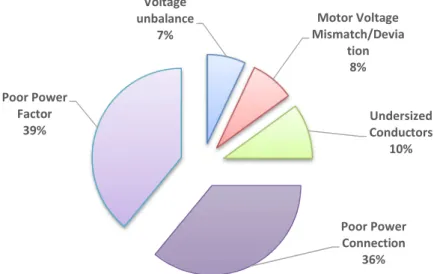
In a study performed by the Department of Energy at three industrial facilities [10], the losses in the electrical distribution system accounted for 2% of the annual plant energy usage. According to the Pareto (Fig. 1.2) of problems resulting in a decreased efficiency (or increased losses) in electrical distribution systems, 36% of the problems are due to the poor connections [11]. Recently, researchers focused their efforts in detecting the existence, the location and severity of high-resistance connections in circuits for electrical machines [12]-[14].
1.2.2
Stator fault components propagation
Electrical machines are subject to both electromagnetic and mechanical stresses, which are symmetrically distributed. In healthy conditions, the three stator and rotor impedances are identical and the currents are balanced. Under these normal conditions, only the normal frequency components at f and sf exist respectively on stator and rotor currents, where f is the power grid frequency and s the slip.
Voltage unbalance 7% Motor Voltage Mismatch/Devia tion 8% Undersized Conductors 10% Poor Power Connection 36% Poor Power Factor 39%
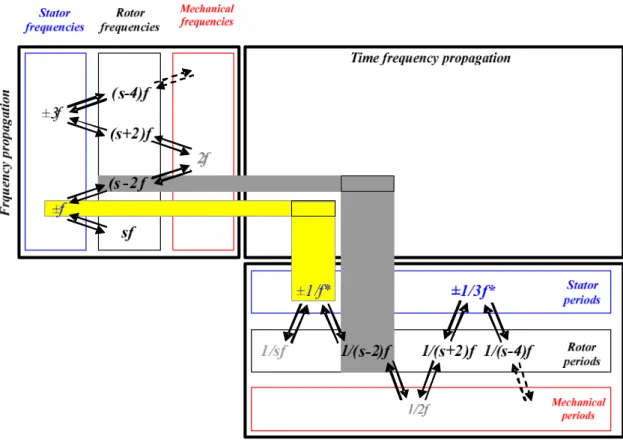
If the stator is damaged, the stator symmetry of the machine is lost and a reverse rotating magnetic field is produced. Let us assume that the stator and rotor voltages are not altered by the fault and that the machine speed is free to vary. Then, a frequency component appears in the stator current at frequency –f. This inverse sequence is reflected on the rotor side and produces the frequency component (s-2)f, which induces a pulsating torque and a speed oscillation at frequency 2f. This frequency generates both a reaction current at frequency (s-2)f and a new component at frequency (s+2)f. The latter produces new components in the stator currents at frequencies ±3f, and the process starts again. In conclusion, it leads to a set of new components at frequencies expressed by (1.1) and (1.2), in the stator and rotor currents respectively.
0,1,2,(fkss 1 2 k f)k (1. 1)
0,1,2,(fkrs s2k f)k (1. 2)
Fig. 1.3 gives a graphical interpretation of the aforementioned propagation mechanism of the fault harmonics. It is worth noting that this interpretation is just qualitative and may help the reader to understand the effect of a fault, but does not provide either a quantitative or an accurate description of all the phenomena involved [15].
Generally, the main focus are on the detection of fault dominant frequency components in stator signals at the frequency −sf and at the frequency (s−2)f in rotor signals. Fig. 1.3 shows the stator fault propagation in frequency domain. This fault can be monitored and detected in a variety of methods. In fact, the equivalent parameters of the machine are changed, the currents are not balanced, and all the quantities linked to the currents are affected by the faults. But in closed-loop operation the control system ensures a safe operation even under an unbalance in stator windings. Therefore, the typical rotor current fault frequency components is reduced by the compensating action of the control system. However, under these conditions the fault-related frequencies are reflected in the voltages that can be used for fault detection [15-16].
Frequency domain
sf
2f ±3 f Rotor frequencies Stator frequencies Mechanical speed frequencies± f
(s -2)f
(s+2)f
Fig. 1.3 Frequency domain propagation of a stator fault. The minus sign (–) identifies current inverse sequence components
1.3
Rotor related-faults
1.3.1
Rotor faults physics
Different faults can affect the rotor part of induction motors, which were repartitioned in [17] and illustrated by Fig. 1.4. Squirrel cage machines can be classified in two different types of cage rotors for induction motors: cast (up to 3000-kW rating) and fabricated. Fabricated cages are used for higher ratings and special application machines, where possible failure events occur on bars and end-ring segment. Cast rotors are almost impossible to repair after bar breakage or cracks, although they are more durable and rugged than fabricated cages. Typically, they are used in laboratory tests to validate diagnostic procedures for practical reasons. Broken bar and cracked end ring faults share only 7 % of induction machine faults, but the detection of these events is a key item. In case of stator faults machine operation after the fault is limited to a short time, but in case of rotor faults the machine operation after the fault is not restricted apart from suitable caution during maintenance. On the other side the current in the rotor bar adjacent to the faulty one increases remarkably, up to 50 % of nominal current, while in the stator faulty winding the current variation is a few percent of the nominal current. Another special and interesting case is for double-cage induction motors. Doubly squirrel cage induction motors (DCIMs) are commonly used for applications in which high starting torque and efficient steady state operation are required, such as conveyors, pulverizers, or mills [18]. In these applications, DCIMs are subject to fatigue
failure of the outer (“starting”) cage, due to the cyclic thermal/mechanical stress caused by frequent starts and long startup time [19]-[22].
Fig. 1. 4 Rotor fault repartition in squirrel cage induction motors.
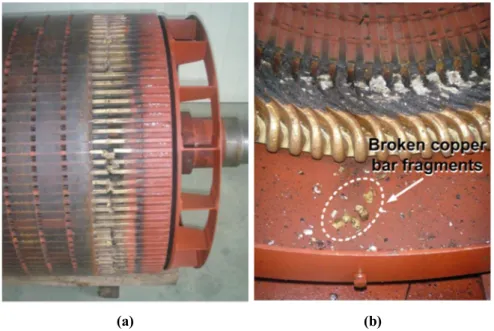
Failure of outer cage bars tends to spread to neighboring bars as the currents of the damaged bars are distributed into them. This could eventually result in startup failure due to insufficient startup torque [23]. An example of a DCIM failure with outer cage bar damage is shown in Fig. 1.5. This 800 kW, 3.3kV pulp stirrer motor recently failed in a paper mill in Korea. The inner cage was in good condition. On the contrary, the excessive thermal and thermo-mechanical stress due to outer cage damage resulted in “melting” and “fracture” of the outer bars (the temperature exceeded 200°C) [22]. This produced copper bar fragments that caused stator end winding insulation and core damage, and led to irreversible motor failure.
For wound-rotor machines, the physics of rotor fault is similar to stator fault and it results either in an increase of rotor resistance or in short and open circuits. In case of increased resistance, the machine can operate also after the fault occurrence, while in case of short and open circuits, after fault operation is limited to a short time. For wound rotor machines it is reasonable to assume that the percentage of stator windings and rotor windings faults can be divided in equal parts. In fact the rotor circuits of wound motors are usually poorly protected even in presence of adjunctive components (slip-ring connections, resistors connected to the slip (slip-rings).
Cage 50% Shaft 20% Magnetic circuit 20% Others 10%
(a) (b)
Fig. 1. 5 Example of 3.3 kV, 800kW double cage induction motor failure due to outer cage damage: (a) outer bar damage, (b) stator end-winding insulation
failure due to broken copper fragments from outer bar
1.3.2
Rotor fault components propagation
An electrical machine is subject to both electromagnetic and mechanical forces which are symmetrically distributed. In healthy conditions, the equivalent windings impedances are identical and consequently the stator and rotor currents are balanced. Under these normal conditions, only normal frequency components at f and sf exist respectively on stator and rotor currents, where f is the power grid frequency and s the slip.
If the rotor is damaged, the rotor symmetry of the machine is lost, the equivalent rotor windings impedances are no longer equal, and a reverse rotating magnetic field is produced. Consequently, an inverse frequency component appears in the rotor current at the frequency −sf. This component produces a fault frequency (1−2s)f in the stator currents which causes a pulsating torque and a speed oscillation at the frequency 2sf. This frequency induces both a reaction current at frequency (1−2s)f and a new component at frequency (1+2s)f. The last frequency produces new components in the stator currents at frequencies ±3sf. As a consequence, a set of new frequency components defined as (1.3) appear in the spectrum of stator currents and a set of new frequency components expressed as (1.4) appear in spectra of rotor currents [15], [16].
fkrr 1 2 k sf
k 0,1,2,... (1. 4)Usually, the diagnostic techniques are focused on the detection of fault dominant frequency components in stator signals at the frequency (1±2s)f and at the frequency −sf in rotor signals. Fig. 1.6 shows the rotor fault propagation in frequency and in time. This fault can be monitored and detected in a variety of methods. In fact, the equivalent parameters of the machine are changed, the currents are not balanced, and all the quantities linked to the currents are affected by the faults. The choice of the best method for a specific application can be made according to the following priorities: simplicity, sensitivity, ruggedness and reliability. Moreover, in closed-loop operation the control system ensures a safe operation even under an unbalance in both stator and rotor windings. Consequently, the typical rotor current fault frequency components is reduced by the compensating action of the control system. However, under these conditions the fault-related frequencies are reflected in the voltages that can be used for fault detection [24].
Fig. 1.6 Frequency domain propagation of a rotor fault. The minus sign (–) identifies current inverse sequence components
1.4
Signal processing techniques for electrical machines
diagnosis
Fault detection is efficient only when fault evolution is characterized by a time constant of the order of days or greater, so that suitable action can take place. In any case, a key item for the detection of any fault is proper signal conditioning and processing. With
advances in digital technology over the last few years, adequate data processing capability is now available on cost-effective hardware platforms. They can be used to enhance the features of diagnostic systems on a real-time basis in addition to the normal machine protection functions.
Fig. 1.7 Block topology of signal-based diagnostic procedure
Signal-based diagnosis looks for the known fault signatures in quantities sampled from the actual machine. Then, the signatures are monitored by suitable signal processing (Fig. 1.7). Typically, frequency analysis is used, although advanced methods and/or decision-making techniques can be of interest. Here, signal processing plays a crucial role as it can be used to enhance signal-to-noise ratio and to normalize data in order to isolate the fault from other phenomena and to decrease the sensitivity to operating conditions.
Different diagnosis techniques for electrical machines can be found in literature. In the category of time-domain analysis technique there are: the time-series averaging method, which consist in extracting a periodic component of interest from a noisy compound signal, the signal enveloping method, and the Kurtosis method, and the spike energy method [6], [25]-[28].
In [26], the oscillation of the electric power in the time domain becomes mapped in a discrete waveform in an angular domain. Data-clustering techniques are used to extract an averaged pattern that serves as the mechanical imbalance indicator. The maximum covariance method is another technique that is based on the computation of the covariance between the signal and the reference tones in the time domain [27].
Spectral frequency estimation techniques were widely adopted in machine diagnosis, as frequency domain tool analysis. These approaches are based on the Fourier analysis (FA) for investigating the signals being analyzed. Unluckily, electrical machines operate mostly in time-varying conditions. In this context, slip and speed vary unpredictably, and the classical application of FA for processing the voltage set points or the measured currents fails, as shown in [29]–[31]. In fact, the bandwidth of the fault frequency components is related to the speed variation. Among different solutions, the signal demodulation [29], the high-resolution frequency estimation [32], and the discrete
polynomial-phase transform [33] have been developed to reduce the effect of the non-periodicity of the analyzed signals or to detect multiple faults [34]. These FA-based techniques give high-quality discrimination between healthy and faulty conditions, but they cannot provide any time-domain information.
This shortcoming in the FA-based techniques can be reduced by analyzing a small interval of the signal by means of the short-time Fourier transform. This method has been widely used to detect both stator and rotor failures in electrical motors. However, the fixed width of the window and the high computational cost required to obtain a good resolution still remain major drawbacks of this technique [35]–[37]. Based on the instantaneous frequencies issued from the intrinsic mode functions, the Hilbert–Huang transform was proposed for motor diagnosis and has shown quite interesting performances in terms of fault severity evaluation [38]–[41]. Other quadratic transforms, such as the Wigner–Ville distribution (WVD), suffer from the same constraint [42]. This limitation can be overcome by new advanced time–frequency distributions such as smoothed pseudo-WVDs [42], Choi–Williams distribution [42], [43], and Zhao–Atlas– Marks distribution [44]. However, the removal of cross-terms leads generally to reducing the joint time–frequency resolution and the signal energy.
Being a linear decomposition, wavelet transform (WT) provides a good resolution in time for high-frequency components of a signal and a good resolution in frequency for low-frequency components. In this sense, wavelets have a window that is automatically adjusted to give the appropriate resolution developed by its approximation and detail signals. Motivated by the aforementioned proprieties, in recent years, some authors have pointed out the effectiveness of WT for tracking fault frequency components under non-stationary conditions. WT was used with different approaches for monitoring motors. The related techniques are the undecimated discrete WT [45], the wavelet ridge method [46], the wavelet coefficients analysis [47], [48], or the direct use of wavelet signals [48]–[50] for stator- and rotor-fault detection. Recently, fractional Fourier transform has been proposed in [51], providing an innovative graphical representation of rotor-fault components issued from discrete WT in the time–frequency domain. More intensive research efforts have been focused on the usage of both approximation and detail signals for tracking different failure modes in motors, such as broken bars [35], [49]- [50], [52]-[53] interturn short circuits [35], [51], [54], mixed eccentricity, [49], [52], [55], and increasing resistance in a stator phase [15], [45], [56] or in a rotor phase [15], [37], [57]. Most of the reported contributions are based on wavelet analysis of currents during the start-up phase or during any load variation. In this context, the frequency components are spread in a wide bandwidth as the slip and the speed change considerably. The situation is more complex under rotor-fault conditions due to the proximity of the fault components to the fundamental frequency. These facts justify the usage of multidetail
or/and approximation signals resulting from the wavelet decomposition [35], [48]–[50], [52]. Moreover, the different decomposition levels are imposed by the sampling frequency. However, the dependence on the choice of the sampling frequency and on the capability of tracking multiplefault frequency components makes difficult to interpret the fault pattern coming from wavelet signals and increases the diagnosis complexity. Moreover, the usage of large frequency bandwidths exposes the detection procedure to erroneous interpretations due to a possible confusion with other frequencies related to gearbox or bearing damages [58].
In order to quantify the fault severity, the energy of approximation and/or detail signals resulting from wavelet decomposition has been already used [35], [49]. However, this attempt reduces each time–frequency band to a single value. In this way, the time-domain information could be lost.
1.5
Conclusion
Potential failure modes in electrical machines, as stator and rotor electrical/mechanical faults, which are investigated in this thesis, were exhaustively analyzed. A literature review of the corresponding diagnosis techniques were also presented.
Finally, an important issue deduced particularly from section (1.4), which is the need to develop new diagnostic approaches for electrical machines operating in time-varying conditions, with possible improvements that can be formulated as follows:
1) Capability of monitoring the fault evolution continuously over time under any transient operating condition;
2) No requirement for speed/slip measurement or estimation;
3) Higher accuracy in filtering frequency components around the fundamental;
4) Reduction in the likelihood of false indications by avoiding confusion with other fault harmonics (the contribution of the most relevant fault frequency components under speed-varying conditions are clamped in a single frequency band);
5) Low memory requirement due to low sampling frequency;
6) Reduction in the latency of time processing (no requirement of repeated sampling operation).
Effectively, in the present thesis, an effective method to solve the aforementioned open points in time-varying conditions is presented. A complete description which systematizes the use of the developed approach is presented in Chapter 2, and experimental results showing the validity of the presented technique are presented and exhaustively commented in the next chapters.
REFERENCES
[1] A.H. Bonnet, and G.C. Soukup, ‘‘Cause and analysis of stator and rotor failures in three-phase squirrel cage induction motors,” IEEE Transactions on Industry
Applications, Vol. 28, N°4, pp. 921–937, 1992.
[2] Nandi, S., Toliyat, H.A.; Xiaodong Li, "Condition monitoring and fault diagnosis of electrical motors-a review," Energy Conversion, IEEE
Transactions on, vol.20, no.4, pp.719,729, Dec. 2005
[3] R. M. Tallam, S. B. Lee, G. C. Stone, G. B. Kliman, J. Yoo, T. G. Habetler, and R. G. Harley, “A survey of methods for detection of stator-related faults in induction machines,” IEEE Transactions on Industry Applications, vol. 43, no. 4, pp. 920–933, Jul./Aug. 2007.
[4] A.H. Bonnett, C. Yung, ‘‘Increased Efficiency Versus Increased Reliability,”
IEEE Industry Application Magazine, Vol. 14, N°1, pp. 29–36, 2008.
[5] G.K. Singh, S.A.S. Al Kazzaz, ‘‘Induction machine drive condition monitoring and diagnostic research-a survey,” Journal of Electric Power Systems Research, Vol. 64, N°2, pp. 145–158, 2003.
[6] A. Bellini, F. Filippetti, C. Tassoni and G.-A. Capolino, ‘‘Advances in Diagnostic Techniques for Induction Machines,” IEEE Transactions on
Industrial Electronics, Vol. 55, N°12, pp. 4109–4126, 2008.
[7] F. Filippetti, A. Bellini, G-A. Capolino, “Condition monitoring and diagnosis of rotor faults in induction machines: State of art and future perspectives”, IEEE
Workshop on Electrical Machines Design Control and Diagnosis
(WEMDCD’2013), pp. 196-209, Paris, 2013.
[8] S.H. Kia, H. Henao, G. Capolino, “Efficient digital signal processing techniques for induction machines fault diagnosis”, IEEE Workshop on Electrical Machines
Design Control and Diagnosis (WEMDCD’2013), pp. 232-246, Paris, 2013.
[9] H. A. Toliyat, S. Nandi, S. Choi, and H. Meshgin-Kelk, Electric Machines, Modeling, condition monitoring and Fault diagnosis. CRC Press, 2012.
[10] “Energy tips—Motor systems,”Motor Systems Tip Sheet #8, Sep. 2005, Washington, DC: U.S. Dept. Energy. [Online]. Available: http://www1 eere.energy.gov/industry/saveenergynow/database/index.asp?filter=4
[11] Electrical Distribution System Tune-Up, Bonneville Power Administration, Portland, OR, Jan. 1995.
[12] J. Bockstette, E. Stolz, and E.J.Wiedenbrug, “Upstream impedance diagnostics for three phase induction machines,” Proc. of IEEE SDEMPED, Cracow, Poland, 2007, pp. 411-414.
[13] Y. Jangho, C. Jintae, B.L. Sang and Y. Jiyoon, ‘‘On-line Detection of High-Resistance Connections in the Incoming Electrical Circuit for Induction Motors,” IEEE Transactions on Industry Applications, Vol. 45, N°2, pp. 694– 702, 2009.
[14] J. Yun, J. Cho, S.B. Lee, J. Yoo,“On-line detection of high-resistance connections in the incoming electrical circuit for induction motors,” IEEE
Transactions on Industry Applications, Vol. 45, Issue 2, pp. 694-702, 2009.
[15] A. Stefani, A. Yazidi, C. Rossi, F. Filippetti, D. Casadei and G.A. Capolino, ‘‘Doubly Fed Induction Machines Diagnosis Based on Signature Analysis of Rotor Modulating Signals,” IEEE Transactions on Industry Applications, Vol. 44, N°6, pp.1711–1721, Nov./Dec. 2008.
[16] D. Casadei, F. Filippetti, C. Rossi, A. Stefani, A. Yazidi et G. A.Capolino, ‘‘Diagnostic technique based on rotor modulating signals signature analysis for doubly fed induction machines in wind generator systems,” Conference Record
of the 41st IAS-IEEE Annual Meeting in Industry Applications Conference,
Tampa, Oct.2006.
[17] Vaag Thorsen, M. Dalva, “Failure ldentificatinn and Analysis for High-Voltage Induction Motors in the Petrochemical Industry”, IEEE Transactions on
Indusbry Applications, Vol. 35, No.4, July/August 1999, pp. 810- 819.
[18] Motors and generators, NEMA standards pub. MG 1-2006, 2006.
[19] P.L. Alger, and J.H. Wray, “Double and triple squirrel cages for polyphase induction motors,” AIEE Transactions Part III – Power Apparatus and Systems, vol. 78, no.2, pp. 637-645, Jan. 1953.
[20] G. Kovacs, “Starting disc rotor for high-output two-pole induction motors”, in
Proc. IEEE IAS, pp. 8-12, vol. 1, 1990.
[21] H.A. Toliyat, G.B. Kliman, Handbook of electric motors, 2nd edition, Marcel Dekker, 2004.
[22] J. Mroz, “Temperature field distribution of a double squirrel-cage rotor during startup,” IEE Proceedings – Electric Power Applications, vol. 152, no. 6, pp. 1531-1538, Nov. 2005.
[23] W.Schuisky, “Starting losses in windings of double squirrel-cage motors,”
Electrical Engineers - Part II: Journal of Power Engineering, vol. 95, N° 45, pp.
325 – 327, 1948.
[24] D. Casadei, F. Filippetti, C. Rossi and A. Stefani, "Closed Loop Bandwidth Impact on Doubly Fed Induction Machine Asymmetries Detection Based on Rotor Voltage Signature Analysis", 43rd UPEC’08, Padova-Italy, Sept. 2008.
[25] A. Dimarogonas, Vibration for Engineers. Englewood Cliffs, NJ: Prentice-Hall, 1996.
[26] C. Kral, T. G. Habetler, and R. G. Harley, “Detection of mechanical imbalances of induction machines without spectral analysis of time-domain signals. IEEE Transactions on Industrial Application, Vol. 40, No. 4, pp. 1101-1106, 2004.
[27] A. Bellini, G. Franceschini, and C. Tassoni, “Monitoring of induction machines by maximum covariance method for frequency tracking,” IEEE Trans. Ind.
Appl., vol. 42, no. 1, pp. 69–78, Jan./Feb. 2006.
[28] J. Lin., “An integrated time domain averaging scheme for gearbox diagnosis. IEEE Proceeding: 8th International Conference on Reliability, Maintainability
and Safety, Pages: 808-812, 2009.
[29] A. Stefani, F. Filippetti, and A. Bellini, “Diagnosis of induction machines in time-varying conditions,” IEEE Trans. Ind. Electron., vol. 56, no. 11 , pp. 4548– 4556, Nov. 2009.
[30] Y. Gritli, C. Rossi, L. Zarri, F. Filippetti, A. Chatti, D. Casadei, and A. Stefani, “Double frequency sliding and wavelet analysis for rotor fault diagnosis in induction motors under time-varying operating condition,” in Proc. IEEE Int.
Symp. Diagn. Elect. Mach., Power Electron. Drives, Bologna, Italy, Sep. 5–8,
2011, pp. 676–683.
[31] B. Akin, S. Choi, U. Orguner, and H. A. Toliyat, “A simple real-time fault signature monitoring tool for motor-drive-embedded fault diagnosis system,”
IEEE Trans. Ind. Electron., vol. 58, no. 5, pp. 1990–2001 , May 2011.
[32] S. H. Kia, H. Henao, and G. A. Capolino, “A high-resolution frequency estimation method for three-phase induction machine fault detection,” IEEE
Trans. Ind. Electron., vol. 54, no. 4, pp. 2305–2314, Aug. 2007.
[33] M. Pineda-Sanchez, M. Riera-Guasp, J. Roger-Folch, J. A. AntoninoDaviu, J. Perez-Cruz, and R. Puche-Panadero, “Diagnosis of induction motor faults in
time-varying conditions using the polynomial-phase transform of the current,”
IEEE Trans. Ind. Electron., vol. 58, no. 4, pp. 1428 – 1439, Apr. 2011.
[34] A. Garcia-Perez, R. de Jesus Romero-Troncoso, E. Cabal-Yepez, and R. A. Osornio-Rios, “The application of high-resolution spectral analysis for identifying multiple combined faults in induction motors,” IEEE Trans. Ind.
Electron., vol. 58, no. 5, pp. 2002–2010, May 2011.
[35] J. Cusido, L. Romeral, J.A. Ortega, J.A. Rosero et A. G. Espinosa, ‘‘Fault Detection in Induction Machines Using Power Spectral Density in Wavelet Decomposition,” IEEE Transactions on Industrial Electronics, Vol. 55, N°2, pp. 633–643, 2008.
[36] S. H. Kia, H. Henao, and G.-A. Capolino, “Torsional vibration assessment using induction machine electromagnetic torque estimation,” IEEE Trans. Ind.
Electron., vol. 57, no. 1, pp. 209–219, Jan. 2010.
[37] I. P. Tsoumas, G. Georgoulas, E. D. Mitronikas, and A. N. Safacas, “Asynchronous machine rotor fault diagnosis technique using complex wavelets,” IEEE Trans. Energy Convers., vol. 23, no. 2, pp. 444–459 , Jun. 2008.
[38] R. Yan and R. X. Gao, “Hilbert–Huang transform-based vibration signal analysis for machine health monitoring,” IEEE Trans. Instrum. Meas., vol. 55, no. 6, pp. 2320–2329, Dec. 2006.
[39] J. Antonino-Daviu, P. J. Rodriguez, M. Riera-Guasp, A. Arkkio, J. Roger-Folch, and R. B. Perez, “Transient detection of eccentricity related components in induction motors through the Hilbert–Huang transform,” Energy Convers.
Manage., vol. 50, no. 7, pp. 1810–1820 , Jul. 2009.
[40] A. Espinosa, J. Rosero, J. Cusido, L. Romeral, and J. Ortega, “Fault detection by means of Hilbert–Huang transform of the stator current in a PMSM with demagnetization,” IEEE Trans. Energy Convers., vol. 25 , no. 2, pp. 312–318, Jun. 2010.
[41] R. Puche-Panadero, M. Pineda-Sanchez, M. Riera-Guasp, J. Roger-Folch, E. Hurtado-Perez, and J. Peres-Cruz, “Improved resolution of the MCSA method via Hilbert transform, enabling the diagnosis of rotor asymmetries at very low slip,” IEEE Trans. Energy Convers., vol. 24, no. 1, pp. 52 –59, Mar. 2009. [42] S. Rajagopalan, J. M. Aller, J. A. Restrepo, T. G. Habetler, and R. G. Harley,
“Detection of rotor faults in brushless DC motors operating under non-stationary conditions,” IEEE Trans. Ind. Appl., vol. 42, no. 6 , pp. 1464–1477, Nov./Dec. 2006.
[43] S. Rajagopalan, J. A. Restrepo, J. M. Aller, T. G. Habetler, and R. G. Harley, “Non-stationary motor fault detection using recent quadratic time–frequency representations,” IEEE Trans. Ind. Appl., vol. 44, no. 3 , pp. 735–744, May/Jun. 2008.
[44] Y. Zhao, L. E. Atlas, and R. J. Marks II, “The use of cone-shaped kernels for generalized time–frequency representations of nonstationary signals,” IEEE
Trans. Acoust., Speech, Signal Process., vol. 38, no. 7, pp. 1084 – 1091, Jul.
1990.
[45] W. G. Zanardelli, E. G. Strangas, and S. Aviyente, “Identification of intermittent electrical and mechanical faults in permanent-magnet AC drives based on time– frequency analysis,” IEEE Trans. Ind. Appl., vol. 43, no. 4 , pp. 971–980, Jul./Aug. 2007.
[46] S. Rajagopalan, J. M. Aller, J. A. Restrepo, T. G. Habetler, and R. G. Harley, “Analytic wavelet ridge-based detection of dynamic eccentricity in brushless direct current (BLDC) motors functioning under dynamic operating conditions,”
IEEE Trans. Ind. Electron., vol. 54, no. 3 , pp. 1410–1419, Jun. 2007.
[47] O. A. Mohammed, N. Y. Abed, and S. Ganu, “Modeling and characterization of induction motor internal faults using finite-element and discrete wavelet transforms,” IEEE Trans. Magn., vol. 42, no. 10, pp. 3434–3436, Oct. 2006. [48] A. Ordaz-Moreno, R. J. Romero-Troncoso, J. A. Vite-Frias, J. R. Rivera-Gillen,
and A. Garcia-Perez, “Automatic online diagnosis algorithm for broken-bar detection on induction motors based on discrete wavelet transform for FPGA implementation,” IEEE Trans. Ind. Electron., vol. 55, no. 5, pp. 2193–2202, May 2008.
[49] M. Riera-Guasp, J. A. Antonino-Daviu, M. Pineda-Sanchez, R. Puche-Panadero, and J. Perez-Cruz, “A general approach for the transient detection of slip-dependent fault components based on the discrete wavelet transform,” IEEE
Trans. Ind. Electron., vol. 55, no. 12, pp. 4167–4180, Dec. 2008.
[50] A. Bouzida, O. Touhami, R. Ibtiouen, A. Belouchrani, M. Fadel, and A. Rezzoug, “Fault diagnosis in industrial induction machines through discrete wavelet transform,” IEEE Trans. Ind. Electron., vol. 58, no. 9, pp. 4385–4395, Sep. 2011.
[51] M. Pineda-Sanchez, M. Riera-Guasp, J. A. Antonino-Daviu, J. Roger-Folch, J. Perez-Cruz, and R. Puche-Panadero, “Diagnosis of induction motor faults in the fractional Fourier domain,” IEEE Trans. Instrum. Meas., vol. 59, no. 8, pp. 2065–2075, Aug. 2010.
[52] J. Antonino-Daviu, P. Jover Rodriguez, M. Riera-Guasp, M. Pineda Sanchez, and A. Arkkio, “Detection of combined faults in induction machines with stator parallel branches through the DWT of the startup current,” Mech. Syst. Signal
Process., vol. 23, no. 7, pp. 2336–2351, Oct. 2009.
[53] J. Pons-Llinares, J. A. Antonino-Daviu, M. Riera-Guasp, M. Pineda-Sanchez, and V. Climente-Alarcon, “Induction motor diagnosis based on a transient current analytic wavelet transform via frequency B-splines,” IEEE Trans. Ind.
Electron., vol. 58, no. 5, pp. 1530–1544, May 2011.
[54] A. Gandhi, T. Corrigan, and L. Parsa, “Recent advances in modeling and online detection of stator interturn faults in electrical motors,” IEEE Trans. Ind.
Electron., vol. 58, no. 5, pp. 1564–1575, May 2011.
[55] W. Yang, P. J. Tavner, C. J. Crabtree, and M. Wlikinson, “Cost-effective condition monitoring for wind turbines,” IEEE Trans. Ind. Electron., vol. 57, no. 1, pp. 263–271, Jan. 2010.
[56] Y. Gritli, A. Stefani, C. Rossi, F. Filippetti, and A. Chatti, “Experimental validation of doubly fed induction machine electrical faults diagnosis under time-varying conditions,” Elect. Power Syst. Res., vol. 81, no. 3, pp. 751–766, Mar. 2011.
[57] Y. Gritli, A. Stefani, C. Rossi, F. Filippetti, and A. Chatti, “Advanced rotor fault diagnosis for DFIM based on frequency sliding and wavelet analysis under time-varying condition,” in Proc. IEEE ISIE, Bari, Italy, Jul. 2010, pp. 2607–2614. [58] W. T. Thomson and M. Fenger, “Current signature analysis to detect induction
CHAPTER 2 : DEVELOPED
APPROACH FOR DIAGNOSING
ELECTRICAL MACHINES
2.1 Introduction ... 24 2.2 Signals and processing tools for faults characterization ... 24 2.2.1 Signals selection for processing... 24 2.2.2 Signal Processing tools ... 25 2.2.2.1 Fourier Transform ... 25 2.2.2.2 Short Time Fourier Transform ... 26 2.2.2.3 Wavelet Transform ... 27 2.3 Problematic and developed Diagnosis approach... 30 2.4 Proposed diagnostic approach ... 34 2.5 Conclusion ... 39 References ... 40
2.1
Introduction
In the present chapter, the problematic of signal processing techniques used for electrical machine diagnosis operating in time-varying conditions is firstly analyzed: limits of Fourier analysis, the use of multi-frequency bands for tracking single fault component, and latency of calculation with direct use of Discrete Wavelet Transform (DWT). Then, a new effective method is completely described and systematized in order to achieve the different open points established in the previous chapter.
2.2
Signals and processing tools for faults characterization
2.2.1
Signals selection for processing
Under normal operating conditions, electrical machines are subject to electromagnetic and
mechanical stresses symmetrically distributed. Once the motor is affected by stator/rotor faults, the symmetry is lost, and the impact of this dissymmetry is reflected on the electrical and mechanical quantities: currents, voltages, torque, magnetic fluxes, or vibrations.
In fact, many contributions can be found in literature dealing with stator or rotor faults diagnosis of electrical machines, based on monitoring of available electrical or mechanical signals. Fault harmonics classification in term of adopted input signals for processing is illustrated by Table. 2.1. Since most bearing vibrations are periodical movements, vibration signature analysis was widely investigated for these purposes [1]-[3].
Table. 2. 1 Fault harmonics Classification in term of Adopted input signals for processing
Fault Signal Characteristic Frequency
Stator asymmetry Stator current (fkss=(1-k)f)k=0,1,2,… Rotor current/voltages (fkrs=(s±2k)f)k=0,1,2,… Rotor asymmetry Stator current (fksr=(12ks)f)k=0,1,2,… Rotor currents/voltages (fkrr=(1+2k)sf)k=0,1,2,… Vibration fkvr=(6-2ks)f)k=1,2,3,…
Mixed eccentricity Stator current fks=|fkfr|k=1,2,3,…
Bearing outer race Stator current fmob=|fmfv|m=1,2,3,…
Vibration fvob=(N/2).fr.(1-bbcos()/dp)
Bearing cage Vibration fvcb=(1/2).fr.(1-dbcos()/dc
Bearing inner raceway Vibration fvib=(Nb/2).fr.(1+dbcos()/dc
Bearing ball Vibration fvbb
=(dc/db).fr.(1-(dbcos()/dc)2)
Magnet
Leakage flux was successfully applied to monitor machine conditions [4]-[5] provided that a suitable shield was available to prevent the influence of external sources. Measured or observed electromagnetic torque was widely investigated for diagnosing mechanical faults [6]-[7].
For conventional machines, the available quantities are three line currents (ia, ib, ic) and
three line-to-line voltages (vab, vbc, vca). Actual quantities are usually transformed in
order to obtain equations with time-invariant coefficients. Moreover, the transformation reduces the number of dimensions of the state variables, and a suitable reference frame may be retrieved in order to simplify the machine model according to the desired operations. For example, in field-oriented control, the right choice of the reference frame results in decoupling of flux and torque.
Another issue in closed-loop operation, is that the control itself affects the behavior of electrical variables, and so new diagnostic procedures are necessary for machine monitoring. In [8], the impact of currents regulators was evidenced and a new approach based on the analysis of rotor modulating signals was proposed for stator and rotor fault diagnosis in steady state conditions [9]. One of the main objectives of this thesis is to extend this approach to time varying operating conditions, using new signal processing technique for investigating the control variables in this context. Also vibration signals will be considered for diagnosing rotor mechanical faults, in order to evaluate the performances of the proposed approach.
2.2.2
Signal Processing tools
Different signal processing techniques for diagnosing electrical machines can be found in literature which can be classified in three categories: time-domain analysis, frequency domain analysis, and time-frequency domain analysis. As already introduced in chapter. 1, the main focus in this thesis is the extension of frequency-domain signature faults to optimal time-frequency domain analysis. In the following, a detailed discussion showing the necessity and advantages of migration from frequency domain analysis (represented by Fourier transform), to time-frequency domain analysis (represented by Wavelet Transform), [10]-[13].
2.2.2.1
Fourier Transform
Fourier analysis breaks down a signal in its constituting sinusoids of different frequencies. In other words, the view of the signal changes from time-base to frequency-base. This technique decomposes a signal into orthogonal trigonometric basis functions. The Fourier transform of a continuous signal x(t) is defined as:
2 . FT j ft X f x t e dt
(2.1)This transformation gives the global frequency distribution of the original time-domain signal x(t) . Most experimentally obtained signals are not continuous in time, but sampled as discrete time intervals ∆T. Furthermore they are of finite length with a total measurement time T, divided into N = T/∆T intervals. These kind of signals can be analyzed in the frequency domain using the discrete Fourier transform (DFT), defined in (2.2). Due to the sampling of the signal, the frequency spectrum becomes periodic, so the frequencies that can be analyzed are finite. The DFT is evaluated at discrete frequencies fn = n/T, n = 0, 1, 2, . . . , N − 1.
1 2 0 1 . N DFT j k T n k X f x k e N
(2.2)The calculation of the DFT can become very time-consuming for large signals (large N). The fast Fourier transform (FFT) algorithm does not take an arbitrary number of intervals N , but only the intervals N = 2m, m ∈ N. The reduction in the number of intervals makes the FFT very fast. A drawback compared to the ordinary DFT is that the signal must have 2m samples, this is however in general no problem.
FFT was widely used for electrical machines diagnosis, and has shown efficient ability to discriminate healthy from faulty operating conditions. Intersting results in diagnosisng electrical and mechanical faults, based on FFT can be found in [4]-[5], [8]-[9].
However, the calculation of the FFT suffer from two limits and has a big drawback for any fault detection procedure. First since only a small part of the signal x(t) on the interval 0 ≤ t ≤ T is used, leakage can occur. Leakage is caused by the discontinuities introduced by periodically extending the signal. Leakage causes energy of fundamental frequencies to leak out to neighboring frequencies. A solution to prevent signal leakage is by applying a window to the signal which makes the signal more periodic in the time interval. A disadvantage is that the window itself has a contribution in the frequency spectrum. The second problem is the limited number of discrete signal values, this can lead to aliasing. Aliasing causes fundamental frequencies to appear as different frequencies in the frequency spectrum and is closely related to the sampling rate of the original signal. Aliasing can be prevented if the sampling theorem of Shannon is fulfilled. The theorem of Shannon states that no information is lost by the discretization if the sample time ∆T equals or is smaller than ∆T = 2/fmax. Finally, the major drawback
of this technique is the lost of the time information, as it is not possible to determine when a particular event, such a discontinuity or a transient, takes place.
2.2.2.2
Short Time Fourier Transform
In order to analyze small sections of a signal, Denis Gabor developed a technique, the STFT that consists in the calculation of the Fourier transform of the original signal