Analyzing Contract Robustness through a
Model of Commitments
Amit K. Chopra1, Nir Oren2, Sanjay Modgil3, Nirmit Desai4, Simon Miles3, Michael Luck3, and Munindar P. Singh5
1 University of Trento [email protected] 2 University of Aberdeen [email protected] 3 King’s College London
{sanjay.modgil, simon.miles, michael.luck}@kcl.ac.uk 4
IBM Research – India [email protected] 5
North Carolina State University [email protected]
Abstract. We address one of the challenges in developing solutions based on multiagent systems for the problems of cross-organizational business processes and commerce generally. Specifically, we study how to gather and analyze re-quirements embodied within business contracts using the abstractions from mul-tiagent systems.
Commerce is driven by business contracts. Each party to a business contract must be assured that the contract isrobust, in the sense that it fulfills its goals and avoids undesirable outcomes. However, real-life business contracts tend to be complex and unamenable both to manual scrutiny and domain-independent sci-entific methods, making it difficult to provide automated support for determining or improving their robustness. As a result, establishing a contract is nontrivial and adds significantly to the transaction costs of conducting business. If the adoption of multiagent systems approaches in supporting business interactions is to be vi-able, we need to develop appropriate techniques to enable tools to reason about contracts in relation to their robustness.
To this end, we propose a powerful approach to assessing the robustness of con-tracts, and make two main contributions. First, we demonstrate a novel conceptual model for contracts that is based oncommitments. Second, we offer a methodol-ogy for (i) creating commitment-based models of contracts from textual descrip-tions, and (ii) evaluating the contract models for robustness. We validate these contributions via a study of real-world contracts.
1
Introduction
When agent-oriented software engineering (AOSE) first emerged, it developed a rich panoply of concepts, abstractions, and techniques based on the notion of agents and allied notions such as roles, protocols, organizations, and commitments. These notions address the inherently interactive nature of multiagent system and provide the key basis
both for developing business applications that involve autonomous and heterogeneous participants and for distinguishing AOSE as a technical discipline from the rest of soft-ware engineering. The applications that AOSE is geared to addressing include cross-organizational business processes and commerce in general. These have clearly gained social importance in the last decade or so since AOSE has been practiced. The needs that they bring up, especially of flexible modeling and enactment, and of managing complexity continue to speak to the importance of AOSE as a discipline.
However, as both traditional software engineering and AOSE have grown, it has become more and more important to bridge the gap between the two. In some cases, researchers have sought to use the tools and techniques of traditional software engi-neering to enhance AOSE, including efforts in programming tools and methodologies and in formal methods. Examples of the former include several works such as those sur-veyed by Nunes et al. [14], and examples of the latter include works by Meneguzzi et al. [13] and Telang and Singh [19, 20]. In other cases, researchers have sought to formalize concepts that originate in AOSE in ways that might influence traditional software en-gineering. Examples of this are works by Bordini et al. [2, 3] and by Weyns et al. [21]. The above works demonstrate the expanding overlaps between agent-oriented and tra-ditional software engineering. However, they also demonstrate an interesting limitation in that generally the forays of AOSE into traditional practice so far take place in the later stages of design and development: either in the formalization of system specifica-tions or in the development of executable or nearly executable software artifacts and in their verification and validation.
The present work addresses one of the least understood and hence riskiest phases of the software engineering life cycle, namely, the determination and analysis of system requirements in the first place. Not only is the requirements phase the riskiest, it is also one where (for problems involving commerce, in particular) multiagent systems concepts can apply naturally and potentially facilitate the later phases.
Another novelty of the present work is that it takes what one might understand as a hybrid approach. It adopts the idea of commitments from AOSE as its key organizing principle and uses it to present a generalized model of business contracts in terms of a variety of commitments. This model sustains both (1) a methodology for identifying various types of commitments from traditional text-based contracts and (2) an approach for assessing the robustness of such contracts from the perspective of any of the parties involved. In other words, the present work seeks to incorporate AOSE concepts into the heart of traditional software engineering practice, seeking neither to replace traditional practice with AOSE concepts and technique nor merely to place AOSE concepts in a thin veneer on top while leaving the rest unchanged.
A business contract specifies the terms under which the contracting parties exchange services. In this context, a contract isrobustfor a party if it satisfies that party’s goals and preferences even in the face of unexpected circumstances. In general, practical contracts can be quite complex, usually because each party inserts clauses to protect its own individual interests. The question of whether such a contract is robust is an important one that is not trivial to answer. In fact, the robustness of a contract may be assessed in different ways. For example, whereas a contract may specify that a particular service will be provided, it need not specifyhowthe specified service will be provided,
leaving open the possibility that the method may be inappropriate in the eyes of some party. Alternatively, a contract may specify exactly what and how a service should be provided, but make no provision for rectifying problems when the service fails to be delivered due to accident or malice.
Two aspects of the complexity of contracts makes ensuring robustness difficult. First, traditional contracts are not explicitly structured according to a suitable high-level model. Second, the free text form of today’s contracts complicates analyzing their content in any automated way. Multiagent systems offer promising solutions to help manage business relationships and enact business processes; however, without first as-sessing the robustness of contracts, agents cannot be relied upon to adopt or execute contracts of real significance.
In this paper, we provide an approach to modeling contracts specifically in order to address the problem of unambiguously analyzing their robustness. We treat a contract as a set of interrelatedcommitmentsamong those parties, that is, the agents, who have signed it. These commitments play differing, interconnected roles in the overall con-tract and support analysis to determine potential threats to the robustness of the given contract. For example, robustness is enhanced when a commitment to provide a service occurs with a concomitant commitment to resolve problems in cases where that service could not be delivered.
We make the following contributions.
– We provide a structured commitment-based model for expressing contracts. The structure of the model captures relationships among the commitments in the con-tract.
– We outline amethodologywhich helps contract designers in two ways. One, it helps identify the various kinds of commitments that occur in textual contracts and helps create structured commitment-based contract models. Two, it specifiesrulesthat can be applied to the models in order to determine the robustness of the underlying contracts.
We motivate our approach using examples from a real services contract between Advanced Semiconductor Engineering (ASE) and Motorola.6 The contract is for the
assembly and testing of semiconductor chips, and the provisioning of related services. To save space, we describe only its relevant snippets. The preamble identifies the parties and their motivations for entering into the contract, as the following snippet shows.
Preamble: MANUFACTURING SERVICES AGREEMENT... WHEREAS, Motorola and ASE desire to establish a strategic supplier relationship in which ASE will utilize the capacity at its final semiconductor manufacturing oper-ation and facilities of ASE Korea located at Paju, Korea (the “PAJU FACIL-ITY”) on a priority basis to perform the assembly, test, and associated services on certain semiconductor products for Motorola.
The contract includes distinct sections, each grouping clauses that impose interre-lated demands on the contracting parties. ASE will use its facility in Korea to assemble
and test semiconductor products (thecontract products) for Motorola. Motorola will provide the requisite specifications and equipment to enable ASE to carry out its task. Motorola will also provide monthly forecasts to aid ASE in capacity planning. Motorola will place purchase orders with ASE for the contract products, upon which ASE will ship the products to destinations specified by Motorola. ASE will then invoice Motorola for payment according to the prices agreed upon in the contract. Clauses in the contract also cover concerns such as insurance, indemnity, liability, and so on.
We validate our approach against another real contract, which we introduce later. This paper is meant to be expository in that it outlines the conceptual underpinnings of contact robustness and presents compelling examples to motivate these concepts as well as to validate them. However, the formalization of the commitment-based model of contracts, the robustness rules, and properties thereof are defered to future work.
The rest of the paper is organized as follows. Section 2 describes our structured, commitment-oriented model of contracts. Section 3 outlines our methodology for trans-lating free text contracts into our model. Section 4 introduces the definition of contract robustness and specifies the rules for determining robustness. Section 5 provides an evaluation using a second case study, and Section 6 discusses related work. Section 7 concludes with discussion of future directions for research.
2
A Commitment-Based Model for Contracts
In this section, we first give the relevant background on commitments and then describe our commitment-based model for contracts.
2.1 Background: Commitments
The expressionC(DEBTOR,CREDITOR,CONTEXT,antecedent,consequent) means that the debtor commits to the creditor for bringing about the consequent provided the an-tecedent holds. In contractual terms, a commitment represents a proposed business ex-change: the antecedent and consequent represent the considerations of the creditor and debtor, respectively.
Importantly, a commitment arises within a context, which captures the legal, social, or community setting in which the commitment is enforced. A subtle feature of our approach is that here the context can correspond to either a real-life institution or orga-nization, such as eBay or the European Union or the famous fish market of Blanes [16]. A context is an active entity and can be modeled as an agent in its own right: a con-text in this sense imposes regulations on the participants, and it might penalize or eject noncompliant participants. The context itself may or may not have any consideration in the business exchange; its primary function is regulation. Often, the context plays the role of an arbiter in disputes. Within a contractual setting, the context typically consists of the legal framework under which the contract is signed, together with the domain ontology and the contract document itself. In other words, given a certain legal system, an understanding of the world, and a contract (all of which make up the context), cer-tain commitments between the contracting parties arise and are manipulated in a natural manner.
More specifically, a contract is a set of commitments, each of which has the same context. As an example, an ordering process may involve two commitments: c1 =
C(SELLER, BUYER, ORG,pay,shipGoods) andc2 = C(BUYER, SELLER, ORG,
buy-Goods,pay). Here we use ORGas the context within whose scope the contract takes place. The first commitment requires the seller to ship the goods to the buyer once pay-ment has been made, whereas the second commits the buyer to pay for goods it has purchased. Notice that theBUYER and theSELLERmay themselves be organizations, each with its own internal structure.
A key benefit of the commitments representation is that commitments can be ma-nipulated in a perspicuous and principled manner, thus yielding the flexibility needed in automated contractual interactions. A commitment may becreated. When its antecedent holds, it isdetachedmeaning that it reduces to a commitment to bring about the con-sequent unconditionally. When its concon-sequent holds, it isdischarged—this could even happen before the commitment is detached. The creditor mayassign a commitment to another agent. Conversely, a debtor maydelegatea commitment to another agent. A debtor maycancel a commitment and a creditor mayreleasethe debtor from the commitment.
Note that the debtor and creditor of a commitment need not be its direct performer or beneficiary [17]. Often, each party would play a role in a participating organization, and would represent the interest of the organization for the purposes of the commitment. For example, a manufacturer may commit to repairing some piece of machinery for a factory, but the repairer may be a subcontractor of the manufacturer.
2.2 Enhanced Commitment Structure
From our examination of real-life contracts, we observe that the commitments occurring within them exhibit a particular structure.
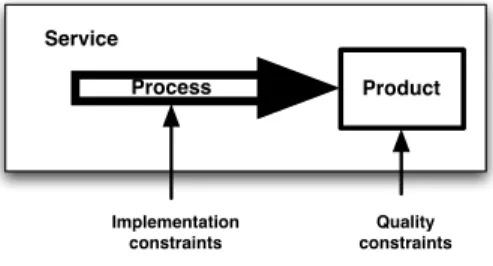
At the heart of this structure is the idea of aservice. A service is the creation of someproductby aprocessunder theassumed circumstances, as shown in Figure 1. The product is what an agent actually wants, whereas the process is the means by which the product is brought about. The product may be an artifact or an activity taking place or something holding true about the world. Significantly, it is often the case that a product can be evaluated by its consumer whereas the process is usually hidden. Theassumed circumstances constitute normal, expected operation: a contract sets up expectations about what each party will do and does so assuming the rest of the world works in a particular way. Considering these assumed circumstances enables us also to consider what should happen when they do not hold in some situations.
We view contracts as inherently symmetric among the parties. Thus each party po-tentially provides one or more services to the others. Aservice commitmentis, then, a commitment whose debtor plays a role in which it provides a service to the creditor of the commitment. A service commitment states what is to be produced by the service and under what assumed circumstances, without further describing the product or pro-cess. In terms of the overall structure of a commitment described in Section 2.1, the service product is the consequent of the commitment.
Product Quality constraints Implementation constraints Process Service
Fig. 1.Control flow for the reasoning process.
A contract contains a set of service commitments. For each service, there are then a number of other constraints and commitments that are meaningful when understood in context of the service.
– Quality constraints, with regard to a service, are restrictions on the debtor to ensure that the service product is of a minimum acceptable quality.
– Implementation constraints, with regard to a service, are restrictions on the debtor to ensure that the process used for production meets certain requirements.
– Acontingency commitment, with regard to a service, is a commitment on the debtor or a third party to provide analternative servicewhen the assumed circumstances do not hold (and statedcontingency circumstanceshold instead).
– Aresolution commitment, with regard to a service, is a commitment on the debtor or a third party to provide analternative servicewhen the service commitment is violated.
– Anaudit commitment, with regard to a service, is a commitment on the debtor or a third party to perform an audit of the service, the product of which is the record of the service having been conducted.
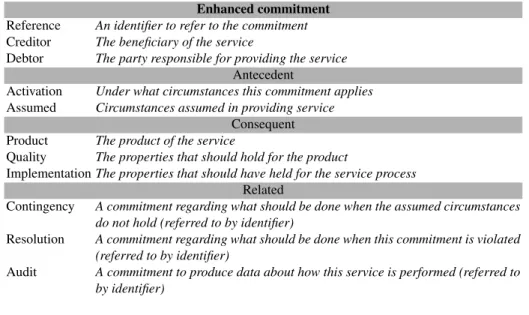
Using the above enhanced structure, we model a contract as a set of such com-mitments. The structure for documenting a commitmentC is shown in Table 1. As explained in Section 2.1, each contract has a CREDITOR and a DEBTOR agent. The
antecedentis divided into anActivationcondition, which states what triggers the com-mitment to apply, andAssumedcircumstances, which states what is assumed to hold when the commitment applies. Both must be true for the commitment to apply, but they are dealt with in different ways. If theActivationcondition does not hold at some time, then the commitment simply does not apply at that time. Conversely, if theActivation
condition holds but theAssumedcircumstances do not, then theContingency commit-ment applies instead (if one is given).
Theconsequent is similarly divided into parts: for theconsequentto be true, the
Product must have been produced such that the Quality properties hold true of the service product and theImplementationproperties hold true of the service process.
Each commitmentCadditionally has related commitments. AResolution commit-ment is applicable when the original commitcommit-mentCis violated, that is, the antecedent of the resolution commitment is the violation of the original commitment. An Audit
as antecedent the same or a more general antecedent thanC) and produces documenta-tion regarding the service process.
A contract, then, is a set of enhanced commitments,EC(CREDITOR,DEBTOR, ac-tivation,assumed,product,quality,implementation), together with functions that map from enhanced commitments to resolution, contingency, and audit commitments (each of which themselves is an enhanced commitment).
Table 1.Enhanced commitment structure.
Enhanced commitment
Reference An identifier to refer to the commitment Creditor The beneficiary of the service
Debtor The party responsible for providing the service Antecedent
Activation Under what circumstances this commitment applies Assumed Circumstances assumed in providing service
Consequent Product The product of the service
Quality The properties that should hold for the product
ImplementationThe properties that should have held for the service process Related
Contingency A commitment regarding what should be done when the assumed circumstances do not hold (referred to by identifier)
Resolution A commitment regarding what should be done when this commitment is violated (referred to by identifier)
Audit A commitment to produce data about how this service is performed (referred to by identifier)
3
Modeling Contracts
Our proposed methodology has two phases: first, it involves mapping the contract text to the commitments model introduced in Table 1; and, second, it involves applying rules to this mapping to check for robustness.
The first phase of our methodology consists of a number of steps, with each step identifying certain artifacts within the contract, and verifying whether these artifacts meet someprerequisitesto ensure the contract is correct and robust in basic ways. For example, verifying might mean ensuring that no commitment has the same creditor as debtor, and that it is clear when the contract begins and ceases to have force. In the next section (Section 4), we introduce the more rigorous robustness rules, which may not hold even for apparently well-drafted contracts.
Our methodology consists of the following steps. For each step, we give the number of the section in this paper in which that step is explained.
1. Identify the critical entities involved in the commitments (Section 3.1) (a) Identify the contracting parties (Section 3.1)
(b) Identify each contracting party’s goals (Section 3.1) (c) Identify domain concepts (Section 3.1)
(d) Identify contract scope (Section 3.1)
2. Map the above entities into the commitment model (Section 3.2) (a) Model services, processes, and products (Section 3.2) (b) Model commitments regarding services (Section 3.2) 3. Check the robustness of the commitments (Section 4)
(a) Check that the contract meets each party’s goals (Section 4.1)
(b) Check that it is well specified how services should be provided and how to handle circumstances in which the services are not provided as specified (Sec-tion 4.2)
(c) Check that the contract does not place conflicting demands on the parties (Sec-tion 4.3)
We illustrate the methodology via clauses selected from the ASE-Motorola contract, especially an abbreviated form of Clause 11.
Clause 11:ASE shall ship the Contract Products to the destinations identified by Motorola. Motorola shall acknowledge to ASE the receipt of each shipment of Contract Products, stating the quantity and type of, and any damages existing at delivery to, such Contract Products within [X days] of receipt at Motorola’s ultimate destination . . . ASE shall certify to Motorola with each shipment that the Contract Products contained therein have successfully passed applicable testing and meet all specifications . . . If Motorola rejects any Contract Prod-ucts, Motorola and ASE shall confer to determine the reason for the rejection. ASE shall immediately exercise commercially reasonable efforts to develop and implement a corrective action plan for any errors, including manufacturing errors or defects, identified in its systems.
3.1 Entity Identification
It is crucial to identify the various artifacts referred to in the contract. These artifacts may then be used within commitments in some structured or unstructured manner. In the former case, rules may be created identifying how they may, or should, be used in order to lead to a robust contract. The following entities are of interest.
Contracting parties A contracting party named by the contract is an entity whose commitments and responsibilities are described by the contract, and who is a signatory to the contract. In Clause 11, ASE and Motorola are the contracting parties.
A contract may identify specific roles within a contracting party, when it is an orga-nization. For example, ASE is committed to providingMotorola Employeeswith office facilities according to Clause 5 (not shown). Other roles mentioned in the contract in-clude those of acoordinatorand theASE account team, which then includes additional roles such asmanagerandexecutive.
Contract goals Business parties adopt a contract if it is conducive to achieving their goals—if the contract is robust, then these goals will be achieved. The preamble spec-ifies the overarching goal; here, this is the successful production and delivery of semi-conductor products from ASE to Motorola. This leads to other identifiable subgoals regarding high-level concepts such as the goal of having ASE deliver the product in a timely manner, the defect rate falling below some threshold, and so on. As we dis-cuss below, each of these goals must be satisfied by some combination of commitments specified in the contract.
Domain concepts Contracts specify what the contracting parties are committed to do within some domain, specifying the relevant states of domain artifacts and how to ma-nipulate them. Domain concepts in Clause 11 includeproducts,rejection,receipt, desti-nation,damage, among others. Although it is beyond the scope of this paper, we assume a suitable ontology for each domain.
Scoping A robust contract should specify when it is in effect, and when it expires, for example, via a termination clause that specifies the conditions under which the contract ends. Clause 3 (not shown) within the Motorola-ASE contract states that the contract is effective from the signing date, and is in force for five years. It also provides alternative ways of terminating the contract early. A prerequisite of robustness is clarity of the scope.
Prerequisite 1 A robust contract specifies the conditions when the contract begins and ends.
3.2 Mapping to Commitment Model
Once we have identified the critical entities, we map them into our commitment-based model.
Services, processes, and products Clearly, it is necessary to identify the services to which the contractual commitments apply. For each service, its product—that is, its desired outcome—must also be identified. Each service is expressed, or sometimes im-plied, in contract clauses using the identified domain concepts, and each party’s goals are expressed in terms of the services.
ThePreamblein our example contract describes the primary services under consid-eration, as follows: “the assembly, test and associated services on high quality semicon-ductor products in volume.” This hints at a service whose product is assembled semi-conductor products and a service whose product is tested semisemi-conductor products. Later clauses identify other “associated” services. For example, Clause 11 includes “ASE shall ship the Contract Products to the destinations identified by Motorola,” the prod-uct of which is the delivery of goods, and goes on to make statements about how this service should be provided.
Service commitments Because we view a contract as an aggregation of the commit-ments it imposes upon the contracting parties, determining whether a contract is ro-bust involves identifying the commitments found in the contract. The remainder of the methodology focuses on these commitments, and the relationships between them.
Each service identified in the contract has a corresponding commitment, with one identified party as debtor, and another as creditor. It is a prerequisite for robust execution that any commitmentmusthave some contracting party (and sometimes a specific role within it) as the commitment’s debtor and creditor, implying the following rule.
Prerequisite 2 A robust contract must ensure that every commitment within the con-tract will have a concon-tracting party as a debtor and a creditor.
For the primary shipment service referred to in Clause 11, the creditor is Motorola and the debtor is ASE. Further, a valid commitment must have distinct parties as debtor and creditor.
Prerequisite 3 The same entity may not be named a debtor and a creditor within a single commitment.
Finally, the given contract must translate unambiguously to our model, and so the following prerequisite applies.
Prerequisite 4 A commitment must only refer to concepts that have been defined within the domain ontology.
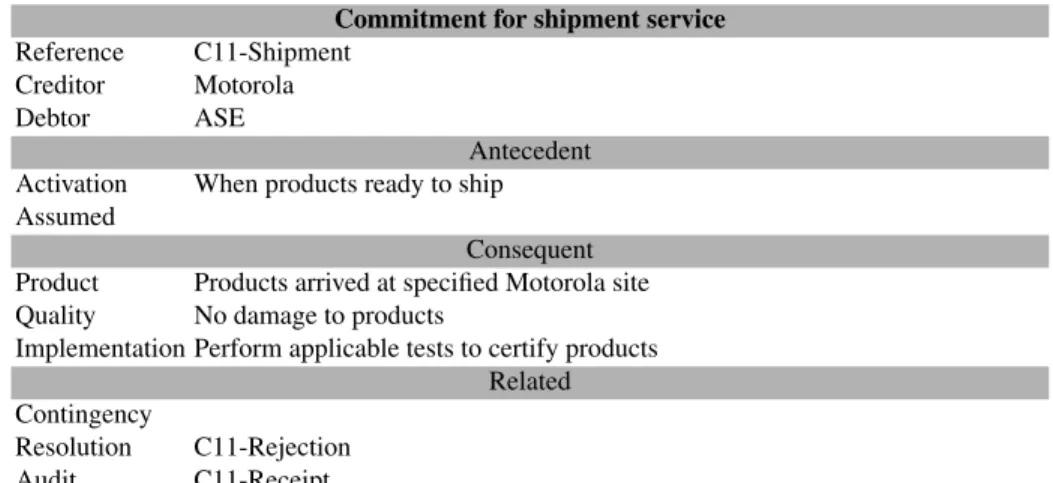
Table 2.Service commitment for shipping.
Commitment for shipment service
Reference C11-Shipment Creditor Motorola
Debtor ASE
Antecedent Activation When products ready to ship Assumed
Consequent Product Products arrived at specified Motorola site Quality No damage to products
Implementation Perform applicable tests to certify products Related Contingency
Resolution C11-Rejection Audit C11-Receipt Audit C11-Quality
Example We apply the above to the initial modeling of Clause 11. Table 2 expresses the commitment to perform the primary service of the clause, that is, shipment of prod-ucts to specified destinations. This commitment is given an identifier, C11-Shipment, and refers to three other commitments extracted from the clause: Rejection, C11-Receipt, and C11-Quality. For brevity, we omit the models for the latter two audit com-mitments; those refer to Motorola’s commitment to provide a timely receipt for prod-ucts received, and ASE’s commitment to provide a statement of quality, respectively. The resolution commitment, C11-Rejection, is invoked when the service product is not achieved, the commitment to quality (no damage) is violated, or the commitment to implementation (tests performed) is not fulfilled.
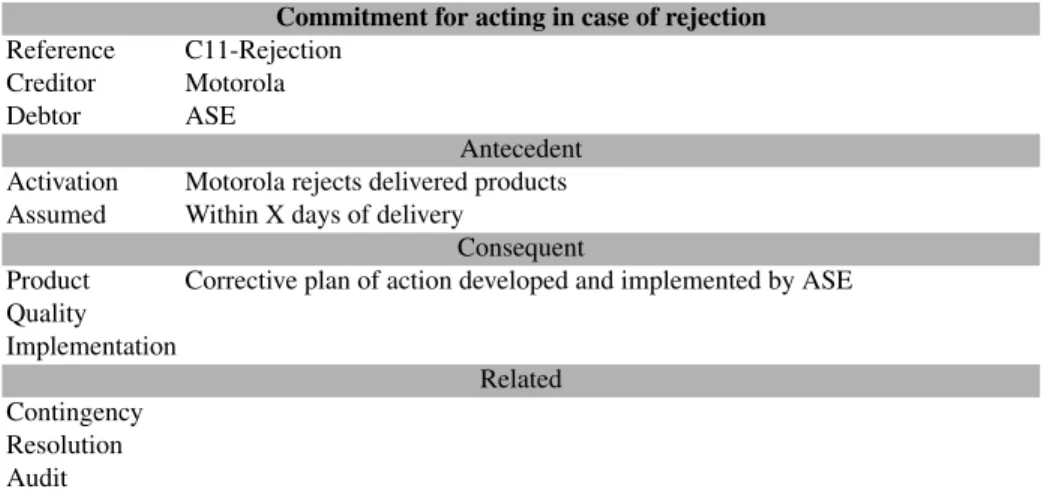
Table 3 shows the model for C11-Rejection. Here, the service performed is the cor-rection of the cause of rejection. No further commitment is involved, as the clause does not specify what should be done to audit the commitment or in contingency situations.
Table 3.Commitment to rectify problems (rejected products).
Commitment for acting in case of rejection
Reference C11-Rejection Creditor Motorola
Debtor ASE
Antecedent Activation Motorola rejects delivered products Assumed Within X days of delivery
Consequent
Product Corrective plan of action developed and implemented by ASE Quality Implementation Related Contingency Resolution Audit
4
Robustness of a Contract
The robustness of a contract depends on how its commitments relate to the goals of the contracting parties. Definition 1 relates each of a party’s goals to commitments in the contract. It says that the fulfillment of a subset of commitments—in any manner— must lead to the satisfaction of the goal, that is, the goal must besupported. The set of commitments leading to fulfillment of the goals may represent either the normal way to fulfill the goals where all services are delivered successfully, or acompensatingway to fulfill the goals where some commitments are violated but compensating commitments are fulfilled.
Definition 1. A contracting party’s goal issupportedby a contract if and only if the fulfillment of the subset of contract commitments, in which the party is the creditor, entails the goal.
Given the above definition, we can then define what it would mean for a contract to be robust for a contracting party.
Definition 2. A contract isrobustfor a contracting party if all of the contract party’s goals are supported by the contract. A contract isrobustoverall if it is robust for all its contracting parties.
In order to specify how to assess robustness, we must define what it means for (1) a contracting party’s goals beentailedby the contract and (2) a commitment to compen-satethe failure of another commitment. Both of the above relate to the different types of behavior a contractual commitment can address. Therefore, it is important to model the kinds of commitments depending on the purpose they serve in the contract. Below, we enhance our basic commitment model to include the specification of commitments based on their purpose.
Given the model of contracts in the preceding section, we now specifyrulesfor determining the robustness of contracts expressed in that model. We divide such rules into the following main categories:
1. those that determine whether the contract contains the content required by each party;
2. those that determine whether each contract commitment is handled robustly; and 3. those that apply to consistency between commitments.
4.1 Necessity Robustness Rules
A robust contract must ensure that each contracting party’s goals are satisfied when the contract executes correctly. The consequent of a service commitment may be used to capture the creditor’s goals (when the commitment’s antecedent holds). Therefore, the desired outcome of a contract may be captured by some subset of the contract’s service commitments. A robust contract must thus satisfy the following rule.
Robustness Rule 1 Each goal expected to be satisfied by the contracting parties should be (a necessary implication of) the consequent of a service commitment.
Applying this rule to our example, the commitments shown in Tables 2 and 3 are judged robust with regard to this rule: on the former’s completion, Motorola will have the components it desires; on the latter’s completion, any problems will have been ap-propriately addressed.
4.2 Coverage Robustness Rules
A service commitment can often be fulfilled in multiple ways, and not all are of equal value to the contracting parties. In order to be robust, the contract must ensure that a commitment is met appropriately.
Robustness Rule 2 Each service commitment must have corresponding quality con-straints that specify what it means for the service product to achieve an adequate stan-dard.
Table 2 shows a simple statement of the quality required of the product: no damage should have occurred. In the commitment in Table 3, no quality constraints are given. Whereas this omission may be deemed appropriate by the contracting parties, the above rule highlights the fact that the contract is less robust if Motorola places no criterion on what an acceptable corrective plan can be.
Whereas the quality constraints concern the service product, we may also apply cri-teria for judging the process by which the service is conducted, leading to the following rule.
Robustness Rule 3 If a service commitment may be met in a number of ways, a proper subset of which capture the creditor’s goals, then the service commitment should have corresponding implementation constraints that specify what it means for the service commitment to have been achieved in a satisfactory manner.
Table 2 shows a commitment by ASE to apply tests for damage and to ensure speci-fications are met prior to delivery (and therefore part of the service process). In contrast, Table 3 gives no implementation commitment. The above rule highlights the fact that the contract is less robust if Motorola places no criterion on what process is accept-able in developing a corrective plan, for example, the factors that ASE should take into account.
The fulfillment of service commitments and quality constraints is usually publicly observable. For example, whether ASE has manufactured the semiconductor chips up to the requisite standard is verifiable by Motorola once Motorola has received the chips. However, implementation constraints restrict the internal processes a contract party em-ploys; compliance with such commitments is not visible outside the company. For ex-ample, Motorola cannot ascertain from outside ASE whether ASE has met the ISO 9000 standards in manufacturing the chips. Hence, implementation constraints call for audit commitments.
Robustness Rule 4 Each service’s implementation constraintsmusthave a correspond-ing audit commitment that ensures that the satisfaction or violation of the constraints is detected.
If a commitment has been violated (for example, if the product is not available, or if quality or implementation constraints haven’t been followed), then the creditors’ goals may not be achieved. In order to be robust, therefore, the creditor in the commitment requires that some compensating commitment comes into force.
Robustness Rule 5 Each commitmentmusthave a corresponding resolution commit-ment that ensures that the violation of the former commitcommit-ment results in a suitable sanction on the debtor.
Table 2 shows two commitments to ensure correct auditing by both parties involved. It is only by auditing that any violations of the implementation constraints are detected. There is also a resolution commitment, to specify what should be done when the prod-uct or process is inadequate according to the quality and implementation constraints. Table 3 shows no audit or resolution commitments are given. The above rules highlight the fact that the contract is less robust if there is no record of ASE having produced and implemented such a corrective plan, or what action to take if ASE fails to produce such a plan.
Further, for the debtors of a contract commitment, the contract is robust only if it adequately accounts for exceptional circumstances, beyond those assumed in normal operation. We ensure the robustness of the contracts in relation to these aspects, with the following rule.
Robustness Rule 6 Each commitment may have corresponding contingency commit-ments that ensure that, in each exceptional circumstance envisaged, the violation of the former commitment does not result in an inappropriate sanction on the debtor.
Table 2 shows no contingency commitments because the contract fails to specify as-sumed circumstances. The absence of assumptions should draw the modelers’ attention, but may merely indicate that there is no contingency to consider. Table 3 also states no contingency commitment, but does have assumed circumstances. The above rule high-lights the fact that the contract is less robust if it is not specified what should be done if Motorola only rejects a product long after (more than X days) it has been delivered.
It might seem that, if applied recursively, the above rules could lead to an infinitely large contract; for example, each commitment requires another commitment for reso-lution. However, our use of the context of a contract—as in a business contract within a wider legal system—provides a natural solution. Not all of the associated commit-ments mentioned in the rules above need to be in the contract document itself; many may be present in the wider context. Ultimately, the audit, resolution, or contingencies of contextual commitments may be captured via general approaches, such as “file a lawsuit.”
4.3 Consistency Robustness Rules
The above rules consider the requirements of robustness on each commitment. The robustness of a contract as a whole depends in addition on whether its commitments are realizable.
It should always be clear to a contracting party what to do to fulfill the contract, even in the case of multiple failures. Further, if success in one commitment prevents success in another, then the contract cannot be robust. A particular example of this is where two commitments require the same party in the same system state to do two conflicting things. A robust contract does not have such conflicts between its commitments, and the following rule expresses this constraint.
Robustness Rule 7 For any given contracting party and applicable system state, by performing an action necessary to avoid violating one commitment, the action should not violate any otherwise nonviolated commitment.
Taken together, the rules specified above provide us with a means of ensuring that a contract is robust at the point of specification. The full set of rules is summarized in Table 4, indicating which aspects of the contract each rule applies to.
Table 4.Contract rules.
Rule Target
PREREQUISITE1 Scope of contract
PREREQUISITES2 & 3 Services and contracting parties
PREREQUISITE4 Well-defined contract
ROBUSTNESSRULE1 Product
ROBUSTNESSRULE2 Quality constraints ROBUSTNESSRULE3 Implementation constraints
ROBUSTNESSRULE4 Audit commitments
ROBUSTNESSRULE5 Resolution commitments ROBUSTNESSRULE6 Contingency commitments
5
Evaluation
We used the Motorola-ASE contract as primary inspiration for our approach to model-ing and assessmodel-ing contract robustness (along with our prior experience with case studies as part of electronic contracting projects). To evaluate our proposed approach, we took an entirely independent contract and applied our methodology to it. Figure 2 shows an excerpt from a short contract7 between a juggling society and an event organizer. We
now show how our methodology applies to determine whether this contract is robust.
5.1 Entity Identification
The two contracting parties involved in this contract are the JUGGLINGCLUB(UJC), and the CANTERBURYCENTREDINNER(CCD). Additional roles includePERFORMER andJUGGLER. As we see below, this contract obeys Prerequisites 2 and 3.
The CCD’s goal from the contract is to obtain performers for their dinner. The UJC’s goal is to get paid.
Apart from temporal concepts (relating to dates and times), and general concepts such as money, we may identify the domain concepts listed in Table 5. Since only these concepts are referred to within the contract, Prerequisite 4 is satisfied.
The contract initiates as soon as it is signed and it isimpliedthat it expires at the end of the performance. Note that the lack of an explicit expiration condition suggests one problem with the robustness of the contract. One may envision a situation where some equipment is damaged, and a disagreement arises as to whether this damage falls under the contract or not (for example, when the jugglers and guests are on their way home from the dinner). Thus, Prerequisite 1 is not satisfied within this contract.
Contract For: Canterbury Centre Dinner 2003 (“CCD”), Friday 6 June 2003, 24 High Street, Canterbury.
This agreement is entered into between the University Juggling Club (“UJC”) and the Canterbury Center Dinner 2003 on the following terms:
1. Service Provider: University Juggling Club. 2. Employer: Canterbury Center Dinner.
3. To be provided by UJC: Performers: J Woods (juggler); one other juggler; all equipment necessary for performance.
4. To be provided by CCD: Cloakroom. 5. Venue address: 24 High Street, Canterbury.
6. CCD understands that performances are restricted in venues with ceilings of insufficient height. The ideal height is 5 meters. Outside performances are re-stricted in rain or strong winds.
7. Date of Performance: Friday 6 June 2003, starting at 6:30PM.
8. Duration of Performance: 1.5 hours. Short (less than one minute) breaks are part of the performance.
9. Fee:£30 per juggler +£10 expenses +£90 insurance (total£160).
10. If UJC is forced to cancel, all monies (including£90 deposit) will be refunded in full. If the Employer cancels with at least 24 hours notice, UJC will retain
£90 and return any other monies.
11. Should poor weather mean that the Event takes place indoors, UJC will refund
£10 expenses.
12. Performers will not consume any alcohol until after completion of services as agreed.
13. CCD will be responsible for compensation to UJC for damage to equipment caused by those attending the Event unless damage is caused when (if) Per-formers have left equipment unguarded.
14. UJC will be liable for any injury sustained by a guest at the Event if such injury results from provision of services as agreed upon in this contract unless the Event fails to provide a suitable area for performance.
Fig. 2.An extract from a contract to provide juggling services.
5.2 Mapping to Commitment Model
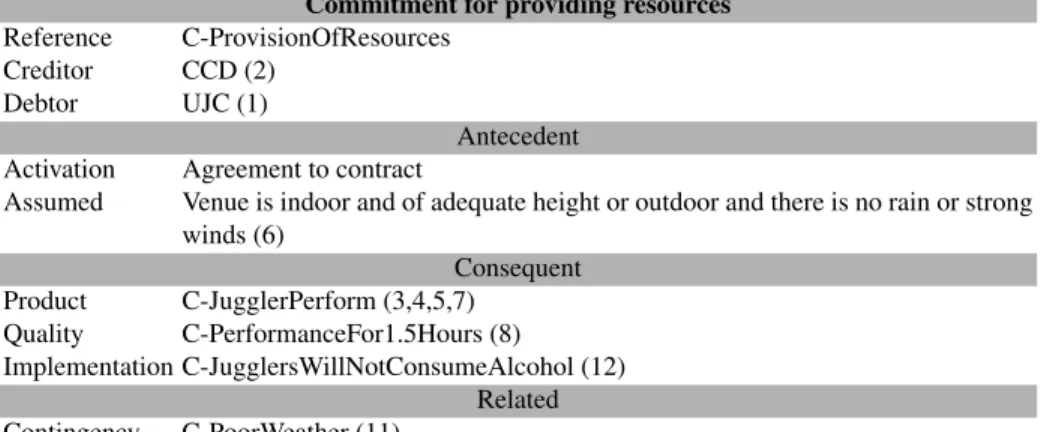
We now map clauses from the contract to the commitment model. Clauses 3 to 7 imply a service to be provided: the provision of jugglers and equipment by UJC, modeled in Table 6. UJC is the debtor, CCD is the creditor and the eventual product of the service is that the jugglers perform at the event. Implementation constraints are specified: that the jugglers remain sober (Clause 12). Where the service cannot be provided due to poor weather conditions (assumed circumstances not holding, Clause 11) or the per-formance is canceled by UJC (violation of commitment under assumed circumstances, Clause 10), contingency and resolution commitments apply, respectively. Clause 9 is a commitment for a separate payment-for-juggling service, and so is not modeled here.
Table 5.Domain concepts for theJugglercontract, grouped according to the commitments that they most closely relate to.
Service performance, breaks, guests, venue, equipment
Contingency deposit, damage, injury, guarding, poor weather, cancellation
Implementationalcohol consumption, cloakroom, performance area, indoors, height, outside
Resolution compensation, liability, refund
Table 6.Service commitment: provide jugglers, equipment (the numbers refer to clauses in the textual description).
Commitment for providing resources
Reference C-ProvisionOfResources Creditor CCD (2)
Debtor UJC (1)
Antecedent Activation Agreement to contract
Assumed Venue is indoor and of adequate height or outdoor and there is no rain or strong winds (6) Consequent Product C-JugglerPerform (3,4,5,7) Quality C-PerformanceFor1.5Hours (8) Implementation C-JugglersWillNotConsumeAlcohol (12) Related Contingency C-PoorWeather (11) Contingency C-Cancellation (10) Resolution C-CompensationResponsibility (13) Resolution C-Injury-Liability (14) 5.3 Assessing Robustness
Having identified the commitments, we may check whether they meet the appropriate robustness rules. Clearly, each desired outcome of the contract meets the commitments specified in Clauses 3, 4, 7, 8 and 9, as a performance will take place, and UJC will be paid. Thus, Rule 1 is satisfied.
According to Rule 2, each service commitment must have associated quality con-straints. Whereas one assessment of quality is given for the service in Table 6, and so the clause can be judged somewhat robust, other quality measures may also be considered (for example, specifying how capable the juggler should be).
UJC agrees to implementation constraints: that the jugglers do not consume alcohol while performing. Note that although there is no corresponding audit commitment, this is only because the contracted performance is slated to happen in a public venue and CCD would easily be able to detect noncompliance on part of the juggler. Thus Rule 4 is satisfied. The parties may consider additional implementation constraints, for example if there are any stipulations that should be made about how the product is reached, such as whether the organizers are given prior warning about when the jugglers will arrive.
There are some commitments for contingency and resolution in Table 6. Therefore, there is some robustness in this regard according to Rules 5 and 6. However, the contract can be even more robust if consideration is made of the other ways in which the assumed circumstances may not come about or the service is not provided. For example, the assumed circumstances are a conjunction of criteria and the contract does not say how to handle jugglers arriving at a venue with too low a ceiling. Similarly, the quality constraints require jugglers to remain sober, but there is no means of redress specified if this commitment is violated.
The juggling contract’s inability to deal with such unexpected situations, together with its vagueness, means that it lacks robustness in several ways, and that in unexpected situations, disagreements between the parties may occur that the contract may be unable to resolve.
6
Related Work
Tropos is one of the leading AOSE methodologies with a substantial emphasis on early-stage requirements [4]. Tropos is centered on the notion of goals (along with dependen-cies among goals), and generally works best where the system-to-be is built to accom-modate the goals of the stakeholders, modeled as actors. Tropos does not naturally apply to cross-organizational settings, where there is no unique system-to-be but rather one per stakeholder and where often the challenge is to specify the interactionprotocolor rules of encounter rather than a complete implementation of a system. Mallya and Singh [12] relate protocols with Tropos using dependencies as bases for inducing protocols. Telang and Singh [18] have sought to incorporate commitments into Tropos as first-class modeling concepts. However, the existing works on Tropos have a general bias toward greenfield system designs whereas the approach we propose above begins from existing contracts and thus potentially can apply when a functioning (though potentially inadequately functioning) cross-organizational system is already in place.
Much work has been done on using automated contracts within computer science, and particularly within the area of multiagent systems. It is possible to categorize this work based on the contract life cycle. Our work in this paper concerns itself with the first stage of the contract life cycle, namely contract drafting. In this phase, themes such as the precise language used to represent the contract are important, as well as challenges such as contract negotiation (for example, as studied by Carbogim and Robertson [5]) and contract validation. Once a contract is drafted, it comes into effect, and further challenges such as contract monitoring and enforcement become important, but are not further discussed here. Daskalopulu et al. [7] describe logic-based tools for this end.
Our use of commitments to model contracts represent a significant departure from existing works on modeling contracts. Both contracts and commitments are social con-structs in that they are both grounded in communication among the participants. By contrast, constructs such as business rules and obligations (as studied in deontic logic) are not social. Many contract languages that have been proposed, including those by Abrahams and Bacon [1], Grosof and Poon [11], and Governatori [10]. However, none of them represent contracts as a set of commitments as we do.
We do not study how a contract comes into being, concentrating instead only on whether it is robust or not. Thus, our work falls into the area of contract validation. However, most work on contract validation concerns itself with either ensuring that contract clauses are consistent, for example, by Daskalopulu [6], or ensuring that a sound legal basis exists, for example, by Gisler et al. [9]. The notion of robustness adds to, rather than replaces these concerns.
The only other large-scale analysis of contractual requirements that we are aware of is the work of Daskalopulu et al. [6], who investigate how to support large engineering contracts. However, their work was focused on identifying language requirements for such contracts, not on a software engineering methodology as here.
The work of Desai et al. [8] is relevant in this regard. Desai et al. study contracts from the perspective of utility theory as a basis for determining from the perspective of a contracting party whether a particular contract issafe(never produces negative utility) orbeneficial(produces positive utility) for it. It would be useful to incorporate Desai et al.’s representation and reasoning approach into our methodology, although a practical challenge that such economic approaches face is determining the relevant utilities and probabilities in domains of sufficient complexity to be practically valuable.
7
Conclusions and Directions
In this paper, we have sought to develop a model, a methodology, and heuristic rules by which we can capture and analyze requirements from business contracts as a potential basis for developing robust multiagent implementations of software systems in open environments.
We identified the notion ofrobustnessas critical to a contract. Informally, a robust contract is one that meets the contracting parties’ goals for the contract, and handles unexpected situations gracefully. We proposed a methodology for determining whether a contract is robust, and evaluated portions of this methodology on portions of two real contracts. Our approach models contracts such that their robustness is assessed in a structured manner. However, many open questions remain.
First, it would be interesting to map the notions of robustness into an existing con-tract language, such as the one proposed by Oren et al. [15], and to automate the rules for robustness, creating an algorithm that may identify whether a contract is robust or not. It would also be useful to study a large number of additional contracts, and see whether our rules for robustness are exhaustive, or should be altered in some way. Further, it may be possible to identify additional commonly occurring classes of commitments, together with associated robustness rules.
The notion of robustness becomes increasingly important as agents autonomously negotiate and create contracts between themselves. By creating a robust contract, able to state what should occur in all situations (within the context of the contract), an agent’s cognitive load is reduced, as it does not need to reason about whether the contract was adhered to or not. Further, robust contracts minimize the situations in which humans need to intervene in order to handle agent disagreements. While many open problems remain, this paper provides an initial approach to identifying and creating robust con-tracts.
Acknowledgments.Amit Chopra was supported by a Marie Curie Trentino award.
References
1. Abrahams, A.S., Bacon, J.M.: A software implementation of Kimbrough’s disquotation the-ory for representing and enforcing electronic commerce contracts. Group Decision and Ne-gotiation 11(6), 487–524 (2002)
2. Bordini, R.H., Dastani, M., Dix, J., Fallah-Seghrouchni, A.E. (eds.): Multi-Agent Program-ming: Languages, Platforms and Applications, Multiagent Systems, Artificial Societies, and Simulated Organizations, vol. 15. Springer (2005)
3. Bordini, R.H., H¨ubner, J.F., Wooldridge, M.J.: Programming Multi-Agent Systems in AgentSpeak using Jason. John Wiley & Sons, Chichester, UK (2007)
4. Bresciani, P., Perini, A., Giorgini, P., Giunchiglia, F., Mylopoulos, J.: Tropos: An agent-oriented software development methodology. Journal of Autonomous Agents and Multi-Agent Systems 8(3), 203–236 (May 2004)
5. Carbogim, D., Robertson, D.: Contract-based negotiation via argumentation (a preliminary report). In: Proceedings of the Workshop on Multi-Agent Systems in Logic Programming: Theory, Application, and Issues (MAS) held at the International Conference on Logic Pro-gramming (ICLP). Las Cruces, New Mexico (1999)
6. Daskalopulu, A.: Logic-based tools for legal contract drafting: Prospects and problems. In: Proceedings of the First Logic Symposium. pp. 213–222. University of Cyprus Press (1997) 7. Daskalopulu, A., Dimitrakos, T., Maibaum, T.: Evidence-based electronic contract
perfor-mance monitoring. Group Decision and Negotiation 11(6), 469–485 (2002)
8. Desai, N., Narendra, N.C., Singh, M.P.: Checking correctness of business contracts via com-mitments. In: Proceedings of the 7th International Joint Conference on Autonomous Agents and MultiAgent Systems (AAMAS). pp. 787–794. IFAAMAS, Columbia, SC (May 2008) 9. Gisler, M., Stanoevska-Slabeva, K., Greunz, M.: Legal aspects of electronic contracts. In:
Proceedings of the CAiSE Workshop on Infrastructure for Dynamic Business-to-Business Service Outsourcing (IDSO). CEUR Workshop Proceedings, vol. 30. CEUR-WS.org, Stock-holm (2000)
10. Governatori, G.: Representing business contracts in RuleML. International Journal of Coop-erative Information Systems 14(2–3), 181–216 (2005)
11. Grosof, B., Poon, T.C.: SweetDeal: Representing agent contracts with exceptions using se-mantic web rules, ontologies, and process descriptions. International Journal of Electronic Commerce 8(4), 61–98 (2004)
12. Mallya, A.U., Singh, M.P.: Incorporating commitment protocols into Tropos. In: M¨uller, J.P., Zambonelli, F. (eds.) Proceedings of the 6th International Workshop on Agent Oriented Software Engineering (AOSE 2005). LNCS, vol. 3950, pp. 69–80. Springer, Berlin (2006) 13. Meneguzzi, F., Miles, S., Holt, C., Luck, M., Oren, N., Faci, N., Kollingbaum, M.:
Elec-tronic contracting in aircraft aftercare: A case study. In: Proceedings of the 7th International Conference on Autonomous Agents and Multiagent Systems. pp. 63–70 (2008)
14. Nunes, I., Cirillo, E., de Lucena, C.J.P., Sudeikat, J., Hahn, C., Gomez-Sanz, J.J.: A survey on the implementation of agent oriented specifications. In: Agent-Oriented Software Engineer-ing X: State of the Art Survey, Lecture Notes in Computer Science, vol. 6038, pp. 157–167. Springer (2010)
15. Oren, N., Panagiotidi, S., V´azquez-Salceda, J., Modgil, S., Luck, M., Miles, S.: Towards a formalisation of electronic contracting environments. In: Proceedings of the International Workshop on Coordination, Organization, Institutions and Norms in Agent Systems (COIN) held at AAAI. pp. 61–68. Chicago (2008)
16. Rodr´ıguez-Aguilar, J.A., Mart´ın, F.J., Noriega, P., Garcia, P., Sierra, C.: Towards a test-bed for trading agents in electronic auction markets. AI Communications 11(1), 5–19 (1998) 17. Singh, M.P.: An ontology for commitments in multiagent systems: Toward a unification of
normative concepts. Artificial Intelligence and Law 7, 97–113 (Mar 1999)
18. Telang, P.R., Singh, M.P.: Enhancing Tropos with commitments. In: Borgida, A., Chaudhri, V.K., Giorgini, P., Yu, E.S.K. (eds.) Conceptual Modeling: Foundations and Applications. LNCS, vol. 5600, pp. 417–435. Springer (2009)
19. Telang, P.R., Singh, M.P.: Abstracting and applying business modeling patterns from Roset-taNet. In: Proceedings of the 8th International Conference on Service-Oriented Computing (ICSOC). pp. 426–440. ACM, San Francisco (2010)
20. Telang, P.R., Singh, M.P.: Specifying and verifying cross-organizational business models: An agent-oriented approach. IEEE Transactions on Services Computing 4 (2011), in press 21. Weyns, D., Haesevoets, R., Helleboogh, A.: The MACODO organization model for
context-driven dynamic agent organizations. ACM Transactions on Autonomous and Adaptive Sys-tems (TAAS) 5(4), 16:1–16:29 (Nov 2010)