2011, No. 1(9), p. 7–22
THE APPLICATION OF E-COMMERCE TECHNOLOGIES
IN THE DEVELOPMENT OF INTERNATIONAL TRADE
Aurelija BURINSKIENĖ
Vilnius Gediminas Technical University, LT-10223 Vilnius, Saulėtekio al. 11, E-mail: [email protected]
Abstract. The article discloses the application of e-commerce technologies for the de-velopment of international trade. In this paper, the problems associated with the application of e-commerce technologies in international trade are analysed. It is identified that enterprises involved in international trade are using e-commerce technologies for selling products in different markets which, based on their openness, are closed and open. The analysis of the benefits and investments is provided herein. By using the study results, the cash-flow model, which can be applied to evaluate efficiency when e-commerce technologies are used for the development of international trade, is formulated. The assessment of practical application of proposed cash-flow model is presented in the paper herein.
JEL classification: L81, D61, P33.
Keywords: e-commerce, international trade, efficiency, benefit, multi-period invest-ments.
Reikšminiai žodžiai: e. komercija, tarptautinė prekyba, ekonominis efektyvumas, eko-nominė nauda, daugkartinės investicijos.
1. Introduction
A huge dynamism is characteristic to international trade: it undergoes multiple and rapid alterations, therefore one needs to react single-mindedly to new challenges and tackle more complicated problems. For the past several decades, by developing international trade, the possibilities to increase efficiency have been re-examined. Since the development level of information technologies is growing, the needs are perceived in a new way, which appear in the practice of e-commerce. Apparently, the importances of e-commerce technologies in the development of international trade is immense and has a tendency to grow: under modern globalisation circumstances, the application of information and telecommunication technologies has become a crucial factor of development in both international trade and economy in general.
There are several ways to develop international trade by applying e-commerce technologies:
-
An Internet shop. The consumer can visit the e-shop and choose an item from a wide range of goods;-
A producer on the Internet. Consumers can easily find, choose and even make a “purchase-sale” deal with a direct producer online. This encourages more and more consumers to buy goods directly;-
Trade with the help of an e-network. More and more permanent business partners use e-networks to receive orders, transfer the documents of payment and transport. Data received via e-networks are integrated into the informa-tion systems of enterprises.E-commerce is distinguishable because of certain peculiarities: a customer can get purchases in any country worldwide; expenditure of trade transactions, when e-commerce technologies are used, are usually lower than expenditure of traditional trade transactions due to the fact that costs of operations are lower; however, there is a growth of expenditure which appears as a result of implementation and mainte-nance of e-commerce technologies and goods delivery.
The above-mentioned peculiarities determine that e-commerce is usually more efficient than common trade forms. Therefore, there is a demand to create and use in international trade such instrumentation for the evaluation of efficiency concerning the usage of e-commerce technologies that would be used to identify reasonably those cases when the traditional technologies of international trade are worth chang-ing into e-commerce technologies and when e-commerce can help to increase the amounts of international trade. Decisions, which are oriented to efficiency of interna-tional trade and the increase of practice competition of various economy subjects in international trade, usually exploit the opportunities provided by e-commerce tech-nologies.
In this paper, the complex application of e-commerce technologies in interna-tional trade are examined, and a model, which can be applied to evaluate efficiency when e-commerce technologies are used in international trade, is formulated, while empirical assessment, which shows that a formulated theoretical model can be ap-plied, is undertaken.
The methods of comparative, statistical, and financial analysis have been mainly applied in the paper.
2. E-commerce conception and its refection in scientific works
E-commerce is the purchase and sale of goods and services by using e-networks (open1 and close2 networks) (Bidgoli, 2004). E-commerce is an activity when
1 Open e-network is a public network and global network. It provides an opportunity to look for
neces-sary information. The most open network is the Internet (Paliulis et al., 2003). For example, external consumers can use the Internet to log on the website of an e-shop and choose desirable items from a wide assortment.
2 Close e-networks are private networks. Such networks are allocated to business, enterprises. They
allow joining companies which are in different geographical regions and establishing a direct relation-ship between an enterprise and its partners. Close e-network is for information exchange which is car-ried out via special networks among business representatives or a specific enterprise branches. For this
networks are used in order to reach customers, sell goods, services and pay for them. Such practice is also related to advertising, purchase delivery, etc. (Bergendahl, 2005).
Talking about e-commerce, M. Khosrowpour (2006) and other authors use the term “e-commerce technologies”; these technologies are used during trade transac-tions.
Enterprises expect that expenditure of item sale on the Internet is lower than ex-penditure, which a company incurs selling goods traditionally. Moreover, they think that sale on the Internet is determined by price, quality and delivery conditions. Ac-cording to K. L. Kraemer’s data (2006), enterprises which sell items on the Internet increase their income, improve client service, reduce expenditure and reach a higher efficiency level.
E-commerce can be based on two major business models: - Business model “business to business”;
- Business model “business to consumer” (Davidavičienėet al.,2009).
“Business to business” often means transactions among companies. Several more enterprises trade on the basis of such a model. This has been the most common e-commerce model in the whole world since e-commerce technologies appeared (Kvainauskaitėet al.,2005).
The business model “business to business” also reflects the form of wholesale when goods are ordered online. Due to this, one should also have the customers’ da-tabase, where information about discounts for each customer is preserved.
The business model “business to consumer” comprises transactions among sell-ers and final consumsell-ers. Enterprises, which use technologies “business to consumer”, make many efforts to attract as many customers as possible (Jovarauskienė et al., 2009). The most important form of such a model is e-shop (Davidavičienė et al., 2009). The model usually reflects the form of retail when goods are ordered online.
The biggest part of transactions, applying e-commerce technologies, makes “business to business” transactions i.e. in between business transactions (transactions among legal persons); they are made on the Internet or via other e-networks. Society better knows “business to consumer” technologies (Becker, 2007). The main peculi-arity of the business model “business to consumer” is to provide a present and poten-tial customer with all available information about goods, offer online order, payment and service (Barnes, 2007).
In comparison to traditional trade, expenditure incurred by selling goods online can be bigger or smaller. Smaller activity expenditure can be determined by forma-tion of a customer's made orders (Khosrowpour, 2006); smaller trade expenditure and relations with other business systems. Enterprises, applying e-commerce tech-nologies, can spend less money on advertisement and exposition equipment. Bigger activity expenditure can be determined by item delivery, establishment and
reason, it can be used the technology of intended lines, allowing to join different e-networks and to deliver data (ITU, 2005).
nance of e-shop. The choice of item prices by e-shop can match the prices of a tradi-tional shop (Khosrowpour, 2006), and delivery price can cover item delivery costs.
E-commerce provides more opportunities to conduct transactions and encourage the development of new forms of international trade. M. A. Hitt (2002) thinks that the main reasons encouraging enterprises to develop e-commerce are extra income, smaller administration expenditure, higher activity efficiency and better financial results.
Implementation of e-commerce technologies gives many new opportunities. However, enterprises have to accept new challenges of international trade and make appropriate decisions. This means that the usage of e-commerce technologies is the main factor, determining the perspectives of international trade development.
3. The concept of international trade and its refection in literature
International trade is a broad term and is defined differently in different sources. International trade by World Trade Organization (WTO) is defined as “the flow of goods, carriage of goods within the territorial borders.” The United Nations Organi-zation (UNO) defines international trade as “the international sale of goods.” In the documents of Organization of Economic Cooperation and Development (OECD), international trade is defined as import and export activities and their results are measured by value of goods, provided to other persons, and the value of goods re-ceived from foreign entities’s hinterland.
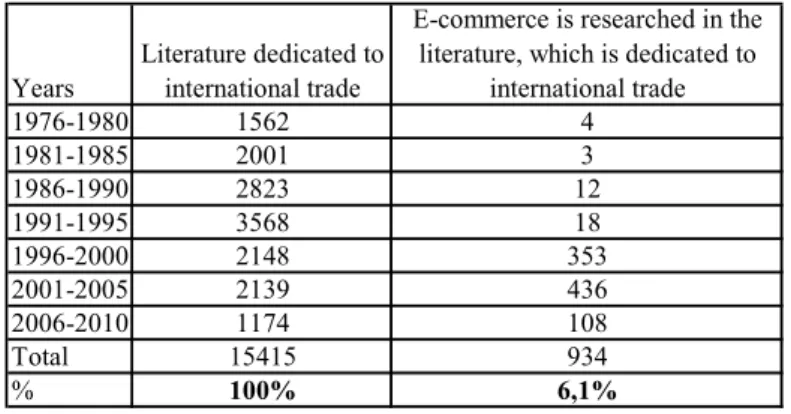
The survey of literature, which ispublished by leading world publishers (such as Oxford University Press, Cambridge University Press, Harvard University Press, Springer, M. E. Sharpe, Routledge, etc.), shows that there are only 6.1% of all scien-tific works (in total) on the topic of the application of e-commerce in international trade (table 1).
Table 1. Scientific literature on the topic of e-commerce in international trade
Years
Literature dedicated to international trade
E-commerce is researched in the literature, which is dedicated to
international trade 1976-1980 1562 4 1981-1985 2001 3 1986-1990 2823 12 1991-1995 3568 18 1996-2000 2148 353 2001-2005 2139 436 2006-2010 1174 108 Total 15415 934 % 100% 6,1%
The conclusion has been drawn that there is a lack of works in scientific litera-ture about the application of e-commerce in international trade.
The successful and purposeful development of international trade has to be based on such scientific knowledge of circumstances and such scientifically-proved solutions. Solutions, which are oriented to efficiency of international trade and the increase of practice competition of various economy subjects in international trade, usually exploit in one or another way the opportunities provided by e-commerce technologies.
The inadequate and inappropriate usage of e-commerce technologies affects de-velopment of international trade. The dede-velopment of instrumentation that allows evaluating the perspectives and opportunities of the application of e-commerce tech-nologies is an important precondition in the development of international trade.
4. Models, which can be applied for the evaluation of efficiency when e-commerce technologies are used in the development of international trade
Efficiency is an index allocated to measure the qualitative and quantitative re-sults of economic practice and it is associated with resources, which are used to achieve the above-mentioned results. Economic efficiency is of two sizes: economic effect and combination of resource usage (or in other words a relation between re-sults and expenditure).
Efficiency of usage of e-commerce technologies in trade can be evaluated by several ways: as a real efficiency and as an expected efficiency. In order to outline a real efficiency, indexes, indicating efficiency of used technologies in real time, are analysed. An expected efficiency is identified in such cases when it is necessary to evaluate the benefit of e-commerce technologies, which are intended to be applied. In order to outline an expected efficiency, historic data and predictions based on infor-mation which reflects other enterprises experience are used. These predictions are used to assess or increase the efficiency of usage of e-commerce technologies. One of the ways to evaluate an expected efficiency is to evaluate the investment (expendi-ture) and benefit (income increase, expenditure decrease) of subjects that work or intend to work in trade.
The works of MacGregor et al. (2005) and Anandarajan et al. (1999) analyse the question of investment in e-commerce technologies. The authors state that invest-ment in e-commerce technologies is long-term. Talking about investinvest-ment, the authors classify it as primary (purchase and implementation of technology) and continual (development of e-commerce technologies).
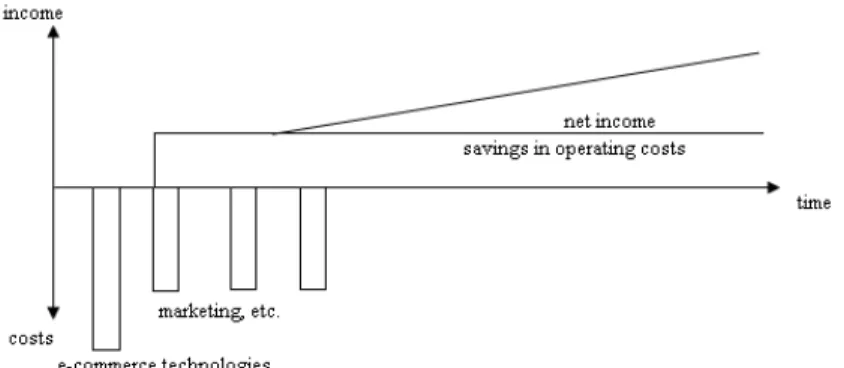
Various methods to evaluate efficiency, including models based on analysis logic of benefit-cost are used (Fig. 1). The importance of technological implementa-tion is emphasized in these models. Such models are intended for assessing cost and results of technological development in the long run. In practice these models are used for making decisions about investment. An example of such a model can be G. Bergendahl’s model (2005) designed to measure the usage benefit of e-commerce technologies, which an enterprise experience from time perspective.
In G. Bergendahl’s model (2005) the extent and growth of sale are considered as the main factors, determining profitability of investment in e-commerce
technolo-gies. Therefore, there is a need to assess sale extent from time perspective. It is con-sidered that income from investment is received immediately after the end of invest-ment process. In the course of time, (It) sale extent increases (1 formula).
, ) q ( I It = 0 1+ t (1)
Here It is during the period t accumulated sale extent, I0 is existing sale ex-tent, q is accumulation standard, t is period.
On one hand, sale extent (It) can grow gradually (q), on the other hand it can increase unevenly. Bergendahl (2005) notices that advertisement cost has influence on increasing sale extent, i.e. the bigger advertisement costs are, the faster growth of sale extent becomes.
In G. Bergendahl’s model (2005) (Fig. 1) investment in e-commerce technolo-gies as well as funds, which an enterprise gives for advertisement of an e-shop, tech-nological maintenance and item sale, are assessed.
Firstly, an enterprise invests in e-commerce technologies. The price of these technologies depends on their flexibility, functionalism, possible number of custom-ers and goods. In this case it is discussed about onetime investment in technological equipment (server, support infrastructure) and software program (website of an e-shop, extranet, an e-catalogue of goods, and technologies guaranteeing safe payment, etc.).
Secondly, an enterprise spends a certain amount of money on advertisement. G. Bergendahl (2005) found that a company, which engaged in an activity and realised its goods in a traditional way before, spent less for advertisement than the enterprise which was not engaged in any activity. It is stated that one needs to give more money for advertisement until a critical mass of customers is achieved.
Thirdly, enterprises, which sell goods online, experience approximately 15% smaller expenditure than those, which sell goods traditionally (Bergendahl, 2005).
In the enterprise, which has just invested in e-commerce, sale expenditure can be bigger, but it can change (decrease) with the time. While sale expenditure (i.e. aver-age common sale expenditure) decreases, there is a monetary return, which forms an appropriate economy of activity expenditure.
A well organized item sale via e-networks can mean extra sale income since such activity expenditure (costs) decreases in the course of time. G. Bergendahl (2005) also notices that additional benefit can be created when income increases and expenditure decreases. Therefore, in order to establish a technological appliance benefit G. Bergendahl (2005) offers to discount (discount is a way of calculating future money on the basis of present worth) savings of activity expenditure and net income. Calculating net income G. Bergendahl (2005) subtracts funds from income which are given for the maintenance of e-commerce technologies and item foreign sale.
Fig. 1. The model of cash flows generated by investments into e-commerce technologies (Bergendahl, 2005)
After summarising the model proposed by G. Bergandahl (2005), the conclusion can be drawn that, the model can be applied to evaluate efficiency when e-commerce technologies are “business to business” and “business to consumer”, when interna-tional trade transactions are conducted in open-market (via internet) and when in-vestments into e-commerce is one-off.
After the literature review it has been clarified that authors, which consider effi-ciency of the application of e-commerce technologies, also examine the evaluation of efficiency, when:
- E-commerce technologies are applied in open-market, are analysed by Bergen-dahl (2005), Cullen et al. (2007), Gottschalk et al. (2002), Kao et al. (2003), Stockdale et al. (2004);
- E-commerce technologies are applied in close-market, (via close e-networks) are analysed by Cullen et al. (2007), Hsieh et al. (2004), Jun et al. (2003); - E-commerce technologies of “business to business” are applied, are analysed
by Baršauskas et al. (2008), Bergendahl (2005), Cullen et al. (2009), Power (2005);
- E-commerce technologies of “business to consumer” are applied, are analysed by Bergendahl (2005), Cao et al. (2001), Fink (2006).
The authors focus on “business to business” questions, issues when international trade is conducted in open-market and questions, which are related with minimisation of costs. The authors mention that investments in e-commerce technology can be the initial and follow-up.
It is noted that in the literature, which is dedicated to efficiency of the applica-tion of e-commerce technologies, some topics and issues are discussed, which are not covered by the G. Bergendahl (2005) model. It is efficiency of the application of e-commerce technologies when trade is conducted in open-market and when invest-ments into e-commerce technologies are follow-up.
The conclusion is drawn that it is necessity to prepare theoretical model, which can involve the ideas of the authors mentioned above and can be applied to evaluate efficiency when investments into e-commerce is one-off and manifold, when the technologies of “business to business” and “business to consumer” are applied, when trade is conducted in open-market and close-market.
5. The comparison of enterprises involved in trade
It has been revealed that the international trade turnover of enterprises of pro-duction and trade amounts to 82% of international trade (Burinskienė, 2010). The analyse of practice of mentioned enterprises shows that production enterprises are more active by selling goods in international markets than trade ones; that the activ-ity of production enterprises is important to assess opportunities in the development of international trade.
The practice of enterprises has been examined. The results of such study show that enterprises passively apply e-commerce technologies in the development of in-ternational trade. It has been established that production companies are more active by doing trade in foreign countries, trade companies—by applying e-commerce tech-nologies in national country. Research shows that in order to activate the application of commerce technologies in international trade it is necessary to invest into e-commerce technologies in an integrated way.
The comparison of US enterprises which practice e-commerce (Amazon.com and others) and US enterprises which are engaged in trade is also presented. By using comparative, statistical analysis the comparison of enterprises is performed. On the basis of enterprises there are highlighted key cases devoted to the usage of e-commerce technologies in enterprises.
It is necessary to consider that companies which engage in traditional trade can also apply and e-commerce technologies, but as there is a problem to obtain more thorough data, while comparing more common data to describe the above mentioned enterprises is used (note: assessing research results it is important to remember that in production enterprises—32%, in wholesale enterprises—19.2% of all sale income makes sale income when goods are ordered, using e-commerce technologies (it is estimated by the author on the basis of US Census Bureau (2009) data). This research is carried out so as to reveal the usage impact of e-commerce technologies and to emphasize essential expenditure differences.
During research the data of the US statistics is used. This data is collected by processing the material provided by the US institutions and the information collected by interviewing enterprises. Assessing data reliability, it is considered that trying to guarantee reliability of 95% survey information, 4% of permissible inaccuracy should be applied (US Census Bureau, 2009).
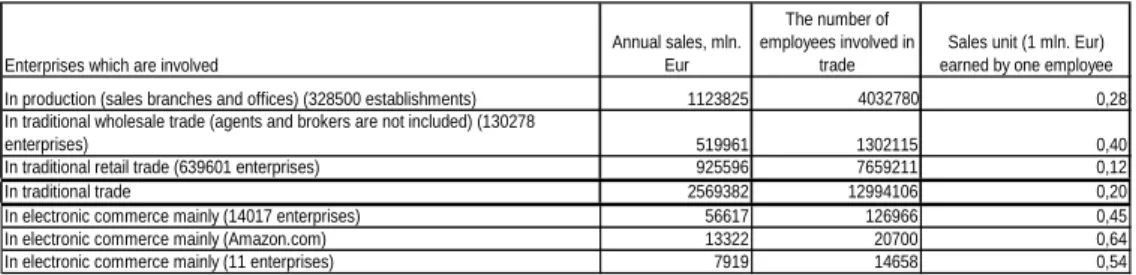
After calculations, it was observed that the, cost structure of enterprises engaged in e-commerce is different than in traditional trade enterprises. In particular, enter-prises involved in e-commerce employees fewer employees than traditional trade enterprises (table 2).
Table 2. The comparison of the need of employees in enterprises, which are involved in trade
Enterprises which are involved
Annual sales, mln. Eur
The number of employees involved in
trade
Sales unit (1 mln. Eur) earned by one employee In production (sales branches and offices) (328500 establishments) 1123825 4032780 0,28 In traditional wholesale trade (agents and brokers are not included) (130278
enterprises) 519961 1302115 0,40
In traditional retail trade (639601 enterprises) 925596 7659211 0,12
In traditional trade 2569382 12994106 0,20
In electronic commerce mainly (14017 enterprises) 56617 126966 0,45
In electronic commerce mainly (Amazon.com) 13322 20700 0,64
In electronic commerce mainly (11 enterprises) 7919 14658 0,54
It is noted that the overall enterprises engaged in e-commerce (when the number of employees attributable to sales unit is compared) have 2.25 times more sales per employee (table 1 (the index for enterprises engaged in traditional trade is equal to 0.20 and for enterprises engaged in e-commerce index—0.45, i.e. after comparison of two indexes we get 2.25)).
It was also found that in 2000-2009 Amazon.com total sales increased by 8.9 times, in the same period the number of employees increased by 2.7 times.
6. Modelling investments into e-commerce
When business investments into e-commerce are modelled, the dicounted cash-flow method is used. The method includes the following four elements: the cash-cash-flow element, element of the real or expected period, the continuity and continuous as-sessment of investments element and the element of discount norm, allowing the inclusion of the risk premium, which is used to calculate the present value of money.
The cash flow is defined as incomes and outcomes of cash and cash equivalents incurred during the period in the company due to specific its investment (Macke-vičius et al., 2006).
The advantage of the method: The discounted cash-flow method is based on the fact that risk premium can be included into the discount norm. Although the method seems simple, difficulties arise when trying to justify financially the size of the dis-count norm, which is used during calculations.
The weakness of the method: In the process of discounting some factors such as inflation changes, the entity’s solvency is not taken into account. These factors may also influence the money at the current value but during the discounting process they are not evaluated.
Modelling investments in e-commerce, G. Bergendahl’s (2005) cash flow model is used. The main input of this model: investment in e-commerce technologies; funds for marketing activities (branding, campaigns, other activities related to expansion of customerbase); savings of activity costs; net income.
Estimating the input of investment in e-commerce technologies, one evaluates funds given for purchasing software and technological equipment as well as guaran-teeing a safe payment.
While calculating the savings of activity costs, the expenditure economy related to item sale is assessed. In the enterprise, which has just invested in e-commerce, the above-mentioned expenditure can be bigger, but in the course of time it can change (decrease). When expenditure (i.e. average common sale expenditure) decreases, its monetary return appears, forming relative economy of activity expenditure.
Referring to expenditure return, it is necessary to mention that it can be steady or decreasing. In G. Bergendahl’s model (2005) a steady expenditure return is high-lighted. According to the article author’s opinion, expenditure return should relate to income direction, i.e. if income increases, it should also increase. For example, talk-ing about the economy of work pay fund, it is possible to state that: firstly, the econ-omy of work pay fund is growing as income is growing; secondly, it is accumulated at the end of the year. This is shown by the results of one research (when it is noticed that in 2002–2007 sale extent in the US enterprises practising e-commerce had grown up 3.4 times and the number of employees had increased up to 2.5 times [Burinskienė, 2010]).
Calculating the input of net income, current expenditure related to item sale is subtracted from sale income as well as expenditure, which economy subjects meet, developing logistic decisions, and maintaining e-commerce technologies.
The author offers to expand this model and apply it not only for one-off but also for manifold (continual) investment cases. In addition, the author offers a mathemati-cal expression of the model (2 formula).
Besides the author suggests supplement G. Bergendahl’s model (2005) (given for enterprises practising e-commerce) with the input of new investment in logistics.
Investment in logistics. There are two cases:
- Trade in open market (using open e-networks). The company, which engages in e-commerce, has to invest in logistics solutions for making small lots. It should be noted that if traditional trade enterprise plans to pursue this, (or even if it is already engaged in) it has to customize an existing product distribution system to new needs, which allows to invest less than for business that start-ups and needs a completely new product distribution system. For example, a company that decides to invest in e-commerce technologies in order to sell the goods to end-customers would have to invest in logistics solutions for the for-mation of smaller lots (the company, which has more than 50 employees and which manually shapes items in great distribution centers, on average, should invest 3.6% of total sales into logistics solutions) (Burinskienė, 2010).
- Trade in a closed market (a practice is carried out only by stable business part-ners). It is noted that enterprises, buying goods throught electronic or tradi-tional networks and enterprises who sell them to buyers follow conditions which are provided in purchase-sale agreement, which also means the place of delivery:
- If goods are transferred to the buyer’s in buyer distribution centre and seller is obliged to pay import taxes, the product purchase price is equal to the final purchase price;
- If goods are transferred to seller's warehouse, the seller of goods is obliged only to load the vehicle and prepare documents then the buyer must cover the transportation costs (if necessary, and declaring costs, to pay import duties). These costs are included in the costs of goods by the buyer and are considered a final purchase price.
In order to determine the benefit of technological application and evaluate its present worth G. Bergendahl (2005) suggests discounting the savings of activity ex-penditure or net income.
The cash flow model is universal. This model can be applied when historic (real) and generated (expected) data is analysed.
The article author also provides the mathematical expression of the model, which can be used for calculating investment in e-commerce and efficiency:
⎪⎩ ⎪ ⎨ ⎧ = ∆ + − − − < ∆ + − − − = • • ; NI NI , C R L T ; NI NI , NI R L T E n n t t t t n n t t t t t kai kai 0 0 0 0 0 0 0 0 (2) Here NIt 0
∆ is net income earned during the period t (when e-commerce tech-nologies are applied), present worth of increase (assessed by applying 3 formula),
•
n
NI is net income when e-commerce technologies are not applied during n years (assessed by applying 1 formula), NInis net income when e-commerce technologies are applied during n years, Ct
0
∆ is activity expenditure received during the period t
(when e-commerce technologies are applied), present worth of decrease (assessed by applying 3 formula), Tt
0is investment made during the period t in e-commerce tech-nologies, present worth , Lt
0is investment made in logistics during the period t, pre-sent worth, Rt
0 is funds given for advertisement during the period t, present worth,
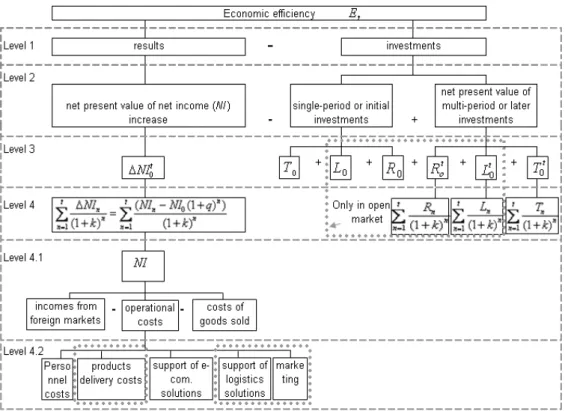
t is the whole analysed period, and the moment of investment beginning, Et is eco-nomic efficiency of usage of e-commerce technologies after the period t. The pre-sent worth of the indicated investment (if it is not one-off) is evaluated by formula 3 (also see Fig. 2).
In order to calculate the present worth of net income, one can refer to the follow-ing formula:
∑
= + = t n n n t , ) k ( NI NI 1 0 1 (3)It is indicated that the index of economic efficiency shows how much accom-plished investment is covered by discounted savings of activity expenditure and or/if net income has been received. The author presumes that cash flows which are gener-ated by goods seller’s investment in e-commerce are positive. However, the author refers to the fact that in the case of a particular goods seller the input of the model can be smaller as well as its size and direction can change.
Fig. 2. The model of cash flows generated by investments in e-commerce (prepared by author)
In summary, it can be mentioned that formulated theoretical model (Fig. 2), can be applied to evaluate efficiency when e-commerce technologies are used in trade: when investments into e-commerce is one-off and manifold (the 2nd level), when a real and expected period is used (the 4th level), when the risk is evaluated (the 4th level) (in such way the risk premium will be included into discount norm), when trade is conducted in open-market (via internet) and closmarket (via closed e-networks).
Empirical assessments for proposed model were undertaken. For this purpose, Amazon.com data was used. W. Kesthong et al. (2007) compared enterprises which use e-commerce technologies. The authors found that Amazon.com, applies “busi-ness to busi“busi-ness” and “busi“busi-ness to consumer” e-commerce technologies.
Enterprises which desire to trade with stable business partners, Amazon.com provides the service of the database establishment and file storage, the service of information input in various languages as well as order formation and payment con-firmation (Kesthong et al., 2007). Enterprises using such services can give their steady business partners the documents of purchase and sale (orders, invoices). One
must pay attention to the fact that Amazon.com sells neither goods advertisement nor delivery services to the enterprises which trade with steady business partners.
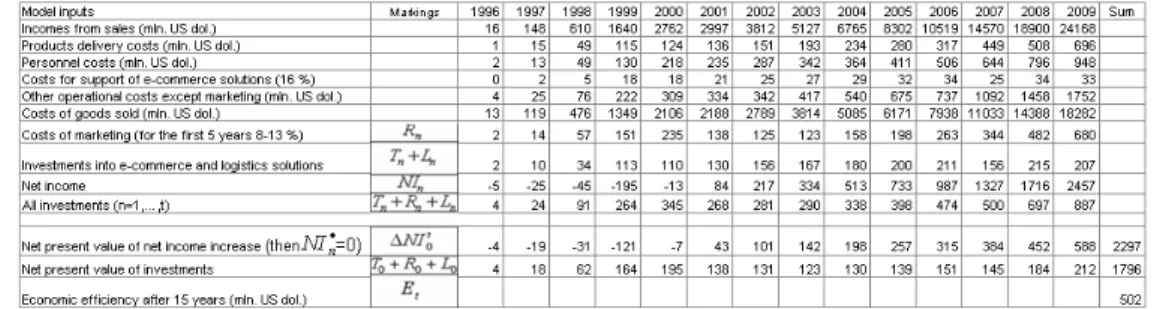
Furthermore, the meanings of the model parameters (in mln of US dollars) are provided in table 3.
Table 3. Evaluation of investments in e-commerce: Amazon.com case (The Wall Street Journal, 2009)
Investment in e-commerce and logistic technologies involve funds, given for purchase of software and technological equipment. Software is purchased every two years whereas technological equipment is purchased every three years (based on the usage duration of software and technological equipment). Calculating the present worth of investment, 10% discount norm (k=0.1) is applied.
Going into details about the funds given for advertisement, it is possible to state that this expenditure comprises the advertisement of an e-shop, where Amazon.com sells goods to their final customers, by e-mail, on the websites, etc.
Undertaken empirical assessment has shown that the formulated theoretical model can be also applied to evaluate efficiency when investments into e-commerce are manifold and when the technologies are used by product sellers (who sell them to business partners) in close-markets.
During empirical estimation, it has been established that a seller receives the biggest economic benefit due to income increase (approximately 63%).
7. Conclussions
The analysis of the application features of e-commerce technologies showed that enterprises involved in e-commerce have 2.25 times more sales per employee. It has been established that generally in enterprises which apply e-commerce technologies there are more sales than in traditional trade enterprises. In addition enterprises can achieve substantial changes in costs devoted to operations of international trade.
For the activation of the usage of e-commerce technologies in international trade, it is appropriate to apply the proposed model which helps to evaluate efficiency when e-commerce technologies are used by the sellers of goods, which at the same time can be stable business partners. In the model various levels of economic evaluation are released, the costs of implementation and the usage of e-commerce technologies,
in particular—investments and the results reached by the deployment of such tech-nologies have been analysed.
Undertaken empirical assessment has shown that formulated theoretical model, can be applied to evaluate efficiency when investments into e-commerce is one-off and manifold, when the technologies of “business to business” and “business to con-sumer” are applied, when international trade is conducted in open-market and close-market.
The conducted empirical study of theoretical model has shown that the offered model can be applied for the evaluation of efficiency when e-commerce technologies are used in internationall trade. During empirical estimation, it has been established that a seller receives the biggest economic benefit due to income increase (approxi-mately 63%).
Literatūra
1. Anandarajan, A.; Wen, H. Evaluation of information technology investment. Manage-ment Decision, 1999. 4(37): 329–37.
2. Bergendahl, G. Models for investment in e-commerce—financial perspectives with em-pirical evidence. Omega, 2005.33: 363–376. doi: 10.1016/j.omega.2004.07.021.
3. Barnes, S. E-commerce and v-business—digital enterprise in the twenty-first century. Butterworth-Heinemann, 2007. P. 351.
4. Baršauskas, P.; Šarapovas, T.; Cvilikas, A. The evaluation of e-commerce impact on business efficiency. Baltic Journal of Management, 2008. 1(3): 71–91.
5. Becker, A. E-commerce—concepts, methodologies, tools and applications. Idea Group Inc., 2007. P. 861.
6. Bidgoli, H. The Internet encyclopedia. John Wiley and Sons, 2004. P. 261.
7. Burinskienė, A. Elektroninės komercijos technologijų taikymas plėtojant tarptautinę
prekybą: doctoral dissertation [The application of electronic commerce technologies in the development of international trade]. 2010. P. 153.
8. Cao, M.; Zhang, Q.; Seydel, J. B2C e-commerce web site quality: an empirical examina-tion. Industrial Management & Data Systems, 2005. 5(105): 645–661.
9. Cullen, A. J.; Margaret, T. Critical success factors for B2B e-commerce use within the UK NHS pharmaceutical supply chain. International Journal of Operations & Produc-tion Management, 2009. 11(29): 1156–1185.
10. Cullen, A. J.; Webster, M. 2007. A model B2B e-commerce based on connectivity and purpose, International Journal of Operations & Production Management 2(27): 205– 225.
11. Davidavičienė, V.; Gatautis, R.; Paliulis, N.; Petrauskas, R. Elektroninis verslas [Elec-tronic business]. Vilnius: Technika, 2009. P. 468.
12. Fink, D. Value decomposition of e-commerce performance.
Benchmarking: an International Journal, 2006. 1/2(13): 81–92.
13. Gottschalk, P; Abrahamsen, A. F. Plans to utilize e-marketplaces: the case of B2B pro-curement markets in Norway. Industrial Management & Data Systems, 2002. 6(102): 325–331.
14. Hsieh, C.; Lin, B. Impact of standardization on EDI in B2B development. Industrial Management & Data Systems, 2004. 1(104): 68–77.
15. ITU. ICT market liberalisation reports for CEE countries and Baltic States. ITU, 2005. P. 78.
16. Jovarauskienė, D.; Pilinkienė, V. E-business or e-technology? Economics & Manage-ment, 2009. 61: 83–89.
17. Jun, M.; Cai, S. Key obstacles to EDI success: from the US small manufacturing compa-nies’ perspective Industrial Management & Data Systems, 2003. 3(103): 192–203. 18. Kao, D.; Decou, J. A strategy-based model for e-commerce planning. Industrial
Man-agement & Data Systems, 2003. 4(103): 238–252.
19. Kesthong, W.; Wei, J.; Liu, L. C; Koong, K. S. Standardization of internet retail e-business solutions Information Systems Educational Journal, 2007. 5(15): 3–16.
20. Khosrowpour, M. Cases on e-commerce technologies and applications. Idea Group Inc., 2006. P. 388.
21. Kraemer, K. L. Global e-commerce—impacts of national environment and policy. Cam-bridge University Press, 2006. P. 344.
22. Kvainauskaitė, V.; Šarapovas, T.; Cvilikas, A. Selection and assessment of e-commerce models in SMEs. Engineering economics, 2005. 4(44): 64–70.
23. MacGregor, R. C.; Vrazalic, L. A basic model of e-commerce adoption barriers. Journal of Small Business and Enterprise Development, 2005. 4 (12): 510–527.
24. Mackevičius, J.; Senkus, K. The system of formation and evaluation of the information of cash flows. Journal of business economics and management, 2006. 4(7): 171–182. 25. Paliulis, N. K; Astrauskienė, N. Informacinės valdymo sistemos [management systems of
information]. Vilnius: Generolo Jono Žemaičio Lietuvos karo akademija, 2003. P. 212. 26. Power, D. Strategy development processes as determinants of B2B e-commerce
perform-ance: a comparative model in a supply chain management context. Internet Research 5, 2005. (15): 557–581.
27. Stockdale, R.; Standing, C. Benefits and barriers of e-marketplace participation: an SME perspective. Journal of Enterprise Information Management, 2004.4(17): 301–311. 28. The Wall Street Journal. Amazon balance, cash flow and earnings, 2002–2009. [accessed
on 2009-07-06] <http://commerce.wsj.com/amzn&type.html>.
29. US Census Bureau. 2009. Detailed statistics database. [accessed on 2009-09-29] <http://factfinder.census.gov/home/saff/main.html?_lang=en>.
E. KOMERCIJOS TECHNOLOGIJŲ TAIKYMAS PREKYBOJE
PLĖTOJANT TARPTAUTINĘ RINKĄ
Aurelija BURINSKIENĖ
Santrauka. Atskleidžiamas e. komercijos technologijų taikymas prekyboje plėtojant tarptautinę rinką ir pateikiama problemų, susijusių su e. komercijos technologijų panaudojimu tarptautinėje prekyboje analizė. Nustatyta, kad įmonės naudoja e. komercijos technologijas parduodamos produktus įvairiose atvirose ir uždarose rinkose.
Analizuojama ekonominė nauda ir investicijos. Remiantis tyrimo rezultatais siūlomas naujas e. komercijos technologijų panaudojimo tarptautinėje prekyboje efektyvumo vertinimo modelis. Rengiant modelį taikytas diskontuotų pinigų srautų metodas. Pristatomas ir atliktas pasiūlyto modelio praktinio tinkamumo vertinimas.
Aurelija Burinskienė Dr.soc. sc., Lecturer at Vilnius Gediminas Technical University, Lithuania; mail: [email protected]. Her research is focused on international trade, logistics, and e-commerce.
Aurelija Burinskienė – Vilniaus Gedimino technikos universiteto Tarptautinės ekonomikos ir vadybos katedros lektorė, dr. Moksliniai interesai: tarptautinė prekyba, logistika, e. komercija.