A FRAMEWORK FOR QOS-AWARE EXECUTION OF
WORKFLOWS OVER THE CLOUD
Moreno Marzolla
1, Raffaela Mirandola
21Universit`a di Bologna, Dipartimento di Scienze dell’Informazione Mura A. Zamboni 7, I-40127 Bologna (Italy)
2Politecnico di Milano, Dipartimento di Elettronica e Informazione Piazza Leonardo da Vinci, I-20133 Milano, Italy
[email protected], [email protected]
Keywords: Cloud Computing, Workflow Engine, Self-Management, SLA Management
Abstract: The Cloud Computing paradigm is providing system architects with a new powerful tool for building scalable applications. Clouds allow allocation of resources on a ”pay-as-you-go” model, so that additional resources can be requested during peak loads and released after that. In this paper we describeSAVER(qoS-Aware workflows oVER the Cloud), a QoS-aware algorithm for executing workflows involving Web Services hosted in a Cloud environment.SAVERallows execution of arbitrary workflows subject to response time constraints. SAVERuses a simple Queueing Network (QN) model to identify the optimal resource allocation; specifically, the QN model is used to identify bottlenecks, and predict the system performance as Cloud resources are allocated or released. Our approach has been validated through numerical simulations, whose results are reported in this paper.
1
INTRODUCTION
The emerging Cloud computing paradigm is rapidly gaining consensus as an alternative to tradi-tional IT systems. Informally, Cloud computing al-lows computing resources to be seen as a utility, avail-able on demand. Cloud services can be grouped into three categories (Zhang et al., 2010): Infrastructure as a Service (IaaS), providing low-level resources such as Virtual Machines (VMs); Platform as a Service (PaaS), providing software development frameworks; and Software as a Service (SaaS), providing whole applications. The Cloud provider has the responsibil-ity to manage the resources it offers so that the user re-quirements and the desired Quality of Service (QoS) are satisfied.
In this paper we present SAVER (qoS-Aware workflows oVER the Cloud), a workflow engine pro-vided as a SaaS. The engine allows different types of workflows to be executed over a set of Web Services (WSs). In our scenario, users negotiate QoS require-ments with the service provider; specifically, for each typecof workflow, the user may request that the av-erage execution time of the whole workflow should not exceed a thresholdR+c. Once the QoS require-ments have been negotiated, the user can submit any
number of workflows of the different types. Both the submission rate and the time spent by the workflows on each WS can fluctuate over time.
SAVERuses an underlying IaaS Cloud to provide computational power on demand. The Cloud hosts multiple instances of each WS, over which the work-load can be balanced. If a WS is heavily used,SAVER
will increase the number of instances by requesting new resources from the Cloud. System reconfigura-tions are triggered periodically, when instances are added or removed where necessary.
SAVER uses a open, multiclass Queueing Network (QN) model to predict the response time of a given Cloud resource allocation. The param-eters which are needed to evaluate the QN model are obtained by passively monitoring the running system. The performance model is used within a greedy strategy which identifies an approximate so-lution to the optimization problem minimizing the number of WS instances while respecting the Service Level Agreement (SLA).
The remainder of this paper is organized as fol-lows. In Section 2 we give a precise formulation of the problem we are addressing. In Section 3 we describe the Queueing Network performance model of the Cloud-based workflow engine. SAVER will
be fully described in Section 4, including the high-level architecture and the details of the reconfigura-tion algorithms. The effectiveness of SAVER have been evaluated using simulation experiments, whose results will be discussed in Section 5. In Section 6 we review the scientific literature and compare SAVER
with related works. Finally, conclusions and future works are presented in Section 7.
2
PROBLEM FORMULATION
SAVERis a workflow engine that receives work-flows from external clients, and executes them over a set ofK WS 1, . . . ,K. At any given timet, there can beC(t)different workflow types (or classes); for each classc=1, . . . ,C(t), clients define a maximum allowed completion timeR+c. The number of work-flow classesC(t)does not need to be known in ad-vance; furthermore, it is possible to add or remove classes at any time.
We denote withλc(t)the average arrival rate of classcworkflows at timet. Since all WSs are shared between the workflows, the completion time depends both on arrival ratesλ(t) = λ1(t), . . . ,λC(t)(t)
, and on the utilization of each WS.
To satisfy the response time constraints, the sys-tem must adapt to cope with workload fluctuations. To do so,SAVERrelies on a IaaS Cloud which main-tains multiple instances of each WS. We denote with
Nk the number of instances of WSk; a system con-figurationN(t) = (N1(t), . . . ,NK(t))is an integer vec-tor representing the number of allocated instances of each WS. When the workload intensity increases, additional instances are created to eliminate the bot-tlenecks; when the workload decreases, surplus in-stances are shut down and released.
The goal ofSAVERis to minimize the total num-ber of WS instances while maintaining the mean ex-ecution time of typecworkflows below the threshold
R+c,c=1, . . . ,C(t). Formally, we want to solve the following optimization problem:
minimize f(N(t)) =
K
∑
k=1Nk(t) (1)
subject to Rc(N(t))≤R+c for allc=1, . . . ,C(t) Ni(t)∈ {1,2,3, . . .}
whereRc(N(t))is the mean execution time of typec workflows when the system configuration isN(t).
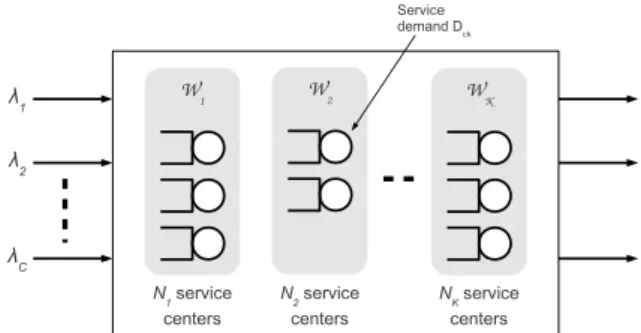
Figure 1: Performance model based on an open, multiclass Queueing Network
3
PERFORMANCE MODEL
In this section we describe the QN performance model which is used to plan a system reconfiguration. We model the system using the open, multiclass QN model (Lazowska et al., 1984) shown in Fig. 1. Each server represents a single WS instance; thus, WS k
is represented by Nk queueing centers, for each k= 1, . . . ,K. Nk can change over time, as resources are added or removed from the system.
In our QN model there areCdifferent classes of requests: each request represents a workflow, thus workflow types are directly mapped to QN request classes. In order to simplify the analysis of the model, we assume that the inter-arrival time of class c re-quests is exponentially distributed with arrival rateλc. The interaction of a typecworkflow with WSkis modeled as a visit of a classcrequest to one of theNk queueing centers representing WSk. We denote with
Rck(N)the total time (residence time) spent by typec workflows on one of theNk instances of WSkfor a given configurationN. The residence time is the sum of two terms: the service demand Dck(N) (average time spent by a WS instance executing the request) and queueing delay (time spent by a request in the waiting queue).
Theutilization Uk(N)of an instance of WSkis
the fraction of time the instance is busy processing re-quests. If the workload is evenly balanced, then both the residence time Rck(N)and the utilizationUk(N) are almost the same for allNkinstances.
4
SAVER
ARCHITECTURE
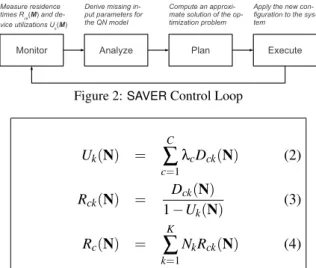
SAVERis a reactive system based on the Monitor-Analyze-Plan-Execute (MAPE) control loop shown in Fig. 2. During theMonitor step,SAVERcollects operational parameters by observing the running sys-tem. The parameters are evaluate during theAnalyze
Figure 2:SAVERControl Loop Uk(N) = C
∑
c=1 λcDck(N) (2) Rck(N) = Dck(N) 1−Uk(N) (3) Rc(N) = K∑
k=1 NkRck(N) (4)Figure 3: Equations for the QN model of Fig. 1
step; if the system needs to be reconfigured (e.g., be-cause the observed response time of class c work-flows exceeds the thresholdR+c, for somec), a new configuration is identified in thePlanstep. We use the QN model described in Section 3 to evaluate dif-ferent configurations and identify an optimal server allocation such that all QoS constraints are satisfied. Finally, during theExecutestep, the new configura-tion is applied to the system: WS instances are cre-ated or destroyed as needed by leveraging the IaaS Cloud. Unlike other reactive systems, SAVER can plan complex reconfigurations, involving multiple ad-ditions/removals of resources, in a single step.
4.1
Monitoring System Parameters
The QN model is used to estimate the execution time of workflow types for different system configurations. To analyze the QN it is necessary to know two param-eters: (i) the current arrival rate of typecworkflows, λc, and (ii) the mean service demandDck(M)of type cworkflows on an instance of WSk, for the current configurationM.
The parameters above can be computed by moni-toring the system over a time interval of suitable du-rationT. The arrival rates λc can be estimated by counting the numberAc or arrivals of type c work-flows which are submitted over the observation pe-riod; thenλccan be defined asλc=Ac/T.
Measuring the service demandsDck(M)is more difficult because they must not include the time spent by a request waiting to start service. If the WSs do not provide detailed timing information (e.g., via their execution logs), it is possible to estimateDck(M) from the measured residence timeRck(M) and uti-lizationUk(M). We use the equations shown in
Fig-ure 3, which hold for the open multiclass QN model in Fig. 1. These equations describe known properties of open QN models (see (Lazowska et al., 1984) for details).
The residence time is the total time spent by a type
cworkflow with one instance of WSk, including wait-ing time and service time. The workflow engine can measureRck(M)as the time elapsed from the instant a type cworkflow sends a request to one of the Nk instances of WS k, to the time the request is com-pleted. The utilizationUk(M)of an instance of WS kcan be obtained by the Cloud service dashboard (or measured on the computing nodes themselves). Us-ing (3) the service demands can be expressed as
Dck(M) =Rck(M) (1−Uk(M)) (5)
LetMbe the current system configuration; let us assume that, under configurationM, the observed ar-rival rates are λ= (λ1, . . . ,λC)and service demands are Dck(M). Then, for an arbitrary configurationN, we can combine Equations (3) and (4) to get:
Rc(N) = K
∑
k=1 Nk Dck(N) 1−Uk(N) (6) The current total class cservice demand on all instances of WS k isMkDck(M), hence we can ex-press service demands and utilizations of individual instances for an arbitrary configurationNas:Dck(N) = Mk Nk Dck(M) (7) Uk(N) = Mk Nk Uk(M) (8)
Thus, we can rewrite (6) as
Rc(N) = K
∑
k=1 Dck(M)MkNk Nk−Uk(M)Mk (9) which allows us to estimate the response timeRc(N) of class cworkflows for any configuration N, given information collected by the monitor for the current configurationM.4.2
Finding a new configuration
In order to find an approximate solution to the opti-mization problem (1),SAVERstarts from the current configuration M, which may violate some response time constraints, and executes Algorithm 1. After col-lecting device utilizations, response times and arrival rates,SAVERestimates the service demandsDck us-ing Eq. (5).
Algorithm 1TheSAVERAlgorithm
Require: R+c: Maximum response time of typec work-flows
1: LetMbe the initial configuration 2: loop
3: MonitorRck(M),Uk(M),λc 4: for allc:=1, . . . ,C;k:=1, . . . ,Kdo 5: ComputeDck(M)using Eq. (5) 6: N:=Acquire(M,λ,D(M),U(M))
7: for allc:=1, . . . ,C;k:=1, . . . ,Kdo
8: ComputeDck(N)andUk(N)using Eq. (7) and (8) 9: N0:=Release(N,λ,D(N),U(N))
10: Apply the new configurationN0to the system 11: M:=N0 {SetN0as the current configurationM}
Then,SAVERidentifies a new configurationN
M1by calling the function ACQUIRE() (Algorithm 2). The new configuration N is computed by greedily adding new instances to bottleneck WSs. The QN model is used to estimate response times as instances are added: no actual resources are instantiated from the Cloud service at this time.
The configurationNreturned by the function AC -QUIRE() does not violate any constraint, but might contain too many WS instances. Thus, SAVER in-vokes the function RELEASE() (Algorithm 3) which computes another configuration N0≺N by remov-ing redundant instances, ensurremov-ing that no constraint is violated. To call procedure RELEASE() we need to estimate the service demandsDck(N)and utiliza-tionsUk(N)with configurationN. These can be eas-ily computed from the measured values for the current configurationM.
After both steps above,N0 becomes the new cur-rent configuration: WS instances are created or termi-nated where necessary by acquiring or releasing hosts from the Cloud infrastructure. See (Marzolla and Mi-randola, 2011) for further details.
5
NUMERICAL RESULTS
We performed a set of numerical simulation ex-periments to assess the effectiveness ofSAVER. We consider all combinations ofC∈ {10,15,20} work-flow types andK∈ {20,40,60}Web Services. Ser-vice demandsDckhave been randomly generated, in such a way that classcworkflows have service de-mands which are uniformly distributed in [0,c/C]. Thus, class 1 workflows have lowest average service demands, while typeC workflows have highest
de-1NMiffNk≥Mkfor allk=1, . . . ,K, the inequality being strict for at least one value ofk
Algorithm 2Acquire(N,λ,D(N),U(N))→N0 Require: NSystem configuration
Require: λCurrent arrival rates of workflows Require: D(N)Service demands at configurationN Require: U(N)Utilizations at configurationN Ensure: NNew system configuration
1: while Rc(N)>R+c for anyc do 2: b:=arg max c Rc(N)−R+c R+c c=1, . . . ,C 3: j:=arg max k {Rb(N)−Rb(N+1k)|k=1, . . . ,K} 4: N:=N+1j 5: Return N Algorithm 3Release(N,λ,D(N),U(N))→N0 Require: NSystem configuration
Require: λCurrent arrival rates of workflows Require: D(N)Service demands at configurationN Require: U(N)Utilizations at configurationN Ensure: N0New system configuration
1: for allk:=1, . . . ,Kdo 2: Nmink:=Nk∑Cc=1λcDck(N) 3: S:={k|Nk>Nmink} 4: while(S6=0/)do 5: d:=arg min c R+c −Rc(N) R+c c=1, . . . ,C 6: j:=arg min k Rc(N−1k)−R+c k∈S 7: if Rc(N−1j)>R+c for anyc then 8: S:=S\ {j} {No instance of WSjcan be removed} 9: else 10: N:=N−1j 11: if Nj=Nminj then 12: S:=S\ {j} 13: Return N
mands. The system has been simulated forT =200 discrete stepst=1, . . . ,T. Arrival ratesλ(t)at step
t have been generated according to a fractal model, starting from a randomly perturbed sinusoidal pattern to mimic periodic fluctuations; each workflow type has a different period.
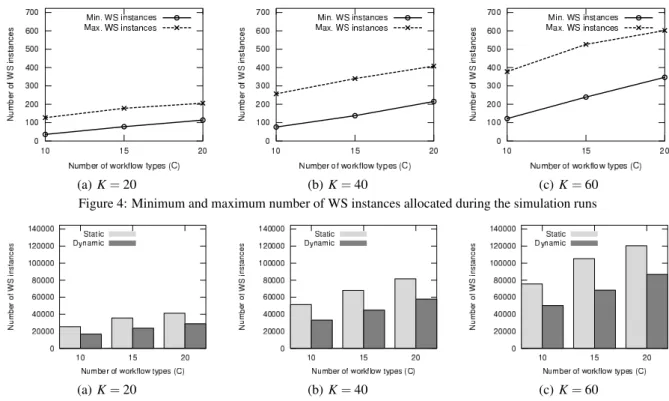
The minimum and the maximum number of re-sources allocated bySAVERduring the simulation run are illustrated in Figure 4. Figure 5 shows the to-tal number of WS instances allocated over the whole simulation run bySAVER(labeledDynamic) with the number of instances statically allocated by overpro-visioning for the worst-case scenario (labeledStatic). The results show thatSAVERallocates between 64%– 72% of the instances required by the worst-case sce-nario. As previously observed, if the IaaS provider
(a)K=20 (b)K=40 (c)K=60 Figure 4: Minimum and maximum number of WS instances allocated during the simulation runs
(a)K=20 (b)K=40 (c)K=60
Figure 5: Total number of WS instances allocated during the whole simulation runs (lower is better).
charges a fixed price for each instance allocated at each simulation step, thenSAVERallows a consistent reduction of the total cost, while still maintaining the negotiated SLA.
6
RELATED WORKS
Several research contributions have previously ad-dressed the issue of optimizing the resource alloca-tion in cluster-based service centers; some of them use control theory-based feedback loops (Litoiu et al., 2010; Kalyvianaki et al., 2009), machine learning techniques (Kephart et al., 2007; Calinescu, 2009), or utility-based optimization techniques (Urgaonkar et al., 2007; Zhu et al., 2009). When moving to virtu-alized environments the resource allocation problem becomes more complex because of the introduction of virtual resources (Zhu et al., 2009). Several ap-proaches have been proposed for QoS and resource management at run-time (Li et al., 2009; Litoiu et al., 2010; Ferretti et al., 2010; Jung et al., 2010; Huber et al., 2011; Yazir et al., 2010).
(Li et al., 2009) describes a method for achieving optimization in Clouds by using performance models all along the development and operation of the appli-cations running in the Cloud. The proposed optimiza-tion aims at maximizing profits by guaranteeing the QoS agreed in the SLAs taking into account a large
variety of workloads. A layered Cloud architecture taking into account different stakeholders is presented in (Litoiu et al., 2010). The architecture supports self-management based on adaptive feedback control loops, present at each layer, and on a coordination ac-tivity between the different loops. Mistral (Jung et al., 2010) is a resource managing framework with a multi-level resource allocation algorithm considering real-location actions based mainly on adding, removing and/or migrating virtual machines, and shutdown or restart of hosts. This approach is based on the usage of Layered Queuing Network (LQN) performance model. It tries to maximize the overall utility taking into account several aspects like power consumption, performance and transient costs in its reconfiguration process. In (Huber et al., 2011) the authors present an approach to self-adaptive resource allocation in vir-tualized environments based on online architecture-level performance models. The online performance prediction allow estimation of the effects of changes in user workloads and of possible reconfiguration ac-tions. Yazir et al. (Yazir et al., 2010) introduces a distributed approach for dynamic autonomous re-source management in computing Clouds, performing resource configuration using through Multiple Crite-ria Decision Analysis.
With respect to these works,SAVERlies in the re-search line fostering the usage of models at runtime to drive the QoS-based system adaptation. SAVERuses
an efficient modeling technique that can then be used at runtime without undermining the system behavior and its overall performance.
Ferretti et al. (Ferretti et al., 2010) describe a middleware architecture enabling a SLA-driven dy-namic configuration, management and optimization of Cloud resources and services. The approach is purely reactive and considers a single-tier application, whileSAVERworks for an arbitrary number of WSs and uses a performance model to plan complex recon-figurations in a single step.
Finally, Canfora et al. (Canfora et al., 2005) describe a QoS-aware service discovery and late-binding mechanism which is able to automatically adapt to changes of QoS attributes in order to meet the SLA. The binding is done at run-time, and de-pends on the values of QoS attributes which are mon-itored by the system. It should be observed that in
SAVER we consider a different scenario, in which each WS has just one implementation which how-ever can be instantiated multiple times. The goal of
SAVERis to satisfy a specific QoS requirement (mean execution time of workflows below a given threshold) with the minimum number of instances.
7
CONCLUSIONS
In this paper we presentedSAVER, a QoS-aware algorithm for executing workflows involving Web Services hosted in a Cloud environment. SAVER se-lectively allocates and deallocates Cloud resources to guarantee that the response time of each class of workflows is kept below a negotiated threshold. This is achieved though the use of a QN performance model which drives a greedy optimization strategy. Simulation experiments show that SAVER can ef-fectively react to workload fluctuations by acquir-ing/releasing resources as needed.
Currently, we are working on the extension of
SAVER, exploring the use of forecasting techniques as a mean to trigger resource allocation and deallo-cation proactively. More work is also being carried out to assess theSAVEReffectiveness through a more comprehensive set of real experiments.
REFERENCES
Calinescu, R. (2009). Resource-definition policies for au-tonomic computing. InProc. Fifth Int. Conf. on Au-tonomic and Autonomous Systems, pages 111–116, Washington, DC, USA. IEEE Computer Society.
Canfora, G., Di Penta, M., Esposito, R., and Villani, M. L. (2005). Qos-aware replanning of composite web ser-vices. InProceedings of the IEEE International Con-ference on Web Services, ICWS ’05, pages 121–129, Washington, DC, USA. IEEE Computer Society. Ferretti, S., Ghini, V., Panzieri, F., Pellegrini, M., and
Tur-rini, E. (2010). Qos-aware clouds. InProceedings of the 2010 IEEE 3rd International Conference on Cloud Computing, CLOUD ’10, pages 321–328. IEEE Com-puter Society.
Huber, N., Brosig, F., and Kounev, S. (2011). Model-based self-adaptive resource allocation in virtualized envi-ronments. In SEAMS ’11, pages 90–99, New York, NY, USA. ACM.
Jung, G., Hiltunen, M. A., Joshi, K. R., Schlichting, R. D., and Pu, C. (2010). Mistral: Dynamically managing power, performance, and adaptation cost in cloud in-frastructures. In ICDCS, pages 62–73. IEEE Com-puter Society.
Kalyvianaki, E., Charalambous, T., and Hand, S. (2009). Self-adaptive and self-configured cpu resource provi-sioning for virtualized servers using kalman filters. In ICAC’09, pages 117–126. ACM.
Kephart, J. O., Chan, H., Das, R., Levine, D. W., Tesauro, G., III, F. L. R., and Lefurgy, C. (2007). Coordinat-ing multiple autonomic managers to achieve specified power-performance tradeoffs. InICAC’07, page 24. IEEE Computer Society.
Lazowska, E. D., Zahorjan, J., Graham, G. S., and Sev-cik, K. C. (1984). Quantitative System Performance: Computer System Analysis Using Queueing Network Models. Prentice Hall.
Li, J., Chinneck, J., Woodside, M., Litoiu, M., and Iszlai, G. (2009). Performance model driven qos guarantees and optimization in clouds. InCLOUD ’09, pages 15–22, Washington, DC, USA. IEEE Computer Society. Litoiu, M., Woodside, M., Wong, J., Ng, J., and Iszlai, G.
(2010). A business driven cloud optimization archi-tecture. InProc. of the 2010 ACM Symp. on Applied Computing, SAC ’10, pages 380–385. ACM. Marzolla, M. and Mirandola, R. (2011). A Framework for
QoS-aware Execution of Workflows over the Cloud. arXiv preprint abs/1104.5392.
Urgaonkar, B., Pacifici, G., Shenoy, P., Spreitzer, M., and Tantawi, A. (2007). Analytic modeling of multitier internet applications.ACM Trans. Web, 1.
Yazir, Y. O., Matthews, C., Farahbod, R., Neville, S., Gui-touni, A., Ganti, S., and Coady, Y. (2010). Dynamic resource allocation in computing clouds using dis-tributed multiple criteria decision analysis. InCLOUD ’10, pages 91–98. IEEE Computer Society.
Zhang, Q., Cheng, L., and Boutaba, R. (2010). Cloud com-puting: state-of-the-art and research challenges. J. of Internet Services and Applications, 1:7–18.
Zhu, X., Young, D., Watson, B. J., Wang, Z., Rolia, J., Sing-hal, S., McKee, B., Hyser, C., Gmach, D., Gardner, R., Christian, T., and Cherkasova, L. (2009). 1000 islands: an integrated approach to resource manage-ment for virtualized data centers.Cluster Computing, 12(1):45–57.