Data Between Environment and Health:
An Epistemological Study of the Exposome
Von der Philosophischen Fakultät der Gottfried Wilhelm Leibniz Universität Hannover zur Erlangung des Grades Doktor der Philosophie (Dr. phil.) genehmigte Dissertation von M. Sc. Stefano Canali.
Referent: Prof. Dr. Thomas Reydon, Institut für Philosopie, Leibniz Universität Hannover.
Korreferentinnen: Prof. Dr. Sabina Leonelli, Dept. Of Sociology, Philosophy and Anthropology, University of Exeter; Prof. Dr. Federica Russo, Dept. Of Philosophy University of Amsterdam.
Abstract
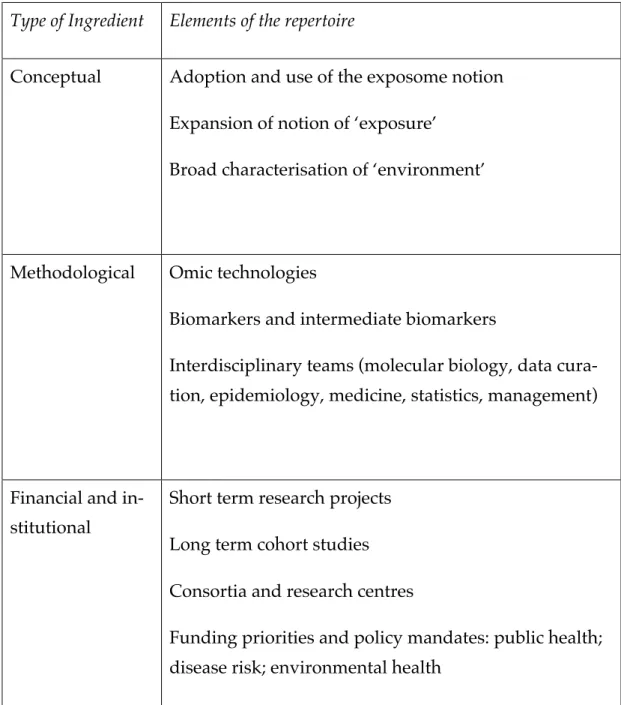
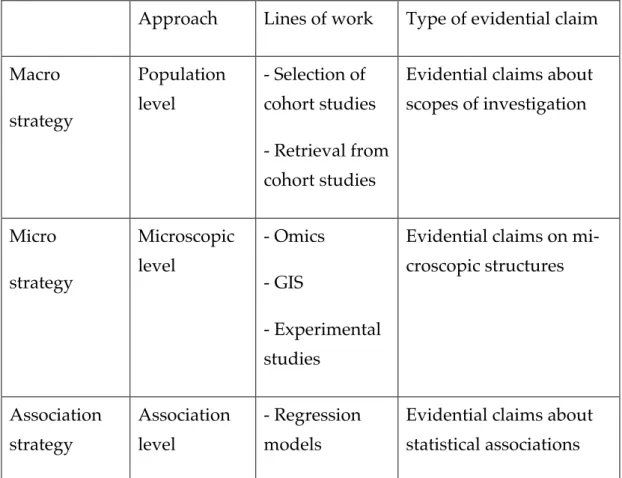
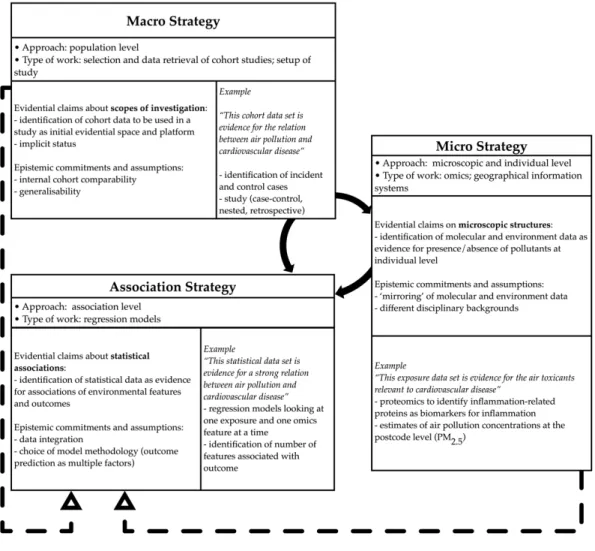
This thesis is a philosophical analysis of the epistemic role of scientific data in biomedical research. It is comprised of an introduction (Chapter 1), three arti-cles (Chapter 2, 3, 4) and a conclusion (Chapter 5). I use a case study approach and focus on the epidemiology of the ‘exposome’, a new line of research based on a reconceptualisation of exposure and the use of new and diverse datasets. I argue that data can sustain the subject matter of exposome research by shap-ing concepts, strategies, techniques and what counts as evidence. Yet, the epis-temic role of data is enacted by the ways in which it is used by episepis-temic agents and thus constantly connected to and mediated by other artefacts, components and features of scientific inquiry. In Chapter 2, I discuss the innovations and changes of the exposome. I argue that these should be framed as the establish-ment of a repertoire, as opposed to a paradigm. The exposome repertoire con-sists in many components transferred from other areas of the life and health sciences: thus, scientific change is the result of the alignment of these compo-nents and it is not due to only one of these factors, such as data. In Chapter 3, I discuss data practices in exposome research. I argue that researchers use evi-dential claims to specify the evievi-dential and representational value of datasets. Three strategies for evidential claims can be distinguished, differing in terms of level of abstraction, lines of work and type of evidential claim and leading to a picture of evidence production as epistemic-intensive labour. In Chapter 4, I discuss how data is classified as evidence in exposome research, in the con-text of philosophical discussions of the types of evidence used for causal claims in biomedical research. I argue that molecular data collected in exposome re-search is used to study differences and dependences, as opposed to mecha-nisms; more generally, the classification of a dataset as a type of evidence is dependent on the ways in which the data is used, rather than its intrinsic prop-erties.
Keywords: Philosophy of epidemiology; Data; Evidence; Exposome; Scientific change.
Acknowledgements
What you can read in the following pages wouldn’t have been possible without the support of many people.
First of all, I am deeply grateful to Thomas Reydon and Sabina Leonelli for giving me the opportunity to conduct this project under their supervision. Thanks for your close reading, comments, motivation and support. I feel so privileged to have you as mentors and role models to look up to.
My home during these years as a PhD student has been the Institute of Philos-ophy of Leibniz Universität Hannover and particularly the DFG Graduierten-kolleg 2073 “Integrating Ethics and Epistemology of Scientific Research” (in Hannover and Bielefeld). A PhD is mostly a solo project and one can easily feel lonely. This is why I feel especially fortunate to have been surrounded by lovely people that have prevented that from happening. Special thanks, first of all, to my fellow PhDs, postdocs and office mates: Markus Ahlers, Rafael Ugarte Chacón, Markus Dressel, Enno Fischer, David Hopf, Daria Jadreškić, Saana Jukola, Anna Leuschner, Anja Pichl, Julia Pfeiff, Leon Schäfer, Tobias Schönwitz, Roel Visser and Martin Wasmer. Thanks for the countless coffees, speculative etymology sessions, beers and table football; you’ve helped me more than you think. Thanks to all the academic staff of the Institute of Philos-ophy and the GRK for the chance to do this PhD, feedback and discussions on my work and support through all these years. Special thanks to: Anke Büter, Martin Carrier, Uljana Feest, Mathias Frisch, Dietmar Hübner, Marie Kaiser, Simon Lohse, Cornelis Menke and Torsten Wilholt. Last but not least, thanks to the support staff in Hannover, Güliz Erdem and Jessica Inhestern, especially for the help in organising the Data Workshop in 2017. Thanks to the Deutsche Forschungsgemeinschaft (DFG, German Research Foundation – Project 254954344/GRK2073) for the funding.
Exeter was my second academic home. During longer and shorter stays, I en-joyed the friendly and stimulating atmosphere of Egenis and the Data Studies
group, auditing seminars, attending workshops, eating Data Crunch break-fasts or walking in Devon. Special thanks to: Gemma Anderson, John Dupré, Stephan Güttinger, Gregor Halfmann, Susan Kelly, Staffan Müller-Wille, Gabi Recknagel, Niccolò Tempini and Chee Wong.
I am indebted with Paolo Vineis as PI of EXPOsOMICS and all the members of group for taking the time to discuss their fascinating work with me, surviving philosophical interviews and, most of all, making this case study possible. Traveling to workshops and conferences has been one of the aspects of my life as a PhD student that I have enjoyed the most. Making new friends is one of the highlights of that, although it is not always easy to keep in touch with friends you might see once a year on the other side of the world (if you’re lucky). I am thus particularly thankful to call friends a few fellow and former PhD students. Thanks for the work chats, the non-work chats and for keeping me sane: Thomas Bonnin, Virginia Ghiara, Javier Suárez Díaz, Michele Luchetti and Guglielmo Militello. Throughout these years, I also had the privilege to learn from the inspiring work of many advanced researchers, who have read versions of my papers, commented on my talks and helped me with crucial feedback. Thanks to: Rachel Ankeny, Giovanni Boniolo, Raffaella Campaner, Brendan Clarke, Sara Green, Phyllis Illari, Emanuele Ratti and Federica Russo. Special thanks to everyone who bothered to come and ask questions at my presentations.
I wish to thank my parents, Patrizia and Corrado, for inspiring and supporting me, even if this has taken me far away. Thanks for making me feel like I was doing the right thing. Thanks to my sister Franci for the indie music, the GIFs, and making me feel more important than I am. You’re one of my “sources of inspiration” (cit.). Thanks to all my family for everything, and all the video calls.
Thanks to all my friends that have made the effort of trying to understand what I have been doing in this thing called PhD. Sorry for failing at that and thanks for pretending to understand. Special thanks to: Elena, Erika, Gab, Stefano and
Yianna. Thanks to Davide for the walks uphill and downhill, taking my mind off things and the occasional mosh.
Above all, thanks to Costanza. I wouldn’t be the person who has written a PhD dissertation in philosophy of science if I hadn’t met you. Thanks for encourag-ing me to follow the dream that has led to this dissertation. Thanks for your love because – and not in spite – of that. No one but you will really understand this last sentence. No one really understands me and you and why we have been doing this. And this makes all the difference.
Table of Contents
Chapter 1. Introduction: a Data-Centric Study of the Exposome ... 1
1.1 Data, Big Data and Scientific (Big) Data ... 4
1.1.1 Data Studies in Philosophy of Science: Data as an Epistemically Salient Artefact ... 8
1.1.2 A Data-Centric Study of the Exposome ... 13
1.2 Methodology: Qualitative Case Study Research and Empirical Grounding in Philosophy of Science in Practice ... 18
1.2.1 Following the Practice Turn: Philosophy of Science in Practice ... 18
1.2.2 Case Study Research ... 22
1.2.3 Empirical Methods for Philosophers: Qualitative Interviews ... 25
1.3 Overview of the Chapters ... 28
Chapter 2. The Exposome as a Postgenomic Repertoire: Exploring Scientific Change in Contemporary Epidemiology ... 37
2.1 Introduction ... 37
2.2 Using Repertoires to Understand the Exposome ... 39
2.3 The Lineage of the Exposome as an Emerging Repertoire ... 48
2.4 Tracing Scientific Innovation in Repertoires: The Exposome as a Postgenomic Repertoire ... 55
2.5 Conclusions ... 60
Chapter 3. Making Evidential Claims in Epidemiology: Three Strategies for the Study of the Exposome ... 63
3.1 Introduction ... 63
3.2 Focusing on Evidential Claims ... 66
3.3 Three Strategies for Evidential Claims ... 69 3.3.1 The Macro Strategy: Primary Data Retrieval from Cohort Studies . 71
3.3.2 The Micro Strategy: Omics, Gis and Experimental Studies ... 75
3.3.3 The Association Strategy: Regression Analysis and Data Integration ... 81
3.4 Epidemiology, Evidence and Causality ... 84
3.5 Conclusions ... 88
Chapter 4. Evaluating Evidential Pluralism in Epidemiology: Mechanistic Evidence in Exposome Research ... 91
4.1 Introduction ... 92
4.2 Exposome Research and Evidential Pluralism ... 95
4.3 Mechanistic Evidence in Exposome Research ... 99
4.4 Classifying Evidence in Exposome Research ... 103
4.5 Exposome Research and the Core of the Russo-Williamson Thesis .... 108
4.6 Conclusions ... 111
Chapter 5. Conclusion and Outlook ... 113
Appendices ... 125
Appendix A: Ethics Consent Form ... 125
Chapter 1
Introduction: a Data-Centric Study of the
Exposome
This dissertation is about the collection, integration and use of scientific data. It studies scientific data as a focus to understand research in contemporary ep-idemiology. The dissertation empirically reconstructs the conditions under which data is created, handled and employed, pointing to the material, meth-odological, theoretical and technological constraints that characterise research about the relation between the environment and health.
Disease and health in human populations are deeply affected by various types of interactions with external entities in their surrounding environments, to the point that the vast majority of disease risks is related to differences in the envi-ronment (Rappaport and Smith 2010). Research on these issues is therefore very significant from a societal and political standpoint, is highly funded and is supposed to deliver evidence for policy-making. At the same time, this is highly complex research. The environment influences human health and dis-ease through a variety of different pathways, which may involve significantly different phenomena, contexts and components, take place in diverse locations and temporalities, are often difficult to track and measure, and need to be stud-ied at various scales and levels of abstraction. In turn, research projects in this area are carried out in an interdisciplinary context, which lies in between the life and health sciences and thus comprises diverse epistemic cultures, such as molecular biology, genetics research, animal research, etc. This implies a com-plex organisation of research, requiring: the collection and dissemination of evidence from and to various sources; the support of institutions, funding bod-ies and industry; and managing platforms and structures allowing for ex-changes and collaborations at an interdisciplinary level.
Introduction: A Data-Centric Study of the Exposome
The primary context for the study of the ways in which disease states are re-lated to and are shaped by environmental factors is the discipline known as epidemiology, which studies the distribution and determinants of health and disease (Morabia 2015; Broadbent 2013). For this dissertation, I have studied a specific approach that has emerged in the last decade of epidemiological re-search and is presented as a way of overcoming some of the complexities of the issues at stake. The ‘exposome’ is the totality of all exposures to environmental elements that are experienced by individuals (Wild 2005). Here, totality is firstly meant to include all the exposures experienced throughout a lifetime. Thus, at any point in an individual’s lifetime, their exposome will comprise all the exposures experienced from conception onwards: for instance, the expo-some of an adult individual includes exposures in utero, which may have an impact on their health only at a later stage (Robinson and Vrijheid 2015). Sec-ondly, totality is meant to comprise all the various elements, substances and processes that an individual is exposed to at a single point in time, both at an external and internal level. In other words, to study an individual exposome requires the study of various levels of investigation, from the macroscopic, ex-ternal component to microscopic, individual elements (Rappaport 2011). At a given point in time, an individual’s exposome comprises exposures to external elements at a general, specific and internal and individual level (Rappaport and Smith 2010). The concept was first introduced by Christopher Wild (Wild 2005), in an attempt to shift attention to the need of better and more precise exposure assessment and integrate various ideas and approaches to the study of the relation between environmental exposure and disease under an um-brella concept (Wild 2012). In the last decade, the concept has increasingly been applied in epidemiology, to the point that large bodies like the European Union have funding streams dedicated to the exposome (Vineis 2018).
The overarching question of this dissertation is the following: in which ways does data inform and sustain the subject matter of epidemiological research on the exposome? In order to answer this question, I study the role of data as an artefact that is produced on the basis of, and in turn used to generate, scientific
Chapter 1
knowledge in exposome research.1 This research question leads me to the anal-ysis of more specific issues. I start by looking at the historical background in which the exposome was developed. I ask the following question: what consti-tutes the subject matter of exposome research from a conceptual, material, and social point of view and which is the role of data in shaping these components? I discuss this issue in the context of philosophical discussions on what consti-tutes change in current scientific research (Chapter 2). Further focusing on sci-entific innovations and their relation with data, I analyse data practices in con-temporary research on the exposome. I ask the following question: how are diverse data sources handled, integrated and used, and in which ways concep-tual, methodological and material assumptions influence data integration? I position this question as a contribution to current philosophical analyses of data and evidence integration in the sciences (Chapter 3). In the context of dis-cussions on evidence, I investigate approaches to evidence classification in the study of the exposome. I ask the following question: how is evidence distin-guished and classified in exposome research and how does data shape knowledge claims about specific aspects of the exposome? I analyse this topic in the context of philosophical and scientific discussions on the classification of medical evidence (Chapter 4).
This ‘data-centric’ philosophical study is based on the empirical study of a spe-cific research project on the exposome, EXPOsOMICS. The project run between 2012 and 2017 and applied the exposome approach to the assessment of disease risk related to air and water pollution, by studying external and internal com-ponents of the exposome (Vineis et al. 2017a). The project was chosen on the basis of an initial study of the philosophical literature on scientific data and online and literary analysis of publications, reports and funding applications of exposome research. The choice was motivated by my philosophical interest
1 I give further details on my research questions in the following subsec-tions (see 1.1.2).
Introduction: A Data-Centric Study of the Exposome
in scientific research that is considered highly interdisciplinary, innovative and based on the collection, integration and use of many different sources of data. I decided that I would focus on the research of a single project, as this allowed me to specify my questions and sample, while at the same time obtaining a good representation of state of the art research on the exposome. EXPOsOM-ICS was the last in a series of projects that has been carried out by a group of research centres, guided by the Department of Epidemiology and Biostatistics of Imperial College London, that has been very successful at securing funding from the European Union. In addition, research of this group has been the fo-cus of recent work in philosophy of science (Russo and Vineis 2017; Vineis et al. 2017b).
In what follows, I detail the broader context where I conduct my study and I present my research questions (Sect. 1.1). I then specify the methodology used in this dissertation (Sect. 1.2). I conclude by presenting the structure and con-tent of the dissertation (Sect. 1.3).
1.1 Data, Big Data and Scientific (Big) Data
The word ‘data’ is increasingly present in the public sphere, from discussions in the media to policy reports and all the way to academic debates. In most of these discussions, the notion of data is associated with the adjective ‘big’, thus forming the phrase ‘big data’, to refer to the increasing amount of data pro-duced, stored and used for various purposes. Big data is presented as a result of a number of phenomena and processes occurring in modern societies, whereby the increasing use of digital devices, software and online platforms has established activities that have the production of data as one of their main steps, if not their aim and endpoint.
As a notion, yet, big data is vague and has received many critiques by scholars. The notion was introduced between the mid 1990s and the early 2000s in the computing industry (Diebold 2012). At the time, big data was defined on the
Chapter 1
basis of three traits: large volume, high velocity and wide variety. This defini-tion, which is also known as the 3Vs, was picked up in various areas of the industry and especially in the business sector, where it is still extensively used (Kitchin and McArdle 2016). Yet, the 3Vs have been extensively criticised by scholars from different fields, to the point that some have argued that it has only increased confusion around big data. According to the Rob Kitchin and Gavin McArdle:
The 3Vs meme is actually false and misleading and along with the term itself is partially to blame for the confusion over the defini-tional boundaries of Big Data. (Kitchin and McArdle 2016, p. 9)
In contrast with the 3Vs, many other definitions have been introduced and dis-cussed, adding various dimensions and traits to the notion of big data. It has been argued that definitional aspects of big data include: exhaustivity, as big data can arguably capture and document entire systems; fine-grained resolu-tion, because big datasets can arguably be as detailed as possible in the descrip-tion of a phenomenon; reladescrip-tionality, since big datasets are arguably easy to in-tegrate.2 At the same time, scholars have underlined how a dataset that is con-sidered big data in a context might not in another context, as a result of the relational character of the predicate ‘big’ and the diversity of areas where data is produced and used (Floridi 2012). Therefore, what is considered big data varies significantly in terms of both attribution and ontological characteristics, as different types of data constitute different ‘species’ of (big) data (Kitchin and McArdle 2016).
On top of discussions about how to properly define big data, why is big data something that we should discuss and care about? An answer to this question is that the increase in quantity of data collected, processed and used is routinely
2 See Kitchin (2013, 2014a) for a detailed discussion of these and other def-initions.
Introduction: A Data-Centric Study of the Exposome
associated with revolutionary changes, paradigm shifts and substantial disrup-tions in various contexts, from the economy to social interacdisrup-tions, from politics to entertainment. This has given rise a certain rhetoric around big data, which extends narratives of the benefits of innovation, revolution and ’disruption’ that are typical of the high-tech sector. In academic debates, this rhetoric has led to a broad and interdisciplinary debate where several claims about the ben-efits, power and features of large datasets have been analysed, assessed and criticised. As part of a debate that has become known as critical data studies, scholars from various disciplines including sociology, philosophy, science and technology studies, information systems and history have criticised various claims of the big data rhetoric (Iliadis and Russo 2016; Kitchin and Lauriault 2018). For instance, scholars have questioned the claims that more data neces-sarily leads to more objective and accurate claims (boyd and Crawford 2012) and that big data allows for complete descriptions of phenomena and can thus do without sampling and bias issues (Kitchin 2013) or ethical considerations (Simon 2015).
In the context of this debate, scholars have significantly focused on the impact of big data for the scientific context, because various claims of the big data rhet-oric have discussed scientific research (Kitchin 2014b). In the sciences, data has always been a cornerstone of the scientific method, at least since the beginning of modern science. At the same time, however, the amount of data scientists can collect, analyse and use has increased significantly in recent years, espe-cially in connection to the development and employment of computing tech-nologies that can collect, store and process large datasets. Between the end of the 2000s and the early 2010s, it was famously claimed that data-intensive ap-proaches were bringing about a fourth scientific revolution (Hey et al. 2009; Bell et al. 2009), as a consequence of which scientific theories were going to be superfluous (Anderson 2008) and correlations were going to triumph over causal knowledge and reasoning (Mayer-Schönberger and Cukier 2013). As a consequence of the epistemological nature of these claims, philosophers of sci-ence started to engage in the debate on these issues, pushing back against the view that the use of large datasets in the scientific context was bringing about
Chapter 1
revolutionary changes to scientific epistemology (Leonelli 2012a). In this con-text, philosophers of science have for instance argued against claims according to which data-intensive methods are an instance of theory-free science (Callebaut 2012), can be based on correlations only and do without causal knowledge (Pietsch in preparation), counter issues such as bias and over-sampling (Leonelli 2014) and are a historical novelty in the sciences (Müller-Wille and Charmantier 2012; Strasser 2011).
Most of the ‘novelty claims’ connected to the collection, processing and use of large datasets have thus been subject to effective criticism in the philosophical literature. I would argue that this has been the first step of the debate on data,
a pars destruens that has been followed by a pars contruens phase. In this second
phase, philosophers of science have started to pay attention to data as a philo-sophically interesting element of scientific methodology, practice and episte-mology more generally. Sabina Leonelli (2013) has argued that one of the nov-elties related to large scientific datasets is the new emphasis placed on the role of data as commodities with crucial scientific, economic, social and political values. Similarly, I would argue that the big data rhetoric has sparked the in-terest of philosophers of science in data, as epistemic elements of scientific epis-temology that should be included in philosophical analyses of the sciences. This is the context where I carry out my research in this dissertation, as I focus on data as the main units of my philosophical analysis. This is also why in the dissertation I analyse the collection, processing and use of data, but I rarely use the phrase ‘big data’, in an attempt to try to move away from the rhetorical tools used in big data narratives. In the dissertation, I discuss issues that have arisen in the context of what I called the first phase of the debate (such as trans-formations and changes in science due to data). Still, I intend my research to be located in current philosophical attempts at making sense of data as an element of scientific epistemology that: is something that deserves philosophical atten-tion per se; and has key connecatten-tions to other elements of scientific epistemol-ogy that have more traditionally been discussed in philosophy of science, such as knowledge, models, phenomena and evidence. In the next subsection, I give
Introduction: A Data-Centric Study of the Exposome
further details about the theoretical background of the research conducted in this dissertation.
1.1.1 Data Studies in Philosophy of Science: Data as
an Epistemically Salient Artefact
The increasing emphasis placed on data in public debates has thus led to an increase in interest and research on data in philosophy of science. Philosophers have studied scientific data in the context of both innovative data-intensive ap-proaches and more traditional settings. That scientific data is of paramount im-portance for scientists has always been quite evident, not only to philosophers. Data is one of the primary objects researchers interact with; its production, col-lection and analysis are daily activities in scientific projects; questions about the quality of data are at the constant centre of scientific research; and data can often be one of the main outputs of scientific projects.
Still, philosophers have historically paid little attention to data in their re-search. Lack of interest in data can be connected to traditional approaches in philosophy of science and more particularly propositional, theory-centric and syntactic views of science.3 According to these views, the goal of science is to produce propositions that can be organised in theories. Accordingly, what re-ally matters in science is the justification of these propositions and theories. In this context, non-propositional components of science are important only inso-far as they are related to the justification of claims and theories. As a result, non-propositional components of scientific research, such as instruments, methods, models and data are considered of little importance and their role is discussed only insofar as they may be involved in the justification of the truth
3 See Suppes (1976) and Winther (2016) for introductions on these ap-proaches.
Chapter 1
of a claim. With the shift from syntactic and semantic accounts of science to pragmatist views (Suppes 2000), philosophers of science started to focus on scientific research not just as a way of justifying claims and theories, but also of understanding, explaining and intervening on the world (Bailer-Jones 2009, pp. 126-158). In this context, philosophers started to pay attention to experi-mentation, models, understanding and values (Hacking 1983; Morgan and Morrison 1999; Douglas 2009). Still, scientific data was not a key component of these analyses, as data was mostly mentioned in connection with other topics, such as visualisation, analysis and interpretation through models or theories. The topic of data emerged mostly in the context of the focus on experimenta-tion, as philosophers started to discuss the relation between experimental traces, data and evidence (Hacking 1983; Rheinberger 1997; 2010). Similar dis-cussions can be found in science studies more generally, especially science and technology studies (see e.g. Latour and Woolgar 1979; Bowker 2005; Bowker and Star 1999) and the history of science (Chang 2004; Strasser 2012). Studies of historical and contemporary sciences revealed a number of challenges to re-ceived philosophical views of the role of data in the sciences. Philosophers highlighted that the same scientific data can be interpreted in significantly dif-ferent ways by the same or other research groups, which presents a challenge to the idea of data as a mere enabler of the justification of scientific claims and theories (Bogen and Woodward 1988).
In the context of renewed interest in data in the sciences, philosophers have confronted these traditional views and built alternative approaches. Much of this work has been carried out in parallel with novel philosophical interest in scientific practice, where data plays a crucial and constant role.4 Philosophers have analysed the practices involved in the collection, handling, curation and
4 I give more information on philosophical studies of scientific practice in the next section (especially Sect. 1.2.1), where I discuss the methodology of the dissertation.
Introduction: A Data-Centric Study of the Exposome
storing of data for sharing and re-use within a specific scientific community, with the aim of critically engaging with the big data rhetoric as well as improv-ing philosophical understandimprov-ing of the epistemic role of data. For instance, Le-onelli has extensively documented data practices in the last three decades of the life sciences, focusing on model organism and the setting up of community databases in this context (Leonelli 2016a). Scholars have underlined that a sig-nificant portion of time, effort and funding is now dedicated to the storing and dissemination of data in assemblages and infrastructures like databases, in or-der to allow for the re-use of data by various actors in the research community and beyond (Leonelli 2013a). In addition, the increasing emphasis on data as a very significant output of research in itself has been highlighted, with reference to the establishment of new journals and other publications focused on pub-lishing data only (Leonelli 2013b). The aims of these analysis have had to do with improving philosophical understandings of scientific practice centred on data, documenting practical and methodological issues, and emphasising and distinguishing epistemic strategies designed and applied by researchers (Leo-nelli 2012b; Leo(Leo-nelli 2013c; O’Malley and Soyer 2012; Green et al. 2018). This line of research has led to more specified and nuanced accounts of the innova-tive dimension of the use of large datasets in the sciences (Leonelli 2014). Furthermore, philosophers have studied the relations between data and com-ponents of scientific research that have traditionally been considered crucial elements of scientific epistemology. In this context, causality and causal rea-soning have been among the most discussed topics. This is connected to one of the main tenets of the big data rhetoric, according to which the vast number of correlations found in large datasets undermines the need for causal analysis and reasoning (Mayer-Schönberger and Cukier 2013). For example, Pietsch and Illari and Russo have explored the nature of causal inference based on large datasets, on the basis of case studies from biomedicine and social sciences, un-derlining the ever more significant role that causal reasoning plays in these areas of research (Pietsch 2015a; 2014; Illari and Russo 2016a; 2016b).
The role of data has also been discussed in the context of the debate on what is known as the ‘theory-ladenness’ of scientific experimentation, within which
Chapter 1
philosophers discuss how much theory influences the ways in which scientists carry out experiments (Burian 1997; Steinle 1997). As part of this debate, Koray Karaca has for example focused on the large datasets collected and used in high energy physics, distinguishing between data-driven, theory-driven and exper-imental procedures in data selection (Karaca 2013; 2017).
In addition, data has been discussed with the aim of understanding what con-stitutes it as a specific component of scientific research. According to an intui-tive view, data has a representational and informational content, which is fixed and mind- and context-independent; in this view, data plays the role of provid-ing evidence for phenomena and givprovid-ing empirical content to claims, models or theories (Bogen and Woodward 1988; Woodward 2000). This representational approach has been challenged by philosophical analyses focused on data prac-tices, and primarily by Leonelli’s account of data, which highlights how, in contemporary data practices in the life science, the evidential value and repre-sentational content of data depend on the context in which data is used, rather than on its intrinsic and predetermined properties (Leonelli 2009; 2015; 2016a). In this view, data is a crucial element of epistemology, rather than a philosoph-ically uninteresting by-product of scientific research. As a result of this debate, philosophers have also been interested in the relations between data and com-ponents of scientific epistemology such as models (Green et al. 2018; MacLeod and Nersessian 2018; Leonelli 2019).
A final line of research on data that I want to highlight here has focused on the (largely construed) ethical dimension of data practices in the sciences. These discussions have been elicited by both concerns over the increasing use of data in society more generally, as well as a philosophical debate that has gained in prominence in recent philosophy of science, i.e. the role of values and trust in science (Douglas 2009; Wilholt 2013; Longino 2015). Philosophers have ex-plored issues related to responsibility and accountability (Leonelli 2016b; Rieder and Simon 2016), openness and divides (Levin and Leonelli 2017; Leo-nelli et al. 2017) and more general ethical frameworks (Simon 2015).
Introduction: A Data-Centric Study of the Exposome
This area of current research in philosophy of science, which I call data-centric
philosophy of science, is the context where I conduct my own research in the
dis-sertation. Works in data-centric philosophy of science have thus been con-cerned with questions about: the relation of data and data practices with ele-ments the cognitive and epistemic dimension of scientific research, including explanations, theories and models; the influence that data and data practices can have on and receive from other elements of scientific epistemology; the production of data as scientific artefacts and the relation with the material di-mension of the sciences, including technology and methods; and the nature itself of scientific data, in the relation with interactions with the world, phe-nomena and empirical knowledge. The focus of data-centric philosophy of sci-ence is data and data practices, broadly construed and including data collec-tion, storing, analysis, use, disseminacollec-tion, etc. Depending on the specific con-text, what counts as data in the first place may vary substantially and ‘scientific data’ may be physical samples, digital files, analogue documents, etc. As a con-sequence, the specific units of philosophical analysis of data studies may change accordingly, potentially including the ways in which data is collected and modified, structured and ordered, and more generally used as evidence for various claims. The philosophical aims of data-centric philosophy of ence include: the description and documentation of data practices in the sci-ences; the critical engagement with assumptions, concerns and underlying is-sues of scientific data; and the philosophical interpretation of the context of data from the perspective of conceptual tools from philosophical work.5
At the conceptual centre and basis of this line of research is a specific view of the epistemic role of data in science. In this dissertation, with the term ‘data’, I refer to both objects produced by the interaction of researchers with an object
5 I will come back to these features of data-centric philosophy of science when discussing methodology and normativity in the next section (see Sect. 1.2.1).
Chapter 1
of investigation (such as samples and materials) and their subsequent pro-cessing and manipulation (affecting e.g. format, medium and order). In this view, the epistemic value of data as a source of information, evidence and knowledge, is the result of various practical, methodological and conceptual interactions and considerations that take place at various levels of research. In line with Leonelli (2016), the use of a dataset as evidence for knowledge claims is dependent on these interactions and considerations, and not only on the in-trinsic properties of the dataset (such as the method through which it was duced, its format, size, etc.). This entails that practices of data collection, pro-cessing, integration and use are not just about extracting objective, fixed and context-independent information, but have a significant and specific epistemic character.
Following this approach, I view data as an epistemically salient artefact of scien-tific research, in the sense that it is the result of epistemically salient scienscien-tific practices and sits in epistemically salient relations with other products and components of scientific epistemology, such as theories, models and knowledge (Leonelli 2019). As a consequence of these features, using data as units of philosophical analysis provides a window into the interrelations be-tween cognitive and material aspects of scientific research. This does not mean that data plays a more important role than models, theories or knowledge. But it implies that the practices, processes and researchers involved in the collec-tion, integration and use of data have a specific epistemological significance, one that deserves a specific as much as models, theories or knowledge do. This is why, in this dissertation, I will be interested in the conditions and ways in which data collected in biomedical research are processed, integrated and used as evidence by epidemiologists, as epistemically significant aspects of research that shape and influence the study of health, environment and their relation.
1.1.2 A Data-Centric Study of the Exposome
In the expanding context of data-centric philosophy of science, the research of this dissertation is about the collection, integration and use of data in the life
Introduction: A Data-Centric Study of the Exposome
and health sciences. A significant part of the recent philosophical scholarship on data has focused on this area, for a number of reasons. First, in the philo-sophical literature these disciplines have often been discussed as particularly fragmented, with highly diverse communities, approaches, methodologies, theories, styles of explanation, commitments and goals. These pluralistic fea-tures of the life and health sciences have been discussed by historians and phi-losophers of science in the context of the debate on reduction, unification and integration. For instance, philosophers have argued that different theories in biology cannot be unified nor reduced to more fundamental ones (Mitchell and Dietrich 2006); the use of diverse methods, models and representations is cru-cial in a number of areas of the life sciences (Mitchell and Gronenborn 2015); many questions and problems require explanations developed in different bi-ological disciplines and with different scientific aims (Brigandt 2013); and the disunity of the life and health science is an inevitable condition (Dupré 1996). As a result of this fragmentation, scientific data in this context can refer to many different objects, is of significantly different types, is collected by different com-munities, for different purposes and with diverse commitments. This elicits questions about the ways in which diverse data sources can be interpreted, an-alysed and used as to constitute a single body of evidence. At the same time, data is an interesting example of integration and diversity in the life and health sciences and provides a significant window into the commitments, assump-tions and aims of diverse communities (Leonelli 2013c). In addition, the life and health sciences present an interesting case in which the standardised pro-duction of large volumes of data has often been mentioned as a potential game changer (Weinberg 2010; Golub 2010), but practices of data handling, storing and analysis have strong continuity with longstanding approaches (Müller-Wille and Charmantier 2012; Strasser 2012; Leonelli 2016b). In this sense, data also sits at the crossroads of many current trends of the field, especially in the biomedical sciences. For example, personalised medicine (also known as pre-cision medicine), i.e. the attempt to take into account individual variables into the study and prevention of disease, is largely built on the assumption that the
Chapter 1
use of large datasets “can account for an increasing number of factors that in-fluence health and disease, and that these data can be used to stratify the pop-ulation and health problems according to various characteristics” (Green and Vogt 2016, p. 106). Similarly, the molecularisation of medicine, i.e. study and treatment of disease from a molecular point of view (Boniolo and Nathan 2017), and postgenomics, i.e. the attempts of going beyond gene-centric approaches (Stevens and Richardson 2015), are largely based around the use and integra-tion of new datasets, at different levels of abstracintegra-tion and at increasing vol-umes. And the classification of evidence into a hierarchy of research designs developed in the context of evidence-based medicine, which has been exten-sively criticised in philosophy of science for the omission of crucial types of evidence (Worrall 2002; Clarke et al. 2013), can be considered a push for certain data sources over others.
As part of this context, I specify my data-centric study of the life and health sciences context by looking at current research in epidemiology on what is known as the exposome. I choose to focus on epidemiology for a number of reasons. First, epidemiology is an interesting case to look at because it follows the fragmented nature of other disciplines in this context, using approaches and methods from the medical, biological, environmental and statistical sci-ences (Broadbent 2013). In addition, epidemiology is particularly interesting from a data perspective. While, epidemiologists have traditionally been con-cerned with the collection and analysis of large datasets (Morabia 2005), the availability of new sources of data and new analytic tools are often presented as a significant novelty, especially in the context of issues at the interface of environment and health (Fleming et al. 2017; Leonelli and Tempini 2018). In this context, I focus on research on an approach and notion that has been introduced in the last decade: the exposome. The exposome is defined as the totality of individuals’ exposures to environmental elements (Wild 2005). The notion is often presented as a new paradigm for the study of the relation be-tween health and the environment (Rappaport and Smith 2010). The exposome is a way to describe and characterise the totality of environmental exposures. This ‘all-encompassing’ approach is considered and presented as innovative
Introduction: A Data-Centric Study of the Exposome
because it distinguishes and includes different levels of exposure, including generic external (e.g. social capital, education, financial status), specific exter-nal (e.g. radiation, infectious agents, chemical contaminants and environmen-tal pollutants, diet) and internal exposure (e.g. oxidative stress, metabolism, inflammation, ageing).
As a line of epidemiological research, the exposome is relatively new and young and key questions about how the exposome should be defined and stud-ies are currently discussed in the field. As a consequence, exposome research allows me to analyse contemporary research where new concepts are devel-oped and applied in practice. In addition, this allows me to analyse from a philosophical perspective scientific research that is in a flux and unsettled state, where conceptual and methodological discussions are at the centre of the de-bate. These features of the exposome also enable me to engage in discussions on innovations and changes in the sciences in general and in connection to the debate on the impact of data in particular. On these issues, I ask this research question: what constitutes scientific change and innovation in the context of the exposome? In order to tackle the question, I then focus on the following questions: What is the conceptual, material and methodological background of the exposome? What is the role of data in shaping theoretical, material, social and infrastructural components of scientific research and bringing about change? In answering these questions, I make a contribution on philosophical debates on change in contemporary biomedical research and provide a thor-ough analysis of the exposome as a ‘paradigm’ for epidemiology (see Chapter 2).
The exposome presents an interesting case where data from many and signifi-cantly diverse sources of evidence are gathered, including: cohort studies, col-lecting data on populations of interest over a long period of time with ques-tionnaires, retrieval of physical samples (e.g. blood, cord blood, urine), and fol-low-up; secondary analysis of primary evidence, including omic analysis to quantify and study the effects of exposure at the level of different molecular processes; experimental studies measuring exposure and responses to
expo-Chapter 1
sure at an individual level, through wearable and tracking devices; and envi-ronmental studies, producing data on air and water pollution through moni-toring stations, geo-spatial models and individual estimates. As a consequence, I consider exposome research as a case study in the integration, handling and use of large datasets. I ask this as my research question on these issues: how are large datasets handled, integrated and used as evidence in exposome re-search? This leads me to tackle the following questions: Which modes, strate-gies and approaches have arisen and are employed for the study of the expo-some? In which ways do epistemic and non-epistemic commitments and as-sumptions influence the integration of diverse types of data? I ask this question in the context of philosophical discussions on modes and strategies of data in-tegration in the sciences, especially the life and health sciences, and to paint a picture of data and evidence production as epistemically intensive activities (see Chapter 3).
I study these issues by looking at data in a specific project of exposome research known as EXPOsOMICS and funded by the European Union. The project fo-cused on the assessment of disease risk, and chronic disease more particularly, involved in the exposure to air and water pollution, applying the exposome approach through the study of external and internal components (Vineis et al. 2017a). The study of a specific research project specifies my questions and claims and allowed me to focus on research that was in progress. In addition, this focus gives empirical grounding to my philosophical analysis (as I detail in Sect. 1.2). Funding from the European Union was connected to ongoing re-vision of quality standards of air and water pollution and points to the need for scientific evidence for policy-making. In relation to these questions, I tackle the following question: what types of evidence are produced in the context of exposome research? This leads me to ask the following, more specific ques-tions: How is data used in claims about aspects of the exposome? Which types of evidence does molecular data provide? I ask these questions from the point of view of philosophical, scientific and policy discussions about the evidence produced in medicine. I contribute to these issues with a new case study of research from an underrepresented discipline like epidemiology and hint at
Introduction: A Data-Centric Study of the Exposome
philosophical discussions on the relation between evidence and data (see Chapter 4).
1.2 Methodology: Qualitative Case Study
Re-search and Empirical Grounding in
Philoso-phy of Science in Practice
My research is empirically-informed philosophy of science, based on a quali-tative case study of data in epidemiology. The methodology of this dissertation is based on three main elements: it draws on work in the practice turn in science studies and, more specifically, the approach known as philosophy of science in practice; it is an instance of case study research in philosophy of science; and it uses data collected through qualitative research to empirically ground philo-sophical claims. In the next subsections, I detail each of these elements in turn.
1.2.1 Following the Practice Turn: Philosophy of
Science in Practice
When introducing and discussing data studies in philosophy of science, I have mentioned that philosophical work on data has been carried out in the context of increasing attention to scientific practice. Many philosophers have discussed this increase as a significant change in philosophy of science, and more pre-cisely as a “practice turn” leading to a philosophy of science in practice (Soler
Chapter 1
et al. 2014).6 While there is no general agreement on what the practice turn consists in, there are a few defining aspects that need to be considered and are particularly important for my own work. At a minimum, the philosophy of science in practice consists in philosophical studies of scientific practice. But why is this a turn? The reason lies in the aforementioned propositional views of science, which in Anglophone and analytic philosophy of science have tra-ditionally regarded the sciences as bodies of propositions and have subse-quently focused on the truth-value and logical relationships of these proposi-tions, usually as sets of propositions organised in scientific theories (Chang 2015). In this tradition, practice has been largely disregarded because it belongs to the non-verbal and non-propositional dimension of science (Ankeny et al. 2011).
In going beyond this tradition, the analysis of scientific practice as the focus of the philosophy of science in practice leads to significant methodological con-sequences, which Soler and colleagues discuss in terms of specific “shifts” (Soler et al. 2014, pp. 14–24).7 Firstly, the focus on practice entails a shift from the study of scientific products to the study scientific processes. As a result, one of the goals of the philosophy of science in practice is the development of de-scriptively adequate and empirically based accounts of the sciences, as op-posed to a priori accounts that are typical of syntactic and semantic ap-proaches. This is closely related to another feature of the practice turn, which consists in a shift from decontextualised, general and macroscopic account to
6 My discussion of the practice turn is limited to philosophy of science, but as argued by Soler and colleagues this turn has concerned science studies more generally (Soler et al. 2014, pp. 1-3).
7 Soler and colleagues list six shifts. For the purpose of the presentation of my own work, I discuss four of them, as the other two concern philosophical analyses of the history of science and experimental activities.
Introduction: A Data-Centric Study of the Exposome
“adopting a local scale of analysis and paying close attention to the specific
con-texts in which scientific results are produced, used, and disseminated” (Soler
et al. 2014, p. 18; emphasis in original). As I detail in the remainder of this sec-tion, these shifts have critical consequences of the methodology of philosophy of science, as they push for the inclusion of empirical methods from social and historical sciences as a way of studying scientific practices. Another aim of the philosophy of science in practice is the documentation of aspects of scientific practice that are contingent of a specific situation and are normally left out of final scientific outputs, which is a shift from traditional philosophical methods such as retrospective, rational reconstructions. In this way, the focus on prac-tice leads to a picture of science as the complex result of multi-faceted, contex-tual, variable and intertwined processes, with a move away from idealised ac-counts.8
My dissertation follows the practice turn in philosophy of science with the choice of focusing on scientific activities and agents involved in the use of data, which makes my research a philosophical study that focuses on scientific prac-tice, rather than on propositional products of scientific research. Data studies in philosophy of science are closely linked to this shift, since data is a crucial element of scientific practice and this is one of the reasons why it is tradition-ally considered irrelevant in philosophy of science. Following the practice turn, I ask open-ended questions about the ways in which data may inform and sus-tain the subject matter of epidemiological research on the exposome. The start-ing point of my research is thus not an idealised account, and I do not presup-pose modes of inquiry, strategies and goals employed by scientists. I engage
8 As highlighted by Bschir and colleagues (Bschir et al. 2018), the philoso-phy of science in practice is one on the many and new approaches of current philosophy of science, and as such it should not be seen as a rejection of all the other approaches and traditions in the field.
Chapter 1
with my case study with the aim of building an account of the practices in-volved in the collection, analysis and use of data in exposome research. On the basis of this account, I discuss the case at a more theoretical level, by either engaging with conceptual notions discussed in philosophy of science (e.g. evi-dence, scientific change) or providing conceptual distinctions of data practices (e.g. epistemic strategies, commitments and issues; relations between the cog-nitive and material dimensions of scientific practice).
Thus, the main goal of the dissertation is largely descriptive, as I aim for an empirically adequate account of the use of data in epidemiological research on the exposome. The normative and descriptive features of philosophical re-search are among the most debated issues of the philosophy of science in prac-tice, and are indeed discussed by Soler and colleagues as one of the shifts that characterise the practice turn (Soler et al. 2014, pp. 15-16; see also Lynch 2014). Namely, in this context, philosophers have often taken a descriptive approach, aimed at making sense of what scientists do in the first instance. Normativity in philosophy of science in practice has been interpreted in terms of a critique of certain scientific practices or the ways in which they are discussed in the sciences, philosophy and beyond, with the aim of developing and providing normative guidance that may help do better science in specific contexts of in-vestigation (Wimsatt 2007, Chap. 2-3). In this dissertation, I do not present a critique of data practices of exposome research, nor do I offer specific recom-mendations on ways to improve them. I do engage in discussions at a more normative level, but these are not aimed at the ways in which scientists work, as much as at the ways in which their practices have been discussed in philo-sophical, sociological and popular accounts of the sciences. In this sense, the normative character of my dissertation can be seen in the fact that I present my own position on these discussions and views, my own perspective on the phe-nomenon that I study, my own distinctions of what the phephe-nomenon consists
Introduction: A Data-Centric Study of the Exposome
in and my own assessment of how significant this phenomenon is for other components of scientific epistemology.9
1.2.2 Case Study Research
At the basis of the philosophy of science in practice is an appreciation of the heterogeneous nature of scientific practice. This, in turn, implies that philoso-phers employ various approaches to the study and analysis of scientific prac-tice. In this dissertation, I have followed a specific approach based on a quali-tative case study of a specific scientific project. This choice is grounded on methodological discussions in the philosophy, history and social studies of sci-ence.
According to Wolfgang Pietsch (2016), case studies can be defined as detailed analyses of episodes and their context: they may be analysed with various methods (empirical investigations, statistical analysis, archival work, etc.); and are always case studies for something, in that the episode and its context are analysed from the perspective of specific question, concept or phenomenon. As a consequence, case studies are a crucial aspect of the history and philoso-phy of science because they “provide the essential link between the history and the philosophy of science” (Pietsch 2016, p. 49). Unsurprisingly, much of the discussion on case studies has taken place in the history of science, where case studies are often used as the main objects of research (Chang 2011). More gen-erally, in philosophy of science case studies can provide grounding to philo-sophical considerations about various aspects of scientific epistemology; offer challenges and counterexamples to philosophical considerations; and enable philosophers to discover new phenomena and develop ways of accounting for them. Pietsch distinguishes between two modes of reasoning with case studies
Chapter 1
in the sciences and the humanities: a predictive mode, with the goal of predict-ing other episodes similar to the case study; and a conceptual mode, with the goal of answering questions about the conceptual framework used to analyse and account for the phenomena in the case study. Beyond methodological rea-sons for why case studies are used in philosophy of science, Adrien Currie (2015) argues that there are historical reasons driving their use in the field. Cur-rie distinguishes between three roles played by case studies in philosophical methodology: as inductive evidence for general claims; for pragmatic and rhe-torical purposes, as ways to ground a philosophical debate; and as ways to test the success of philosophical reconstructions of scientific practice and concepts. In the research of this dissertation, I follow a moderate version of Pietsch’s con-ceptual mode and Currie’s view of case studies as tests for philosophical re-constructions of scientific practice and concepts. My primary interest is to map the use of data in exposome research and to understand it by introducing and discussing philosophical accounts of the role of data in scientific research. In this sense, I do not start from preconceived accounts of data practices, but from the empirical reconstruction of my case study, and get to the conceptual level on the basis of this empirical evidence. This use of case studies is grounded in philosophical analyses of the use of case studies in the social sciences. In her analysis of case study research in the social sciences, Mary Morgan has pre-sented a definition of the case study according to which the unit of analysis of case studies is “a bounded whole object of analysis” (Morgan 2012, p. 668). In this view, case studies aim at analysing whole processes, events, or evidence (as opposed to the focus on specific aspects or bits of evidence) and in continu-ity with their context. Moreover, case studies are open-ended, as there are no preconceived limits on the amount of work, specificity of the topic and separa-tion between subject and context. Case studies also require the study of “a ‘real-life’ whole”, which implies extensive engagement with the subject and collec-tion of evidence on a variety of different aspects (Morgan 2012, p. 668). As a result, the output of case study research is a “complex, often narrated, account that typically contains some of the raw evidence as well as its analysis and that ties together the many different bits of evidence in the study” (Morgan 2012, p.
Introduction: A Data-Centric Study of the Exposome
668). Another element highlighted by Morgan is that case studies may not be used only for theory or hypothesis testing, but rather for the development of "evidence-based concepts" and for “revealing phenomena and developing ac-counts of them” (Morgan 2012, p. 671).
In my case study research in the dissertation, I draw on these insights and I engage with real-life processes of research in EXPOsOMICS. I aim at analysing data practices as Morgan’s whole processes, as I follow the ways in which data is collected, integrated and used as evidence and I situate them in a broader material, social and epistemic background. By closely looking at scientific pro-cesses and their context and building what can be considered a microscopic and local account (Soler et al. 2014, p. 18), I also draw inspiration from work in feminist epistemology and philosophy of science. In this line of research, phi-losophers view knowers as constantly “situated in particular relations to what is known and to other knowers”, which implies that “what is known, and the way that it is known, thereby reflects the situation or perspective of the knower” (Anderson 2017). As a metaphilosophical and methodological impli-cation of this view, philosophers have argued for the need of situated accounts of scientific knowledge, aimed at locating epistemic practices, agents and knowledge in the material, institutional, and cultural context of their stand-point (Haraway 1988; Wylie 2012; see also Leonelli 2016a, p. 190). I thus take a bottom-up approach to my case study, in which discussions of issues at a con-ceptual level are based on empirical accounts of the case I discuss. As a conse-quence, I discuss and introduce what can be considered Morgan’s evidence-based concepts, such as the “exposome repertoire” (see Chapter 2, briefly in-troduced in the next section) and “evidential claims” (see Chapter 3, briefly introduced in the next section).
As a result, the output of my case study research presents both descriptive and conceptual components. In this sense, I do not use my case study with the aim of general or universal results: rather, I aim at discussing concepts at a ‘mesoscopic’ level, that is adapted and grounded in a specific context (Pietsch 2016; Burian 2011). I further rely on Pietsch’s idea of case studies being always case studies for something, as I take the exposome to be a case study of the use
Chapter 1
of data in contemporary epidemiology and the ways in which data practices inform and sustain its subject matter. In this sense, my case study can thus be considered to have a “use-value” (Morgan 2019) that is connection to compar-isons with other contexts and cases, to build “bridges” between similarities (Morgan 2014, pp. 1015-1016), and to strengthen the compelling character of a case that has been the focus of other philosophical research.
1.2.3 Empirical Methods for Philosophers:
Qualita-tive Interviews
According to Bschir and colleagues:
Philosophers of scientific practice typically identify as naturalist philosophers whose methods are continuous with those of the ences. As a consequence, methods from the arsenal of the social sci-ences have become more and more integrated into the philosophy of science, blurring the boundaries between philosophy of science and sociology of science. (Bschir et al. 2018)
In my case study research on data in exposome research, I have relied on meth-odologies from social science research to collect evidence on scientific practices. The use of empirical methods from the historical or social sciences is a recent addition to philosophy of science methodology and is a crucial aspect of the practice turn and the philosophy of science in practice, in whose context it is
Introduction: A Data-Centric Study of the Exposome
discussed as one of the main ways to “acquire insights into and evidence of scientists’ research behaviour” (Boumans and Leonelli 2013, p. 260).10
For this dissertation, as a result of the choice of case study, I decided to employ empirical methods to study data in the context of EXPOsOMICS. Only very little of data is discussed by scientists in their publications and presentations, which made it necessary to directly engage with EXPOsOMICS researchers. Using an approach that is often applied in the context of philosophy of science in practice (Osbeck and Nersessian 2015) and philosophical studies of data practices (e.g. Leonelli 2010a, pp. 120-122), I carried out qualitative interviews with EXPOsOMICS researchers. Methods such as qualitative interviews are used when social scientisats are interested in gaining insight into the ‘worlds’ of others, i.e. how participants view, experience or conceptualise an aspect of social life (Flick 2014, Chap. 13). The interviews were semi-structured, with a list of specific topics to cover that was flexible regarding the order and phrasing of the questions (Kelly 2010). They were based on an approach called “in-formed observation”, which Laudel and Gläser define as follows:
With “informed observation” we refer to social studies of science undertaken by sociologists who acquire a scientific understanding of the field they study by self-education prior to or at the beginning of their empirical study. (Laudel and Gläser 2007, p. 95)
In the literature, this approach is connected to the notion of interviewing as a social interaction and performance that generates new knowledge, as a result of a communication process where the meaning of questions and answers is
10 The integration of empirical methods in philosophical analyses has also kickstarted discussions about methodology in philosophy of science, a topic that traditionally has not received detailed consideration in the field. See, for example, the discussion of case studies in the previous subsection and, more generally, Wagenknecht and colleagues (Wagenknecht et al. 2015).
Chapter 1
built jointly by interviewers and interviewees (Laudel and Gläser 2007, p. 98). An understanding was necessary for my observations because I wanted to get into the details of the data employed by EXPOsOMICS researchers. Another argument that is often used for informed interviewing is that being informed demonstrates the competence of interviewers and helps with being taken seri-ously. In my research, I would argue that this has not played a particularly important role, as my preliminary knowledge of exposome research often could not get into the specifics of data practices. As a result, many of the ques-tions I asked were aimed at understanding which data practices are carried out, which types of data and meta-data are involved, which methods are used to collect and stored data, which assumptions are underlying these steps and how these are perceived and discussed by EXPOsOMICS researchers. Ques-tions were thus based on my knowledge of exposome research and the philo-sophical issues I was interested to tackle.
I conducted five interviews. Participants were recruited on the basis of the sug-gestions of the principal investigator of EXPOsOMICS and following a snow-ball method. Interviews lasted around an hour and were audio-recorded, fol-lowing consent by participants. All the interviews took place at the Department of Epidemiology and Biostatistics of Imperial College London, UK, where I was hosted for a week in January 2017. During the week, I did some participant observation through informal discussions with researchers and by attending a weekly meeting of the group. The background, skillset and role in the project of the interviewees varied, including molecular biology, statistics, epidemiol-ogy and medical science. I argue that this provided me a good representation of the work of EXPOsOMICS.
In the months following the fieldwork, I transcribed and analysed the inter-views and I took the data collected through the interview as providing the em-pirical grounding of my philosophical analysis. I made a list of excerpts and themes that emerged from the interview transcripts and developed in the course of my analysis. This included: types of data used in EXPOsOMICS; the management of large datasets and modes of data integration; the current land-scape of innovations in epidemiology; the concept of the exposome and
Introduction: A Data-Centric Study of the Exposome
changes to other approaches and foundational notions of epidemiology; inter-disciplinarity and collaboration in contemporary science. In carrying out the interviews, my interest was to gain an understanding of the ways in which data is used in the project. At the same time, I did not take what interviewees said only at face value, as I connected their claims with publications and reports of exposome research. Throughout the dissertation, when I discuss insights or in-formation from the interviews, I provide references to published articles, as a way of giving further grounding to my claims. In addition, I gave my own philosophical interpretation to the material I collected from the interviews. Namely, the main claims of the subsequent chapters were based on a mix of input from the interviews data, the philosophical literature and my own anal-ysis. The claims that I present in the dissertation are my own, as for example I did not discuss the notion of repertoire (Chapter 2), evidential claims (Chapter 3) and evidential pluralism (Chapter 4) directly with the interviewees.
1.3 Overview of the Chapters
My dissertation consists of this introductory chapter, three articles that I repro-duce as the main chapters of the dissertation11, and a concluding chapter. The articles all focus on data in the context of epidemiological research on the expo-some, that I have accounted for on the basis of empirical research on the
11 I reproduce the articles in their current publication or submission form. Turning articles into chapters, I have only edited page, section, footnote, fig-ure and table numbering and referencing (i.e. a reference to Section 1 in article form is now a reference to Section 1.1, the phrase "In this paper I will" has been changed to "In this chapter I will", etc.). Following university regula-tions, I have not made any other change to the content of the articles. This creates some repetition of references and premises across the central chapters, as these are primarily intended to function as stand-alone articles.
Chapter 1
EXPOsOMICS project. I present an account of how data practices are aligned to and inform the cognitive, material and social dimensions of scientific re-search on these issues.
I start by providing an account of the conditions under which the exposome was conceived, developed and established in epidemiology, in Chapter 2 “The Exposome as a Postgenomic Repertoire: Exploring Scientific Change in Con-temporary Epidemiology”.12
I start by discussing the ways in which the exposome has been introduced (Wild 2005). The exposome is a way to describe and characterise the totality of environmental exposures. This ‘all-encompassing’ approach is considered and presented as highly innovative because it distinguishes different levels of ex-posure, including generic external (e.g. social capital), specific external (e.g. en-vironmental pollutants) and internal exposure (e.g. oxidative stress). As such, it has been presented as a new “paradigm” in the scientific literature (Rap-paport and Smith 2010). However, I show that the paradigm framework does not work here, because: the exposome has strong continuity with longstanding approaches in epidemiology and environmental science; and the plurality of exposome approaches, solutions and procedures lacks the theoretical coher-ence of paradigms. Instead of a new paradigm, I argue that the innovation