University of Massachusetts Amherst University of Massachusetts Amherst
ScholarWorks@UMass Amherst
ScholarWorks@UMass Amherst
Doctoral Dissertations Dissertations and Theses
October 2019
Neural Models for Information Retrieval without Labeled Data
Neural Models for Information Retrieval without Labeled Data
Hamed Zamani
Follow this and additional works at: https://scholarworks.umass.edu/dissertations_2
Part of the Artificial Intelligence and Robotics Commons, and the Databases and Information Systems Commons
Recommended Citation Recommended Citation
Zamani, Hamed, "Neural Models for Information Retrieval without Labeled Data" (2019). Doctoral Dissertations. 1787.
https://scholarworks.umass.edu/dissertations_2/1787
This Open Access Dissertation is brought to you for free and open access by the Dissertations and Theses at ScholarWorks@UMass Amherst. It has been accepted for inclusion in Doctoral Dissertations by an authorized administrator of ScholarWorks@UMass Amherst. For more information, please contact
NEURAL MODELS FOR INFORMATION RETRIEVAL
WITHOUT LABELED DATA
A Dissertation Presented by
HAMED ZAMANI
Submitted to the Graduate School of the
University of Massachusetts Amherst in partial fulfillment of the requirements for the degree of
DOCTOR OF PHILOSOPHY September 2019
c
Copyright by Hamed Zamani 2019 All Rights Reserved
NEURAL MODELS FOR INFORMATION RETRIEVAL
WITHOUT LABELED DATA
A Dissertation Presented by
HAMED ZAMANI
Approved as to style and content by:
W. Bruce Croft, Chair
James Allan, Member
Erik Learned-Miller, Member
Weibo Gong, Member
James Allan, Chair of the Faculty
ACKNOWLEDGMENTS
First and foremost, I would like to thank my advisor and role model, Bruce Croft, without whom this dissertation would not have been possible. Bruce provided me with the perfect balance of guidance and freedom. Most importantly, he taught me how to be a scientist and make significant impact on the community. His immense support, visionary leadership, boundless intellectual curiosity, and constant enthusi-asm had, and will continue to have, tremendous impact on my academic life. I am also grateful to him for placing his trust and confidence in my abilities and giving me the opportunity to teach the Information Retrieval course (CS646) at UMass, collaborate broadly, write research grants, and organize workshops.
I must also acknowledge my committee members, James Allan, Erik Learned-Miller, and Weibo Gong. Their insightful comments improved this dissertation in many ways. In particular, I would like to thank James for his thought-provoking feedback and detailed comments on the materials presented in this dissertation. I must also thank Erik for his invaluable feedback during our close collaboration.
It was a great privilege to be part of the Center for Intelligent Information Re-trieval (CIIR). I would like to thank all of my fellow graduate students at the Cen-ter. In particular, I would like to thank Qingyao Ai, Dan Cohen, John Foley, Helia Hashemi, Jiepu Jiang, and Youngwoo Kim for their nearly endless supply of profound discussions. In addition, I am sincerely indebted to all the CIIR staff, for their ded-icated support of my work. In particular, I would like to thank Stephen Harding, Jean Joyce, Kate Morruzzi, Dan Parker, and Glenn Stowell for their administrative and technical support.
I had the honor of collaborating with over 50 researchers so far, as either mentor, mentee, or collaborator. I have not only learned a lot from them, but also made many great friends. In particular, I would like to thank my Master’s advisor, Azadeh Shakery, for introducing me to the field of information retrieval. I would also like to thank my internship mentors and collaborators at Google Research and Microsoft Research for giving me the opportunity to see what it was like to be a researcher in industrial research labs. They include Michael Bendersky, Paul Bennett, Nick Craswell, Susan Dumais, Gord Lueck, Bhaskar Mitra, Xia Song, Saurabh Tiwary, Xuanhui Wang, and Mingyang Zhang. I must also acknowledge the help and support of Nick Craswell, Mostafa Dehghani, Fernando Diaz, and Hang Li while organizing the first international workshop on learning from limited or noisy data for information retrieval (LND4IR) at SIGIR 2018. A special thanks to Mohammad Aliannejadi, Mostafa Dehghani, Jaap Kamps, and Markus Schedl for the productive collaborations we had throughout the last few years.
Last but not least, I would not be where I am today without the amazing support, encouragement and love from my family. I am forever indebted to my parents, Razieh and Mokhtar, for giving me the opportunities that have made me who I am. They selflessly encouraged me to explore new directions in life. This journey would not have been possible if not for them, and I dedicate this milestone to them. I would like to thank my brother and sister, Mahdi and Mahsa, for their unfailing emotional support. I am grateful to have them by my side. Finally, I would like to thank my girlfriend, Helia, for her love and care while I was finishing this dissertation. This paragraph is woefully inadequate to express the depth of support and love I received from all of them.
This work was supported in part by the Center for Intelligent Information Re-trieval. Any opinions, findings and conclusions or recommendations expressed in this material are those of the authors and do not necessarily reflect those of the sponsor.
ABSTRACT
NEURAL MODELS FOR INFORMATION RETRIEVAL
WITHOUT LABELED DATA
SEPTEMBER 2019
HAMED ZAMANI
B.Sc., UNIVERSITY OF TEHRAN M.Sc., UNIVERSITY OF TEHRAN
Ph.D., UNIVERSITY OF MASSACHUSETTS AMHERST
Directed by: Professor W. Bruce Croft
Recent developments of machine learning models, and in particular deep neural networks, have yielded significant improvements on several computer vision, natural language processing, and speech recognition tasks. Progress with information retrieval (IR) tasks has been slower, however, due to the lack of large-scale training data as well as neural network models specifically designed for effective information retrieval. In this dissertation, we address these two issues by introducing task-specific neural network architectures for a set of IR tasks and proposing novel unsupervised orweakly supervised solutions for training the models. The proposed learning solutions do not require labeled training data. Instead, in our weak supervision approach, neural models are trained on a large set of noisy and biased training data obtained from external resources, existing models, or heuristics.
We first introduce relevance-based embedding models that learn distributed rep-resentations for words and queries. We show that the learned reprep-resentations can be
effectively employed for a set of IR tasks, including query expansion, pseudo-relevance feedback, and query classification.
We further propose a standalone learning to rank model based on deep neural networks. Our model learns a sparse representation for queries and documents. This enables us to perform efficient retrieval by constructing an inverted index in the learned semantic space. Our model outperforms state-of-the-art retrieval models, while performing as efficiently as term matching retrieval models.
We additionally propose a neural network framework for predicting the perfor-mance of a retrieval model for a given query. Inspired by existing query perforperfor-mance prediction models, our framework integrates several information sources, such as re-trieval score distribution and term distribution in the top retrieved documents. This leads to state-of-the-art results for the performance prediction task on various stan-dard collections.
We finally bridge the gap between retrieval and recommendation models, as the two key components in most information systems. Search and recommendation often share the same goal: helping people get the information they need at the right time. Therefore, joint modeling and optimization of search engines and recommender sys-tems could potentially benefit both syssys-tems. In more detail, we introduce a retrieval model that is trained using user-item interaction (e.g., recommendation data), with no need to query-document relevance information for training.
Our solutions and findings in this dissertation smooth the path towards learn-ing efficient and effective models for various information retrieval and related tasks, especially when large-scale training data is not available.
TABLE OF CONTENTS
Page
ACKNOWLEDGMENTS . . . v
ABSTRACT. . . vii
LIST OF TABLES. . . .xiii
LIST OF FIGURES. . . xvii
CHAPTER 1. INTRODUCTION . . . 1
1.1 Distributed Representation for Information Retrieval . . . 2
1.2 Neural Ranking Models . . . 4
1.3 Neural Query Performance Prediction . . . 5
1.4 Joint Modeling of Search and Recommendation . . . 6
1.5 Contributions . . . 7
2. RELATED WORK . . . 10
2.1 Neural Approaches to Information Retrieval . . . 10
2.1.1 Word Embedding for Information Retrieval . . . 10
2.1.2 Neural Ranking Models . . . 13
2.2 Machine Learning without Labeled Data . . . 16
2.3 Weak Supervision for Information Retrieval . . . 18
3. DISTRIBUTED REPRESENTATIONS FOR INFORMATION RETRIEVAL . . . 20
3.1 Background: Word Embedding . . . 20
3.2 Relevance-based Word Embedding . . . 21
3.2.2 Modeling Relevance for Training without Labeled Data . . . 24
3.2.3 Relevance Likelihood Maximization Model . . . 25
3.2.4 Relevance Posterior Estimation Model . . . 27
3.3 Applications to Information Retrieval . . . 29
3.3.1 Query Expansion . . . 29
3.3.1.1 Embedding-based Query Expansion Models . . . 30
3.3.1.2 Embedding-based Relevance Models . . . 32
3.3.1.3 Experiments . . . 34
3.3.2 Query Classification . . . 43
3.3.2.1 Estimating Embedding Vectors for Queries . . . 44
3.3.2.2 Query Classification with k-Nearest Neighbors . . . 48
3.3.2.3 Experiments . . . 49
3.4 Summary . . . 51
4. NEURAL RANKING MODELS . . . 53
4.1 Learning to Rank with Weak Supervision . . . 53
4.1.1 Preliminaries . . . 54
4.1.1.1 Learning to Rank Formulation . . . 54
4.1.1.2 Risk Minimization Framework . . . 55
4.1.2 Problem Statement . . . 56
4.1.3 Symmetric Ranking Loss . . . 56
4.1.4 Weak Supervision as Uniform Noisy Channel . . . 58
4.1.5 Weak Supervision as Non-uniform Noisy Channel . . . 60
4.1.6 A Study of Pairwise Loss Functions . . . 62
4.1.7 Experiments . . . 64
4.1.7.1 Evaluation on Synthetic Data . . . 64
4.1.7.2 Evaluation on Weak Supervision Data . . . 65
4.2 A Standalone Neural Ranking Model with Weak Supervision . . . 68
4.2.1 Design Desiderata . . . 68
4.2.2 Network Architecture . . . 70
4.2.3 Training . . . 73
4.2.4 Inverted Index Construction . . . 76
4.2.5 Retrieval . . . 77
4.2.7 SNRM Summary . . . 78
4.2.8 Experiments . . . 79
4.3 Summary . . . 89
5. NEURAL QUERY PERFORMANCE PREDICTION . . . 90
5.1 Background: Query Performance Prediction . . . 90
5.2 A Neural Network Architecture for Query Performance Prediction . . . 92
5.2.1 Component I: Retrieval Scores Analyzer . . . 94
5.2.2 Component II: Term Distribution Analyzer . . . 95
5.2.3 Component III: Semantic Analyzer . . . 96
5.3 Learning from Multiple Weak Supervision Signals . . . 97
5.3.1 Training . . . 98
5.3.2 Component Dropout . . . 99
5.3.3 Weak Supervision Signals . . . 101
5.4 Experiments . . . 103
5.4.1 Data . . . 103
5.4.2 Evaluation . . . 104
5.4.3 Experimental Setup . . . 105
5.4.4 Results and Discussions . . . 105
5.5 Summary . . . 113
6. JOINT MODELING OF SEARCH AND RECOMMENDATION . . . 114
6.1 Motivation . . . 114
6.2 Learning a Retrieval Model from User-Item Interactions . . . 116
6.2.1 Problem Statement . . . 116
6.2.2 The JSR Framework . . . 117
6.2.2.1 Recommendation . . . 117
6.2.2.2 Item Text Reconstruction . . . 119
6.2.2.3 Optimization . . . 120
6.2.3 Training Efficiency in JSR . . . 120
6.2.4 Matrix Factorization Interpretation . . . 121
6.2.5 Item Retrieval using JSR . . . 122
6.3 Experiments . . . 124
6.3.1 Training . . . 124
6.3.1.1 Training Data . . . 124
6.3.1.2 Parameter Setting . . . 125
6.3.2 Evaluating the Retrieval Performance . . . 126
6.3.2.1 Evaluation Data . . . 126
6.3.2.2 Evaluation Metrics . . . 127
6.3.2.3 Experimental Setup . . . 128
6.3.2.4 Results and Discussion . . . 128
6.3.3 Evaluating the Recommendation Performance . . . 130
6.3.3.1 Evaluation Data . . . 130
6.3.3.2 Evaluation Metrics . . . 131
6.3.3.3 Results and Discussion . . . 131
6.3.4 Additional Empirical Analysis . . . 134
6.3.4.1 Analyzing the Learned Representations . . . 134
6.3.4.2 Investigating the Impact of Word Embedding Vectors . . . 136
6.4 Potential Applications for JSR . . . 136
6.5 Summary . . . 138
7. CONCLUSIONS AND FUTURE WORK . . . 139
7.1 Overview of Weak Supervision for Information Retrieval . . . 139
7.2 Key Findings and Results . . . 140
7.3 Future Work . . . 141
LIST OF TABLES
Table Page
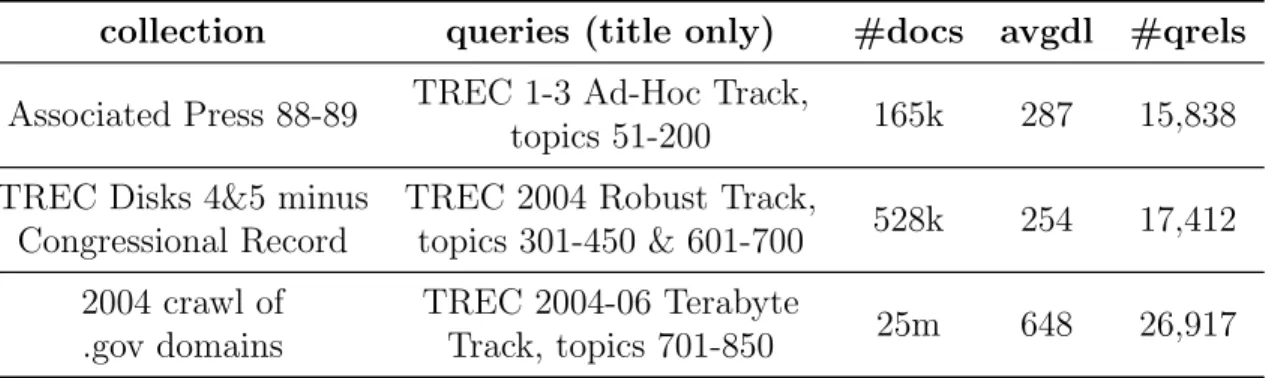
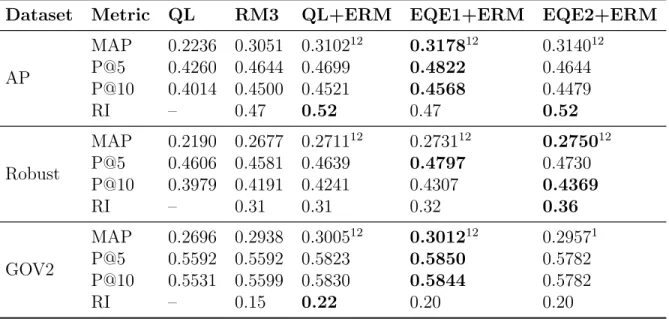
3.1 Collections statistics. . . 34 3.2 Comparing the proposed embedding-based query expansion methods
(EQE1 and EQE2) with the baselines. The superscript 1/2/3/4 denotes that the MAP improvements over
QL/GLM/VEXP/AWE are statistically significant. The highest
value in each row is marked in bold. . . 37 3.3 Evaluating the proposed methods in the pseudo-relevance feedback
scenario. The superscript 1/2 denotes that the MAP
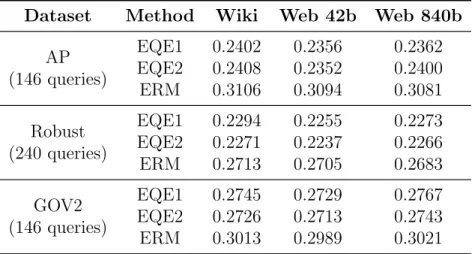
improvements over QL/RM3 are statistically significant. The
highest value in each row is marked in bold. . . 38 3.4 The corpora used for training the embedding vectors. . . 38 3.5 The MAP values achieved by EQE1, EQE2, and ERM (MLE+ERM)
with different corpora for training the embedding vectors
(dimension = 300). . . 39 3.6 Evaluating relevance-based word embeddings in the context of query
expansion. The superscripts 0/1/2 denote that the MAP improvements over MLE/word2vec/GloVe are statistically
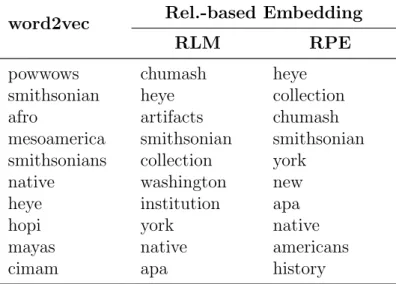
significant. The highest value in each row is marked in bold. . . 40 3.7 Top 10 expansion terms obtained by the word2vec and the
relevance-based word embedding models for an example query:
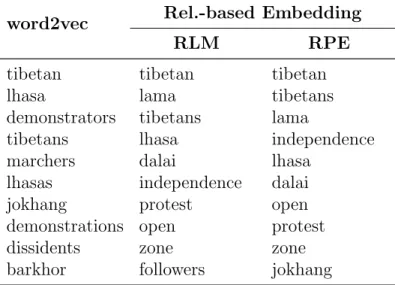
“indian american museum”. . . 41 3.8 Top 10 expansion terms obtained by the word2vec and the
relevance-based word embedding models for an example query:
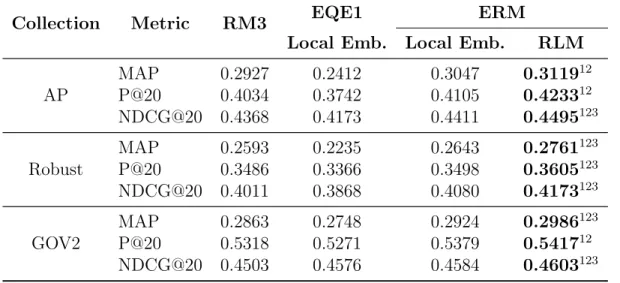
3.9 Evaluating relevance-based word embedding in pseudo-relevance feedback scenario. The superscripts 1/2/3 denote that the MAP improvements over RM3/EQE1 with Local Embedding/ERM with Local Embedding are statistically significant. The highest
value in each row is marked in bold. . . 43 3.10 Evaluating embedding algorithms via query classification. The
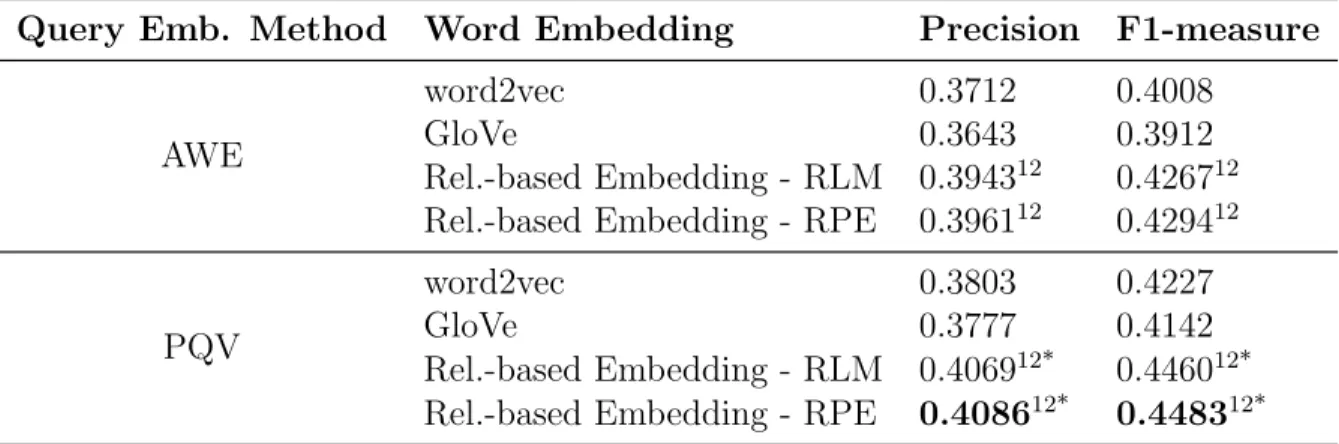
superscripts 1/2 denote that the improvements over
word2vec/GloVe with the same query embedding method are significant. The superscript * denotes that the improvements over the AWE method with all embeddings are significant. The highest value in each column is marked in bold. . . 50 4.1 Retrieval performance of weakly supervised neural ranking models
(FNRM) with different loss functions. The highest value per column is marked in bold, and the superscripts 0/1/2 denote statistically significant improvements compared to
QL/FNRM-CE/FNRM-L2, respectively. . . 67 4.2 Performance of the proposed models and baselines. The highest value
per column is marked in bold, and the superscripts 1/2/3/4/5/6 denote statistically significant improvements compared to
QL/SDM/RM3/FNRM/CNRM/SNRM, respectively. . . 82 4.3 Number of non-zero elements in the query and document
representations with 10,000 output dimensionality. . . 87 4.4 Efficiency of SNRM compared to query likelihood, in terms of average
run time (milliseconds) per query. . . 87 4.5 Performance of SNRM on the Robust collection with respect to
different amount of random document removal at training time. The superscriptO denotes significant performance loss in
comparison with the setting where no document is removed (i.e.,
no removal). . . 88 5.1 Statistical properties of the four collections used. . . 103 5.2 Performance of query performance prediction models on four
collections, in terms of the Pearson’sρ and the Kendall’s τ
correlations. The results are reported for estimating the performance of each query in terms of AP@1000 as the target metric. The highest value in each column is marked in bold, and the superscripts † /‡ denote statistically significant improvements compared to all baselines at 95% / 99% confidence intervals. . . 106
5.3 Performance of query performance prediction models on four collections, in terms of the Pearson’sρ and the Kendall’s τ
correlations. The results are reported for estimating the
performance of each query in terms of nDCG@20 as the target metric. The highest value in each column is marked in bold, and the superscripts † /‡ denote statistically significant improvements compared to all baselines at 95% / 99% confidence intervals. . . 107 5.4 Performance of the NeuralQPP’s individual components as well as
the Component Dropout technique in case of existing multiple components. The Pearson’s ρand the Kendall’s τ correlations are reported for the AP of the top 1000 documents per query. The highest value in each column is marked in bold, and the
superscripts‡ denotes statistically significant improvements compared to all individual components at a 99% confidence
interval. . . 110 5.5 Performance of NeuralQPP trained with different weak labels, in
terms of correlation with the actual AP@1000 values. The highest value in each column is marked in bold, and the superscript † /‡ denote statistically significant improvements compared to all individual weak signals as well as both All-MV and All-Ind
methods at 95% / 99% intervals. . . 111 5.6 Performance of the NeuralQPP model for predicting the average
precision of the top 1000 documents for popular retrieval
models. . . 113 6.1 Statistics of the data used in our experiments. . . 124 6.2 Two sample queries and their associated relevant movies from the
retrieval dataset. . . 127 6.3 Retrieval performance of JSR and the baselines. The highest value
per column is marked in bold, and the superscript * denotes statistically significant improvements compared to all the
baselines. . . 129 6.4 Recommendation performance of JSR and the baselines. The highest
value per column is marked in bold, and the superscript * denotes statistically significant improvements compared to all the
collaborative filtering baselines (i.e., ItemPopularity, BPR, eALS,
6.5 The top 10 words selected by JSR for four sample movies. The words are sorted in descending order in terms of their weights. The table should be viewed in color. . . 134 6.6 The corpora used for training the embedding vectors. . . 135 6.7 Retrieval performance of JSR with different word embedding
initialization. The highest value per column is marked in bold, and the superscript * denotes statistically significant
LIST OF FIGURES
Figure Page
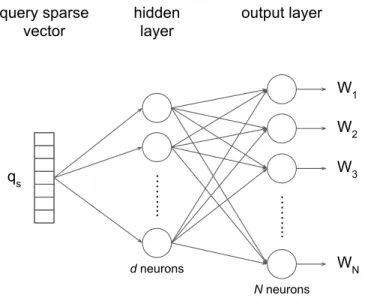
3.1 The relevance-based word embedding architecture. The objective is to learnd-dimensional distributed representation for words based on the notion of relevance, instead of term proximity. N denotes
the total number of vocabulary terms. . . 23
4.1 The retrieval performance on MQ2008 with respect to the uniform noise probability (ρ <0.5). . . 65
4.2 The retrieval performance on MQ2008 with respect to the non-uniform maximum noise probability. . . 66
4.3 Learning a latent sparse representation for a document. . . 73
4.4 General schema of the SNRM at training time. . . 74
4.5 General schema of the SNRM after training. . . 77
4.6 Sensitivity of SNRM with PRF to the number of non-zero elements in the updated query vector. . . 83
4.7 Sparsity ratio for query and document representations plus the L1 norm with respect to the training steps, for SNRM trained on the Robust collection with 10,000 output dimensionality and λ= 1e−7. . . 85
4.8 The document frequency for the top 1000 dimensions in the actual term space (blue), the latent dense space (red), and the latent sparse space (green) for a random sample of 10k documents from the Robust collection. . . 86
4.9 Retrieval performance and sparsity ratio on the Robust collection with respect to different values of parameter λ. The output dimensionality was set to 10,000. . . 88
5.1 NeuralQPP consists of the three components depicted above. The representations learned by each of these components are then aggregated using the arithmetic mean and then fed into a
fully-connected feed-forward network that produces a single score
for query performance prediction. . . 94 6.1 A high-level overview of the JSR framework that consists of three
major components φU, φI, andψ. JSR is trained using two
objective functions: a recommendation objective and an item text reconstruction objective. . . 117
CHAPTER 1
INTRODUCTION
Information Retrieval (IR) is a field of science concerned with finding material of mostly unstructured nature to satisfy an information need [102].1 Information retrieval technologies have impacted and are having increasing impact on people’s everyday lives. They are a major source of revenue for the key players of the tech industry, such as Google2 and Microsoft3. Search engines are probably the most successful applications of information retrieval. Effective search engines mostly rely on machine learning algorithms with carefully designed hand-craftedfeatures trained onlarge-scale data collected from past user interactions with the search engine [91].
Manual feature engineering has several disadvantages. First it is expensive, in terms of both time and cost. Second, extracting effective complex features is difficult or sometimes infeasible. Third, effective features are mostly application- and task-specific, therefore, they must be carefully designed for each target application and task, separately. One goal of this dissertation is to omit the need for manual feature engineering. In more detail, we propose models based on the recent advances in deep learning to learn latent features instead of manual feature engineering. Recent deep learning techniques have shown impressive performance in various computer
1Information retrieval refers to a wide range of information seeking and organizing needs. Among
them, text retrieval has been the focus of the IR community since 1950s [142]. Text retrieval focuses on helping people find documents that are relevant to their information needs. In this dissertation, all references to information retrieval will be to text retrieval systems.
2https://www.google.com/
3
vision, natural language processing, and speech recognition tasks. However, deep neural networks require large-scale training data to perform well, which is not always available. The academic community and small companies lack such data, which prevents them from working on a set of cutting-edge technologies. Even within the major tech industry, there are situations where data is extremely sparse; these include enterprise systems, new or small international markets or demographics, and personal systems [187]. As a result, dealing with limited data is an unavoidable problem in both academia and industry. Therefore, a considerable portion of this dissertation proposes approaches to deal with limited training data in its extreme case, where there is no training data in hand.
Most approaches introduced in this dissertation are based on a weak supervision solution, a machine learning strategy that does not require labeled data. In more detail, our proposed models are mostly trained based on the output of an existing unsupervised model for the underlying task [42, 180]. In the following sections, we review a set of information retrieval tasks studied in this dissertation and briefly introduce our contributions.
1.1
Distributed Representation for Information Retrieval
Representation learning for terms,4 queries, and documents is at the core of in-formation retrieval. Assuming vocabulary terms being the atomic units of natural languages, most information retrieval models represent each piece of text based on the vocabulary terms it contains as well as their frequencies. For instance, in the vector space model [143], each text is represented by a|V| dimensional vector, where
V denotes the vocabulary set. Each dimension corresponds to a vocabulary term and the similarity between two vectors is often computed using dot product or
co-4Although there are some subtle differences between the meanings of “word” and “term”, they
sine similarity functions. Using one dimension per vocabulary term is called local representation.
In local representations, it is assumed that dimensions are independent, which is not a true assumption in the context of natural language. The reason is that there exist syntactic and semantic relations between terms in the vocabulary. This assumption in traditional retrieval models has led to a long-standing problem called vocabulary mismatch [30]. Vocabulary mismatch refers to a common phenomenon in natural language where different vocabulary terms are used for the same (or similar) concepts or entities. Vocabulary mismatch is particularly important for information retrieval, since the language usage in queries and documents is different.
Usingdistributed representation for text is a potential solution for addressing the vocabulary mismatch problem. Distributed representation refers to representing each atomic unit of language by a pattern of activity distributed over several dimensions in a vector space model [70]. This allows us to measure the similarity between any arbitrary pair of vocabulary terms, and consequently any pair of text.
Latent semantic indexing (LSI) [39] is an early model that uses distributed rep-resentation for information retrieval. LSI decomposes a document-term matrix com-puted from the collection using singular value decomposition (SVD) into three ma-trices. The latent representations learned by SVD are then considered as distributed representations of terms and documents. Despite its clever idea, LSI is expensive or infeasible to run on large collections [102]. More recently, with the rapid growth of computational resources, distributed representations have again attracted much at-tention. Among various approaches for learning distributed representation for terms, word2vec [107] and GloVe [123] are notable. They are also called word embedding models. These models are designed based on similar idea. Unlike LSI, they use a small window context (e.g., five terms) instead of the whole document.
In this dissertation, we focus on learning distributed representations for informa-tion retrieval. We argue that the objectives of existing word embedding models are based on term adjacency, which differs from the main objective in information re-trieval. In fact, the main goal in information retrieval is to capturerelevance. There-fore, we revisit the objective of word embedding models by predicting the terms appeared in the relevant documents in response to an information need. This has led to the development ofrelevance-based word embedding models [180]. It is notable that our models do not require labeled data. In more detail, we assume that the top retrieved documents in response to each query are relevant to the query and use relevance models [87], state-of-the-art pseudo-relevance feedback models, to automat-ically generate large-scale weakly supervised data.
To evaluate the effectiveness of word embedding models for information retrieval, we propose a set of extrinsic evaluation methodologies for the tasks of query ex-pansion [178, 3] and query classification [179]. We show that relevance-based word embedding models outperform general-purpose word embedding models in these IR tasks.
1.2
Neural Ranking Models
Developing efficient and effective retrieval models has always been at the core of information retrieval [30]. Modern search engines use a multi-stage cascaded architec-ture for ranking documents in response to each query [170]. The early stage rankers are supposed to be efficient with high recall. They use an inverted index to efficiently retrieve documents from a large-scale collection. On the other hand, the last stage rankers are often expensive with high precision. They only re-rank a small subset of the collection [176]. It has been over a decade since learning to rank models are used as the last stage rankers in the search and recommendation industry [91].
To avoid the need for manual feature engineering, a set of learning to rank models based on deep neural networks has been recently proposed to learn representation for unstructured text [56, 108]. These models, calledneural ranking models, often require large-scale training data to perform effectively. To address this issue, Dehghani et al. [42] have recently proposed a weak supervision approach that uses an existing retrieval model, e.g., BM25 [134], as a weak labeler to produce a large volume of training data.
In this dissertation, we theoretically study weak supervision in the context of learning to rank [182, 183]. We model weak supervision as a noisy channel that introduces noise to the true labels. Our study not only theoretically explains why weak supervision models perform well, but also provides guidelines for training weakly supervised learning to rank models. We further propose a standalone neural ranking model [186] that is trained with weak supervision with no labeled data. Unlike existing learning to rank models, including neural ranking models, our model can retrieve documents from a large-scale collection. In other words, our model does not require a multi-stage cascaded architecture. This enables us to train our model fully end-to-end. We show that our model outperforms competitive baselines, while performing as efficient as term matching models, such as query likelihood [126] and BM25 [134].
1.3
Neural Query Performance Prediction
Predicting the performance of a search engine for a given query is a fundamen-tal and challenging task in information retrieval. The query performance prediction (QPP) task is defined as predicting the quality of a retrieval model for a given query, when neither explicit nor implicit relevance information is available [32]. Accurate and real-time performance predictors could potentially be used in triggering a specific action in the retrieval system, such as selecting an index traversal algorithm at query time [101], choosing the correct number of documents to process in a cascaded
mul-tistage retrieval system [34], choosing the most effective ranking function per query, selecting the best variant from multiple query reformulations, or requesting more in-formation from users in cases of potential poor retrieval performance, particularly in conversational systems.
In this dissertation, we propose a general end-to-end framework based on neural networks for query performance prediction. Our framework, called NeuralQPP [184], consists of multiple components, each analyzing a distinct aspect useful for perfor-mance prediction. We implement NeuralQPP using three components and train it using multiple weak supervision signals. Our model provides state-of-the-art results for the query performance prediction task.
1.4
Joint Modeling of Search and Recommendation
A quarter-century has passed since Belkin and Croft [15] discussed the similarity and unique challenges of information retrieval and information filtering systems. They concluded that their underlying goals are essentially equivalent, and thus they are two sides of the same coin. Search and recommendation are nowadays two major components of information systems. For example, in e-commerce applications, such as Amazon5 and eBay6, improving both search and recommendation engines is essential for increasing user satisfactions. We believe that search engines and recommender systems seek the same goal: helping people get the information they need at the right time. Therefore, joint modeling and optimization of search engines and recommender systems, if possible, could potentially benefit both systems.
In this dissertation, we propose to use joint modeling and optimization of search and recommendation [181] in order to learn a retrieval model from recommendation
5https://www.amazon.com/
6
data (i.e., without labeled retrieval data). This is not only a theoretically interesting problem, but also useful in practice. From theoretical perspective, it is a challenging transfer learning problem that differs from typical domain adaptation tasks. From practical perspective, it can lead to the development of search functionality for infor-mation systems that only have a recommender system. Our multi-task learning model takes advantage of weakly supervised relevance-based word embedding in addition to user-item interaction data for learning item (document) representations.
1.5
Contributions
In this dissertation, we make the following contributions:
1. We introduce relevance-based word embedding and propose maximum likeli-hood maximization and relevance posterior estimation as two models for learn-ing relevance-based word embeddlearn-ing vectors. We further propose a weak super-vision approach for training relevance-based word embedding models without labeled data (Chapter 3).
2. We propose two based query expansion models as well as an embedding-based pseudo-relevance feedback model embedding-based on the language modeling frame-work. These models improve the retrieval performance by considering semantic information. They also provide a set of extrinsic evaluation methodologies for evaluating word embedding algorithms for information retrieval (Chapter 3). 3. We propose a model for estimating query embedding vectors from pre-trained
word representations, based on maximum likelihood estimation. We show that average word embedding, which is a simple yet effective model for query repre-sentation, is a special case of our model. Our model can also incorporate the top documents retrieved for the query in order to estimate more accurate query representations. We use our query embedding vectors for query classification
as an extrinsic evaluation methodology to evaluate word embedding algorithms (Chapter 3).
4. We theoretically study learning to rank with weak supervision. Our study has led to the definition of symmetric ranking loss functions. We study a set of pairwise loss functions and prove that the pairwise L1 and the hinge loss are symmetric. We theoretically and empirically show that learning to rank models trained with noisy or weak labels should use a symmetric ranking loss function (Chapter 4).
5. We propose an end-to-end standalone neural ranking model trained with weak supervision, without labeled data. Our model learns a sparse representation for each query and document. We use the learned high-dimensional sparse repre-sentations to construct an inverted index in the latent space. This has led to development of the first learning to rank model that can retrieve documents from large-scale collections as efficiently as term matching models. Leveraging pseudo-relevance feedback in the learned latent space has resulted in outper-forming state-of-the-art baselines (Chapter 4).
6. We design a neural network architecture for the task of query performance pre-diction. Inspired by the existing performance prediction models, our model analyzes retrieval score distribution, term distribution in the top retrieved doc-uments, and semantic coherence of the top documents. To train a robust and effective model, we propose a weak supervision solution by learning from mul-tiple weak signals. To regularize our model, we propose a component dropout technique that improves the generalization of our model. Our model consis-tently performs better than state-of-the-art performance prediction baselines (Chapter 5).
7. We introduce a framework for joint modeling and optimization of search and recommendation. Without query-document relevance information for training, thanks to relevance-based word embedding, our model transfer knowledge from user-item interactions (i.e., recommendation data) to learn item representation suitable for information retrieval. The retrieval component is based on bag-of-words. Our model outperforms state-of-the-art retrieval baselines and performs comparably with competitive hybrid recommendation models, in terms of rec-ommendation performance (Chapter 6).
CHAPTER 2
RELATED WORK
In this chapter, we review related work in two sections. We first explore neural network approaches to information retrieval and then briefly review machine learning techniques that do not require labeled training data, with a focus on weak supervision training.
2.1
Neural Approaches to Information Retrieval
Deep neural network methods have been recently applied to various information retrieval applications, including ad-hoc retrieval [42, 109, 172], web search [16, 188], question answering [26, 62, 146], product search [4, 181], personal search [90, 149, 177], mobile search [5, 6], and conversational search [7, 175], and recommender sys-tems [145, 189]. In the following, we focus on two categories of models that are most related to this dissertation, including word embedding approaches applied to infor-mation retrieval and neural ranking models. For more inforinfor-mation on neural models to other information retrieval tasks, we refer the readers to [108].
2.1.1 Word Embedding for Information Retrieval
Learning a semantic representation for text has been studied for many years. Latent semantic indexing (LSI) [39] is considered as an early work in this area that tries to map each text to a semantic space using singular value decomposi-tion (SVD), a well-known matrix factorizadecomposi-tion algorithm. Subsequently, Clinchant and Perronnin [25] proposed Fisher Vector (FV), a document representation frame-work based on continuous word embeddings, which aggregates a non-linear mapping
of word vectors into a document-level representation. However, relatively simple term matching retrieval models, such as BM25 [134] and query likelihood [126], often sig-nificantly outperform the models that are solely based on semantic matching.
More recently, the rapid advances in computational resources (especially GPUs) have led to the development of efficient word embedding algorithms that are much more effective than their classic alternatives in measuring semantic similarity be-tween words. Word embedding, also known as distributed representation of words, refers to a set of machine learning algorithms that learn high-dimensional real-valued dense vector representationw~ ∈Rd for each vocabulary term w, where ddenotes the
embedding dimensionality. GloVe [123] and word2vec [107] are two well-known word embedding algorithms that learn embedding vectors based on the same idea, but using different machine learning techniques. The idea is that the words that often appear in similar contexts are similar to each other. Based on this idea, these algorithms try to accurately predict the adjacent word(s) given a word or a context (i.e., a few words appeared in the same context window). GloVe learns the word embedding vectors by decomposing a global word-word co-occurrence matrix, while word2vec is based on a feed-forward fully-connected neural network with a single hidden layer. Levy and Goldberg [89] further showed that neural word embedding models are theoretically equivalent to implicit matrix factorization models, under some constraints.
Recently, Rekabsaz et al. [131] proposed to exploit global context in word embed-dings in order to avoid topic shifting. In more detail, they suggest using document-level term co-occurrence to measure term relatedness by post filtering the related terms with high word embedding similarities using various global context measures. In another study, Diaz et al. [45] suggested using local information to train word em-bedding vectors. Their approach is motivated by a widely known fact in the informa-tion retrieval literature, indicating that there is a big difference between the unigram distribution of words on sub-topics of a collection and the unigram distribution
esti-mated from the whole collection [173]. In more detail, Diaz et al. proposed training word embedding vectors on the top retrieved documents for each query. However, this model, called local embedding, is not always practical in real-word applications, since the embedding vectors must be trained at query time.
Word embedding vectors have been successfully employed in several NLP and IR tasks. Kusner et al. [83] proposed word mover’s distance (WMD), a function for calculating semantic distance between two documents, which measures the minimum traveling distance from the embedded vectors of individual words in one document to the other one. Zhou et al. [197] introduced an embedding-based method for question retrieval in the context of community question answering. Vuli´c and Moens [168] proposed learning bilingual word embedding vectors from document-aligned compa-rable corpora for the task of cross-lingual information retrieval (CLIR). Zheng and Callan [196] presented a supervised embedding-based technique to re-weight terms in the existing IR models, e.g., BM25. Based on the well-defined structure of the lan-guage modeling framework in information retrieval [126], a number of methods have been introduced to employ word embedding vectors within this framework in order to improve the performance in IR tasks. For instance, Ganguly et al. [51] considered the semantic similarities between vocabulary terms to smooth document language models. Zuccon et al. [200] further proposed to employ word embeddings within the translation model for IR. Their proposed method achieves comparable performance to the mutual information-based translation language models of Karimzadehgan and Zhai [78]. The main idea behind the methods proposed by Ganguly et al. and Zuc-con et al. is similar. Both methods Zuc-consider semantic similarity in computing the probability of terms in the documents. Apart from estimating document language models, ALMasri et al. [8] proposed a heuristic query expansion method based on word embedding similarities. Their method is a term-by-term expansion. Kuzi et al. [84] also employed word embedding for query expansion, both with and without
pseudo-relevance feedback. Sordoni et al. [155] earlier proposed a query expansion method based on concept embedding. Their method is a supervised learning ap-proach with the quantum entropy loss function that uses click-through data. All of these approaches are based on word embedding vectors learned based on term prox-imity information. PhraseFinder of Jing and Croft [76] is an early work that used term proximity information for query expansion.
Most recently, word embedding algorithms went beyond the bag-of-words repre-sentation and learn contextual reprerepre-sentation for words and sentences. ELMo [125] and BERT [43] are two successful implementations of contextual word embeddings. The network architecture in ELMo is based on recurrent neural networks (RNNs), while BERT uses Transformers [165], which are solely based on attention. The effi-ciency of Transformers compared to RNNs enables us to train BERT on a large-scale corpus and achieve a better performance, compared to ELMo. BERT has been re-cently applied to information retrieval tasks, and led to significant improvements in passage retrieval [117, 119].
Chapter 3 revisits the objective in word embedding algorithms and proposes to learn relevance-based word embedding by predicted the distribution of terms in the documents relevant to a specific information need. It also introduces a set of effective and formally motivated query expansion and query classification techniques.
2.1.2 Neural Ranking Models
Learning to rank refers to a set of machine learning algorithms for producing a ranked list of objects [91]. Conventional learning to rank models range from lin-ear [105] to tree-based [19] to support vectors machines [77] to neural networks [18]. These models require careful feature engineering, which significantly affects their per-formance.
Recent studies in the area of deep learning have enabled us to learn abstract representations from raw data, such as image or text. This not only avoids the troublesome and expensive feature engineering procedure, but also allows the model to learn complex task-specific features from the data. The learning to rank models based on such neural representation learning are called neural ranking models.1
Guo et al. [55] categorized neural ranking models to representation-focused and interaction-focused models. Since representation-focused models also use the interac-tion informainterac-tion for learning the representainterac-tions, Dehghani et al. [42] suggested early combination and late combination as the two categories of neural ranking models. The early combination models are designed based on the interactions between query and document as the networks’ input. For instance, the deep relevance matching model (DRMM) [55] takes histogram-based features as input, representing the in-teractions between query and document. DeepMatch [97] is another example that maps the input to a sequence of terms and computes the matching score using a feed-forward network. Dehghani et al. [42] also proposed simple pointwise and pair-wise neural ranking models based on feed-forward networks. Their models use the average word embedding of query and document as the input of the network. Xiong et al. [172] proposed a neural ranking model, called KNRM, that applies different kernel functions to the query-document interaction matrix. Dai et al. [36] extended KNRM by considering soft matching of ngrams using convolutional neural networks and proposed the Conv-KNRM model that outperforms the original KNRM model.
The late combination models, on the other hand, separately learn a representation for query and document and then compute the relevance score using a matching function applied on the learned representations. DSSM [74] is an example of late
1All the learning to rank models based on neural networks are sometimes referred to as neural
ranking models. However, we use the phrase “neural ranking models” for the models that do not require manual feature engineering.
combination models that learns representations using feed-forward networks and then uses cosine similarity as the matching function. DSSM was further extended by making use of convolutional neural networks, called C-DSSM [150].
Furthermore, Mitra et al. [109] combined both early and late combination ideas. Their duet model consists of two components: local and distributed. The local com-ponent takes the query-document term matching matrix and produces a retrieval score, while the distributed component learns distributed representations for both query and document and compares them. The final score is obtained by summing the local and distributed retrieval scores.
The aforementioned neural ranking models assume that each document is an un-structured text, however, documents in most applications, including web search, prod-uct search, and email search, contain multiple fields (i.e., semi-strprod-uctured documents). Zamani et al. [188] proposed NRM-F, a neural model for ranking semi-structured doc-uments. NRM-F was evaluated in the context of web search and has shown significant improvements compared to state-of-the-art learning to rank models. Liu et al. [95] enhanced document representation in neural ranking models by incorporating entity representations and utilizing knowledge graphs. Besides document representation, Zamani et al. [177] proposed a context-aware neural ranking model that takes con-textual information into account for learning more accurate query representation. Their network is based on a deep and wide architecture. For more information on neural ranking models, we refer the readers to the recent survey by Guo et al. [56].
All the existing learning to rank algorithms, including neural ranking models, re-rank a small subset of documents retrieved by a set of efficient early stage re-rankers. In Chapter 4, we propose a standalone neural ranking model, that unlike existing learn-ing to rank models, can efficiently retrieve documents from a large-scale collection.
2.2
Machine Learning without Labeled Data
Many machine learning algorithms are trained using labeled training data. Labels can be obtained using expert annotators, crowdsourcing, explicit feedback, or implicit feedback from user interactions with a system. As machine learning models get more complex, they generally require more labeled data to train. Deep neural networks nowadays consist of hundreds of millions of parameters, which necessitates the need for large-scale training data. However, collecting large-scale labeled data is time-consuming, expensive and sometimes infeasible. In this section, we briefly review a set of learning approaches that do not require labeled training data.
Unsupervised Learning: Unsupervised learning is a type of machine learning al-gorithms used to draw inferences from test data. Cluster analysis is a typical unsuper-vised learning task. Besides clustering, there exist a number of unsuperunsuper-vised dimen-sionality reduction methods, such as principal component analysis (PCA) [72, 122] and linear discriminant analysis (LDA) [50]. In the realm of neural networks, au-toencoders are popular unsupervised learning models that are employed for represen-tation learning and dimensionality reduction by input reconstruction as the learning objective [53]. Restricted Boltzmann machines can be also trained unsupervised [71]. Generative adversarial networks (GANs) [54] are a class of unsupervised machine learning algorithms, implemented by a system of two neural networks (i.e., generative and discriminative models) contesting with each other in a zero-sum game framework. GANs have recently shown promising results in a set of computer vision tasks [53]. Unsupervised learning models only identify commonalities in the data.
Self-Supervised Learning: Self supervision refers to a learning category in which models are trained to predict a part of the data that is withheld. Language modeling is a good example of self supervision that has been used in various natural language related tasks. General-purpose word embedding algorithms, such as word2vec [107]
and GloVe [123], are also categorized as self-supervised learning approaches that predict a term given a context or vice versa. Self-supervised models also do not require manually labeled data; they automatically generate training data by withholding a part of the data.
Transfer Learning: Transfer learning refers to a category of models that transfer knowledge learned in one or more source tasks and use it to improve learning in a related target task. Transfer learning is particularly useful when the target task suffers from lack of large-scale training data. Research in transfer learning began in early 1990’s [127] and has attracted increasing attention. A simple approach for transfer learning is to train a model using the source training data and use it as a pre-trained model for the target task. Multi-task learning is also a subcategory of transfer learning algorithms that simultaneously optimizes multiple objectives for different tasks.
Weakly Supervised Learning: In weak supervision, the objective is the same as in the supervised setting, however instead of a ground-truth labeled training set we have a set of noisy labels, called weak labels. Weak supervision is a broad concept that refers to learning from any inaccurate, noisy, or biased labels. In this disserta-tion, we refer to weak supervision as a technique that does not require manual labeled data or implicit feedback. Therefore, learning from crowdsourced data or click data collected from user interactions with the system does not consider as weak supervision in this dissertation. In fact, weak supervision refers to methods that can automat-ically generate large-scale training data. They can be based on heuristics, external resources, or existing models. This is a student-teacher learning, in which the teacher is an unsupervised weak labeler. This can be used to either improve efficiency [27] or effectiveness [42, 79]. Distant supervision is also a type of weak supervision that makes use of an existing resource, such as knowledge base, to generate training data.
Most of the approaches presented in this dissertation are based on weak supervision. We use existing models for a target task to generate large-scale training data and leverage it for training our neural network models.
2.3
Weak Supervision for Information Retrieval
Limited training data has been a perennial problem in information retrieval [187]. This has motivated researchers to explore building models using pseudo-labels. For example, pseudo-relevance feedback (PRF) [13, 31] assumes that the top retrieved documents in response to a given query are relevant to the query. Although this assumption does not necessarily hold, PRF has been proven to be effective in many retrieval settings [87, 135, 191]. Building pseudo-collections and simulated queries for various IR tasks could be considered as another set of approaches that tackle this issue [11, 14].
As widely known, deep neural networks often require a large volume of training data. Recently, weak supervision has been started to be explored in information re-trieval. It was firstly proposed in SIGIR 2017 by Dehghani et al. [42] for training neural ranking models and by Zamani and Croft [180] for learning IR-specific word representations. Since then, weak supervision has been studied from various perspec-tives for different applications. Following Dehghani et al. [42], weak supervision has been explored for ranking tasks. For instance, Nie et al. [116] proposed a convolutional neural ranking model trained with weak supervision for ad-hoc retrieval. MacAvaney et al. [100] explored a number of different methods for generating weak supervision data using the content information. Weak supervision has been also explored for passage retrieval by Xu et al. [174]. Recently, Haddad and Ghosh [59] proposed a sampling strategy to reduce the training time in weakly supervised neural ranking models.
In addition to ranking, weak supervision has been employed for some other IR tasks. For example, Xiao et al. [171] proposed a weak supervision method for query re-writing in the context of e-commerce applications. Chaidaroon et al. [23] proposed a weak supervision solution for text semantic hashing. Learning knowledge graph representation [167] is another application addressed by weak supervision training.
There is a line of research for combining supervised and weakly supervised signals to learn more accurate models. Dehghani et al. [40, 41] proposed weighting methods for controlling the learning rate of each mini-batch during training. Luo et al. [98] proposed to use click data for training weakly supervised ranking models. In addi-tion, Shnarch et al. [151] proposed a method for blending weak supervision and strong supervision data for training a model for argumentation mining. Recent data pro-gramming frameworks, such as Snorkel [130],2 have smoothed the path for generating weak supervision data for a wide variety of tasks.
In this dissertation, we show that weak supervision is a general solution for many information retrieval tasks. For example. we provide successful implementation of weakly supervised models for representation learning (Chapter 3), ranking (Chap-ter 4), and query performance prediction (Chap(Chap-ter 5). In addition, we provide a theoretical study for weak supervision training (Chapter 4). Learning from multiple weak supervision signals have been also explored in the dissertation (Chapter 5).
2
CHAPTER 3
DISTRIBUTED REPRESENTATIONS FOR
INFORMATION RETRIEVAL
Information retrieval is mainly concerned with retrieving relevant documents from a large document collection in response to a query. This requires developing computa-tional representations for queries and documents. The quality of these representations directly impacts the retrieval performance. This is why building useful query and doc-ument representations has been always at the core of information retrieval research. Learning IR-specific representations often require query-document relevance signal. In this chapter, we mainly focus on representation learning for words as the atomic units of natural languages. We propose relevance-based word embedding and discuss how to train the model using weak supervision. In fact, we use Lavrenko and Croft’s relevance models [87] to automatically generate training data for our model.
This chapter is structured as follows: Section 3.1 briefly reviews word embedding models. Section 3.2 introduces our models for learning IR-specific distributed repre-sentations. Section 3.3 studies the application of word embedding in a number of IR tasks.
3.1
Background: Word Embedding
Learning a semantic representation for text has been studied for many years. Latent semantic indexing (LSI) [39] can be considered as early work in this area that tries to map each text to a semantic space using singular value decomposition (SVD), a well-known matrix factorization algorithm. Subsequently, Clinchant and
Perronnin [25] proposed Fisher Vector (FV), a document representation framework based on continuous word embeddings, which aggregates a non-linear mapping of word vectors into a document-level representation. However, a number of popular IR models, such as BM25 and language models, often significantly outperform the models that are based on semantic similarities. More recently, efficient algorithms for learning word representations have been proposed that model semantic similarly between words, effectively.
Word embedding, also known as distributed representation of words, refers to a set of machine learning algorithms that learn high-dimensional real-valued dense vector representation w~ ∈ Rd for each vocabulary term w, where d denotes the embedding
dimensionality. GloVe [123] and word2vec [107] are two well-known word embedding algorithms that learn embedding vectors based on the same idea, but using different machine learning techniques. The idea is that the words that often appear in similar contexts are similar to each other. These algorithms try to accurately predict the adjacent word(s) given a word or a context (i.e., a few words appeared in the same context window). The word2vec algorithm uses a fully-connected feed-forward net-work with a single hidden layer to learn distributed representation of words. On the other hand, GloVe employs a matrix factorization algorithm to decompose a global word-word co-occurrence matrix to two lower ranked matrices. Both of these two models have shown promising results in a set of natural language processing tasks.
3.2
Relevance-based Word Embedding
As introduced earlier in Section 3.1, typical word embedding algorithms, such as word2vec [107] and GloVe [123], learn high-dimensional real-valued embedding vectors based on the proximity of terms in a training corpus, i.e., co-occurrence of terms in the same context window. Although these approaches could be useful for learning the embedding vectors that can capture semantic and syntactic similarities between
vocabulary terms and have shown to be useful in many NLP and IR tasks, there is a large gap between their learning objective (i.e., term proximity) and what is needed in many information retrieval tasks. For example, consider the query expansion task and assume that a user submitted the query “dangerous vehicles”. One of the most similar terms to this query based on the typical word embedding algorithms (e.g., word2vec and GloVe) is “safe”, and thus it would get a high weight in the expanded query model. The reason is that the words “dangerous” and “safe” often share similar contexts. However, expanding the query with the word “safe” could lead to poor retrieval performance, since it changes the meaning and the intent of the query.
This example together with many others have motivated us to revisit the objective used in the learning process of word embedding algorithms in order to obtain the word vectors that better match with the needs in IR tasks. The primary objective in many IR tasks is to model the notion ofrelevance. Several approaches, such as the relevance models proposed by Lavrenko and Croft [87], have been proposed to model relevance. Given the successes achieved by these models, we propose to revisit the objective for learning word embedding vectors as follows:
The objective is to accurately predict the terms that are observed in a set of documents relevant to a particular information need.
In the following, we first describe our neural network architecture, and then ex-plain how to build a training set for learning relevance-based word embeddings. We further introduce two models, relevance likelihood maximization (RLM) and relevance posterior estimation (RPE), with different objectives using the described neural net-work.
3.2.1 Neural Network Architecture
We use a simple yet effective feed-forward neural network with a single linear hid-den layer. The architecture of our neural network is similar to that of the word2vec
query sparse vector ……... ……... W1 hidden layer output layer W2 W3 WN d neurons N neurons qs
Figure 3.1: The relevance-based word embedding architecture. The objective is to learn d-dimensional distributed representation for words based on the notion of rele-vance, instead of term proximity. N denotes the total number of vocabulary terms.
model [107] and is depicted in Figure 3.1. The input of the model is a sparse query vector ~qs with the length of N, where N denotes the total number of vocabulary
terms. This vector can be obtained by a projection function given the vectors corre-sponding to individual query terms. In our model, we simply consider average as the projection function. Hence, ~qs = |1q|Pw∈q~ew, where ~ew and |q| denote the one-hot
vector representation of termw and the query length, respectively. The hidden layer in this network maps the given query sparse vector to a query embedding vector ~q, as follows:
~q=~qs× WQ (3.1)
where WQ ∈ RN×d is a weight matrix for estimating query embedding vectors and
d denotes the embedding dimensionality. The output layer of the network is a fully-connected layer given by:
where Ww ∈Rd×N and bw ∈ R1×N are the weight and the bias matrices for
estimat-ing the probability of each term. σ is the activation function which is discussed in Sections 3.2.3 and 3.2.4.
To summarize, our network contains two sets of embedding parameters, WQ and
Ww. The former aims to map the query into the “query embedding space”, while the
latter is used to estimate the weights of individual terms.
3.2.2 Modeling Relevance for Training without Labeled Data
Relevance feedback has been shown to be highly effective in improving retrieval performance [135, 30]. In relevance feedback, a set of documents relevant to a given query is considered for estimating accurate query models. Since explicit relevance signals for a given query are not always available, pseudo-relevance feedback (PRF) assumes that the top retrieved documents in response to the given query are relevant to the query and uses these documents in order to estimate better query models. The effectiveness of PRF in various retrieval scenarios indicates that useful information can be captured from the top retrieved documents [87, 86, 191]. We make use of this well-known assumption to train our model. It should be noted that there is a significant difference between PRF and the proposed models: In PRF, the feedback model is estimated from the top retrieved documents of the given query in an online setting. In other words, PRF retrieves the documents for the initial query and then estimates the feedback model using the top retrieved documents. We propose to train the model in an offline setting. Moving from the online to the offline setting would lead to substantial improvements in efficiency, because an extra retrieval run is not required in the offline setting. To learn a model in an offline setting, we consider a fixed-length dense vector for each vocabulary term and estimate these vectors based on the information extracted from the top retrieved documents for large numbers of training queries. Note that our models do not require labeled training data. However,
if explicit or implicit relevance signals, such as click data, are available, without loss of generality, they can be employed for training the models.
To formally describe our training data, let T ={(q1,R1),(q2,R2),· · · ,(qm,Rm)}
be a training set withmtraining queries. Theith element of this set is a pair of query
qi and the corresponding pseudo-relevance feedback distribution. These distributions
are estimated based on the top k retrieved documents (in our experiments, we set k
to 10) for each query. The distributions can be estimated using any PRF model, such as those proposed in [87, 157, 185, 191]. In our model, we focus on a variant of the relevance models (i.e., RM3) [2, 87] that estimates the relevance distribution as:
p(w|Ri)∝ X d∈Fi p(w|d) Y w0∈q i p(w0|d) (3.3)
whereFi denotes a set of top retrieved documents for query qi. Note that the
proba-bility of terms that do not appear in the top retrieved documents is equal to zero.
3.2.3 Relevance Likelihood Maximization Model
In this model, the goal is to learn the relevance distribution R. Given a set of training data, we aim to find a set of parameters θR in order to maximize the likelihood of generating relevance model probabilities for the whole training set. The likelihood function is defined as follows:
m Y i=1 Y w∈Vi b p(w|qi;θR)p(w|Ri) (3.4)
where pbis the relevance distribution that can be obtained given the learning param-eters θR and p(w|Ri) denotes the relevance model distribution estimated for the ith
query in the training set (see Section 3.2.2 for more detail). Vi denotes a subset of
vocabulary terms that appeared in the top ranked documents retrieved for the query
whole vocabulary set V is that the probability p(w|Ri) is equal to zero for all terms
w∈V −Vi.
In this method, we model the probability distributionpbusing the softmax function (i.e., the function σ in Equation (3.2)) as follows:
b p(w|q;θR) = exp (w~T~q) P w0∈V exp (w~0 T ~ q) (3.5)
where w~ denotes the learned embedding vector for term w and ~q is the query vector came from the output of the hidden layer in our network (see Section 3.2.1). Accord-ing to the softmax modelAccord-ing and the log-likelihood function, we have the followAccord-ing objective: arg max θR m X i=1 X w∈Vi
p(w|Ri) log exp (w~Tq~i)−log
X w0∈V exp (w~0Tq~ i) ! (3.6)
Computing this objective function and its derivatives would be computationally expensive (due to the presence of the normalization factor P
w0∈V exp (w~0
T
~
q) in the objective function). Since all the word embedding vectors as well as the query vector are changed during the optimization process, we cannot simply omit the normal-ization term as is done in [179] for estimating query embedding vectors based on pre-trained word embedding vectors. To make the computations more tractable, we consider a hierarchical approximation of the softmax function, which was introduced by Morin and Bengio [112] in the context of neural network language models and then successfully employed by Mikolov et al. [107] in the word2vec model.
The hierarchical softmax approximation uses a binary tree structure to represent the vocabulary terms, where each leaf corresponds to a unique word. There exists a unique path from the root to each leaf, and this path is used for estimating the probability of the word representing by the leaf. Therefore, the complexity of cal-culating softmax probabilities goes down from O(|V|) to O(log(|V|)) which is the
height of the tree. This leads to a huge improvement in computational complexity. We refer the reader to [110, 112] for the details of calculating the hierarchical softmax approximation.
3.2.4 Relevance Posterior Estimation Model
As an alternative to maximum likelihood estimation, we can estimate the rele-vance posterior probability. In the context of pseudo-relerele-vance feedback, Zhai and Laffery [191] assumed that the language model of the top retrieved documents is es-timated based on a mixture model. In other words, it is assumed that there are two language models for the feedback set: the relevance language model1 and a back-ground noisy language model. They used an expectation-maximization algorithm to estimate the relevance language model. In this model, we make use of this assumption in order to cast the problem of estimating the relevance distribution R as a classi-fication task: Given a pair of word w and query q, does w come from the relevance distribution of the queryq? Instead ofp(w|R), this model estimatesp(R = 1|w, q;θR) whereRis a Boolean variable andR = 1 means that the given term-query pair (w, q) comes from the relevance distribution R. θR is a set of parameters that is going to be learned during the training phase.
Therefore, the problem is cast as a binary classification task that can be modeled by logistic regression (which means the function σ in Equation (3.2) is the sigmoid function):
b
p(R = 1|w, ~~ q;θR) =
1
1 +e(−w~T~q) (3.7) where w~ is the relevance-based word embedding vector for term w. Similar to the previous model, ~q is the output of the hidden layer of the network, representing the query embedding vector.
1The phrase “topical language model” was used in the original work [191]. We call it “relevance
In order to address this binary classification problem, we consider a cross-entropy loss function. In theory, for each training query, our model should learn to model relevance for the terms appearing in the corresponding pseudo-relevant set and non-relevance for all the other vocabulary terms, which could be impractical, due to the large number of vocabulary terms. Similar to [107], we propose to use the noise contrastive estimation (NCE) [58] which hypothesizes that we can achieve a good model by only differentiating the data from noise via a logistic regression model. The main concept in NCE is similar to those proposed in the divergence from random-ness model [9] and the divergence minimization feedback model [191]. Based on the NCE hypothesis, we define the following negative cross-entropy objective function for training our model:
arg max θR m X i=1 η+ X j=1 Ewj∼p(w|Ri)[logpb(R= 1|w~j, ~qi;θR)] + η− X j=1 Ewj∼pn(w)[logpb(R= 0|w~j, ~qi;θR)] (3.8)
wherepn(w) denotes a noise distribution andη= (η+, η−) is a pair of hyper-parameters
to control the number of positive and negative instances per query, respectively. We can easily calculate pb(R = 0|w~j, ~qi) = 1−pb(R = 1|w~j, ~qi). The noise distribution
pn(w) can be estimated using a function of unigram distribution U(w) in the whole
training set. Similar to [107], we use pn(w) ∝ U(w)3/4 which has been empirically
shown to work effectively for negative sampling.
It is notable that although this model learns embedding vectors f