2006:320 CIV
M A S T E R ' S T H E S I S
Developing a Strategic
Procurement Process
A Case Study at Boliden AB
Magnus Blomberg
Luleå University of Technology MSc Programmes in Engineering Industrial Business Administration
Department of Business Administration and Social Sciences Division of Industrial Logistics
Abstract
Abstract
Boliden is one of the leading mining and smelter companies in the world. Boliden have mines in Sweden and Ireland and smelters in Sweden, Norway and Finland. Their main products are copper, zinc, lead, gold and silver.
To make it easier to standardize the procurement process and introduce new lead-buyers, Boliden has decided to create a procurement manual. The primary purpose of the Manual is to provide an overview of Bolidens procurement operations, procurement processes and procurement information systems. As such, this Manual provides an awareness of mandatory requirements, policy considerations, guidelines, procedures and best practices. The manual will contain job descriptions for all roles involved in procurement, instructions on how to handle communications, purchasing ethics and policies and detailed descriptions of the procurement process and its sub processes.
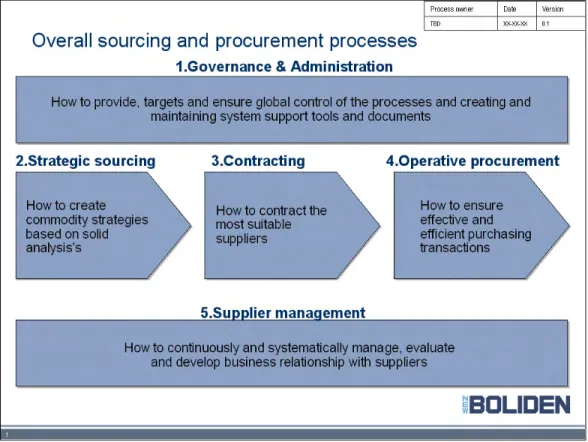
In this project this manual is created through interviews and workshops with relevant personnel. The manual is adopted for presentation at the company intranet. In the process of creating this manual five main processes are identified: Governance and administration, strategic sourcing, contracting, operative procurement and supplier management. These processes are mapped in flowcharts and presented in the report. The final conclusions of this report is that in order to be able to control and measure the procurement process in order to improve it, it has to be properly mapped.
Preface
Preface
During the summer and autumn of 2006 I have conducted this study for my master thesis at Boliden Mineral AB outside Skellefteå. This master thesis is the final piece of my educational puzzle and I would like to thank everyone who made it possible. First of all I would like to thank Mats Gustavsson CPO at the Boliden Group for trusting me with this project. I would also like to thank Mattias Berggren Commodity Manager at Boliden Group for all the time that he has invested in this project. An other important person that deserves a my gratitude is Stefan Sandberg, at the time management consultant at Cap Gemini, I would like to thank him for the support that he gave me in the early stages of the project.
I would also like to thank Torbjörn Wiberg at Luleå University of Technology for his supervision during this project. Finally I would like to thank my classmates for their invaluable tips and support during the project and all the friendly people at Bolidens procurement and logistics department for the positive way that they have welcomed me into their fellowship.
Boliden 3 October 2006
Table of contents
Table of contents
1. INTRODUCTION 1
1.1. BACKGROUND 1
1.2. PURPOSE 1
1.3. LIMITATIONS OF THE STUDY 1
2. RESEARCH METHODOLOGY 2
2.1. RESEARCH STRATEGY 2
2.2. METHODOLOGICAL APPROACH WHEN CREATING THE MODEL 2
2.3. LITERATURE REVIEW 4
2.4. SELECTION OF RESPONDENTS 4
2.5. DATA COLLECTION 5
2.5.1. SECONDARY DATA COLLECTION 5 2.5.2. PRIMARY DATA COLLECTION 5
2.6. RELIABILITY AND VALIDITY 6
3. THEORETICAL FRAMEWORK 8
3.1. THE STRATEGIC ROLE OF PURCHASING 8
3.2. PURCHASING ORGANIZATION 10
3.2.1. LEVELS OF TASKS, RESPONSIBILITY AND AUTHORITY 10 3.2.2. CENTRALIZED VERSUS DECENTRALIZED PURCHASING ORGANIZATION 11
3.3. THE PROCUREMENT PROCESS 12
3.3.1. THE GOVERNANCE PROCESS 12 3.3.2. THE STRATEGIC SOURCING PROCESS 14 3.3.3. THE CONTRACTING PROCESS 20 3.3.4. THE SUPPLIER MANAGEMENT PROCESS 21
3.4. PURCHASING POLICY 23 3.4.1. RISK 23 3.4.2. ETHICS 24 3.5. AUTHORITY 25 4. SITUATIONAL DESCRIPTION 27 4.1. COMPANY DESCRIPTION 27 4.1.1. ORGANIZATION 27 4.2. THE SITUATION AT THE PROCUREMENT AND LOGISTICS DEPARTMENT 28
5. RESULTS 31
5.1. PURPOSE, TARGET GROUP AND LAYOUT 31
5.2. MAIN PROCESSES 34
Table of contents
5.2.2. STRATEGIC SOURCING 35 5.2.3. CONTRACTING 35 5.2.4. OPERATIVE PROCUREMENT 35 5.2.5. SUPPLIER MANAGEMENT 35 5.2.6. LAYOUT OF MAIN ACTIVITIES 35
5.3. SUB-PROCESSES AND ACTIVITIES 36
5.3.1. GOVERNANCE AND ADMINISTRATION 37 5.3.2. STRATEGIC SOURCING 48 5.3.3. CONTRACTING 53 5.3.4. OPERATIVE PROCUREMENT 60 5.3.5. SUPPLIER MANAGEMENT 62
6. ANALYSIS 64
6.1. THE STRATEGIC ROLE OF PURCHASING 64
6.2. PURCHASING ORGANIZATION 64
6.3. THE PROCUREMENT PROCESS 65
6.3.1. THE GOVERNANCE PROCESS 65 6.3.2. THE STRATEGIC SOURCING PROCESS 65 6.3.3. THE CONTRACTING PROCESS 65 6.3.4. THE SUPPLIER MANAGEMENT PROCESS 66
6.4. PURCHASING POLICY 66
7. CONCLUSIONS 67
8. REFERENCES 68
BOLIDENS PROCUREMENT MANUAL _____________________ Appendix 1 BOLIDENS PROCUREMENT POLICY ______________________ Appendix 2 ABBREVIATIONS AND ACRONYMS________________________ Appendix 3
1. Introduction
1. Introduction
This chapter will give a short introduction to the company and the present situation. Other important parts of this chapter are the purpose of the study and limitations.
1.1. Background
Boliden is one of the leading mining and smelter companies in the world. Boliden have mines in Sweden and Ireland and smelters in Sweden, Norway and Finland. Their main products are copper, zinc, lead, gold and silver.
Boliden has recently acquired new facilities in Ireland, Norway and Finland. These facilities have different routines and practices for procurement than the other facilities in the company. This means that all purchasing has been done at each site and all possibilities to purchase with the full strength of the corporation has been made impossible. Boliden has decided to change this situation and strives to maximize the efficiency of the procurement function and save money. In order to do so they have decided to go from a decentralized procurement organization to a centralized one, where the purchasing will be organized based upon commodity groups instead of facility. Each product group will be represented by a lead-buyer who is responsible for all contracting within his/her product group. At the present time there are no common routines for this process and the process has not been mapped. This is a problem when commodities are to be moved from the old decentralized organization in to the new strategic procurement organization.
To make it easier to standardize the procurement process and introduce new lead-buyers, Boliden has decided to create a procurement manual. The primary purpose of the manual is to provide an overview of Bolidens procurement operations, procurement processes and procurement information systems. As such, this manual provides an awareness of mandatory requirements, policy considerations, guidelines, procedures and best practices. The manual will contain job descriptions for all roles involved in procurement, instructions on how to handle communications, purchasing ethics and policies and detailed descriptions of the procurement process and its sub processes.
1.2. Purpose
The purpose of this thesis is to create a substantial contribution to the procurement manual involving:
• A complete mapping of the future procurement process and its sub process.
• A proposal for Bolidens procurement policy.
• Identify, and where needed create, routine descriptions, tools and templates for all relevant procurement processes.
• Present all these parts in a clear and easy to use model
1.3. Limitations of the study
The responsibility for the advanced IT-support and implementation of the procurement manual onto the company intranet is not in the span of this project due to
2. Research methodology
2
2. Research methodology
This chapter will explain how the study was conducted, what methods were used and why.
2.1. Research strategy
In order to create the model best adapted to the company’s situation, the research has been based heavily on empirical data from the interviews. The information gathered through interviews and workshops, has then been compared to present research to make sure that the solutions reached are in line with best practice according to those sources. The data gathered in this research is mainly qualitative data although some quantitative data has been used mainly in the spend maps, and other material related to the spend.
2.2. Methodological approach when creating the model
When this project started the company was in the middle of a restructuring of the procurement department, with fragments from the old organization working side by side with fragments from the new organization. Because of this special situation the classical approach to process mapping, where a snapshoot picture of the present situation is first created then possible improvements are identified and finally a future process map are created. Due to the ever-changing processes in the present organization it was decided that a snapshoot image of the present situation would be hard to create and would contribute very little value to the process. Instead a future process description was created that the ongoing changes in the department could be steered towards.
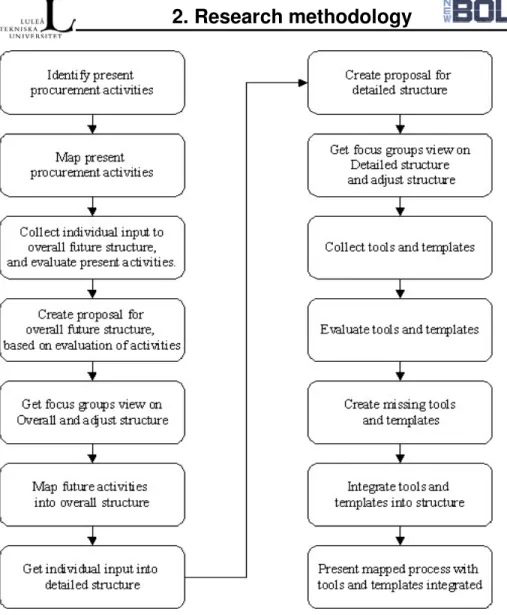
I have created 14 steps through which I intend to approach this issue:
1. The first step was to identify all present procurement activities in the company. This was done through secondary data in the form of documents routine descriptions and tools and template collected from the different sites. Some interviews with people in the organization also contributed to the identification of different procurement activities. Some ideas for necessary procurement processes were also collected from the literature review. However in this stage not only present activities were collected but also ideas for new processes that could improve purchasing. Basically an activity long-list was created of all activities that might have to be included in the new process map.
2. The second step was to organize the activities into groups so that main processes could be identified. It was also important to identify any connections between activities to be able organize them into sequential flows.
3. When the present activities where identified it was important to see which activities where interesting to keep in a future procurement process. This was done by interviews with management personal and through investigation of purchasing and logistics departments’ targets and visions as well as the corporations’ targets and vision. Present activities were also compared with theoretical models from the literature review.
2. Research methodology
4. When the significance of different activities and their interrelations were established. A first draft of an overall structure could be created based on theoretical models, interviews and collected material.
5. This first draft was presented to a focus group containing procurement personnel from all countries and with different roles in the organization. The focus group provided valuable input into the process and the overall structure were adjusted according to new information that was discovered in the focus group.
6. When an overall structure where established the next phase was to try to place all identified activities in the new structure. This was done through interviews with different persons from the procurement organization who provided their view on where different activities were to be placed.
7. Once all activities were mapped into the structure it was important to validate the new structure. This was done by presenting the structure to different people and get their views on it. As different persons gave different suggestions the structure evolved.
8. Based on the information collected a proposal for detailed structure was presented.
9. Since different persons were interviewed at different times it was important to make sure that the final structure were to everyone’s satisfaction. So the final result were presented to a focus group so that it could be approved.
10. Once the structure was approved all tools and templates that were used by different people in different processes were collected.
11. Then the tools and templates were evaluated and the need for additional tools and templates were assessed.
12. The missing tools and templates were created in cooperation with relevant personnel from the organization.
13. When all necessary tools and templates existed, they were connected to the process map, and integrated into the complete structure.
14. Finally the complete process mapping with the integrated tools and templates were prepared for publication on the company intranet.
2. Research methodology
4
Figure 2:1. The stepwise approach of creating a process map to procurement manual.
2.3. Literature Review
To gain an understanding of how procurement processes can be organized the project was initiated with a vast literature review. The literature review was conducted mainly through Luleå University Library. The databases used are J-stor, emerald and ebsco. These databases have given some input to the work but most of the input comes from printed material in the form of books. The results from the literature review have been used mainly to verify the information gathered in interviews and workshops.
2.4. Selection of respondents
Snowball sampling did the selection of respondents both for the secondary and primary data collection. This means that the first respondent is asked to recommend a few other persons who might also have valuable information for the research (Denscombe, 2000). The advantages of this method is that a large number of relevant respondents can be selected in a short time without detailed knowledge of the organization and the researcher can get a good connection to the respondent since he has been “recommend” by someone else (Denscombe, 2000). Since both these
2. Research methodology
conditions were met, the knowledge of the organization was limited and there was a great need for good contacts with relevant respondents, it was decided that snowball sampling would be the best sampling method for this study.
2.5. Data collection
In this project both secondary- and primary data were used.
2.5.1. Secondary data collection
To get a picture of the present situation in the procurement organization secondary data were collected. The data that was collected were routine descriptions, process descriptions, tools and templates for procurement from all facilities in the corporation. This was done via e-mail and all Country Procurement Managers and Lead-Buyers where asked to submit all materials of this type for investigation. All documents that were submitted were then mapped into the different processes.
2.5.2. Primary data collection
The primary data collected were in the form of interviews and focus groups. Usually the interviews were used for data collection to create proposals for presentation to the focus groups. Then the focus groups were used to validate the data collected through interviews. Often persons who were interviewed were also in the focus group and could then make sure that the answers that they had given were interpreted correctly.
2.5.2.1. Interviews
Interviews were conducted with personnel involved in the purchasing process. The interviews were conducted as semi-structured interviews, where the respondent was presented a topic, which then were discussed rather openly. Usually the result from the interviews were not a protocol or specific answers but more often a sketch describing their views on a certain process or activity. During interviews the respondents were also asked to present any template or examples of documents that they used during different activities or processes. These documents were then collected and used when creating the tools and templates part of the model. The roles in the company that were interviewed were:
• Chief Procurement Officer (CPO). The purpose of the interviews with the
CPO was to get his overall views on strategy and break them down to instructions for the creation of commodity strategies. The CPO:s input were also important to Governance and administration process and especially the target setting and follow up parts. Interviews with the CPO were also used to get approval of drafts and clearance to continue working according to specific ideas.
• Procurement Support. The role of procurement support is a support function
to the CPO and the person with the most detailed overall knowledge of all procurement processes. The interviews with the procurement support officer were initially used to get an overall picture of all the processes. Later the input from the procurement support officer was used to create routines and templates for reporting from the operative organization to the CPO. The role of procurement support officer was changed during this project so the leaving procurement support was interviewed on the present situation and the entering
2. Research methodology
6
procurement support was interviewed on how he wanted the future situation to be.
• Country Procurement Managers (CPM). Each country had a CPM who was
responsible for all buyers and all purchases not yet represented by a commodity manager.
• Lead-Buyers/ Commodity Managers. Lead buyers are the foundation of the
new organization and the interviews with theme were used to create operative processes of contracting, supplier management and strategic sourcing. The Lead buyers were also the main contributors of tools and templates. The title Lead buyer was changed to Commodity Manager during this project so both titles will occur in this report but the role is the same.
• Buyers. Buyers are operative personnel on each site doing the actual
purchasing within commodity groups not represented by commodity managers.
• Quality managers. There was a parallel project in the organization to create a
quality manual and this manual was supposed to incorporate routine and process descriptions. To ensure that the descriptions created in this project were in line with those in that manual interviews were conducted with quality managers.
2.5.2.2. Focus groups / Workshops
Some of the inputs to this project were gathered through focus groups or workshops. These workshops were usually used to verify and improve the results from interviews, often based on a draft created after the interview. Then the people gathered at the workshop could discuss the final draft and make changes so that my interpretations of the interview material were correct. This also gave the opportunity to discuss those sections where the results from the interviews were inconclusive and the best option could be chosen. The most commonly used focus group were the Procurement Strategic Team which were compounded of:
• The Chief Procurement Officer (CPO)
• The Procurement Support Officer
• All Country Procurement Managers
• Representative for the Lead-buyers
• Representative for the Buyers
But other focus groups were used from time to time.
2.6. Reliability and Validity
Since this entire project are based on interviews and observations and there are very few measurable facts to work with it is important to try to make the results as valid and reliable as possible. When conducting interviews it is always a risk that things are misinterpreted. To minimize the risk of this multiple persons has been asked to present their views on every process mapped. Another way to ensure the right interpretation is to try to create the process map in cooperation with the person leaving the information. This has been done through workshops were the process map has been drafted and adjusted on a whiteboard. When the workshop was over the
2. Research methodology
process was drawn in the computer, and to further validate the results it was presented both to the person involved in the development process, and to other person with knowledge of the mapped process. This way of validating the results should ensure both that the information received from the respondent wasn’t distorted both also that the information given was in line with other people’s views on the same processes.
3. Theoretical framework
8
3. Theoretical Framework
This chapter presents a theoretical framework. This framework was used to validate the information gathered through interviews and workshops. But the theoretical models were also used to make sure that the right questions were asked.
3.1. The strategic role of purchasing
Purchasing has for a long time been considered primarily as an operational function without any strategic importance (Baily, Farmer Jessop & Jones, 1994). However in resent years the strategic importance of purchasing has been given more attention. One reason for this could be the trend of increase in outsourcing. Companies tend to outsource a large number of activities that were earlier part of their own operations (Van Weele, 2005). This outsourcing means that costs that were once internal costs such as wages and overheads are now external in the form of purchased gods or services. Baily et al (1994) states that the average manufacturing company disposes of well over half of its income on materials, supplies and services. This means that the strategic significance of purchasing most be realized.
The purchasing function can usually contribute to the competitive position of the company in many other ways than just through cost savings. Van Weele (2005) presents a few of these ways, such as:
• Reduction of quality costs. Purchasing can reduce quality costs by make sure
that selected suppliers deliver a product or service that does not need extensive quality control. Purchasing can also reduce quality costs by making sure that the components bought do not lead to complaints on the final product.
• Product standardization. Purchasing can contribute do lower costs by striving
for a reduction in product variety. This can be achieved by reducing the number of different components and/or the number of suppliers
• Contribution to product design and innovation. Often innovations in industry
come from suppliers or are results from intensive interactions between suppliers and buyers. By actively encourage this kind of interactions purchasing can contribute to the continuous innovation and improvement of products.
• Stock reduction. Through imposing a solid discipline on supplier and enforce
it, purchasing can minimize the need for safety stocks of components. This might include such actions as demanding a consignation stock to be held at the facility by the supplier. These types of actions can significantly reduce the amount of stock needed and thereby the capital employed.
• Increasing flexibility. If the company wishes to offer flexibility to its
customers it might also have to demand it from its suppliers. The use of EDI and synchronized data systems can make it easier to inform suppliers about change in demand over time.
• Fostering purchasing synergy. Many companies have a business unit structure
where the business units are fairly autonomous. In such a structure the business unit manager are responsible for both revenue and costs, hence purchasing is usually done locally. In these cases the purchasing officers at the
3. Theoretical framework
different units can make significant savings by coordinating their purchasing with other units.
Chen, Paulraj and Lado (2004) states that strategic purchasing is a vital link in a working supply chain. They mean that strategic purchasing can give a firm a competitive advantage by enabling the firm to:
• Foster close working relationships with a limited number of suppliers
• Promote open communication among supply-chain partners
• Develop long-term strategic relationship orientation to achieve mutual gains Chen et al (2004) states that strategic purchasing will lead to communications with suppliers, a limited number of suppliers and a long-term orientation. They mean that this will lead to a higher customer responsiveness, which means that the buyer gives feedback to the supplier and the supplier makes changes accordingly which leads to mutual gains and ultimately a higher financial performance, see figure 3:1.
Figure 3:1. The contribution of strategic purchasing to the companies financial performance. (Chen et al, 2004)
Chen et al (2004) proves all of these connections to be significant except for the statement that Long-term orientation leads to higher Customer responsiveness, there is such a relation but the effects are not large enough to be significant.
However Chen et al (2004) has a rather special view on the number of suppliers to be used and marginalize the risks involved in having very few suppliers. They state that the fewer suppliers the better under all circumstances and that the risks of a supplier to act opportunistic is counterweighted by the increase in trust which sounds a bit naive.
The conclusion to be drawn from their research however is that strategic purchasing can be an important link in the supply chain and contribute to the overall financial results of a company.
3. Theoretical framework
10
3.2. Purchasing organization
Axelsson and Laage-Hellman (1991) states that the shape of the organization is essential for procurement performance. They imply that how the organization is to be governed is depending heavily on the type of organizational structure adopted. Axelsson and Laage-Hellman (1991) identifies three ways to organize purchasing according to specialization:
• Specialization based on commodity
• Specialization based on facility
• Specialization based on supplier
In the first case a specific buyer deals with specific products or services, in the second case a buyer deals with all purchasing for a specific facility, and in the last case a specific buyer deals with all purchasing from a specific supplier (Axelsson and Laage-Hellman, 1991)
3.2.1. Levels of tasks, responsibility and authority
In purchasing organization three levels of responsibility can be identified, strategic level, tactical level and operational level. Each level are concerned with different types of issues. The strategic level is the highest level and are concerned with more overall issues, while the level of detail are higher at the tactical level, and the operational level are concerned almost entirely with everyday details.(van Weele, 2005)
3.2.1.1. Strategic level
On the strategic level are decisions made influencing the long-term market position of the company. These types of decisions are usually positioned rather high up in the organization preferably at top management level. (Van Weele, 2005)
Examples of purchasing decisions on the strategic level according to van Weele (2005) are:
• The development and issuing of operational guidelines, procedures, and task descriptions, which provide authority to the purchasing department.
• The development and implementation of auditing and review programs in order to monitor and improve purchasing operations and performance.
• Decisions to outsource activities, which currently have been executed by the company to outside suppliers.
• Establish long-term contracts and contacts with certified and/or preferred suppliers.
• Decisions related to adopting a supplier strategy based on multi- versus single sourcing.
• Major investments decisions.
• Decisions with regard to backward integration.
• Decisions related to policies concerning transfer-pricing and intercompany supplies.
• Decisions related to policies on reciprocal arrangements, counter trade and barter-deals.
3. Theoretical framework
3.2.1.2. Tactical level
The tactical level constitutes of decisions such as supplier selection and supplier evaluation and development. Decisions about purchasing actions that affect products and processes are also usually placed on the tactical level. (Van Weele, 2005)
Examples of purchasing decisions on the tactical level according to van Weele (2005) are:
• Agreement on corporate and/or annual supplier agreements.
• Preparing and developing value analysis programs, programs aimed at design review and product standardization.
• Adopting and conducting certification programs for suppliers in order to improve the quality of incoming goods and materials.
• Selecting and contracting of suppliers in general, and programs aimed at supply-base reduction, in particular.
3.2.1.3. Operational level
The operational level contains the daily activities of ordering and expediting. This level is also concerned with delivery surveillance and follow up on orders.
Examples of purchasing decisions and activities on the operational level according to van Weele (2005) are:
• The ordering process
• All expediting activities related to released orders.
• Troubleshooting: solving daily problems on supply and payment in relationship with the supplier.
• The monitoring and evaluation of supplier performance.
3.2.2. Centralized versus Decentralized purchasing organization
One major decision that has to be made when building the purchasing organization is the degree of centralization (van Weele, 2005). The two extremes in this are centralized organization and decentralized organization.
3.2.2.1. Decentralized purchasing structure
The decentralized structure is common in companies with a business unit structure. With this type of structure the business unit manager is usually responsible for the financial result of the business unit, and are therefore often responsible for all purchasing within the business unit. One major disadvantage with this type of organization is that the company cannot use its full bargaining power since each negotiator can negotiate only for the spend of his/her business unit. This means that the same company can have different agreements with the same supplier, so that one business unit gets one price and another unit another price. This type of organization is usually favored when a company has business units with different needs and the products purchased at the different units are unique for each unit. (Van Weele, 2005)
3. Theoretical framework
12
3.2.2.2. Centralized purchasing organization
In a centralized purchasing organization a corporate level purchasing department are responsible for all purchasing. With this type of organization decisions about product specifications are made centrally, and the same goes for supplier selection. Contracts with suppliers are usually negotiated centrally and the same terms and conditions are valid for all business units. With this type of organization contracts tend to be long-term agreements that states from which suppliers purchases can be made and to what prices and delivery arrangements, but the actual purchasing within the agreements are usually carried out by the business units. The main advantage of this organization is that the negotiators are negotiating for the entire spend of the company and hence have a much larger leverage on the supplier and a stronger negotiation position. This usually leads to better prices and other arrangements. Another advantage of this organization is that this tends to lead to a higher level of standardization of products purchased. The disadvantage is that it creates problems in responsibility when a business unit manager are responsible for his result but cannot affect his cost for purchased goods. This organizational structure is usually appropriate when multiple business units purchase similar products or services.(van Weele, 2005)
3.3. The procurement process
Van Weele (2005) presents a basic model of the procurement process. This process has six steps:
1. Define specifications 2. Select supplier 3. Contract agreement 4. Ordering 5. Expediting 6. Evaluation
This process gives a rather good overall picture of the operative handling of procurement, but it lacks descriptions of other parts of procurement such as measuring performance and advanced supplier management. So to get a broader view of the subject research on other parts of the procurement process has also been investigated.
3.3.1. The governance process
The governance process is a process that has as a main purpose to measure the performance of the procurement and logistics department, but also to supply guidelines in the form of instructions and policies.
3.3.1.1. Measuring purchasing performance
Axelsson and Laage-Hellman (1991) states that a suitable way to govern purchasing is through target setting and measuring. They state that this could be done through Key Performance Indicators. The authors divide the KPI: s into seven categories:
• Price related KPI:s
• Quality related KPI:s
• Delivery related KPI:s
3. Theoretical framework
• Savings related KPI:s
• Activity Related KPI:s
• Other
Axelsson and Laage-Hellman (1991) presents a large number of KPI:s within these categories
Van Weele (2005) presents two areas in which purchasing performance can be measured, purchasing effectiveness and purchasing efficiency. He states that purchasing effectiveness is a measure of what has been accomplished and purchasing efficiency is a measure of what resources has been used to accomplish it. He divides this two measures further, see figure 3:2.
Figure 3:2. Purchasing performance according to van Weele (2005).
Based on van Weeles (2005) four dimensions; Cost/price, Product/Quality, Logistics and organization, presents Lööw (2006) a large amount of KPI:s that can be applied in the construction industry but some of these are rather general and can be applied in
3. Theoretical framework
14
other industries. These KPI:s were organized into a dashboard to make them more accessible and easy to understand.
3.3.2. The Strategic Sourcing process
Developing a sourcing strategy is a complex process and there are a lot of factors that has to be taken into account, which factors vary between companies, commodities situation and environment.
One of the most common strategic decisions is the one of single versus multiple sourcing. This decision is discussed by Saunders (1994), Dobler and Burt (1996) Heniritz et al (1991) as well as others.
Dobler and Burt (1996) present a number of issues to be taken into consideration when dealing with strategic and tactical issues regarding purchasing.
Early supplier involvement
Dobler and Burt (1996) states that if suppliers are involved early in the buyers design process they can contribute with their expertise in the following nine areas.
• Material specifications
• Tolerances
• Standardization
• Order sizes
• Process changes in supplier’s manufacturing
• Packaging
• Inventory
• Transportation
• Assembly changes in buyers plant
The authors present four reasons for utilizing early supplier involvement:
• Get suppliers input before the design is frozen
• Capitalize on the latest technology
• Save time since design cycles are getting shorter
• Let the supplier know that they are part of the team
Number of suppliers
Dobler and Burt (1996) states that another aspect to consider when developing a strategy is how many parallel sources of supply should be used. A company can chose to take all supply from a single supplier, which is usually called single sourcing, or they can take their supplies from two or more suppliers, called dual or multiple sourcing. The different strategies are appropriate in different situations. According to Dobler and Burt (1996) single sourcing is appropriate when:
• Better prices can be achieved through larger volumes (economies of scale)
• Quality is important.
• A strong influence over a supplier is advantageous.
3. Theoretical framework
• The quality, control, and coordination required with just-in-time manufacturing require a single source.
• Significantly lower freight costs may result
• Special tooling or machinery is required, and the use of more than one supplier is impractical or excessively costly.
• Total system inventory will be reduced
• An improved commitment on the supplier’s part results
• Improved interdependency and risk sharing result
• Time to market is critical
On the other hand Dobler and Burt (1996) states that dual or multiple sourcing may be appropriate:
• To protect the buyer in times of shortages, strikes or other emergencies.
• To maintain competition and provide a back-up source. Having a main supplier who is awarded about 70 % of the volume and a second who has the other 30 % of the volume usually does this. Then economies of scale can be maintained and a back up ensures supply.
• To meet local content requirements for international manufacturing locations.
• To meet customer’s volume requirements.
• To avoid lethargy or complacency on the part of the single source supplier.
• When the customer is a small player in the market for a specific item.
• When the technology path is uncertain.
• In areas where suppliers tend to leapfrog each other technologically.
Share of supplier business
Dobler and Burt (1996) states that when a company decides it purchasing strategy they have to decide how large share of the suppliers turnover they want to constitute. The larger share they constitute the more influence they will get but if they withdraw their business they might put the supplier in a difficult situation, which in turn might reflect badly on them selves.
Buying locally, nationally or internationally
One thing that has to be considered when developing a sourcing strategy according to Dobler and Burt (1996) is whether to source locally, nationally or internationally. Local sourcing has the following benefits according to Dobler and Burt (1996):
• Closer cooperation between buyer and supplier is possible due to the close geographical proximity.
• Delivery dates are often more certain since transportations are only a minor factor in delivery.
• Lower prices can result from consolidated transportation and insurance charges. A local supplier, in fact, brings in many local buyers’ orders in the same shipment.
• Shorter lead times frequently can permit reductions or elimination of inventory.
3. Theoretical framework
16
• Rush orders are likely to be filled faster.
• Disputes are usually more easily resolved.
• Implied social responsibility to the community are fulfilled
National sourcing has the following advantages according to Dobler and Burt (1996):
• Larger economies of scale in comparison with local suppliers
• National companies can usually provide superior technical assistance.
• Larger national companies have greater production capacity and therefore greater production flexibility to handle fluctuating demands.
• Shortages are less likely with because of their broader market.
International sourcing is a lot more complex than the first two alternatives. When sourcing from abroad many issues has to be taken into account, and it is hard to pinpoint the exact benefits of international sourcing, they depend on what product is sourced from what country, and the benefits could be anything from finding the lowest price to finding the highest quality. (Dobler and Burt, 1996)
Purchasing from a Manufacturer or a distributor.
When purchasing gods it is important to make a decision whether to buy from a distributor or directly from the manufacturer. In general it is more expensive to buy from a distributor than from the manufacturer, but instead the distributor can add other values to the product. The distributor can for instance stock products from many different manufacturers and thereby make it possible to order many different products with only one order this saves money in ordering, receiving, control and invoice handling. It is also often possible to buy smaller quantities from a distributor than from a manufacturer. The conclusion is that the smaller and less significant the purchase the more likely it is that a distributor is the way to go, for instance MRO-articles are often purchased from a distributor. (Dobler and Burt, 1996)
Environmental considerations
In some cases environmental considerations has to be taken into account when purchasing. It is imperative that the buying firm makes sure that their suppliers does not handle environmentally problematic substances in such a manner that it could hurt the buying company. This could be through bad publicity or in some cases the buying firm might even be financially liable for problems created by a supplier. (Dobler and Burt, 1996)
Ethical considerations
A Buyer most always be aware of potential conflicts of interest when developing a sourcing strategy and in particular when choosing suppliers (Dobler and Burt, 1996). For more information about this see chapter 3.4.2, ethics.
3.3.2.1. Supply market research
To be able to decide upon a sourcing strategy it is imperative to have all relevant information about the supply market. To get this information supply market research can be conducted. Van Weele (2005) presents the following systematic approach to conducting supply market research:
3. Theoretical framework
1. Determine objectives. What exactly is the problem to be solved? What
information is desired? How accurate does the information have to be? These questions are to be answered in this stage. If you do not know what you are looking for its not likely that you are going to find it.
2. Cost-benefit analysis. What will be the cost of the research? How many
man-hours are required for the research? Will the value of the obtained information outweigh the expense?
3. Feasibility study. What information is already available within the company, in
statistics and publications? A good documentation service can be invaluable. A lot of powerful databases can be found publicly or at universities.
4. Design of research plan. The creation of a research plan is an important step to
make sure that you are well prepared. It should contain all relevant steps of the intended research.
5. Execution of research activities. In this stage the actual research is conducted
according to the plan.
6. Preparing research report and evaluation. When the research is conducted a
report containing the assignment as well as the obtained results should be prepared.
3. Theoretical framework
18
Figure 3:3. Supply market research according to van Weele (2005)
Supply market research can be conducted on three separate levels according to Van Weele (2005):
• Macroeconomic research. In macroeconomic research general factors for an
entire country is investigated such as unemployment, labor cost, inflation or consumer prize index.
• Mesoeconomic research. At this level an industry is analyzed rather than an
entire country, and more specific variables are investigated such as capacity, supply and demand.
• Microeconomic research. In microeconomic research specific suppliers are
3. Theoretical framework
Figure 3:4. Different levels of supply market research according to van Weele (2005).
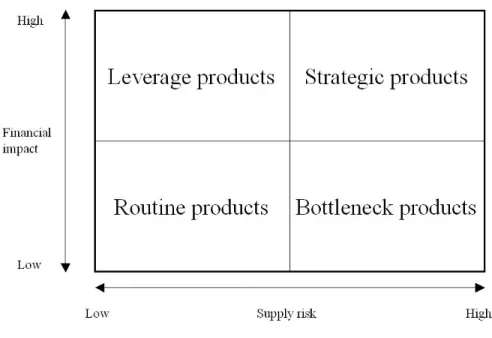
3.3.2.2. Kraljic’s Matrix
A commonly used tool when working with strategies is Kraljic’s matrix. This matrix is divided into four squares were, commodities or suppliers are classified according to their financial impact on the company, and the supply risk. See figure 3:5. (Van Weele, 2005)
The four classes are:
1. Leverage products are products with high financial impact but low supply risk.
These products are usually sourced by competitive bidding.
2. Strategic products are products with high financial impact as well as high
supply risk. These products are usually sourced through partnerships.
3. Routine products are products with low financial impact as well as low supply
risk. The strive in the sourcing process for these products are to source them with as few man-hours as possible, for instance through automated systems.
4. Bottleneck products are products with high supply risk but with low financial
impact. The commonly used strategies for these types of products are to secure the supply.
3. Theoretical framework
20
Figure 3:5. Kraljic’s matrix, (based on Van Weele, 2005)
3.3.3. The Contracting process
Dobler and Burt (1996) identifies eight steps in the procurement process:
• Recognizing, define and describe the need
• Transmit the need
• Investigate qualify and select the supplier
• Prepare and issue the purchase order
• Follow up the order
• Receive and inspect the material
• Audit the invoice
• Close the order
3.3.3.1. Specifications
One way to make the purchasing department aware of a need in the organization is according to Dobler and Burt (1996) to send a purchase requisition. Such a requisition should include
• Description of the material
• Quantity
• Date required
• Estimated unit cost
• Operating account to be charged
• The date of issue
3. Theoretical framework
Dobler and Burt (1996) suggests that purchasing requisitions can be built in to the companies ERP-system so that the user only fills out a pre-designed template, which then is automatically sent to the appropriate buyer.
3.3.3.2. RFP and supplier selection
According to Dobler and Burt (1996) should the request for quotation (RFQ), or request for proposal (RFP) as it is sometimes called, should be carefully prepared. The RFQ should contain the same basic information that will subsequently be included on the purchase order. (Dobler and Burt, 1996)
3.3.3.3. Negotiation strategies
Many authors state that a win-win negotiation strategy is to prefer to competitive strategy (Fisher, 1999, Cronin-Harris, 2004, among others)
Cronin-Harris (2004) presents five steps to go through to ensure a win-win negotiation situation.
1. Decide on priority interests and rank them. This is done before the actual
negotiation situation in order to know what demands can be sacrificed for others.
2. Assess the other sides’ priorities. In this stage a negotiator should put him
self into the other parties shoes in order to get a picture of what he wants.
3. Know that money represents other needs. This is important because if
money is the only factor to consider there can be no win-win negotiation.
4. Plan factual inquiries carefully. In the initial state of the negotiation it is
important to try to find out as much as possible about what the other party wants because it is then easier to meet him and reach a good deal.
5. Plan money moves based on objective principles. This means that since
money usually is the hardest part to agree upon it might be good to back up all monetary claims with objective facts, because these are usually hard to argue with.
3.3.4. The Supplier management process
Van Weele (2005) presents three major questions that have to be asked in the supplier management process.
• For which commodities should the number of suppliers be reduced?
• For which commodities should the current number of suppliers be maintained?
• For which commodities should the number of suppliers be increased?
Van Weele (2005) states that the present trend is to focus sourcing strategies on reducing the number of suppliers and that this cannot go on forever. He also states that the reduction of suppliers should not be a goal but rather a mean to achieve something else.
Van Weele (2005) suggests the following steps in the supplier management process: 1. Contract review. In this step all existing contracts with suppliers are analyzed.
3. Theoretical framework
22
be a substantial amount of contracts that are outside of the purchasing department. The objective of this stage is to determine which price agreements have been made, whether the actual performance and satisfaction with the supplier have been documented and to assess the risks and the responsibilities involved.
2. Competitive bidding amongst current and new suppliers. The purpose of this step is to analyze the entire supply market by inviting more companies than the present suppliers to make an offer. The final outcome of this step is a contract with the “best-in-class” supplier.
3. Optimizing the supplier relationship and value chain mapping. The first two steps in the process focuses on selecting the most suitable suppliers while this third and final step focuses on getting the most out of these suppliers. In this step concrete objectives and targets on price and cost reduction, quality improvement, lead-time reduction and improvement of costumer service are settled. Many companies have teams of specialists from different disciplines from both parties involved in this target setting process. One of the major purposes of this activity is the exchange of ideas for improvement activities on both sides. Usually the suppliers have to do most of the work in this process and gradually become integrated into the customers’ business process. Another part of this step is to analyze the entire supply chain through value chain mapping, where the source of origin of every component is determined
3.3.4.1. Types of supplier
Van Weele (2005) presents four types of suppliers depending on how developed the relation to each of them are. The least developed relationship is with the supplier, which is any supplier delivering anything to the company and the most developed relationship is to a design partner, see table 3:1.
3. Theoretical framework
Table 3:1. Different types of suppliers (Van Weele, 2005)
Aspect Supplier Preferred Supplier Supply Partner Design partner Relationship
characteristics -Operational -Operational -Tactical -Strategic Time-horizon -Order to Order -1 year -1-3 years -1-5 years Quality -As requested by
producer -Quality control by producer -As requested by producer -Quality control by producer and supplier -“Sign-off” by supplier -Quality assessment by supplier (Process quality) -“Sign-off” by supplier -Early supplier involvement in design. -Quality assessment by supplier (Process quality)
Logistics -Orders -Annual
agreement + Call-off orders -Periodical scheduling of materials requirements by producer -Electronic Document Interchange (EDI) Contract -Order to Order -Annual
agreement (1 year) -Annual agreement (> 1 year) -Quality agreement -Design contract -Life of type responsibility (product liability supply)
Price/cost -Price -Price + rebate Price +
Cost reduction targets - Price based on calculation. - Continuous improvement (design, quality, cycle time)
3.4. Purchasing Policy
Dobler and Burt (1996) defines a policy as:
A statement that describes in very general terms an intended course of action.
The authors’ states that after the fundamentals of an activity are established, policies are developed to serve as a general guideline in making operating decisions that channel actions toward achievement of the objectives.
3.4.1. Risk
Persson (2006) defines risk as:
“The probability that something unwanted should happen multiplied with the severity of the consequences of such an event.”
Persson (2006) divide risks in purchasing into two categories, internal and external risks.
Internal risks are risks that has its origin within the own company such as
3. Theoretical framework
24
• Inadequate knowledge of actual need
• Imprecise RFQ:s
• Losing key personnel
• And many other
External risks, or commercial risks are risks that has its origin within the suppliers such as:
• Rising prices or other costs
• Shortages
• Cancellation of production of desired products
• Exchange rates
Van Weele (2005) divides risks in purchasing into four categories:
• Technical risk
• Commercial risk
• Contractual risk
• Performance risk
Technical risk is related to whether the supplier can deliver the functionality and
performance agreed upon. Technical risk are also concerned with whether the supplier has the required skills to provide what was ordered.(van Weele, 2005)
Commercial risks are related to the costs a company has due to a purchase. This might
be prices as well as other costs that result from the purchase such as shipping, production cost, customs or other. (Van Weele, 2005)
Contractual risks are concerned with whether the contract is precise enough so that no
mistakes are made and that the consequences of mistakes are clearly stated. Attaching penalties for inadequate performance can minimize contractual risks. (Van Weele, 2005)
Performance risks are simply the risk that the supplier is incapable of doing what the
contract requires from them. (Van Weele, 2005)
3.4.2. Ethics
Dobler and Burt (1996) state that a company has two main windows to the outside world, the sales department and the purchasing department. Because of this they mean that the actions of these two departments are extremely visible and therefore important for the perception of the firm externally.
According to Dobler and Burt (1996), studies have shown that the behavior of the purchasing department in ethical issues has a major effect on the behavior of the rest of the company in similar situations. It is therefore essential to ensure ethical behavior from the purchasing department. The authors state that the best way to insure this is through the development and enforcement of a relevant ethics policy and through continuous training and education.
3. Theoretical framework
Dobler and Burt (1996) present a standard of conduct created by The National Association of Purchasing Management.
1. Ethical Perceptions. Avoid the intent and appearance of unethical or
compromising practice in relationships, actions and communications.
2. Responsibilities to the employer. Demonstrate loyalty to the employer by
diligently following the lawful instructions of the employer, using reasonable care and only the authority granted.
3. Conflict of interest. Refrain from any private business or professional
activity that would create a conflict between personal interests and the interest of the employer.
4. Gratuities. Refrain from soliciting or accepting money loans, credits, or
prejudicial discounts, and the acceptance of gifts, entertainment, favors or services from present or potential suppliers that influence, or appear to influence, purchasing decision.
5. Confidential information. Handle confidential or proprietary information
belonging to employers or suppliers with due care and proper consideration of ethical and legal ramifications and governmental regulations.
6. Treatment of suppliers. Promote positive supplier relationships through
courtesy and impartiality in all phases of the purchasing cycle.
7. Reciprocity. Refrain from reciprocal agreements that restrain competition.
8. Law. Know and obey the letter and spirit of laws governing the purchasing function, and remain to legal ramifications of purchasing decisions.
9. Small, disadvantaged and minority owned business. Encourage all
segments of society to participate by demonstrating support for small, disadvantaged, and minority owned business.
10. Personal purchase for employees. Discourage purchasing’s involvement in
employee-sponsored programs of personal purchases that are not business related.
11. Responsibility to the profession. Enhance the proficiency and stature of the
purchasing profession by acquiring and maintaining current technical knowledge and the highest standards of ethical behavior.
12. International Business. Conduct international business in accordance with
the laws, customs, and practices of foreign countries consistent with homeland laws, your organizations policies, and these ethical standards and guidelines.
3.5. Authority
According to Heinritz et al (1991), a purchaser is an agent for his/her company who has been given the authority by owner or management to commit company funds. There are often monetary limits to the amount that may be spent by any single buyer without securing specific approval of the expenditure by general management. The authors’ states further that the authority should be comparable with responsibility and the ability to meet that responsibility.
Heinritz et al (1991) state that managers gives purchasers authority, they usually control costs by restricting the amounts that a purchaser has the authority to sign for. There might be several steps of authority, for instance a single buyer has the authority
3. Theoretical framework
26
to sign deals up to a certain amount, over that amount the deal has to be signed by a senior purchaser up to a certain amount and over that by the chief procurement officer and above that by the CEO.
4. Situational description
4. Situational description
In this chapter the situation that led up to the decision to create a procurement manual is described. This chapter also describes the present situation in the company and which ongoing changes that occurs. Since most of the empirical data gathered in this project is gathered through interacting with respondents in interviews and workshops, it is hard to separate the empirical data from the result hence both empirical data and the results are presented in chapter 5.
4.1. Company description
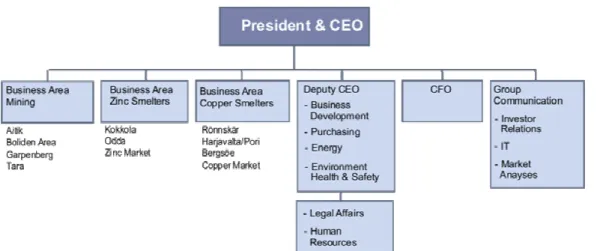
Boliden is a mining and smelting company that produces zinc, copper, lead, gold and silver. The company’s principal products are copper and zinc. The operations concentrate on the early stages of activity in the base metals industry, i.e. on exploration, milling and mining, and on smelting and refining. Metal recycling an area in which Boliden is the European leader also comprises a growing part of the business. The operations are conducted through three Business Areas: Mines, Copper Smelters, and Zinc Smelters. Financial results are reported for the Product Segments Copper and Zinc. Boliden has mines at Aitik, the Boliden Area and Garpenberg in Sweden, and at Tara in Ireland. The company has two zinc smelters, one at Kokkola in Finland and one at Odda in Norway. Boliden also has two copper smelters, one at Rönnskär in Sweden and one at Harjavalta in Finland, together with a lead smelter at Bergsöe in Sweden. The head office is located in Stockholm. The company has just over 4,500 employees and an annual turnover of about 20 000 MSEK. (Boliden annual report, 2005)
4.1.1. Organization
Boliden is organized according to figure 4.1.
Figure 4:1. Organizational chart of the entire corporation
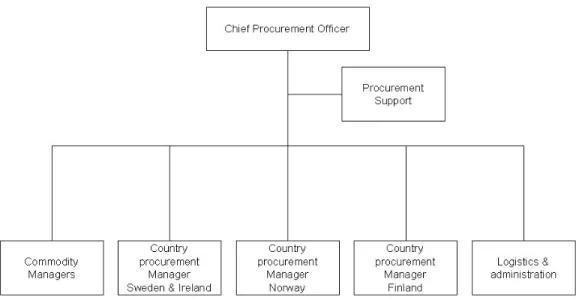
The purchasing and logistics department is subordinate to Deputy CEO, and organized according to figure 4:2.
4. Situational description
28
Figure 4:2. Organizational chart of the procurement department
4.2. The situation at the procurement and logistics department
In 2003 the procurement department of Boliden were assigned to realize a saving potential of a certain percentage of the total procurement volume. In the summer of 2004 the realization of these targets were far from accomplished. Some crucial components were missing to be able to realize the savings potential:
• Commodity groups and structure
• Spend data / Spend map
• Spend analysis and development of strategies
• Organization, processes and governance
A decision was made to accelerate the procurement project and the main purpose was to realize the savings potential and build a solid foundation for strategic purchasing in the future.
Boliden identified the following organizational challenges and improvement areas in November 2004:
• Procurement was not organized to maximize purchasing leverage on a group level
• Low use of consolidated purchasing between respective site with few exceptions
• Local procurement organizations have focus on performing tactical and operational procurement on behalf of the local operations
• Short term requirements more important than long term strategic sourcing
• Procurement is not recognized as core to business operation – low or no status of procurement in the organization
• For some sites, roles and responsibilities are defined but on local basis – limited job descriptions are in place
• Most procurement organizations have resources with long experience from the mining and smelting business – but limited experience of strategic sourcing
4. Situational description
• With a few exceptions no purchasing performance targets are set.
• No personal and/or departmental measures are set, no monitoring from senior level is being carried out and no commitments from the procurement organizations on achieving savings
The procurement project was divided into phases and in the first phase the following was to be achieved:
• Commodity structure
o The foundation for goals, strategies and organizational design
• Spend map
o Clarifying how the total spending is distributed in the organization, among suppliers and in the commodity groups
• Spend analysis
o Identified and prioritized potentials, and plan for realization
• Design of organization and high level processes
o A suitable corporate organization, ensuring a speedy initial progress and being a foundation for continuous long term development
o The cross functional impact and collaboration required for a short and long term success requires an ”over empowered” structure, especially initially
The information from this work would than be used to further develop the procurement organization. This development was to be done through four main activities, see figure 4:3. The Second of these four activities, implement a common procurement process is done in this master thesis.
4. Situational description
30
Figure 4:3. Improvement actions in the procurement department.
Once commodity groups were established all strategic work was centered on these groups. The first step was to assign a commodity manager who would be responsible for the development of a commodity strategy for the group and all contracting within the group. This commodity strategy was to the guideline for all purchasing within that commodity group. This was done in stages and up to the present date six groups has been rolled out. This means that the new organization based on commodity managers and commodity groups exists parallel to the old organization based on countries and sites.
5. Results
5. Results
In this chapter the result of the research is presented as well as the model created. In this chapter only the high-level processes are described and commented. To see the entire manual with all activity descriptions see Appendix 1. In that appendix the entire manual are presented, however only the names of the attached tools and templates are presented due to confidentiality.
5.1. Purpose, target group and layout
The first stage in the development of the procurement manual was to decide the purpose of the manual, the target group, the layout and presentation medium.
The purpose and target group of the procurement manual was decide in a focus group based on a suggestion prepared by myself, the procurement support officer and the CPO. The focus group decided to formulate the purpose as follows:
The primary purpose of the Manual is to provide an overview of Boliden’s procurement function, procurement processes and procurement information systems. As such, this Manual provides an awareness of mandatory requirements, policy considerations, guidelines, procedures and best practices
It was also decided that the procurement manual was to be addressed to:
All Boliden employees that are involved in any sourcing and procurement related activities.
However some documents that contain strategically critical information, for instance negotiation instructions will be available only to those who need it.
There was a strong link between the presentation medium and the layout since certain layouts were better suited for certain mediums. The two presentation mediums that were possible were, on paper for printing and online on the company intranet. It was decided in an early stage of the discussions that presentation on the company intranet was preferred for a number of reasons. It was easier to upgrade the document and avoid old versions, this was an important issue because a document of this kind is constantly changing and it is important that it is easy to upgrade. Another important reason for choosing the intranet was that it is more accessible and it is likely that more people would use it if it were presented there. The final reason for choosing the intranet was that some technical features would be available such as links between documents.
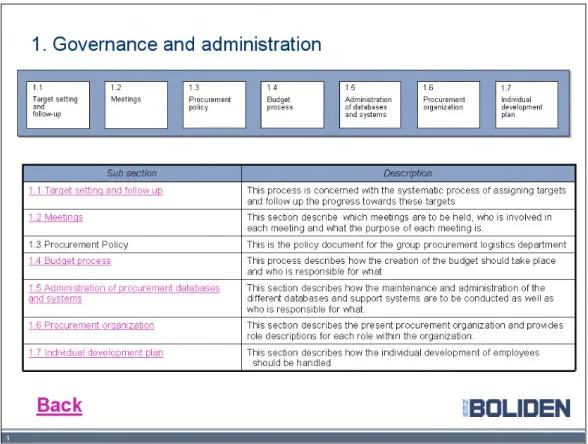
Once the medium was chosen the layout were to be decided. Three options for layout were presented to the focus group for decision. These alternatives were prepared based on the inputs of the Procurement support officer. The alternatives were to present the manual in text format, see figure 5:1, as tables, see figure 5:2, or as flow-charts, see figure 5:3.
5. Results
32
Figure 5:1. The text model
The text model was more suited for the paper medium and was eliminated by the focus group rather quickly after deciding on the intranet medium.