The University of Akron
IdeaExchange@UAkron
Akron Law Review
Akron Law Journals
July 2015
Revenue Act of 1978
Merlin G. Briner
Please take a moment to share how this work helps you
through this survey. Your feedback will be
important as we plan further development of our repository.
Follow this and additional works at:
http://ideaexchange.uakron.edu/akronlawreview
Part of the
Taxation-Federal Commons, and the
Taxation-Federal Estate and Gift Commons
This Article is brought to you for free and open access by Akron Law Journals at IdeaExchange@UAkron, the institutional repository of The University of Akron in Akron, Ohio, USA. It has been accepted for inclusion in Akron Law Review by an authorized administrator of IdeaExchange@UAkron. For more information, please [email protected], [email protected].
Recommended Citation
Briner, Merlin G. (1979) "Revenue Act of 1978,"Akron Law Review: Vol. 12 : Iss. 3 , Article 5. Available at:http://ideaexchange.uakron.edu/akronlawreview/vol12/iss3/5
REVENUE ACT OF 1978*
MERLIN G. BRINERtINTRODUCTION
THE
REVENUE ACT OF 1978 is a continuation of Federal Income Tax Developments: 1978 which appeared in the Fall, 1978 issue of theAKRON LAW REVIEW. This survey examines the substantive changes in federal tax law resulting from the passage of the Revenue Act of 1978 and other legislation. This author has again engaged the most able assistance of several members of the AKRON LAW REVIEW. Without their substantial contributions and complete dedication, this article would not have been possible. Special appreciation is extended to Linda Robison for her dedi-cated efforts.
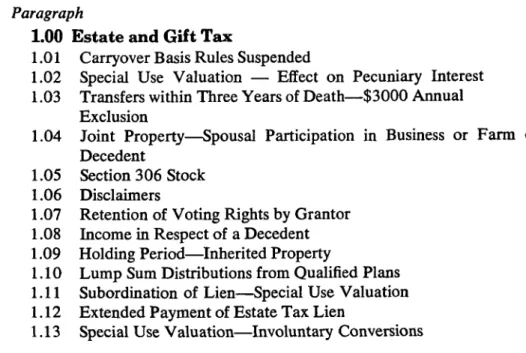
TABLE OF CONTENTS
Paragraph
1.00 Estate and Gift Tax
1.01 Carryover Basis Rules Suspended
1.02 Special Use Valuation - Effect on Pecuniary Interest 1.03 Transfers within Three Years of Death-$3000 Annual
Exclusion
1.04 Joint Property-Spousal Participation in Business or Farm of
Decedent
1.05 Section 306 Stock 1.06 Disclaimers
1.07 Retention of Voting Rights by Grantor 1.08 Income in Respect of a Decedent 1.09 Holding Period-Inherited Property
1.10 Lump Sum Distributions from Qualified Plans 1.11 Subordination of Lien-Special Use Valuation 1.12 Extended Payment of Estate Tax Lien
1.13 Special Use Valuation-Involuntary Conversions
*Copyright 1979 by Merlin G. Briner. All rights reserved.
tProfessor of Law, University of Akron School of Law; formerly manager, Tax Department, The Timken Co., Canton, Ohio; B.B.A., Wichita State University; J.D., University of Akron
School of Law.
AKRON LAW REVIEW
2.00
Corporations
2.01 Corporate Tax Rates
2.02 Tax Free Incorporation-Assumption of Liability 2.03 Section 1244 Stock
2.04 Subchapter S Corporation-Time to Make Election 2.05 Subchapter S Corporation-Number of Shareholders
2.06 Subchapter S Corporation-Husband and Wife Treated as One Shareholder
2.07 Subchapter S Corporation-Grantor Trust 3.00 Deductions
3.01 Entertainment Facility Expenses 3.02 Gasoline Taxes
3.03 Political Contributions
3.04 United States Citizens Working Abroad
3.05 Vacation Home-Conversion to or from Personal Residence 3.06 Foreign Conventions
3.07 Product Liability Losses
3.08 Low Income Housing-Rehabilitation Expenditures 3.09 Regular Corporate Nonqualified Compensation Plans
3.10 Independent Contractor-Nonqualified Compensation Plans 3.11 Government Compensation Plans
3.12 Qualified Salary Reduction Plans 3.13 Cafeteria Plans
3.14 Education Reimbursement Programs 3.15 Medical Reimbursement Plans 3.16 Commuting Expense
3.17 Fringe Benefits 4.00 Individuals
4.01 Individual Income Tax
4.02 Sale of Residence-Exclusion of Gain
4.03 Sale of Residence-Multiple Sales within Eighteen Months 4.04 Unemployment Compensation
4.05 Income Averaging 5.00 Capital Gains
5.01 Capital Gains Deduction
5.02 Capital Gains-Reduction of Personal Service Income 5.03 Capital Gains Alternative Tax Repealed
5.04 Alternative Minimum Tax
FEDERAL INCOME TAx DEVELOPMEN$tS: 1978
6.00 Tax Credits
6.01 Investment Credit of Ten Percent Becomes Permanent 6.02 Investment Credit-Limitations
6.03 Investment Credit-Rehabilitation Expenditures
6.04 Investment Credit-Livestock and Horticultural Buildings 6.05 Investment Credit-Pollution Control Facilities
6.06 Targeted Jobs Tax Credit 6.07 Energy Credit-Individuals
6.08 Energy Credit-Solar and Wind Energy Equipment 6.09 Energy Credit-Business
6.10 Commuter Vehicles 6.11 Geothermal Deposits
6.12 Child Care Payments to Related Individuals 6.13 General Tax Credit
6.14 Earned Income Credit
7.00 Tax Shelters
7.01
Partnership Provisions
8.00 Retirement Plans
8.01
ESOPs
8.02 Closely Held Stock-Voting Rights
8.03 Individual Retirement Account-Spousal 8.04 IRA Contribution Date Extended
8.05 Alternative Treatments for Excess Contributions to an IRA 8.06 Property Distributions
8.07 Partial Rollovers of IRA Distributions 8.08 Spouse Allowed Rollovers
8.09 Rollover Restrictions Eased
8.10 Fixed Premium Contracts Eliminated
8.11 Reporting Requirements Simplified 8.12 Penalty Tax
8.13 Simplified Pension Plans
8.14 Limitations on Pension Benefits 8.15 Changes in Tax Sheltered Annuities 8.16 Government Annuity Contracts
9.00
Administrative Procedures
9.01 Disclosure of Tax Returns 9.02 Charge Account Tips
9.03 Preparer Requirements-Banks and Fiduciaries 9.04 Partnerships-Timely Returns Required 9.05 Partnerships-Extended Statute of Limitations 9.06 Small Tax Cases
AKRON LAW REVIEW
1.00
Estate and Gift Tax
1.01 Carryover Basis Rules Suspended
Code Sections 691, 1023-Act Section 515
Effective Date: Decedents Dying after December 31, 1976
Prior to the Tax Reform Act of 1976, effective January 1, 1977, the ba-sis of property received from a decedent in the hands of the recipient, heir, de-visee, or legatee, was equal to the fair market value at the date of death or the alternate valuation date six months later. This was referred to as stepped-up or stepped-down basis. The actual cost to the decedent had no relevance to the basis in the hands of the recipient beneficiary. As the quid pro quo for the increase in the amount of the estate tax exemption from $60,000 to $175,000 by 1981 and the increase in the marital deduction to the greater of one-half of the adjusted gross estate or $250,000, Congress, in the Tax Reform Act of 1976, substituted the concept of carryover basis for the old stepped-up basis rules for decedents dying after December 31, 1976. The basis to the beneficiary for property acquired after December 31, 1976, received from a decedent dying after that date would be equal to the decedent's cost, or adjusted basis. The result of this change and its effect on the beneficiary can be illustrated by an example where a father originally acquired a parcel of land at a cost of $10,000 and at the date of the father's death the land had a value of $100,000. If the decedent died prior to January 1, 1977, the basis to the heir would have been the fair market value at date of death, or $100,000. However, after the Tax Re-form Act of 1976 the basis to the father of $10,000 would be carried over and would become the basis to the beneficiary. The result of the step-up in basis was that prior to January 1, 1977, the beneficiary who sold the property for an amount equal to the fair market value at the date of death or the alternate valuation date six months later had no income tax liability as a result from the gain. After January 1, 1977, the beneficiary would have a taxable gain equal to the difference between the selling price of $100,000 and the basis of $10,000 or a gain of $90,000. This gain, of course, would qualify for long-term capital gains treatment assuming that the asset was a capital asset and had been held for the requisite holding period.
For property which was acquired prior to January 1, 1977, and the decedent died after that date, the concept of a fresh start basis was intro-duced by the Tax Reform Act of 1976. The fresh start basis of stock or securities which were listed on a recognized exchange took a basis equal to their value on December 31, 1976. Other properties such as land, farms, apartment houses, office buildings, automobiles, antiques, etc. required a special calculation to determine their fresh start basis. The basis of these
FEDERAL INCOME TAX DEVELOPMENTS. 1978
assets in the hands of the beneficiary was equal to the decedent's cost plus a portion of the appreciation equal to a fraction, the numerator of which was the number of days held from date of acquisition by decedent to De-cember 31, 1976 over a denominator which was the total number of days the property was held from date of acquisition until decedent's death times the appreciation in value from acquisition until death. An illustration of this calculation is set forth below:
The formula for non-depreciable property is:
Decedent's Basis Number of days property +Fair Market Value at Death X held prior to 12/31/76
-Decedent's Basis Total number of days property held Illustration:
Fair Market Value at Death $25,000
Decedent's Basis 10,000
Date of Acquisition 1/1/73
Date of Death 12/31/82
Holding Period before 12/31/76 4 years
Total Holding Period 10 years
Fair Market Value at 12/31/76 $20,000 Basis $10,000
-
(25,000 - 10,000 X 4/10) Basis $10,000 - ($15,000 X 40%)Basis $10,000
+
$6,000 Basis $16,000If depreciable property is involved the calculation takes on an additional complexity. The formula is:
Multiply: Decedent's Basis (at Death)
--
Number of Days Property held prior to 12/31/76Number of Days property held by
Value at Death
- Decedent's Basis
+
Depreciation by 12/31/76- Total Depreciation
AKRON LAW REVIEW
Illustration:
Fair Market Value at Death $60,000
Decedent's Initial Cost 30,000
Depreciation to Date of Death 5,000
Depreciation to 12/31/76 4,000
Total Holding Period 5 years
Holding Period to 12/31/76 4 years
Decedent's Basis at Death ($30,000- $5,000) $25,000 $25,000 + 4/5 X ($60,000 - $25,000 - $5,000) + 4,000
$25,000 + (4/5 X $30,000) + $4,000 $25,000 + $24,000 + $4,000
Basis to Distributee = $53,000
To the fresh start basis as calculated under one of the preceding two methods was added an adjustment for federal estate taxes, an adjustment for a $60,000 minimum basis and an adjustment for state succession taxes. The carryover basis rules and the fresh start basis rules have probably generated more criticism and valid complaint from the practitioner than any other Code section or revision resulting from the Tax Reform Act of 1976. It placed an almost unworkable burden upon practitioners to attempt to determine the decedent's original cost. In addition, the inartful drafting of the Code sections resulted in many practical problems that surfaced after the law was enacted. The reader should remember that the Tax Reform Act of 1976, as well as the Revenue Act of 1978, were enacted without public hearings where practitioners and other tax experts could have had the oppor-tunity to review the proposed drafts of the legislation and submit comments prior to enactment. This has proven to be a serious deficiency in our legisla-tive process in a field as vitally important as taxation. It is impossible to estimate the millions of dollars and hours that have been spent by prac-titioners in the field of taxation in an attempt to solve and to comply with what the government has thrust upon us.
As a result of the problems which surfaced in the committee hearings, the Revenue Act of 1978 retroactively suspends the carryover and fresh start basis rules for decedents dying from January 1, 1977 through December 31, 1979. Therefore, the stepped-up basis rules under prior law are applic-able and have been reinstated.
As a result of this retroactive change it will be incumbent upon bene-ficiaries and heirs who have sold property prior to the effective date of the Revenue Act of 1978 to amend returns and recalculate their gain or loss.
FEDERAL INCOME TAx DEVELOPMENTS: 1978
To the extent the selling price was equal to the fair market value at date of death or six months later, as used on the federal estate tax return, no gain or loss is recognized.
Estates of decedents which held flower bonds which were used to pay fed-eral estate taxes should file amended returns since the value of the flower bond for determining basis will be equal to the bond's face value. The retroactive reinstatment of the carryover basis rules creates a problem where the fresh start basis or the decedent's basis exceeded the estate tax value of the asset in question. The Senate proposed that taxpayers should have an option to elect whether to use fresh start or carryover basis. However, this proposal was eliminated at the conference level. Some commentators and Congressmen have indicated that there will be some type of legislation to clear up problems which resulted during the period when fresh start and carryover basis rules were in effect. It would also appear that the taxpayer has no constitutional right to utilize a law which has been revised retro-actively.
It should also be noted that although the rules have been suspended until December 31, 1979, the fresh start date is still December 31, 1976. The Act also provides a simplified method of determining the fresh start value for tangible personal property through the application of a proximate 8% discounted value from fair market value at the date of decedent's death. The value is determined as of death and then discounted for the number of years that it was held prior to death to eliminate the problem of determin-ing decedent's actual basis. The Act also clears up the question of whether or not a different fresh start calculation was required depending on whether the asset was sold at a gain or at a loss. The Act states that the basis will be the same under fresh start calculations for both a gain and loss.
1.02 Special Use Valuation-Effect on Pecuniary Bequest Code Section 2032A-Act Section 702(d)(2)
Effective Date: Decedents dying after December 31, 1976
A pecuniary bequest is one which sets forth a specific amount as the bequest. This is in contrast to describing the bequest or devise in terms of a fraction of the entire amount. If the devise or bequest of a specific amount is satisfied in kind with property which has appreciated in value from the value which was used for estate tax purposes, taxable gain results to the estate. The Tax Reform Act of 1976 addressed itself to the problem of whether or not gain should be recognized from the carryover basis value to the value of the pecuniary bequest and indicated that no gain would be recognized due to the establishment of carryover basis. However, the Reform Act did not answer the question of what occurs when special use valuation Winter, 19791
AKRON LAW REVIEW
is elected for farm or closely held businesses and this property is distributed to an heir in satisfaction of a pecuniary bequest.
The Revenue Act of 1978 clears up any question as to this matter and states that gain will be recognized only to the extent that the date of distri-bution value exceeds the fair market value at date of death, irrespective of whether or not the Section 2032 special use valuation was utilized for estate tax purposes.
1.03 Transfers Within Three Years of Decedent's Death-$3000 Annual Exclusion
Code Section 2035(b)-Act Section 702(f)
Effective Date: Decedents Dying after December 31, 1976 or Transfers Made after December 31, 1976
Prior to the Tax Reform Act of 1976 there was a rebuttable presump-tion that transfers made within three years of a decedent's death were made in contemplation of death and, therefore, were includable in the decedent's estate for estate tax purposes. This presumption gave rise to a great amount of litigation and the Tax Reform Act of 1976 removed the presumption and changed the law to provide for automatic inclusion in a decedent's estate of all transfers made within the three years preceding death. A gift within this three-year period that had a value at the time of gift and at the time of death of less than $3,000 was excluded based on the $3,000 annual per donee exclusion.
However, the Tax Reform Act left a great deal of confusion as to the status of gifts which had a value of less than $3,000 at the time of gift but a value in excess of $3,000 at the date of the decedent's death.
The Revenue Act of 1978 provides an exclusion for any gift which is excludable in computing the taxable gifts by reason of Section 2035(b) which relates to the $3,000 annual exclusion. The Senate committee report explains this provision as meaning that if a transfer is required to be re-ported on a gift tax return, the gifts made within three years of decedent's death are required to be included in the decedent's gross estate. By impli-cation, in the event the gift was less than $3,000 and no gift tax return was required to be filed, nothing is to be included in decedent's estate even if the gift property appreciates in value to an amount in excess of $3,000 as of the date of decedent's death. The Senate committee report specifically mentions that this exception is not applicable to a gift of a life insurance policy. If a share of stock with a value of $3,001 is given and donor dies within three years when the stock has a fair market value of $10,000, the entire $10,000 is includable in the decendent's estate. There is no provision in the Revenue Act of 1978 which permits the gross amount
FEDERAL INCOME TAX DEVELOPMENTS: 1978
at date of death to be reduced by the $3,000 annual exclusion. When a gift is made, the actual amount of the gift as shown on the gift tax return is reduced by the annual exclusion of $3,000.
However, if the stock had a value of $2,999 at the time of the gift and at the date of decedent's death had appreciated to $100,000, nothing is includable in the decedent's estate. The test is whether or not at the time of gift, a gift tax return was required to be filed. If a life insurance policy with a cash surrender value (interpolated terminal reserve value) of $2,900 and a face value of $100,000 is the subject matter of a gift, the entire face value of the policy $100,000 is includable in decedent's estate if death occurs within three years after making the gift.
If a husband and wife make a gift of $6,000, they are entitled under Code Section 2513 to elect to split the gift so that in effect the gift, for gift tax return purposes, has been made $3,000 by the husband and $3,000 by the wife even though the entire amount of funds came from one of the spouses individually. Since the election to split the gift can be made only by the filing of a return, the full amount of the gift corpus is required to be included in the decedent's estate in the event of death within three years. The Senate committee report indicates that the rule as to life insurance does not apply to any premiums paid by the decedent within three years of death if such payments would not have caused inclusion under pre-existing law. This comment is merely reflective of the status of the law on transfers of life insurance outside a three-year period immediately preceding the decedent's death where the decedent continues to pay the premiums. Although the premiums paid within the three-year period are includable in the estate, no amount of the face value is included.
The $3,000 annual exclusion can be used only for gifts of a present interest. The annual exclusion cannot be used to offset a gift of a future interest where possession or enjoyment is limited to commence at some time in the future. Therefore a gift of a $1.00 future interest would require the filing of a gift tax return and the inclusion of the value of the gift corpus in the decedent's estate, based on the date of death value.
1.04 Joint Property-Spousal Participation in Business or Farm of Decedent Code Section 2040-Act Section 511
Effective Date: Decedents Dying after December 31, 1978
Section 2040(c) of the estate and gift tax provisions provides a statu-tory alternative to the "consideration furnished test" which has developed under Section 2040(a). Under old law the surviving spouse of a farmer or business owner was required to prove that he/she satisfied the "consideration furnished test" for the land or other business property included in the joint
AKRoN LAW REVIEW
tenant's gross estate in order to exclude any of the property from the de-ceased's estate. Such proof is not always an easy task.
The court decisions have interpreted what is meant by the "money or money's worth" provisions of Section 2040(a) in several ways. Cases have inconsistently defined what is adequate consideration when such con-sideration is the result of services performed by the surviving spouse, mortgages and loans received jointly, and income from property purchased by the deceased spouse, yet managed by the surviving spouse.
Under the Revenue Act of 1978 the decedent's estate may elect the statu-tory exclusion of Section 2040 (c) which is determined by applying a two per-cent rate to the excess of the value of the joint interest over the amount of the original consideration for each year the spouse materially participated in the business, subject to a fifty percent limitation. For purposes of this statute, original consideration includes the actual amount contributed by the surviving spouse plus six percent simple interest for the period of the investment. Although such statutory provision simplifies the burden of proof on decedent's estate in showing that the decedent did not furnish all the consideration, situations may arise in which a greater exclusion could be obtained under previous law, particularly if the surviving spouse does not meet the "material participation" requirement.
This new subsection (as provided in Section 2040(c) (9)) is elective. Logically, if the estate does not elect the provision, the estate would still have the alternative of proving consideration furnished as developed by case decisions under Section 2040 (a). In those situations where the exclusion under 2040(a) would be greater than that allowed under 2040(c), the estate would not elect the new subsection.
A 1934 United States Court of Claims decision1 held that a school teach-er wife's steach-ervices to hteach-er attorney husband in managing propteach-erty which they purchased as joint tenants and in helping her husband in his law practice were not consideration for the jointly purchased property. All the property was included in the deceased husband's estate. If under the new statute the wife could show material participation,' the estate could have excluded two per cent of the value of the joint interest for each year she materially participated up to fifty percent of the total value of the property.
Since that time the Tax Court, as well as circuit and district courts, has been more liberal in construing what is meant by money's worth and have eased the requirements for satisfying the estate's burden of proof.
I Bushman v. United States, 8 F. Supp. 694 (Ct. Cl. 1934).
2 Material participation is determined in a manner similar to the manner used for purposes
of Section 1402(a) relating to net earnings from self employment.
FEDERAL INCOME TAX DEVELOPMENTS: 1978
In Estate of Otte,3 a husband and wife operated a farm for forty-five years on land originally purchased by the husband for $9,000. With income received from the farm, the two purchased other property. Although the Service contended that all such property belonged in the husband's estate, the Tax Court included only one-half. Under the new statute, the result would have been the same as long as the wife materially participated for at least twenty-two and a half years of the forty-five years.
Similar results were reached in the Third Circuit4 where a peddler and his wife started a grocery store. Although there was no partnership agreement, half of the business was considered as belonging to the wife. The court rejected the Service's contention that the wife made a gift of her services to the husband who in turn gifted one-half of the joint tenancy property to her.
Although there have been no cases defining original consideration for Section 2040(c) purposes, cases under Section 2040(a) have defined original consideration. There appears to be no viable reason for not de-termining original consideration in the same manner for Section 2040(c). A case, Bremer v. Lufl,5 interpreting original consideration, has held that where a husband and wife are both personally liable on an existing mort-gage, jointly assumed, and one was not merely an accommodation maker of the other, each is treated as having made an original contribution to the extent of one-half the mortgage.
In Drummond's Estate v. Paschal,' a district court held that where a husband and wife were each personally liable on an unsecured note for con-struction of rental property, and the rental proceeds received on the com-pleted property then paid off the loan, only half of such property should be included in the deceased spouse's estate.
If Section 2040(c) had been applicable in Bremer and the wife did not materially participate, one-half the mortgage plus six percent simple interest for the period of the investment would have been excluded from the estate. The Bremer decision did not address the question of what extent appreciation of the property would be attributed to the wife's share.
A greater portion of the property value would have been included in the deceased's estate under Section 2040(c) than in Drummond's Estate if the wife had not materially participated and the increase in value of the property had been more than six percent. Although the burden of proof
341
P-H TAx Cr. MEM. 317 (1972).4 Berkowitz v. Commissioner, 108 F.2d 319 (3rd Cir. 1939). 5 7 F. Supp. 148, 156 (N.D.N.Y. 1933).
• 75 F. Supp. 46 (E.D. Ark. 1948). Wyinter, 1979]
AKRON LAW REVIEW
is on the decedent's estate to show that the deceased did not furnish all the original consideration, the Tax Court has been very liberal in this regard. In Estate of Carpousis,7 the Tax Court accepted the uncorroborated testimony of a widow of a joint owner that she furnished the money portion of the consideration.
Section 2040(c) requires that the spouse of the decedent materially participate in the farm or other business. This terminology raises the question of what constitutes material participation. Section 2040(c) (7) provides that material participation shall be determined in a manner similar to the test used for purposes of Section 1402(a) relating to net earnings from self-employment.
Logically, the way in which Section 1402 defines material participation should provide the answer. However, the material participation language discussed in Section 1402(a) of the Self Employment Contribution Act refers to rental income derived by the owner or tenant of land from an arrangement whereby the owner or tenant materially participates in the production or the management of the production of such agricultural or horticultural commodities and with respect to any such agricultural or horti-cultural commodity. The Regulations provide that the individual is materially participating and farm rental income counts for Social Security purposes if the rental arrangement provides for a significant part of production or management activities." If the individual meets one of the following four tests, he is said to be materially participating:
Test 1: He/she does three of the four following activities; consults with the tenant, furnishes tools, equipment and livestock, or shares produc-tion expenses.
Test 2: Frequently and regularly makes decisions which affect the success of the farm operation.
Test 3: Takes part in the work by working at least 100 hours over five or more weeks in work connected with crop production.
Test 4: Test one, two, and three may be considered together to con-stitute material participation.9
Since material participation thusly determined does not address the material participation requirement for a husband and wife in joint tenancy property, Congress undoubtedly was referring to the line of cases related to Regulation Section 1.1402(a)(2) which has determined whether a
743 P-H TAx C-. MEM. 258 (1974). sTreas. Reg. § 1.1402(a).
9 UNEMXpL, INS. REP, (CCH) 10608 F.917.
FEDERAL INCOME TAX DEVELOPMENTS: 1978
husband or wife in a jointly owned and operated business or farm is re-quired to pay self-employment tax or is entitled to receive benefits under the Social Security Act.
Although the Social Security Administration contends that in order for both husband and wife of a jointly owned and operated business to be credited with self-employment income, the business must be operated as a partnership within the meaning of Section 211(a) and 211(d).10 Section
211(d) provides that the term "partner" and "partnership" have the same meaning as used in Subchapter K of the Internal Revenue Code. Neither all the cases arising under the Social Security Act nor the cases arising under Section 2040(a) of the Internal Revenue Code have required a formal partnership arrangement. However, Regulation 1.402(a) -2(f) does provide that partners not recognized as such for income tax purposes, as in the case of certain family partnerships, would not be recognized for self-employment tax either.
In Rasmussen v. Gardner,11 the court held that the existence of a
part-nership is not a necessary condition of dividing self-employment income. In Rasmussen, the Tenth Circuit allowed the husband to file amended returns on behalf of his deceased wife in order to obtain Social Security benefits for their children. The court stated that even if the husband had, in paying the self-employment tax, deliberately claimed all the income of the family business for himself, such was only the assertion of a position which may have been the result of a misapprehension of the law, and was not sufficient to deny benefits to which otherwise entitled.
Revenue Ruling 54-752 provides that "net earnings" from self-employment may include income derived by a wife as a participant in a husband-wife partnership, even if such partnership is not valid under the laws of the state in which it was organized.
Furthermore, the cases arising under Section 2040(a) have not re-quired a formal partnership arrangement in order to reduce the includable amount of joint tenancy property in the deceased spouse's estate. This position leads to the conclusion that in order to meet the material partici-pation requirement of Section 2040(c) a formal partnership arrangement would not be required.
A final question to be examined is whether in order to qualify under the material participation requirement, the wife must pay self-employment tax. At least one expert has stated that the "material participation
require-'Od. at 10,608 B.587, Social Security Rul. 68-48C.
11374 F.2d 589, 594 (10th Cir. 1967).
12 1954-1 CuM. BULL. 169. Winter, 19791
AKRON LAW REVIEW
ment will limit the usefulness of subsection (c) because of the necessity that the wife pay self-employment tax."" He then raises the question of how much tax the wife must pay, that is, will a threshold degree of participation be sufficient. Covey' contends that it should. Although Covey's position has merit, if Congress had intended that the payment of self-employment tax was a prerequisite to subsection (c) election, it would have been easy to so state. Since the only requirement is that material participation be de-termined in a similar manner to that of Section 1402, there may be no
necessity to pay self-employment tax.
Although designed as a statutory alternative to the consideration furnished test, new Section 2040(c) is wrought with ambiguities. The surviving spouse who is depending upon Section 2040(c) as a means of excluding a portion of joint tenancy property used in farming or other business is still confronted with difficulties. Hopefully when the Treasury Department issues regulations explaining this new subsection, the problems and questions will be answered.
1.05 Section 306 Stock
Code Section 306(a)-Act Section 702(a)(1)
Effective Date: Section 306 Stock distributed before January 1, 1977, which is acquired from a decedent dying after December 31, 1979
When a corporation issues preferred stock as a dividend on common stock, the receipt of the stock is not a taxable event. However, such stock is considered "Section 306 stock" and if the issuing corporation has accumu-lated earnings and profits at the time of distribution, the person receiving the stock will generate ordinary income rather than capital gains when the stock is sold. Prior tco the Tax Reform Act of 1976 the ordinary income "taint" disappeared at the shareholder's death. After the Tax Reform Act of 1976 the stock did not lose its "taint" and therefore continued to generate ordinary income to the beneficiary or estate who sold the stock. The Revenue Act of 1978, in an attempt to mitigate the harshness of this rule, adopted special provisions for tainted stock distributed prior to January 1, 1977 and which is acquired from a decedent dying after December 31, 1979. The ordinary income is limited to the selling price minus the adjusted basis of the stock plus the other fresh start adjustments as established under the carryover basis rules. The reader should note that during the interim period from December 31, 1976 through December 31, 1979, Section 306 stock takes a step-up in basis equal to the fair market value at date of death under the stepped-up basis rules. However, once the moratorium period ends, ordinary 13 Covey, Recent Developments Concerning Estate, Gift, and Income Taxation, 13th Inst. on Estate Planning 157, 164 (Univ. of Miami 1979).
'A1d. ,
FEDERAL INCOME TAX DEVELOPMENTS: 1978
income will be the result upon sale other than for stock issued prior to January 1, 1977.
The Revenue Act of 1978 clarifies the confusion which resulted from the overlap of the tainted stock rules of Section 306 and the redemption rules of Section 303. Section 303 provides that sale or exchange treatment shall result if stock is sold to a corporation by an estate or an heir in amount not in excess of the administration expenses, federal and estate taxes, and funeral expenses. Therefore, to the extent that a corporate redemption qualifies under Section 303, long-term capital gain will be the result after the moratorium on carryover basis ends. Again, as of this date, the stock sold to the corporation would take a step-up in basis equal to the fair market value at date of death and if sold at this price would result in neither gain nor loss.
1.06 Disclaimers
Code Section 2518(b)(4)-Act Section 102(m)
Effective Date: Transfers creating an interest in the party disclaiming made after December 31, 1976
Prior to the Tax Reform Act of 1976 a problem existed as to whether or not a person who inherited or was devised or was bequeathed property could disclaim such inheritance without having the disclaimer treated as a gift by the disclaimant to the party who would otherwise take the dis-claimed property under the will or intestate succession. The deciding factor was whether or not the person was permitted to disclaim under state law. This caused a substantial amount of litigation and confusion in the admini-stration of estates. The Tax Reform Act of 1976 created a new Code Section 2518, which authorized the use of a disclaimer for federal transfer tax purposes, even if not authorized under applicable state law. The require-ments under Section 2518 are that the disclaimer 1) must be in writing; 2) must be made by the transferor of the interest or his legal representative within nine months after the date on which the interest was created or the date on which the person making the disclaimer attains age 21; 3) the person disclaiming must not have accepted any interest or benefits from the property prior to making the disclaimer; and 4) the interest must pass to a person other than the disclaimant. In addition, the disclaimant must not have any control over who will receive the property after the disclaimer.
The problem which this last requirement left unsolved was whether or not a spouse who had been left an amount which overfunded the marital deduction trust could affect a valid disclaimer if the residue of the estate and the disclaimed property passed to the family trust under which a wife received income for life, either directly or under a sprinkling provision and
AKRON LAw REVIEW
the trustee had a power to invade for the health education maintenance and support of the surviving spouse.
The Revenue Act of 1978 attempts to clear up this ambiguity by amending Section 2518(b)(4) to read as follows: "As a result of such refusal, the interest passes without any direction on the part of the person making the disclaimer and passes either to the spouse of the decedent, or to a person other than the person making the disclaimer." Therefore, it appears that the surviving spouse can disclaim an amount which otherwise would have resulted in an overfunding of the marital deductiod trust, or in an outright gift to the spouse and have the disclaimed property pass to the family trust whereby the surviving spouse receives an income interest provided that the income does not result from any direction by the surviving spouse, and the disclaimer meets the other requirements of Section 2518.
A serious problem for estate planners and professional advisers still remains when the residuary passes to the family trust, if in addition to providing for income to the surviving spouse, it also vests in that spouse an annual noncumulative right to withdraw the greater of 5 % of the trust corpus or $5,000. A literal reading of the Code would lead an adviser to believe that the 5% or $5,000 power would cause no problems. However, a review of the Senate Finance Committee Report indicates that "the dis-claimer will be valid although the surviving spouse receives an income interest with respect to the property if the income interest does not result from any direction by the surviving spouse and the disclaimer is otherwise qualified." The Senate Report is certainly more restrictive than the broad language of Section 2518(b) (4) and should the courts adopt the narrower definition from the Senate Report, estate planners are faced with the dilemma of whether or not to include the 5% or $5,000 power in the family trust. A question could also be raised as to the effect of the trustee's power to distribute for the spouse's health, education, maintenance, and support on a disclaimer. Here, although the spouse has no power to compel the distri-bution of these funds, a very narrow interpretation could hold that there was a power for the principle to return to the disclaiming spouse. These two problems remain unsolved and whether or not the Treasury regulations will solve the problem cannot be answered at this time.
Notwithstanding the problems previously mentioned, the disclaimer provides a great opportunity for the attorney who did not engage in estate planning prior to the client's death, to rectify some of his or her mistakes on a post mortem basis. But for the disclaimer statute, as amended in the Revenue Act of 1978, it is the author's opinion that a great many small practitioners who have prepared "simple" wills leaving all the client's prop-erty to the surviving spouse may now have an opportunity on a post mortem
FEDERAL INCOME TAX DEVELOPMENTS: 1978
basis to extract themselves from a very serious problem which otherwise may have resulted in large malpractice claims against the attorney for excessive estate taxes paid at the death of the surviving spouse.
1.07 Retention of Voting Rights by Grantor Code Section 2036(b)-Act Section 702(i)
Effective Date: Decedents dying after December 31, 1976
In Byrum v. United States," the Supreme Court held that where the taxpayer created an irrevocable trust for stock in three family controlled corpo-rations and named an independent corporation as trustee with broad power of control and management of the trust, the corpus of the trust was not includ-able in the grantor's (decedent's) estate even though he retained the power to vote the corporate shares, to disapprove the sale or transfer of trust assets, to approve investments and reinvestments, and to remove the trustee and designate a sucessor corporate trustee. Although Byrum did not have a legally enforceable right to control the flow of income to the trust benefi-ciaries, in effect he did have the power to control the declaration of dividends since he was a majority shareholder, taking into consideration the shares individually owned and the right to vote those shares held in trust. The majority of the Supreme Court determined that because of fiduciary duties owed by a majority shareholder to minority shareholders, there were definite ascertainable external standards and also that the directors operated under a legally enforceable duty to pay dividends and to manage the corporation for the benefit of all shareholders.
In the Tax Reform Act of 1976 Congress enacted legislation to over-rule and reverse the decision in Byrum. The amendment to Section 2036 provided that if the grantor retained voting rights in any stock transferred to an irrevocable trust, this would be sufficient power to cause inclusion of the trust corpus in the decedent grantor's estate.
This broad language accomplished the purpose of overruling Byrum and also resulted in overkill since under the wording as enacted, an individual who transferred one share of IBM stock to a trust and retained the power to vote that stock would cause the value of the transferred stock to be includable in his estate.
The Revenue Act of 1978 limits the applicability of the abovemen-tioned rule from the Tax Reform Act of 1976 to the transfer of stock from a controlled corporation. A controlled corporation is defined as one which at the time of the transfer and during a three-year period ending on the date of the decedent's death the decedent owned or had the right to vote stock possessing at least 20% of the total combined voting power of all
15408 U.S. 125 (1972). Winter, 19791
AKRON LAW REVIEW
classes of stock. To determine the 20% ownership all shares which are attributable to the grantor through the attribution rules of Section 318 are included in addition to the grantor's individually owned shares.
Under Section 318 the grantor would be considered to own the shares owned by his spouse, his children, grandchildren and parents plus the proportionate number of shares of stock held by a partnership or estate. Ownership of stock by a partnership or estate is attributed to the individual partner or estate beneficiary based on their proportionate ownership interest. The attribution of stock from a trust to a beneficiary is based on the bene-ficiary's actuarial interest in the trust. Attribution from a corporation to the individual is applicable only where the individual owns 50% or more in value of the stock of the corporation, either directly or indirectly. If the individual meets this test, then he is attributed with the number of shares of stock which is equal to his proportionate ownership of the cor-poration.
1.08 Income in Respect of a Decedent Code Section 691-Act Section 515
Effective Date: Decedents dying after December 31, 1976 and prior to January 1, 1980
Income to which a cash basis taxpayer was entitled at the date of death, but had not yet received is categorized as income in respect of a decedent. Also includable in this category are payments made subsequent to death which are attributable to the decedent's income earning capacity, such as a bonus. Income in respect of a decedent is an exception to the rule of Section 102 which provides that inheritances, devises and bequests are received by the beneficiary free of any income tax and also take a step-up in basis under Section 1014. The reason for the exception is to place the decedent and the estate in the same position as if the decedent had received the payment which would have resulted in taxable income immediately prior to decedent's death.
The result of income in respect of a decedent is that if the individual was entitled to the funds at the date of death, then the receipt of funds are includable in the decedent's estate, and also results in taxable income to the recipient, whether it be the estate or a named beneficiary. Since the item of income in respect of a decedent is subject to both income and estate taxes, Section 691(c) provides that the individual or estate which reports the income is entitled to a deduction for the estate tax attributable thereto. Prior to the Tax Reform Act of 1976 the deduction applied only to federal estate taxes and was calculated at the highest marginal tax bracket. The calculation was determined by calculating what the estate tax would have been had the item of income in respect of a decedent not [Vol. 12:3
FEDERAL INCOME TAX DEVELOPMENTS: 1978
been included and making calculation with the item included. The difference then was the amount of the deduction which the estate or individual re-porting the income was entitled to take.
The Tax Reform Act of 1976 expanded the deduction to include state inheritance and estate taxes as well as the federal estate tax. However, another change was made so that the estate tax attributable to the inclusion of this item of income in respect of a decedent was calculated at the average rate, rather than at the highest marginal rate.
With the moratorium on carryover basis, the revisions instigated by the Tax Reform Act of 1976 have been suspended until January 1, 1980 and the law now reverts to the pre-January 1, 1977 rule whereby the tax attributable to the income in respect of a decedent is based on the highest marginal rate and applies only to the federal estate tax.
1.09 Holding Period-Inherited Property Code Section 1223-Act Section 702(c)(5)
Effective Date: Decedents dying after December 31, 1979
Prior to the Tax Reform Act of 1976, inherited property received a step-up in basis equal to the fair market value at date of death. It was also deemed to have been held by the heirs or beneficiary for a period of time sufficient to qualify for long-term capital gain treatment in the event the property was sold. This result was accomplished by reference in Section 1014 to stepped-up basis property.
The Tax Reform Act of 1976 substituted the concept of carryover basis, whereby the basis of the property to the decedent was carried over and given to the heir as the heir's basis. All references to the holding period were made to property which received a step-up in basis at death. There-fore after January 1, 1977, property had to be held for nine months in 1977 and twelve months in 1978 to qualify for long-term capital gain treat-ment.
The Senate Report indicates that this was not the intended result of the change, so the Revenue Act of 1978 applies the automatic holding period rule to carryover basis property. The reader should remember at this point that the carryover basis rules have been suspended until December 31, 1979, and until such time the basis of inherited property continues to be equal to the fair market value at date of death.
1.10 Lump Sum Distributions from Qualified Plans Code Section 2039-Act Section 142
Effective Date: Decedents Dying after December 31, 1978
Distributions from a qualified plan may be made in either a lump sum or as an annuity. If the payment is made in a lump sum, then the
AKRON LAW REVIEW
ment qualifies for partial capital gains treatment applicable to the pre-January 1, 1974 portion and/or the favorable ten-year averaging method of calculating the income tax. Under the ten-year averaging method, the lump sum distribution was divided by ten and the individual tax rate was applied to this amount and then multiplied by ten to arrive at the actual tax on the distribution. This calculation is an "off 1040-individual tax return" calculation. The amount of the distribution, or the averaging process, does not enter into taxpayer's taxable income for the year in question, but the tax from the ten-year averaging form is merely carried over and added to the individuals other income tax.
Prior to the Tax Reform Act of 1976, pension plan distributions were excluded from the decedent's estate. The Tax Reform Act of 1976, however changed the rule as to lump sum distributions. In effect, if the benefits were to be obtained from the ten-year averaging then the lump sum distribution was required to be included in the decedent's estate. The other method of distributing the pension proceeds as an annuity, over a period of at least twelve months, resulted in exemption from the federal state tax but the individual payments were included in the distributee's taxable income in the year of receipt. Thus executors and professional advisers were faced with the problem of determining whether or not the benefits from lump
sum ten-year averaging outweighed the cost of the additional estate tax. The Revenue Act of 1978 eliminates this problem by providing that a lump sum distribution can be excluded from the decedent's estate, if there is an irrevocable waiver of the right to use the favorable ten-year averaging method of calculating the income tax.
1.11 Subordination of Lien-Special Use Valuation Code Sections 6324B, 6324-Act Section 513
Effective Date: Decedents dying after December 31, 1976
The Tax Reform Act of 1976 provides that if certain requirements are met, property used for farming or in connection with a closely held business may be valued at its use to the farm or to the business rather than the highest and best use as required under prior law. However, if the heirs do not continue to use the land for farm or closely held business purposes for a period of fifteen years, there is a provision for the recapture of the difference in the estate tax. To secure the government's interest in the additional estate taxes, the property is made subject to a "super lien" in favor of the government.
The Revenue Act of 1978 permits the Service to subordinate this lien if it is satisfied that the interest of the government will be adequately pro-tected after the subordination. This means that in the event the farmer
FEDERAL INCOME TAX DEVELOPMENTS: 1978
or closely held business person needs to borrow money from the bank for business purposes and use the land as security, the taxpayer should be able to obtain subordination of the government's lien. This is particularly important when farm land is involved, since the Federal Land Bank will not loan money unless they can have a first mortgage on the land. Had the property been subject to the lien under Section 6324B, it would have been impossible to give the Federal Land Bank a first mortgage.
Although this provision for subordination is a move in the right direc-tion, it remains to be seen what impediments the IRS will find to place in the way of taxpayers attempting to avail themselves of this benefit.
It should be kept in mind that while there is a provision for the sub-ordination of the lien resulting from the special use valuation, no subordi-nation provision is applicable to the super lien placed on farm or other closely held business property to secure the payment of estate taxes which are being paid over a ten-year period as authorized by Section 6166(a) or deferred for a period of five years and then paid equally over the remain-ing ten years per Section 6166. It would appear to the author that if there was a valid reason to provide for subordination of the lien resulting from the special use valuation, the same line of reasoning should permit the extended payment of the estate tax lien to also be subordinated.
1.12 Extended Payment of Estate Tax Lien
Code Section 6324A(e)(2)-Act Section 702(e)
Effective Date: Decedents dying after December 31, 1976
When a taxpayer elects to extend the payment of estate taxes for up to ten years under Code Section 6166(a) or to defer payment for five years and then make payments over the remaining ten years under Section 6166, the Tax Reform Act of 1976 provided for a lien on the property involved in the amount of the deferred tax liability plus the total interest that would be payable over the ten or fifteen year period.
The Revenue Act of 1978 now relaxes this lien requirement by re-ducing it to the amount of the deferred taxes plus the amount of interest for the first four years of the deferral period. However, this "super lien" re-mains a serious problem for the heirs who may require financing in the future.
1.13 Special Use Valuation-Involuntary Conversions Code Section 2032A-Pub. L. No. 95-472, Section 4
Effective Date: Involuntary Conversions after December 31, 1976
When property is sold which was valued under the special use valuation provisions of Section 2032, there is a recapture of the amount of the differ-ence in estate tax which would have been paid had the valuation based on the
AKRON LAW REVIEW
highest and best use been used instead of the special use valuation of land to a closely held business or farm. This rule resulted in hardship to tax-payers who held special use valuation property which was subject to an involuntary conversion. The Revenue Act of 1978 eliminates this problem by providing that no recapture will result where the proceeds from an in-voluntary conversion are reinvested in property used for the same purpose as the converted property.
2.00 Corporations 2.01 Corporate Tax Rates
Code Section 11-Act Section 301
Effective Date: Tax years beginning January 1, 1979 and fiscal years ending in 1979
For taxable years commencing after December 31, 1978, the new corporate tax rates have been substantially reduced. Under prior law, the corporate income tax rate was 20% on the first $25,000 of taxable income and 22% on taxable income from $25,000 to $50,000. Taxable income in excess of $50,000 was subject to an additional 26% surtax which made the total tax rate equal to 48%. The new tax rates are as follows: $0 to $25,000, 17%; $25,000 to $50,000, 20%; $50,000 to $75,000, 30%; $75,000 to $100,000, 40%; and taxable income in excess of $100,000, 46%. The tax savings are as follows with corporations with the indicated
amount of taxable income:
$25,000 $750
50,000 1,250
75,000 5,750
100,000 7,750
The reduction for a corporation with a $200,000 income would be $9,750. The corporate capital gain rates have also been reduced from 30% in
1978 to 28% in 1979.
The tax reduction will have to be prorated for corporations whose fiscal tax year commenced in 1978 and ends in 1979. To determine the actual tax liability, the income tax is calculated under both the old and the new rate structure. The tax calculated under the old rate structure is utilized for the number of days from the start of the tax year till December 31, 1978 over a denominator of 365 days, and the tax calculated under the new rate structure is used for a fraction of the time the numerator of which is the number of days remaining in the tax year in 1979 over a denominator of 365 days. An example of the calculation is set forth below:
Corporation has a taxable income of $100,000 and its fiscal year commences on June 1, 1978 and ends on May 31, 1979. Therefore, there
FEDERAL INCOME TAX DEVELOPMENTS: 1978
are 151 days in 1979 and 214 days in 1978. The calculation of the tax due is calculated as follows:
214
Tax calculated based on 1978 rates _ $34,500 X j65 = $20,227 151
Tax calculated based on new rates - $26,750 X
-36-5
11,066Total tax for fiscal year $31,293
2.02 Tax Free Incorporation-Assumption of Liability Code Sections 357, 358-Act Section 365
Effective Date: Tax free incorporations after November 6, 1978
Under Section 351 no gain or loss is recognized when an unincorpo-rated taxpayer or a partner transfers property to a newly formed corpora-tion. Were it not for the protection of Section 351, such a transfer would be considered a sale or exchange giving rise to capital gain which would be recognized by the transferor of the property. Section 351 requires that there be a transfer of property to the corporation and that the transferor receive stock or securities in exchange for the property transferred. Under Section 351 stock refers to an equity interest and securities refer to debt instruments. Another requirement of Section 351 is that the transferors be in control immediately after the transfer occurs. Control is defined in Section 368(c) as being at least 80% of the total combined voting power of all classes of stock entitled to vote and at least 80% of the total number of shares of all other classes of stock. If any other property or cash is re-ceived then gain is recognized to the lesser of "boot" rere-ceived or the gain realized.
Section 357(a) provides that if the property transferred to the cor-poration is subject to a liability or if the corcor-poration assumes a liability in relation to that property, such liability shall not be considered as boot for the purposes of triggering gain upon the transaction. However, Section 357(b) requires that the liability be considered as boot if the liability was incurred to avoid federal income tax on the exchange or if there was no valid business purpose for the acquisition of the indebtedness. Also, Section 357(c) requires that gain be recognized to the extent that the liabilities assumed, or to the extent the property is subject to liabilities, exceeds the adjusted basis of the assets transferred to the corporation.
The problem which has arisen in various courts can be illustrated as follows:
An attorney who maintains his acounting records on the cash basis transfers accounts receivable in the amount of $10,000 and liabilities for
AKRON LAW REVIEW
expenses incurred in the amount of $8,000 to a newly formed corporation. A literal reading of Section 357(c) requires that a gain of $8,000 be recognized. The reason for this recognition is that the liability of $8,000 exceeds the adjusted basis of the accounts receivable which is zero. The reason that the acounts receivable have a zero basis, even though they have a value of $10,000, is that the taxpayer maintains his records on a cash basis and reports no income until cash is actually received from the clients. In the Tax Court decision of Focht v. Commissioner,6 the court determined that the term "liability" in Section 357(c) should be limited to those obli-gations that, if transferred, cause gain recognition. To the extent that the obligation transferred would be deductible if paid by the transferor should not be considered as a liability for the purposes of Section 357(c). Hence, the holding of this case was that if the liabilities were for consumable supplies or other items which would normally be deductible in the ordinary course of business, this amount of liabilities would not be taken into con-sideration. Since the $8,000 of liabilities were for operating expenses, no gain would be recognized upon transfer of the accounts receivable and the accounts payable to the corporation.
In the Revenue Act of 1978 Congress acted to remedy the harsh results which some court decisions had visited upon unsuspecting cash basis trans-ferors to newly formed corporations and also to eliminate the conflict among the various court decisions." Congress, in effect, adopted the rationale of Focht and added Section 357(c)(3) which provides that accounts pay-able assumed by a corporation will not be considered liabilities because the transferor would be entitled to a deduction if such liabilities had been paid by the transferor. It should be noted that this rule will not be applicable in the event that the liabilities apply to anything other than deductible expenditures, or in the event that the incurrence of the liability resulted in the creation of an increase in the basis of any property. Therefore, if a word processing machine with an adjusted basis of $10,000 is transferred to a corporation and the corporation assumes a liability of $12,000, gain will be recognized by the transferor, since this liability was not for a deductible ex enditure.
Section 358(d), prior to the Revenue Act of 1978, provided that liabilities assumed by the corporation would reduce the amount of the transferor's basis in the stock received, the same as if the transferor had received cash or other property. Section 358(d) has now been amended to provide that if the liabilities are not taken into consideration under the
16 68 T.C. 223 (1977).
17 See Thatcher v. Commissioner, 61 T.C. 223 (1977), rev'd in part and affd in part, 533 F.2d
1114 (9th Cir. 1976); Bongiovanni v. Commissioner, 470 F.2d 921 (2d Cir. 1972); Raich v. Commissioner, 46 T.C. 604 (1966).
FEDERAL INCOME TAX DEVELOPMENTS: 1978
newly enacted portion of Section 357(c), the liability will not be used to reduce the transferor's basis of the stock received.
2.03 Section 1244 Stock
Code Section 1244-Act Section 345
Effective Date: Common Stock issued after November 6, 1978
An individual who purchases stock of a corporation acquires a capital asset. If this individual has held this stock for a period of more than twelve months, any loss resulting from the disposition of the stock due to a sale or to the bankruptcy of the corporation will result in a long-term capital loss. This means that in effect one-half of the loss is not going to be deductible unless it can be offset against future capital gains. In addition, the deduction of capital losses, long or short-term, are limited to a $3,000 deduction in any one year. For example, if an investor lost $60,000 on corporate stock, and anticipated no future capital gains, his loss would be deductible only to the extent of $30,000 and would have to be deducted at the rate of $3,000 per year against ordinary income over the next ten years.
To mitigate these harsh results and to encourage capital formation for small businesses, the Small Business Investment Act of 1958 provided that losses of up to $50,000 on a joint return, $25,000 for other taxpayers, would be treated as ordinary loss with the remaining loss being subject to the capital loss rules. Basically, the requirement to qualify for this favor-able treatment was that the stock of the small business corporation be issued under a plan and that the stock to be issued could not exceed $500,000. There was also an additional requirement that the total stock issued by the corporation could not exceed $1 million.
Since one of the requirements was that the stock be issued under a plan, much litigation resulted as to whether or not the plan was proper and qualified under the Code.
The Revenue Act of 1978 materially liberalized the use of the small business corporation Section 1244 election by eliminating the requirement that the plan be in writing and substituting the requirement that the issuing corporation qualify as a small business corporation, that the stock be issued in exchange for money or property, and for the five years preceding the date the stock is issued that less than 50% of the corporation's gross in-come was derived from passive sources such as royalties, rents, dividends, interest, etc. It should also be noted that the passive income requirement is applicable only in the event that the corporation's deductions and expenses exceed its gross income.
In addition, the Act has increased the amount of stock to be issued under such a plan from $500,000 to $1 million and has increased the
AKRON LAW REVIEW
amount of the loss which can be deducted as an ordinary loss to $100,000 on a joint return and $50,000 on returns filed by other individual tax-payers. Also the overall $1 million limitation on the corporation's total capital has been eliminated.
2.04 Subchapter S Corporation-Time to Make Election Code Sections 1372(a),(c),(e)-Act Section 343
Effective Date: Taxable years beginning after December 31, 1978
Under prior law the time period in which a newly formed corporation could make a Subchapter S election was limited to a one-month period after it started business. Existing corporations were permitted to make a Subchapter S election only during a time period commencing one month before and ending one month after the start of their taxable year. These strict time limitations caused a great deal of difficulty for corporations who thought they had made timely elections, but upon audit the determination was made that the election had not been within the prescribed time period. This caused difficulty not only