Properly
Mark J. Roe and Michael Tr6get
At the root of recurring bank crises are deeply-implanted incentives for banks and their executives to take systemically excessive risk. Since the 2008-2009 financial crisis, regulators have sought to strengthen the financial system
by requiring more capital (which can absorb losses from risk-taking) and less
risk-taking, principally via command-and-control rules. Yet bankers' baseline incentives for system-degrading risk-taking remain intact.
A key but underappreciated reason for banks' recurring excessive
risk-taking is the structure of corporate taxation. Current tax rules penalize equity and boost debt, thereby undermining the capital adequacy efforts that have been central to the post-crisis reform agenda. This tax-based distortion incentivizes financial firms to undermine regulators' capital adequacy rules, either transactionally or by lobbying for their repeal. The resulting debt-heavy structure not only renders banks fragile but also pushes them toward further excessively risky strategies.
This result is not inevitable. By repurposing tax tools used elsewhere, we show how the safety-undermining impact of the corporate tax can be reversed without affecting the overall level of tax revenue that the government raises
from
the financial sector. Several means to the desired end are possible, with the best trade-off between administrability and effectiveness being to lift the tax penalty on banks to the extent that they add to their loss-absorbing, safety-enhancing equity buffer above the regulatory minimum. This solution would minimize the tax impact. Revenue loss would be small and could be offset by modest tax changes targeted at the riskiest forms of financial sector debt. Existing studies indicate that the magnitude of the resulting safety benefit should rival the size of the benefitfrom all the post-crisis capital regulation to date. Thus the main thesis we bring forward is not a small or technical claim.
Standard bank regulatory style is command-and-control, and while much can be and has been accomplished with the standard style, it has its limits. In
t Professors, Harvard Law School and ESCP-Europe, respectively. Thanks for comments go to Hilary Allen, Thomas J. Brennan, John Coates, John Coffee, Wilson Ervin, Merritt Fox, Ben Friedman, Kenneth Froot, Renee Gagne, Charles Goodhart, Jeffrey Gordon, Oliver Hart, Scott Hirst, Howell Jackson, Calvin Johnson, Kate Judge, Louis Kaplow, Reinier Kraakman, Sam Peltzman, Alex Razkolnikov, David Schizer, Hal Scott, Steven Shavell, Stephen Shay, Holger Spamann, Larry Summers, Marlen Thaten, Andrew Tuch, Alvin Warren, and participants in workshops at the American Law and Economics Association 2016 meeting, Columbia Law School, Harvard Law School, and the London School of Economics.
today's political environment, current safety rules' continuance may not be viable, as a repeal of recent regulatory advances, rather than refinement, has become a serious possibility. Yet rolling back the post-crisis regulatory advances without addressing the underlying risk-taking incentives would be unwise. While our policy preference would be to supplement and not replace traditional and recent regulation with the tax reform, any major rollback makes reducing the risk-taking tax distortion more urgent than ever.
Introduction ... 183
I. Regulation Thus Far and Why It Must Be Incomplete ... ... 189
A. Strengthening Command-and-Control Rules.... ... 189
1. Traditional Command-and-Control ... 189
2. New Command-and-Control Strategies ... ... 190
B. Limits to Command-and-Control Bank Regulation and the Limits of the Regulator. ... 190
1. Limits to Regulatory Perspicacity ... 191
2. Limits of the New Resolution System . ... 192
3. Limits Due to Distorted Incentives from Taxes and the Too-Big-To-Fail Boost for Debt... ... 193
II. Taxing Banks Properly to Make Them Safer... ... ... 193
A. The Basic Pro-Debt Bias Stated.... ... 194
B. Comprehensive Tax Reform or Bank-Specific Tax Reform?... 195
C. Ending the Deductibility ofInterest for Banks.... ... 196
III.The Proposal: A Targeted Deduction for Non-Regulatory Bank Equity. 199 A. Deducting the Cost ofBank Equity... ... 199
B. Deducting the Cost ofNon-Regulatory Bank Equity ... 203
IV.Will It Work?: Taxing Banks Properly as Corporate Governance Strategy... ... 205
A. Shareholder-Manager Agency Cost Benefits for Industry... 205
B. Debt-Equity Agency Cost Degradation for Banks... ... 206
C. Corporate Governance Debilities in Banks: Why Existing Tax Proposals Failfor Banks ... 207
V. Will It Work?: Would Reducing Tax Distortion Change Banks' Capital Structure?. . . . .. . .. . .. 208
A. The Overall Evidence: Tax Incentives Change Banks' Capital Structure ... 208
B. Extrapolating the Proposal's Impact on American Banks... 210
VI.Will It Work?: Tax Arbitrage and the Cost of Finance ... ... 216
A. Increases and Decreases in Tax Arbitrage from an ACE on Non-Regulatory Equity ... ... 216
1. Tax Arbitrage Today Via Hybrid Instruments ... ... 216
2. Tax Arbitrage Today Between Different Corporate Forms.... 217
4. Interaction Between Taxation and Regulation ... ... 218
5. Artificial Changes in Equity ... ... 218
6. The Inevitability of Arbitrage ... ... 219
B. The Cost ofFinance When Taxing Banks Properly .... ... 220
1. Evening Up ... 220
2. Facilitating the Liquidity Buffer ... 221
3. Redistributing Tax Benefits Within the Financial Industry.... 221
VII.Taxing Banks Improperly in Congressional Reform Proposals and Around the World ... ... 221
A. Taxing Banks Improperly: Bank Levies ... 222
B. Taxing Banks Improperly: Weak and Destructive Proposals in Political Discourse. ... ... 223
1. Pigouvian Tax Add-Ons ... ... 223
2. The Financial Transaction Tax ... ... 223
3. Systemically Destructive Surcharges ... ... 224
4. The 2017 Tax Proposal ... 224
C. The Propitious Political Economy of Taxing Banks Properly... 225
1. How Strongly Will Banks Oppose It? ... ... 225
2. Deposits are Politically Untouchable ... 225
3. Fix It All ... 226
Conclusion ... ... 226
Appendix A: Tax Cost to Goldman Sachs by Capitalizing at IMF/FDIC Best Safety Level ... ... 228
Appendix B: Negative Tax Impact on Bank from Regulatory Requirement to Hold Liquid Treasuries ... 230
Introduction
Well-capitalized financial firms with considerable safe equity and a traditional banking business model generally handled the 2008 financial crisis well,' while weakly-capitalized banks and banks that took on excessively risky activities failed or tottered.2 Lehman Brothers and Bear Steams-two of the iconic failures-had less than four percent of their value in equity, allowing relatively small losses to cripple those firms.3 Banks that were unable to smoothly absorb losses stemming from turmoil in the American housing market
1. See, e.g., Andrea Beltratti & Rene M. Stulz, The Credit Crisis Around the Globe: Why Did Some Banks Perform Better?, 105 J. FIN. ECON. 1 (2012); Ash Demirguc-Kunt, Enrica
Detragiache & Ouarda Merrouche, Bank Capital: Lessons from the Financial Crisis, 45 J. MONEY,
CREDIT & BANKING 1147 (2013).
2. By banks, we refer not only to commercial banks, savings banks, and credit unions,
but also to investment banks and broker-dealers, like Bear Stearns and Lehman Brothers.
3. Adrian Blundell-Wignall & Paul Atkinson, The Sub-prime Crisis: Causal Distortions and Regulatory Reform, in RESERVE BANK OF AUSTL., LESSONS FROM THE FINANCIAL TURMOIL OF 2007 AND 2008 (2008).
failed, struggled, or were bailed out by the government and, as a consequence, cut back their lending.4 Lending declined throughout the financial system, slowing economic growth, first in the United States and then around the world, with the world's lost economic output exceeding ten trillion dollars.
Regulators and analysts concluded that better-capitalized financial institutions with fewer risky activities could have better performed their essential economic functions during the crisis. Accordingly, a major regulatory initiative has been to raise capital levels at the world's major financial institutions and to limit their riskiest activities.6
The strategy fully satisfies few: pro-regulation critics see the mandated increases in capital and new restrictions in activities as insufficient, too readily reversible, and prone to end-runs by the regulated. Market measures of bank risk do not show much of a decrease from pre-crisis levels,8 and several primary regulators are skeptical that the regulatory reaction arrests the chance of another financial crisis.9 New systemic risks will eventually emerge and, when the system is off its high-alert of the first post-crisis few years, authorities are less likely to react quickly and perspicaciously.
More could be done, but more command-and-control regulation will have diminishing safety returns and is becoming increasingly privately costly for banks. Banks are already readying to seek to roll back mandated post-crisis increases in bank equity-increases that important outside analysts see as insufficient to stabilize the financial system in a future crisis:
4. Jonathan Bridges et al., The Impact of Capital Requirements on Bank Lending (Bank of Eng. Working Paper No. 486, 2014), http://www.bankofengland.co.uk/research/Documents /workingpapers/2014/wp486.pdf[http://perma.cc/9EBH-8E7P].
5. See U.S. GOV'T ACCOUNTABILITY OFFICE, GAO-13-180, FINANCIAL
REGULATORY REFORM: FINANCIAL CRISIS LOSSES AND POTENTIAL IMPACTS OF THE DODD-FRANK
ACT (2013).
6. On capital adequacy, see, for example, Daniel K. Tarullo, Governor, Fed. Reserve Sys., Speech at the Banque de France Conference: Capital Regulation Across Financial Intermediaries (Sept. 28, 2015), http://www.federalreserve.gov/newsevents/speech/tarullo20150928a.htm [http://perma.cc/2HWW-VSYC] ("Strengthening the ... capital held by banks has been a central element of post-financial crisis regulatory reform."). On activity restrictions, see, for example, Charles K. Whitehead, The Volcker Rule and Evolving Financial Markets, 1 HARV. Bus. L. REV. 39 (2011).
7. See Binyamin Appelbaum, Policy Makers Skeptical on Preventing Financial Crisis,
N.Y. TIMES (Oct. 5, 2015), http://www.nytimes.com/2015/10/05/business/economy/policy-makers-skeptical-on-preventing-financial-crisis.html [http://perma.cc/LL2U-679G] (reporting the Federal Reserve conference's prevailing wisdom that a crisis like that of 2008 can readily recur); Dan Wilchins
& Jonathan Stempel, Citigroup Gets Massive Government Bailout, REUTERS (Nov. 24, 2008, 7:05
PM), http: //www.reuters.com/article/us-citigroup-idUSTRE4AJ45G2008 1125 [http://perma.cc /2RW6-NHXY].
8. See Natasha Sarin & Lawrence H. Summers, Understanding Bank Risk Through Market Measures, BROOKINGS PAPERS ON ECON. ACTIVITY, Fall 2016, at 57, 57 (noting that market data
points to banks not being safer, despite post-crisis regulation).
9. Binyamin Appelbaum, Federal Reserve Executive Says Banks Are Still Too Big To
Fail', N.Y. TIMES (Feb. 17, 2016),
https://www.nytimes.com/2016/02/17/business/dealbook/federal-reserves-kashkari-says-banks-still-too-big-to-fail.html [http://perma.cc/LE5Z-98RR]; Andrew Haldane, Exec. Dir., Fin. Stability, Bank of Eng. & Vasileios Madouros, Economist, Bank of Eng., Speech at the Federal Reserve Bank of Kansas City's Economic Policy Symposium: The Dog and the Frisbee (Aug. 31, 2012), http://www.bis.org/review/rl20905a.pdf [http://perma.cc/9LEG-GXVU].
"Left to our own devices," said Lloyd Blankfein, boss of Goldman Sachs, in February [2017], "we wouldn't hold as much capital as we are holding." He is not alone. "It is clear that the banks have too much capital," wrote Jamie Dimon of JPMorgan Chase, America's biggest bank by assets, in a letter to shareholders [in April 2017].10
And new public policymakers seem ready to accommodate the banks, by scaling back some or much of the post-crisis safety regulation."
This reaction is part of a general pattern: banks and other financial firms resist regulation that reduces their profitability, lobby against it, and innovate to work around it. This regulatory avoidance then requires new regulation to maintain safety. The regulatory and counter efforts create complexity and absorb economic resources, top management attention, and the energy of the nation's top regulators, with each side's efforts often neutralizing the other'S.2 Banks can create too much private value for themselves by avoiding regulatory impact compared to what they can earn by improving financial channels for lenders and borrowers.
An additional strategy is available. Instead of further micromanaging banks with increasingly complex but less effective rules, regulators can reduce risk by directly acting on financial firms' incentives. Core to the real incentives for any American business is the corporate tax. But current tax rules work against financial stability by penalizing equity and favoring debt. This tax-based distortion then incentivizes financial institutions to undermine capital adequacy rules, either transactionally or by lobbying for repeal and withdrawal of the regulation.
The pro-debt bias arises because the cost of debt is deductible from the corporate tax bill, while the cost of equity is not.13 Firms consequently can reduce their tax-adjusted average cost of finance by using more debt and less equity than they otherwise would. While this tax effect is well known and affects all firms, it is particularly pernicious for banks as their principal "raw material" is not steel
10. American Banks Think They Are Over-Regulated, ECONOMIST (May 4, 2017)
http://www.economist.com/news/special-report/21721504-time-loosen-reins-say-americas-banks-not-so-fast-say-regulators-american-banks [http://perma.cc/F4SX-4PH5] (emphasis added).
11. See John Heltman, Big Banks Plead for Capital Relief D.C. Is Listening, AM.
BANKER (July 11, 2017, 1:06 PM), http://www.americanbanker.com/news/big-banks-plead-for-capital-relief-dc-is-listening [http://perma.cc/K6KL-SHDT].
12. See, e.g., Rym Ayadi et al., Does Basel Compliance Matterfor Bank Performance?
3 n.5 (Int'l Monetary Fund Working Paper No. 15/100, 2015), http://papers.ssrn.com/abstract=2613299
[http://perma.cc/3VY8-RAWG] ("By the end of 2014, Citigroup had nearly 30,000 employees working on regulatory and compliance issues (an increase of 33 percent since 2011)."). Complexity undermines regulatory effectiveness. See Haldane & Madouros, supra note 9, at 1-3.
13. See Franco Modigliani & Merton H. Miller, Corporate Income Taxes and the Cost of Capital: A Correction, 53 AM. ECON. REV. 433 (1963); see also Ending the Debt Addiction: A Senseless Subsidy, ECONOMIST (May 16, 2015),
http://www.economist.com/news/briefing/21651220-most-western-economies-sweeten-cost-borrowing-bad-idea-senseless-subsidy [http://perma.cc/L7MA-KXN3]; Mark J. Roe & Michael Troege, How To Use a Bank Tax to Make the Financial System Safer,
FIN. TIMES (Mar. 24, 2014), http://www.ft.com/content/468a9fe2-b2ce-11e3-8038-00144feabdcO
or electricity, but funding. Increasing equity adversely affects banks' funding costs because equity is taxed unfavorably. For banks, even a small tax increase in their funding costs-a fraction of a percent-can alter their behavior in large ways, because the change affects banks' ability to compete with more highly leveraged banks and with the newer non-taxed financial intermediaries that are proliferating in the so-called shadow banking sector.14
Tax-induced excessive leverage in financial firms is also more economically damaging than excessive leverage in industrial firms. Failure is costly for any firm, its employees, its executives, and its financiers, but a big bank's failure, unlike that of a major industrial firm, can spill over to severely damage other firms and the overall economy.
The tax bias toward debt has not attracted the attention it deserves perhaps because of how the financial crisis of 2008-2009 played out.'5 No immediate pre-crisis change in corporate taxation weakened the financial system.16 Policymakers and academic analysts accordingly focused on the proximate causes-a housing bubble and weakly-capitalized financial institutions. But the preexisting levels of debt were too high largely because of the tax-based debt bias. To analogize: if one observes a fall off a cliff after an unexpected gust of wind, one might only blame the weather and the wind; here we blame the decision to walk near the cliff's edge.
In the spirit of seeking the doable, we show how an incremental, targeted tax reform that ends the tax penalty for the equity of banks and other financial firms can achieve much of the safety-inducing goals of more comprehensive tax
14. See Jeremy C. Stein, Comment, BROOKINGS PAPERS ON ECON. ACTIVITY, Spr. 2010, at 50, 52; Claire Celerier, Thomas K. Kick & Steven Ongena, Changes in the Cost ofBank Equity and the Supply ofBank Credit (Working Paper, 2017), http://papers.ssrn.com/sol3/papers.cfm?abstractid =2829326 [http://perma.cc/7XW7-T3KE] (demonstrating that changes in the tax cost of equity in Italy
and Belgium strongly affect banks' competitiveness). An example: banks borrow from savers and then lend to those needing cash. Those needing cash can today issue securities that are packaged in the shadow-banking sector and sold directly to savers. These shadow banks can often pass through their income and are taxed more favorably than traditional banks, which are subject to the standard tax on corporate income.
See George Pennacchi, Banks, Taxes and Nonbank Competition, 52 J. FIN. SERV. RES. (forthcoming 2017).
15. See Fiscal Affairs Dep't, Debt Bias and Other Distortions: Crisis-Related Issues in Tax Policy, IMF (June 12, 2009), http://www.imf.org/external/np/pp/eng/2009/061209.pdf [http://perma.cc/8W5P-X99M]. The IMF later abandoned their corporate tax analysis for minor bank levies and a financial transactions tax on trading turnover instead. A Fair and Substantial Contribution by the Financial Sector, Final Report for the G-20, IMF (June 2010), http://www.imf.org/external /np/g20/pdf/062710b.pdf [http://perma.cc/5VSA-C4YT]. Policymakers worldwide prefer a bank levy or
a financial transactions tax and not overhauling the corporate tax and the interest deduction. For strong academic analysis of the corporate tax and banking, see Hilary J. Allen, Let's Talk About Tax: Fixing
Bank Incentives to Sabotage Stability, 18 FORDHAM J. CORP. & FIN. L. 821 (2013); Ruud A. de Mooij,
Tax Biases to Debt Finance: Assessing the Problem, Finding Solutions, 33 FISCAL STUD. 489 (2012); cf Mark J. Roe, Structural Corporate Degradation Due to Too-Big-To-Fail Finance, 162 U. PA. L. REV. 1419, 1452-53 (2014); Mark J. Roe & Michael Troege, How to Use a Bank To Make the Financial System Safer, FIN. TIMES (Mar. 24, 2014), http://www.ft.com/content/468a9fe2-b2ce-11e3-8038-00144feabdcO
[http://perma.cc/387W-RPT5].
16. See Douglas A. Schackelford, Daniel N. Shaviro & Joel Slemrod, Taxation and the Financial Sector, 63 NAT'L TAX J. 781, 783-84 (2010).
reform. This can be achieved without raising or lowering the overall tax load for banks. The least intrusive way to do so is to reduce the added taxation on equity for banks that increase their equity above their regulatory minima, while maintaining the unfavorable taxation of the regulatory equity that banks must have in any case. If, after the expected capital adjustments, banks would still be paying less tax than under the status quo, then an offsetting reduction to the tax benefit of the financial system's riskiest debt can be levied.
Our plan will encourage banks to have equity that noticeably exceeds today's regulatory minima. This extra equity is particularly useful in a financial crisis, when banks must maintain regulatory capital at the minimum level required. During the last crisis, banks desperately avoided violating capital rules by cutting back lending and shrinking their loan assets to fit their diminished equity. This led to a credit crunch that hurt the real economy.'7
Hence, while higher equity, whether required or incentivized, reduces the chance of bank failure, higher required equity does not do as much for the economy during a crisis as higher non-required equity. With higher required equity, banks are more likely to find themselves too close to the regulatory line and, hence, cut their lending in a crisis, to shrink their assets to fit their shrunken equity. A systemically better-capitalized banking system, with equity levels well above the regulatory minimum, would then have been, and would be at this writing, less susceptible to economy-wide degrading systemic risk events.
Overall, more strongly capitalized banks, with more safe equity, should better absorb systemic upheavals, fail less often and less severely, transmit less risk and loss into the financial system, and less sharply cut back lending in a crisis.
Moreover, international experience with tax structures similar to those we analyze clearly shows that financial firms subject to directionally correct tax incentives will voluntarily lower debt and increase equity, promoting rather than resisting capital strengthening. The magnitude of this increase from a properly-designed reform should rival the size of all the post-crisis mandates to increase capital. Thus this is not a small, technical claim we bring forward, but a major one. Given that the current policy environment has seen influential calls for a
major regulatory rollback,1 our tax-incentivized proposal takes on more
urgency.
17. Viral Acharya & Matthew Richardson, Introduction, in RESTORING FINANCIAL
STABILITY: How TOREPAIRAFAILED SYSTEM 11-12 (Viral Acharya & Matthew Richardson eds., 2009). 18. Michael C. Bender & Damian Paletta, Donald Trump Plans To Undo Dodd-Frank
Law, Fiduciary Rule, WALL ST. J. (Feb. 3, 2017, 7:44 AM),
http://www.wsj.com/articles/trump-moves-to-undo-dodd-frank-law-1486101602 [http://perma.cc/35GD-KPDL]; Ryan Rainey, Hensarling:
Dodd-Frank Repeal Coming Under Trump, MORNING CONSULT (Nov. 10, 2016),
http://www.morningconsult.com/2016/11/10/hensarling-dodd-frank-repeal-coming-trump
[http://perma.cc/XU77-3DKD] (reporting that Jeb Hensarling, chair of the House Financial Services Committee, urges and expects Dodd-Frank repeal); Glenn Thrush, Trump Vows to Dismantle Dodd-Frank
Disaster,' N.Y. TIMES (Jan. 30, 2017),
A roadmap for this Article: in Part I, we review the major post-crisis regulatory efforts to improve financial safety, demonstrate why critics conclude they are incomplete, and observe that well-placed actors now seek to reverse them.
In Part II, we show the pro-debt bias of taxation and how treating debt and equity symmetrically eliminates it. We then examine how the taxation of bank debt and equity can be equalized, progressing through several reforms, starting with the most comprehensive and then narrowing scope until we reach in Part III our preferred, targeted, new, and quite likely efficacious restructuring of financial taxation. We would allow financial firms to deduct an imputed cost of their equity on the portion of their equity that exceeds what regulators require. This effort is operationally viable and politically possible, could be made tax-revenue neutral, and, despite being modest in its incremental scope, would greatly benefit financial safety. It would make difficult-to-implement safety regulations more viable and some of them unnecessary.
In Part IV, we compare how the tax imbalance distorts corporate governance in industrial corporations with how it distorts corporate governance in banks, to show that the most prominent fixes for industrial firms will degrade financial safety if applied to banks. For large industrial firms, the tax-induced preference for leverage mitigates managerial debilities. But for already highly levered financial firms, further increasing their leverage lacks meaningful corporate governance benefits and is costly in governance terms because it encourages banks' executives and boards to take on more risk, which is just what regulators want the banks to avoid. The most commonly proposed debt-equity fix for industrial firms is a dividend deduction. For banks, this would incentivize very large payouts of cash, which would further destabilize them when the policy goal is the opposite: to induce the banks to retain more cash.
In Part V, we examine the empirical evidence, which points to the tax fix as likely to rival the strength of all post-crisis capital regulation. Banks in nations that accord debt a lower tax advantage than other nations have less debt and more equity; banks react to increases or decreases in debt's tax advantage by decreasing or increasing their equity levels accordingly.
In Part VI, we examine basic objections to the proposal, such as the potential for gaming the system to private advantage. While these cannot be dismissed out of hand, most gaming of the proposal will improve financial safety. And the current tax imbalance encourages safety-diminishing gaming, which our proposal would reverse or decrease.
In Part VII, we evaluate the relevant banking tax proposals in policy circles, both international and domestic, and in Congress. Some are better than others, but all fall short of what can and should be done. Most would be inefficacious. Some would be systemically dangerous. We also evaluate the end-of-2017 tax reform, which, by lowering the corporate tax rate that banks pay, will affect
banks' capitalization incentives for the better. We briefly describe why it falls short of making banks as safe as plausible, and offer predictions.
Overall, we make three primary points for improving financial safety-none of which we believe has been made before-by intersecting legal literatures on financial regulation, corporate taxation, and corporate governance: (1) that the tax benefit can be achieved by focusing on equity levels above the regulatory-required amounts, making the concomitant revenue-neutral tax adjustments practicable; (2) that the currently-favored overall equity-debt tax reforms, which differ from ours, would work for industrial firms, but cause havoc with banking safety and, hence, need to be rejected for banks; and (3) that extrapolating from the extant empirical literature, the impact of our revenue-neutral tax proposal would be about that of all post-2009 crisis capital regulation, making the potential impact on financial stability here not at all small.
I. Regulation Thus Far and Why It Must Be Incomplete
Regulators intensely sought to strengthen the financial system after the 2008-2009 financial crisis, primarily by using command-and-control regulation. In this Part, we summarize that effort and its limits.
A. Strengthening Command-and-Control Rules 1. Traditional Command-and-Control
Traditional bank regulation requires capital adequacy, aiming to make banks able to withstand losses, and restricts their riskiest activities, aiming to make large losses less likely. After the crisis, regulators used both tools to strengthen the financial system.
But increasing bank equity enough to be able to absorb losses of the size suffered during the financial crisis has proven difficult.19 The best evidence indicates that capital levels are still not high enough.20 The Financial Stability Board, a major post-crisis international regulatory consortium, estimates that a
19. See Basel Committee on Banking Supervision Reforms-Basel III, BANK FOR INT'L
SETTLEMENTS (2014), http://www.bis.org/bcbs/basel3/b3summarytable.pdf [http://perma.cc/7KKU-XXK8] [hereinafter Basel lll]; see also HAL S. SCOTT, CONNECTEDNESS AND CONTAGION: PROTECTING THE FINANCIAL SYSTEM FROM PANICS 169-82 (2016). The most prominent academic critical evaluation of the international capital requirements as still being far too low is ANAT ADMATI & MARTIN HELLWIG, THE BANKERS' NEW CLOTHES: WHAT'S WRONG WITH BANKING AND WHAT TO DO ABOUT IT 179-91
(2013).
20. "Merrill Lynch ... lost 19% [of its value]. It would have needed a core-capital ratio of 23% to avoid falling through the 4% floor. . . ." Reforming Banking: Base Camp Basel, Regulators
Are Trying To Make Banks Better Equipped Against Catastrophe, ECONOMIST (Jan. 21, 2010),
http://www.economist.com/node/15328883 [http://perma.cc/MEU8-WYNH]. An IMF study points to fifteen percent to seventeen percent equity as the level of risk-weighted capital needed to withstand most financial crises, such as the one we had. See Jihad Dagher et al., Benefits and Costs ofBank Capital 19 (IMF Staff Discussion Note, Mar. 2016), http://www.imf.org/en/Publications/Staff-Discussion-Notes/Issues/2016/12/31/Benefits-and-Costs-of-Bank-Capital-43710 [http://perma.cc/EE3P-LV23].
seven percent equity requirement, roughly the current rule, would have stabilized no more than one-quarter of the largest banks.21 Alan Greenspan, the former Federal Reserve chair, argued for equity levels of up to twenty-to-thirty percent.22
2. New Command-and-Control Strategies
Because banks resist both sharply higher equity levels and limits on their activities, regulators seek different tools to stabilize banks. They have mandated not only increases of banks' going concern loss absorption capacity via increases in capital, but also shock absorbers for bank failure via debt that can rapidly be turned into equity, which takes up a bank's business loss before the bank's basic business is deeply damaged23 and still has all of debt's tax advantages in normal times. In a sense, this is a command-and-control capital requirement, with the extra capital mandated in the form of tax-deductible debt when the bank is stable and solvent. Our proposal is in the spirit of these existing concepts-to remove the tax consideration from banks' calculus on whether to add more capital that can absorb loss in a crisis-but to do so more effectively.
An added strategy to stabilize banks has been to lift their liquidity, by 24
requiring banks to own assets that can readily be sold for cash quickly. Whether these liquidity rules are improving the long-term stability of the financial system and whether they stabilized highly indebted banks enough is questionable, as the
25 recent European bank failures have demonstrated.
B. Limits to Command-and-Control Bank Regulation and the Limits of the Regulator
While these overall efforts have made the system safer to an uncertain degree, they are reaching their limits and may be affecting bank efficiency.
21. Historical Losses and Recapitalisation Needs Findings Report, FIN. STABILITY BD.
23 tbl.A2 (2015),
http://www.fsb.org/wp-content/uploads/Historical-Losses-and-Recapitalisation-Needs-findings-report.pdf [http://perma.cc/62CD-2YTN].
22. See Alan Greenspan, More Capital Is a Less Painful Way To Fix the Banks, FIN. TIMES (Aug. 17, 2015), http://www.ft.com/content/4d55622a-44c8-11e5-af2f-4d6eOe5eda22 [http://perma.cc/BL2P-FHNR].
23. See Total Loss-Absorbing Capacity, Long-Term Debt, and Clean Holding
Company Requirements for Systemically Important U.S. Bank Holding Companies, 82 Fed. Reg. 8,266 (Jan. 24, 2017) (to be codified at 12 C.F.R. pt. 217, 252).
24. See Basel III, supra note 19.
25. See Rachel Sanderson, Italian Finance Minister Reassures over Liquidity of Troubled Banks, FIN. TIMES (May 25, 2017),
1. Limits to Regulatory Perspicacity
Command-and-control regulation puts much of the economic onus for error on the regulators, but government officials lack enough contextual knowledge for understanding which regulatory commands are efficacious and which are onerous. They must predict how inherently uncertain future economic conditions will affect banks. They may mistakenly ban a profitable activity that poses
* 26
minimal risks. Conversely, they may misunderstand how, say, credit derivatives can put a financial firm at risk of failing.2 7 Such misjudgments are neither isolated nor unlikely to recur. They are common, contributed to the 2008-2009 financial crisis,28 and are embedded in the regulators' limited knowledge base. Financial regulation must be incomplete, over-shooting and under-shooting the mark in promoting safety.
This is an instance of the generalized limits of centralized information and the value of decentralized decisionmaking, a view Friedrich Hayek famously promoted.29 Regulators have limited information and that which they have is often distorted, because it is mismeasured and because the regulated players are often its source. Banks find transactional channels that the rules do not penalize but accomplish the same end; the banks have little reason to inform regulators that the channels are close to the regulated channel but unregulated.3 0
But an improved incentive-based structure using tax rules can harness information closer to the market than command-and-control regulation. When the bank is thinly capitalized, its incentives are to take risk and, hence, the regulators' rules reduce the banks' range of permitted risk-taking. But the regulators are far from the scene and not as well informed as the bankers themselves, so the regulators will over-regulate and under-regulate particular risky activities. But if the bank raises its own equity level voluntarily because negative tax incentives are removed, its biases toward risk-taking diminish, and because it is better informed than the regulators, its actions will more accurately reduce the costliest risk-taking. While the result may be insufficient, the incentives of the better informed players will improve. Although this information concept is not alien to tax theory,3' it surprisingly is not part of the analytics of bank safety regulation.
26. Cf Sarin & Summers, supra note 8, at 59, 89, 95-102 (observing that safety-seeking
regulation is eroding big banks' franchise value).
27. See Richard Squire, Shareholder Opportunism in a World ofRisky Debt, 123 HARV.
L. REV. 1151, 1182-98 (2010).
28. See Viral V. Acharya, Philipp Schnabl & Gustavo Suarez, Securitization Without Risk Transfer, 107 J. FIN. ECON. 515, 515 (2013).
29. See, e.g., Friedrich A. Hayek, The Use ofKnowledge in Society, 4 AM. ECON. REV. 519 (1945). Decentralized decisionmaking in banks with a thin equity layer has better-informed actors
deciding but lacking good incentives for systemic safety. The proposals here aim to better align incentives.
30. Donald J. Smith, Hidden Debt: From Enron's Commodity Prepays to Lehman's
Repo 105s, 67 FIN. ANAL. J. 15 (2011).
31. Cf Louis Kaplow & Steven Shavell, On the Superiority of Corrective Taxes to Quantity Regulation, 4 AM. L. & ECON. REV. 1, 4, 7 (2002).
2. Limits of the New Resolution System
Major efforts now seek to resolve failed banks well, by rapidly putting the losses on long-term debt. But these mechanisms have proven unwieldy, are yet to be tested, and may not work as planned in a crisis.32 Stalling litigation is plausible, incomplete regulatory authority is likely,33 and, given the global nature of the largest financial institutions and markets, may be unworkable because international regulatory coordination is still too low.34 Regulators, fearful of failure, may refuse to test the new resolution structures,35 waiting until it is too late when they again feel compelled to bail out the banks.
One can only learn for sure whether the planning process works by seeing 36 how it performs in a crisis, with little possibility of a mid-course correction. European regulators started down this path earlier than their American counterparts and have not succeeded: in the first half of 2017, multiple European banks with the purportedly easy-to-restructure debt in place failed, but instead of being privately restructured, several failed institutions were bailed out.37
32. See Mark J. Roe, Why Regulators Are Needed To Handle Failed Banks, N.Y. TIMES
(June 6, 2017), http://www.nytimes.com/2017/06/06/business/dealbook/why-regulators-are-needed-to-handle-failed-banks.html [http://perma.cc/4X72-5RM5]; see also Howell E. Jackson & Stephanie Massman, The Resolution ofDistressed Financial Conglomerates, 3 RSF J. SOC. SCIEN. 48 (2017); Paul
H. Kupiec, Is Dodd-Frank Orderly Liquidation Authority Necessary To Fix Too-Big-To-Fail? (AEI Working Paper No. 2015-09, 2015), http://www.aei.org/wp-content/uploads/2015/10/Kupiec-Oct-22-working-paper.pdf [http://perma.cc/6R83-DDL5].
33. Cf State Nat'l Bank of Big Spring v. Lew, 795 F.3d 48 (D.C. Cir. 2015)
(challenging regulators' authority under the Dodd-Frank resolution regime, with appellate court deferring decision as not ripe until an emergency contemplated by the statute arose); Note, D.C. Circuit Limits
Prospects for Challenging Dodd-Frank's Orderly Liquidation Authority, 129 HARV. L. REV. 835 (2016).
34. Emilios Avgouleas & Charles Goodhart, Critical Reflections on Bank Bail-ins, 1 J.
FIN. REG. 3 (2015); Federico Lupo-Pasini & Ross P. Buckley, International Coordination in
Cross-Border Bank Bail-ins: Problems and Prospects, 16 EUR. BUS. ORG. L. REV. 203, 203 (2015) ("[B]ail-in
suffers from complex coordination problems.").
35. John Gallemore, Does Bank Opacity Enable Regulatory Forbearance? (2013) (unpublished Ph.D. dissertation, University ofNorth Carolina) (on file with author).
36. See Resolution of Systemically Important Financial Institutions: The Single Point
of Entry Strategy, 78 Fed. Reg. 76,614 (Dec. 18, 2013); see also John F. Bovenzi, Randall D. Guynn & Thomas H. Jackson, Too Big To Fail: The Path to a Solution, BIPARTISAN POL'Y CTR. (May 2013), http://bipartisanpolicy.org/wp-content/uploads/sites/default/files/TooBigToFail.pdf [http://perma.cc
/H9X7-5D25] (discussing a bankruptcy channel for financial resolution); Letter from Jeffrey N. Gordon
& Mark J. Roe to Senator Michael Crapo et al., Financial Scholars Oppose Eliminating 'Orderly Liquidation Authority' as Crisis-Avoidance Restructuring Backstop, May 23, 2017,
http://www.ssrn.com/abstract=2979546 [http://perma.cc/NGL2-CJT7].
37. Neel Kashkari, New Bailouts Prove 'Too Big To Fail' Is Alive and Well, WALL ST.
J. (July 9, 2017, 6:17 PM),
3. Limits Due to Distorted Incentives from Taxes and the Too-Big-To-Fail Boost for Debt
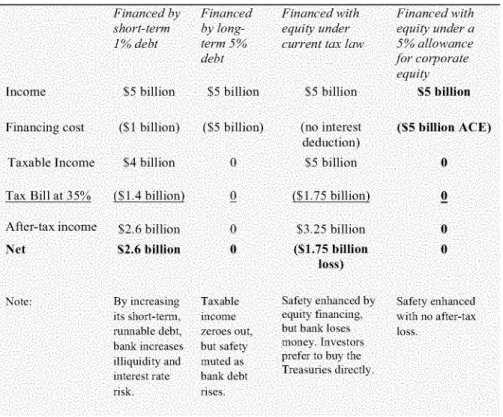
Distorted incentives deepen these problems. There is a double regulatory subsidy to bank debt (over bank equity): the first comes from the implicit too-big-to-fail guarantee on big banks' borrowings, a subsidy that waxes and wanes, depending on the strength of the economy and the anticipation of regulatory help for bank debt. This subsidy pushes banks to use more debt than equity, because creditors understand that in a crisis they will (usually) be paid at government expense, whereas shareholders' losses will (usually) be absorbed by the shareholders themselves. The second regulatory subsidy is the pervasive tax advantage of debt, due (in simplistic terms) to the deductibility of interest on debt and the nondeductibility of dividends on equity.
To illustrate verbally: Posit that banking regulators require banks to double their level of equity. If a bank's size stays the same, the bank would reduce its own borrowing concomitantly. But that bank borrowing would have been tax beneficial, with the interest paid deductible from the tax bill, while returns to the new equity will not be. The bank's tax bill would rise, making the new equity expensive. The Appendix shows how increased equity for Goldman Sachs along the lines and magnitude of respected safety proposals could devastate the bank's after-tax profits.
Given this double subsidy for debt, it is not surprising that banks see equity as costlier than debt.38 Increased equity should reduce the too-big-to-fail subsidy, by making banks less likely to fail. Moreover, the tax disparity itself can be ended-or even reversed to counterbalance any remaining too-big-to-fail subsidy. In this paper, we shall show how.
II. Taxing Banks Properly to Make Them Safer
In this Part, we show the basic tax bias toward debt embedded in today's tax code and then outline a simple, revenue-neutral way to reverse the bias. We consider mechanisms to right the balance: first, an economy-wide, but thus far unattainable, rebalancing of the taxation of all debt and equity. Next, and second, we consider a bank-specific end to the tax deductibility of bank-paid interest. It is the simplest fix conceptually and the most disruptive to implement. We then in the next Part develop our proposal: a targeted allowance for bank equity.
38. Bankers say more equity will raise banks' cost of funding, induce them to raise their lending rates, and then reduce overall economic growth. See The Cumulative Impact on the Global
Economy of Changes in the Financial Regulatory Framework, INT'L INST. FIN. 12 tbl.I.2. (Sept. 2011),
A. The Basic Pro-Debt Bias Stated
The basic tax bias toward debt arises from the American corporation now paying a thirty-five percent tax on its net profits. (This rate is scheduled to go to twenty-one percent, diminishing the effect, but maintaining the bulk of it.) Both banks and nonbanks alike pay this tax. The corporation deducts its interest expense on debt from its gross profits, but cannot deduct its costs for common equity, such as the dividends and capital gains that stockholders expect.3 9
Consider two operationally identical trillion-dollar firms, with one raising its funding only via equity, while the other raises its funding via significant borrowing. Both earn five percent, or $50 billion, from operations. At a thirty-five percent tax rate, the unlevered, all-equity firm pays thirty-thirty-five percent of $50 billion in taxes and has a $32.5 billion return to its owners. The first column of figures illustrates:
Table 1: Corporate Tax Impact in an All-Equity vs. a Highly-Leveraged Firm
All-equity firm Highly-leveraged firm
Earnings from operations: $50 billion $50 billion
Deductible interest: 0 (40 billion)
Income before corp. taxes: 50 billion 10 billion
Corporate income tax: (17.5 billion) (3.5 billion)
Income to shareholders: 32.5 billion 6.5 billion
Income to creditors: 0 40 billion
Total investor income: S32.5 billion S46.5 billion
The second firm borrows heavily to fund itself and pays $40 billion in interest, the deductibility of which lowers its tax bill. By paying taxes on the net income of $10 billion at a thirty-five percent tax rate, it returns $46.5 billion to its investors ($40 billion to its creditors and $6.5 billion to its stockholders, from $10 billion in pre-tax income, minus $3.5 billion in corporate income tax), yielding $14 billion more to its investors. Hence, unless this rather large difference of $14 billion is fully offset by the increased risk of failure, financial stress, or operational degradation, the total value to investors of the second, indebted firm will be much higher than that of the first firm. The second column of figures shows the higher after-tax returns to investors in the highly-leveraged firm.
39. Sven Langedijk, Gaetan Nicodeme, Andrea Pagano & Alessandro Rossi, Debt Bias
in Corporate Taxation and the Costs of Banking Crises in the EU (Eur. Comm'n Taxation Papers,
Working Paper No. 50-2014, 2014), http://ec.europa.eu/taxation customs/sites/taxation/files/resources /documents/taxation/gen info/economicanalysis/taxpapers/taxation-paper_50.pdf [http://perma.cc /AS77-2WZ4].
To emphasize this result (which is standard in financial analysis): the total value that these firms create for private investors comes from the sum of all monies returned to investors. The all-equity operation returns $14 billion less to its investors than does the leveraged firm. Ordinarily the leveraged firm would be worth much more to its total investor pool than the all-equity firm, solely due to the tax deductibility of interest paid.
One might mistakenly think that the investors in the leveraged firm have suffered compared to the investors in the all-equity firm. Stockholders of the highly-leveraged firm get $6.5 billion after taxes while the all-equity stockholders get $32.5 billion. But such a view is wrong because the leveraged firm needs, and would get, less investment from stockholders. The key feature is which firm can return more dollars to the totality of its investors. Clearly, it's the leveraged firm.
Tax aficionados know that this is not the whole story. While equity is costlier to the firm's tax bill, individuals are taxed more favorably on equity than on debt, via low tax rates on dividends and capital gains taxes. This tax advantage of equity for investors partially offsets its tax disadvantage at the firm level.40 Balancing out these pluses and minuses yields a mixed analytic, but the consensus is that when all factors are added up, the tax system is biased toward debt.4'
A firm will generally choose its debt level by trading off the positive and negative effects of leverage. If the tax savings from debt were not in the mix of trade-offs, then the chance of failure would weigh more strongly in the bank's mix of pluses and minuses. Everything else equal, the current corporate tax system pushes firms in general, and banks in particular, to take on more debt. If we fixed this bias, banks would take on less debt, would be more stable, and would drag the economy down in crisis less often and less severely.
B. Comprehensive Tax Reform or Bank-Specific Tax Reform?
This bias towards debt pervades the corporate economy. Proposals to even up the taxation of debt and equity throughout the economy have regularly been made but not enacted.42 Good reasons support a system-wide reform. By
40. The same principle reduces the investor-level tax disadvantage of debt. But while interest income is generally taxed to investors, debt held by untaxed entities is not. The earnings on debt instruments owned by tax exempt entities are never taxed, but the interest paid is still deducted from the issuer's tax bill. The issuer of equity, however, enjoys no tax deduction. "[T]he share of U.S. corporate stock held in taxable accounts fell more than two-thirds over the past 50 years, from 83.6 percent in 1965 to 24.2 percent in 2015." Steven M. Rosenthal & Lydia S. Austin, The Dwindling Taxable Share of U.S.
Corporate Stock, 151 TAX NOTES 923, 923 (2016).
41. RICHARD A. BREALEY, STEWART C. MYERS & FRANKLIN ALLEN, PRINCIPLES OF CORPORATE FINANCE 441-43 (11th ed. 2014); John R. Graham, How Big Are the Tax Benefits ofDebt?,
55 J. FIN. 1901 (2000).
42. E.g., U.S. DEP'T OF THE TREASURY, REPORT ON INTEGRATION OF INDIVIDUAL AND CORPORATE TAX SYSTEMS: TAXING BUSINESS INCOME (Jan. 1992).
encouraging nonbank operating firms to raise their outside capital more via debt than via equity, firms become more susceptible to financial stress and failure.
Hence, even industry-only interest-based tax reform should bolster
financial safety (and not just bolster industrial firm stability), by reducing the
general demand for debt and by making less risky that debt which would continue to exist.
This point deserves emphasizing. We focus on the tax incentives inside the financial institution to favor debt over equity. But the debt bias outside in the real economy raises outside demand for financial institutions to grow, lend, and finance themselves via debt. This artificially boosted demand for debt induces an artificially large debt-based financial sector. (The deductibility of interest on personal debt, such as on household mortgages, has the same systemically detrimental effect.) Fully fixing the corporate (and household) debt bias would shrink an unnaturally large financial intermediation sector.4 3 (And, analogously, the scheduled reduction in the corporate tax rate to twenty-one percent would reduce the nonfinancial sector's demand for debt, including bank debt. The financial sector should shrink somewhat, but to an uncertain degree.)
Moreover, the debt bias arises from the corporate tax. If the corporate tax were eliminated, the basic bias would disappear; when the corporate tax is reduced, the bias should be reduced. Proposals to reduce or eliminate the corporate tax have multiple pluses and minuses. One unstated plus is its positive impact on bank safety, by reducing industrial sector demand for debt as well as by reducing financial firms' demand for excessive debt in their capital structure. While we favor comprehensive reform, we do not pursue our analysis in that direction. First and foremost, no such full-scale debt-equity reform has yet proven politically viable.4 4 Second, comprehensive reform implicates issues beyond financial system safety, such as capital accumulation, industrial investment, and income distribution. Third, the most-developed tax reform for industry would devastate the financial industry and degrade systemic safety, as we analyze in Part IV, meaning that even comprehensive reform must treat finance and industry differently anyway.
C. Ending the Deductibility ofInterest for Banks
The most direct path to capital structure neutrality is to tax debt the way we tax equity, that is, to end the deductibility of interest. That would greatly expand
43. Shawn Donnan, Financial Sector in Advanced Economies Is Too Big, Says IMF,
FIN. TIMES (May 12, 2015), http://www.ft.com/content/4b70ee3a-f88c-11e4-8el6-00144feab7de [http://perma.cc/LXJ5-VLUG].
44. Most comprehensive corporate tax reforms would reduce the corporate incentive to retain cash, and doing so is not a goal that corporate leaders tend to support. See Jennifer Arlen & Deborah M. Weiss, A Political Theory of Corporate Taxation, 105 YALE L.J. 325 (1995). Below, we indicate the impact on banks' capital structure and size from the reduction in the corporate tax rate, enacted shortly before this article went to press. See infra Section VII.B.4.
the taxable base for banks. Hence, to avoid a big tax increase, the tax rate for the pre-interest income base would have to decrease substantially.
We add more structure to the prior financial statements to illustrate. Consider a trillion-dollar bank with the following capital structure and $50 billion in gross profit before interest:
Table 2: Trillion-dollar Bank's Balance Sheet and Traditional Tax Impact
Traditional bank balance sheet Loans & investments $1000B 1OOB bonds at 6%
100B short-term debt at 6%
700B deposits at 4%
100B equity
With a traditional corporate tax on profits after deducting interest, this balance sheet would produce an income statement like that in the right-hand column of Table 1. This is reproduced below, with more detail, on the left:
Table 3. Trillion-dollar Bank's Income Statements
Traditional bank's income statement, Traditional bank's income statement traditionally taxed with low corporate tax levied on
pre-interest profit 50B Gross operating profit (income 50B Gross operating profit
from loans & investments) (income from loans & investments)
(6B) Bond interest (0) 6B Bond interest:
(6B) Short-term interest (0) 6B Short-term interest
(28B) Deposit interest (0) 28B Deposit interest:
lOB Taxable profit 50B Taxable profit
(3.5B Corporate tax (3.B ) Ta\ of 70 on pre-interest
40.5B 1 Afler-t~tx pre-interest (401B) lInterest paid to creditors,
6.5B Net profit for shareholders, after 6.5B Net profit for stockholders,
interest expenses and taxes after interest expenses and taxes
This table compares two banks' income statements. The first bank, on the left, has $40 billion in interest expenses on deposits and debt. It pays tax at a 35% rate on the net profit of $10 billion after deducting interest from its gross profits. The second pays its tax on pre-interest gross income of $50 million at a lower 7% rate. The first returns $46.5 billion to its investors, as does the second. The traditionally-taxed bank on the left pays tax on $10 billion in profits, from operating income of $50 billion, minus $40 billion in interest expense. The bank's net profit of $10 billion is taxed at the longstanding thirty-five percent corporate income tax rate, yielding the tax authorities $3.5 billion.
Note that in addition to the bank's deposits and short-term borrowings, the bank borrows $200 billion from capital markets. When it raises capital via debt, it shields operating income from tax, because the return to that capital is deductible from its gross income.
The right-hand income statement shows that the Internal Revenue Service can obtain that same $3.5 billion from this bank by taxing its gross operating profit of $50 billion, instead of taxing the bank's net profit of $10 billion. To yield the tax authorities the same $3.5 billion, the tax rate on the gross operating income of $50 billion would be only 7%.
This reform idea begins with several strengths. It is simple and easy to understand: the tax impact would become independent of interest expense and the bank's leverage. So management and the bank's creditors would not choose debt levels with the tax bill in mind. It also leads to a low tax rate and comports with basic preferences for American taxation, namely, to widen the tax base and lower the tax rate.45 If policymakers wish not to levy the tax on insured deposits, they need not. If $20 billion of the $28 billion deposit interest went to insured deposits, then the tax would be levied on $30 billion; the tax rate would be eleven and two-thirds percent of $30 billion (of profit, before deposit interest), not seven
46
percent of $50 billion. Most importantly, it would encourage banks, as compared to the current tax structure, to substitute away from debt and into systemically safer equity.
However, ending the deduction for interest for banks has major drawbacks. First, it will tax them even if their net profit is zero or if they run a loss. This drawback could be ignored, because banks running losses are systemically wounded, are risky to the economy, and should shrink further. Alternatively, one could exempt a net-loss bank.
The second major drawback is that the bank's tax would vary with the level of interest rates. When interest rates increase, banks' interest income rises, but so does their interest cost. And the tax bill would decline when interest rates declined. For a traditional corporate tax, a rising deduction offsets rising interest income. But, a tax only on the "top-line" gross income, with no offsetting deduction for its interest expense, would balloon when interest rates rise. Some mechanism for indexing, perhaps to the inflation rate, would be needed.
45. Stephen E. Shay, Senior Lecturer, Harv. Law Sch., Presentation at the EC-IMF Conference on Corporate Debt Bias: U.S. Experience with Interest Deductibility Restrictions 32 (Feb. 23-24, 2015), http://studylib.net/doc/9425959/u.s.-experience-with-interest-deductibility-restrictions [http://perma.cc/XZA7-BUGN] (applying the concept to interest deduction and ACE). On broadening the base and cutting the rate, see The President's Framework for Business Tax Reform: A Joint Report by the
White House and the Department of the Treasury, U.S. DEP'T TREASURY 1-2 (2012), http://www.treasury.gov/resource-center/tax-policy/tax-analysis/Documents/OTA-Report-Business-Tax-Reform-2012.pdf [http://perma.cc/Z836-NJDE].
46. A corporate tax at a 3 5% on $10 billion of traditional, after-interest profit yields a
tax bill of $3.5 billion. A tax of 7% on pre-interest income of $50 billion also yields a tax bill of $3.5 billion. A tax of 112/3% on $30 billion of income after deducting only deposit interest paid yields a tax bill of $3.5 billion.
Third, ending the deduction may push the newly disfavored debt from the sector whose tax is reconfigured to elsewhere in the economy. If that elsewhere is systemically safer, this shift is a benefit; if riskier, it is not. Accordingly, the specific sorts of debt that would be targeted would need to be thought out.
Hence, while the no-deduction-for-interest solution has conceptual simplicity in its favor, much work would be needed to make it viable in practice.
III.The Proposal: A Targeted Deduction for Non-Regulatory Bank Equity
Comprehensive corporate tax reform, while desirable, has been unattainable. Ending the deductibility of interest has conceptual simplicity in its favor and difficulty in implementation as a weakness. We now come to our general conceptual proposal: an allowance to the bank, allowing it to deduct the cost of equity.
A. Deducting the Cost ofBank Equity
The concept, although less intuitive than the other evening-up solutions, is quite promising: treat equity similarly to debt for tax purposes, by according the bank an interest-like deduction for the cost of its equity. Conceptually, the firm "rents" debt for its operations and also "rents" equity. Both rental payments are costs to the firm.
Financial-oriented readers may think of firms paying up for their "cost of capital" and that intuition accords well with this tax idea, an allowance for corporate equity (or ACE): Equity capital, like debt capital, has a cost. Under traditional corporate taxation, equity's cost is not deductible; with an ACE, it would be.47
To be sure, our proposal does not depend on precisely calculating the actual cost of equity. Thus a purist might object. Our proposal is, instead, instrumental, designed to induce the banks to capitalize with more equity and less debt, with the net impact on tax revenue from the financial sector approximately neutral. Moreover, the ACE does not allow banks to deduct dividends paid (which is the
47. The ACE idea was introduced almost simultaneously in Ekkehard Wenger, Gleichmaj3igkeit der Besteuerung von Arbeits- und Vermagenseinkiinfiten, FINANZARCHIV [PUBLIC FIN.
ANALYSIS] 207 (1983), and in Robin Boadway & Neil Bruce, A General Proposition on the Design of a Neutral Business Tax, 24 J. PUB. ECON. 231 (1984), then developed in Equity for Companies: A
Corporation Tax for the 1990s, IFS CAP. TAXES GRP. (1991), http://www.ifs.org.uk/comms/comm26.pdf [http://perma.cc/D77R-M8U3], and most recently analyzed in the Mirrlees Review, see DIMENSIONS OF TAX DESIGN (Stuart Adam et al. eds., 2010) [hereinafter Mirrlees Review]. For further analysis, see Alvin
C. Warren, The Business Enterprise Income Tax: A First Appraisal, 118 TAX NOTES 921, 921-26 (2008);
Alvin C. Warren, Corporate Cash-Flow Tax Bases (Sept. 24, 2015) (unpublished manuscript) (on file with author); cf Michael J. Graetz & Alvin C. Warren, Integration of Corporate and Shareholder Taxes (SSRN
favored reform to remedy the debt-equity imbalance)-a distinction that is a 48 quite important strength of ACE for banks, as we shall discuss further below.
The ACE tax system was developed to reduce investment and financing distortions in nonfinancial corporations and was not intended for financial institutions.49 However, the ACE concept can be repurposed for taxation of financial institutions to reverse the tax subsidy to debt.
Mechanically, in most ACE renditions, the deduction for equity is calculated by multiplying the book value of equity by a formulaic rate of interest
tied to market rates. The following financial statement illustrates a
straightforward six percent allowance for corporate equity for the running example of our trillion-dollar bank. The allowance for the cost of the bank's equity gives the banks a $6 billion deduction for the cost of the bank's $100 billion of equity, which it deducts from its gross operating income alongside its interest expense. By allowing that $6 billion deduction for the cost of equity, the bank then has $4 billion of taxable profits, instead of the original $10 billion.
We apply an ACE in our running example, in the next illustration. The ACE structure is as leverage-neutral as the prior possibility of taxing only pre-interest operating income, as long as the interest rate on the bank's debt is the same as percentage equity allowance. (If the interest rate is eight percent but the allowance is only six percent, then the traditional corporate tax retains a small advantage; conversely, if the ACE rate is higher than the interest rate, equity becomes more attractive after taxes than debt.) When the two (the interest rate and the equity allowance) are equal, then, if the bank decided to increase its equity and decrease its long-term debt, its overall tax bill would not change, because the bank would replace deductible debt with newly-deductible equity. Tax would no longer motivate capital structure. However, the total tax bill diminishes the proposal is not yet revenue-neutral.
These two income statements for the traditional bank compare results with and without an allowance for corporate equity. The ACE is calculated as some function of the long-term U.S. Treasury rates, resulting in a six percent number here. The book value of equity is accorded a deduction of six percent, or $6 billion. This should make the bank tax-indifferent to debt at 6% or new equity, but the capital structure of the trillion-dollar bank remains unchanged here, even after the ACE is introduced. And the tax bill with the ACE is about $2 billion less than without it; this example's structure is not revenue neutral.
48. As we have alluded before, a deduction for dividends-paid-the reigning reform idea would devastate the financial system, by encouraging banks to pay out cash to get the tax deduction.
See infra Section IV.C.
49. Setting Savings Free: Proposals for the Taxation ofSavings and Profits, INST. FOR FISCAL STUD. 31 (1994) (unpublished report), http://www.ifs.org.uk/comms/r44.pdf [http://perma.cc /23RZ-6K5U].
Table 4: ACE for traditional bank
Traditional bank's income statement, Income Statement with a 6% Allowance traditionally taxed for the Cost of Corporate Equity, on
$100 B of equity
50B Gross operating profit 50B Gross operating profit (income from loans & (income from loans &
investments) investments)
(6B) Bond interest (6B) Bond interest
(6B) Short-term interest (6B) Short-term interest
(28B) Deposit interest (28B) Deposit interest
10B Taxable profit 10B Basic pre-tax profit
(6Bi) ACE 167 0 ofthec
4B Taxable profit
(3.5B) Corporate tax (1.4B Corporate tax
6.5B Net profit 8.6B Net profit
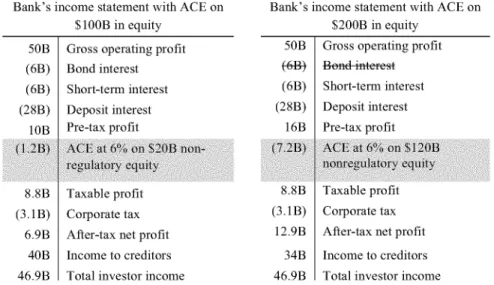
A more realistic rendition would have equity, made relatively cheaper as compared to debt, increasing while debt, made relatively more expensive, decreasing. The following example shows how, once an ACE structure is in place, the bank would not be penalized by increased taxation if it raised its equity to $200 billion from $100 billion, by replacing $100 billion of old debt with new equity. Profit increases overall, because shareholders would have more capital in the bank, while the overall payout to all investors (stockholders and creditors, together) remains constant. Again, tax would no longer motivate the firm's choice of capital structure.
We introduce dynamism next. When the bank's debt matures in the prior example with the ACE in place, it is tax-indifferent to rolling over the debt into more debt and replacing the old debt with equity. Here it replaces the old debt with new equity, thereby doubling its equity from ten percent of its trillion-dollars in total value to twenty percent. The bank loses the $6 billion deduction for interest paid to the debt that is not rolled over, but requires that deduction via the allowance for corporate equity for the newly increased equity, which makes the bank more stable. The two structures are tax-revenue-neutral as between the ACE with no equity increase and ACE with a major increase in equity. But neither is revenue neutral when compared to the current system. Both reduce the bank's tax bill.